
Life, 1920-09-30 · page 12 of 40
Life — September 30, 1920 — page 12: what you’re looking at
What you’re looking at
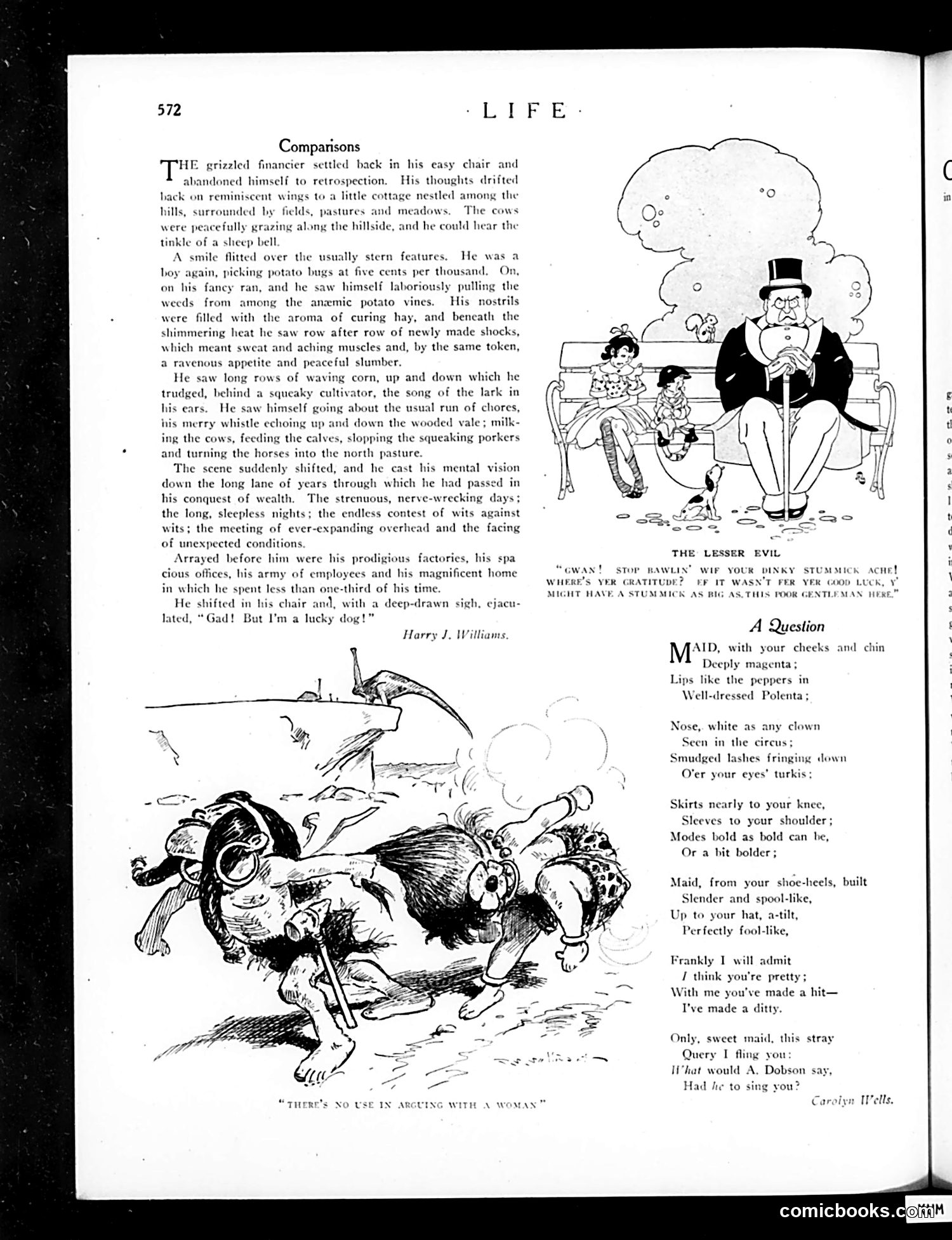
This page contains two distinct cartoons satirizing gender relations in early 20th-century America. **"The Lesser Evil"** (top right) depicts a rotund gentleman with two children, lecturing about the virtues of fatherhood versus marriage troubles. The caption suggests men preferred dealing with misbehaving children to dealing with difficult wives—a common domestic complaint of the era. **"There's No Use in Arguing With a Woman"** (bottom) shows chaotic figures in violent disagreement, the caption mocking the futility of logical debate with women. Both cartoons reflect period attitudes portraying women as unreasonable or problematic. The separate poem "A Question" sarcastically describes an idealized "maid" as foolish yet pretty—reinforcing stereotypes of feminine superficiality that contemporary satire frequently deployed.
📄 Transcribed text from this page (OCR, searchable)
Machine-transcribed from the original scan — historical spelling and the odd misread are preserved.
572 ~-LIFE- Comparisons HE grizzled financier settled back in his easy chair and His thought hack on reminiscent wings to a little cottage nestled amon abandoned himself to retrospection. hills, surrounded by fields, pastures and meadows. The cows were peacefully grazing along the hillside, and he could hear the tinkle of a sheep bell A smile flitted over the usually stern features. boy again, picking potato bugs at five cents per thousand. On, on his fancy He was a ran, and he saw himself laboriously pulling the weeds from among the anemic potato vines. His nostrils were filled with the aroma of curing hay, and beneath the shimmering heat he saw row after row of newly made shocks, muscles and, by the same token, ful slumber, which meant sweat and achin a ravenous appetite and pea He saw long rows of waving corn, up and down which he trudged, behind a squeaky cultivator, the song of the lark in his ears. He saw himself going about the usual run of chores, his merry whistle echoing up and down the wooded vale ; milk- ing the cows, feeding the calves, slopping the squeaking porkers and turning the horses into the north pasture. The scene suddenly shifted, and he cast his mental vision down the long lane of years through which he had passed in his conquest of wealth. The strenuous, nerve-wrecking days; the long, sleepless nights; wits; the meeting of ever-expanding overhead and the facing of unexpected conditions. the endless contest of wits a Arrayed before him were his prodigious factories, his spa cious offices, his army of employees and his magnificent home in which he spent less than one-third of his time. He shifted in his chair and, with a dee lated, “Gad! But I'm a lucky dog!” awn sigh, ejacu- Harry J. Williams. THE LESSER EVIL "GWAN! STOP BAWLIN’ WIF YOUR DINKY STUMMICK acne! WHERE’S YER GRATITUDE? FF IT WASN'T FER YER GOOD LUCK, Y" MIGHT HAVE A STUMMICK AS BIG AS. THIS POOR GENTLEMAN HERE.” A Question AID, with your cheeks and chin Deeply magenta ; Lips like the peppers in Well-dressed_ Polenta ; Nose, white as any clown en in the circus; Smudged lashes fringiv O'er your eyes’ turkis: Skirts nearly to your knee, Sleeves to your shoulder; Modes bold as bold can be, Or a bit bolder; Maid, from your shoe-heels, built Slender and spool-like, Up to your hat, a-tilt, Perfectly fool-like, Frankly I will admit I think you're pretty; With me you've made a hit— I've made a ditty, Only, sweet maid, this stray Query I fling you Iihat would A, Dobson say, Had hie to sing you? Carolyn Wells, comicbooks.comiy)