
Life, 1920-09-30 · page 30 of 40
Life — September 30, 1920 — page 30: what you’re looking at
What you’re looking at
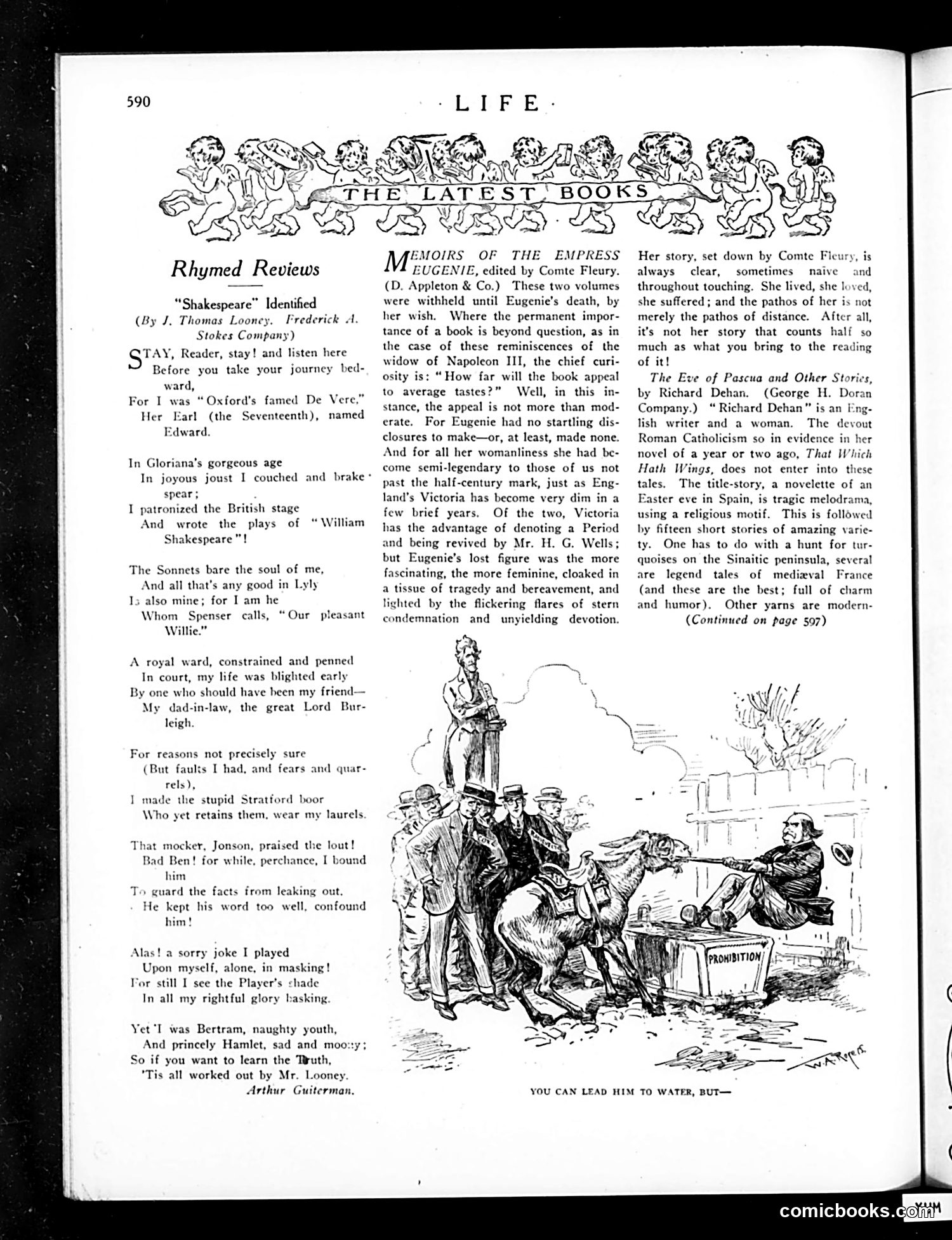
This page satirizes the "Shakespeare Authorship Question"—specifically J. Thomas Looney's 1920 theory that Edward de Vere, 17th Earl of Oxford, actually wrote Shakespeare's plays, not the "Stratford boor" William Shakespeare. The poem, attributed to Arthur Guiterman, mocks this theory by having "Oxford" confess he secretly authored all Shakespeare's work but let an illiterate actor take credit. The satire is sharp: Oxford complains he made "the stupid Stratford boor" famous while remaining anonymous, even fooling Ben Jonson into praising the impostor. The cartoon below (captioned "YOU CAN LEAD HIM TO WATER, BUT—") shows a donkey labeled "Prohibition" being led to water by men in formal dress—likely mocking Prohibition enforcement efforts as futile, suggesting you can't force compliance on an unwilling subject. The page primarily reviews recent books about Napoleon's widow Eugenie and stories by "Richard Dehan."
📄 Transcribed text from this page (OCR, searchable)
Machine-transcribed from the original scan — historical spelling and the odd misread are preserved.
Rhymed Re “Shakespeare” Identified (By J. Thomas Looney, Frederick A. Stokes Company) TAY, Reader, stay! and listen here Before you take your journey bed- ward, For I was “Oxford's famed De Vere.” Earl (the Seventeenth), named Edward. Her In Gloriana’s gorgeous age In joyous joust I couched and brake * spear; I patronized the British stage And wrote the plays of Shakespeare"! “William The Sonnets bare the soul of me, And all that’s any good in Lyly 13 also mine; for I am he Whom Spenser calls, Willie.” “Our pleasant A royal ward, constrained and penned In court, my life was blighted early By one who should have been my friend— My dad-in-law, the great Lord Bur- leigh. For reasons not precisely sure (But faults I had, and fears and quar- rels), 1 made the stupid Stratford boor Who yet retains them, wear my laurels. That mocker, Jonson, praised the lout! Bad Ben! for while, perchance, I bound him To guard the facts from leaking out. He kept his word too well, confound him! Alas! a sorry joke I played Upon myself, alone, in masking! For still I see the Player’s shade In all my rightful glory basking Yet ‘I was Bertram, naughty youth, And princely Hamlet, sad and moo::y; So if you want to learn the Truth, 'Tis all worked out by Mr. Looney. Arthur Guiterman, EMOIRS OF THE EMPRESS /GENIE, edited by Comte Fleury. (D. Appleton & Co.) These two volumes were withheld until Eugenie’s death, b her wish. Where the permanent impor- tance of a book is beyond question, as in the case of these reminiscences of the widow of Napoleon III, the chief curi- osity is: “How far will the book appeal to average tastes?” Well, in this in- stance, the appeal is not more than mod- erate. For Eugenie had no startling dis- closures to make—or, at least, made none. And for all her womanliness she had be- come semi-legendary to those of us not past the half-century mark, just as Eng- land’s Victoria has become very dim in a few brief years. Of the two, Victoria has the advantage of denoting a Period and being revived by Mr. H. G. Wells; but Eugenie’s lost figure was the more fascinating, the more feminine, cloaked in a tissue of tragedy and bereavement, and lighted by the flickering flares of stern condemnation and unyielding devotion. Her story, set down by Comte F . is always clear, sometimes naive and throughout touching. She lived, she loved, she suffered; and the pathos of her is not merely the pathos of distance. After all, it’s not her story that counts half so much as what you bring to the reading of it! The Eve of Pascua and Other Stories, by Richard Dehan. (George H. Doran Company.) “Richard Dehan” is an Eng- lish writer and a woman. The devout Roman Catholicism so in evidence in her novel of a year or two ago, That Which Hath Wings, does not enter into these tales. The title-story, a novelette of an Easter eve in Spain, is tragic melodrama, using a religious motif. This is followed by fifteen short stories of amazing varie- ty. One has to do with a hunt for tur- quoises on the Sinaitic peninsula, several are legend tales of medieval France (and these are the best; full of charm and humor), Other yarns are modern- (Continued on page 597) YOU CAN LEAD HIM TO WATER, BUT— comicbooks.