
Life, 1920-09-30 · page 27 of 40
Life — September 30, 1920 — page 27: what you’re looking at
What you’re looking at
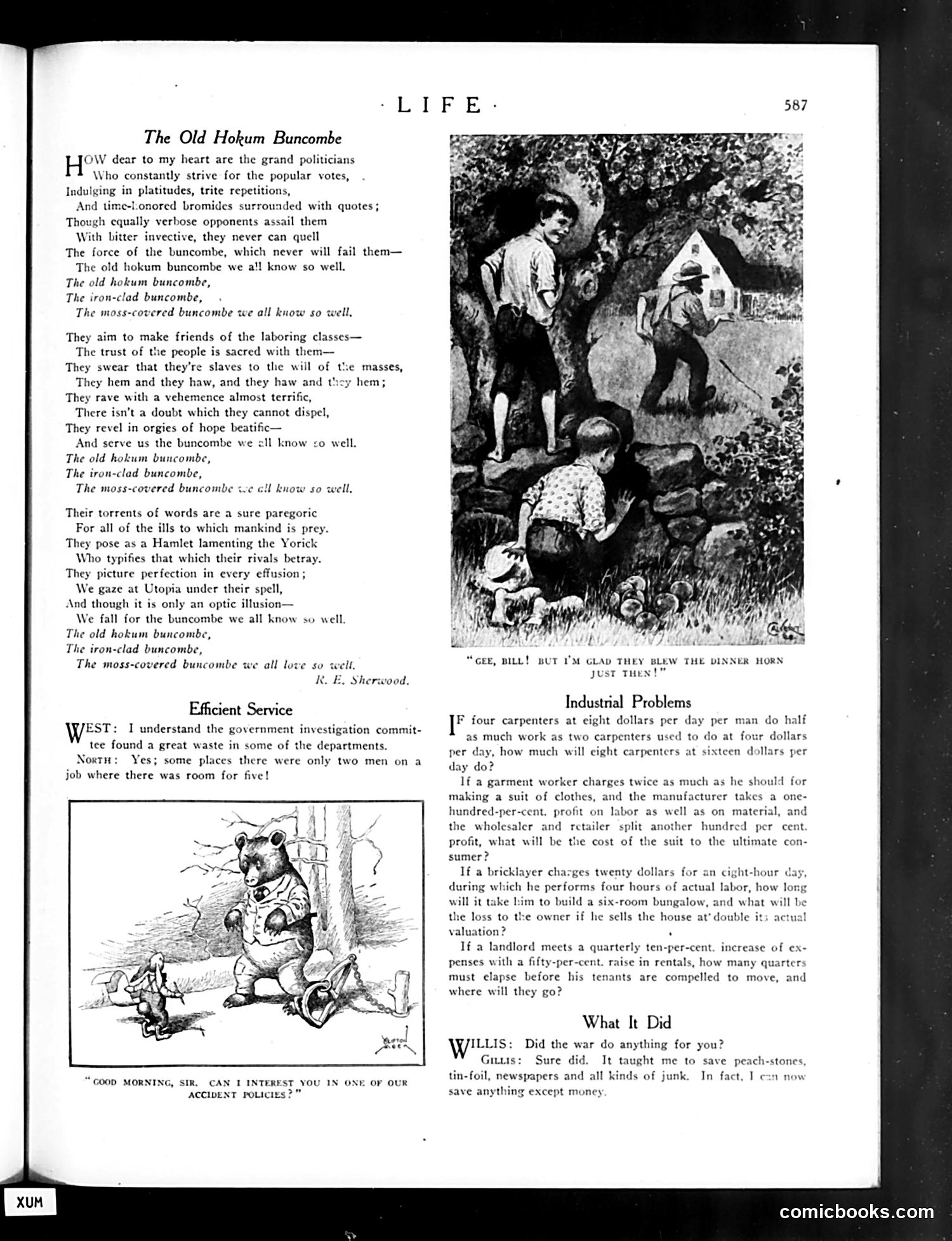
This page satirizes **American politicians and political rhetoric** through a song-poem by K.E. Sherwood. The satire targets politicians who win votes through empty promises and worn-out rhetoric ("buncombe"—meaning nonsense or deceptive talk). The poem mocks politicians who claim to champion working people while delivering only flowery speeches, theatrical emotion ("pose as a Hamlet"), and false visions of utopia. The repeated refrain emphasizes how voters knowingly accept this "buncombe" anyway. The accompanying cartoons reinforce the theme: one shows a bear (likely Uncle Sam or government) representing bureaucratic inefficiency, another depicts insurance salesmanship. The "Industrial Problems" section uses math word problems to expose economic exploitation—workers and manufacturers inflating costs at each level. The final "What It Did" joke suggests the war (likely WWI) taught people only to save junk, not money—implying widespread economic hardship despite wartime sacrifice. Overall, the page critiques political dishonesty and economic inequality in early 20th-century America.
📄 Transcribed text from this page (OCR, searchable)
Machine-transcribed from the original scan — historical spelling and the odd misread are preserved.
The Old Hokum Buncombe OW dear to my heart are the grand politicians Who constantly strive for the popular votes, Indulging in platitudes, trite repetitions, And time-l.onored bromides surrounded with quotes ; Though equally verbose opponents assail them With bitter invective, they never can quell The force of the buncombe, which never will fail them— The old hokum buncombe we a!! know so well. The old hokum buncombe, The iron-clad buncombe, The moss-covered buncombe we all know so well. They aim to make friends of the laboring classes— The trust of the people is sacred with them— They swear that they're slaves to the will of the They hem and they haw, and they haw and they hem; They rave with a vehemence almost terrific, There isn’t a doubt which they cannot dispel, They revel in orgies of hope beatific— And serve us the buncombe we cll know co well. The old hokum buncombe, The iron-clad buncombe, The moss-covered buncombe we cll know so well. masses, Their torrents of words are a sure paregoric For all of the ills to which mankind is prey. They pose as a Hamlet lamenting the Yorick Who typifies that which their rivals betray. They picture perfection in every effusion ; We gaze at Utopia under their spell, And though it is only an optic illusion— We fall for the buncombe we all know so well. The old hokum buncombe, The iron-clad buncombe, The moss-covered buncombe we all love so well. K. E, Sherwood. Efficient Service EST: I understand the government investigation commit- tee found a great waste in some of the departments. Noxtu: Yes; some places there were only two men on a job where there was room for five! “GOOD MORNING, SIR, CAN I INTEREST YOU IN ONE OF OUR ACCIDENT PoLicis?” “GEE, BILL! BUT I'M GLAD THEY BLEW THE DINNER HORN just THEN!" Industrial Problems F four carpenters at eight dollars per day per n do half as much work as two carpenters used to do at four dollars per day, how much will eight carpenters at sixteen dollars per y do? If a garment worker charges twice as much as he should for making a suit of clothes, and the manufacturer takes a one- hundred-per-cent. profit on labor as well as on material, and the wholesaler and retailer split another hundred per cent profit, what will be the cost of the suit to the ultimate con- sumer? If a bricklayer charges twenty dollars for an cight-hour during which he performs four hours of actual labor, how long will it take him to build a six-room bungalow, and what will be the loss to the owner if he sells the house at’ double its actual valuation? . If a landlord meets a quarterly ten-per-cent. increase of ex- penses with a fifty-per-cent. raise in rentals, how many quarters must elapse before his tenants are compelled to move, and where will they go? What It Did ILLIS: Did the war do anything for you? Guus: Sure did. It taught me to save peach-stones, tin-foil, newspapers and all kinds of junk. In fact, 1 c2n now save anything except money comicbooks.com