
Life, 1920-09-30 · page 22 of 40
Life — September 30, 1920 — page 22: what you’re looking at
What you’re looking at
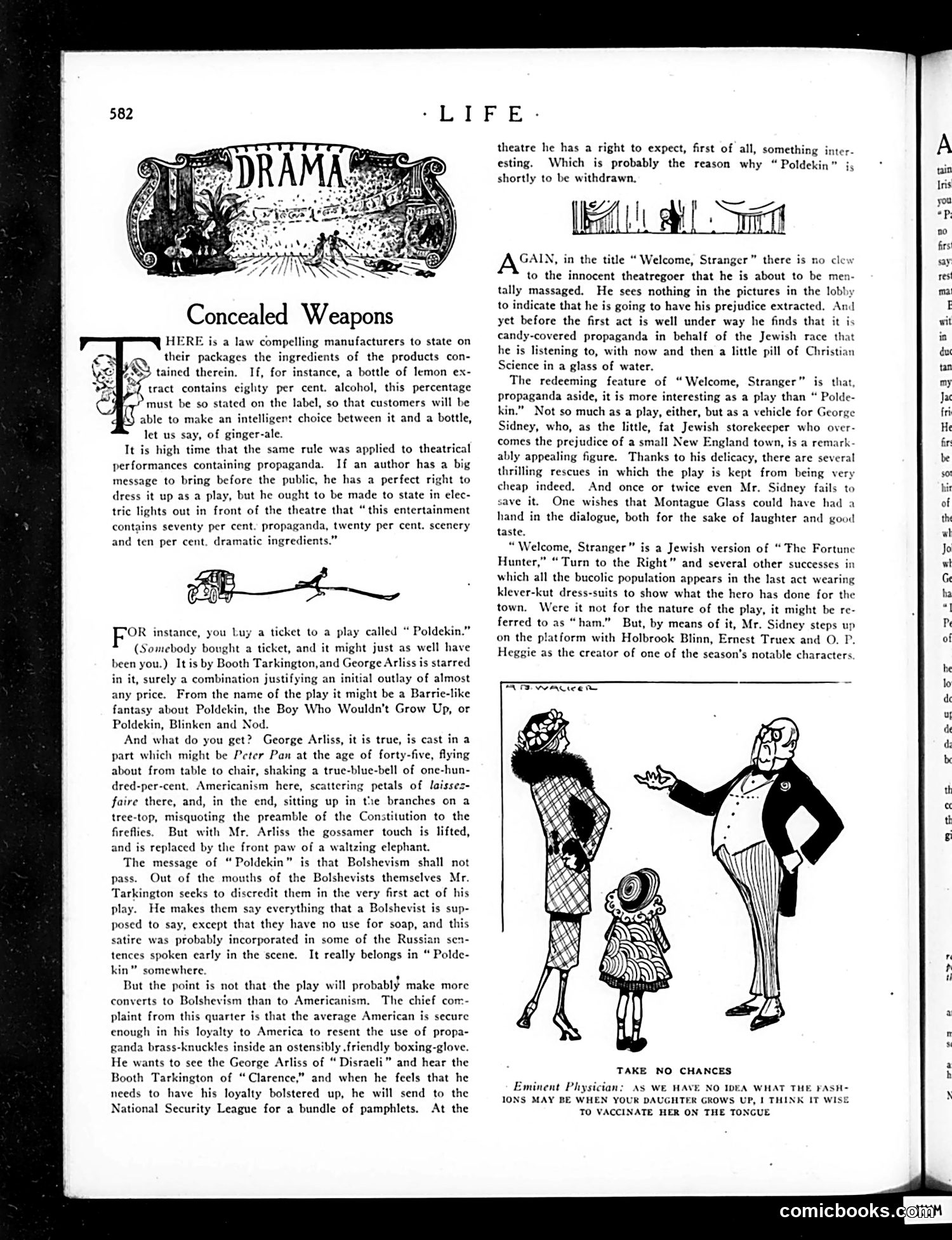
This article attacks plays that disguise political messaging as entertainment. The author argues that just as consumer products must list ingredients, theatrical performances containing propaganda should display warnings. The main target is **"Poldekin,"** a play by Booth Tarkington starring actor George Arliss. The satire criticizes the play for wrapping anti-Bolshevik propaganda in entertainment—using a whimsical fantasy premise to deliver political messaging against communism. The author argues that while Americans are secure enough in their loyalty to not need such "brass-knuckles" tactics, audiences resent being manipulated into political positions under the guise of drama. A secondary example, **"Welcome, Stranger,"** similarly uses entertainment to promote Jewish interests and Christian Science doctrine—described as "candy-covered propaganda." The cartoon (bottom right, captioned "Take No Chances") appears to mock the deceptive nature of such theatrical manipulation, though details are unclear from the image alone. The satire's core point: entertainment should entertain first; politics should be transparent, not hidden.
📄 Transcribed text from this page (OCR, searchable)
Machine-transcribed from the original scan — historical spelling and the odd misread are preserved.
-LIFE. Concealed Weapons HERE is a law compelling manufacturers to state on their packages the ingredients of the products con- tained therein. If, for instance, a bottle of lemon ex- tract contains eighty per cent. alcohol, this percentage must be so stated on the label, so that customers will be able to make an intelligent choice between it and a bottle, let us say, of ginger-ale. It is high time that the same rule was applied to theatrical performances containing propaganda. If an author has a big message to bring before the public, he has a perfect ht to dress it up as a play, but he ought to be made to state in elec- tric lights out in front of the theatre that “this entertainment contains seventy per cent. propaganda, twenty per cent. scenery and ten per cent. dramatic ingredient fe _t—_ ‘OR instance, you Luy a ticket to a play called “ Poldekin.” (Somebody bought a ticket, and it might just as well have been you.) It is by Booth Tarkington,and George Arliss is starred in it, surely a combination justifying an initial outlay of almost any price. From the name of the play it might be a Barrie-like fantasy about Poldekin, the Boy Who Wouldn't Grow Up, or Poldekin, Blinken and Nod. And what do you get? George Arliss, it is true, is cast in a part which might be Peter Pan at the age of forty-five, flying about from table to chair, shaking a true-blue-bell of one-hun- dred-per-cent. Americanism here, scattering petals of laissez- faire there, and, in the end, sitting up in the branches on a tree-top, misquoting the preamble of the Constitution to the fireflies. But with Mr. Arliss the gossamer touch is lifted, and is replaced by the front paw of a waltzing elephant. The message of “ Poldekin” is that Bolshevism shall not pass. Out of the mouths of the Bolshevists themselves Mr. Tarkington seeks to discredit them in the very first act of his play. He makes them say everything that a Bolshevist is sup- posed to say, except that they have no use for soap, and this satire was probably incorporated in some of the Russian sen- tences spoken early in the scene. It really belongs in “ Polde- kin” somewhere. ; But the point is not that the play will probably make more converts to Bolshevism than to Americanism. The chief com- plaint from this quarter is that the average American is secure enough in his loyalty to America to resent the use of propa- ganda brass-knuckles inside an ostensibly friendly boxing-glove. He wants to see the George Arliss of “ Disraeli” and hear the Booth Tarkington of “Clarence,” and when he feels that he needs to have his loyalty bolstered up, he will send to the National Security League for a bundle of pamphlets. At the theatre he has a right to expect, first of all, something inter- esting. Which is probably the reason why “ Poldekin” j shortly to be withdrawn. Z AIN, in the title “ Welcome, Stranger” there is no clew to the innocent theatregoer that he is about to be men tally massaged. He sees nothing in the pictures in the lob! to indicate that he is going to have his prejudice extracted, An yet before the first act is well under way he finds that it is candy-covered propaganda in behalf of the Jewish race that he is listening to, with now and then a little pill of Chris Science in a glass of water. The redeeming feature of “Welcome, Stranger” is that, propaganda aside, it is more interesting as a play than “ Polde- kin.” Not so much as a play, either, but as a vehicle for Georg: Sidney, who, as the little, fat Jewish storekeeper who over- comes the prejudice of a small New England town, is a remark- ably appealing figure. Thanks to his delicacy, there are several thrilling rescues in which the play is kept from being very cheap indeed. And once or twice even Mr. Sidney fails to save it. One wishes that Montague Glass could have had a hand in the dialogue, both for the sake of laughter and good taste. “Welcome, Stranger” is a Jewish version of “The Fortune Hunter,” “Turn to the Right” and several other successes in which all the bucolic population appears in the last act wearing klever-kut dress-suits to show what the hero has done for the town. Were it not for the nature of the play, it might be re- ferred to as “ham.” But, by means of it, Mr. Sidney steps up on the platform with Holbrook Blinn, Ernest Truex and O. P. Heggie as the creator of one of the season's notable characters. IS WARE IN WHAT THE FASH S MAY BE WHEN YOUR DAUGHTER GROWS UP, I THINK IT WI TO VACCINATE HER ON THE TONGUE comicbooks.