
Life, 1920-09-30 · page 28 of 40
Life — September 30, 1920 — page 28: what you’re looking at
What you’re looking at
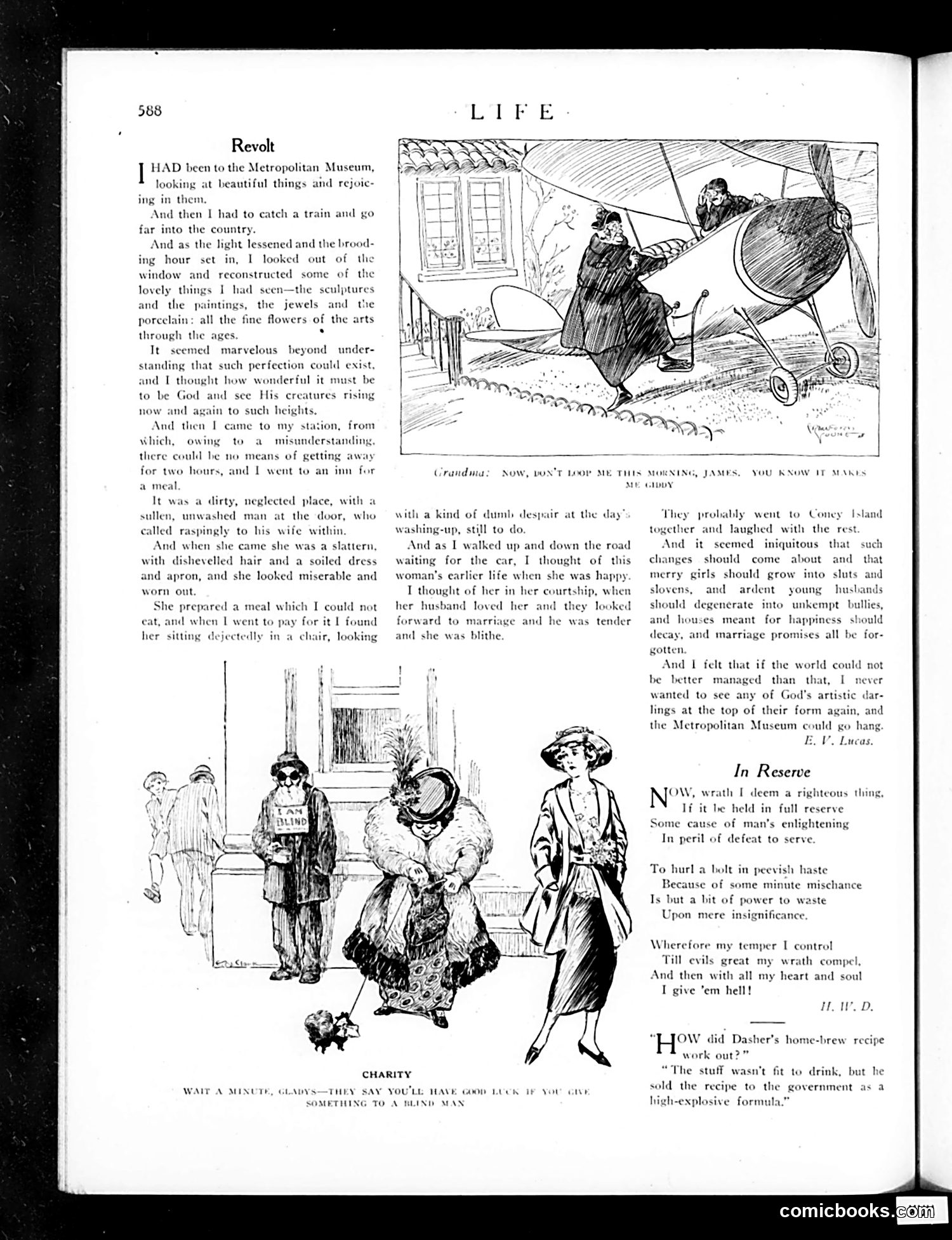
This page contains two distinct pieces satirizing social inequality: **"Revolt"** (main narrative with illustrations): The author contrasts visiting the Metropolitan Museum—appreciating humanity's artistic achievements—with a depressing train-station inn encounter. He meets a slovenly innkeeper couple, and reflects that the cheerful young woman this wife once was has deteriorated into an exhausted drudge. The satire critiques how marriage and poverty transform people, suggesting society is "better managed" if we ignore God's beautiful creations altogether rather than witness their degradation. It's social commentary on class, marriage, and wasted human potential. **"Charity"** (street scene cartoon): Shows well-dressed people approaching a beggar, with the caption suggesting superstitious charity ("good luck if you give something to a blind man"). The satire mocks superficial, self-interested charity—helping the poor not from genuine compassion but from superstition or desire for personal benefit. Both pieces critique indifference to human suffering and question whether civilization's "progress" means anything when ordinary people live in misery.
📄 Transcribed text from this page (OCR, searchable)
Machine-transcribed from the original scan — historical spelling and the odd misread are preserved.
Revolt HAD been to the Metropolitan Museum, looking at beautiful things and rejoic- ing in them, And then I had to catch a train and go far into the country. And as the light lessened and the brood- ing hour set in, I looked out of the window and reconstructed some of the lovely things I had seen—the sculptures and the paintings, the jewels and the porcelain: all the fine flowers of the arts . through the ages. under- dl exist, and [ thought how wonderful it must be to be God now and a It seemed marvelous beyond standing that such perfection ¢ do see His creatures rising nin to such heights. And then I came to my station, from Mhich, owing to a misunderstandir there could be no means of getting away for two hours, and I went to an inn for a meal. with a sullen, unwashed man at the door, who It was a dirty, neglected place, called raspingly to his wife within. And when she came she was a slattern, with dishevelled hair and a soiled dress and apron, and she looked miserable and worn out. She prepared a meal which I could not eat, and when | went to pay for it 1 found her sitting dejectedly in a chair, looking Crandma: NOW, DON'T LOOP ME THIS MOKNING, JAMES YoU KNOW IT MAKES Me GIDDY with a kind of dumb despair at the day” washing-up, still to do. And as I walked up and down the road waiting for the car, I thought of this woman's earlier life when she was happy I thought of her in her courtship, when her husband loved her and they looked forward to marriage and he was tender and she was blithe. CHARITY WAIT A MINUTE, GLADYS: THEY SAY YOU'LE HAVE GooD LUCK IF V0 SOMETHING TOA BLIND MAN They probably went to Coney Island together and laughed with the rest And it changes scemed iniquitous that such that merry girls should grow into sluts and and ardent should come about and slovens, young —husbai should te into unkempt bullies, and houses meant for happiness should decay, and marriage promises all be for- gotten ene! And I felt that if the world could not be better managed than that, [never wanted to see any of God's artistic dar- lings at the top of their form again, and the Metropolitan Museum could go hang. ELV. Lucas. In Reserve N' IW, wrath [ deem a righteous thing, If it be held in full reserve Some cause of man’s enlightening In peril of defeat to serve To hurl a bolt in pi Because of some minute mischance vish haste Is but a hit of power to waste Upon mere insignificance. Wherefore my temper I control Till evils great my wrath compel, And then with all my heart and soul I give 'em hell! HW. De “LJOW did Dasher’s home-brew recipe work out?” “The stuff wasn't fit to drink, but he sold the recipe to the government as a high-explosive formula.” comicbooks. Sona