
Life, 1920-09-30 · page 14 of 40
Life — September 30, 1920 — page 14: what you’re looking at
What you’re looking at
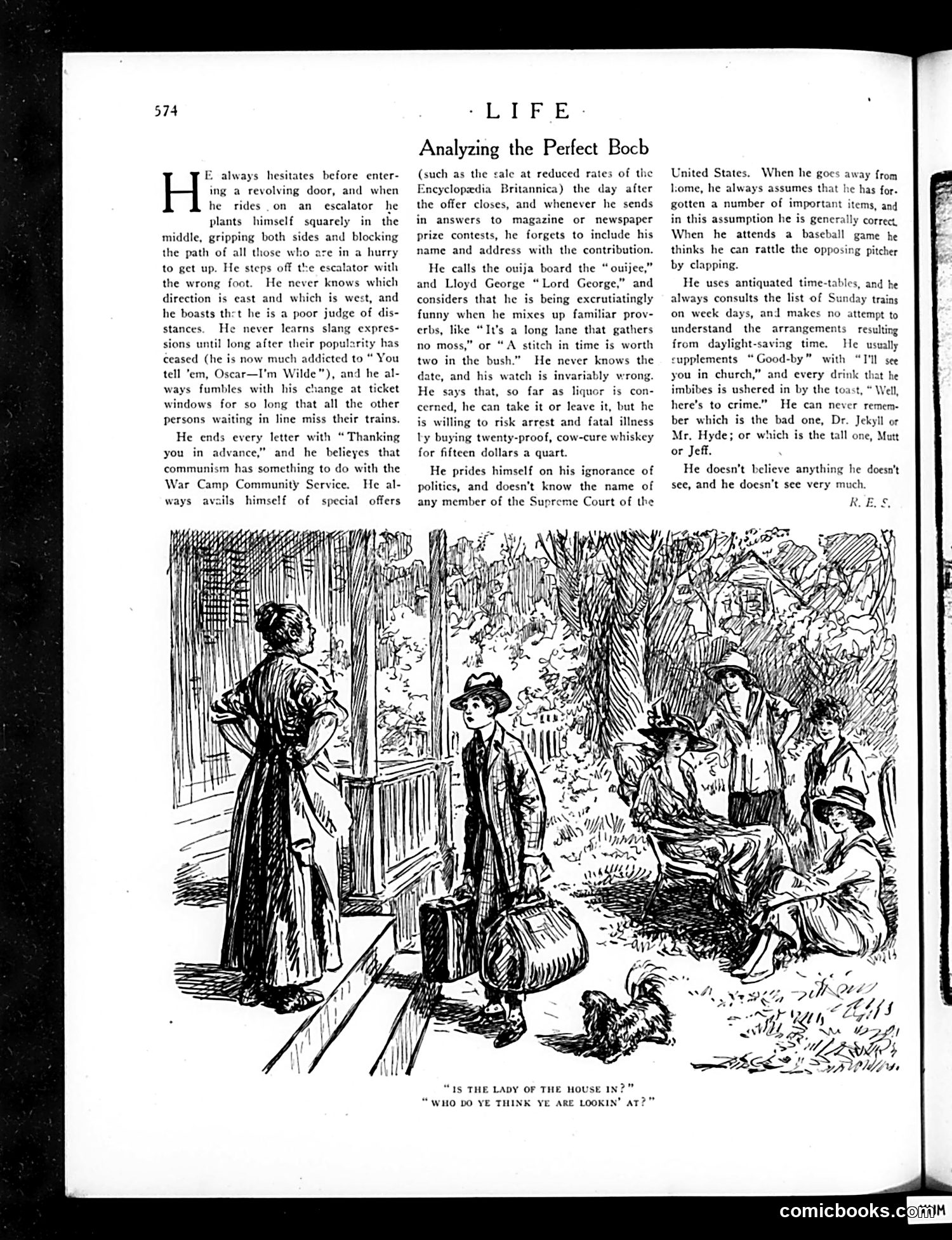
This page satirizes a man characterized by social incompetence and obliviousness. "Bob" exemplifies someone who: - Constantly makes social blunders (entering revolving doors incorrectly, misjudging distances) - Remains ignorant of current events and politics, unable to name Supreme Court justices - Participates in contests and magazine contests while forgetting to include his name - Misquotes common sayings and proverbs - Avoids War Camp Community Service work through excuse-making - Frequents bars, misses trains through tardiness, and generally operates through sheer luck The accompanying illustration depicts an awkward scene—likely showing Bob's characteristic social ineptitude among gathered figures. The satire targets a particular archetype of American male incompetence and willful ignorance, presented as entertainment for Life's readers.
📄 Transcribed text from this page (OCR, searchable)
Machine-transcribed from the original scan — historical spelling and the odd misread are preserved.
E always hesitates before enter- ing a revolving door, and when he rides on an escalator he plants himself squarely in the middle, gripping both sides and blocking the path of all those who are in a hurry to get up. He steps off the escalator with the wrong foot. He never knows which direction is east and which is west, and he boasts thrt he is a poor judge of dis- stances. He never learns slang expres- sions until long after their popula ceased (he is now much addicted to “ You tell ‘em, Oscar—I'm Wilde"), and he al- ways fumbles with his change at ticket windows for so long that all the other persons waiting in line miss their trains, has He ends every letter with “ Thanking you in advance,” and he belieyes that communism has something to do with the War Camp Community Service. He al- ways avails himself of special offers ~LIFE Analyzing the Perfect Bocb (such as the sale at reduced rates of the Encyclopedia Britannica) the day after the offer closes, and whenever he sends in answers to magazine or newspaper prize contests, he forgets to include his name and address with the contribution. He calls the ouija board the “ ouijee,” and Lloyd George “Lord George,” and considers that he is being excrutiatingly funny when he mixes up familiar prov- erbs, like “It’s a long lane that gathers no moss,” or “A stitch in time is worth two in the bush.” He never knows the date, and his watch is invariably wrong. He says that, so far as liquor is con- cert he can take it or leave it, but he is willing to risk arrest and fatal illness ly buying twenty-proof, cow-cure whiskey for fifteen dollars a quart. He prides himself on his ignorance of politics, and doesn’t know the name of any member of the Supreme Court of the “1S THE LADY OF THE HOUSE IN?” “WHO DO YE THINK YE ARE LOOKIN’ aT?" United States. When he gocs away from Lome, he always assumes that he has for. gotten a number of important items, and in this assumption he is generally correct, When he attends a baseball game he thinks he can rattle the opposing pitcher by clapping. He uses antiquated time-ta and he always consults the list of trains on week days, and makes no attempt to understand the arrangements resulting from daylight-saving time. He uswally supplements “Good-by” with “I'll see you in church,” and every drink that he imbibes is ushered in by the toast, “ Well, here's to crime.” He can never remem- ber which is the bad one, Dr. Jekyll or Mr, Hyde; or which is the tall one, Mutt or Jeff. He doesn’t believe anything he doesn't see, and he doesn’t see very much. MY, AM oH ; My (2, waitin comicbooks.coml