
A complete issue · 36 pages · 1920
Life — July 29, 1920
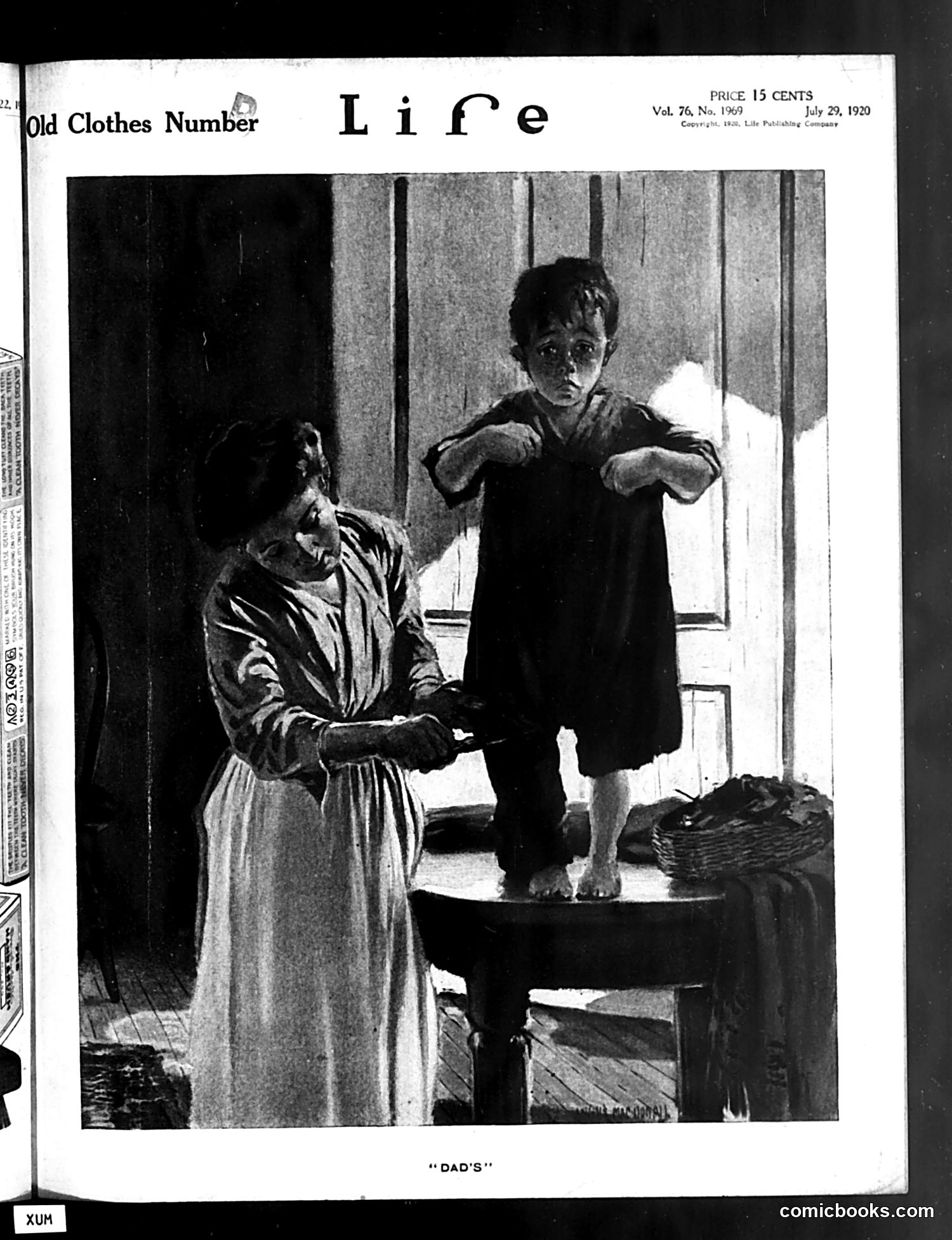
This is a humorous domestic scene rather than political satire. The caption "DAD'S" suggests commentary on fatherhood or paternal authority. The image shows a woman examining or fitting clothes on a barefoot child who stands on what appears to be a table or platform. A basket of laundry sits nearby. The title "Old Clothes Number" indicates the page addresses clothing—likely discussing hand-me-downs, mending, or children's wardrobes. The joke appears to be that the child's worn or ill-fitting garments are "dad's" old clothes being repurposed for the child, commenting on either post-WWI economic constraints, thrift, or the humorous reality of children inheriting oversized paternal clothing. The scene captures early 20th-century domestic economy and resourcefulness.
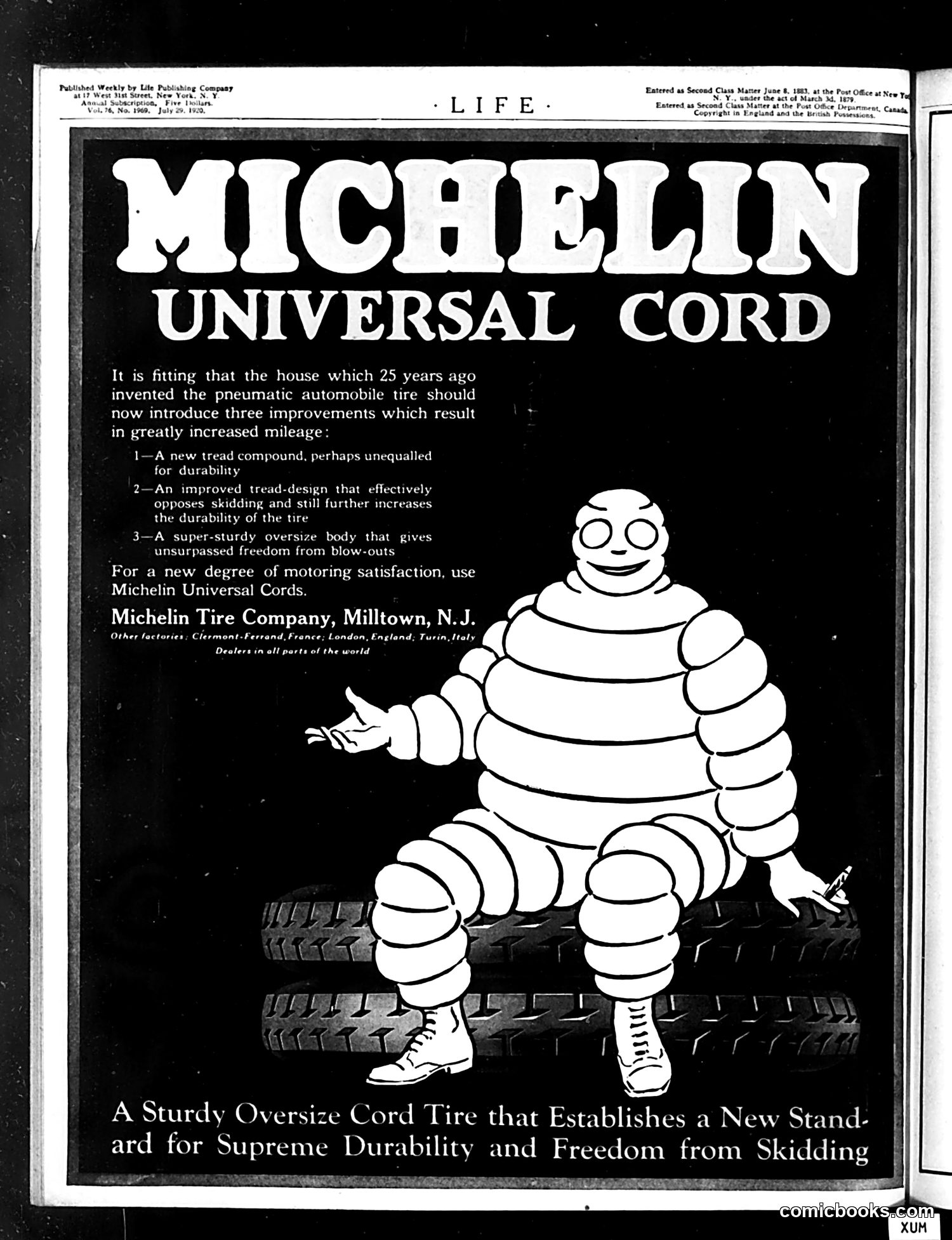
This is a **Michelin tire advertisement**, not political satire. The famous "Michelin Man" (Bibendum) — the rotund mascot made of stacked tire rings — is prominently featured as the central illustration. The ad highlights three tire improvements: new tread compound for durability, improved tread design to prevent skidding, and a sturdy oversized body for blow-out resistance. The Michelin Man, created around 1898, was already an established advertising icon by this 1923 publication date. The cartoon character represents the company's product literally — a figure composed of tires — making the advertising concept both clever and memorable for early 20th-century audiences. This is straightforward commercial promotion, not editorial commentary.
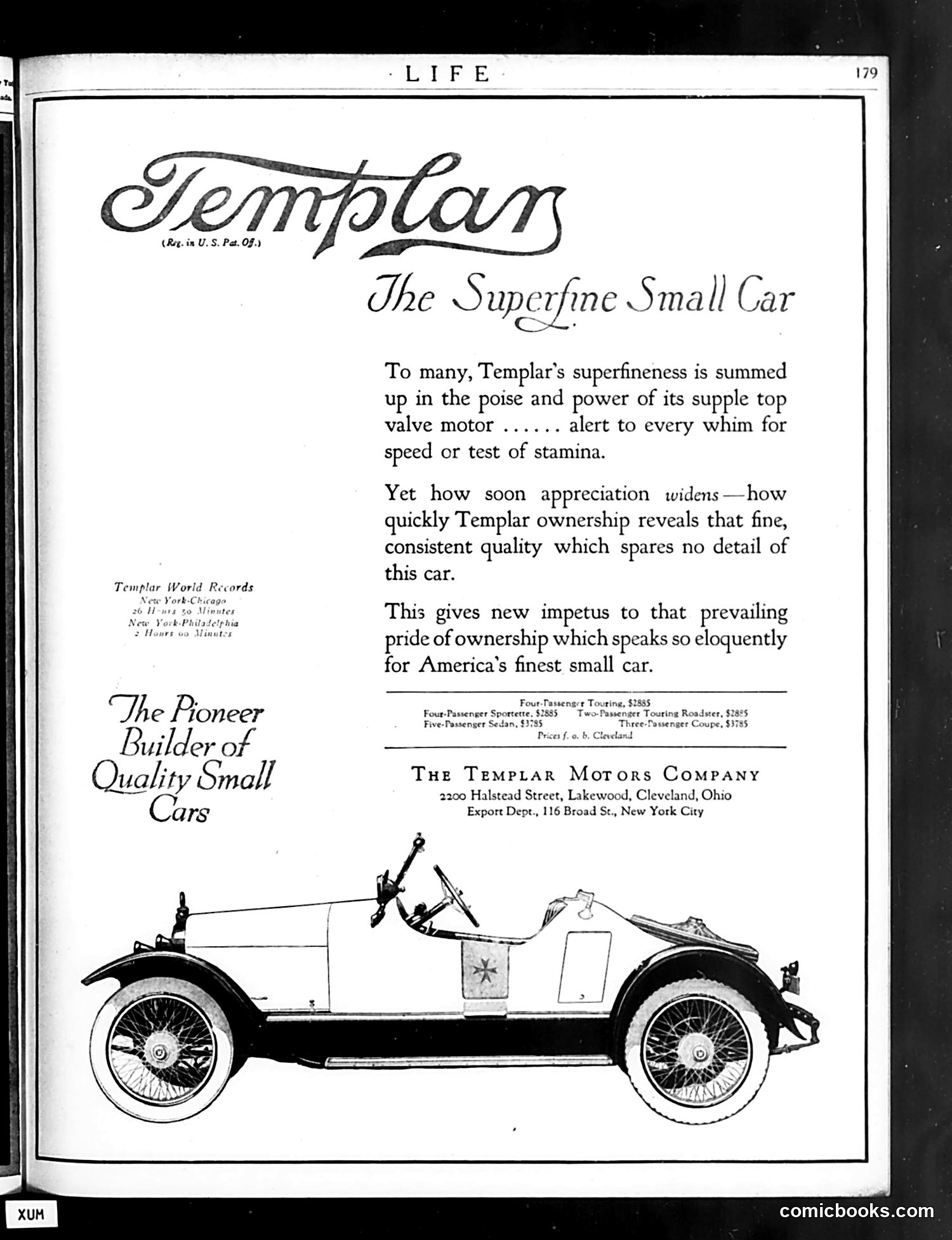
This is **not a cartoon or satire** — it's a **straightforward automobile advertisement** for the Templar, described as "The Superfine Small Car." The page promotes the Templar Motors Company (based in Lakewood, Cleveland, Ohio) by emphasizing that while the car's reputation rests on its powerful engine, ownership reveals its true value: consistent quality and attention to detail throughout the vehicle. The ad appeals to American pride, calling it "America's finest small car." The side panel declares Templar "The Pioneer Builder of Quality Small Cars," listing world records and performance achievements. The illustration shows a side-profile drawing of an open-top touring car with spoke wheels — typical early-1920s automotive design. This is purely commercial advertising with no satirical or political content.
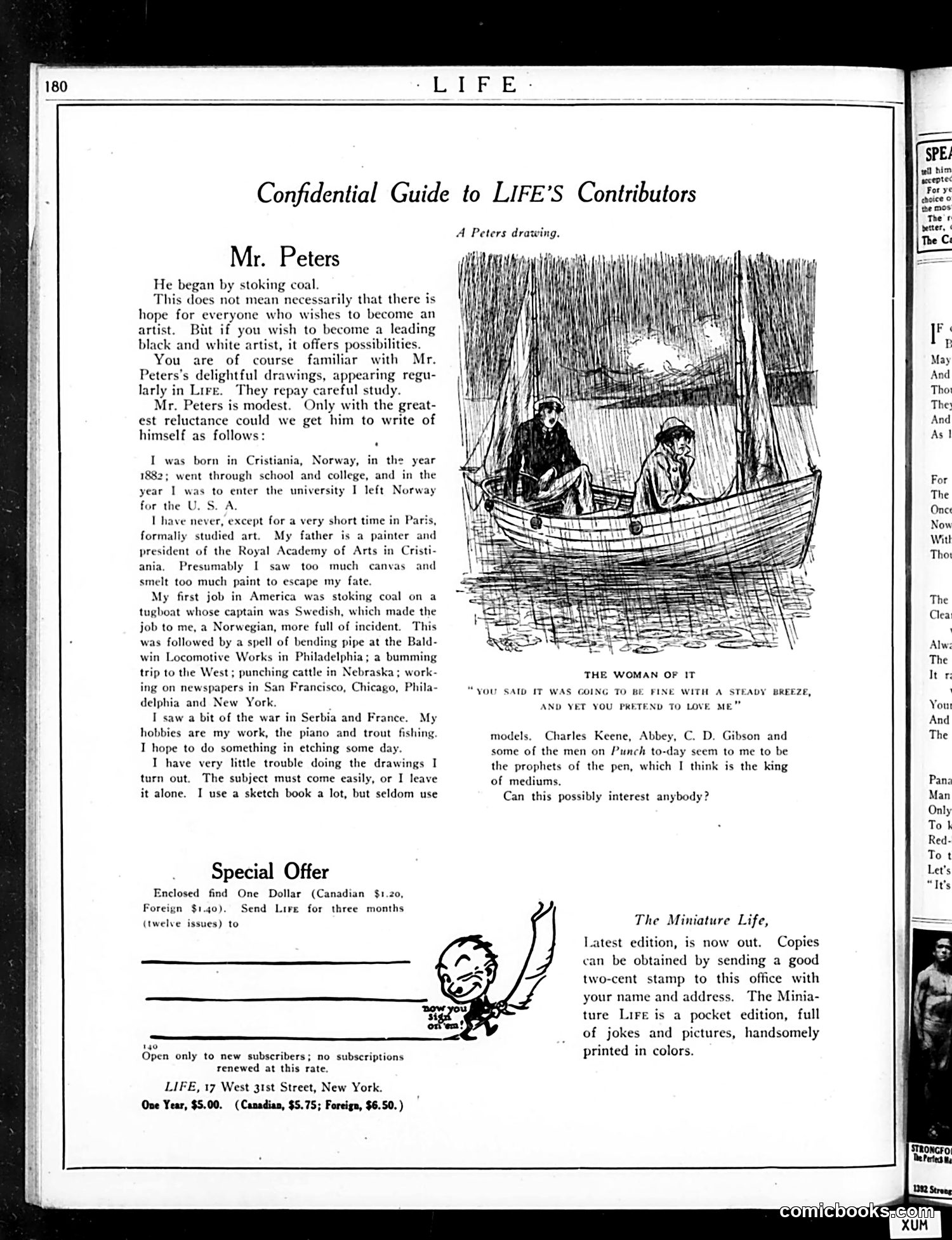
This page is primarily a **contributor profile and subscription advertisement** rather than political satire. **The Content:** - A biographical sketch of **Mr. Peters**, a cartoonist/illustrator whose work appears regularly in Life - Peters describes his background (born in Norway 1882, emigrated to America, worked various jobs including coal-stoking) - The accompanying **ink drawing shows two figures in a boat**, illustrating Peters's artistic style—sketchy, expressive line-work **The Cartoon's Meaning:** The boat scene appears to be a sample of Peters's work, demonstrating his subject matter and technique rather than containing specific political commentary. The quote beneath suggests a romantic or human-interest narrative. **The Advertising:** The page includes a subscription offer ($5.00/year) and promotes "The Miniature Life," a pocket-sized edition, appealing to new subscribers. This is essentially a **professional portfolio page** showcasing an artist's credentials to potential readers.
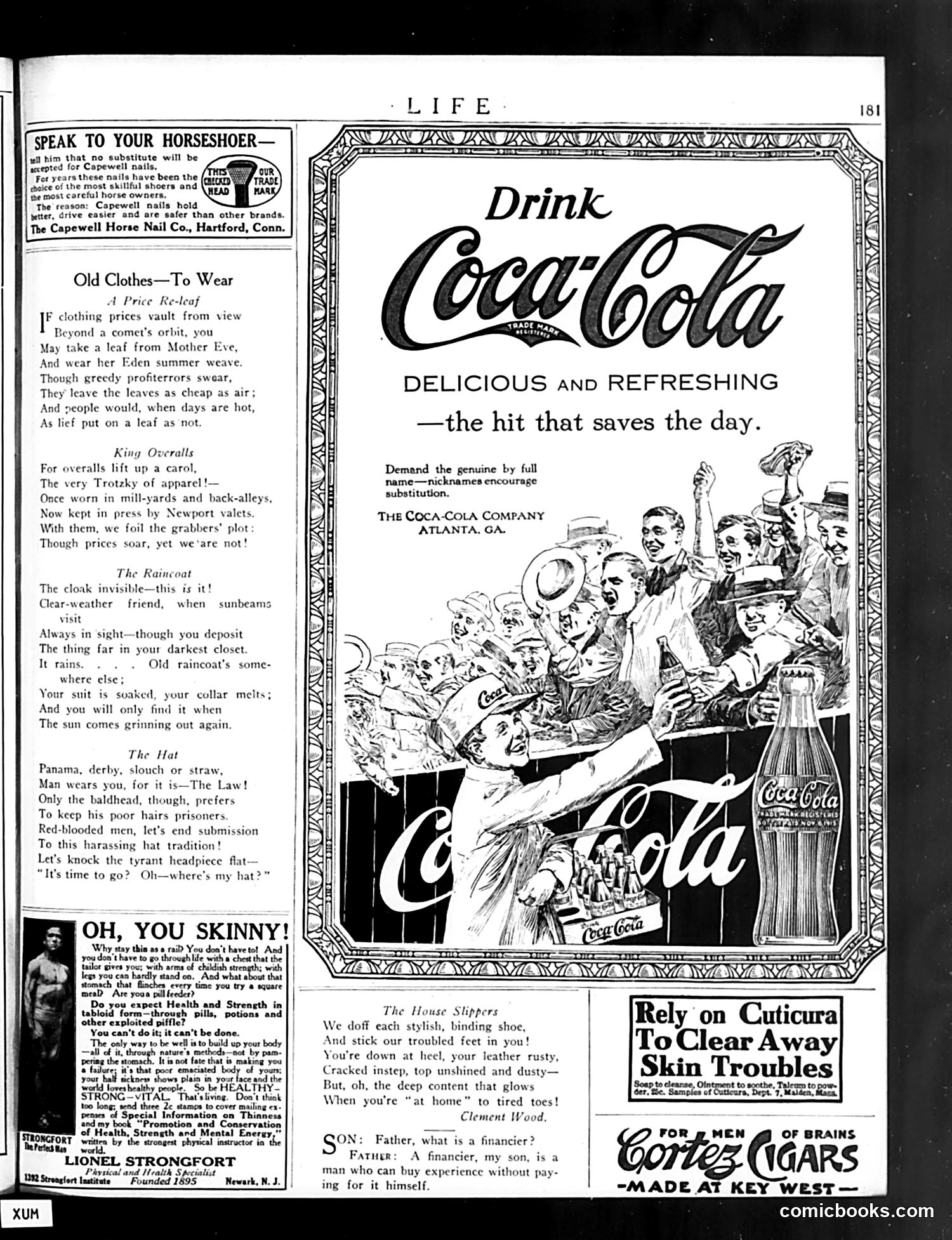
This page is primarily **advertising** rather than editorial content or political cartoons. The major advertisements include: - **Coca-Cola**: A large illustrated ad showing a cheerful group enjoying the beverage, with the slogan "the hit that saves the day" - **Cuticura**: Promoting skin treatments - **Cortez Cigars**: "For Men of Brains" The left side contains **humorous verse about fashion** ("Old Clothes—To Wear," "King Overalls," "The Raincoat," "The Hat") and an ad for **Lionel Strongfort** physical training, featuring before/after imagery. There's a brief **joke** at bottom: "SON: Father, what is a financier? FATHER: A financier, son, is a man who can buy experience without paying for it himself." The page reflects early-20th-century advertising aimed at middle-class consumers, with lighthearted social commentary rather than political satire.
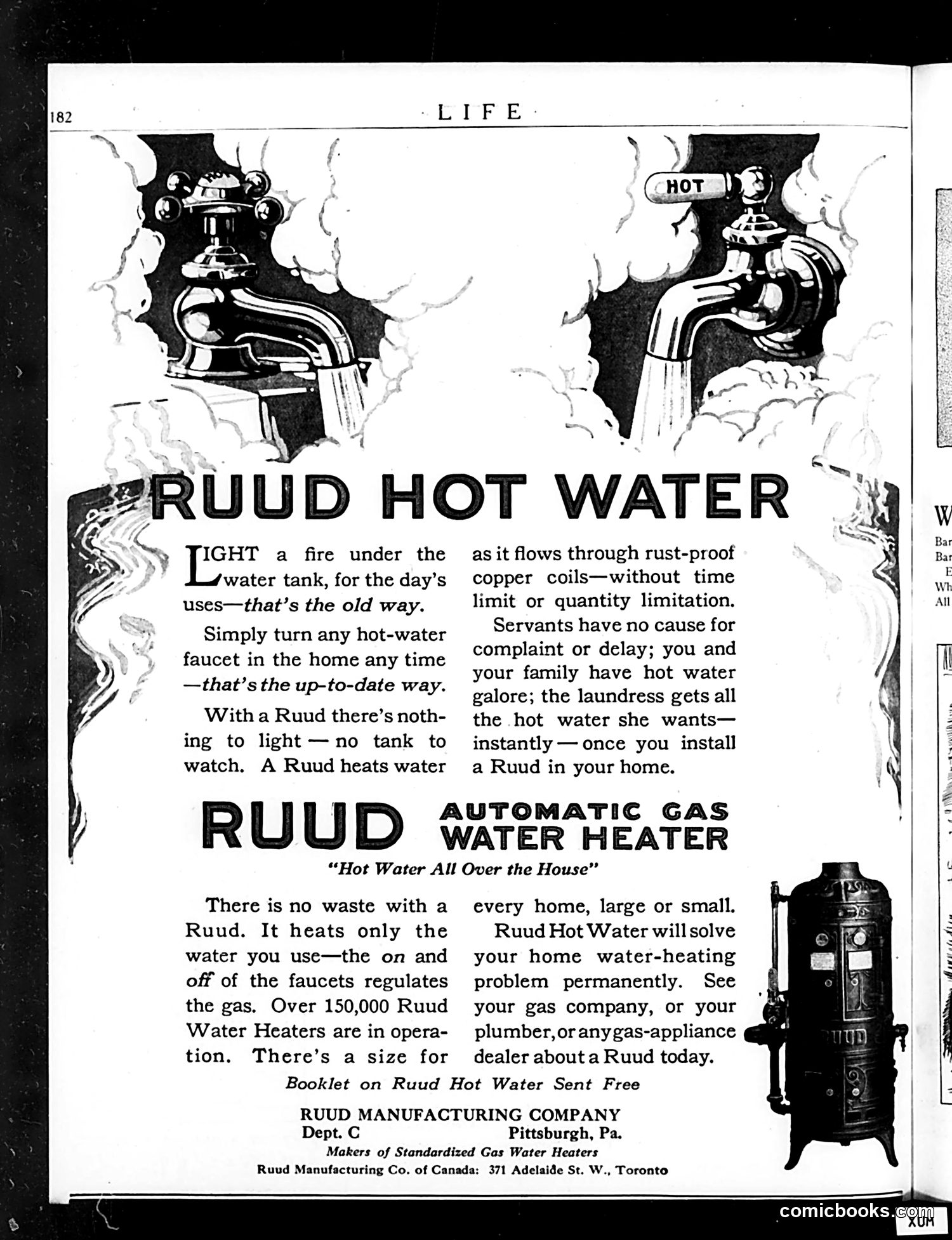
This page is **primarily an advertisement**, not satirical content. It promotes the Ruud Automatic Gas Water Heater, manufactured in Pittsburgh, Pennsylvania (with a Canadian branch in Toronto). The ad contrasts two approaches to hot water: the "old way" (lighting a fire under a water tank daily) versus the "up-to-date way" (instant hot water from a gas heater). The illustration shows two decorative faucets with steam, emphasizing convenient, always-available hot water. The pitch emphasizes labor-saving benefits for household staff ("servants have no cause for complaint") and convenience for families and laundresses. The ad claims over 150,000 units were in operation and encourages readers to contact their gas company or plumber. This reflects early 20th-century marketing of modern domestic conveniences as status symbols and time-savers.
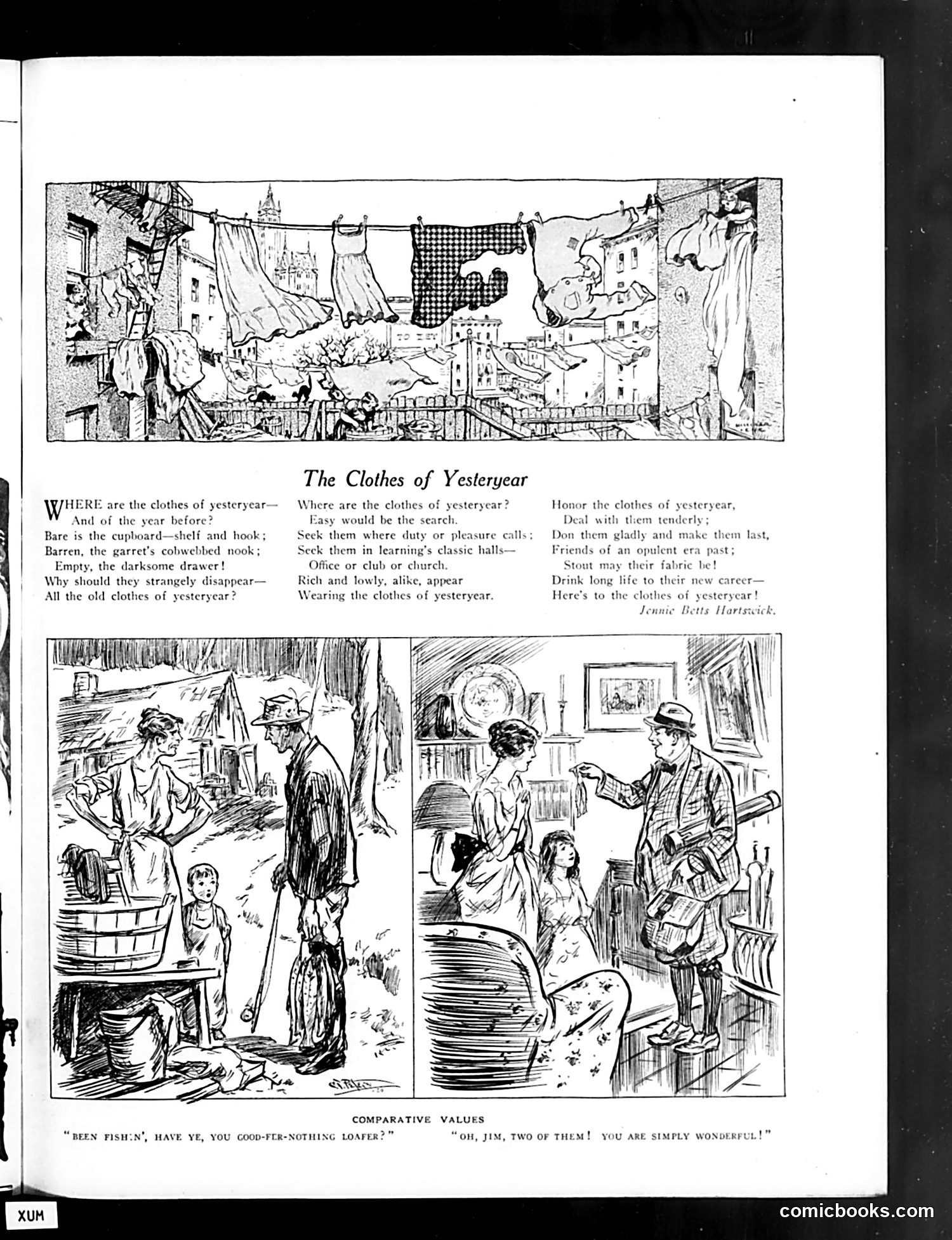
This page presents a sentimental poem by Jennie Betts Hartswick celebrating old, worn clothing—"the garments of yesteryear"—found in attics and drawers. The poem romanticizes these tattered items as treasured memories. The two illustrated scenes below depict contrasting economic scenarios. The left panel shows what appears to be a poorer family in humble circumstances, while the right shows a wealthier household. The caption "COMPARATIVE VALUES" with dialogue about "been fish'n" and "two of them" suggests the satire: the cartoonist is mocking the disparity between social classes and their material possessions, implying that old clothes hold equal or greater sentimental value regardless of economic status. The humor lies in this ironic juxtaposition of sentiment versus actual wealth.
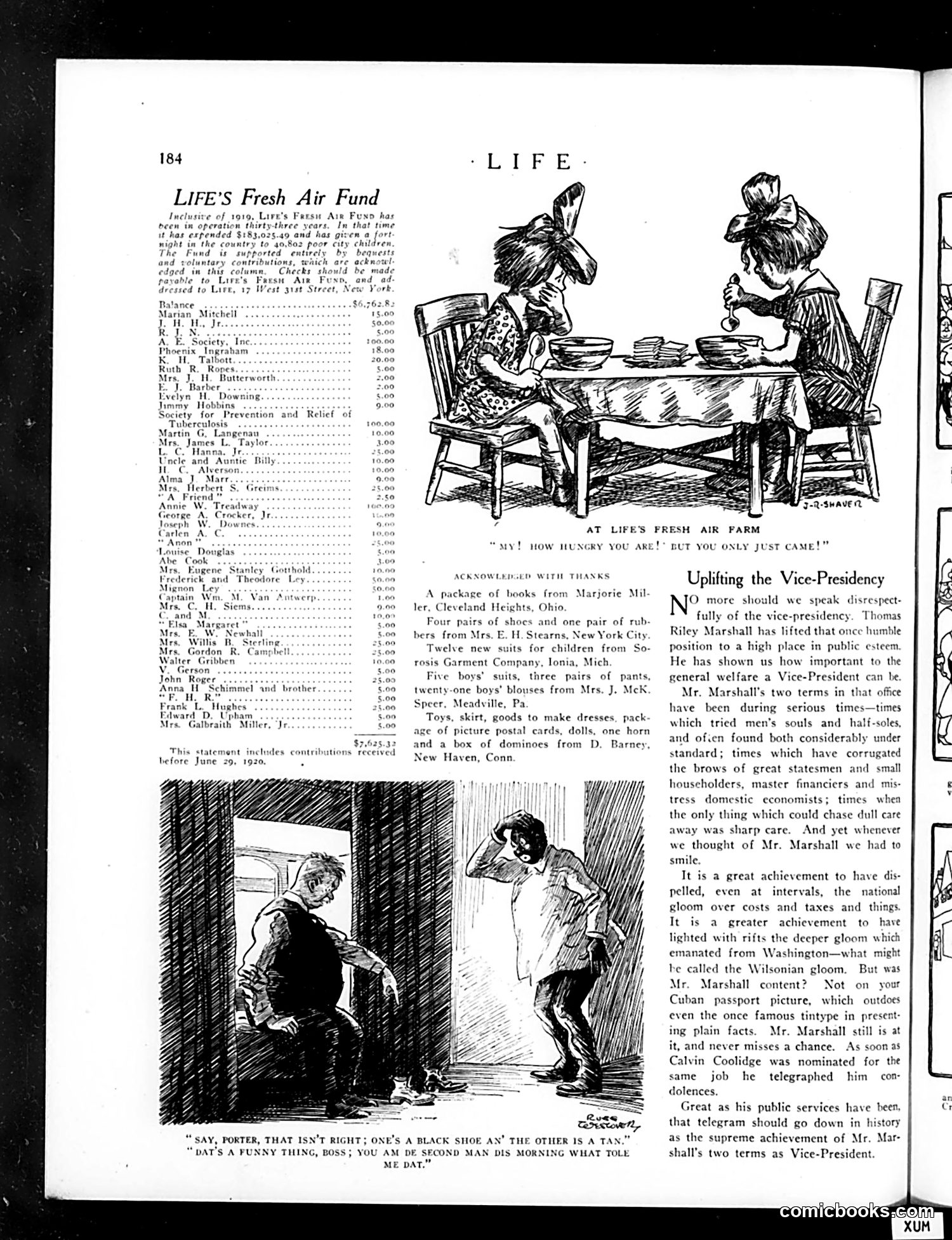
**Top Section:** "Life's Fresh Air Fund" lists charitable donations. The accompanying illustration shows two children eating at a table—a cheerful domestic scene captioned "At Life's Fresh Air Farm: 'Say! How hungry you are! Bet you only just came!'" This depicts the magazine's charitable program providing meals and outdoor recreation to underprivileged children. **Bottom Section:** "Uplifting the Vice-Presidency" discusses Thomas Riley Marshall's service as Vice-President under Woodrow Wilson. The cartoon shows a man discovering someone wearing mismatched shoes—one black, one tan—with dialogue about the absurdity. This satirizes the vice-presidency as a trivial, often-mocked position, using the shoe confusion as metaphor for the office's lack of substance and importance in American governance.
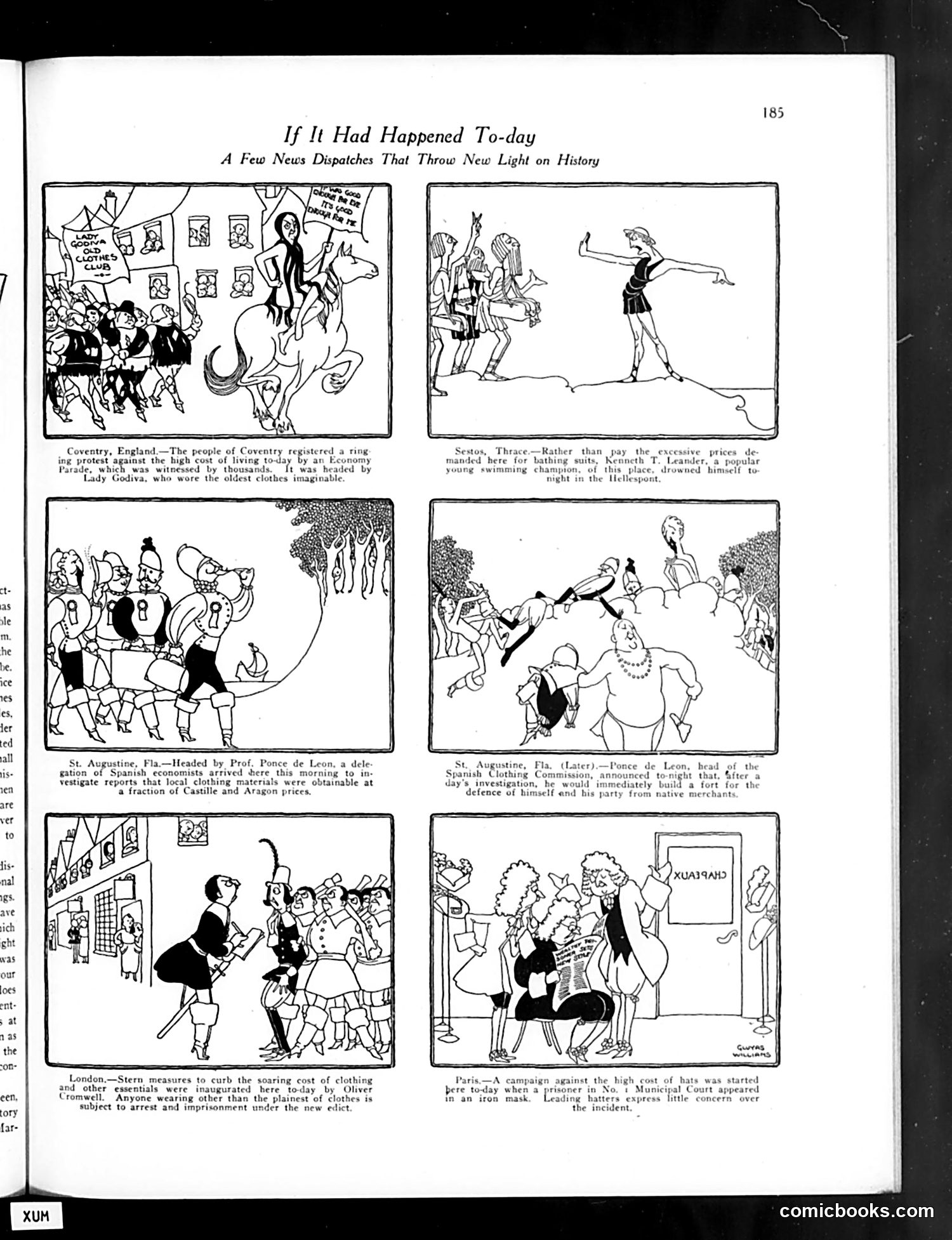
This satirical page reimagines historical events through modern (1920s-era) circumstances. Each cartoon presents absurdist scenarios: 1. **Coventry, England**: Lady Godiva's legendary nude ride reframed as a protest against high clothing costs—she wears "the oldest clothes imaginable." 2. **Seston, Thrace**: Paris of Troy chooses a woman based on modern beauty pageant standards rather than divine judgment. 3. **St. Augustine, Florida**: Spanish conquistador Ponce de Leon plans to build fortifications against "native merchants" instead of indigenous peoples. 4. **London/Paris**: Historical events (clothing regulations, hat costs) treated as contemporary policy debates. The humor stems from applying modern economic concerns and bureaucratic regulations to ancient history, satirizing contemporary anxieties about inflation and government control.
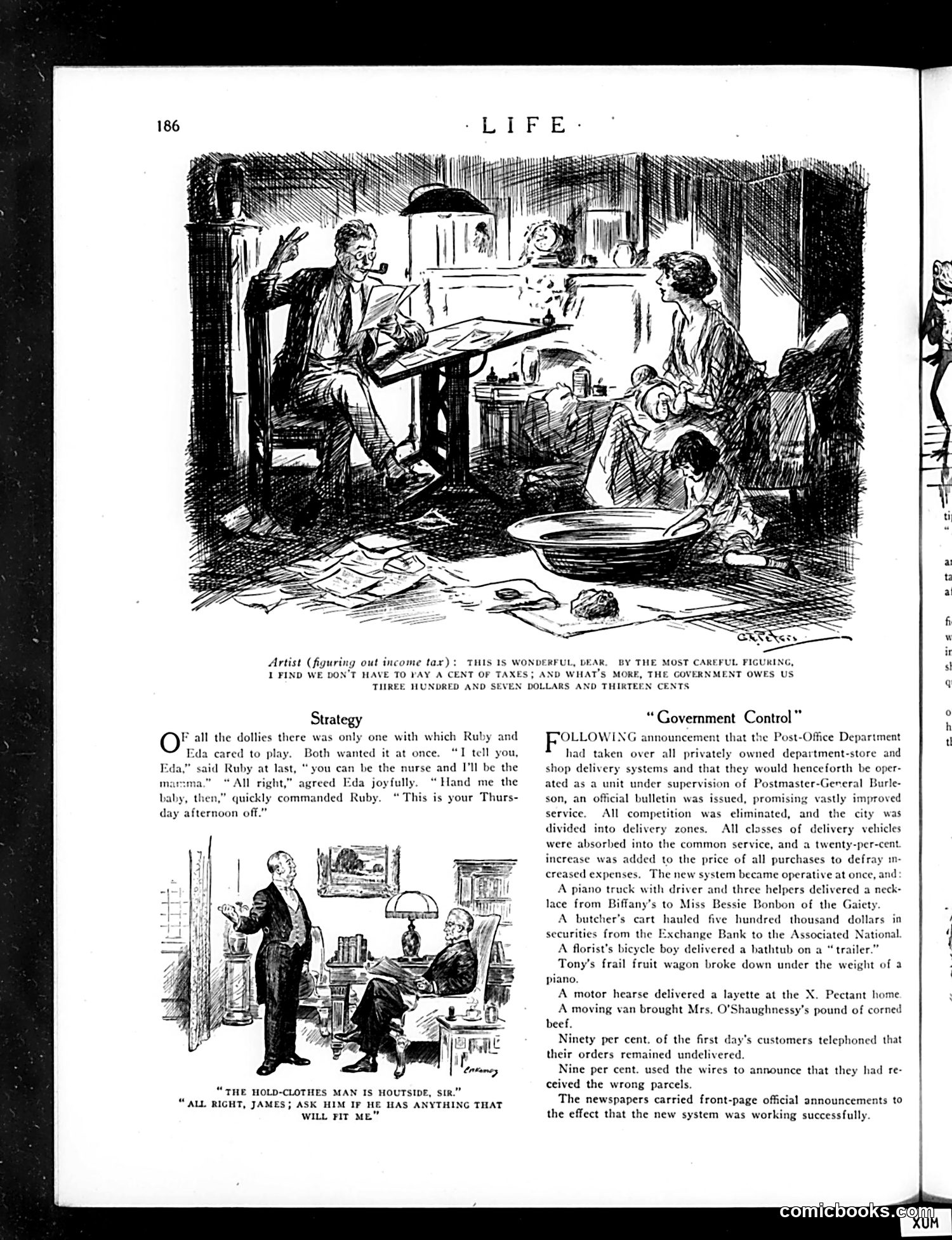
**Top cartoon**: An artist complains to tax collectors about owing taxes while claiming the government itself owes him money—apparently satirizing bureaucratic absurdity and unequal treatment between citizens and government. **"Strategy" section**: A humorous domestic scene where a father allows his daughter to choose which doll to play with, establishing her decision-making authority over household matters. **"Government Control" article**: Describes Post-Office Department takeover of private delivery systems, eliminating competition and raising costs through consolidation. The satirical anecdotes that follow—piano trucks breaking down, wrong parcels delivered, customers unable to reach services—mock the inefficiency and failures of government monopoly, suggesting private enterprise operated better. The page criticizes government's expanding control over commercial services as bungling and inferior.
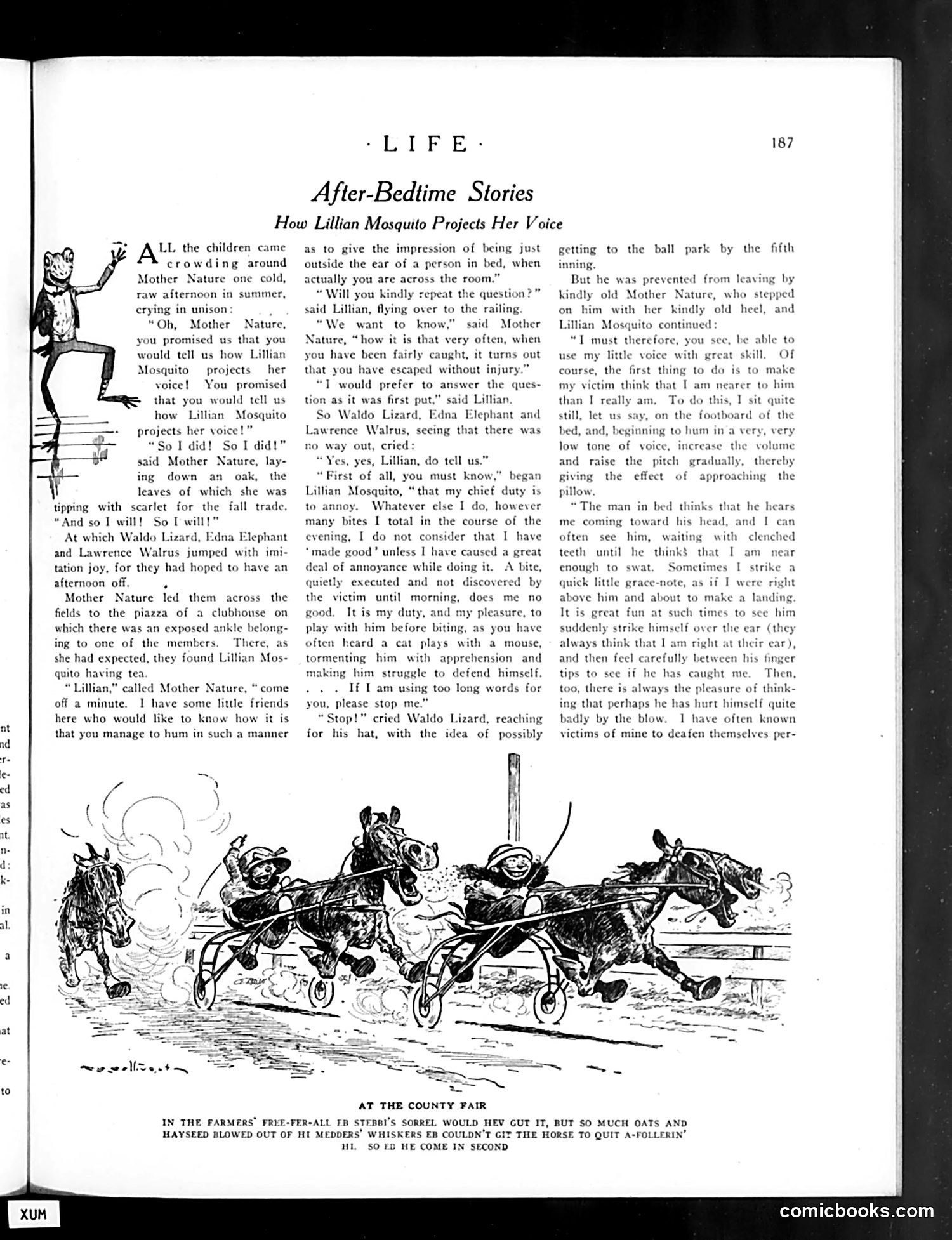
This page presents a children's bedtime story featuring anthropomorphic animals: Mother Nature, Waldo Lizard, Edna Elephant, and Lawrence Walrus. The narrative humorously explains how mosquitoes project their buzzing sound to torment sleeping people. The illustration at bottom depicts a horse race at a county fair, showing horses and riders in motion. The caption jokes about a farmer's mule cutting through a hay-filled course so effectively that other horses' whiskers blow off and their riders cannot keep them focused—resulting in the mule placing second despite this chaos. The humor relies on absurdist animal behavior and slapstick outcomes typical of early 20th-century satirical magazine content.
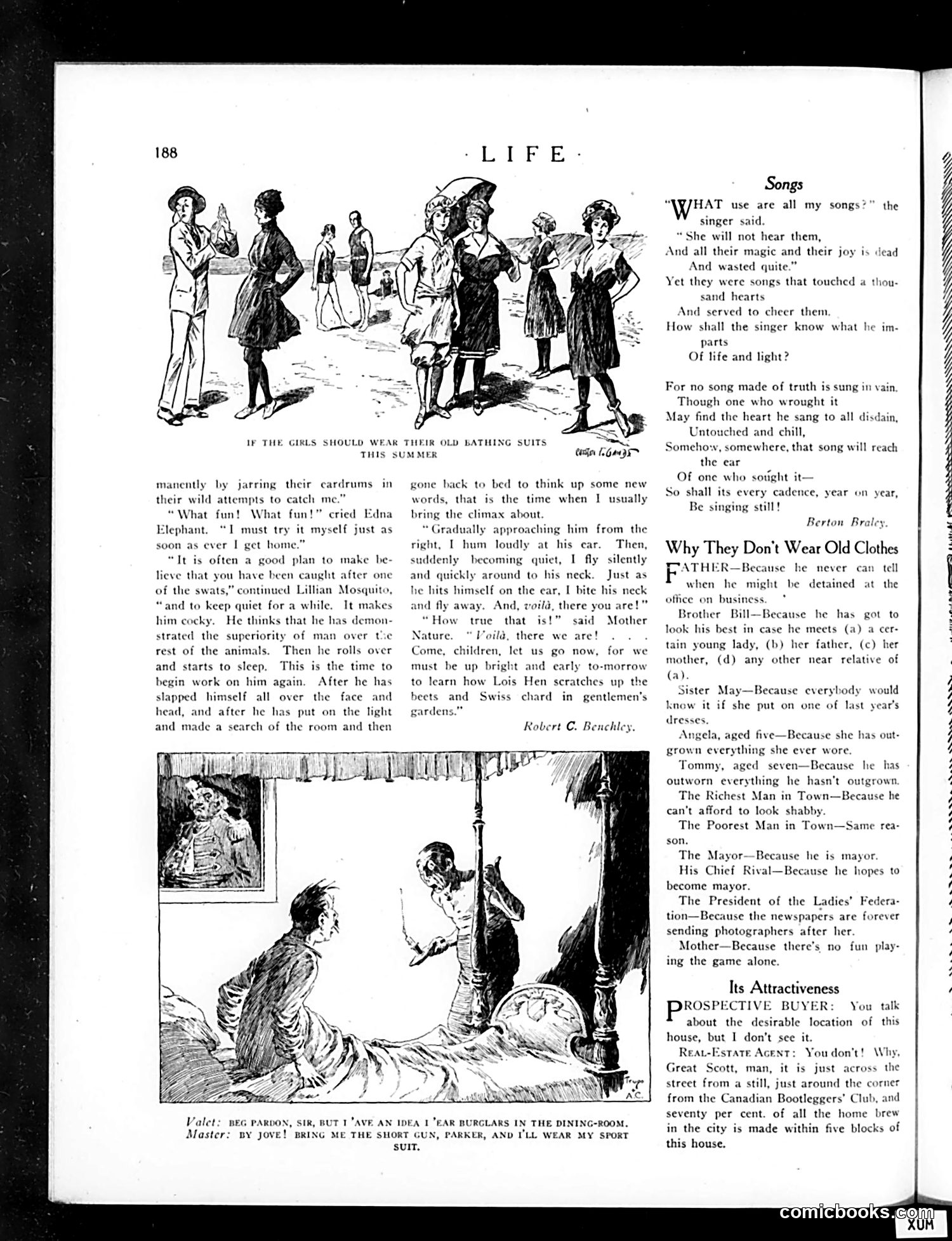
This page contains two distinct pieces of satire: **Top Illustration**: "If the Girls Should Wear Their Old Bathing Suits This Summer" depicts women in Victorian-era bathing costumes interacting with men on a beach. The joke satirizes outdated fashion—the women's heavy, restrictive old swimsuits contrast with modern expectations, creating awkward social situations as men react with surprise or discomfort. **Bottom Cartoon**: Shows a servant presenting hunting equipment to his master, captioned about wearing a sport suit. The humor appears to concern class distinctions and servants' presumptuous suggestions about their employers' attire. The accompanying text pieces ("Songs," "Why They Don't Wear Old Clothes," "Its Attractiveness") are humorous observations on fashion, social status, and human behavior typical of Life's satirical commentary on early 20th-century American society.
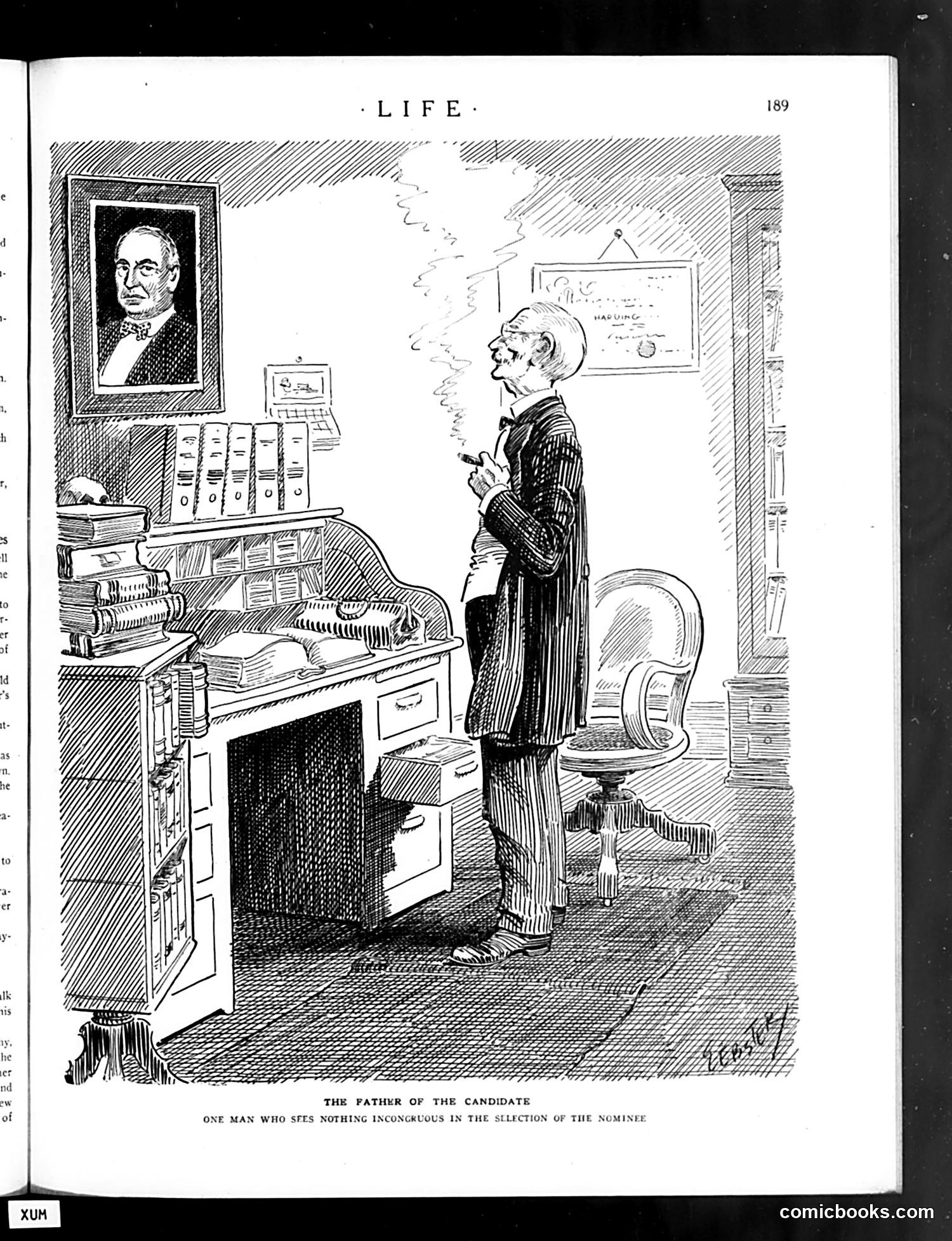
This satirical cartoon depicts a scholarly gentleman in his study, surrounded by books and academic materials, gazing thoughtfully at a portrait on the wall. The caption reads: "One man who sees nothing incongruous in the selection of the nominee." The satire targets the tension between intellectual merit and political selection. The figure appears to represent someone educated and refined—surrounded by evidence of learning and serious study—yet he finds nothing odd about a candidate's nomination despite apparent unsuitability. The humor lies in the disconnect: this "father of the candidate" sees his selection as perfectly reasonable, while the magazine's readers presumably find it absurd or problematic. The cartoon suggests political patronage or nepotism overrides qualifications.
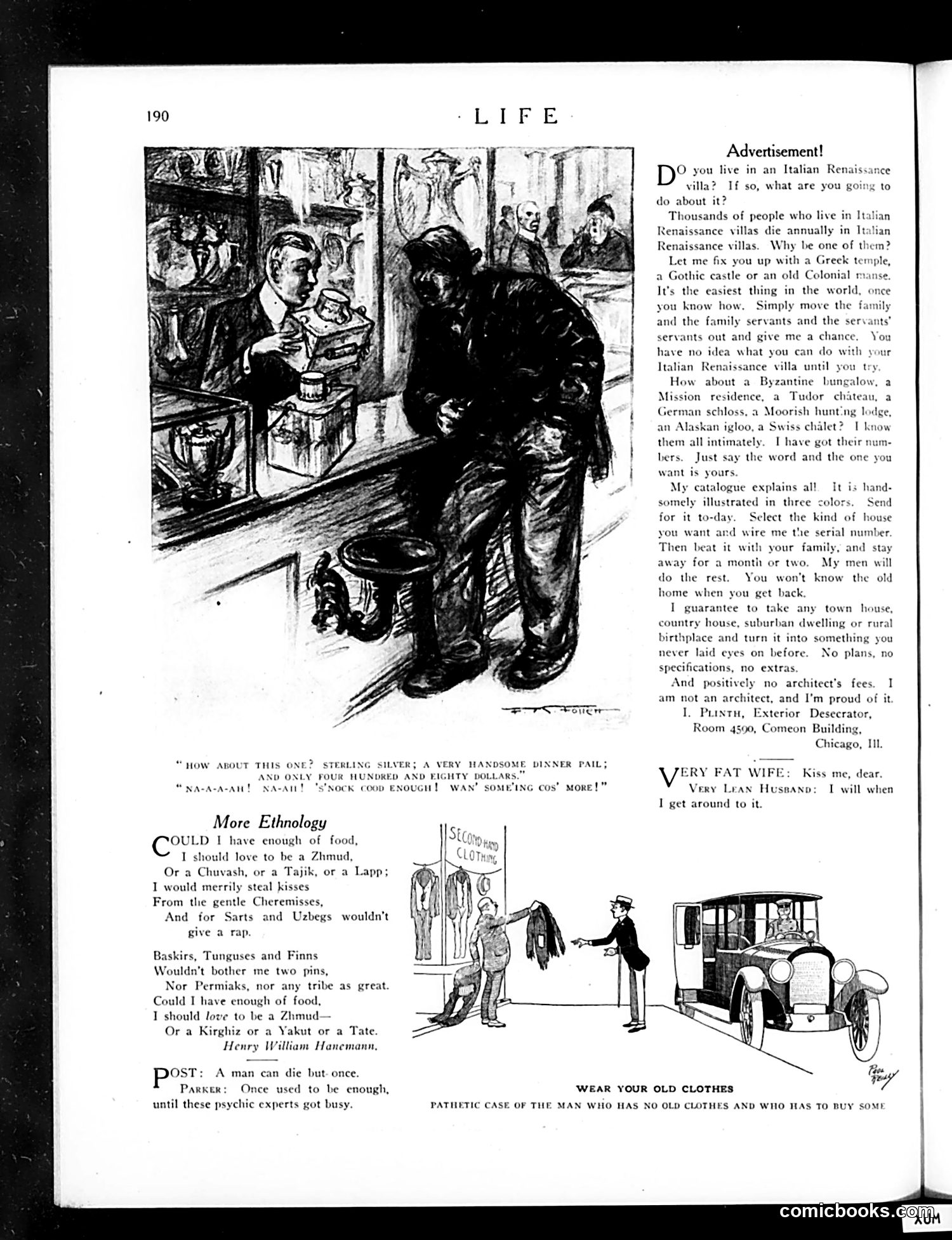
This page contains mixed content: a literary poem ("More Ethnology" by Henry William Hanemann) satirizing ethnic stereotypes through exaggerated food preferences, and period advertisements. The main cartoon depicts two men at a clothing exchange window, illustrating the advertisement "Wear Your Old Clothes." The satire targets economic waste—a man unable to afford new garments must reuse old ones. The caption's phrase "psychic experts got busy" suggests mockery of contemporaneous self-help movements. The Italian Renaissance villa advertisement is humorous real estate marketing, offering fantastical property transformations. Overall, the page reflects early 20th-century American satirical humor combining ethnic comedy, economic themes about consumption and class, and mockery of emerging consumer culture and pseudo-scientific trends.
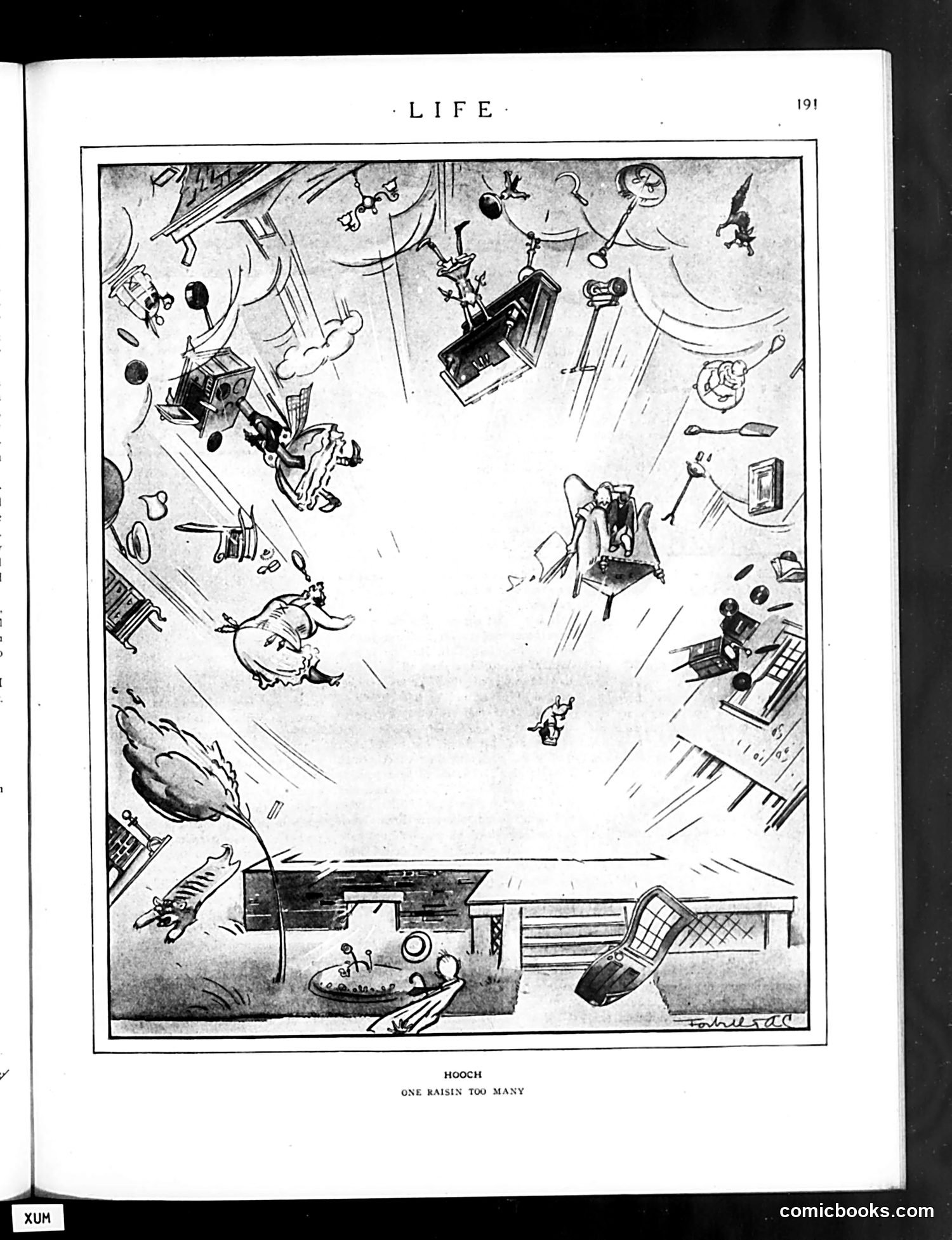
This cartoon depicts a chaotic overhead view of a home interior, with furniture and household items scattered as if in a domestic disaster. Multiple figures appear to be falling or tumbling through the space in disarray. The title "One Raisin Too Many" suggests the cartoon satirizes excess or overindulgence. The scene likely references a specific contemporary domestic or social situation—possibly relating to Prohibition-era concerns about alcohol consumption, given the magazine's satirical nature. The overhead perspective creates a comedic effect by showing the complete disorder resulting from this unnamed excess. Without additional context about the specific date and cultural references of this Life magazine issue, the precise target of satire remains unclear, though the cartoon clearly mocks some form of domestic chaos caused by going "one step too far."
This page discusses the 1920 presidential election. The text debates potential Republican candidates, specifically mentioning **Warren G. Harding** and **Governor Cox** as possibilities, alongside references to figures like Hiram Johnson and General Wood. The small cartoon at top-left appears to depict a figure in political distress or confusion—likely satirizing the uncertainty around candidate selection. The main editorial argues that the public has little concrete knowledge of these candidates and questions their qualifications. It critiques the difficulty in identifying what distinguishes them from one another, suggesting the candidates lack clear, visible differences in platform or character. The overall tone is satirical frustration with the vagueness of the political process and candidates' unclear identities or positions to voters.
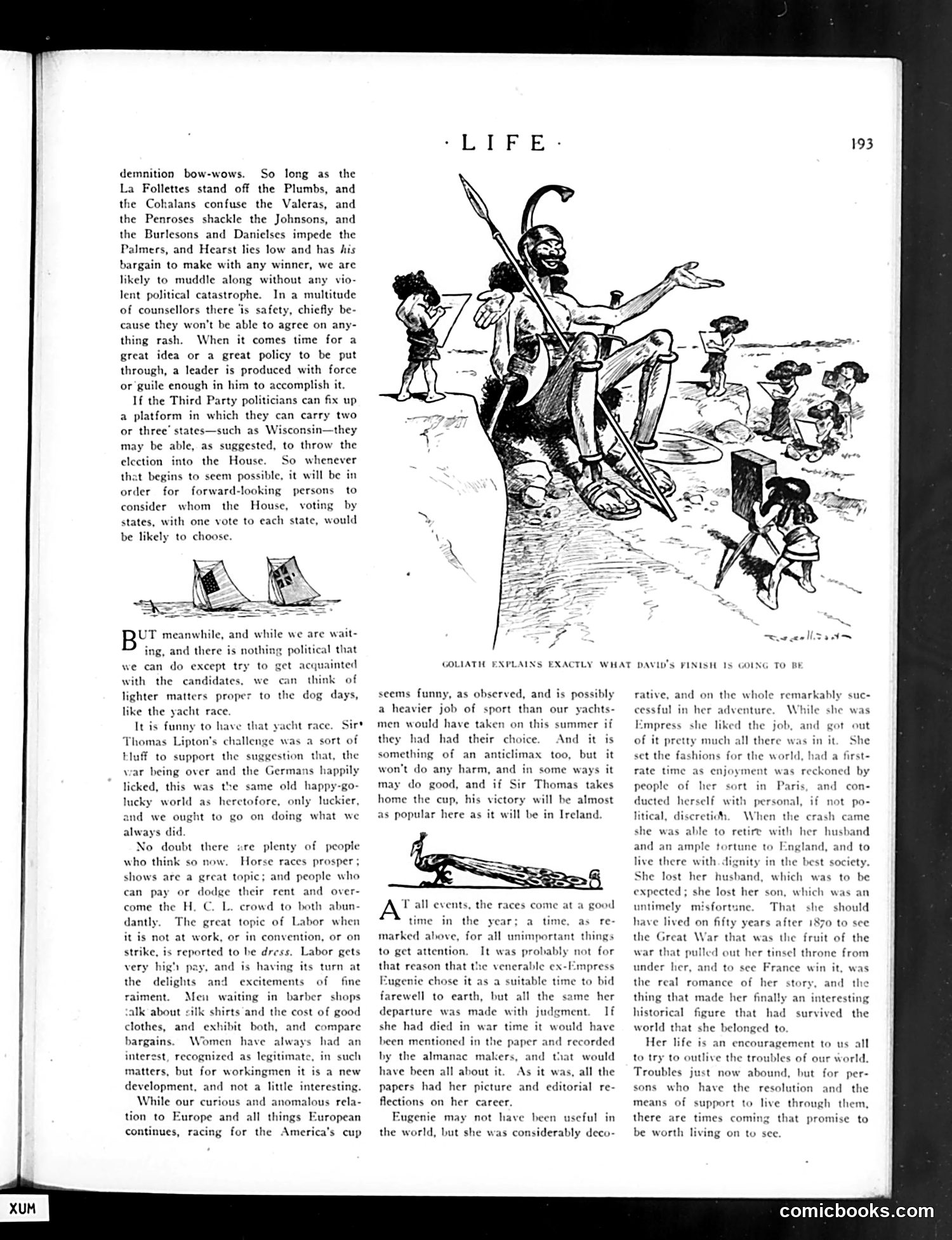
This page contains political commentary on early 20th-century American politics, likely from around 1920. The main text discusses third-party political maneuvering and the 1920 election, referencing politicians like La Follette, Palmer, and Hearst—figures involved in contested presidential politics of that era. The prominent illustration labeled "GOLIATH EXPLAINS EXACTLY WHAT DAVID'S FINISH IS GOING TO BE" uses the biblical David-and-Goliath metaphor satirically. The giant figure (Goliath) appears to represent established political power or the status quo, while the small figures around him (David) represent challengers or reformers. The image suggests that despite appearing outmatched, smaller political forces will inevitably be crushed by entrenched power. The secondary discussion addresses post-WWI American life, including labor issues, fashion (notably workers' newfound interest in expensive clothing), and Sir Thomas Lipton's America's Cup yacht race challenge—presented as harmless entertainment during uncertain political times.
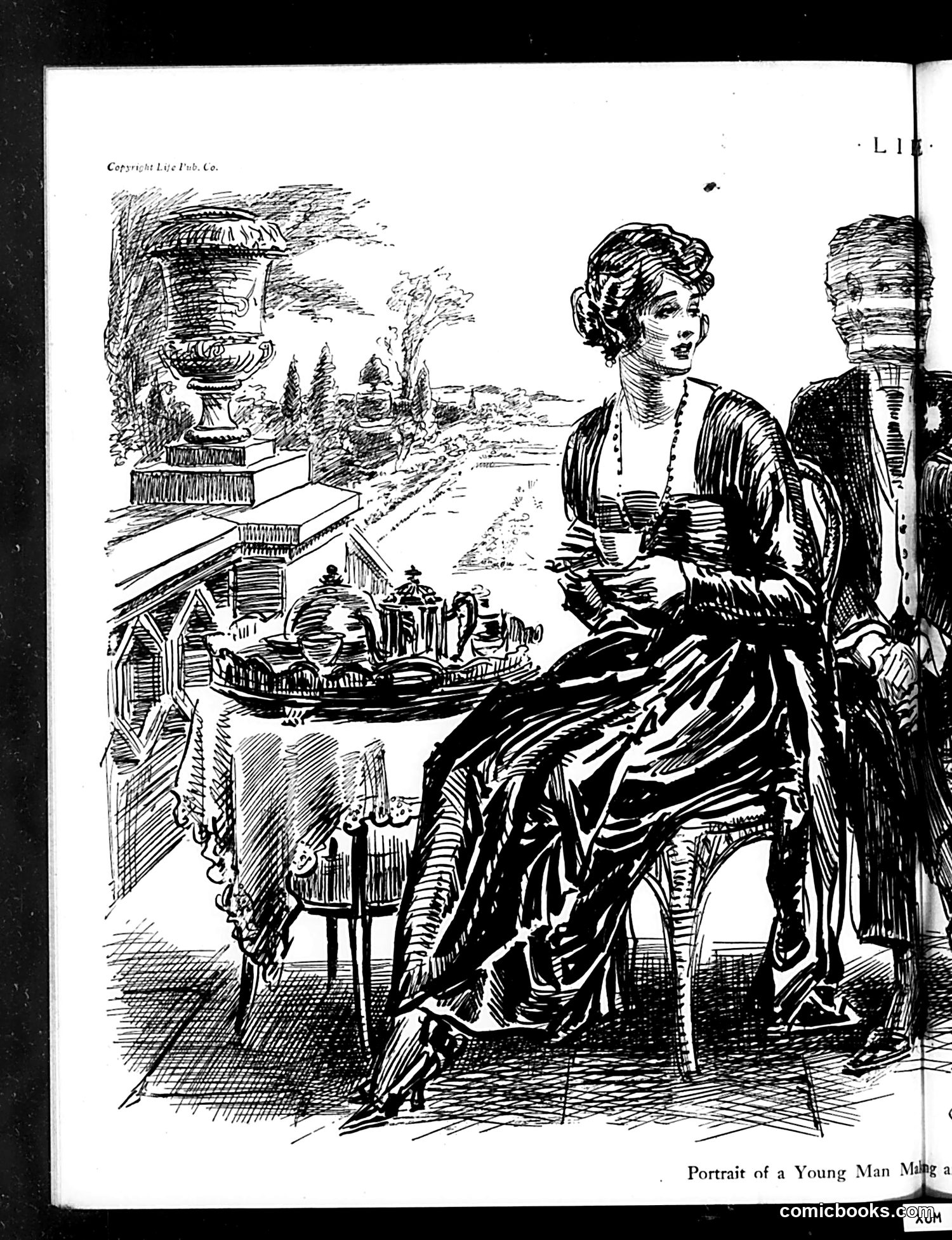
The OCR text is too corrupted to read meaningfully. From the IMAGE alone: This is a pen-and-ink illustration showing an elegant interior scene. A well-dressed woman in fashionable clothing sits prominently in the foreground, while a man in formal attire stands beside her. The background depicts an ornate garden or estate setting with classical architectural elements (urns, gates, formal landscaping). The partial caption reads "Portrait of a Young Man Mak[ing a...]" but is cut off. Without legible text, I cannot identify the specific figures, social commentary, or satirical intent. The style and composition suggest this may be satirizing upper-class courtship, social ambition, or romantic pursuits among the wealthy—common Life magazine subjects—but I cannot assert specifics without clearer textual support.
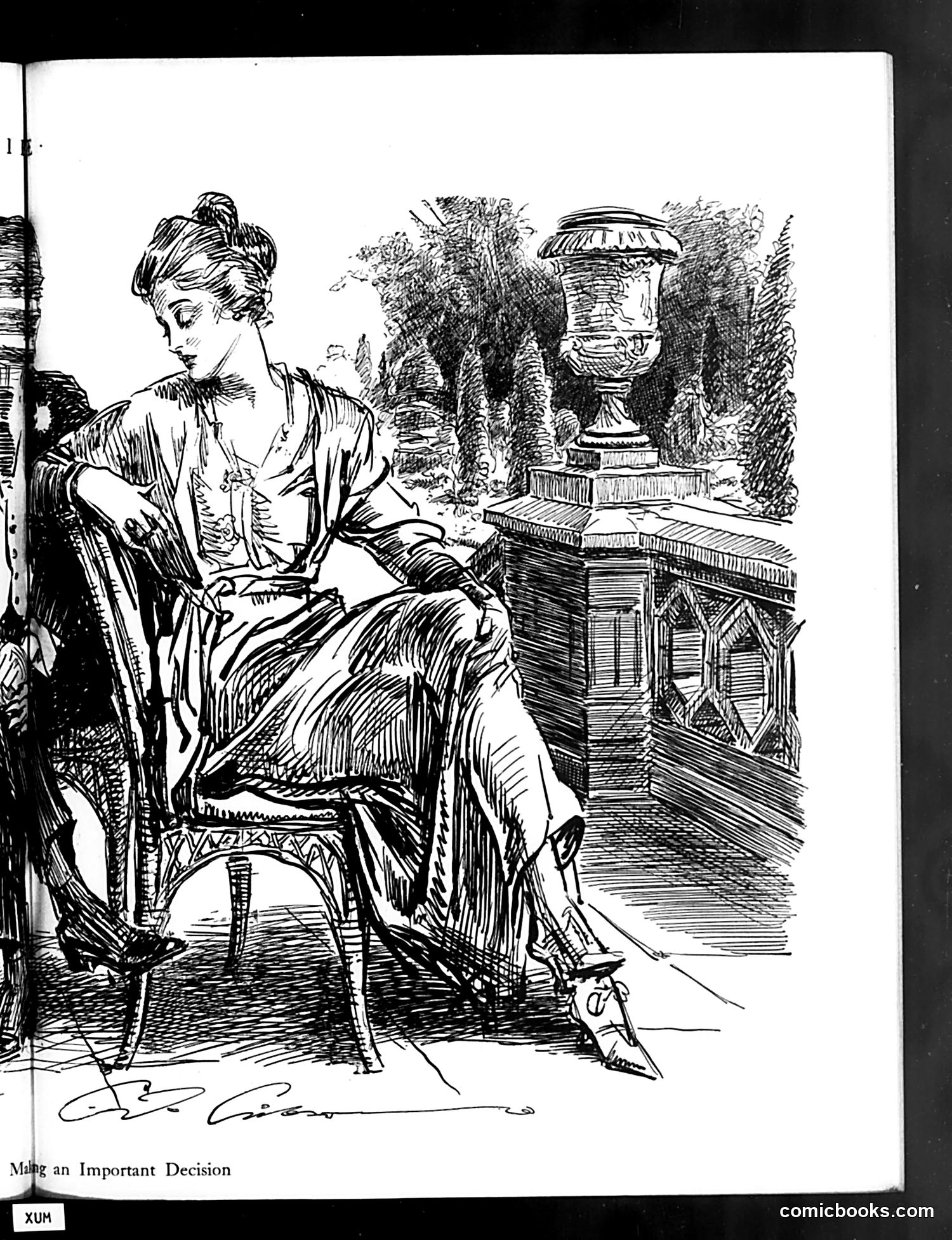
This illustration depicts a well-dressed woman seated in an elegant garden setting, appearing to contemplate a decision. The formal attire, composed posture, and refined surroundings suggest a woman of social standing. The caption "Making an Important Decision" is deliberately vague, likely inviting satirical interpretation about what such a decision might involve. Given Life magazine's satirical nature, this probably mocks the stereotype of upper-class women facing trivial choices (fashion, social engagements, suitors) as "important decisions"—contrasting their sheltered concerns with larger world events. The pen in her hand and contemplative pose reinforce the notion of deliberation, though the actual subject of her decision remains humorously unstated, allowing readers to supply their own commentary on women's priorities or limitations in early-20th-century society.
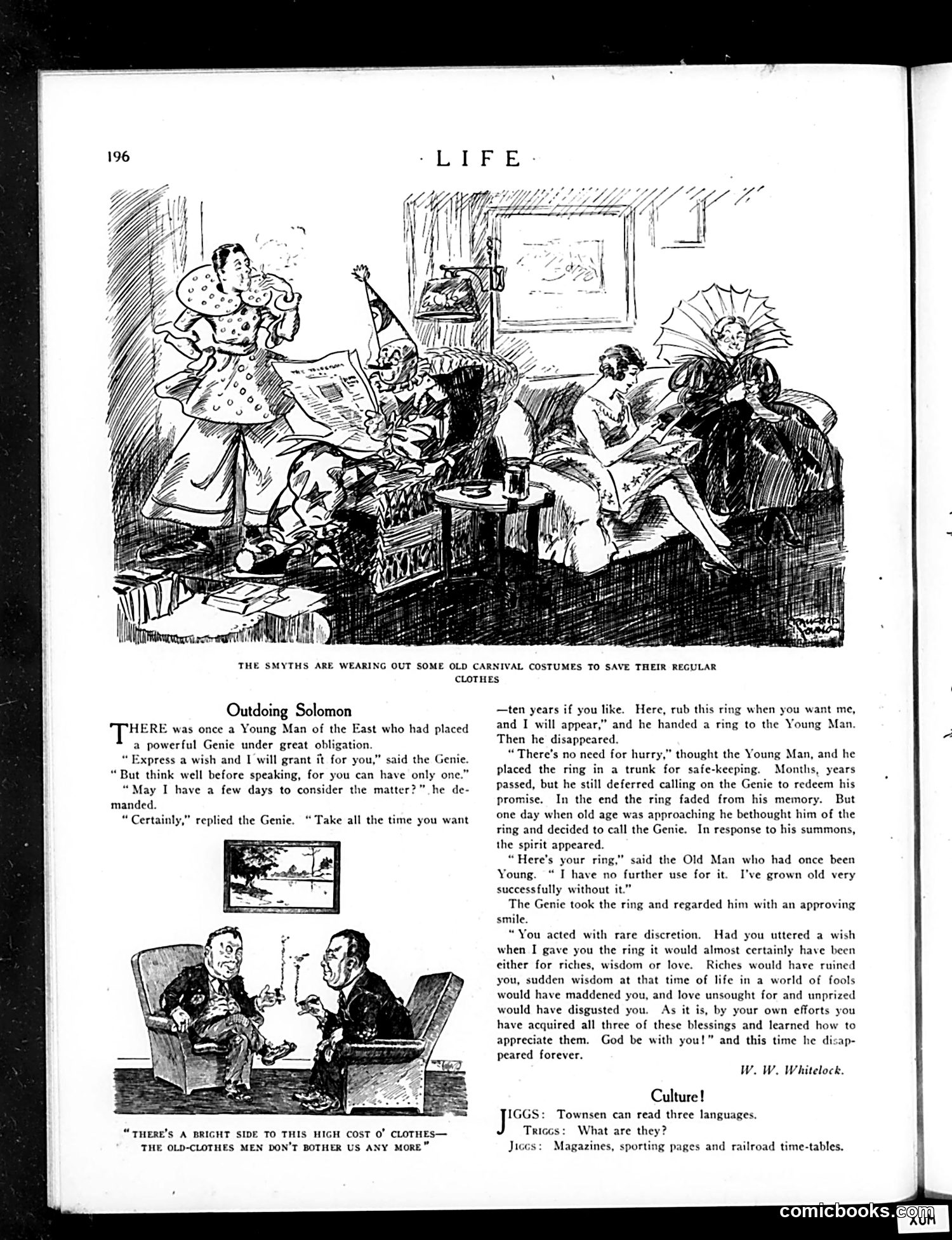
**Top Cartoon:** Shows the Smyth family wearing old carnival costumes at home to preserve their regular clothes during a period of high clothing costs—a direct reference to post-WWI inflation and economic hardship. The joke satirizes how ordinary families economized during this expensive period. **Main Story ("Outdoing Solomon"):** A moral fable by W.W. Whitelock about a young man granted one wish by a genie. Rather than immediately wishing for riches, wisdom, or love, he delays. By old age, he's earned all three through his own efforts and learned to appreciate them—the genie approves his restraint. The story argues that self-made success and patience yield better results than instant gratification. **Bottom Cartoon:** Two working-class men discuss the "bright side" of high clothing costs: secondhand clothes dealers no longer bother them, implying poverty has made them irrelevant customers. **"Culture!" Section:** A brief joke about what different social classes read—magazines, sports pages, and train schedules—mocking lowbrow reading habits.
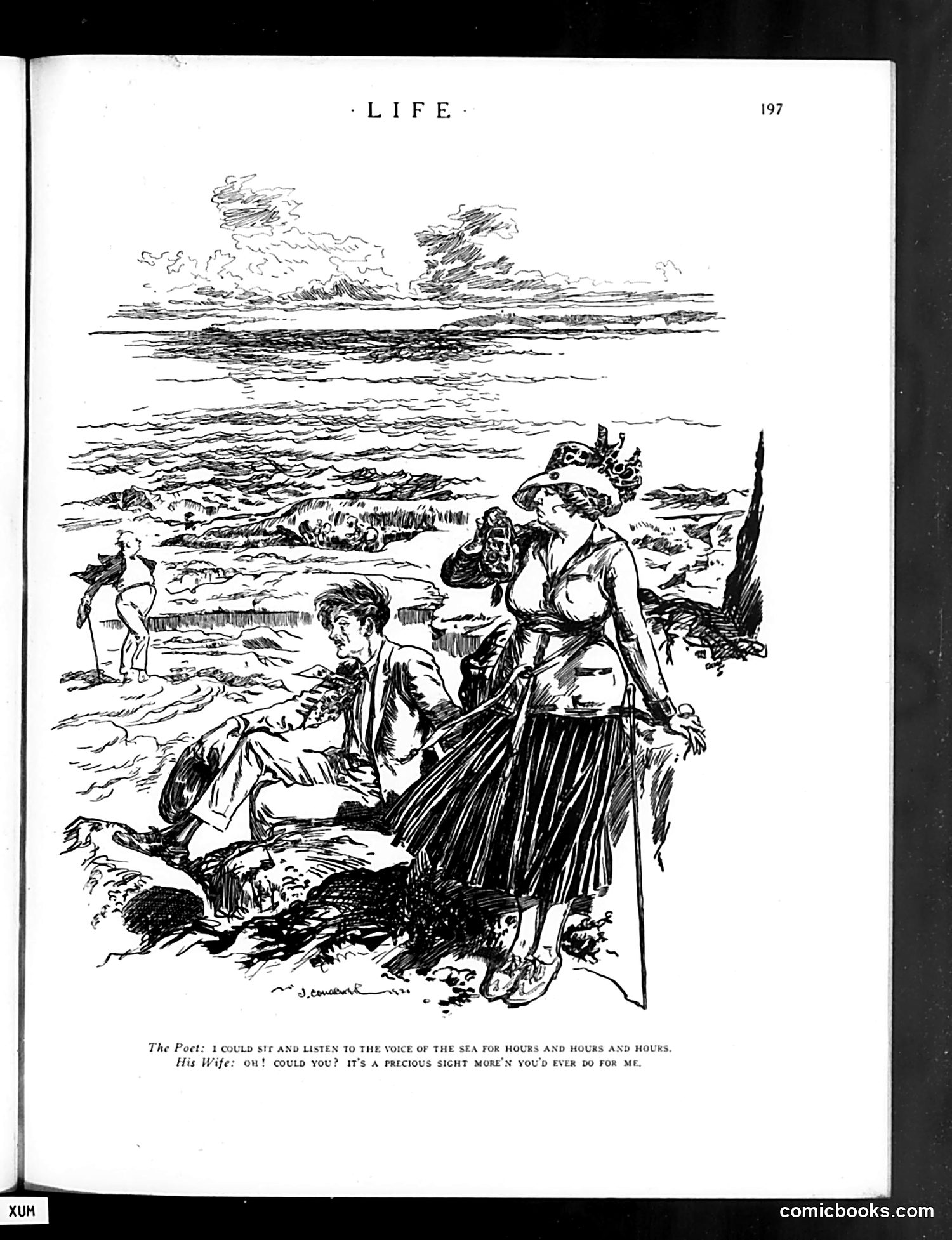
This is a domestic humor cartoon satirizing romantic male pretension. A poet sits gazing at the sea, waxing poetic about listening to its "voice" for endless hours. His wife punctures this sentimentality with sharp practicality: she's saying he'd never devote that kind of attention and time to *her*, despite marriage vows implying he should value her company above nature's abstractions. The joke relies on the period's common stereotype of husbands neglecting their wives' emotional needs while romanticizing external pursuits. The wife's direct, unglamorous dialect contrasts with the poet's flowery language, emphasizing the gap between male idealism and female pragmatism in marriage. It's gently mocking male self-absorption disguised as artistic sensitivity.
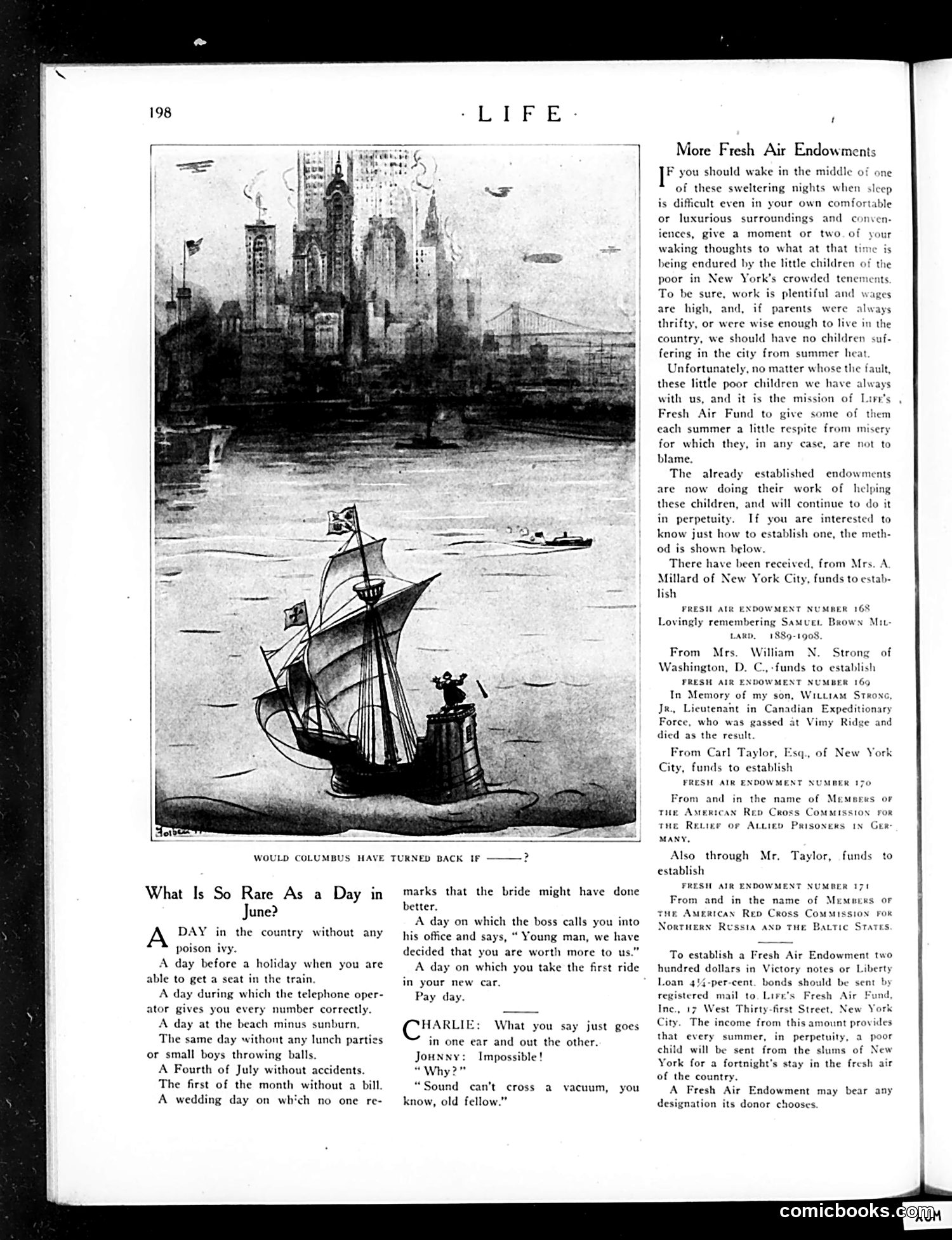
This page combines social commentary with humor typical of early 20th-century Life magazine. The main cartoon depicts Columbus's ship approaching a modern New York City skyline, posing the question "Would Columbus have turned back if—?" This is satirical commentary on urbanization and industrial America: the implication is that the explorer might have reconsidered "discovering" America upon seeing the crowded, polluted modern city. Below this is a humorous list titled "What Is So Rare As a Day in June?"—playing on the Lowell poem. It catalogs everyday American frustrations: poison ivy, train crowding, telephone operator errors, sunburn, bills, and romantic skepticism at weddings. The Charlie/Johnny dialogue jokes about sound traveling through a vacuum, reflecting early-20th-century pseudo-scientific humor. The page's substantial remainder promotes Life's "Fresh Air Fund," soliciting donations for endowments sending poor NYC tenement children to the countryside during summers. Multiple specific endowments are listed, some memorial gifts honoring the deceased, others from organizations like the Red Cross. This reflects Progressive Era charitable concerns about urban poverty and child welfare.
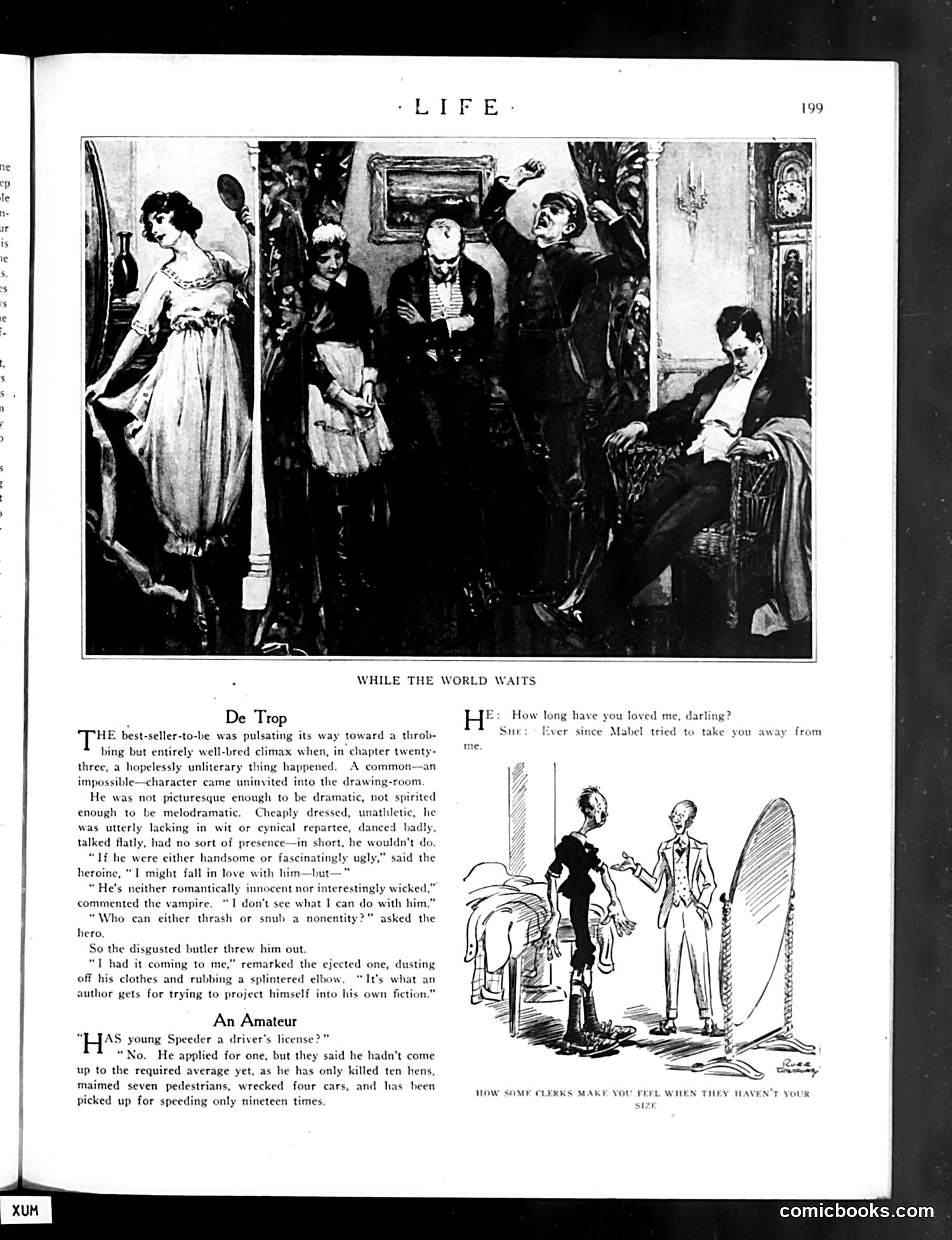
This page from *Life* magazine contains two satirical pieces: **"While the World Waits"** mocks pretentious literary fiction. A bestselling novel's climactic scene is ruined when an ordinary, unglamorous character—a common man—appears uninvited. The characters (heroine, vampire, hero) find him useless because he lacks the required dramatic qualities: he's neither handsome nor fascinatingly ugly, neither romantically innocent nor wickedly sophisticated. The butler ejects him. The joke satirizes how highbrow fiction demands artificially heightened characters and ignores ordinary reality. **"An Amateur"** is a brief joke about a reckless young driver named Speeder. When asked if he has a license, the answer is no—despite killing ten hens, maiming seven pedestrians, and wrecking four cars, he hasn't met the "required average" yet and has only been cited for speeding nineteen times. This absurdist humor mocks both dangerous driving and bureaucratic standards. The bottom cartoon satirizes rude retail clerks who make customers feel inadequate.
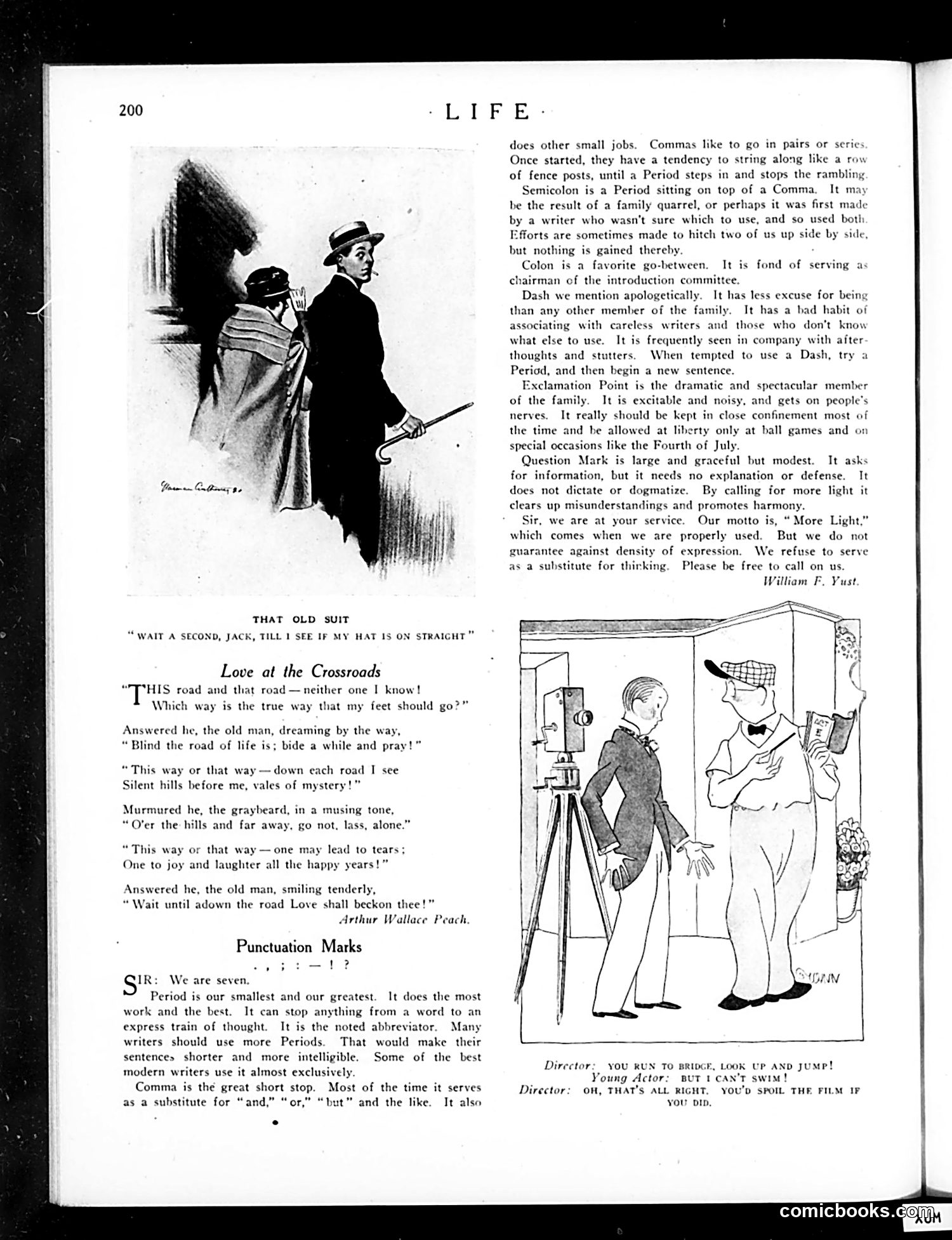
This page contains educational and humorous content rather than political satire. **"Punctuation Marks"** is a personified essay by William F. Yust describing punctuation as a family of characters. The Period is "smallest and greatest," the Comma a "great short stop," the Semicolon a "Period sitting on top of a Comma," and the Dash is criticized as having "a bad habit of associating with careless writers." The Exclamation Point is "excitable and noisy" and should be "kept in close confinement." This whimsical presentation teaches grammar through character sketches. **"Love at the Crossroads,"** a poem by Arthur Wallace Peach, depicts a young woman at a metaphorical crossroads asking an old man which life path to take. He offers romantic, philosophical counsel about trusting Love to guide her. The cartoon *"That Old Suit"* shows two men, one asking the other to wait while he checks if his hat is straight—a simple visual gag about vanity or nervousness. The page represents early 20th-century *Life* magazine's blend of light verse, practical advice, and gentle humor.
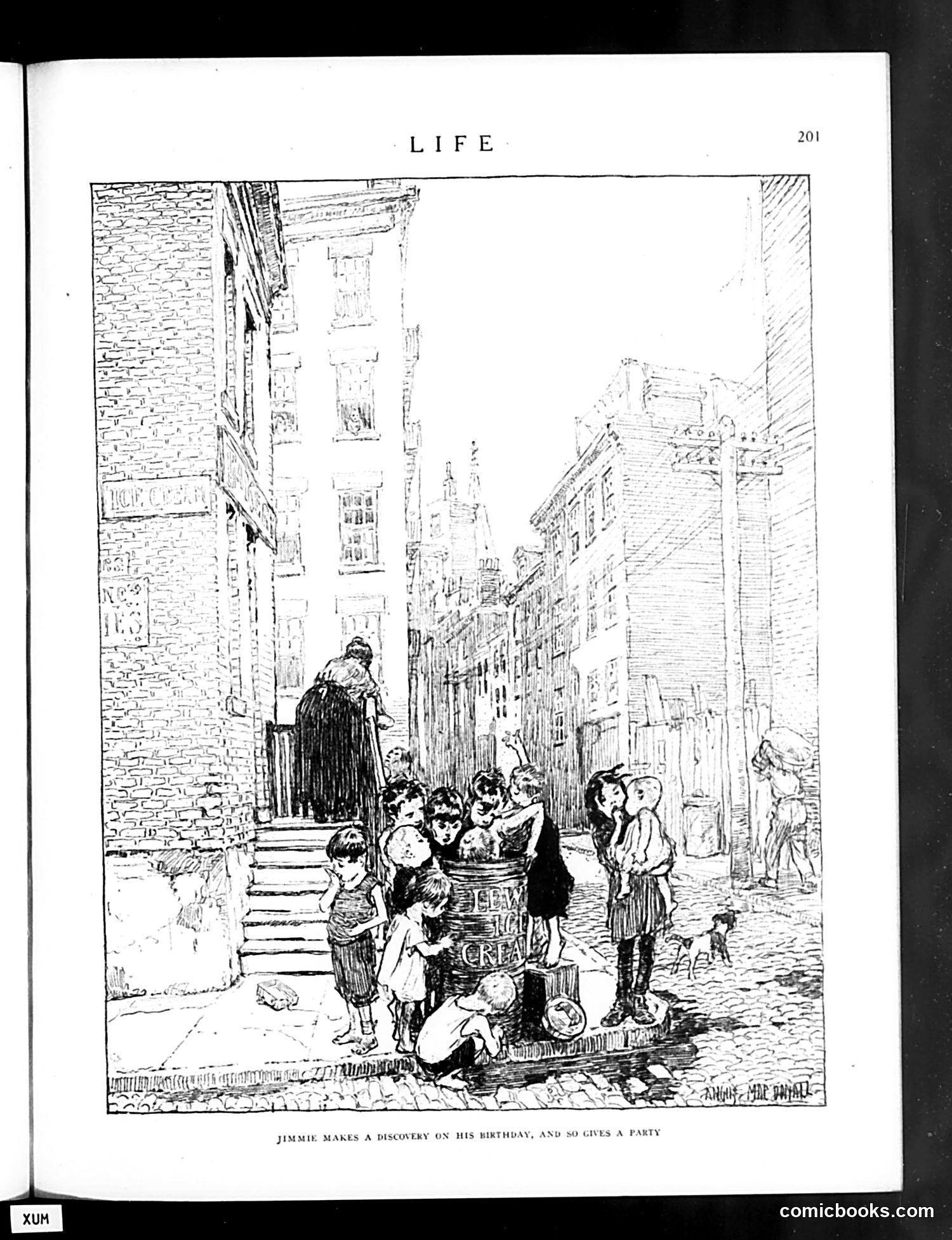
This illustration depicts a street scene with children gathered around what appears to be an ice cream cart or vendor stand (marked "ICE CREAM"). The caption indicates "Jimmie makes a discovery on his birthday, and so gives a party." The humor appears gentle and domestic rather than political: a child named Jimmie has discovered ice cream on his birthday and is sharing it with neighborhood children as a celebration. The detailed pen-and-ink drawing shows a crowded urban alley with brick buildings, characteristic of early 20th-century American city life. This is simple narrative humor—a boy's innocent pleasure leading to a spontaneous party—rather than political satire. It captures a relatable childhood moment without apparent social commentary or caricature of identifiable figures.
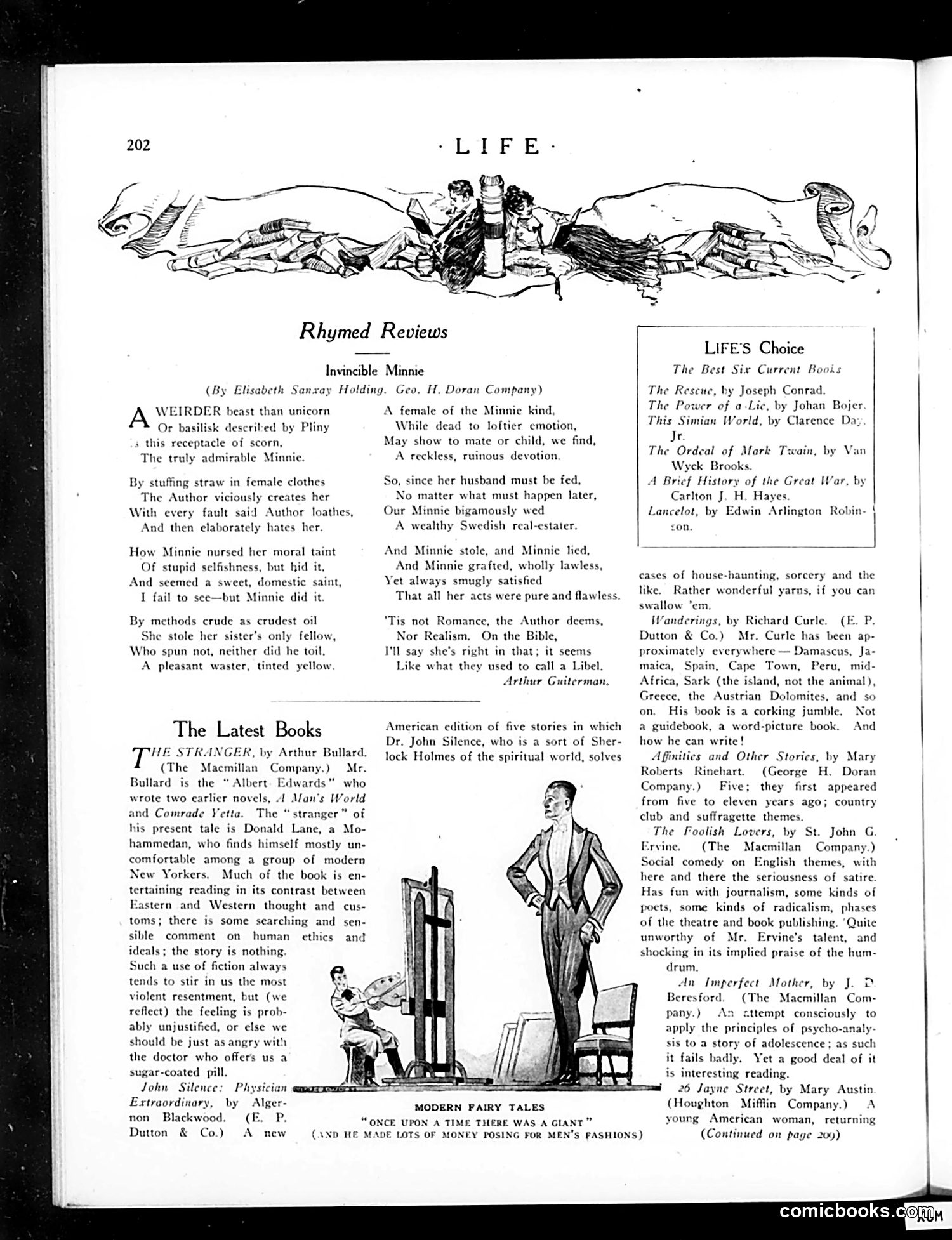
This page features a satirical cartoon titled "Modern Fairy Tales" with the caption: "Once upon a time there was a giant—and he made lots of money posing for men's fashions." The joke is a commentary on early 20th-century consumer culture and masculinity. The illustration shows an oversized man in fashionable clothing posed like a model, with a smaller figure admiring or studying him below—likely a tailor, designer, or fashion advertiser. The satire mocks how modern commercial culture has replaced traditional heroic narratives (giants in fairy tales represent power and danger) with shallow consumer aspiration. The "giant" achieves wealth not through strength or conquest, but through modeling clothes—a feminized, commercialized activity that would have seemed absurd or undignified to earlier generations. The cartoon criticizes how advertising and fashion manufacture artificial ideals of masculinity for profit.
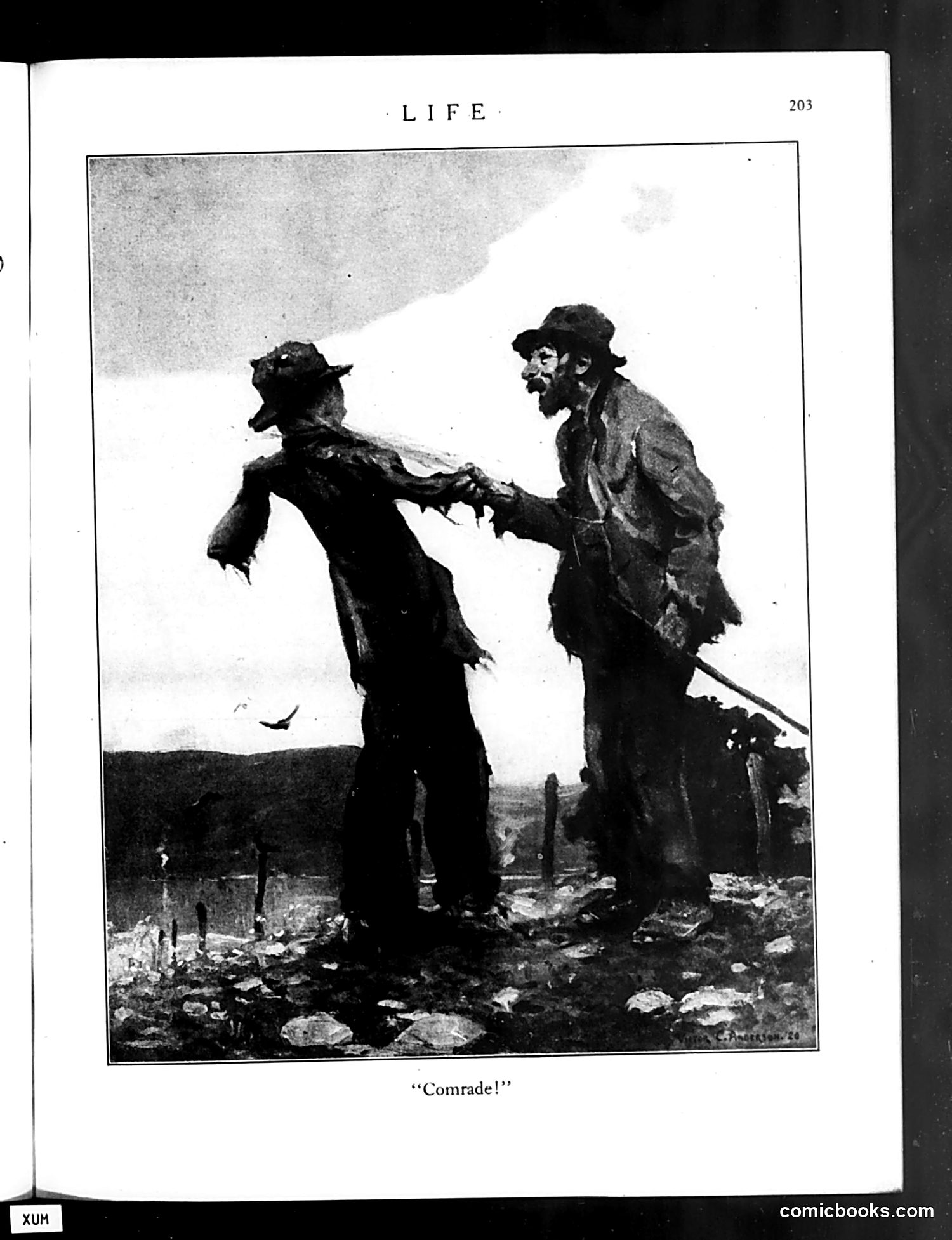
This political cartoon depicts two figures in a desolate, war-torn landscape. One appears to be a skeletal or death-like figure on the left, while the other on the right is a bearded man in worn clothing. The greeting "Comrade!" suggests a meeting between two communist or revolutionary figures. The satire likely criticizes communism or communist ideology, depicting it as associated with death, decay, and destruction—represented by the barren battlefield setting and the skeletal appearance of one figure. The cartoon appears designed to warn readers about communist movements by linking them visually to devastation and mortality, a common Cold War-era propaganda approach. The specific historical context or figures referenced remains unclear without additional dating or attribution information.
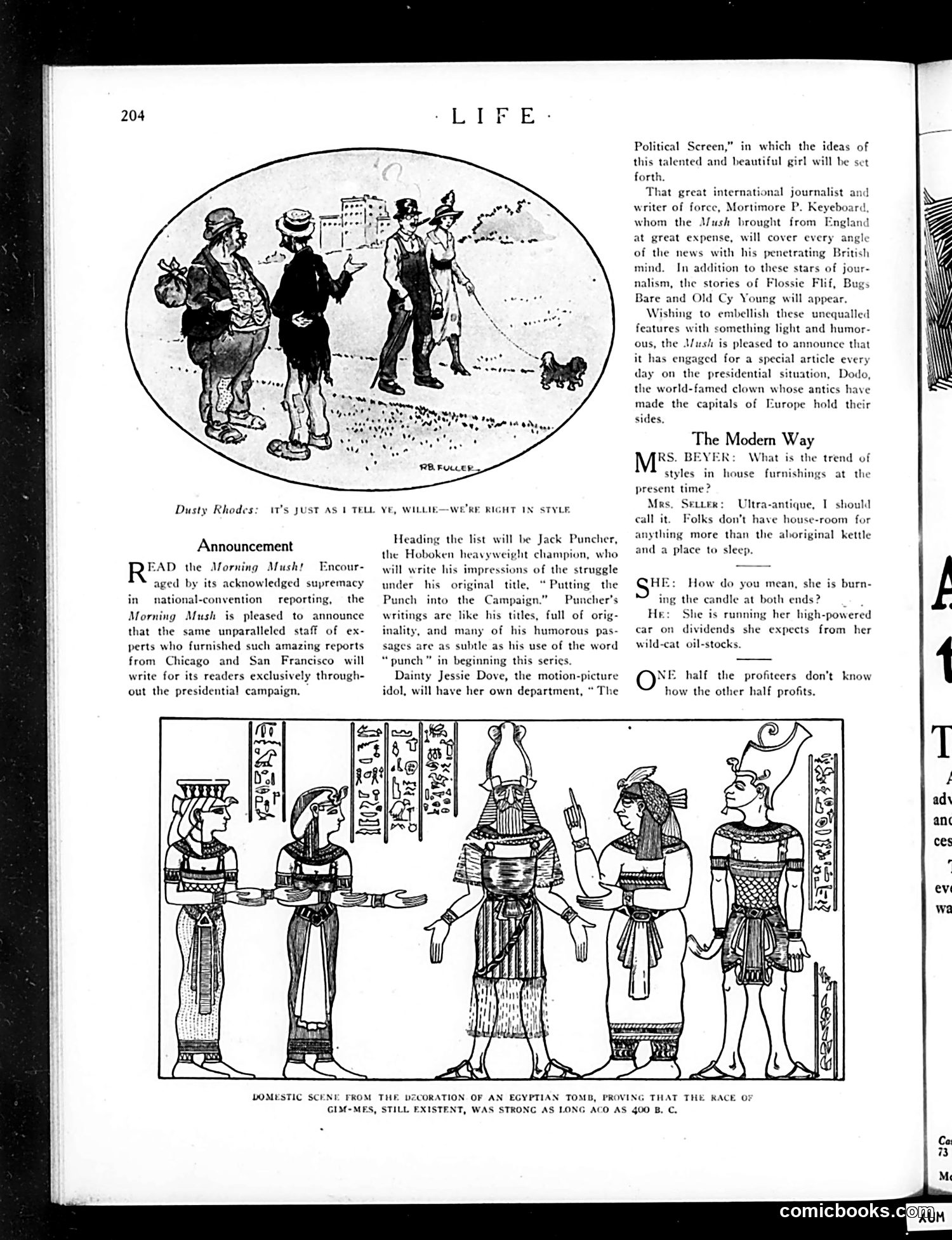
This page satirizes presidential campaign journalism and modern consumer culture circa the 1920s. **Top cartoon**: "Dusty Rhodes" mocks sensationalist political reporting. The *Morning Mush* newspaper announces hiring boxing champion Jack Puncher, actress Jessie Dove, and other unqualified celebrities as campaign correspondents—satirizing how publications hired famous names rather than serious journalists to cover elections. **"The Modern Way" dialogue**: Three brief exchanges mock contemporary trends. One ridicules "ultra-antique" interior design as economical necessity; another jokes about women living off speculative "wild-cat" oil stocks rather than legitimate income; the final quip suggests profiteers don't understand each other's schemes. **Bottom illustration**: An Egyptian tomb scene humorously claims ancient Egyptians were "gim-mes" (gimme-people/greedy), suggesting human nature—and consumer greed—is timeless, unchanged since 400 B.C. Overall, the page satirizes sensationalism in journalism, financial speculation, and materialistic modern life.
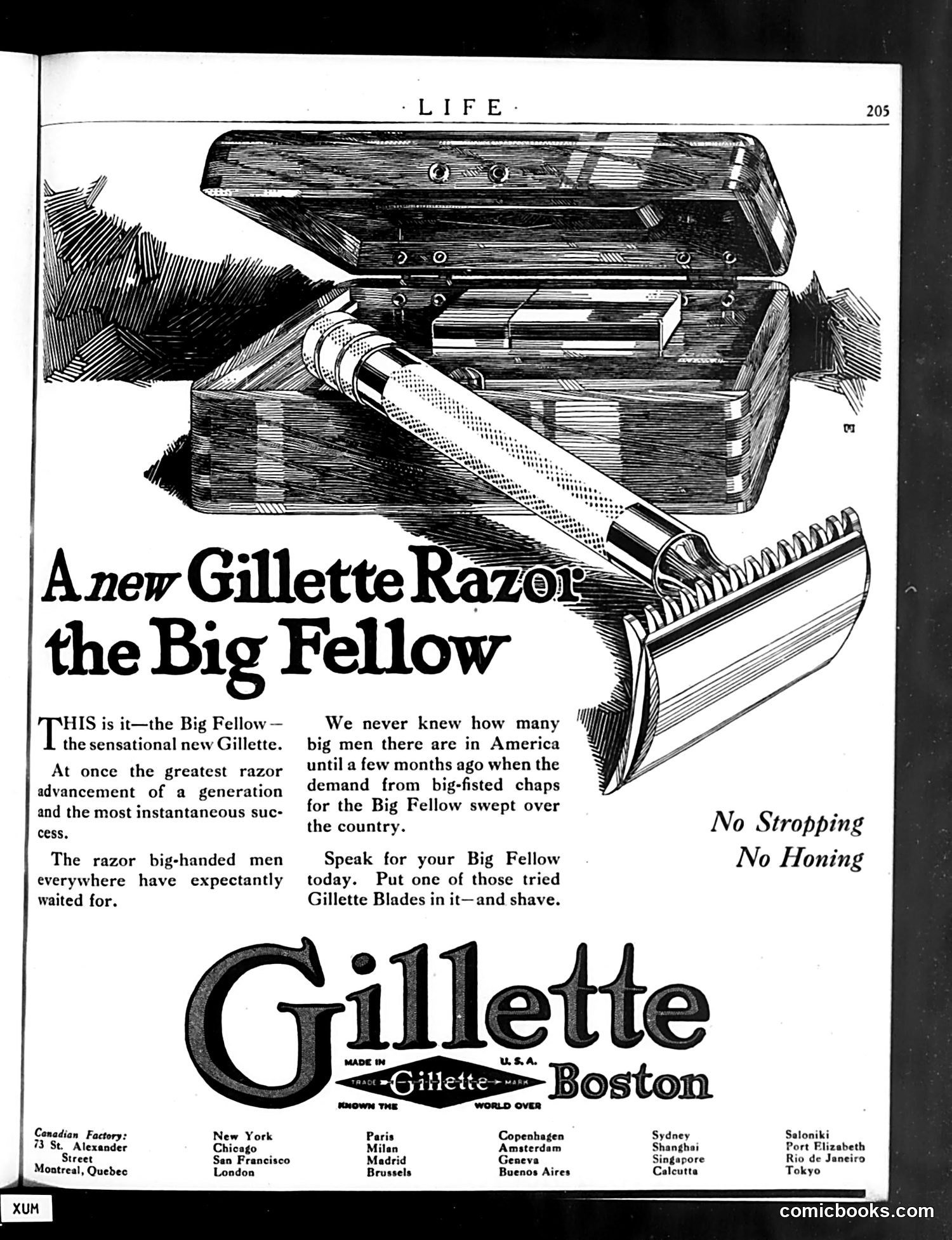
This is a **Gillette razor advertisement**, not political satire. The page promotes the "Big Fellow," a new safety razor marketed specifically for men with large hands. The humor is mild and commercial: the ad claims that demand from "big-fisted chaps" for this oversized razor "swept over the country," supposedly revealing how many large men exist in America. The joke plays on the idea that big men had been waiting for a razor proportioned to their size. Key selling points emphasized are "No Stropping / No Honing"—advantages over traditional straight razors requiring maintenance. The product illustration shows the razor in its case alongside a brush. This is purely **product marketing** using gentle humor about physical size to appeal to masculine identity and practicality. The "Big Fellow" branding anthropomorphizes the razor itself. Gillette's international factory locations listed at bottom indicate this was a major global manufacturer by this period.
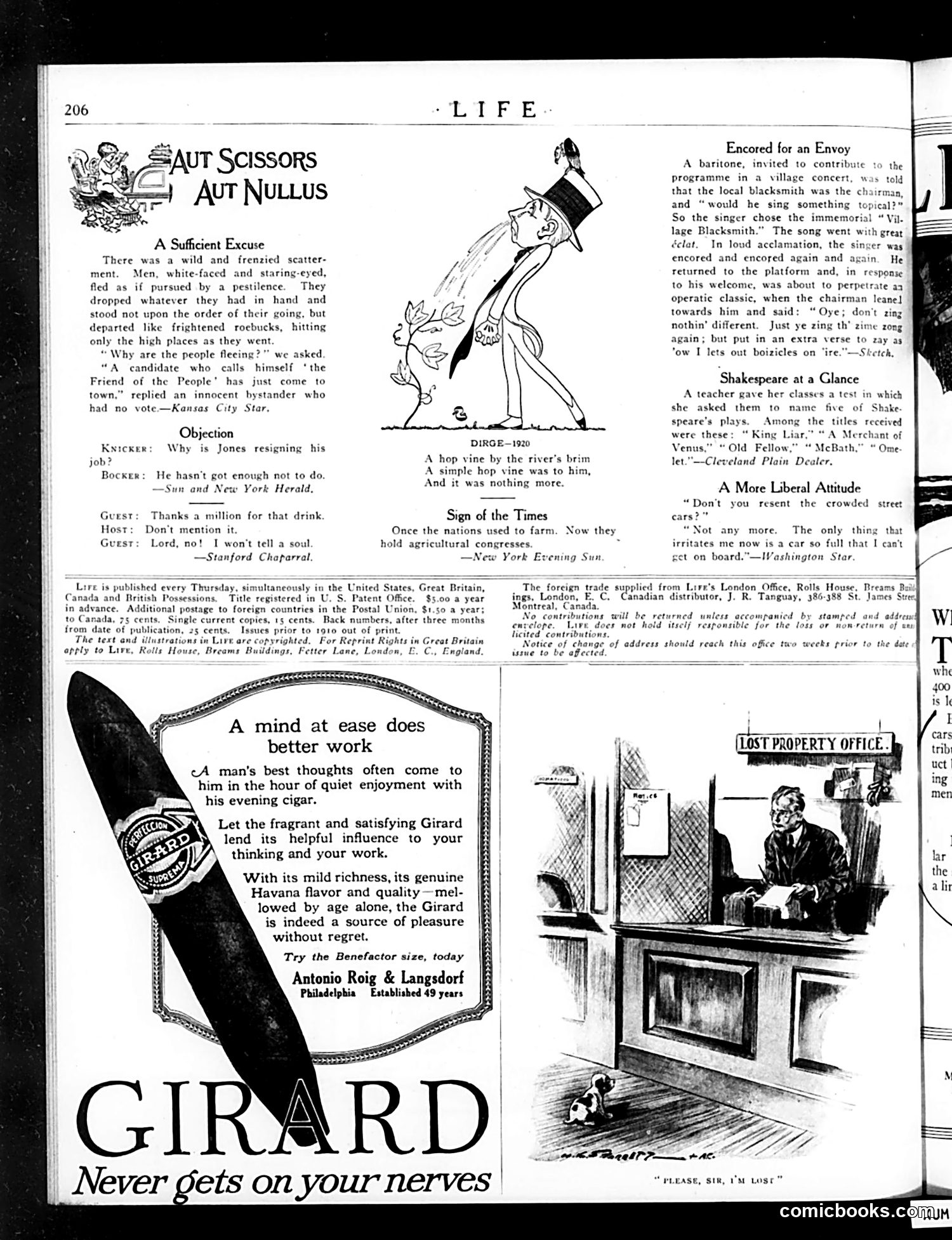
This page contains multiple short satirical pieces typical of Life's humor format: **"A Sufficient Excuse"** mocks political candidates who style themselves "Friends of the People"—their mere arrival causes panicked flight, suggesting their populist rhetoric is hollow and people instinctively distrust them. **"Objection"** is a one-liner joke: Jones resigns because he lacks sufficient reasons *not* to—commenting on workplace mediocrity or lack of conviction. **"Sign of the Times"** contrasts agricultural societies with modern car culture, suggesting societal shift from farming to automobiles as a defining concern. **"Shakespeare at a Glance"** humorously depicts students mangling Shakespeare titles ("King Lia," "McBath"), capturing the perennial problem of student ignorance. **"A More Liberal Attitude"** presents someone unbothered by crowded streets—only irritated when cars are too full to board, reflecting early automobile-era anxieties. The **Girard cigar advertisement** uses pseudo-philosophical copy about productivity and contemplation to sell cigars. Overall, the page reflects 1920s American preoccupations: political skepticism, automotive culture, and educational standards.
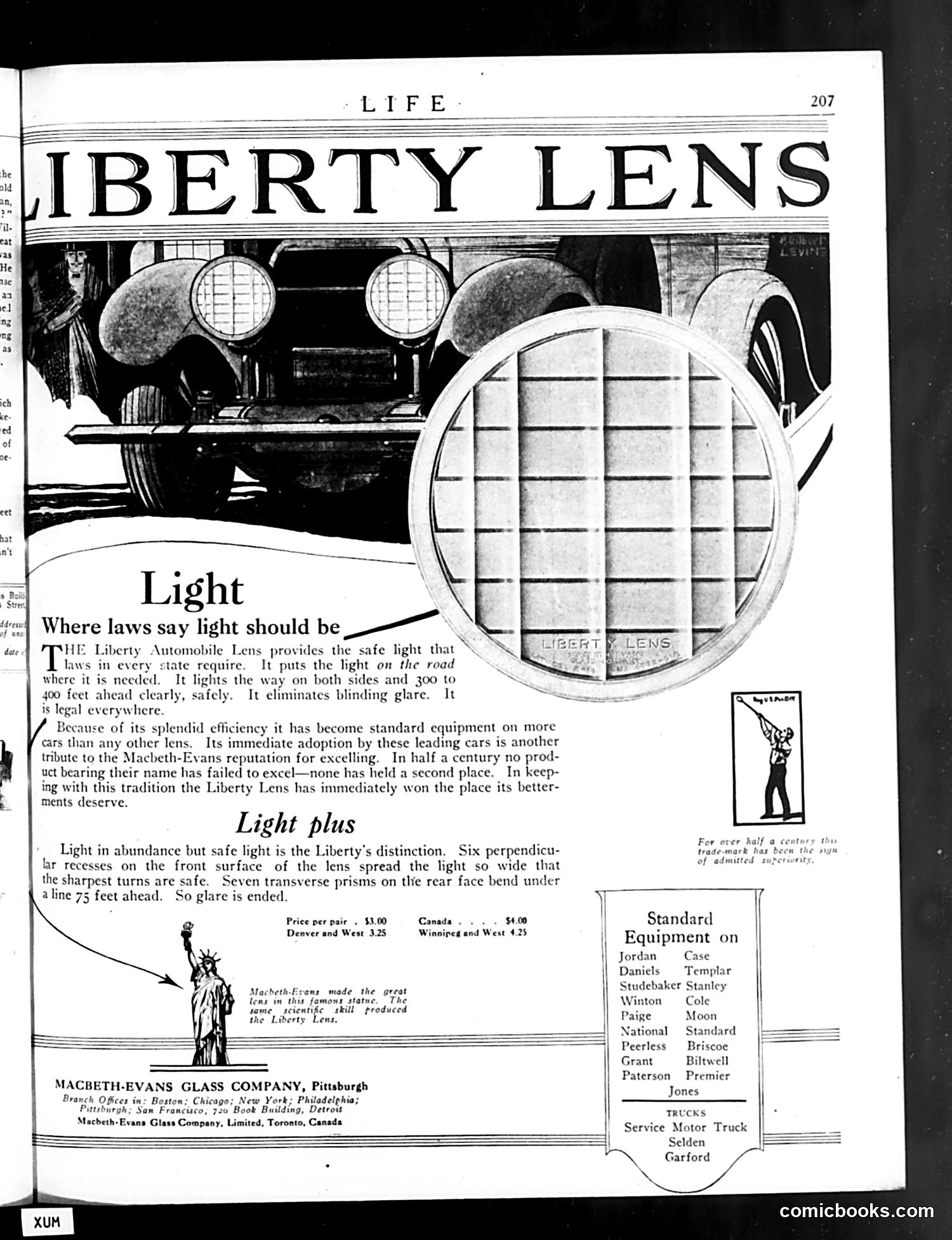
This is a **product advertisement**, not political satire. It promotes the Liberty Automobile Lens, manufactured by Macbeth-Evans Glass Company. The page uses the Statue of Liberty as a visual metaphor—the statue appears holding a torch, connecting Liberty the brand name to the product's function (providing light). The ad emphasizes that the lens provides safe, legal automotive lighting by spreading light widely without glare, meeting state regulations. The advertisement lists major automobile manufacturers of the era (Jordan, Studebaker, Paige, National, etc.) as standard equipment users, establishing credibility through adoption by leading cars. Pricing varies by region. This represents early automotive safety marketing—automobile headlights were a relatively new technology requiring standardization and legal compliance. The patriotic imagery (Statue of Liberty) links American manufacturing quality to the product.
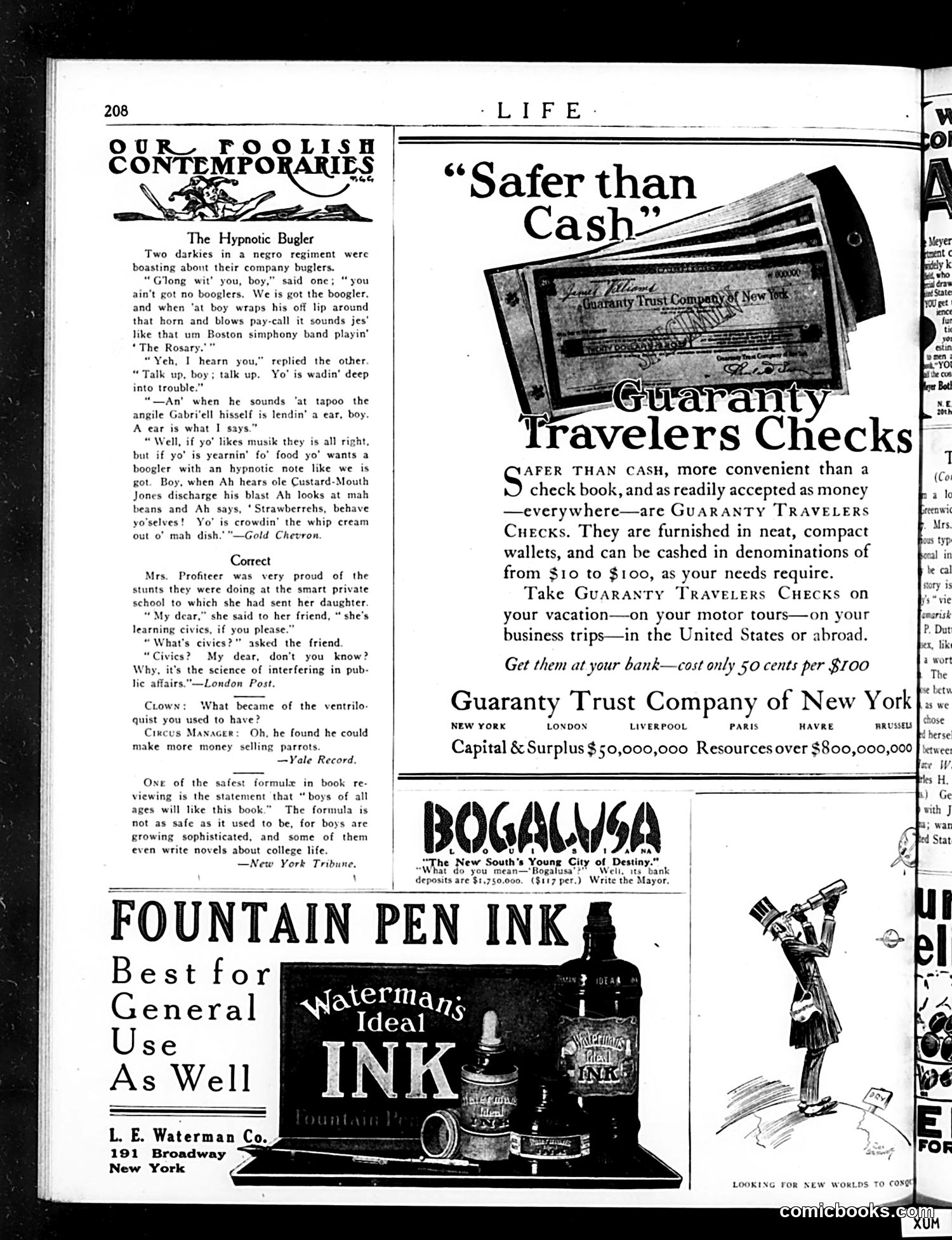
This page contains three brief satirical items under "Our Foolish Contemporaries": 1. **"The Hypnotic Bugler"**: A dialect joke featuring two African American soldiers debating whose regiment's bugler is superior. The humor relies on racial stereotypes and exaggerated dialect speech, mocking Black soldiers' speech patterns while depicting them as obsessed with food. 2. **"Correct"**: Mocks a wealthy woman ("Mrs. Profiteer") who confuses "civics" (the study of government and citizenship) with "civies," which she defines as "the science of interfering in public affairs." The satire targets upper-class ignorance. 3. **"Clown"**: A brief joke about a ventriloquist whose dummy parrot became more profitable than the ventriloquist himself—commenting on entertainment economics. The page is primarily **advertisements** (Guaranty Travelers Checks, Waterman's Ink, and Bogalusa, Louisiana). The cartoons exemplify early 20th-century American humor conventions: racial caricature, class mockery, and wordplay.
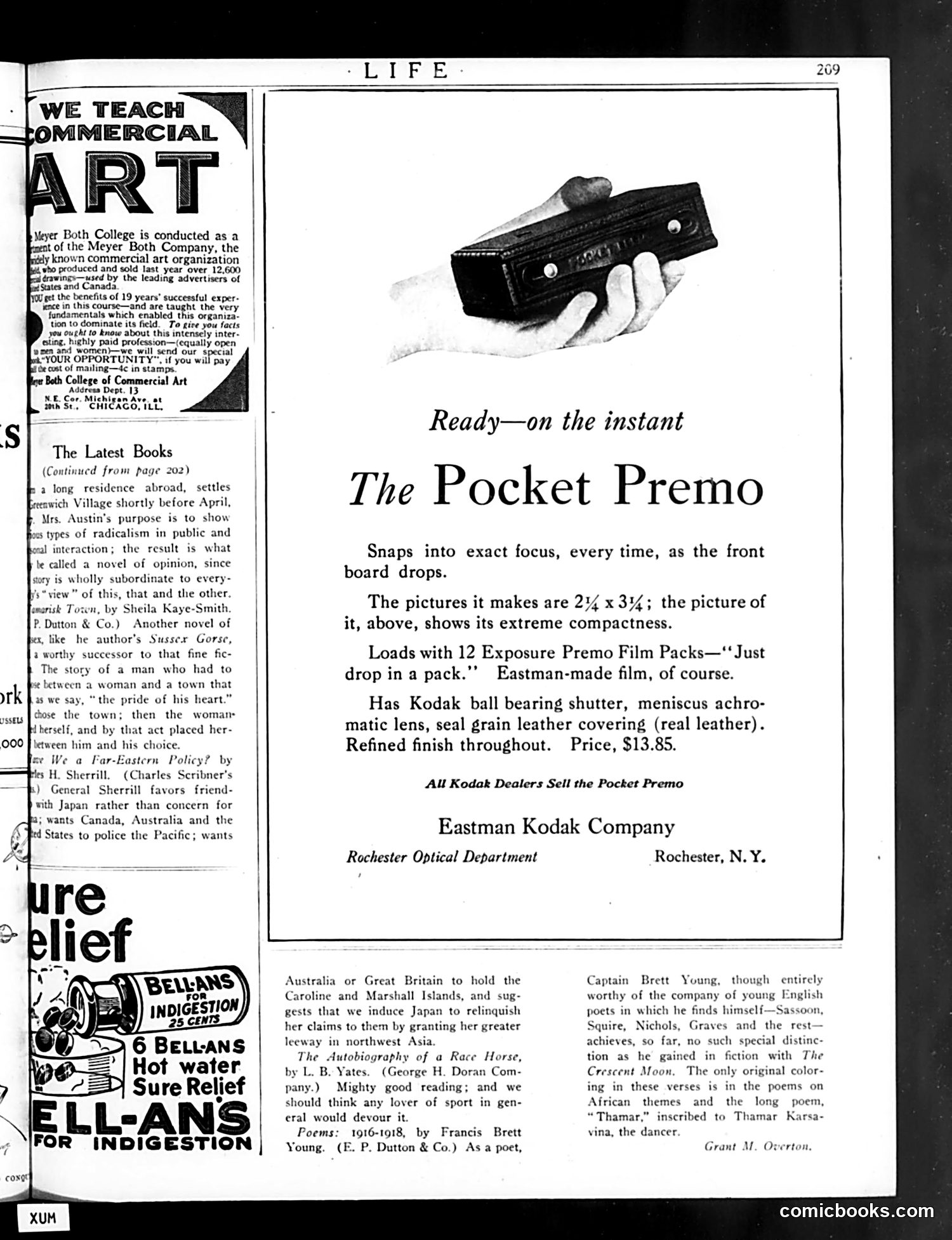
This page is primarily **advertising and book reviews**, not political satire. The main content features: 1. **Commercial Art School Advertisement** (top left): Meyer Both College promotes itself as a leading commercial art organization that trained advertisers' artists. It's a straightforward vocational school ad. 2. **The Pocket Premo Camera Advertisement** (center/right): Eastman Kodak Company advertises their compact pocket camera ($13.85), highlighting its automatic focus and portability—a consumer product pitch. 3. **Book Reviews** (bottom): Literary reviews of contemporary works, including novels about radicalism and a horse autobiography—cultural commentary without political cartoon elements. 4. **Bellans Advertisement** (bottom left): A patent medicine ad for indigestion relief. There are **no political cartoons or caricatures** on this page. It's a typical early 20th-century magazine page mixing commercial advertisements with book reviews—standard Life magazine content from this era.
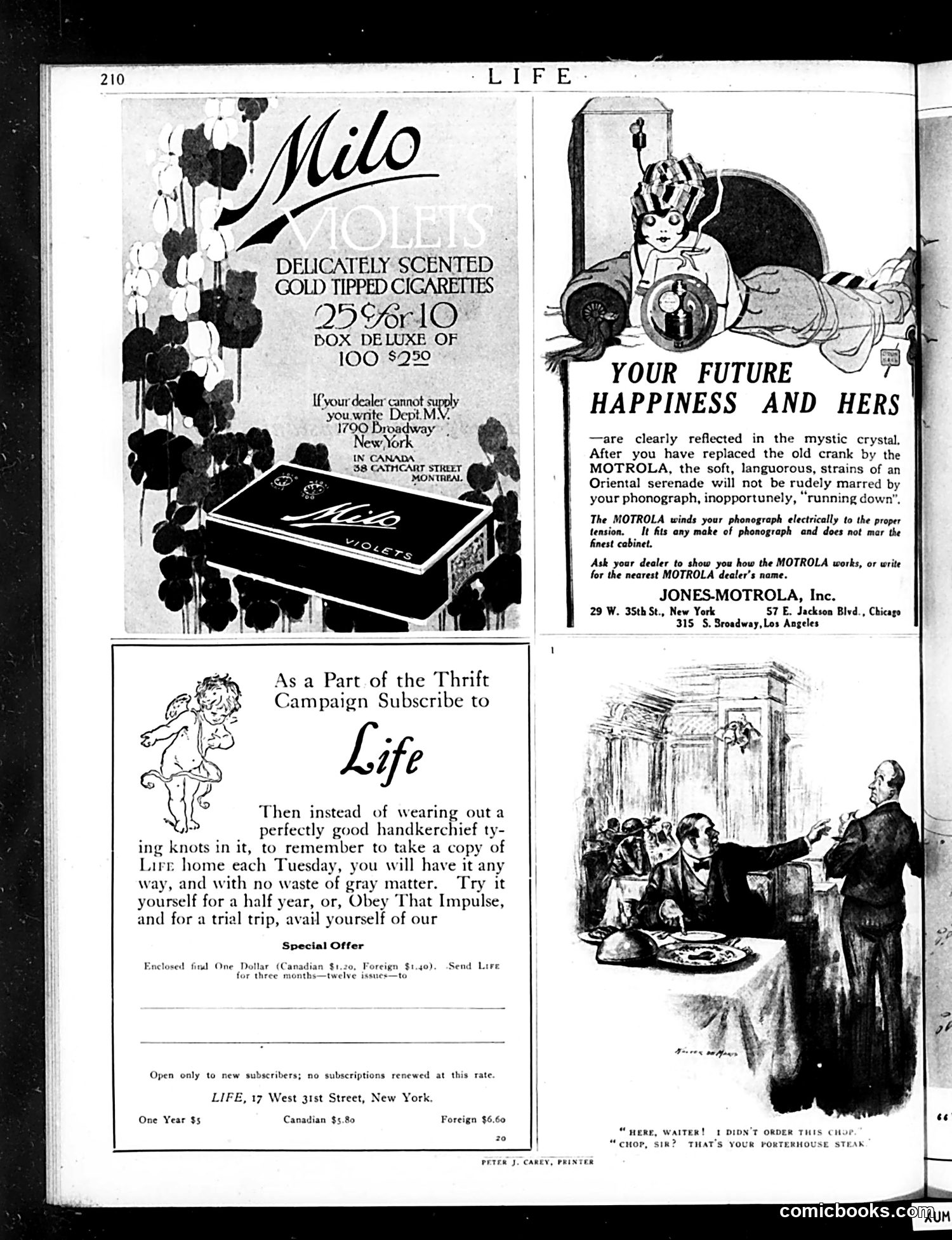
This page primarily contains **advertisements and promotional content** rather than satirical cartoons. The **Milo Violets cigarette ad** (top left) markets luxury "delicately scented" cigarettes, appealing to affluent consumers with decorative violet imagery. The **Life magazine subscription pitch** (center) uses self-deprecating humor to promote subscriptions as a practical alternative to tying knots in handkerchiefs as memory aids—a tongue-in-cheek appeal to readers' efficiency during what appears to be a "Thrift Campaign." The **Motrola advertisement** (top right) promotes an electric motor attachment for phonographs, using mystical imagery and a fortune-teller aesthetic to suggest it will improve musical playback. The **single cartoon** (bottom right) depicts a restaurant scene with a waiter and customer with the caption about a "porterhouse steak"—an apparent pun or joke about the waiter's mistake, though the specific reference is unclear without additional context. The page represents **early 20th-century magazine advertising** targeting middle to upper-class consumers with luxury goods.
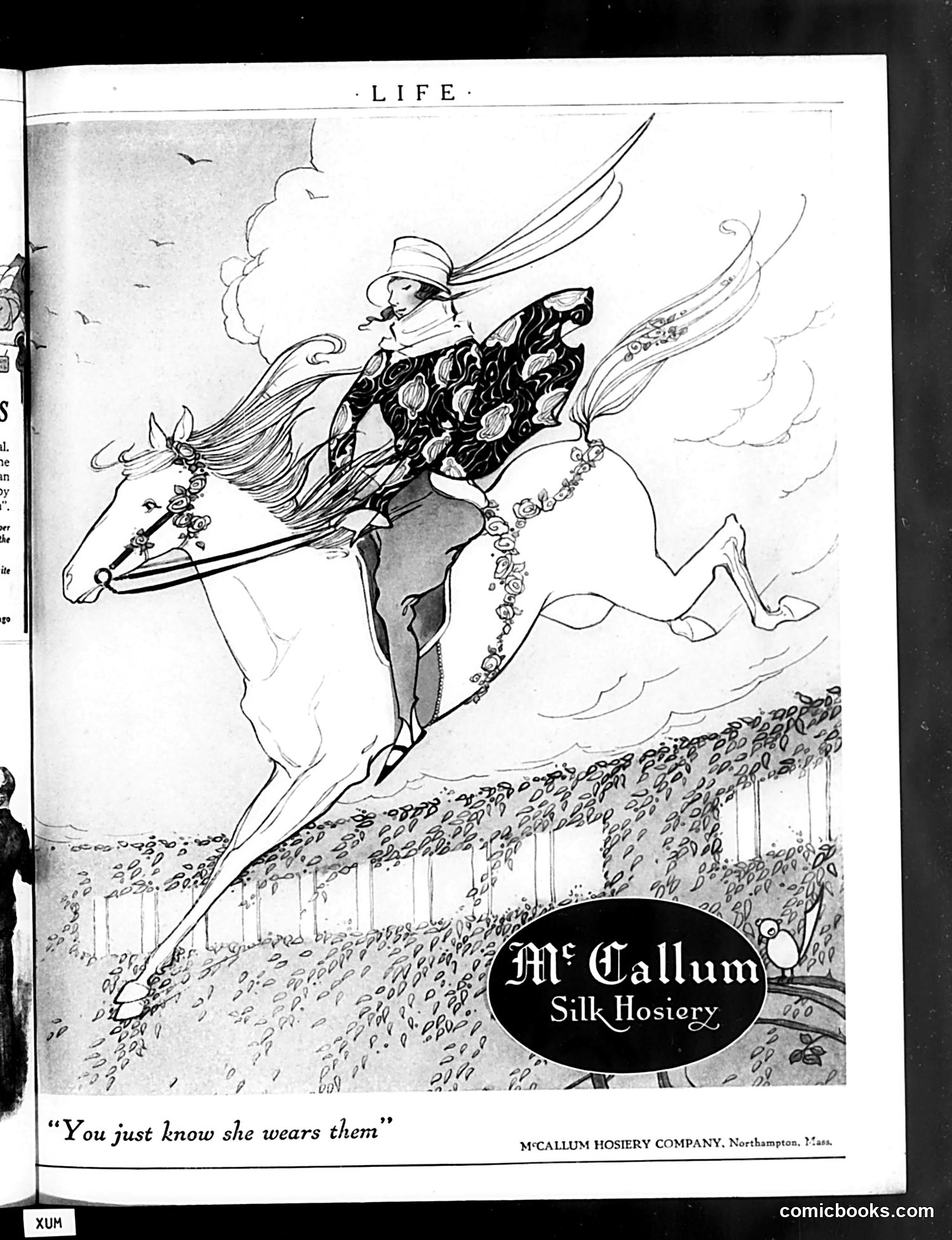
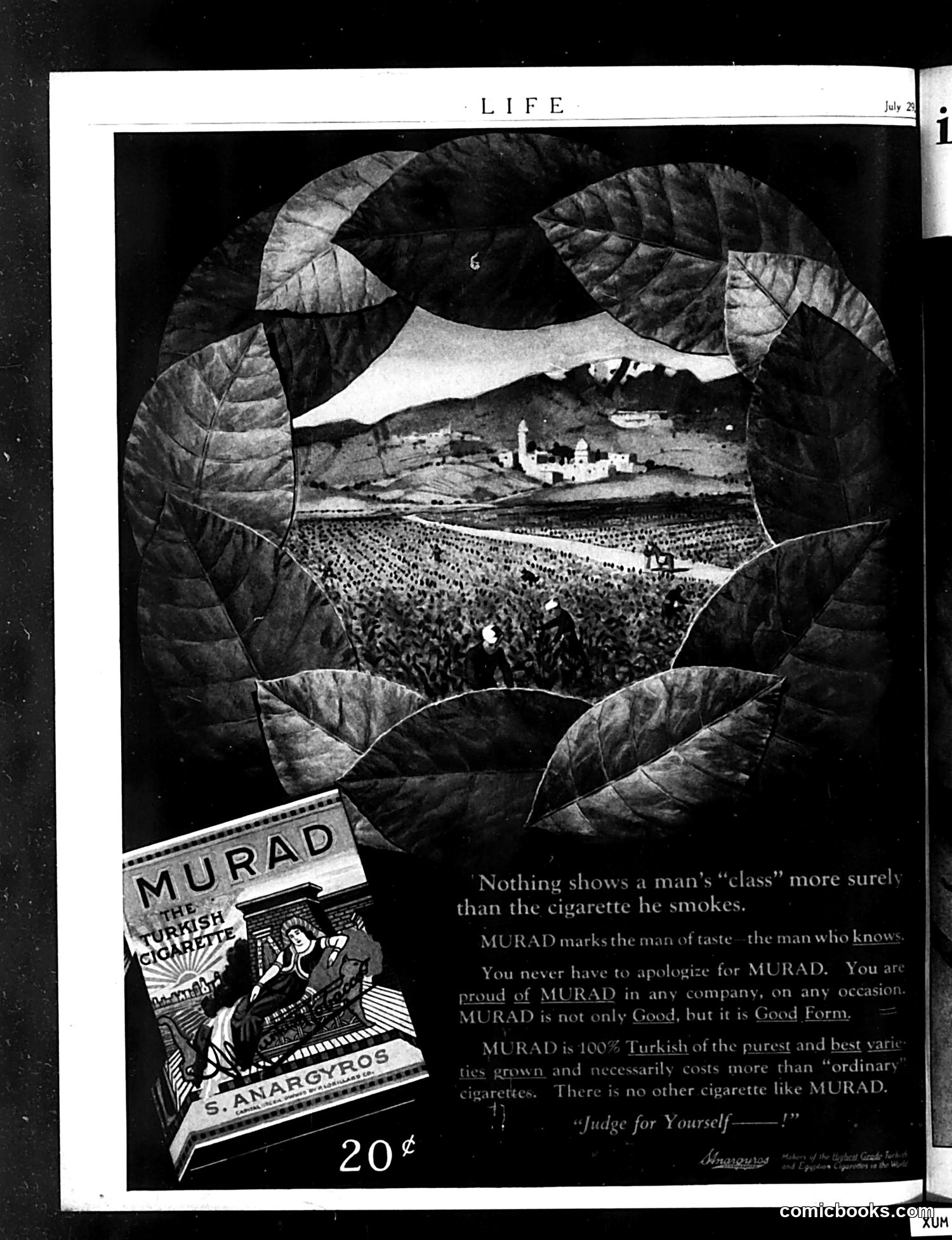
This is a **cigarette advertisement**, not political satire. The page promotes Murad Turkish cigarettes, priced at 20¢. The ad uses a framing device: large tobacco leaves frame a landscape vista showing agricultural fields and a distant town, suggesting the product's origin in tobacco-growing regions (likely Turkey or the Middle East, given "Turkish" emphasis). The copy employs **aspirational marketing** common to early 20th-century advertising, claiming that smoking Murad signals "class" and "good form"—social respectability. The ad asserts Murad's superiority through purity ("100% Turkish") and cost ("necessarily costs more than 'ordinary' cigarettes"). The pitch appeals to vanity and social anxiety: smoking this brand supposedly requires no apology in any company. This reflects an era when cigarettes were marketed as status symbols rather than health products.