
Life, 1920-07-29 · page 26 of 36
Life — July 29, 1920 — page 26: what you’re looking at
What you’re looking at
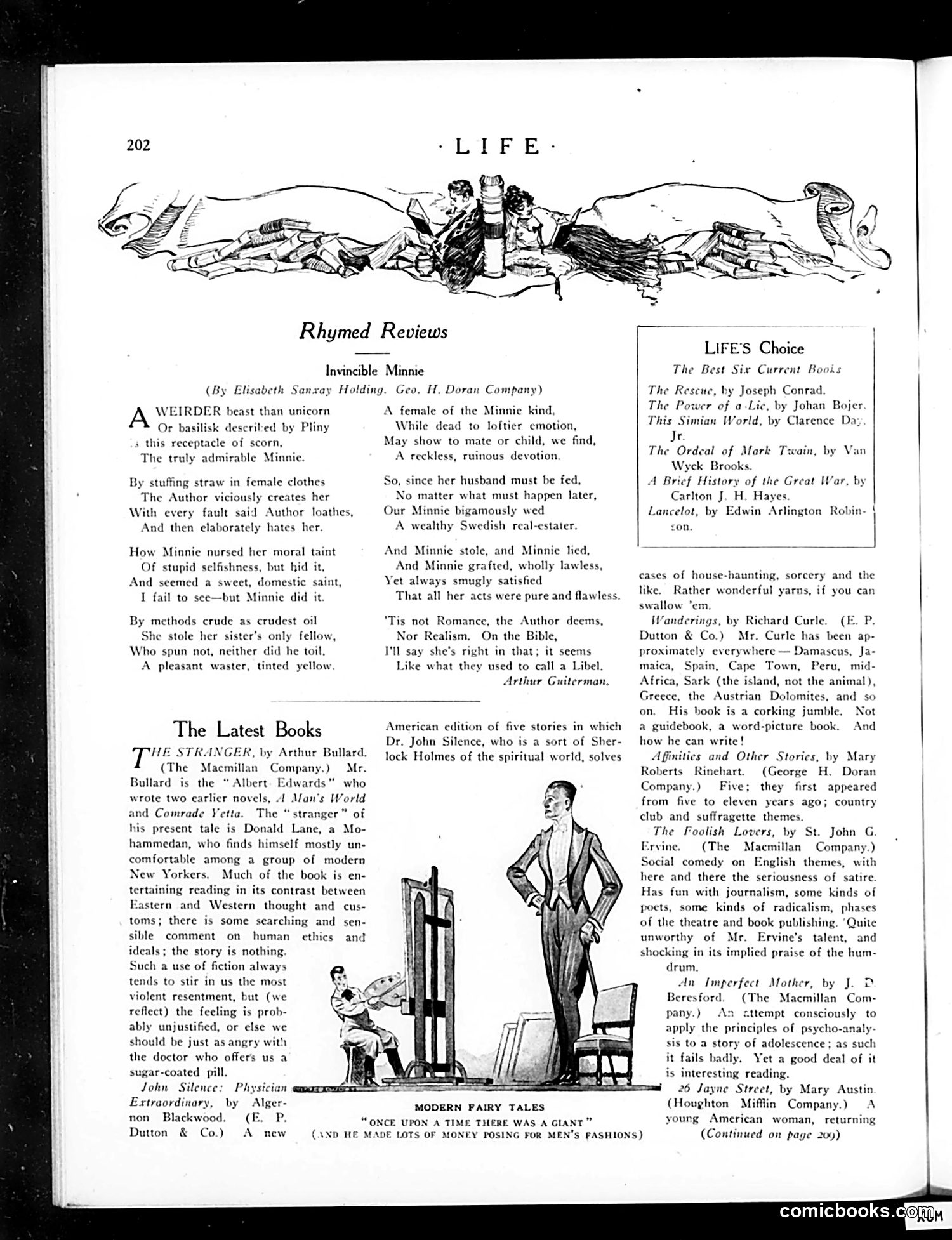
This page features a satirical cartoon titled "Modern Fairy Tales" with the caption: "Once upon a time there was a giant—and he made lots of money posing for men's fashions." The joke is a commentary on early 20th-century consumer culture and masculinity. The illustration shows an oversized man in fashionable clothing posed like a model, with a smaller figure admiring or studying him below—likely a tailor, designer, or fashion advertiser. The satire mocks how modern commercial culture has replaced traditional heroic narratives (giants in fairy tales represent power and danger) with shallow consumer aspiration. The "giant" achieves wealth not through strength or conquest, but through modeling clothes—a feminized, commercialized activity that would have seemed absurd or undignified to earlier generations. The cartoon criticizes how advertising and fashion manufacture artificial ideals of masculinity for profit.
📄 Transcribed text from this page (OCR, searchable)
Machine-transcribed from the original scan — historical spelling and the odd misread are preserved.
Rhymed Reviews Invincible Minnie (By Elisabeth San: WEIRDER beast than unicorn Or basilisk descriled by Pliny s this receptacle of scorn, The truly admirable Minnie. By stuffing straw in female clothes The Author viciously creates her With every fault said Author loathes, And then elaborately ates her. How Minnie nursed her moral taint Of stupid selfishness, but hid it, And seemed a sweet, domestic saint, I fail to see—but Minnie did it. By methods crude as crudest oil She stole her sister's only fellow, Who spun not, neither did he toil, A pleasant waster, tinted yellow. The Latest Books HE STRANGER, by (The Macmillan Company.) Mr. Bullard is the “Albert. Edwards" who wrote two earlier novels, 4 Man's World and Comrade Yetta. The “stranger” of his present tale is Donald Lane, a Mo- hammedan, who finds himself mostly un- comfortable among a group of modern New Yorkers. Much of the book is en- tertaining reading in its contrast between Eastern and Western thought and cus- toms; there is some searching and sen- sible comment on and Arthur Bullard. human ethics ideals; the story is nothing. Such a use of fiction always tends to stir in us the most violent resentment, but (we reflect) the feeling is prob- ably unjustified, or else we should be just as angry with the doctor who offers us a sugar-coated pill. John Silence: Physician Extraordinary, by Alger- non Blackwood. (E. P. Dutton & Co.) Holding. Geo. H. Doran Company) A female of the Minnie kind, While dead to loftier emotion, May show to mate or child, we find, A reckless, ruinous devotion. So, since her husband must be fed, No matter what must happen later, Our Minnie bigamously wed A wealthy Swedish real-estater. And Minnie stole, and Minnie lied, And Minnie grafted, wholly lawless, Yet always smugly satisfied That all her acts were pure and flawless. ‘Tis not Romance, the Author deems, Nor Realism. On the Bible, I'll say she’s right in that; it seems Like what they used to call a Libel. Arthur Guiterman, American edition of five stories in which Dr. John Silence, who is a sort of Sher- lock Holmes of the spiritual world, solves MODERN FAIRY TALES “ONCE UPON A TIME THERE WAS A GIANT” A new (AND HE MADE LOTS OF MONEY POSING FOR ME: LIFE’S Choice The Best Six Current Books The Rescue, by Joseph Conrad. The Power of a-Lie, by Johan Bojer This Simian World, by Clarence Daz Jr The Ordeal of Mark 1 Wyck Brook A Brief History of the Great War, by ain, by Van son, 'S FASHIONS) cases of house-haunting, sorcery and the like. Rather wonderful yarns, if you can swallow ‘em, Wanderings, by Richard Curle. (E. P. Dutton & Co.) Mr. Curle has been ap- proximately everywhere — Damascus, Ja- pain, Cape Town, Peru, mid- » Sark (the island, not the animal), Greece, the Austrian Dolomites, and so on, His book is a corking jumble. Not a guidebook, a word-picture book. And how he can write! Affinities and Other Stories, by Mary Roberts Rinehart. (George H. Doran Company.) Five; they first appeared from five to eleven years ago; country club and suffragette themes The Foolish Lovers, by St. John G. Ervine. (The Macmillan Company.) Social comedy on English themes, with here and there the seriousness of satire. Has fun with journalism, some kinds of pocts, some kinds of radicalism, phases of the theatre and book publishing. ‘Quite unworthy of Mr. Ervine’s talent, and shocking ii implied praise of the hum- drum. An Imperfect Mother, by J. D Beresford. (The Macmillan Com- pany.) ttempt consciously to apply the principles of psycho-analy- sis to a story of adolescence; as such it fails badly. Yet a good deal of it is interesting reading. 26 Jayne Street, by Mary Austin (Houghton Miffin Company.) A young American woman, returning (Continued on page 209) comicbooks.