
Life, 1920-07-29 · page 16 of 36
Life — July 29, 1920 — page 16: what you’re looking at
What you’re looking at
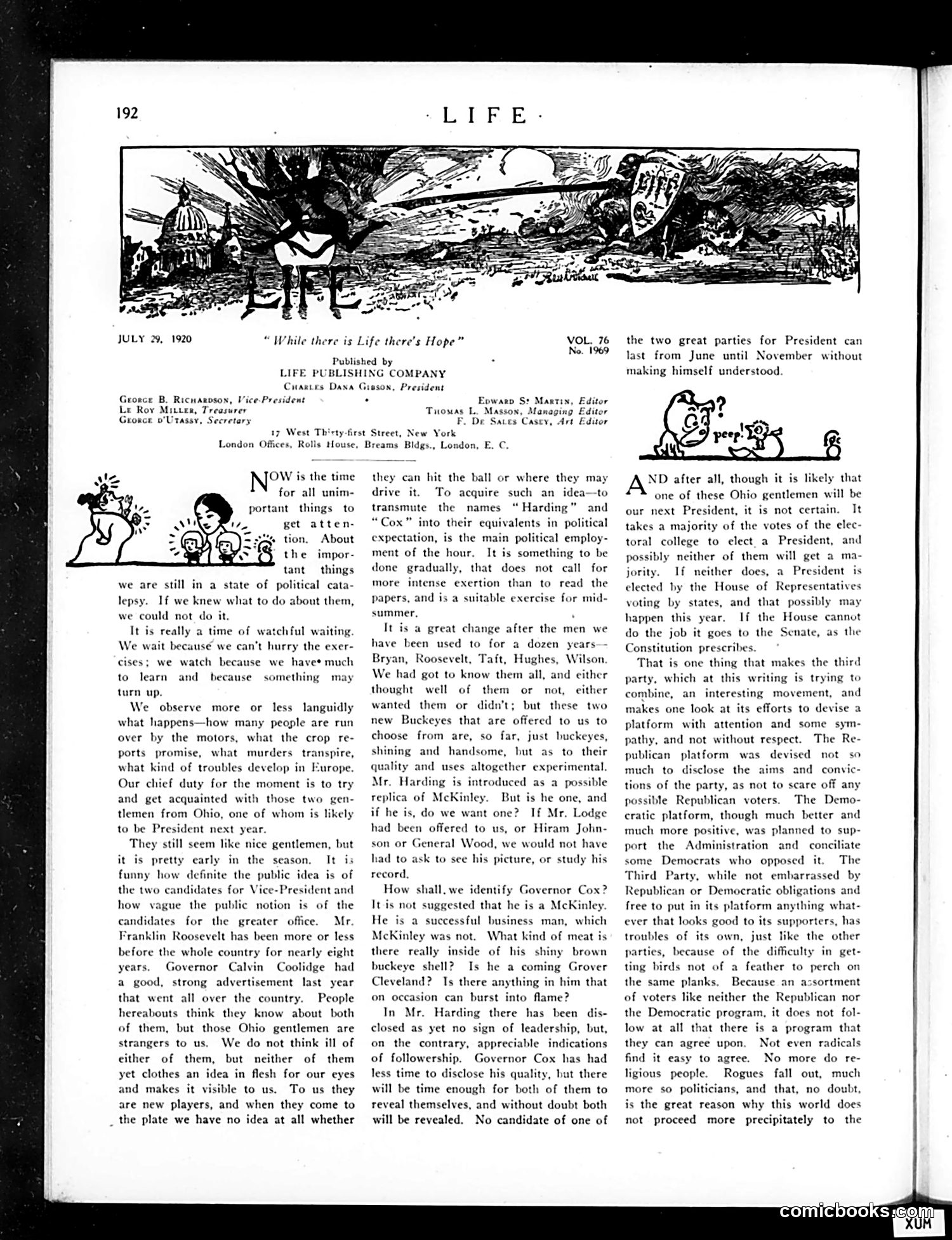
This page discusses the 1920 presidential election. The text debates potential Republican candidates, specifically mentioning **Warren G. Harding** and **Governor Cox** as possibilities, alongside references to figures like Hiram Johnson and General Wood. The small cartoon at top-left appears to depict a figure in political distress or confusion—likely satirizing the uncertainty around candidate selection. The main editorial argues that the public has little concrete knowledge of these candidates and questions their qualifications. It critiques the difficulty in identifying what distinguishes them from one another, suggesting the candidates lack clear, visible differences in platform or character. The overall tone is satirical frustration with the vagueness of the political process and candidates' unclear identities or positions to voters.
📄 Transcribed text from this page (OCR, searchable)
Machine-transcribed from the original scan — historical spelling and the odd misread are preserved.
“ While there is Life there's Hope” Publi PUBLISHING d by COMPANY wagces Dana Gisson, President Grorce B. Ricnasvson, Vice-President Le Rov Mutter, Treasurer Groncr v'Utassy, Secretary . Eowarp St Martix, Editor Tuosas L, Masson, Managing Editor F, De Saves Casey, Art Editor t7 West Thirty-first Street, New York London Offices, Rolls House, OW is the time for all unim- portant things to get atten- About the impor- tant things we are still in a state of political cata- ve tion. lepsy. If we knew what to do about them, we could not do it, It is really a time of watchful w We wait because we can't hurry the ¢ we watch because we havee much to learn turn up. We observe more or less languidly what happens—how many people are run over by the motors, what the crop re- ports promise, what murders transpire, what kind of troubles develop in Europe. cises ; and because something may Our chief duty for the moment is to try and get acquainted with those two gen- tlemen from Ohio, one of whom is likely to be President next year. They still seem like nice gentlemen, but it is pretty early in the season, It is funny how definite the public idea is of the two candidates for Vice-President and how vague the public notion is of the candidates for the greater office. Mr. Franklin Roosevelt has been more or less before the whole country for nearly eight years. Governor Calvin a good, strong advertisement last year Coolidge had that went all over the country. People hereabouts think they know about both of them, but those Ohio gentlemen are strangers to us. We do not think ill of either of them, but neither of them yet clothes an idea in flesh for our eyes and makes it visible to us. To us they are new players, and when they come to _ the plate we have no idea at all whether Breams Bldgs., London, E. C. they can hit the ball or where thi drive it. To acquire such an idea—to transmute the “Harding” and “Cox” into their equivalents in political expectation, is the main political employ- ment of the hour, It is something to be done gradually, that does not call for more intense than to read the papers, and is a suitable exercise for mid- summer, y may names pxertion t change after the men we It is a gre: have been Bryan, Roosevelt, used to for a dozen years aft, Hughes, Wilson. We had got to know them all, and either thought well of not, either wanted them or didn't; but these two new Buckeyes that are offered to us to choose from are, so far, just buckeyes, shining and handsome, but as to their them or quality and uses altogether experimental. Mr. Harding is introduced as a possible replica of McKinley. if he is, do we want one? But is he one, and If Mr. Lodge had been offered to us, or Hiram John- son or General Wood, we would not have had to ask to see his picture, or study his record, How shall, we identify Governor Cox? It is not suggested that he is a McKinley. He is a successful business man, which McKinley was not. What kind of meat is there really inside of his shiny buckeye shell? Is he a coming Grover Cleveland? Is there anything in him that on occasion can burst into flame? In Mr. Harding there has been dis- closed as yet no sign of leadership, but, on the contrary, appreciable indications of followership. Governor Cox has had less time to disclose his quality, but there will be time enough for both of them to reveal themselves, and without doubt both will be revealed. No candidate of one of brown the two great parties for President can last from June until November without making himself understood. ND after all, though it is likely that one of these Ohio gentlemen will be our next President, it is not certain. It takes a majority of the votes of the elec- toral college to elect. a President, and possibly neither of them will get a ma- jority. If neither clected hy the House of Representatives voting by states, and that possibly may happen this year. If the do the job it goes to the Senate, as the does, a President is House cannot Constitution prescribes. That is one thing that makes the third party, which at this writing is trying to combine, an interesting movement, and makes one look at its efforts to devise latform with attention and some sym- and not without respect. The Re- publican platform not so much to disclose was devised the aims and convic- tions of the party, as not to scare off any possible Republican voters. The Demo- cratic platform, though much better and much more positive, was planned to sup- port the conciliate some Democrats who opposed it. The Third Party, while not embarrassed by Republican or Democratic obligations and free to put in its platform anything what- ever that looks good to its supporters, has troubles of its own, just like the other parti because of the difficulty in get- ting birds not of a feather to perch on the same planks, Administration and Because an assortment of voters like neither the Republican nor the Democratic program, it does not fol- low at all that there is a program that they can agree upon. Not even radicals find it easy to agree. No more do re- ligious people. Rogues fall out, much more so politicians, and that, no doubt, is the great reason why this world does not proceed more precipitately to the ‘Comicbooks