
Life, 1920-07-29 · page 17 of 36
Life — July 29, 1920 — page 17: what you’re looking at
What you’re looking at
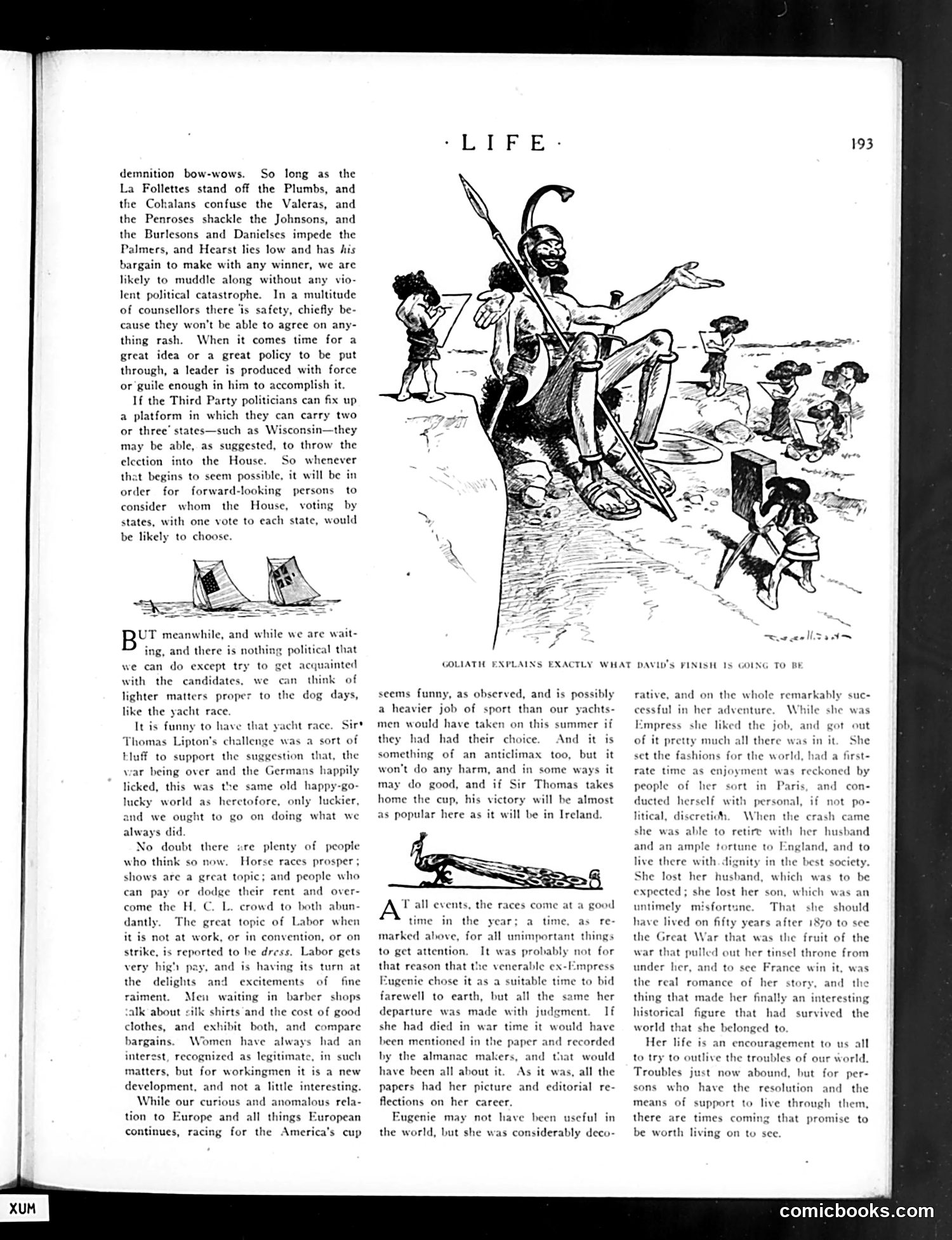
This page contains political commentary on early 20th-century American politics, likely from around 1920. The main text discusses third-party political maneuvering and the 1920 election, referencing politicians like La Follette, Palmer, and Hearst—figures involved in contested presidential politics of that era. The prominent illustration labeled "GOLIATH EXPLAINS EXACTLY WHAT DAVID'S FINISH IS GOING TO BE" uses the biblical David-and-Goliath metaphor satirically. The giant figure (Goliath) appears to represent established political power or the status quo, while the small figures around him (David) represent challengers or reformers. The image suggests that despite appearing outmatched, smaller political forces will inevitably be crushed by entrenched power. The secondary discussion addresses post-WWI American life, including labor issues, fashion (notably workers' newfound interest in expensive clothing), and Sir Thomas Lipton's America's Cup yacht race challenge—presented as harmless entertainment during uncertain political times.
📄 Transcribed text from this page (OCR, searchable)
Machine-transcribed from the original scan — historical spelling and the odd misread are preserved.
demnition bow-wows. So long as the La Follettes stand off the Plumbs, and the Cohalans confuse the Valeras, and the Penroses shackle the Johnsons, and the Burlesons and Danielses impede the Palmers, and Hearst lies low and has his bargain to make with any winner, we are likely to muddle along without any vio- lent political catastrophe. In a multitude of counsellors there ‘is safety, chiefly be- cause they won't be able to agree on any- thing rash. When it comes time for a great idea or a great policy to be put through, a leader is produced with force or guile enough in him to accomplish it. If the Third Party politicians can fix up a platform in which they can carry two or three’ states—such as Wisconsin—they may be able, as suggested, to throw the election into the House. So whenever that begins to seem possible, it will be in forward-looking House, persons to voting by order for consider whom the states, with one vote to each state, would be likely to choose. UT meanwhile, and while we are wait- ing, and there is nothing political that we can do except try to get quainted with the candidates, we can think of lighter matters proper to the dog days, like the yacht race. It is funny to have that yacht race. Sir* Thomas Lipton’s challenge was a sort of tluff to support the suggestion that, the war being over and the Germans happily licked, this was the same old happy-go- lucky world as heretofore, only luckier, and we ought to go on doing what we always did No doubt there are plenty of people who think so now. Horse races prosper; shows are a great topic; and pi can pay or dodge their rent come the H. C. L. crowd to both abun- dantly. The great topic of Labor when it is not at work, or in convention, or on strike, is reported to be dress, Labor gets very hig’) pay, and is having its turn at the delights and raiment. alk about silk shirts and the cost of good clothes, and exhibit both, and compare bargains. Women have always had an interest, recognized as legitimate, in such matters, but for workingmen it is a new development, and not a little interesting. While our curious and anomalous rela- tion to Europe and all things European continues, racing for the America’s cup ple who and over- excitements of fine Men waiting in barber shops GOLIATH EXPLAINS EXACTLY WHAT DAVID'S FINISH 1S GOING TO BE seems funny, as observed, and is possibly a heavier job of sport than our yachts- men would have taken on this summer if they had had their choice. And it is something of an anticlimax too, but it won't do any harm, and in some ways it may do good, and if Sir Thomas takes home the cup, his victory will be almost as popular here as it will be in Ireland. all events, the races come at a good A! time in the year; a time, as re- marked above, for all unimportant things to get attention. that reason that t! Eugenie chose it as a suitable time to bid farewell to earth, but all the same her departure was made with judgment. If she had died ii been mentioned in the by the almanac makers, and that have been all about it. As it wa papers had her picture and editc flections on her career. Eugenie may not have been useful in It was probably not for venerable ex-Empress war time it would have paper and recorded would all the ial re- the world, but she was considerably deco- rative, and on the whole remarkably adventure. While she Empress she liked the job, and got of it pretty much suc- cessful in her was out She there was in it set the fashions for the world, had a first- rate time as enjoyment was re people of her sort in koned by and ducted herself with personal, if not po- When the she was able to retire with he Paris con- litical, discretioh sh came husband and an ample tortune to England, and to live there with dignity in the best societ She lost her which was to be expected; she lost her son, which was an untimely m That she should have lived on fifty years after 1870 to see the Great War that was the husband fortune fruit of the war that pulled out her tinsel throne from under her, and to see France win it, was the real romance of thing that made her fi historical her story, and th ally an interesting that i world that she belonged to. figure survived the Her life is an encouragement to us all to try to outlive the tre Troubles j who ables of our world. st now abound, but for per- sons have the resolution and the means of support to live through them, there are times coming that be worth living on to sce promise to comicbooks.com