
A complete issue · 40 pages · 1920
Life — July 8, 1920
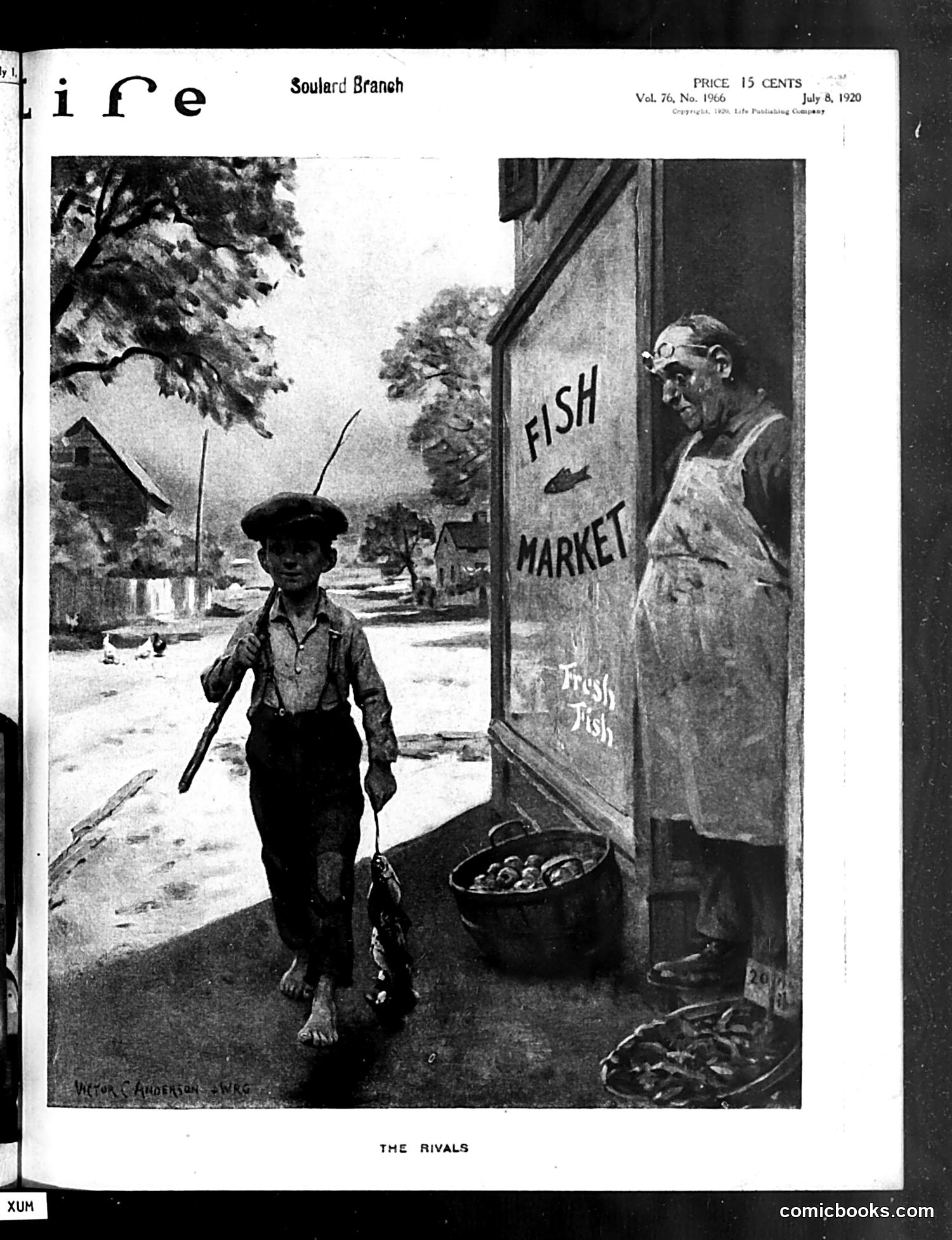
This cartoon depicts competition between two fish vendors. A young boy carrying fish approaches a "Fish Market" storefront where an older man stands ready to conduct business. The title "The Rivals" suggests commentary on commercial competition. The image appears to satirize street-level economic rivalry during the early 1920s—likely contrasting established fish market operators against independent young vendors or street sellers. The boy's youth and humble presentation versus the established shopkeeper's position represents tension between traditional retail and informal street commerce. This reflects post-WWI American economic conditions when many returned soldiers and working-class people competed for limited commercial opportunities. The cartoon's humor derives from depicting a small-scale vendor as a genuine "rival" to an established business—suggesting either the boy's boldness or the shopkeeper's concern about losing trade to cheaper street competition.
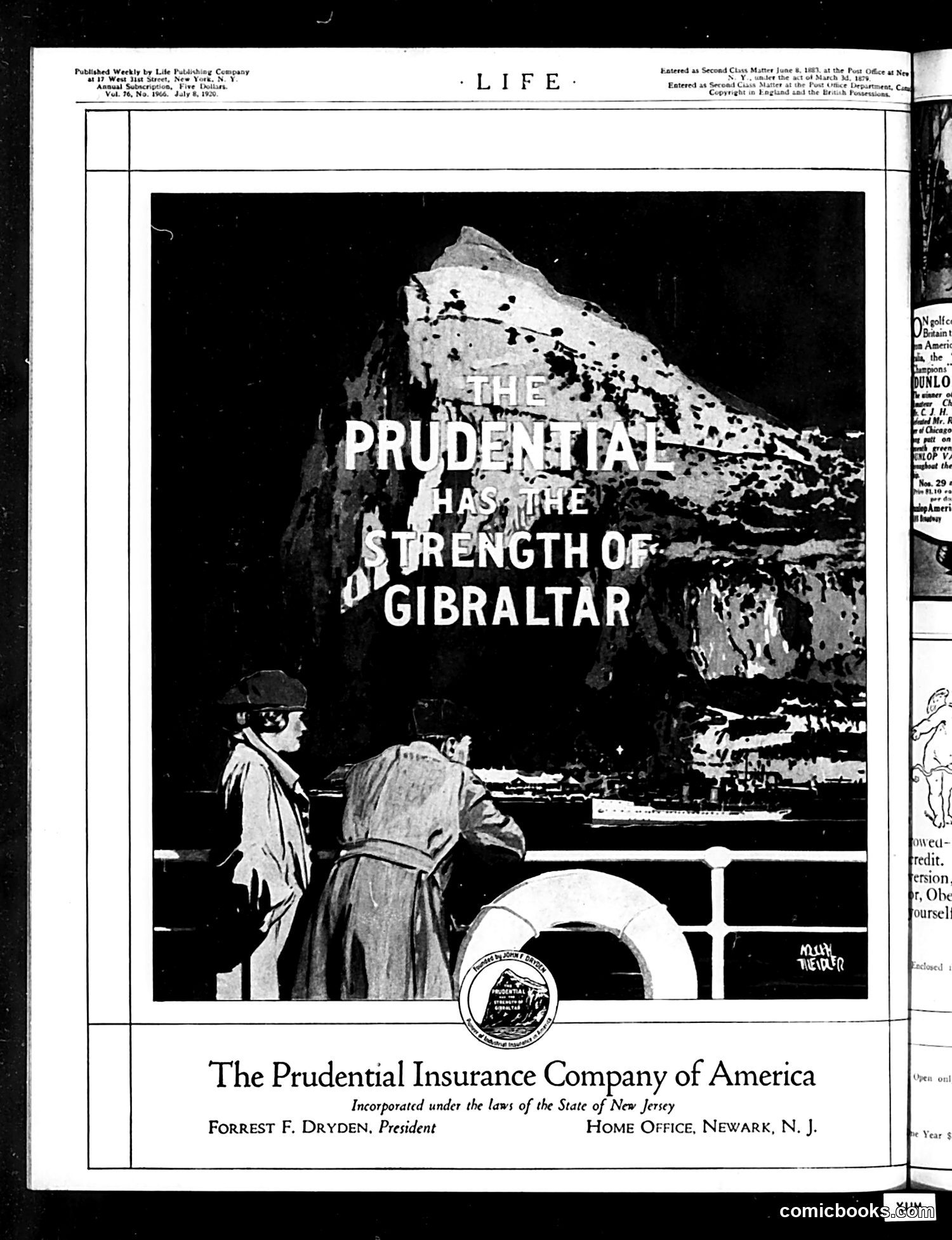
This page is **primarily an advertisement**, not editorial content or satire. It's a full-page ad for the Prudential Insurance Company of America, with the company's home office listed in Newark, New Jersey, and Forrest F. Dryden noted as President. The ad uses an image of Gibraltar—the famous Rock of Gibraltar—as a visual metaphor. Two figures (appearing to be a woman and man) stand on what looks like a ship's deck, gazing at the imposing rock formation. The headline "THE PRUDENTIAL HAS THE STRENGTH OF GIBRALTAR" directly connects the insurance company's reliability to Gibraltar's famous stability and permanence. This is straightforward corporate advertising using a natural landmark as a symbol of strength and dependability.
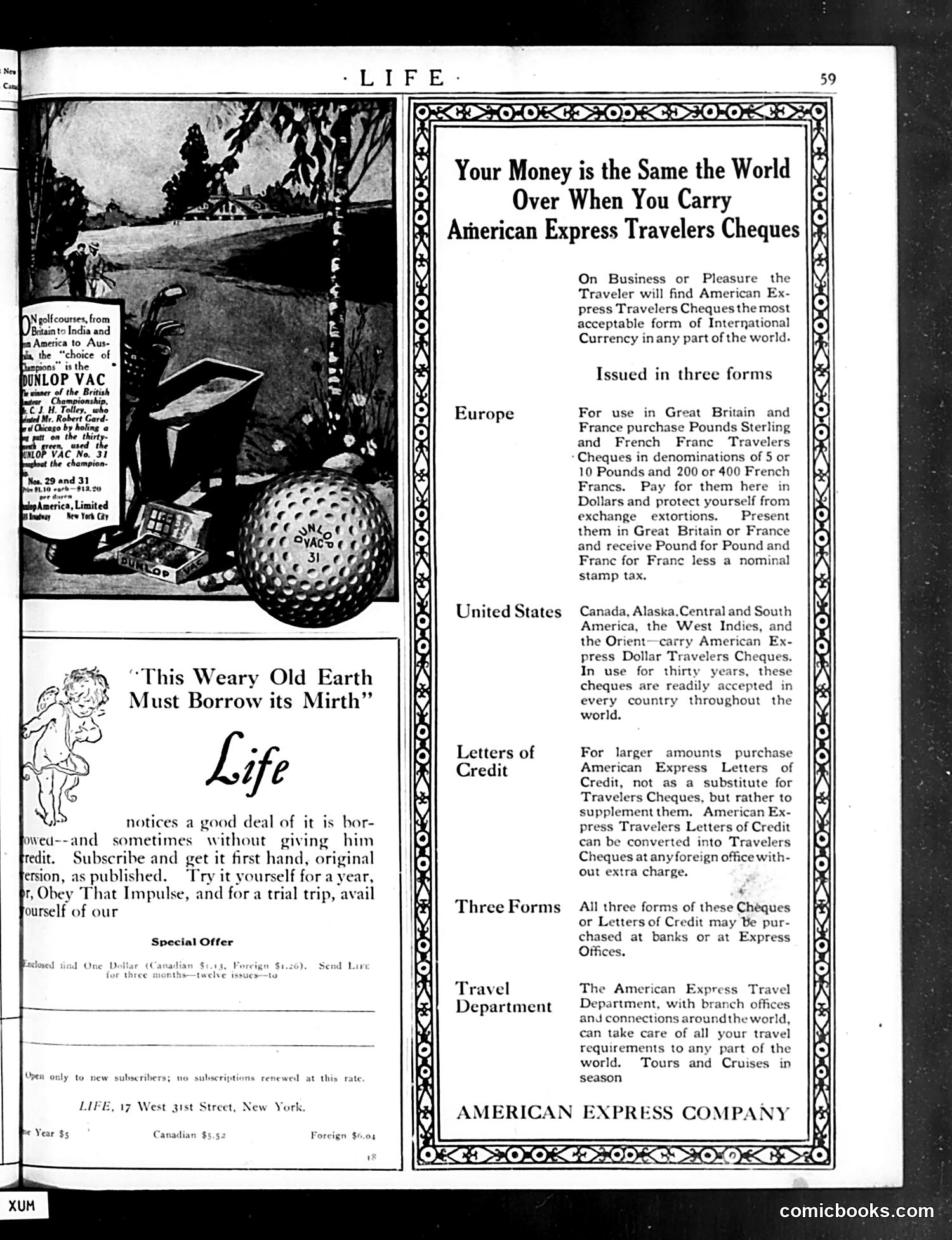
This page is primarily **advertising**, not satire. The right side features a full American Express advertisement for traveler's cheques in three forms (Europe, United States, Letters of Credit), emphasizing their acceptance worldwide and protection against exchange fraud. The left side contains a brief Life magazine section titled "This Weary Old Earth Must Borrow its Mirth," with a cherub illustration. It promotes Life magazine subscriptions with a "Special Offer" for new subscribers. The top-left image appears to be a travel or leisure photograph, possibly promoting the Dunlop Vac golf ball (visible text), but lacks clear satirical content. **Overall: This is primarily commercial advertising with minimal editorial cartoon content.**
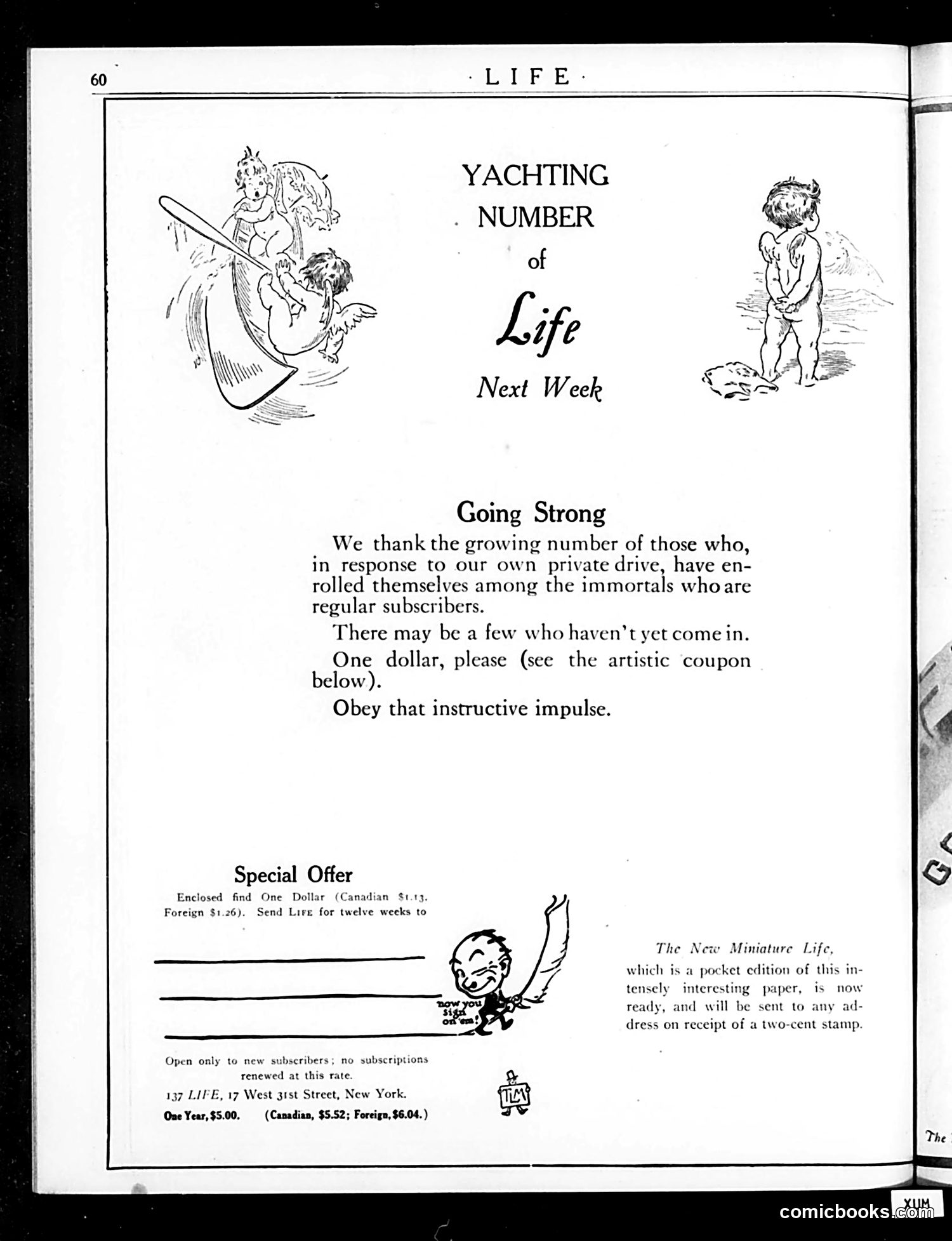
This page is primarily a **subscription advertisement** for Life magazine, not a political cartoon. The decorative illustrations—cherubs fishing and playing—are generic classical imagery used ornamentally, not satirical commentary. The "Going Strong" section thanks new subscribers in response to Life's "private drive" (subscription campaign). The tone is self-promotional, encouraging holdouts to subscribe for one dollar. The "Special Offer" advertises Life's new pocket-sized edition and provides subscription details: $5 annually (domestic), with different rates for Canada and foreign subscribers. The small cartoon character celebrating is simply a decorative mascot, not a political figure. This is essentially a **magazine house advertisement**—marketing copy dressed up with period artwork rather than satirical content.

This is a **Goodrich Tires advertisement**, not political satire. The page promotes "Silvertown Cord Tires" as "America's First Cord Tire." The ad features a smiling man in a flat cap and jacket pointing to a tire with visible cord construction. The sales pitch emphasizes durability: older Silvertown Cords from previous years remain on roads still delivering mileage, suggesting reliability and long-term value. The tagline "Best in the Long Run" plays on both tire longevity and driving distance. There is no political cartoon or satire present. This represents early automotive advertising from *Life* magazine's commercial content, likely from the 1920s based on the styling and cord tire technology referenced.
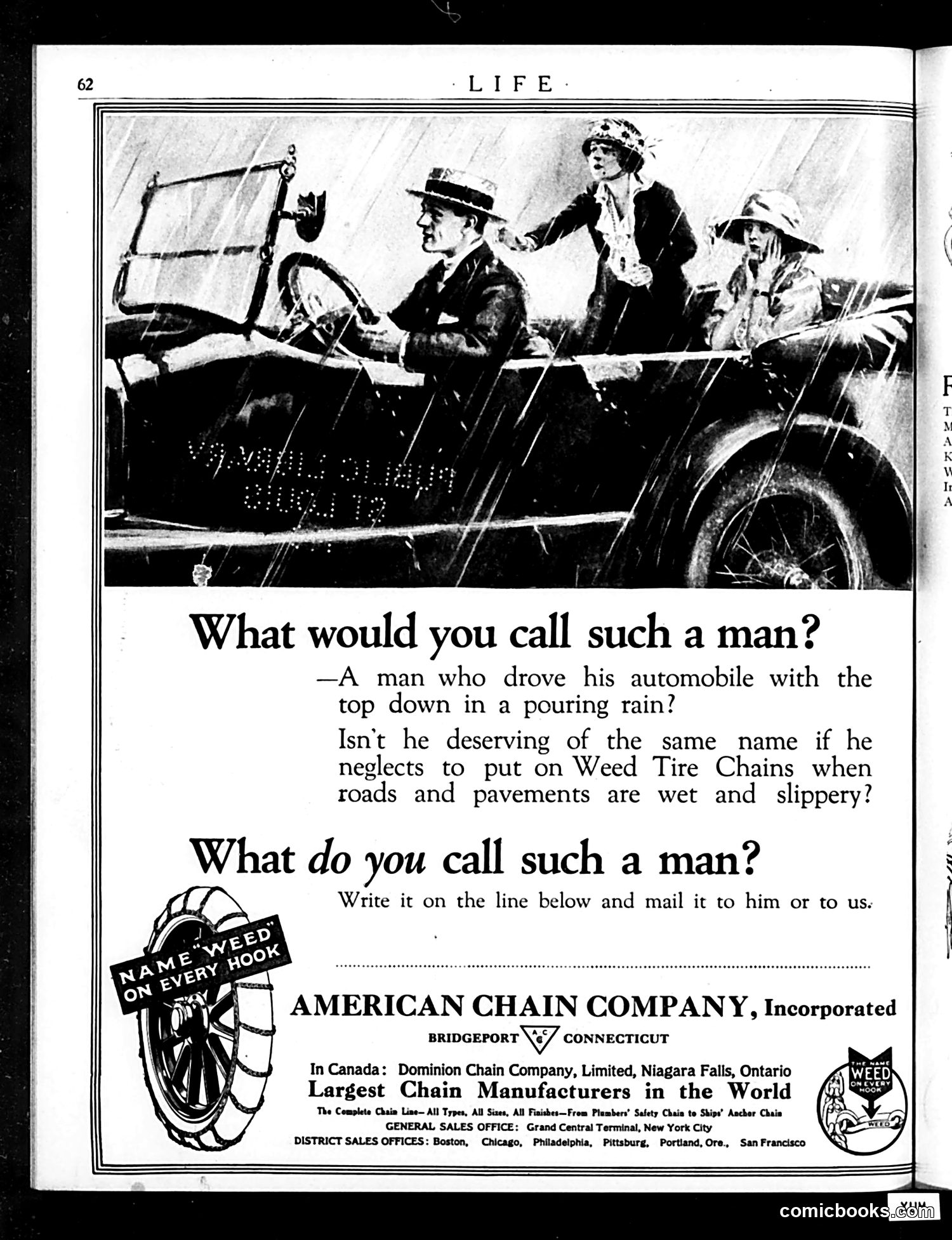
This page is primarily **advertising**, not satire or political commentary. It's a 1920s advertisement for Weed Tire Chains, manufactured by American Chain Company (Bridgeport, Connecticut). The ad uses a rhetorical appeal: it depicts four people in an open-top automobile driving in heavy rain with the convertible top down—presented as foolish behavior. The text poses a challenge to readers: "What would you call such a man?" who neglects tire chains in wet, slippery conditions? The ad then invites reader participation: "What *do* you call such a man? Write it on the line below and mail it to him or to us." This is a **participatory marketing gimmick** encouraging consumer engagement while promoting tire safety equipment as essential for automobile maintenance.
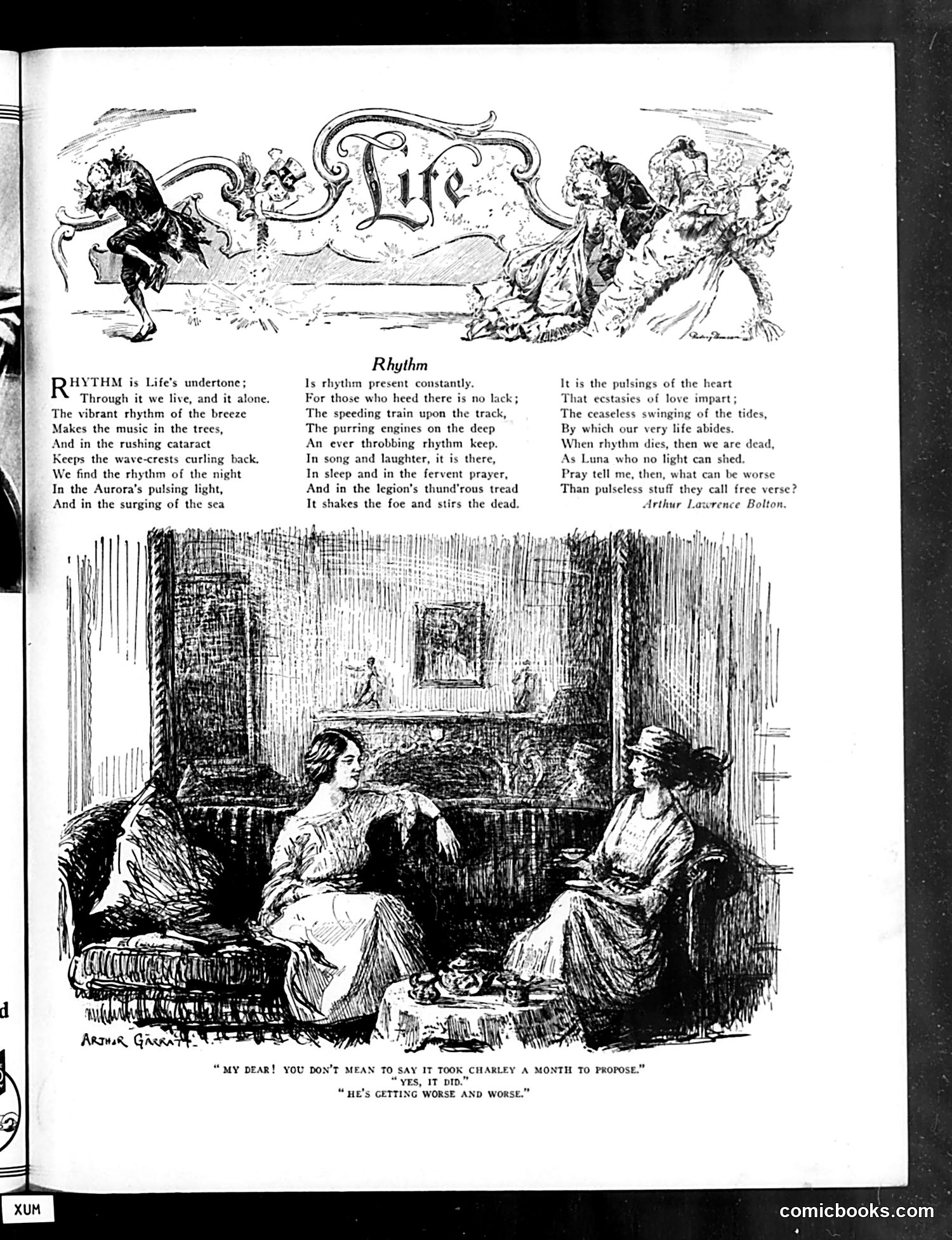
This page features a poem titled "Rhythm" by Arthur Lawrence Bolton, illustrated with decorative sketches at the top and a single-panel cartoon below. The cartoon depicts three women in an interior setting having a conversation. The dialogue reads: "My dear! You don't mean to say it took Charley a month to propose." / "Yes, it did." / "He's getting worse and worse." The satire mocks the social expectation that men should propose quickly to women they court. The joke is that a one-month courtship before proposal is considered unacceptably slow—implying that in the era's social norms, proposals should happen almost immediately. The women's dismissive tone suggests the man's hesitation reflects poorly on his character or decisiveness. This reflects early 20th-century courtship conventions where prolonged engagements were viewed negatively.
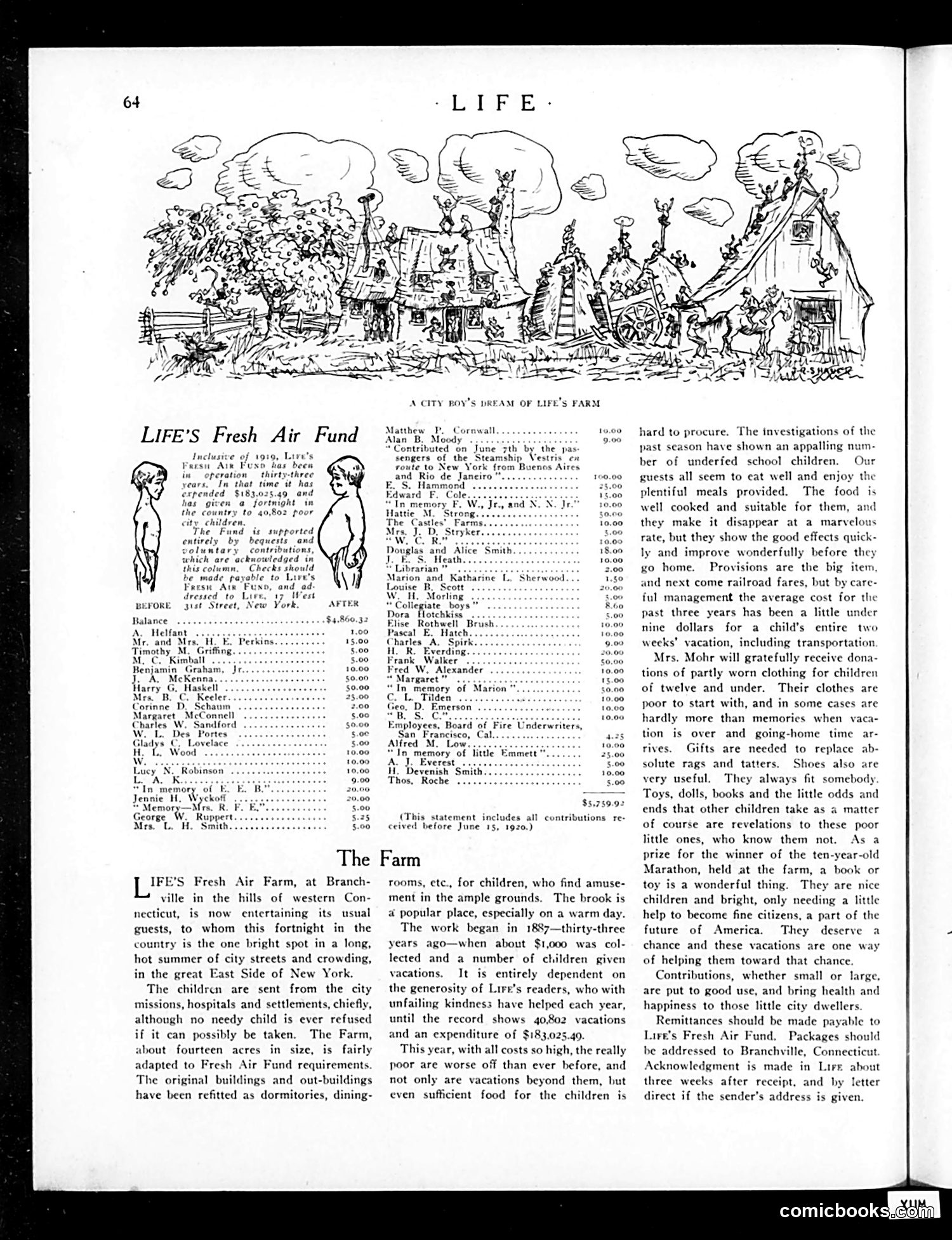
This page combines two unrelated items: **Top: "A City Boy's Dream of Life's Farm"** — a whimsical illustration showing an idealized, fantastical farm scene with exaggerated, surreal architecture and activity. It's a satirical vision of what urban children might imagine a farm to be—clearly unrealistic and humorous. **Bottom: "Life's Fresh Air Fund"** — a charitable fundraising appeal. The text describes a real initiative providing vacations for underprivileged city children. The fund had collected ~$4,800 and funded 20,802 child-vacations by 1908. The juxtaposition is ironic: the fanciful cartoon contrasts sharply with the earnest charitable mission below, which addressed genuine poverty. The small anatomical drawings labeled "Before" and "After" illustrate the physical benefits these poor children gained from fresh air and nutrition—a progressive-era social reform message.
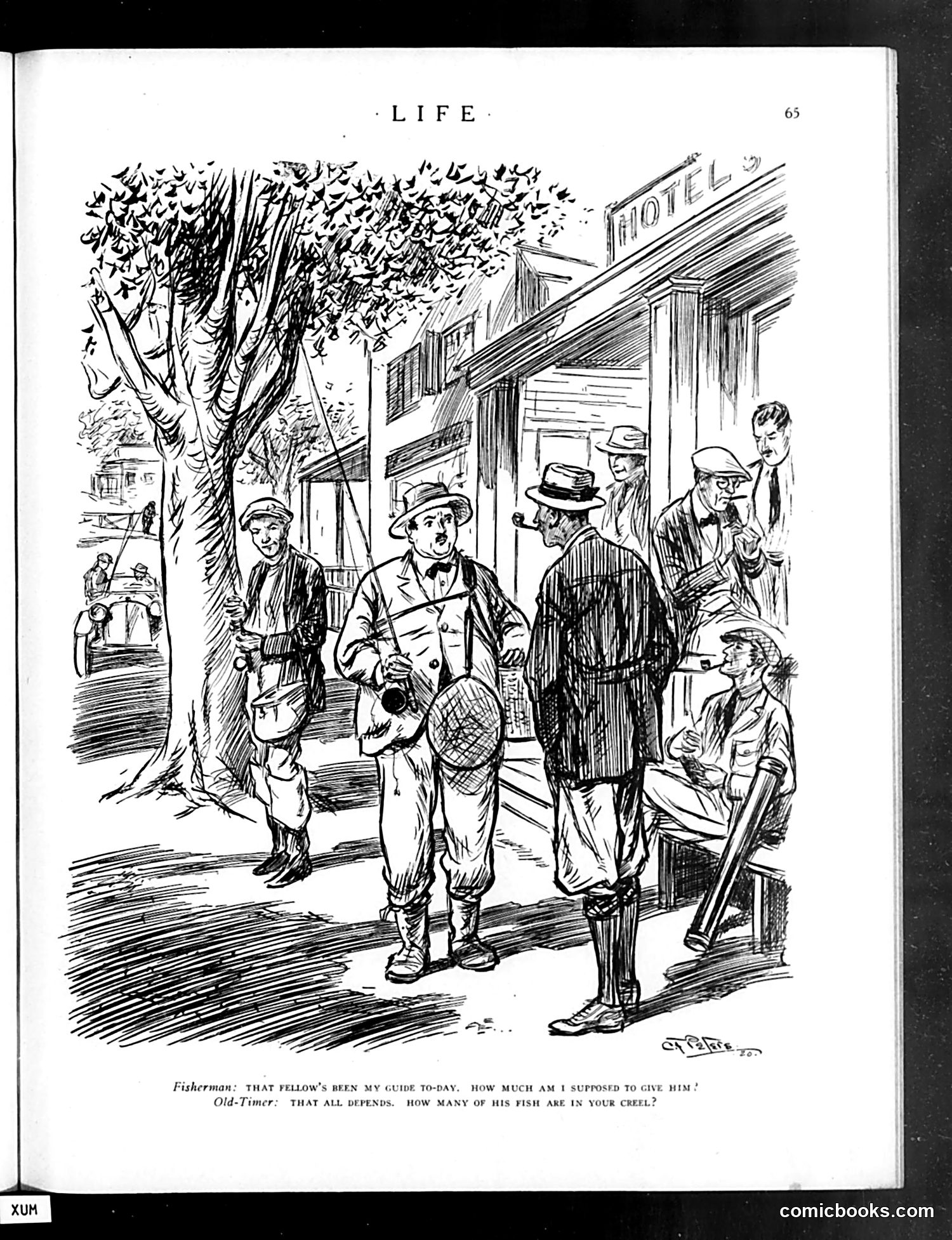
This single-panel cartoon depicts a scene outside a hotel where a fisherman with his catch encounters an older man. The caption reveals the joke: the fisherman says he's been paying his guide, and the old-timer asks how many fish are in the creek. The satire targets **tipping culture and guide services**. The implication is that the fisherman has overpaid his guide for poor results—few fish despite payment. The old-timer's question sarcastically suggests the guide's incompetence or dishonesty: if there were many fish in the creek, the fisherman would have caught more. This appears to critique the common practice of overpaying service workers (guides, porters) who deliver minimal results, a social frustration of the era.
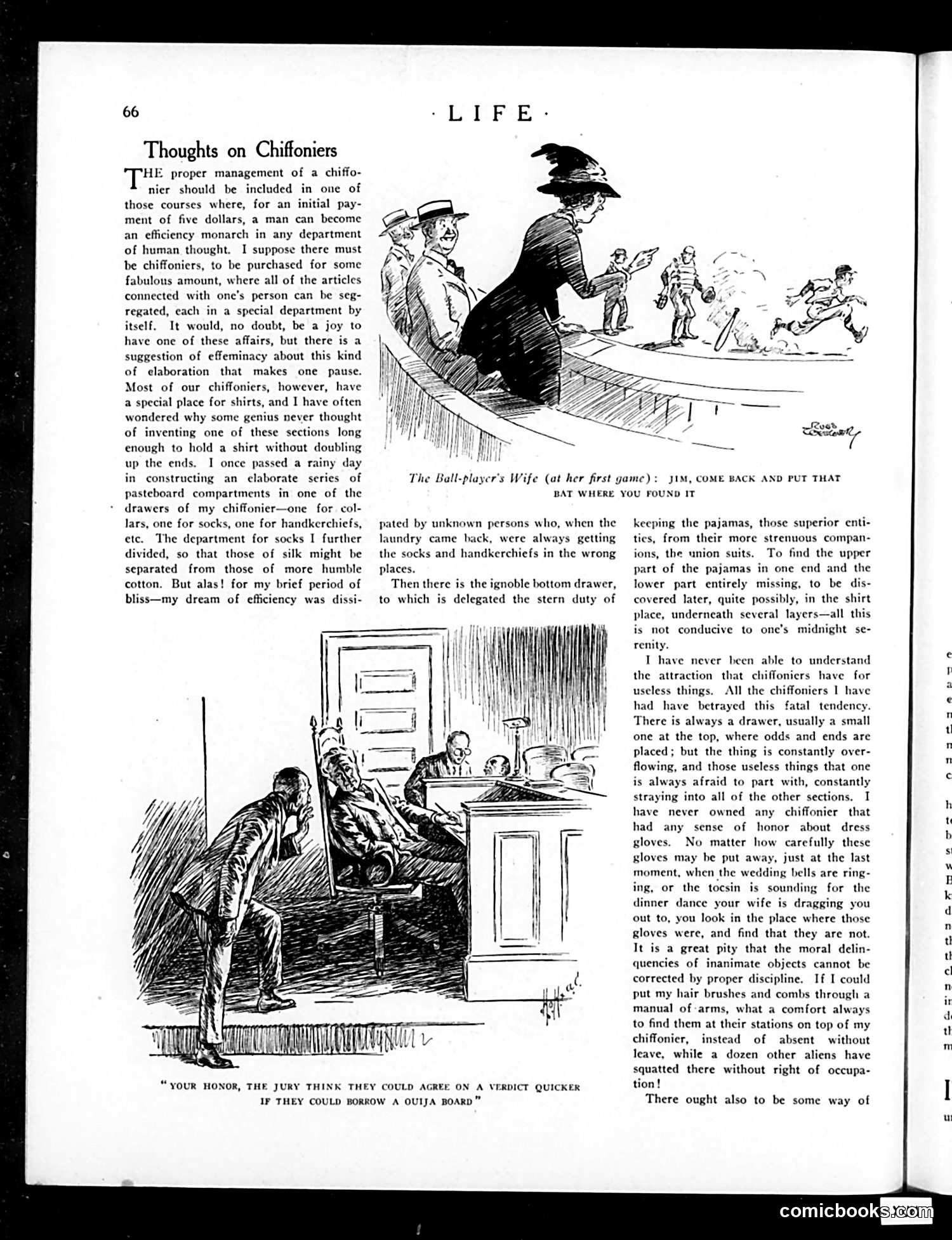
This page satirizes the impracticality of chiffoniers (tall, narrow dresser drawers) through humorous illustrations and commentary. **The top cartoon** shows a woman at a baseball game wearing an elaborate hat, with the caption "The Ball-player's Wife (at her first game): JIM, COME BACK AND PUT THAT BAT WHERE YOU FOUND IT" — mocking wives' ignorance of sports. **The main article** humorously laments chiffoniers' uselessness: items constantly go missing in their deep drawers, creating domestic chaos. The author describes searching endlessly through compartments for lost gloves, socks, and handkerchiefs. **The bottom cartoon** depicts men in a courtroom, captioned "Your honor, the jury think they could agree on a verdict quicker if they could borrow a ouija board" — suggesting jury deliberation is mystifyingly difficult. The satire targets household management frustrations and institutional inefficiency common to early 20th-century American life.
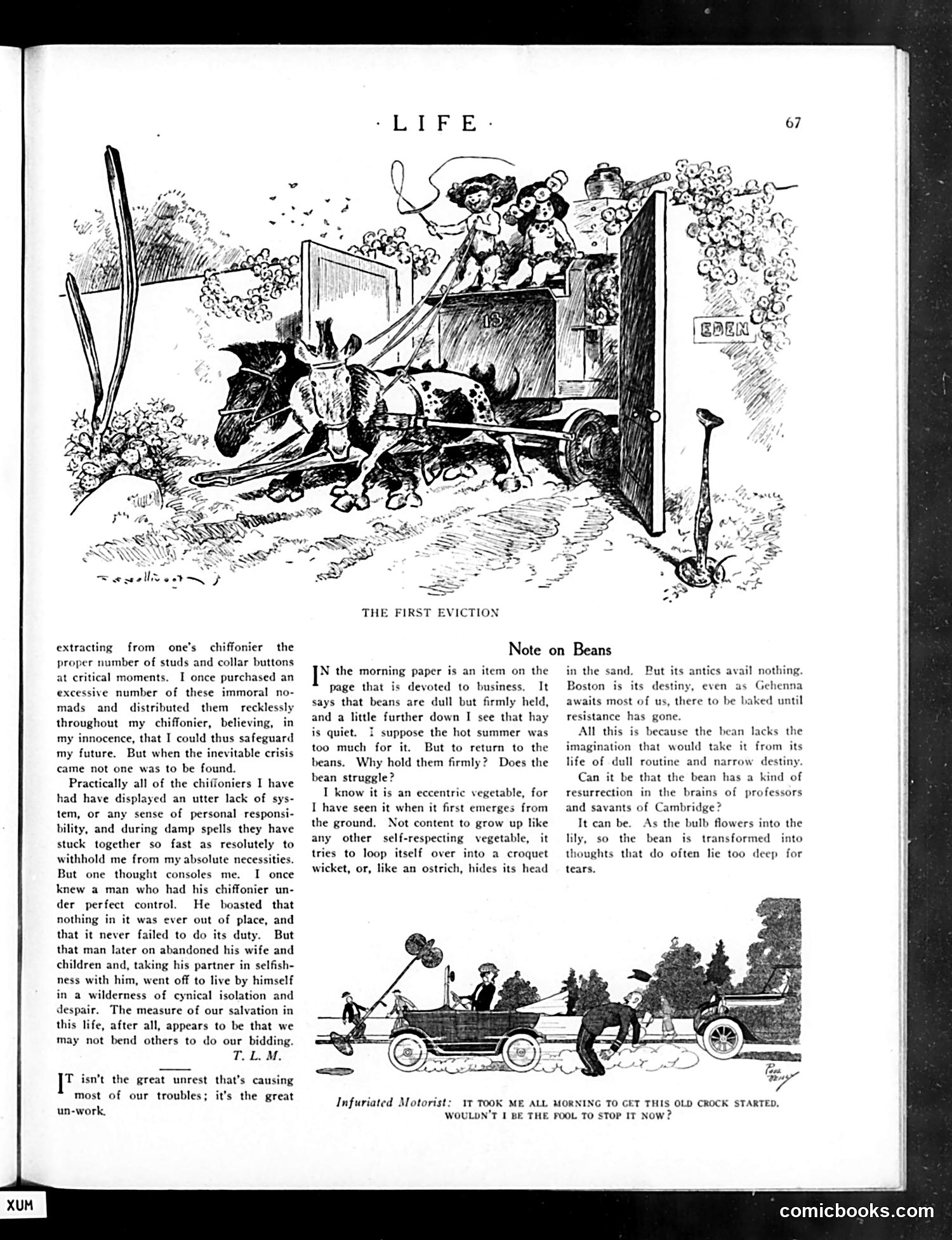
**Top Cartoon ("The First Eviction"):** Shows a donkey-drawn cart loaded with evicted household goods, with figures being removed from a building. This satirizes landlord-tenant disputes and housing instability—likely referencing post-WWI economic hardship when evictions were common. **"Note on Beans" Essay:** A humorous philosophical meditation on beans as vegetables, comparing their stubborn nature to human character. The author uses the bean's refusal to grow like "self-respecting" vegetables as a metaphor for nonconformity and individuality. **Bottom Cartoon ("Infuriated Motorist"):** Shows an early automobile breaking down, with the frustrated driver unable to start the engine. This mocks the unreliability of early automobiles and impatient motorists—a common theme in period satire about new automotive technology.
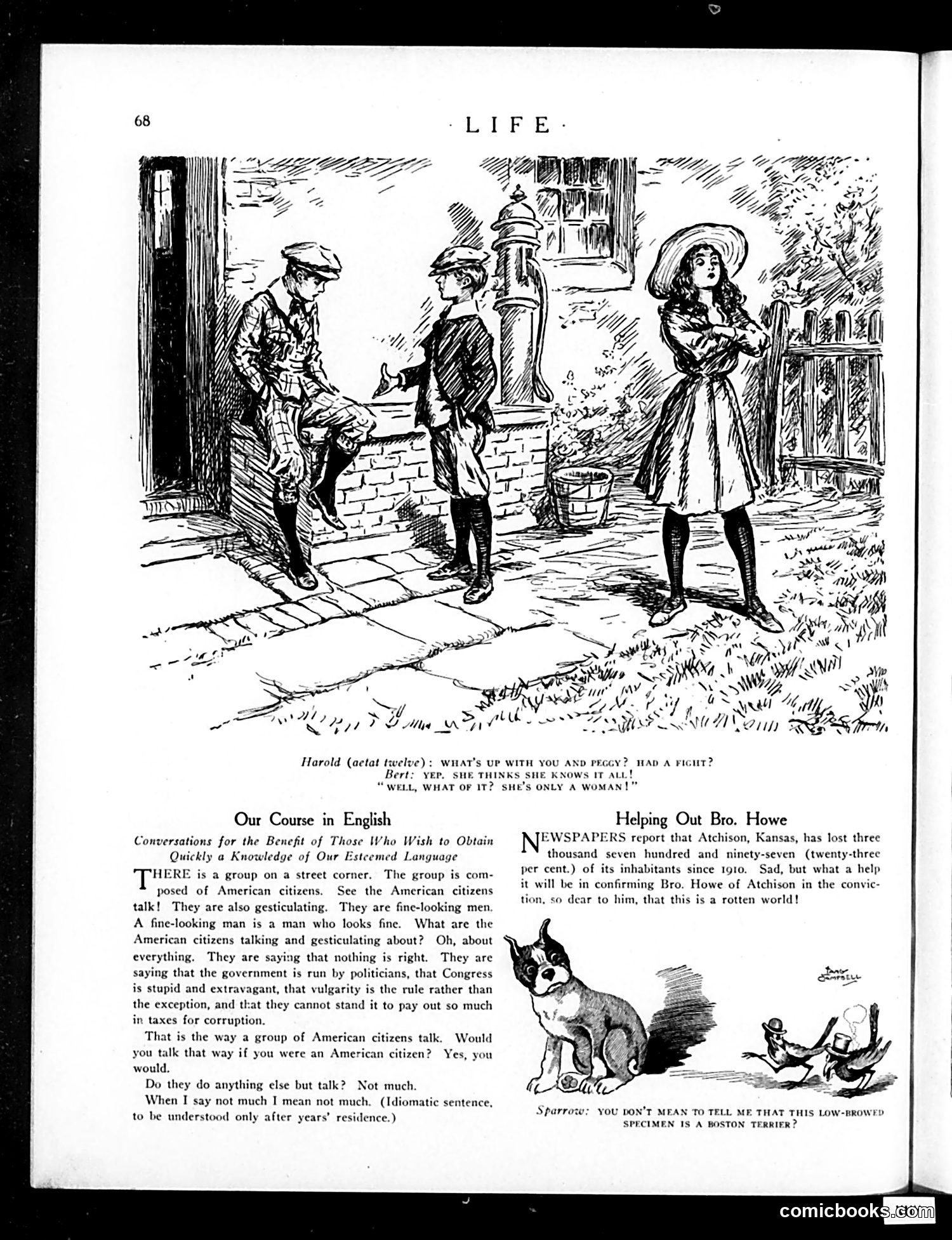
**Top Cartoon:** Three figures in a street scene. The dialogue indicates Harold and Bert are discussing Peggy, with Bert saying "she thinks she knows it all" and Harold responding "Well, what of it? She's only a woman!" This satirizes early-20th-century gender attitudes—the joke mocks men's casual sexism, presenting their dismissal of women's knowledge as foolish. **"Our Course in English" Section:** A commentary on American discourse. It describes citizens on a street corner criticizing government, Congress, and taxation as corrupt. The text humorously notes they "talk" and "gesticulate" constantly but "do not do anything else." This satirizes American complaint culture—citizens loudly criticize politics without taking constructive action. **Bottom Cartoon:** Sparrow to a dog about a Boston Terrier, likely a breed joke.
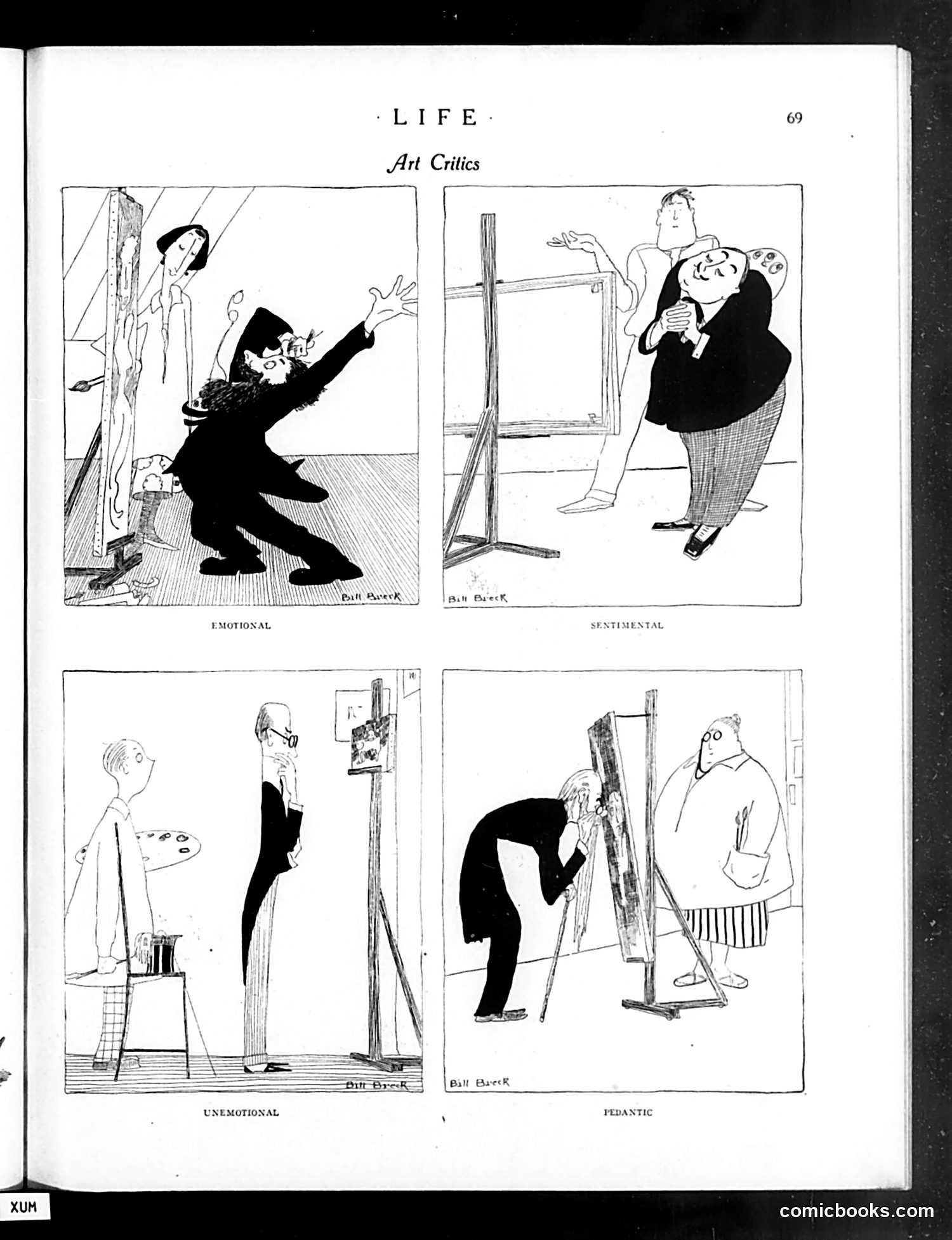
This page from *Life* magazine presents four cartoon panels by Bill Eurck satirizing different types of art critics through their emotional responses to viewing artwork. Each panel is labeled with a critical approach: "Emotional" shows an exaggerated, theatrical reaction; "Sentimental" depicts affected sentimentality; "Unemotional" shows clinical detachment; and "Pedantic" illustrates pompous, overly intellectual analysis. The satire mocks how art critics adopt exaggerated personas and mannerisms when viewing paintings, suggesting their responses are performative rather than genuine. Rather than engaging with the artwork itself, each critic type adopts a distinctive affectation—ranging from melodramatic gesturing to pretentious posturing—implying that critical interpretation is often about self-presentation rather than authentic aesthetic judgment.
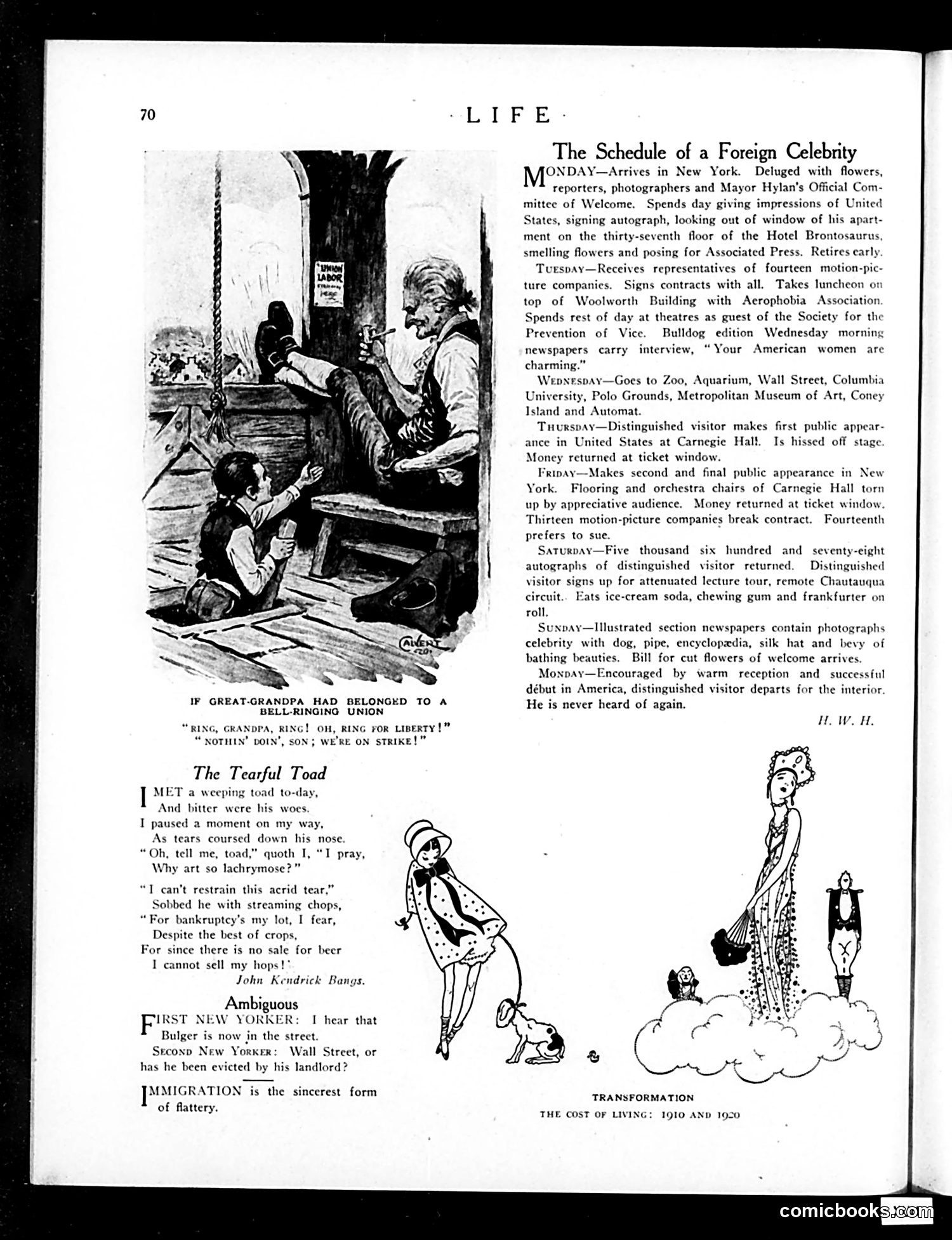
The top cartoon satirizes a visiting foreign dignitary's exhausting American tour. The schedule shows the celebrity mobbed by press, flower committees, and commercial interests—signing contracts, posing for photographers, appearing at theaters and museums. By Monday the visitor departs "for the interior," never to be heard from again. The satire mocks how Americans commodify and exhaust foreign visitors through relentless publicity and commercial exploitation. "The Tearful Toad" below is a humorous poem about a weeping toad lamenting bankruptcy during what appears to be Prohibition (referencing beer sales), paired with cartoons about urban displacements and social transformation. The "Transformation" illustration suggests changing class and living conditions in 1910-1920 America.
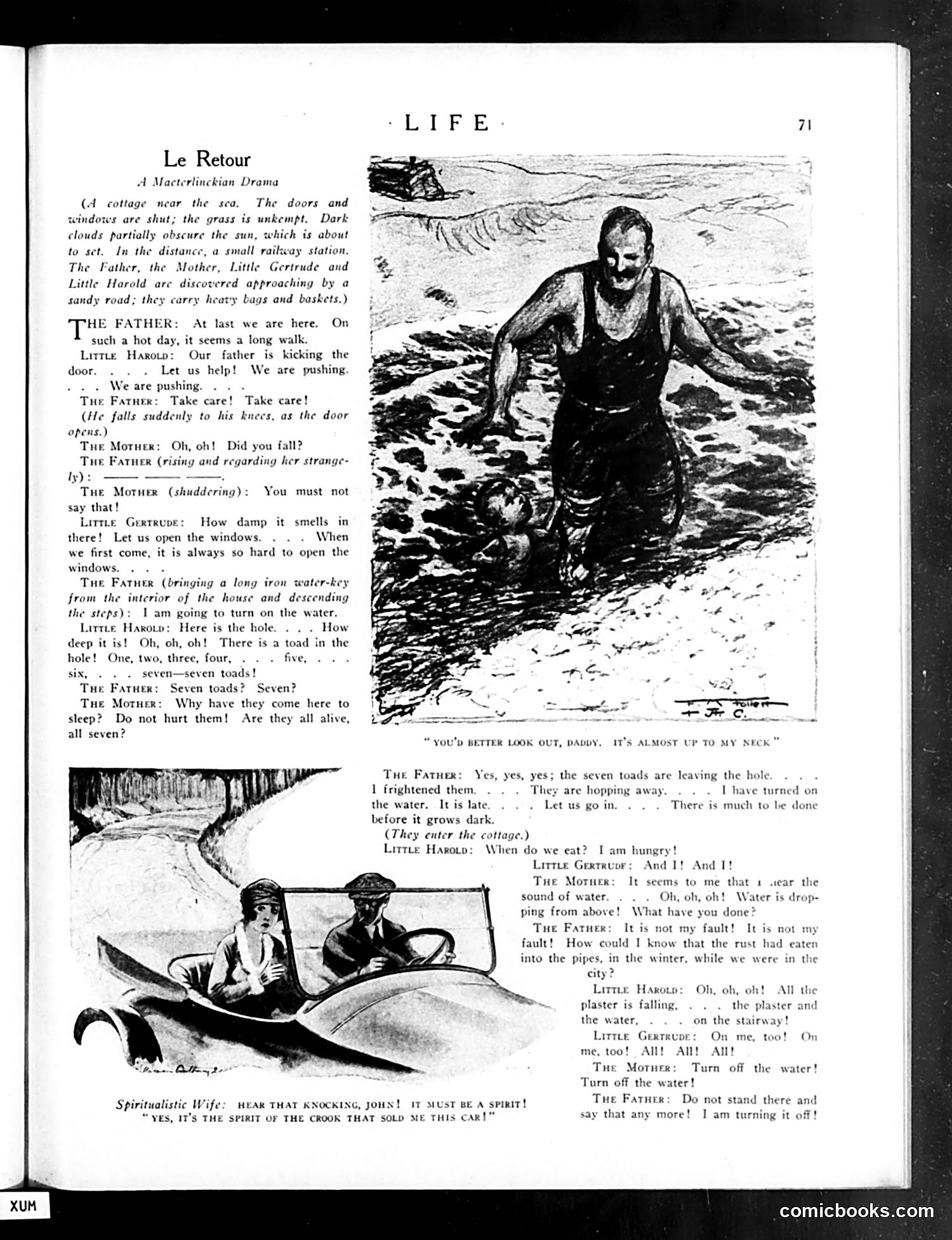
This page presents a one-act play satirizing pretentious symbolist theater (specifically referencing Belgian playwright Maurice Maeterlinck, known for mysterious, allegorical works). The plot depicts a family's chaotic homecoming at a seaside cottage: toads emerge from a hole, water leaks catastrophically, plaster falls, and domestic panic ensues. The dialogue is deliberately overwrought and self-serious despite mundane domestic disasters. The satire mocks early 20th-century avant-garde theater's affectation—treating ordinary household problems as profound symbolic drama. Two accompanying illustrations show the family's comedic distress (one illustration depicts a "spiritualistic wife" making absurd pronouncements about a car purchase). The humor targets both pretentious playwrights and the intellectual audiences who took such obscure symbolism seriously.
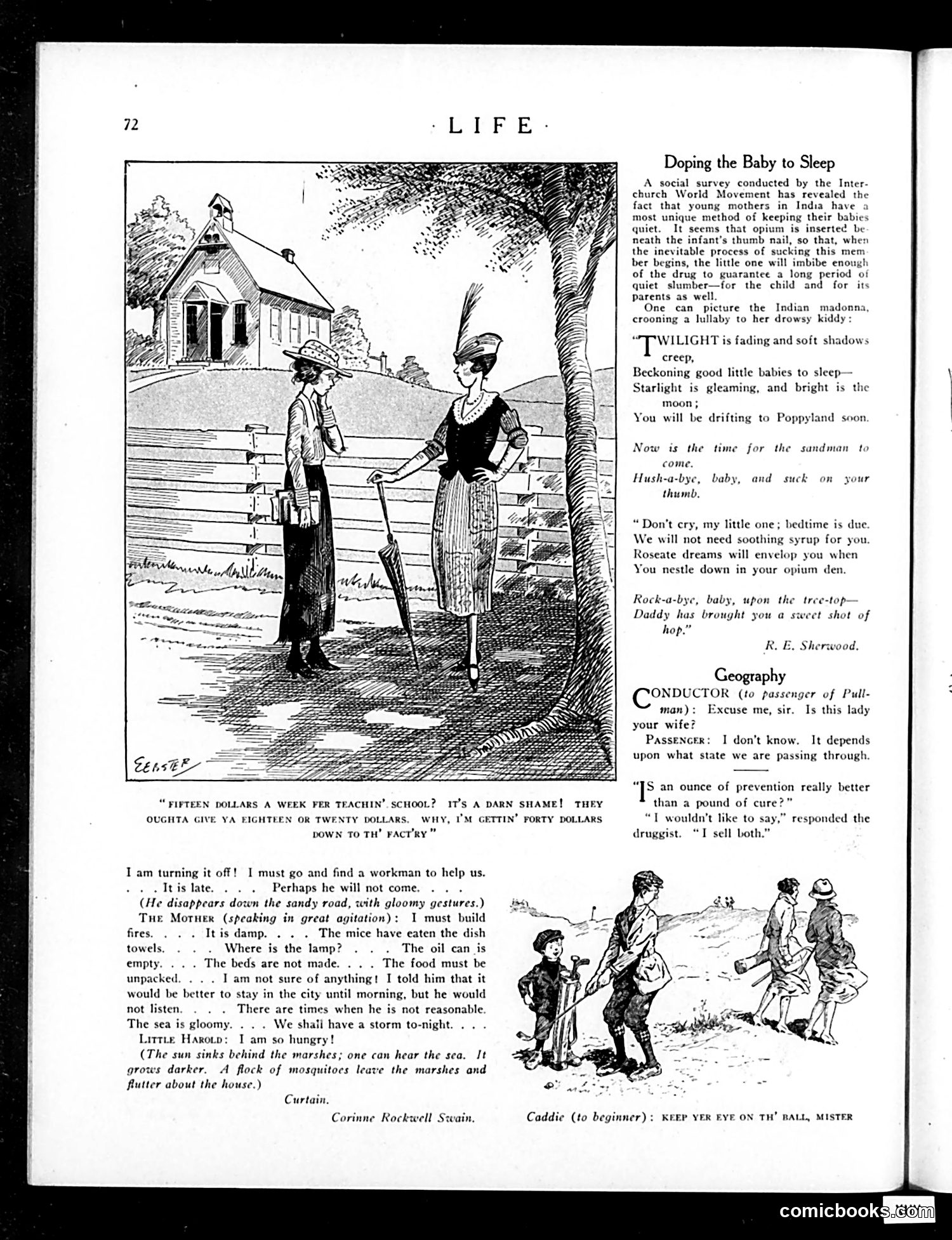
This page contains two main items: 1. **"Doping the Baby to Sleep"** article discusses Indian mothers using opium to keep infants quiet, accompanied by a poetic lullaby by R.E. Sherwood that satirizes this practice through gentle irony. 2. **Top illustration** shows two women by a fence near a church, apparently discussing teaching wages. The caption criticizes low teacher pay ("fifteen dollars a week for teachin' school? it's a barn shame!"), contrasting it with other professions earning more. 3. **Bottom illustration** depicts a golf lesson scene with the caption "Caddie (to beginner): keep yer eye on th' ball, mister"—a straightforward sports humor reference. The page primarily satirizes early 20th-century American social issues: inadequate teacher compensation and the casual attitude toward opium use in child-rearing practices.
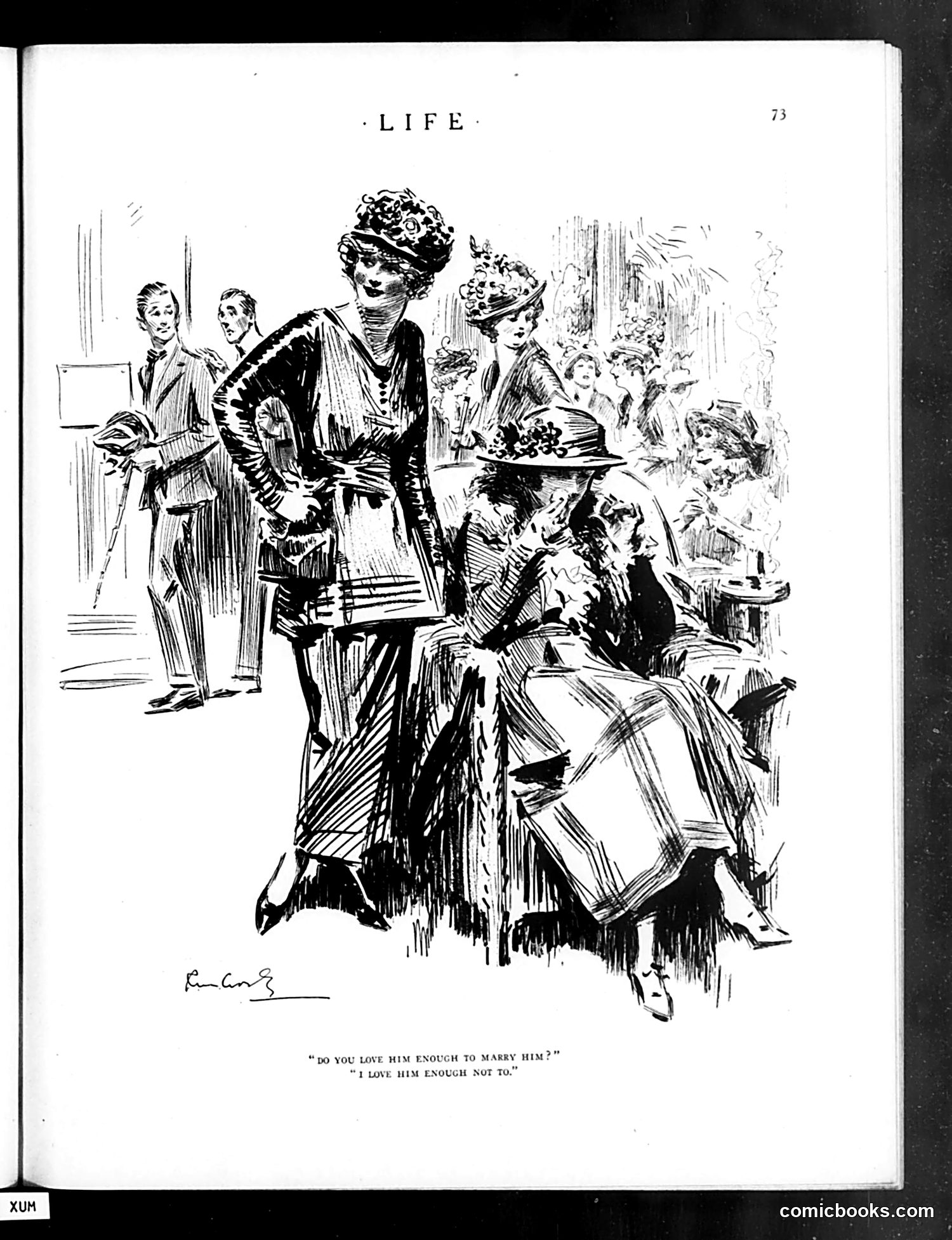
This satirical illustration depicts a conversation between two women about marriage. The central figure, an elegantly dressed woman with an elaborate hat, is being asked by a seated woman: "Do you love him enough to marry him?" The standing woman responds: "I love him enough not to." The satire targets early-20th-century attitudes about marriage and women's autonomy. Rather than romantic love being a prerequisite for marriage, the joke suggests that genuine affection might actually *prevent* a woman from marrying—implying marriage was often pursued for social obligation, financial security, or other practical reasons rather than love. This reflects period anxieties about matrimony and emerging feminist perspectives questioning whether marriage served women's genuine interests.
This page discusses the 1920 Democratic Convention and presidential candidates. The text examines **William Gibbs McAdoo** (Wilson's son-in-law and Treasury Secretary), who has declared he won't be a candidate despite being considered the Democrats' strongest option. The editor speculates McAdoo may have been influenced by President Wilson but accepts his stated reasoning. The piece reflects on American fatigue after World War I, noting that both Roosevelt and Wilson were "extraordinary Presidents" and suggesting the country might now prefer "ordinary men." It references **Warren Harding**, the Republican nominee, as an example of this ordinariness. The small cartoon appears unrelated editorial artwork. The commentary reflects pre-convention speculation from a moment when delegates hadn't yet assembled, illustrating Life's role as satirical political commentary on contemporary election dynamics.
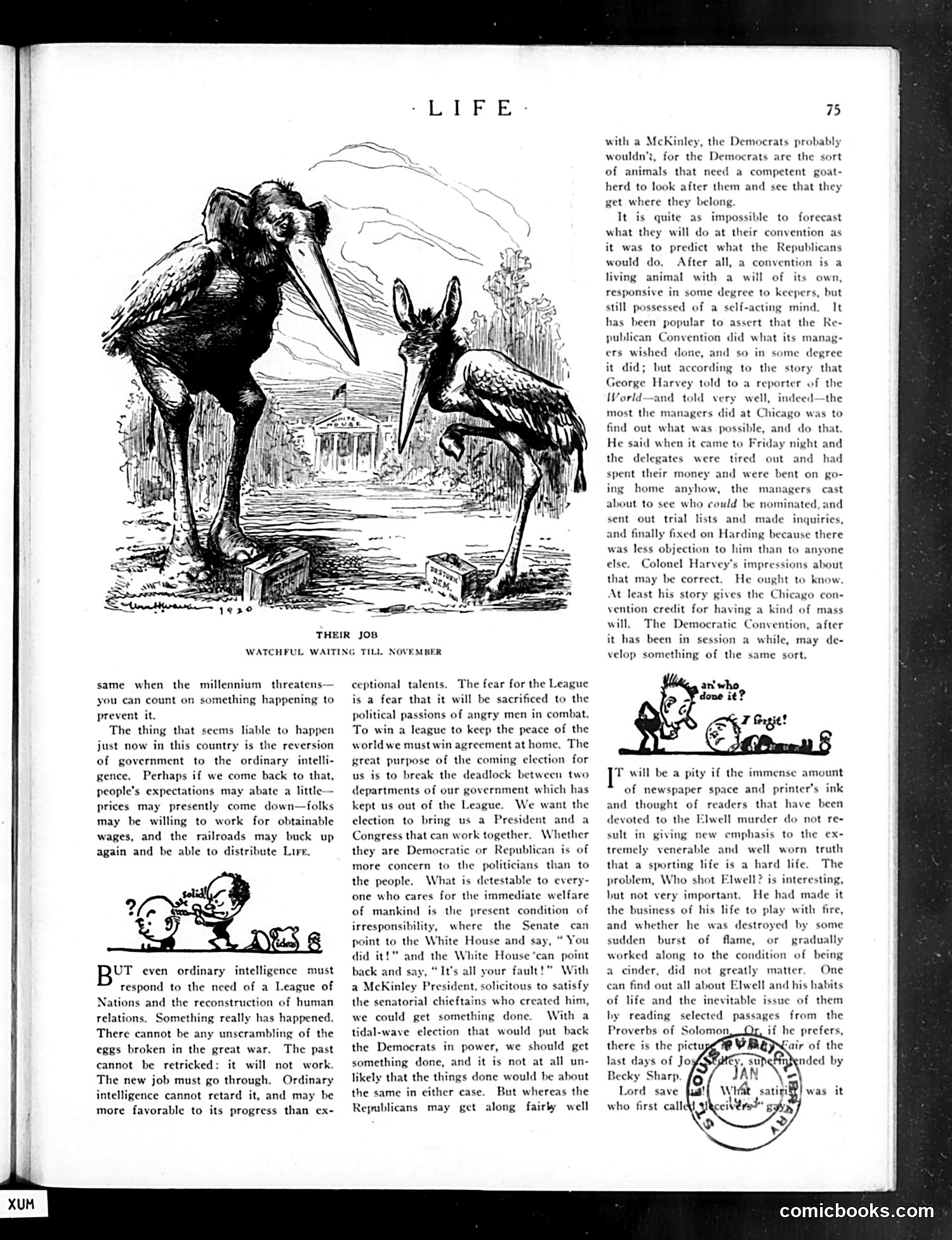
This page discusses post-WWI American politics, likely from 1920 or 1924. The cartoon depicts two animals—a stork and a donkey—"watchfully waiting till November," symbolizing the Democratic and Republican parties anticipating the upcoming election. The text satirizes political deadlock between the presidency and Senate over League of Nations participation. The author argues that whether Democrats or Republicans win matters less than breaking governmental gridlock. He notes a potential McKinley presidency (likely referring to a Republican candidate) could satisfy Senate leaders, while Democrats need strong management to accomplish anything—comparing them to animals requiring a "competent goatherd." The satire mocks both parties' conventions as somewhat chaotic, with managers simply discovering what's possible rather than controlling outcomes, citing journalist George Harvey's account of Harding's nomination at the Chicago convention.
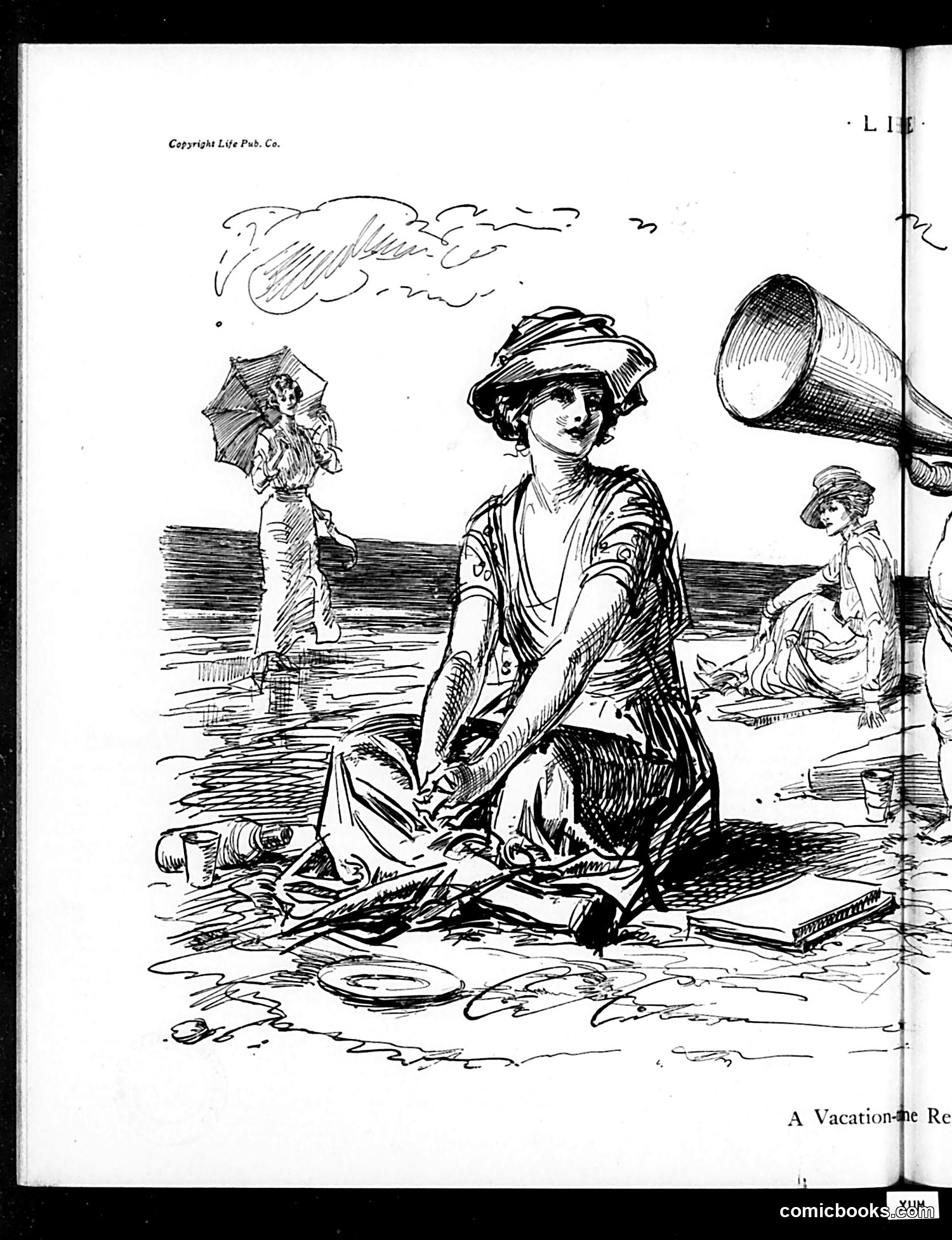
This page shows a sketch of women at a beach during what appears to be the early 20th century. The central figure sits knitting while others around her engage in leisure activities—one holds a parasol, another sits under a large beach umbrella, and a third reclines nearby. The title "A Vacation-e Re[st]" (text cut off) suggests this is satirizing leisure activities. The satire likely mocks the contradiction between "vacation" and "rest"—the women appear occupied with various tasks and social obligations rather than actually relaxing. The detailed clothing and accessories emphasize the formality and social performance of seaside recreation during this era, poking fun at how supposedly restful vacations were still governed by propriety and busyness. The knitting particularly suggests productive labor interrupting leisure.
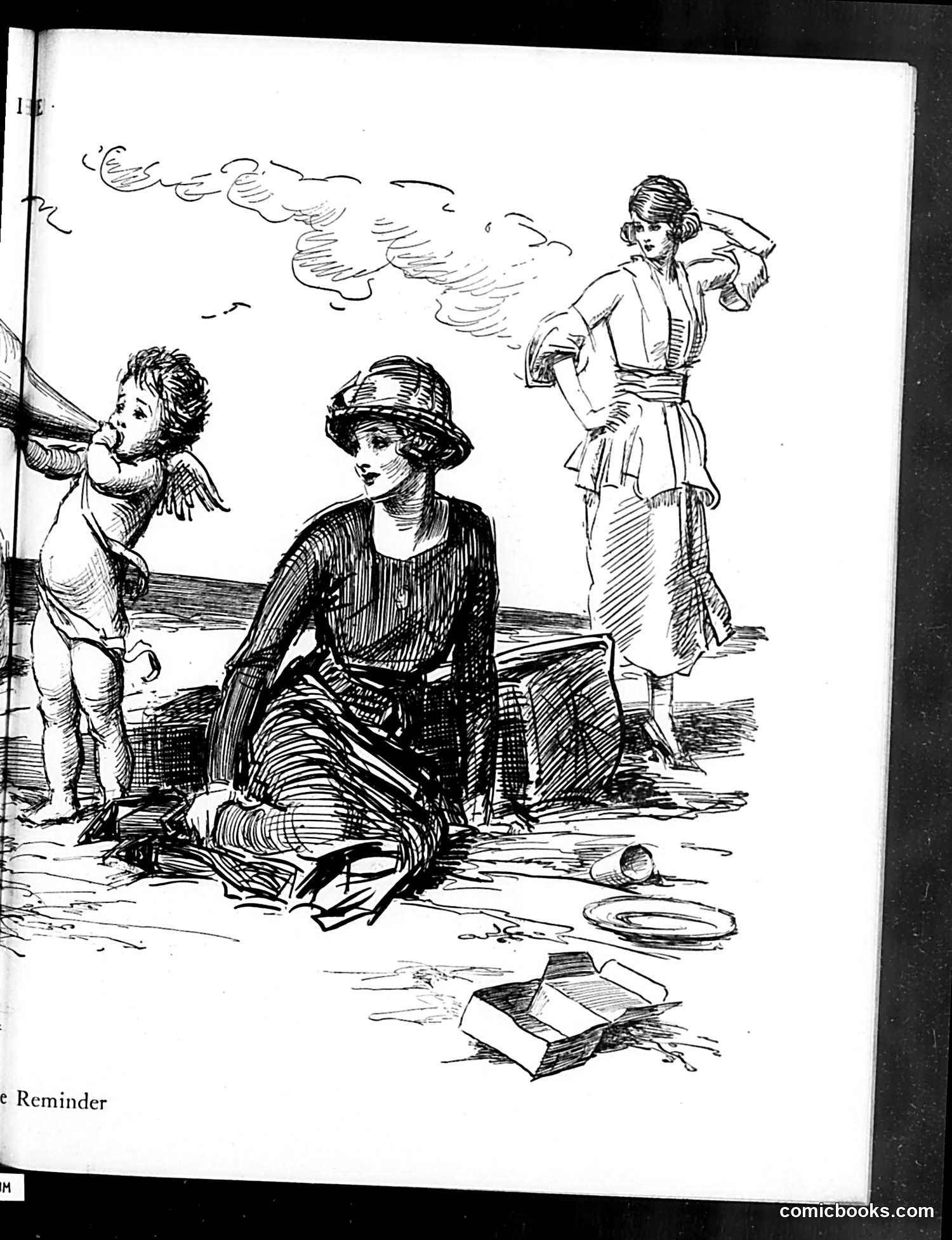
This appears to be a satirical illustration titled "A Reminder," though the OCR text is largely corrupted and provides little context. The image shows three figures in what appears to be an early 20th-century domestic scene. A woman sits centrally wearing a hat and dark dress, while a cherub or cupid figure plays a horn on the left, and a woman in lighter clothing stands on the right. Various objects scatter the floor—boxes, a plate, and other domestic items. The satire likely comments on **domestic life, marriage, or feminine affairs**, given the cherub (symbol of love/cupid), the fashionable women's clothing, and the disheveled household setting. Without clearer text or additional context, the specific social commentary remains unclear—it could concern marital discord, household management, or women's roles, but I cannot definitively identify the precise target or message.
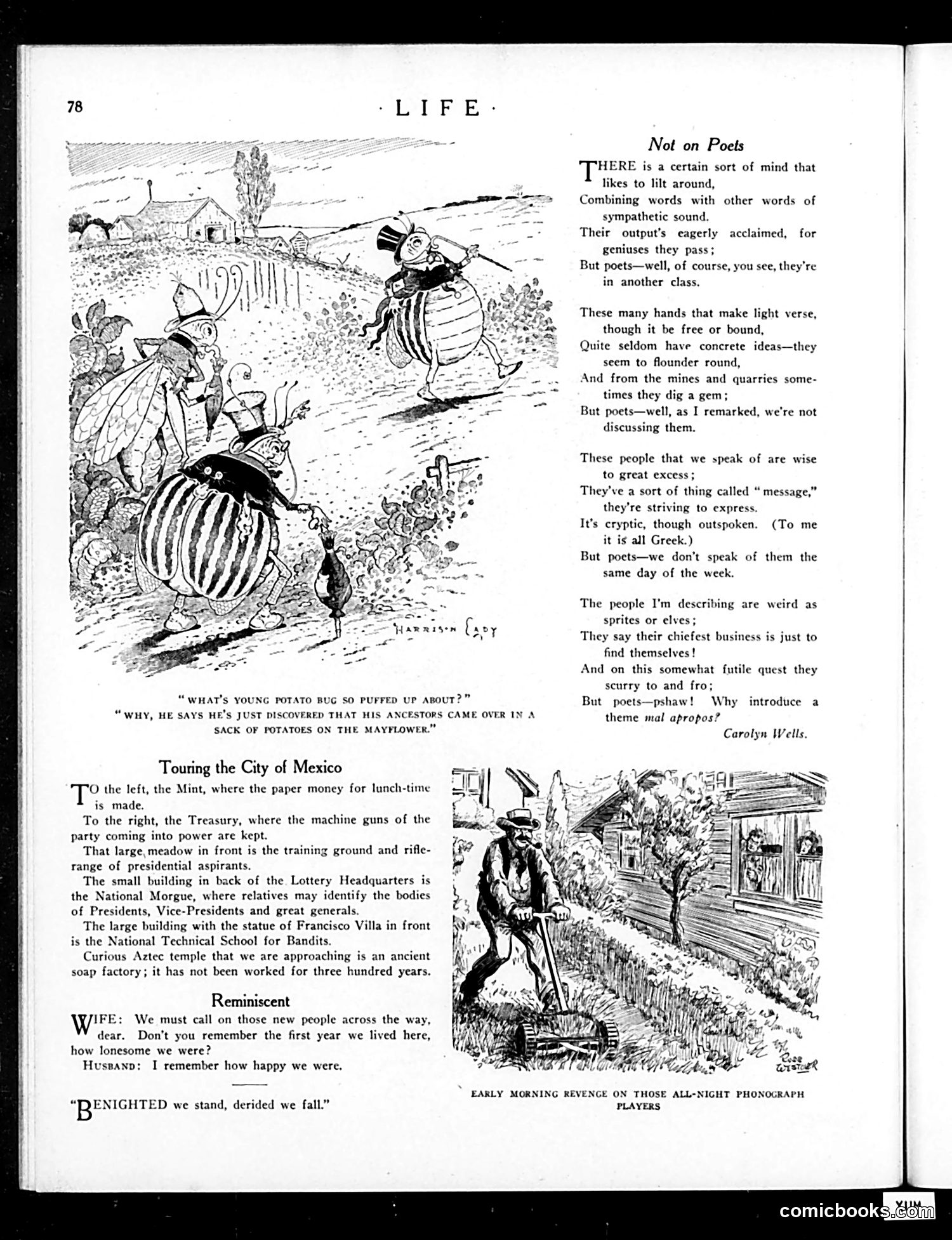
This *Life* magazine page contains three distinct pieces of social satire: **"Young Potato Bug" Cartoon:** A joke mocking nouveau-riche pretension. A potato bug brags about aristocratic ancestry, claiming his forebears came on the Mayflower in a sack of potatoes. The humor targets people of humble origin who, upon gaining wealth or status, fabricate grand ancestries—a common American anxiety about social climbing. **"Touring the City of Mexico":** Dark political satire describing Mexico City institutions with cynical realism. The Mint makes "lunch money," the Treasury stores "machine guns of the party coming into power," and a "National Technical School for Bandits" exists. This mocks Mexican government instability, corruption, and frequent violent power transfers—reflecting early 20th-century perceptions of Mexico as politically chaotic. **"Not on Poets" (by Carolyn Wells):** Verse satirizing pretentious poets who produce obscure, message-laden work while lacking concrete ideas. The poem dismisses them as self-absorbed and cryptic, contrasting them favorably with more practical people. It's a dig at artistic pretension and modernist poetry's opacity.
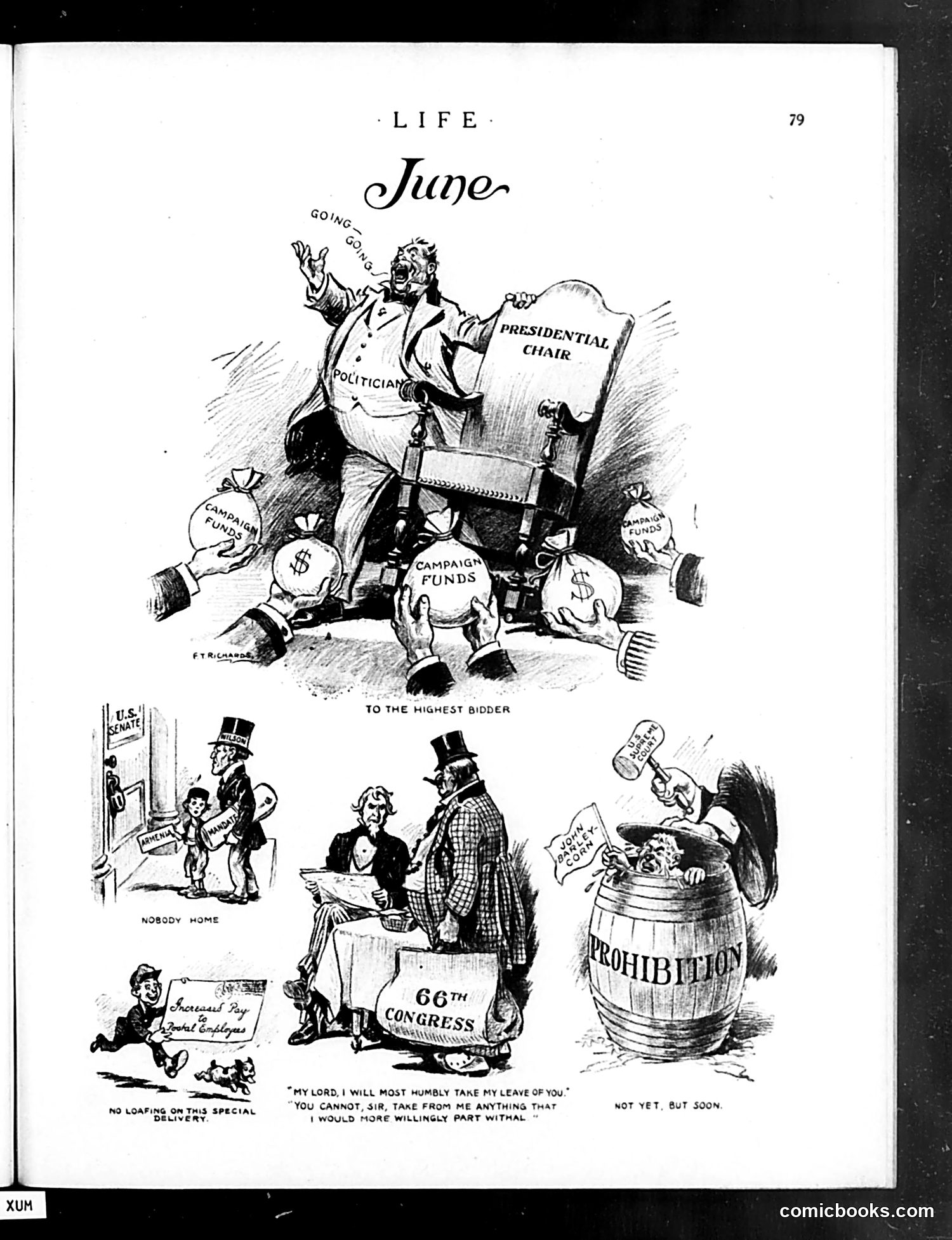
This page satirizes early 20th-century American politics, likely from a presidential election cycle. The main cartoon shows a politician being auctioned "to the highest bidder," surrounded by money bags labeled "campaign funds"—critiquing how wealthy donors control political candidates. Lower cartoons mock: - **Congressional corruption**: The 66th Congress scene suggests legislators are willing to trade favors - **Prohibition**: The barrel cartoon labeled "Not Yet, But Soon" references the impending Prohibition era (18th Amendment), implying politicians resist it until forced - **Political patronage**: "Nobody Home" suggests absent representatives; the "special delivery" panel mocks rushed legislative action The overall message: American politics is for sale, Congress lacks integrity, and politicians only act when public pressure forces them. This reflects Progressive Era skepticism toward corrupt machine politics and corporate influence.
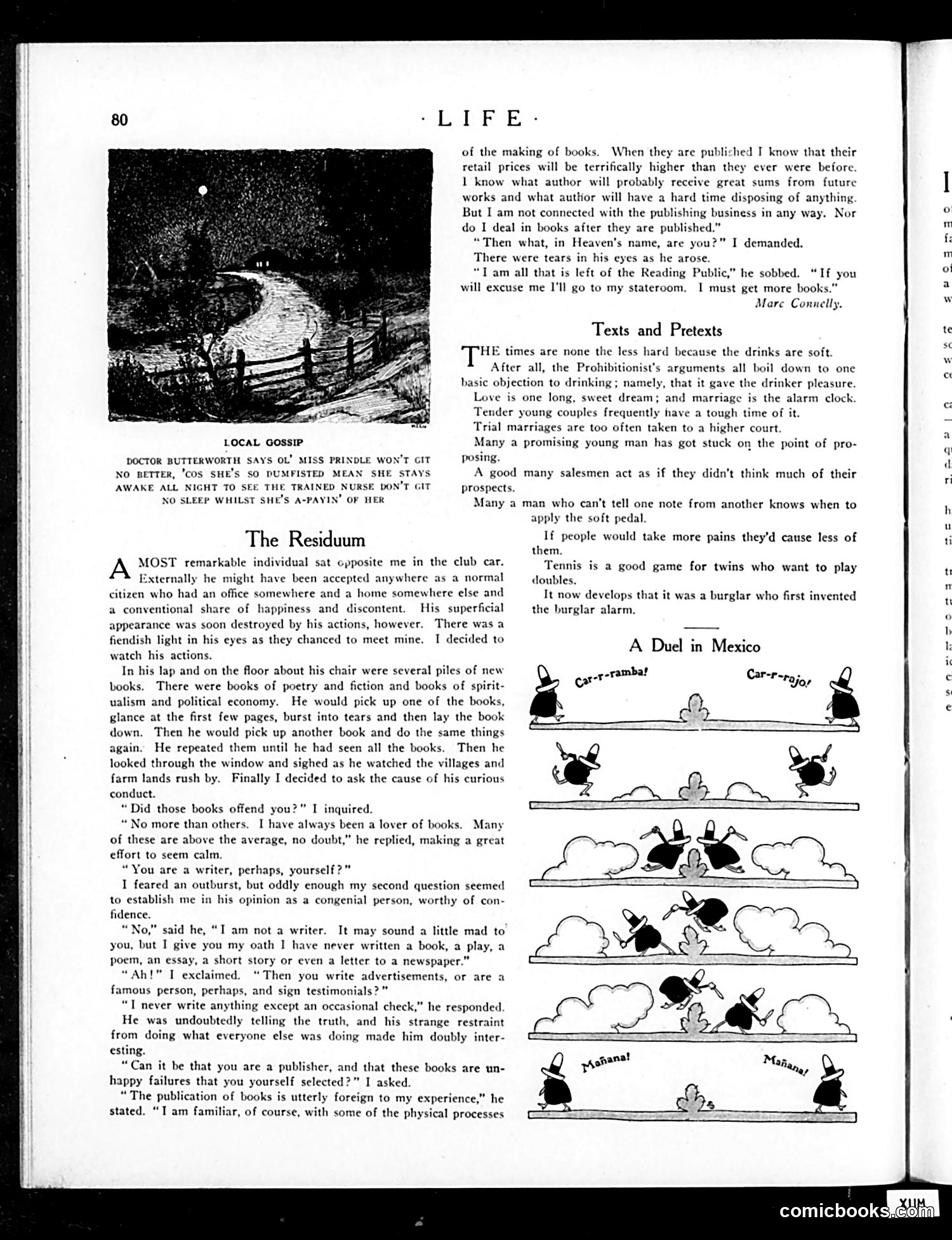
This page contains two distinct pieces of satire from *Life* magazine: **"The Residuum"** (main article): A humorous monologue about a mysterious man obsessively reading books in a train car. The joke culminates when he reveals he is "all that is left of the Reading Public"—a sardonic comment that the general reading audience has nearly disappeared. The satire targets both the decline of serious readership and the publishing industry's commercial practices. **"Texts and Pretexts"** (right column): A collection of brief, witty aphorisms mocking contemporary social issues, particularly **Prohibition** (referenced in the opening line about "soft drinks"). The jokes satirize marriage, courting, salesmanship, and modern life's disappointments in the style typical of early 20th-century satirical magazines. **"A Duel in Mexico"** (cartoon): A silent comic strip showing two figures in what appears to be a confrontation with onomatopoeia ("Car-r-ramba!", "Mañana!"). The specific reference is unclear without additional context. The overall tone reflects *Life*'s role as a venue for urban, educated satire targeting contemporary cultural anxieties.
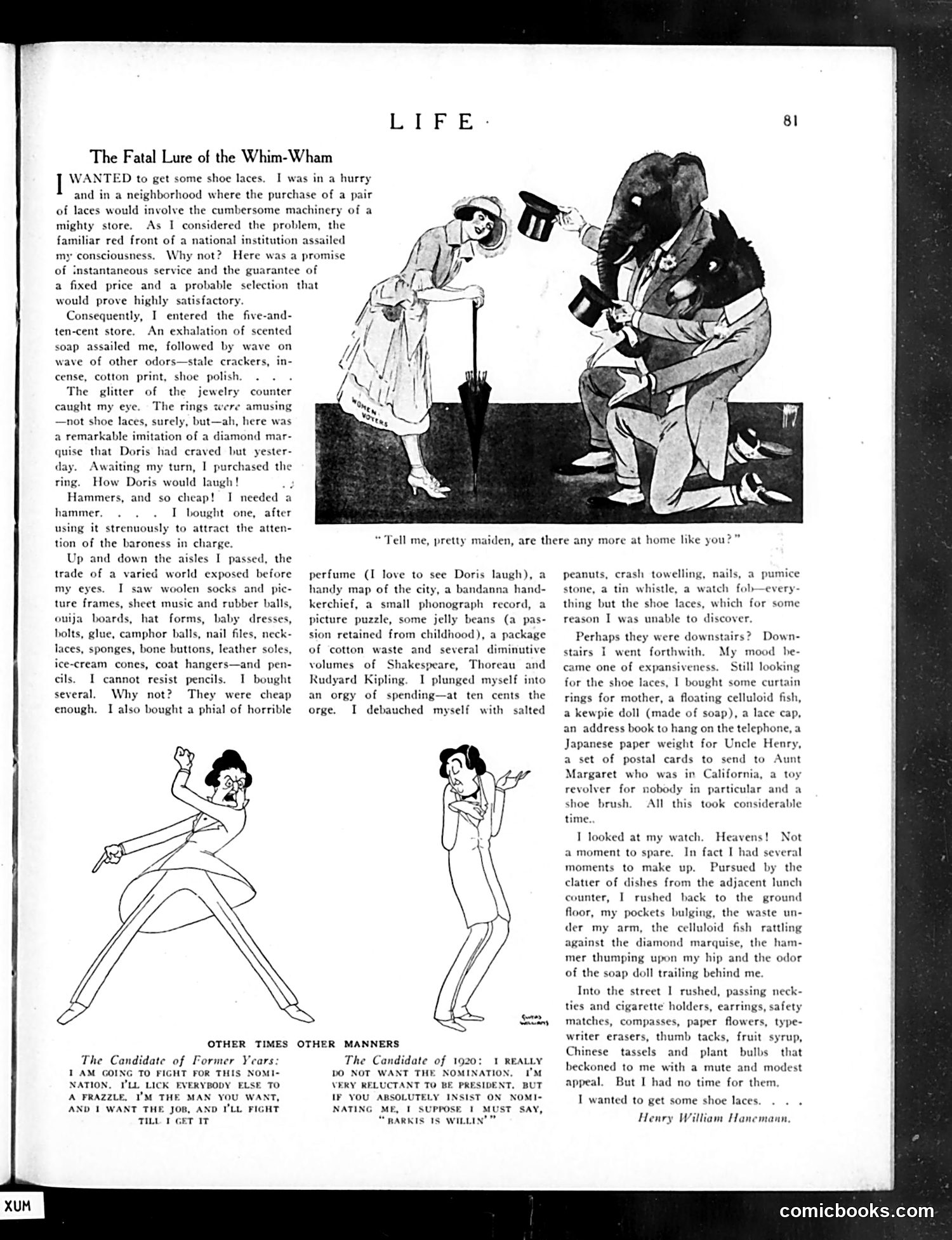
This humorous essay satirizes the five-and-ten-cent store (the "dime store," a precursor to modern variety retailers). The author entered seeking only shoelaces but was seduced by the store's deliberate sensory assault—scents, displays, and cheap novelties—into an impulsive spending spree. He purchased a diamond ring imitation, a hammer, perfume, records, jelly beans, Shakespeare volumes, curtain rings, a soap doll, phonograph record, and more—everything *except* the original shoelaces. The satire targets consumer culture and retail psychology: how merchants exploit human weakness for bargains and impulse buying. The store's chaotic inventory and low prices create an "orgy of spending" that derails rational shopping. The two small political cartoons below mock politicians' shifting campaign rhetoric between past and present, paralleling the broader theme of being lured from one's actual purpose by temptation and salesmanship.
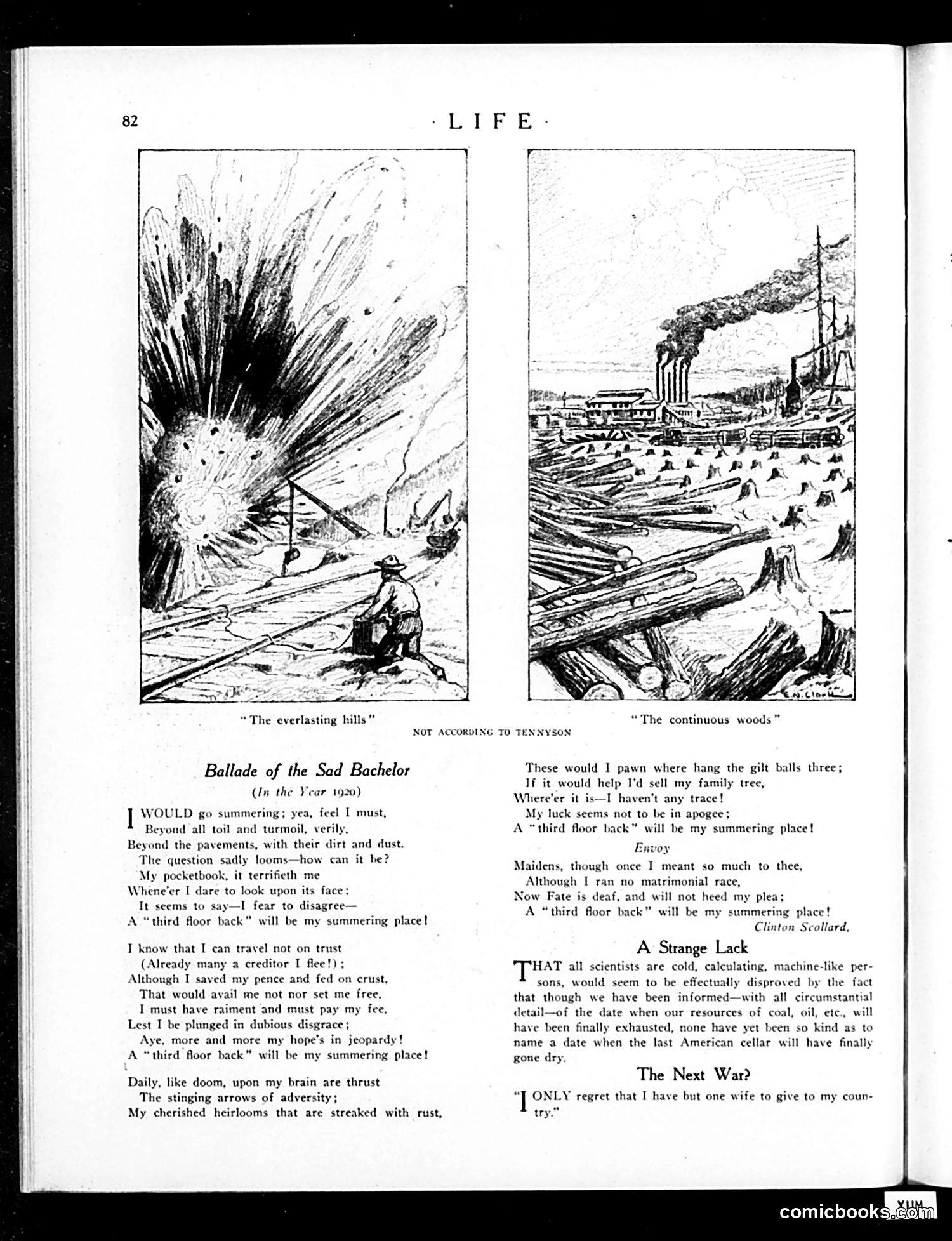
**The Two Cartoons:** The paired illustrations titled "The everlasting hills" and "The continuous woods" mock Tennyson's romantic poetry by depicting industrial devastation instead. The left shows an explosion at a mining or industrial site; the right shows a lumber mill with clear-cut forest. Both contrast sharply with Tennyson's idealized nature imagery, satirizing how industrial progress destroys the natural world the Romantic poets celebrated. **"Ballade of the Sad Bachelor" (1920):** This poem humorously depicts a poor, unmarried man unable to afford a summer vacation. His only option is a "third floor back" (a cheap, cramped attic room). He laments his empty pockets, failed romantic prospects, and creditors—capturing post-WWI economic hardship and bachelor poverty in humorous verse. **"A Strange Lack" and "The Next War?":** Brief satirical commentary: scientists can predict when coal/oil will run out but haven't predicted when American basements will dry up (unclear reference). The final quote likely mocks patriotic sacrifice rhetoric, with someone joking they'd only give one wife to their country.
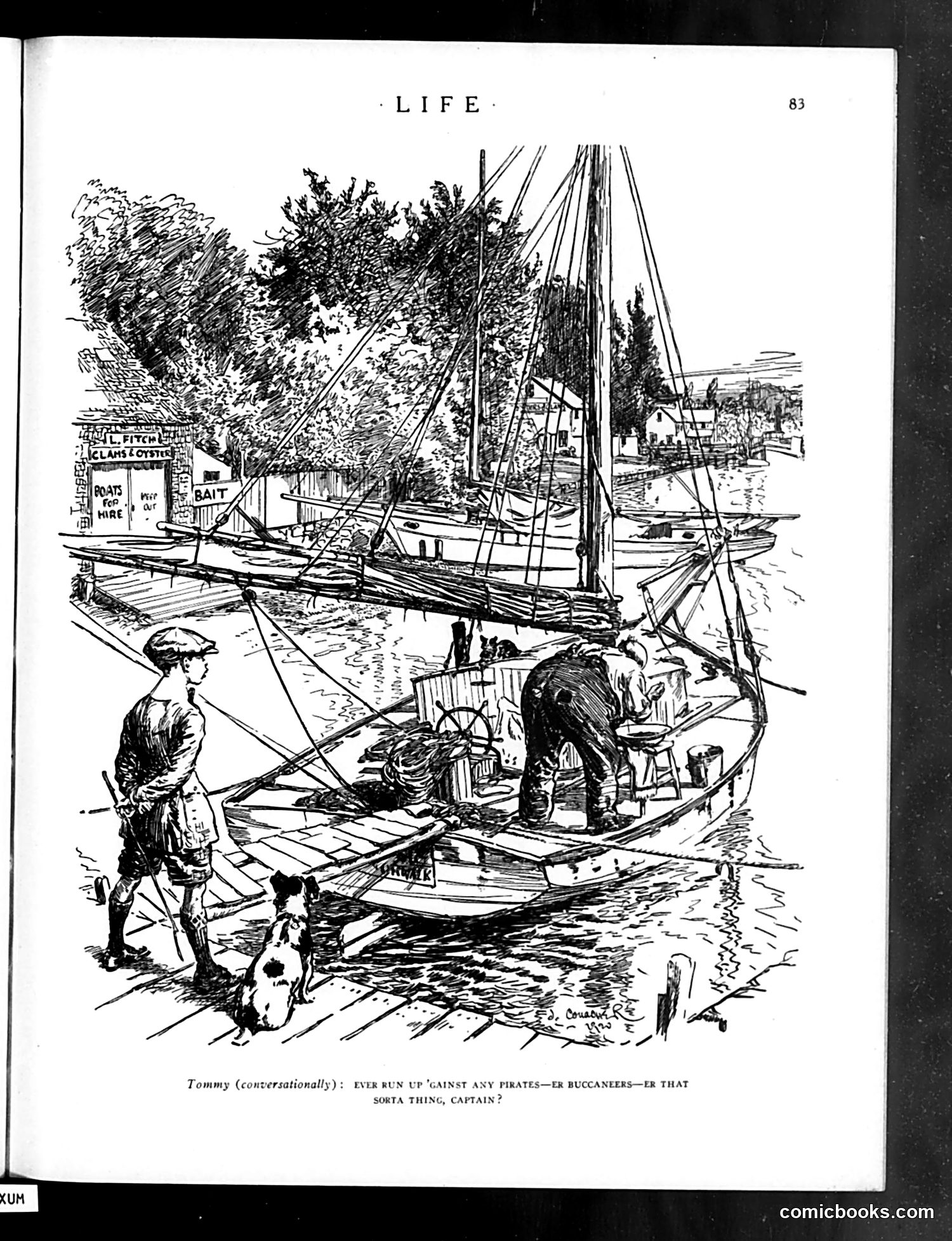
This is a single-panel cartoon showing a young boy named Tommy speaking with a ship captain at a harbor. Tommy asks if the captain has "ever run up 'gainst any pirates—er buccaneers—er that sorta thing." The humor operates on multiple levels: Tommy's casual, conversational tone treats piracy as a simple topic of curiosity rather than serious danger. The setting—a working harbor with merchant vessels and commercial activity—contrasts with Tommy's romanticized notions of adventure. The joke likely satirizes how boys' adventure stories (popular literature of the era) glamorized piracy and seafaring danger, while real maritime commerce was mundane and regulated. The captain's implied bemused response to this naive question adds to the satire of youthful idealism meeting practical reality.
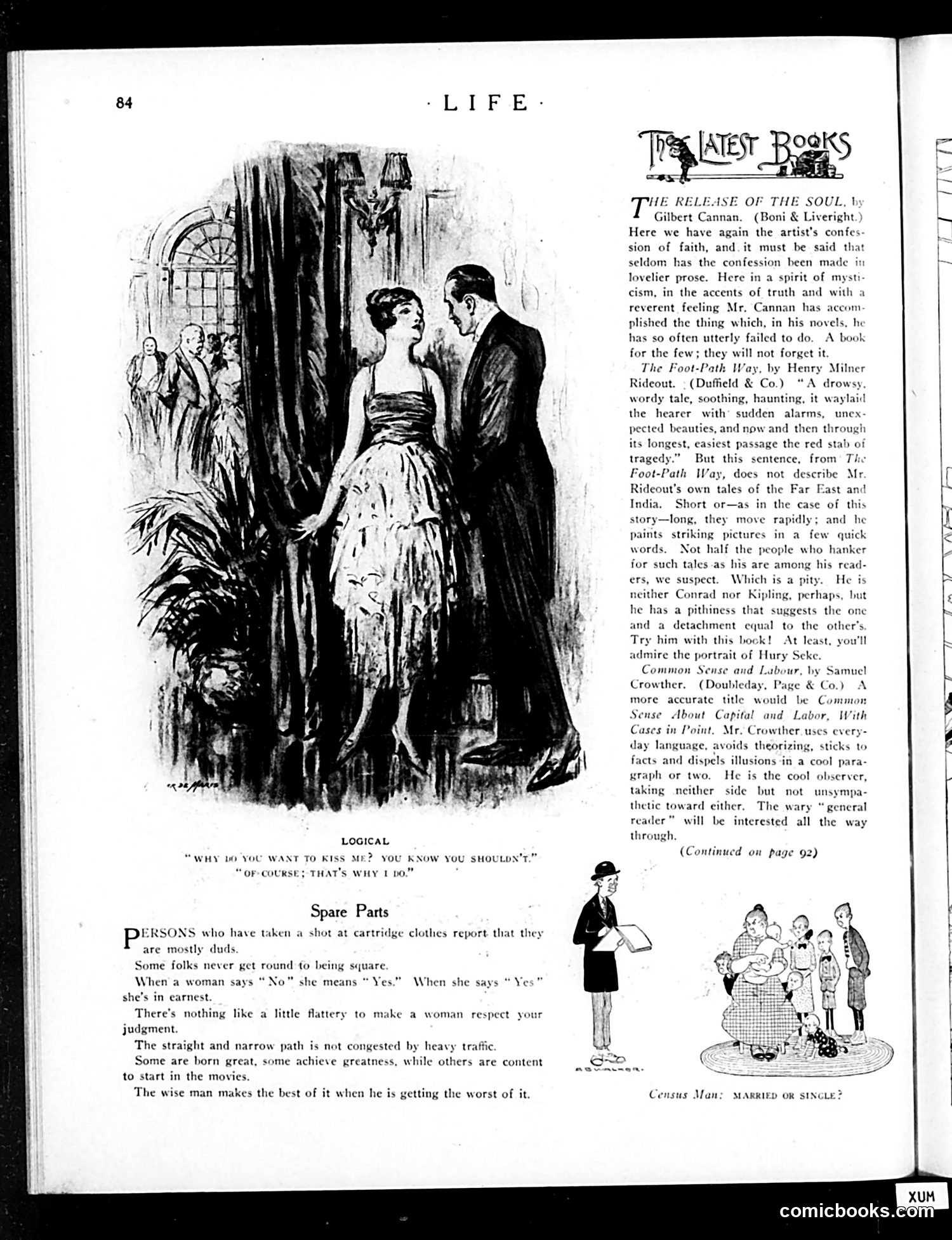
The main cartoon depicts a man and woman in formal dress at what appears to be a social gathering, with the caption presenting a flirtatious exchange about kissing. The "Logical" section below offers cynical observations about gender relations—particularly mocking conventional wisdom about women's behavior (e.g., "When a woman says 'No' she means 'Yes'"). This reflects early 20th-century attitudes toward courtship and romance that modern readers would find problematic. The satire targets outdated social conventions and male assumptions about female consent, though presented as "wisdom" rather than critique. The smaller cartoon labeled "Census Man" shows an official questioning a family, asking whether the adult male is "married or single?"—likely satirizing the intrusive nature of census-taking or bureaucratic classifications. Both pieces exemplify *Life* magazine's humor targeting social pretension and gender dynamics of the era.
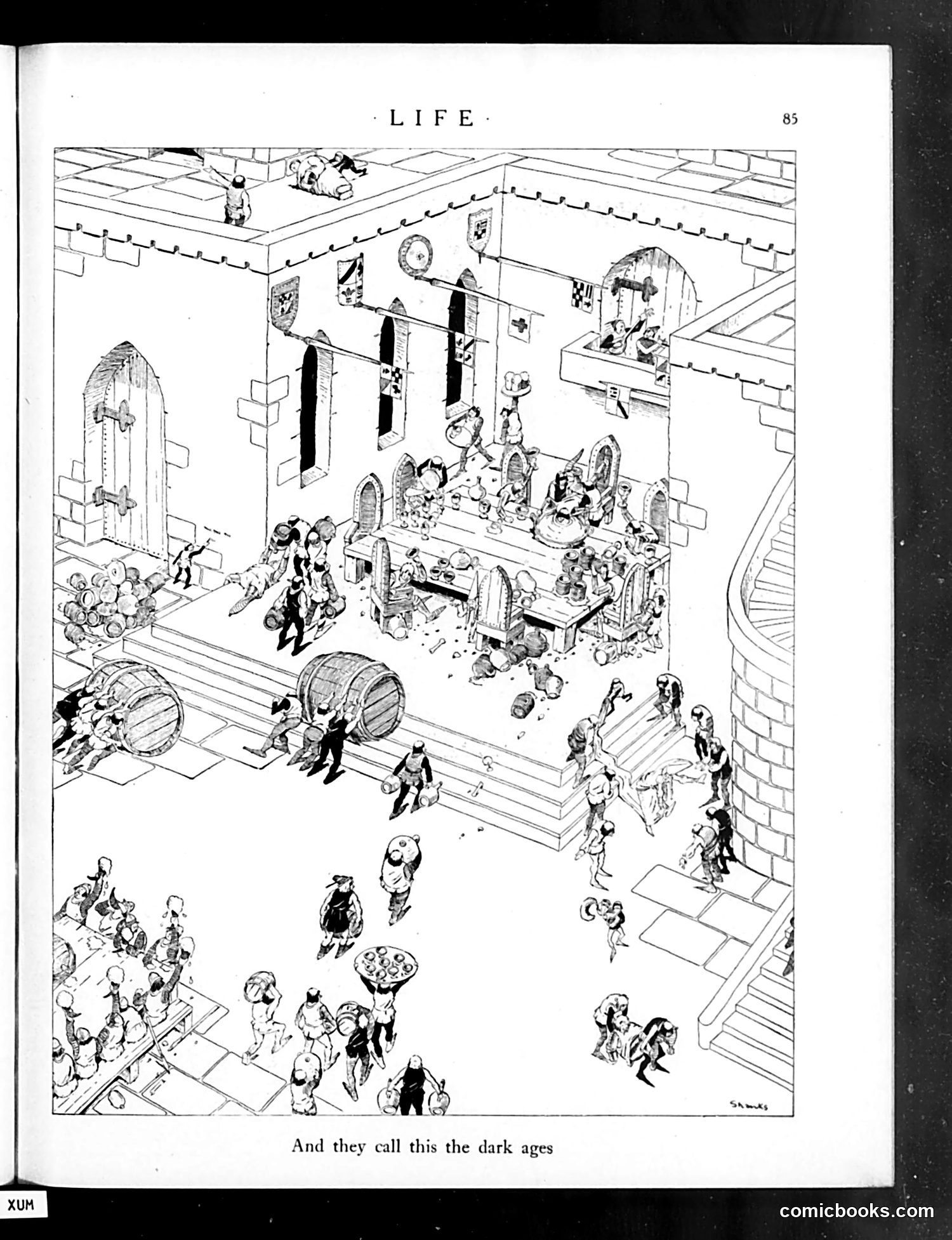
This single-panel cartoon depicts a bustling medieval castle courtyard rendered in isometric perspective. Numerous figures engage in various activities—feasting, working, socializing, and laboring—creating a scene of energetic commerce and daily life. The satire's point is ironic: the "Dark Ages" (medieval period) appear anything but dark or primitive. The cartoon challenges the historical characterization of this era as backward or uncivilized by showing it as lively, organized, and socially complex. The humor lies in the contradiction between the historical label "dark ages" and the actual vitality depicted. This reflects early-to-mid 20th-century historical revisionism that questioned whether the medieval period was truly as primitive or culturally barren as traditional narratives claimed.
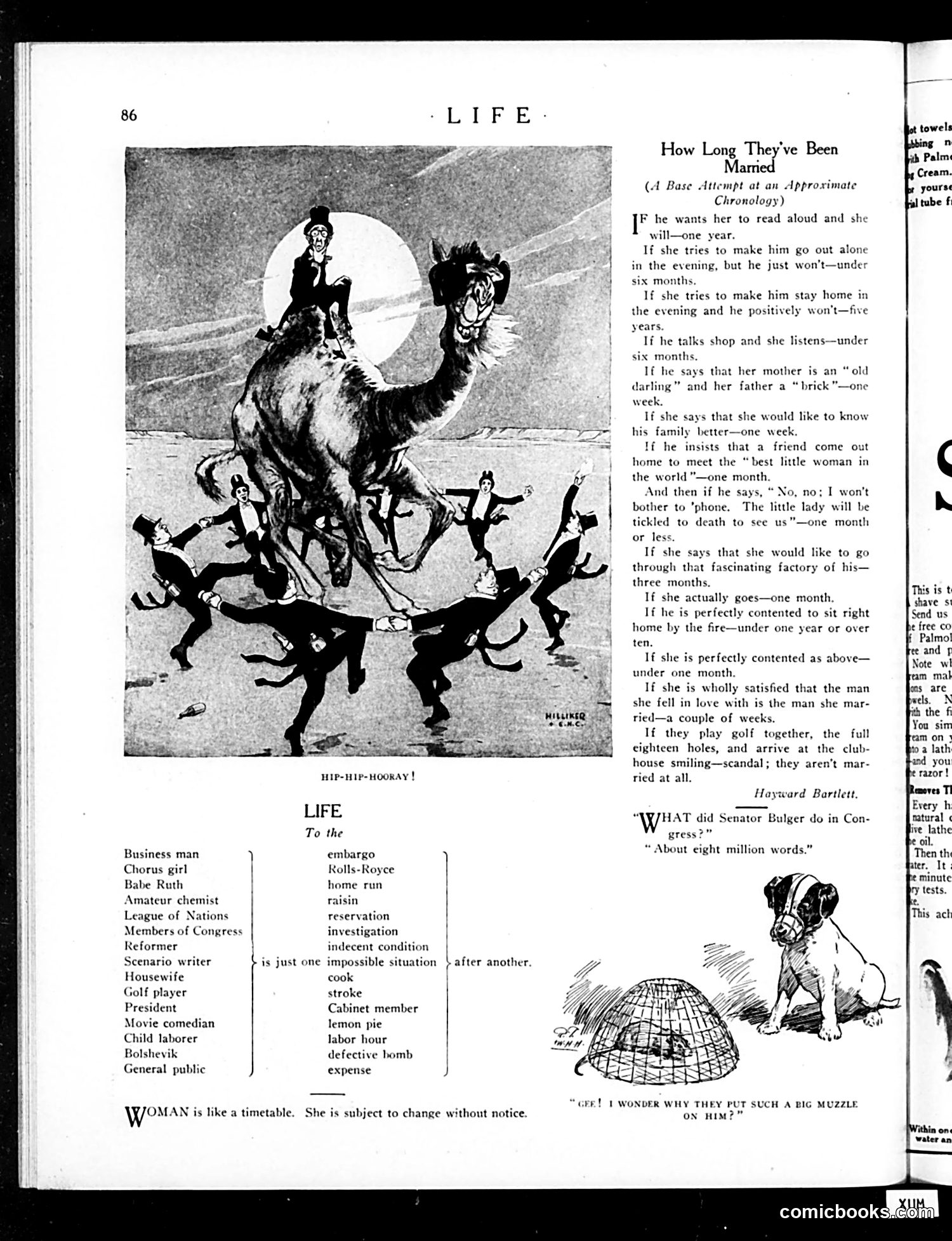
This page contains two separate satirical pieces about marriage and politics. **"How Long They've Been Married"** (top): A humorous chronology listing various marital scenarios and their duration—for example, if a wife wants her husband to read aloud, they've been married one year; if he refuses to go out alone, under six months. The joke critiques how quickly romantic behavior deteriorates in marriage, using specific domestic situations as a timeline measuring tool. **The "LIFE" section** (bottom left): Lists impossibly contradictory situations (business man, chorus girl, President, etc.) all being "just one impossible situation after another"—likely satirizing how American life contains inherent contradictions. **The Senator Bulger cartoon** (bottom right): References an unnamed Senator's Congressional activity as producing "about eight million words"—satirizing verbose, unproductive political rhetoric. The dog cartoon (bottom) makes an obscure joke about a muzzle, context unclear from visible text. These pieces exemplify Life magazine's early 20th-century satirical approach: domestic mockery and political critique through brevity and absurdist humor.
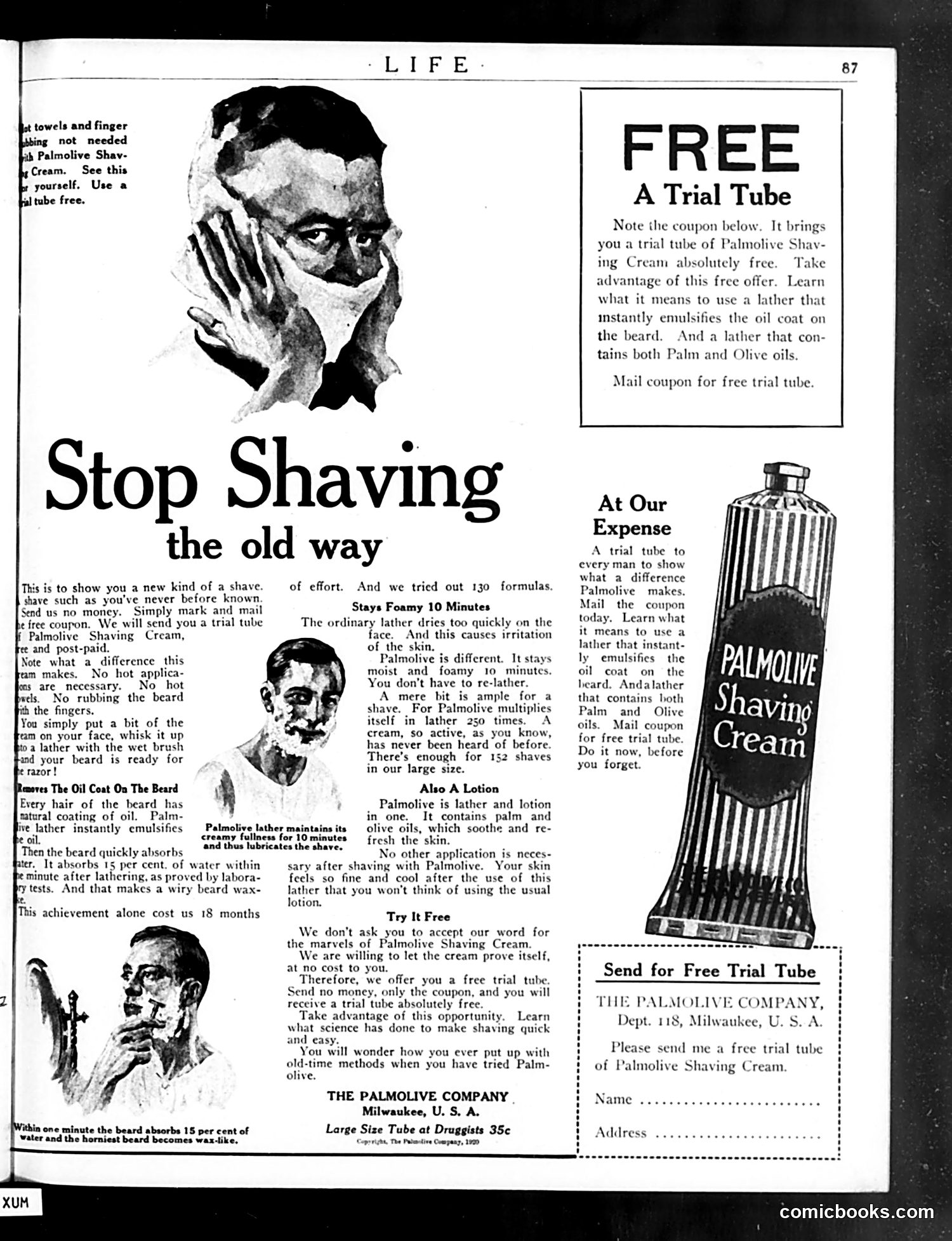
This is primarily a **product advertisement**, not political satire. The page promotes Palmolive Shaving Cream to early 20th-century male readers by contrasting "old-fashioned" shaving methods with modern convenience. The illustrated faces show men at different shaving stages—applying lather, mid-shave—demonstrating the product's ease of use. The key selling points emphasize **scientific innovation**: the cream stays foamy for 10 minutes (versus traditional lathers that dried quickly), absorbs water to soften whiskers, and contains palm and olive oils for skin conditioning. The advertisement uses before-and-after visual rhetoric common to the era, suggesting that adopting Palmolive means abandoning inconvenient, irritating traditional methods. The free trial tube offer was a standard marketing tactic to overcome consumer skepticism about new products. There is no political or satirical content—this is straightforward commercial persuasion targeting men concerned with grooming efficiency and skin health.
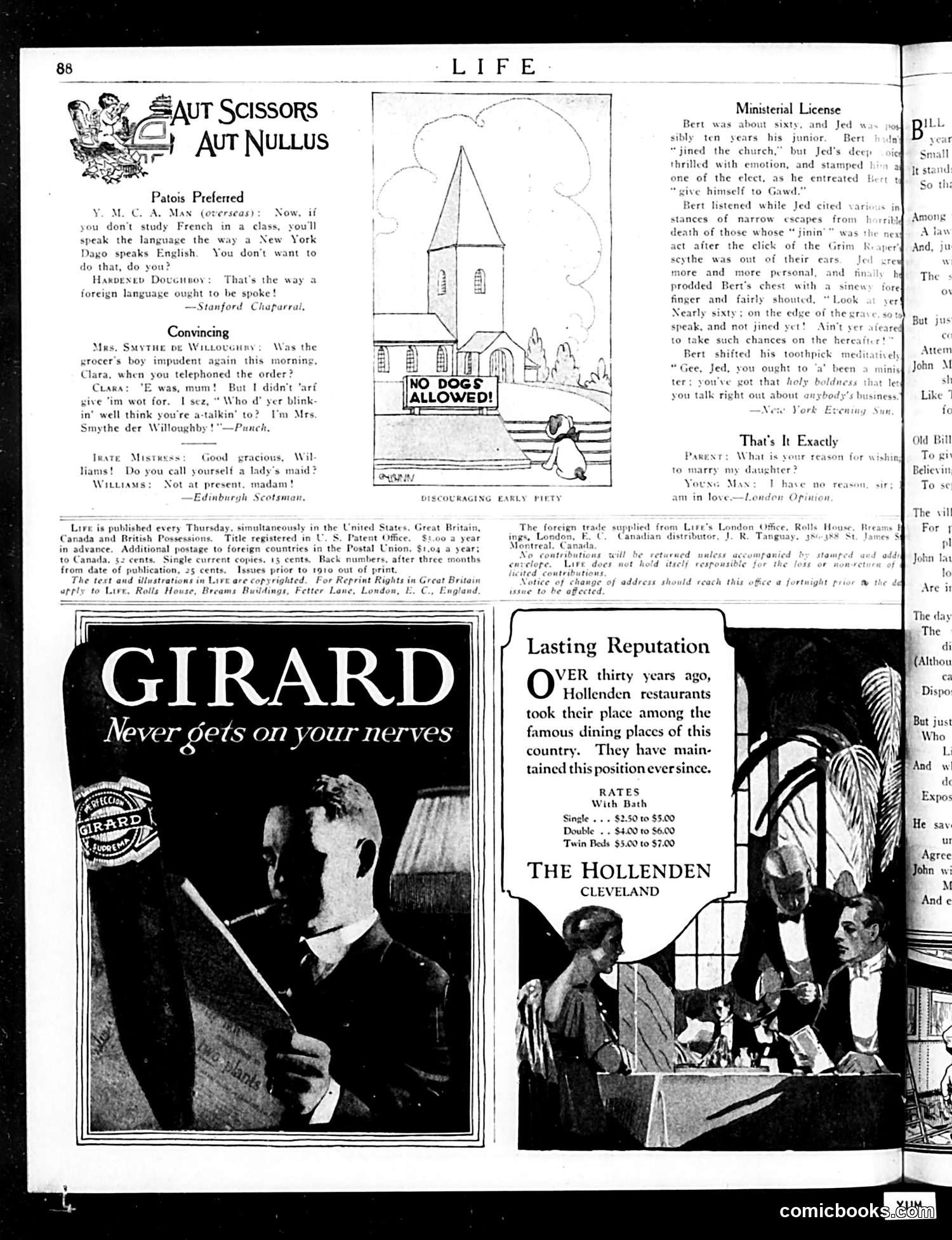
This page from Life magazine contains **satirical humor pieces and advertisements** targeting early 20th-century social attitudes. The "Patois Preferred" joke mocks class pretension: a man warns against learning French "the way a New York Dago speaks," using an ethnic slur common to the era. The humor relies on attacking both snobbish language instruction and immigrant accents—typical of Life's satirical commentary on American social hierarchies. "Convincing" presents a domestic comedy where a housewife recounts scolding a delivery boy who was "impudent," using working-class dialect ("'arf give 'im wot for"). The joke appears to mock class-conscious servants or female pretension about status. The "Ministerial License" and "That's It Exactly" pieces are brief domestic humor focusing on marriage and religious conversion. The **Girard advertisement** ("Never gets on your nerves") uses a cigarette to advertise calm composure—a common marketing approach of that era. The **Hollenden hotel advertisement** promotes upscale dining and lodging in Cleveland. Overall, the page reflects period attitudes toward class, ethnicity, and gender through satirical humor typical of Life's editorial voice.
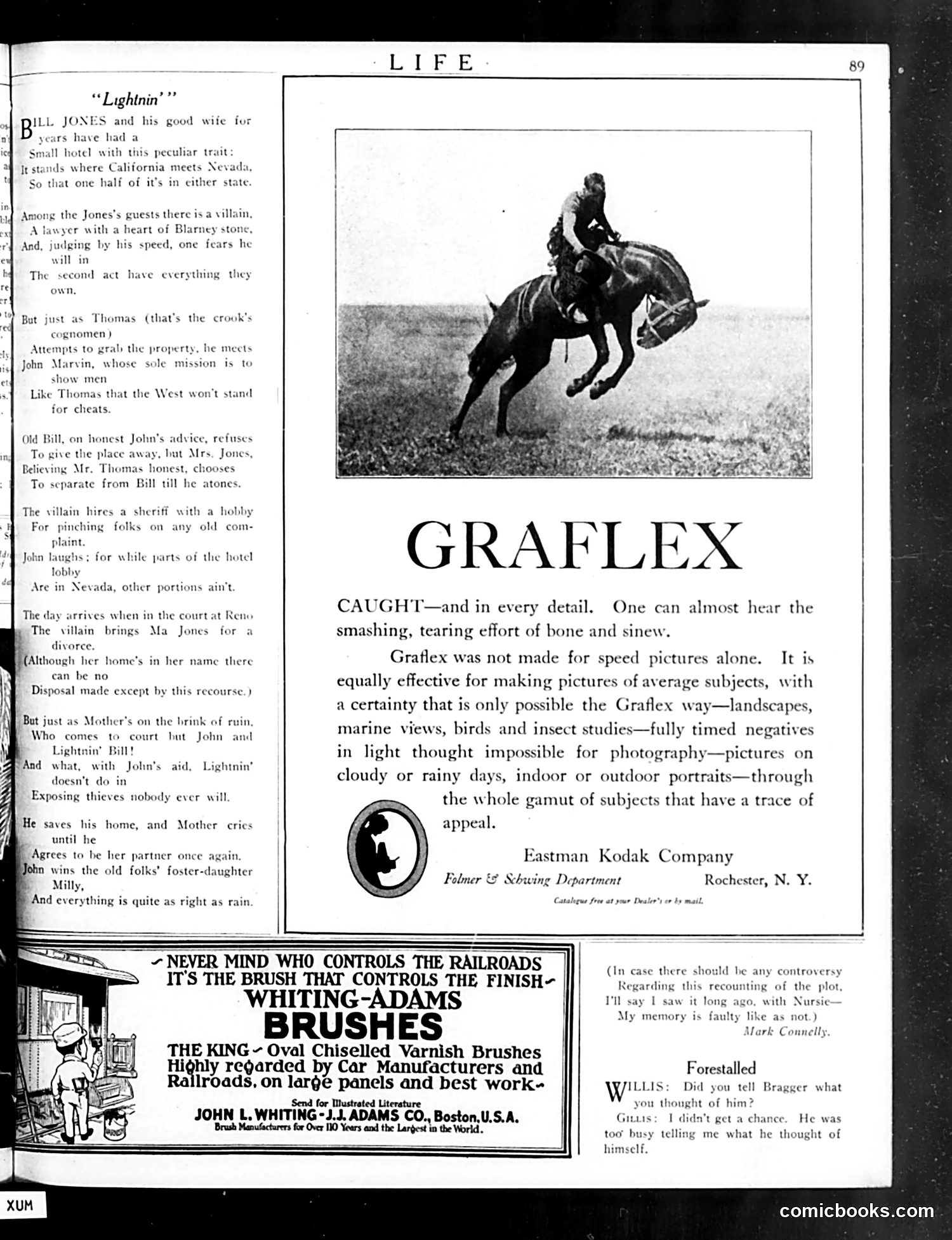
This page promotes **"Lightnin'"** — a stage play (later film) about a California-Nevada border hotel. The plot synopsis describes a classic melodrama: a villain-lawyer attempts to swindle the elderly proprietor Bill Jones and his wife through fraud and a divorce suit, but is exposed and defeated by an honest man named John (called "Lightnin' Bill"). The satire is gentle morality-play fare typical of early 20th-century theater: the West's rough justice triumphs over civilized corruption; honest men defeat scheming lawyers; virtue is rewarded. The page is primarily **advertising** — three separate pitches for commercial products (Graflex cameras, Whiting-Adams brushes, varnish) surround the plot summary. A brief exchange at bottom ("Forestalled") is a joke about honesty in social interaction, likely unrelated to the main story. This reflects Life's dual nature as both satirical publication and advertising vehicle.
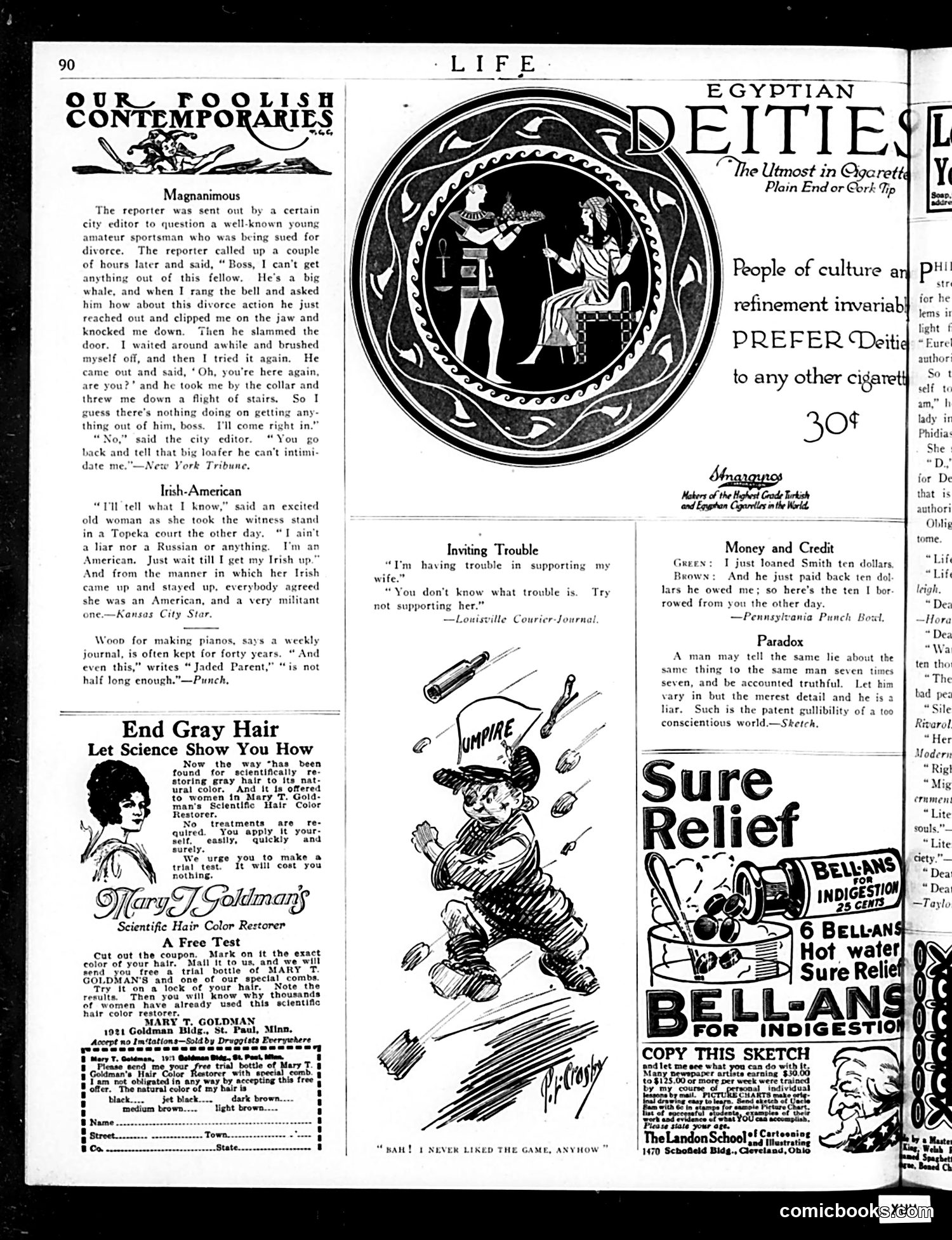
This page from Life magazine (a satirical publication) contains several distinct elements: ## "Our Foolish Contemporaries" Column Three brief humorous anecdotes mocking human behavior: - A reporter physically beaten by a divorce defendant, undeterred - An Irish-American woman confidently (and stereotypically) asserting her credibility as a witness - A comment on piano wood preservation lasting "forty years" The satire targets journalistic persistence, ethnic stereotypes, and editorial absurdity. ## Central Image An ornate Egyptian-style cigarette advertisement for "Deities" brand (30¢), featuring decorative hieroglyphic-inspired design. ## Supporting Jokes & Ads Brief comic exchanges about marital debt, lying, and a sketch captioned "Bah! I never liked the game, anyhow" (unclear reference). ## Main Advertisement Mary T. Goldman's "Scientific Hair Color Restorer" for gray hair—a period cosmetic product offering a free trial. The page represents typical early 20th-century magazine content: satirical social commentary mixed with product advertising.
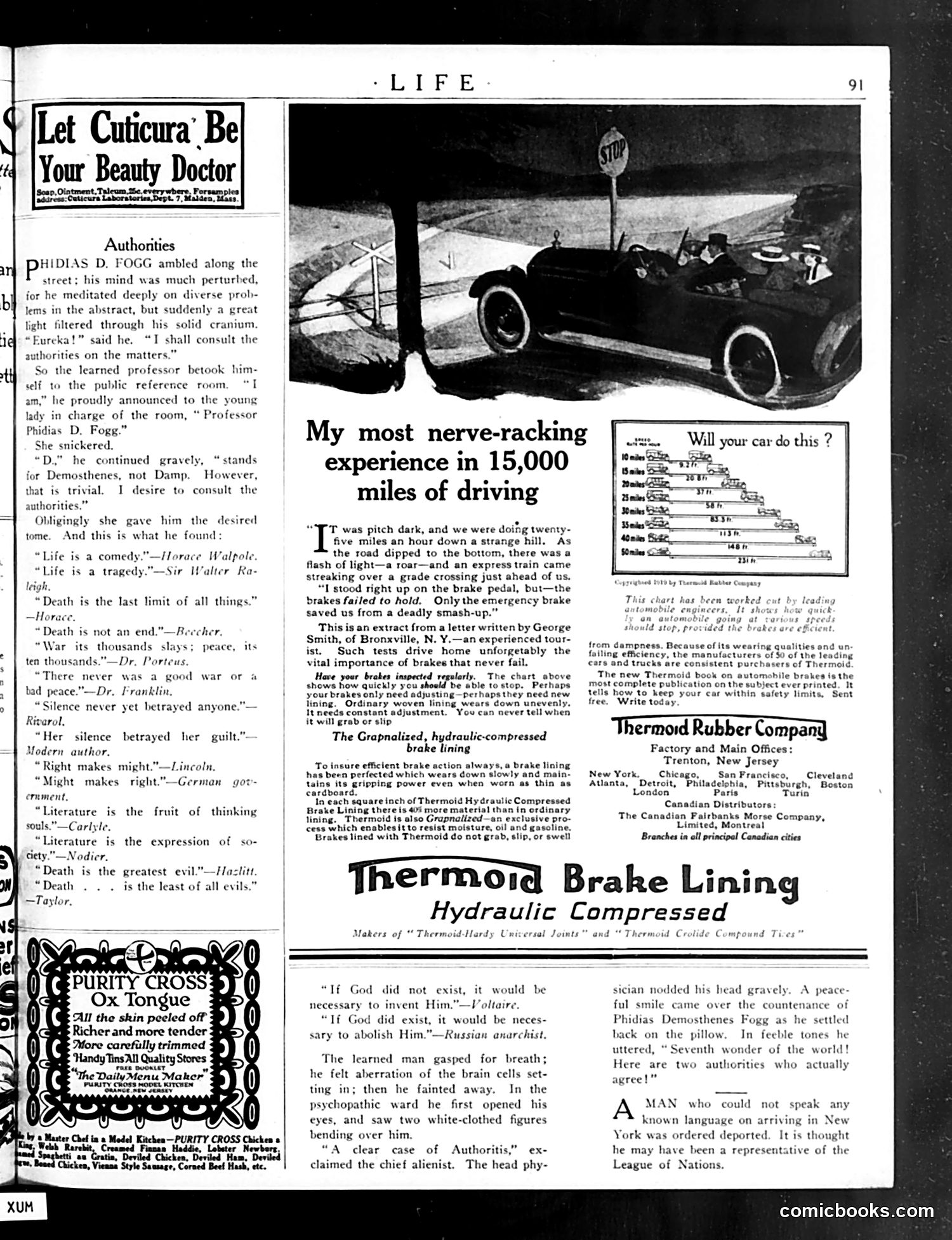
This page mixes satirical content with advertising. The main cartoon/story titled "Authorities" satirizes academic pedantry through Professor Phidias D. Fogg, who consults reference materials seeking definitive answers to life's big questions. The joke: he finds contradictory quotations—about whether life is tragedy or comedy, whether death is evil or natural, whether might makes right or right makes might. The satire mocks both philosophers who offer opposing "authorities" and the naive belief that consulting books yields absolute truth. The bulk of the page is a **Thermoid Brake Lining advertisement** disguised as an editorial story. "George Smith of Bronxville" recounts a harrowing near-accident where faulty brakes almost caused a train collision. This is marketing: the dramatic incident promotes Thermoid's superior brake lining as the solution to automotive safety dangers—a growing concern in the automobile age. The left sidebar advertises Cuticura beauty products and Purity Cross tongue product, typical period advertising.
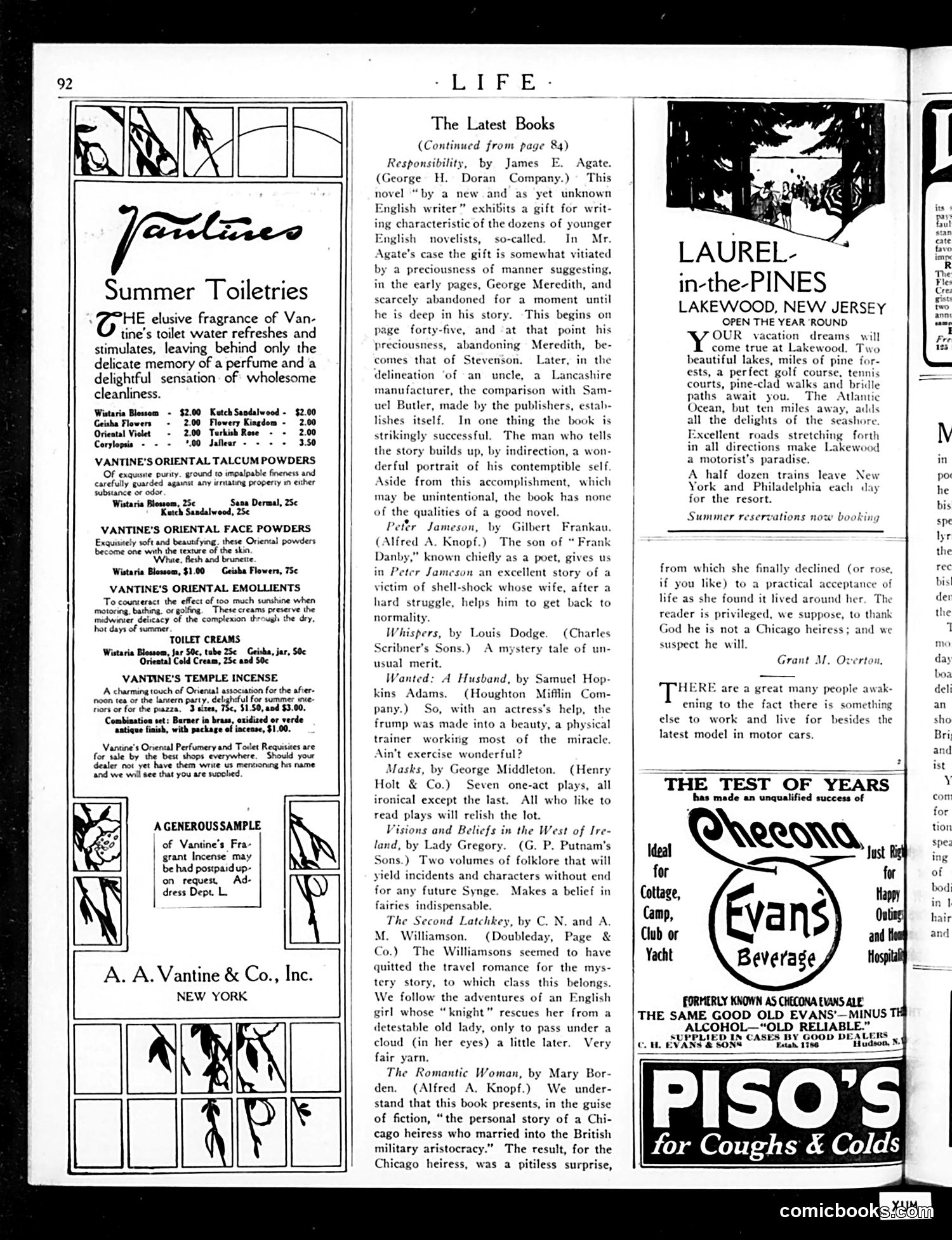
This page is primarily **advertising and book reviews** with minimal editorial content. The left side features luxury toiletries ads from A.A. Vantine & Co.—expensive fragrances, powders, and creams marketed to affluent women with orientalist branding ("Wistaria Blossom," "Geisha Flowers"). The pricing ($1-$3.50) targets wealthy consumers. The center contains book reviews of contemporary fiction, including works addressing post-WWI themes—notably *Peter Jameson*, which concerns a "shell-shock" victim recovering from war trauma. This reflects early 1920s literature grappling with psychological wounds from World War I. The right side advertises **Laurel-in-the-Pines**, a New Jersey resort, and commercial products (Piso's cough drops, Evans Beverage). **No political cartoon or satire is visible.** This is a commercial magazine page typical of the 1920s, mixing high-end consumer advertising with literary coverage for educated, affluent readers.
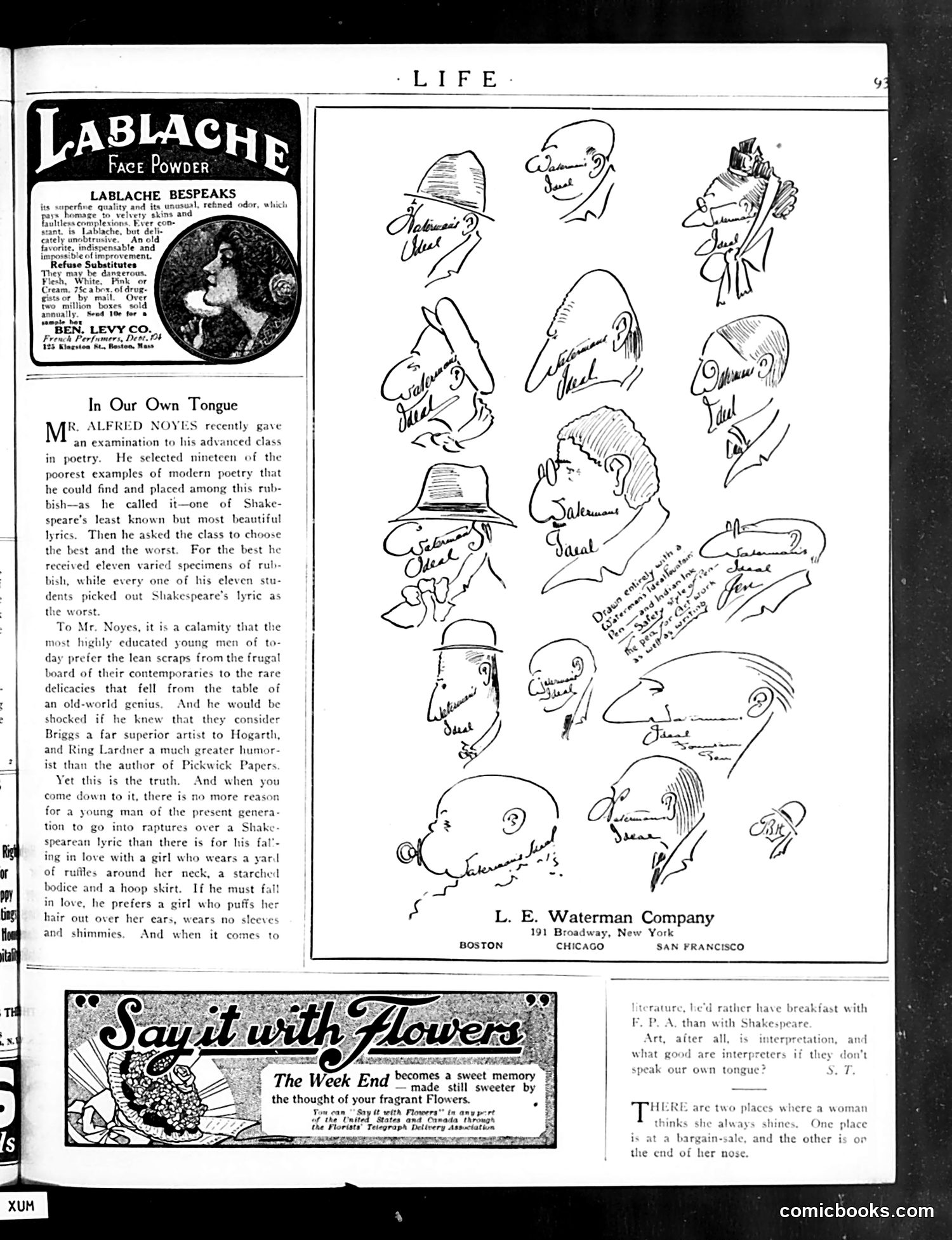
This essay satirizes the declining aesthetic standards of educated young people. Alfred Noyes (a real poet) conducted an experiment: he mixed nineteen examples of contemporary "rubbish" poetry with one beautiful Shakespeare lyric, asking students to identify the best and worst. All eleven students chose Shakespeare as the worst—a damning verdict on modern taste. The author argues that young men now prefer mediocre contemporary writers (Briggs, Ring Lardner) to literary masters (Hogarth, Dickens). The satire extends to fashion: just as they'd rather date a girl with no sleeves and bobbed hair than one in traditional dress, they prefer modern "lean scraps" to timeless artistic "delicacies." The point: education hasn't improved judgment; contemporary culture has corrupted aesthetic sensibility. Modern readers prefer breakfast gossip to Shakespeare itself—a biting commentary on declining literary standards among the supposedly educated classes.
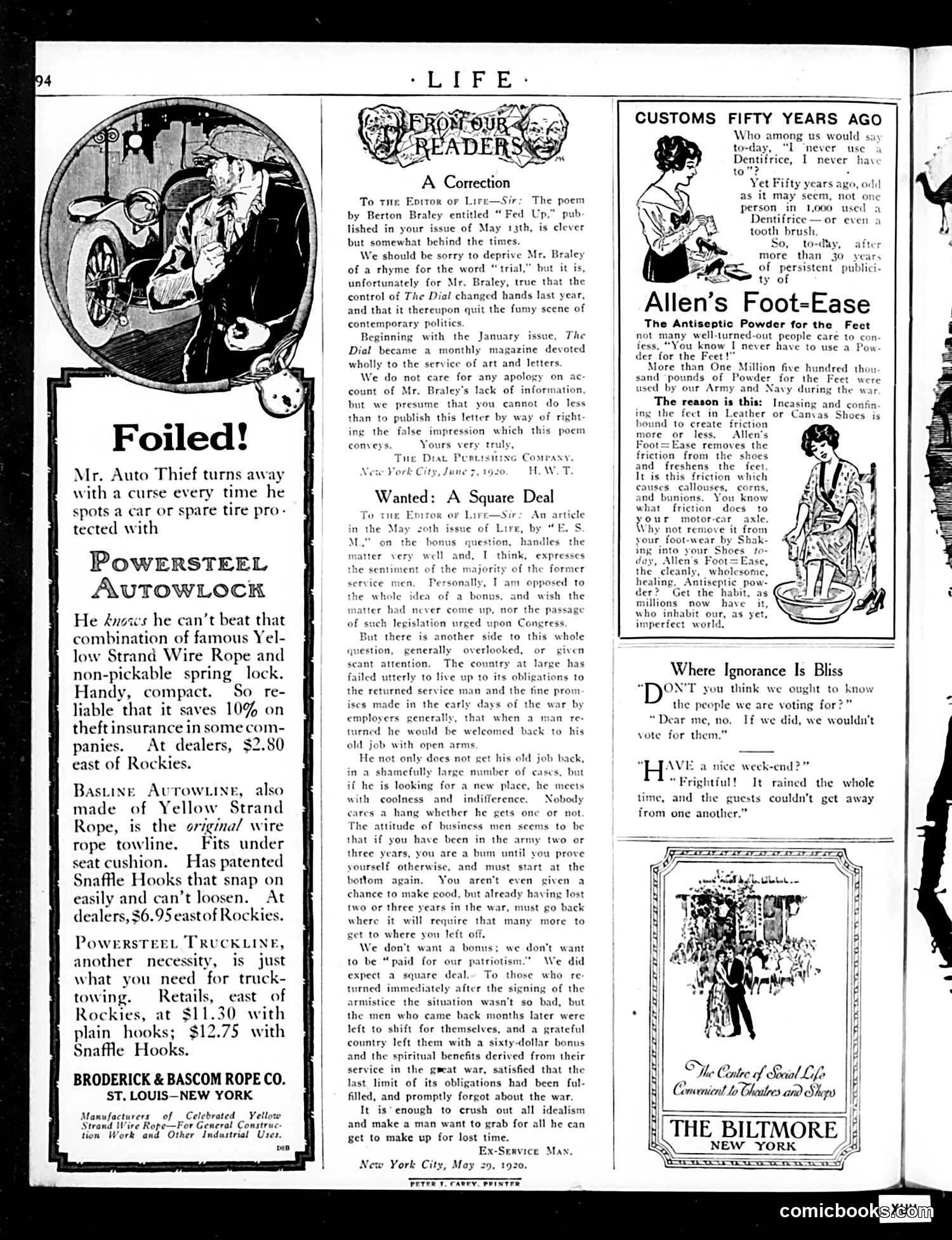
This page is primarily **advertising and reader correspondence**, not political satire. The main cartoon (left) illustrates a Powersteel Autowlock ad: a thief attempts to steal a car but is thwarted by the anti-theft device. The humor is straightforward—the frustrated criminal represents the product's effectiveness. The letters section contains two notable items: a correction about *The Dial* magazine (clarifying it shifted from political satire to arts coverage), and a longer complaint from an unnamed serviceman about post-WWI treatment. The latter is genuinely bitter—he argues returning soldiers received poor job prospects and a meager $60 bonus despite promises of fair treatment. He distinguishes between rejecting a "paid patriotism" bonus while demanding actual economic opportunity. The **social context**: This reflects genuine 1920 tensions over veteran reintegration and the perceived betrayal of returning soldiers by employers and government. It's earnest grievance, not satire—illustrating how economic disappointment after WWI fueled postwar discontent.
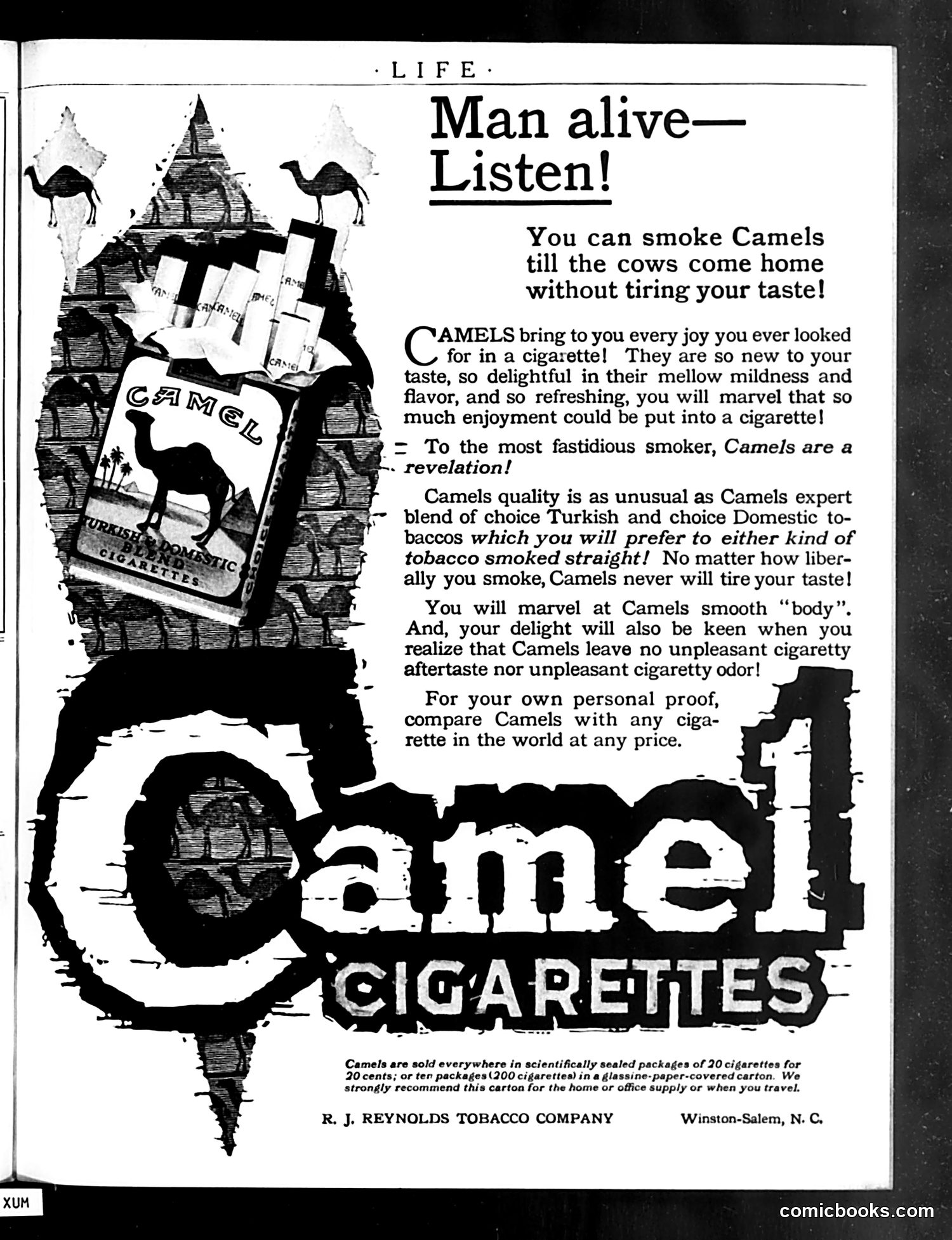
This is a **Camel cigarette advertisement**, not satire or political commentary. The page features an ornate pyramid illustration with camels, designed to evoke exotic appeal and quality. The ad's claims—that Camels won't tire your taste, leave no unpleasant aftertaste, or create cigarette odor—reflect early 20th-century tobacco marketing before health warnings. The "blend of choice Turkish and choice Domestic tobaccos" positioning suggests premium quality. For modern readers, the stark contrast is jarring: this straightforward product pitch treats smoking as purely pleasurable with no health concerns mentioned. The confident claims about taste endurance and lack of odor odor now read as absurdly false advertising. The pricing (20 cents for 20 cigarettes) provides historical context. This represents a pre-regulation era when tobacco companies made unsubstantiated health and sensory claims freely in mainstream publications.
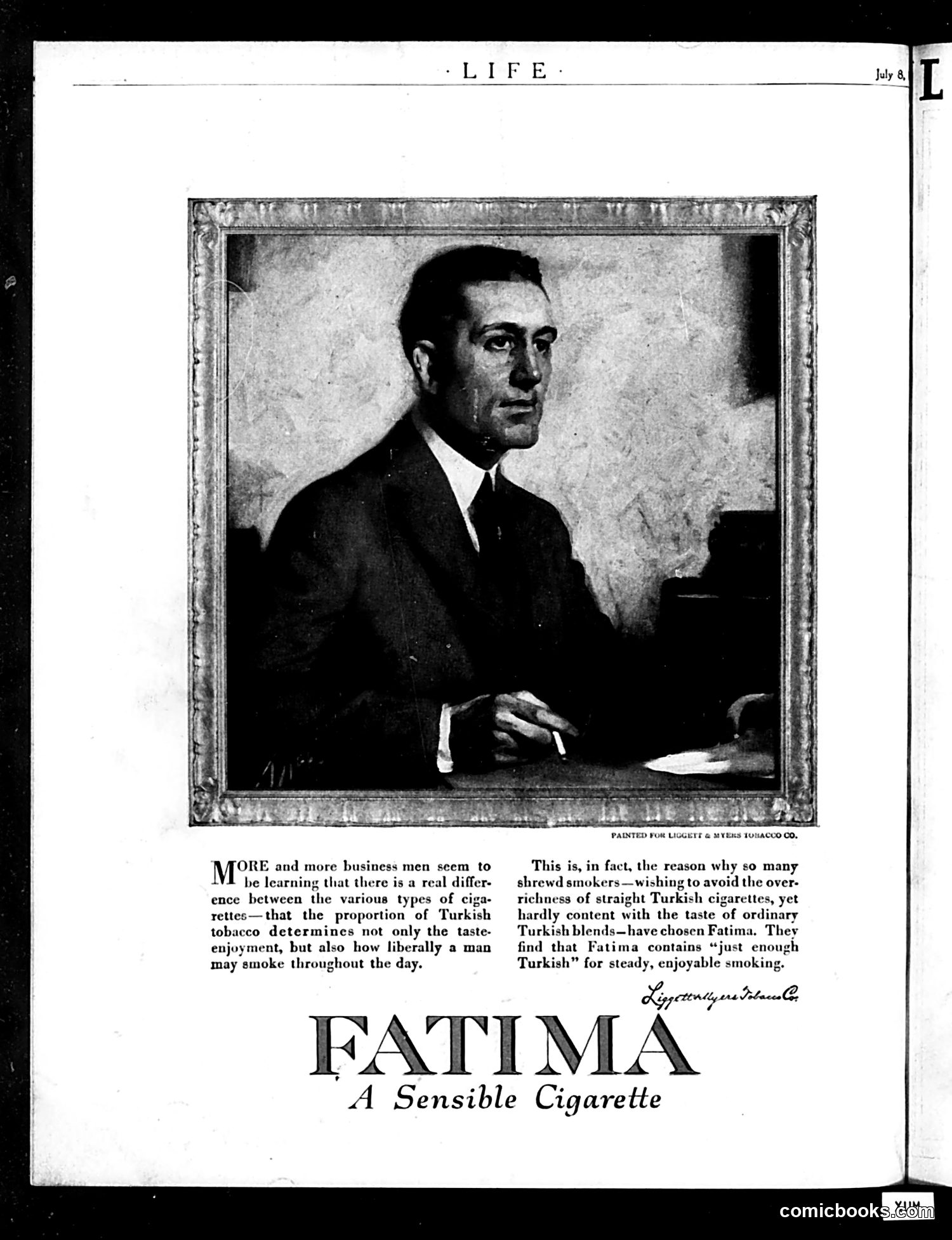
This is a **cigarette advertisement**, not satire or political commentary. The page features a portrait of an unnamed businessman in formal attire, presented as endorsing Fatima cigarettes. The ad's pitch targets early 20th-century business professionals, arguing that Fatima offers balanced Turkish tobacco content—enough for flavor without the "over-richness" of pure Turkish cigarettes. The unidentified man represents the target consumer: a successful, discriminating businessman who makes smart choices about tobacco proportions. The message reflects period marketing logic: positioning a blended product as the "sensible" middle ground. There's no satire here—this is straightforward product promotion typical of Life magazine's advertising revenue model, using an authoritative male figure to lend credibility to consumption choices.