
Life, 1920-07-08 · page 24 of 40
Life — July 8, 1920 — page 24: what you’re looking at
What you’re looking at
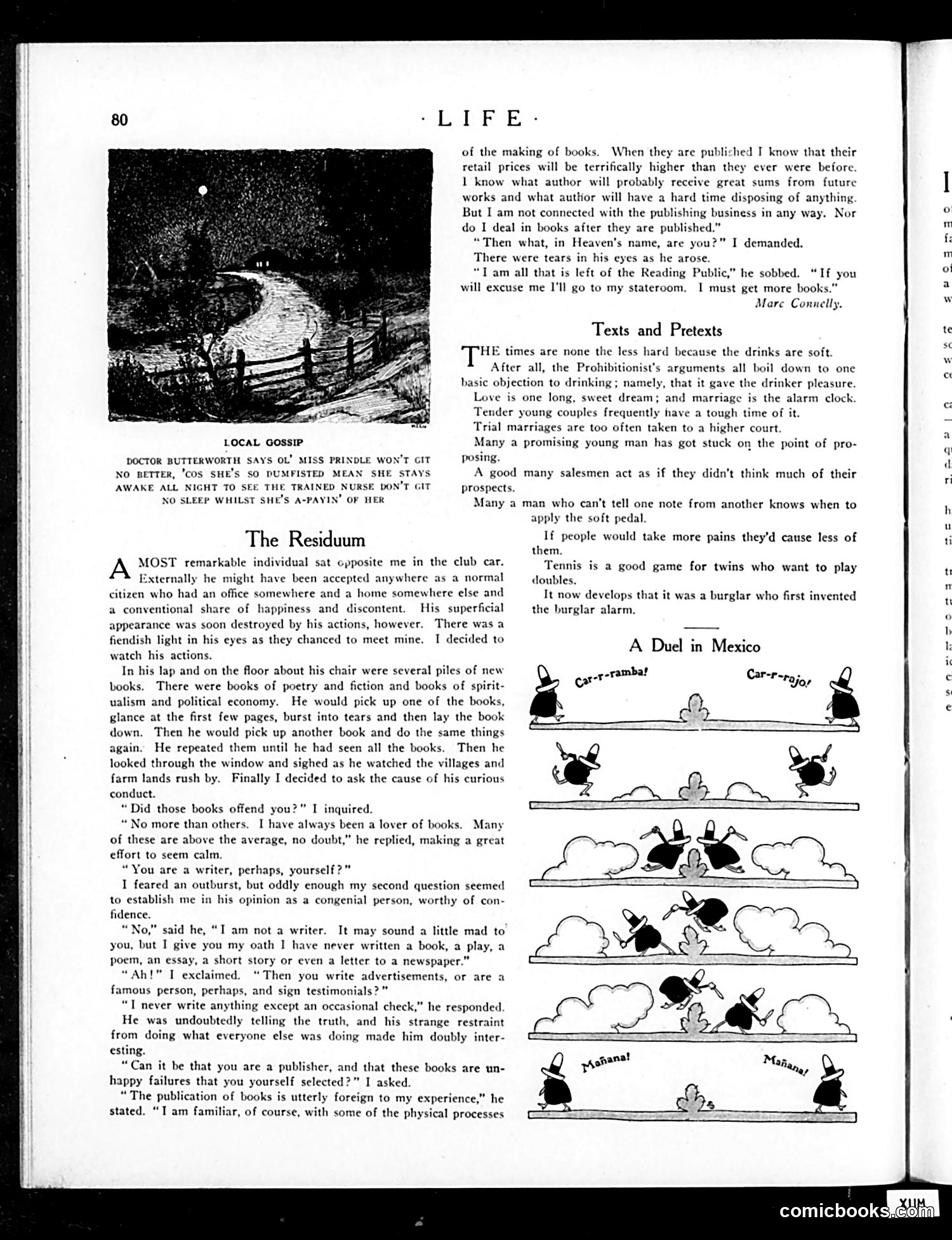
This page contains two distinct pieces of satire from *Life* magazine: **"The Residuum"** (main article): A humorous monologue about a mysterious man obsessively reading books in a train car. The joke culminates when he reveals he is "all that is left of the Reading Public"—a sardonic comment that the general reading audience has nearly disappeared. The satire targets both the decline of serious readership and the publishing industry's commercial practices. **"Texts and Pretexts"** (right column): A collection of brief, witty aphorisms mocking contemporary social issues, particularly **Prohibition** (referenced in the opening line about "soft drinks"). The jokes satirize marriage, courting, salesmanship, and modern life's disappointments in the style typical of early 20th-century satirical magazines. **"A Duel in Mexico"** (cartoon): A silent comic strip showing two figures in what appears to be a confrontation with onomatopoeia ("Car-r-ramba!", "Mañana!"). The specific reference is unclear without additional context. The overall tone reflects *Life*'s role as a venue for urban, educated satire targeting contemporary cultural anxieties.
📄 Transcribed text from this page (OCR, searchable)
Machine-transcribed from the original scan — historical spelling and the odd misread are preserved.
: B-IFF UE - of the making of books. When they are published I know that their retail prices will be terrifically higher than they ever were before. 1 know what author will probably receive great sums from future ] works and what autlior will have a hard time disposing of anything But I am not connected with the publishing business in any way. Nor ° do I deal in books after they are published.” a “Then what, in Heaven's name, are you?” I demanded. There were tears in his eyes as he arose. “Tam all that is left of the Reading Public,” he sobbed. “If you o! will excuse me I'll go to my stateroom. I must get more books.” sd Marc Connelly. W Texts and Pretexts te HE times are none the less hard because the drinks are soft. * After all, the Prohibitionist’s arguments all boil down to one o basic objection to drinking; namely, that it gave the drinker pleasure. Love is one long, sweet dream; and marriage is the alarm clock. Tender young couples frequently have a tough time of it. Trial marriages are too often taken to a higher court. LOCAL GossIP Many a promising young man has got stuck on the point of pro- DOCTOR BUTTERWORTH SAYS SDLE WON’ posing. NO BETTER, 'COS SHE'S SO DUMFISTED MEAN S STAYS A good many salesmen act as if they didn’t think much of their AWAKE ALL NIGHT TO SEE THE TRAINED NU! prospects. NO SLEEP WHILST SHE'S A-PAYIN’ OF HER Many a man who can't tell one note from another knows when to apply the soft pedal. The Residuum If people would take more pains they'd cause less of ti them. MOST remarkable individual sat cpposite me in the club car. Tennis is a good game for twins who want to play Externally he might have been accepted anywhere as a normal doubles. citizen who had an office somewhere and a home somewhere else and It now develops that it was a burglar who first invented a conventional share of happiness and discontent. His superficial the burglar alarm. appearance was soon destroyed by his actions, however. There was a fiendish light in his eyes as they chanced to meet mine, I decided to A Duel in Mexico watch his actions. In his lap and on the floor about his chair were several piles of new _peramba! books. There were books of poetry and fiction and books of spirit- oF ualism and political economy. He would pick up one of the books, oh glance at the first few pages, burst into tears and then lay the book down. Then he would pick up another book and do the same things again. He repeated them until he had seen all the books, Then he looked through the window and sighed as he watched the villages and farm lands rush by. Finally I decided to ask the cause of his curious s) conduct. —<™ “Did those books offend you?" I inquired. “No more than others. I have always been a lover of books. Many of these are above the average, no doubt,” he replied, making a great effort to seem calm. a F Car-t-rajoy ¢ “You are a writer, perhaps, yourself I feared an outburst, but oddly enough my second question seemed to establish me in his opinion as a congenial person, worthy of con- fidence. “No,” said he, “I am not a writer. It may sound a little mad to you, but I give you my oath I have never written a book, a play, a poem, an essay, a short story or even a letter to a newspaper. “Ah!" T exclaimed. “Then you write advertisements, or are a famous person, perhaps, and sign testimonials?” “T never write anything except an occasional check,” he responded. He was undoubtedly telling the truth, and his strange restraint from doing what everyone else was doing made him doubly inter- esting. “Can it be that you are a publisher, and that these books are un- happy failures that you yourself selected?” I asked. “The publication of books is utterly foreign to my experience,” he stated. “I am familiar, of course, with some of the physical processes comicbookMen H|