
Life, 1920-07-08 · page 19 of 40
Life — July 8, 1920 — page 19: what you’re looking at
What you’re looking at
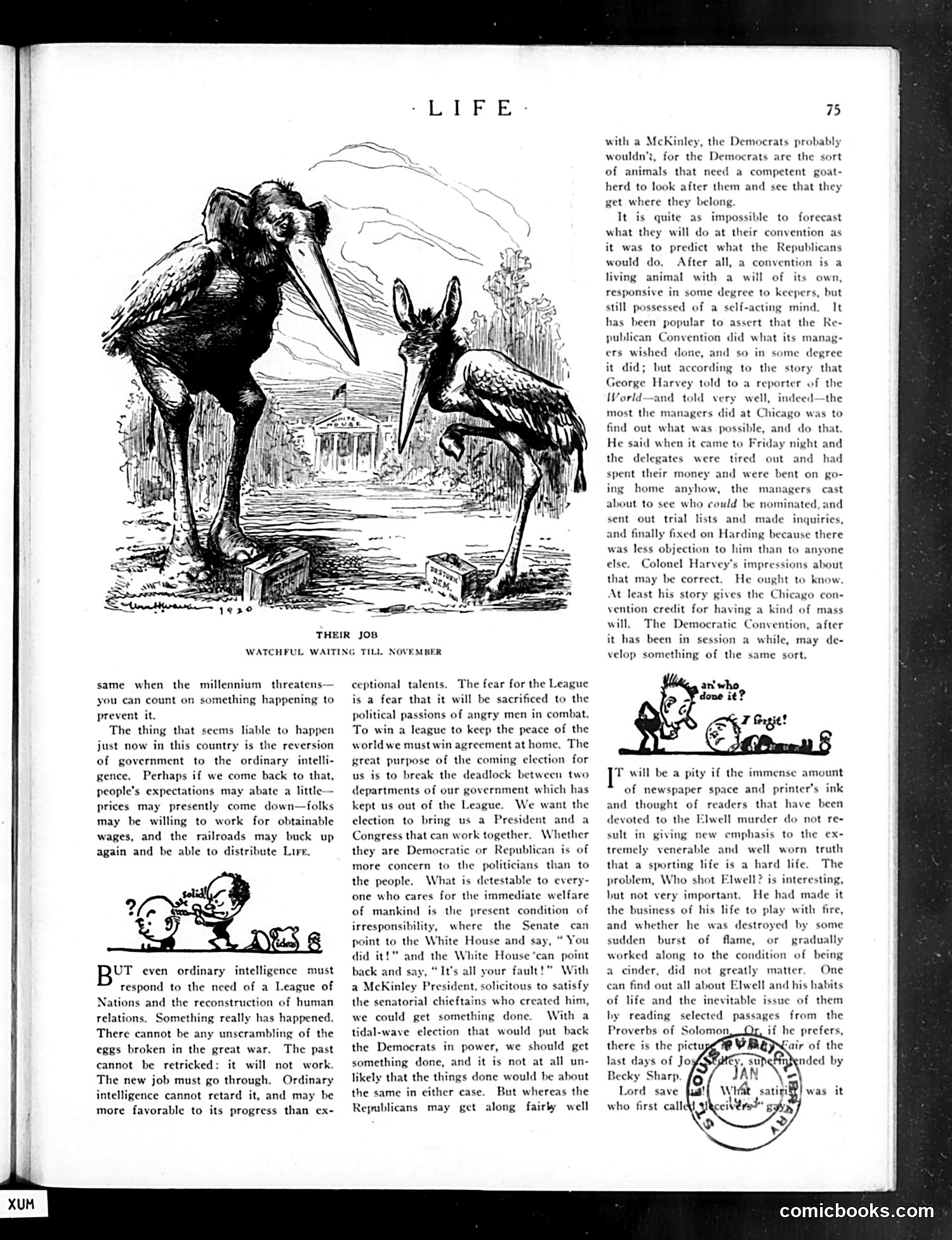
This page discusses post-WWI American politics, likely from 1920 or 1924. The cartoon depicts two animals—a stork and a donkey—"watchfully waiting till November," symbolizing the Democratic and Republican parties anticipating the upcoming election. The text satirizes political deadlock between the presidency and Senate over League of Nations participation. The author argues that whether Democrats or Republicans win matters less than breaking governmental gridlock. He notes a potential McKinley presidency (likely referring to a Republican candidate) could satisfy Senate leaders, while Democrats need strong management to accomplish anything—comparing them to animals requiring a "competent goatherd." The satire mocks both parties' conventions as somewhat chaotic, with managers simply discovering what's possible rather than controlling outcomes, citing journalist George Harvey's account of Harding's nomination at the Chicago convention.
📄 Transcribed text from this page (OCR, searchable)
Machine-transcribed from the original scan — historical spelling and the odd misread are preserved.
THEIR JOB WATCHFUL WAITING TIL same when the millennium threatens— you can count on something happening to prevent it. The thing that seems liable to happen just now in this country is the reversion of government to the ordinary intelli- gence. Perhaps if we come back to that, people’s expectations may abate a little— prices may presently come down—folks may be willing to work for obtainable wages, and the railroads may buck up again and be able to distribute Lire. But even ordinary intelligence must respond to the need of a League of Nations and the reconstruction of human relations. Something really has happened. There cannot be any unscrambling of the eggs broken in the great war. The past cannot be retricked: it will not work. The new job must go through. Ordinary intelligence cannot retard it, and may be more favorable to its progress than ex- ceptional talents. The fear for the League is a fear that it will be sacrificed to the political passions of angry men in combat. To win a league to keep the peace of the world we must win agreement at home. The great purpose of the coming election for us is to break the deadlock between two departments of our government which has kept us out of the League. We want the election to bring us a President and a Congress that can work together. Whether they are Democratic or Republican is of more concern to the politicians than to the people. What is detestable to every- one who cares for the immediate welfare of mankind is the present condition irresponsibility, where the Senate n point to the White House and say, “ You did it!” and the White House ‘can point back and say, “It's all your fault!” With a McKinley President, solicitous to satisfy the senatorial chieftains who created him, we could get something done. With a tidal-wave election that would put back the Democrats in power, we should get something done, and it is not at all un- likely that the things done would be about the same in either case. But whereas the Republicans may get along fairly well 75 with a Mckinley, the Democrats probably wouldn’, for the Democrats are the sort of animals that need a competent goat- herd to look after them and see that they get where they belong. It is quite as impossible to forecast what they will do at their convention as it was to predict what the Republicans would do. After all, a convention is a with a will of its responsive in some degree to keepers, but f a self-acting mind. It living an own, still possessed has been popular to assert that the Re- publican Convention did what its manag- ers wished done, it did; but according to the story that ‘orge Harvey told to a reporter of the World most the managers did at Chicago was to find out what was possible, and do that. He said when it came to Friday night and the delegates tired out and had and were bent on g cast about to see who could be nominated, and and so in some degree and told very well, indeed—the were spent their money ing home anyhow, the managers sent out trial lists and made inquiries, and finally fixed on Harding because there was less objection to him than to anyone else. Colonel Harvey's impressions about that may be correct. He ought to know. At least his story gives the Chicago con- vention credit for having a kind of mass The Democratic Convention, after it has been in session a while, may de- velop something of the same sort. will, | . will be a pity if the immense amount of newspaper space and printer's ink and thought of readers that have been devoted to the Elwell murder do not re- sult in giving new emphasis to the ex- tremely venerable and well worn truth that a sporting life is a hard life. The problem, Who shot Elwell? is interesting, but not very important. He had made it the business of his life to play with fire, and whether he was destroyed by some sudden burst of flame, or worked along to the condition of being a cinder, did not greatly matter. One can find out all about Elwell and his habits of life and the inevitable issue of them by reading selected passages from the Proverbs of Solomon, if he prefers, gradually comicbooks.com