
Life, 1920-07-08 · page 18 of 40
Life — July 8, 1920 — page 18: what you’re looking at
What you’re looking at
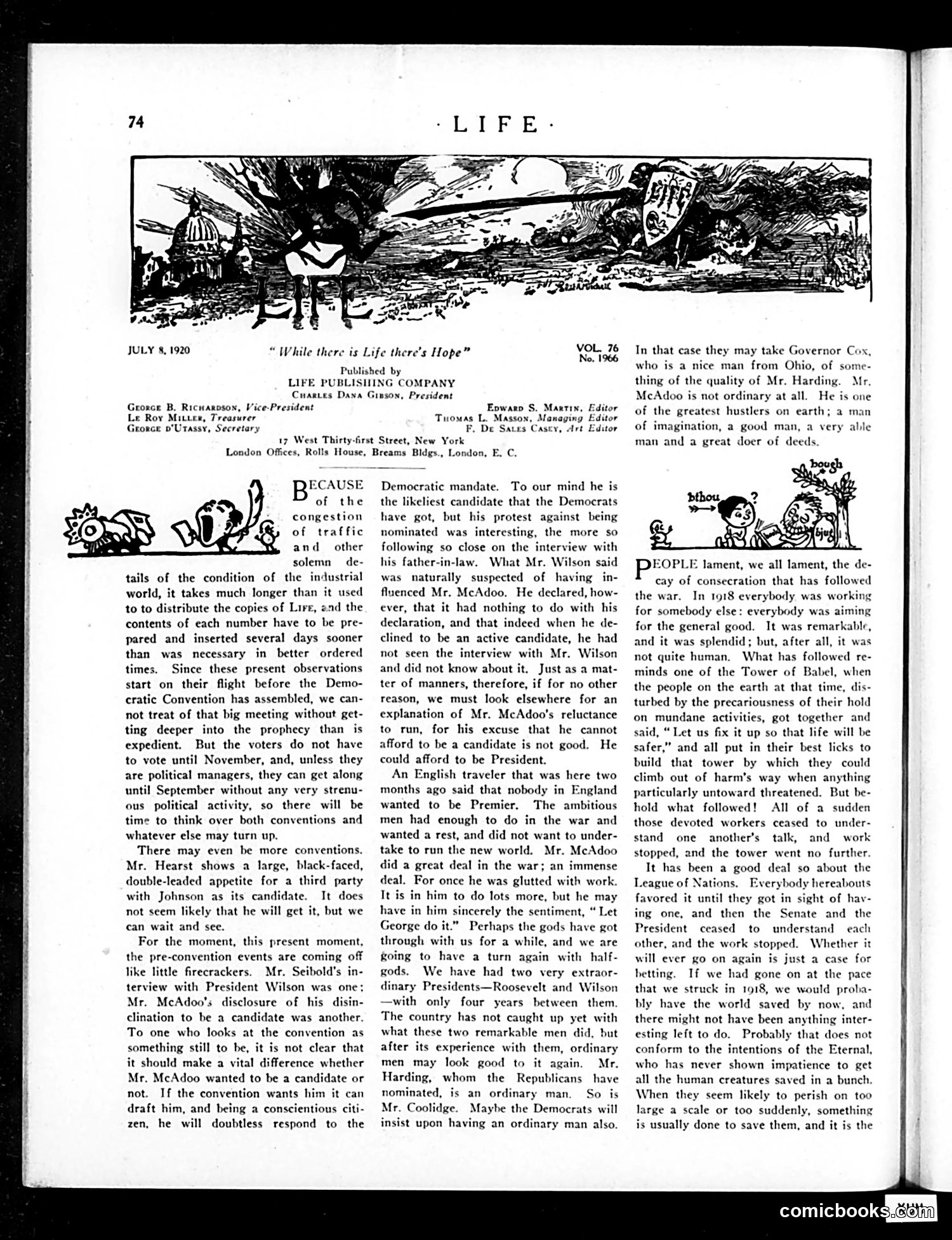
This page discusses the 1920 Democratic Convention and presidential candidates. The text examines **William Gibbs McAdoo** (Wilson's son-in-law and Treasury Secretary), who has declared he won't be a candidate despite being considered the Democrats' strongest option. The editor speculates McAdoo may have been influenced by President Wilson but accepts his stated reasoning. The piece reflects on American fatigue after World War I, noting that both Roosevelt and Wilson were "extraordinary Presidents" and suggesting the country might now prefer "ordinary men." It references **Warren Harding**, the Republican nominee, as an example of this ordinariness. The small cartoon appears unrelated editorial artwork. The commentary reflects pre-convention speculation from a moment when delegates hadn't yet assembled, illustrating Life's role as satirical political commentary on contemporary election dynamics.
📄 Transcribed text from this page (OCR, searchable)
Machine-transcribed from the original scan — historical spelling and the odd misread are preserved.
JULY 8, 1920 “While there is Life there’s Hope” Published by LIFE PUBLIS ING COMPANY Cuartes Daya Ginson, President Groxce B, Ricuarosox, Vice-President Le Rov Muttee, Treasurer Groxce p'Urassy, Secretary Epwaro S. Martin, Editor Tuomas L. Masson, Managing Editor P, De Sates Casey, Art Editor 17 West Thirty-first Street, New York London Offices, Rolls House, Breams Bldgs., London, E. C. =CAUSE of the congestion of traffic and other solemn de- tails of the condition of the industrial world, it takes much longer than it used to to distribute the copies of Lire, and the contents of each number have to be pre- pared and inserted several days sooner than was necessary in better ordered times. Since these present observations start on their flight before the Demo- cratic Convention has assembled, we can- not treat of that big meeting without get- ting deeper into the prophecy than is expedient. But the voters do not have to vote until November, and, unless they are political managers, they can get along until September without any very strenu- ous political activity, so there will be time to think over both conventions and whatever else may turn up. There may even be more conventions. Mr. Hearst shows a large, black-faced, double-leaded appetite for a third party with Johnson as its candidate. It does not seem likely that he will get it, but we can wait and see. For the moment, this present moment, the pre-convention events are coming off like little firecrackers. Mr. Seibold’s in- terview with President Wilson was one; Mr. McAdoo’s disclosure of his disin- clination to be a candidate was another. To one who looks at the convention as something still to be, it is not clear that it should make a vital difference whether Mr. McAdoo wanted to be a candidate or not. If the convention wants him it can draft him, and being a conscientious citi- zen, he will doubtless respond to the Democratic mandate. To our mind he is the likeliest candidate that the Democrats have got, but his protest against being nominated was interesting, the more so following so close on the interview with his father-in-law. What Mr. Wilson said was naturally suspected of having in- fluenced Mr. McAdoo. He declared, how- ever, that it had nothing to do with his declaration, and that indeed when he de- clined to be an active candidate, he had not seen the interview with Mr. Wilson and did not know about it. Just as a mat- ter of manners, therefore, if for no other reason, we must look elsewhere for an explanation of Mr. McAdoo’s reluctance to run, for his excuse that he cannot afford to be a candidate is not good. He could afford to be President. An English traveler that was here two months ago said that nobody in England wanted to be Premier. The ambitious men had enough to do in the war and wanted a rest, and did not want to under- take to run the new world. Mr. McAdoo did a great deal in the war; an immense deal. For once he was glutted with work. It is in him to do lots more, but he may have in him sincerely the sentiment, “ Let George do it.” Perhaps the gods have got through with us for a while, and we are going to have a turn again with half- gods. We have had two very extraor- dinary Presidents—Roosevelt and Wilson —with only four years between them. The country has not caught up yet with what these two remarkable men did, but after its experience with them, ordinary men may look good to it again. Mr. Harding, whom the Republicans have nominated, is an ordinary man. So is Mr. Coolidge. Maybe the Democrats will insist upon having an ordinary man also. In that case they may take Governor Cox, who is a nice man from Ohio, of some- thing of the quality of Mr. Harding. Mr. McAdoo is not ordinary at all. He is one of the greatest hustlers on earth; a man of imagination, a good man, a very able man and a great doer of deeds. EOPLE lament, we all lament, the de- cay of consecration that has followed the war. In 1918 everybody was working for somebody else: everybody was aiming for the general good. It was remarkable, and it was splendid; but, after all, it was not quite human. What has followed re- minds one of the Tower of Babel, when the people on the earth at that time, dis- turbed by the precariousness of their hold on mundane activities, got together and said, “ Let us fix it up so that life will be safer,” and all put in their best licks to build that tower by which they could climb out of harm's way when anything particularly untoward threatened. But be- hold what followed! All of a sudden those devoted workers ceased to under- stand one another's talk, and work stopped, and the tower went no further. It has been a good deal so about the League of Nations, Everybody hereabouts favored it until they got in sight of hav- ing one, and then the Senate and the President ceased to understand each other, and the work stopped. Whether it will ever go on again is just a case for betting. If we had gone on at the pace that we struck in 1918, we would proba- bly have the world saved by now, and there might not have been anything inter- esting left to do. Probably that does not conform to the intentions of the Eternal, who has never shown impatience to get all the human creatures saved in a bunch, When they seem likely to perish on too large a scale or too suddenly, something usually done to save them, and it is the comicbooks#com|