
Life, 1920-07-08 · page 28 of 40
Life — July 8, 1920 — page 28: what you’re looking at
What you’re looking at
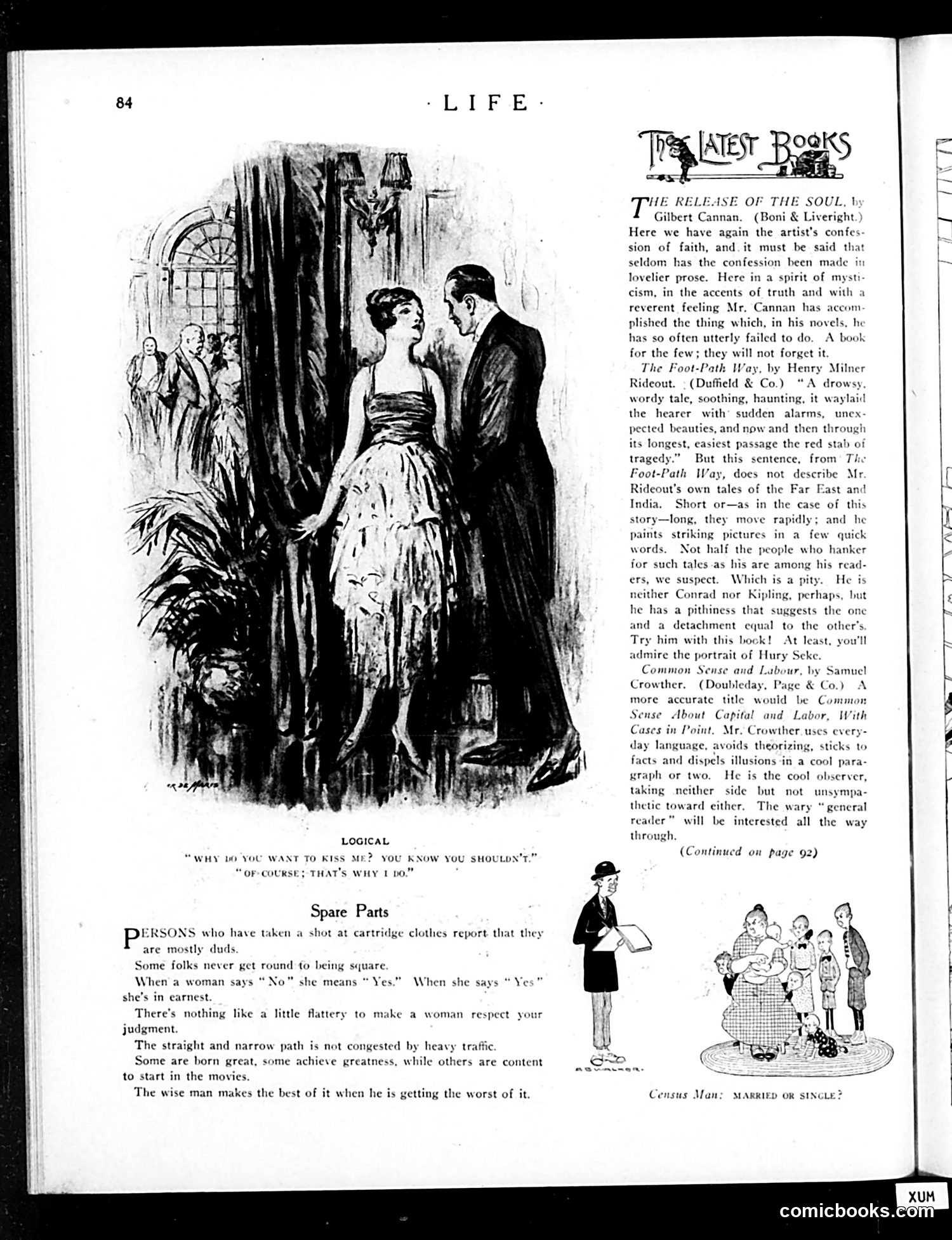
The main cartoon depicts a man and woman in formal dress at what appears to be a social gathering, with the caption presenting a flirtatious exchange about kissing. The "Logical" section below offers cynical observations about gender relations—particularly mocking conventional wisdom about women's behavior (e.g., "When a woman says 'No' she means 'Yes'"). This reflects early 20th-century attitudes toward courtship and romance that modern readers would find problematic. The satire targets outdated social conventions and male assumptions about female consent, though presented as "wisdom" rather than critique. The smaller cartoon labeled "Census Man" shows an official questioning a family, asking whether the adult male is "married or single?"—likely satirizing the intrusive nature of census-taking or bureaucratic classifications. Both pieces exemplify *Life* magazine's humor targeting social pretension and gender dynamics of the era.
📄 Transcribed text from this page (OCR, searchable)
Machine-transcribed from the original scan — historical spelling and the odd misread are preserved.
LOGICAL “WHY DO YOU WANT TO KISS ME? YOU KNOW YOU SHOULDN'T.” “OF COURSE; re mostly duds. Some folks never get round to being square When a woman says “No” she means “ Yes.” she’s in earnest. There's nothing like a little flattery to make a woman respect your judgment. THAT'S WHY 1 D0.” Spare Parts ERSONS who have taken a shot at cartridge clothes report that they When she says “ The straight and narrow path is not congested by heavy traffic. Some are born great, some achieve greatness, while others are content to start in the movies. The wise man makes the best of it when he is getting the worst of it. Ye be gs ASE OF THE HE RE Gilbert Cannan. (Boni & Liveright Here we have again the artist’s confes- sion of faith, and. it must be said that SOUL, by seldom has the confession been made in lovelier prose. Here in a spirit of mysti cism, in the accents of truth and with a reverent feeling Mr, Cannan has accom plished the thing which, in his novels, he has so often utterly failed to do. A book for the few; they will not forget it. The Foot-Patk Way, by Henry Milner Rideout. . (Duffield & Co.) “A drowsy. wordy tale, soothing, haunting, it waylaic the hearer with’ sudden alarms, unex- pected beauties, and npw and then through its longest, easiest passage the red stab of tragedy.” But this sentence, from The Foot-Path Way, does not describe Mr. Rideout’s own tales of the Far East and India. Short or—as in the case of this story—long, they move rapidly; and he paints striking pictures in a few quick words. Not half the people who hanker for such tales-as his are among his read- ers, we suspect. Which is a pity. He is neither Conrad nor Kipling, perhaps, but he has a pithiness that suggests the one and a detachment equal to the other's Try him with this book! At least, you'll admire the portrait of Hury Seke. Common Sense and Labour, by Samucl Crowther. (Doubleday, P: & Co.) A more accurate title would be Common Sense About Capital and Labor, With Cases in Point, Mr. Crowther uses every- day language, avoids theorizing, sticks to facts and dispels illusions in a cool para- graph or two, He is the cool observer, taking neither side but not unsympa- thetic toward either. The wary “general reader” will be interested all the way through. (Continued on page 92) Census Man; Marriep or stNcLe? comicbooks Mell