
A complete issue · 44 pages · 1920
Life — April 22, 1920
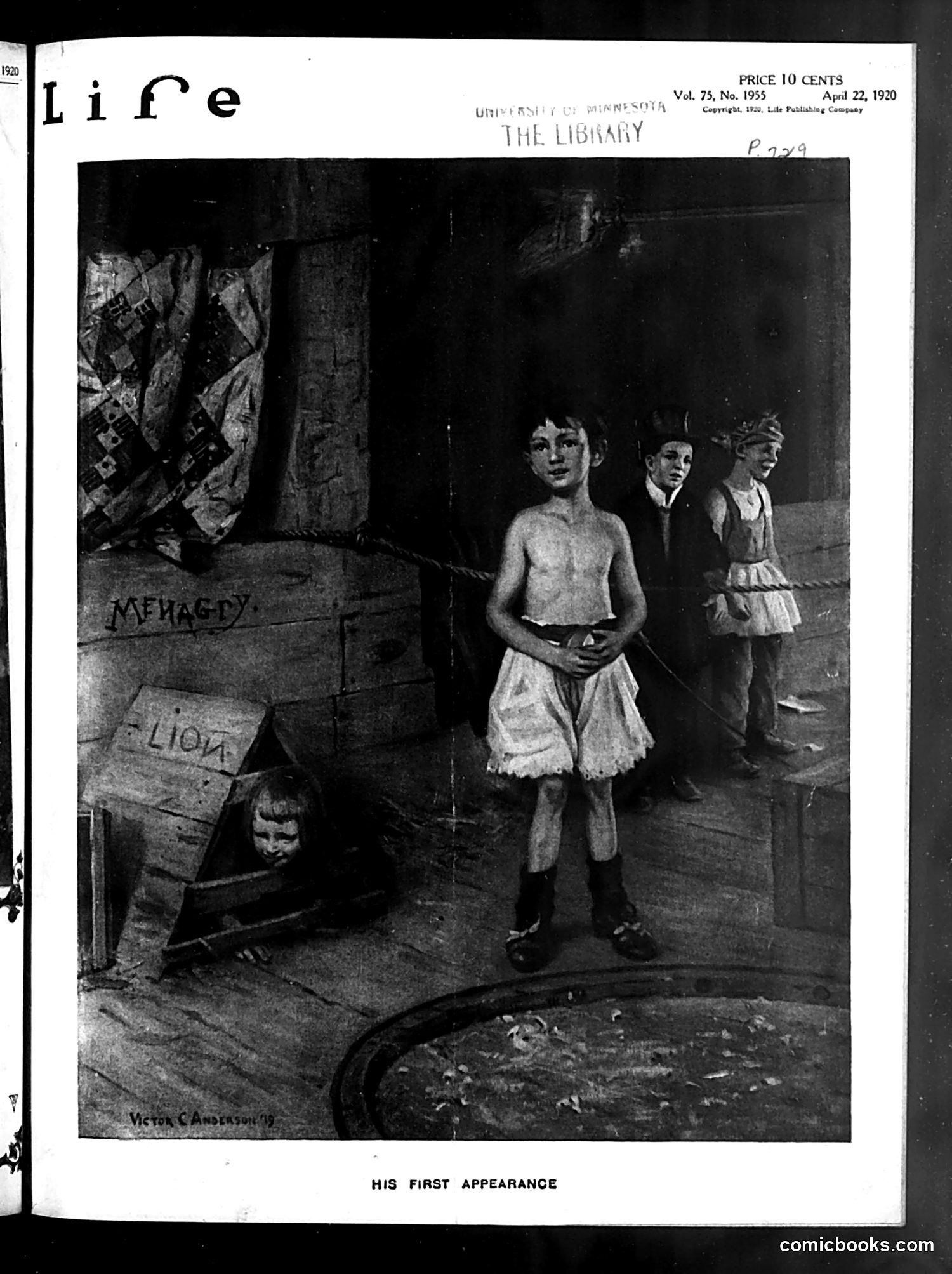
This Life magazine cover from April 22, 1929 shows a photograph titled "His First Appearance" depicting children in what appears to be a theatrical or film production scene. The image shows a shirtless young boy as the central figure, with other children in costume around him, staged in what looks like a basement or industrial setting with wooden crates. The photographer is credited as "Victor C Anderson." Without additional context from the magazine's text, the specific satirical point remains unclear. However, given Life's satirical nature, this likely comments on child exploitation in entertainment during the 1920s—either child labor in theater/film productions or the commercialization of children's performances. The caption's ironic tone ("first appearance") may underscore concerns about children being thrust into public performance.
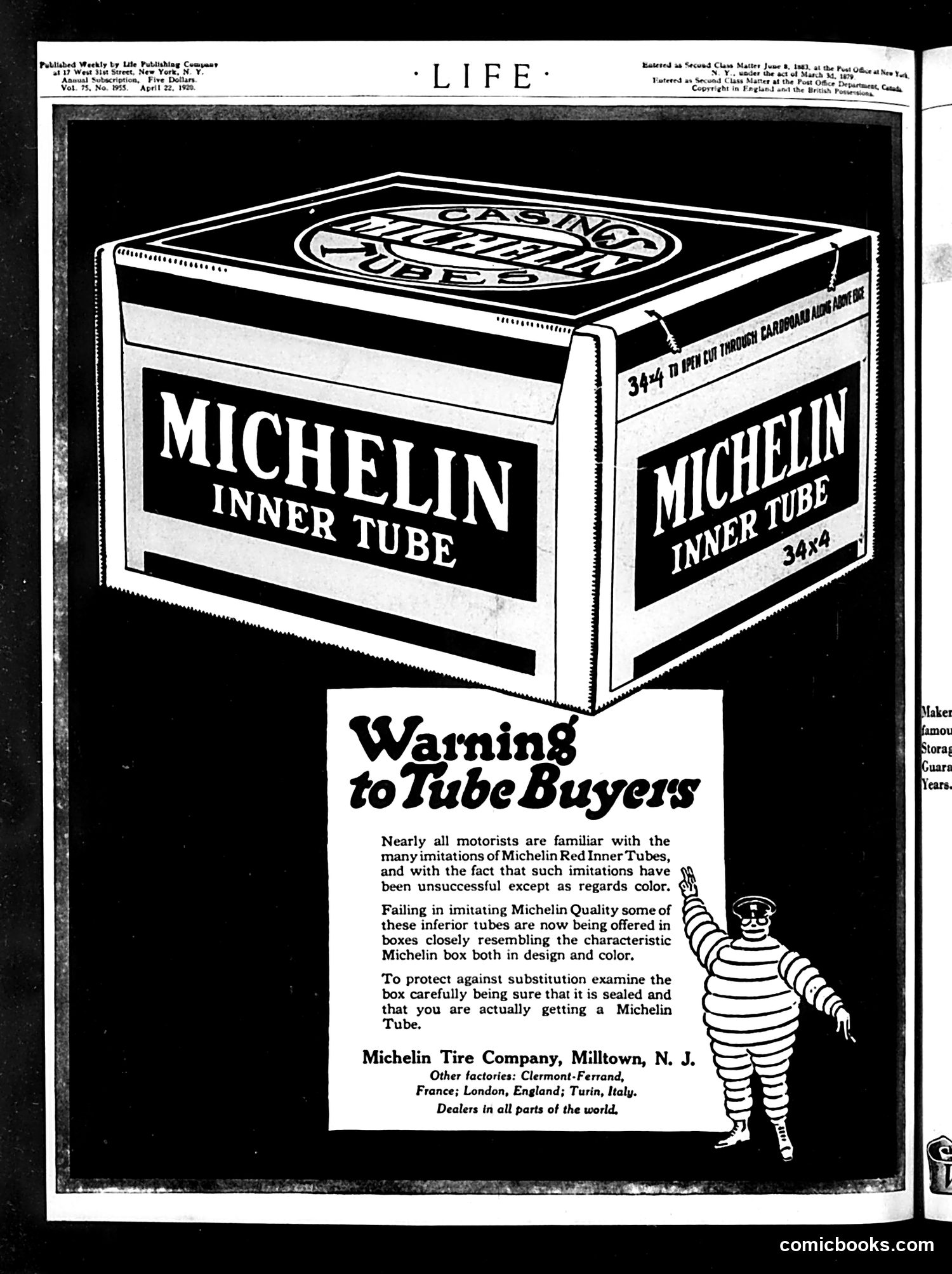
This is primarily a **Michelin Tire Company advertisement**, not political satire. The page warns consumers about counterfeit inner tubes mimicking genuine Michelin Red Inner Tubes. The key message: inferior tubes were being sold in boxes designed to resemble authentic Michelin packaging—exploiting brand recognition through deceptive imitation. The ad urges buyers to carefully examine seals and verify they're purchasing genuine Michelin products. The cartoon figure is **Bibendum**, Michelin's famous mascot (the rotund tire-man character), used here to add brand identity and a somewhat humorous tone to the consumer protection warning. This reflects early 20th-century concerns about product counterfeiting and the growing importance of brand protection as manufacturing and distribution expanded.
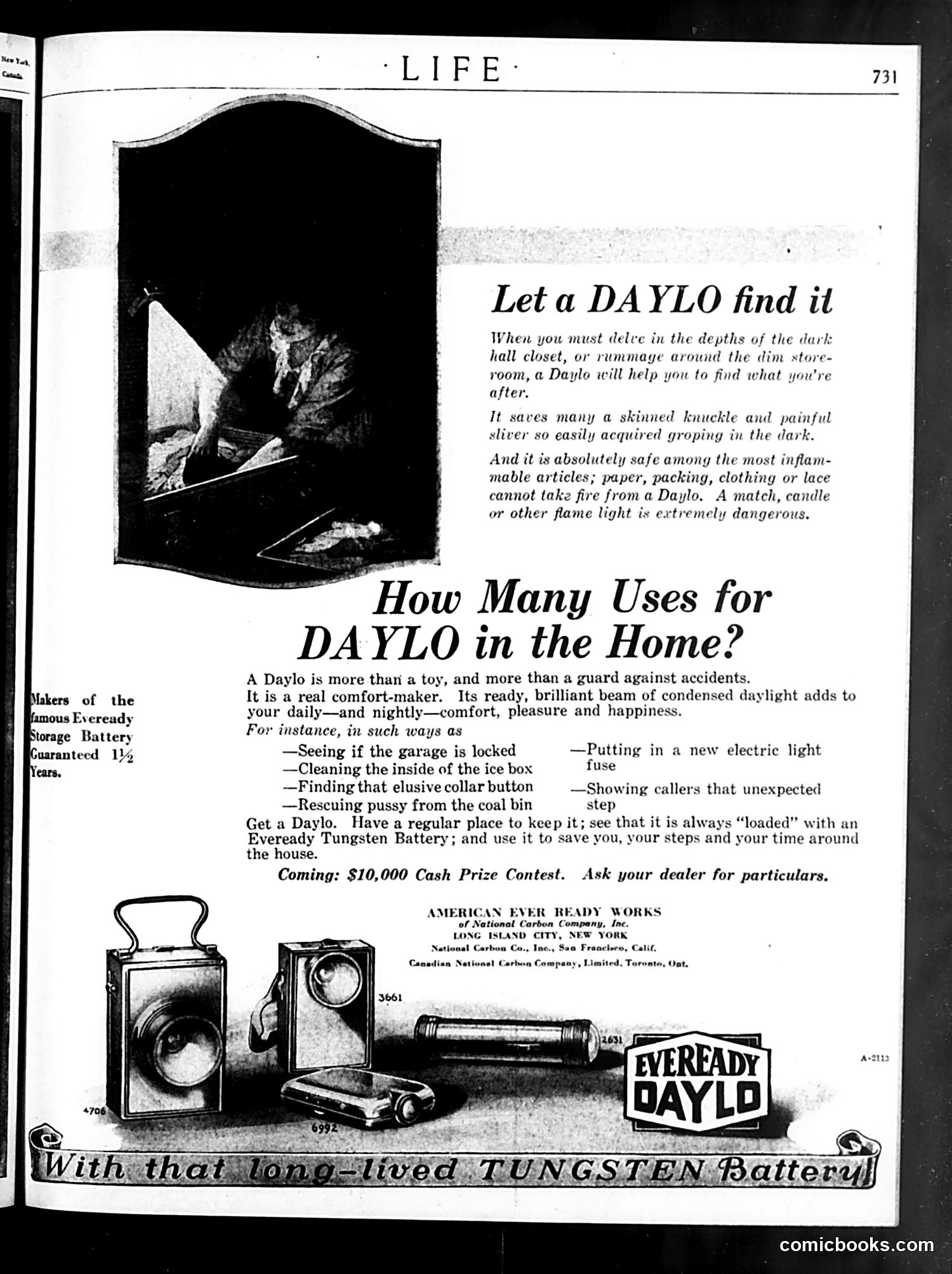
This page is **primarily advertising, not satire or political commentary**. It promotes the Eveready Daylo flashlight, made by American Ever Ready Works in Long Island City, New York. The advertisement uses a dramatic illustration of someone using a flashlight in a dark closet to appeal to safety concerns. The copy emphasizes the Daylo's reliability and safety—it won't cause fires like matches or candles—making it useful for household emergencies like finding items in dark spaces or showing unexpected visitors a step. The ad highlights the product's "long-lived Tungsten Battery" and mentions a coming "$10,000 Cash Prize Contest." There is no political cartoon or satire present; this is straightforward consumer product marketing typical of 1920s-era Life magazine advertising.
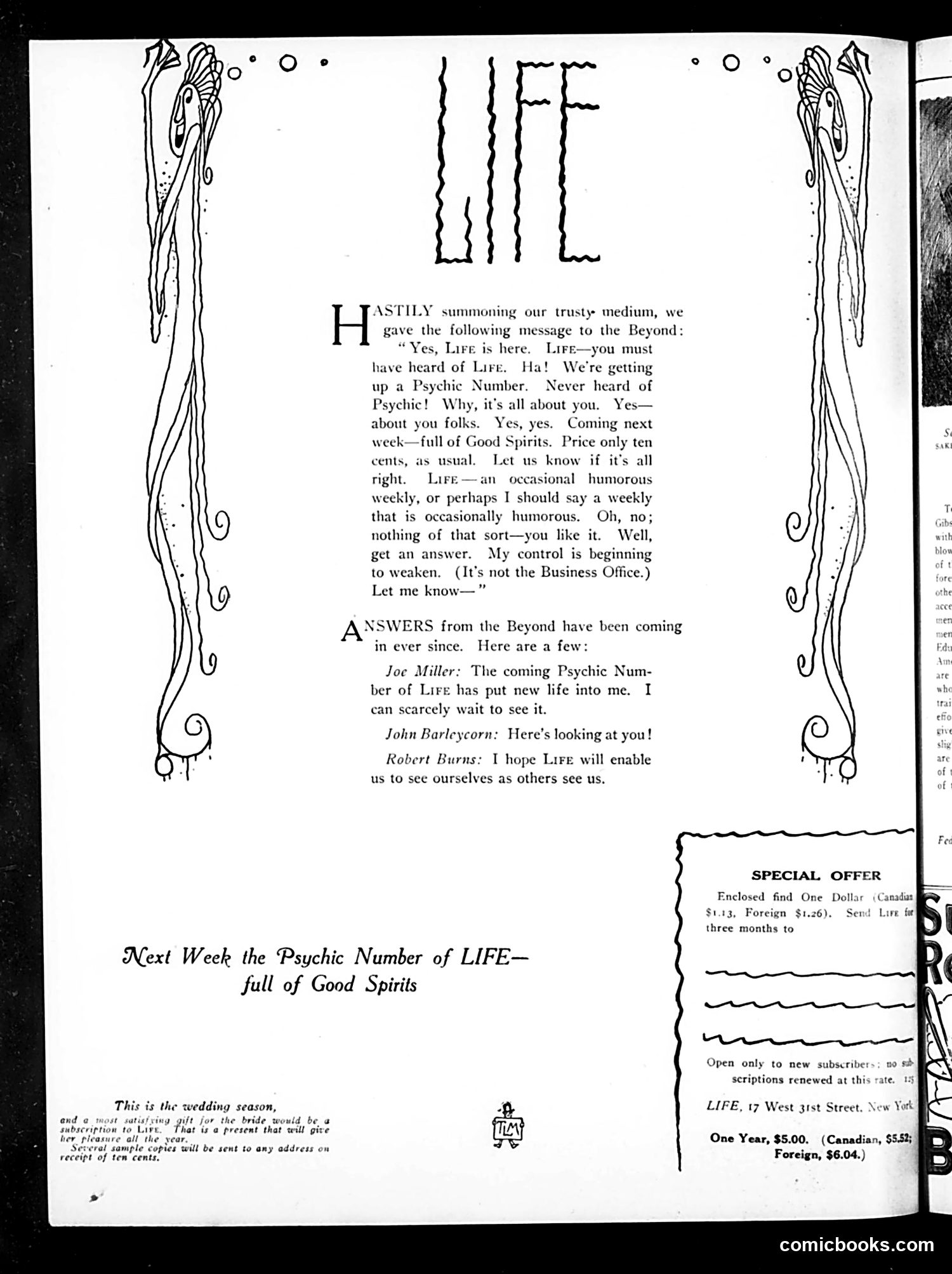
This page features a satirical piece titled "LIFE" that mocks spiritualism and séances—popular phenomena in early 20th-century America. The text humorously presents a fake "message from the Beyond" claiming that a "Psychic Number" of LIFE magazine will soon arrive, full of "Good Spirits." The joke relies on contemporary interest in contacting the deceased through mediums. LIFE sarcastically promises readers supernatural communication while actually advertising their magazine's next issue. The decorative borders show simplified spirit or ghost figures, reinforcing the spiritualist theme. Responses attributed to "Joe Miller," "John Barleycorn," and "Robert Burns" appear to be playful fictional testimonials, likely using well-known names (Burns was a Scottish poet) for comedic effect rather than actual quotes. The page is primarily satirical advertising disguised as supernatural entertainment.
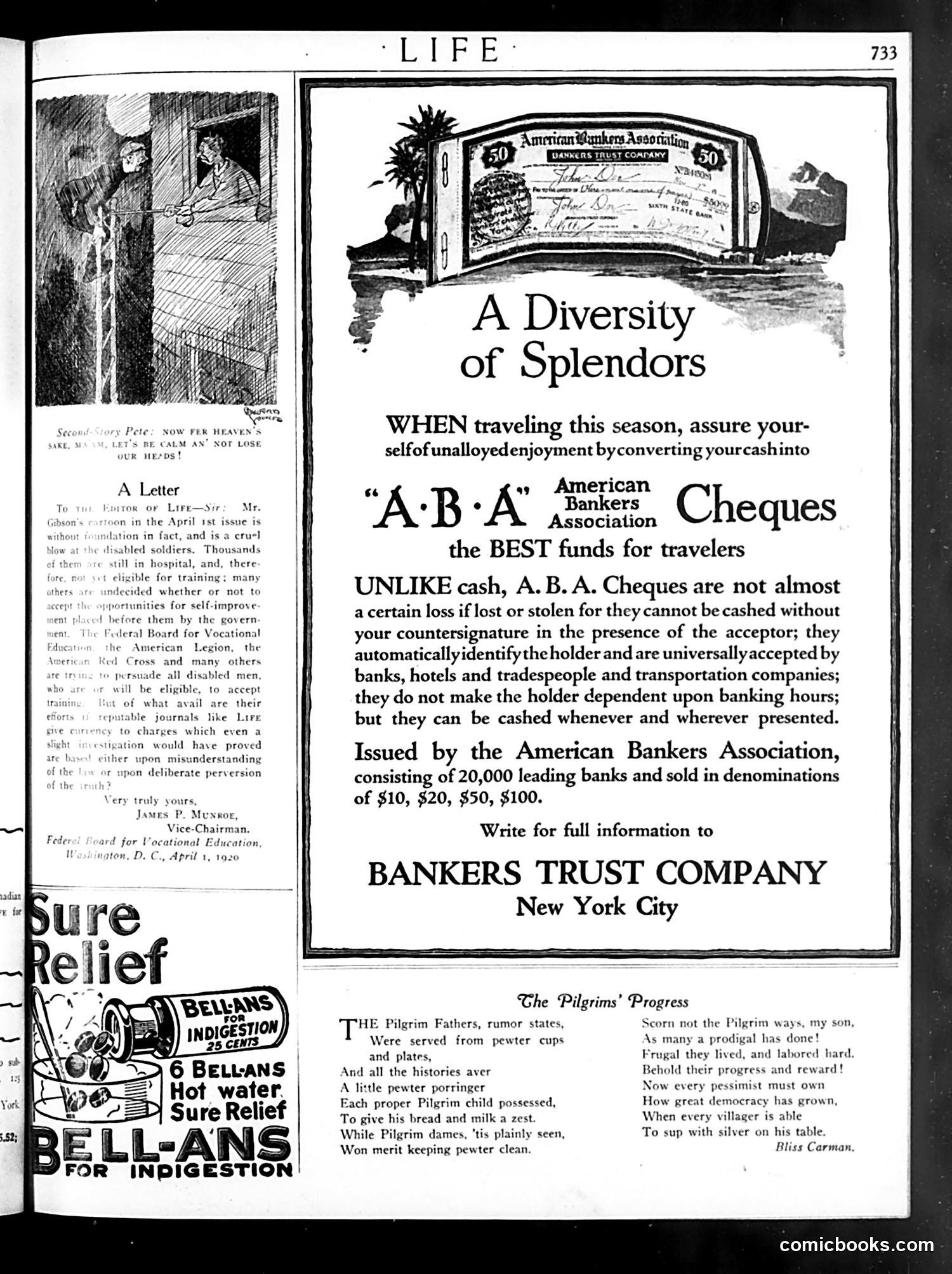
This page is primarily **advertising**, not satirical content. The main advertisement promotes "A.B.A. Cheques" (traveler's checks) from the American Bankers Association, emphasizing their safety advantages over cash while traveling. The upper left contains a brief illustrated anecdote titled "A Letter" about disabled soldiers, addressing concerns about veterans' post-WWI care and training opportunities. Below that is a "Sure Relief" advertisement for Bell-Ans antacids. At the bottom is a poem titled "The Pilgrims' Progress" by Bliss Carman, reflecting nostalgically on Pilgrim Fathers and American democratic values. **The page reflects post-WWI American concerns**: veteran welfare, consumer conveniences for middle-class travelers, and nostalgic patriotic sentiment—typical of 1920s Life magazine content mixing editorial matter with advertising.
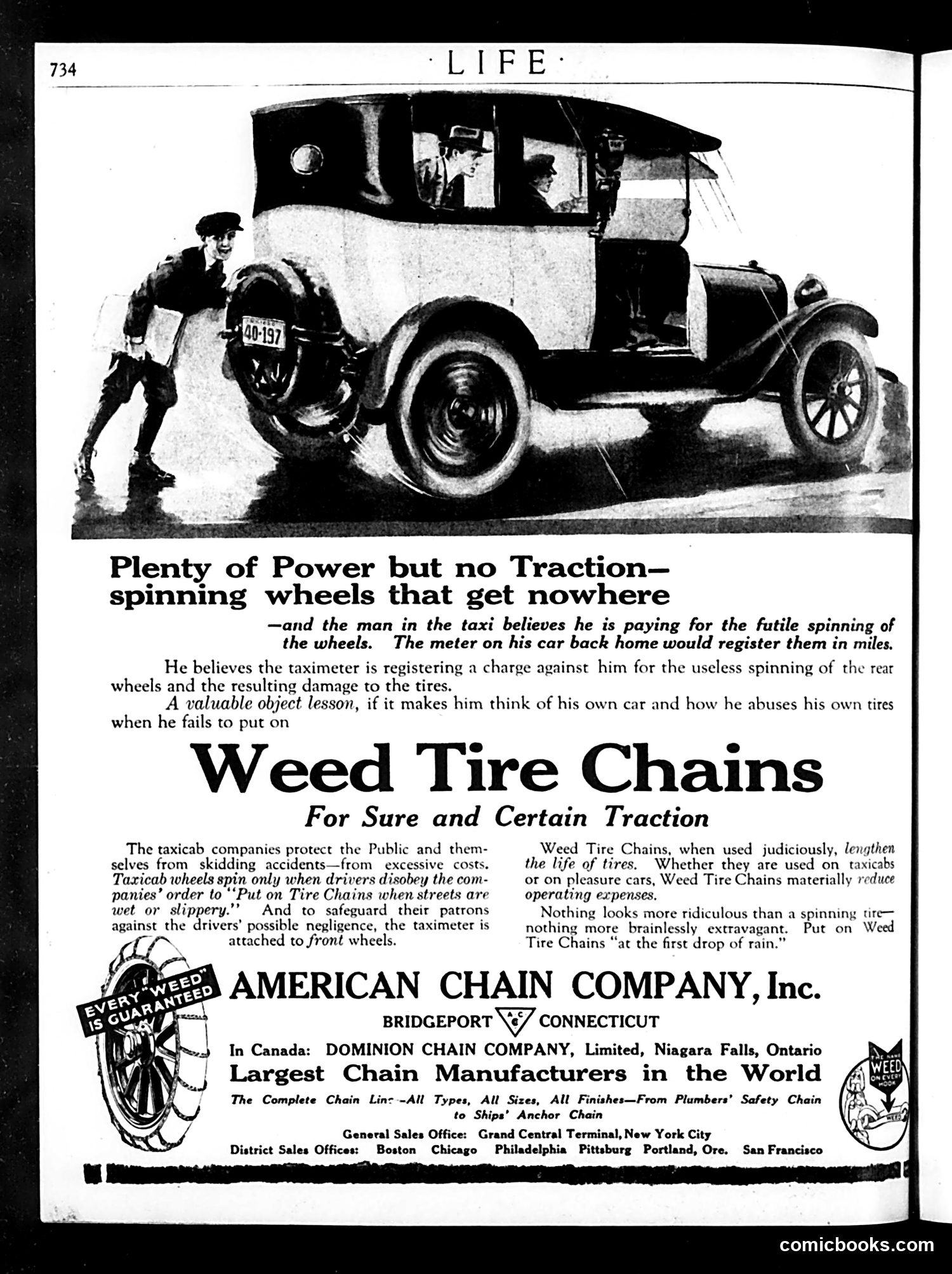
This is primarily a **commercial advertisement** for Weed Tire Chains, occupying most of the page. The satirical cartoon at top illustrates the ad's central argument: a taxi with spinning rear wheels stuck in place while a man pushes, showing "plenty of power but no traction." The joke targets **taxi drivers and car owners who abuse their tires**, arguing they then wrongly blame worn wheels for slipping. The taxicab meter keeps running despite the wheels' useless spinning—a metaphor for wasted money and resources. The advertisement positions Weed Tire Chains as the solution: practical safety equipment that "lengthen[s] the life of tires" and "reduce operating expenses," especially for commercial vehicles. This reflects early-20th-century concerns about vehicle traction in poor weather, before modern tire technology.
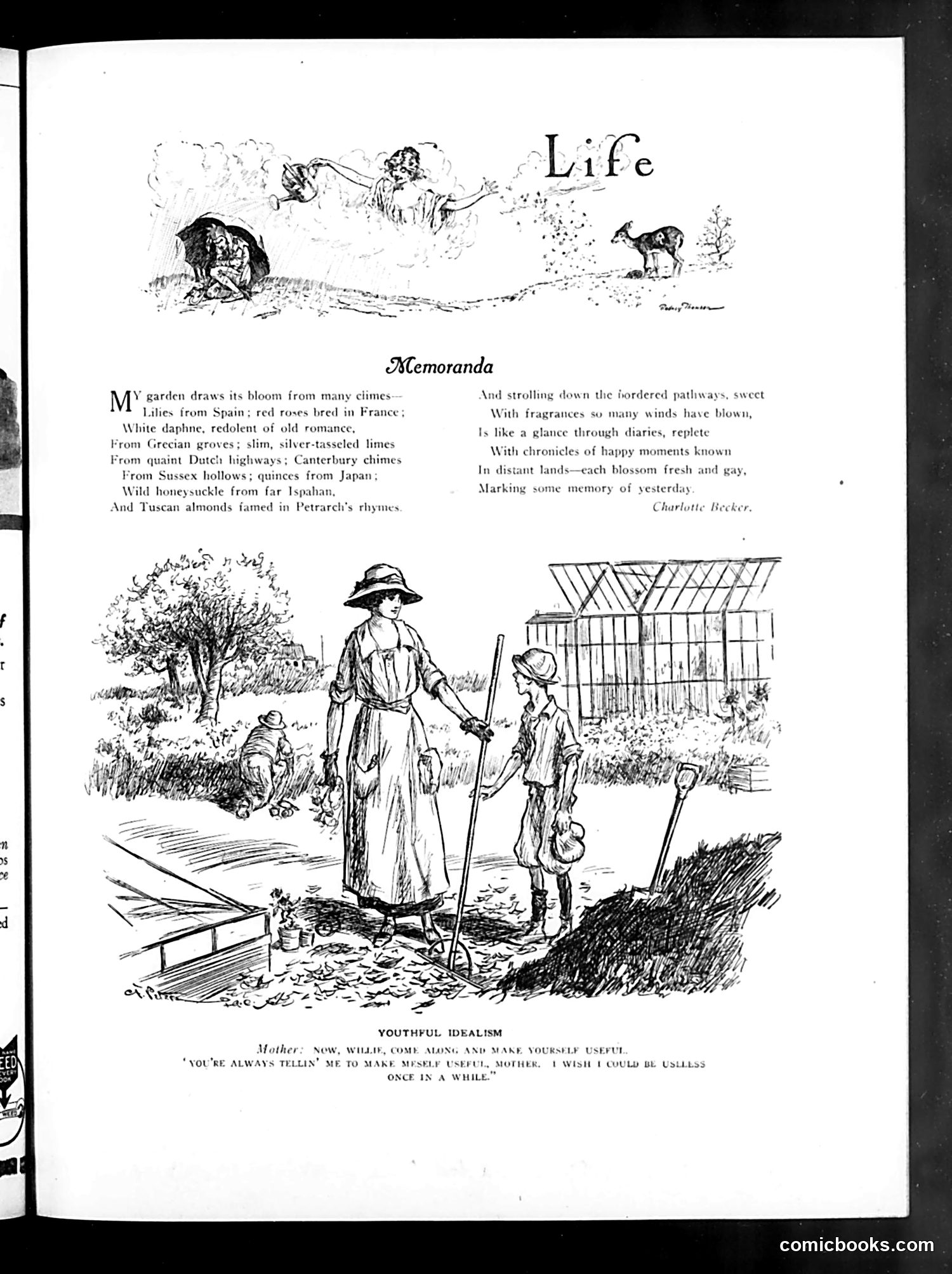
This page is titled "Life" and features the poem "Memoranda" by Charlotte Becker about gardens and flowers, illustrated with pastoral sketches. The main cartoon, captioned "Youthful Idealism," depicts a mother instructing two children in a garden setting. The mother's dialogue reads: "Now, Willie, come along and make yourself useful. You're always tellin' me to make myself useful, mother. I wish I could be useless once in a while." The satire mocks the Victorian/Edwardian era's obsession with instilling duty and productivity into children. The child's complaint humorously exposes the relentless pressure of parental expectations—the irony being that even leisure time becomes another opportunity for instruction rather than genuine play or rest. It's a gentle critique of overly earnest child-rearing philosophy.
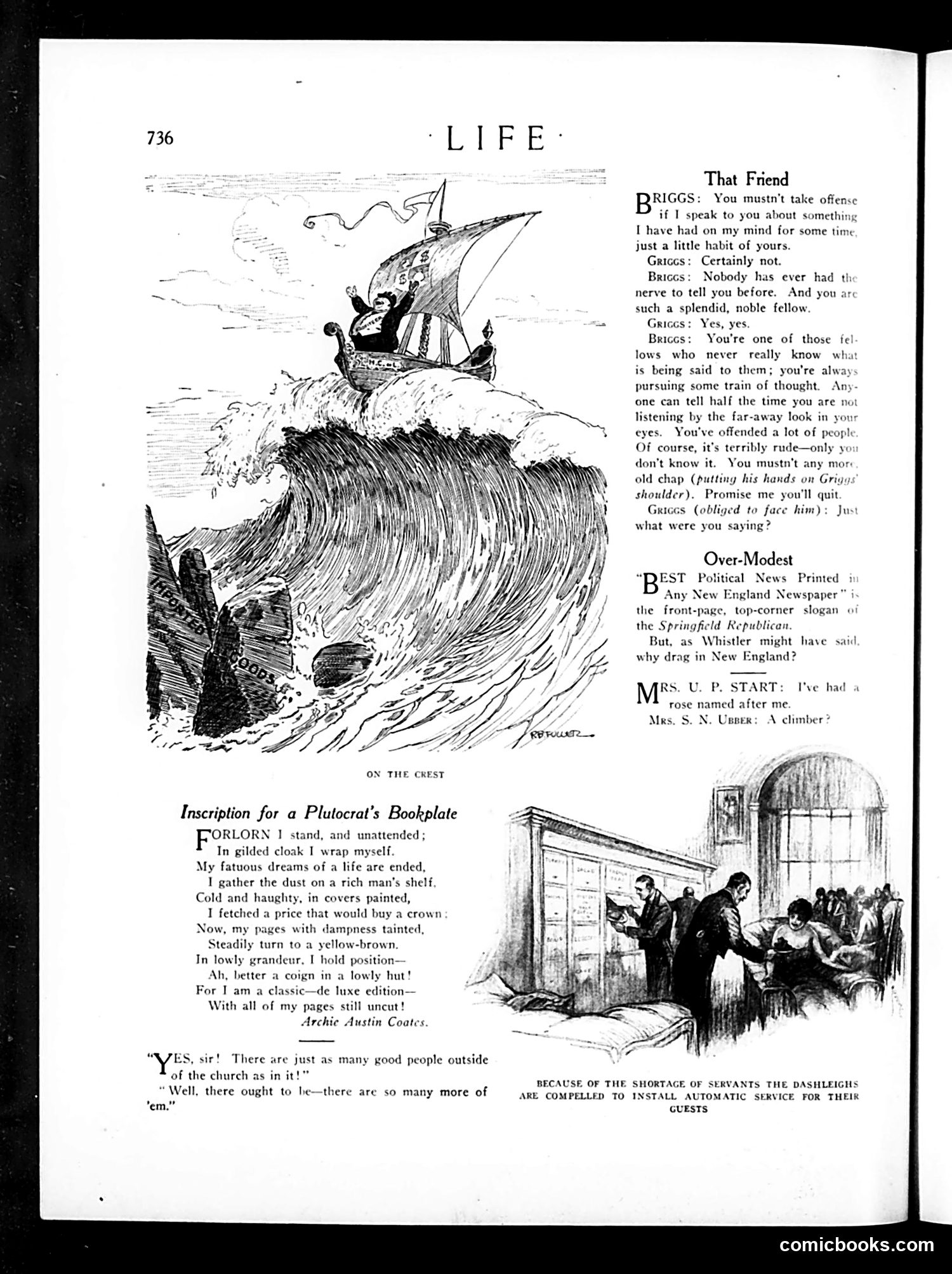
The page contains three distinct satirical pieces: 1. **"That Friend"** (top right): A dialogue between Briggs and Griggs satirizing insensitive people who monopolize conversation. Briggs complains that Griggs never listens—always pursuing his own thoughts while appearing attentive. The satire targets social rudeness and self-absorption in polite society. 2. **"On the Crest"** (left): An illustration showing a ship on a wave, likely depicting dramatic maritime adventure or nautical hubris, though the specific reference is unclear without additional context. 3. **"Inscription for a Plutocrat's Bookplate"** (center): A poem mocking wealthy collectors whose book collections remain unread ("pages still uncut"), satirizing aristocratic pretense and hollow cultural status symbols. 4. **Bottom section**: A brief joke about church attendance and servant shortages.
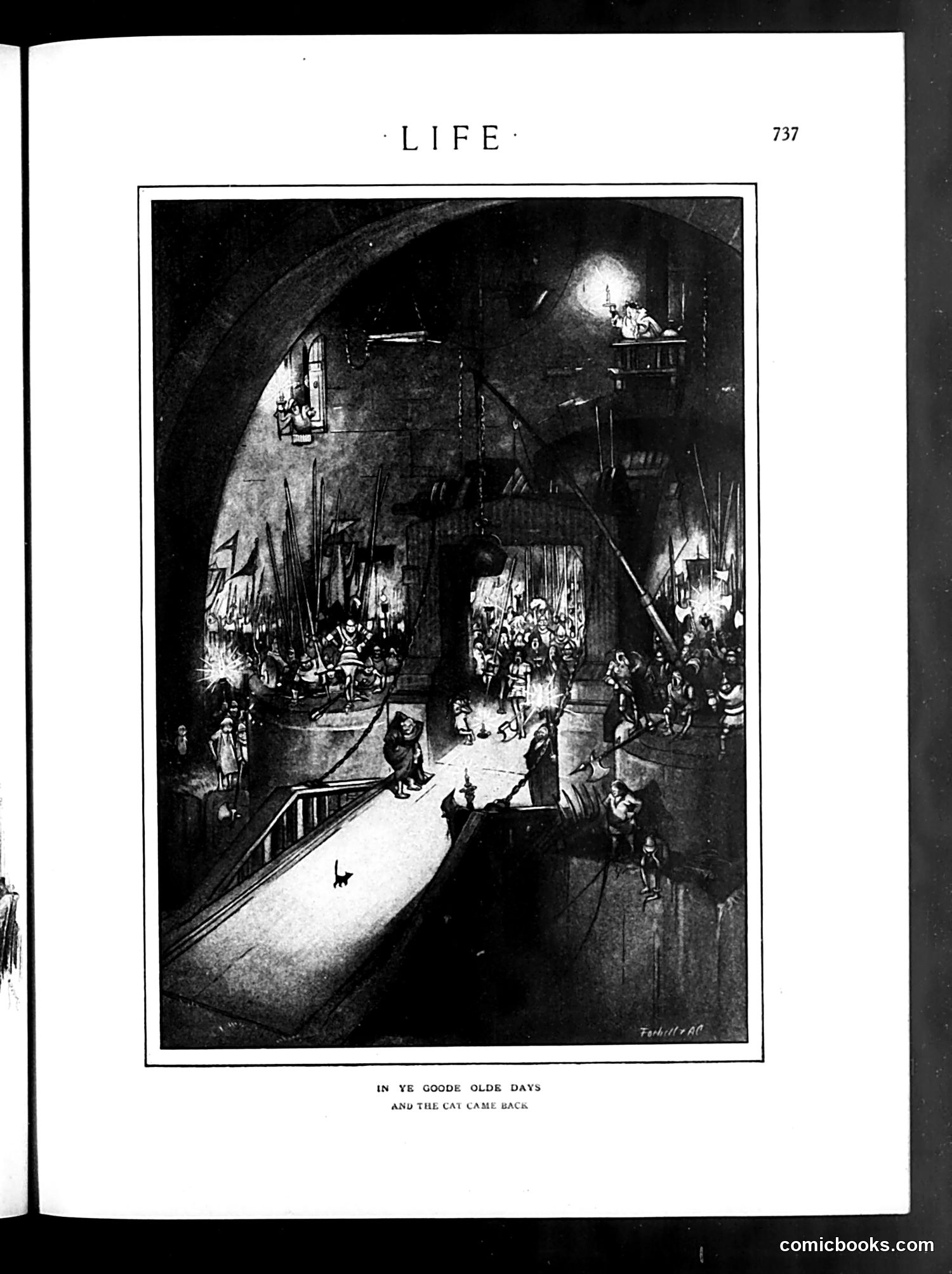
This page features a single illustration titled "IN YE GOODE OLDE DAYS AND THE CAT CAME BACK." The image depicts a medieval or ancient cathedral or grand hall with a vaulted ceiling, populated by numerous figures in period costume. A beam of light streams through an opening above, illuminating the vast interior space where crowds gather. A cat appears in the central floor area. The satire likely plays on the phrase "the cat came back" (referencing a popular 1893 song about a cat that repeatedly returns despite attempts to remove it). By juxtaposing this mundane detail against an elaborate historical or religious setting, Life is making a humorous comment about persistence or inevitability. The specific historical reference or social commentary remains unclear without additional context about the magazine's publication date and contemporary events.
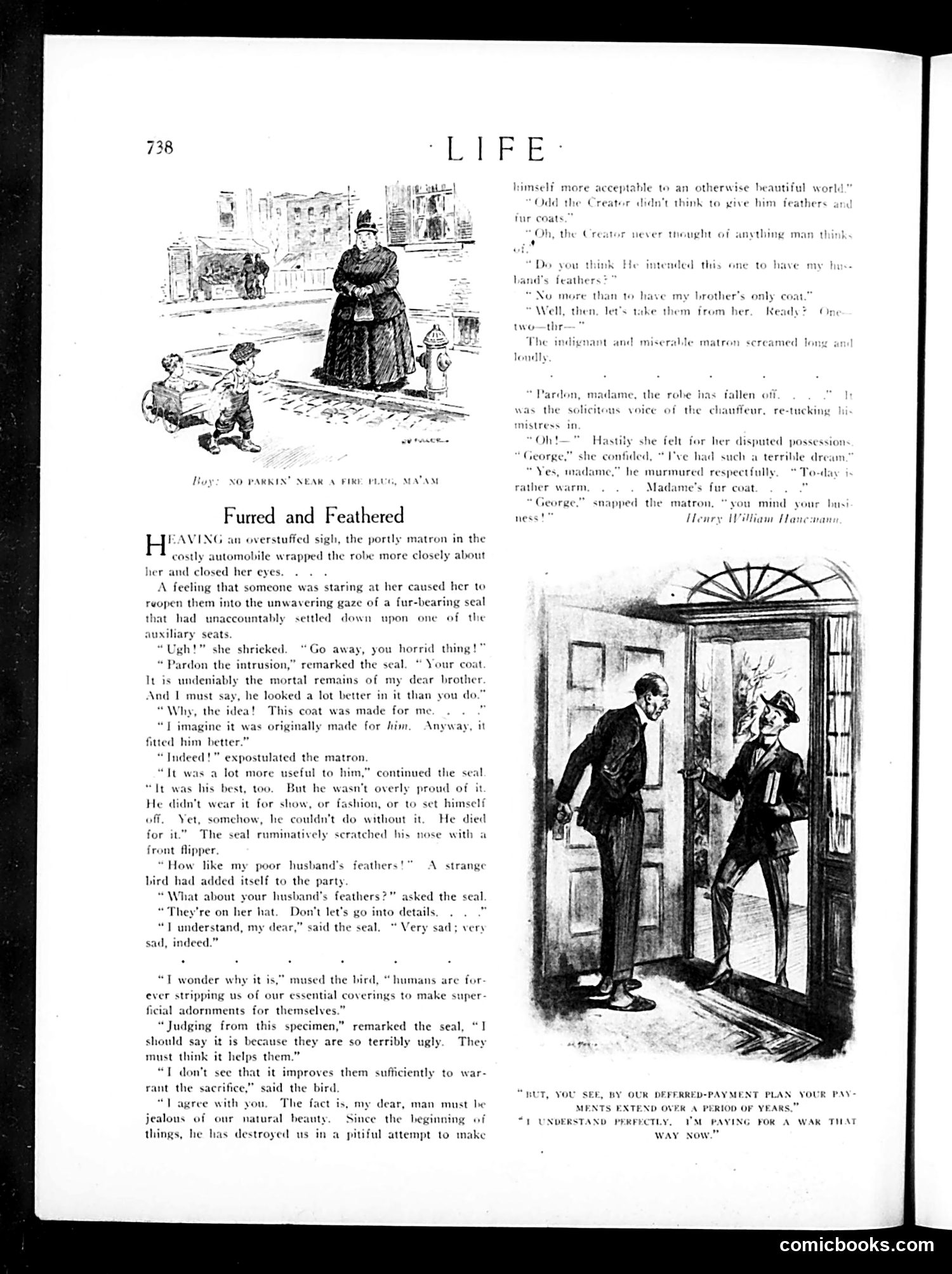
This story satirizes wealthy women's obsession with fur coats through dialogue between animals (a seal and bird) observing humans. The narrative mocks the justifications women use for wearing animal pelts—claiming they "improve" appearance or are "essential." The two illustrations show: (1) a well-dressed matron confronted by children about a dead seal's coat, and (2) a man at a doorway, apparently discussing the deferred-payment plan for acquiring furs. The satire targets Gilded Age consumerism and the disconnect between fashionable ladies and the animals killed for their vanity. By giving voice to the seal and bird questioning human "logic," Life ridicules both the practice and the rationalizations offered to justify it—a common early-20th-century critique of materialism and animal exploitation.
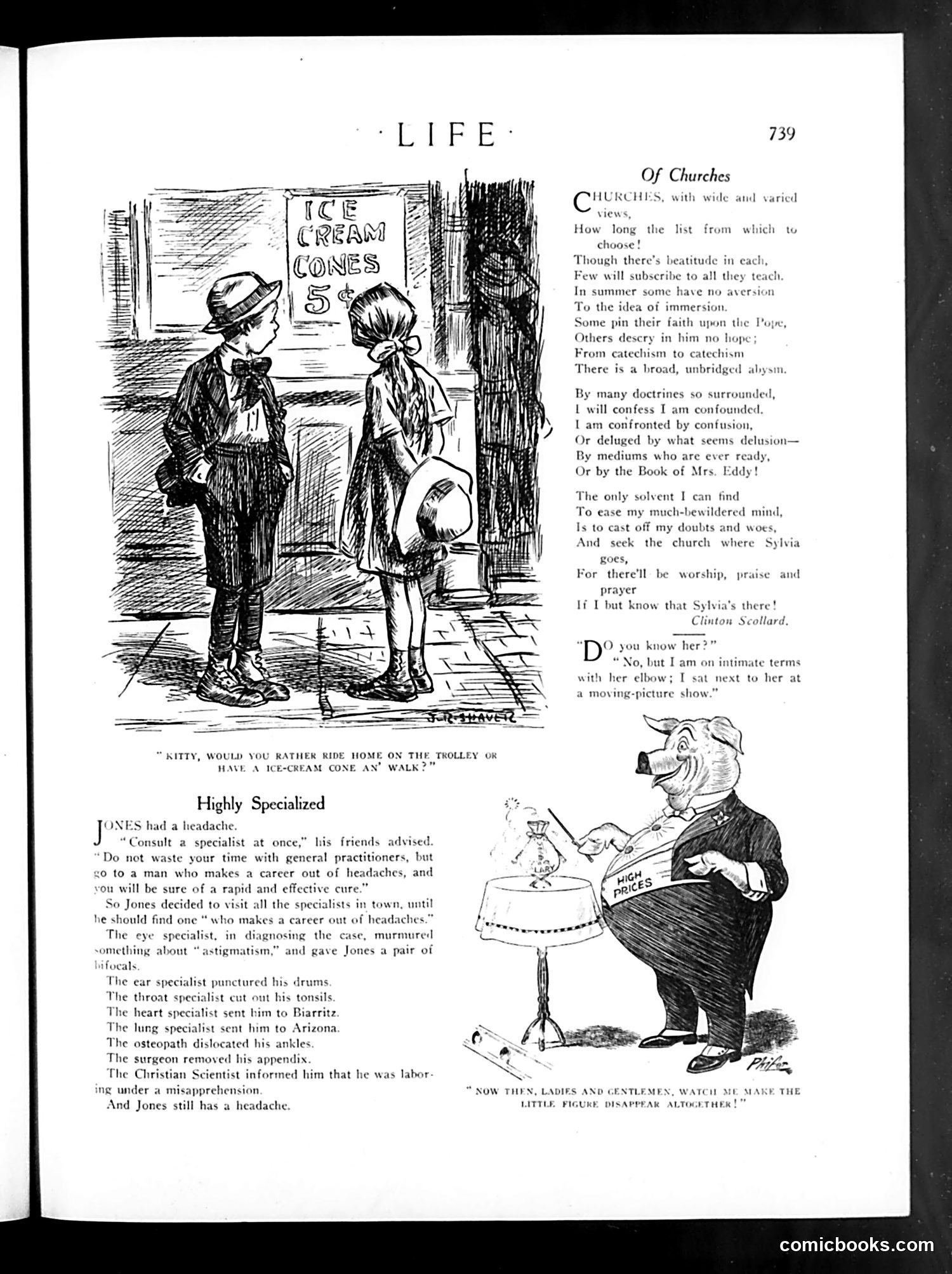
This page contains two satirical pieces: **"Of Churches"** (top right): A poem by Clinton Scollard lamenting religious confusion. The accompanying sketch shows two children debating whether to ride home or walk, positioned near an ice cream cone sign—a mundane contrast to the poem's spiritual anxiety. **"Highly Specialized"** (bottom): A humorous anecdote about a man named Jones who visits numerous medical specialists for a headache, each diagnosing different ailments (astigmatism, ear problems, throat issues, heart conditions, etc.). The accompanying caricature shows a rotund man with a "high prices" sign, satirizing the proliferation of specialists and their fees—suggesting over-specialization in medicine is profitable but ineffective. Both pieces mock contemporary institutional confusion: religious pluralism and medical fragmentation.
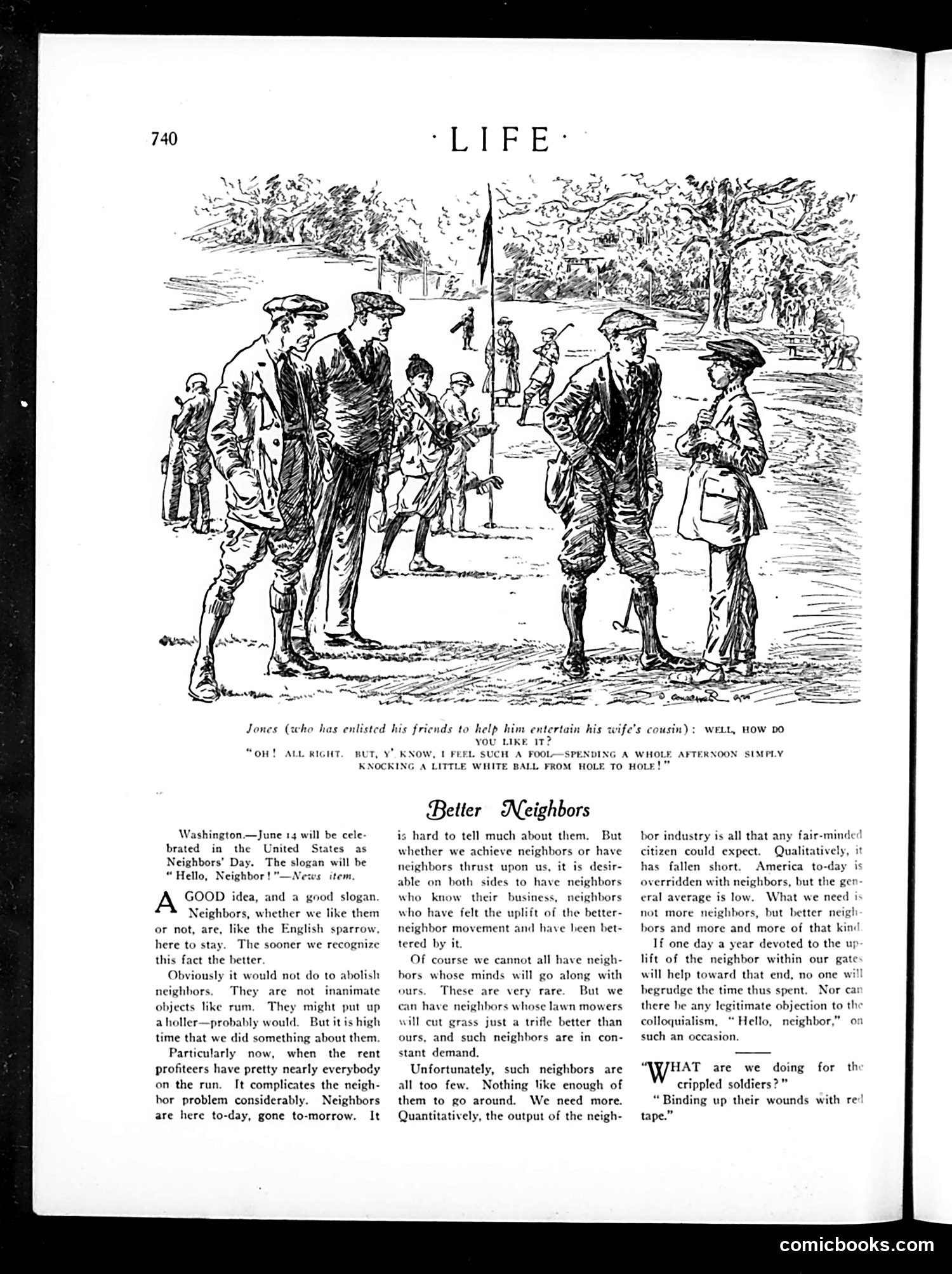
**The Cartoon:** Shows military officers and civilians at what appears to be a recreational area (possibly a golf course, given the dialogue). One soldier complains to another about entertaining his wife's cousin, saying he feels "such a fool—spending a whole afternoon simply knocking a little white ball from hole to hole!" **The Satire:** The humor targets the absurdity of golf as a leisure activity—particularly for soldiers, suggesting the tedium and purposelessness of the sport. The soldier's frustration contrasts the pointless recreation with military duty. **The Article:** "Better Neighbors" argues for stronger community bonds. It discusses how good neighbors improve society but are increasingly rare, and calls for more attention to neighborly civic responsibility. **Context:** This appears to be WWI-era content, given military uniforms and the reference to "crippled soldiers" in the visible text, suggesting post-war social concerns about community support.
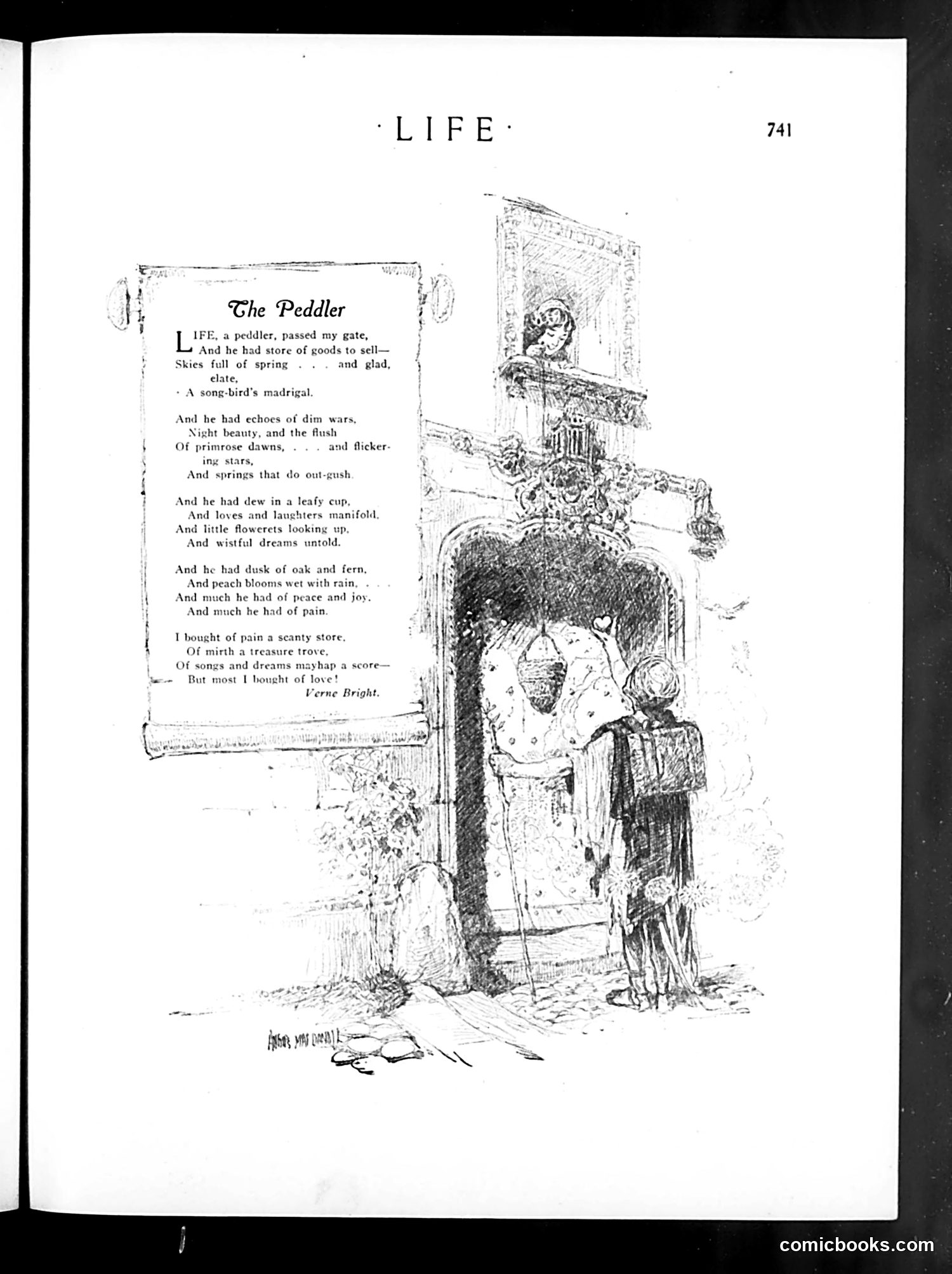
This is a poem by Verne Bright accompanying an illustration showing a street peddler at a doorway. The poem celebrates a traveling merchant who passes by, describing his wares and the sensory richness of his goods—spring skies, primrose dawns, oak and fern, peace and joy. The final stanza reveals the satirical point: the speaker bought pain, mirth, songs, and dreams from this peddler, "But most I bought of love!" The illustration depicts a woman at her door encountering the peddler, suggesting domestic life's intersection with commerce and romance. The satire appears gentle—mocking sentimental notions that love and happiness can be "purchased" like ordinary goods, while celebrating the peddler as a purveyor of life's intangibles rather than mere merchandise.
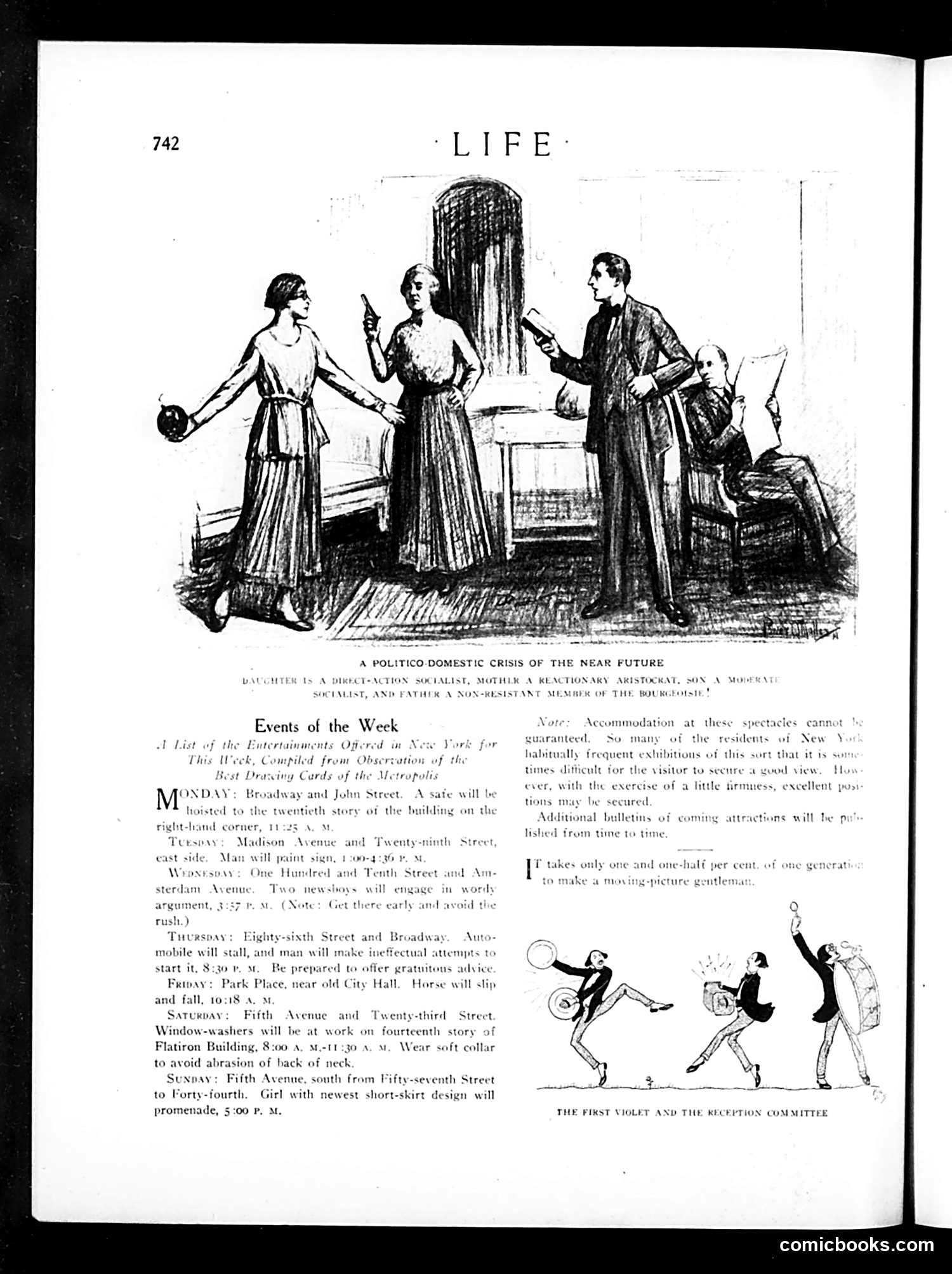
This page satirizes upper-class family tensions around progressive politics. The main cartoon shows a domestic debate: a woman (labeled a "direct-action socialist"), her mother (a "reactionary aristocrat"), a man in modern dress, and a young boy. The caption promises "A Politico-Domestic Crisis of the Near Future," suggesting anxiety about how socialist and progressive ideologies might divide wealthy families. The smaller cartoon below, titled "The First Violet and the Reception Committee," shows figures frantically chasing or presenting a violet—likely mocking the social competition and performative status-seeking among the wealthy elite. The humor targets both progressive activism and upper-class pretension, suggesting that political ideology creates absurd domestic conflict among the privileged.
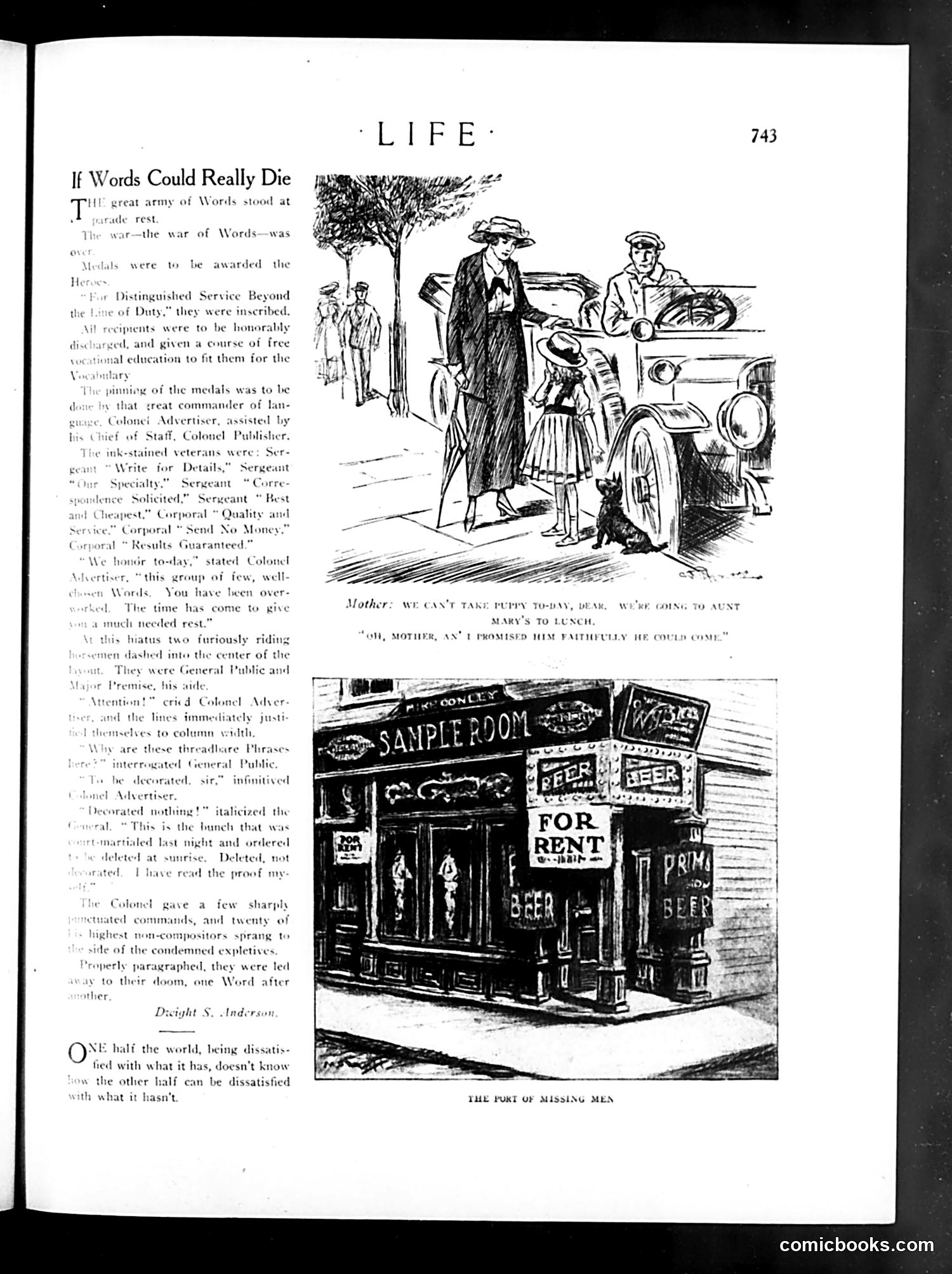
This Life magazine page contains two satirical pieces: **"If Words Could Really Die"** (top) is a humorous fantasy where words are treated as soldiers in warfare, receiving medals for "Distinguished Service Beyond the Line of Duty." Colonel Advertiser oversees this mock-military operation, awarding honorable discharge and "free vocational education" to retiring words. The satire mocks advertising language and corporate jargon by literalizing words as expendable combatants. **"The Port of Missing Men"** (bottom illustration) depicts a seedy saloon labeled "Sample Room" with beer advertisements, marked "For Rent." The caption suggests this represents where men disappear into vice and dissipation—a critique of urban poverty, alcoholism, and societal neglect during this era. Both pieces satirize American social problems through visual metaphor.
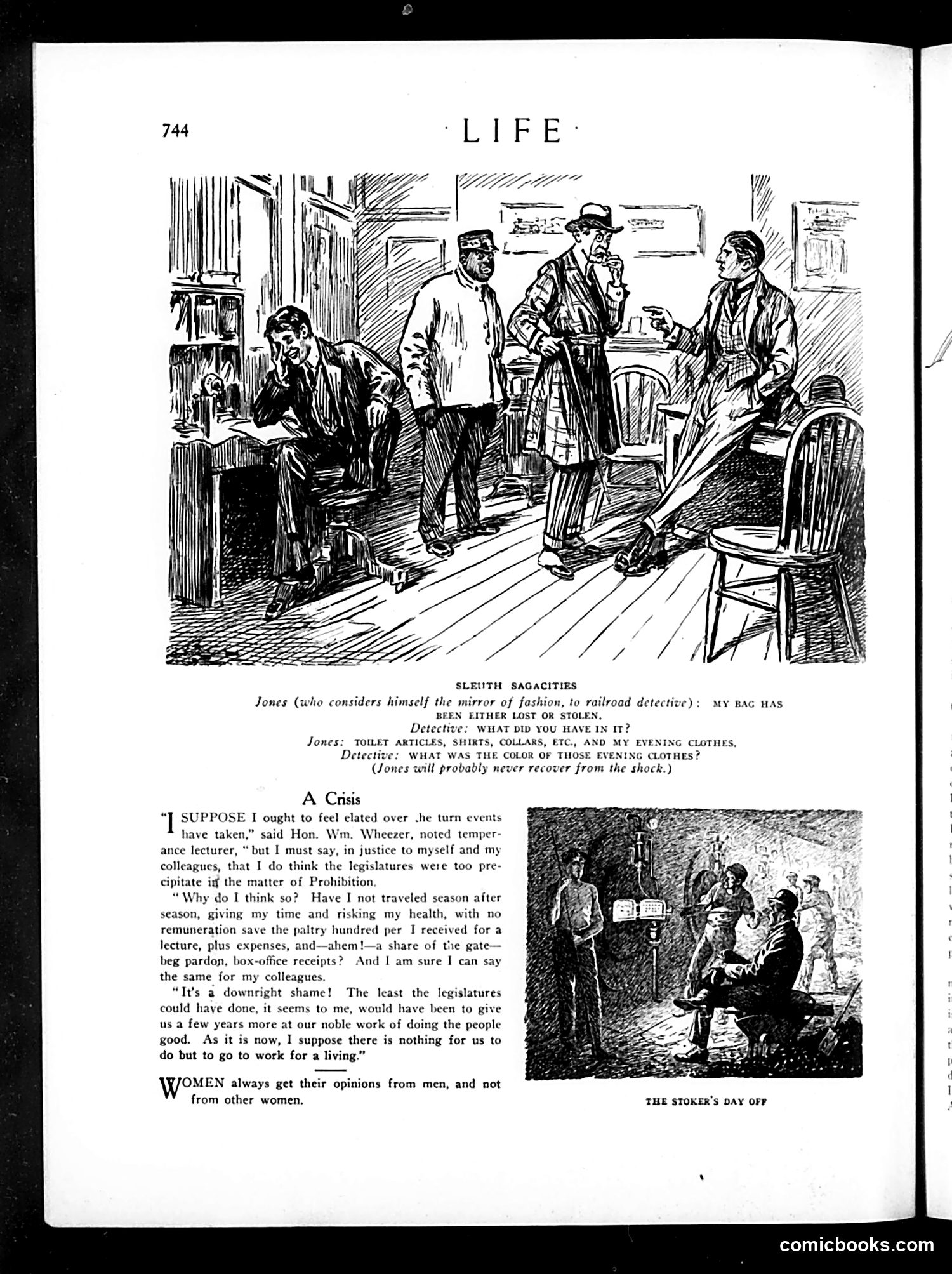
The top cartoon satirizes a railroad detective interrogating Jones about a missing bag. The joke hinges on the detective's incompetence: Jones lists the bag's contents (toilet articles, shirts, collars, evening clothes), but the detective asks only what color the clothing was—information utterly useless for recovery. Jones "will probably never recover from the shock" of such bumbling. Below, Hon. Wm. Wheeler complains that legislatures failed to support lecturers adequately, forcing them to work for meager compensation. He argues women's opinions come from men, not other women—likely a reference to women's suffrage debates of the era, suggesting women need male guidance on political matters. The page reflects early-20th-century attitudes toward women's autonomy and bureaucratic inefficiency.
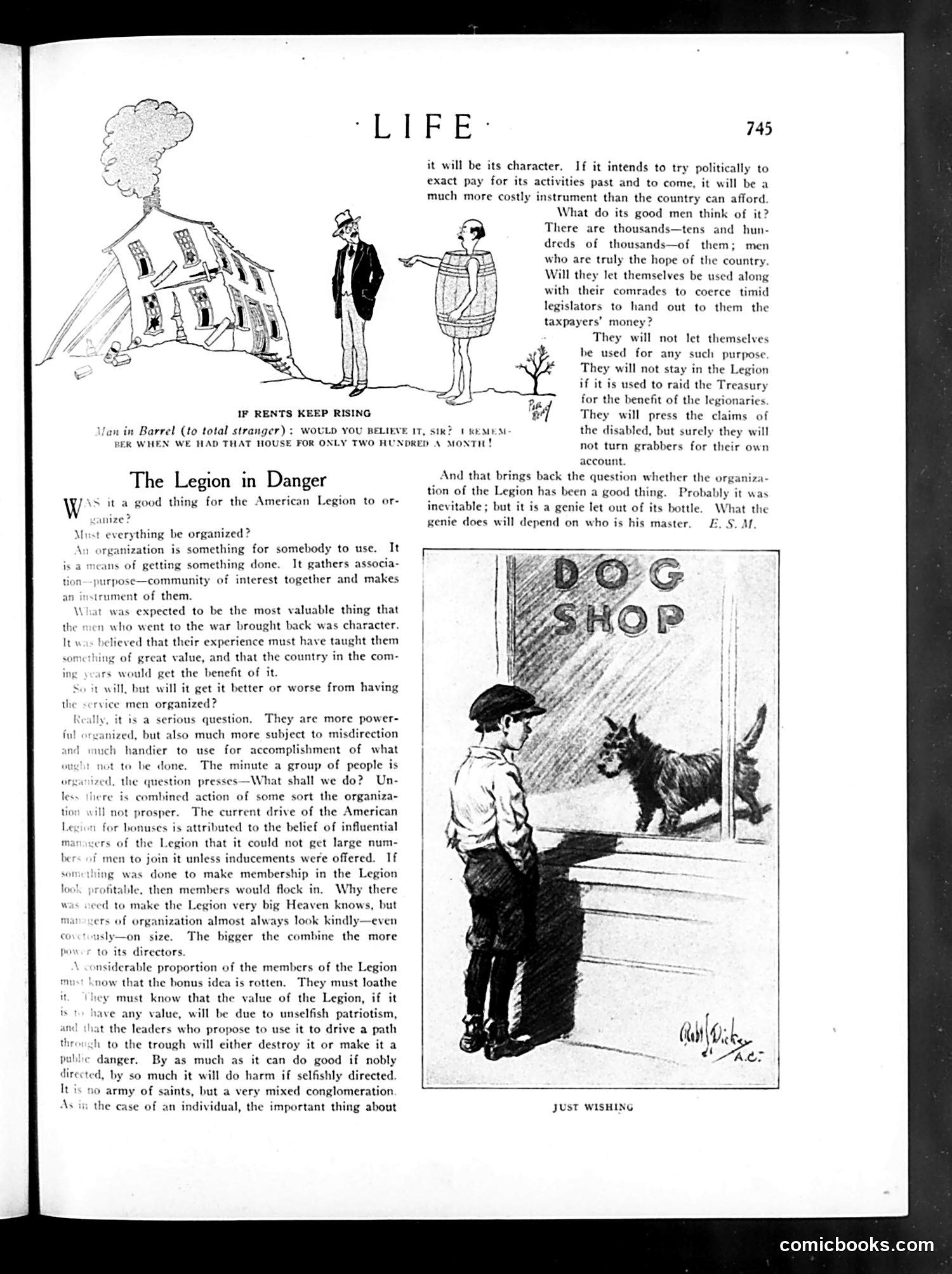
This page critiques the American Legion's post-WWI organization and direction. The top cartoon shows a man in a barrel (representing homelessness from rising rents) speaking to a stranger—satirizing economic hardship while contrasting with the Legion's focus. The main article by E.S.M. warns that while the Legion's character could be valuable, organized groups risk corruption. The author specifically fears the Legion will use its political power to lobby Congress for veteran bonuses ("raid the Treasury"), prioritizing members' financial gain over genuine patriotism and service to disabled veterans. The "Just Wishing" cartoon depicts a boy at a "dog shop" window—a visual pun on wanting what one cannot afford, likely reinforcing the economic anxieties of the era. The piece's central tension: organized veterans' power could do great good *or* serious harm, depending entirely on whether leaders pursue selfless patriotism or selfish exploitation of government funds.
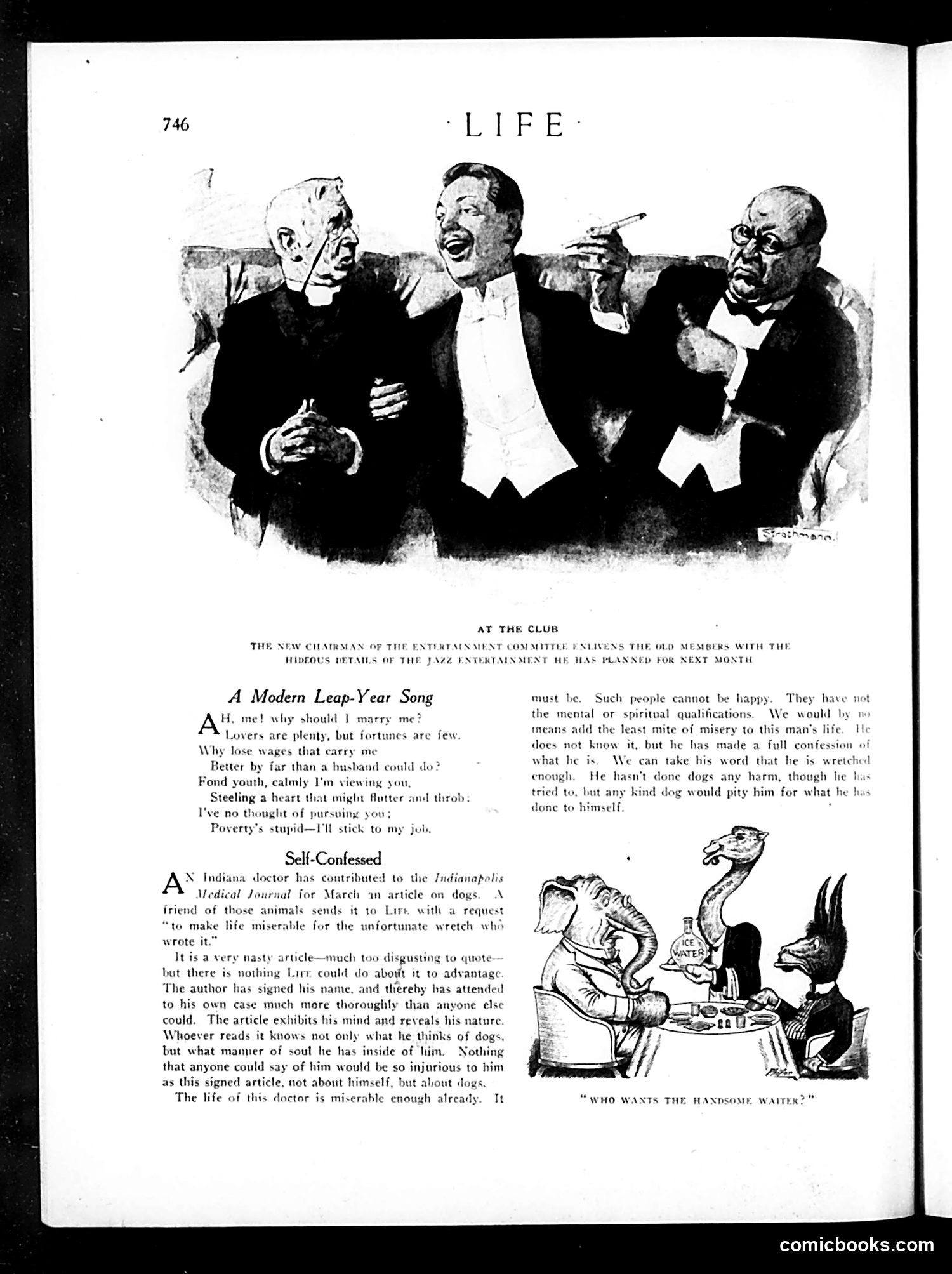
**Top Cartoon ("At the Club"):** Shows three well-dressed men at a club reacting with exaggerated horror and disgust. The caption indicates the new Entertainment Committee chairman is planning "jazz entertainment" for next month. The satire mocks upper-class snobbery toward jazz music—then considered vulgar, modern, and associated with lower classes and African Americans. The gentlemen's appalled expressions ridicule their stuffy resistance to contemporary popular culture. **"Modern Leap-Year Song":** A woman rejects marriage proposals, preferring economic independence through employment. This satirizes the "Leap Year" tradition (when women supposedly propose to men) while commenting on women's changing attitudes toward marriage versus financial security—a progressive social commentary for the era. **"Self-Confessed":** Life mocks an Indiana doctor who published a cruel article about dogs. Rather than attack him directly, the magazine argues his signed article self-exposes his character. The satire suggests that people reveal their true nature through their cruelty—their own words condemn them more effectively than outside criticism.
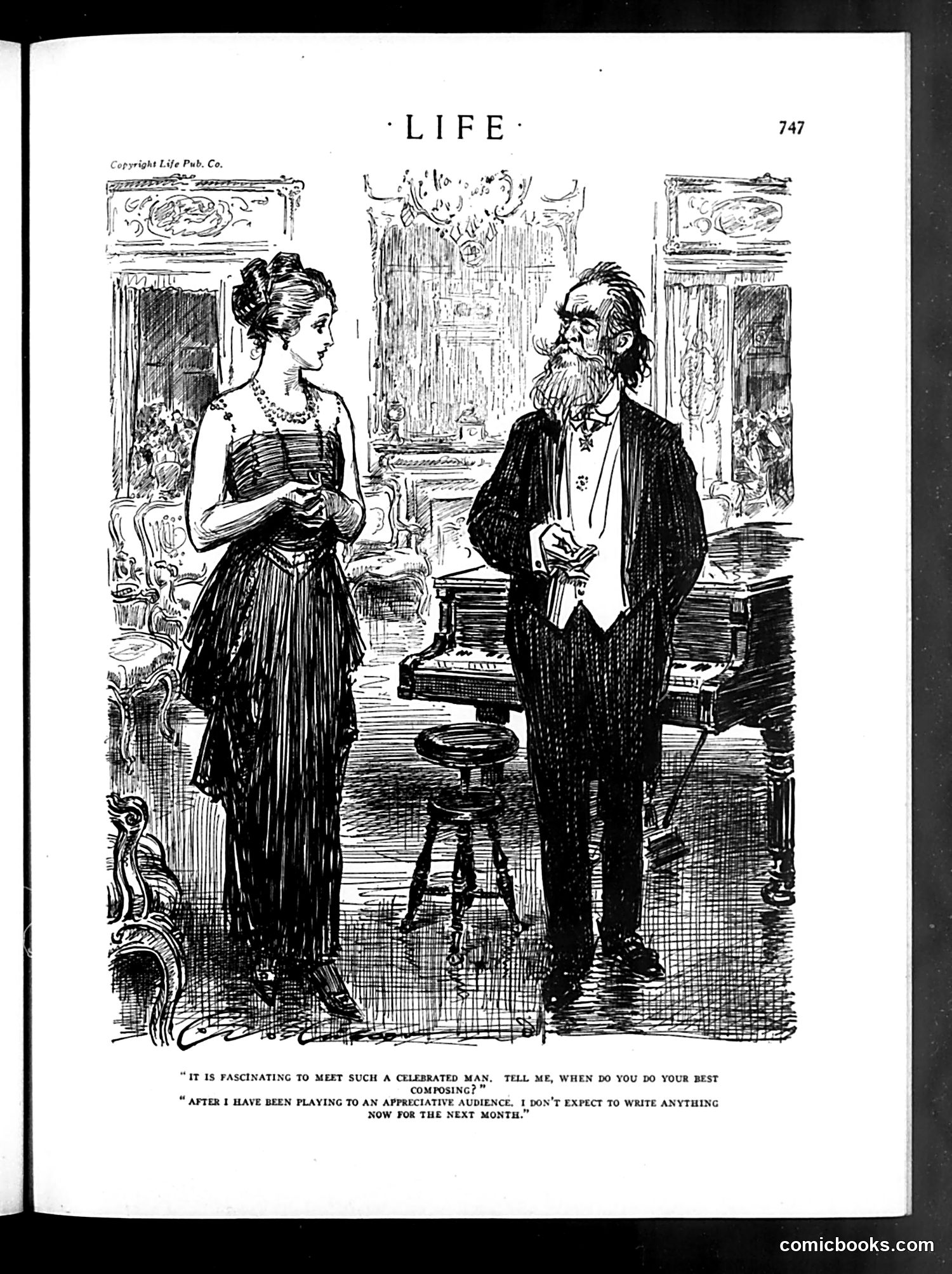
This is a satirical cartoon about a celebrated composer. The woman, dressed elegantly, asks when he does his best composing. The bearded man replies that after performing for an appreciative audience, he won't write anything for a month. The satire mocks the composer's creative process and ego: he's so exhausted and satisfied by audience adulation that he becomes creatively unproductive. The joke suggests that performers can become dependent on immediate applause rather than sustained creative work. The elegant interior setting emphasizes this is a figure of some social prominence, making the criticism of artistic laziness more pointed—even celebrated talents fall into this trap. The specific composer isn't identified in the visible text, though the caricature and context suggest this targets a real figure from Life's era.
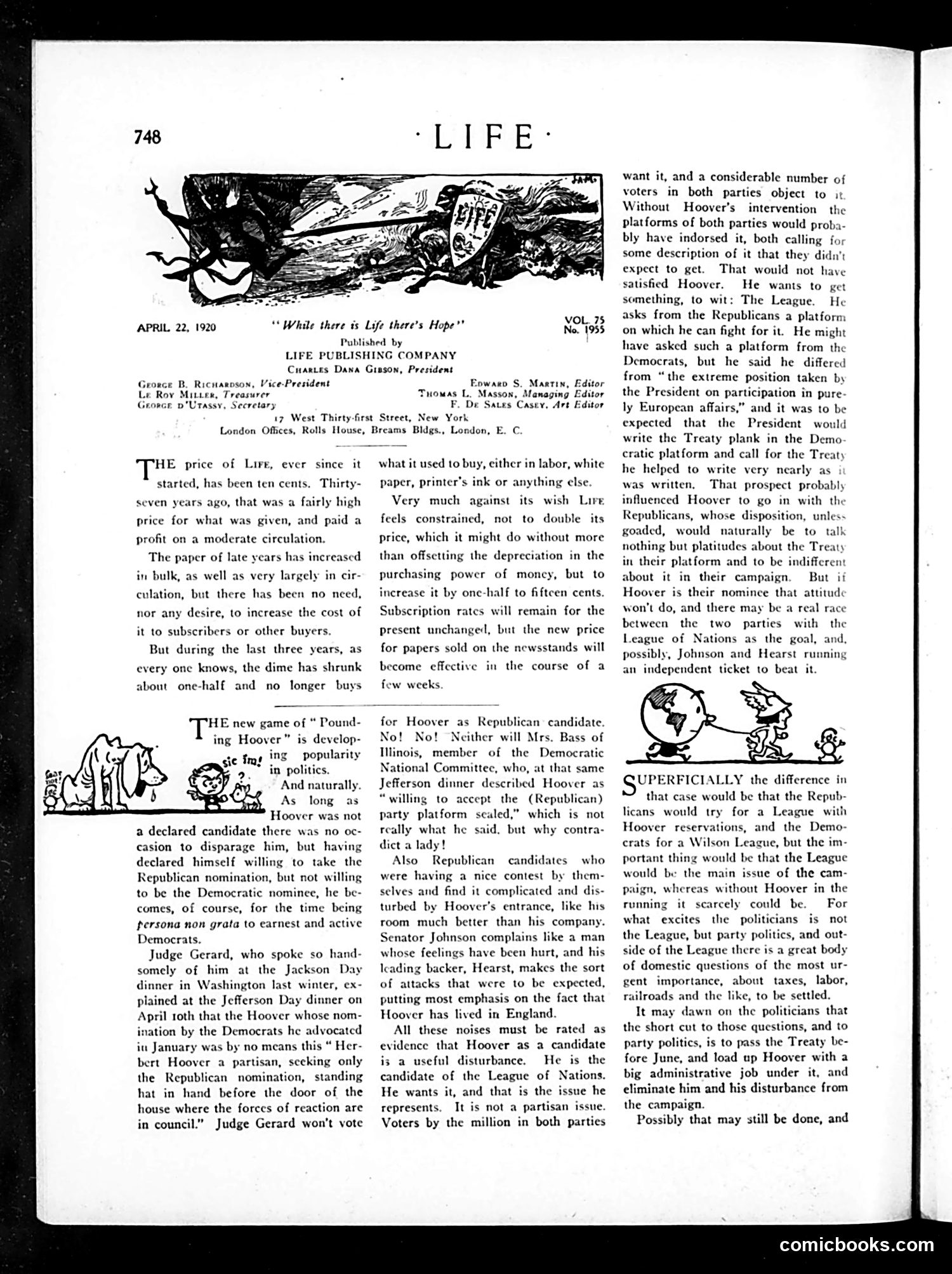
This article discusses Herbert Hoover's 1920 presidential campaign and the political backlash he faced after declaring as a Republican candidate. **The Context:** Democrats who previously praised Hoover (like Judge Gerard at a Jackson Day dinner) now attack him as "persona non grata" because he's pursuing the Republican nomination rather than the Democratic one. **The Satire:** The article mocks Democratic inconsistency—they supported Hoover when he seemed available to them, but abandoned him once he committed to the Republicans. Mrs. Bass's quoted criticism deliberately misrepresents his actual position. **The Central Issue:** Hoover's actual distinguishing position is his support for the League of Nations, which transcends party lines. The article argues his candidacy forces both parties to take a clear stand on this major issue rather than offering vague endorsements. **The cartoon** (top left, unclear details) likely illustrates this political chaos, though specific figures are difficult to identify from the image alone.
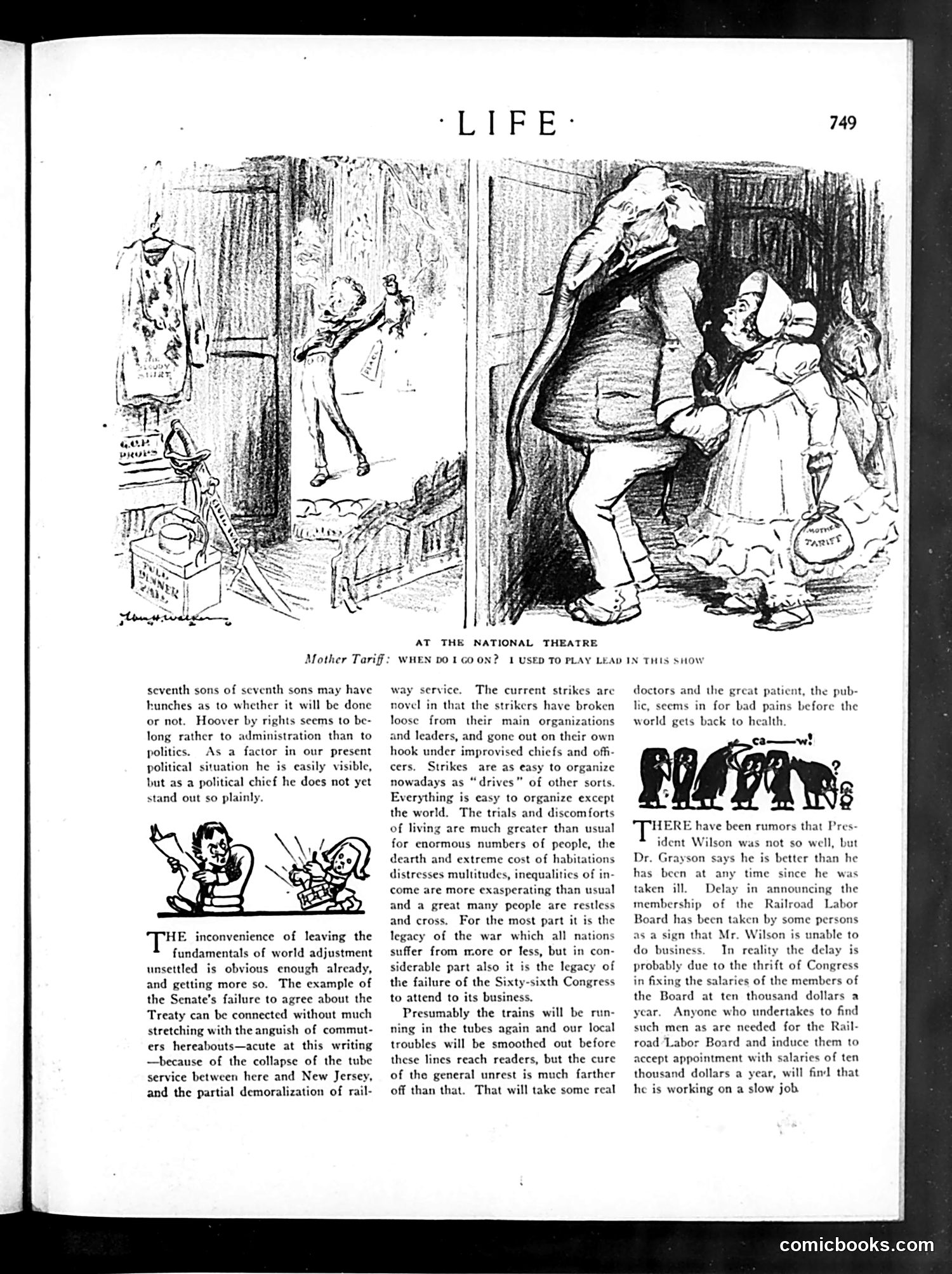
The top cartoon depicts "Mother Tariff" at the National Theatre, asking "When do I go on? I used to play lead in this show." This satirizes American tariff policy as a theatrical performance—suggesting protectionist trade policies, once central to American politics, have been sidelined or are no longer the main attraction in current political discourse. The surrounding text addresses post-WWI America's problems: railroad strikes, housing shortages, income inequality, and general social unrest. The author criticizes both the failure of the Sixty-sixth Congress to ratify the Treaty of Versailles and current labor disruptions. There's discussion of President Wilson's health and the delayed appointment of the Railroad Labor Board, with sardonic commentary about the difficulty of recruiting qualified people at a ten-thousand-dollar annual salary. The overall theme: America faces serious structural problems requiring genuine solutions, not political theater.
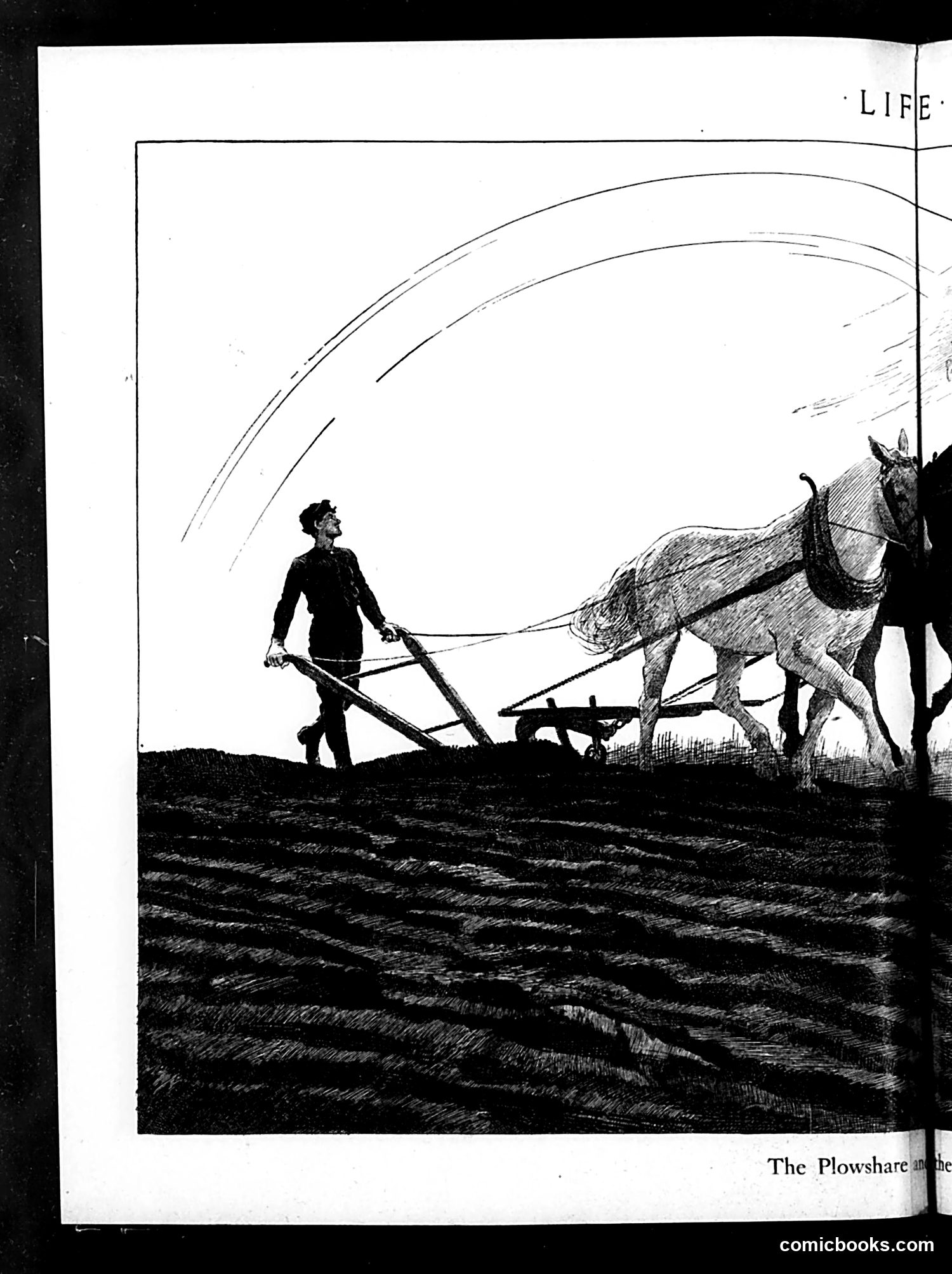
This is a silhouette illustration showing a farmer guiding a horse-drawn plow across furrowed ground. The image appears to be titled "The Plowshare" (visible at bottom). The cartoon likely represents agricultural labor or rural American life. The silhouette style emphasizes the worker's labor against an expansive sky. Given Life magazine's satirical nature, this could be commenting on farmers' conditions, agrarian economics, or the dignity of manual work—though without additional context or visible captions, the specific satirical point remains unclear. The stark black-and-white silhouette style was common in early 20th-century editorial illustration for conveying symbolic or political meaning about working-class subjects.
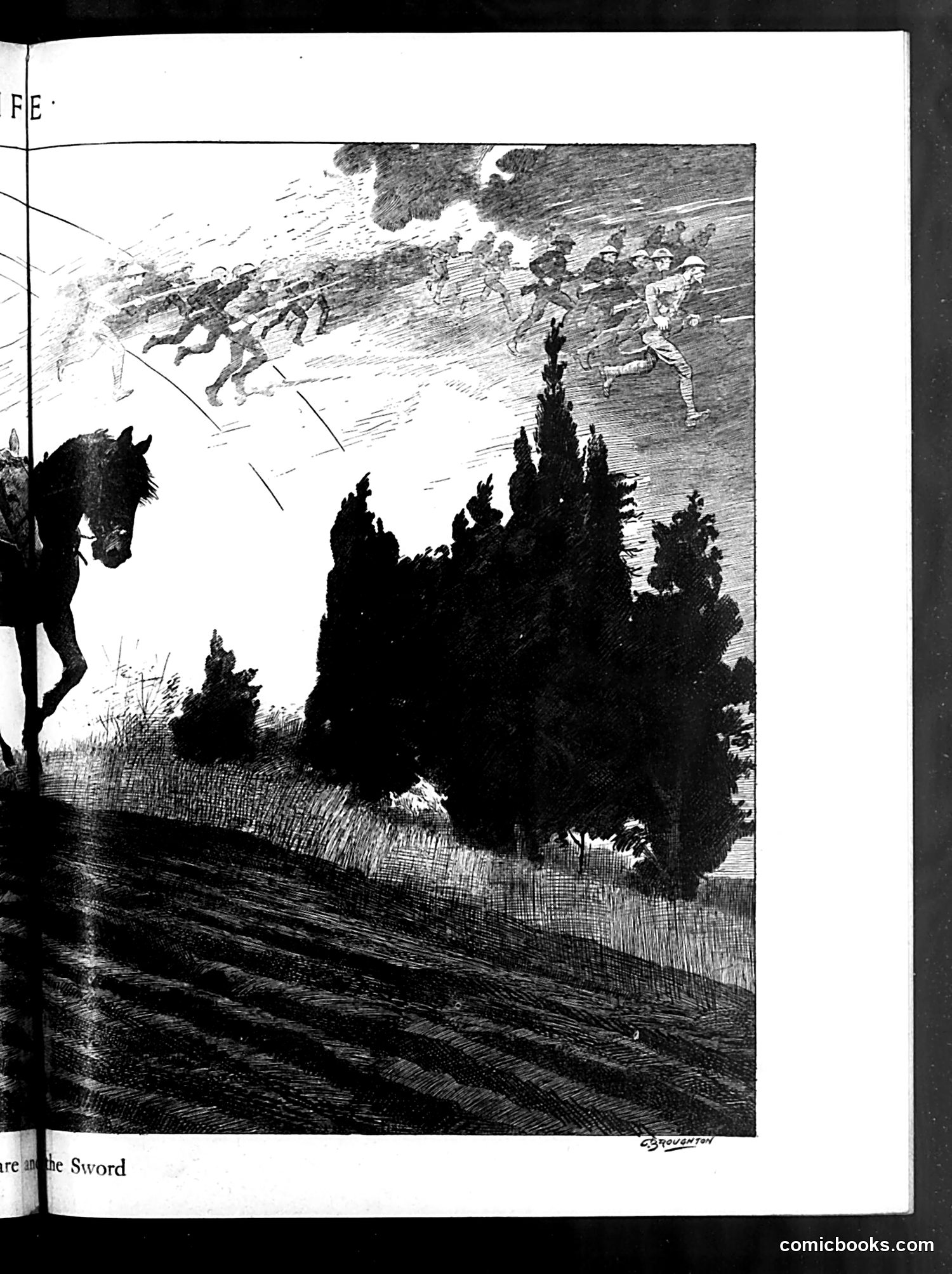
This page appears to be from an illustration titled "Arc and the Sword" (visible at bottom left). The engraving depicts a historical or legendary scene: a mounted figure on the left observes soldiers advancing up a hillside toward cypress trees in the distance. The style and composition suggest a classical or medieval narrative scene, possibly depicting Joan of Arc or a similar historical military figure, given the title reference to "Arc." The engraving employs dramatic contrasts between dark foreground vegetation and lighter sky, with careful crosshatching to create depth. The signature "Croverton" appears at bottom right. Without additional context from surrounding pages, the specific satirical or political point remains unclear, though the heroic framing suggests either earnest historical illustration or potential ironic commentary on military heroism.
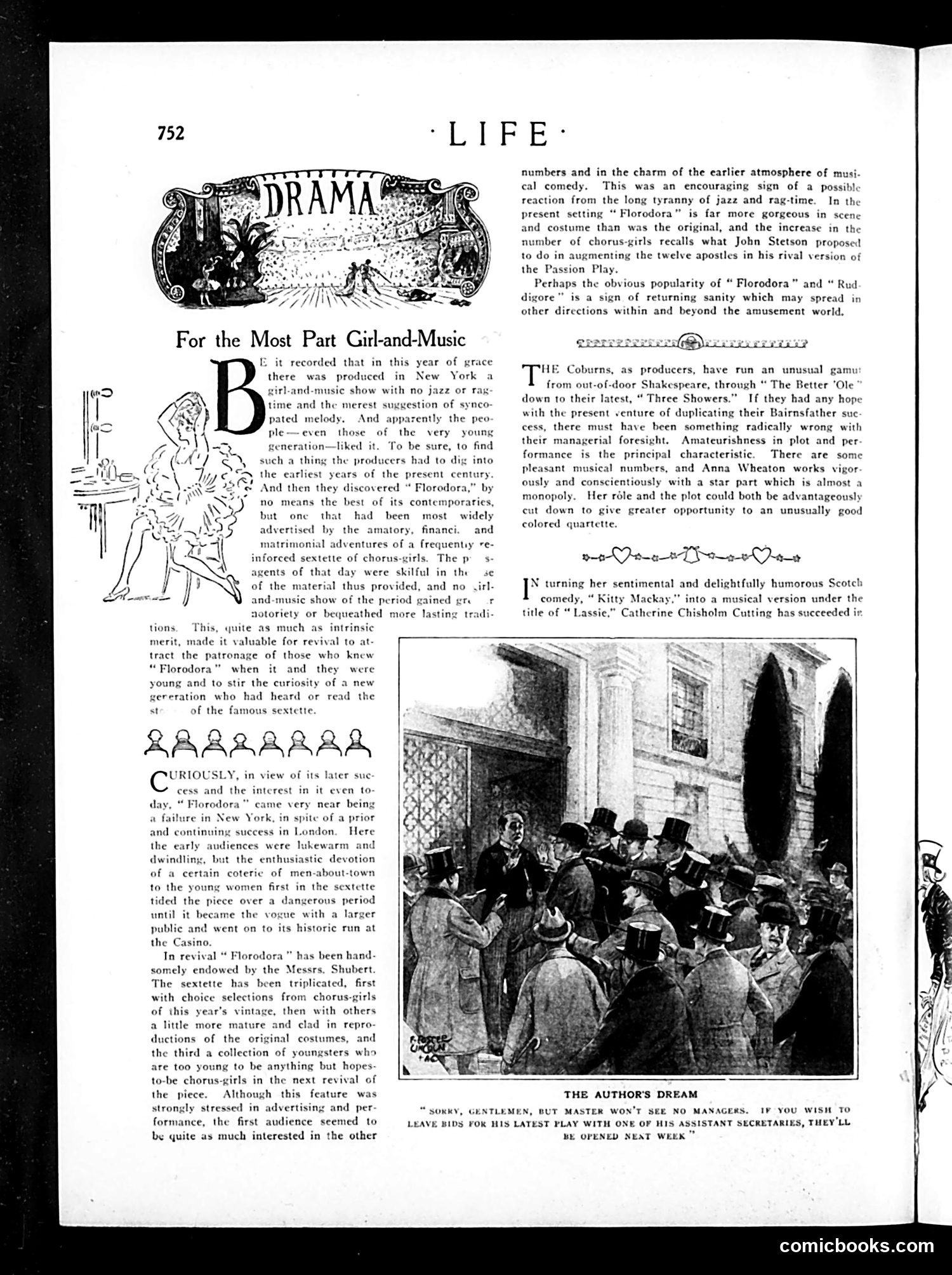
This page reviews theatrical productions, primarily discussing the revival of "Florodora," an early 1900s musical comedy. The article praises its return as a reaction against "jazz and rag-time" tyranny, suggesting audiences welcomed a return to earlier musical-theater styles. The critique notes "Florodora" nearly failed in New York despite London success, only surviving because wealthy "men-about-town" supported it for its chorus girls—a satirical jab at male patrons' motivations. The 1920s revival has tripled the original sextette (six dancers) and expanded costumes and spectacle. The page also briefly reviews "Three Showers" by the Coburn producers, dismissing it as amateurish despite featuring performer Anna Wheaton and a "colored quartette" (Black musical group). The cartoon caption at bottom ("The Author's Dream") appears to be a separate theatrical joke about playwriting and theater management, though details are unclear from this image alone.
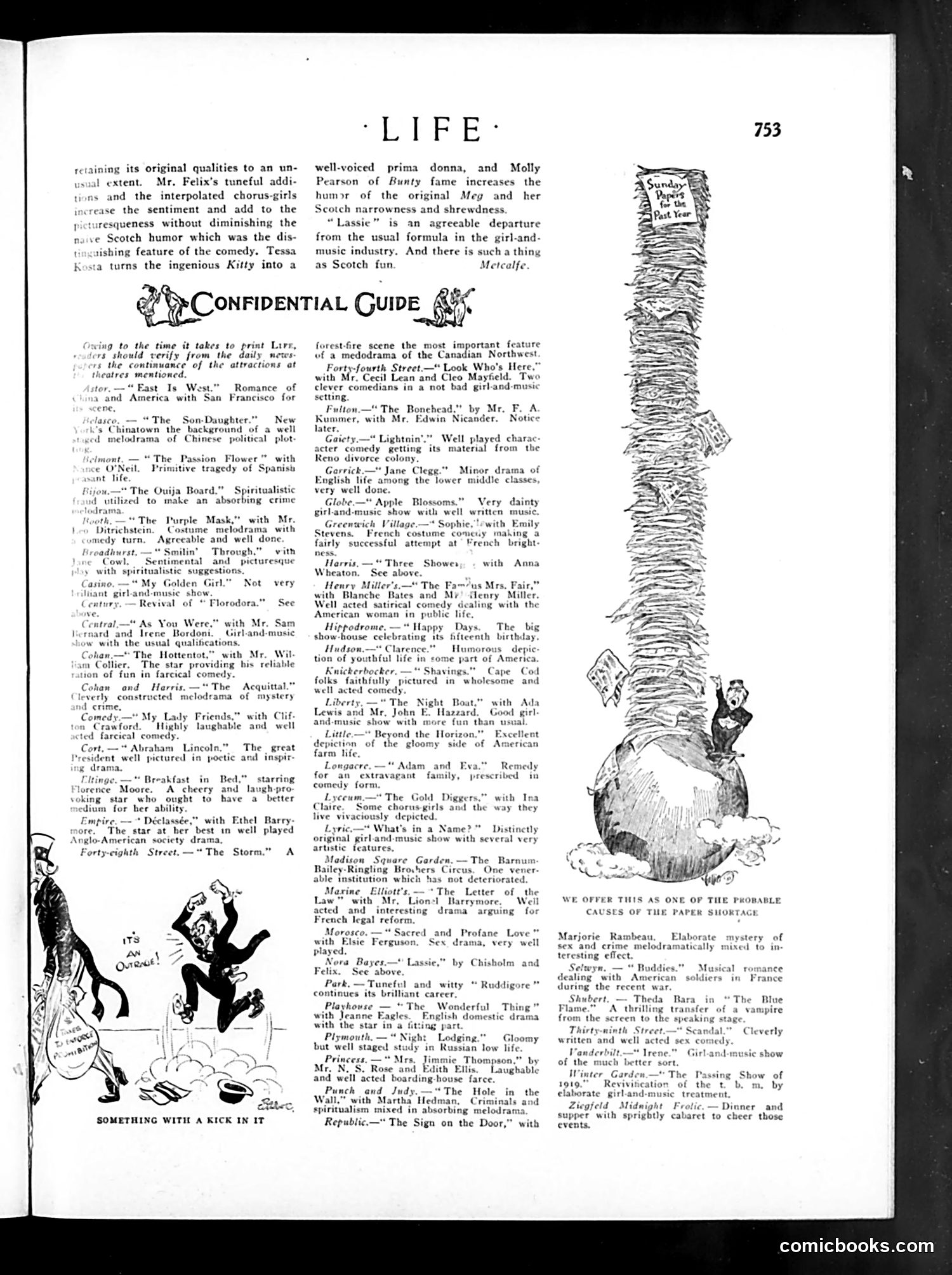
This is a theater review section from *Life* magazine listing Broadway productions with brief critical commentary. The page contains two cartoons lampooning theatrical entertainment. The left cartoon, captioned "SOMETHING WITH A KICK IN IT," depicts a caricatured figure (appears to be a theatrical performer or impresario) in exaggerated poses, suggesting the physical comedy and slapstick humor popular in contemporary stage productions. The right cartoon shows a figure climbing or struggling with what appears to be a large stack of papers or scripts, illustrating the overwhelming volume of theatrical productions reviewed. The text reviews various plays, musicals, and theatrical productions—comedies, melodramas, girl-and-music shows—indicating the diversity of entertainment available. References to "spiritualistic suggestions," "girl-and-music" shows, and "farcical comedy" reflect popular theatrical genres of the early 20th century. The satire gently mocks the theatrical world's relentless output and the magazine's difficulty keeping pace with constant openings and closings.
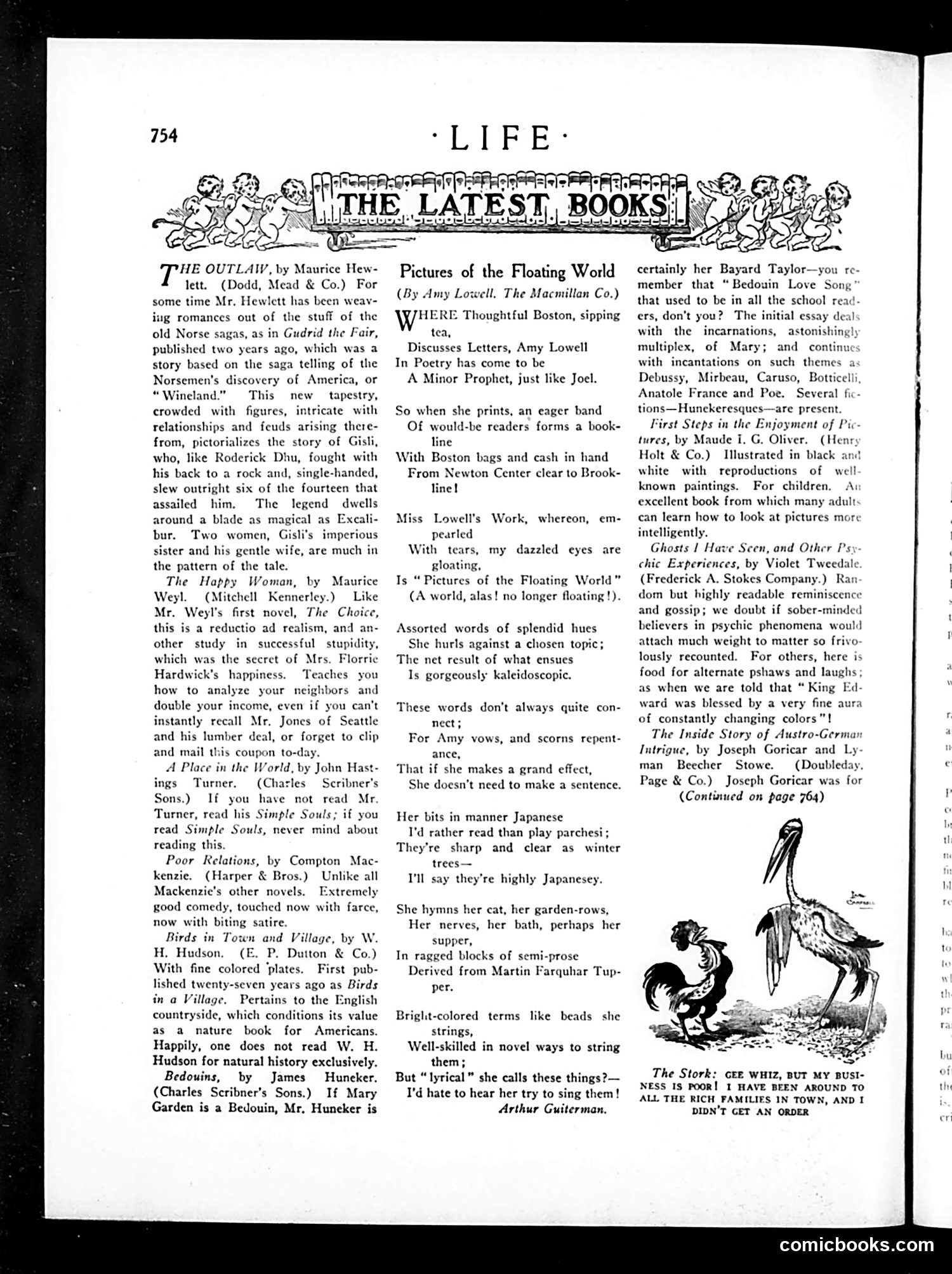
This is a book review page from *Life* magazine featuring poetry criticism and literary notices. The main satirical content is **Arthur Guiterman's verse review** of Amy Lowell's poetry collection *Pictures of the Floating World*. Guiterman mocks Lowell as a pretentious Boston poet-celebrity whose work prioritizes aesthetic effect over grammatical coherence. He ridicules her adoption of Japanese poetic forms (imagism), sarcastically calling her verses "highly Japanesey" and criticizing her belief that she needn't construct proper sentences if she achieves visual impact. The poem also suggests her subject matter is trivial—cats, gardens, her nerves—wrapped in pseudo-intellectual language. The accompanying illustration shows a stork, likely referencing her work's ornamental, decorative nature rather than substantive meaning. Guiterman's satire targets both Lowell's modernist poetry techniques and the Boston literary establishment's reverence for her as a serious poet.
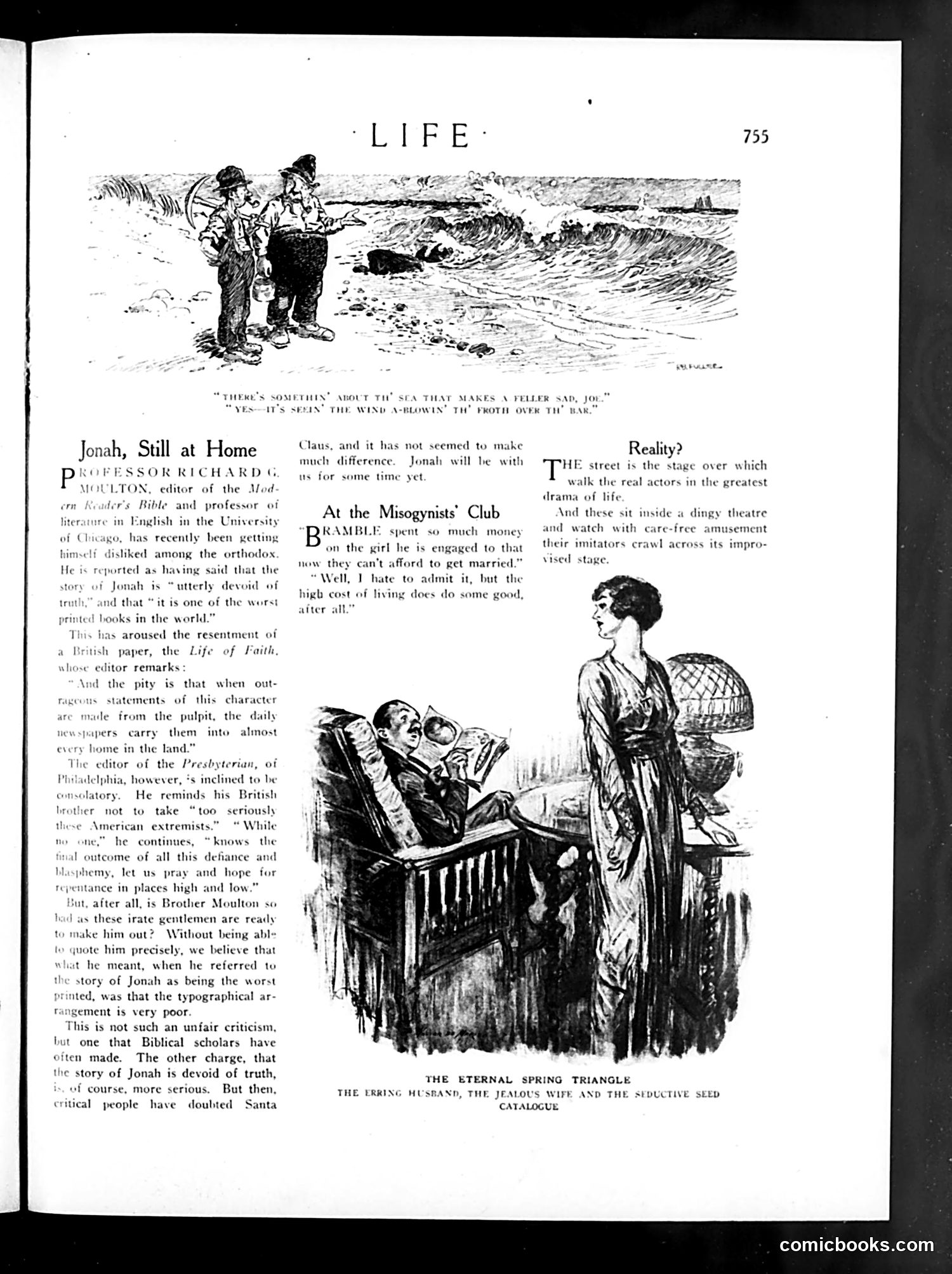
This page contains three satirical pieces: **"Jonah, Still at Home"** critiques Professor Richard Moulton's scholarly dismissal of the biblical Book of Jonah as "utterly devoid of truth." The piece mocks both the professor's extreme statement and the religious establishment's outrage over it. The satire suggests that whether or not Jonah is literally true is irrelevant—it will persist culturally regardless, just as people still believe in Santa Claus despite knowing better. The actual complaint about poor typography is humorously reframed as the real issue. **"At the Misogynists' Club"** is a brief joke about an engaged couple who cannot afford to marry because he spent too much courting her. The dark humor suggests the high cost of living inadvertently prevents marriage—presenting economic hardship as having an unexpected positive effect. **"The Eternal Spring Triangle"** cartoon satirizes theatrical melodrama, contrasting real human drama (erring husbands, jealous wives, seduction) with actors performing these same scenarios on stage. The joke critiques both theatrical artificiality and life's genuine emotional struggles. The top illustration depicts sailors discussing melancholy seasickness.
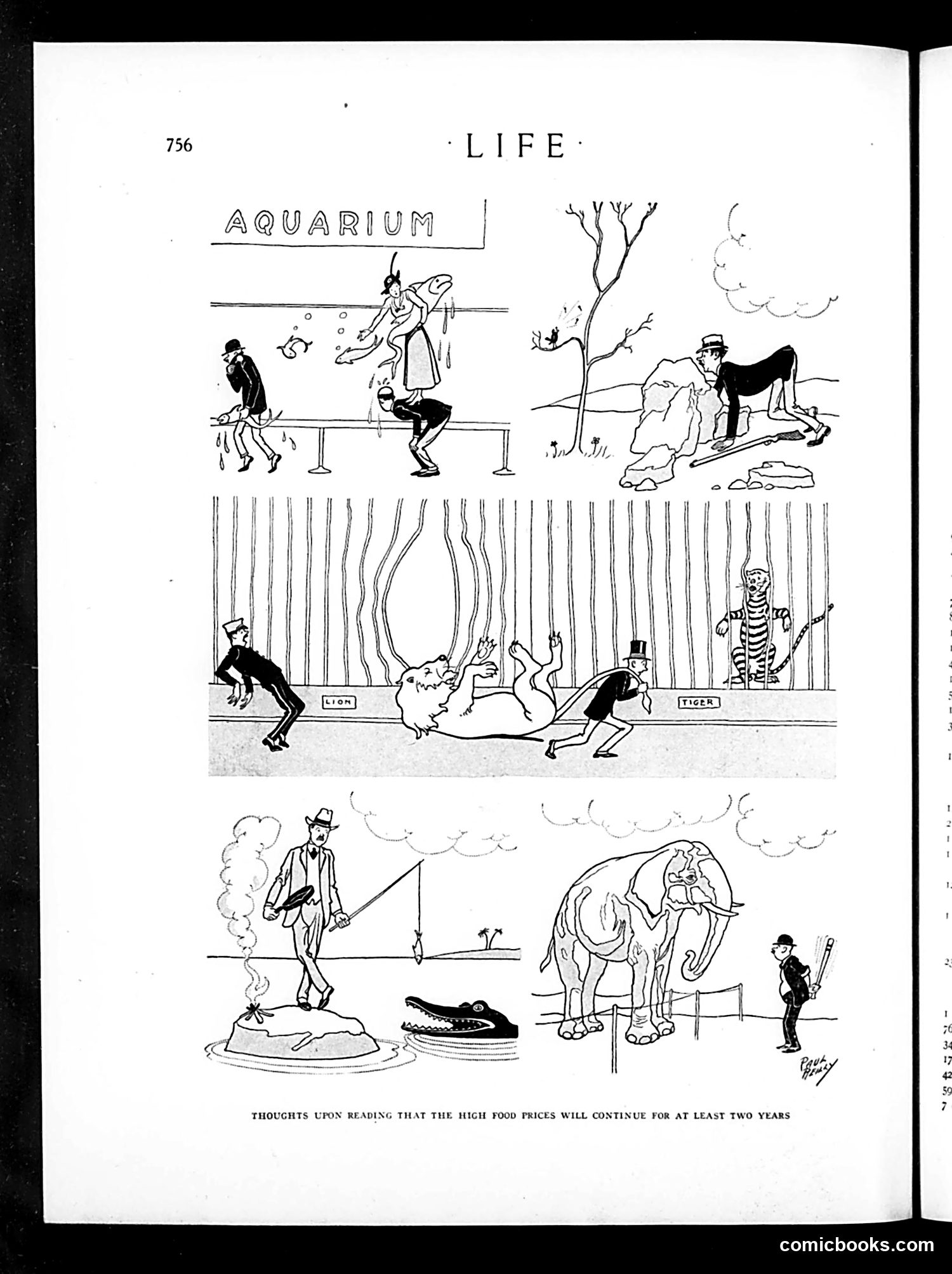
This page contains satirical cartoon vignettes about the cost of living. The header "AQUARIUM" frames the top scene, where wealthy figures feed fish while poor people fish below—suggesting economic class disparity. The middle panel depicts a circus scene with a lion and tiger, likely representing dangerous economic forces, while skeletal figures perform, implying people are being exploited. The bottom scenes show: a man standing near a campfire with what appears to be a shoe or boot (suggesting poverty/desperation), and a wealthy figure examining an elephant, contrasting affluence with hardship. The caption reads: "THOUGHTS UPON READING THAT THE HIGH FOOD PRICES WILL CONTINUE FOR AT LEAST TWO YEARS"—indicating the satire addresses anxiety about prolonged economic hardship and food inflation, likely from the post-WWI era.
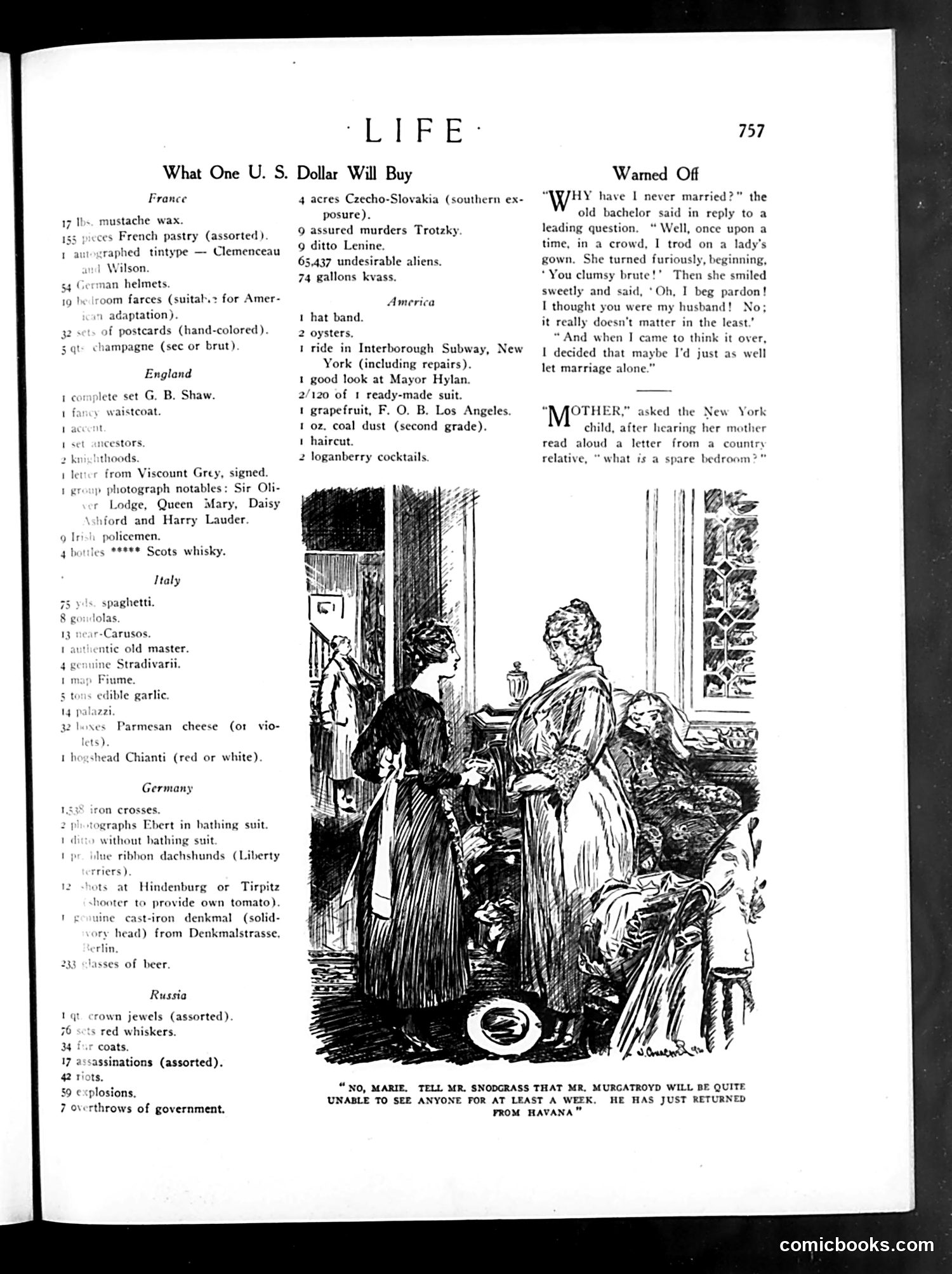
This is a satirical price list comparing what one American dollar could purchase in different countries circa 1919-1920, following World War I. The humor lies in mocking each nation's characteristic exports and current conditions. **The targets:** - **France**: stereotyped luxuries (mustache wax, champagne, pastries) - **England**: cultural pretension (Shaw plays, nobility connections) - **Italy**: artistic clichés (masters, opera singers, garlic) - **Germany**: post-war humiliation (iron crosses, photos of leaders, destroyed monuments from Berlin) - **Russia**: chaos and violence (assassinations, overthrows, explosions—referencing the recent Bolshevik Revolution and figures like Trotsky and Lenin) - **America**: modest, practical goods (subway rides, coal dust, cheap suits) The satire suggests American economic superiority while mocking each nation's stereotypes and current instability. The accompanying cartoons appear unrelated domestic humor about marriage and social etiquette.
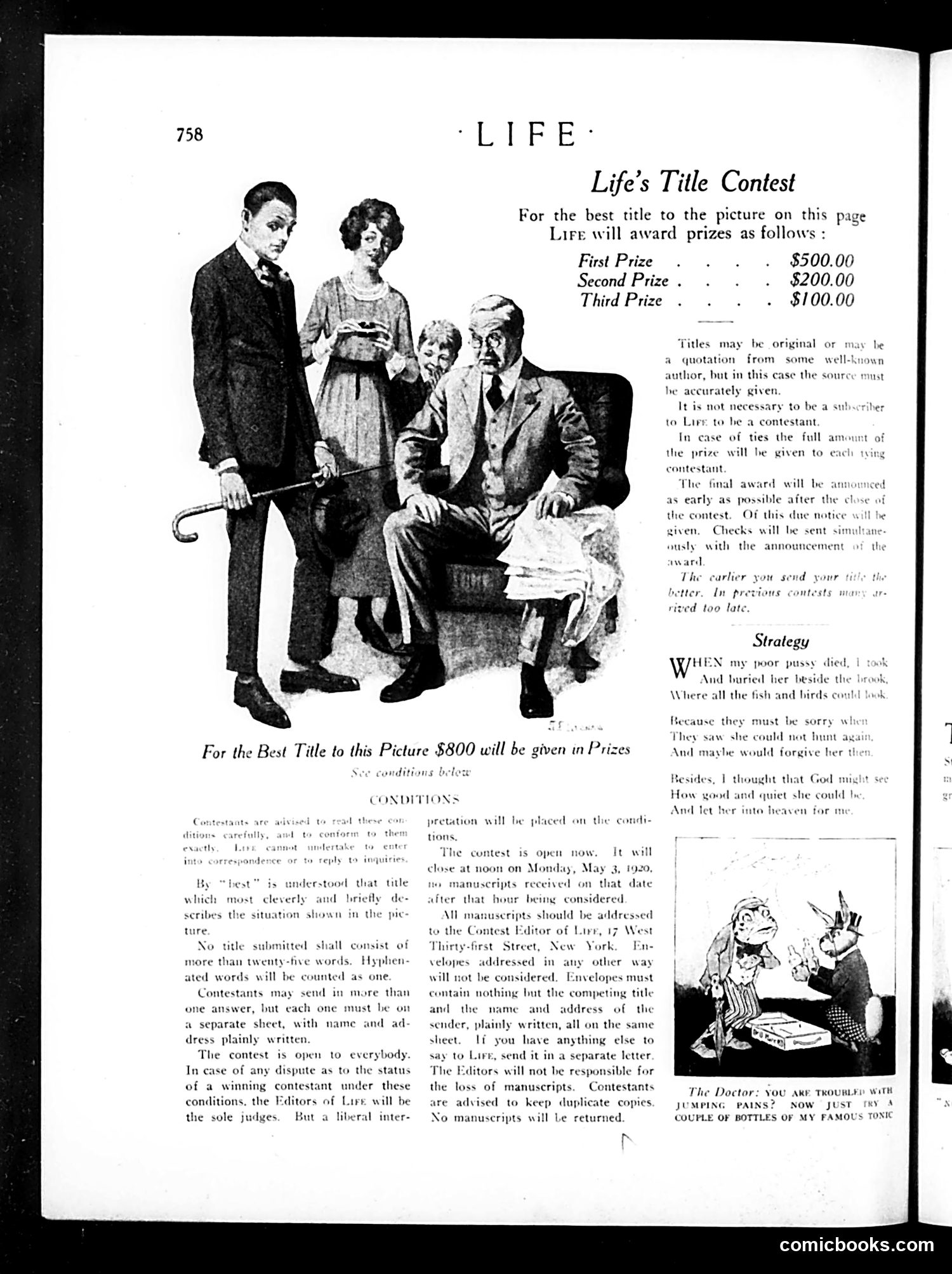
This page announces a title-writing competition for the illustration at top left, offering $800 in total prizes ($500 first place). The image shows four figures—two men and a woman examining what appears to be a document or paper, with one man holding a cane. The page also includes two unrelated pieces: a sentimental poem titled "Strategy" about burying a dead cat, and a quack-medicine advertisement at bottom featuring "The Doctor" hawking a dubious tonic for "jumping pains." The contest rules specify entries must be 25 words or fewer, submitted by May 5, 1920, to Life's New York office. No subscription required to enter. The advertisement parodies the widespread patent-medicine fraud endemic to early 20th-century America—snake oil salesmen made exaggerated health claims for ineffective tonics, a practice Life's satirical tradition would mock.
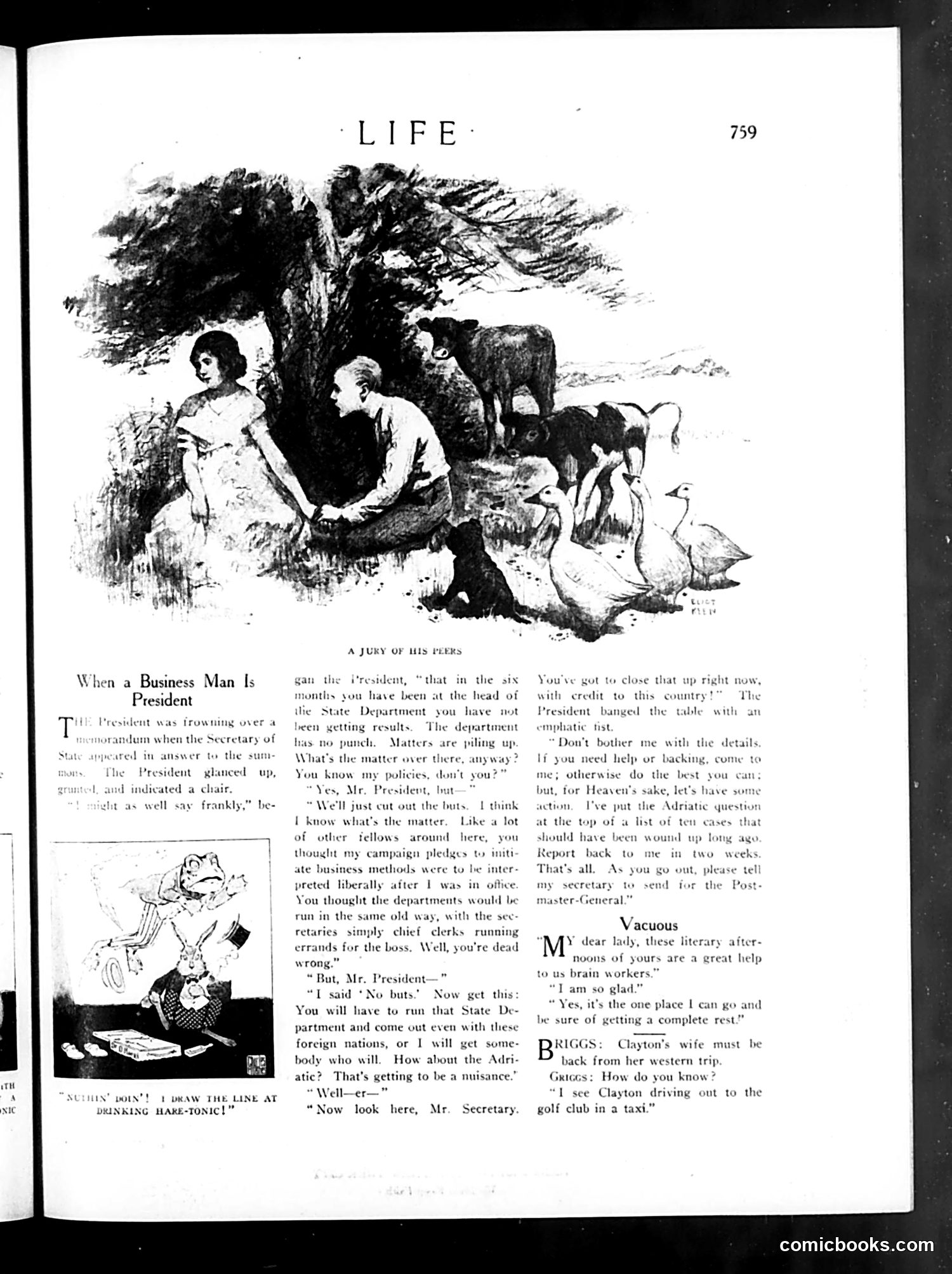
This cartoon satirizes the ineffectiveness of applying strict business management to diplomacy. A president with a business background demands his Secretary of State run the State Department "even with these foreign nations" like a profit-and-loss ledger, complete with deadlines and cost-cutting. The satire lies in the fundamental mismatch: international relations cannot be managed like a corporation. The president dismisses diplomatic complexity ("Don't bother me with the details"), treats longstanding issues like the Adriatic dispute as mere administrative problems needing quick resolution, and expects results through forceful rhetoric rather than negotiation. The accompanying cartoon labeled "A Jury of His Peers" reinforces this—showing the president surrounded by animals, suggesting his business-focused peers lack diplomatic sophistication. The page ridicules the notion that executive efficiency translates to statecraft, a timely critique given early 20th-century American politics.
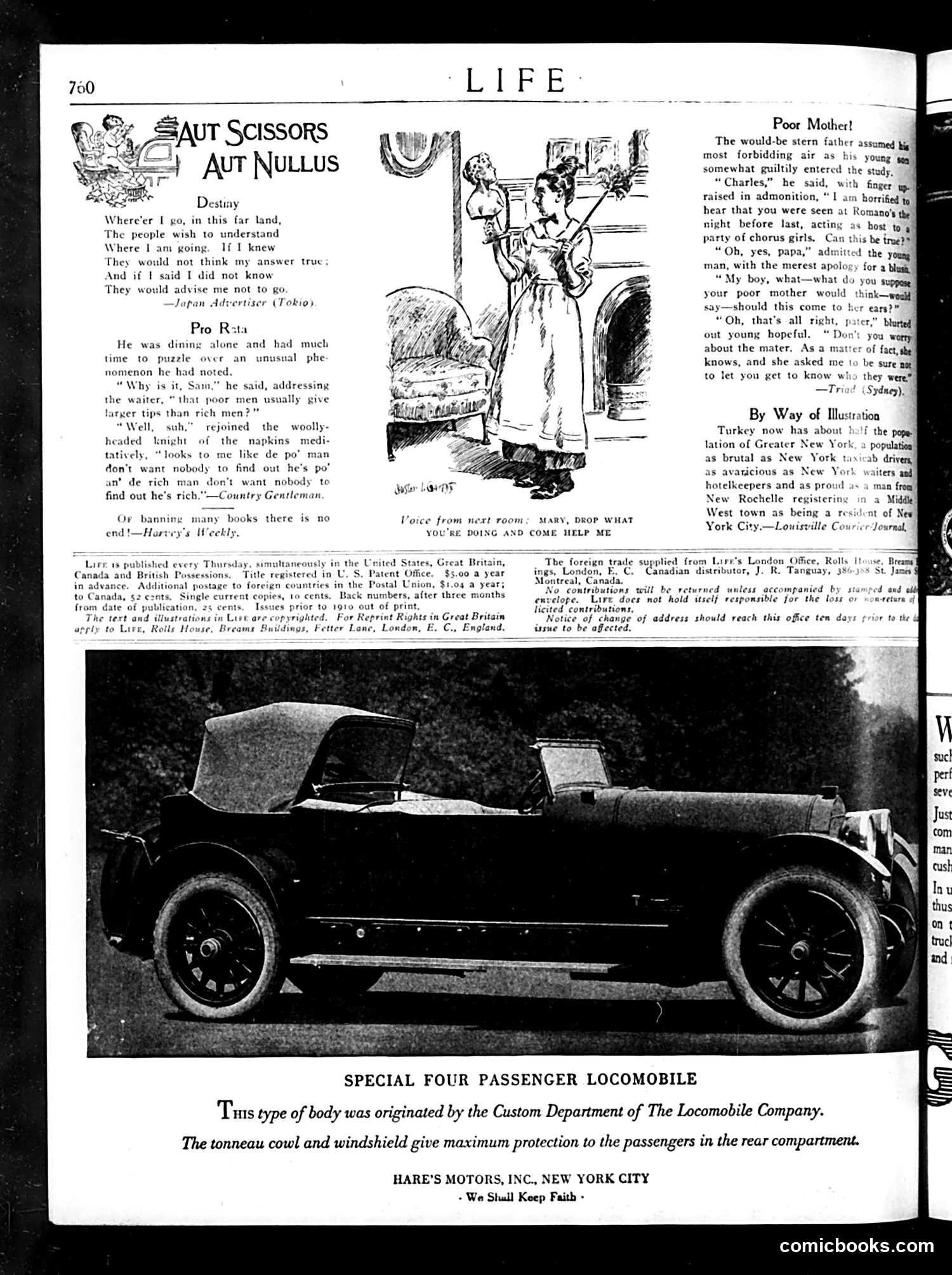
This page contains three distinct humor pieces and an automobile advertisement: **"Aut Scissors / Aut Nullus"** presents a Japanese saying about destiny—people want to know your future plans but won't believe honest answers, so they advise against going anyway. It's satirizing human contradictions. **"Pro Rata"** is a dialogue joke: a wealthy diner asks why poor men tip better than rich men. The waiter's answer—that poor men don't want discovered to be poor while rich men hide their wealth—satirizes class anxiety and how money affects behavior regardless of direction. **"Poor Mother!"** depicts a father discovering his son hosted chorus girls at a nightclub. The twist: the mother already knew and asked the son not to tell the father. It satirizes parental hypocrisy and the pretense of moral authority. **"By Way of Illustration"** compares Turkey's population density to New York City's, characterizing New Yorkers as brutal, avaricious taxi drivers, and boastful—contemporary American urban stereotyping. The lower half features a Locomobile automobile advertisement showcasing a four-passenger touring car with protective tonneau covering.
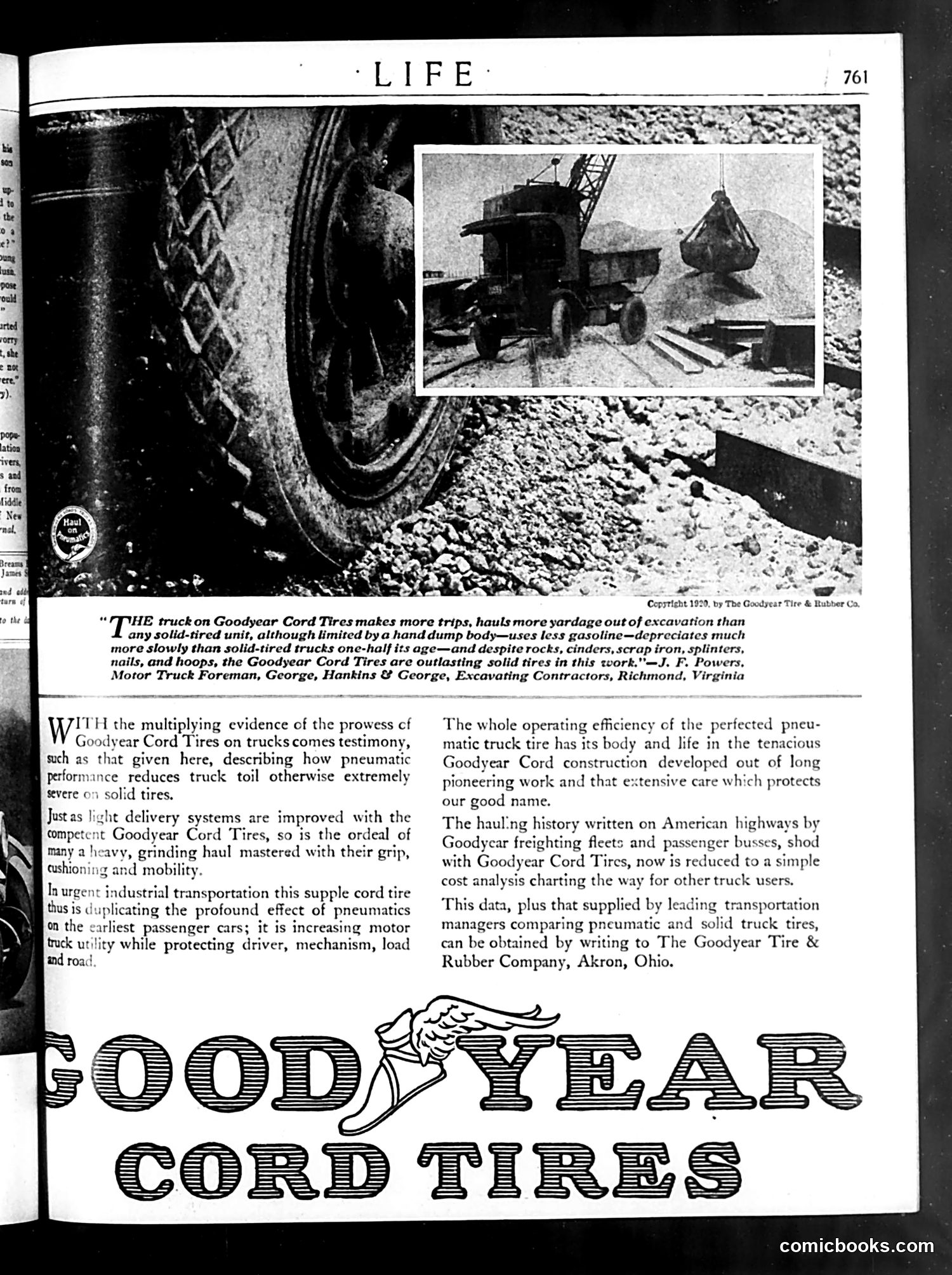
This is **not a cartoon or satire**—it's a straightforward **advertisement** for Goodyear Cord Tires, published in 1929. The page features testimonial advertising common to the era: photographs of an excavation truck in operation, plus quoted praise from J.F. Powers, a motor truck foreman in Richmond, Virginia. The text makes product claims comparing pneumatic (air-filled) Goodyear Cord Tires favorably against solid tires—asserting they handle more loads, use less fuel, depreciate slower, and outlast competitors despite rough conditions. The rhetorical strategy emphasizes industrial utility and cost-effectiveness. There is no political satire, caricature, or joke. Life magazine apparently carried such advertisements alongside its editorial content during this period.
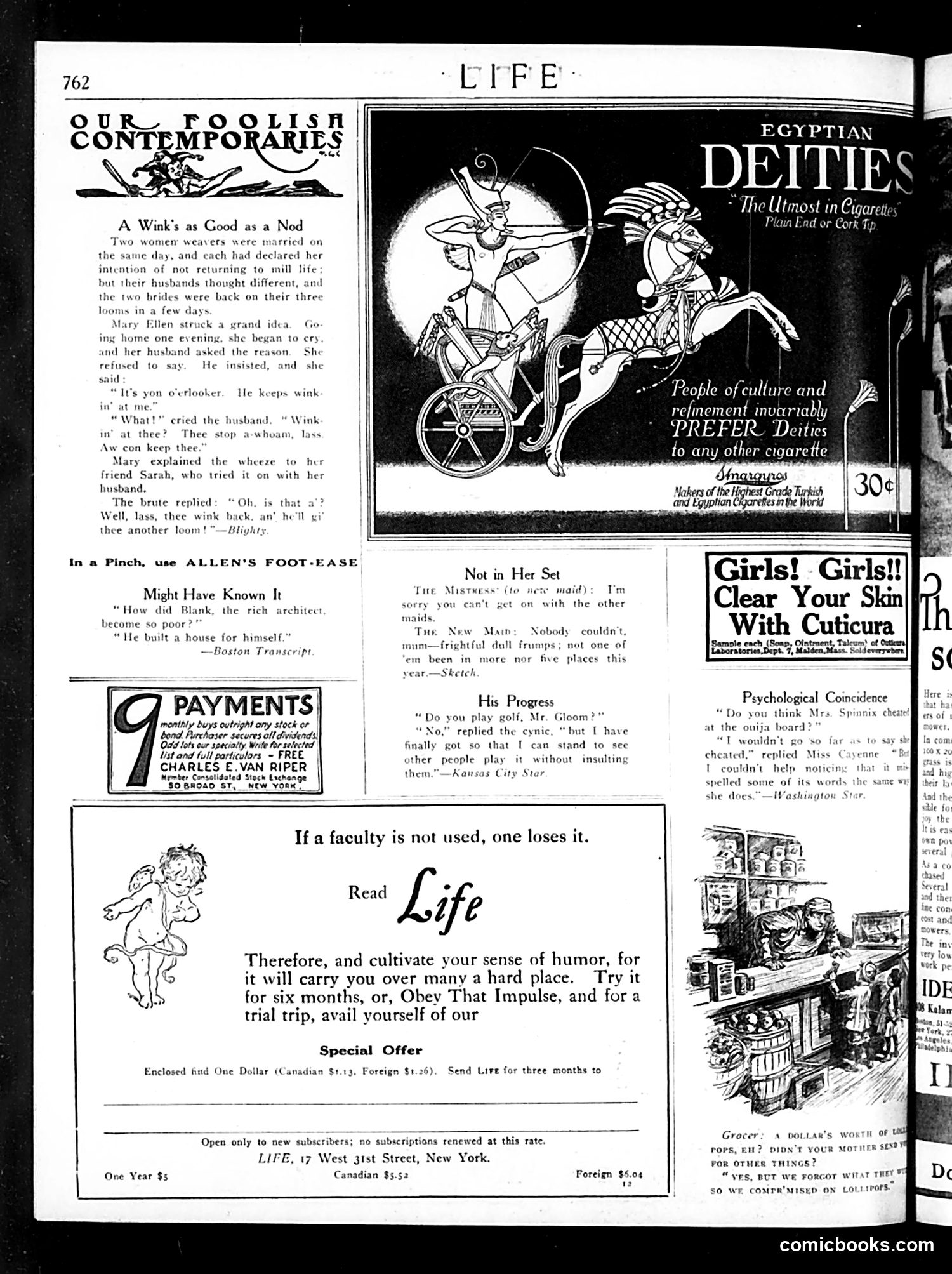
This page from Life magazine contains several satirical humor pieces typical of early 20th-century American comedy: **"A Wink's as Good as a Nod"** presents working-class British dialect humor about a mill worker whose supervisor winks at his wife. The joke plays on the phrase "a wink's as good as a nod"—she interprets the wink as flirtation, her husband tells her to wink back, and the punchline suggests this will earn her another loom (more work). **Other brief jokes** mock social pretension ("Might Have Known It"), domestic situations, and character types common to the era. The **Egyptian Deities cigarette ad** uses Egyptian imagery and claims cultural superiority to sell tobacco—reflecting period advertising that casually appropriated foreign imagery. **Cuticura ad** targets young women's insecurities about skin appearance. The **Life magazine subscription pitch** at bottom uses humor ("cultivate your sense of humor") as a marketing tool, positioning the publication as essential reading. Overall, the page reflects early 1900s humor: working-class stereotypes, gender dynamics, and advertising that would seem dated today.

This is primarily a **product advertisement**, not political satire. The page promotes the Ideal Power Lawn Mower, manufactured by R.E. Olds' company in Lansing, Michigan. The advertisement addresses a genuine early-20th-century problem: labor scarcity. The opening headline states the machine "can take care of several good sized lawns," emphasizing that "help is hard to get"—reflecting post-WWI domestic help shortages that made yard maintenance difficult for homeowners. The satire, if present, is subtle: the tagline claims one power mower "does the work of five hand mowers," converting manual labor into mechanical efficiency. Small accompanying illustrations show the machine's capabilities (cutting blades, rolling function). The ad targets middle-class homeowners and institutions (golf clubs, cemeteries, estates) who could afford motorized solutions. The framing suggests modernization as both practical necessity and status symbol—a common advertising approach of the 1920s era.
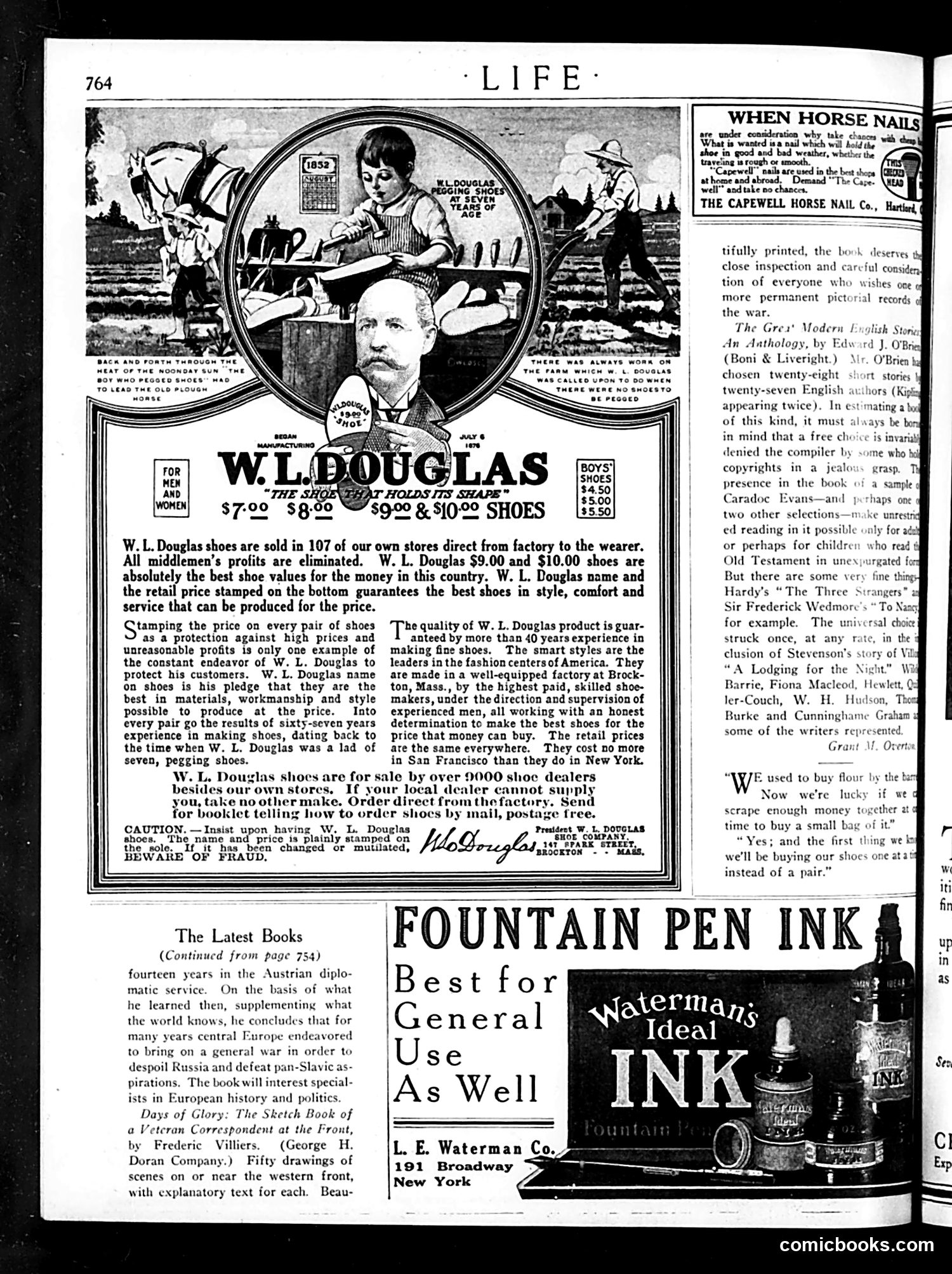
This page is primarily **advertising**, not political satire. The dominant content is a large W. L. Douglas shoe advertisement featuring the company founder's portrait surrounded by vignettes of shoe manufacturing and use. The Douglas ad emphasizes **direct-to-consumer sales** ("factory to the wearer"), eliminating middlemen profits—a progressive business model for the era. The advertisement stresses affordability, quality, and fair pricing standardized nationwide. The smaller advertisements include horseshoe nails and fountain pen ink—practical goods typical of early 20th-century Life magazine. The page's upper and lower sections contain book reviews unrelated to satire or politics, discussing war-related literature and poetry anthologies. **There is no political cartoon or satirical content visible on this page.** It represents Life magazine's mixed format of advertising and literary content from this period, likely circa 1915-1920s based on the typography and product types.
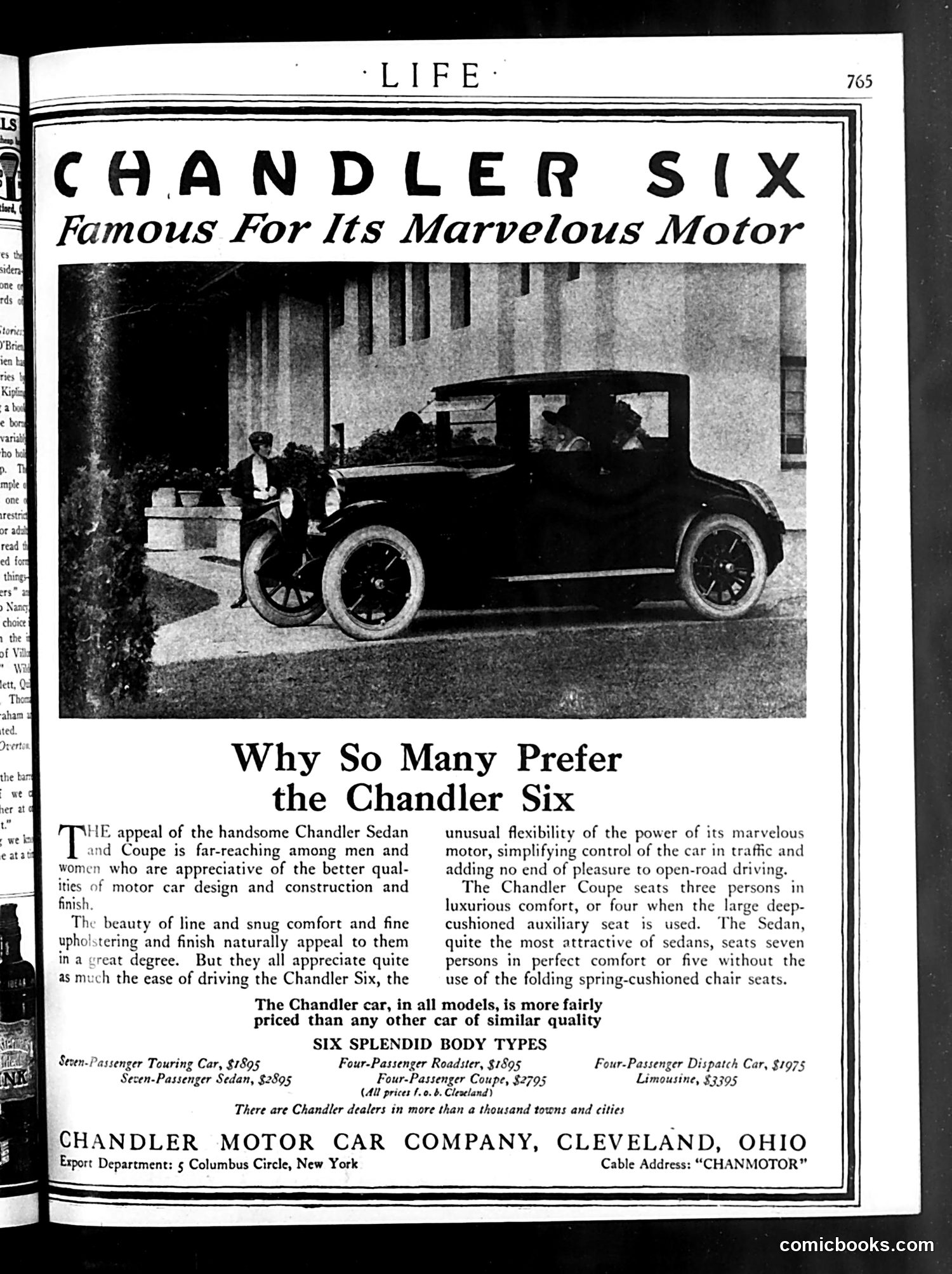
This is not a cartoon or satire—it's a **straight automobile advertisement** from an early 20th-century issue of *Life* magazine. The page promotes the Chandler Six motor car, manufactured in Cleveland, Ohio. The ad emphasizes the car's appeal to quality-conscious buyers, highlighting its "marvelous motor," flexible power delivery, comfortable seating (accommodating 3-7 passengers depending on model), and competitive pricing. It lists six body styles with prices ranging from $1,895 to $3,395. The single photograph shows a Chandler sedan parked against a building, demonstrating the vehicle's handsome design. The ad notes that Chandler dealers operated in over a thousand towns and cities, suggesting widespread availability. This reflects the era when automobiles were luxury goods marketed primarily to affluent consumers who valued engineering and comfort.
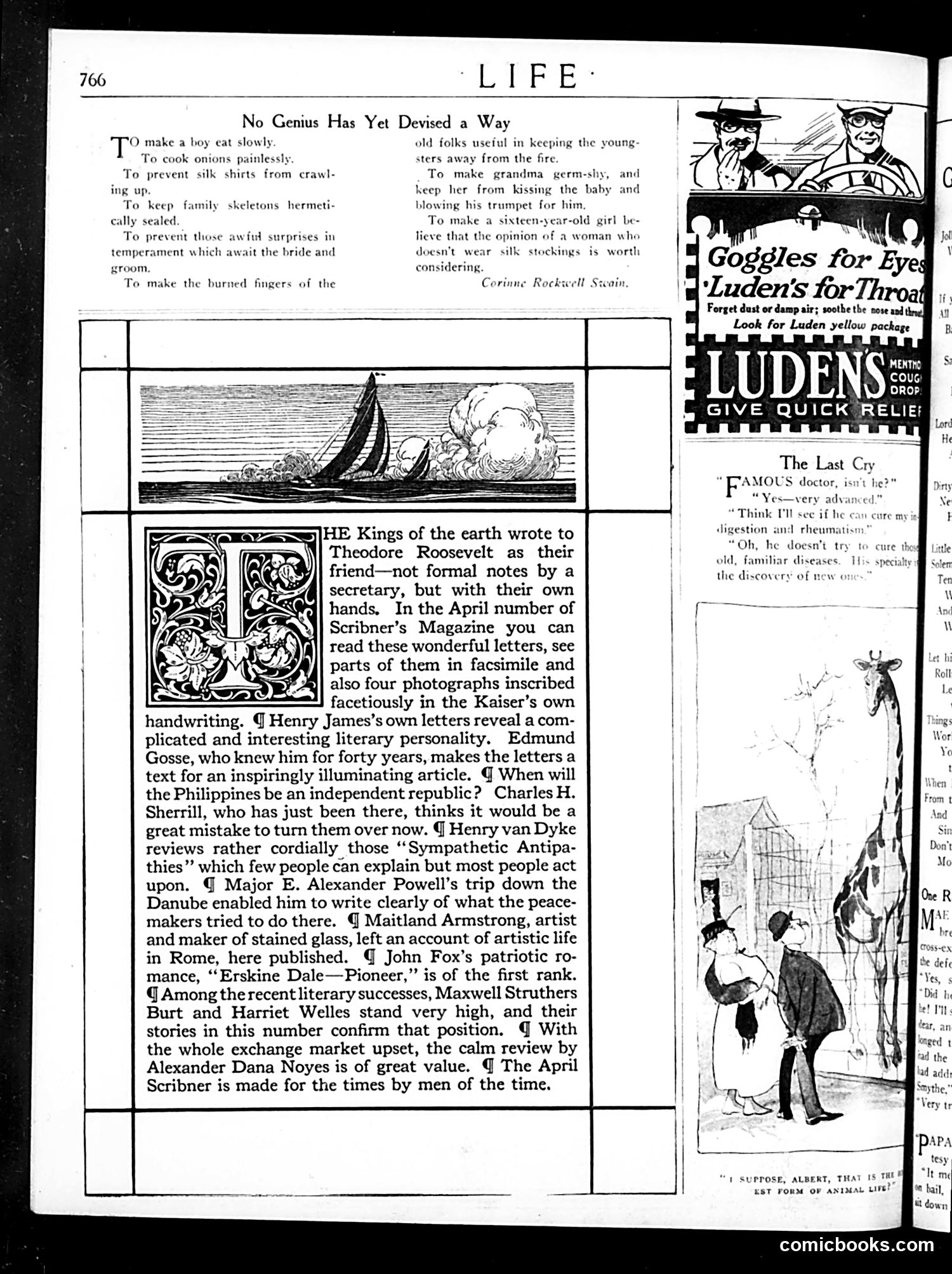
This page from *Life* magazine presents humorous observations about domestic life's unsolvable problems (cooking onions painlessly, preventing silk shirts from riding up, keeping family secrets hidden). The satirical list mocks the gap between desire and reality in everyday situations. The main content advertises *Scribner's Magazine* for April, promoting exclusive letters between European kings and Theodore Roosevelt—presented as personal handwritten correspondence rather than formal diplomatic notes. This highlights Roosevelt's celebrity status and appeal to educated readers. Additional article announcements cover literary personalities (Henry James), imperial politics (Philippine independence), and cultural matters. The cartoon at page's bottom shows two figures viewing a giraffe, with one remarking it's the "best form of animal life"—likely satirizing absurd social pretension or misguided aesthetics among the upper classes. The *Ludens* cough drop advertisement occupies the right margin.
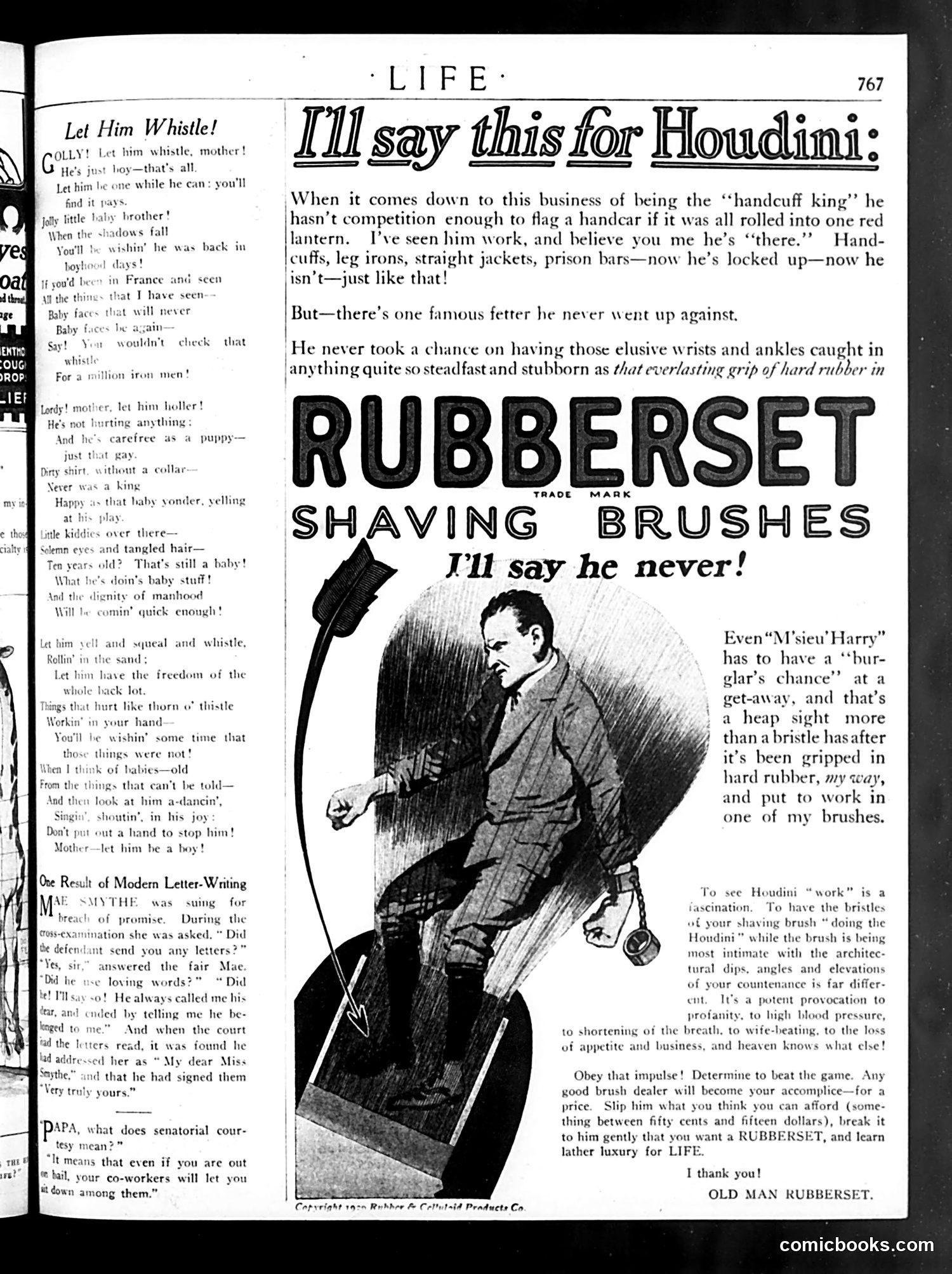
This page contains two distinct pieces: **Left side:** A sentimental poem titled "Let Him Whistle!" urging parents to let children be carefree and playful. The nostalgic tone—referencing "France" and "babies" with "solemn eyes and tangled hair"—suggests this was written post-WWI, encouraging people to preserve childhood innocence after witnessing the war's horrors. **Right side:** An advertisement for Rubberset shaving brushes using magician Harry Houdini as a reference point. The pitch claims that even Houdini—famous for escaping handcuffs and restraints—cannot escape the grip of a rubber-bristled brush. It's a playful comparison: if Houdini can't break free from their brush's grip, the bristles must be superior. The ad promises a better shaving experience and encourages readers to buy one from a dealer, treating the purchase as a humorous act of defiance against poor shaving quality.
This satirical timeline mocks the bureaucratic incompetence afflicting World War I veterans seeking vocational retraining. "Private Hick" applies for government-funded education on March 1, but his application gets lost, misdirected, and shuffled between Washington and district offices for months. The military discharge takes immediately; bureaucratic approval takes until August—by which point he's spent his $60 discharge bonus. The punchline: when finally approved for a plumbing course, it's overcrowded, so he's offered cigar-wrapping instead. The course material never arrives and is cancelled. By October, broke and abandoned by the system, Hick is reduced to street-vending pencils and shoelaces. The satire indicts post-war governmental failure to support returning soldiers. The Latin title emphasizes the cruel irony: a soldier's brief "glory" (military service) evaporates into bureaucratic ruin. This reflects real 1920s frustrations with inadequate veteran benefits and administrative dysfunction.
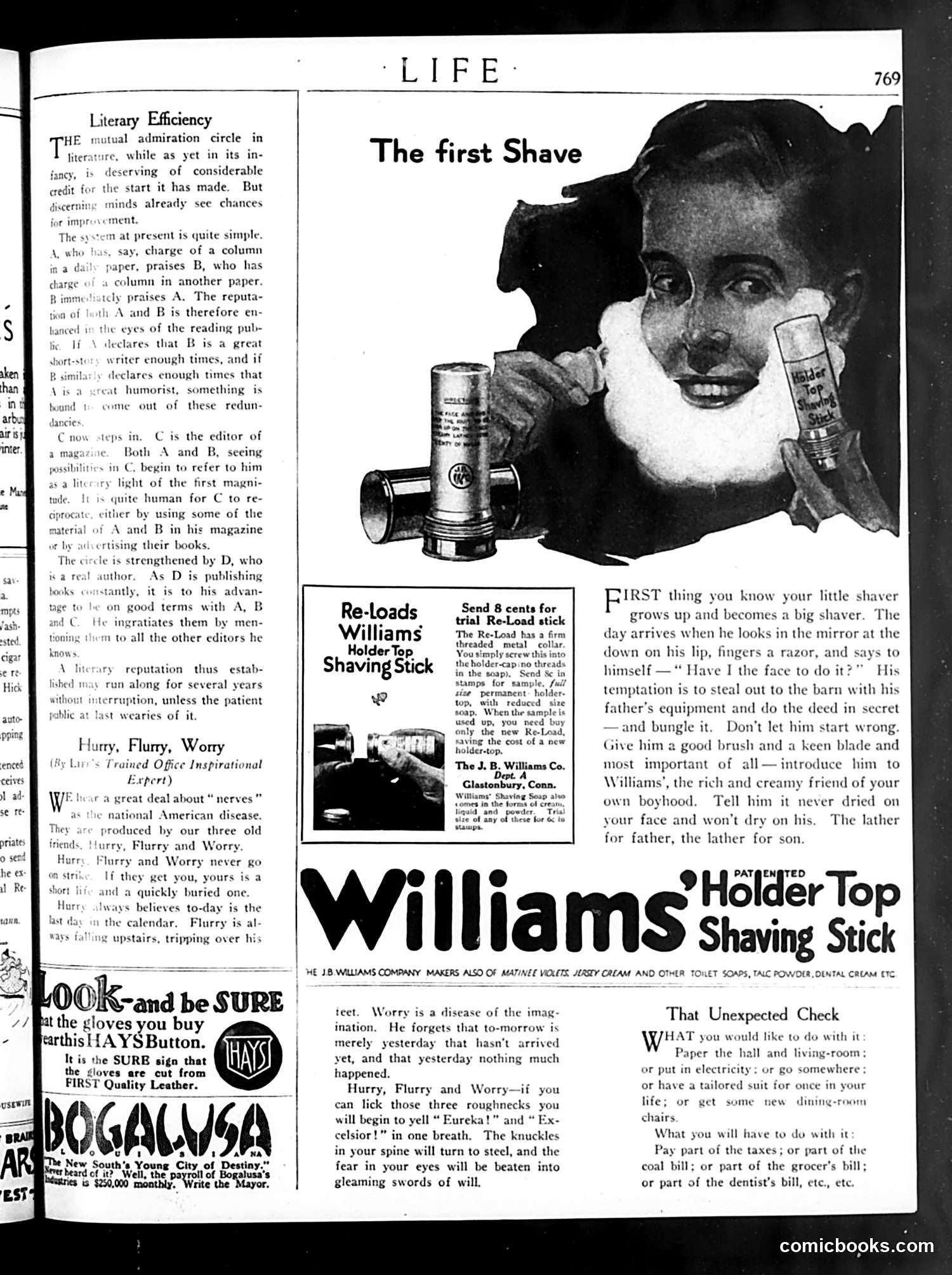
This page combines satirical articles with advertising. The main cartoon/advertisement depicts a boy's first shaving experience—a rite of passage. The accompanying text humorously frames introducing a son to proper shaving as a father's responsibility, warning against letting him bungle the deed secretly in a barn with makeshift equipment. The satire lies in treating this mundane grooming moment with mock-serious, almost coming-of-age ceremony language. It's an advertisement for Williams Shaving Stick that frames the product as essential to proper paternal guidance. The page also includes two unrelated satirical pieces: "Literary Efficiency" mocks mutual-admiration circles among writers and editors who praise each other to boost reputations, and "Hurry, Flurry, Worry" personifies three causes of American nervousness as character types who embody different anxieties—representing contemporary concerns about stress and modern life's pace.
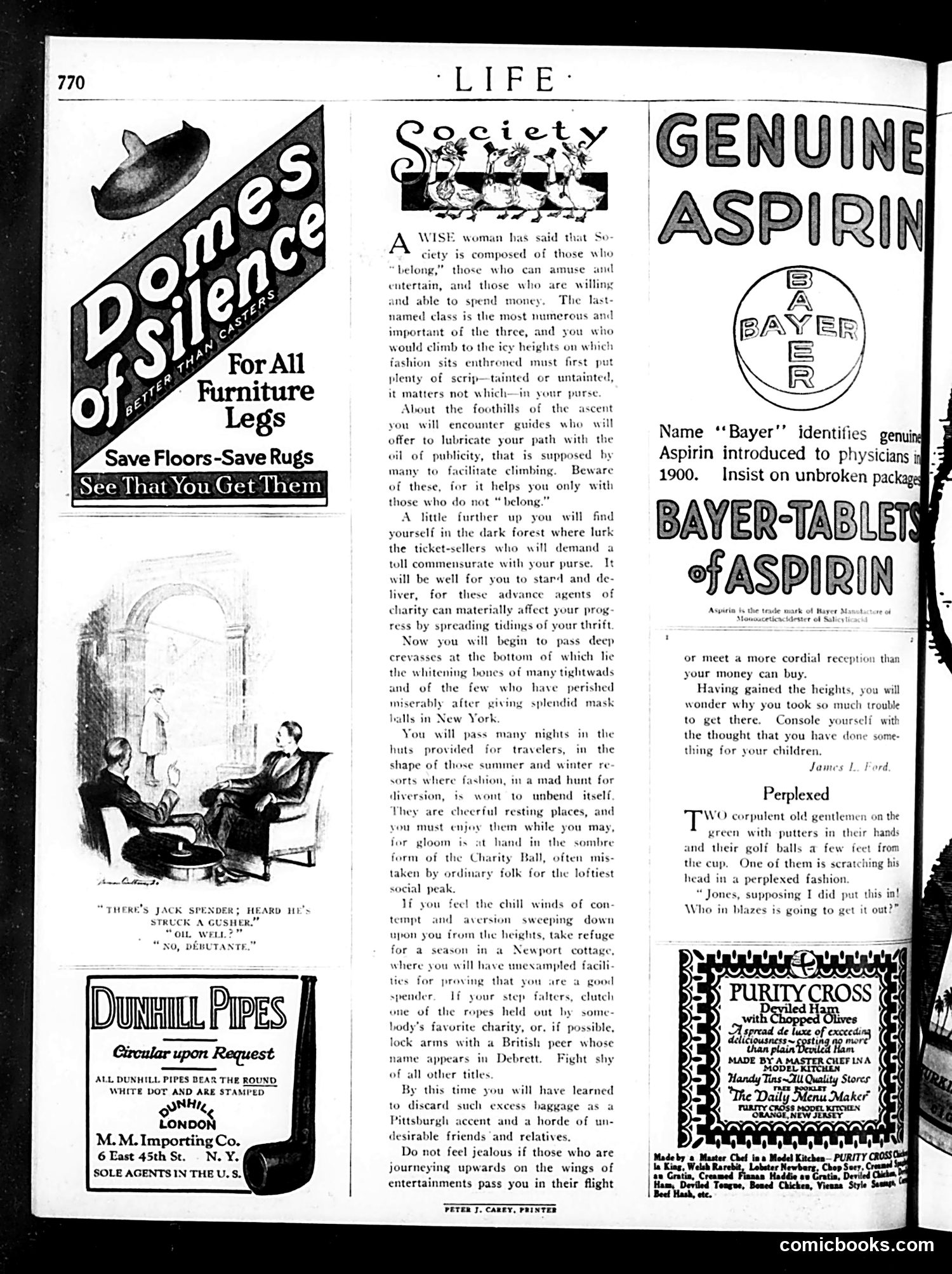
This page mixes satirical editorial content with period advertising (circa 1900s). **Main Cartoon**: The small illustration shows two men discussing "Jack Spender," who "struck a gusher" (oil fortune). The punchline—"No, debutante"—satirizes wealthy men marrying into society through romance rather than earning wealth legitimately. It mocks the social-climbing culture where marrying a debutante (wealthy young woman) was treated as a financial "strike." **"Society" Essay**: The lengthy middle text is satirical social commentary mocking the nouveau riche climbing "society's" ranks. It describes a journey up a metaphorical mountain where money is the primary requirement, where one encounters "ticket-sellers" (charity fundraisers), must abandon regional accents and undesirable friends, and ultimately wonders if the effort was worthwhile. It's biting critique of Gilded Age social pretension and the corruption of charitable institutions. **Minor Cartoon**: Two golfers puzzle over retrieving a golf ball—gentle humor requiring no historical context. The page primarily satirizes class aspiration and the commercialization of high society.

This is a **full-page cigarette advertisement**, not satirical content. It promotes Camel brand cigarettes through direct claims and imagery. The ad features a large camel's head as the brand mascot, with a pack of Camels visible below. The headline uses hyperbolic language ("as sure as you are a foot high") to suggest universal appeal—the product will please literally anyone. The body copy makes specific marketing claims: that Camels blend Turkish and domestic tobacco superior to either alone, don't cause unpleasant aftertaste or odor, and won't tire the smoker's taste. It challenges readers to compare Camels with competitors "at any price." **Context for modern readers**: This reflects an era before tobacco health warnings were mandated (pre-1960s). Such ads openly promoted heavy smoking ("liberally you smoke") without acknowledging health risks—a practice that seems shocking today but was standard advertising practice then.
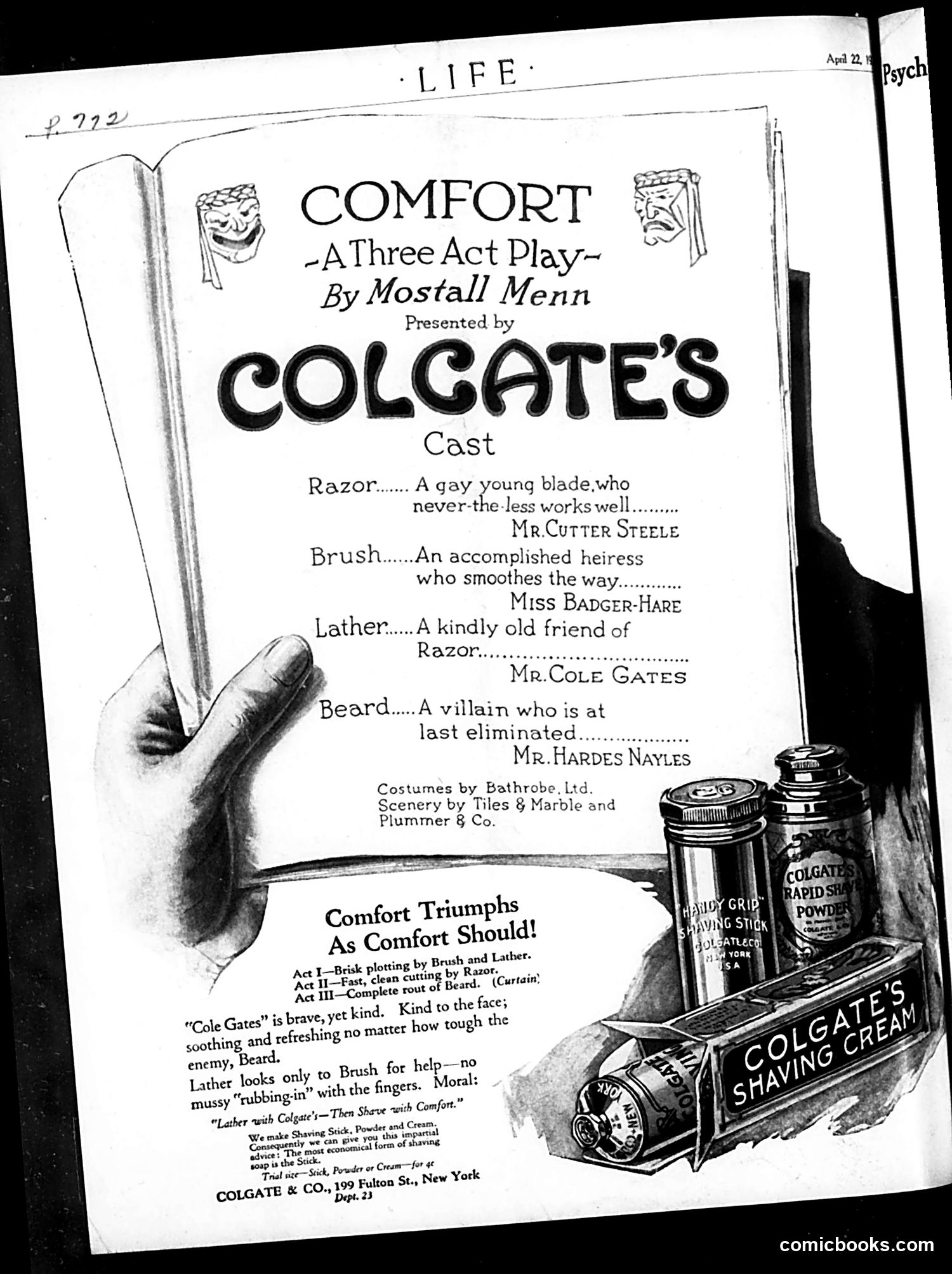
This is a **full-page advertisement**, not political satire. Colgate & Co. presents a three-act theatrical play to promote their shaving products. The "play" uses personified characters representing shaving implements: Razor (a young blade), Brush (an heiress who "smoothes the way"), Lather (a kindly old friend played by "Cole Gates"—a pun on Colgate), and Beard (the villain defeated in Act III). The humor is straightforward product messaging: the moral states that using Colgate lather prevents messy finger-rubbing and ensures a comfortable shave. The theatrical framing was a common advertising technique of the era, converting product benefits into entertaining narrative. The illustration shows a hand wielding a razor alongside Colgate's shaving stick, powder, and cream—all displayed as the solution to shaving "comfort."