
Life, 1920-04-22 · page 24 of 44
Life — April 22, 1920 — page 24: what you’re looking at
What you’re looking at
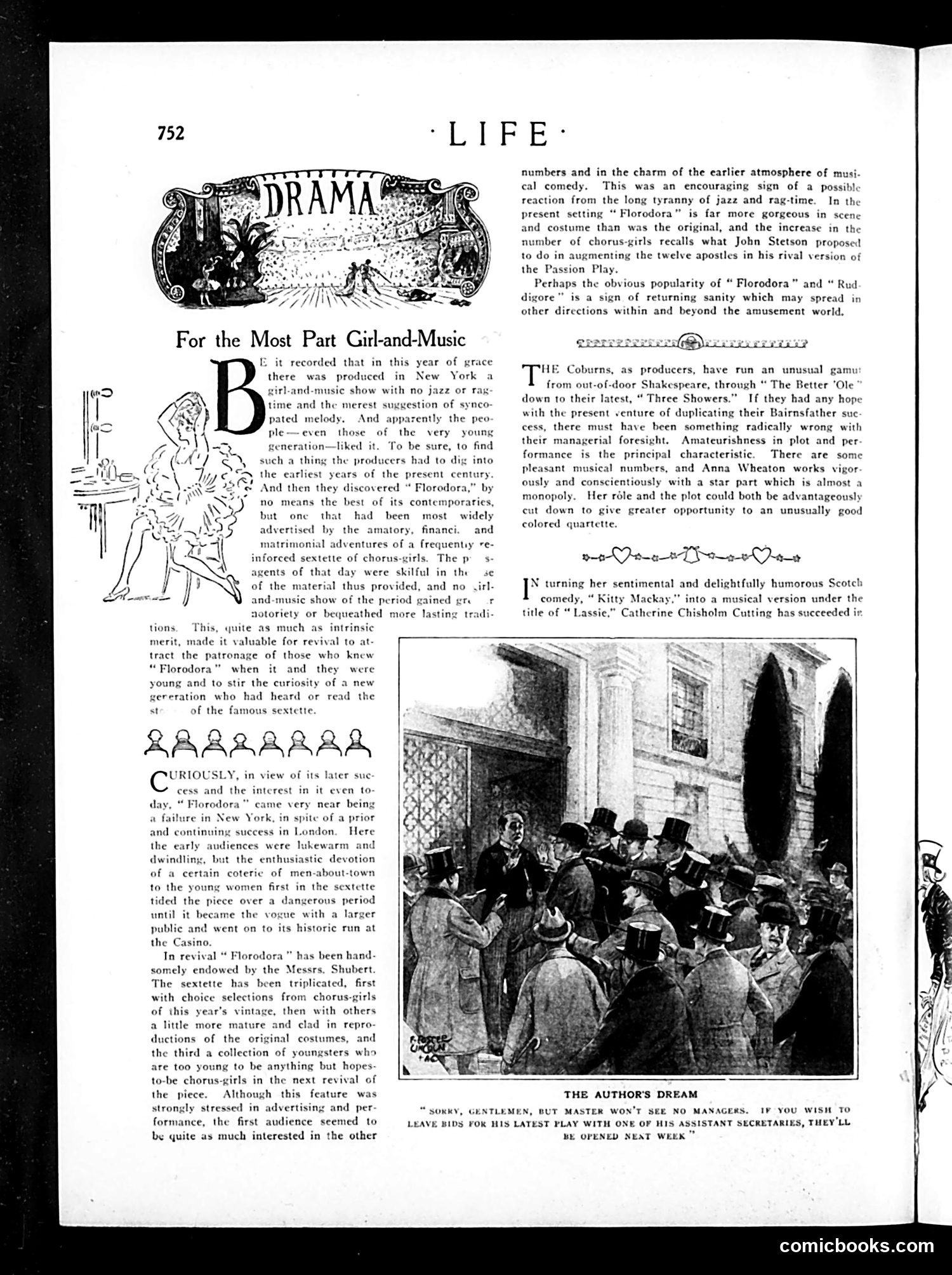
This page reviews theatrical productions, primarily discussing the revival of "Florodora," an early 1900s musical comedy. The article praises its return as a reaction against "jazz and rag-time" tyranny, suggesting audiences welcomed a return to earlier musical-theater styles. The critique notes "Florodora" nearly failed in New York despite London success, only surviving because wealthy "men-about-town" supported it for its chorus girls—a satirical jab at male patrons' motivations. The 1920s revival has tripled the original sextette (six dancers) and expanded costumes and spectacle. The page also briefly reviews "Three Showers" by the Coburn producers, dismissing it as amateurish despite featuring performer Anna Wheaton and a "colored quartette" (Black musical group). The cartoon caption at bottom ("The Author's Dream") appears to be a separate theatrical joke about playwriting and theater management, though details are unclear from this image alone.
📄 Transcribed text from this page (OCR, searchable)
Machine-transcribed from the original scan — historical spelling and the odd misread are preserved.
“LIFE: numbers and in the charm of the earlier atmosphere of musi- cal comedy. This was an encouraging sign of a possible reaction from the long tyranny of jazz and rag-time. In the present ‘ceiting “ Florodora” ig far more gorgeous, ii scene and costume than was the original, and the increase in the number of chorus-girls recalls what John Stetson proposed to do in augmenting the twelve apostles in his rival version of the Passion Play. Perhaps the obvious popularity of “ Florodora” and “ Rud digore” is a sign. of returning sanity which may spread in other directions within and beyond the amusement world. For the Most Part Girl-and-Music quarerrrres exerener seis? E it recorded that in this year of grace there was produced in New York a girl-and-music show with no jazz or rag HE Coburns, as producers, have run an unusual gamu from out-of-door Shakespeare, through “ The Better ‘Ole down to their latest, “ Three Showers.” If they had any hope with the present venture of duplicating their Bairnsfather suc cess, there must have been something radically wrong with their managerial foresight. Amateurishness in plot and per formance is the principal characteristic. There are some pleasant musical numbers, and Anna Wheaton works vigor ously and conscientiously with a star part which is almost a monopoly. Her role and the plot could both be advantageously cut down to give greater opportunity to an unusually good colored quartette. time and the merest suggestion of synco- pated melody. And apparently the peo ple—even those of the very young generation—liked it. To be sure, to find such a thing the producers had to dig into the earliest years of the present century And then they discovered “ Florodora,” by but one that had been most widely 7 I ' : no means the best of its contemporaries, advertised by the amatory, financi, and agents of that day were skilful in the se of the material thus provided, and no irl- ] turning her sentimental and delightfully humorous Scotch Pema | and-music show of the period gained gre comedy, “ Kitty Mackay," into a musical version under the notoriety or bequeathed more lasting tradi- title of “ Lassie,” Catherine Chisholm Cutting has succeeded ir tions. This, quite as much as intrinsic merit, made it valuable for revival to at- tract the patronage of those who knew “Florodora” when it and they were young and to stir the curiosity of a new gereration who had heard or read the st of the famous sextette. ZARLARRR Curiovsty, in view of its later suc cess and the interest in it even to day, “ Florodora” came very near being a failure in New York, in spite of a prior and continuing success in London. Here the early audiences were lukewarm and dwindling, but the enthusiastic devotion of a certain coterie of men-about-town to the young women first in the sextette | 7 | 4 matrimonial adventures of a frequentiy re- ; / - inforced sextette of chorus-girls. The ps wpe Ta eee LY tided the piece over a dangerous period until it became the vogue with a larger public and went on to its historic run at the Casino. In revival “ Florodora ” has been hand- somely endowed by the Messrs, Shubert The sextette has been triplicated, first with choice selections from chorus-girls of this year’s vintage, then with others a little more mature and clad in repro- ductions of the original costumes, and the third a collection of youngsters who are too young to be anything but hopes- to-be chorus-girls in the next revival of the piece. Although this feature was THE AUTHOR'S DREAM strongly stressed in advertising and per > “ SORKY, ENTLEMEN, BUT MASTER WON'T SEE NO MANAGERS. IF YOU WISH TO formance, the first audience seemed to LEAVE BIDS FOK MIS LATEST PLAY WITH ONE OF HIS ASSISTANT SECRETARIES, THEY'LL be quite as much interested in the other BE OPENED NEAT WEEK” comicbooks.com