
Life, 1920-04-22 · page 21 of 44
Life — April 22, 1920 — page 21: what you’re looking at
What you’re looking at
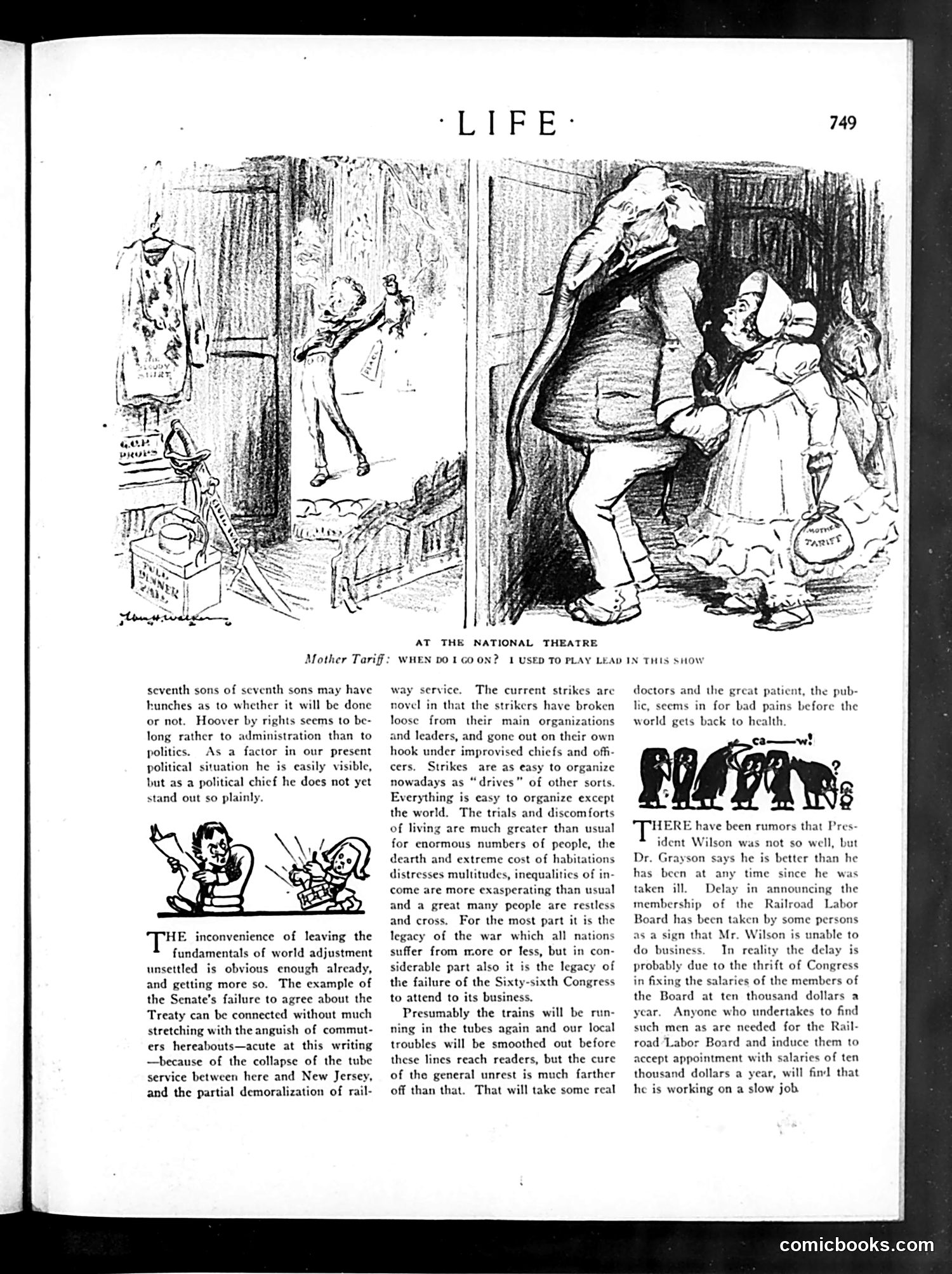
The top cartoon depicts "Mother Tariff" at the National Theatre, asking "When do I go on? I used to play lead in this show." This satirizes American tariff policy as a theatrical performance—suggesting protectionist trade policies, once central to American politics, have been sidelined or are no longer the main attraction in current political discourse. The surrounding text addresses post-WWI America's problems: railroad strikes, housing shortages, income inequality, and general social unrest. The author criticizes both the failure of the Sixty-sixth Congress to ratify the Treaty of Versailles and current labor disruptions. There's discussion of President Wilson's health and the delayed appointment of the Railroad Labor Board, with sardonic commentary about the difficulty of recruiting qualified people at a ten-thousand-dollar annual salary. The overall theme: America faces serious structural problems requiring genuine solutions, not political theater.
📄 Transcribed text from this page (OCR, searchable)
Machine-transcribed from the original scan — historical spelling and the odd misread are preserved.
AT THE NATIONAL THEATRE Mother Tariff: WHEN DO1 GOON? 1 USED TO PLAY LEAD IN THIS SHOW seventh sons of seventh sons may have hunches as to whether it will be done or not. Hoover by rights seems to be- long rather to administration than to politics. As a factor in our present political situation he is easily visible, but as a political chief he does not yet stand out so plainly. 'HE inconvenience of leaving the fundamentals of world adjustment unsettled is obvious enough already, and getting more so. The example of the Senate’s failure to agree about the Treaty can be connected without much stretching with the anguish of commut- ers hereabouts—acute at this writing —because of the collapse of the tube service between here and New Jersey, and the partial demoralization of rail- service. The current strikes are novel in that the strikers have broken loose from their main organizations and leaders, and gone out on their own hook under improvised chiefs and offi- cers. Strikes are as easy to organize nowadays as “drives” of other sorts. Everything is easy to organize except the world. The trials and discomforts of living are much greater than usual for enormous numbers of people, the dearth and extreme cost of habitations distresses multitudes, inequalities of in- come are more exasperating than usual and a great many people are restless and cross. For the most part it is the legacy of the war which all nations suffer from more or less, but in con- siderable part also it is the legacy of the failure of the Sixty-sixth Congress to attend to its business. Presumably the trains will be run- ning in the tubes again and our local troubles will be smoothed out before these lines reach readers, but the cure of the general unrest is much farther off than that. That will take some real doctors and the great patient, the pub- lic, seems in for bad pains before the world gets back to health HERE have been rumors that Pres- ident Wilson was not so well, but Dr. Grayson says he is better than he has been at any time taken ill, Delay in announcing the membership of the Railroad Labor Board has been taken by some persons as a sign that Mr. Wilson is unable to do business. In reality the delay is probably due to the thrift of Congress in fixing the salaries of the members of the Board at ten thousand dollars a year. Anyone who undertakes to find since he was such men as are needed for the Rail- road ‘Labor Board and induce them to accept appointment with salaries of ten thousand dollars a year, will find that he is working on a slow job comicbooks.com