
Life, 1920-04-22 · page 26 of 44
Life — April 22, 1920 — page 26: what you’re looking at
What you’re looking at
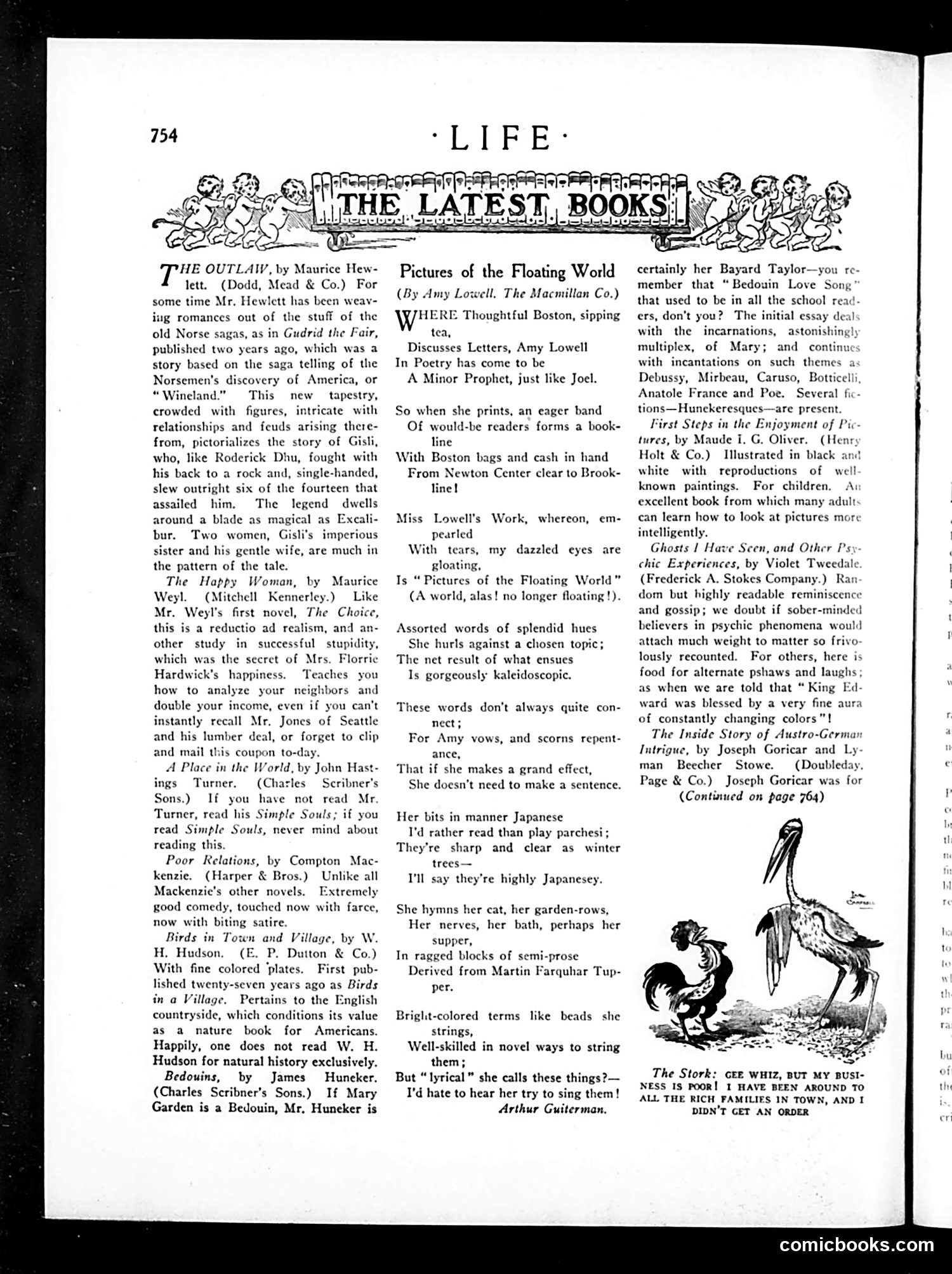
This is a book review page from *Life* magazine featuring poetry criticism and literary notices. The main satirical content is **Arthur Guiterman's verse review** of Amy Lowell's poetry collection *Pictures of the Floating World*. Guiterman mocks Lowell as a pretentious Boston poet-celebrity whose work prioritizes aesthetic effect over grammatical coherence. He ridicules her adoption of Japanese poetic forms (imagism), sarcastically calling her verses "highly Japanesey" and criticizing her belief that she needn't construct proper sentences if she achieves visual impact. The poem also suggests her subject matter is trivial—cats, gardens, her nerves—wrapped in pseudo-intellectual language. The accompanying illustration shows a stork, likely referencing her work's ornamental, decorative nature rather than substantive meaning. Guiterman's satire targets both Lowell's modernist poetry techniques and the Boston literary establishment's reverence for her as a serious poet.
📄 Transcribed text from this page (OCR, searchable)
Machine-transcribed from the original scan — historical spelling and the odd misread are preserved.
HE OUTLAIW, by Maurice Hew- lett. (Dodd, Mead & Co.) For some time Mr. Hewlett has been weav- iug romances out of the stuff of the old Norse sagas, as in Gudrid the Fair, published two years ago, which was a story based on the saga telling of the Norsemen’s discovery of America, or “Wineland.” This new tapestry, crowded with figures, intricate with relationships and feuds arising there- from, pictorializes the story of i who, like Roderick Dhu, fought his back to a rock and, single-handed, slew outright six of the fourteen that assailed him. The legend dwells around a blade as magical as Excali- bur. Two women, Gisli’s imperious sister and his gentle wife, are much in the pattern of the tale. The Happy Woman, by Maurice Weyl. (Mitchell Kennerley.) Like Mr. Weyl's first novel, The Choice, this is a reductio ad realism, and an- other study in successful stupidity, which was the secret of Mrs. Florric Hardwick’s happiness. Teaches you how to analyze your neighbors and double your income, even if you can’t instantly recall Mr, Jones of Seattle and his lumber deal, or forget to clip and mail this coupon to-day. A Place in the World, by John Hast- ings Turner. (Charles Scribner's Sons.) If you have not read Mr Turner, read his Simple Souls; if you read Simple Souls, never mind about reading this. Poor Relations, by Compton Mac- kenzie. (Harper & Bros.) Unlike all Mackenzie's other novels. Extremely good comedy, touched now with farce, now with biting satire. Birds in Town and Village, by W. H. Hudson, (E. P. Dutton & Co.) With fine colored ‘plates. First pub- lished twenty-seven years ago as Birds in a Village. Pertains to the English countryside, which conditions its value as a nature book for Americans. Happily, one does not read W. H. Hudson for natural history exclusively. Bedouins, by James Huneker, (Charles Scribner's Sons.) If Mary Garden is a Bedouin, Mr, Huneker is Pictures of the Floating World (By Amy Lowell. The Macmillan Co.) WHERE Thoughtful Boston, sipping tea, Discusses Letters, Amy Lowell In Poetry has come to be A Minor Prophet, just like Joel. So when she prints, an eager band Of would-be readers forms a book- line With Boston bags and cash in hand From Newton Center clear to Brook- line! Miss Lowell's Work, whereon, em- pearled With tears, my dazzled eyes are gloating, Is “Pictures of the Floating World” (A world, alas! no longer floating !). Assorted words of splendid hues She hurls against a chosen topic; The net result of what ensues Is gorgeously kaleidoscopic. These words don’t always quite con- nect; For Amy vows, and scorns repent- ance, That if she makes a grand effect, She doesn’t need to make a sentence, Her bits in manner Japanese I'd rather read than play parchesi; They're sharp and clear as winter trees— T'll say they're highly Japanesey. She hymns her cat, her garden-rows, Her nerves, her bath, perhaps her supper, In ragged blocks of semi-prose Derived from Martin Farquhar Tup- per. Bright-colored terms like beads she strings, Well-skilled in novel ways to string them; But “lyrical” she calls these things ?— I'd hate to hear her try to sing them! Arthur Guiterman. member that “Bedouin Love Song’ that used to be in all the school read- ers, don’t you? The initial essay deals with the incarnatio: i multiplex, of Mary; and continues ith incantations on such themes as Debussy, Mirbeau, Caruso, Botticelli, Anatole France and Poe, Several fic- tions—Hunckeresques—are present. First Steps in the Enjoyment of Pic- tures, by Maude i. G. Oliver. (Henry Holt & Co.) Illustrated in black white with reproductions of well known paintings. For children. A: excellent book from which many adults can learn how to look at pictures more intelligently. Ghosts 1 Have Seen, and Other Psy- chic Experiences, by Violet Tweedale (Frederick A. Stokes Company.) Ran dom but highly readable reminiscenc and gossip; we doubt if sober-minded believers in psychic phenomena would attach much weight to matter so frivo lously recounted. For others, here is food for alternate pshaws and laughs; as when we are told that “ King Ed- ward was blessed by a very fine aura of constantly changing colors"! The Inside Story of Austro-German Iutrigue, by Joseph Goricar and Ly- man Beecher Stowe. (Doubleday, Page & Co.) Joseph Goricar was for (Continued on page 764) The Stork: cee wuz, BUT MY BUSI- NESS IS POOR! I HAVE BEEN AROUND TO ALL THE RICH FAMILIES IN TOWN, AND I DIDN'T GET AN ORDER comicbooks.com