
A complete issue · 44 pages · 1920
Life — April 8, 1920
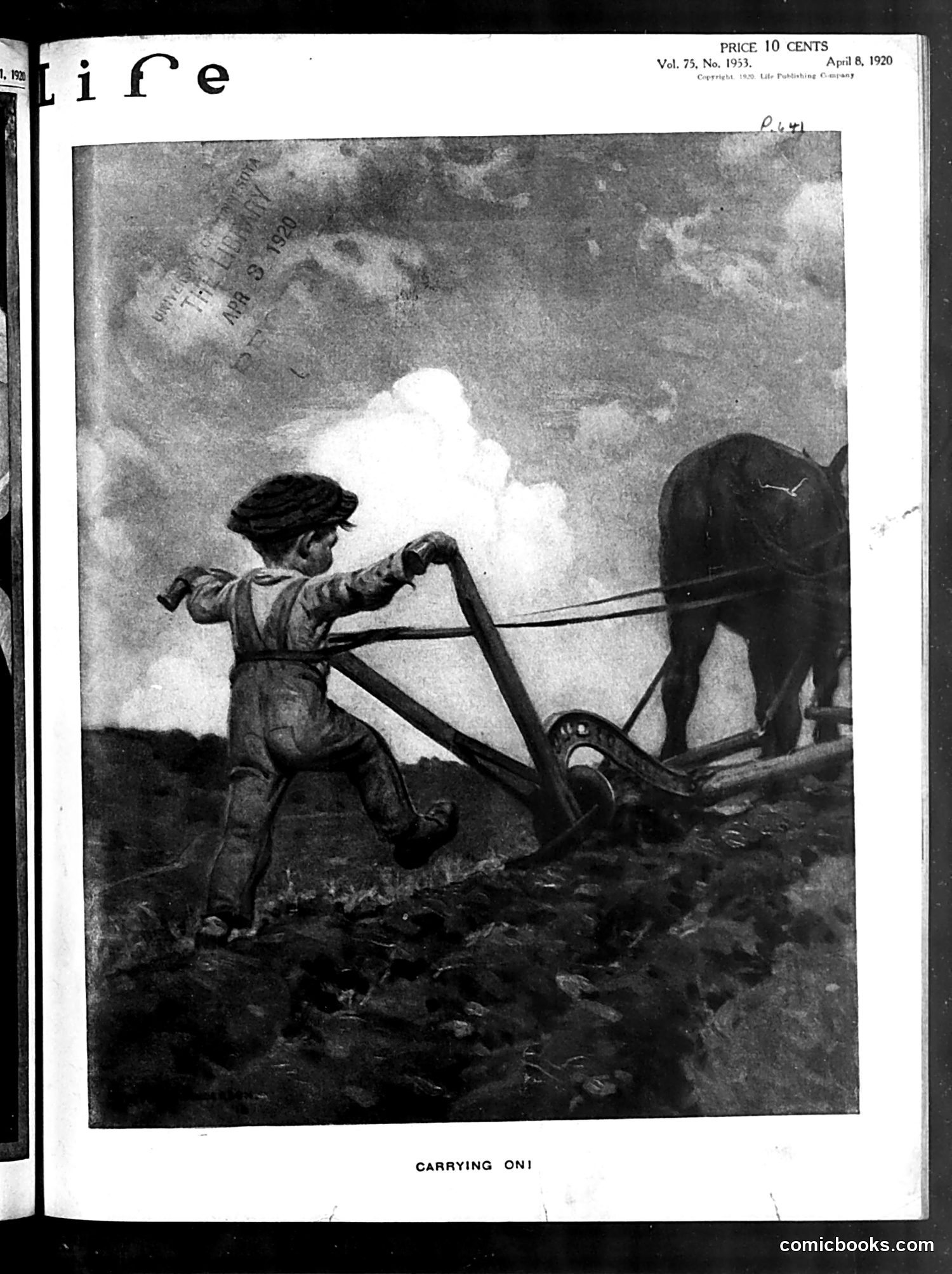
This illustration depicts a person plowing a field with a horse, titled "Carrying On!" The image appears to be post-World War I commentary, likely celebrating civilian return to agricultural work or the resumption of normal farming life after the war ended in 1918. The figure's determined posture and the caption suggest themes of perseverance and duty—"carrying on" was common wartime/postwar phraseology emphasizing resilience. The depiction of manual farm labor may also reflect broader early 1920s attitudes about productivity, American agricultural heritage, or the transition from wartime to peacetime economy. Without additional context from surrounding pages, the exact satirical target remains unclear, though the tone appears celebratory rather than critical.
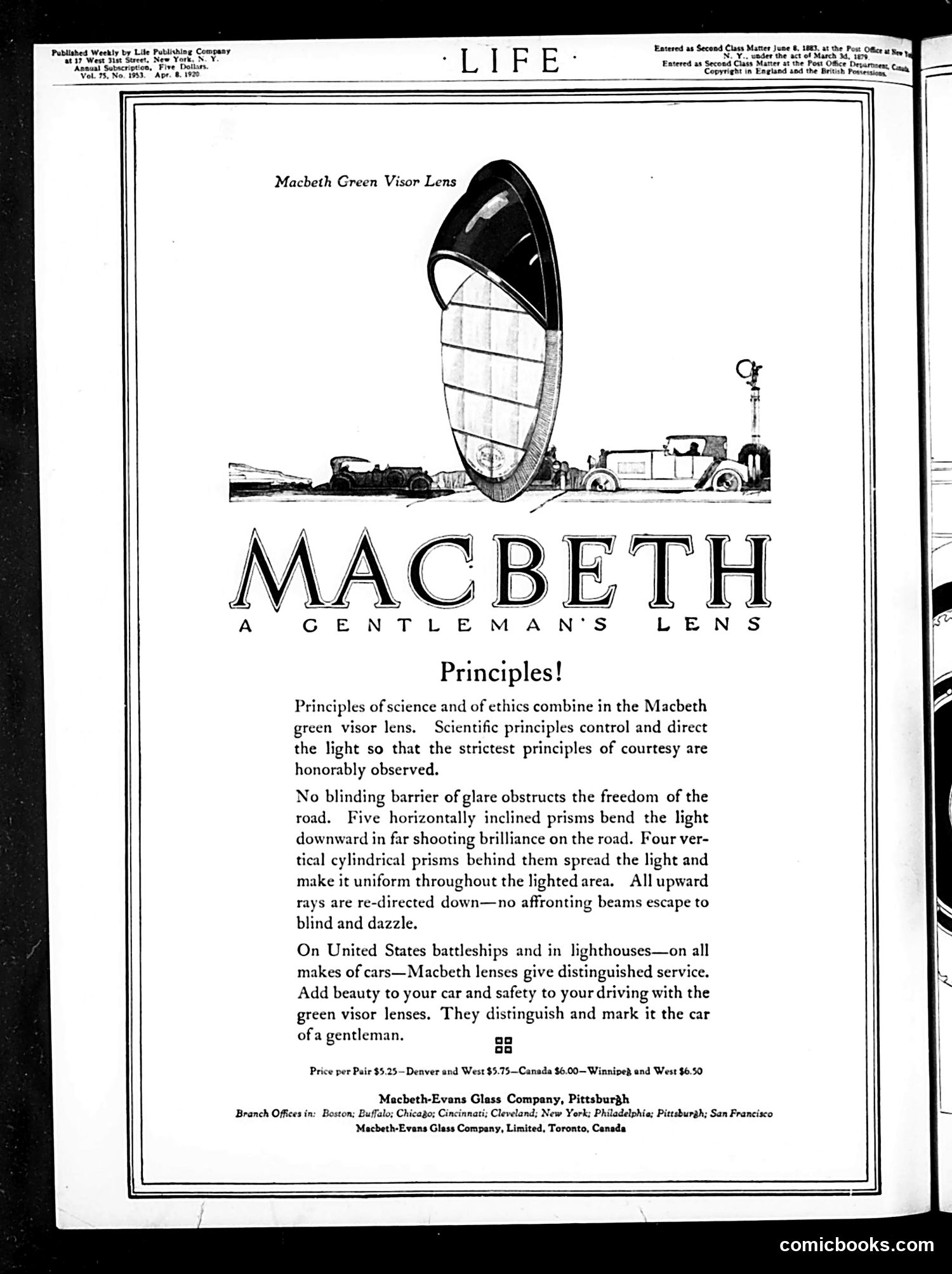
This is a straightforward **product advertisement**, not political satire. It promotes the Macbeth green visor lens for automobile windshields, manufactured by Macbeth-Evans Glass Company in Pittsburgh. The ad emphasizes practical benefits: the green-tinted lens reduces glare and road brightness through optical prisms, directing light downward to illuminate the road while preventing upward rays from blinding drivers. The illustration shows a giant lens looming over vehicles, trains, and industrial landscape. Marketing language positions the product as both **practical safety equipment and status symbol**—"They distinguish and mark it the car of a gentleman." Pricing varied by location (Denver, Canada, Winnipeg). The "principles" headline is merely advertising copy, not commentary.
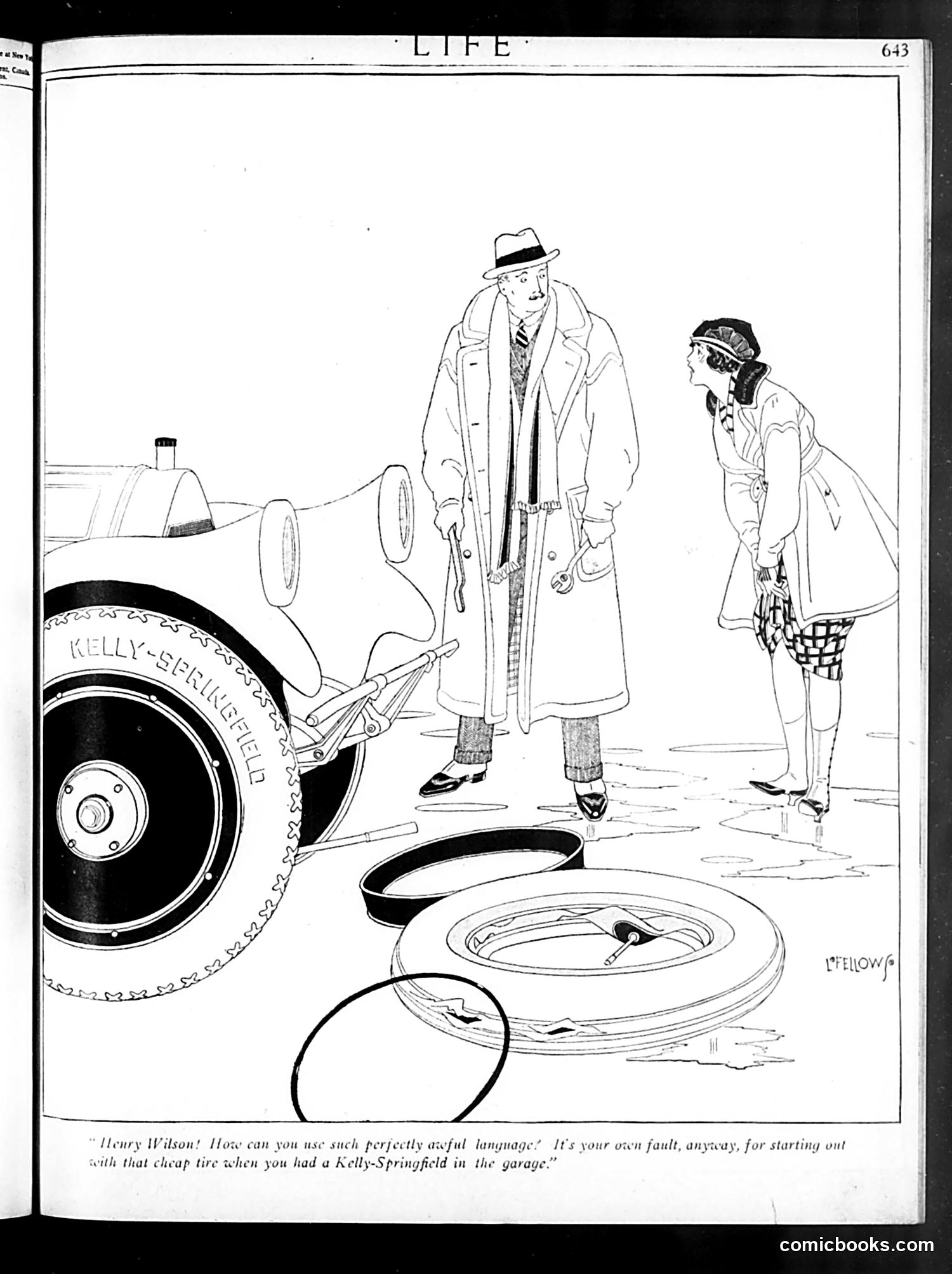
This is a humorous cartoon about automobile tire failures. A man in a overcoat and fedora stands between a car with a blown-out Kelly-Springfield tire and a woman holding what appears to be a defective spare tire. The caption shows the woman (likely his wife) sarcastically chiding "Henry Wilson" for using profanity about the tire failure, then blaming him for cheapness—he bought an inferior tire when he had a Kelly-Springfield vehicle. The joke is that the man is trapped: he can't complain about the poor tire quality without admitting he purchased an inferior product. This advertisement-disguised-as-humor promotes Kelly-Springfield brand tires by humiliating owners of competing brands. The cartoon reflects 1920s consumer culture and the emerging importance of brand loyalty in automobile accessories.
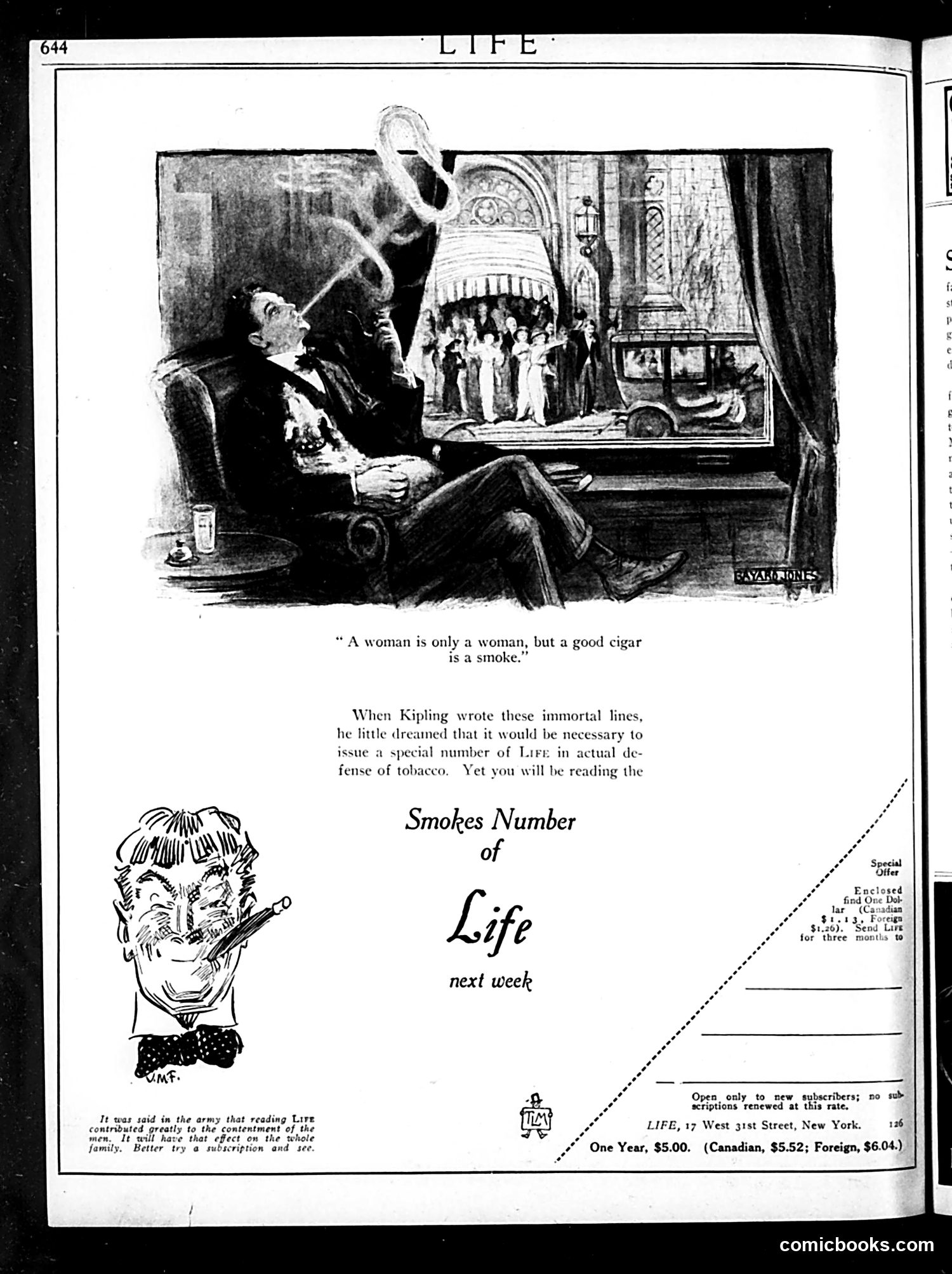
This page is primarily a **subscription advertisement** for Life magazine, using humor to promote a special "Smokes Number" issue dedicated to tobacco. The main cartoon shows a man in formal attire smoking a cigar while viewing what appears to be a theatrical or cinematic scene. The caption quotes Rudyard Kipling: "A woman is only a woman, but a good cigar is a smoke." The accompanying caricatured head (lower left) with a cigar reinforces the tobacco theme humorously. The satire works on a simple level: the ad jokingly suggests Life will defend tobacco consumption—treating a consumer product with mock-serious journalistic treatment. For modern readers, it's notable as period advertising that openly celebrated smoking without health warnings, reflecting early 20th-century attitudes toward tobacco.
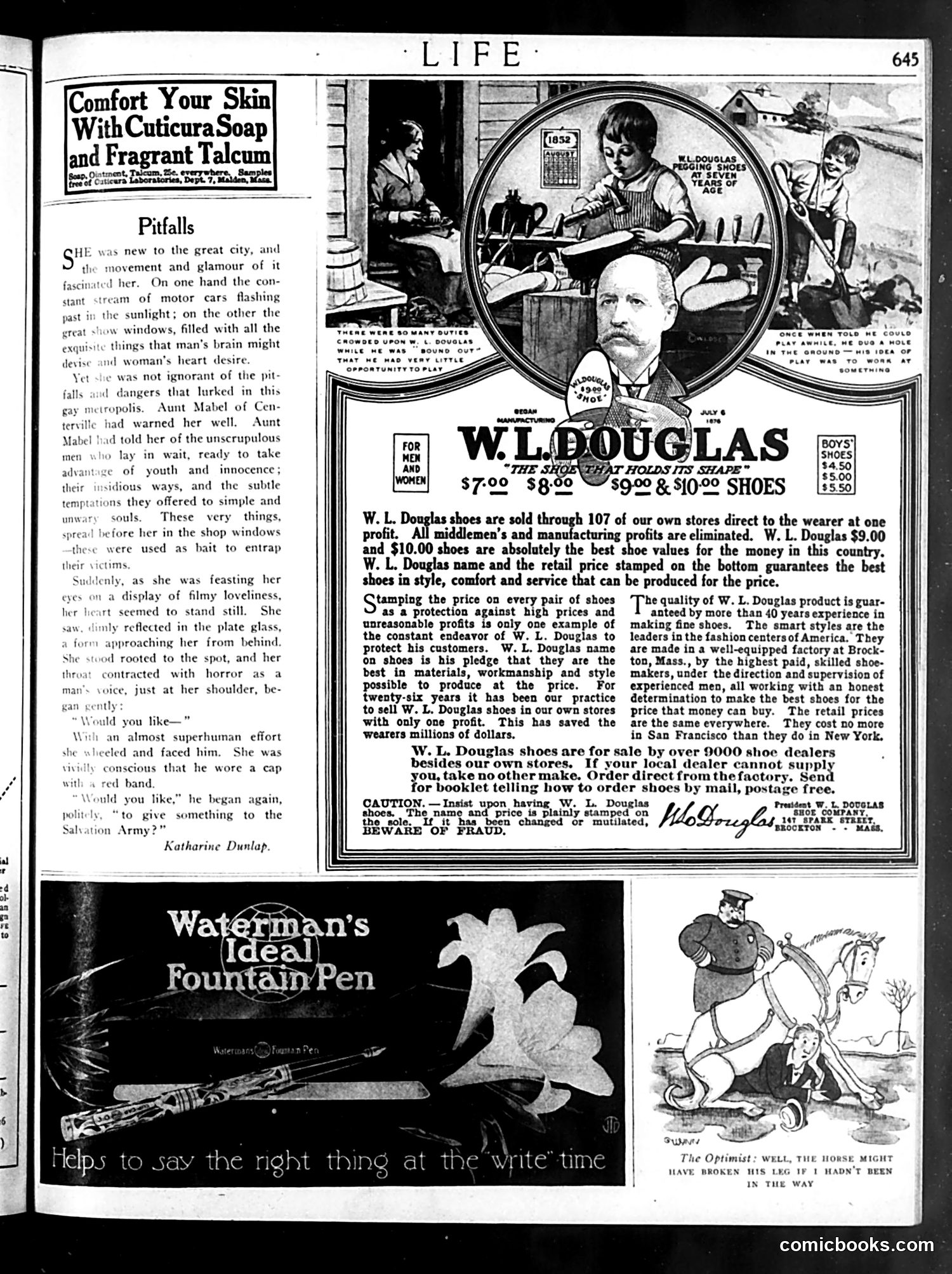
This page is primarily **commercial advertising** rather than political satire. The dominant content features a W.L. Douglas shoe advertisement showcasing their $7-$10 shoes, with images of a man (likely W.L. Douglas himself) and children. The ad emphasizes direct factory-to-consumer sales eliminating "middlemen's and manufacturing profits." The page also contains: - A brief short story titled "Pitfalls" by Katharine Dunlap about a woman new to the city - A Waterman's Ideal Fountain Pen advertisement - A small cartoon titled "The Optimist" showing a horse and rider The W.L. Douglas ad dominates through its size and detailed sales pitch, representing early 20th-century direct-sales marketing claims rather than satirical commentary.
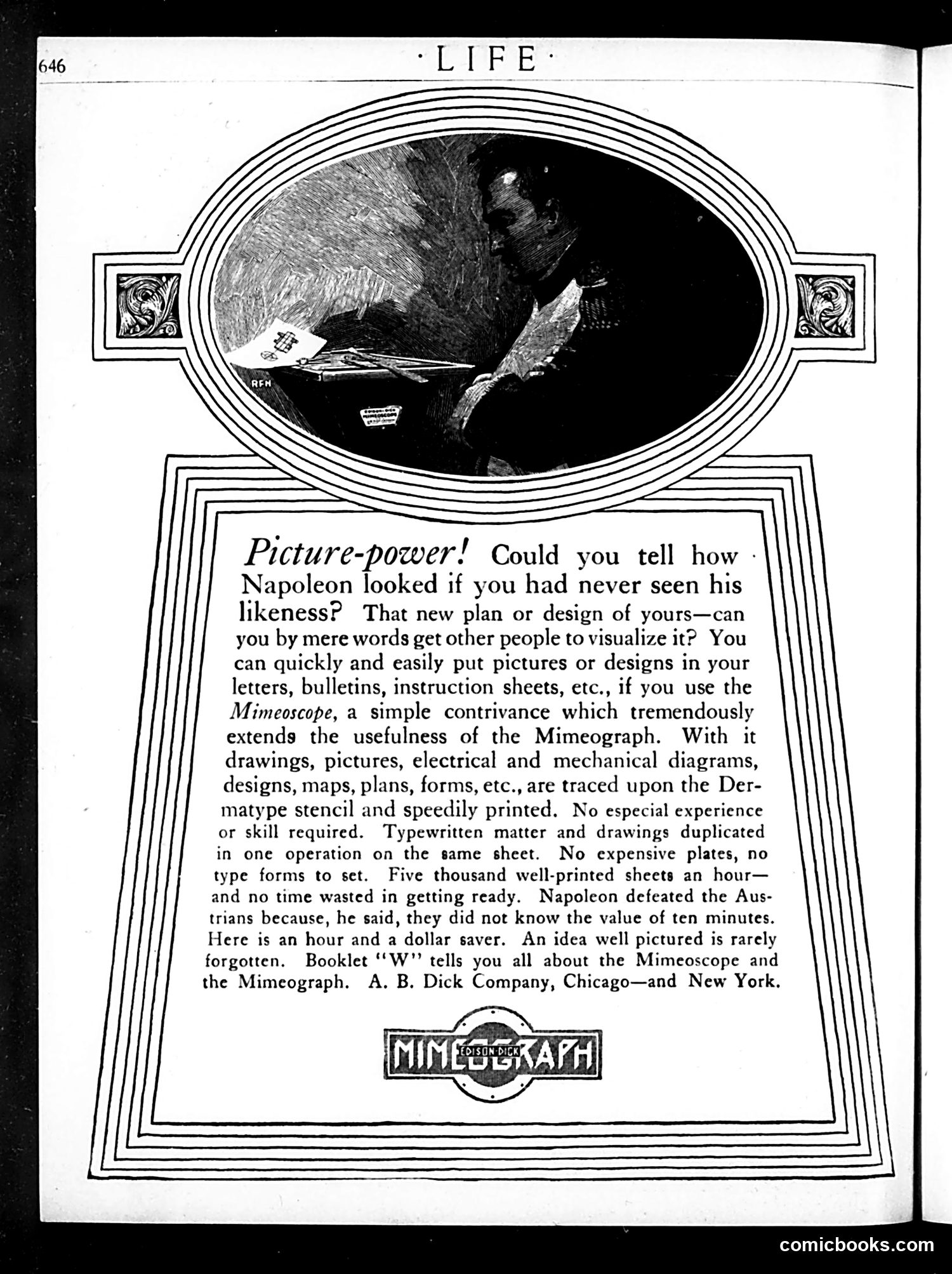
This is primarily a **Mimeograph machine advertisement** from Life magazine (page 646), not a political cartoon. The ad uses a rhetorical hook about Napoleon to sell the Mimeoscope—an attachment for Mimeograph machines that allowed users to reproduce drawings, diagrams, and designs alongside typewritten text. The opening invokes Napoleon's military defeat, claiming the Austrians didn't value "ten minutes"—likely a reference to rapid communication or information dissemination. The ad argues that visual communication ("an idea well pictured") is powerful and efficient. The small photograph shows someone using the device. This is essentially **commercial messaging masquerading as editorial content**, common in early 20th-century magazines. The Napoleon reference is merely a catchy sales hook, not political satire.
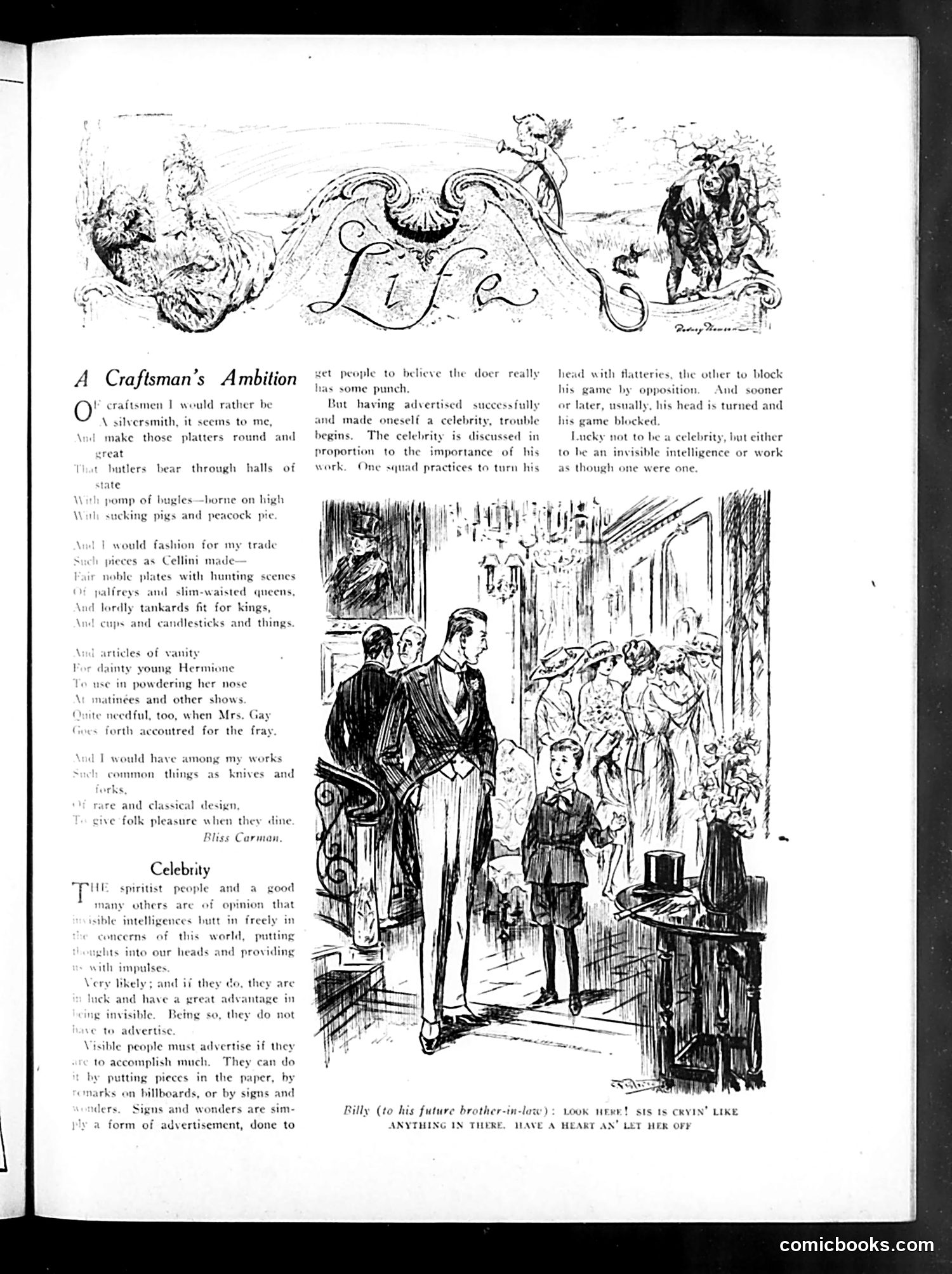
This page contains two satirical pieces about ambition and celebrity in early 20th-century America. **"A Craftsman's Ambition"** (by Bliss Carman) satirizes how craftspeople abandon their trades for celebrity. The poem mocks artisans who, after achieving fame through advertising and self-promotion, become distracted by flattery and lose focus on quality work. **"Celebrity"** section discusses how visibility requires constant advertisement to maintain relevance. The accompanying illustration shows a social scene where Billy (addressing his future brother-in-law) makes a crude joke about his fiancée, saying she lacks "anything in there"—implying she's unintelligent but attractive. The satire targets both the superficiality of celebrity culture and the shallow social ambitions driving people to abandon craftsmanship for fame.
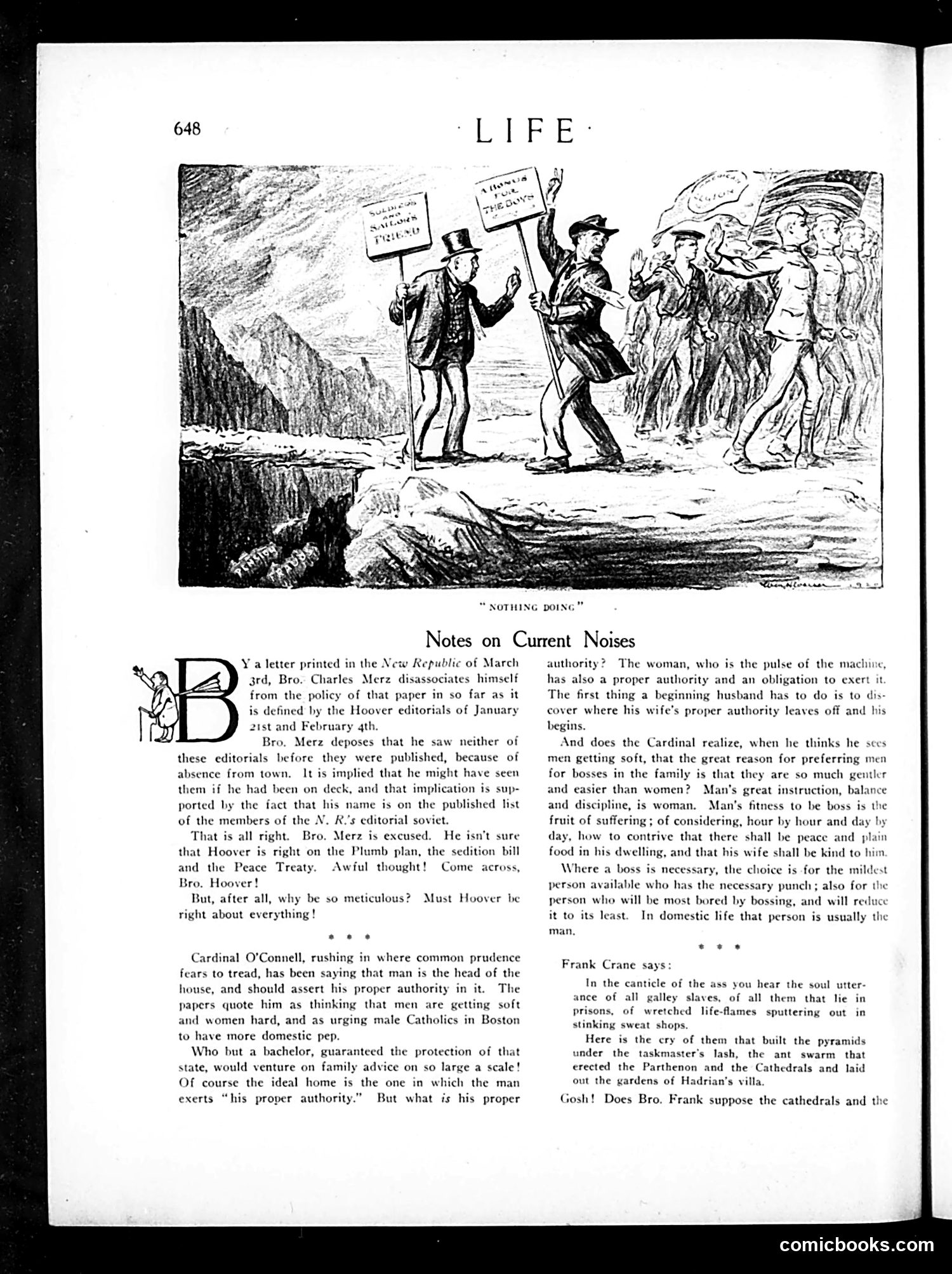
The cartoon titled "Nothing Doing" depicts two men holding protest signs confronting a group of onlookers near a body of water with mountains. The signs appear to reference current political debates (text is too small to read clearly). The accompanying article "Notes on Current Noises" discusses disputes within the New Republic magazine's editorial board regarding Hoover administration policies, specifically about the Plumb Plan and Peace Treaty. It also addresses Cardinal O'Connell's statements about male authority in households, with contributors Frank Crane and others offering satirical counter-arguments. The cartoon likely visualizes the frustration of activists or reformers being ignored by the public—"nothing doing" suggesting their message isn't gaining traction—while the text satirizes various contemporary political and social controversies of the post-WWI era.
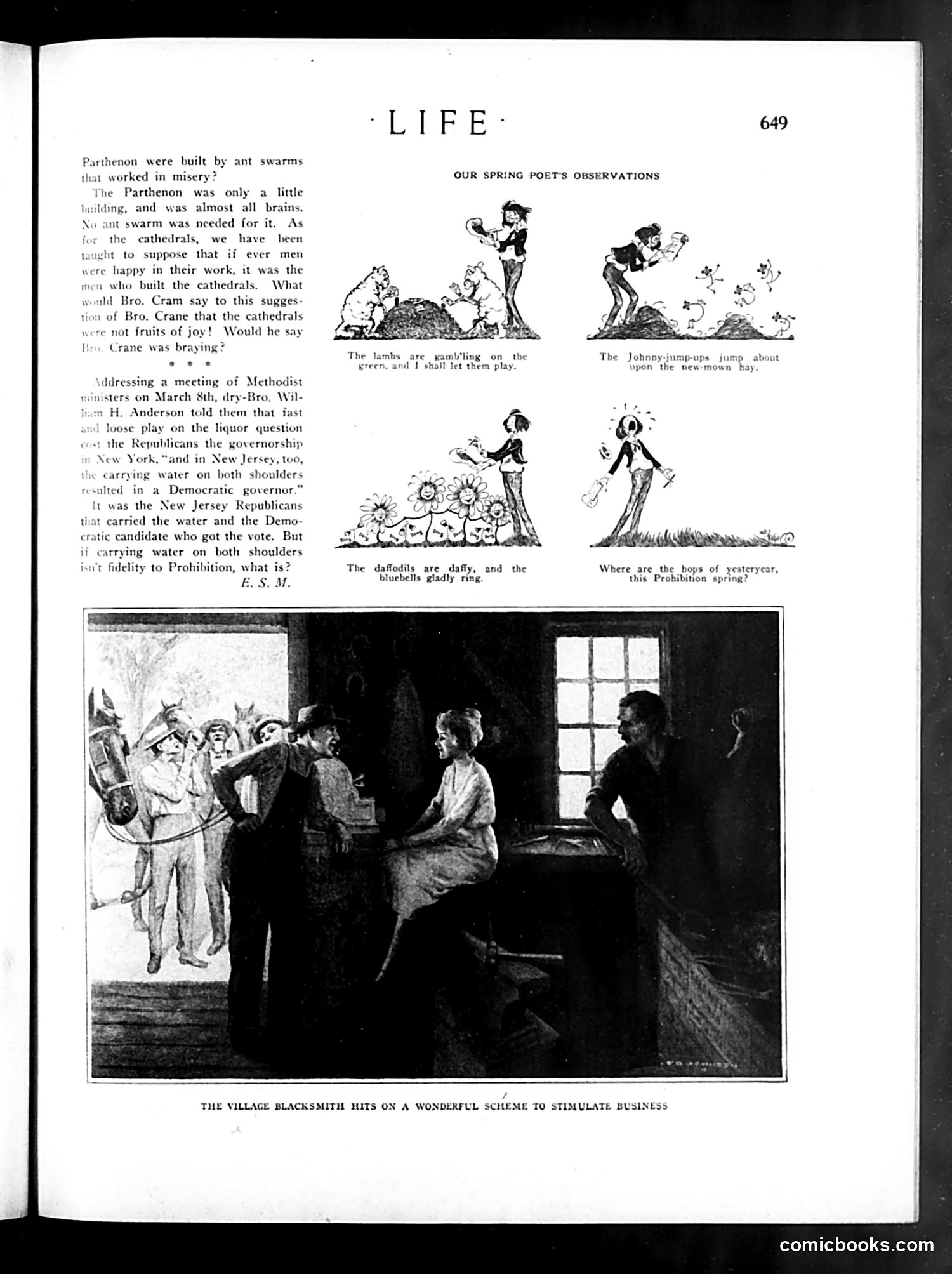
This page contains **spring-themed comic illustrations** (lambs, flowers, Johnny-jump-ups) alongside **political satire about Prohibition**. The main text criticizes **Republican governance in New York and New Jersey**, specifically mocking their inconsistent stance on alcohol. The passage notes that while Republicans claimed to support Prohibition, they actually "carried the water on both shoulders"—meaning they pleased both wet (anti-Prohibition) and dry (pro-Prohibition) voters to win elections. The satire suggests this hypocrisy undermines Prohibition's moral authority. The illustration below depicts **"The Village Blacksmith"** discussing a "wonderful scheme to stimulate business," likely implying corrupt or underhanded economic practices tied to Prohibition enforcement. The author E.S.M. questions whether such political maneuvering constitutes real fidelity to Prohibition.
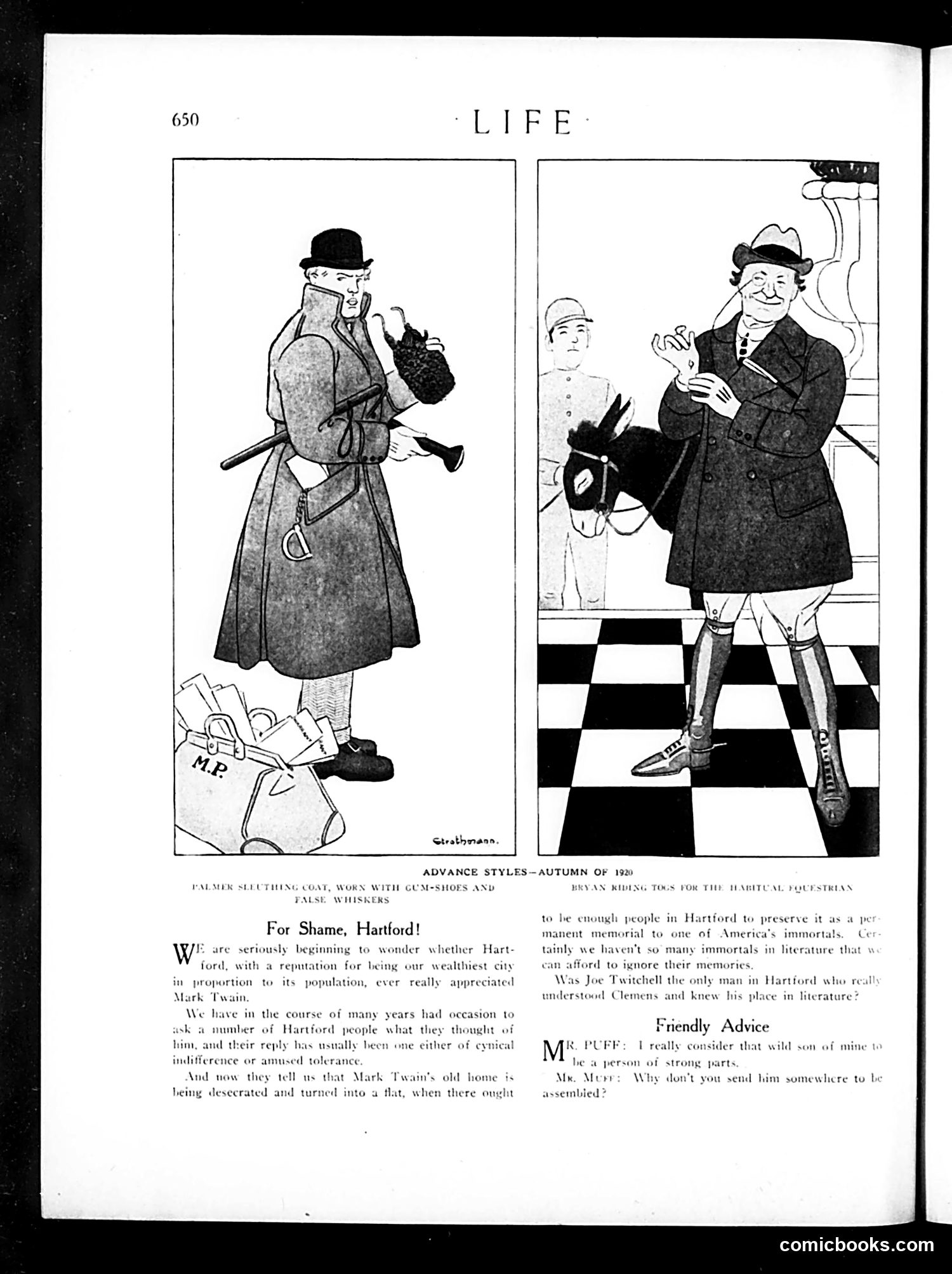
This page contains two fashion illustrations labeled "Advance Styles—Autumn of 1920" showing women's clothing with "cushions and false whiskers" for equestrian wear. The left figure wears a sleuthing coat; the right shows Bryan riding togs. Below are two opinion pieces: "For Shame, Hartford!" criticizes Hartford's potential desecration of Mark Twain's home, arguing the city should preserve it as a memorial to the famous author. The writer expresses surprise that Hartford residents don't better appreciate Twain's legacy. "Friendly Advice" is a brief dialogue where "Mr. Puff" suggests sending his "wild son" somewhere to be "assembled," with "Mr. Mutt" recommending disassembly instead—likely a joke about a destructive or unruly child. The page mixes fashion satire, literary commentary, and humor typical of Life magazine's format.
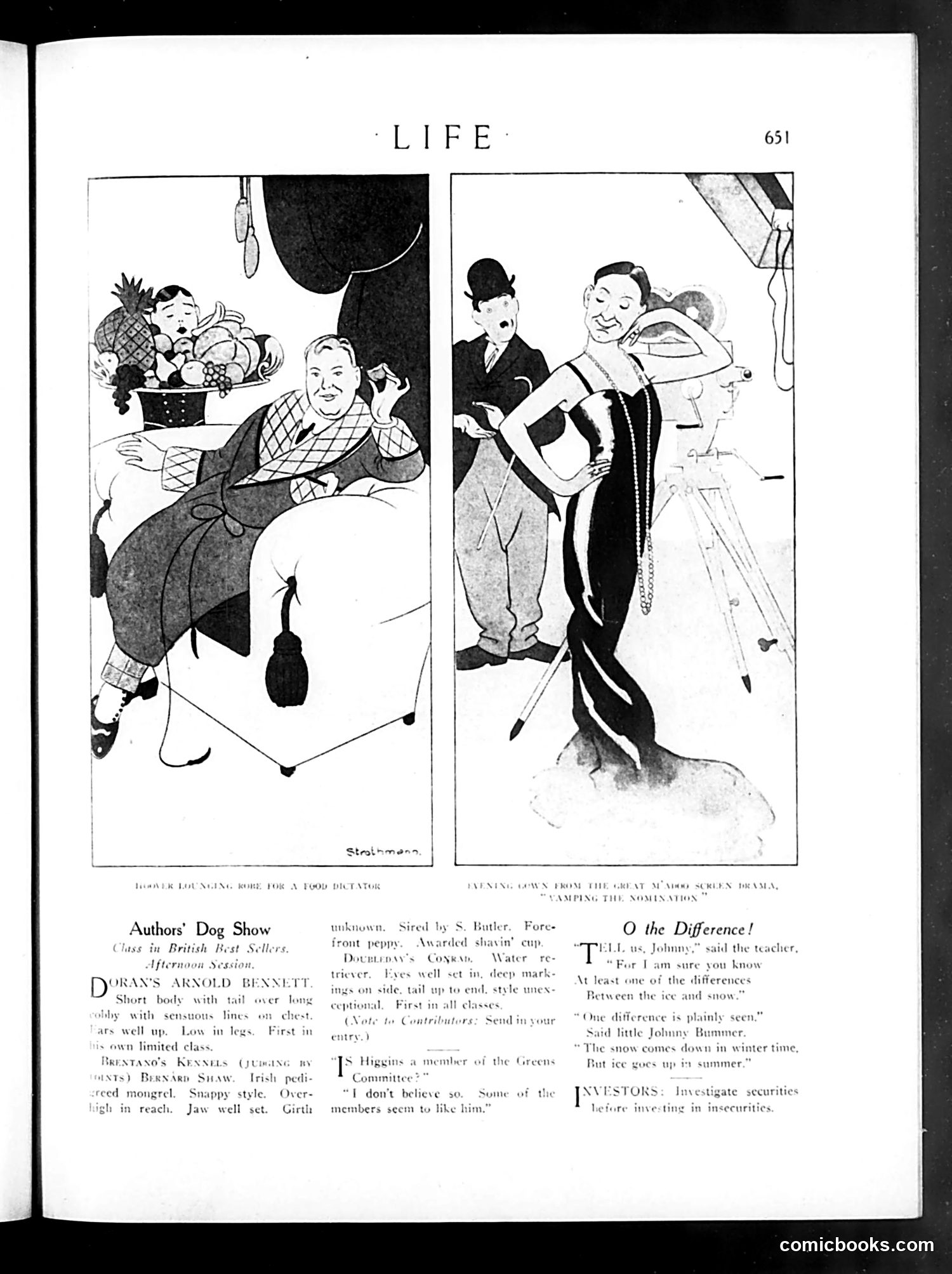
This page contains two satirical cartoons about dogs and social commentary. **Left cartoon**: Titled "Authors' Dog Show," it depicts a man in bed with a fruit basket, appearing to be ill or resting. The satire mocks dog show descriptions, listing absurdly overblown pedigree credentials for what appear to be ordinary dogs. It's a humorous jab at the pretentiousness of dog show culture and breeders' inflated claims about their animals' lineages and qualities. **Right cartoon**: Titled "O the Difference!" shows figures examining what appears to be a snow sculpture. The accompanying dialogue contrasts properties of snow versus ice—one melts seasonally while the other remains. This appears to be gentle social satire, though the specific reference is unclear without additional context. Both cartoons use visual humor to mock contemporary social affectations.
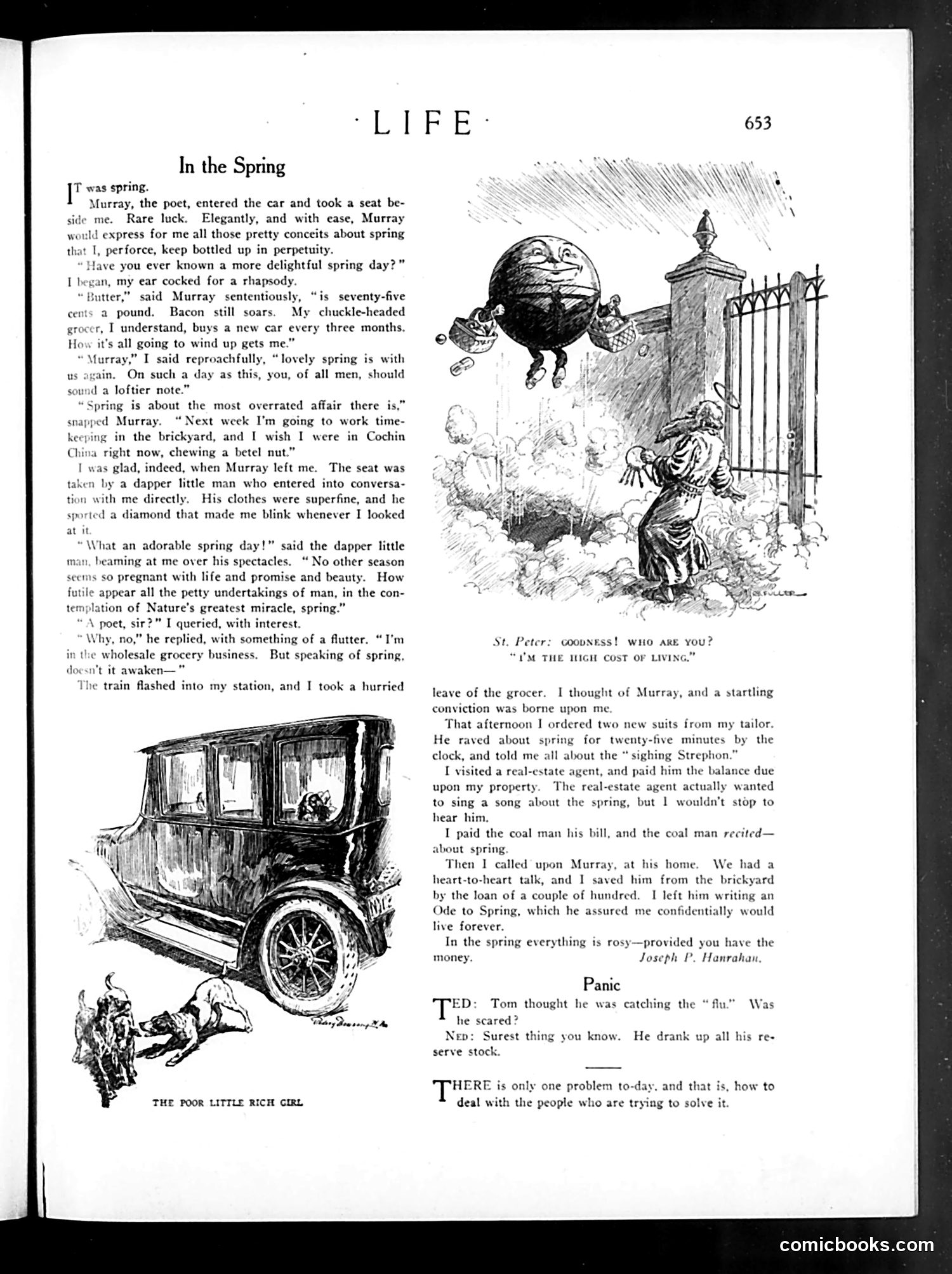
This page contains two illustrated stories and social commentary typical of Life's satirical approach. **"In the Spring"** depicts a conversation between the narrator and poet Murray in a car, satirizing spring's romanticization. Murray complains about inflation ("butter" costs 75 cents a pound; bacon "soars") while the narrator and others wax poetic about spring. The story mocks the disconnect between sentimental seasonal celebration and economic hardship—people praise spring's beauty while facing financial strain. **"The Poor Little Rich Girl"** illustration (lower left) shows a wealthy child in contrast to the economic commentary above. **"Panic"** presents a brief joke about someone catching the flu after drinking reserve stock. The final text block suggests Life's broader concern: people attempting to solve contemporary problems (likely economic) without acknowledging their complexity.
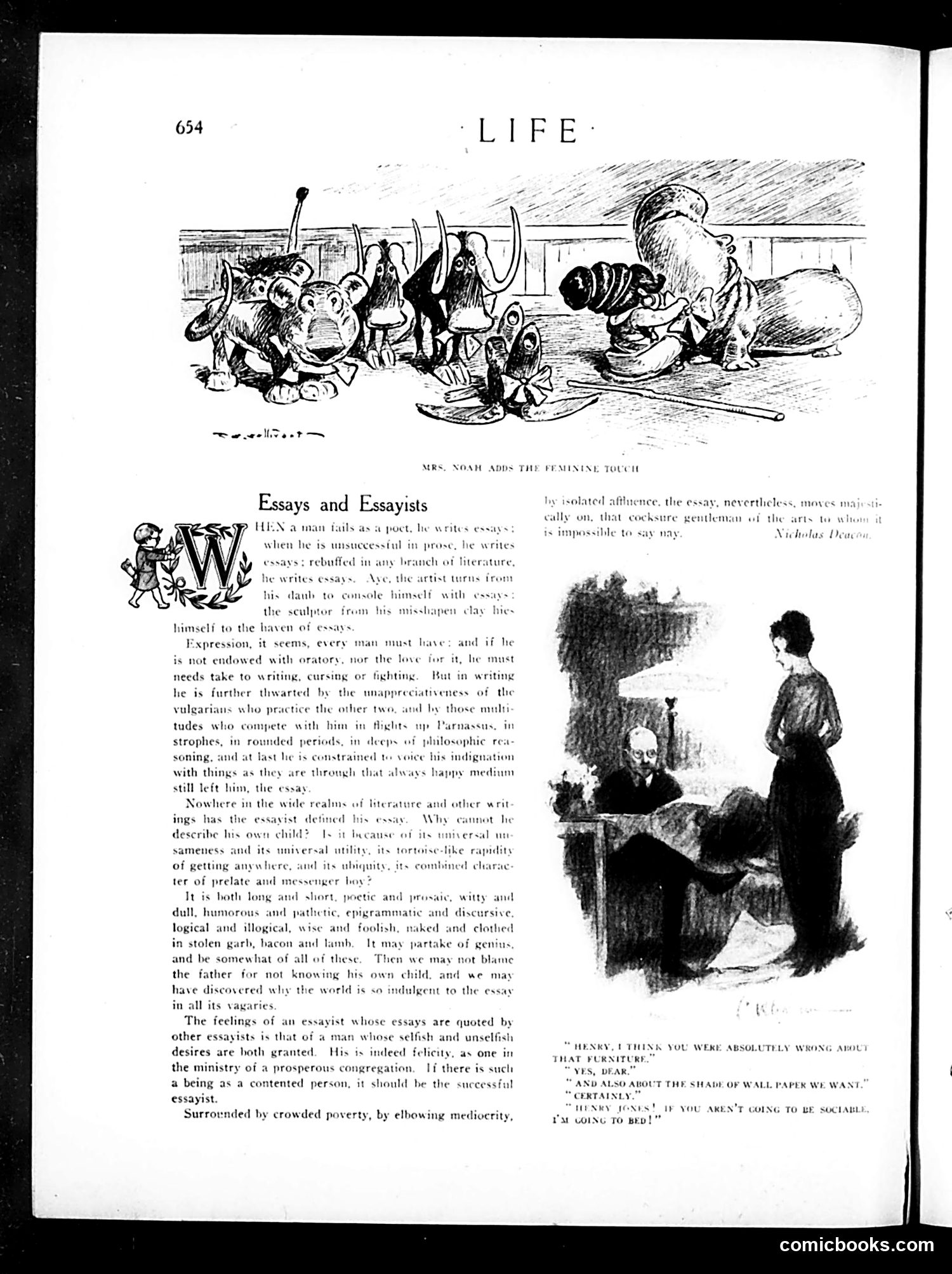
This page contains an essay titled "Essays and Essayists" discussing the literary form of the essay. The top illustration shows a cartoon of various animals (appearing to be creatures from Noah's ark) in a playful scene, captioned "MRS. NOAH ADDS THE FEMININE TOUCH" — a humorous reference to domesticity improving a rough situation. Below is a sketch showing two figures in what appears to be an interior scene, accompanying a dialogue about furniture and wallpaper choices. The conversation suggests marital disagreement over home decoration, with one figure insisting they won't "be sociable" if certain aesthetic decisions aren't made. The page primarily focuses on literary criticism rather than political satire, using the domestic furniture debate as light humor illustrating typical household disputes of the era.
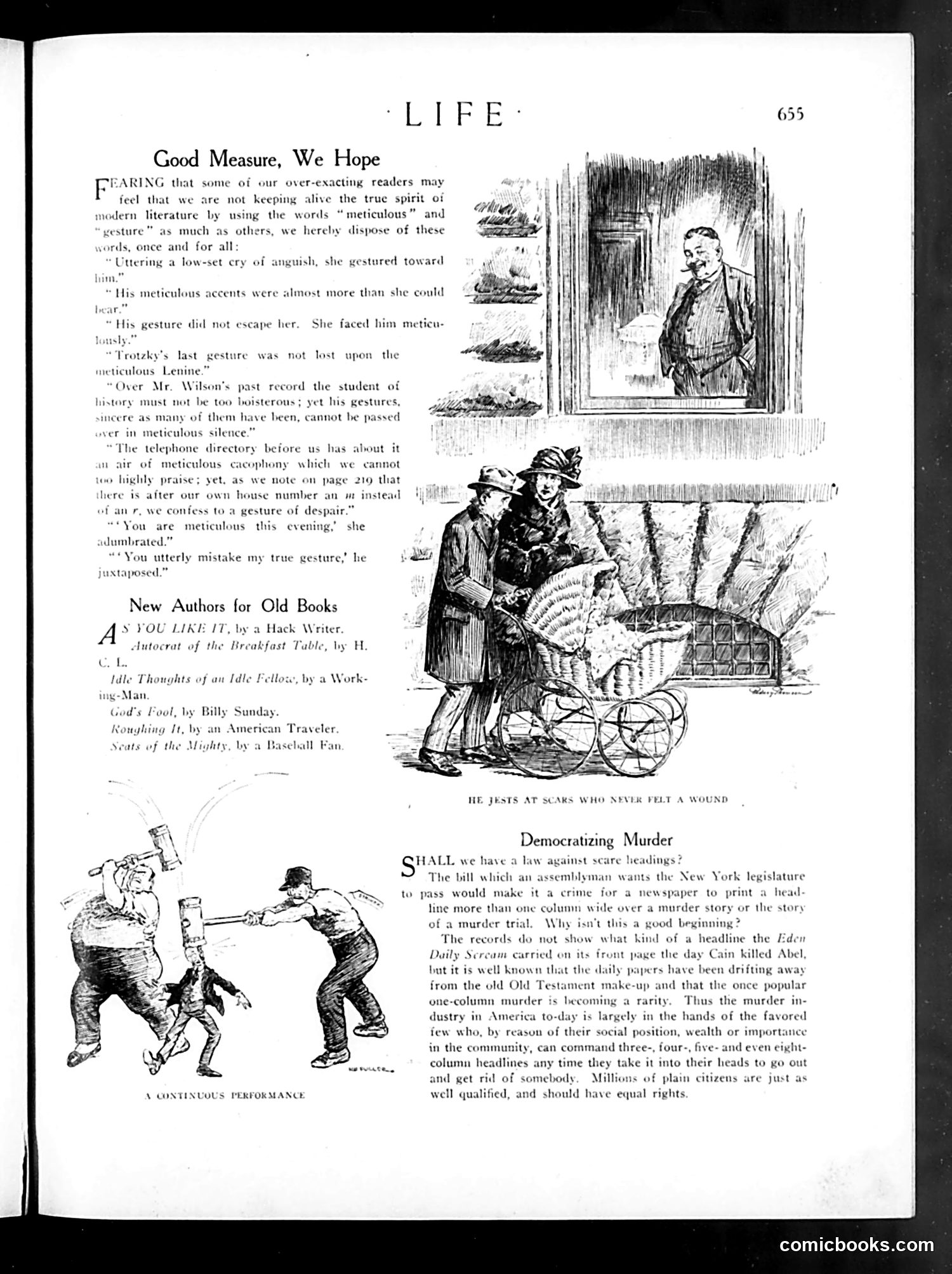
This page contains two distinct sections: **"Good Measure, We Hope"** (top): A literary excerpt featuring dialogue with characters expressing meticulous gestures and theatrical language—likely satirizing overly mannered writing or affected speech patterns in contemporary literature. **"New Authors for Old Books"** (middle): A humorous list of fictitious book titles by contemporary writers, mocking both hack writers and literary pretension. **"Democratizing Murder"** (bottom): The main satire critiques sensationalized newspaper coverage of crime. The text argues against "scare headlines" in murder stories, particularly referencing the *Eden Daily Scream*. It advocates for legal restrictions on how newspapers cover murders, arguing that wealthy, socially-prominent individuals unfairly control media narratives. The cartoon below shows two men in a physical altercation, illustrating the violent content driving newspaper sales.
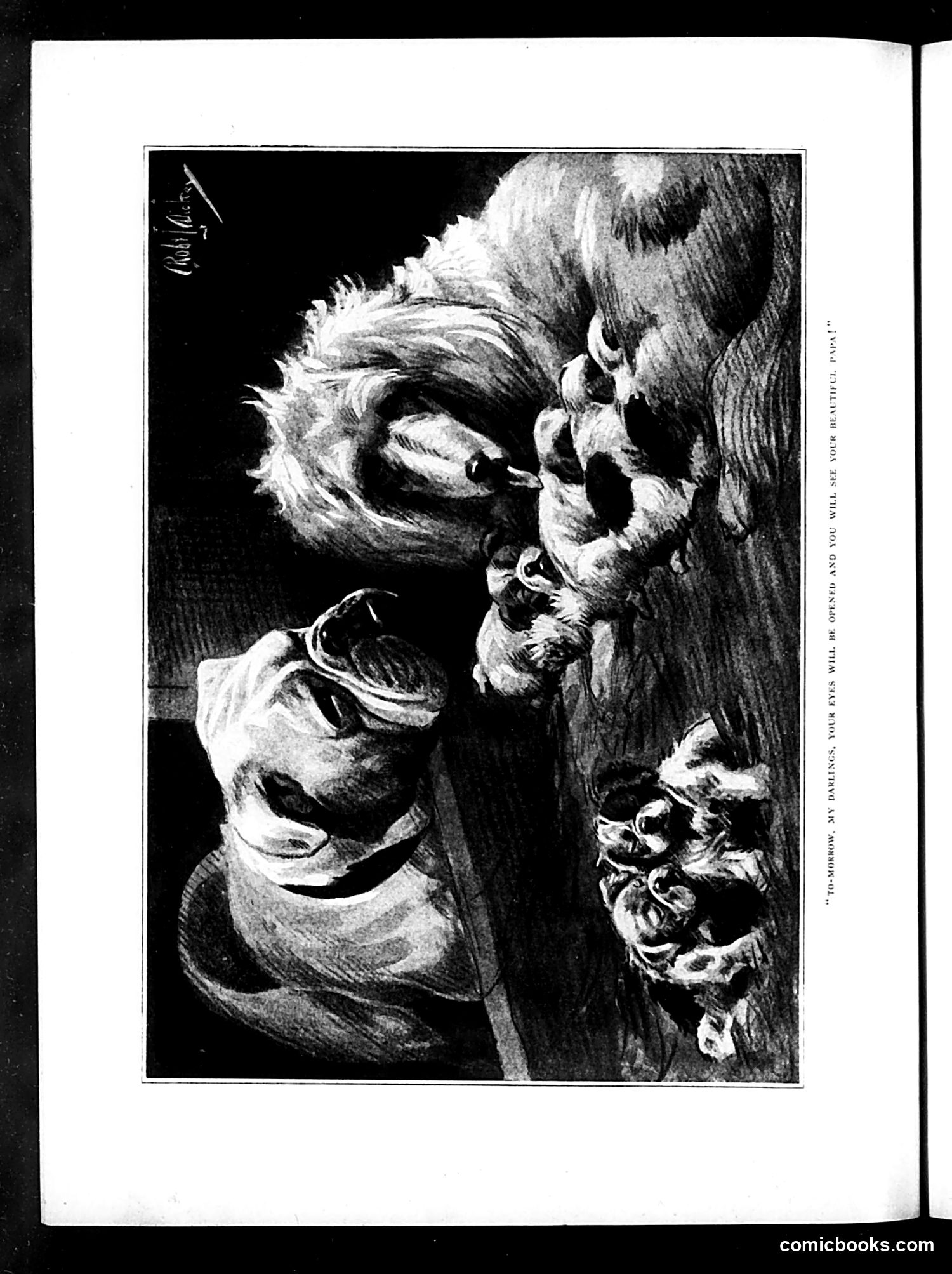
I can see this is a black and white illustration showing three figures in what appears to be a dramatic or theatrical scene, but I cannot read the caption text clearly enough to identify the specific figures or determine the cartoon's subject matter with confidence. The image shows detailed character work with expressive faces and period clothing, suggesting this depicts historical or literary figures rather than contemporary ones. The artistic style and print quality are consistent with early-to-mid 20th century Life magazine satirical work. Without being able to reliably read the accompanying caption or text on this page, I cannot accurately explain what political, social, or cultural references this illustration makes, or identify which specific figures or events it's meant to satirize. I'd need clearer text to provide an accurate historical interpretation.
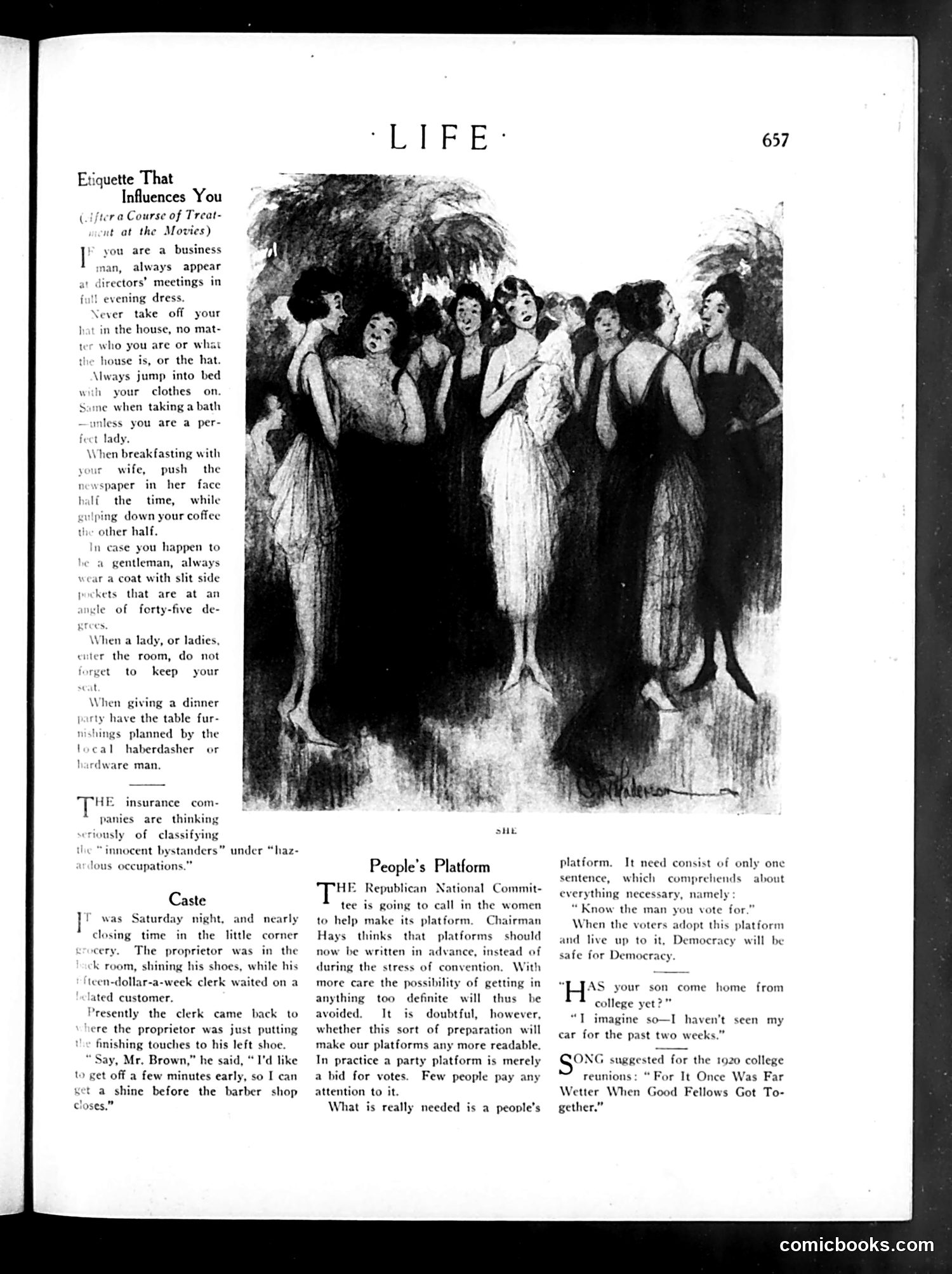
The page contains three satirical pieces mocking early 20th-century social conventions and politics: 1. **"Etiquette That Influences You"** (top left): A humorous "etiquette guide" that inverts proper behavior—advising businessmen to jump into bed clothed, keep hats on indoors, and push newspapers in wives' faces. This satirizes the rigid, absurd social codes imposed by "movie morality" and uptight respectability culture of the era. 2. **The cartoon** (center): Shows women in various states of undress, likely satirizing hypocrisy around female modesty standards or moral panics about women's changing social roles in the 1920s. 3. **"People's Platform"** (bottom right): Mocks the Republican National Committee's platform-writing process as meaningless political theater. The satire suggests political platforms are merely "bids for votes" that nobody reads; what voters actually need is simply to know whom they're voting for. 4. **Minor humor pieces** (bottom): Quick jokes about college sons and reunion songs, reflecting post-WWI social commentary. The overall tone is cynical about social pretension, political dishonesty, and changing morality.
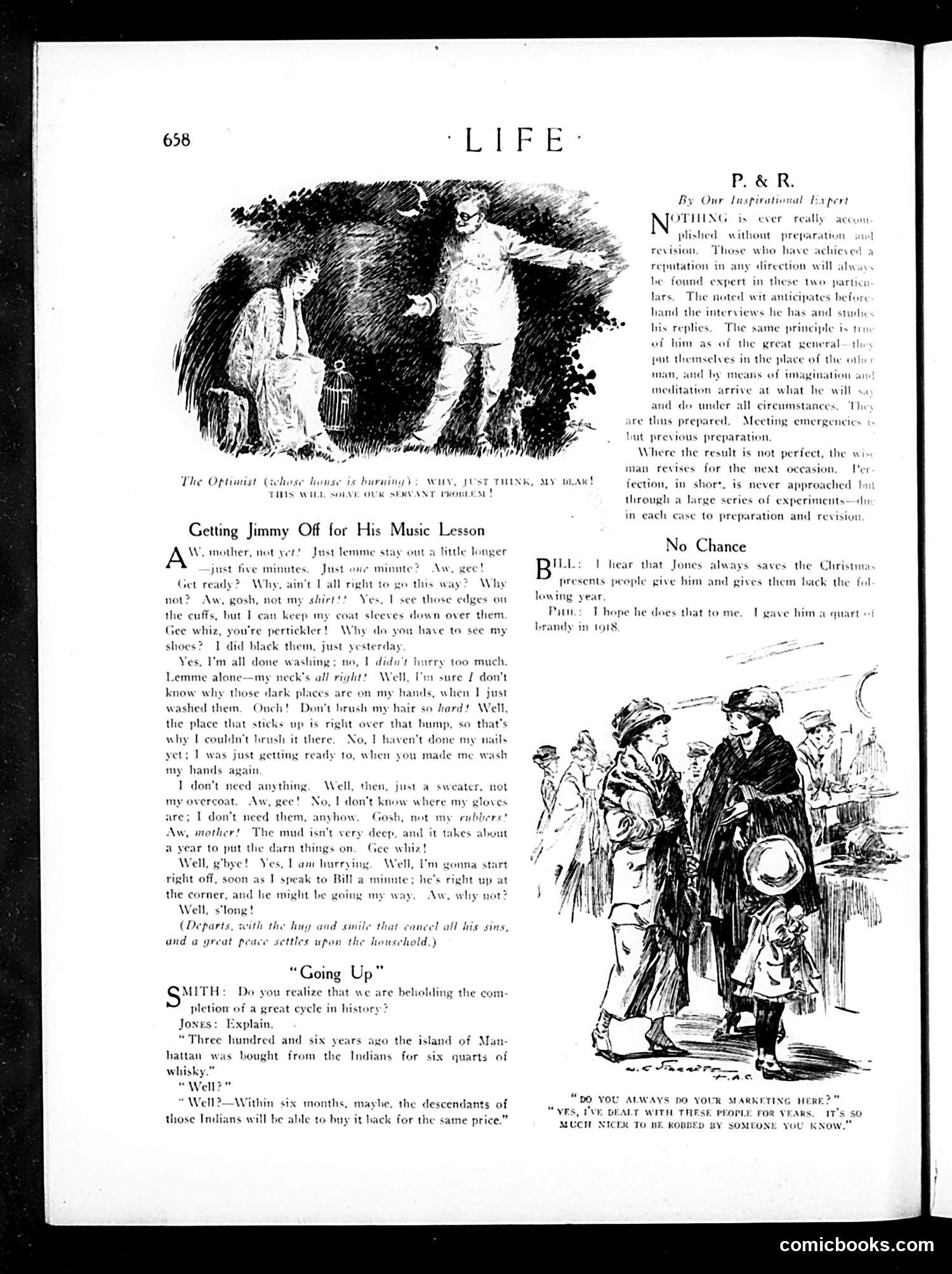
This page contains three satirical pieces typical of early 20th-century American humor: **"Getting Jimmy Off for His Music Lesson"** depicts a mother's frustration getting her reluctant son ready for lessons. The boy makes endless excuses about his appearance and wants to delay. The satire targets both the child's universal resistance to parental authority and the era's class anxieties about proper grooming and punctuality. **"The Optimist"** (top cartoon) shows a man pointing to a burning house, suggesting the fire will "solve our servant problem"—dark humor about the servant shortage that plagued American households post-WWI. **"Going Up"** jokes about Manhattan's real-estate cycle: Native Americans sold the island for whisky 306 years ago; within six months, their descendants could buy it back at whisky prices—implying alcohol would become worthless as currency, or sarcastically suggesting American Indians' economic prospects. **Bottom cartoon** features cynical banter about a grocer who consistently overcharges customers, whom the speaker trusts *because* of this predictable dishonesty. These pieces reflect Jazz Age cynicism about modern institutions, economics, and social pretension.
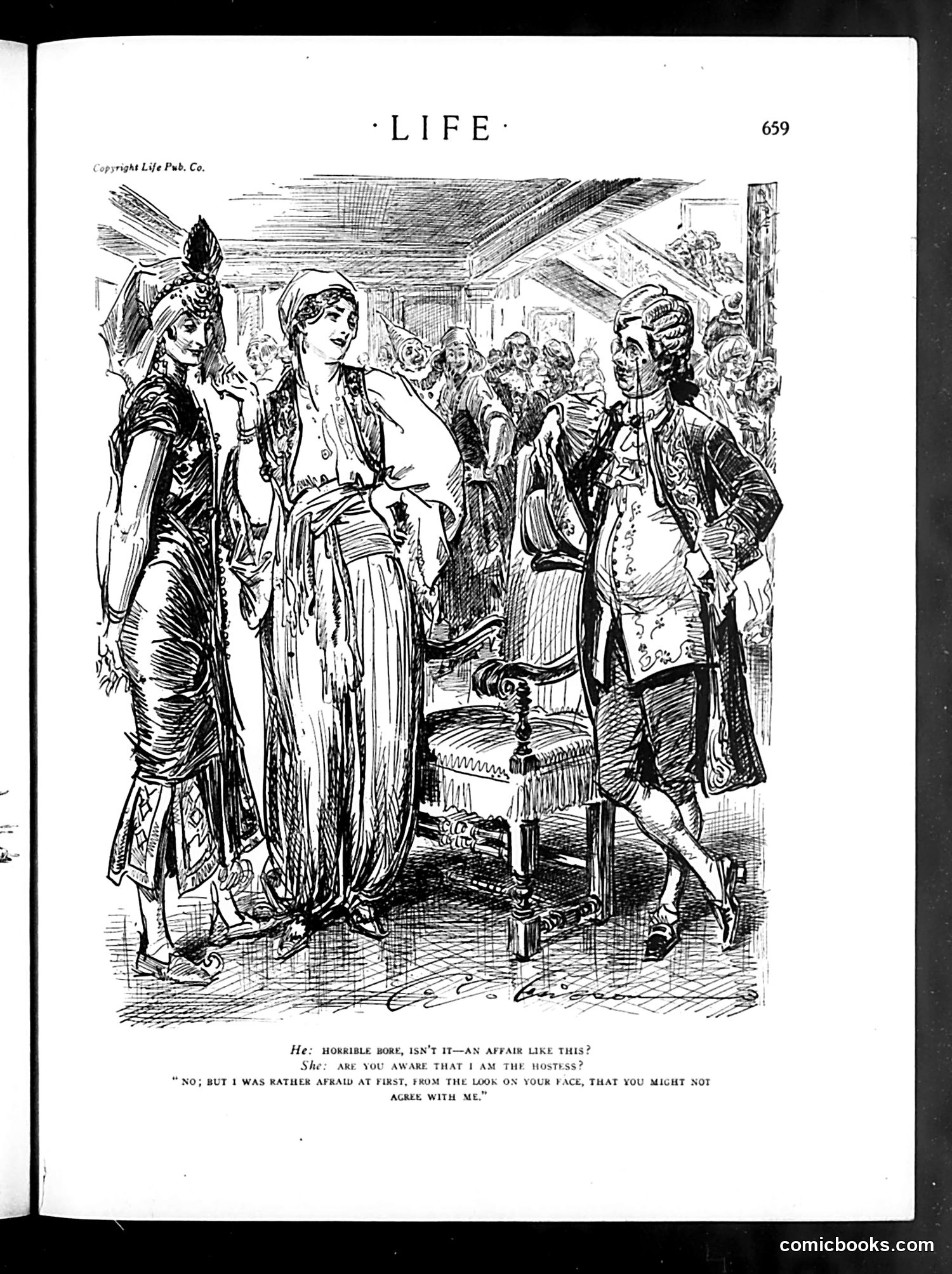
This is a social satire about party etiquette and power dynamics. A man complains to a woman about a boring social affair, making what appears to be a pass at her by suggesting shared disdain for the event. The woman's sharp retort reveals the joke: she identifies herself as the hostess—the very person responsible for the event he's insulting. Her response cuts deeper: she was initially wary of him based on his appearance, but his insulting remarks about her party have now confirmed her suspicion that he's disagreeable. The satire mocks men who attempt casual flirtation through negativity, unaware they're insulting their host. It also comments on social pretense—the gap between what people say privately versus their social obligations. The elaborate period dress and formal setting emphasize this is about upper-class social conventions.
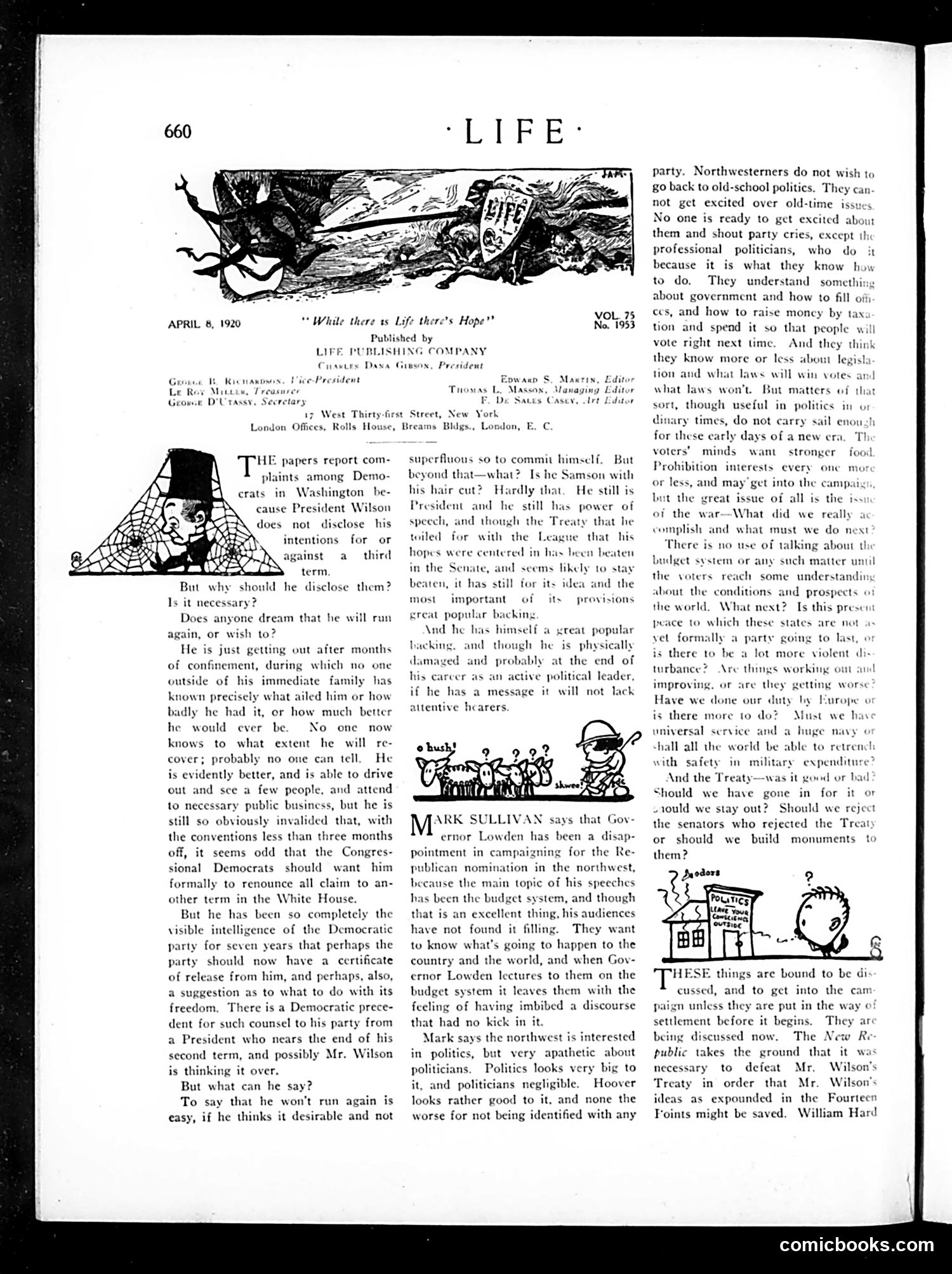
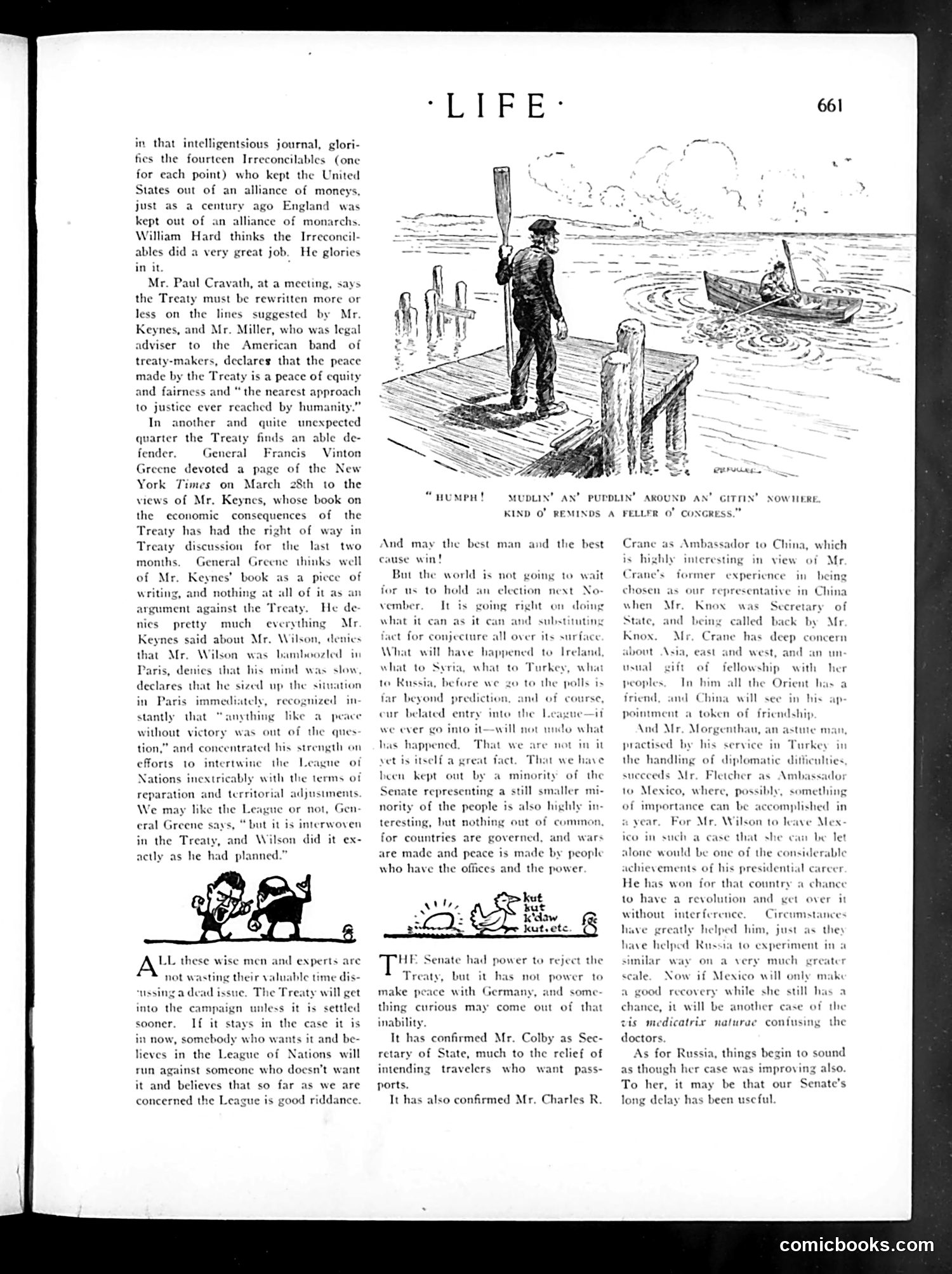
This page discusses whether President Woodrow Wilson should publicly declare he won't seek a third term. Wilson has just recovered from a serious illness (likely his 1919 stroke, though not named here) that confined him for months. The editorial argues it's unnecessary for Wilson to make such a declaration—it's already obvious he won't run again given his weakened health. However, it notes the Democratic Party may want formal release from him, and perhaps guidance on its future direction. A secondary piece by Mark Sullivan critiques Governor Frank Lowden's Republican campaign in the northwest, saying voters want discussion of major issues—what will happen to the country and world—not just budget policy. Sullivan notes northwestern voters find politics important but politicians negligible, and that Herbert Hoover appeals to them partly *because* he's unidentified with old-style party politics. The cartoons (not clearly detailed in OCR) appear to illustrate these political uncertainties.
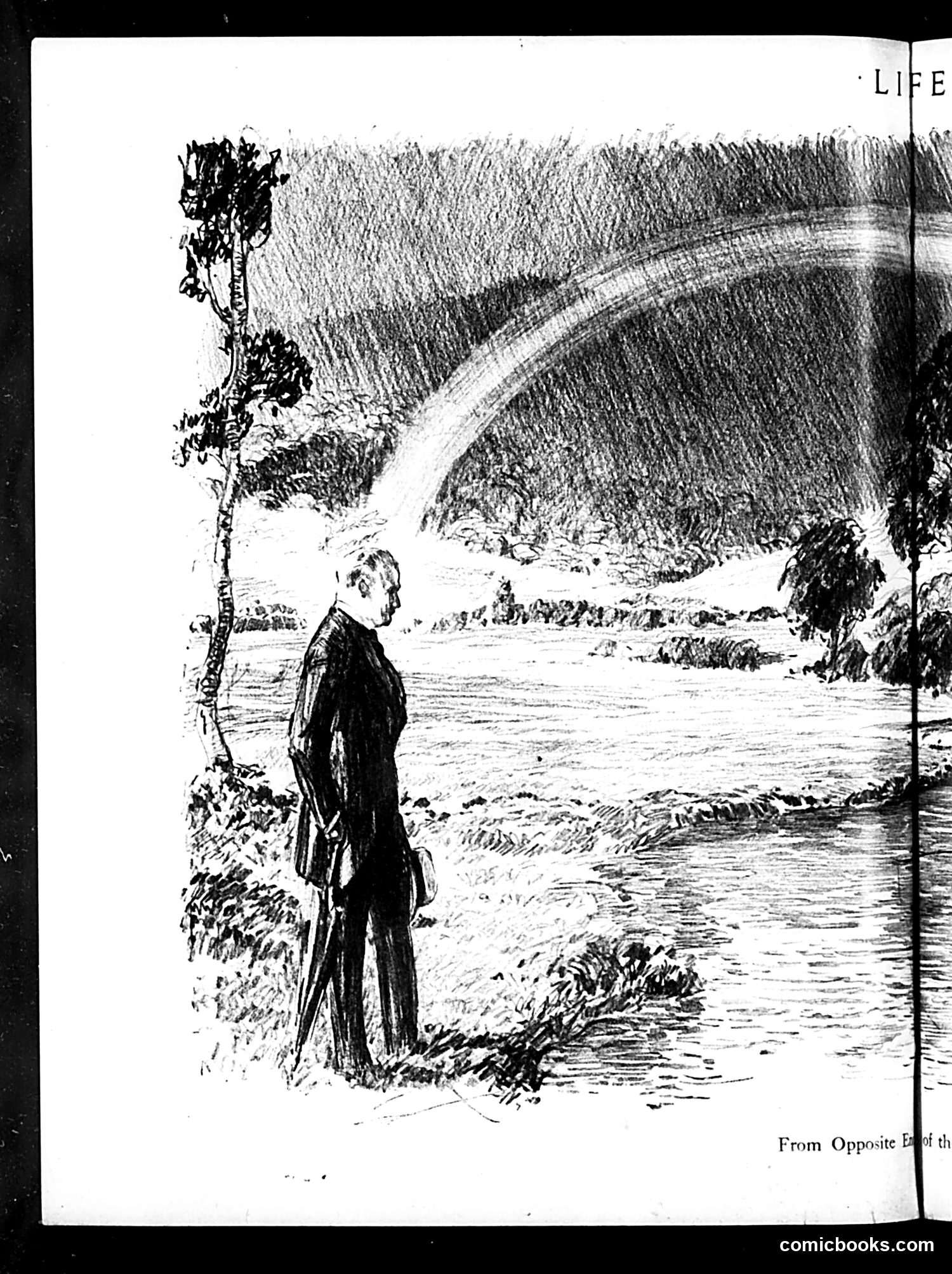
This is a sketch illustration showing a solitary man in formal attire standing by a riverbank, gazing across the water at distant cliffs and forested landscape. The drawing style is characteristic of early 20th-century Life magazine editorial illustration. The incomplete OCR text "From Opposite Bank of th[e]" suggests this illustration accompanied a narrative or essay (the full title is cut off). Without additional context or caption visible, the specific political or social commentary is unclear. The image appears to be a contemplative scene—possibly illustrating a literary piece, travel narrative, or philosophical essay about nature and solitude—but the exact subject and satirical intent cannot be determined from the visible portion alone.
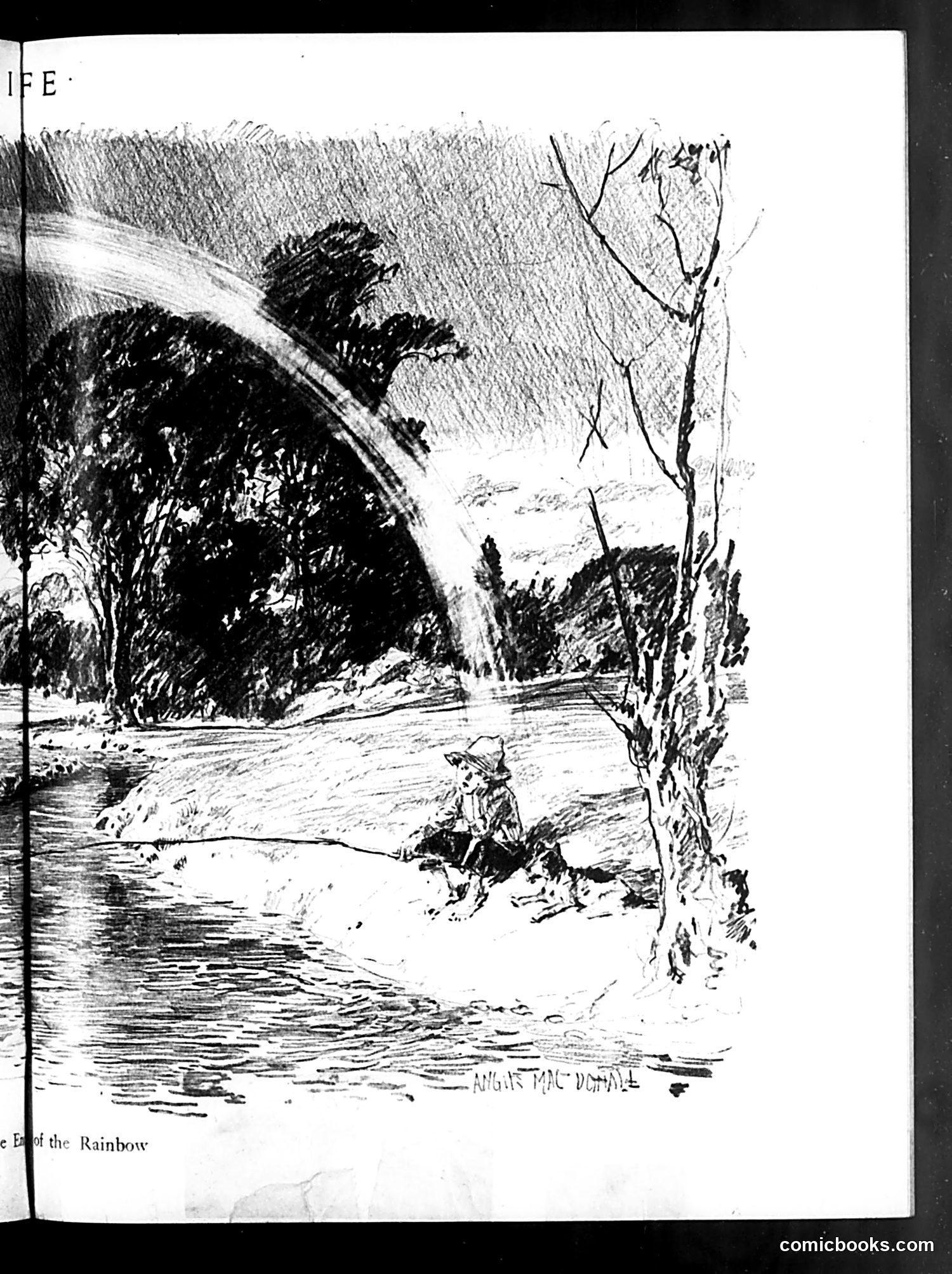
This illustration depicts a fisherman sitting by a river or stream, fishing with a rod. The detailed landscape includes trees, rocky outcrops, and water rendered in detailed cross-hatching. The caption reads "End of the Rainbow," suggesting a satirical commentary on unfulfilled expectations or disappointed hopes—the "pot of gold" at rainbow's end being a classic metaphor for unattainable wealth or success. The cartoon likely critiques the false promises or disappointing outcomes of some contemporary pursuit, though without additional context or visible political figures, the specific target remains unclear. The lonely fisherman's patient wait for a catch may represent hopeful but futile effort, a common theme in Life magazine's satirical commentary on American life and aspiration.
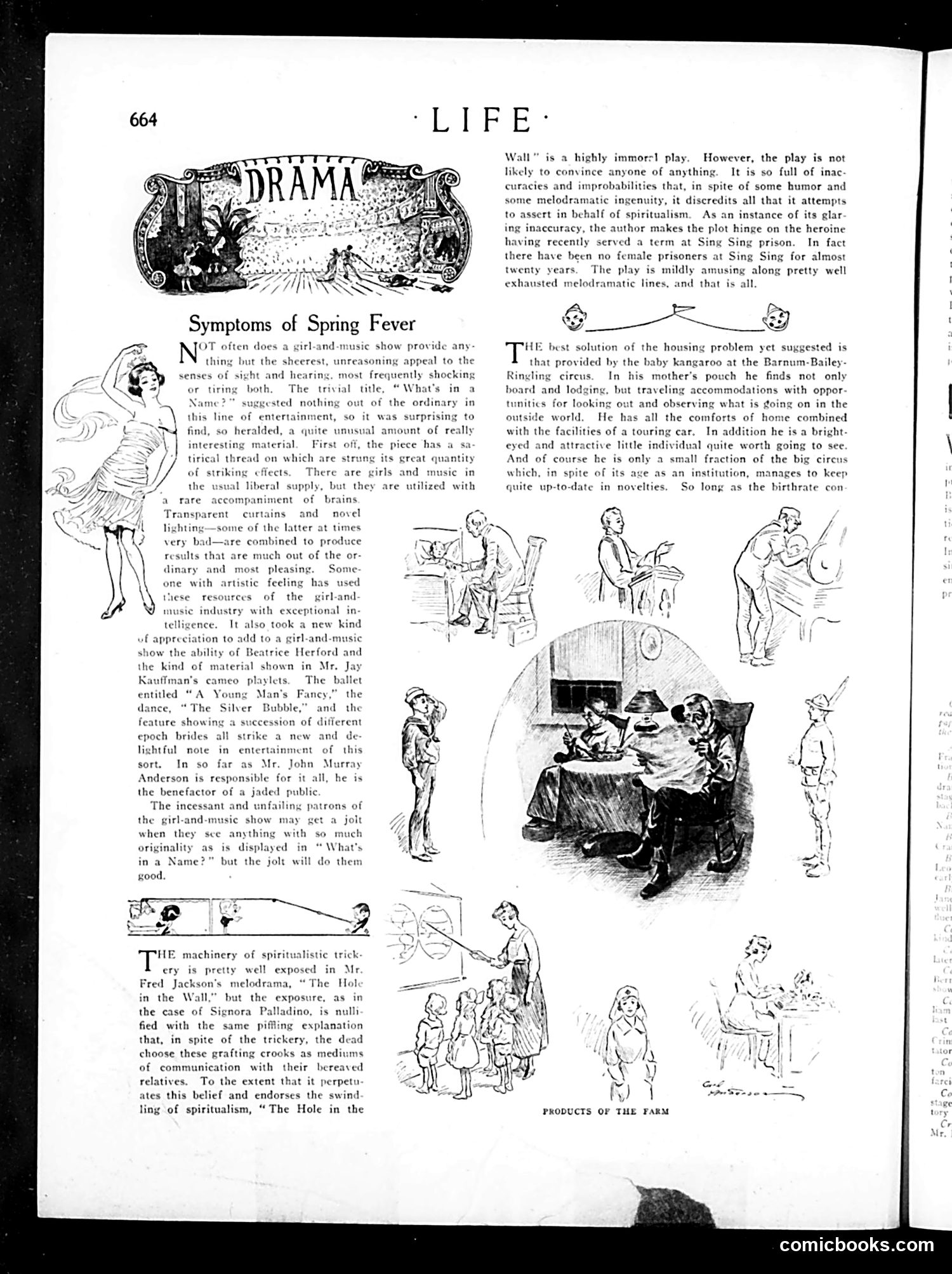
This page contains theater reviews critiquing contemporary Broadway productions: **"Wall"** — A play about spiritualism criticized for moral problems and factual errors. The reviewer notes it falsely claims a female character served time at Sing Sing prison, when the page explicitly states no female prisoners had been held there for nearly twenty years. The satire targets spiritualism as fraudulent. **"What's in a Name?"** — A girl-and-music show praised for unusual artistic merit, featuring choreography by John Murray Anderson and performances by Beatrice Herford. The review praises its innovative use of transparent curtains and clever staging in an otherwise tired theatrical genre. **"The Hole in the Wall"** — Fred Jackson's melodrama exposing spiritualist fraud. The reviewer criticizes how the play ultimately endorses spiritualism despite revealing mediums' trickery, comparing it to fraudster Signora Palladino (an actual spiritualist con artist of the era). The page satirizes both theatrical mediocrity and the broader public gullibility toward spiritualism—a major social concern of the early 20th century.
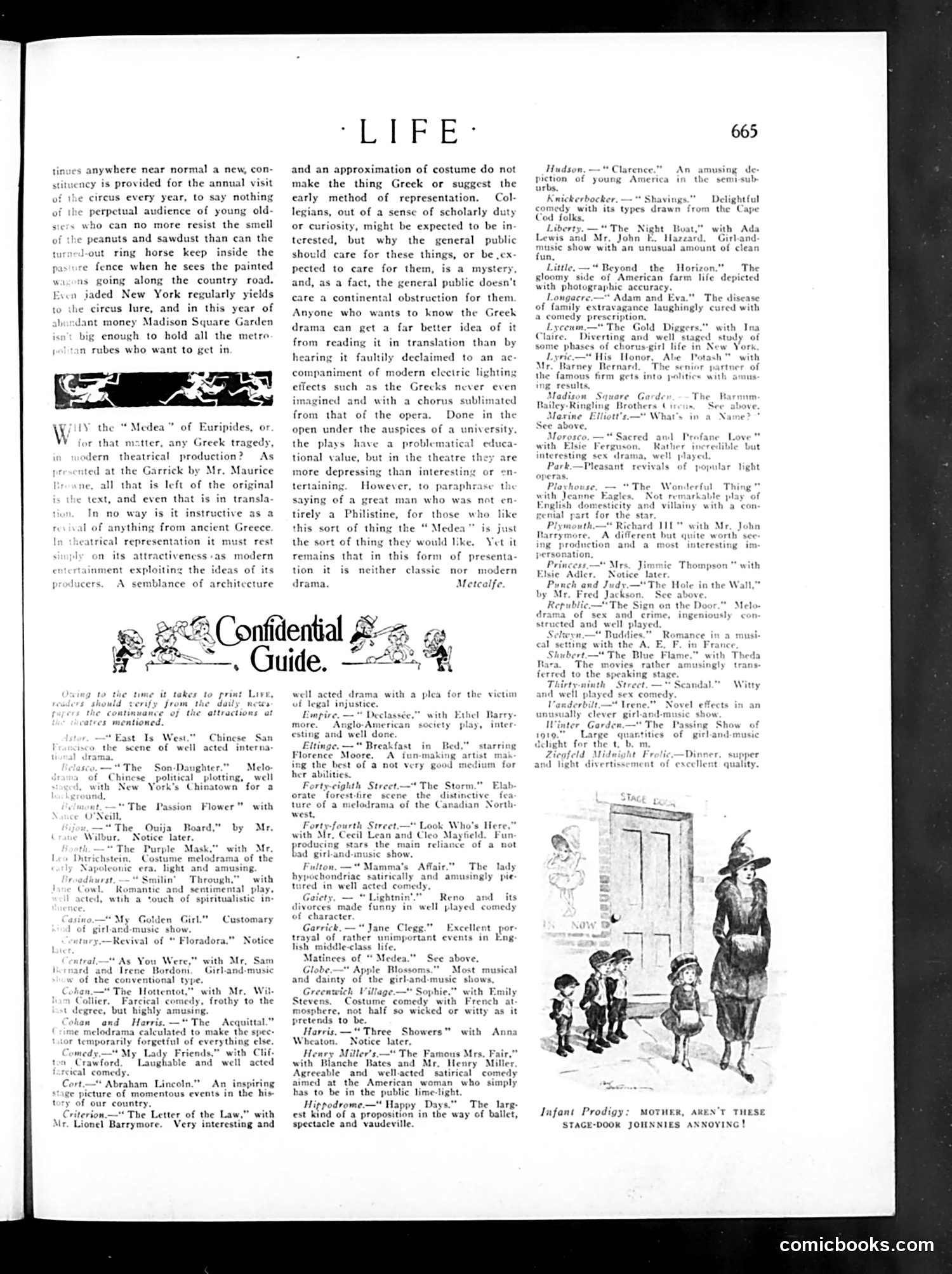
This page is primarily **theater criticism and reviews**, not political satire. The small cartoon at bottom right shows a mother scolding children about annoying behavior in theaters—likely a commentary on audience conduct during performances. The bulk of the page critiques current Broadway productions (1918-1919 era), including reviews of "Medea," "East Is West," "The Son-Daughter," and various comedies and melodramas. The longest article discusses a production of Euripides' "Medea" at the Garrick Theatre, directed by Maurice Browne. The critic argues that staging classical Greek drama with modern electric lighting and contemporary theatrical techniques doesn't authentically represent ancient theater. He suggests reading translations is preferable to watching poorly-realized stage productions, and notes the general public has little interest in such highbrow material anyway. The reviews are lighthearted assessments of commercial theater offerings rather than political commentary. The page reflects Life magazine's dual role as both satirical publication and entertainment guide for urban audiences.
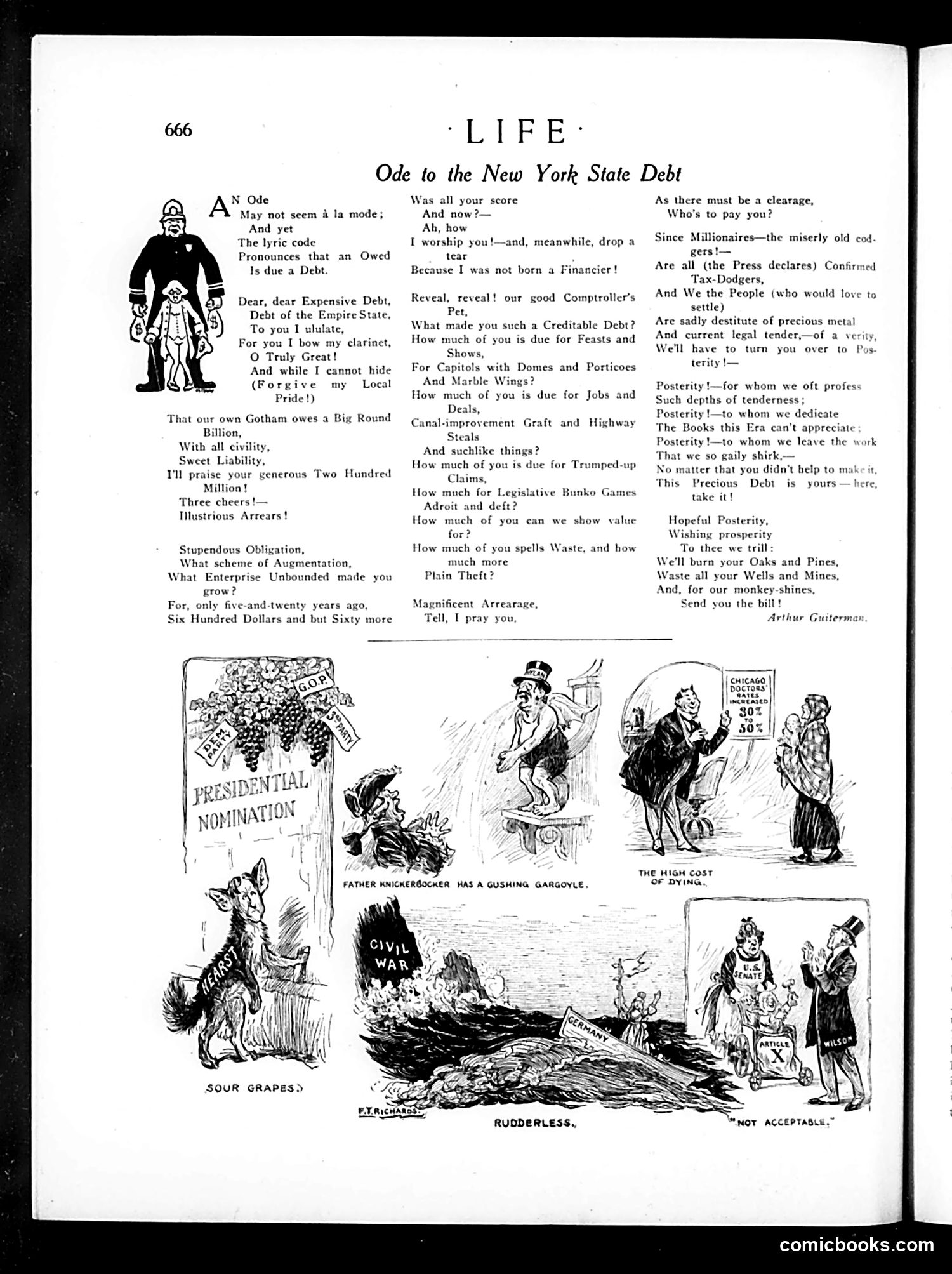
This 1910s *Life* magazine page mocks New York State's ballooning debt—which grew from $660 to $200+ million in 25 years. Poet Arthur Guiterman's "Ode" sarcastically "praises" this debt while cataloging its sources: corrupt "Legislative Bunko Games," canal graft, questionable public works, and outright theft disguised as legitimate spending. The satire's punch: politicians cheerfully pass fiscal irresponsibility to future generations ("Posterity"), joking they'll "burn your Oaks and Pines" and "waste all your Wells and Mines" while sending posterity the bill. The accompanying cartoons reinforce themes of waste and political corruption—figures like "Sour Grapes" (left) and "The High Cost of Dying" (right) suggest broader systemic failures. The satire targets both corrupt politicians and wealthy citizens ("Tax-Dodgers") who escape paying their share, leaving ordinary people to bear the burden.
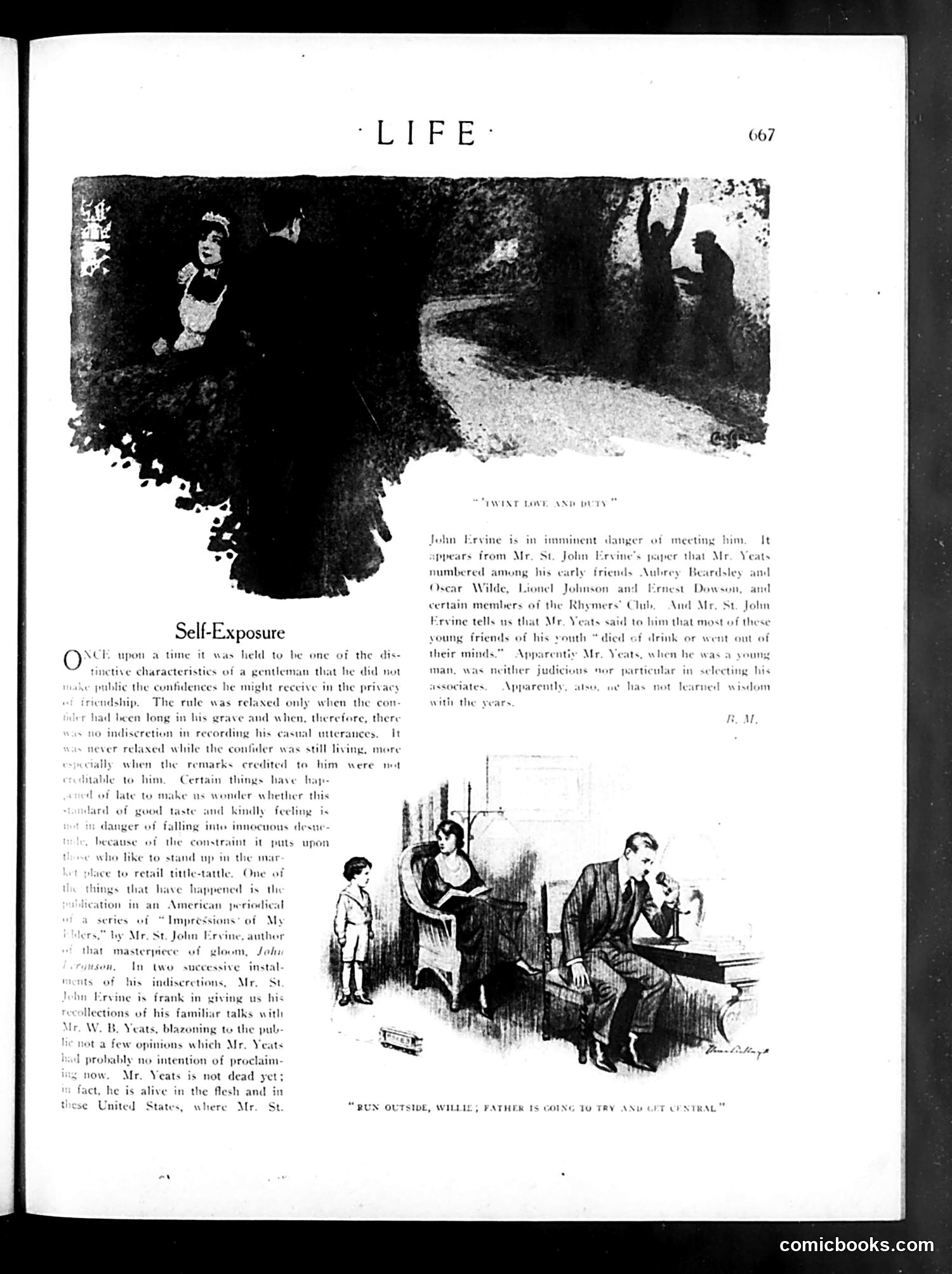
This page satirizes St. John Ervine, an Irish author who published "Impressions of My Friends"—a series in an American periodical containing private recollections of conversations with the living W.B. Yeats. The article criticizes Ervine for violating the gentleman's code of discretion by publicly revealing Yeats's reportedly harsh judgments about their mutual acquaintances (Aubrey Beardsley, Oscar Wilde, Lionel Johnson, Ernest Dowson—members of the Rhymers' Club). The satire's point: Ervine violated social propriety by publishing Yeats's unflattering private remarks—particularly that these young friends "died of drink or went out of their minds"—while Yeats was still alive and unable to defend himself. The cartoon illustrates domestic friction resulting from such indiscreet gossiping, suggesting Ervine's behavior destroys relationships and trust.
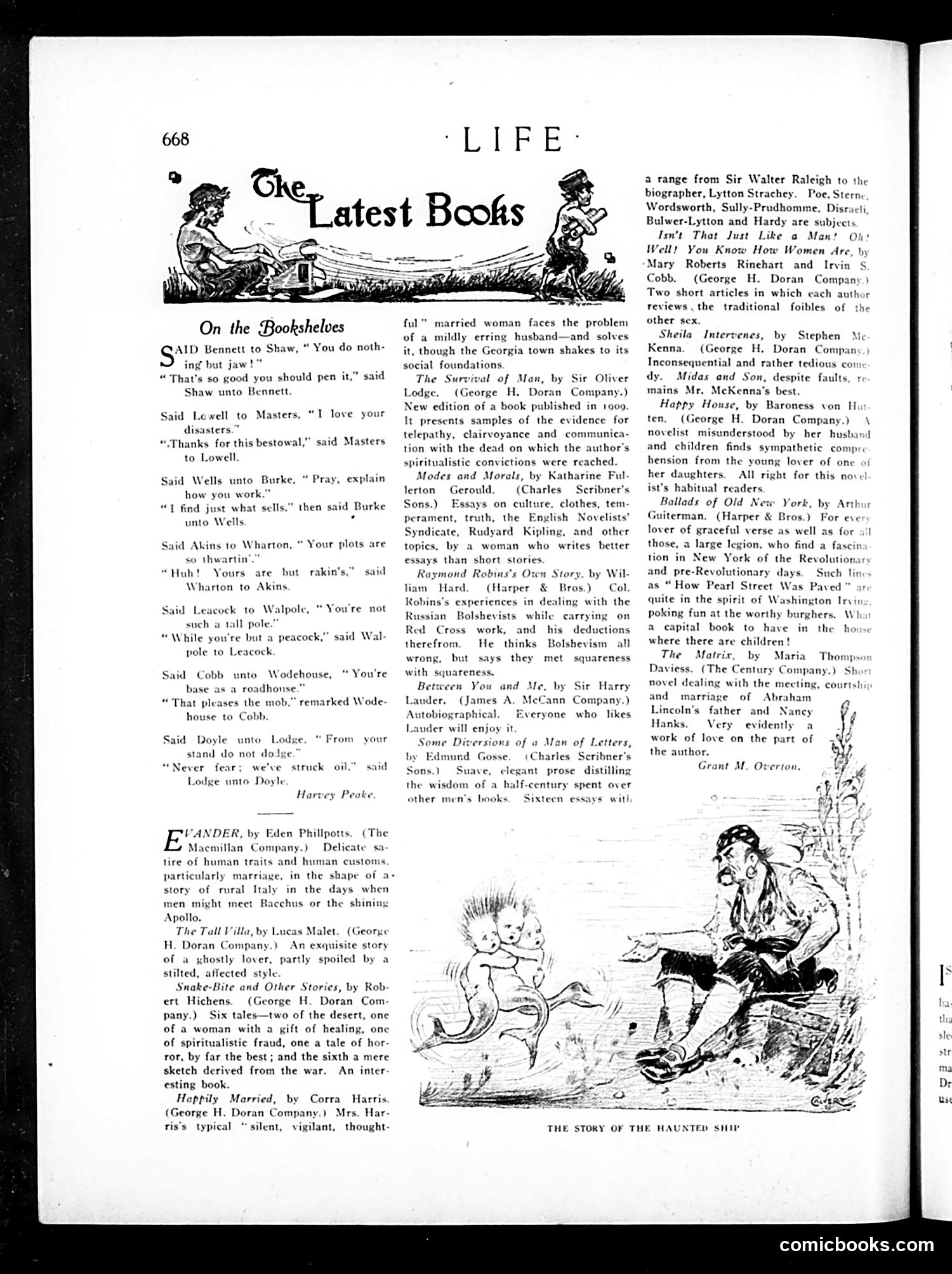
This page from *Life* magazine features book reviews alongside a satirical section titled "On the Bookshelves." The main humor comes from witty exchanges between famous early 20th-century authors—Bennett, Shaw, Wells, Masters, Lowell, Wharton, Leacock, Walpole, Cobb, Wodehouse, Doyle, and Lodge. Each exchange is a punning insult delivered in rhyming couplets that plays on the authors' reputations or names. For example, "Said Lowell to Masters, 'I love your disasters'" mocks Masters's writing style, while "Said Leacock to Walpole, 'You're not such a tall pole'" makes a joke about Walpole's relatively minor literary stature. The cartoon below (credited to Cesare) titled "The Story of the Haunted Ship" depicts a supernatural scene unrelated to the text above. The page also contains genuine book reviews of contemporary publications by the listed authors.
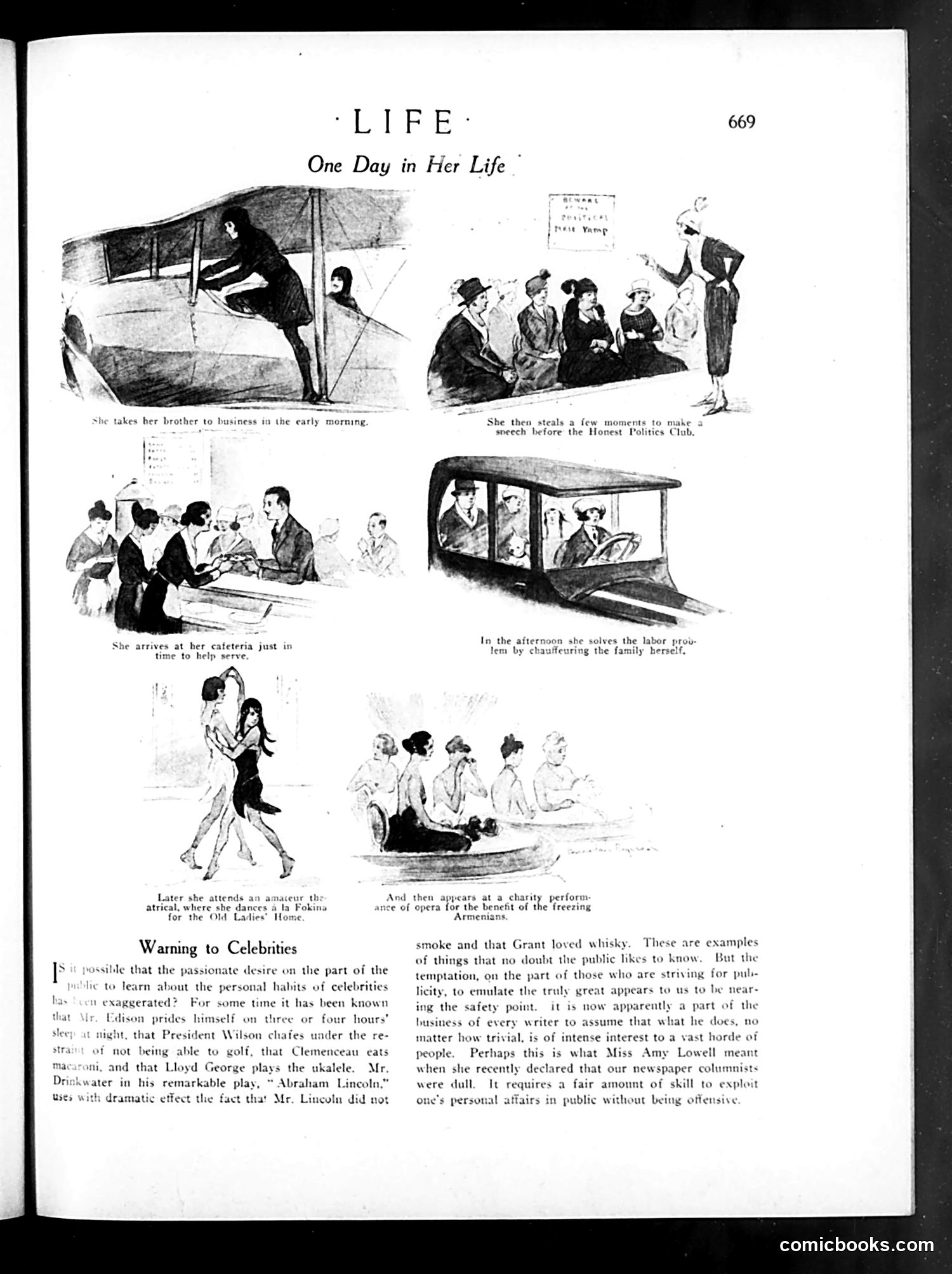
This page satirizes the modern woman's impossible schedule and the public's obsession with celebrities' private lives. The top comic strip depicts a busy woman's day: taking her brother to business, giving a speech to a "Honest Politics Club," solving labor problems by driving the family car, and attending charity opera performances. The satire suggests she's trying to do everything—be productive, politically engaged, socially conscious, and philanthropic—simultaneously. The "Warning to Celebrities" article below mocks how public figures and aspiring publicity-seekers reveal trivial personal habits (Edison's sleep schedule, Wilson's golfing, Lloyd George's ukulele playing) to seem relatable and interesting. The piece criticizes this trend as shallow—suggesting that minor details about celebrities' lives shouldn't be treated as newsworthy. The reference to Amy Lowell indicates newspaper columnists are similarly exploiting personal trivia for column space, making journalism dull rather than substantive. The satire targets both celebrity culture and women's expanding but conflicted social roles in the early 20th century.
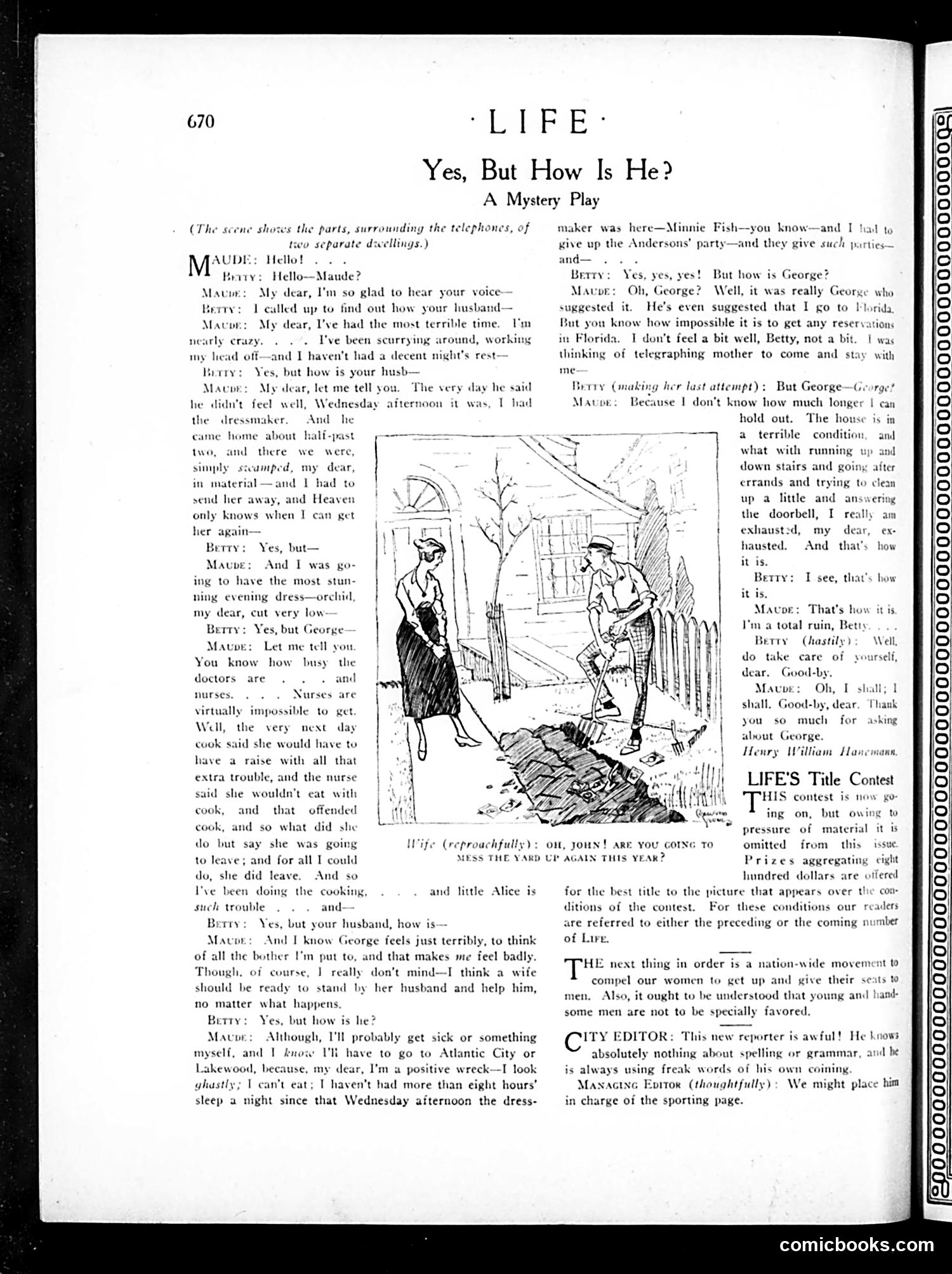
This is a comedy sketch mocking upper-class women's self-absorption. Two women (Maude and Betty) speak by telephone. Betty repeatedly asks how Maude's husband George is feeling (he's apparently ill), but Maude launches into endless complaints about *her own* suffering: the dressmaker's inconvenience, the cook's demands, her exhaustion, her appearance, potential trips to Atlantic City. Each time Betty tries to redirect to George's health ("Yes, but how is your husband?"), Maude ignores the question and continues detailing her own troubles. The joke is that Maude is so consumed with her domestic problems and social obligations that she can barely acknowledge her husband's illness—she mentions him only to describe how *his* condition affects *her*. The accompanying illustration shows a domestic scene. The satire criticizes wealthy women for viewing themselves as perpetual victims of household management while being indifferent to others' actual needs.
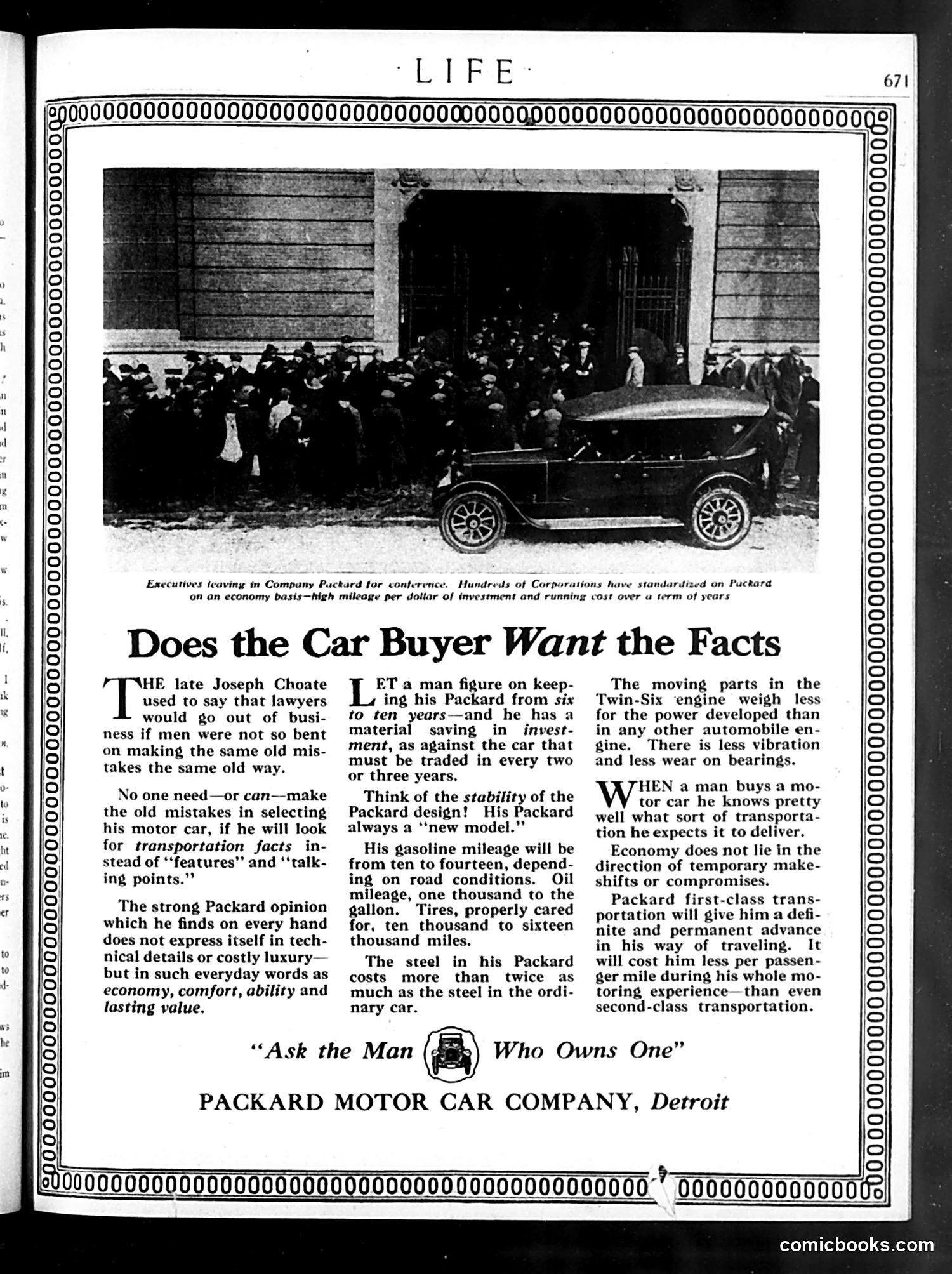
This is a **Packard automobile advertisement**, not satire or political commentary. The page promotes the Packard Motor Car Company's vehicles to potential buyers. The headline "Does the Car Buyer Want the Facts" frames the ad's argument: buyers should prioritize practical transportation benefits over flashy marketing. The text references Joseph Choate (a historical figure) to suggest people repeat old mistakes—here, supposedly choosing inferior cars. The photograph shows executives outside a building with a Packard automobile, establishing the car's association with business success and corporate standardization. The advertisement emphasizes **durability and economy**: a Packard lasts 6-10 years versus competitors requiring replacement every 2-3 years; superior steel construction; excellent fuel mileage; and reduced maintenance costs over time. The Twin-Six engine receives technical praise. The tagline "Ask the Man Who Owns One" became Packard's famous slogan, implying satisfied owners would endorse the brand. This represents early automotive advertising targeting rational, cost-conscious buyers rather than emphasizing luxury or speed.
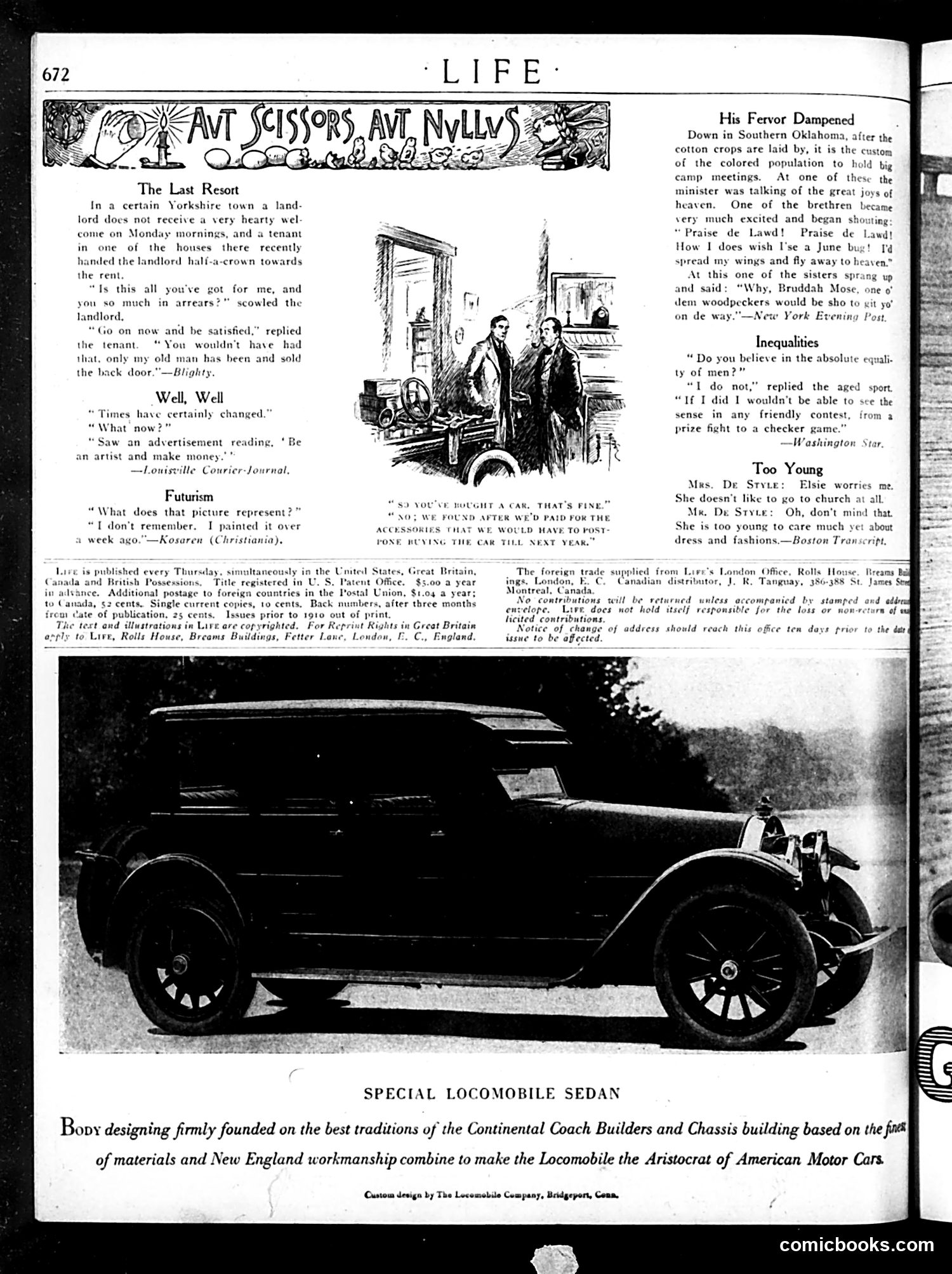
This page contains several short humor pieces typical of *Life* magazine's satirical format: **"The Last Resort"** mocks tenant-landlord relations: a destitute tenant pays rent by selling his door, prompting the landlord's grudging acceptance—dark humor about poverty. **"Well, Well"** satirizes changing times: an advertisement promising artists can "make money" represents optimism about new commercial opportunities. **"Futurism"** jokes about modernist art's abstraction: a painter can't remember what he painted a week ago, mocking the movement's apparent meaninglessness. **"Scissors, Ave Nullus"** (cartoon with two men and a car) criticizes consumer culture: buyers discover car accessories cost so much they must postpone purchasing the vehicle itself—commentary on hidden costs and poor financial planning. The remaining pieces use racial dialect humor and gender stereotypes typical of the era—largely incomprehensible and offensive to modern audiences. At bottom: a Locomobile sedan advertisement claiming superiority through Continental coachbuilding traditions and American craftsmanship.
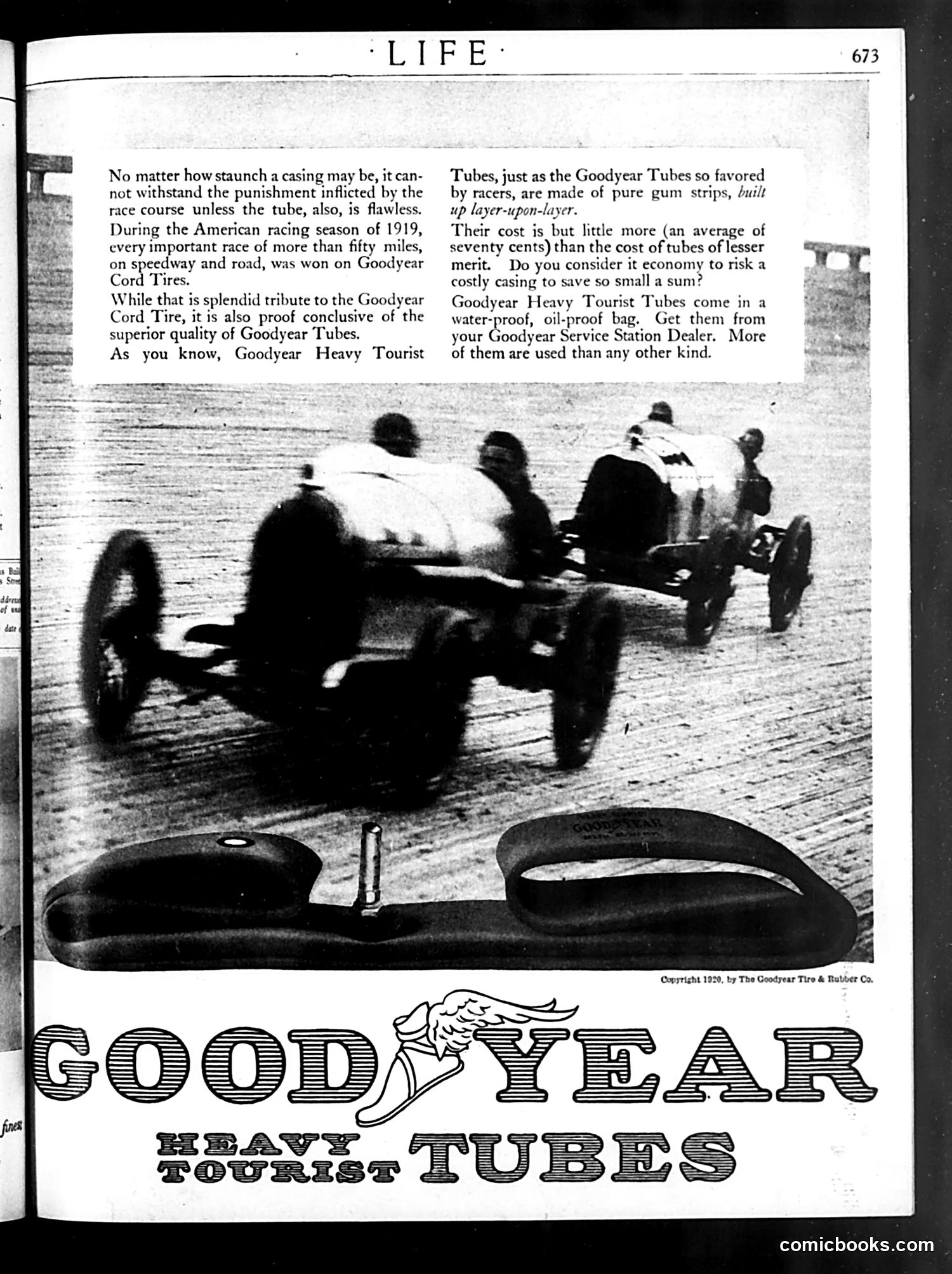
This is primarily a **Goodyear tire and tube advertisement**, not political satire. The page promotes Goodyear Heavy Tourist Tubes by claiming they won "every important race of more than fifty miles" during the 1919 American racing season. The image shows racing cars in competition, serving as visual proof of the product's durability and performance. The advertisement argues that while Goodyear tubes cost only slightly more (70 cents average) than inferior alternatives, they're essential protection for expensive tire casings—essentially asking consumers: why risk a costly investment to save pennies? The "Heavy Tourist" tubes are marketed as the same quality used by professional racers, now available to ordinary drivers through Goodyear Service Station dealers. This is straightforward consumer advertising from the early automotive era, not editorial cartoon or satire.
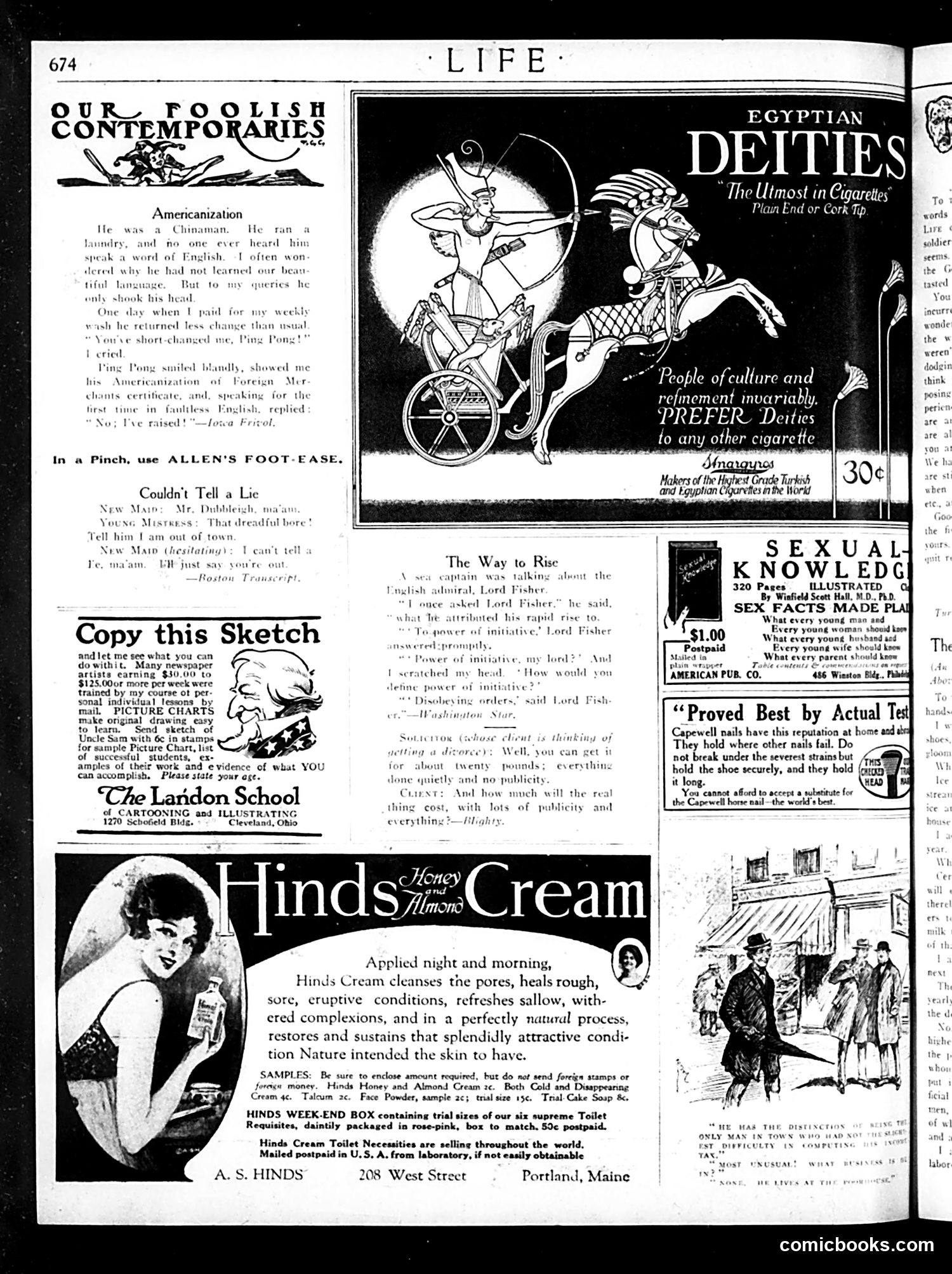
This page from *Life* (a satirical magazine, likely early 1900s) contains primarily **advertisements and humor columns** rather than political cartoons. **Main Content:** The "Our Foolish Contemporaries" section includes a humor piece titled "Americanization" about a Chinese laundryman named Ping Pong. The joke plays on contemporary stereotypes: despite appearing to not understand English, the character reveals he's learned American entrepreneurship by shortchanging a customer and defending it as "raising" his prices. The satire mocks both Chinese immigrants and American capitalist greed. **Other notable items:** - "Couldn't Tell a Lie" - a brief joke about Southern etiquette - Multiple beauty and health product ads (*Hinds Cream*, *Egyptian Deities* cigarettes, etc.) - An advertisement for *The Landon School* of cartooning - A book advertisement for "Sexual Knowledge" **Historical context:** This reflects early-20th-century American attitudes toward immigrants and consumer culture. The humor relies on ethnic caricature and dialect humor common to the era.
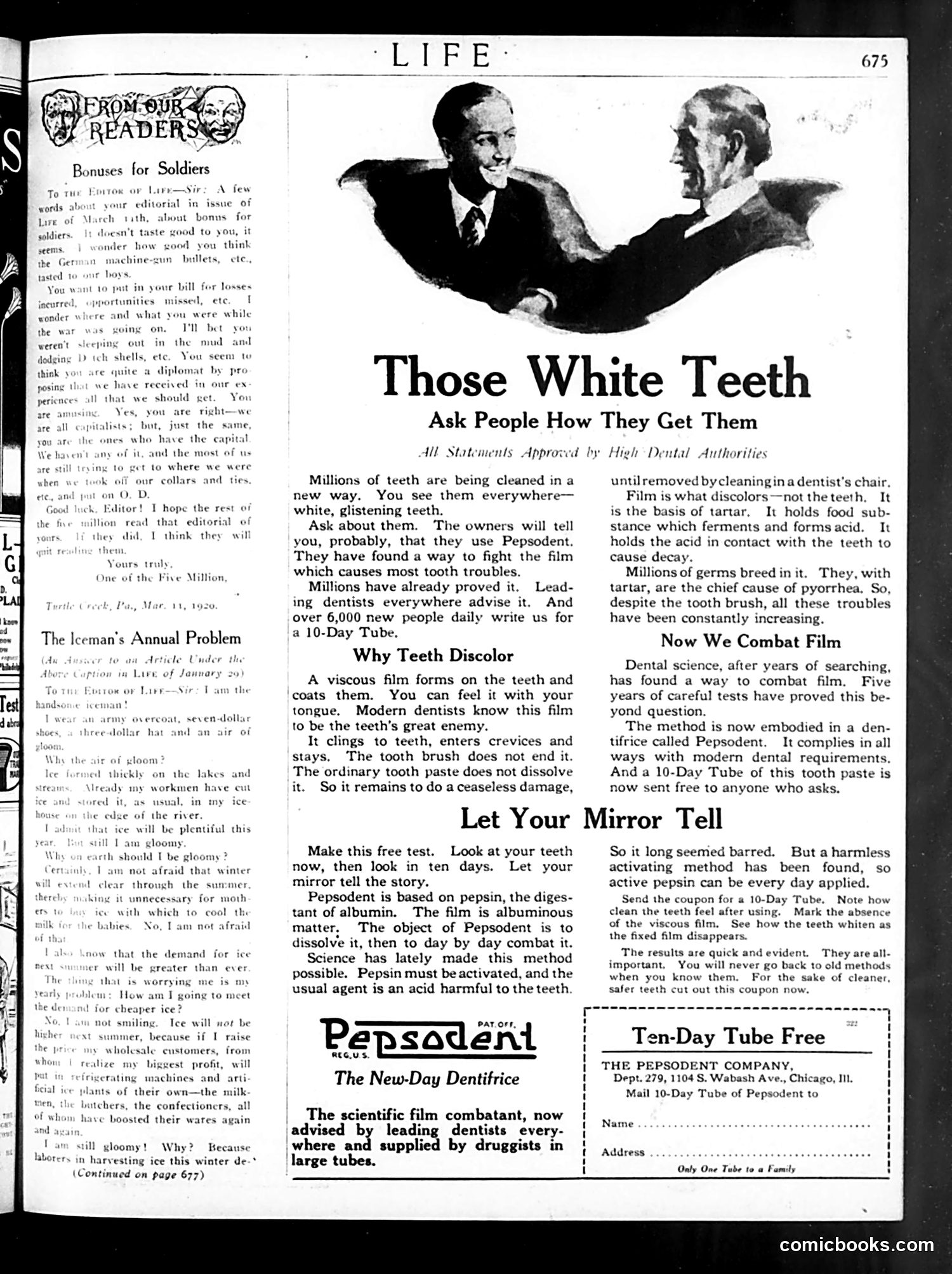
This page combines reader letters and a toothpaste advertisement. The left side features two opinion pieces: one soldier complaining that Life's editorial undervalued war bonuses (suggesting Life dismissed soldier sacrifices too casually), and an iceman worried about post-war labor costs affecting his industry. The dominant content is a **Pepsodent toothpaste advertisement**—not satire, but period marketing. It claims scientific backing ("statements approved by high dental authorities") and uses a novel advertising strategy: offering a free 10-day trial tube via coupon. The ad's core pitch is that Pepsodent's pepsin-based formula dissolves the invisible "film" that causes tooth discoloration and decay—a claim positioning it as scientifically superior to ordinary toothpaste. The advertisement reflects early 20th-century marketing tactics: scientific authority claims, free samples, and direct mail response coupons. It's notable mainly as a historical artifact of consumer advertising evolution, not as satire.
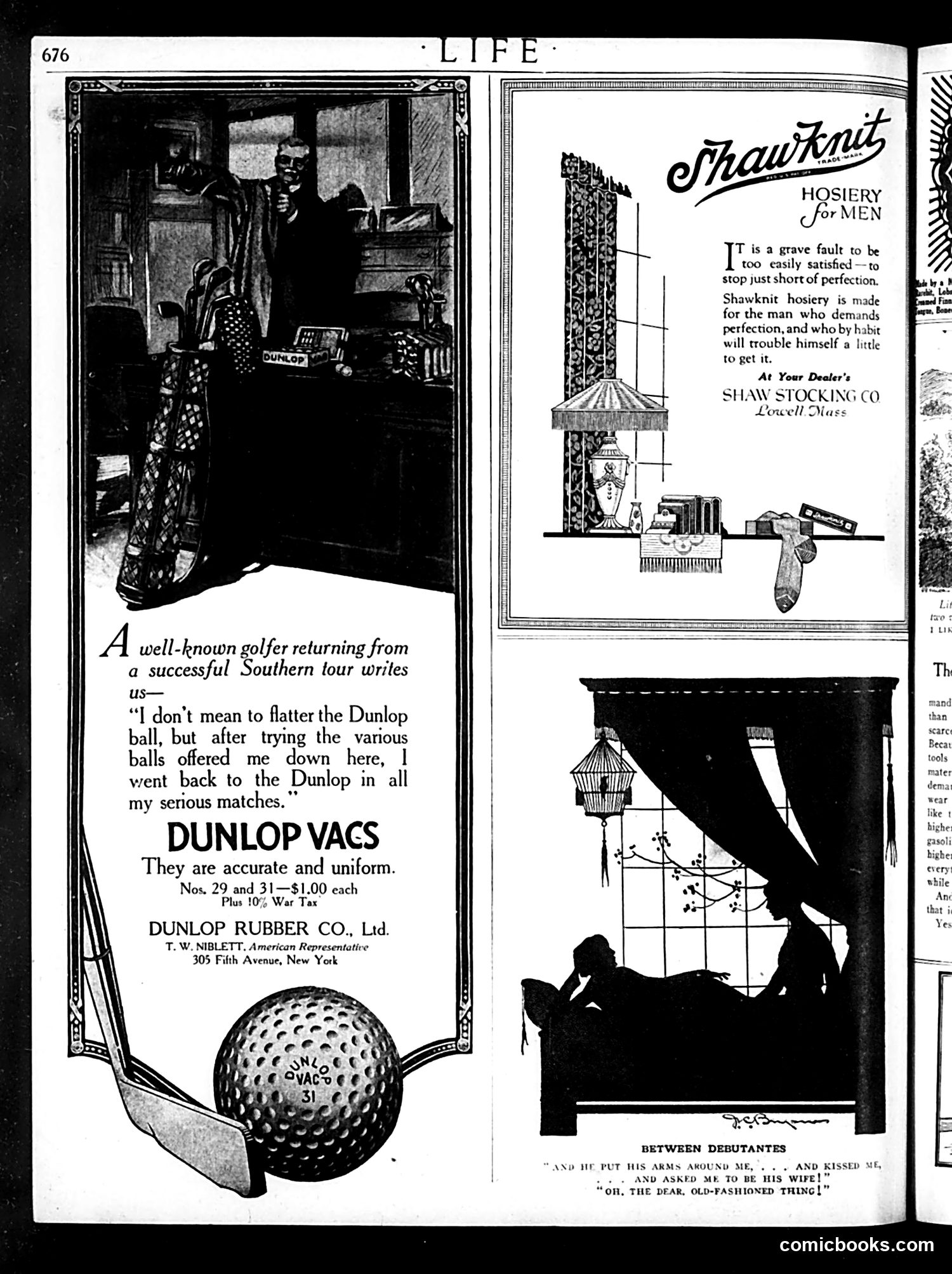
This page consists primarily of **advertisements**, not political cartoons. The left side advertises **Dunlop golf balls** via a testimonial from "a well-known golfer" praising their quality after a Southern tour. The pitch emphasizes accuracy and uniformity at $1.00 each (plus 10% war tax, indicating WWI-era publication). The right side advertises **Shawknit hosiery for men**, framing quality socks as a mark of a discerning gentleman who demands perfection. The bottom cartoon, titled "Between Debutantes," depicts a social humor scenario: one young woman excitedly tells another that a man proposed to her in old-fashioned romantic fashion (embracing and asking for her hand). The other woman's response—"Oh, the dear, old-fashioned thing!"—suggests gentle mockery of traditional courtship as charmingly antiquated, likely reflecting 1920s modernization of dating customs among upper-class youth.
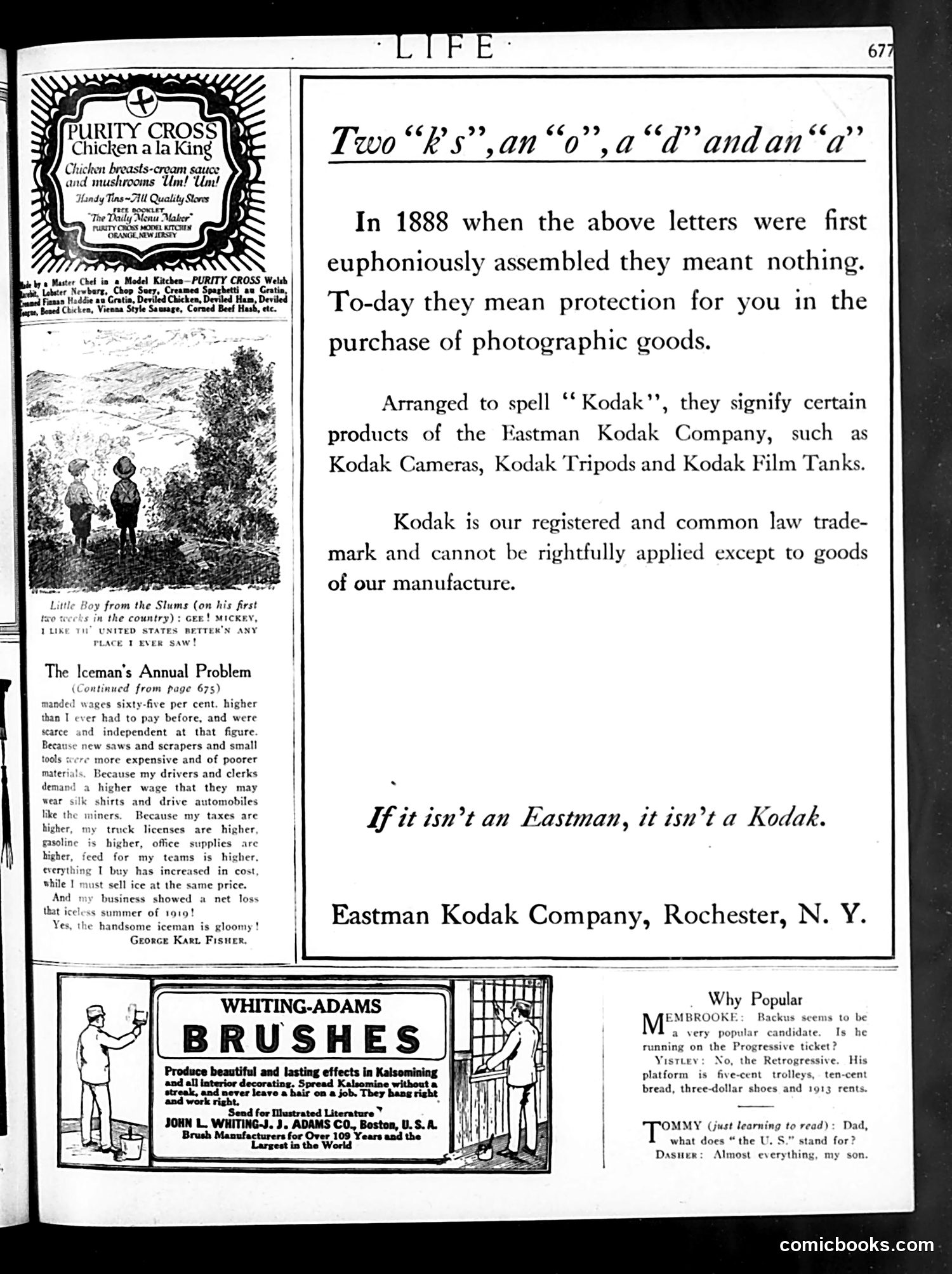
This page is primarily **advertising** rather than political satire. The main content is an **Eastman Kodak Company trademark defense** explaining that "Kodak" (spelled from two "k's," an "o," a "d," and an "a") became a registered trademark protecting their photographic products. The advertisement emphasizes brand protection—only genuine Eastman goods may bear the Kodak name. Supporting content includes: - A **Purity Cross advertisement** for chicken dishes - A **Whiting-Adams Brushes ad** - A continuing article about "The Iceman's Annual Problem" (business economics) - Two brief **humorous exchanges**: one about a political candidate's "Retrogressive" platform (five-cent trolleys, expensive bread/rents—likely 1910s-era critiques), and another where a child asks what "U.S." means, with father's answer being vague humor about American complexity The page reflects early 20th-century advertising practices and light domestic humor rather than pointed political cartooning.
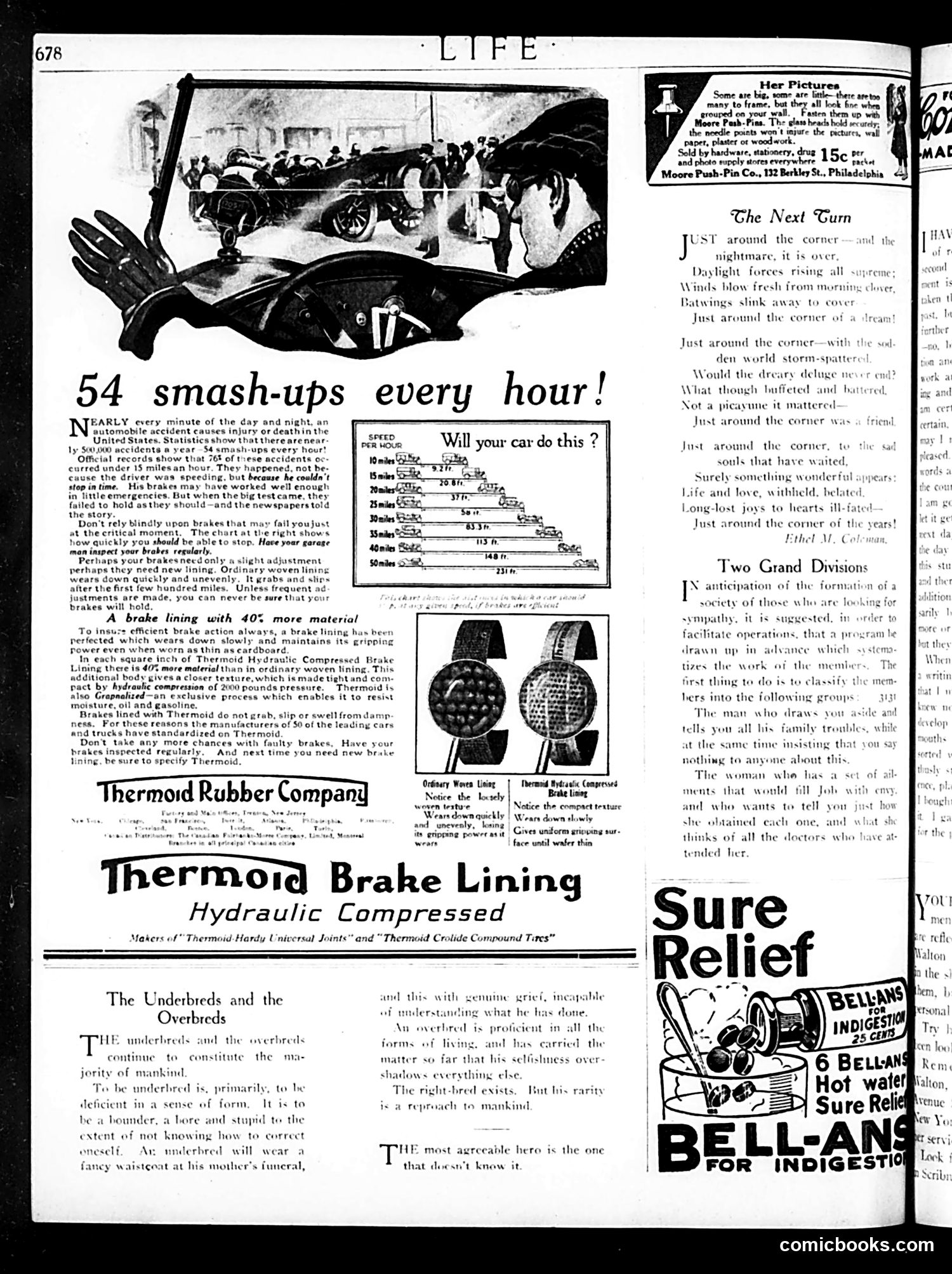
This page is primarily **automotive advertising**, not political satire. The dominant content is a Thermoid Brake Lining advertisement responding to a genuine public safety crisis. **The Context:** The ad cites statistics that nearly 54,000 automobile accidents occurred yearly in America, with 76% happening at speeds under 15 mph—not from speeding but from **brake failure**. This was a real crisis in early automobile safety. **The Advertisement's Point:** Thermoid promotes superior brake lining with "40% more material" than ordinary woven linings. The ad uses visual comparisons showing how their hydraulic-compressed lining maintains grip better than competitors' products that wear unevenly and lose effectiveness quickly. **Supporting Content:** The page includes a performance chart and technical specifications, plus unrelated articles on social etiquette ("The Underbreds and Overbreds") and a poem ("The Next Turn"). There's also a minor ad for Moore Push-Pins for hanging pictures. **For Modern Readers:** This reflects an era when brake safety was genuinely inadequate and manufacturers competed on mechanical reliability rather than style—a serious consumer protection issue before government safety standards.
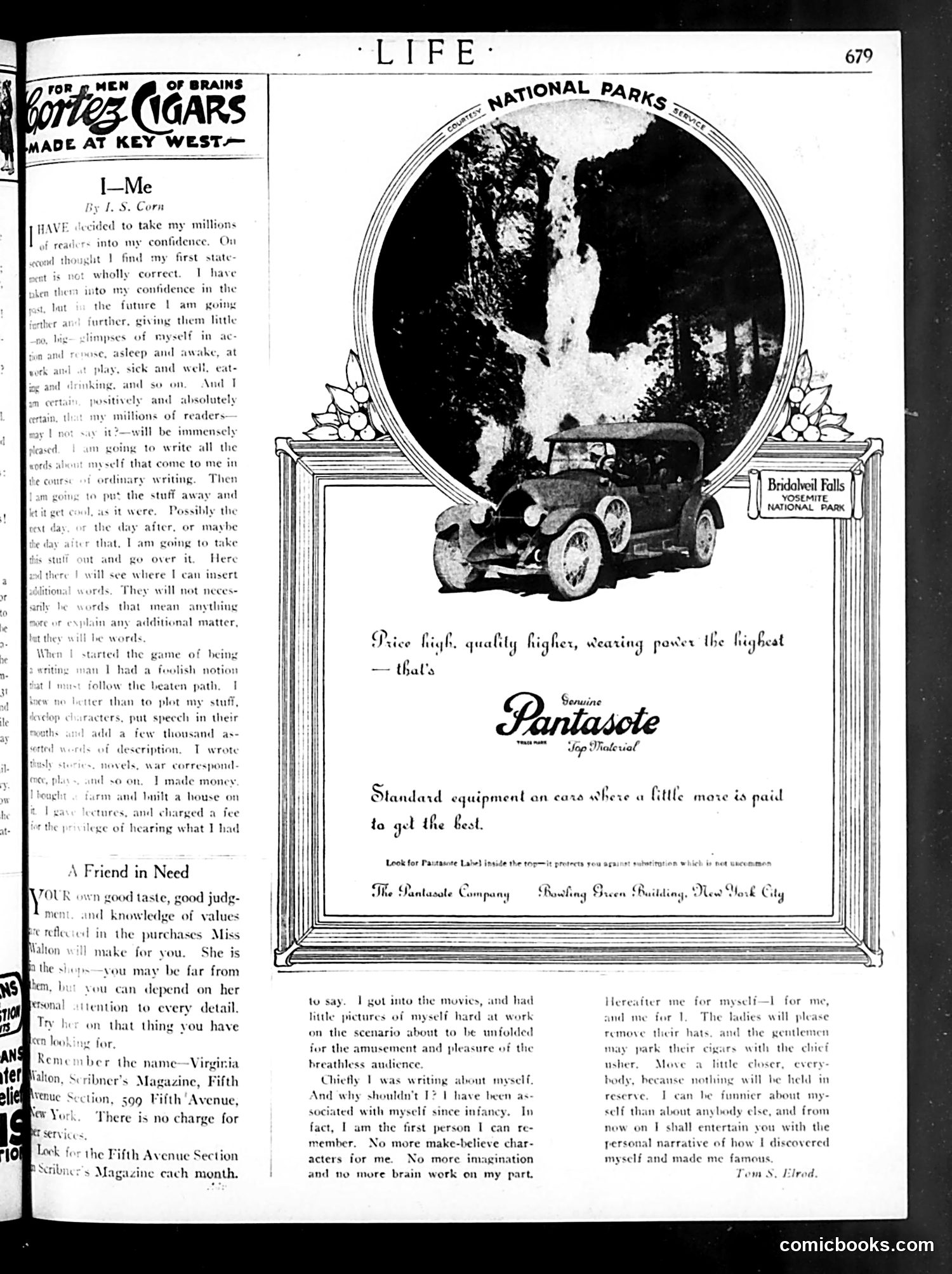
This page contains two distinct pieces: **Left column:** An essay titled "I—Me" by I.S. Corn about his writing process and ambitions. Corn describes deciding to share his creative methods with readers, planning to write material, then revise and polish it. He reflects on his career writing fiction and scenarios, noting he'll focus on autobiographical material going forward because he knows himself best as a subject. **Right side:** An advertisement for Pantasote automobile tires, featuring a luxury car photographed at Bridal Veil Falls in Yosemite National Park. The ad emphasizes quality and durability with the tagline "Price high, quality higher, wearing power the highest—that's Genuine Pantasote." **Social context:** The juxtaposition is likely intentional satire—Corn's self-absorbed essay about making himself famous contrasts with the era's emphasis on product quality and tangible value. The advertisement represents practical consumer goods, while Corn's essay represents vanity and self-promotion, a common satirical tension in 1920s Life magazine.
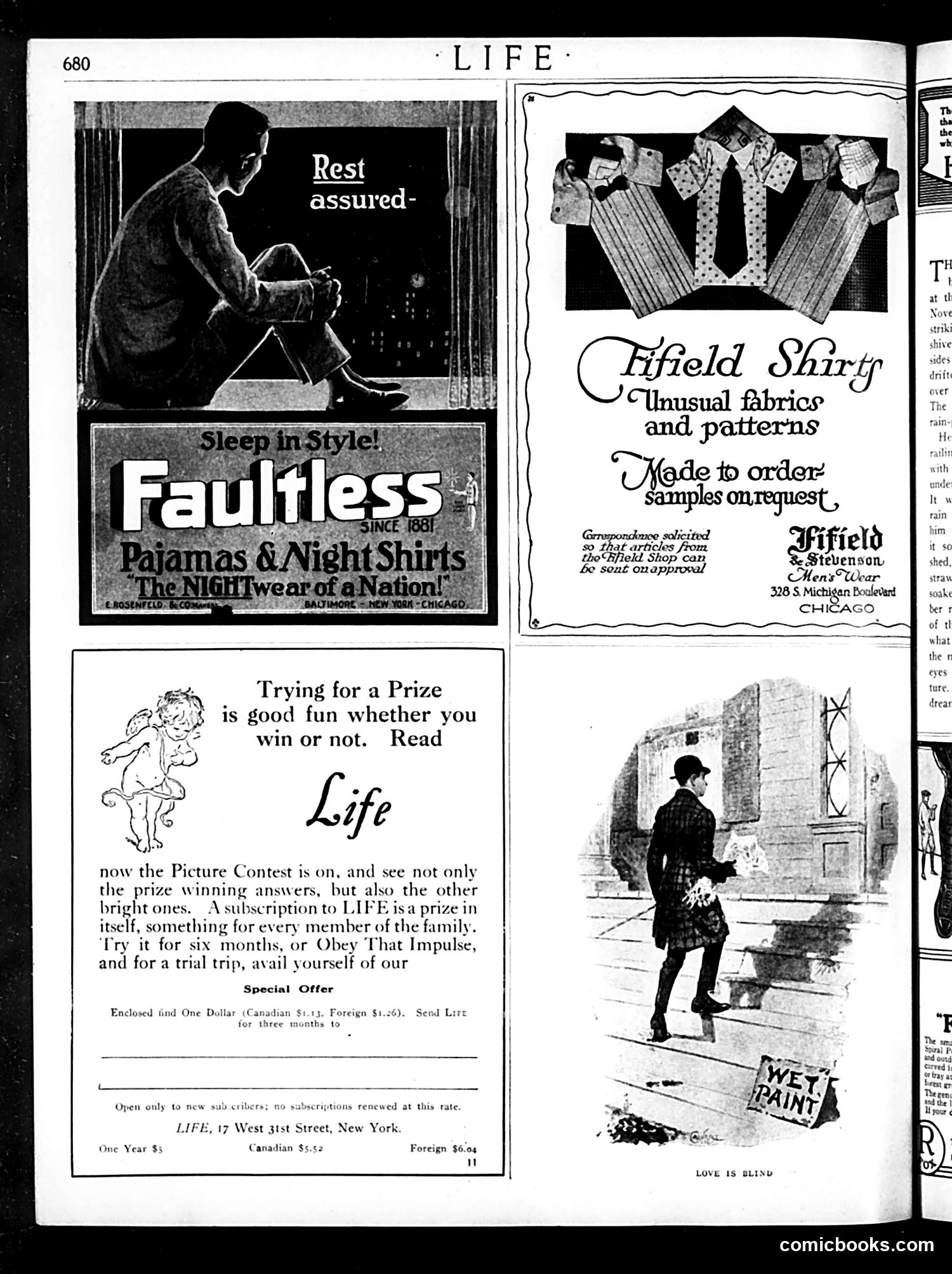
This page is primarily **advertising and promotional content** rather than political satire. The top features ads for **Faultless Pajamas** ("Sleep in Style") and **Fifield Shirt** (custom fabrics). The main content is a **subscription promotion for Life magazine itself**, encouraging readers to enter an ongoing "Picture Contest." The copy emphasizes that participating is fun regardless of winning, and that a Life subscription is itself "a prize" for the whole family. It offers a discounted trial offer. The small cartoon at bottom right labeled "**Love Is Blind**" depicts a man in a bowler hat painting a "Wet Paint" sign on a wall—a visual gag suggesting someone is oblivious to obvious warning, hence "blind" love. This is a standard joke format, not political commentary. The page reflects **early 20th-century Life magazine**: a humor/satire publication that also ran contests and self-promotion to build readership. Nothing here requires historical context beyond understanding Life's subscription model of the era.
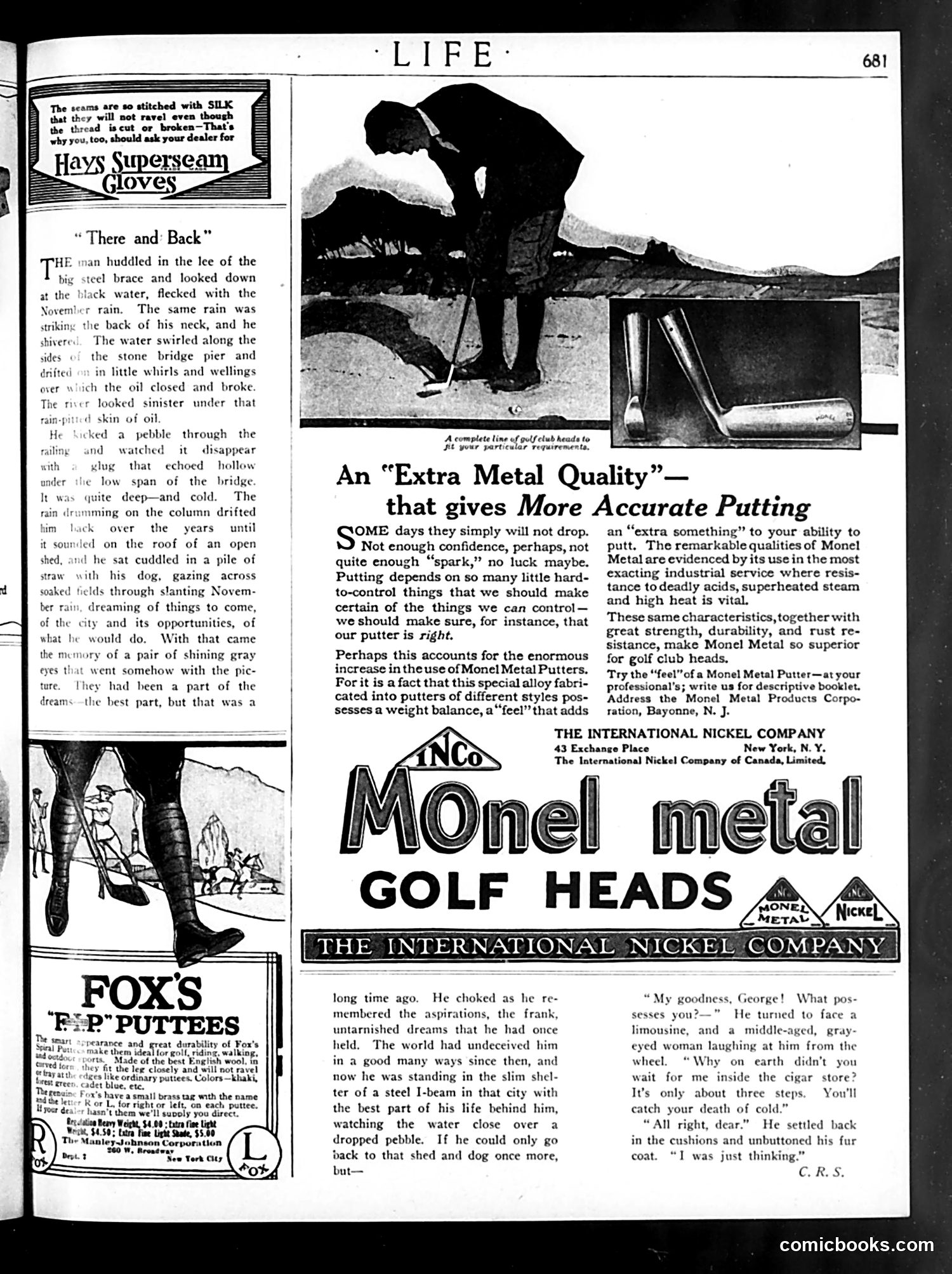
This page is primarily **advertising** with a literary fiction piece as filler content. The main story, "There and Back," depicts a melancholic man standing in the rain on a bridge, remembering his youthful aspirations and a woman with "shining gray eyes." He recalls dreaming of the city and its opportunities while a poor boy with his dog. The narrative's poignant conclusion reveals he's now a wealthy married man in a limousine—his dreams realized materially—yet he's nostalgic for his simpler past. His wife, the gray-eyed woman from memory, calls him in from the cold, suggesting he's achieved success but lost something intangible: youth, hope, or authentic happiness. The story exemplifies early 20th-century sentimental fiction exploring **the bittersweet cost of upward mobility**—a common Life magazine theme. The surrounding advertisements (Hays gloves, Fox's puttees, Monel Metal golf heads) represent the consumer goods and leisure activities his success now affords, yet the narrative questions whether material comfort compensates for lost dreams.
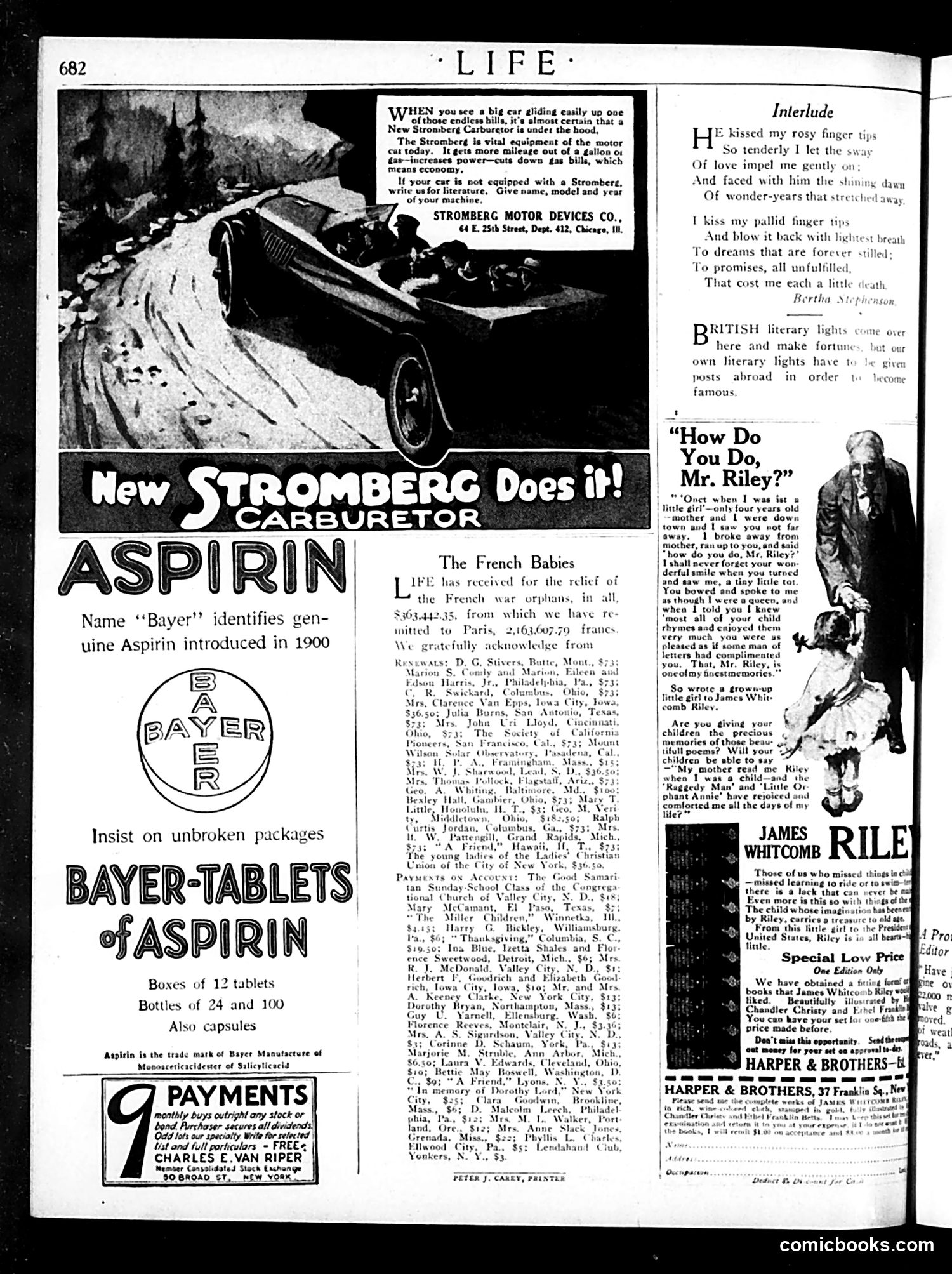
This page is primarily **advertising and literary content** from an early 20th-century Life magazine, not political satire. **Key advertisements:** - **Stromberg Carburetors**: A motor device claiming to improve gas mileage—typical automotive advertising of the era - **Bayer Aspirin**: Emphasizes the trademarked "Bayer" name, reflecting early pharmaceutical marketing when aspirin was still a branded product - **Stock trading service**: Charles E. Van Riper offering investment opportunities **Literary content:** - **"Interlude"** by Bertha Stephenson: A romantic poem about lost love - **"How Do You Do, Mr. Riley?"**: A promotional feature for James Whitcomb Riley's poetry books, presenting a touching anecdote from a childhood encounter with the poet. Harper & Brothers is advertising a special low-price edition of his works. The Riley piece uses nostalgic Americana to sell books—playing on readers' emotional connections to the beloved Indiana poet. There is **no political cartoon or satire** on this page; it's a standard magazine layout mixing commercial and cultural content.
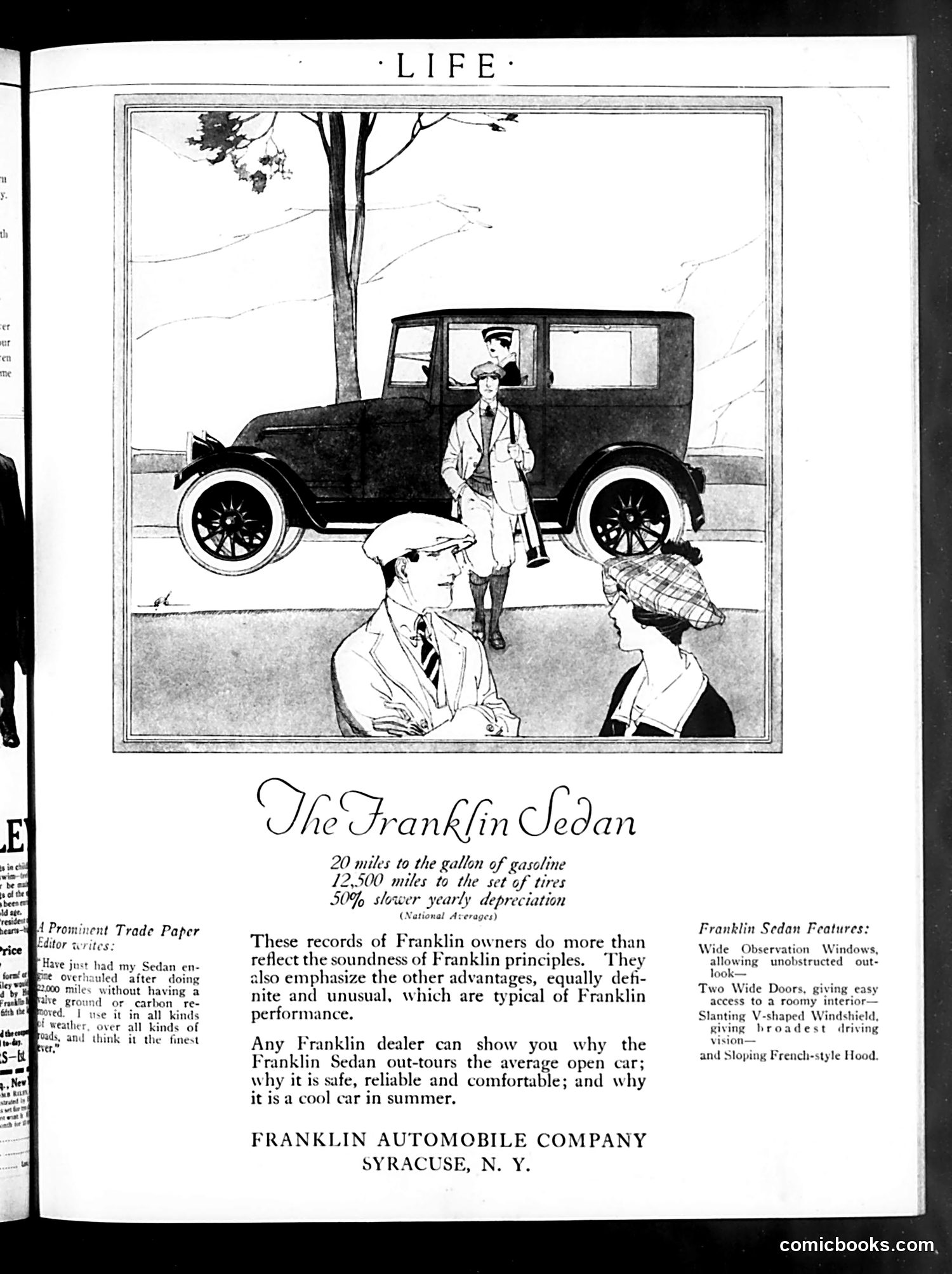
This is a **Franklin automobile advertisement**, not political satire. It appeared in *Life* magazine during the early automobile era (likely 1920s, based on styling and technology references). The illustration shows three well-dressed figures discussing a Franklin Sedan parked behind them. The advertisement emphasizes the car's practical advantages: fuel efficiency (20 miles per gallon), tire durability (12,500 miles), and slower depreciation (50% below average). The "satire" element, if any, is subtle—it's social commentary through *Life's* typical approach: the fashionable, leisured class casually discussing automobiles as status symbols and practical investments. The fine-line illustration style and refined figures reflect *Life's* target audience of educated, affluent readers. For modern readers: this is straight product advertising dressed in the magazine's sophisticated aesthetic. The humor, if present, lies in the earnest sales pitch presented as elevated lifestyle commentary rather than crude advertising.
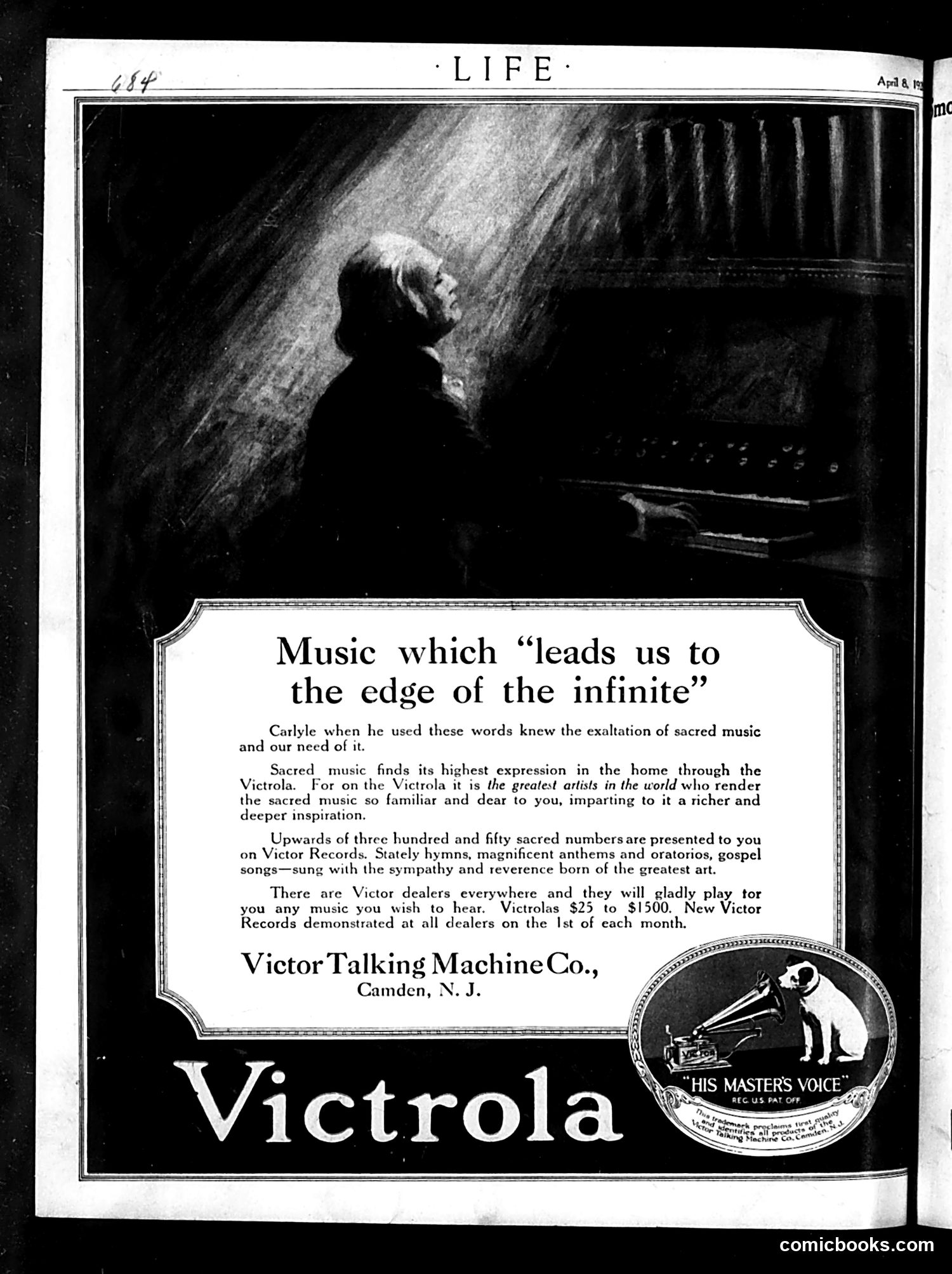
This is a **Victrola phonograph advertisement**, not political satire or a cartoon. The page features a dramatic illustration of an elderly man (appearing to be a composer or musician) at a piano, gazing upward in inspiration, with dramatic lighting suggesting spiritual transcendence. The ad quotes philosopher Thomas Carlyle about sacred music's power to elevate the human spirit. It positions the Victrola—Victor Talking Machine Company's home phonograph—as the ideal device for experiencing "the greatest artists in the world" performing hymns, anthems, and gospel songs in one's home. This reflects early 20th-century marketing strategy: framing consumer goods as culturally refined and spiritually enriching. The "His Master's Voice" logo (visible lower right) became the company's iconic trademark. There is no satire here—this is straightforward luxury product advertising targeting middle-to-upper-class consumers who could afford machines priced $25-$1500 (substantial sums at the time).