
Life, 1920-04-08 · page 28 of 44
Life — April 8, 1920 — page 28: what you’re looking at
What you’re looking at
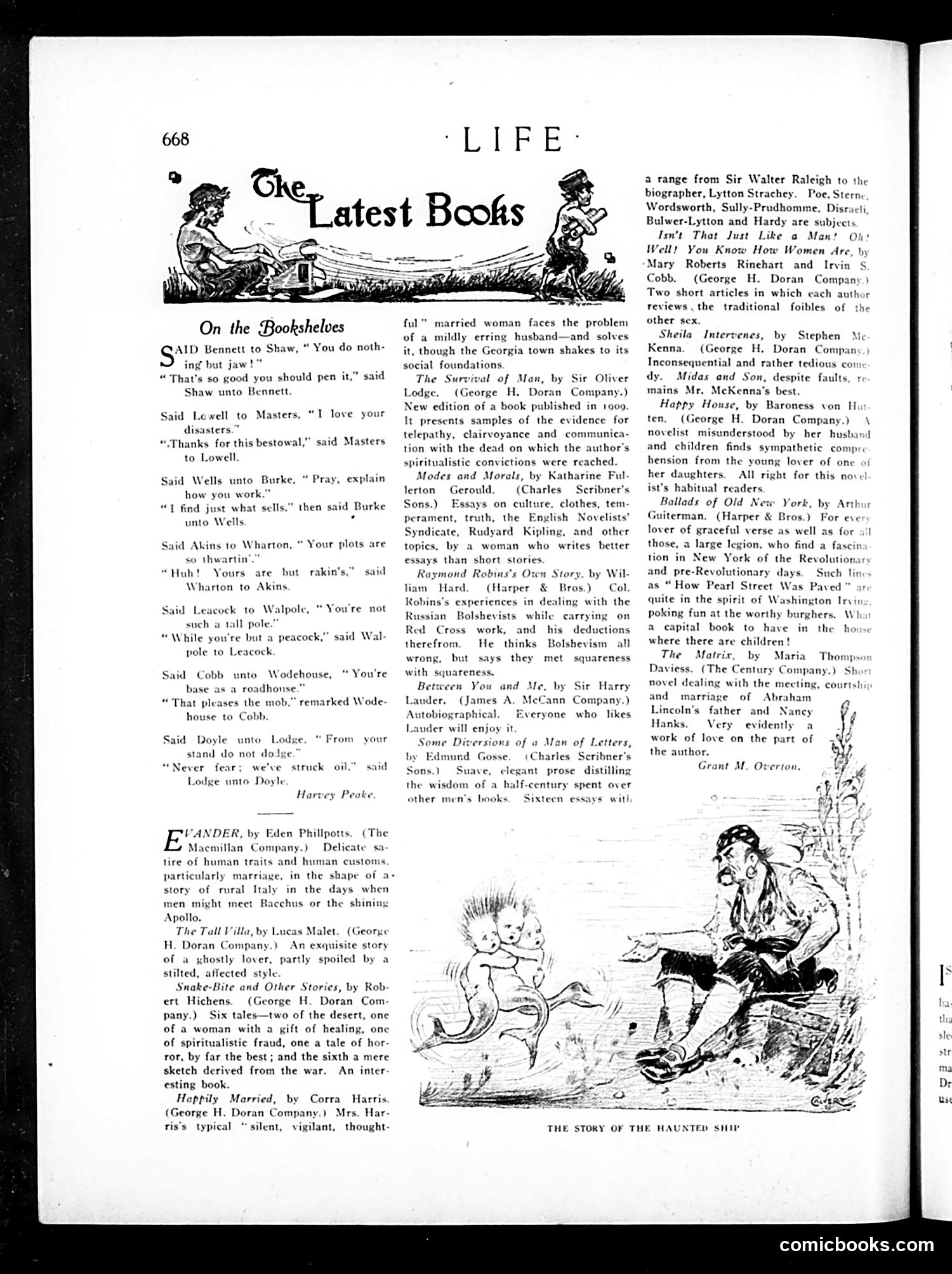
This page from *Life* magazine features book reviews alongside a satirical section titled "On the Bookshelves." The main humor comes from witty exchanges between famous early 20th-century authors—Bennett, Shaw, Wells, Masters, Lowell, Wharton, Leacock, Walpole, Cobb, Wodehouse, Doyle, and Lodge. Each exchange is a punning insult delivered in rhyming couplets that plays on the authors' reputations or names. For example, "Said Lowell to Masters, 'I love your disasters'" mocks Masters's writing style, while "Said Leacock to Walpole, 'You're not such a tall pole'" makes a joke about Walpole's relatively minor literary stature. The cartoon below (credited to Cesare) titled "The Story of the Haunted Ship" depicts a supernatural scene unrelated to the text above. The page also contains genuine book reviews of contemporary publications by the listed authors.
📄 Transcribed text from this page (OCR, searchable)
Machine-transcribed from the original scan — historical spelling and the odd misread are preserved.
On the Bookshelves AID Bennett to Shaw, “ You do noth- gf but jaw!” “That's so good you should pen it,” said Shaw unto Bennett Said Lowell to Masters, “I love your disasters.” “Thanks for this bestowal,” said Masters to Lowell Said Wells unto Burke, “ Pray, explain how you work.” “1 find just what sells.” then said Burke unto Wells. Said Akins to Wharton, so thwartin’.” “Huh! Yours are but rakin’s,” said Wharton to Akins. Your plots are Said Leacock to Walpole, “You're not such @ tall pole.” “While you're but a peacock,” said Wal pole to Leacock Said Cobb unto Wodehouse, “ You're base as a roadhonse.” “That pleases the mob.” remarked Wode house to Cobb. Said Doyle unto Lodge, “ nm your stand do not d. “Never fear; we've struck oil.” said Lodge unto Doyle Hai Pe VANDER, by Eden Phillpotts. (The E Macmillan Company.) Delicate sa tire of human traits and human customs particularly marriage, in the shape of a+ story of rural Italy in the days when men might meet Bacchus or the shining Apollo. The Tall Villa, by Lucas Malet. (George H. Doran Company.) An exquisite story of « ghostly lover, partly spoiled by a stilted, affected style Snake-Bite and Other Stories, by Rob: ert Hichens. (George H. Doran Com- pany.) Six tales—two of the desert, one of a woman with a gift of healing, one of spiritualistic fraud, one a tale of hor- ror, by far the best; and the sixth a mere sketch derived from the war. An inter- esting book. Happily Married, by Corra Harris (George H. Doran Company.) Mrs. Har- ris’s typical “silent, vigilant, thought- ils PME, * ful” married woman faces the problem of a mildly erring husband—and solves it, though the Georgia town shakes to its social foundations. The Survival of Man, by Sir Oliver Lodge. (George H. Doran Company.) New edition of a book published in 1909. It presents samples of the evidence for telepathy, clairvoyance and communica- tion with the dead on which the author's spiritualistic convictions were reached. Modes and Morals, by Katharine Ful- lerton Gerould (Charles Scribner's Sons.) Essays on culture, clothes, tem- perament, truth, the English Novelists’ Syndicate, Rudyard Kipling, and other topics, by a woman who writes better essays than short stories. Raymond Robins's Own Story, by Wil- liam Hard. (Harper & Bros.) Col. Robins’s experiences in dealing with the Russian Bolshevists while carrying on Red Cross work, and his deductions therefrom, He thinks Bolshevism all wrong, but says they met squareness with s eness. Between You and Me, by Sir Harry Lauder. (James McCann Company.) Autobiographical. Lauder will enjoy it. Some Diversions of a Man of Letters, by Edmu Gosse. (Charles Scribner's Sons.) Suave, elegant prose distilling the wisdom of a half-century spent over other men’s bo Everyone who likes Sixteen essays wit! THE STORY OF THE a range from Sir Walter Raleigh to the biographer, Lytton Strachey. Poe, Stern Wordsworth, Sully-Prudhomme, Disraeli Bulwer-Lytton and Hardy are subjects Isn't That Just Like a@ Man! ¢ Well!’ You Know How Women Are, by Mary Roberts Rinehart and Irvin Cobb. (George H. Doran Company.) Two short articles in which cach author reviews. the traditional foibles of the other sex. Sheila Intervenes, by Stephen M Kenna. (George H. Doran Compan Inconsequential and rather tedious cor dy. Midas and Son, despite faults mains Mr. McKenna’s best. Happy House, by Baroness von H ten, (George H. Doran Company.) novelist misunderstood by her hus and children finds sympathetic compr: hension from the young lover of one her daughters. All right for this nov« ist's habitual readers Ballads of Old New York, by Arthur Guiterman. (Harper & Bros.) For ev« lover of graceful verse as well as for those, a large legion, who find a fascir tion in New York of the Revolutionar and pre-Revolutionary days. Such lin as “How Pearl Street Was Paved ” quite in the spirit of Washington Irvir poking fun at the worthy burghers. W a capital book to have in the ho where there are children! The Matrix, by Maria Thor Daviess. (The Century Company.) novel dealing with the mecting, court and marriage of Abraham - Lincoln's father and Nancy fy Hanks. Very evidently a work of love on the part of the author, Grant M. Overton, HAUNTED SHIP comicbooks.com