
Life, 1920-04-08 · page 20 of 44
Life — April 8, 1920 — page 20: what you’re looking at
What you’re looking at
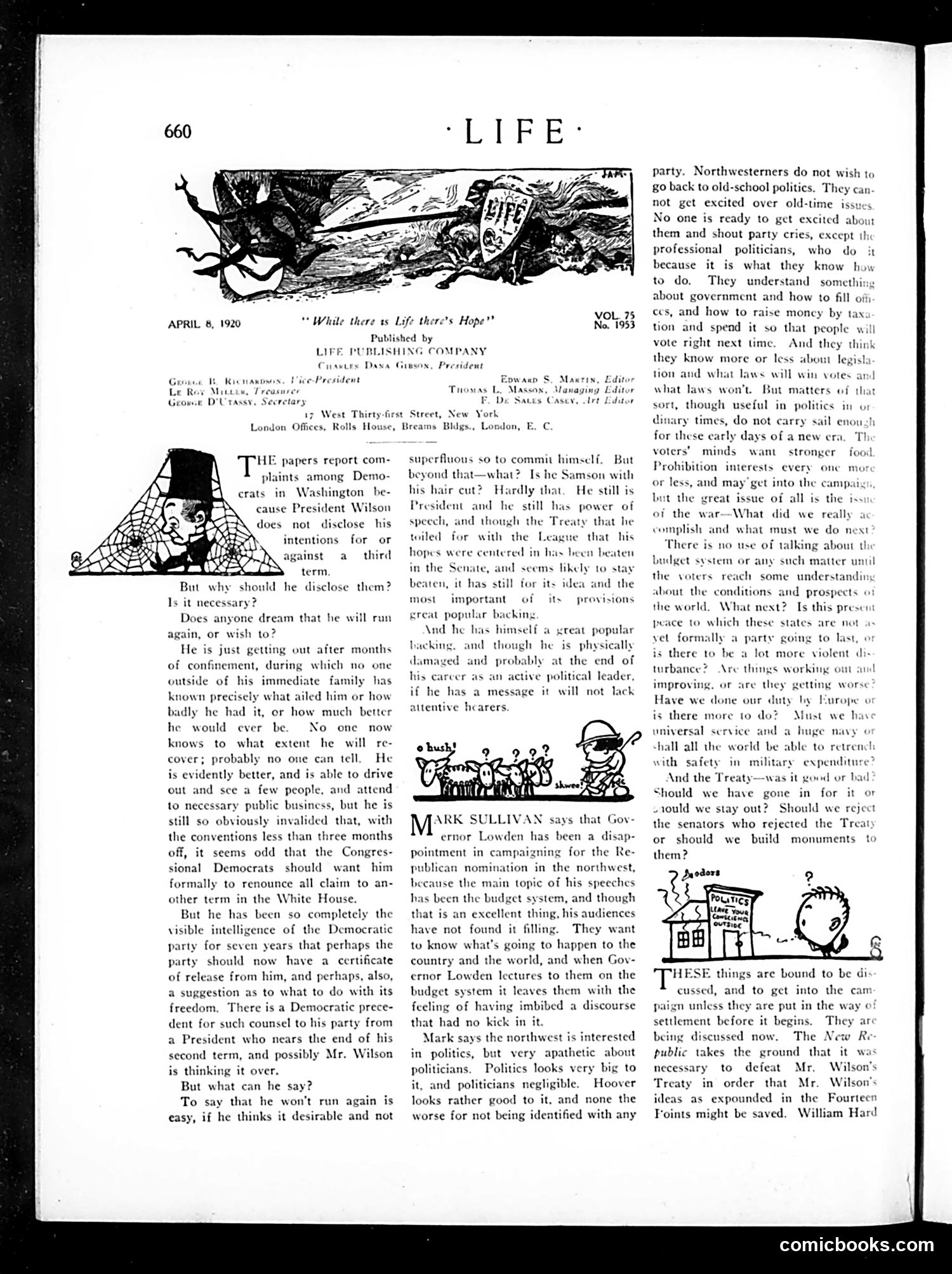
This page discusses whether President Woodrow Wilson should publicly declare he won't seek a third term. Wilson has just recovered from a serious illness (likely his 1919 stroke, though not named here) that confined him for months. The editorial argues it's unnecessary for Wilson to make such a declaration—it's already obvious he won't run again given his weakened health. However, it notes the Democratic Party may want formal release from him, and perhaps guidance on its future direction. A secondary piece by Mark Sullivan critiques Governor Frank Lowden's Republican campaign in the northwest, saying voters want discussion of major issues—what will happen to the country and world—not just budget policy. Sullivan notes northwestern voters find politics important but politicians negligible, and that Herbert Hoover appeals to them partly *because* he's unidentified with old-style party politics. The cartoons (not clearly detailed in OCR) appear to illustrate these political uncertainties.
📄 Transcribed text from this page (OCR, searchable)
Machine-transcribed from the original scan — historical spelling and the odd misread are preserved.
Pul LIFF. Curaetrs ce-President 17 West Thirty-fi Rolls Ho napers report com- plaints among Demo- crats in) Washington cause President Wilson not his intentions inst a term he disclose them? be- does disclose for or third But s it necessary? why should Does anyone dream that he will run again, or wish to? He is just getting out after months of confinement, during which no one outside of his immediate family has known precisely what ailed him or how badly he had it, or how much better he would No knows to he cover; probably no one can tell ever be what extent one now will re- He is evidently better, and is able to drive out and sce a few people, and attend to necessary public business, but he is still so obviously invalided that, with the conventions less than three months off, it seems odd that the Congres- sional Democrats should want him formally to renounce all claim to an- other term in the White House. But he has been so completely the visible intelligence of the Democratic party for seven years that perhaps the party should now have a certificate of release from him, and perhaps, also, a suggestion as to what to do with its freedom. There is a Democratic prece- dent for such counsel to his party from a President who nears the end of his second term, and possibly Mr. Wilson is thinking it over. But what can he say? To say that he won't run again is easy, if he thinks it desirable and not , Breams Bligs.. VOL. 75 No. 1953 hed by PUBLISHING COMPANY Dana Ginsox, President wano S. Marin Ma De Sa t Street, New York London, E. C. Editor 9 Editor Editor Thomas aN, Managi ks Casey, oly superfluous so to commit himself. But beyond that—what? Is he Samson with Hardly that. He still is President and he still has power of speech, and though the Tre that he that his his hair cu toiled for with the Leagu hopes were centered in has been beaten in the Senate, and seems likely to stay beaten, it has still for its idea and the most important of its provisions great popular backing And he has himself a xreat popular backing, and though he d-and probabl is. physically at the end of cr as an active political leader, if he has a message it will not lack attentive hearers. ARK SULLIVAN says that Gov- ernor Lowden has been a disap- pointment in campaigning for the Re- tion in the northwest, because the main topic of his sf publican nomin ‘eches has been the budget system, and though that is an excellent thing, his audiences have not found it filling. They want to know what's going to happen to the country and the world, and when Gov- ernor Lowden lectures to them on the budget system it leaves them with the feeling of having imbibed a discourse that had no kick in it. Mark says the northwest is interested , but very apathetic about politicians. Politics looks very big to it, and politicians negligible. Hoover looks rather good to it, and none the worse for not being identified with any in. politi party. Northwesterners do not wish to go back to old-school politics. They can not get excited over old-time issu No one is ready to get excited about them and shout party cries, except th professional politicians, who do because it is what they know ho: to do. They understand something about government and how to fill off ccs, and how to raise money by tax nd spend it so that people And they thir they know more or less about legisl: tion vote right next time. tion and what laws will win votes what laws won't. But matters of sort, though useful in. politics in os dinary times, do not carry sail enous! for these early days of a new era. TI voters’ minds want stronger — foc Prohibition interests every one mo: or less, and may’ get into the campai but the great issue of all is the iss of the war—What did we really complish and what must we do next There is no use of talking about tl budget system or any such matter until the voters reach some understanding about the conditions and prospects © What next? Is this present peace to which these states are not the world yet formally a party going to last, is there to be a lot more violent di- turbance? Are things working out and improving, or are they getting worse Have we done our duty by Europe o is there more to do? t owe hay universal service and a huge navy « shall all the world be able to retrench with safety in military expenditure? And the Treaty—was it good or bad Should we gone in for ould we stay out? Should we reject the senators who rejected the Treat or should we build monuments to them? have it or = things are bound to be di cussed, and to get into the cam paign unless they are put in the way ¢ settlement before it begins. They are being discussed now. The New Ri public takes the ground that it was necessary to defeat Mr. Wilso Treaty in order that Mr. Wilson's ideas as expounded in the Fourteen Foints might be saved. William Hard comicbooks.com