
Life, 1920-04-08 · page 17 of 44
Life — April 8, 1920 — page 17: what you’re looking at
What you’re looking at
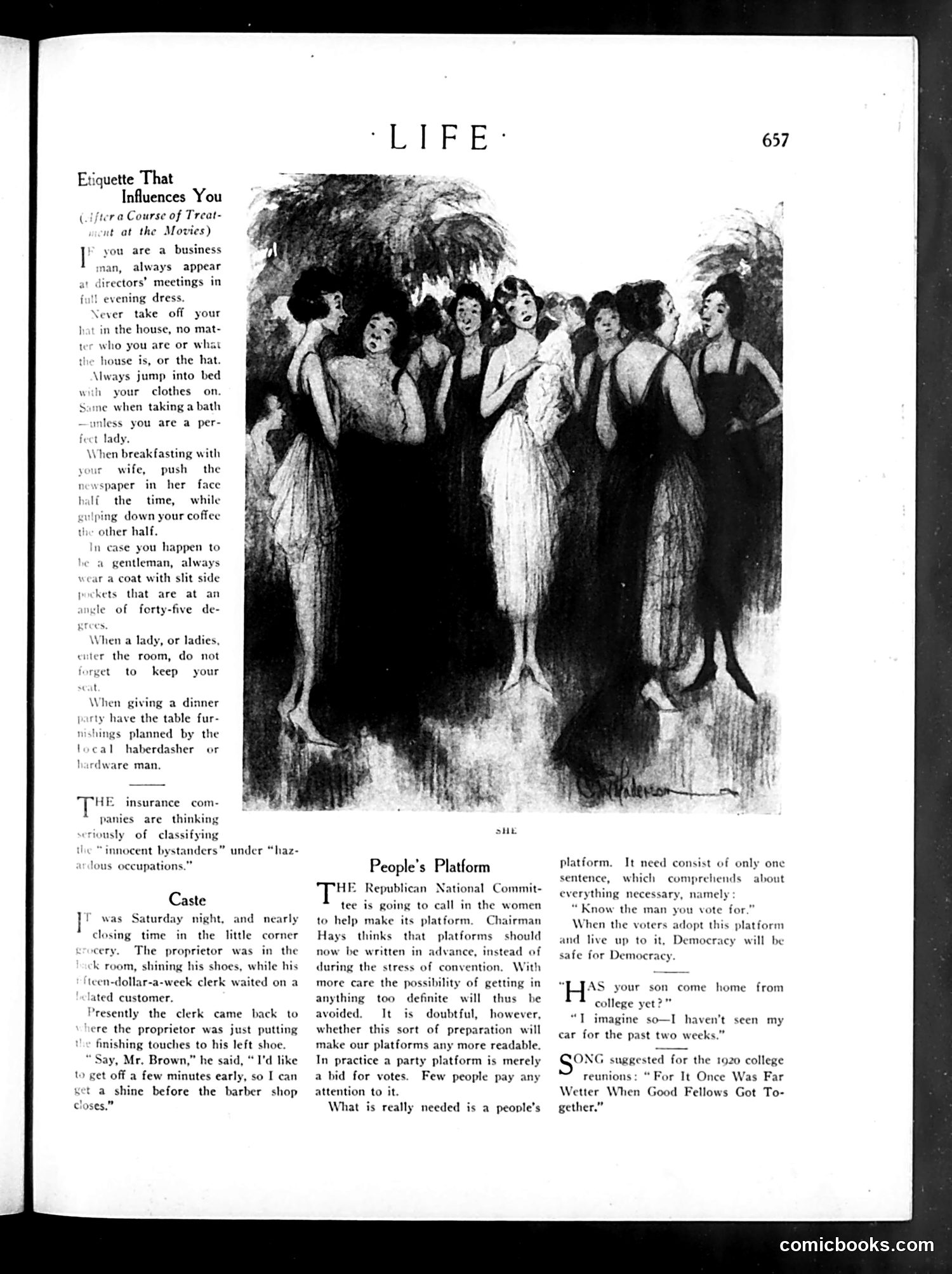
The page contains three satirical pieces mocking early 20th-century social conventions and politics: 1. **"Etiquette That Influences You"** (top left): A humorous "etiquette guide" that inverts proper behavior—advising businessmen to jump into bed clothed, keep hats on indoors, and push newspapers in wives' faces. This satirizes the rigid, absurd social codes imposed by "movie morality" and uptight respectability culture of the era. 2. **The cartoon** (center): Shows women in various states of undress, likely satirizing hypocrisy around female modesty standards or moral panics about women's changing social roles in the 1920s. 3. **"People's Platform"** (bottom right): Mocks the Republican National Committee's platform-writing process as meaningless political theater. The satire suggests political platforms are merely "bids for votes" that nobody reads; what voters actually need is simply to know whom they're voting for. 4. **Minor humor pieces** (bottom): Quick jokes about college sons and reunion songs, reflecting post-WWI social commentary. The overall tone is cynical about social pretension, political dishonesty, and changing morality.
📄 Transcribed text from this page (OCR, searchable)
Machine-transcribed from the original scan — historical spelling and the odd misread are preserved.
Etiquette That Influences You (ister a Course of Treat- ut at the Movies) you are a_ business always appear rectors’ meetings in evening dress. Never take off your hat in the house, no mat- ter who you are or what house is, or the hat. \lways jump into bed with your clothes on. me when taking a bath inless you are a per- t lady \When breakfasting with push the vspaper in her fa the time, while ping down your coffee other half. is wife, ase you happen to he a gentleman, alw wear a coat with slit side that are at an forty-five de- pockets uigsle of When a lady, or ladies, cuter the room, do not forget’ to keep your seat When giving a dinner party have the table fur- hings planned by the cal haberdasher or rdware man, insurance are thinking of classifying com- riously “innocent bystanders” under “haz- lous occupations.” Caste |! was Saturday night, and nearly little The proprietor was in the closing time in’ the corner very. k room, shining his shoes, while his tcen-dollar-a-week clerk waited on a uted customer. Presently the clerk came back to ere the proprietor was just putting finishing touches to his left shoe. Say, Mr. Brown,” he said, “I'd like off a few minutes early, so I can a shine before the barber shop People’s Platform Republican ional Commit- “TRE tee is going to call in the women Chairman to help make its platform. Hays thinks that platforms now be written in advance, instead of With more care the possibility of getting in anything too definite will thus be avoided. It is doubtful, however, whether this sort of preparation will should during the stress of convention, make our platforms any more readable. In practice a party platform is merely a bid for votes. Few people pay any attention to it. What is really needed is a people's platform. It need consist of only one sentence, which comprehends about everything necessary, namely: “Know the man you vote for.” When the voters adopt this platform and live up to it, Democracy will be safe for Democracy. * AS college yet?” “1 imagine so—I haven't seen my car for the past two weeks.” your son come home from ONG suggested for the 1920 college reunions: “For It Once Was Far Wetter When Good Fellows Got To- gether.” comicbooks.com