
A complete issue · 36 pages · 1919
Life — November 6, 1919
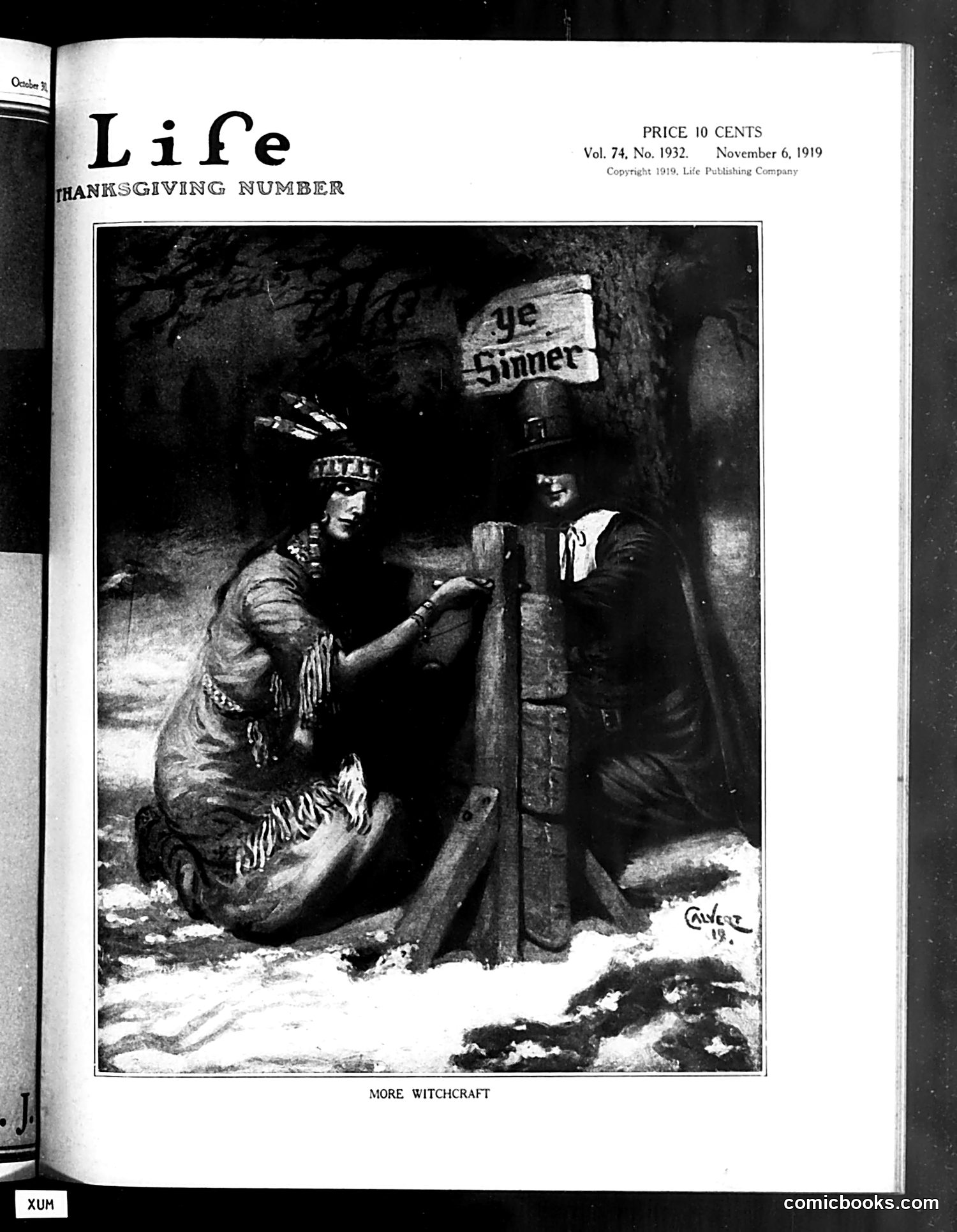
This Thanksgiving-themed satirical illustration depicts a scene labeled "More Witchcraft," showing two figures in a snowy setting. One figure, dressed in Native American attire with a headband, appears to be a stereotypical "Indian" character. The other wears formal dress and a hat reading "The Sinner." The image likely satirizes contemporary anxieties about morality or social corruption circa 1919. The "witchcraft" title suggests accusations of wrongdoing or supernatural mischief. The juxtaposition of the stereotyped Native American figure with the formally-dressed "sinner" character—possibly representing a politician or authority figure—implies commentary on hypocrisy or blame-shifting during this period, though the specific political reference remains unclear without additional context.
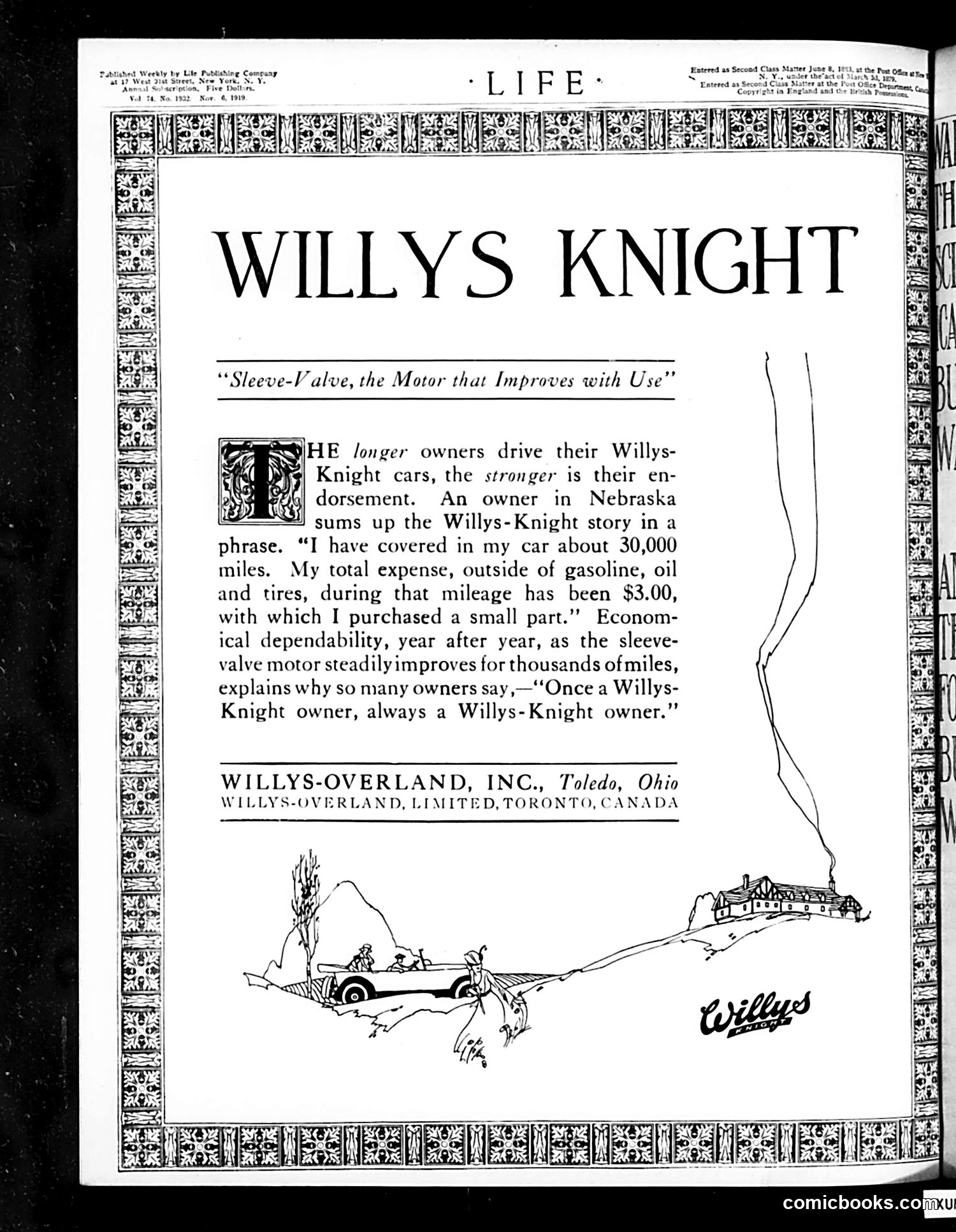
This is a **Willys-Knight automobile advertisement**, not a political cartoon. The page promotes the "Sleeve-Valve" motor technology as Willys-Knight's key selling feature. The advertisement includes a testimonial from a Nebraska car owner claiming 30,000 miles with only $3 in maintenance costs (excluding fuel, oil, tires). This endorsement supports the marketing claim that the sleeve-valve motor "improves with use" and becomes more reliable over time. The illustration shows a rural scene with a Willys-Knight vehicle, emphasizing the car's dependability for everyday American drivers. The slogan "Once a Willys-Knight owner, always a Willys-Knight owner" suggests strong customer loyalty based on the vehicle's mechanical superiority and low operating costs—key selling points during the early automotive era.
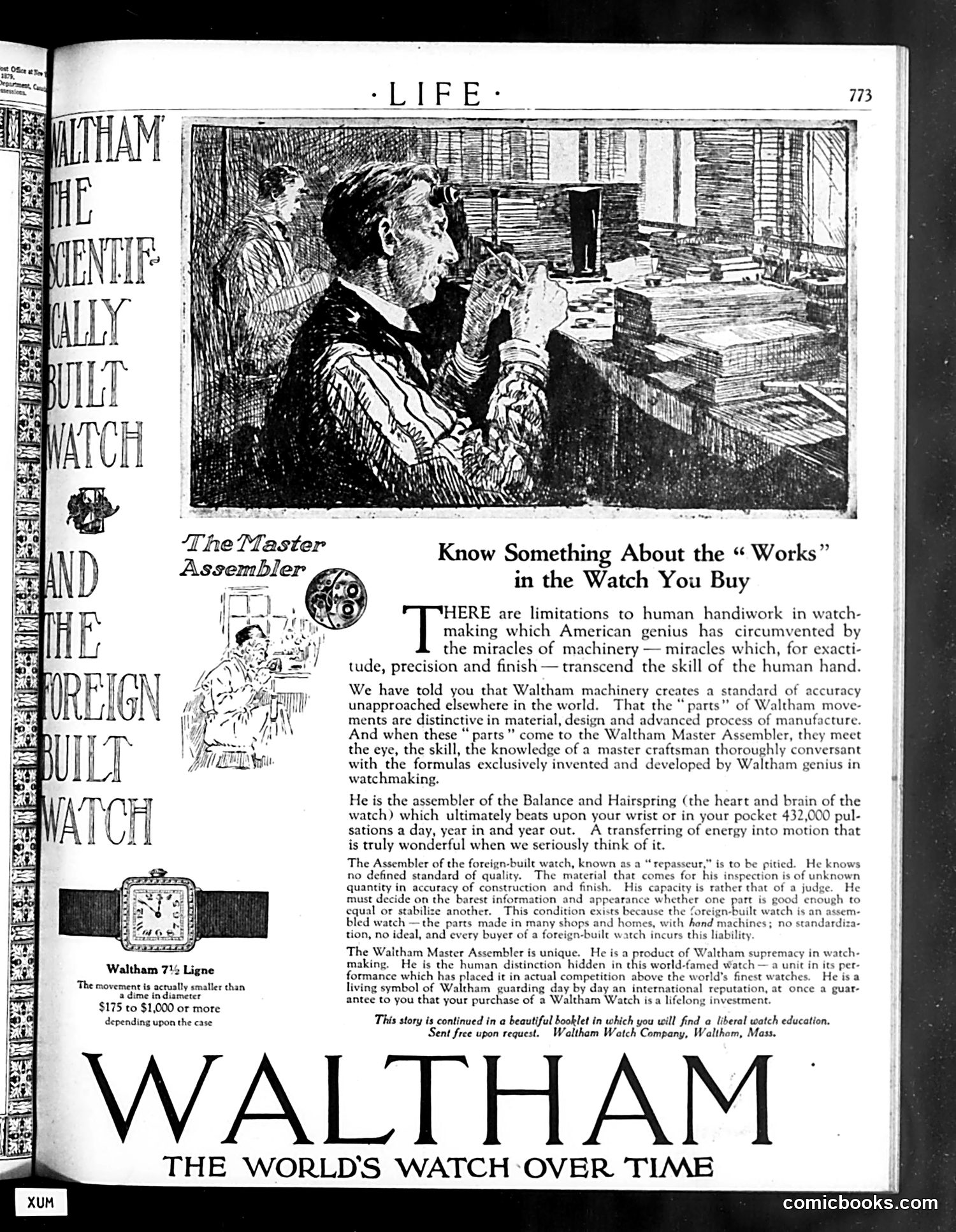
This page is primarily a **Waltham Watch Company advertisement**, not political satire. The image shows a man (identified as "The Master Assembler") examining watch components in a workshop. The ad's appeal is to **American pride in precision manufacturing**. It emphasizes that Waltham watches represent American industrial superiority—their machinery and craftmanship allegedly surpass foreign competitors. The "Master Assembler" is portrayed as a skilled artisan whose expertise ensures quality, positioning the watch as a guarantee of American technical excellence and reliability. The left sidebar appears to contain unrelated satirical content from Life magazine, but the dominant page content is straightforward commercial messaging targeting buyers who valued American-made precision goods.
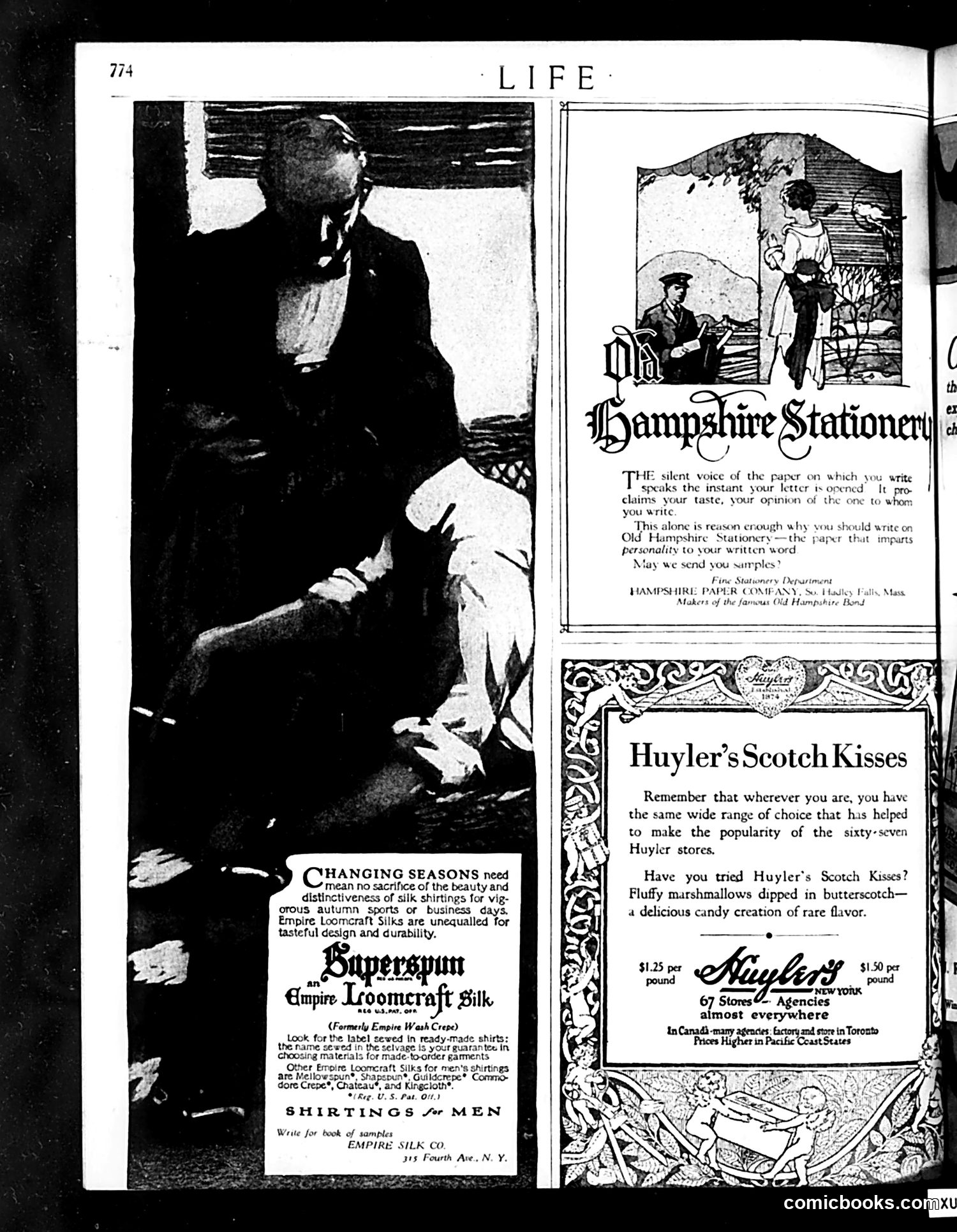
This page is **primarily advertising** rather than editorial content or political satire. The left side features a **Paperspan Empire Loomcraft Silk advertisement** showing a man examining fabric, promoting silk shirtings with messaging about "changing seasons" and fashion durability. The right side contains two advertisements: **Old Hampshire Stationery** (emphasizing that quality paper reflects one's personality in written communication) and **Huyler's Scotch Kisses** (a candy product available at 67 stores). There are **no political cartoons or satirical commentary** visible on this page. The content is entirely commercial, typical of Life magazine's business model during this era, when advertising subsidized publication costs.
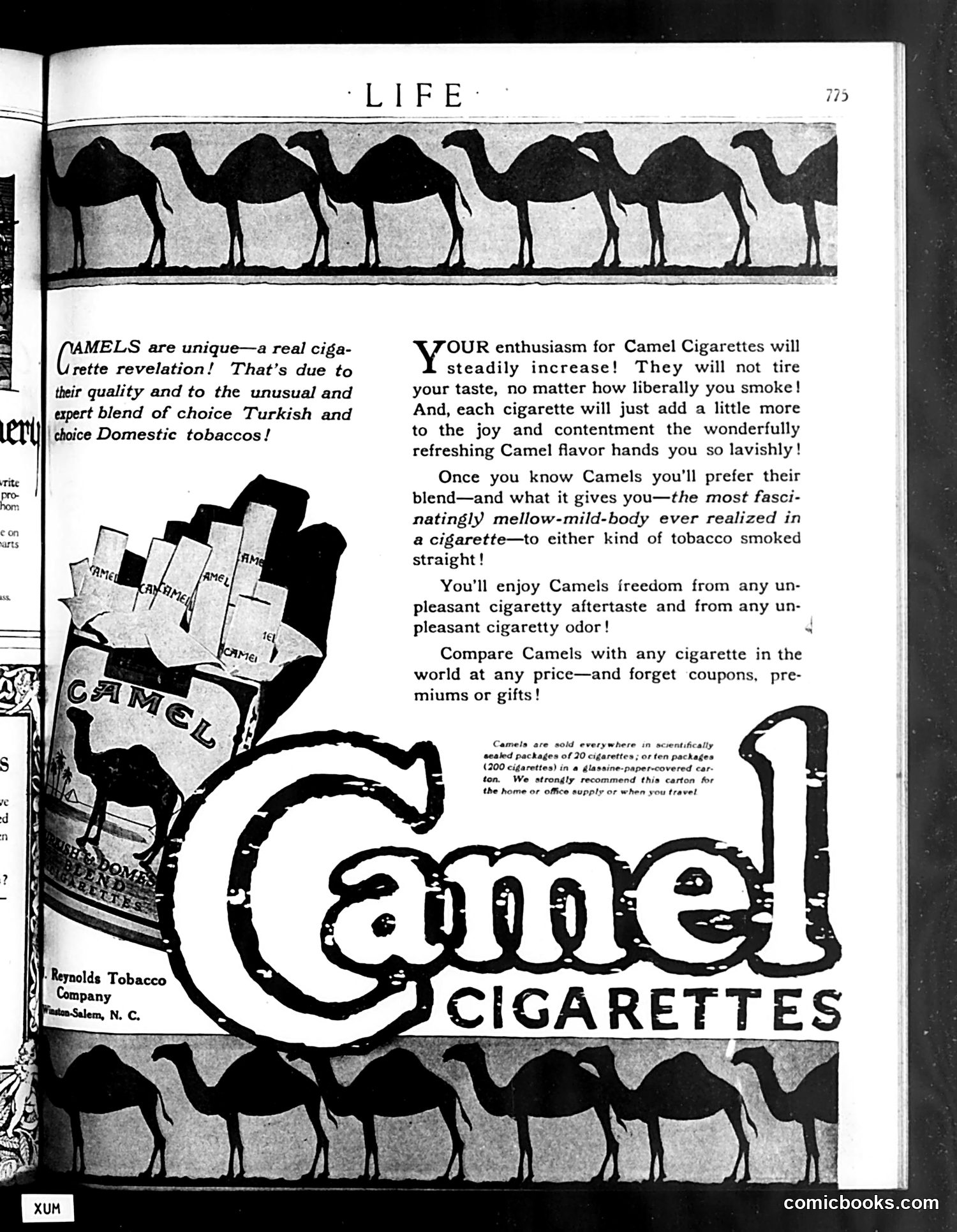
This page is primarily a **Camel cigarette advertisement**, not political satire. The ad uses decorative silhouettes of camels at top and bottom—a visual reference to the product's name and exotic branding. The advertisement emphasizes Camel's "unique" blend of "Turkish and choice Domestic tobaccos" and claims superiority over competitors, promising a "fascinatingly mellow-mild-body" smoking experience with no unpleasant aftertaste or odor. The large product image shows a Camel cigarette pack held prominently. The text encourages direct comparison with other brands "at any price" and dismisses competitor incentives like "coupons, premiums or gifts." This reflects early 20th-century cigarette marketing, when such advertising appeared routinely in mainstream publications without health warnings—a practice now prohibited.
This page is **not a cartoon or satirical content**—it's a straightforward advertisement from the American Express Company addressed to travelers. The ad announces that U.S. passport restrictions have been lifted, allowing Americans to travel abroad again. American Express is promoting its global services to facilitate this renewed travel: mail forwarding, transportation bookings, travel credit, shipping/insurance, and commercial financing. The piece is signed by a Vice-President and lists the company's Broadway headquarters in New York. This reflects post-restriction travel policy (likely post-WWI or another period of travel limitations), positioning American Express as the patriotic, reliable institution for American travelers seeking international services.
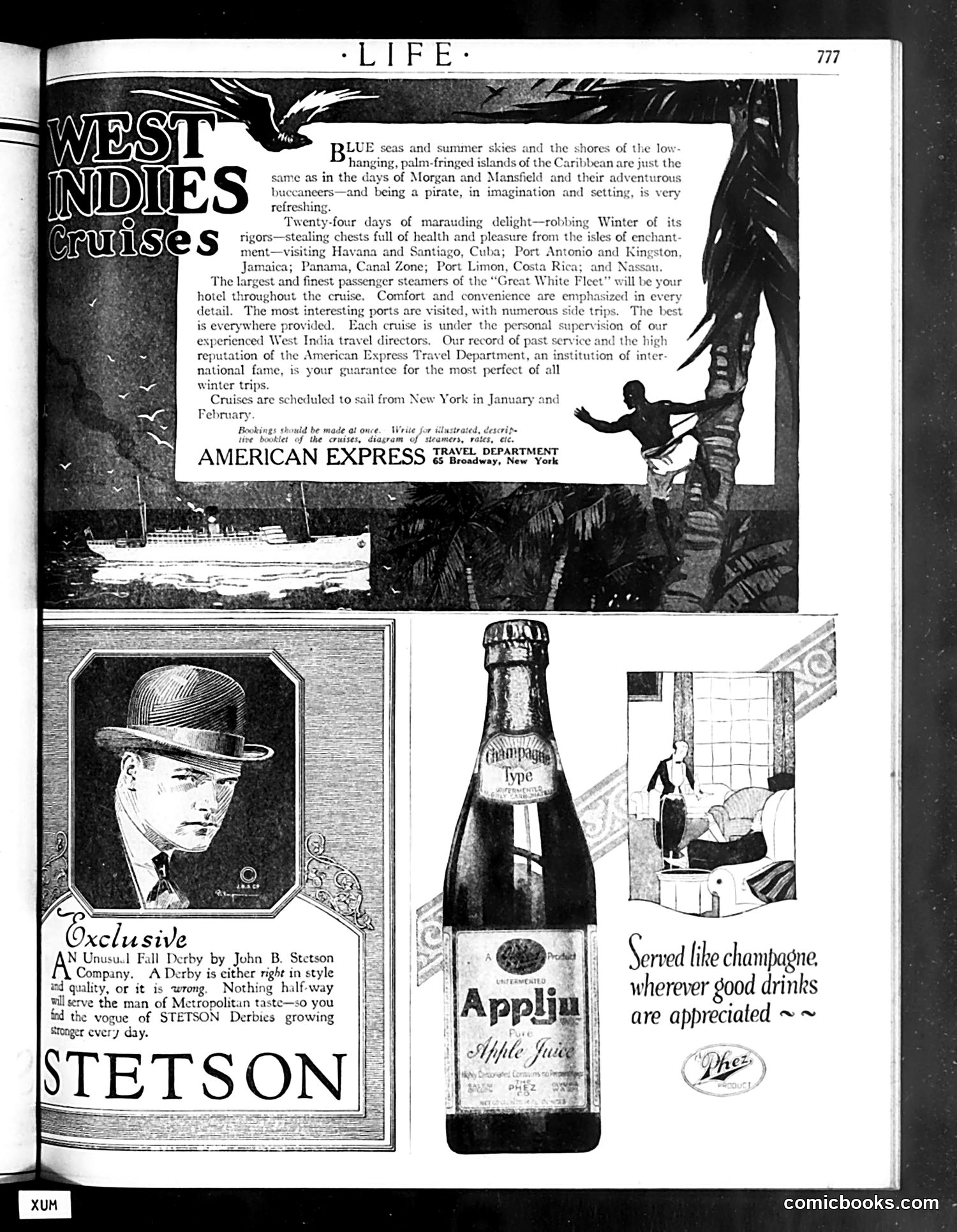
This page is primarily **advertising**, not satire or political commentary. It contains three distinct ads: 1. **West Indies Cruises** (top): American Express Travel Department promotes luxury Caribbean cruises aboard "Great White Fleet" steamers, departing from New York in winter months, visiting ports like Havana, Santiago, and Panama. 2. **Stetson Hats** (bottom left): Features a man in a formal hat, advertising John B. Stetson Company's "Full Derby" as an exclusive, high-quality product with no compromises. 3. **Applin Apple Juice** and **Pozzi** drink (center and right): Beverage advertisements emphasizing quality and refined consumption. The page reflects early 20th-century luxury consumption marketing targeting affluent readers, with no apparent political satire or social commentary.
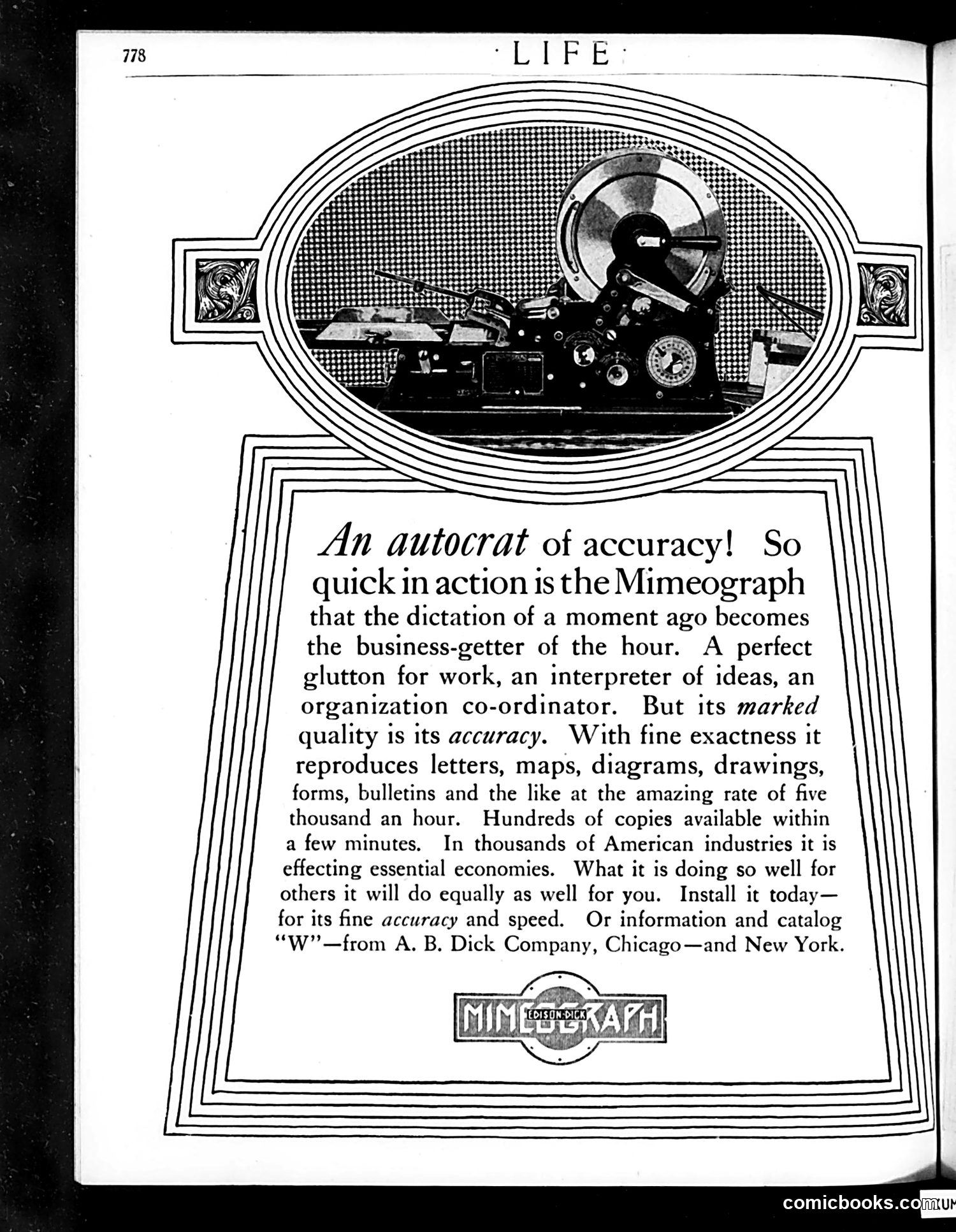
This is a **full-page advertisement** for the Mimeograph duplicating machine, manufactured by A.B. Dick Company (Chicago and New York). The ad uses hyperbolic language typical of early 20th-century marketing, calling the machine "an autocrat of accuracy" and praising its speed (5,000 copies per hour) and precision for reproducing letters, maps, diagrams, and forms. The copy emphasizes how the technology benefits "thousands of American industries" by enabling rapid document reproduction—positioning it as essential business equipment. The image shows the machine's mechanical components with gauges and internal workings. There is **no political satire or cartoon** on this page; it is purely commercial advertising aimed at business owners considering document-copying technology.
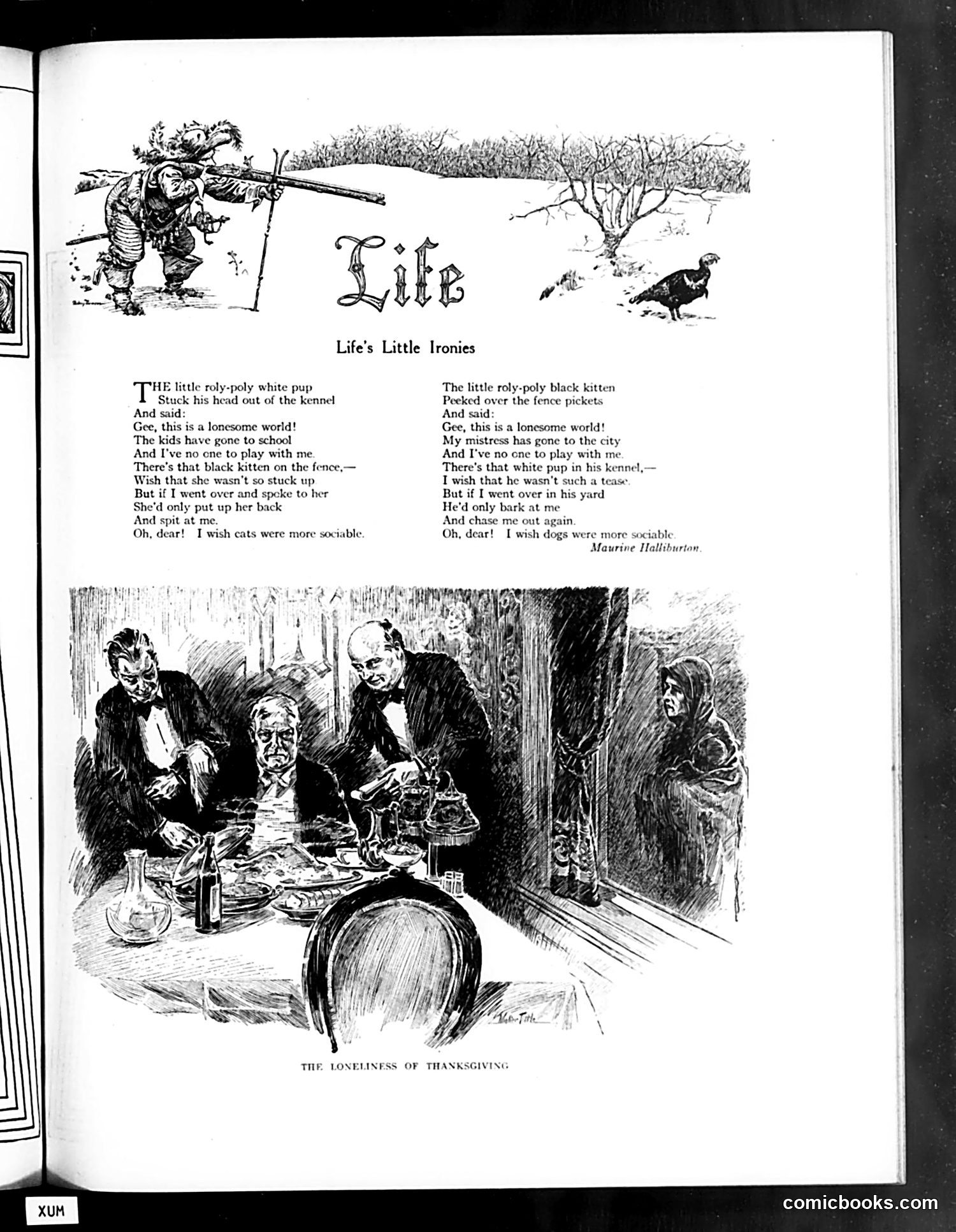
This page contains two satirical pieces from *Life* magazine: **Top section:** A poem by Maurice Halliburton titled "Life's Little Ironies" contrasts two pets' perspectives. A lonely white puppy and black kitten, both stuck indoors with absent owners, wish the other species were "more sociable." The irony: despite shared loneliness, they cannot befriend each other due to natural cat-dog antagonism. **Bottom illustration:** Titled "The Loneliness of Thanksgiving," this sketch depicts a lone figure (shown from behind) seated at a dining table, observing a festive group of men dining together. The satire satirizes social exclusion—someone observing others' celebration while remaining isolated, capturing the emotional paradox that holidays can intensify loneliness for the excluded. Both pieces explore isolation and missed connections amid seemingly social situations.
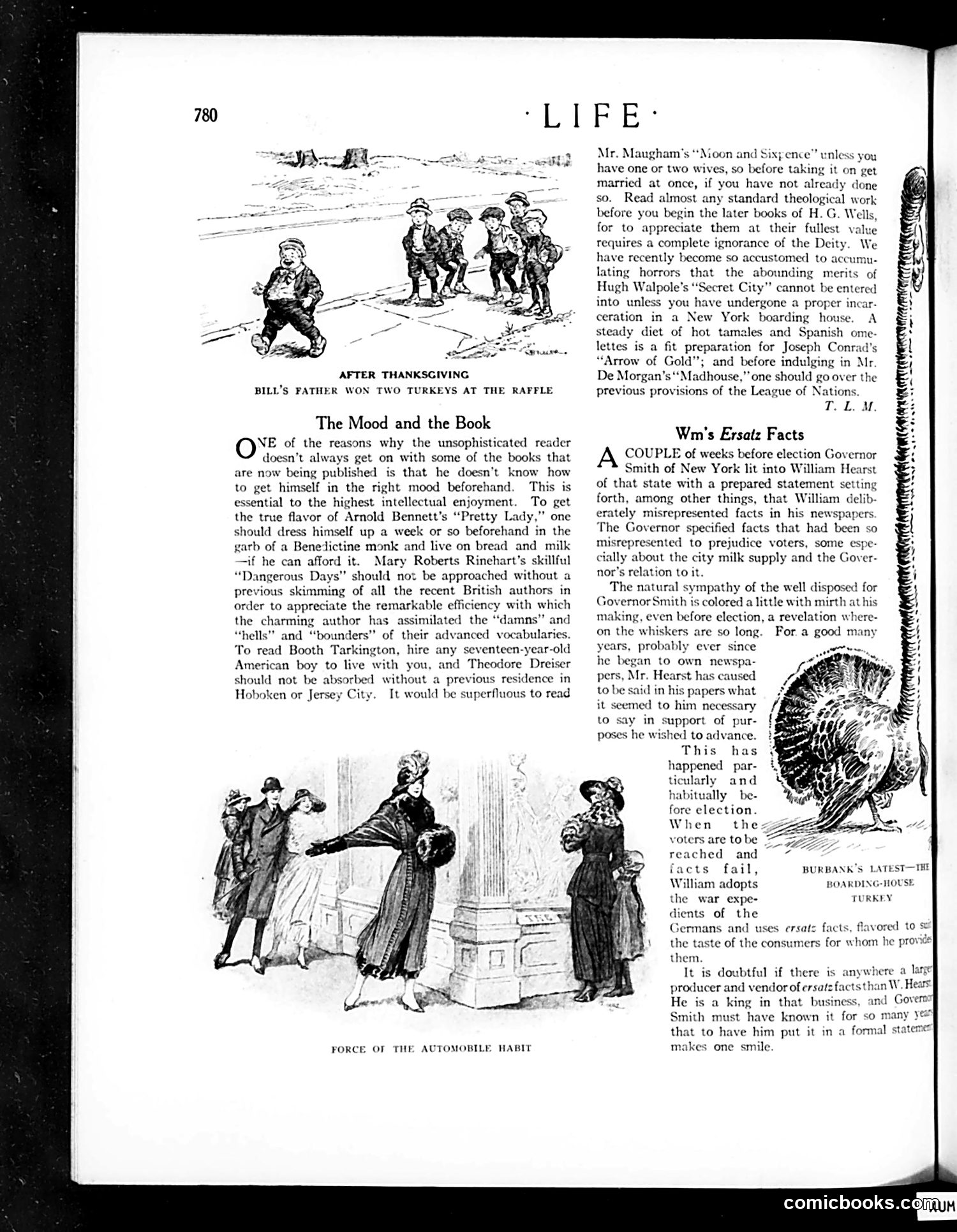
This page contains two satirical pieces: **"The Mood and the Book"** (left) advises readers to prepare mentally before reading challenging literature—recommending preliminary reads like Booth Tarkington and Theodore Dreiser as preparation for Arnold Bennett's "Pretty Lady." **"Wm's Ersatz Facts"** (right) critiques Governor William Hearst of New York for spreading false claims about milk supply and city governance before an election. The piece sarcastically notes Hearst is a master of "ersatz facts"—fake information designed to mislead voters. The accompanying Burbank turkey illustration appears to mock his reliability. The text suggests Hearst deliberately misrepresented facts to advance his political agenda, though modern readers would need additional context about this specific gubernatorial race.
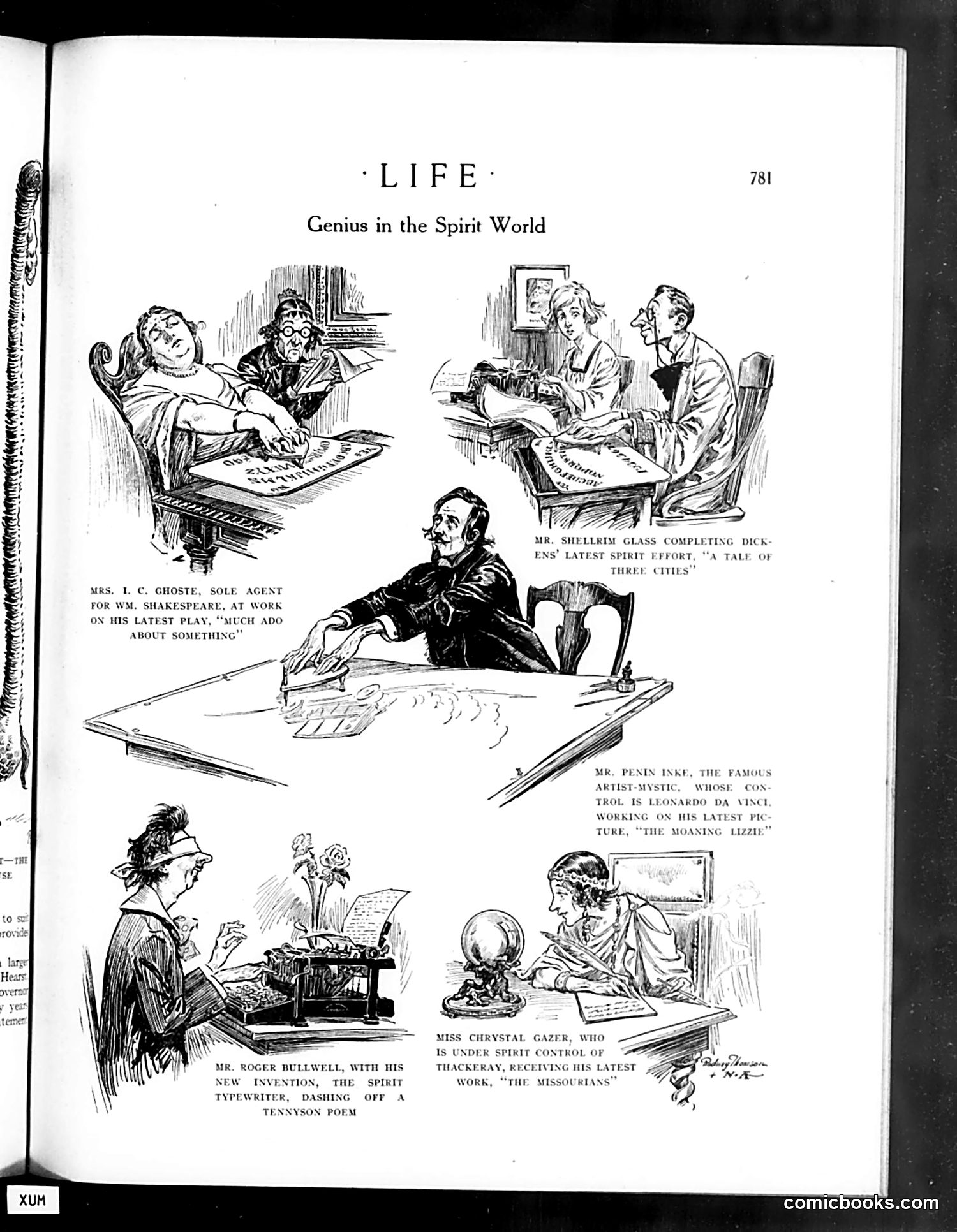
This page satirizes spiritualism, a popular late 19th/early 20th-century belief in communicating with the dead through mediums. The cartoon mocks famous spiritualist practitioners and their clients: - **Mrs. I.C. Ghoste** (pun on "ghost") works as a medium on Shakespeare plays - **Mr. Shellrim Glass** completes spiritualist "efforts" - **Mr. Penin Inke**, an "artist-mystic," channels artwork - **Mr. Roger Bullwell** invents a spirit typewriter for automatic writing - **Miss Chrystal Gazer** receives spiritualist messages via crystal ball The satire ridicules both the mediums claiming supernatural powers and wealthy believers seeking contact with spirits. The exaggerated names and absurd scenarios emphasize how Life's editors viewed spiritualism as fraudulent entertainment exploiting gullible clients.
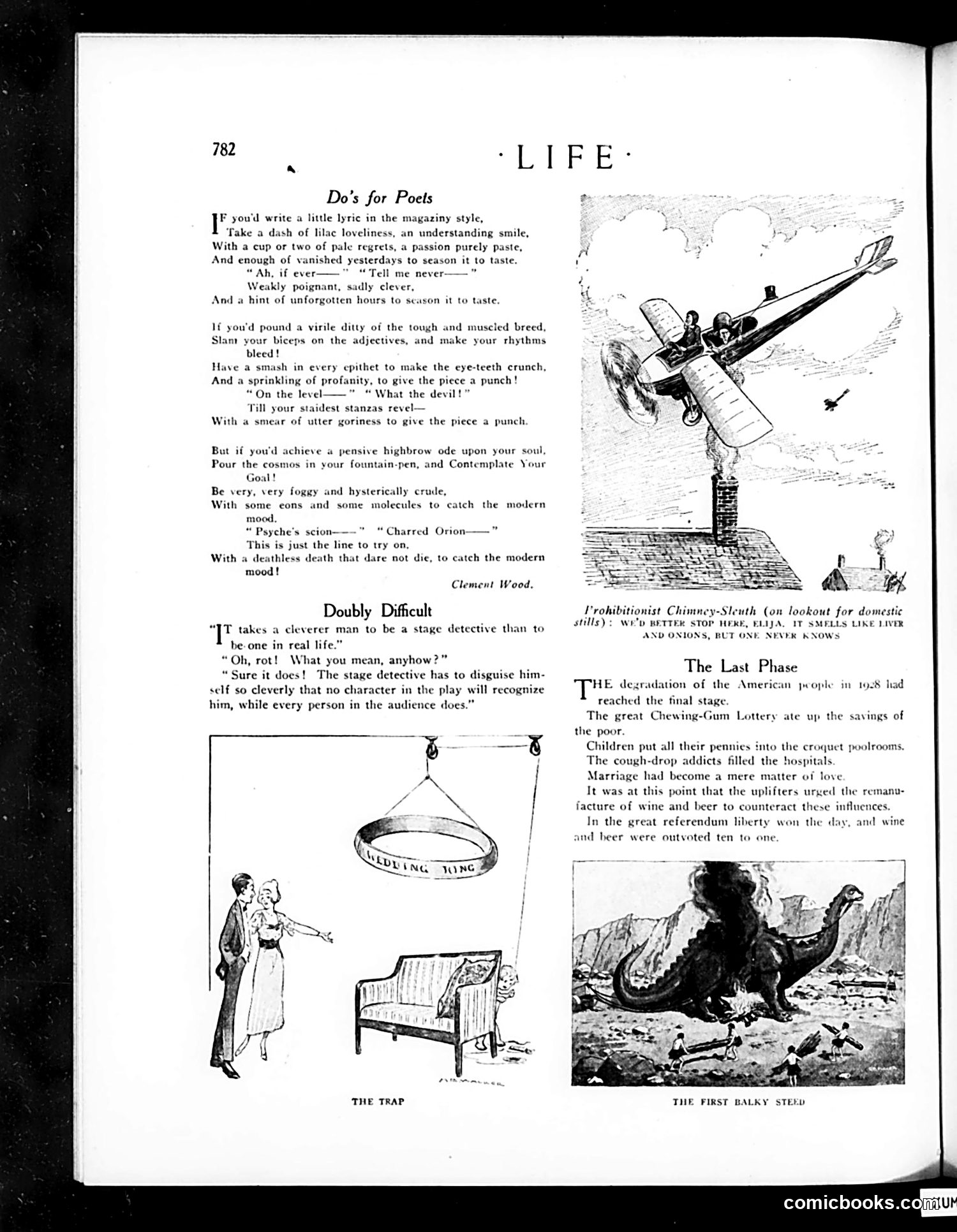
This page contains three distinct satirical pieces: **"Do's for Poets"** (by Clement Wood): Mock advice for aspiring poets, mocking pretentious literary styles—urging clichéd "passion," affected language, and deliberate obscurity to appeal to "modern mood." **"Doubly Difficult"**: A joke contrasting stage detectives (who must disguise their intelligence) with real-life detectives (who needn't hide their competence). **"The Last Phase"**: Satirizes 1920s American social decay—chewing gum lotteries draining poor people's savings, children in croquet pools, hospitals filled with cough-drop addicts, and marriage reduced to commercialism. The punchline: a referendum made wine and beer 10-to-1 favorites, suggesting Prohibition's failure and public desire for repeal. **"The Trap"** and **"The First Balky Steed"** appear to be humorous illustrations accompanying these pieces.
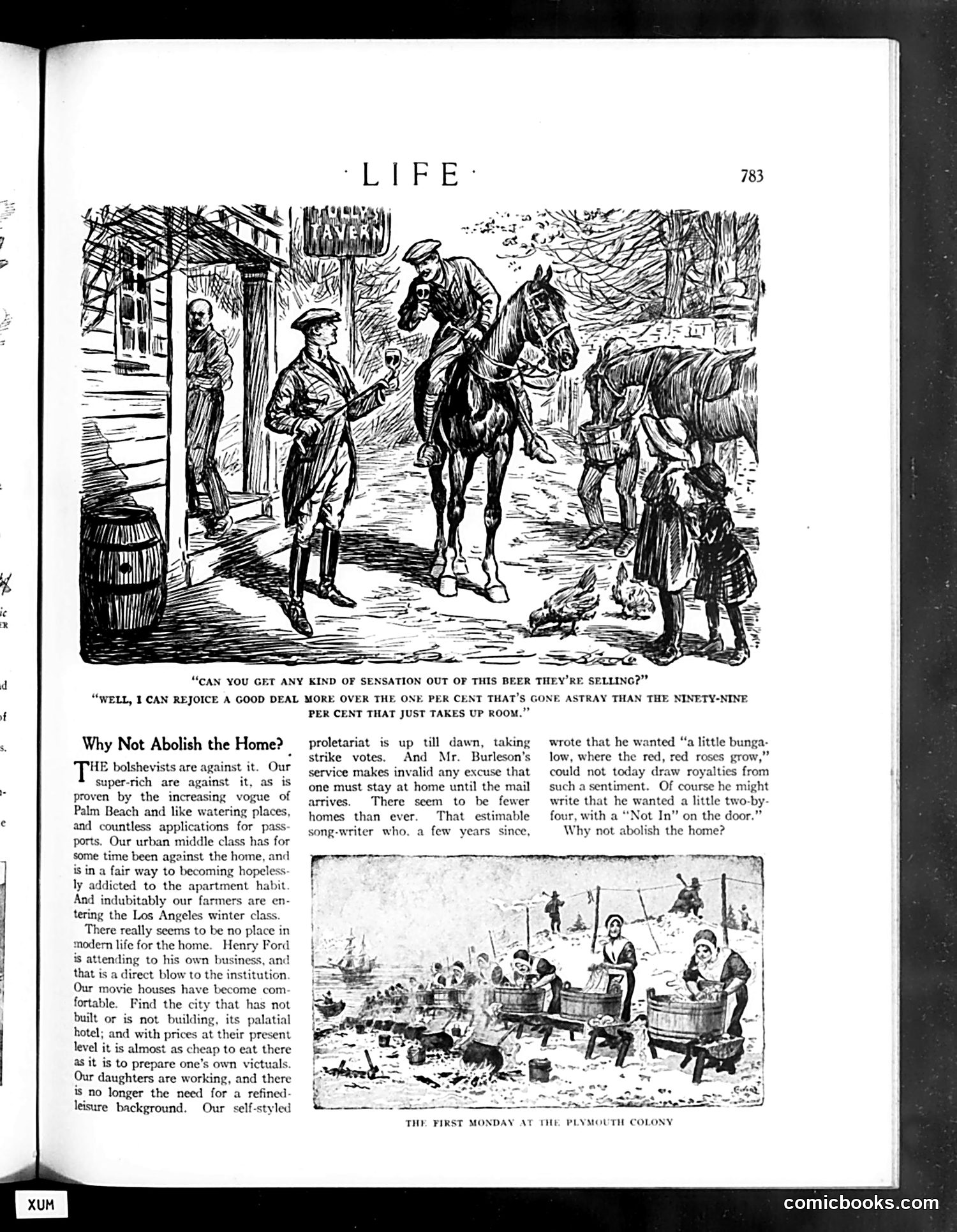
**Top Cartoon:** A street scene showing a tavern keeper discussing beer quality with a soldier on horseback and other figures. The caption jokes about beer sales during wartime—the keeper claims he can "rejoice a good deal more over the one per cent that's gone astray than the ninety-nine per cent that just takes up room." This satirizes profiteering: merchants celebrating waste because scarcity drives up prices during military conflicts. **Article: "Why Not Abolish the Home?"** Argues against anti-home sentiment among socialists and the wealthy elite. The author defends home life's value, citing Henry Ford's continued attention to his business and family. The piece advocates for preserving domestic life against what it characterizes as attacks from revolutionaries ("Bolshevists") and the privileged class. **Bottom Image:** "The First Monday at the Plymouth Colony"—depicting early colonial settlement activities.
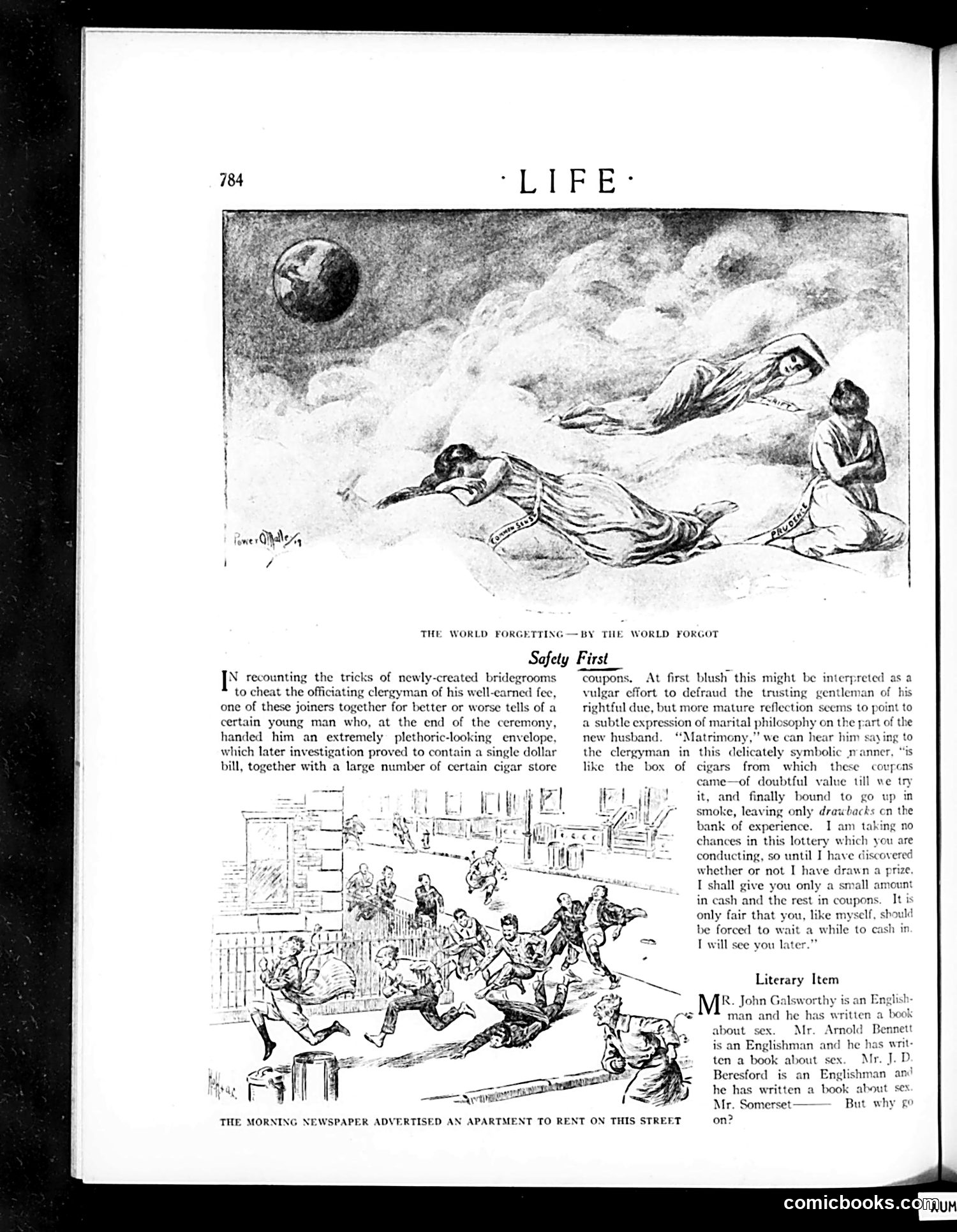
This page contains two satirical pieces. The top illustration, "The World Forgetting—By the World Forgot," depicts figures reclining on clouds with a celestial body above, likely satirizing romantic honeymoon fantasies or newlyweds' unrealistic expectations. Below, "Safety First" is a humorous anecdote about a joiner (carpenter) who received a mysterious envelope containing a dollar bill and cigar store coupons—apparently lottery winnings. The text satirizes both the joiner's superstitious hope and the dubious nature of such prize schemes, suggesting the narrator is conducting an untrustworthy lottery where actual cash winnings are minimal, with mostly worthless coupons distributed instead. The accompanying illustration shows chaotic street activity, likely depicting the scramble surrounding such schemes. The "Literary Item" section briefly notes three Englishmen who have written books about sex.
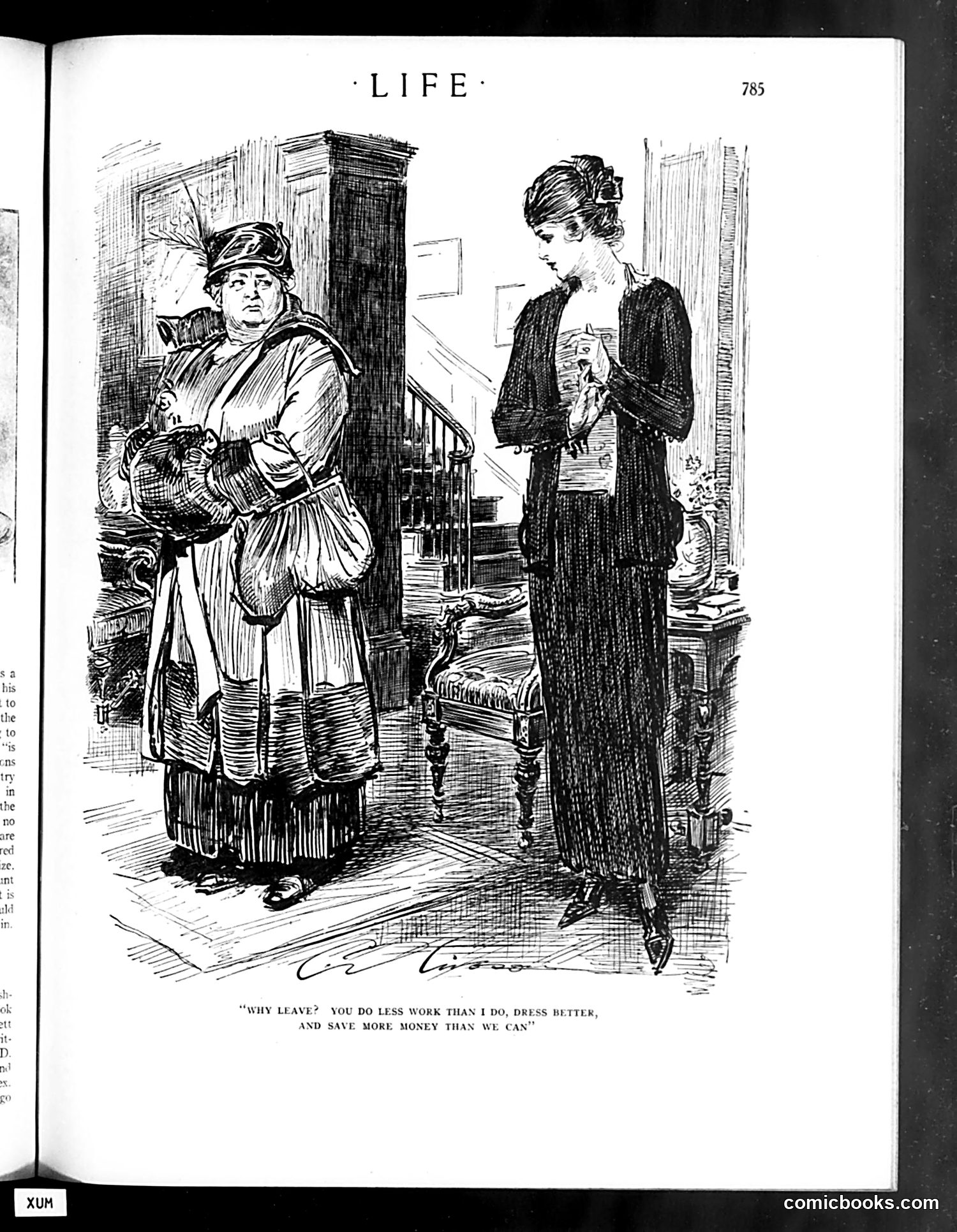
This cartoon depicts two women in what appears to be a domestic interior. The woman on the left wears a servant's or working-class outfit with a headscarf, while the woman on the right is dressed more elegantly. The caption reads: "Why leave? You do less work than I do, dress better, and save more money than we can." The satire targets class and labor relations, likely from the early 20th century. It mocks the irony of domestic service—suggesting a servant lives better than her employer while doing less work. The joke appears to critique either the absurdity of the employment arrangement or perhaps satirize changing social dynamics where working-class women gained unexpected economic advantages or leverage. The cartoon reflects anxieties about shifting labor conditions and class boundaries during this period.
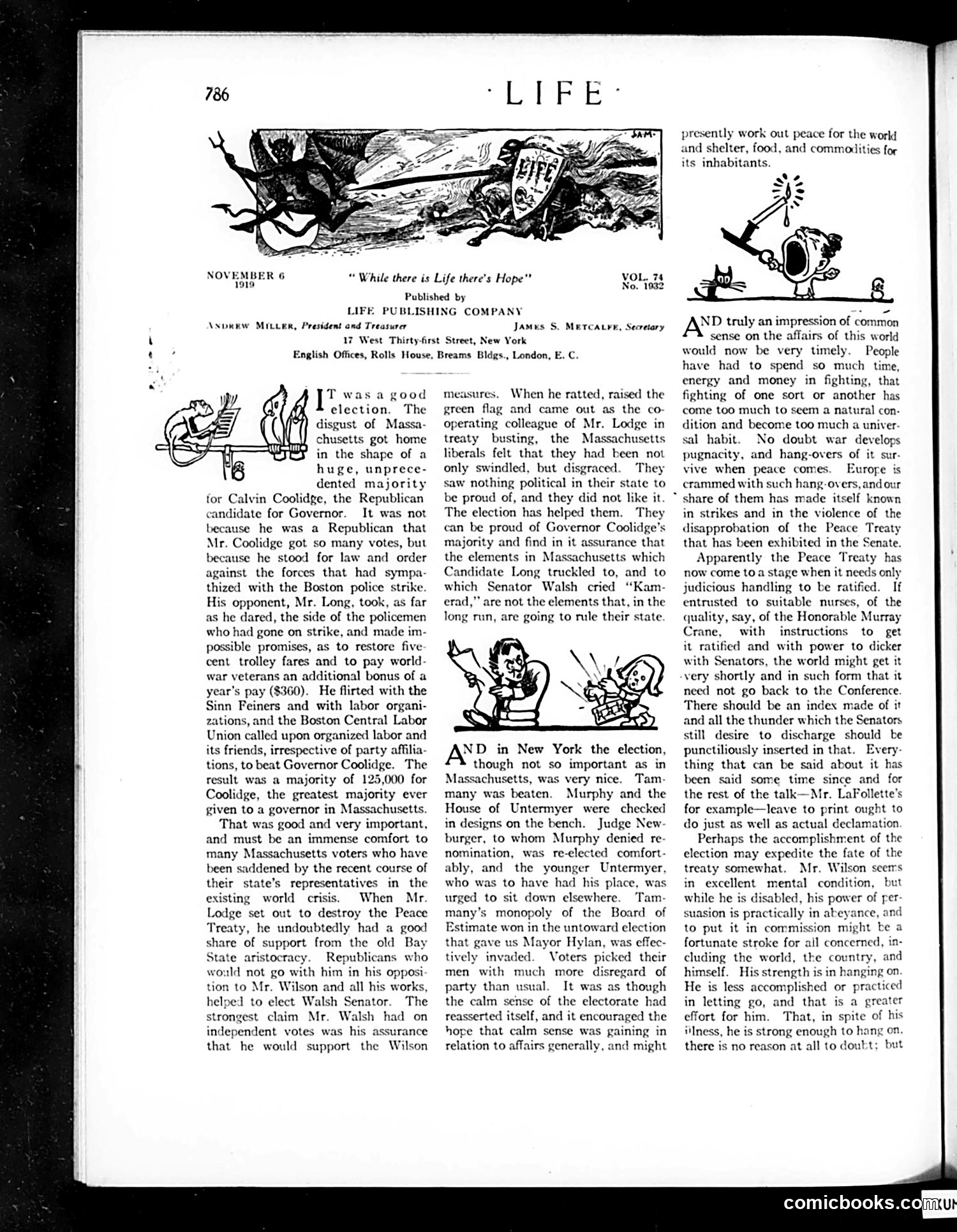
This editorial celebrates recent American elections as signs of rational governance returning after World War I. The key victories are: **Massachusetts**: Calvin Coolidge won governor with an unprecedented 125,000-vote majority, defeating Mr. Long, who sympathized with the Boston police strike and courted labor unions and Irish nationalists ("Sinn Feiners"). Coolidge represented law and order. **New York**: Tammany Hall's political machine was defeated; voters disregarded party loyalty, picking independent candidates like Judge Newburger over Murphy's preferred choices. The author argues these results show the electorate reasserting "calm sense" after years of war consumed national energy and resources. The hope is this electoral maturity will extend to achieving "peace for the world and shelter, food, and commodities for its inhabitants"—addressing post-war instability and scarcity. The cartoons (appearing small on the page) support this theme of sanity triumphing over chaos and disorder.
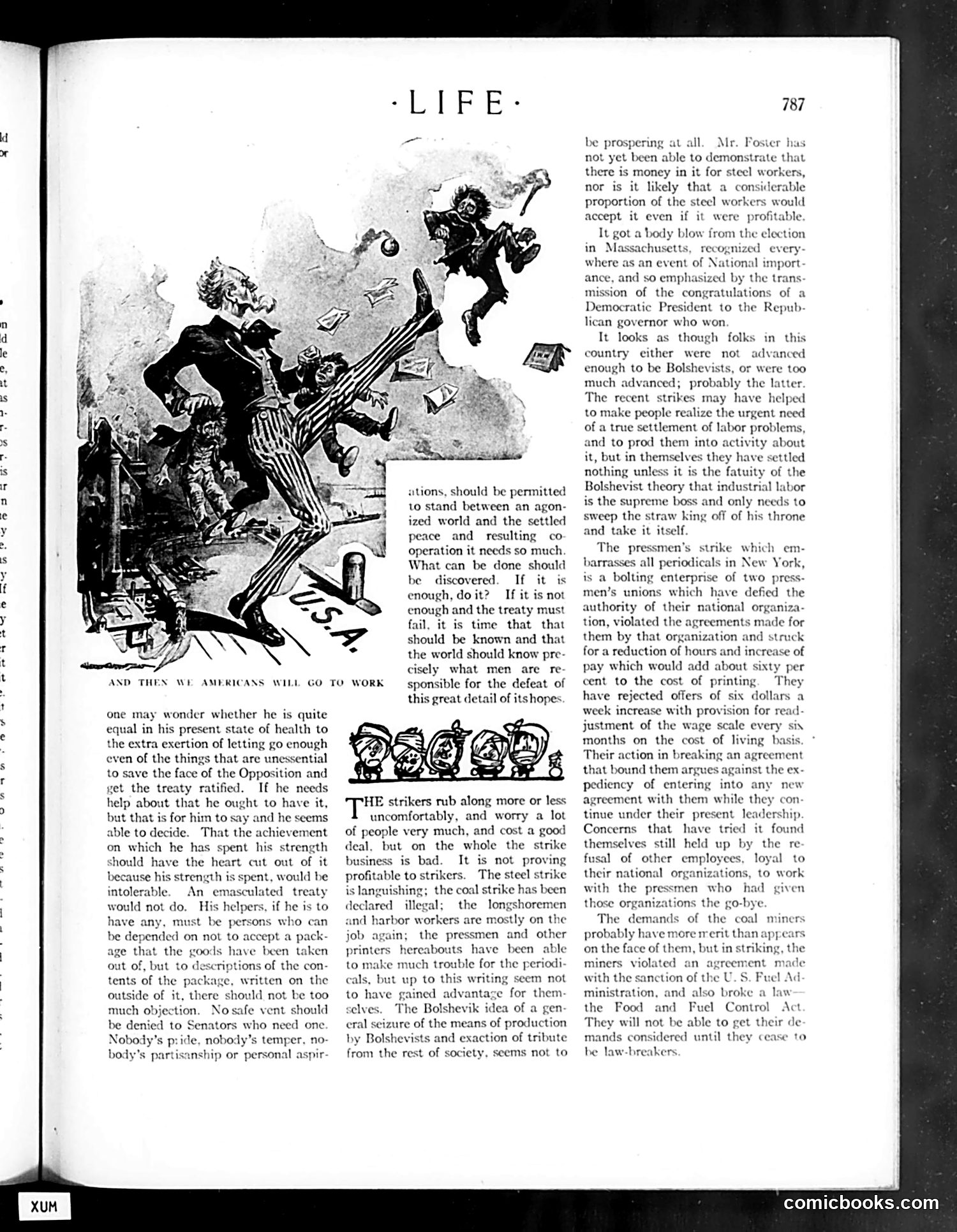
**Main Cartoon ("And Then We Americans Will Go To Work"):** The large illustration depicts figures being violently ejected or thrown upward—appearing to show strikers or labor agitators being expelled. The cartoon satirizes labor unrest, particularly the 1919 steel and coal strikes mentioned in the text. **Political Context:** The article discusses failed strike movements, especially condemning Bolshevik-inspired labor actions. It references: - The Massachusetts election (where a Republican governor defeated labor-backed candidates) - The pressmen's strike in New York - Steel and coal strikes that proved "unprofitable to strikers" **The Satire:** *Life* magazine argues that radical labor organizing and strikes—seemingly influenced by Bolshevism—are failing because American workers reject extremism. The cartoon's title suggests that once these disruptive elements are removed, normal American productivity resumes. **Modern Context:** This reflects post-WWI American anxiety about communist influence and the 1919 strike wave. *Life* positions itself against both radical labor and Bolshevism, suggesting American workers are too pragmatic for revolution.
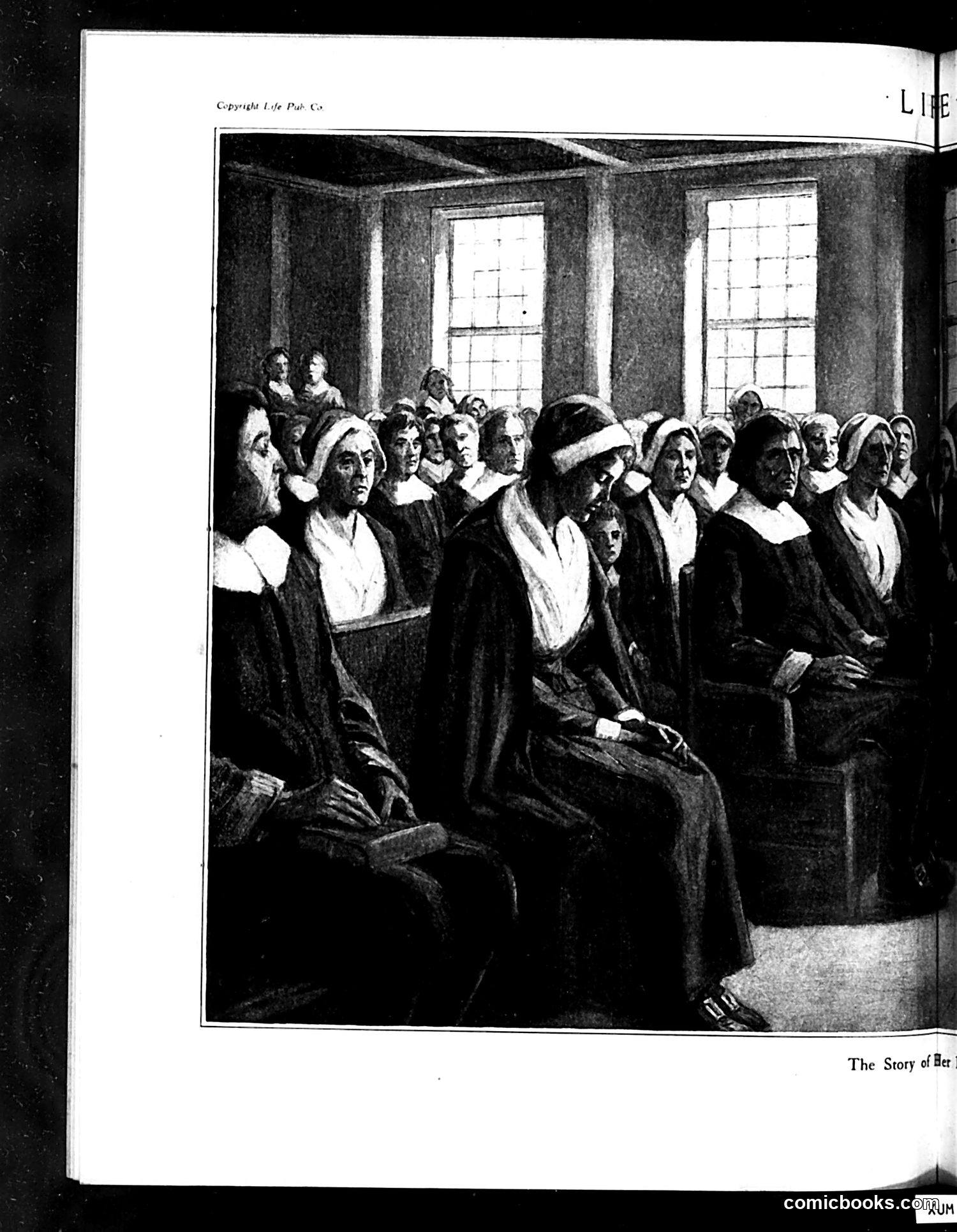
This appears to be an illustration from Life magazine showing a group of women in early 20th-century dress (identifiable by their bonnets and long skirts) gathered indoors. The caption reads "The Story of Her," though the full caption is cut off. Without additional text visible, the specific subject and satirical point are unclear. The image could reference women's suffrage activism, a social commentary on women's gatherings, or a narrative illustration accompanying an article. The formal interior setting with tall windows suggests an institutional or official building, possibly a courthouse or government building—contexts relevant to women's political activism of the era. The incomplete caption prevents definitive identification of what "story" is being depicted.
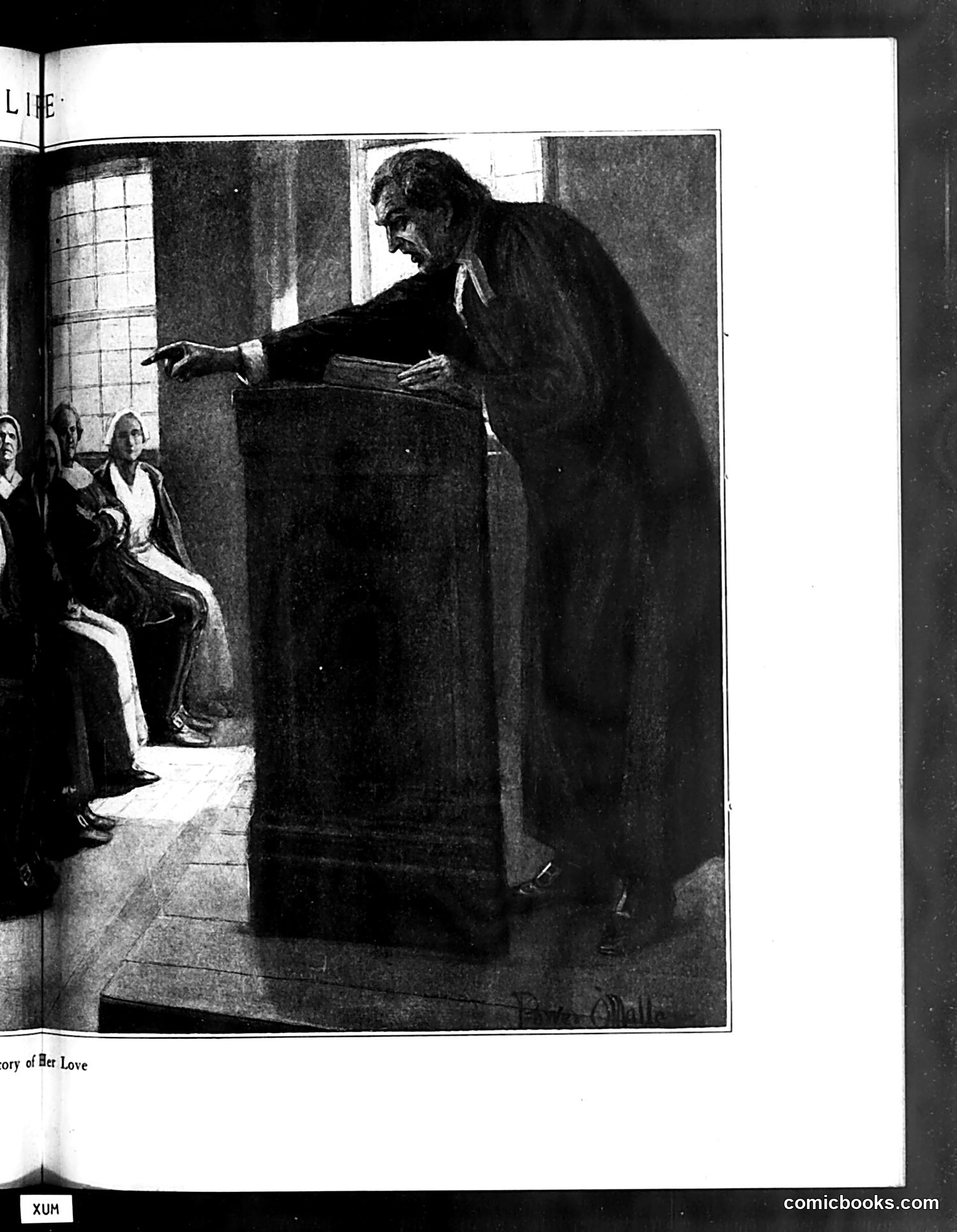
This page from *Life* magazine shows a dramatic illustration titled "Story of Bet Love" (partially visible at bottom). The image depicts a stern-looking man in dark clothing standing at what appears to be a pulpit or lectern, gesturing expressively while addressing an audience of seated women visible on the left side. The scene suggests a religious or moral sermon, likely satirizing evangelical preaching or moralizing about romantic/sexual behavior. The exaggerated, theatrical pose of the speaker and the captive audience arrangement implies mockery of melodramatic moral instruction—a common *Life* magazine target. The title "Story of Bet Love" suggests the content concerns courtship or romantic conduct, themes frequently satirized in early 20th-century American humor magazines as subjects of overwrought moral commentary.
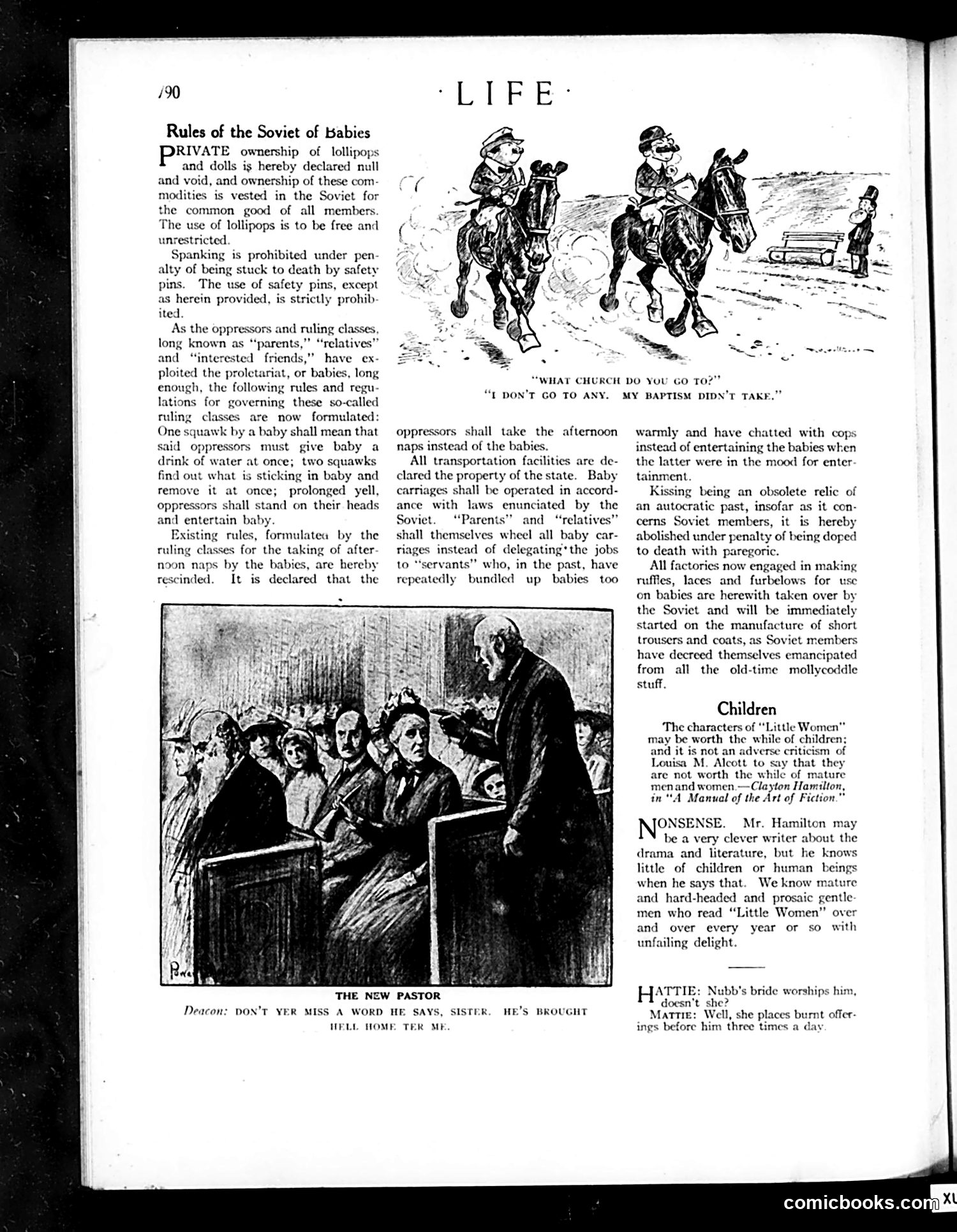
This page satirizes **Bolshevik communism** through absurdist mock-legislation titled "Rules of the Soviet of Babies." The satire inverts the Soviet's ideological rhetoric about collective ownership and worker liberation by applying it literally to infants and their caregivers ("oppressors" and "ruling classes"). The joke: communists rhetorically positioned themselves as liberating the exploited masses (babies); this satire exposes the system's supposed absurdity by showing what happens when you actually treat children and parents this way—parents must provide constant service to babies, private toys become state property, and all interactions are regulated by state decree. The cartoon titled "The New Pastor" below shows a different social commentary: a deacon warns the new preacher not to miss a word (he'll report everything), while a parishioner admits her Baptist baptism "didn't take"—likely mocking either religious hypocrisy or ineffectual faith. Both pieces use humor to critique rigid ideological systems.
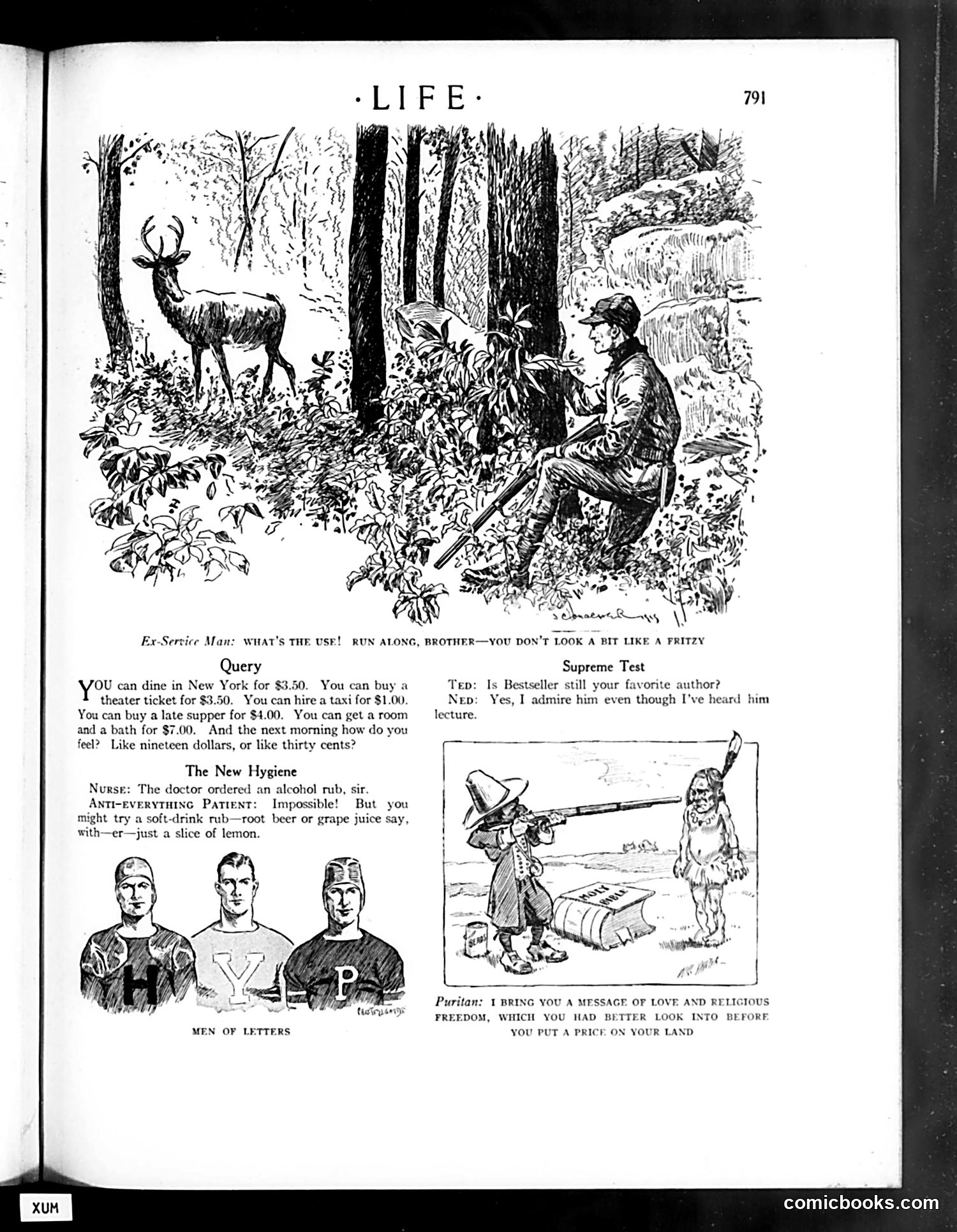
This satirical page contains multiple humor pieces targeting post-WWI American society: **Top cartoon**: An ex-serviceman (World War I veteran) dismisses a Native American, suggesting the veteran looks impoverished rather than "ritzy" (wealthy/fashionable). This satirizes the poor treatment of returning soldiers. **"Query"**: Mocks post-war inflation and cost-of-living crisis—a person can afford individual luxuries ($3.50 dinner, $3.50 theater ticket) but feels financially depleted afterward, suggesting wages haven't kept pace with rising prices. **"The New Hygiene"**: Jokes about Prohibition-era alcohol restrictions. A patient refusing doctor-ordered alcohol rub suggests alternative "soft drinks" instead, satirizing the absurdity of Prohibition enforcement (1920-1933). **"Men of Letters"**: Social commentary on authors and lecturing (unclear specific reference). **Bottom cartoon**: A Puritan preaches "religious freedom" to a Native American while eyeing land—a sardonic historical critique of colonial hypocrisy, suggesting early settlers used religious rhetoric to justify seizing Native American territory.
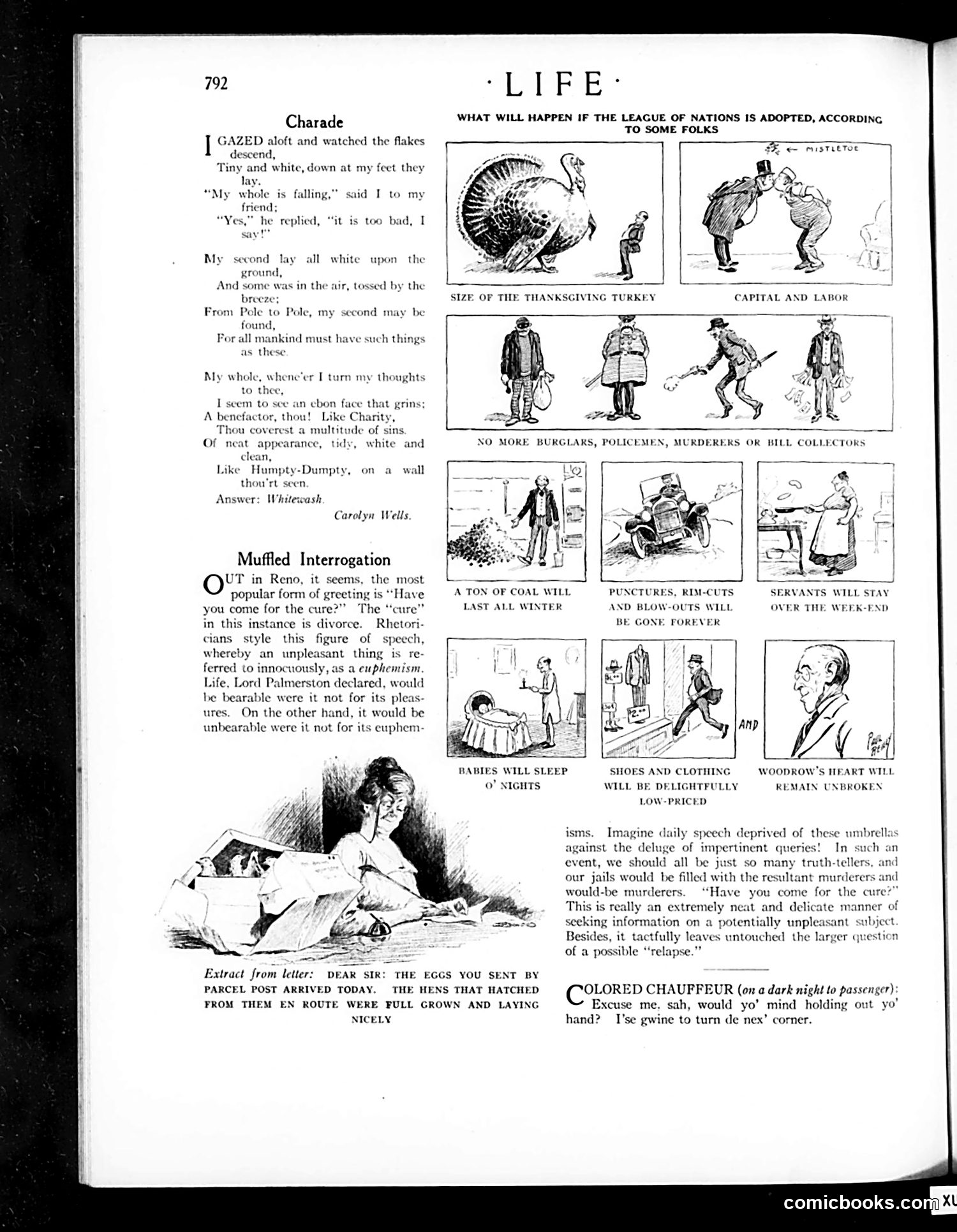
The page satirizes optimistic predictions about adopting the League of Nations. The cartoon grid titled "What Will Happen If the League of Nations Is Adopted, According to Some Folks" depicts absurdly utopian outcomes: an impossibly massive Thanksgiving turkey, capital and labor embracing peacefully, elimination of crime and poverty, eternal coal supplies, indestructible automobiles, and even "Woodrow's Heart Will Remain Unbroken" (likely referencing President Wilson's health struggles). The satire ridicules naive idealism—the notion that international governance could solve fundamental human problems and economic scarcity. Each panel exaggerates a different hope to expose their unrealism. The League of Nations, established post-WWI, was controversial in America; this mocks both its supporters' excessive optimism and the public's unrealistic expectations about what international cooperation could achieve. The other pieces on the page ("Charade," "Muffled Interrogation") are unrelated literary content typical of Life magazine's miscellaneous offerings.
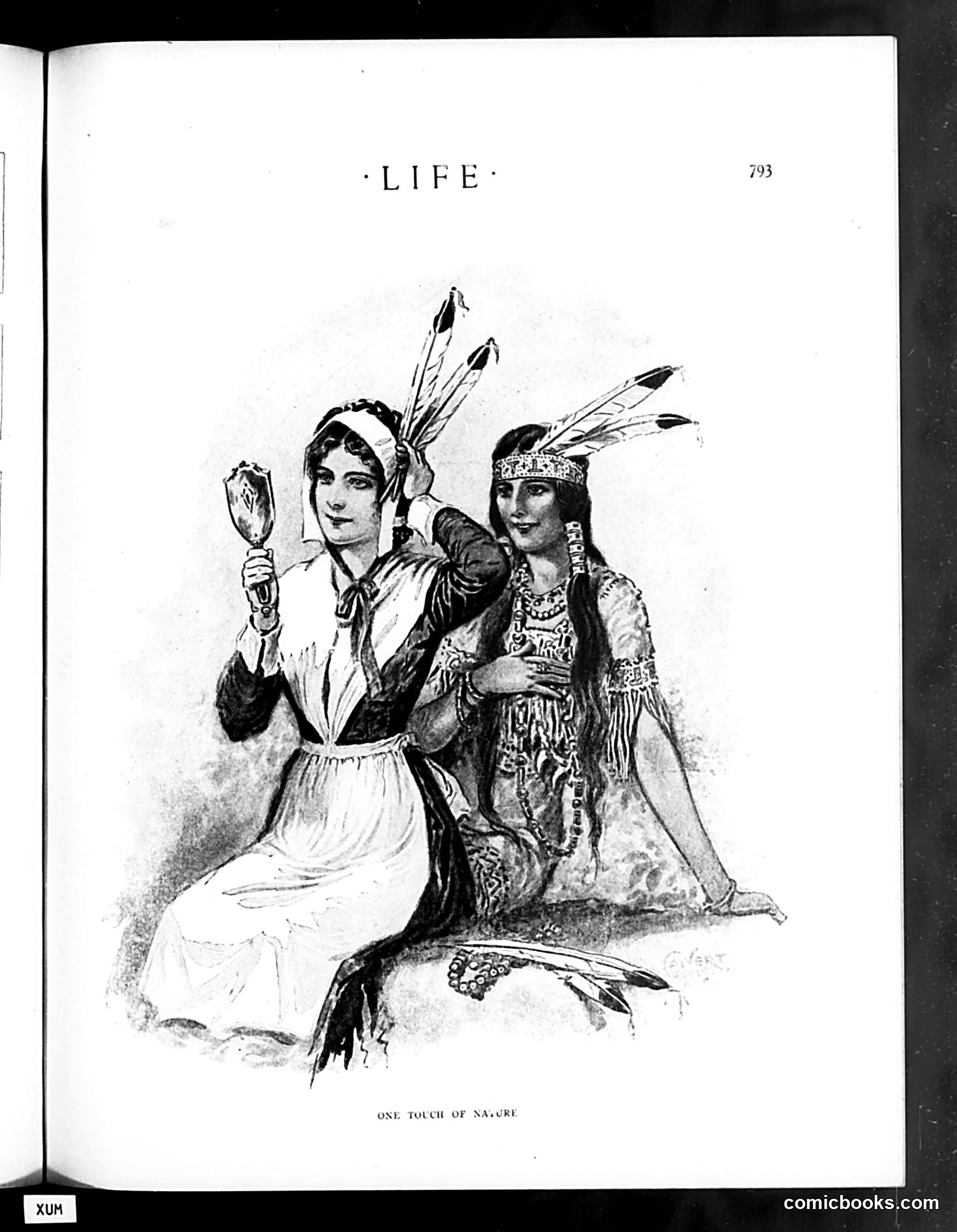
This illustration depicts two women in contrasting aesthetic styles. The figure on the left wears modern, Western dress with a headband featuring feathers, while the figure on the right is dressed in elaborate Native American-inspired clothing with ornate beadwork, feathered headdress, and decorative garments. The title "One Touch of Nature" appears to satirize early 20th-century fashion trends where Western women adopted "exotic" or "primitive" aesthetics as costume or affectation. The juxtaposition suggests mockery of how non-Native women appropriated Indigenous visual elements as fashionable accessories while actual Native peoples faced marginalization. The work likely critiques this shallow cultural borrowing and the racial attitudes underlying such trends.
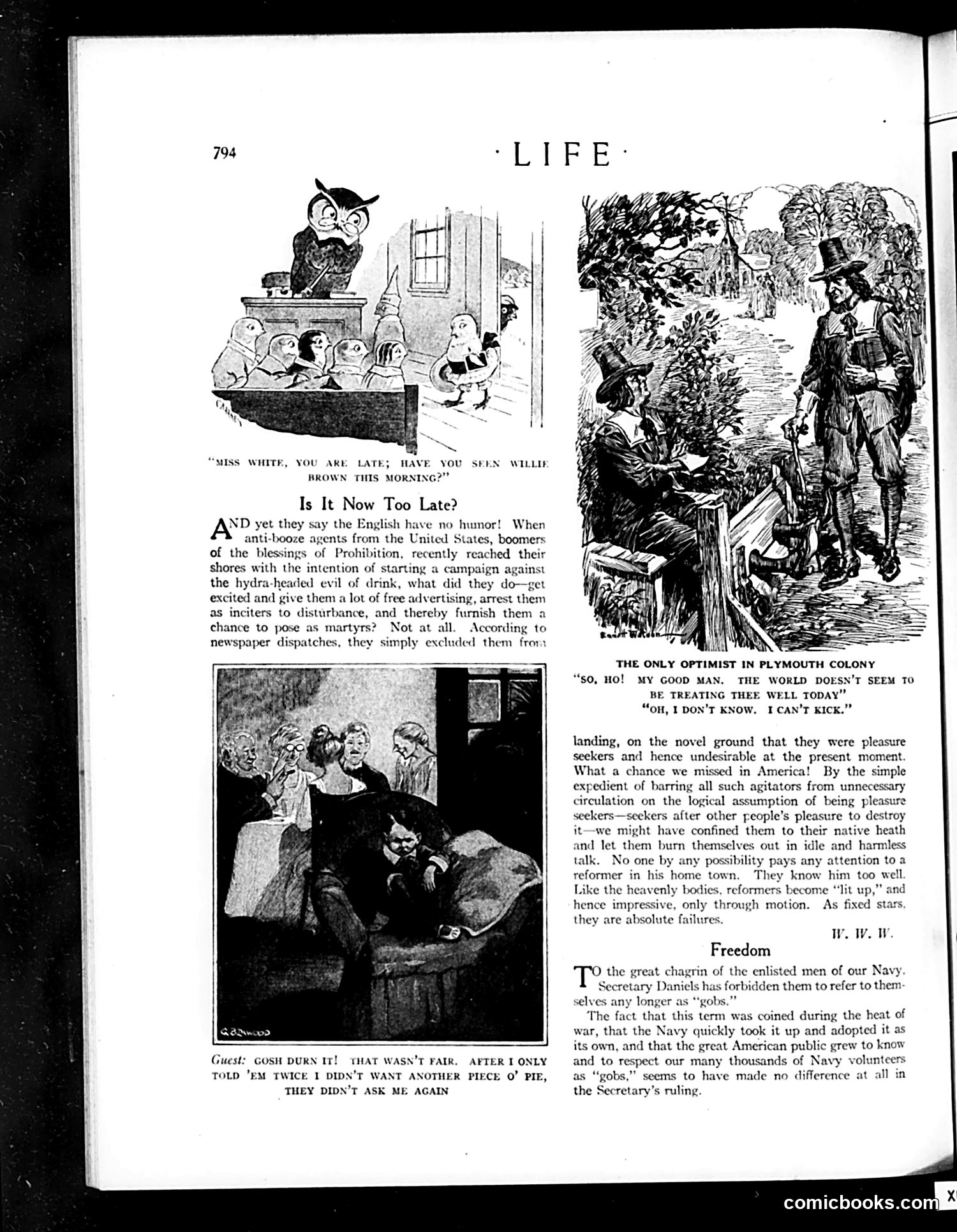
This page contains three satirical cartoons mocking American social reform efforts circa the Prohibition era. **Top cartoon**: Shows American Prohibition agents being rejected entry to England. The satire praises British pragmatism—rather than arrest the activists (giving them martyrdom publicity), Britain simply excluded them as "pleasure seekers," denying them the attention reformers crave. **Middle cartoon ("Plymouth Colony")**: A Pilgrim optimist refuses to complain despite hardship, captioned "I can't kick." The irony satirizes how reformers gain power through grievances; deny them an audience, they fade away. **Bottom section ("Freedom")**: Criticizes Navy Secretary Daniels for forbidding sailors to use the term "gobs" (slang the Navy had embraced). The satire questions this unnecessary linguistic policing of a term that had gained public respect and military tradition. All three pieces ridicule American reformers' ineffectiveness through contrast with pragmatism or critique of petty authoritarianism.
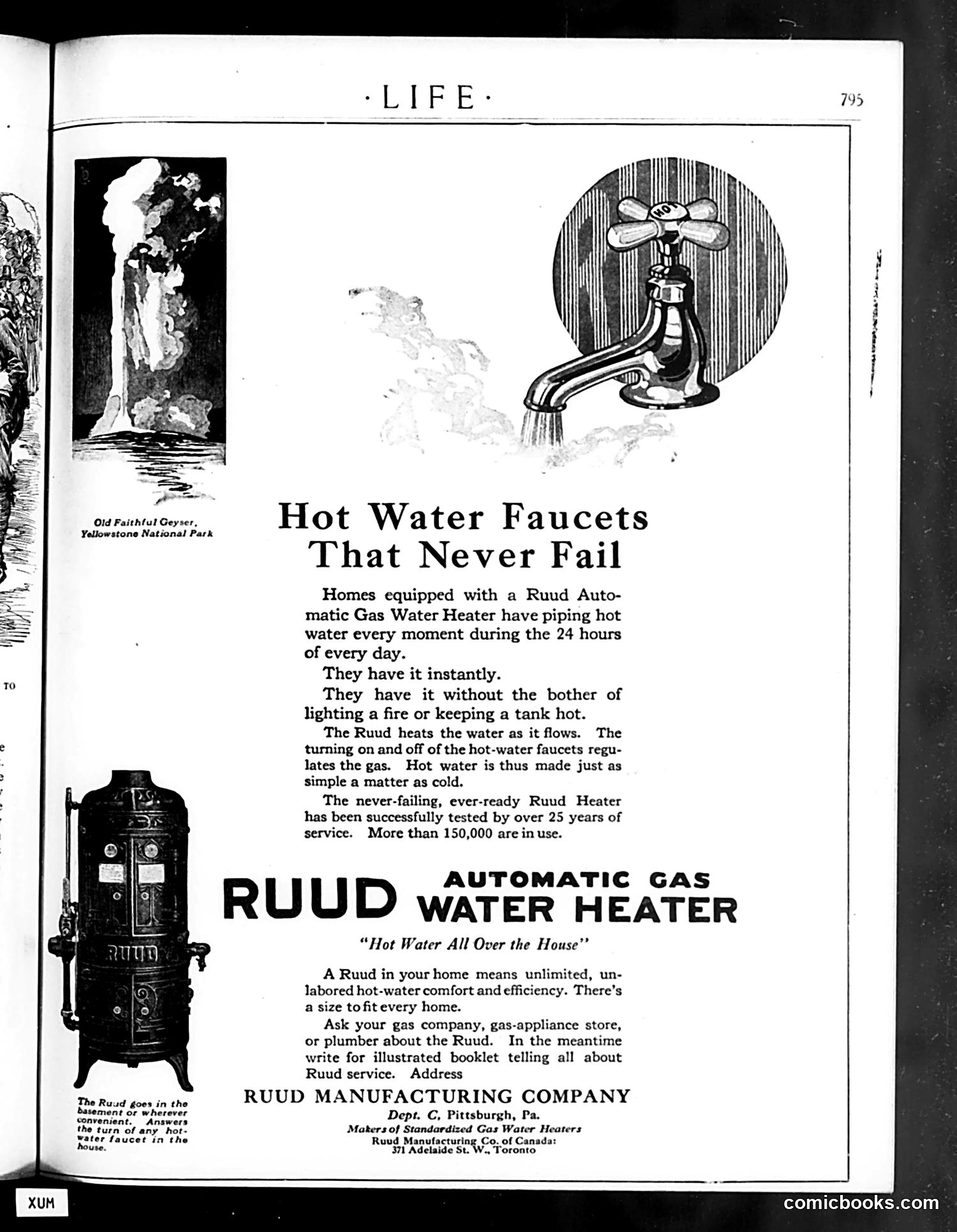
This page is primarily **advertising, not political satire**. It features a full-page advertisement for the Ruud Automatic Gas Water Heater, published in *Life* magazine (page 795). The only visual "cartoon" element is an illustration of a tap/faucet with water flowing, paired with a photograph of Old Faithful geyser in Yellowstone National Park. This visual comparison is purely promotional—equating the reliability and constancy of the Ruud heater's hot water output with nature's most famous reliable water fountain. The left side shows the actual heater unit itself—a tall, cylindrical tank with decorative metalwork. **There is no satire or political commentary here.** This is a straightforward early 20th-century product advertisement emphasizing convenience, reliability ("over 25 years of service"), and the modern comfort of instant hot water without maintaining a fire or tank. The Yellowstone reference simply suggests dependable, tireless performance.
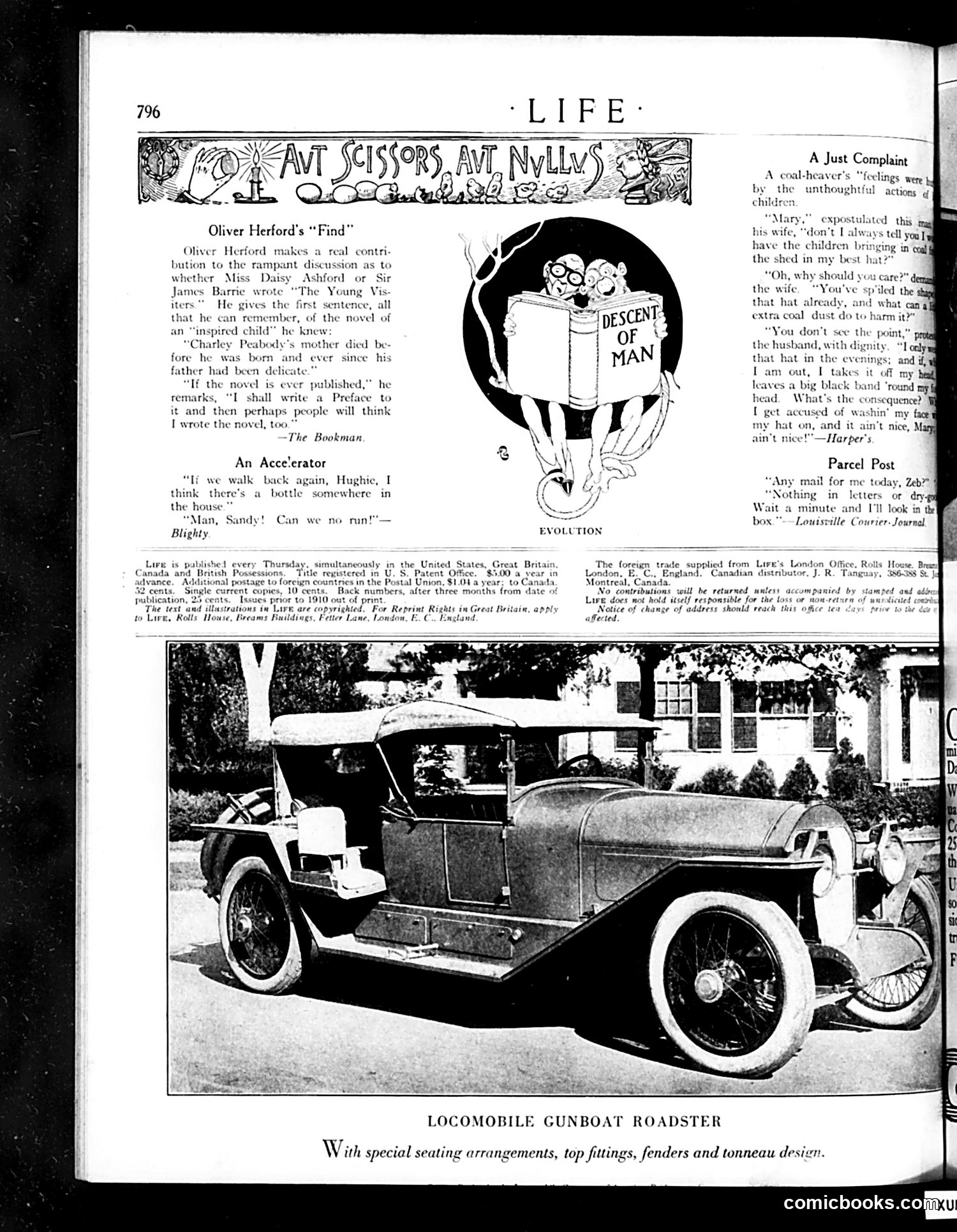
This page contains three separate satirical pieces: **Oliver Herford's "Find"**: A joke about the authorship controversy surrounding *The Young Visitors*, a novel supposedly written by a child named Daisy Ashford. Herford humorously suggests that if the novel is published, he'll write a preface to it—implying that adding a preface by a famous author would make people mistakenly credit him as the writer. The satire mocks how literary prestige and authorship attribution can be manipulated. **"An Accelerator"** and **"A Just Complaint"**: Brief comic dialogues about domestic life and inconvenience. **"Parcel Post"**: A joke about mail delivery expectations. The page's centerpiece is an illustration labeled "EVOLUTION"—a book titled *Descent of Man* emerging from a gorilla, referencing Darwin's evolutionary theory and the enduring public controversy over human origins. Below is an advertisement for a **Locomobile Gunboat Roadster**, an early automobile model.
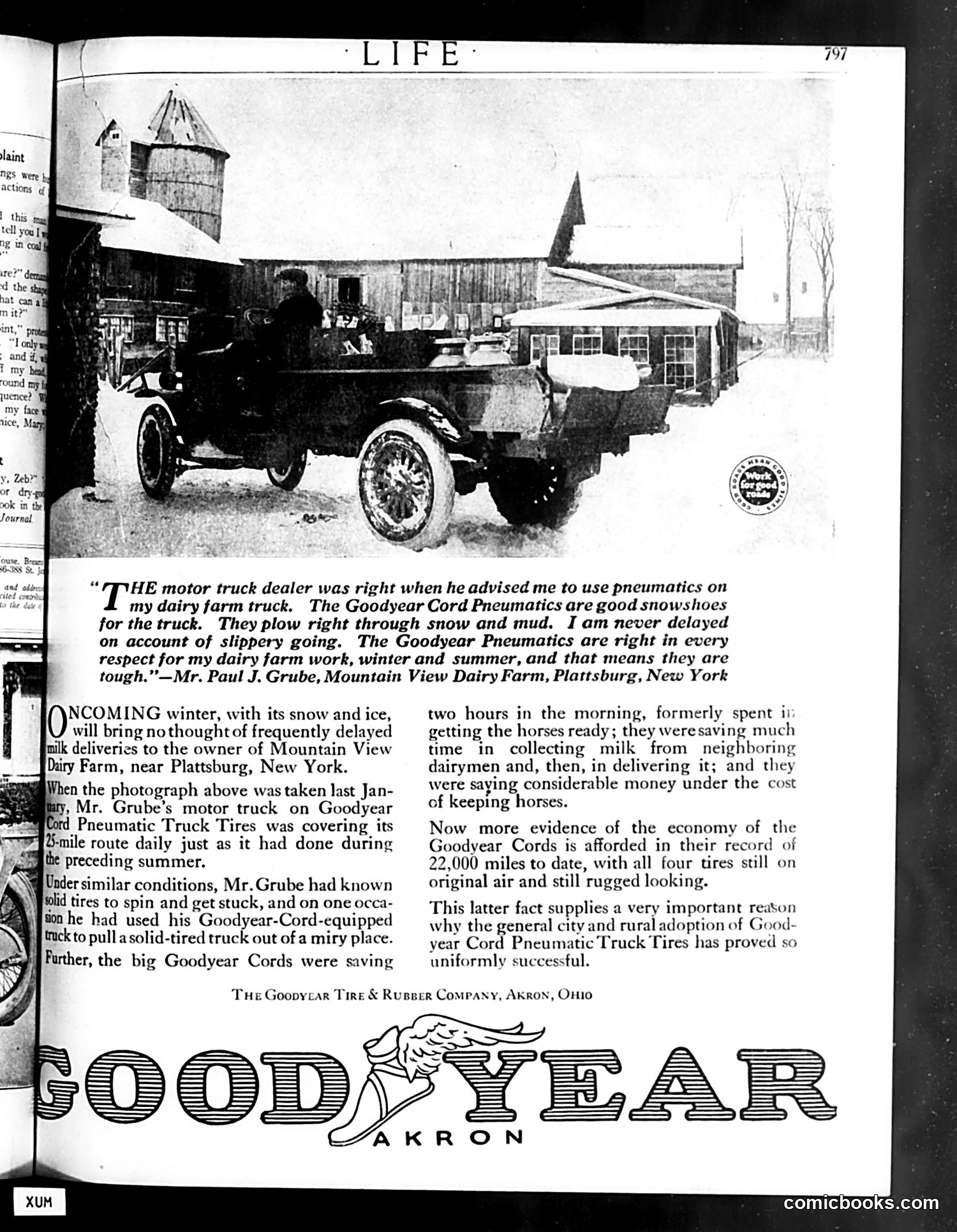
This is **not a cartoon or satire**—it's a straightforward **product advertisement** for Goodyear pneumatic truck tires, disguised as a testimonial article. The page features a photograph of a motor truck delivering milk in upstate New York, with a quoted endorsement from Paul J. Grube, a dairy farmer. The advertisement argues that pneumatic (air-filled) tires outperform solid tires in winter conditions: they prevent slipping, enable faster deliveries, and eliminate the need for horses—thus saving time and money. The "editorial" text presents purported facts: the truck traveled 22,000 miles on original tires; Goodyear Cords supposedly pulled stuck vehicles out of mud. This exemplifies early 20th-century advertising strategy: presenting ads as credible customer testimonies in magazines to lend authority to commercial claims. The modern reader should recognize this as sponsored marketing content masquerading as journalism.
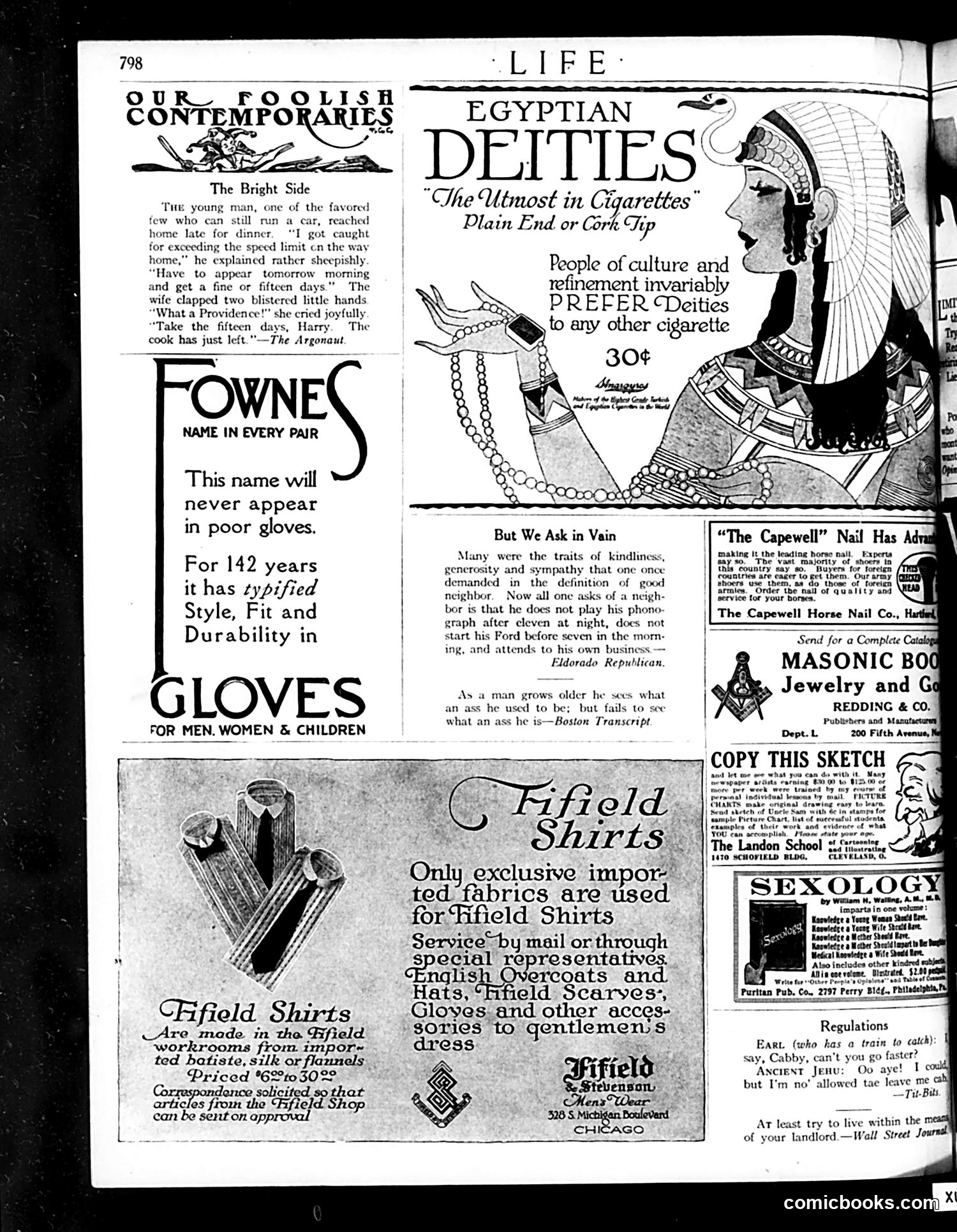
This page is primarily **advertising**, not political satire. The dominant content is a large Egyptian Deities cigarette advertisement featuring an Egyptian woman in profile, promoting cigarettes at 30¢ as products of "culture and refinement." The small **cartoon content** includes: 1. **"Our Foolish Contemporaries"** (top left): A brief domestic humor sketch about a speeding husband who got a ticket—his wife is relieved because now he'll serve jail time instead of coming home, solving her problem of the cook quitting. 2. **"Regulations"** (bottom right): A two-panel joke showing an impatient passenger asking a cab driver to speed up, but the driver claims he's not "allowed" to exceed the speed limit—likely mocking post-WWI traffic enforcement or regulatory complaints. The page also contains various product advertisements (Fownes Gloves, Fifield Shirts, Masonic jewelry). The satire is mild and domestic rather than political, reflecting 1920s consumer culture and everyday life complaints.
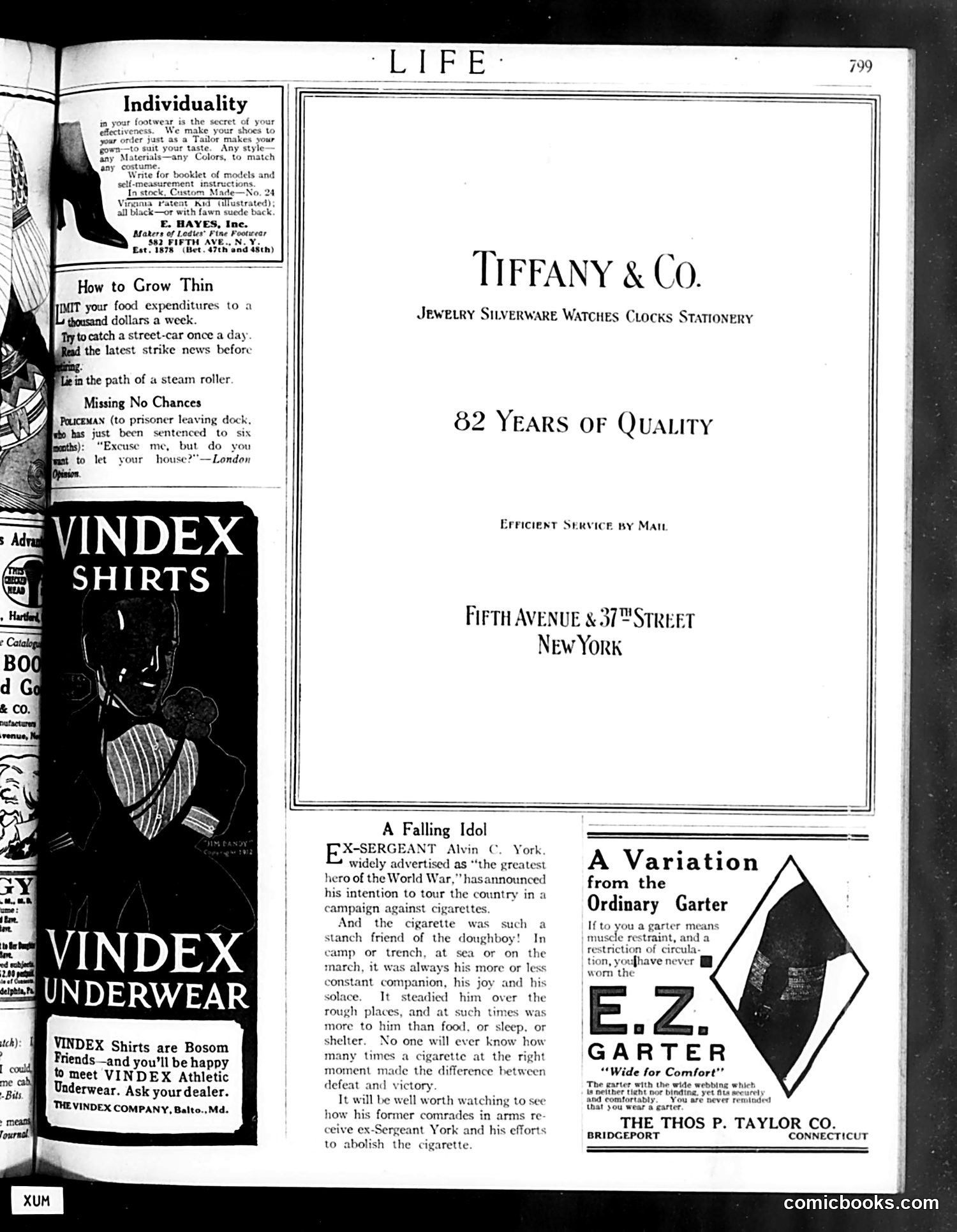
This page is primarily **advertising and editorial content**, not political satire. The main article, "A Falling Idol," discusses **Sergeant Alvin C. York**, a heavily publicized World War I hero, announcing a campaign against cigarettes. The satire is mild: Life ironically notes the contradiction that cigarettes were soldiers' constant companions in the trenches—providing comfort during combat—yet York now campaigns to abolish them. The piece gently mocks this reversal without harsh criticism. The surrounding content consists entirely of **period advertisements**: Tiffany & Co. (jewelry/silverware), Vindex shirts and underwear, and E.Z. garters. The left sidebar includes brief humorous items like "How to Grow Thin" (suggesting catching streetcars and standing before steam rollers) and "Missing No Chances" (a joke about a prisoner being asked to rent his house). This is typical Life magazine fare from the 1920s—a mix of light social commentary, humor, and commercial advertisements reflecting the era's consumer culture.
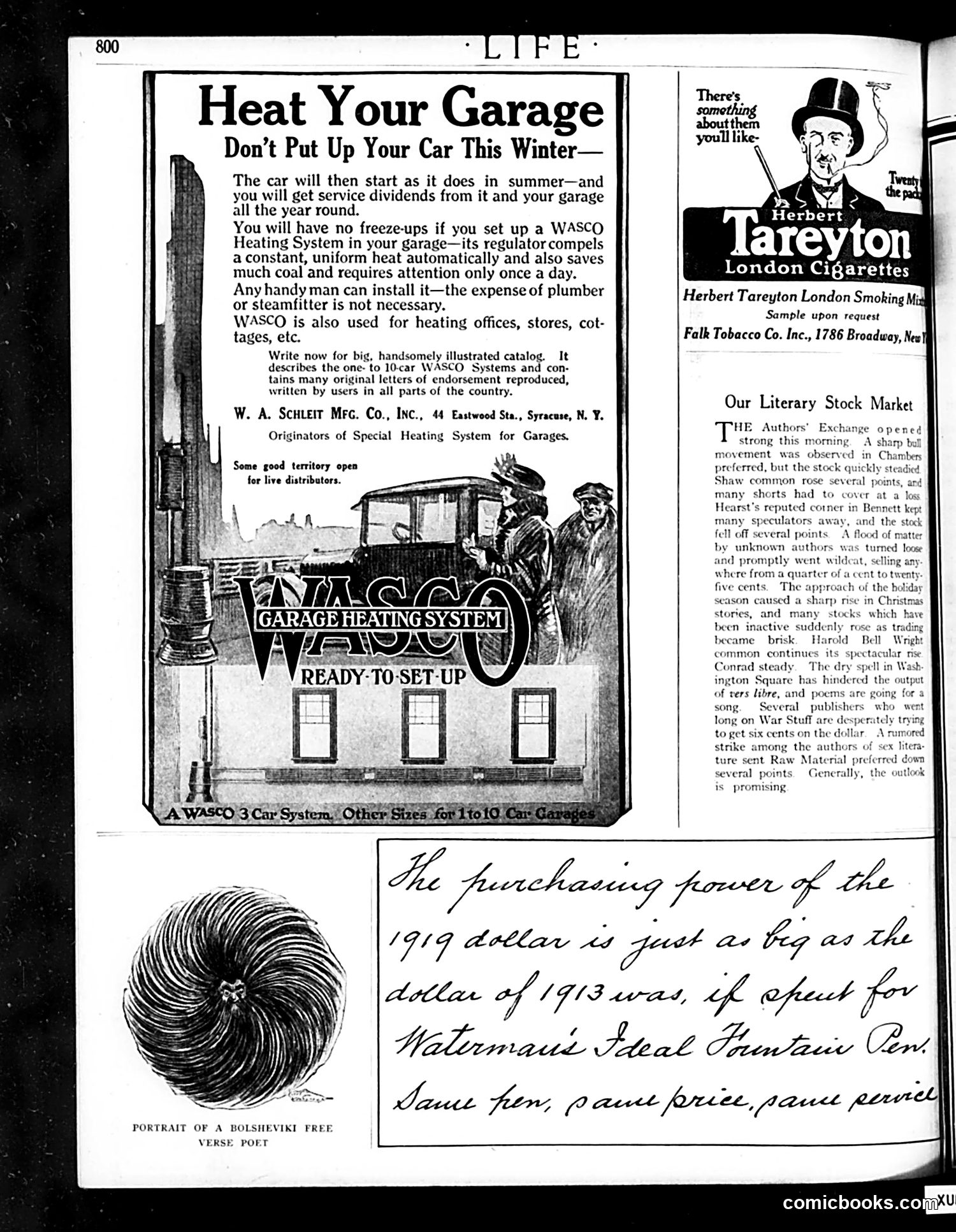
This page is primarily **advertising and literary commentary**, not political satire. The main advertisement promotes the WASCO garage heating system—a practical product allowing car owners to keep vehicles heated through winter, preventing freeze-ups and maintaining engine readiness. The illustration shows the heating apparatus installed in a garage. Below is a **Herbert Tareyton cigarette ad** and a section titled "Our Literary Stock Market," which uses financial metaphor to humorously discuss contemporary authors' popularity. References include George Bernard Shaw's stock "rising," unknown authors' work being "turned loose," and mention of Harold Bell Wright and the "dry spell in Washington Square" (likely referring to short poetry or "vers libre"). At bottom left is a portrait labeled "Portrait of a Bolsheviki Free Verse Poet"—a satirical jab at avant-garde poetry associated with radical movements, seemingly mocking both modern poetry and political extremism. The page reflects early 1920s American concerns: practical technology, consumer goods, literary trends, and lingering anxiety about radical ideologies.
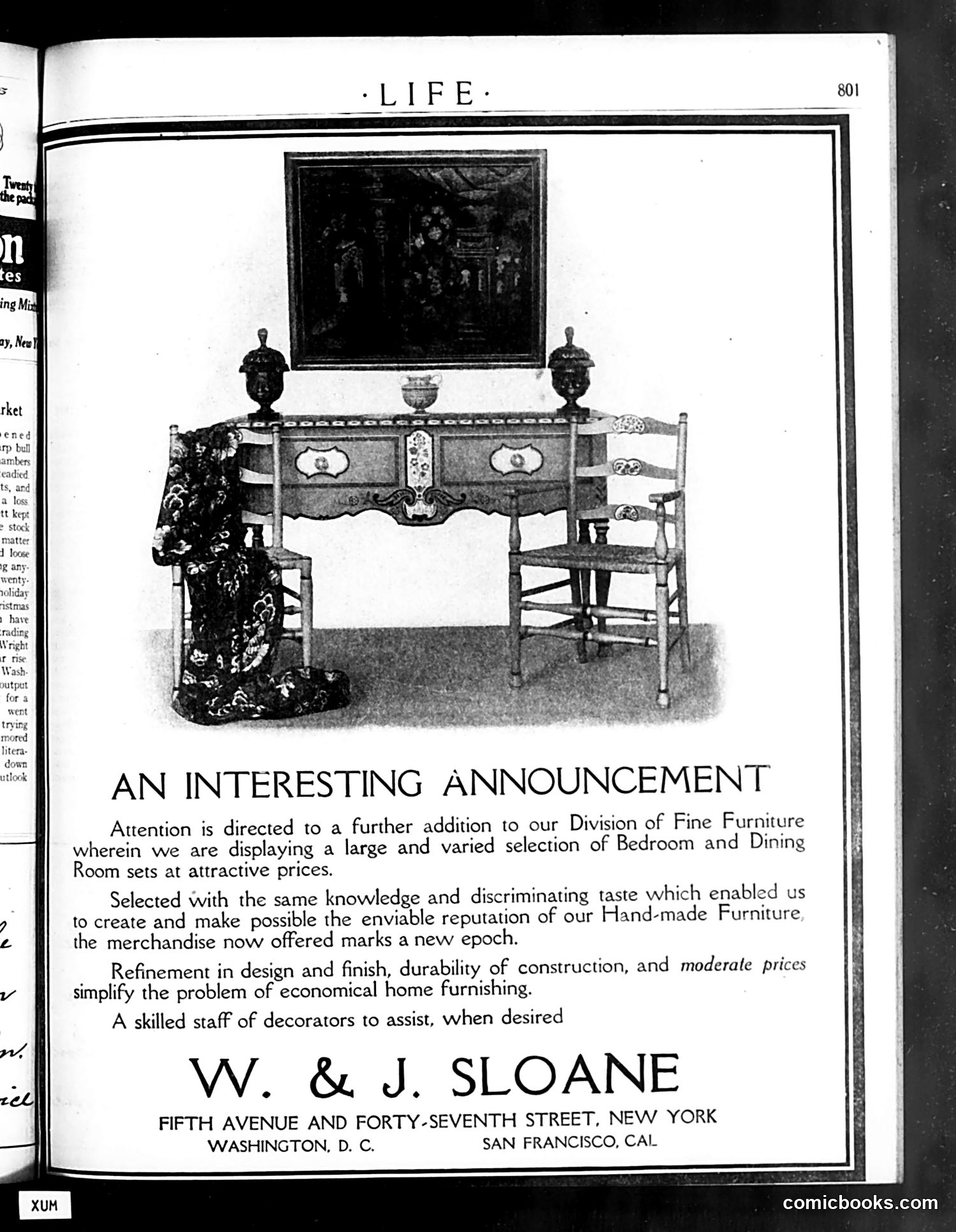
This page is **not a cartoon or satirical content**—it's a straightforward advertisement for W. & J. Sloane, a furniture retailer with locations in New York, Washington D.C., and San Francisco. The ad announces an expansion of their "Division of Fine Furniture," promoting bedroom and dining room sets at "moderate prices." It emphasizes their hand-made reputation, design refinement, durability, and offers decorator assistance. The image shows a period bedroom set arrangement displayed against a wall, featuring a vanity/dresser with decorative urns, a mirror, and period-appropriate chairs. This appears in *Life* magazine (page 801), which despite its satirical reputation, regularly carried advertising. There is no political or social satire present—simply a luxury furniture company marketing to middle-to-upper-class readers.
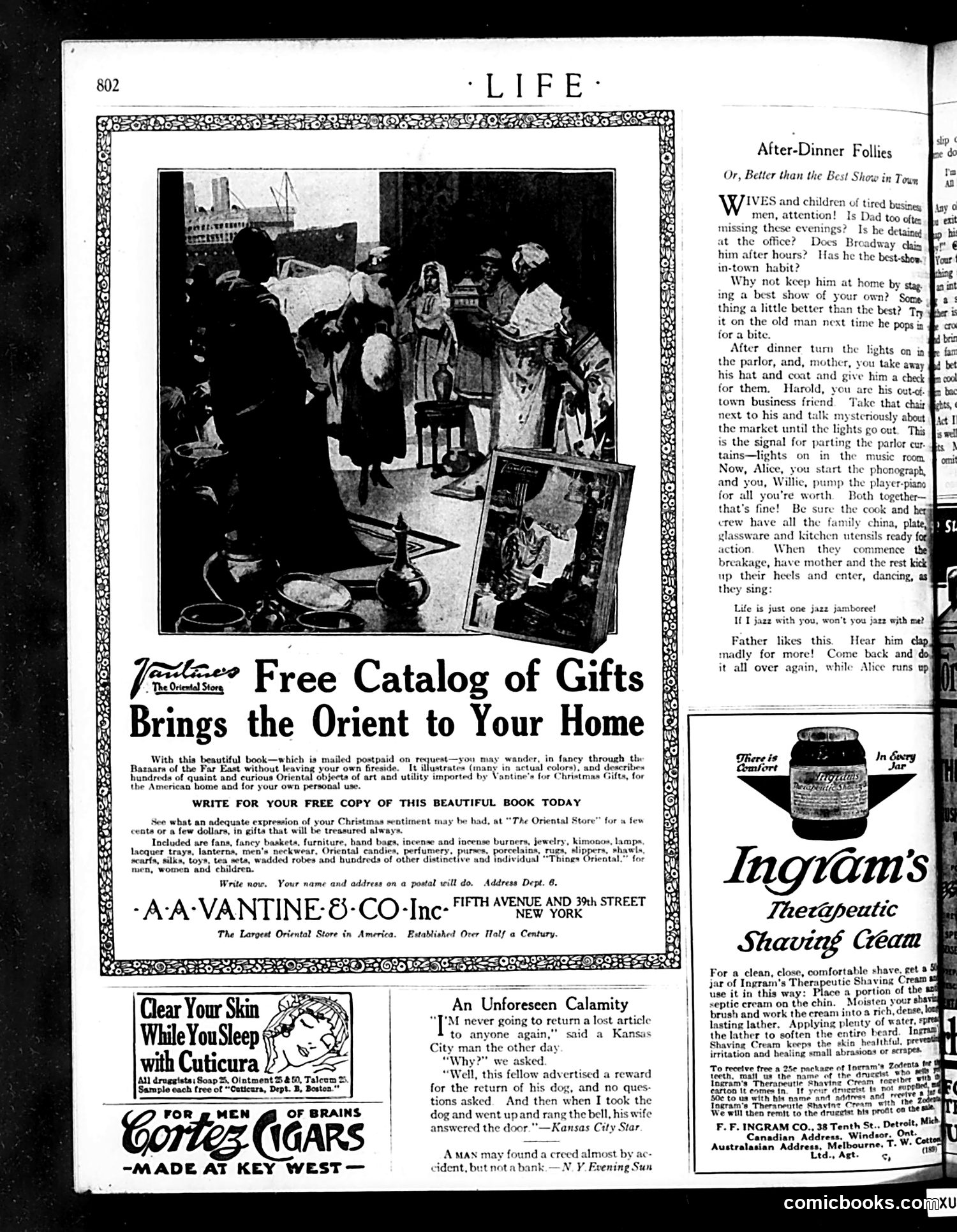
This page is primarily **advertising** rather than political satire. The main content is: **"After-Dinner Follies"** (top right): A humorous advice column suggesting wives stage home entertainments to keep husbands from attending Broadway shows and staying late at the office. The suggestion involves family members performing a jazz-themed show with music, dancing, and singing—reflecting 1920s jazz-age entertainment as a novelty to entertain businessmen. It's gentle domestic satire about keeping husbands engaged at home. **Full-page advertisements** dominate the layout: - **A.A. Vantine & Co.**: Promoting an Oriental gift catalog - **Ingram's Therapeutic Shaving Cream**: With usage instructions - **Cuticura soap** and **Cortez cigars**: Smaller ads **"An Unforeseen Calamity"** (bottom): A brief anecdote about someone refusing to return a lost dog because the reward-seeker's wife was rude when answering the door—a mild joke about unexpected social consequences. The page reflects 1920s consumer culture and domestic life concerns rather than political commentary.
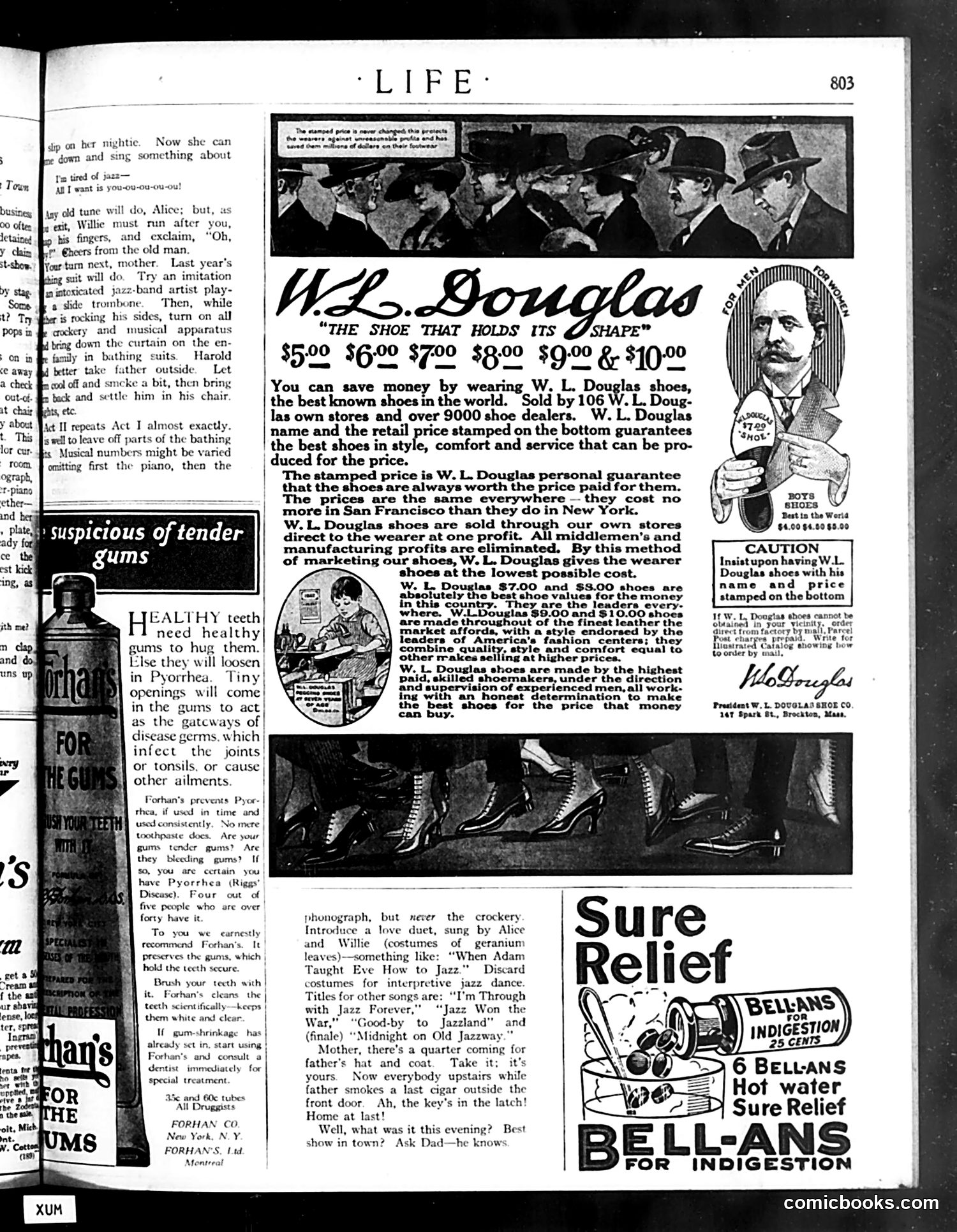
This page is primarily **advertising**, not political satire. The dominant content is a large W.L. Douglas shoe advertisement (center-right), featuring price points ($5-$10) and claims about direct-to-consumer sales eliminating middleman profits. The ad includes a portrait of W.L. Douglas himself and photographs of shoes. Secondary advertisements include **Forhan's toothpaste** (left side, addressing "Pyorrhea" or gum disease) and **Bell-ans indigestion remedy** (lower right). The text fragments on the left appear to be a theater/entertainment review discussing a jazz-themed show with performers named Alice and Willie, mentioning costumes and song titles like "When Adam Taught Eve How to Jazz"—reflecting the 1920s jazz craze. **No political cartoon is present.** This is a commercial magazine page from the Jazz Age era, showcasing period consumer products and entertainment references typical of that time.
This page is primarily an **advertisement for Rexall Orderlies**, a laxative/digestive product. The repeated text "They work naturally and form no habit" is the product's key marketing claim—a selling point emphasizing that the laxative won't create dependency, a concern consumers had about such medications. The visual shows the product box with pills scattered below it. The pricing ("8 for 10¢, 24 for 25¢, 60 for 50¢") indicates availability at Rexall drugstore chains. This isn't political satire but rather a commercial advertisement typical of early 20th-century magazines like *Life*, which mixed editorial content with ads. The repetitive text layout appears designed for visual emphasis and memorability—a common advertising technique of the era.
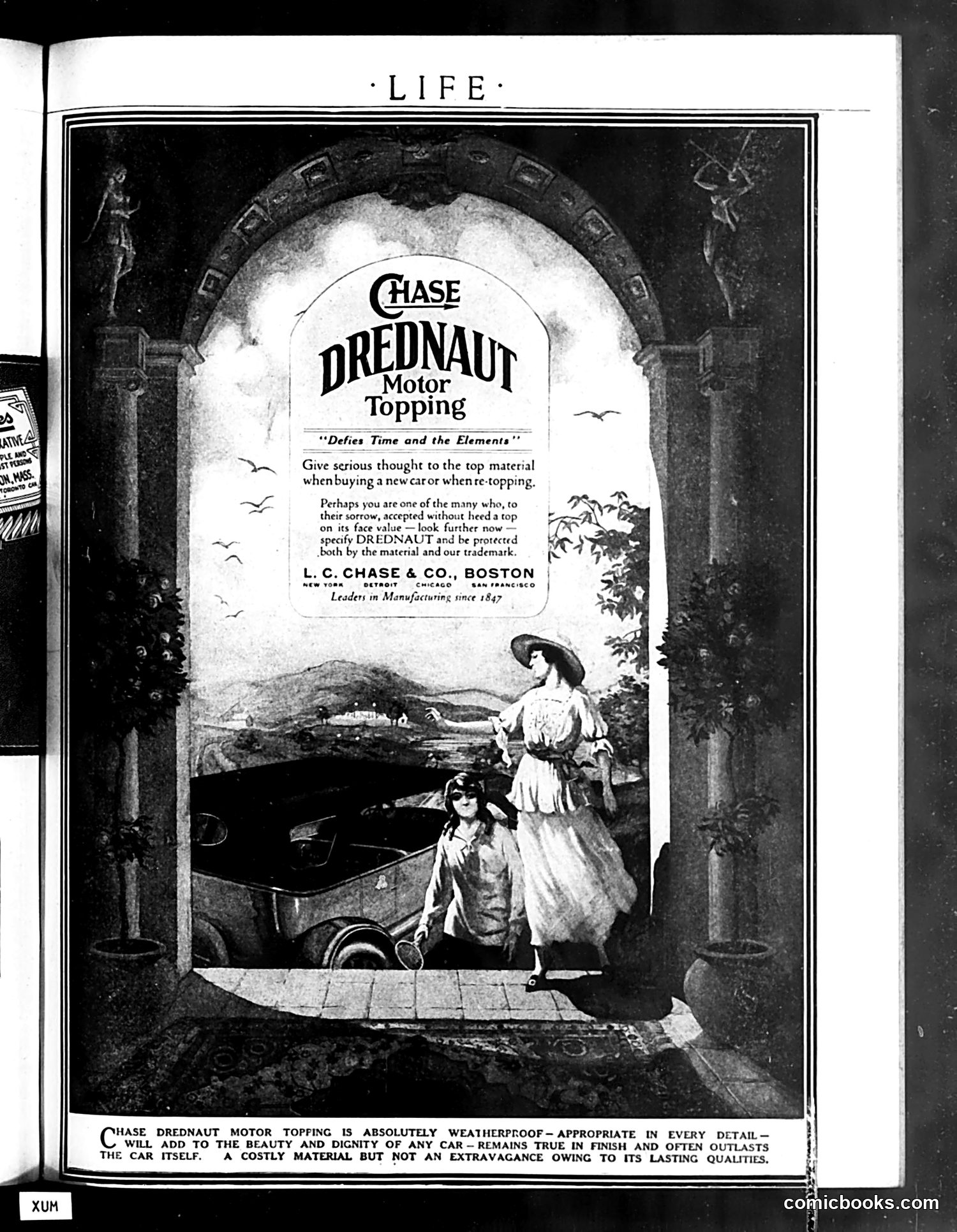
This is a **full-page advertisement**, not a political cartoon or satire. It promotes Chase Drednaut Motor Topping, a car roof material manufactured by L.C. Chase & Co. of Boston (established 1847). The ad uses a romantic, idealized illustration—two figures (a man and woman) admiring a landscape vista framed by classical architecture—to associate the product with beauty, durability, and quality. The tagline "Defies Time and the Elements" emphasizes weatherproofing. The sales pitch targets early-20th-century car owners who may have purchased cheap roof materials without consideration. Chase Drednaut promises superior finish and longevity, positioning the higher cost as justified by durability. The ad exemplifies vintage automotive marketing that tied functional products to aspirational imagery and emotional appeal rather than technical specifications.
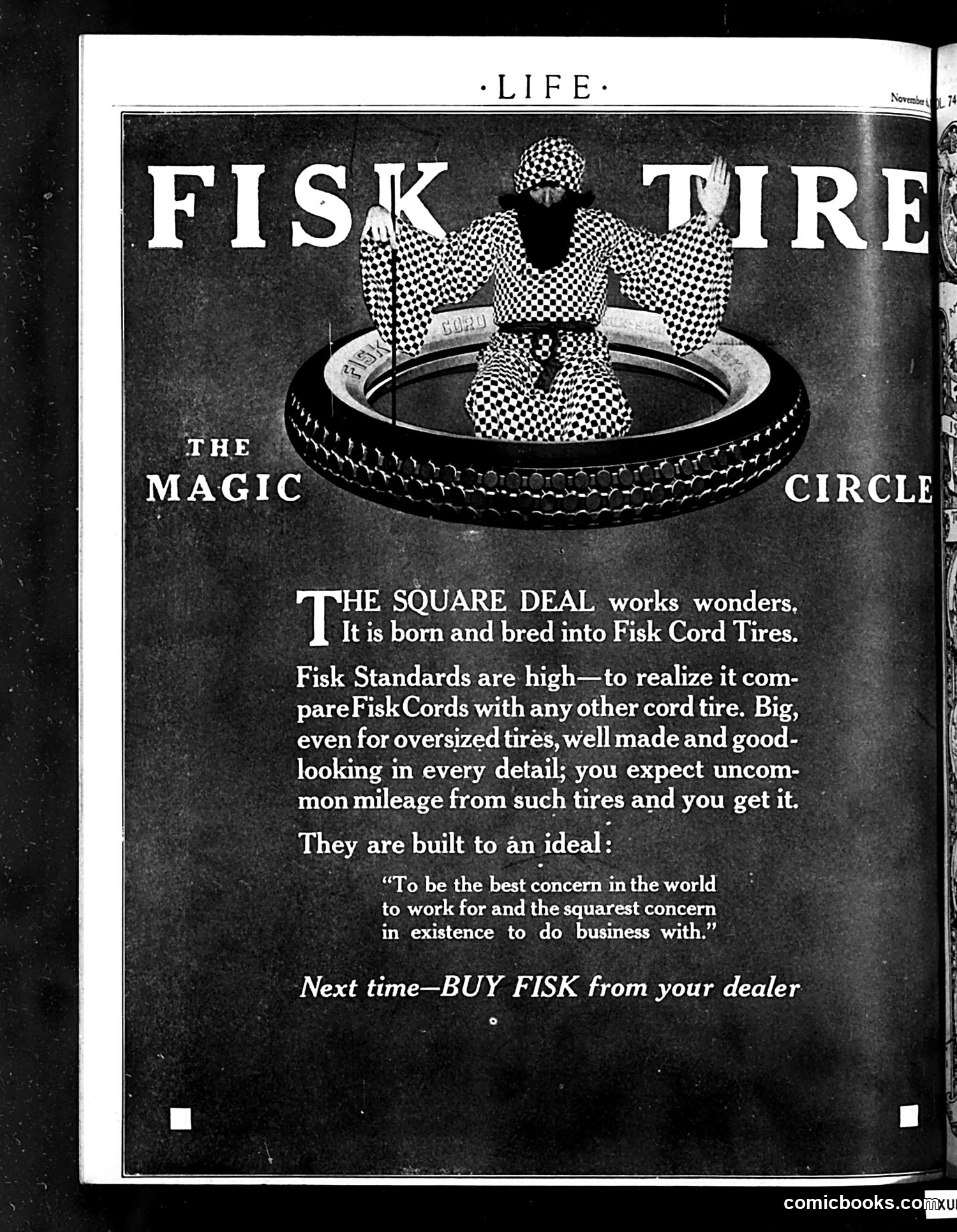
This is a **commercial advertisement**, not political satire. It's a Fisk Cord Tires ad from *Life* magazine featuring "The Magic Circle"—a stylized checkered figure seated in a large tire rim. The ad invokes **"The Square Deal,"** Theodore Roosevelt's progressive political platform from the early 1900s, to market tires as ethically manufactured and fairly priced. By associating the product with Roosevelt's reform agenda, Fisk positions itself as a company that treats workers well and conducts honest business—appealing to consumers' values during the Progressive Era. The checkered figure is Fisk's brand mascot, designed to be memorable and eye-catching. The ad promises durability and value ("uncommon mileage") backed by the company's ideals of fair dealing.