
A complete issue · 36 pages · 1919
Life — October 30, 1919
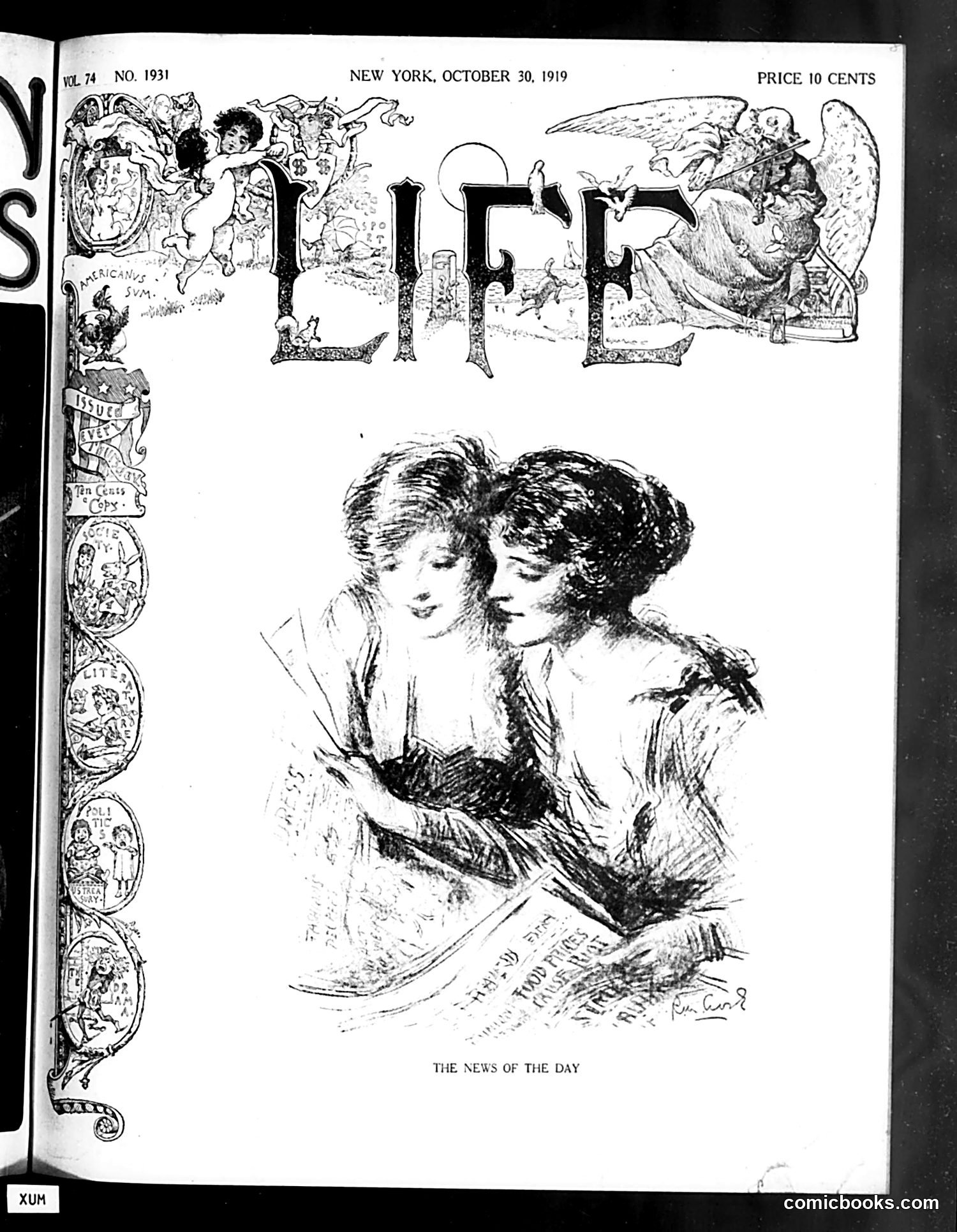
This cover illustration titled "The News of the Day" depicts two women reading a newspaper together. The image appears to be social commentary on women's engagement with current events during the early 20th century. The ornate left border contains decorative vignettes typical of Life magazine's design. The elaborate "LIFE" masthead at top features classical cherubs and allegorical figures, standard for the publication's artistic branding. Without additional context or caption text visible, the specific political or social reference remains unclear. However, given the 1919 date—following women's suffrage activism and World War I—the image likely comments on women's newly expanded public interests or their growing role in civic awareness, though the precise satirical point is not definitively determinable from the image alone.
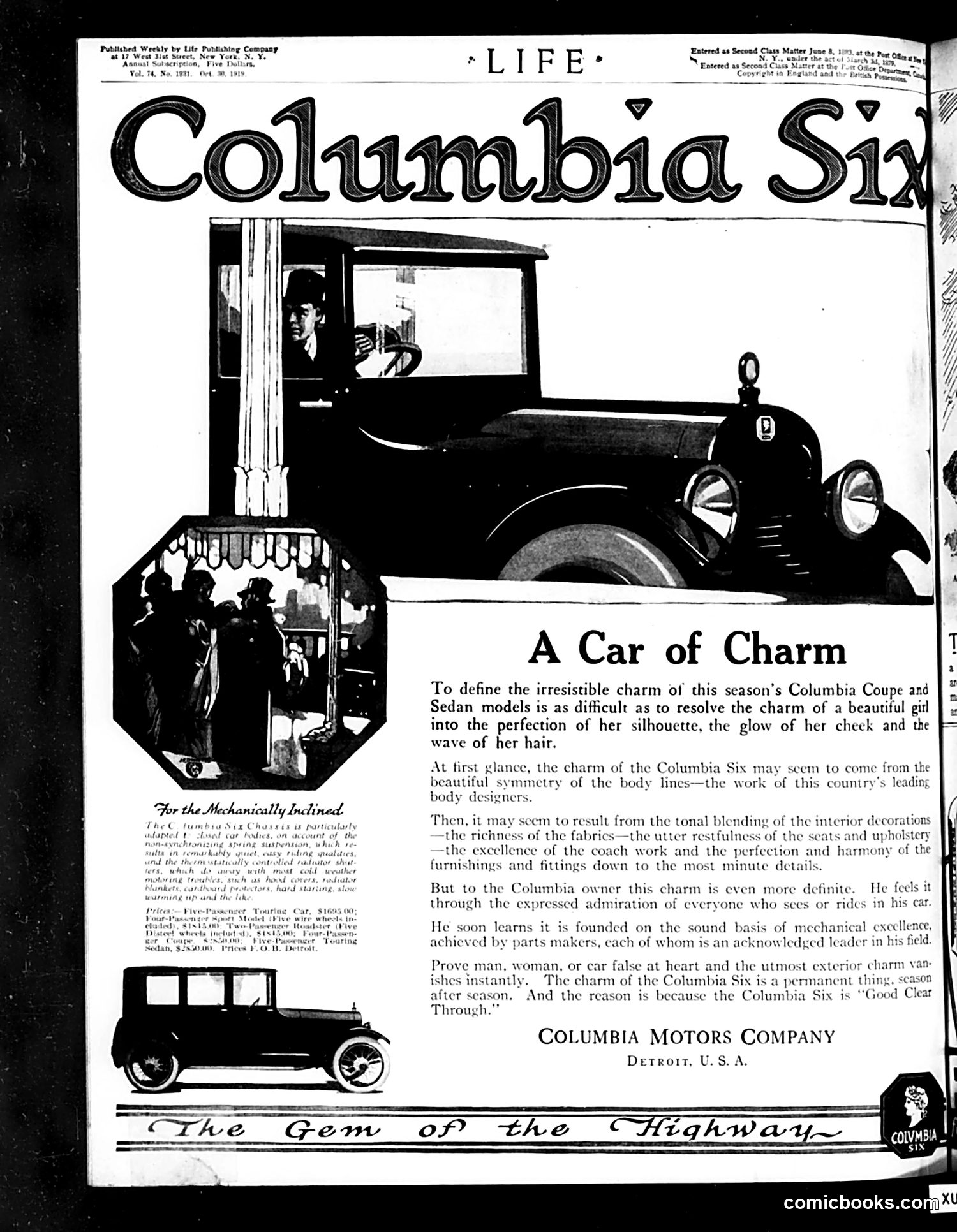
This is primarily a **Columbia Motors automobile advertisement**, not political satire. The page appears in *Life* magazine (Vol. 74, No. 1931, dated June 19, 1919). The ad promotes the Columbia Six automobile as "A Car of Charm," emphasizing its mechanical excellence and aesthetic appeal. The accompanying images show the vehicle and a scene labeled "For the Mechanically Inclined," depicting what appears to be a showroom or dealership. The tagline "The Gem of the Highway" presents the Columbia Six as a luxury vehicle combining both mechanical reliability and visual beauty. This is straightforward commercial messaging typical of early automotive advertising—no political commentary or satirical content is evident on this page.
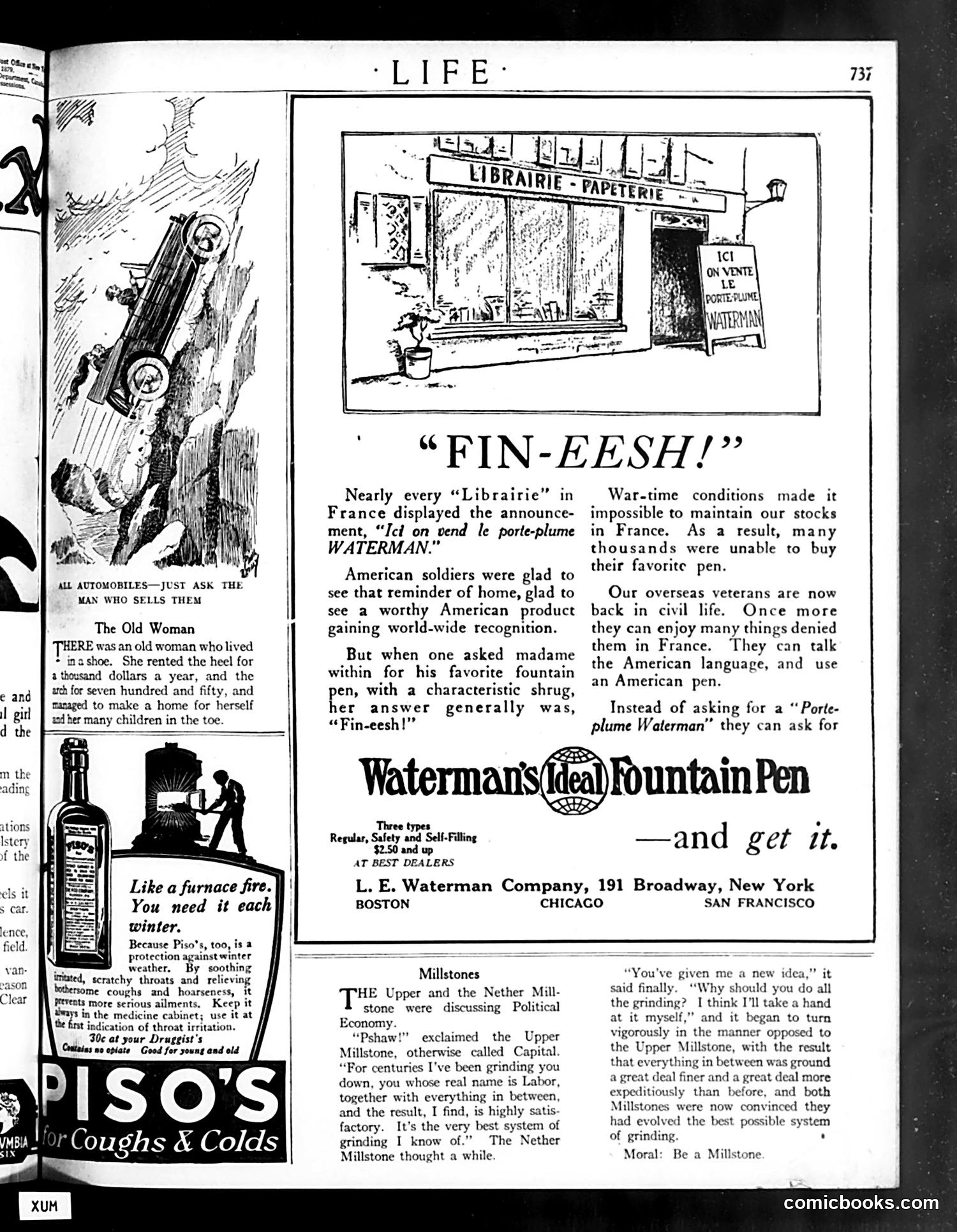
This page is primarily **advertising** rather than political satire. The dominant content is a Waterman's Idea Fountain Pen advertisement exploiting post-WWI nostalgia. The ad references French "Librairies" displaying signs reading "Ici on vend le porte-plume Waterman" (Here we sell Waterman pens), noting that American soldiers found these pens comforting reminders of home during wartime France. The secondary content includes a brief fable called "The Old Woman" and a Piso's cough medicine ad, plus a short satirical piece titled "Millstones" about political economy featuring Upper and Nether Millstones in dialogue. The satire is minimal—primarily the "Millstones" wordplay about grinding grain versus grinding labor.
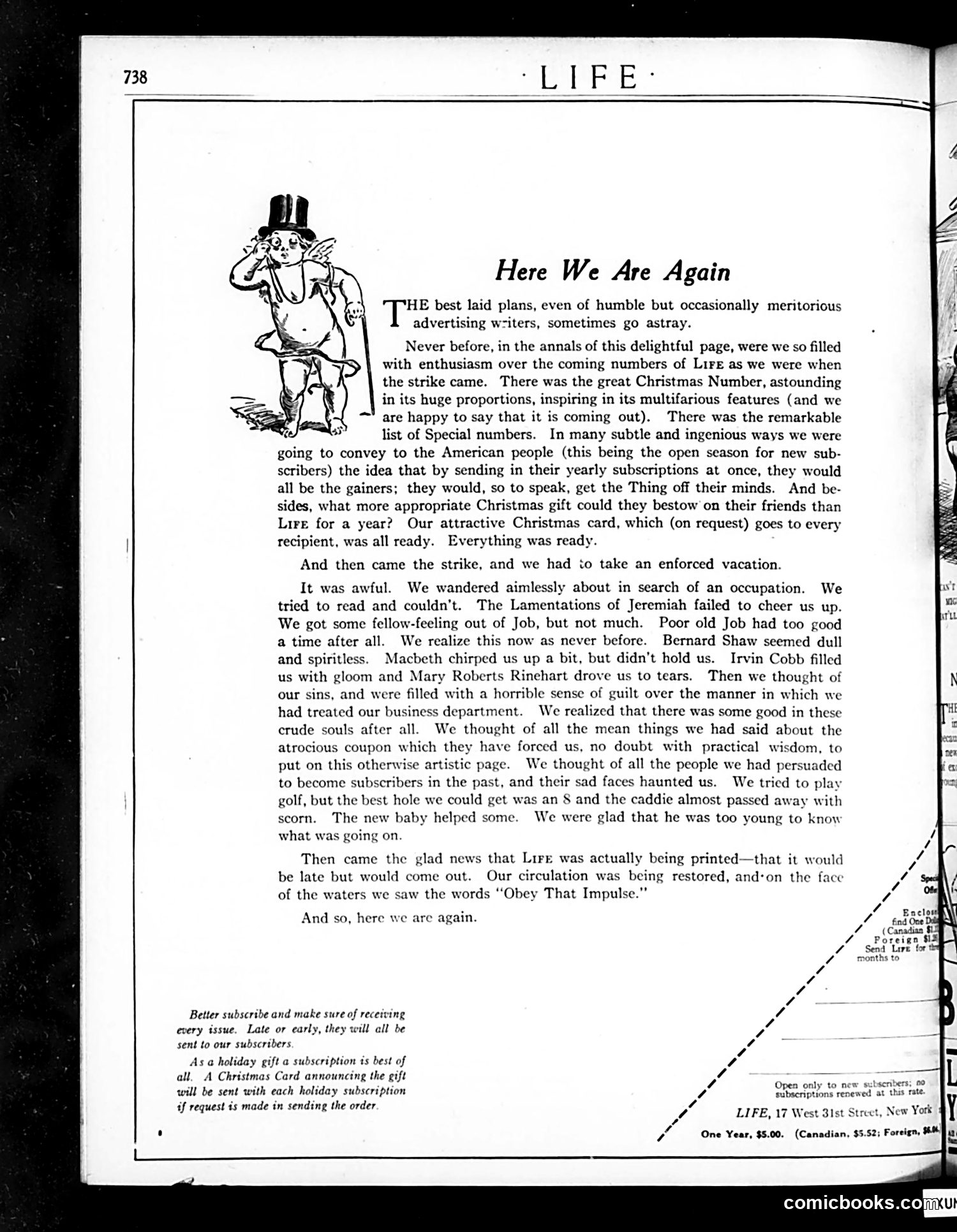
This is an editorial piece, not a cartoon, reflecting on *Life* magazine's resumption after a printing strike. The illustration shows a cupid-like figure, symbolizing the magazine's return. The text describes the staff's emotional turmoil during the strike—attempting to read job postings, feeling guilt over how they'd treated their business department, and worrying about lost subscribers. They reference feeling "gloom" and nearly losing hope, comparing their situation to biblical suffering ("Lamentations of Jeremiah"). The piece celebrates *Life's* return to print with the phrase "Obey That Impulse," urging readers to renew subscriptions as Christmas gifts. The tone is humorous self-deprecation about the staff's anxiety, while ultimately promoting the magazine's resurrection and financial recovery through holiday subscriptions.
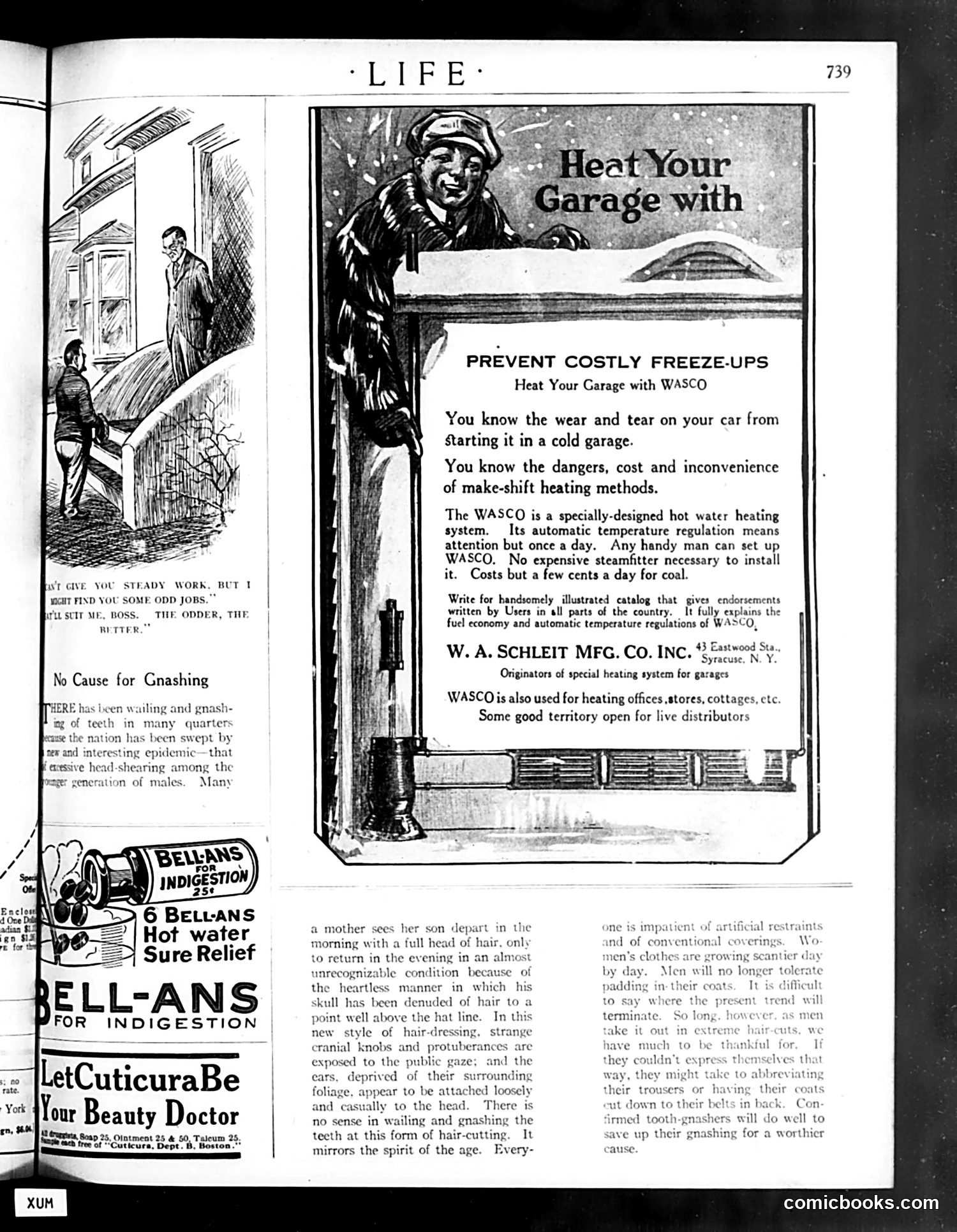
This page is primarily **advertising** rather than satirical content. The dominant feature is a WASCO garage heating system advertisement showing a man installing heating equipment in a cold garage. The copy emphasizes preventing car freeze-ups and wear from cold starts—a practical concern for early 20th-century motorists before modern heating. The left side contains minor content: a small sketch titled "No Cause for Gnashing" (about hair-cutting practices), plus advertisements for Bell-Ans indigestion remedy and Cuticura beauty products. The satirical elements are minimal. The "No Cause for Gnashing" piece appears to mock excessive hair-grooming trends among men, but details are unclear. Overall, this is a commercial page reflecting period concerns about automobile maintenance and patent medicines, rather than political satire.
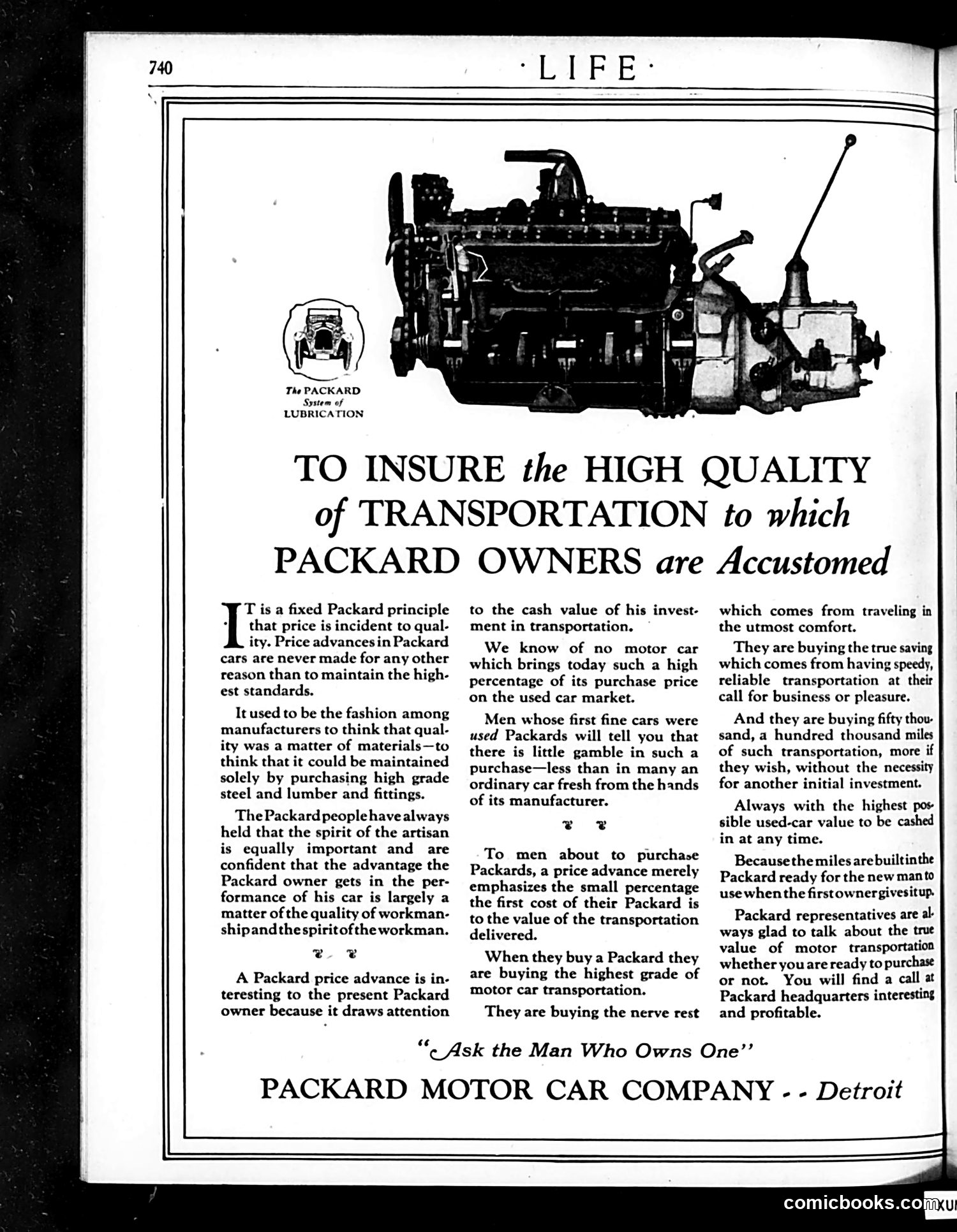
This page is **primarily an advertisement** for Packard Motor Car Company (Detroit), not a political cartoon or satire. The ad argues that Packard maintains high quality standards despite price increases—a key selling point during the 1920s when automobile prices were rising. The text emphasizes that Packard owners are accustomed to "high quality transportation" and that the brand's reputation justifies premium pricing. The small illustration shows a Packard engine and chassis. The "Ask the Man Who Owns One" tagline was Packard's actual marketing slogan, positioning owner testimonials as proof of quality. The ad reflects post-WWI economic conditions when luxury car manufacturers justified inflation by emphasizing craftsmanship and reliability—appealing to wealthy buyers concerned about value retention of their investments.
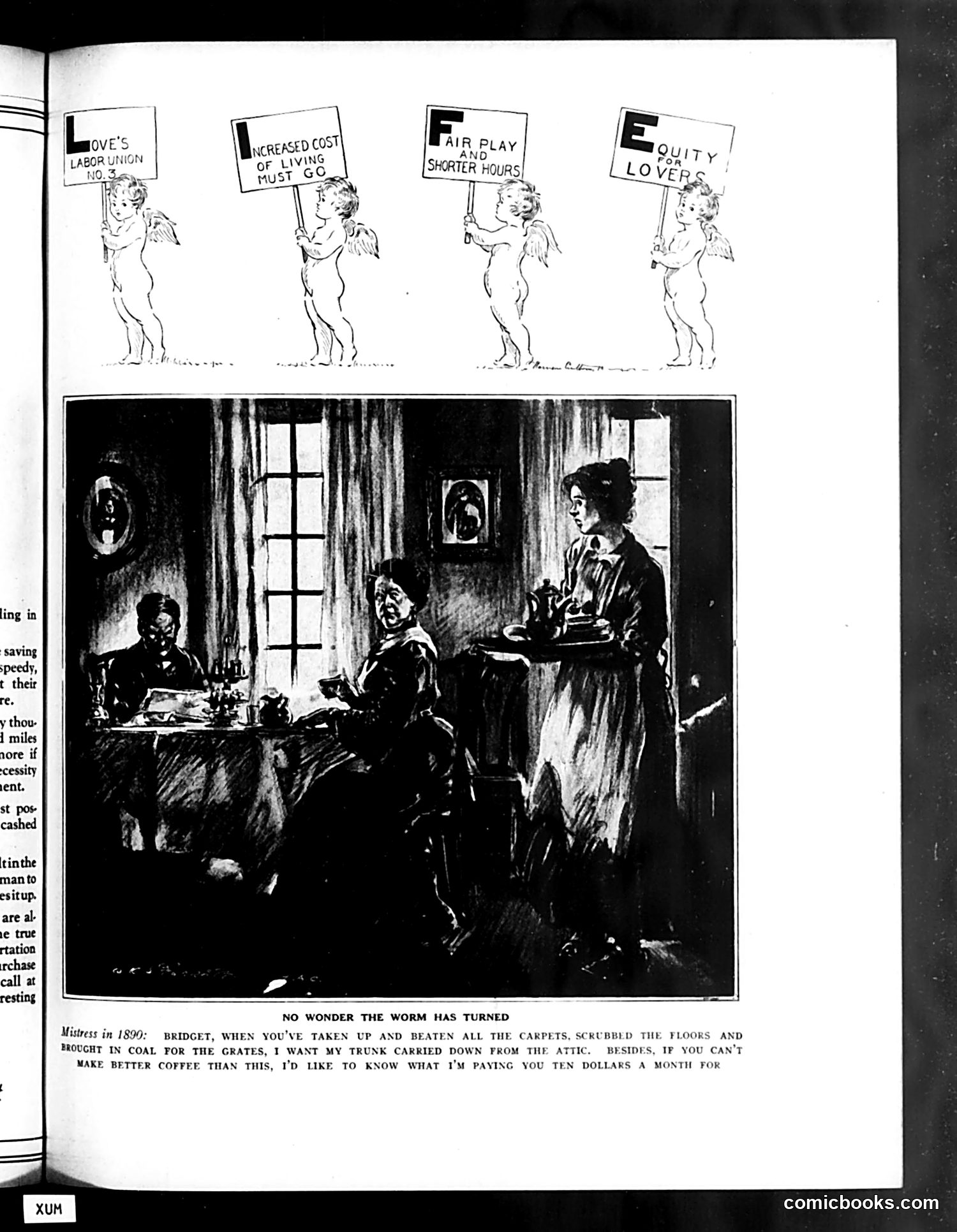
This page contains two distinct satirical pieces about labor and domestic work: **Top panel:** Four cherubs hold signs representing different labor demands: "Love's Labor Union No. 3," "Increased Cost of Living Must Go," "Fair Play and Shorter Hours," and "Equity Lovers." This appears to satirize labor union organizing and wage demands of the era. **Bottom cartoon:** A domestic scene titled "No Wonder the Worm Has Turned" depicts a mistress complaining to her maid about unpaid household labor. The mistress demands the maid take on additional duties (carpets, floors, coal) while receiving only ten dollars monthly, then expresses shock at the servant's discontent. The satire critiques the exploitative wages and working conditions of domestic servants, particularly women, while mocking employers' obliviousness to why workers would demand better treatment—the labor unrest referenced above.
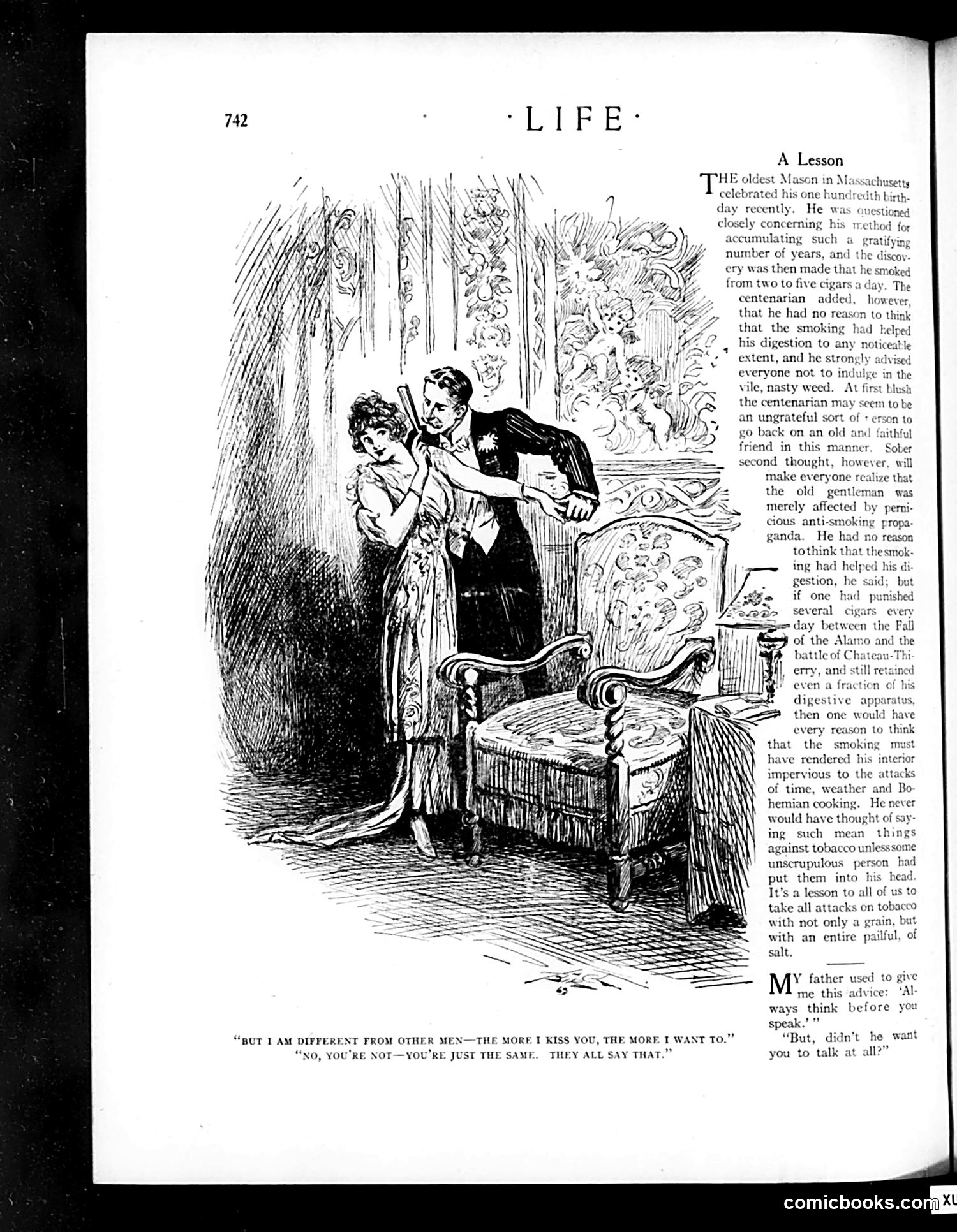
This page from *Life* magazine contains an article titled "A Lesson" and an accompanying illustration. The article discusses a Massachusetts centenarian who attributed his longevity to smoking two to five cigars daily. The piece argues, with tongue-in-cheek irony, that the old man's health actually *disproves* smoking's benefits—his survival was despite smoking, not because of it. The illustration shows a man and woman in an elegant interior; the caption reads: "But I am different from other men—the more I kiss you, the more I want to." The woman responds: "No, you're not—you're just the same. They all say that." This satirizes romantic clichés and male flattery. The juxtaposition mocks how people rationalize questionable habits (smoking, insincere compliments) as uniquely justified in their case, paralleling the centenarian's unfounded confidence in tobacco.
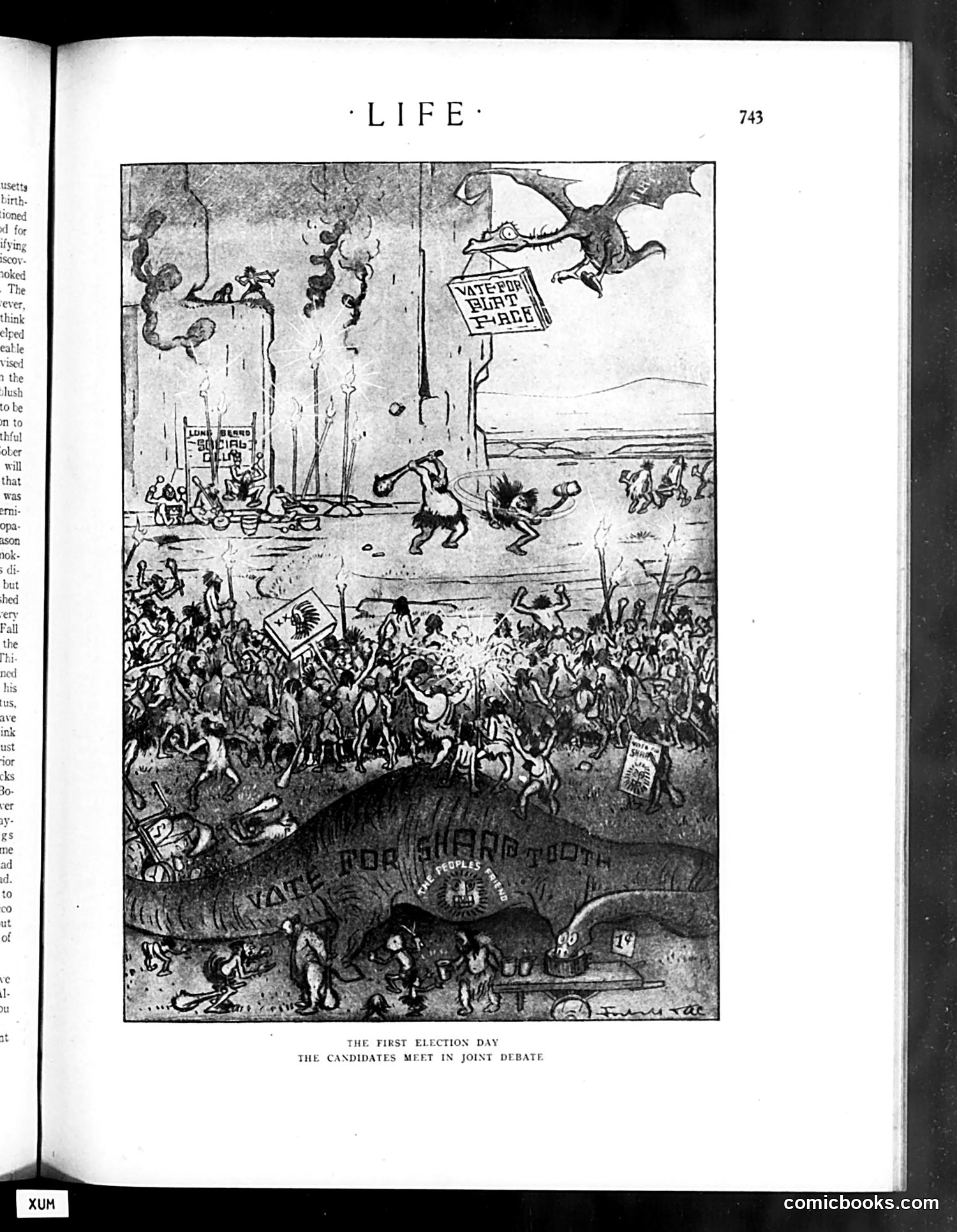
This satirical cartoon depicts what appears to be an imagined future election scenario where animal and human candidates meet for "joint debate." The image shows a chaotic scene divided into two levels: above ground, where crowds gather around voting booths and campaign materials (including a "Vote for Right" banner); below ground, where various creatures and figures appear to be engaged in underhanded political maneuvering. The satire likely critiques electoral corruption, backstage political dealing, and the gap between public campaign rhetoric and actual political machinations. The underground activity suggests hidden forces controlling elections despite surface-level democratic participation. Without clearer dates or identifiable caricatures, the specific historical election referenced remains unclear, though the cartoon mocks fundamental aspects of electoral dishonesty.
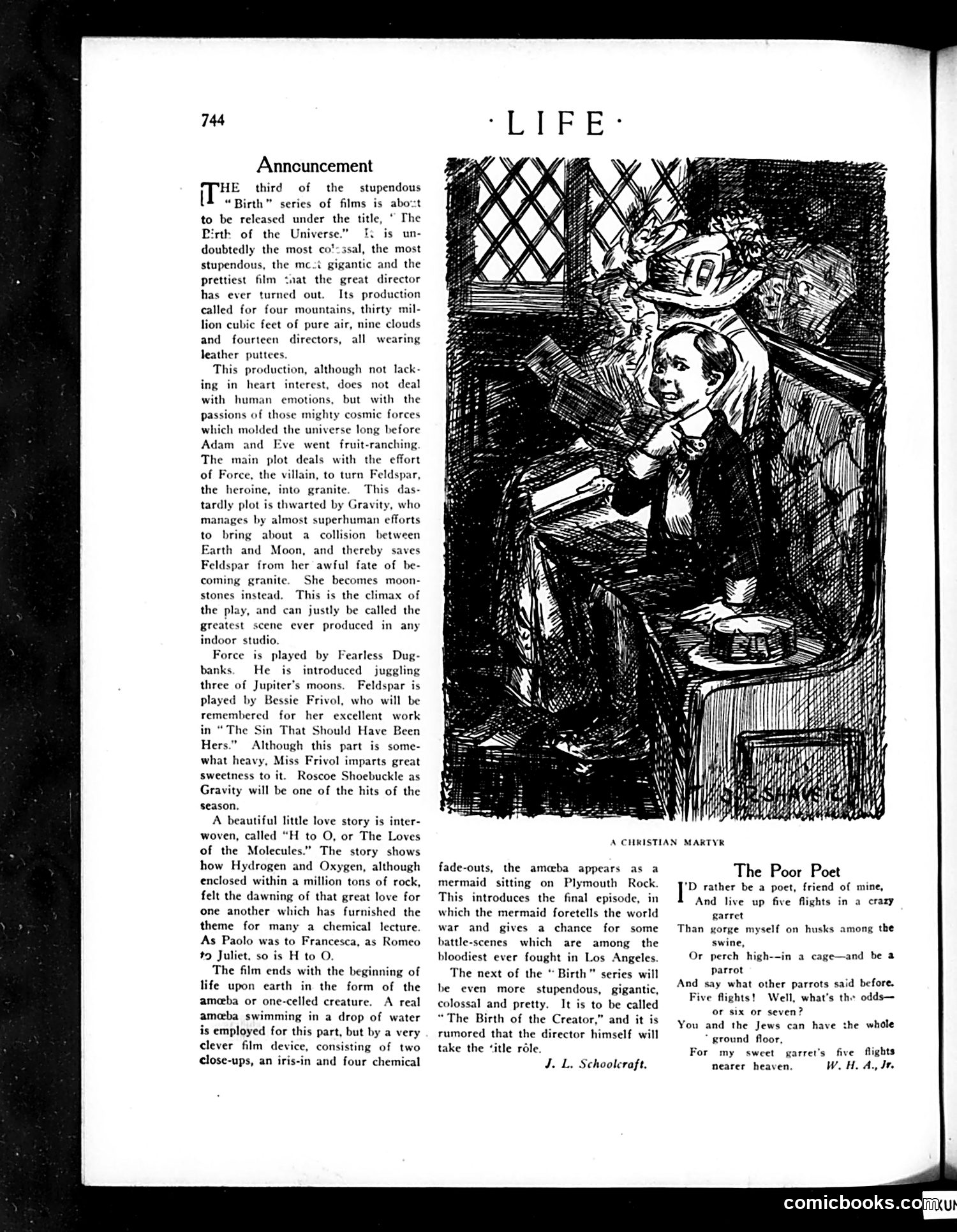
The main illustration shows a dramatic scene of a figure being tortured or executed, labeled "A Christian Martyr." Based on the accompanying text about a film series called "Birth of the Universe," this appears to be a still or promotional image from an early cinema production. The page primarily discusses this third film in the "Birth" series, describing its elaborate production—four mountains, thirty million cubic feet of pure air, nine clouds, and fourteen directors. The text details the film's cosmic plot involving characters named Force, Feldspar, and Gravity, with elaborate special effects depicting the creation of worlds. The illustration likely satirizes either the film's grandiose ambitions or serves as promotional material for what the text describes as an extraordinarily ambitious cinematic spectacle.
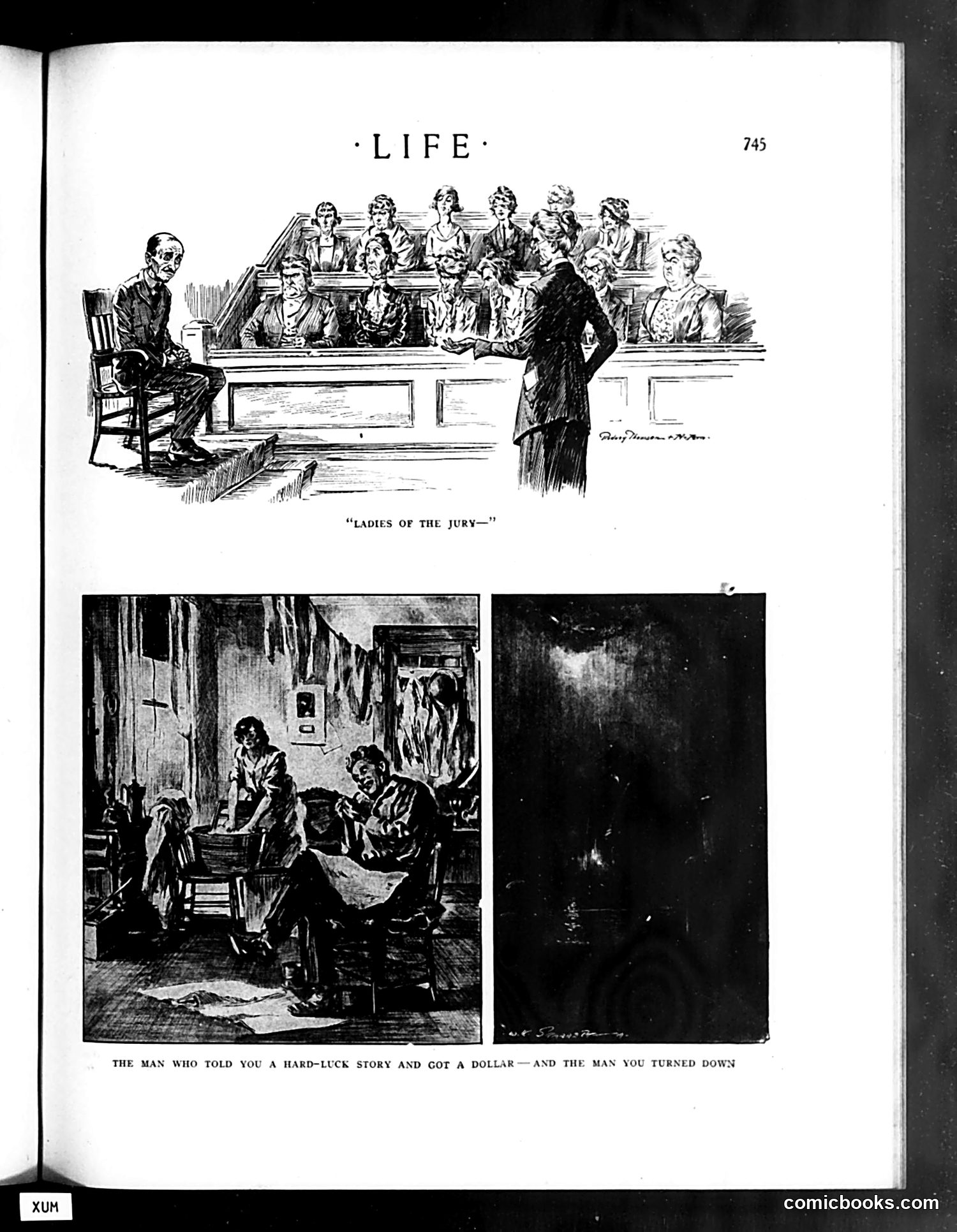
This page contains two satirical pieces about justice and social hypocrisy: **Top cartoon** ("Ladies of the Jury"): A courtroom sketch showing a defendant and lawyer facing a jury box filled entirely with women. The satire appears to mock either women serving on juries (relatively novel at this time) or the unpredictability of their verdicts. **Bottom images**: A two-panel piece titled "The Man Who Told You A Hard-Luck Story And Got A Dollar — And The Man You Turned Down." The left panel shows someone receiving charity; the right panel appears blank or heavily darkened. This satirizes the inconsistency of charitable impulses—criticizing readers for giving to one beggar while refusing another, exposing the arbitrary nature of compassion. The overall theme addresses courtroom judgment and moral judgment more broadly.
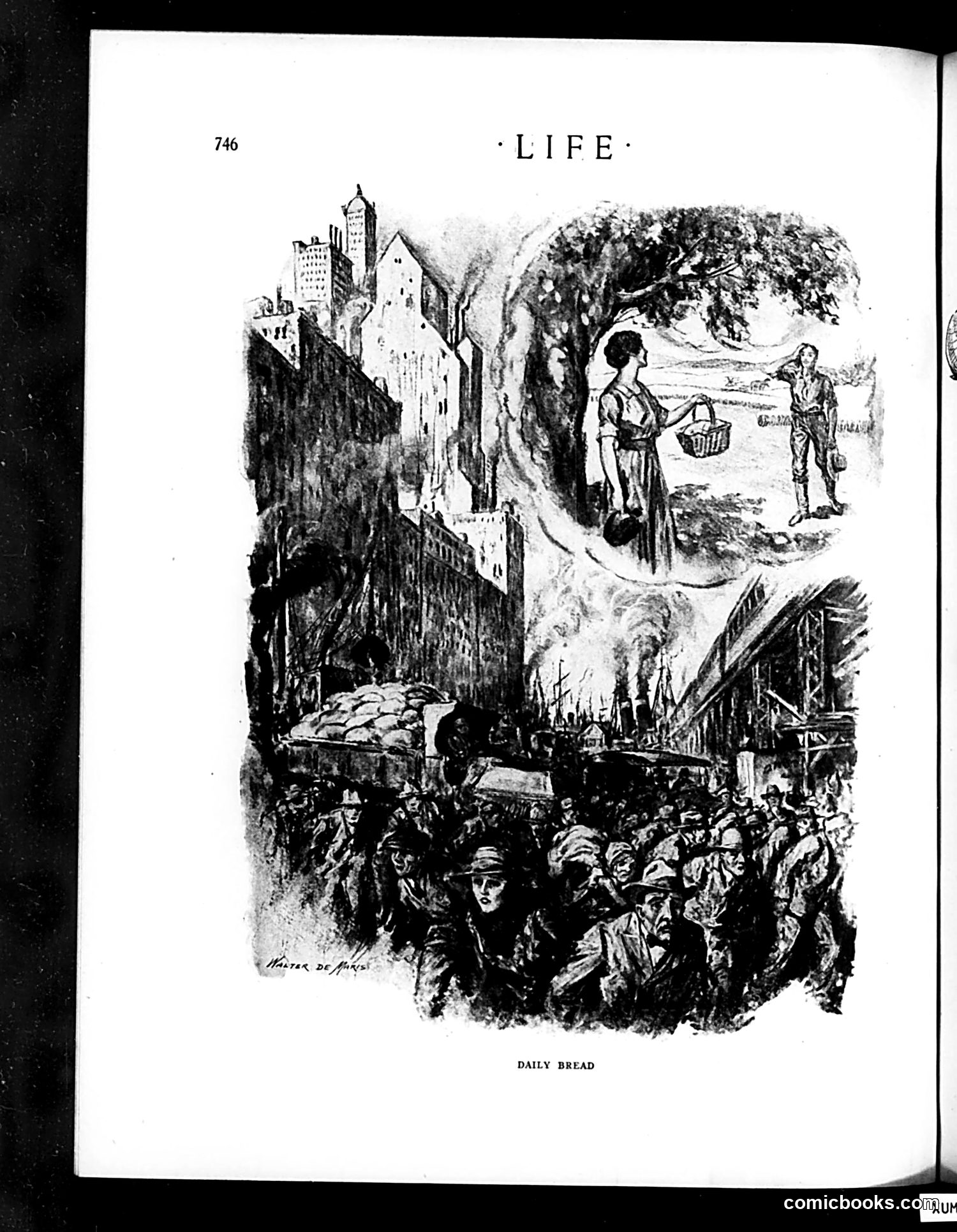
This satirical illustration contrasts urban poverty with rural prosperity. The bottom half depicts a crowded, desperate urban masses pressing against castle walls—suggesting medieval scarcity or class conflict in industrial cities. The top half shows a pastoral idyll: a woman with a basket and a man in countryside abundance beneath a large tree, with distant fields. The title "Daily Bread" likely references the Lord's Prayer, implying commentary on how bread—basic sustenance—remains unequally distributed. The cartoon critiques industrial society's failure to provide for urban workers while rural/agricultural life appears to offer natural plenty. This reflects turn-of-the-century concerns about urbanization, labor conditions, and economic inequality in America.
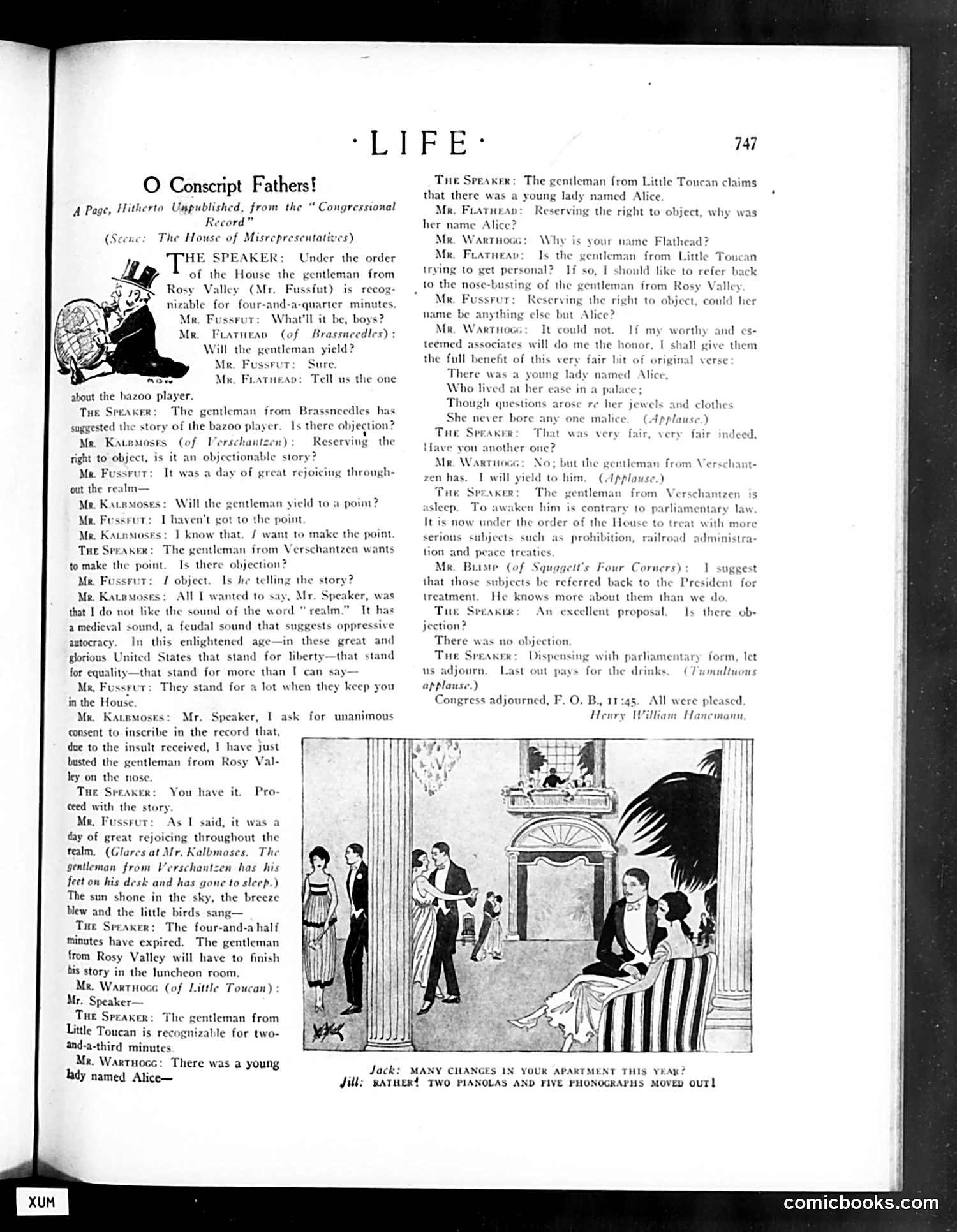
This page presents a Congressional Record excerpt featuring a debate about a gentleman from Rosy Valley telling a story about a young lady named Alice. The exchange satirizes parliamentary procedure and decorum: Mr. Fussbudget objects to the story as "objectionable," while Ms. Kalmoses pushes back against censorship in "these great and glorious United States." The accompanying cartoon depicts an apartment scene with figures discussing moving logistics—specifically "two pianos and five phonographs moved out." The satire targets stuffy Congressional propriety and nitpicking objections to harmless anecdotes, contrasting legislative formality with everyday domestic concerns. The cartoon humorously juxtaposes grand parliamentary debate with mundane residential life, suggesting Congress's preoccupation with trivial matters.
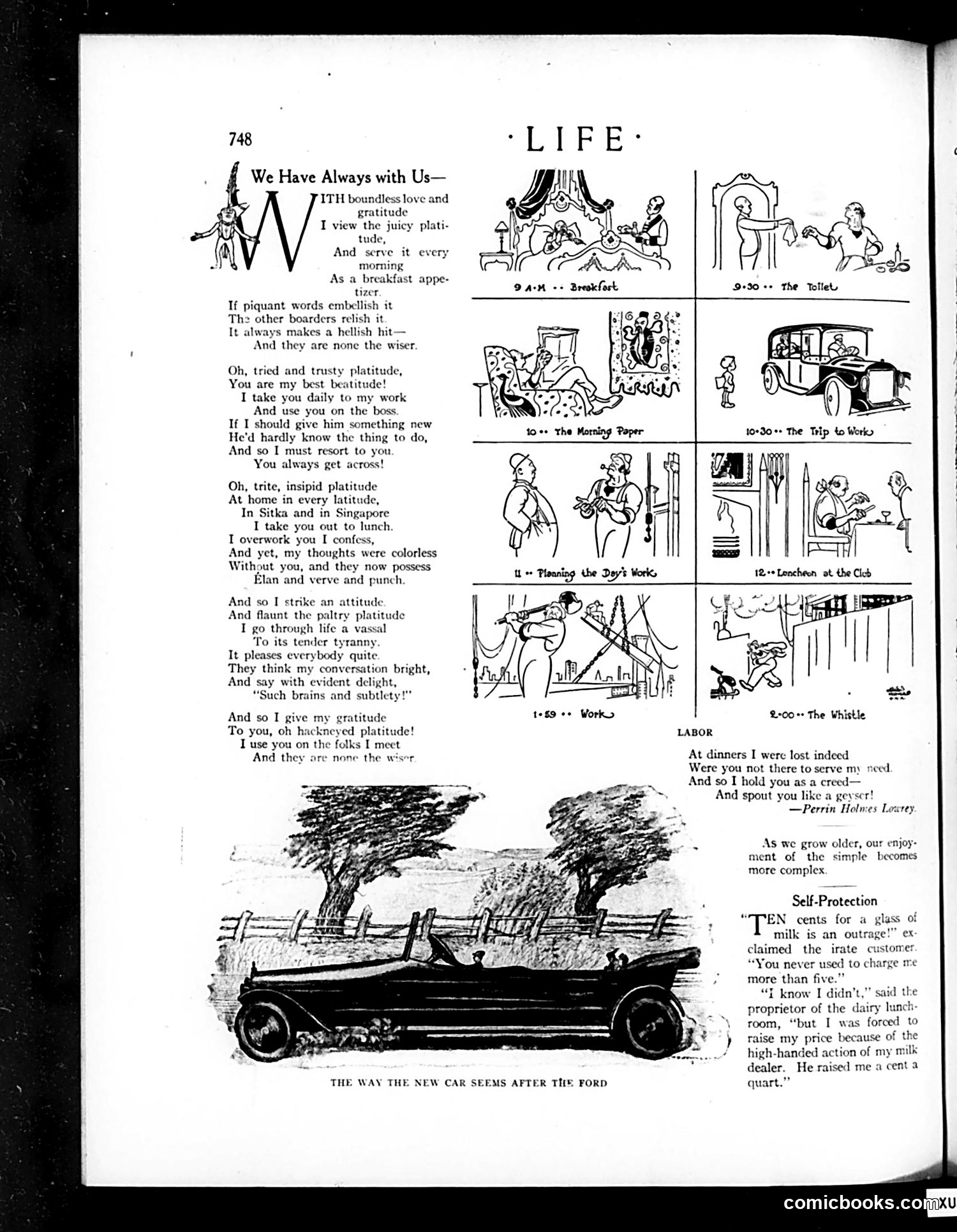
This page combines a poem about **gratitude toward domestic servants** with a daily-life comic strip and satirical commentary. The poem addresses an unnamed servant ("tried and trusty platitude"), expressing dependence on their labor while simultaneously complaining about their ungrateful nature and laziness. The speaker admits overworking them and notes their "colorless" thoughts—a paternalistic view typical of early 20th-century employer attitudes. The accompanying comic strip shows a **wealthy person's typical day** (breakfast, toilette, work, lunch, leisure), illustrating the leisure class lifestyle made possible by servants' labor. The bottom cartoon mocks the Ford Model T's popularity, showing how the "new car seems after the Ford"—suggesting inferior imitations. A sidebar story criticizes a milk dealer's price increase, reflecting working-class economic anxieties of the era.
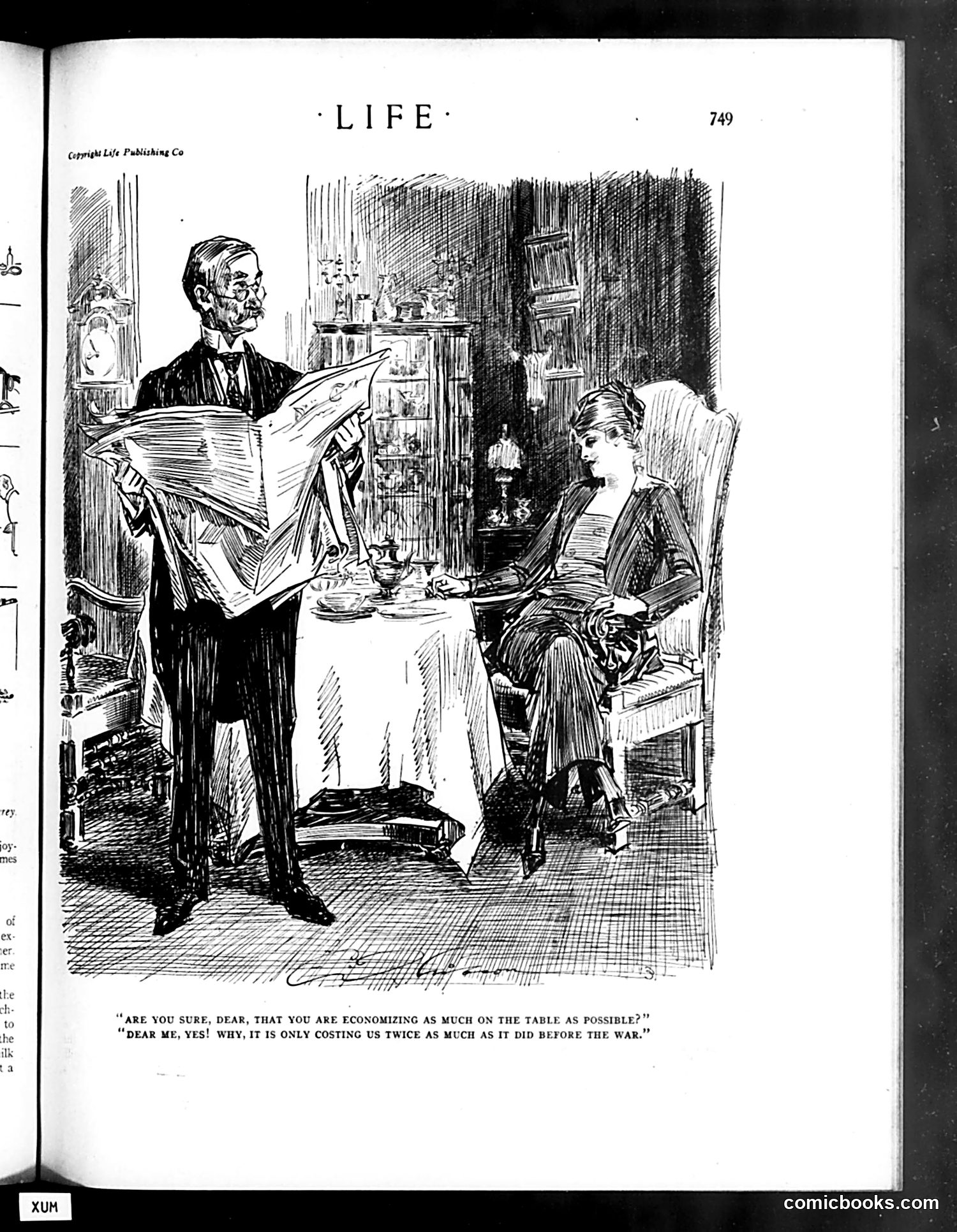
This *Life* magazine cartoon satirizes post-World War I inflation and domestic economics. A well-dressed man reads a newspaper while his wife sits nearby, and she asks if he's economizing on household expenses. His response reveals the joke's bitter point: their table costs **twice as much as before the war**, despite supposed belt-tightening. The cartoon mocks the gap between wartime promises of frugality and postwar economic reality. Families were urged to conserve during the war effort, but peacetime brought not relief but increased prices—inflation that made pre-war costs seem impossibly cheap. The satire targets both the husband's false assurances of economy and the broader economic disappointment many Americans faced after 1918.
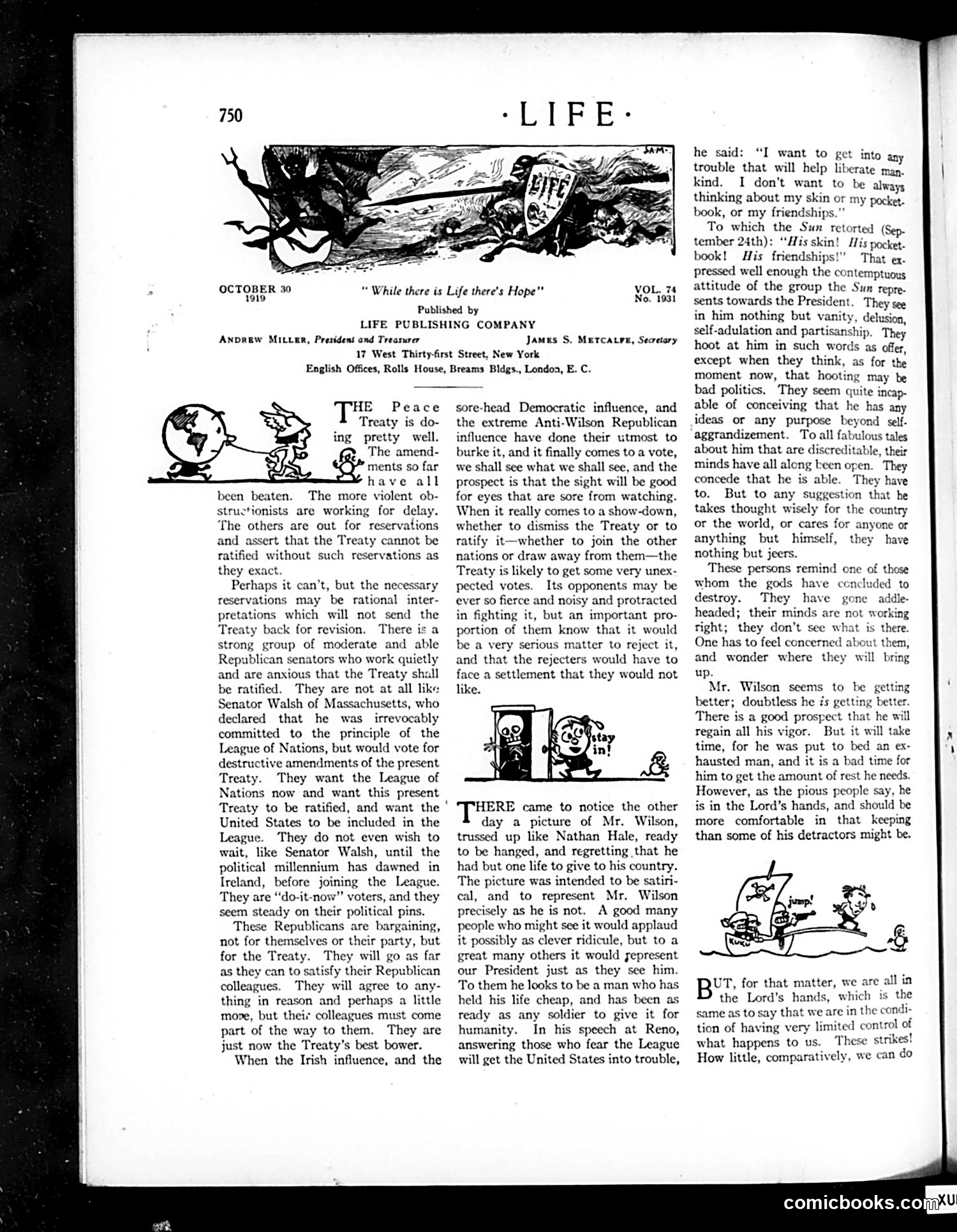
This page discusses the U.S. Senate's ratification debate over the Treaty of Versailles and League of Nations membership—a contentious 1919 issue. The main article analyzes competing factions: moderate Republicans willing to ratify with reasonable reservations; extreme Republicans and Irish-influenced Democrats seeking to block it; and anti-Wilson Republicans opposing it entirely. Life's editors predict unexpected support will emerge when forced to choose between ratification or rejection. The second section critiques a political cartoon depicting President Wilson as Nathan Hale facing execution—meant as satire. Life notes many see this as accurate: Wilson genuinely prioritizes humanitarian causes over personal interests. The article cites Wilson's Reno speech about accepting any trouble that liberates mankind, and quotes a hostile Sun newspaper response mocking his supposed indifference to "his skin," "pocket-book," and "friendships"—revealing contempt from Wilson's political opponents. The page illustrates deep partisan divisions over America's post-WWI international commitments.
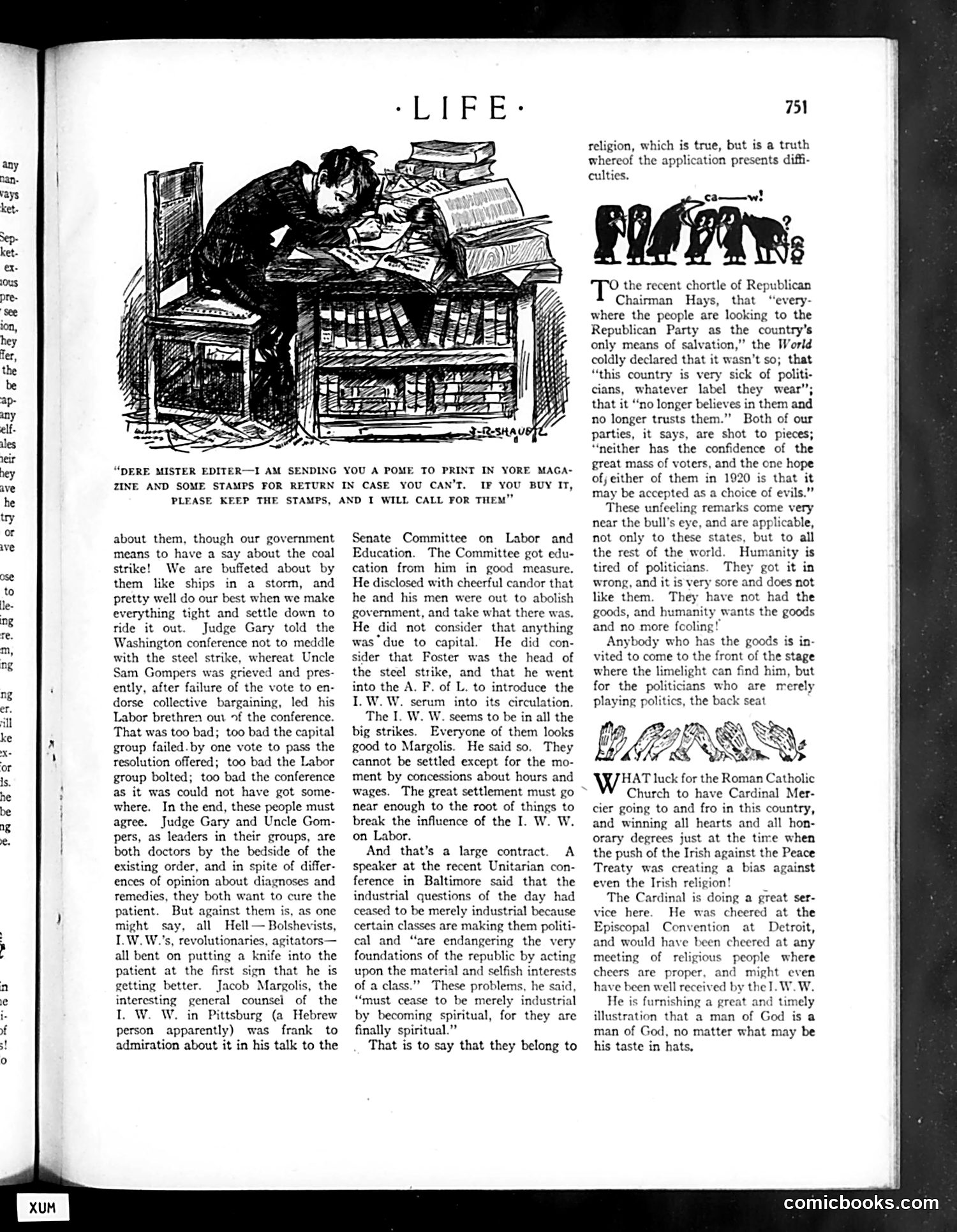
The cartoon depicts a struggling writer submitting poor-quality work to a magazine editor, humorously referencing the impoverished "starving artist" archetype. The figure is hunched over a desk surrounded by books and papers, sending in a poem with return postage "in case you can't" accept it—a self-deprecating acknowledgment that rejection is likely. The accompanying text discusses labor strikes (particularly steel industry strikes), the I.W.W. (Industrial Workers of the World), and radical political movements threatening American stability. It critiques both major political parties as having lost public confidence by 1920, with citizens viewing them as merely "a choice of evils." The piece characterizes revolutionaries and Bolshevists as threats to the existing order, while praising moderate labor leaders like Samuel Gompers. The cartoon's placement alongside this anti-radical political commentary suggests *Life* magazine was using humor to mock both struggling writers and, implicitly, the radical ideologies discussed in the text.
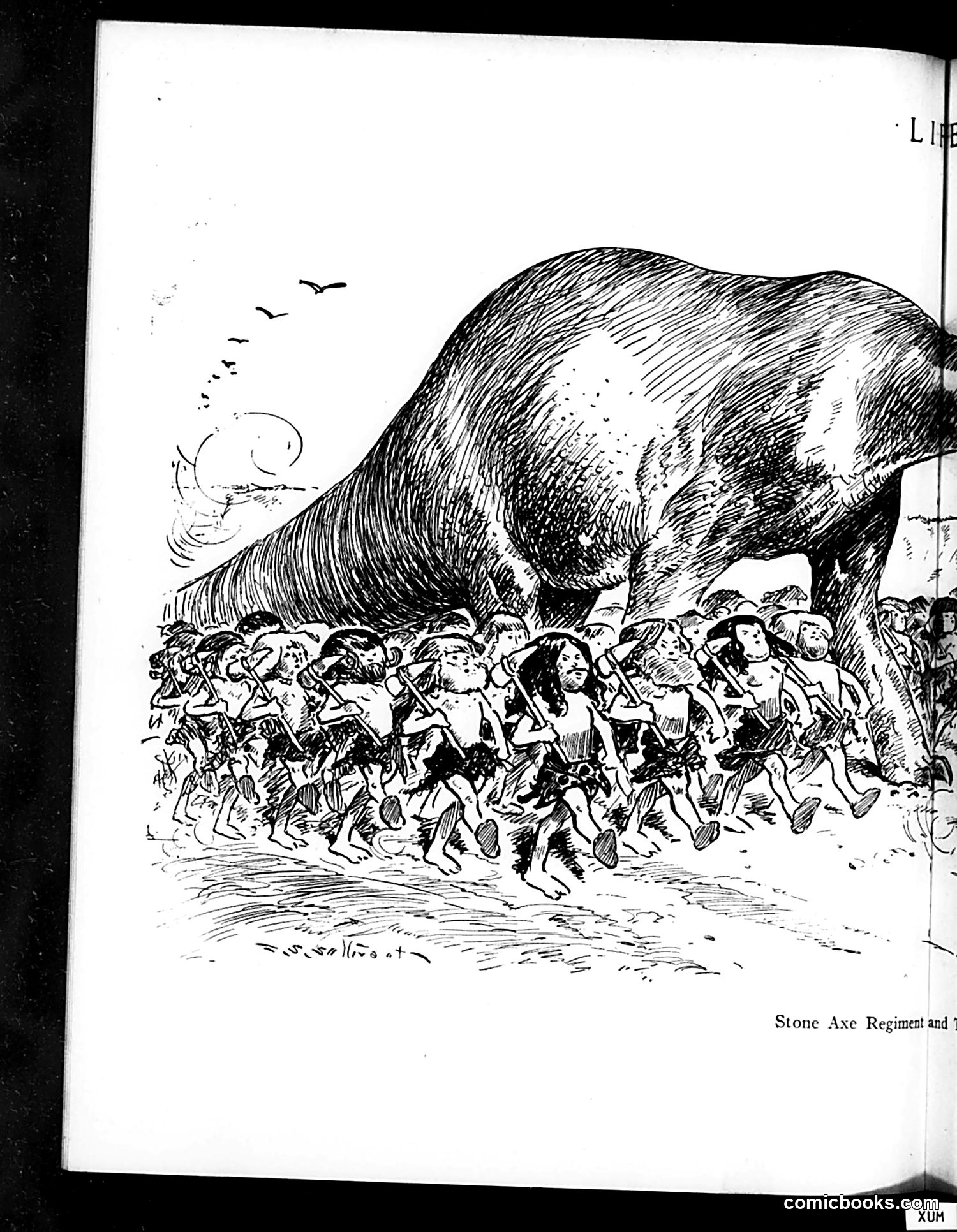
This is a satirical cartoon titled "Stone Axe Regiment and [text cut off]." The image depicts a large prehistoric creature (appears to be a mammoth or similar Ice Age animal) towering over a crowd of armed, primitive-looking soldiers carrying stone axes and weapons. The satire likely comments on military organization or governance during a particular historical period, though the specific political reference is unclear without the complete caption. The juxtaposition of primitive forces against an enormous, overwhelming obstacle suggests commentary on inadequate preparation, futile resistance, or the absurdity of military power against superior force. The "Stone Age" weaponry may mock outdated tactics or policies, or possibly reference a specific regiment or military unit of the era in which *Life* magazine published this cartoon. Without additional context about the date and full caption, the precise target of satire cannot be definitively identified.
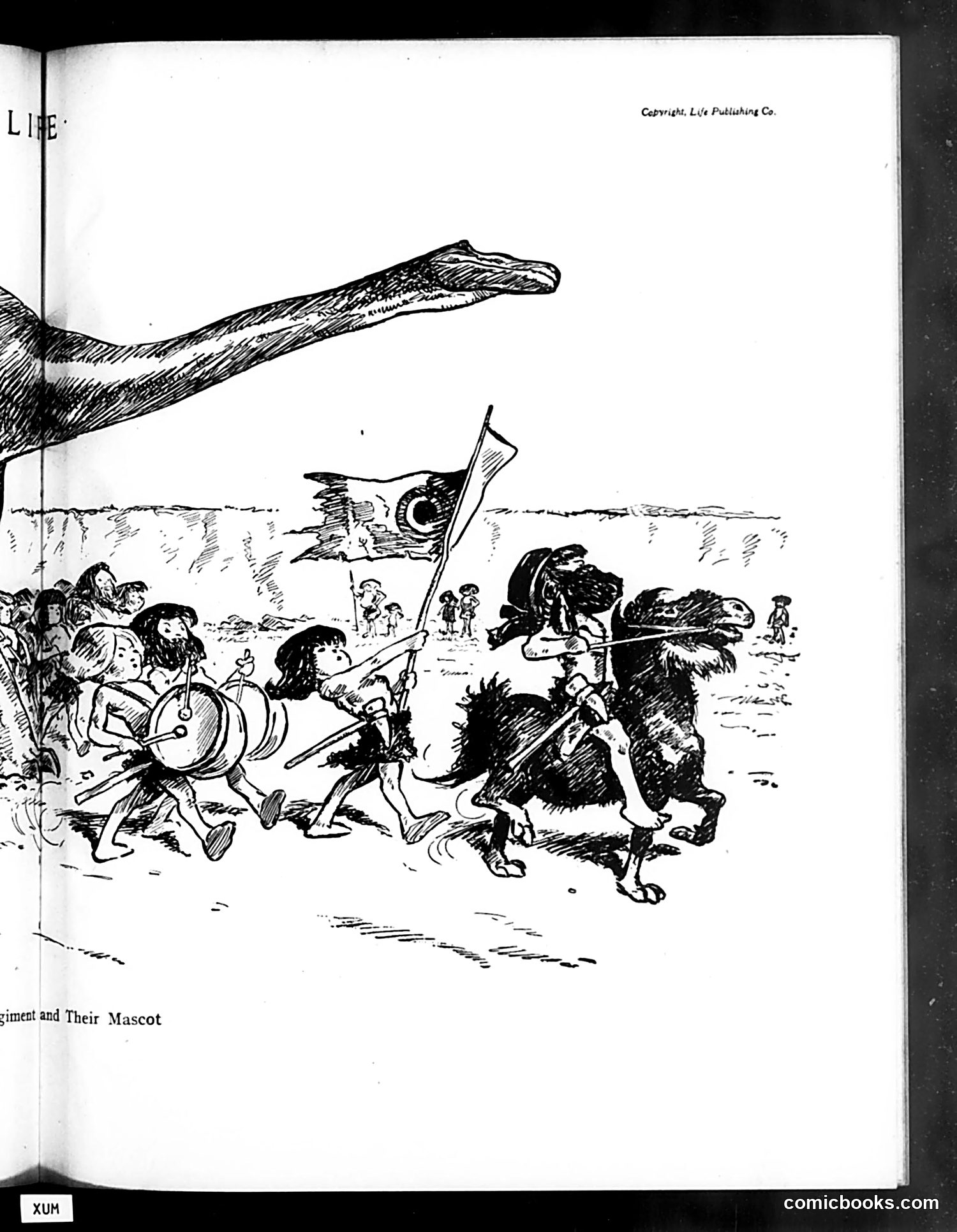
This appears to be a satirical cartoon from *Life* magazine showing a group of small figures (appearing to be caricatured as children or diminutive people) marching or parading with what looks like military equipment or drums, under the shadow of a giant crocodile or alligator head looming above them. The partial caption reads "ziment and Their Mascot," suggesting these figures represent some regiment or military unit with the large reptile as their mascot. The style and subject matter suggest this is likely mocking a military unit or organization, though without the complete caption or date, the specific historical reference remains unclear. The exaggerated scale contrast creates the satirical effect, implying something absurd or ridiculous about this group's pretensions.
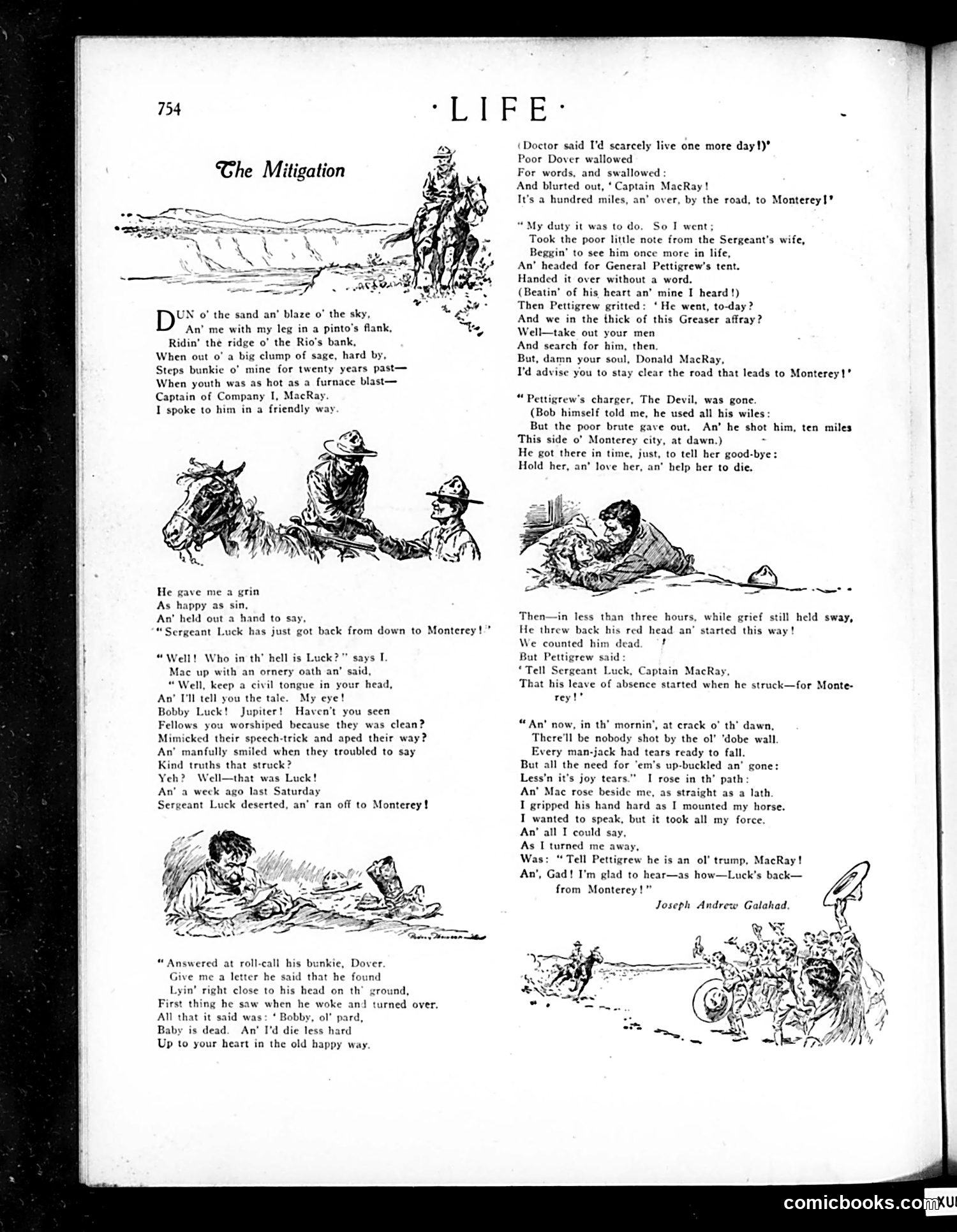
This sentimental narrative poem, illustrated with Western sketches, tells of Sergeant Luck, a beloved soldier who deserts during military operations (likely the Mexican-American War, given references to "Greaser affray" and General Pettigrew). Learning his wife is dying, Luck abandons his post to reach her in Monterey. The "mitigation" of the title refers to how even stern military authority—represented by General Pettigrew—recognizes the human tragedy. Though technically desertion, Luck's compassionate act is implicitly pardoned: Pettigrew allows him to say goodbye, then retroactively dates his leave from when he departed, converting desertion into authorized absence. The piece celebrates loyalty transcending duty—loyalty to love overriding loyalty to the Army. It's sentimental Americana valorizing personal relationships over rigid military protocol, presented as ultimately noble rather than criminal.
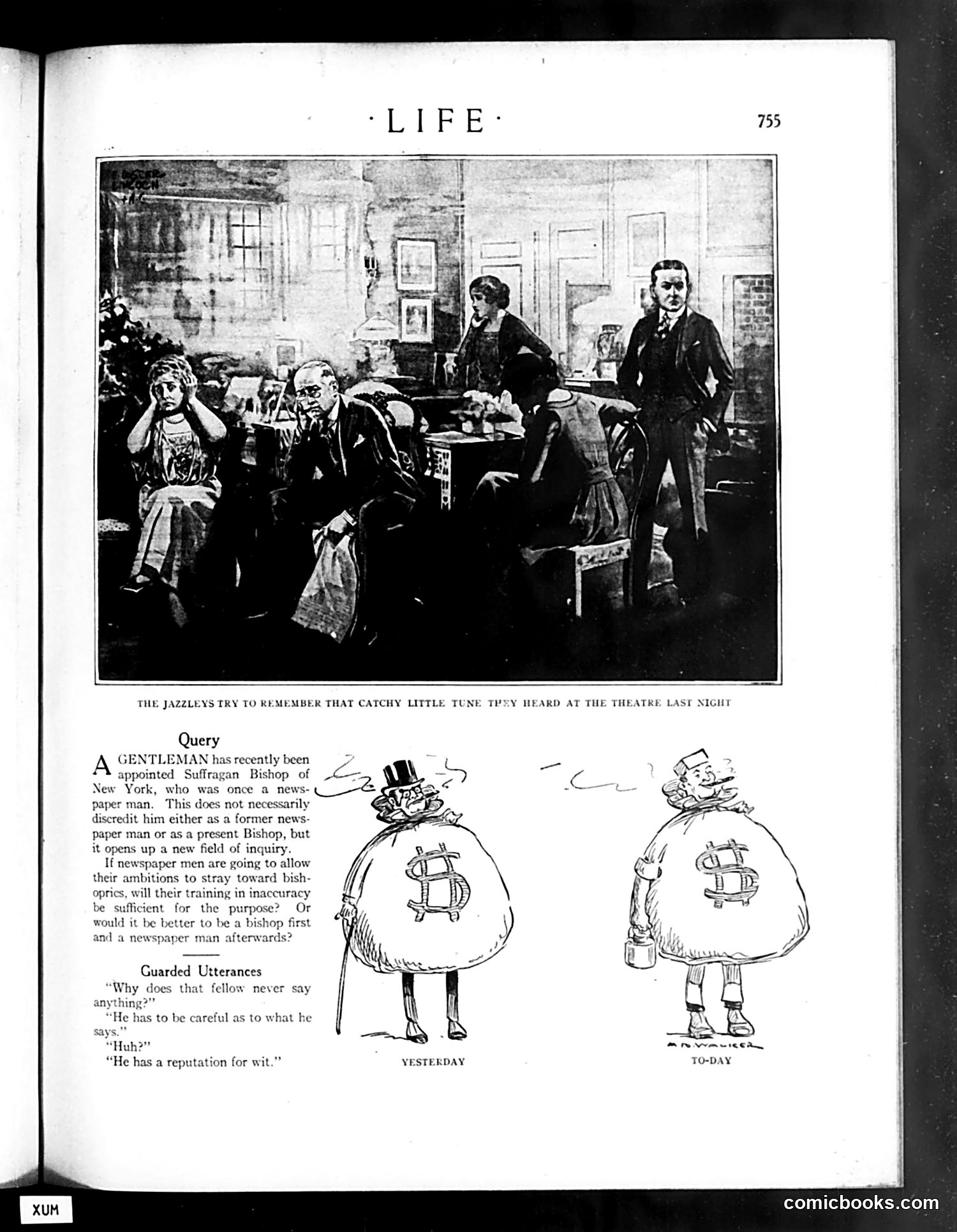
The page contains two distinct satirical pieces: **Top Image:** "The Jazzleys Try to Remember That Catchy Little Tune They Heard at the Theatre Last Night" shows a family struggling to recall a melody, satirizing the era's popular jazz music and how catchy but forgettable songs dominated entertainment. **"Query" Section:** Satirizes the recent appointment of a former newspaper man as Suffragan Bishop of New York. The piece humorously questions whether a journalist's training in "inaccuracy" qualifies him for religious leadership—a tongue-in-cheek jab at both the newspaper industry's reputation for unreliability and the unusual career transition. **"Guarded Utterances" Cartoon:** Two money-bag figures labeled "Yesterday" and "To-Day" illustrate how wealth's behavior has changed over time, likely commenting on economic shifts (possibly post-WWI). The accompanying dialogue mocks someone known for wit who now carefully avoids speaking—suggesting caution replaces cleverness, perhaps due to political or social pressure. The page reflects 1920s concerns about journalism credibility, social mobility, and economic anxiety.
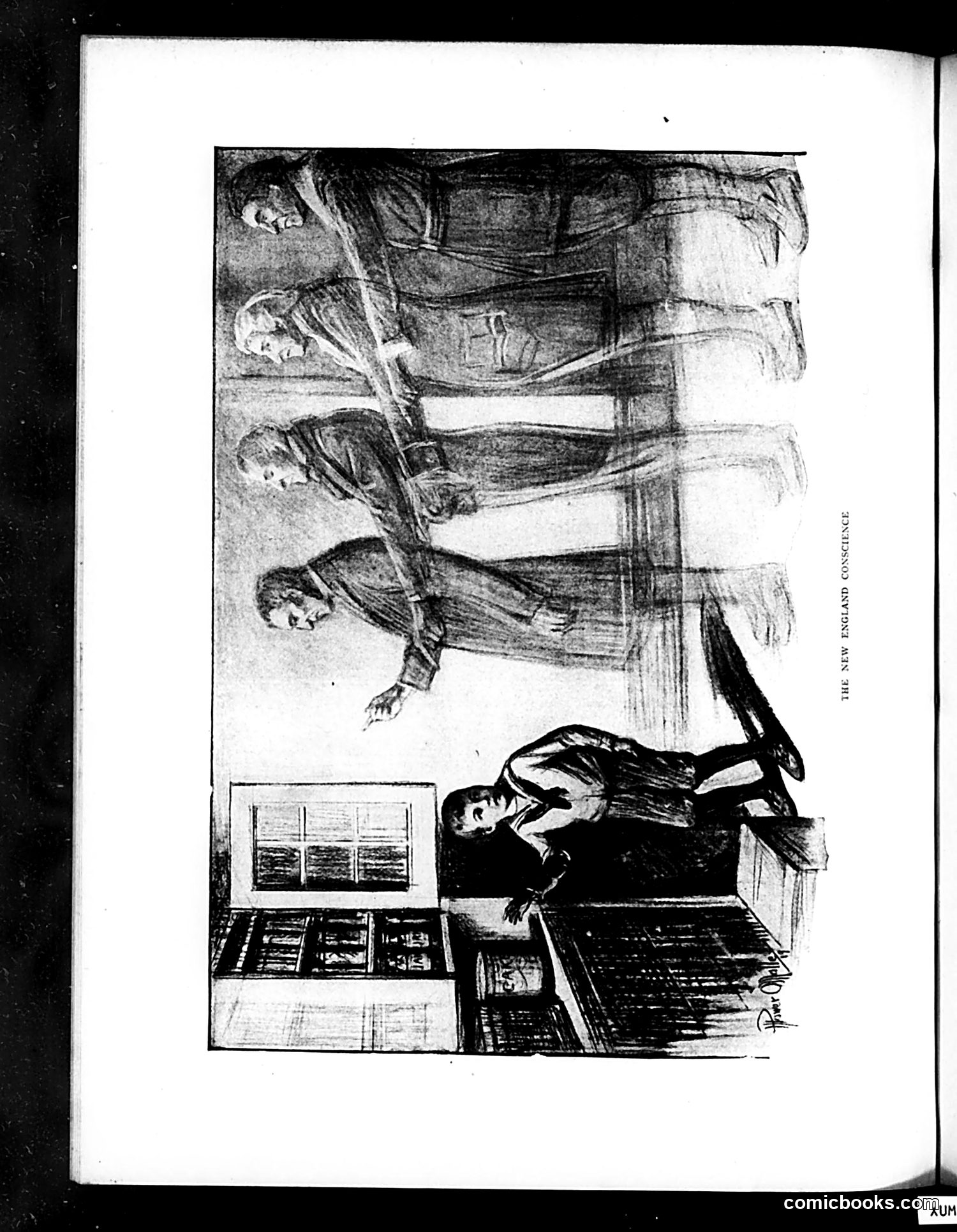
This page appears to be a title page or section header for "The New Comicbooks.com" (based on the watermark visible at bottom). The main image is rotated 90 degrees and shows what appears to be a historical sketch or cartoon, but the OCR text consists only of the letter "Z" repeated several times. Without clear, legible text to accompany the image, I cannot reliably identify specific political figures, historical references, or the intended satirical message. The repetition of "Z" and the notation "THE NEW" suggest this may be a humorous or cryptic heading, but the actual content and meaning remain unclear from this reproduction. A clearer image or more complete OCR would be needed for accurate interpretation of the satire's target and historical context.
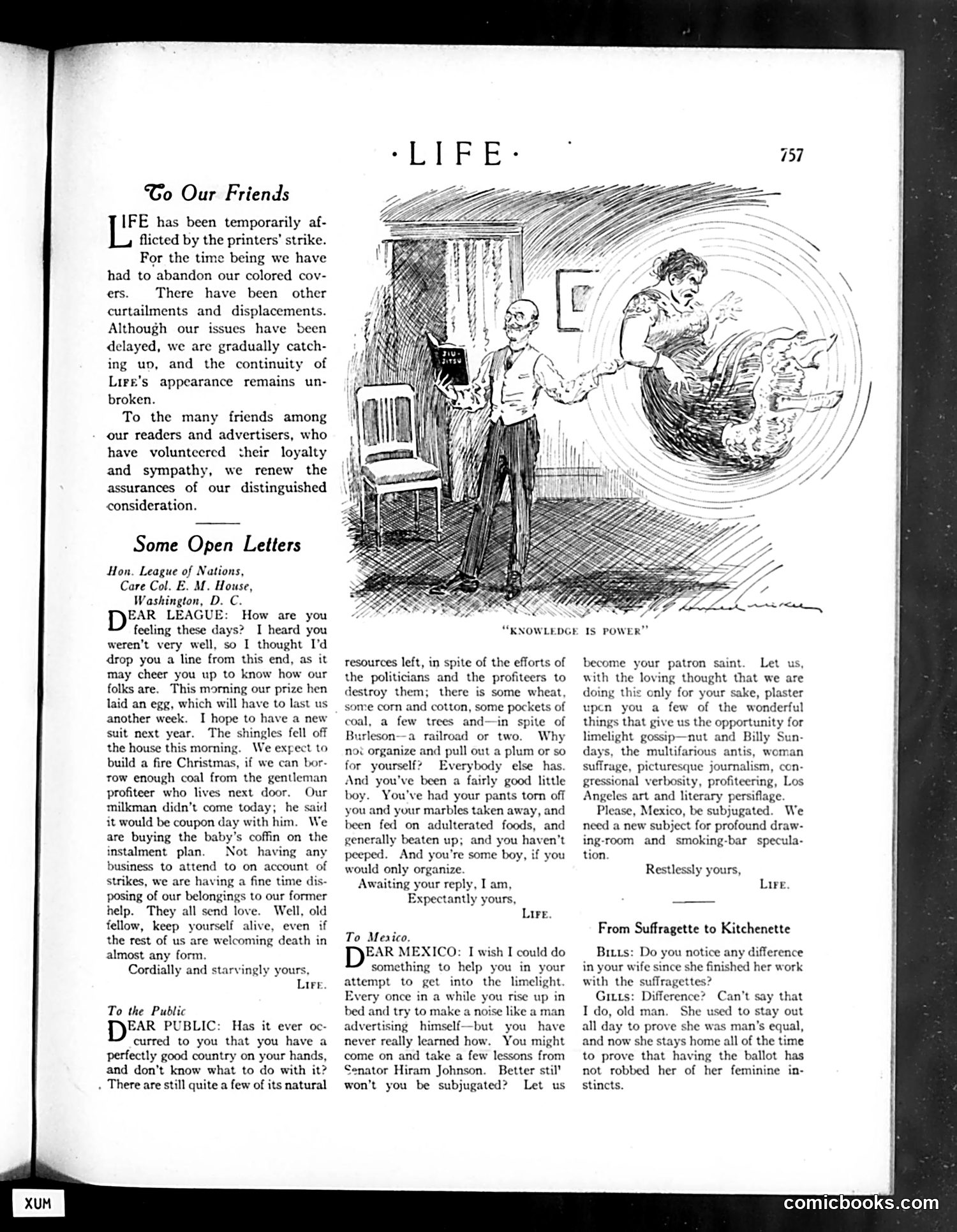
This page addresses Life's printing strike disruptions while offering satirical "open letters" to contemporary targets. The main cartoon shows a man gesturing toward a woman emerging from a crystal ball labeled "Knowledge is Power"—illustrating the concept that information/education provides advantage. The letters mock various subjects through exaggerated complaint: **To the League of Nations**: Bitter sarcasm about post-WWI poverty and scarcity (rationing, installment plans, profiteering). **To the Public**: Satirizes American complacency, suggesting citizens should organize to claim resources being monopolized by "politicians and profiteers." References "Burleson" (likely Postmaster General Albert Burleson) negatively. **To Mexico**: Patronizing mock-advice suggesting Mexico learn self-promotion from Senator Hiram Johnson; offers to "subjugate" Mexico with American exports (fundamentalist religion, journalism, profiteering). **Suffragette to Kitchenette**: Mocks women's suffrage gains—a woman who fought for equality now simply stays home, proving voting hasn't changed traditional gender roles. The tone is cynical about post-war American society and international relations.
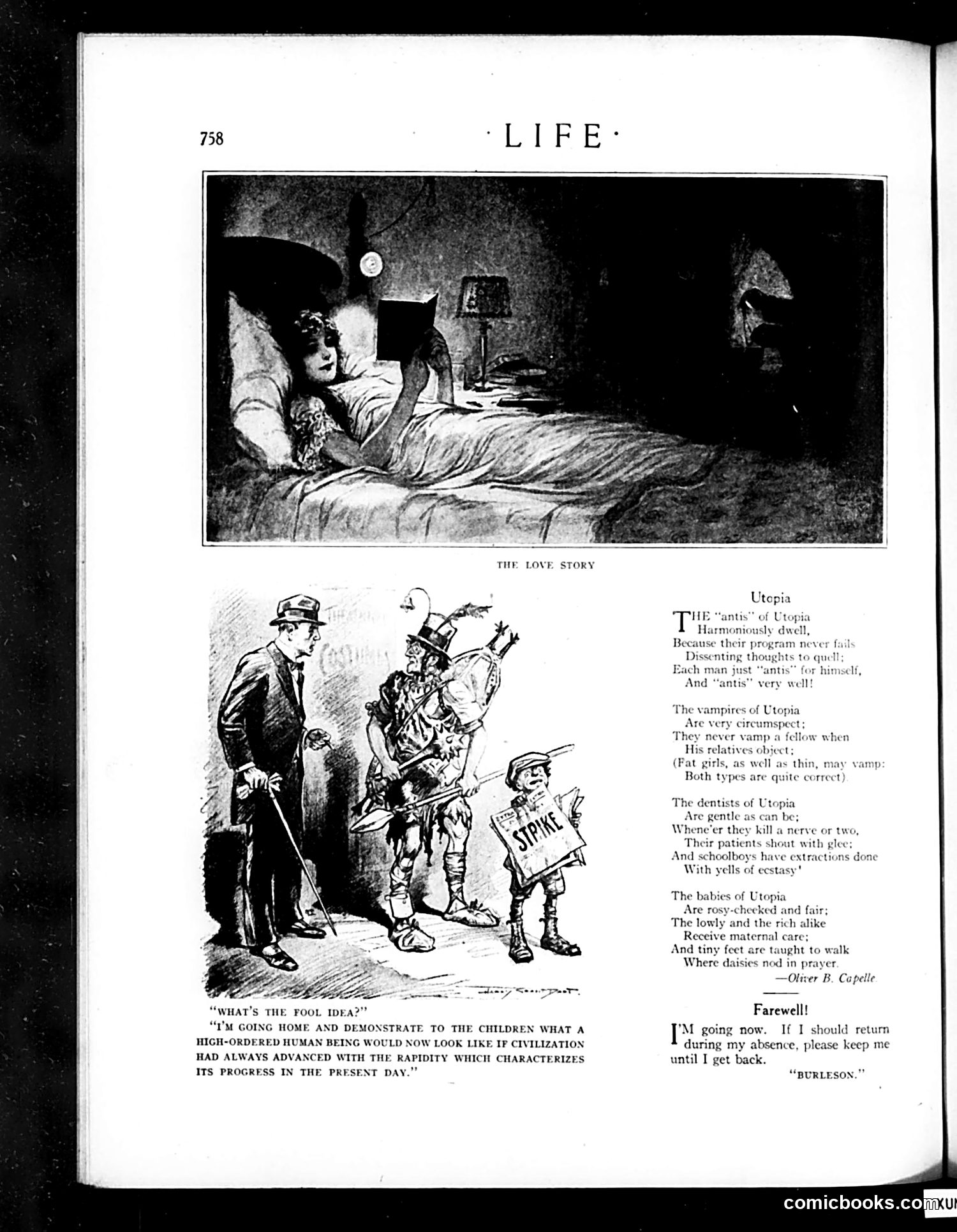
This page contains two satirical pieces from *Life* magazine mocking utopian idealism and government overreach. **"The Love Story" (top):** A humorous poem about an imaginary "Utopia" where everything is supposedly perfect—dentists cause no pain, vampires follow strict rules, babies learn to walk among flowers. The satire targets naive utopian fantasies by presenting absurdities (vampires existing in an "ordered" society, children screaming with joy during tooth extractions) as if they were logical improvements. **"What's the Fool Idea?" (bottom cartoon):** A man tells children he'll demonstrate what a "high-ordered human being" looks like, suggesting civilization has advanced so rapidly that humans now look different. The caption attributes this to "BURLESON," likely Albert Burleson, Postmaster General under Wilson, suggesting satire of government claims about "progress" and social engineering. The joke critiques politicians promoting grand visions of societal advancement while appearing foolish or hypocritical themselves. Both pieces satirize utopian thinking and governmental optimism about rapid social progress.
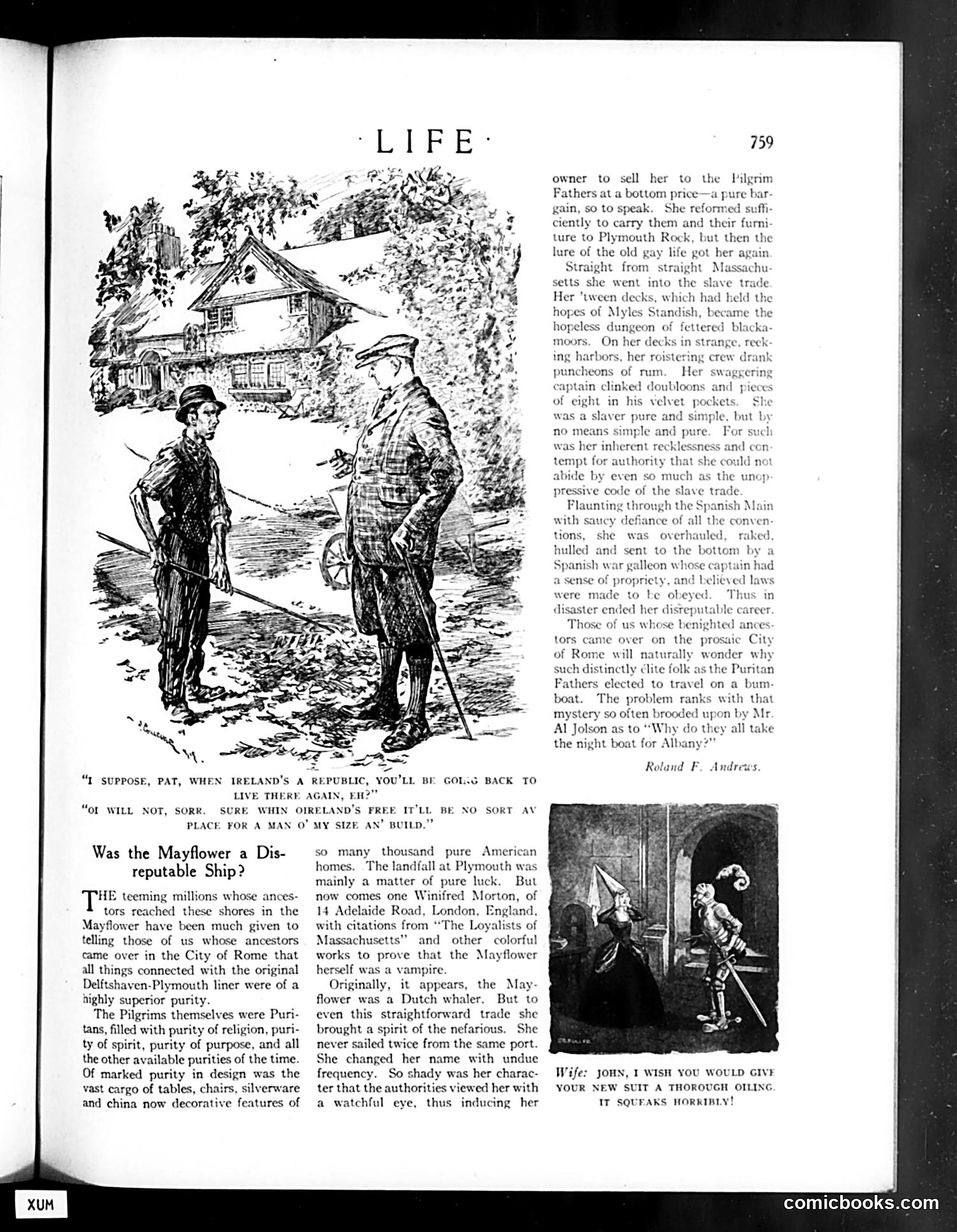
This page contains two distinct satirical pieces: **Top cartoon:** An Irish immigrant (Pat) and an English character debate Ireland's independence. Pat refuses to return to Ireland even when it becomes a republic, claiming no place suits "a man o' my size an' build." The joke mocks Irish-Americans who romanticize Irish freedom while remaining comfortable in America—poking fun at nationalist rhetoric versus practical self-interest. **Main article:** "Was the Mayflower a Disreputable Ship?" challenges WASP (White Anglo-Saxon Protestant) claims of moral superiority. Winifred Morton allegedly proved the Mayflower was previously a shady Dutch whaler, later a slave ship—undermining Puritan ancestors' claims to purity. The satire attacks snobbish descendants of Mayflower passengers who looked down on Catholic immigrants (arriving via ships like the "City of Rome"), exposing their ancestors' actual moral compromises. **Bottom cartoon:** An unrelated domestic joke about a squeaky suit requiring oil. The page targets ethnic and class prejudice in early 20th-century America.
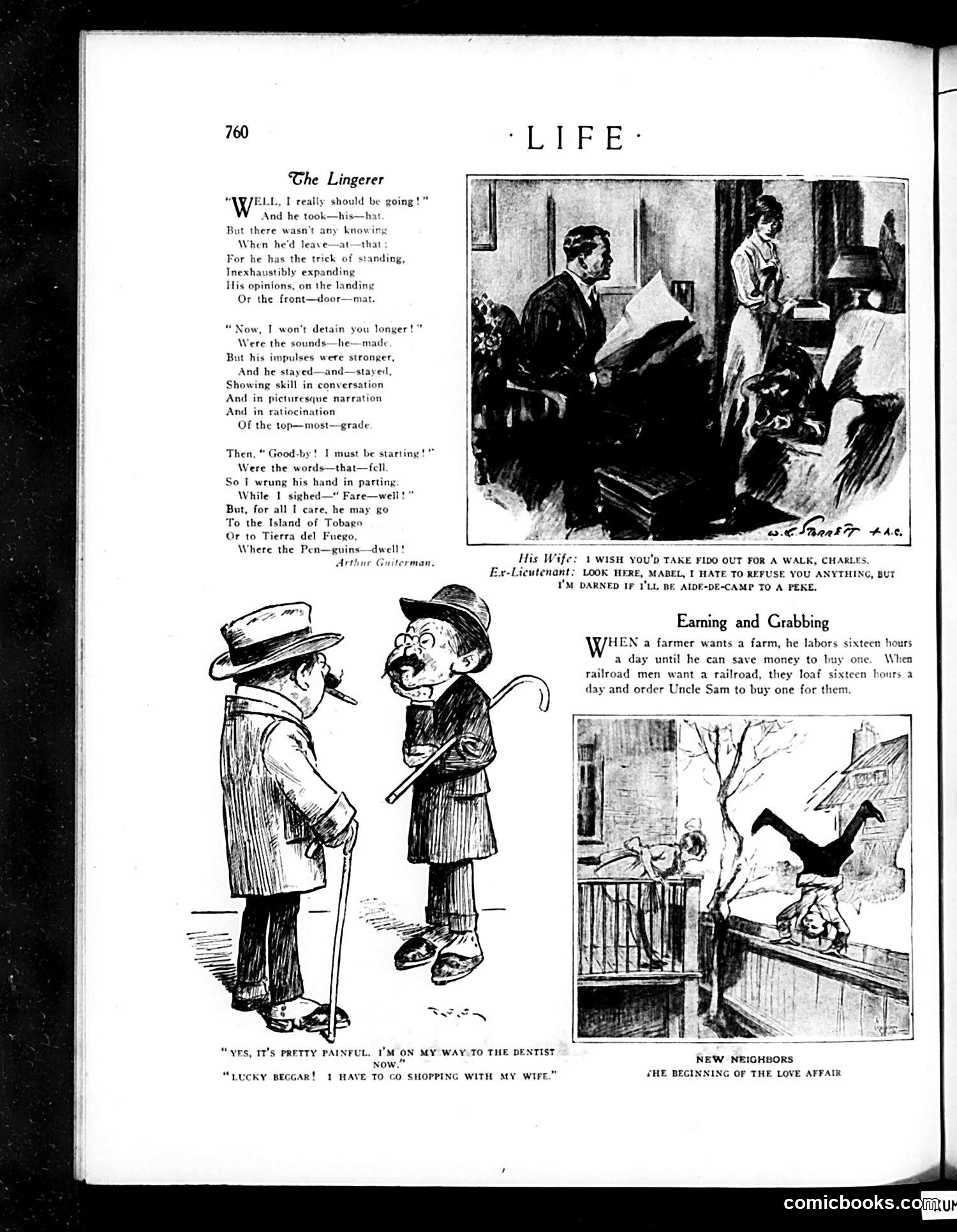
This page contains three separate satirical pieces: **"The Lingerer"** (top left): A poem by Arthur Guiterman mocking the social nuisance of guests who overstay their welcome. The humor lies in the guest's repeated false departures—saying goodbye but then launching into more conversation on the doormat or landing, forcing the exhausted host to endure endless "ratiocination." **"Earning and Grabbing"** (center): Social commentary contrasting farmers' work ethic (laboring 16 hours daily to purchase land) with railroad workers' approach (loafing 16 hours daily while demanding the government buy railroads for them). This criticizes what appears to be railroad monopoly favoritism and government subsidy abuse. **Lower cartoons**: A domestic scene showing an ex-lieutenant refusing to walk his wife's small dog ("Peke"), calling himself "aide-de-camp" to emphasize his reduced status post-military service. The final panel shows "New Neighbors" beginning a flirtation, suggesting potential marital trouble. The page reflects early 20th-century American anxieties: social etiquette, corporate privilege, and changing gender dynamics post-WWI.
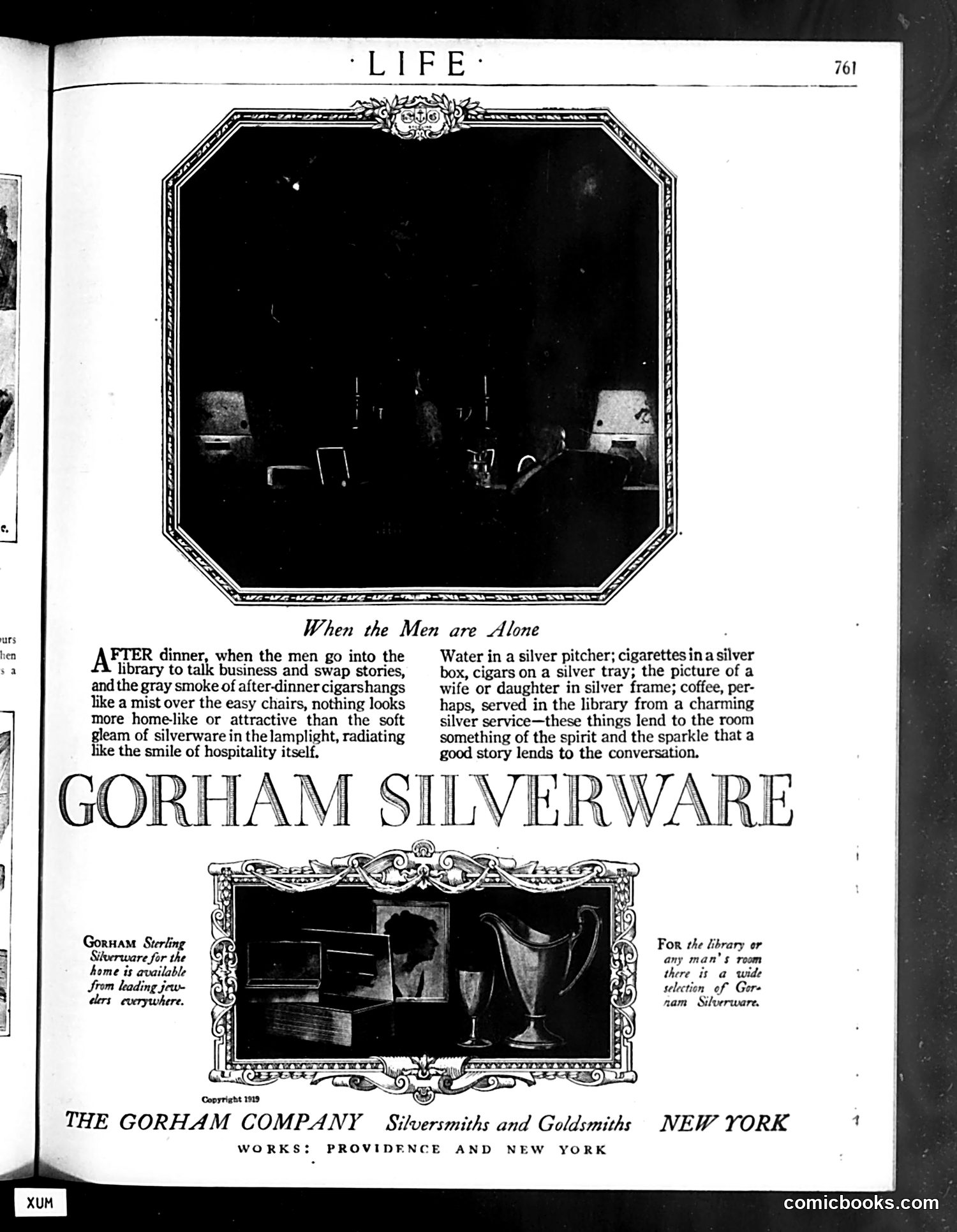
This is primarily a **luxury advertisement**, not satire or political commentary. The Gorham Company (silversmiths) uses a genteel domestic scene to market silverware. The text describes early 20th-century upper-class male socializing: after-dinner gatherings in libraries where men discuss business and "swap stories" while smoking cigars. The ad suggests that silver serving pieces—pitchers, cigarette boxes, cigar trays, coffee service—enhance these intimate male spaces and conversations. The illustration (top) shows a dimly lit library interior with figures and glowing lamps; the lower image displays sample silver items available for purchase. The appeal is straightforward: quality silverware signals hospitality, refinement, and masculine sophistication. There is **no obvious political satire or social critique**—this is a straightforward pitch to wealthy consumers, likely from a 1919 *Life* magazine issue. Modern readers might note the gendered assumptions (silverware as a marker of home elegance and male status).
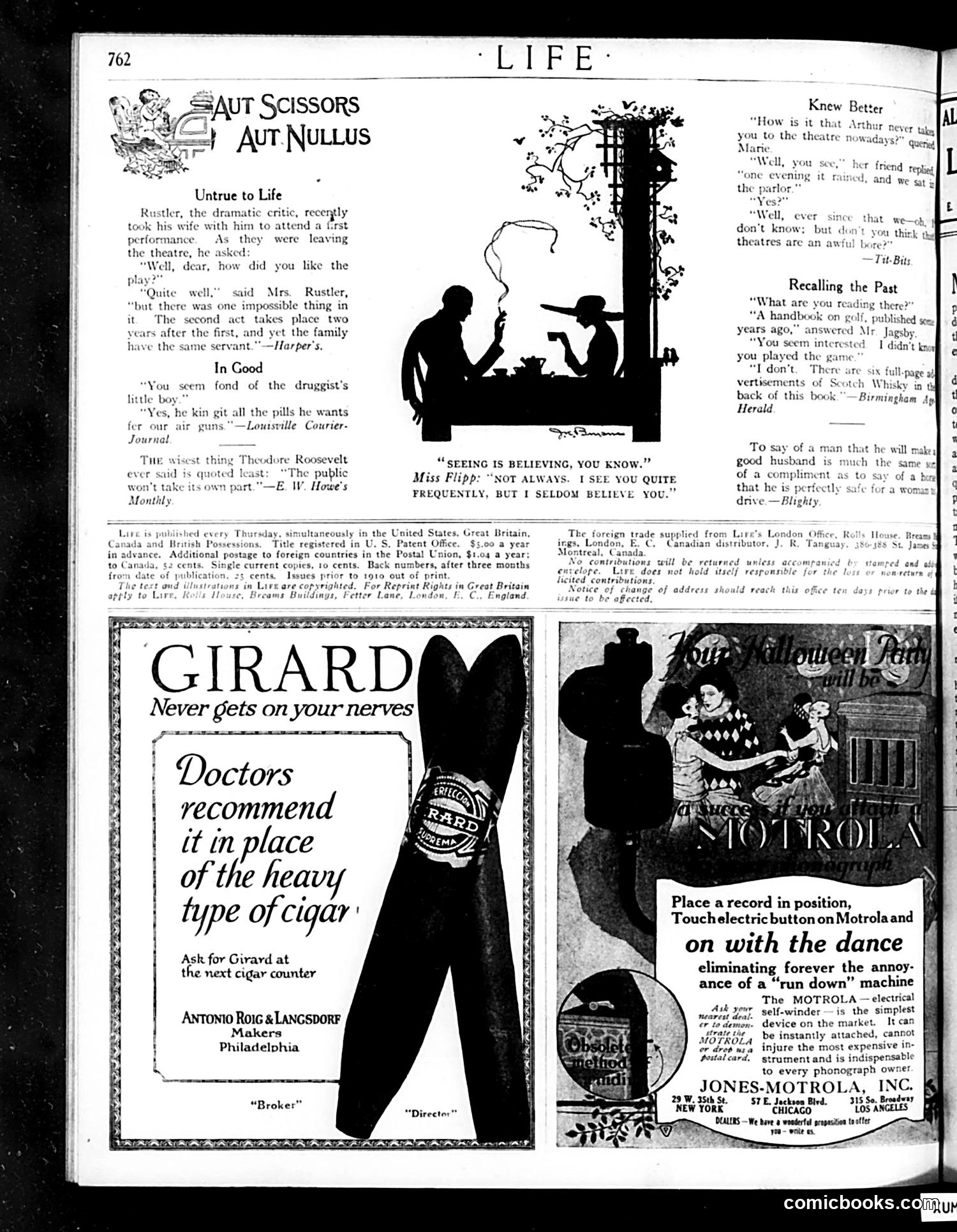
This page combines humor columns with period advertisements. The main satirical content includes: **"Untrue to Life"**: A joke about theatrical implausibility—a dramatic critic and his wife attend a play where the second act occurs two years after the first, yet the family still employs the same servant. The satire mocks both overwrought theater plots and the predictable social conventions they ignore. **"In Good"**: A brief quip about a druggist's boy taking pills meant for air guns, playing on pharmaceutical ambiguity and child mischief. **The central cartoon** depicts two silhouetted figures (a man and woman) in a domestic scene, captioned with dialogue about believing versus seeing—likely commentary on marital trust or perception. **Advertisements** dominate the lower half, including Girard cigars (claiming doctors recommend them) and a Motrola phonograph self-winder device, typical of 1920s consumer marketing. The page reflects early 20th-century Life magazine's formula: light domestic satire aimed at middle-class readers, paired with luxury goods advertising.
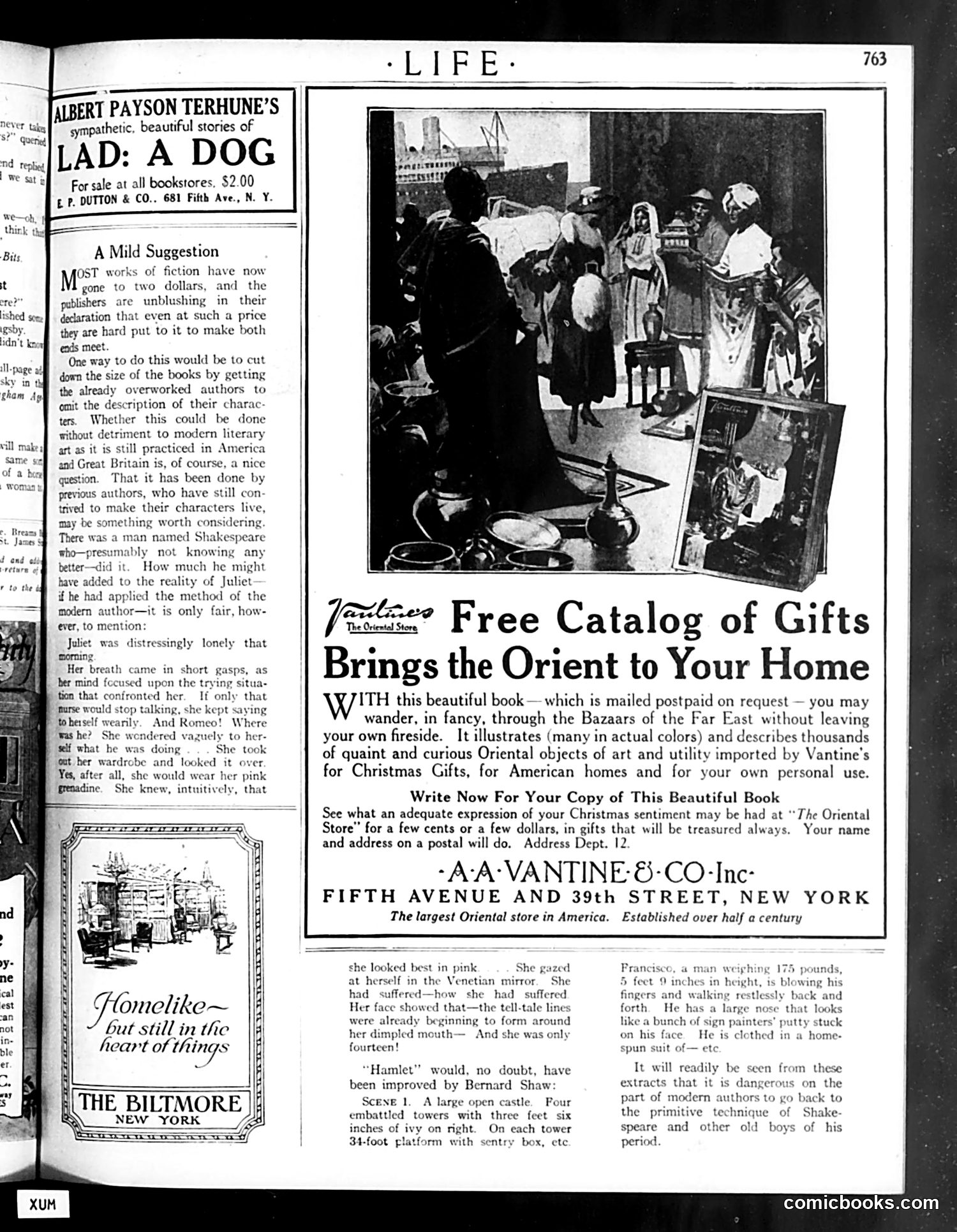
This page is primarily **advertising and literary commentary**, not political satire. The main content is an essay titled "A Mild Suggestion" arguing that modern publishers should cut book sizes to reduce costs. The author uses **Shakespeare as an example**, noting he created compelling characters (like Juliet) despite brevity—implying modern authors could do the same rather than blaming high prices on necessity. The satirical point: The essay mockingly suggests authors like **Bernard Shaw** could improve classics like *Hamlet* by trimming them. This is tongue-in-cheek criticism of publishers' excuses for expensive books ($2.00 in this era). The page also advertises **A.A. Vantine & Co.'s Oriental gift catalog** and **Albert Payson Terhune's dog story "Lad: A Dog."** A smaller ad promotes *The Biltmore* hotel in New York. No specific political figures or contemporary events are caricatured. The humor targets the publishing industry's cost-cutting justifications rather than any particular person or movement.
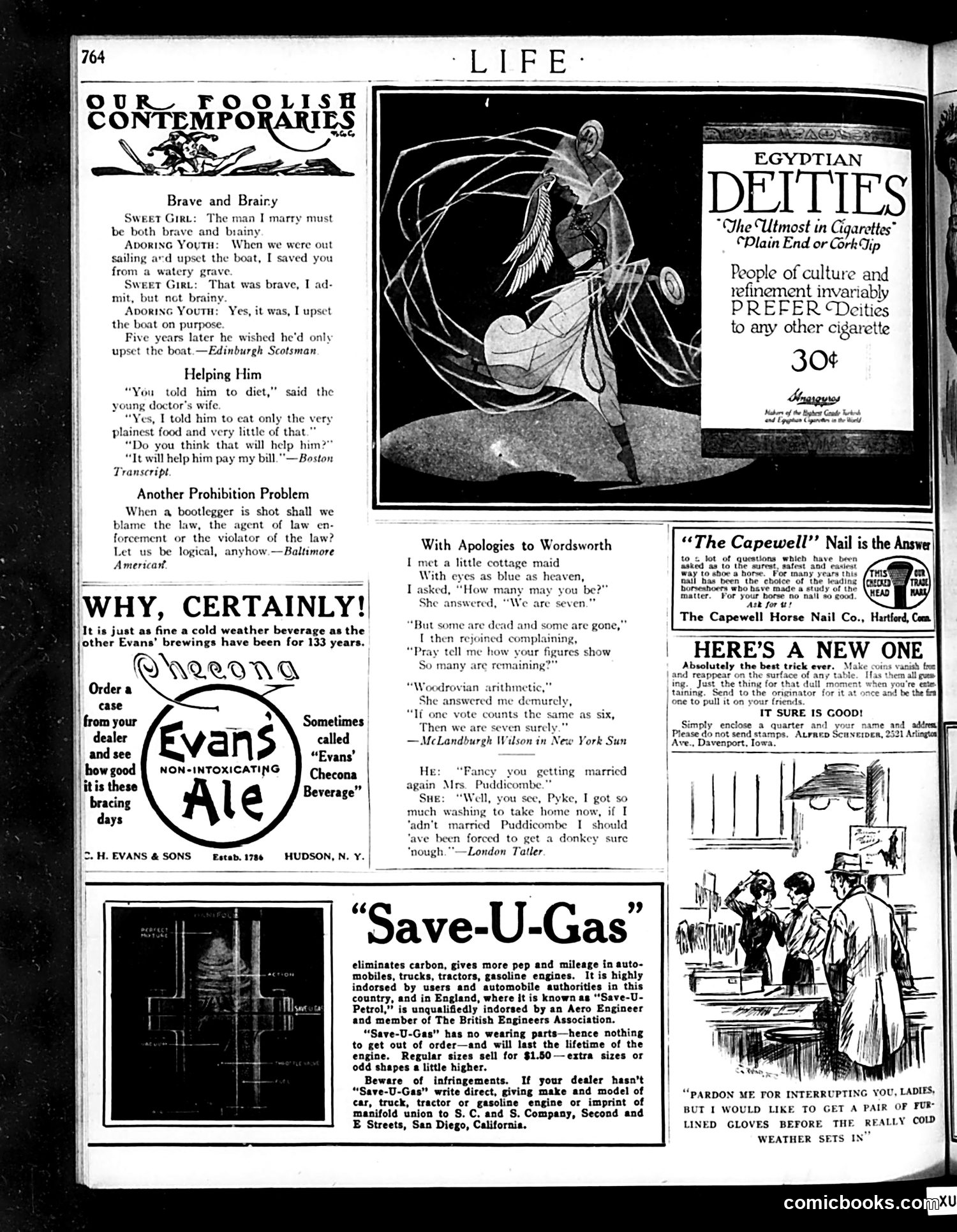
This page comprises **humorous anecdotes and period advertisements** rather than political cartoons. ## Humor Sections: The jokes satirize social pretense and domestic life. "Brave and Brainy" mocks a suitor who upsets a boat intentionally to appear heroic—a commentary on performative masculinity. "Helping Him" jokes about a doctor's wife recommending diet partly to increase her bill. "Another Prohibition Problem" references the contemporary alcohol ban, questioning who bears blame when bootleggers (illegal liquor dealers) are shot—highlighting Prohibition's logical contradictions. ## Advertisements: **Evans' Ale** advertises as a "non-intoxicating beverage" despite Prohibition, using euphemistic language. **Egyptian Deities cigarettes** (30¢) appeal to "culture and refinement." **"Save-U-Gas"** promotes a fuel additive. **Capewell Horse Nails** pitch their product as superior. The "Wordsworth Apologies" poem sarcastically references **Woodrovian arithmetic**—likely mocking Woodrow Wilson's political math or policies—while commenting on working-class women's lives and family economics.
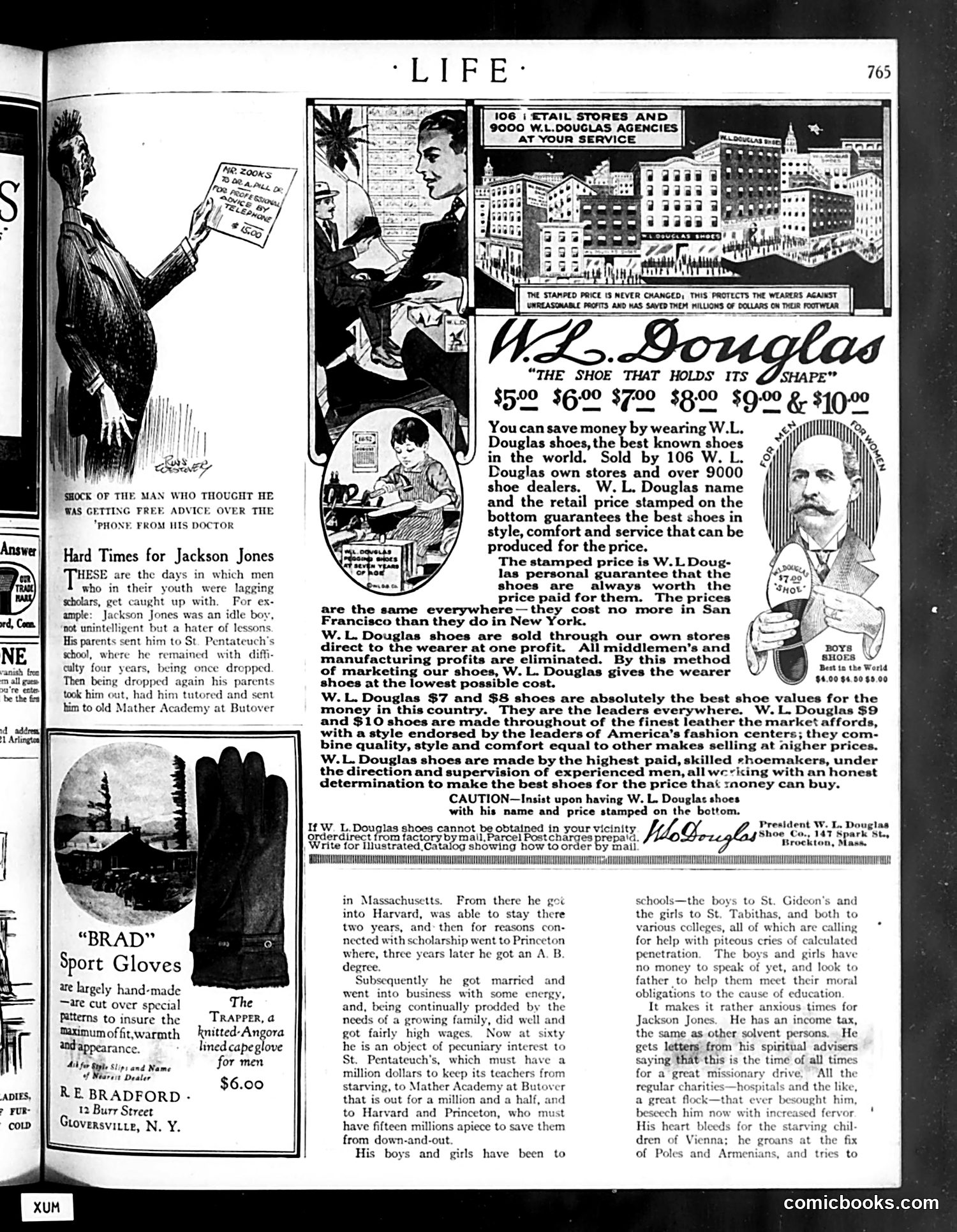
This page contains two distinct elements: **Left side cartoon:** "Shock of the Man Who Thought He Was Getting Free Advice Over the Phone From His Doctor" depicts a thin, disheveled figure recoiling in horror while holding a bill. The satire mocks the expectation that doctors provide free telephone consultations—a commentary on the emerging practice of doctors charging for medical advice even delivered remotely. **Main content:** A lengthy article on "Hard Times for Jackson Jones" traces a wealthy man's life trajectory from idle youth through elite education (St. Pentateuch's, Harvard, Princeton) to financial pressures in old age. The satire criticizes how these prestigious institutions continually solicit donations from successful alumni, extracting money under the guise of preventing educational collapse. The right side is dominated by a W.L. Douglas shoe advertisement featuring price-stamped footwear and endorsements. The page satirizes both medical and educational commercialism—the implicit expectation that professionals and institutions will extract payment for services and support from those who've already benefited from them.
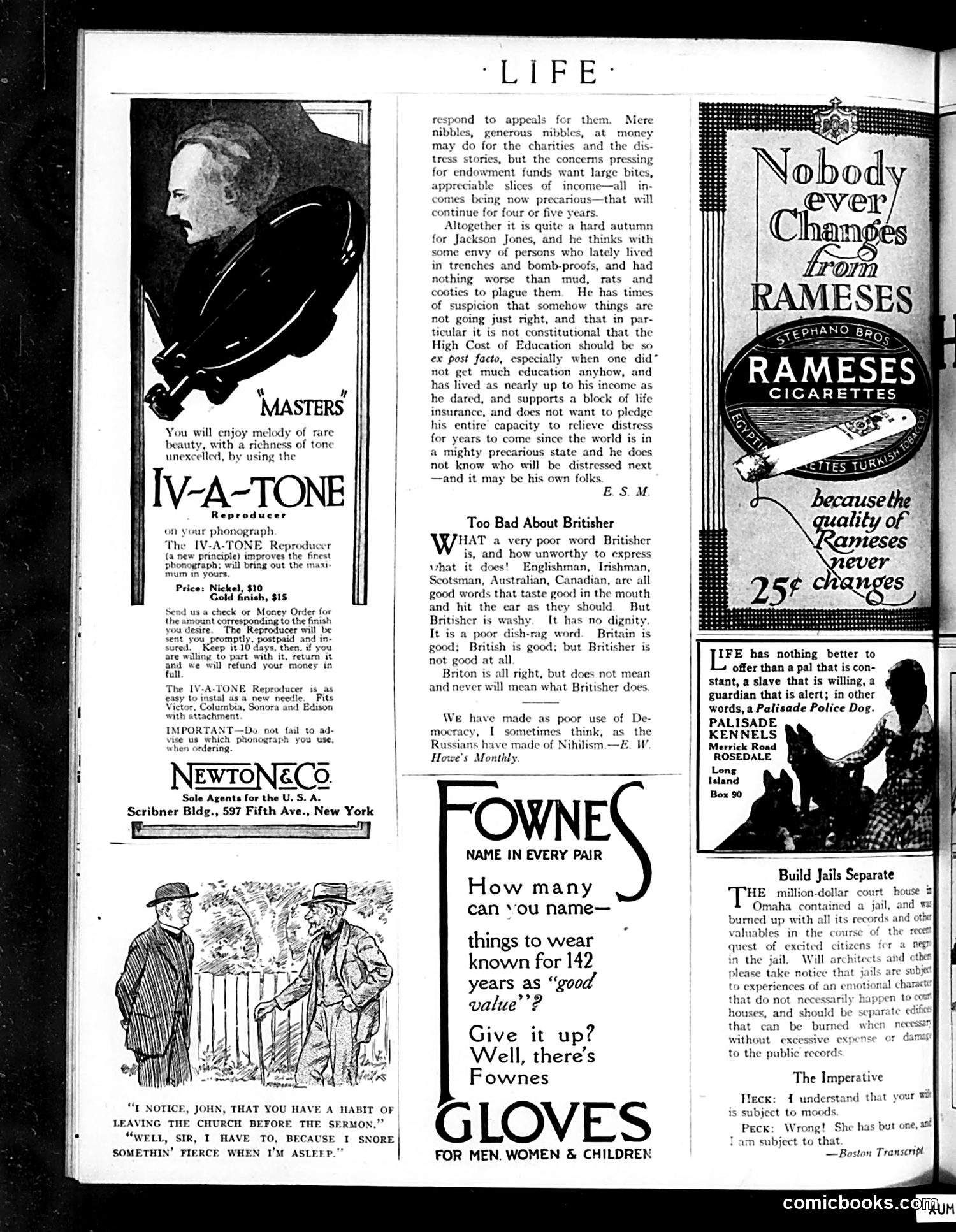
This page contains several distinct pieces of social satire: **"Jackson Jones" Editorial Segment**: A commentary on postwar economic anxiety. "Jackson Jones" appears to be an everyman figure struggling with inflation and fundraising pressure. The text satirizes those nostalgic for WWI trenches—where at least suffering was straightforward—compared to the confusing "High Cost of Education" and financial precariousness of peacetime. **"Too Bad About Britisher"**: Linguistic criticism of American English. The author mocks the word "Britisher" as undignified slang, arguing proper terms like "Englishman," "Briton," or "British" are superior. This reflects early 20th-century anxieties about American linguistic refinement. **"Build Jails Separate"**: Social commentary on an Omaha courthouse fire that destroyed records. The piece sardonically suggests separate jail construction to protect irreplaceable documents from excited mobs. **Bottom cartoon**: A domestic humor piece about a husband's church-sleeping habit—light social observation rather than political satire. The page blends serious economic concern with linguistic and institutional critique typical of Life's satirical approach.
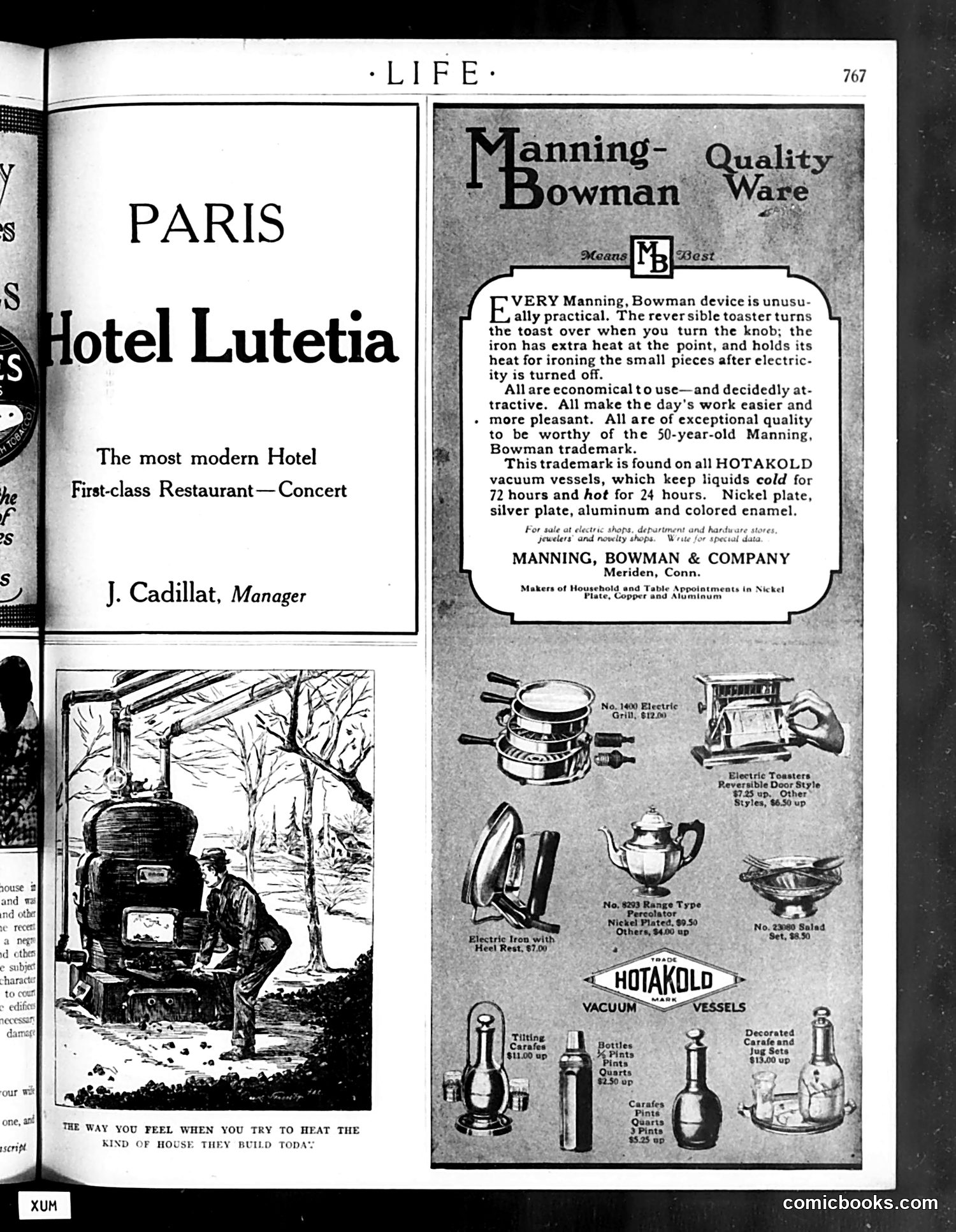
This page contains two distinct elements: an advertisement for Hotel Lutetia in Paris (left) and a Manning-Bowman appliance advertisement (right). The cartoon accompanying the hotel ad depicts a man struggling to heat an old-fashioned house, illustrating the satirical caption: "THE WAY YOU FEEL WHEN YOU TRY TO HEAT THE KIND OF HOUSE THEY BUILD TODAY." The joke criticizes early 20th-century American home construction as inefficient and poorly insulated—modern houses are difficult to heat despite contemporary building standards. The contrast with the "most modern Hotel" in Paris suggests American homes lag behind European luxury. The Manning-Bowman ad promotes electric kitchen appliances (toasters, irons, percolators, vacuum vessels), emphasizing their practicality and time-saving benefits for housework. Both pages reflect 1920s consumer culture promoting modern conveniences and comfort.
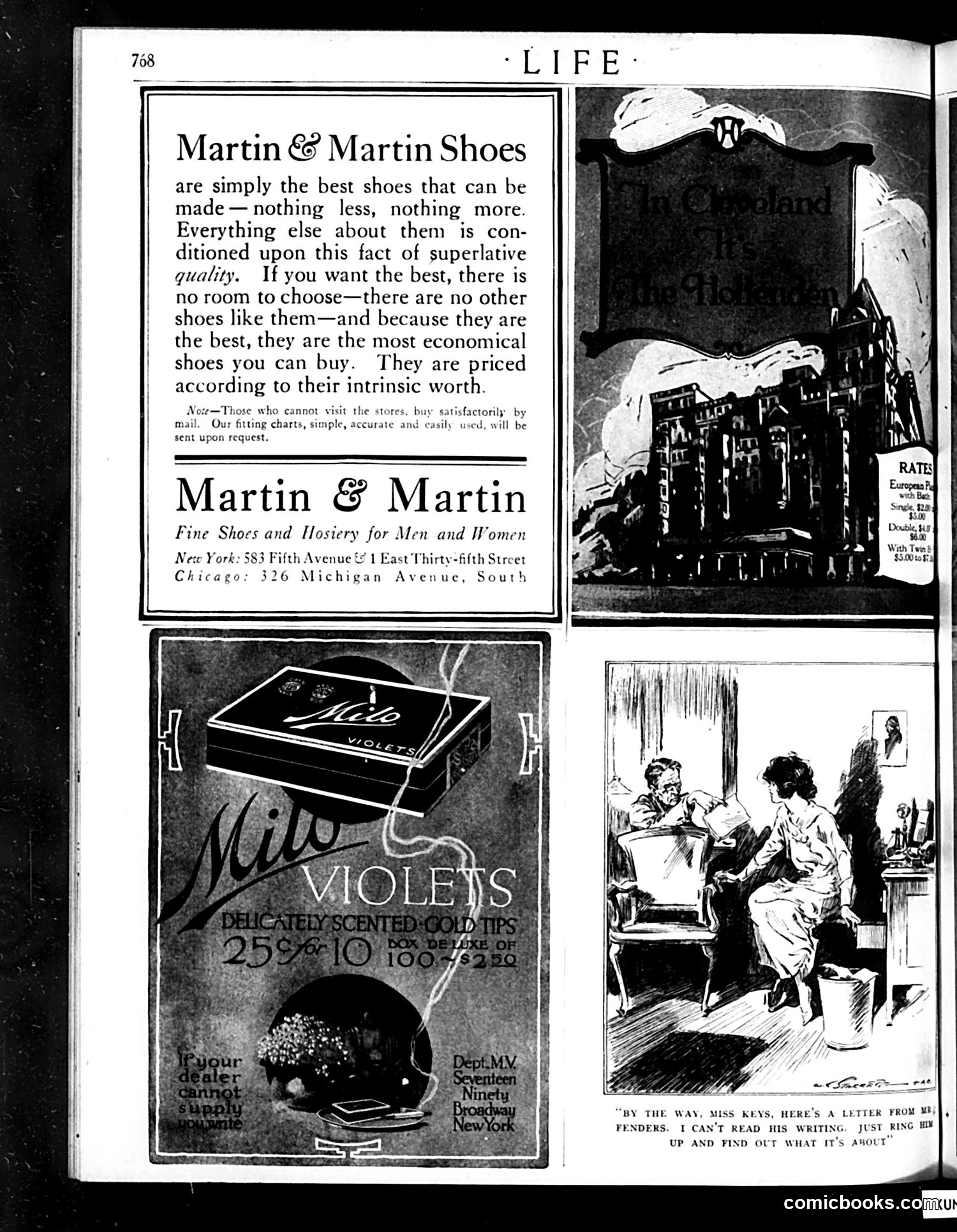
This page is primarily **advertising**, not political satire. It contains two commercial ads: 1. **Martin & Martin Shoes** (top): A straightforward luxury shoe advertisement emphasizing superior quality and fair pricing. The copy claims their shoes are simply "the best" available. 2. **Milo Violets** (bottom left): An advertisement for scented candies or lozenges, priced at 25¢-10¢-100/$2.50, with dealer information for New York. The **cartoon** (bottom right) is a humorous domestic sketch showing two women, where one receives a letter from someone named "Fenders" with illegible handwriting. She quips she'll phone him to decipher it—a mild joke about poor penmanship. This appears unrelated to the advertisements and serves as filler content. The page represents typical early 20th-century magazine layout mixing advertising with light comedic content.
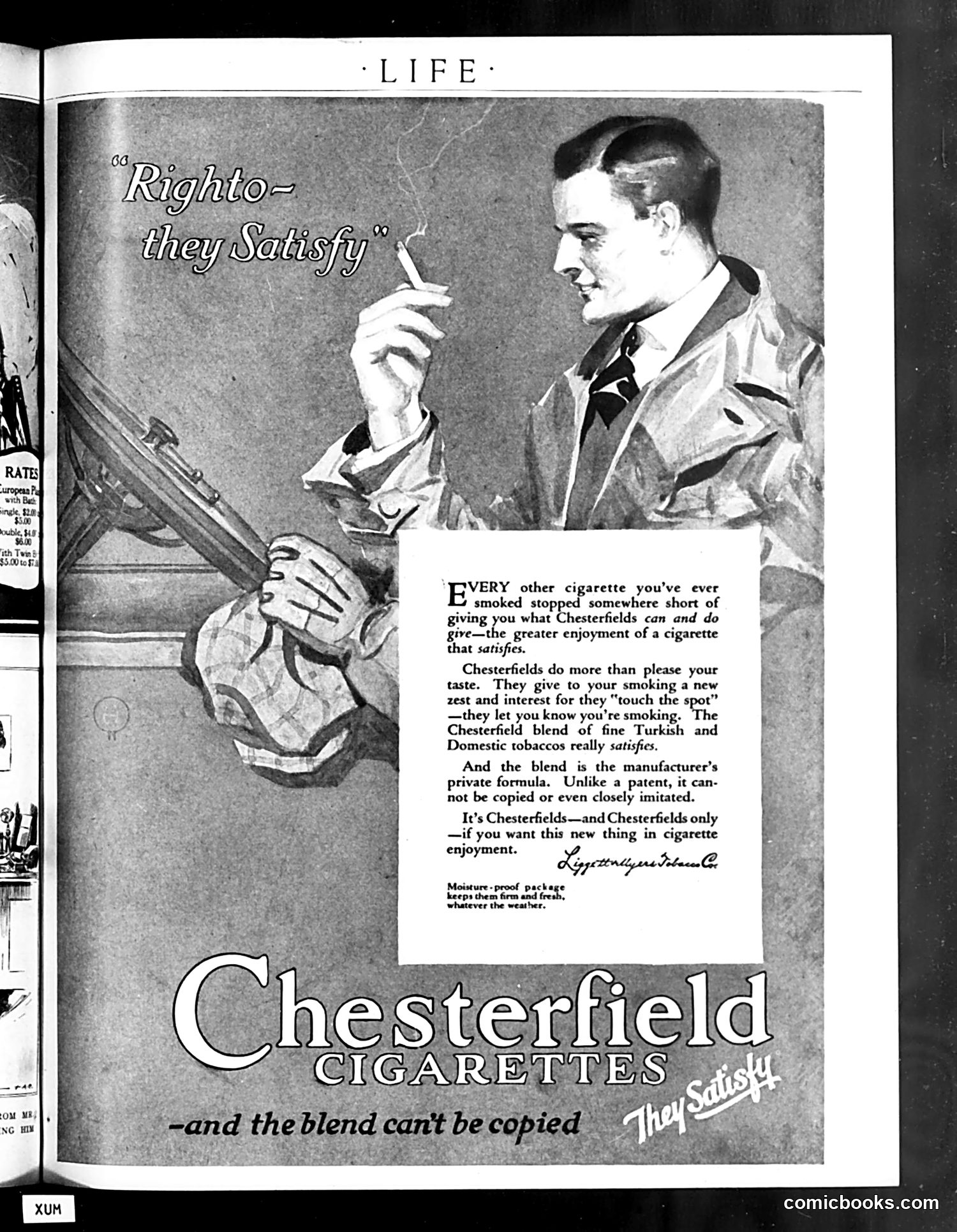
This is primarily a **cigarette advertisement**, not political satire. It features a well-dressed man in profile smoking a cigarette, with the headline "Right—they Satisfy." The ad makes standard early 20th-century marketing claims: Chesterfields provide superior satisfaction compared to competitors, offer a distinctive (and secret) Turkish-Domestic tobacco blend that cannot be imitated, and give smoking "new zest and interest" by letting smokers "know you're smoking." The slogan "They Satisfy" and emphasis on the uncopyable blend reflect typical vintage advertising rhetoric. There is no political commentary or satirical content visible—this is straightforward product promotion in what appears to be a *Life* magazine issue, likely from the 1920s-30s based on design style and typography.
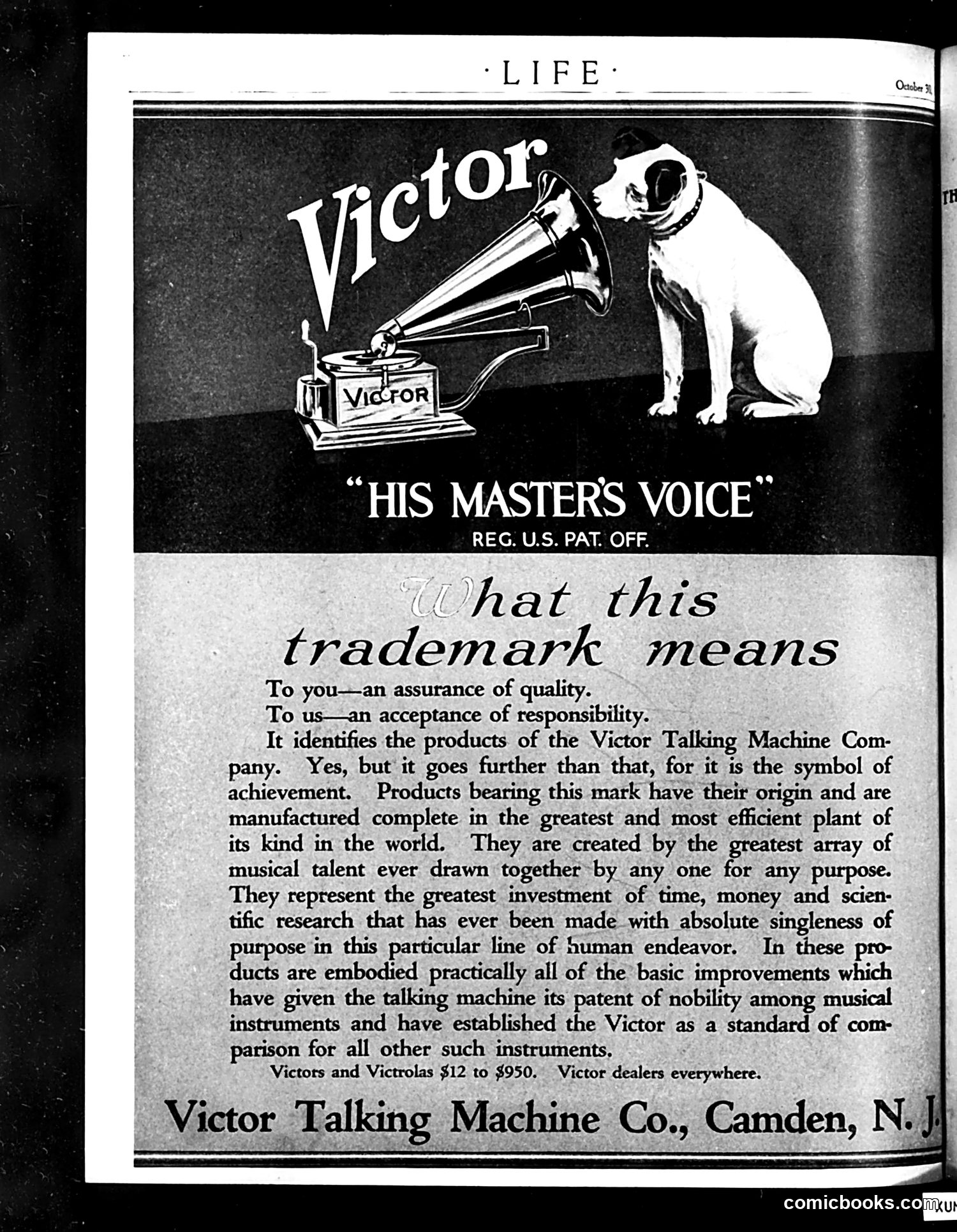
This is **not a cartoon or satire**—it's a full-page advertisement for Victor Talking Machine Company (phonographs/gramophones), featuring their famous trademark: a dog listening to a gramophone horn with the caption "His Master's Voice." The ad emphasizes the trademark's meaning: quality assurance and responsibility. It claims Victor products represent the greatest musical talent, scientific research, and manufacturing standards available. The pricing ($12–$950) indicates products ranging from affordable to luxury models. The "His Master's Voice" trademark was iconic and literal—it symbolized a dog recognizing and responding to recorded sound, demonstrating the phonograph's fidelity. For modern readers, this is recognizable as RCA Victor's famous logo, though the company name and branding have changed over decades. This appears to be early 20th-century advertising, when phonographs were still relatively new technology worth elaborate marketing claims.