
Life, 1919-10-30 · page 17 of 36
Life — October 30, 1919 — page 17: what you’re looking at
What you’re looking at
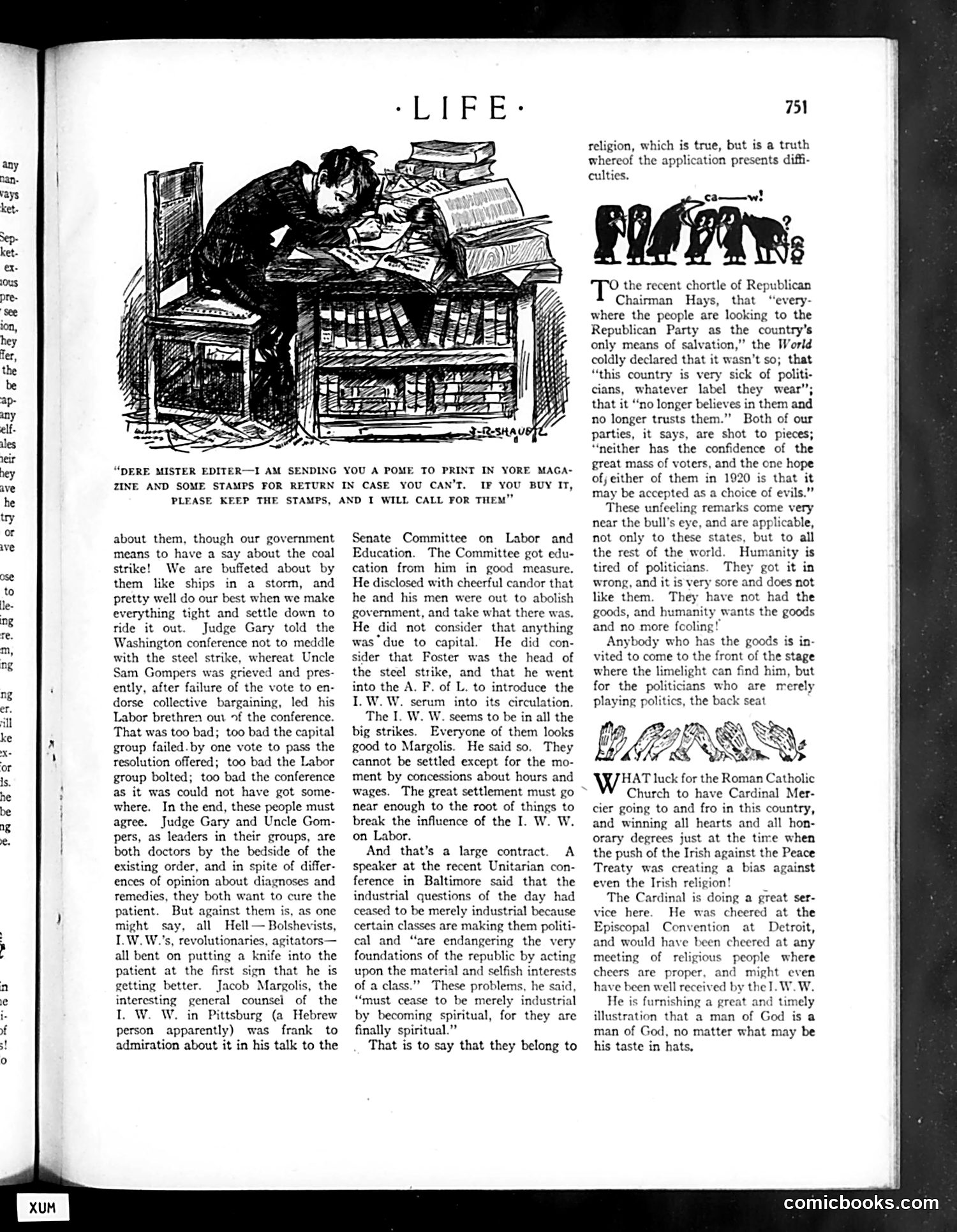
The cartoon depicts a struggling writer submitting poor-quality work to a magazine editor, humorously referencing the impoverished "starving artist" archetype. The figure is hunched over a desk surrounded by books and papers, sending in a poem with return postage "in case you can't" accept it—a self-deprecating acknowledgment that rejection is likely. The accompanying text discusses labor strikes (particularly steel industry strikes), the I.W.W. (Industrial Workers of the World), and radical political movements threatening American stability. It critiques both major political parties as having lost public confidence by 1920, with citizens viewing them as merely "a choice of evils." The piece characterizes revolutionaries and Bolshevists as threats to the existing order, while praising moderate labor leaders like Samuel Gompers. The cartoon's placement alongside this anti-radical political commentary suggests *Life* magazine was using humor to mock both struggling writers and, implicitly, the radical ideologies discussed in the text.
📄 Transcribed text from this page (OCR, searchable)
Machine-transcribed from the original scan — historical spelling and the odd misread are preserved.
“DERE MISTER EDITER—I AM SENDING YOU A POME TO PRINT IN YORE MAGA- ZINE AND SOME STAMPS FOR RETURN IN CASE YOU CAN'T. IP you BUY IT, PLEASE KEEP THE STAMPS, AND I WILL CALL FOR THEM” about them, though our government means to have a say about the coal strike! We are buffeted about by them like ships in a storm, and pretty well do our best when we make everything tight and settle down to ride it out. Judge Gary told the Washington conference not to meddle with the steel strike, whereat Uncle Sam Gompers was grieved and pres- ently, after failure of the vote to en- dorse collective bargaining, led his Labor brethren out of the conference. That was too bad; too bad the capital group failed.by one vote to pass the resolution offered; too bad the Labor group bolted; too bad the conference as it was could not have got some- where. In the end, these people must agree. Judge Gary and Uncle Gom- pers, as leaders in their groups, are both doctors by the bedside of the existing order, and in spite of differ- ences of opinion about diagnoses and temedies, they both want to cure the patient. But against them is, as one might say, all Hell — Bolshevists, I.W.W.'s, revolutionaries, agitators— all bent on putting a knife into the patient at the first sign that he is getting better. Jacob Margolis, the interesting general counsel of the I. W. W. in Pittsburg (a Hebrew person apparently) was frank to admiration about it in his talk to the Senate Committee on Labor and Education. The Committee got edu- cation from him in good measure. He disclosed with cheerful candor that he and his men were out to abolish government, and take what there was. He did not consider that anything was "due to capital. He did con- sider that Foster was the head of the steel strike, and that he went into the A. F. of L. to introduce the I. W. W. serum into its circulation. The I. W. W. seems to be in all the big strikes. Everyone of them looks good to Margolis. He said so. They cannot be settled except for the mo- ment by concessions about hours and wages. The great settlement must go near enough to the root of things to break the influence of the I. W. W. on Labor. And that’s a large contract. A speaker at the recent Unitarian con- ference in Baltimore said that the industrial questions of the day had ceased to be merely industrial because certain classes are making them politi- cal and “are endangering the very foundations of the republic by acting upon the material and selfish interests of a class.” These problems, he s: “must cease to be merely industrial by becoming spiritual, for they are finally spiritual.” That is to say that they belong to 751 religion, which is true, but is a truth whereof the application presents diffi- culties. ca——w! the recent chortle of Republican Chairman Hays, that “every- where the people are looking to the Republican Party as the country’s only means of salvation,” the World coldly declared that it wasn’t so; that “this country is very sick of politi- cians, whatever label they wear’; that it “‘no longer believes in them and no longer trusts them.’ Both of our parties, it says, are shot to pieces; “neither has the confidence of the great mass of voters, and the one hope ofjeither of them in 1920 is that it may be accepted as a choice of evils. These unfeeling remarks come very near the bull's eye, and are applicable, not only to these states, but to all the rest of the world. Humanity is tired of politicians. They got it in wrong, and it is very sore and does not like them. They have not had the goods, and humanity wants the goods and no more fooling! Anybody who has the goods is in- vited to come to the front of the stage where the limelight can find him, but for the politicians who are merely playing politics, the back seat HAT luck for the Roman Catholic Church to have Cardinal Mer- cier going to and fro in this country, and winning all hearts and all hon- orary degrees just at the time when the push of the Irish against the Peace Treaty was creating a bias against even the Irish religion! The Cardinal is doing a great ser- vice here. He was cheered at the Episcopal Convention at Detroit, and would have been cheered at any meeting of religious people where cheers are proper, and might even have been well received by the 1. W. W. He is furnishing a grea 1 illustration that a man of God is a man of God, no matter what may be his taste in hats, comicbooks.com