
Life, 1919-10-30 · page 16 of 36
Life — October 30, 1919 — page 16: what you’re looking at
What you’re looking at
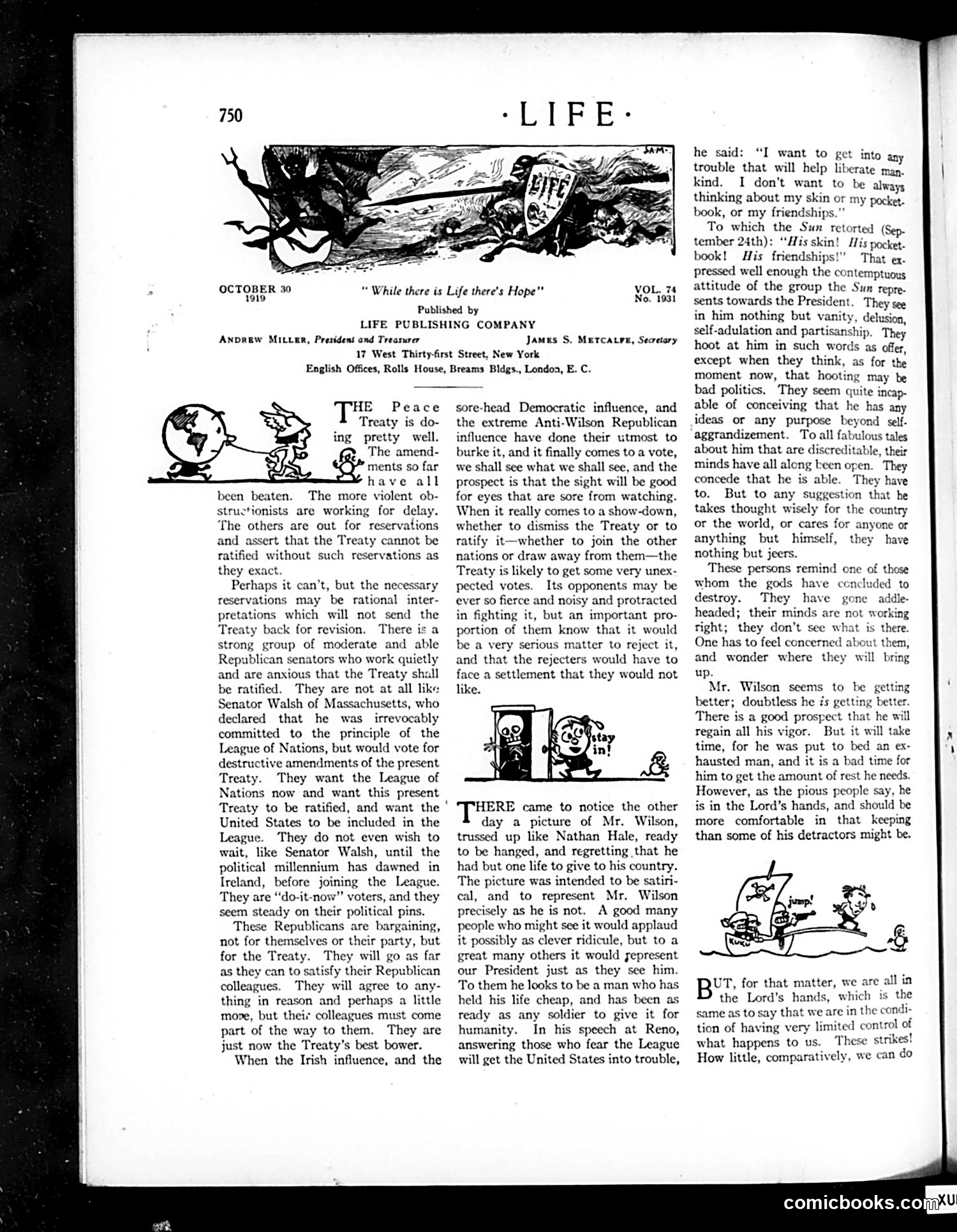
This page discusses the U.S. Senate's ratification debate over the Treaty of Versailles and League of Nations membership—a contentious 1919 issue. The main article analyzes competing factions: moderate Republicans willing to ratify with reasonable reservations; extreme Republicans and Irish-influenced Democrats seeking to block it; and anti-Wilson Republicans opposing it entirely. Life's editors predict unexpected support will emerge when forced to choose between ratification or rejection. The second section critiques a political cartoon depicting President Wilson as Nathan Hale facing execution—meant as satire. Life notes many see this as accurate: Wilson genuinely prioritizes humanitarian causes over personal interests. The article cites Wilson's Reno speech about accepting any trouble that liberates mankind, and quotes a hostile Sun newspaper response mocking his supposed indifference to "his skin," "pocket-book," and "friendships"—revealing contempt from Wilson's political opponents. The page illustrates deep partisan divisions over America's post-WWI international commitments.
📄 Transcribed text from this page (OCR, searchable)
Machine-transcribed from the original scan — historical spelling and the odd misread are preserved.
OCTOBER 30 1919 “ While there is Life there’s Hope" No. 1931 Published by LIFE PUBLISHING COMPANY ANDREW MILLER, President ond Treasurer Jamas S. METCALPE, Secretary 17 West Thirty-first Street, New York English Offices, Rolls House, Breams Bldgs., Londoa, E. C. HE Peace Treaty is do- ing pretty well. The amend- ments so far have all been beaten. The more violent ob- structionists are working for delay. The others are out for reservations and assert that the Treaty cannot be ratified without such reservations as they exact. Perhaps it can’t, but the necessary reservations may be rational inter- pretations which will not send the Treaty back for revision. There is a strong group of moderate and able Republican senators who work quietly and are anxious that the Treaty shall be ratified. They are not at all like Senator Walsh of Massachusetts, who declared that he was irrevocably committed to the principle of the League of Nations, but would vote for destructive amendments of the present Treaty. They want the League of Nations now and want this present Treaty to be ratified, and want the ' United States to be included in the League. They do not even wish to wait, like Senator Walsh, until the political millennium has dawned in Ireland, before joining the League. They are “do-it-now”’ voters, and they seem steady on their political pins. These Republicans are bargaining, not for themselves or their party, but for the Treaty. They will go as far as they can to satisfy their Republican colleagues. They will agree to any- thing in reason and perhaps a little move, but their colleagues must come part of the way to them. They are just now the Treaty’s best bower. When the Irish influence, and the sore-head Democratic influence, and the extreme Anti-Wilson Republican influence have done their utmost to burke it, and it finally comes to a vote, we shall see what we shall see, and the prospect is that the sight will be good for eyes that are sore from watching. When it really comes to a show-down, whether to dismiss the Treaty or to ratify it—whether to join the other nations or draw away from them—the Treaty is likely to get some very unex- pected votes. Its opponents may be ever so fierce and noisy and protracted in fighting it, but an important pro- portion of them know that it would be a very serious matter to reject it, and that the reject would have to face a settlement that they would not HERE came to notice the other day a picture of Mr. Wilson, trussed up like Nathan Hale, ready to be hanged, and regretting that he had but one life to give to his country. The picture was intended to be satiri- cal, and to represent Mr. Wilson precisely as he is not. A good many people who might see it would applaud it possibly as clever ridicule, but to a great many others it would sepresent our President just as they see him. To them he looks to be a man who has held his life cheap, and has been as ready as any soldier to give it for humanity. In his speech at Reno, answering those who fear the League will get the United States into trouble, he said: “I want to get into an trouble that will help liberate man. kind. I don’t want to be always thinking about my skin or my pocket- book, or my friendships.” To which the Sun retorted (Sep- tember 24th): “His skin! His pocket. book! His friendships!” That ex. pressed well enough the contemptuous attitude of the group the Sun repre. sents towards the President. They see in him nothing but vanity, delusion, self-adulation and partisanship, They hoot at him in such words as offer, except when they think, as for the moment now, that hooting may be bad politics. They seem quite incap- able of conceiving that he has any ideas or any purpose beyond self- aggrandizement. To all fabulous tales about him that are discreditable, their minds have all along been open. They concede that he is able. They have to. But to any suggestion that he takes thought wisely for the country or the world, or cares for anyone or anything but himself, they have nothing but jeers. These persons remind one of those whom the gods have concluded to destroy. They have ge headed; their minds are not working tight; they don’t see what is there. One has to feel concerned about them, and wonder where they will bring up. Mr. Wilson seems to be getting better; doubtless he is getting be! There is a good prospect that he w regain all his vigor. But it will take time, for he was put to bed an ex- hausted man, and it is a bad time for him to get the amount of rest he needs. However, as the pious people say, he is in the Lord’s hands, and should be more comfortable in that keeping than some of his detractors might be. UT, for that matter, we are all in the Lord's hands, which is the same as to say that we are in the condi- tion of having very limited control of what happens to us. TI strikes! How little, comparatively, we can do comicbooks.comgg