A complete issue · 40 pages · 1919
Life — September 25, 1919
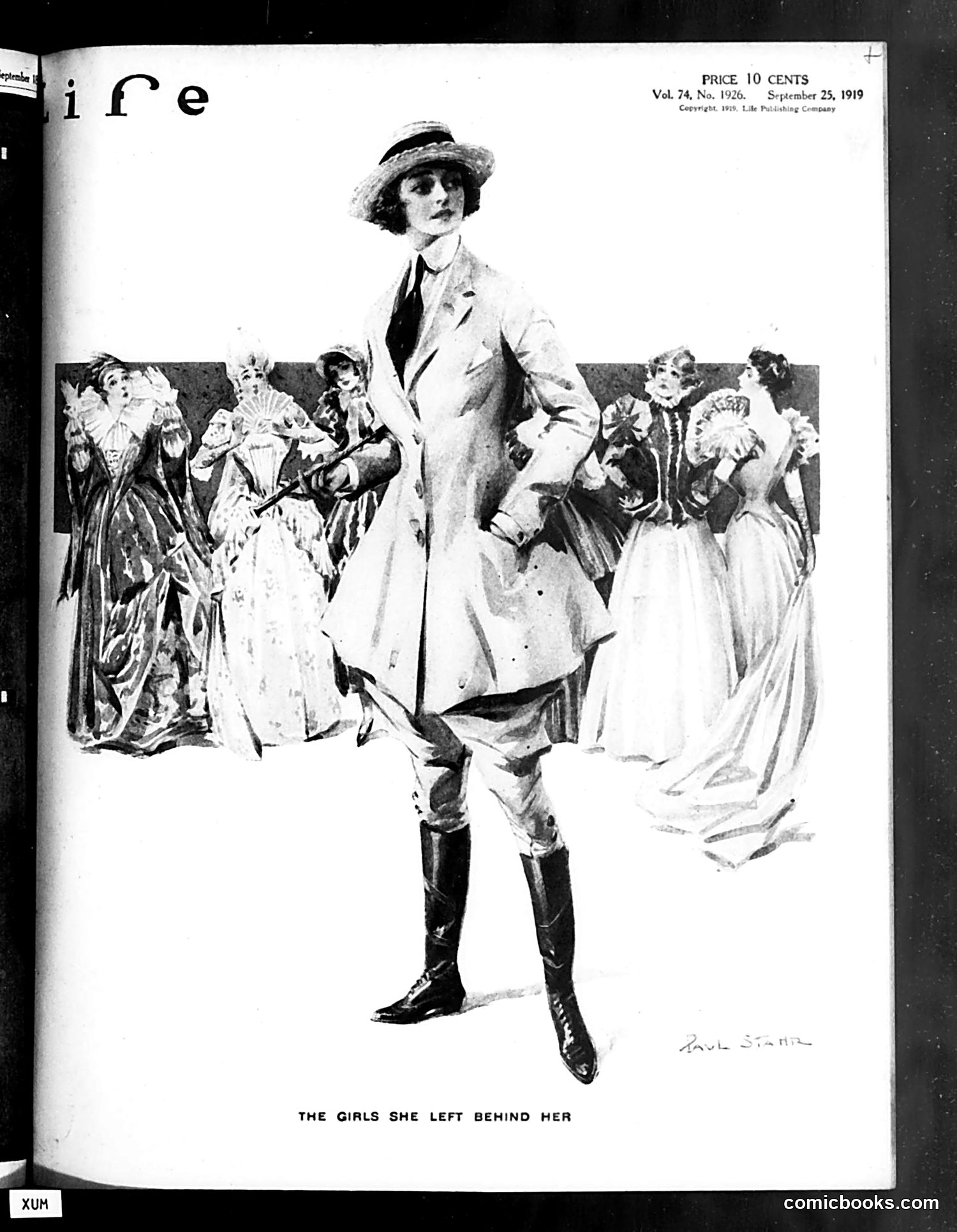
This illustration by a artist named Startt (signature visible) depicts a fashionably dressed woman in a light coat and boots, standing confidently among formally-dressed female figures in elaborate period gowns in the background. The caption reads "THE GIRLS SHE LEFT BEHIND HER," suggesting a narrative about social change or generational difference. Given the 1919 date—immediately following World War I and coinciding with the women's suffrage movement (19th Amendment passed that June)—this likely satirizes the "New Woman" of the post-war era: more independent, modernly dressed, and liberated compared to the constrained Victorian femininity represented by the ornately-gowned figures behind her. The image celebrates this social shift through fashion and posture.
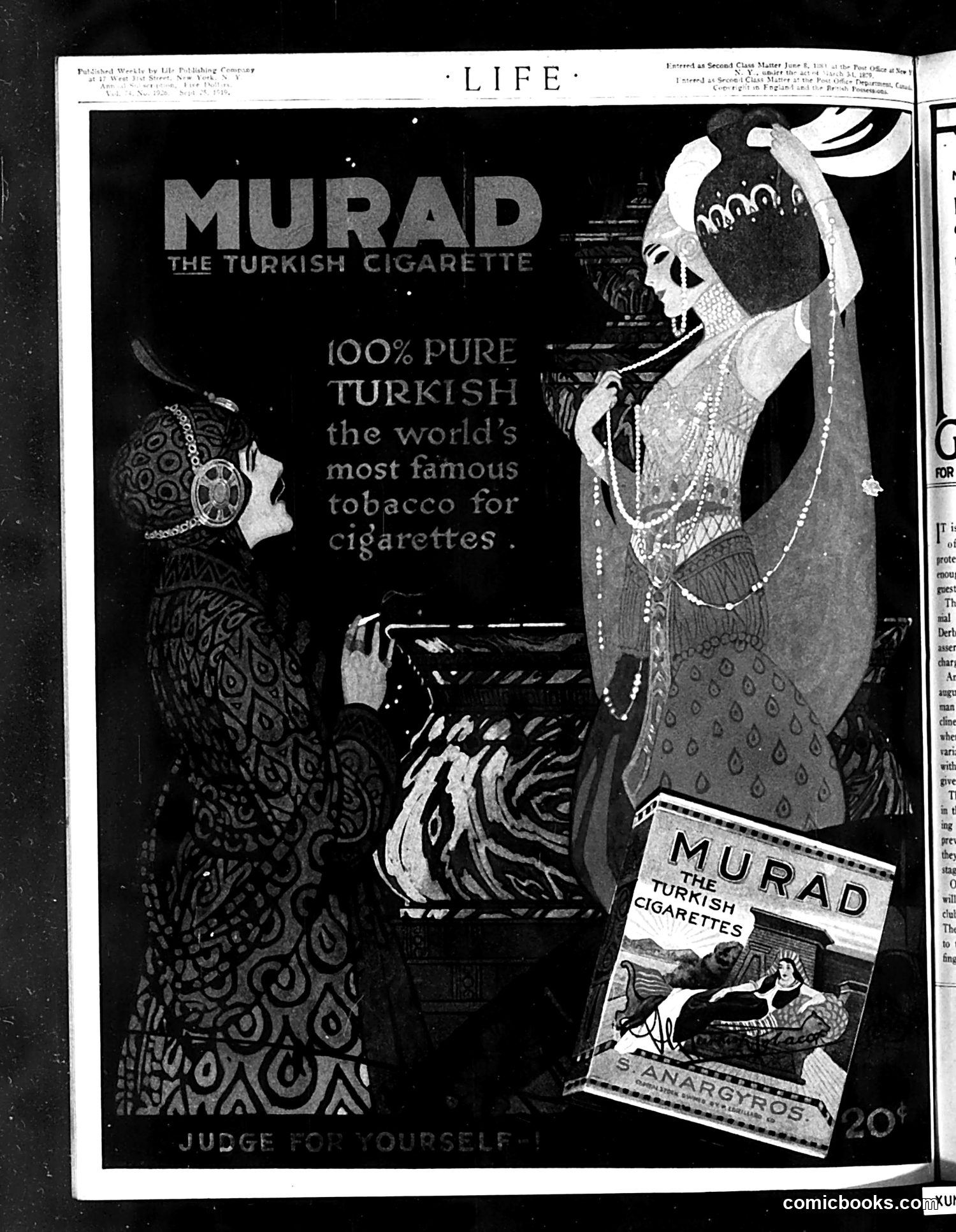
This is a **cigarette advertisement**, not political satire. It promotes Murad brand Turkish cigarettes, emphasizing "100% pure Turkish" tobacco as "the world's most famous tobacco for cigarettes." The imagery features two stylized figures in exotic Oriental dress and jewelry, reflecting early 20th-century Western stereotypes about the "exotic East." The ornate patterns and jeweled accessories were designed to evoke luxury and foreign sophistication—common marketing tactics of the era. The phrase "Judge for Yourself" invites consumers to try the product. A product package is shown at lower right, priced at 20¢. This represents typical vintage advertising that weaponized Orientalist imagery to sell consumer goods to American audiences.
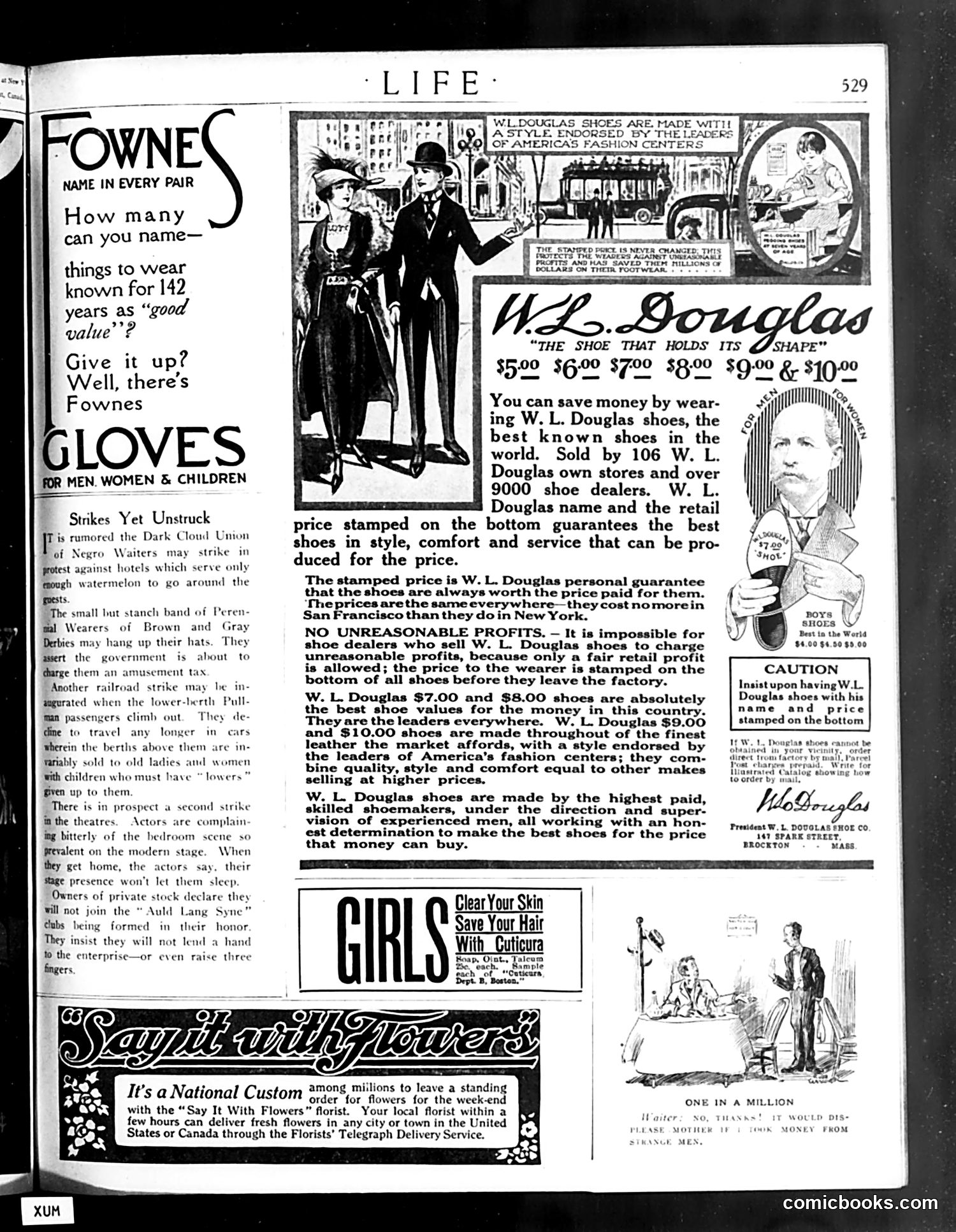
This page is **primarily advertising** with one satirical article. The main content features: **Left side:** A Fownes Gloves advertisement and a brief satirical piece titled "Strikes Yet Unstruck," discussing labor tensions. It mentions the "Dark Cloud Union of Negro Workers" threatening strikes against hotels and railroads unless workers can unionize. The piece sarcastically suggests actors' complaints about hat-checking and theater strikes as minor grievances compared to serious labor disputes. The tone mocks trivial workplace complaints. **Center/Right:** Large W.L. Douglas shoe advertisement emphasizing affordable pricing and quality. **Bottom:** A "Say It With Flowers" florist service advertisement and a "Cutticura" beauty products ad. The page reflects early 20th-century labor activism and consumer culture rather than political satire.
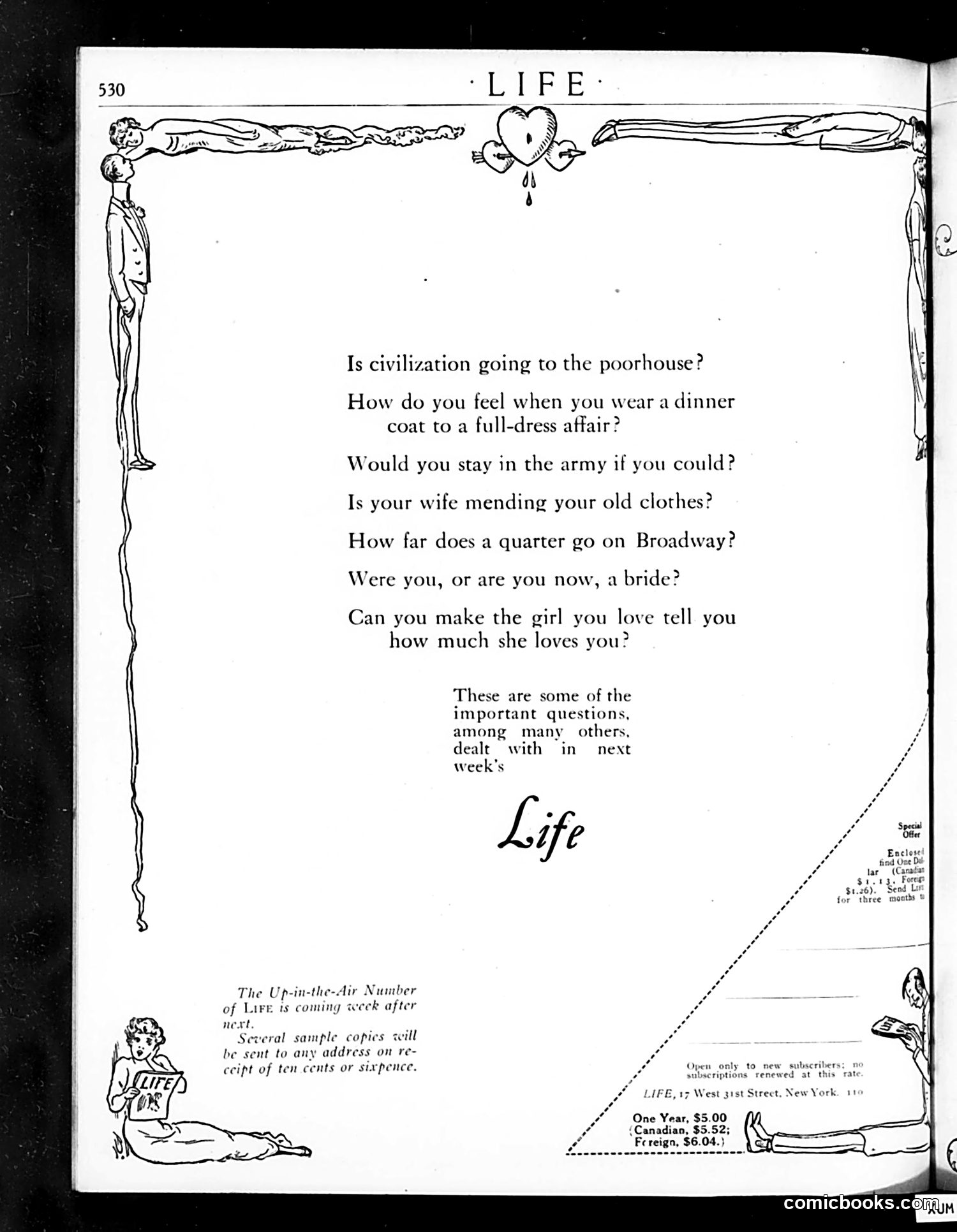
This page advertises Life magazine's upcoming issue, featuring a series of contemporary questions that reflect post-WWI American society and social anxieties: The questions address economic inequality ("Is civilization going to the poorhouse?"), class consciousness (formal dress etiquette), military service, domestic economics (wife mending clothes), urban entertainment costs (Broadway), marital status, and romantic relationships. The decorative border features stylized nude figures typical of Art Deco design popular in the 1920s. The questions suggest Life magazine positions itself as addressing "important" cultural and social issues relevant to modern readers. The publication details and subscription pricing at bottom appear standard for the era. Overall, this is primarily an advertisement showcasing the magazine's editorial focus on contemporary social commentary.
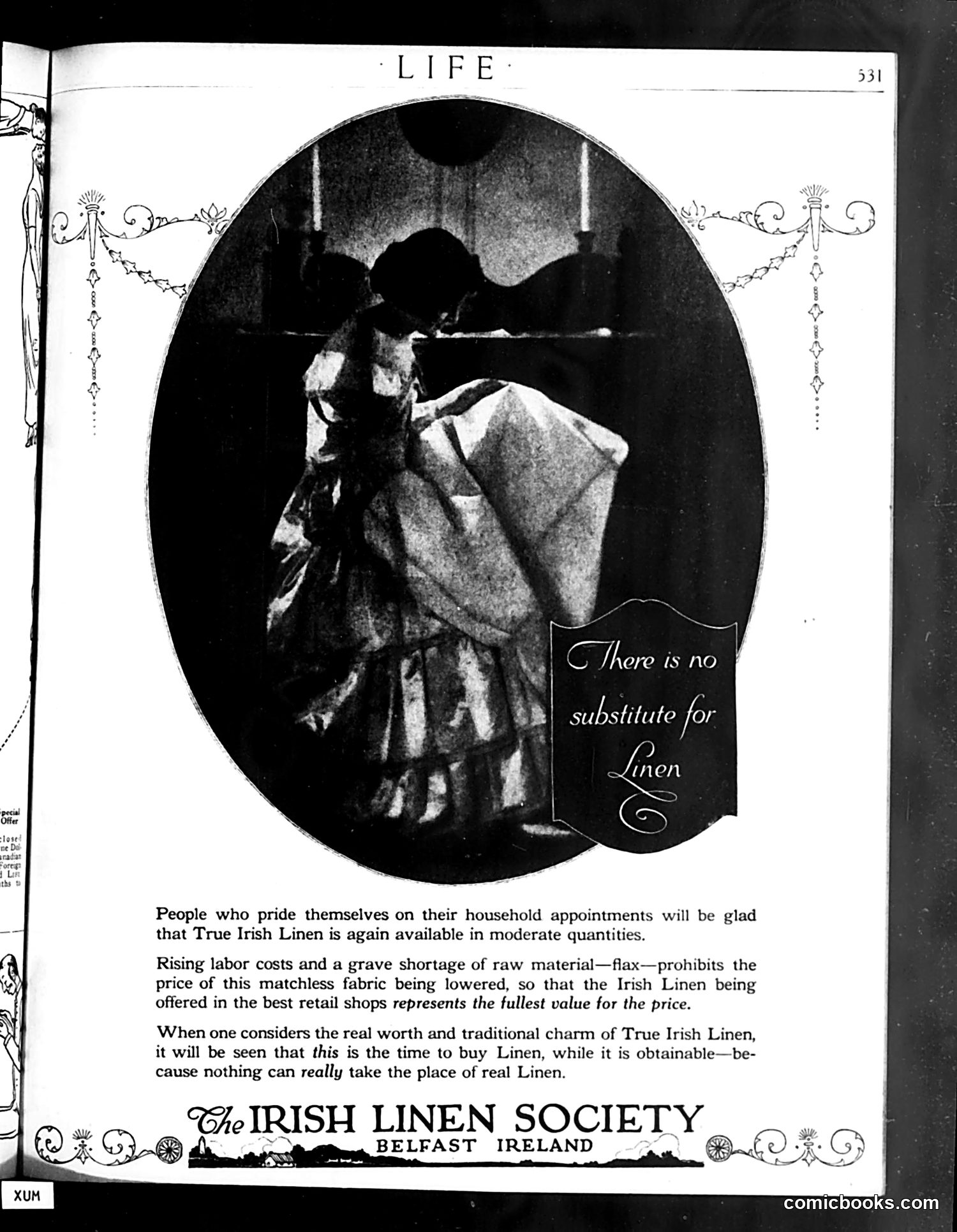
This is primarily a **product advertisement** rather than political satire. The Irish Linen Society of Belfast is marketing True Irish Linen to American consumers, likely in the 1920s-1930s based on the styling. The ad uses emotional appeal rather than humor: an oval photograph shows a woman in elegant period dress handling fine linen fabric by candlelight, suggesting luxury and domestic refinement. The tagline "There is no substitute for Linen" emphasizes product superiority. The text addresses "people who pride themselves on their household appointments," positioning Irish linen as a status symbol. It acknowledges post-WWI economic realities—rising labor costs and flax shortages—to justify pricing while claiming this represents "fullest value for the price." This is marketing, not satire.
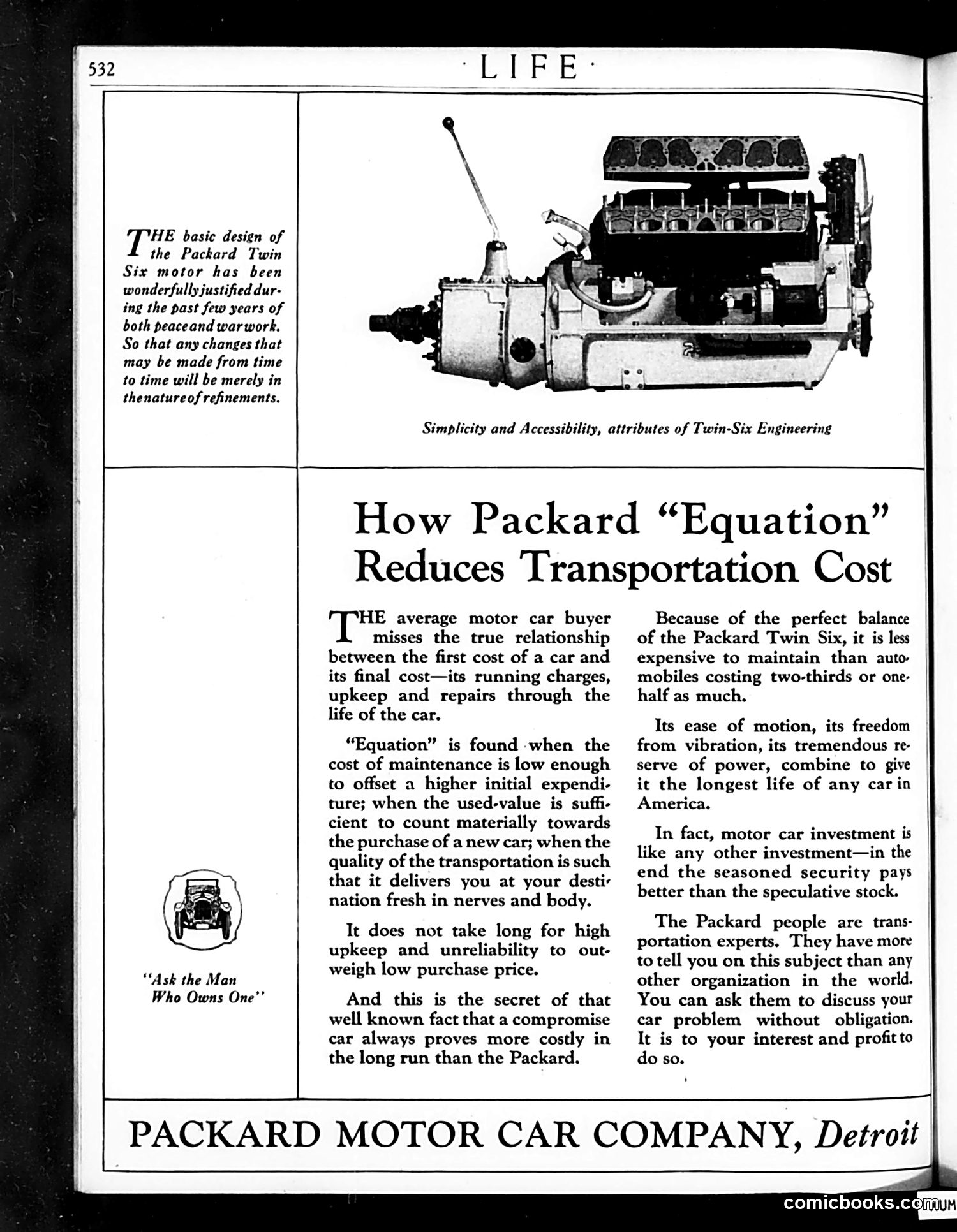
This page is **primarily an advertisement**, not satire or political commentary. It's a Packard Motor Car Company ad from *Life* magazine (page 532). The top section shows a cross-section diagram of the Packard Twin-Six engine, emphasizing its engineering refinement. The main ad below, titled "How Packard 'Equation' Reduces Transportation Cost," argues that while Packards cost more initially, their low maintenance expenses and reliability make them economical over a car's lifetime. The small cartoon ("Ask the Man Who Owns One") is Packard's famous advertising slogan, showing a satisfied owner—not political commentary. The appeal targets affluent buyers concerned with long-term value rather than purchase price alone, positioning Packard as a sound investment comparable to stocks.
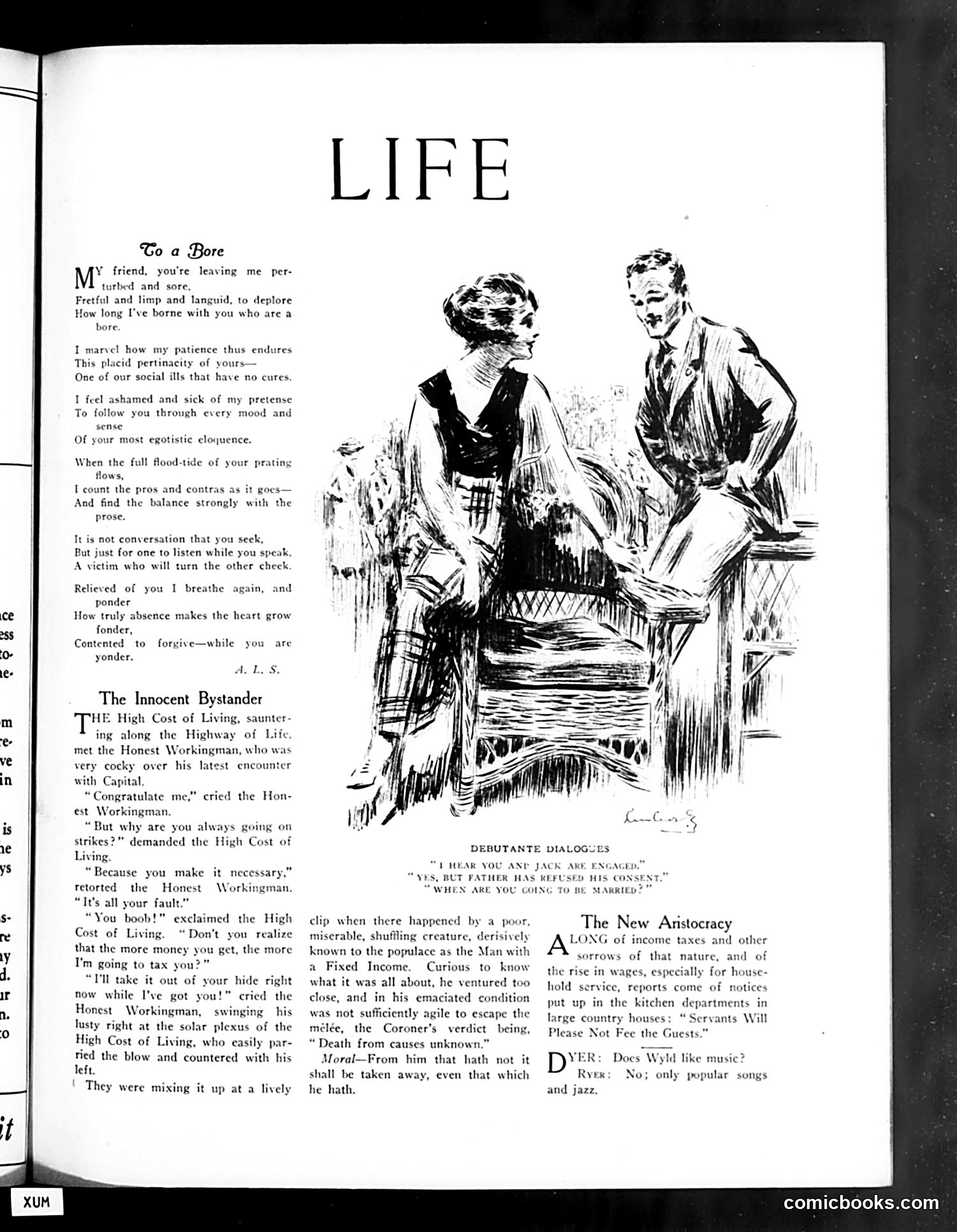
This satirical cartoon depicts a social conversation between two well-dressed figures, likely representing upper-class society members. The sketch shows what appears to be a woman and man in formal attire engaged in dialogue. The accompanying text titled "The Innocent Bystander" presents a sardonic exchange about labor strikes and the "High Cost of Living"—referencing early 20th-century economic anxieties. An "Honest Workingman" complains about strikes, but the "High Cost of Living" personified responds that strikes are necessary because workers' wages don't keep pace with inflation. The satire targets wealthy society's indifference to working-class economic struggles, suggesting the affluent remain detached from or unsympathetic to workers' legitimate grievances about poverty wages amid rising prices.
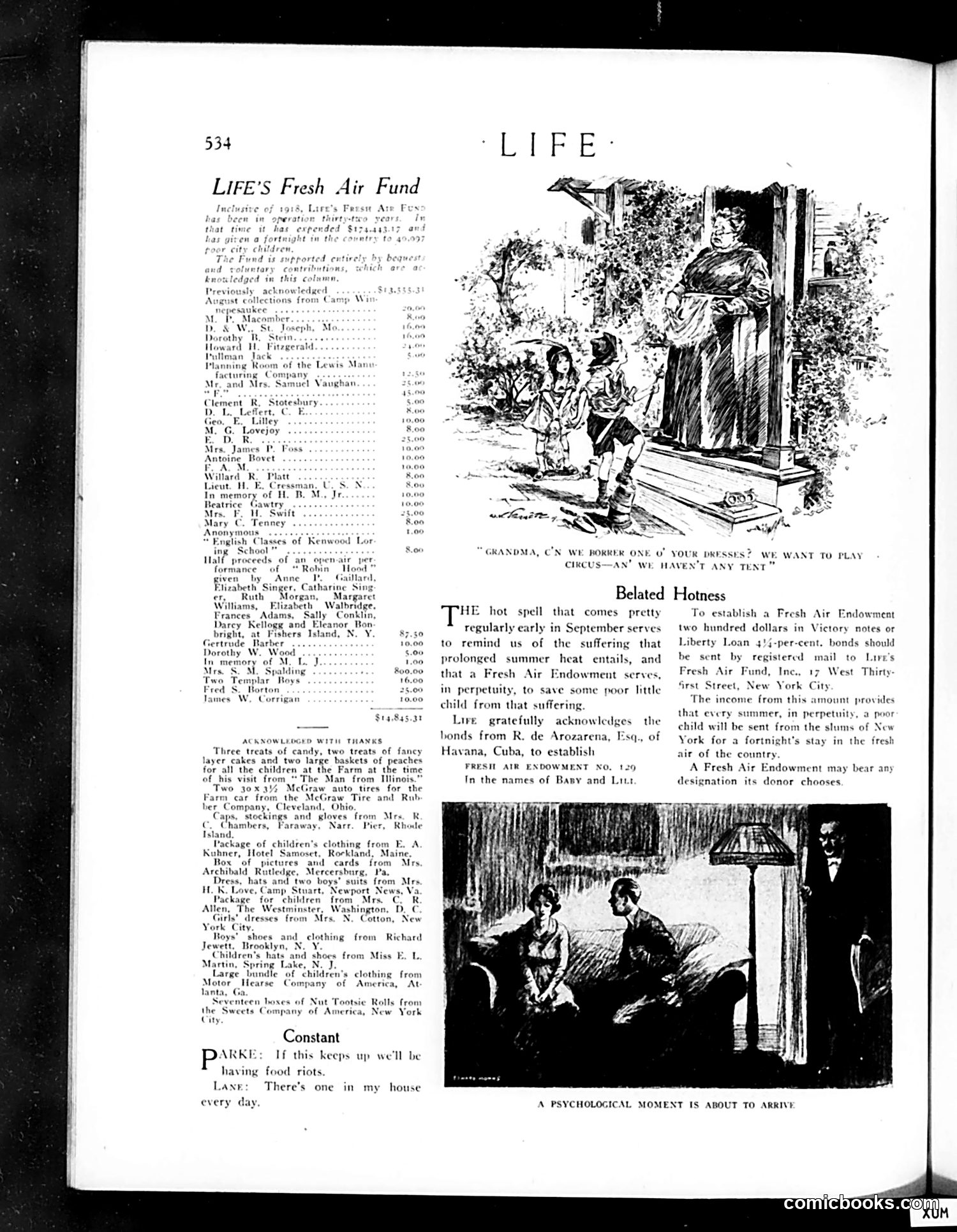
This page contains **two distinct sections**: **Left column:** A charitable fundraising list for "Life's Fresh Air Fund," documenting donations toward a children's fresh air endowment. The text indicates this was a real philanthropic effort to send poor urban children to the countryside for summer relief—a common Progressive Era charitable cause. **Right side:** Two illustrations accompany an article titled "Belated Hotness." The sketch shows children at a doorway, while the photograph below (captioned "A Psychological Moment Is About to Arrive") depicts what appears to be a domestic scene with two women and a man entering. The bottom includes a brief comedic dialogue between characters named "Parke" and "Lane" about food riots, suggesting satirical commentary on economic or social conditions of the era.
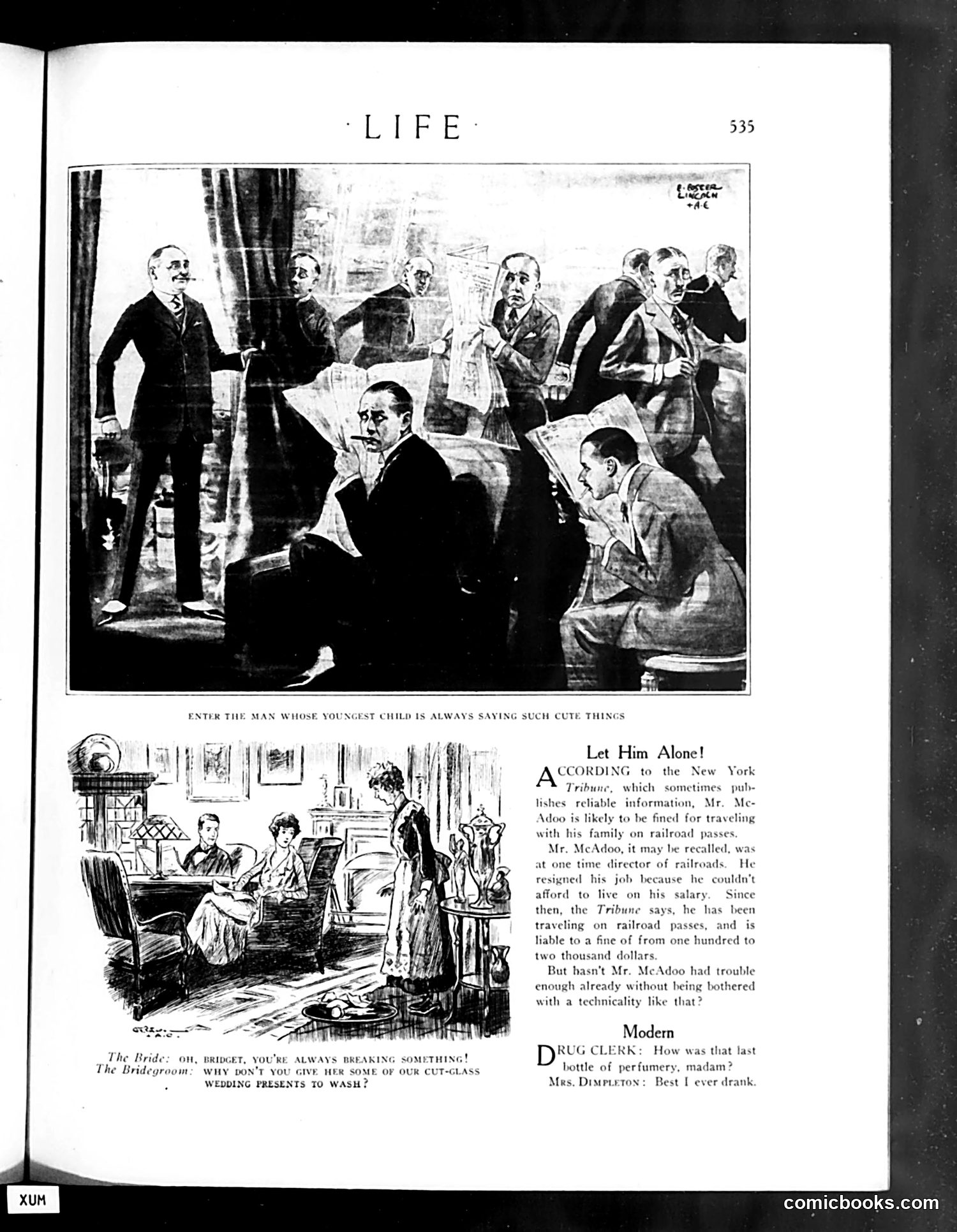
This page contains two separate satirical cartoons from Life magazine. **Top cartoon**: Shows a group of men in business attire in an office setting. The caption reads "ENTER THE MAN WHOSE YOUNGEST CHILD IS ALWAYS SAYING SUCH CUTE THINGS," satirizing a common social type—the father who constantly boasts about his children's precocious remarks, apparently annoying his colleagues. **Bottom cartoon**: Depicts a domestic scene with a bride and bridegroom. The caption has the bride saying she's "always breaking something," and the bridegroom asking why she doesn't get their wedding presents washed. This jokes about newlywed domestic expectations and the bride's clumsiness or carelessness with household items. Both are gentle social humor typical of Life's satirical approach to everyday American life and manners.
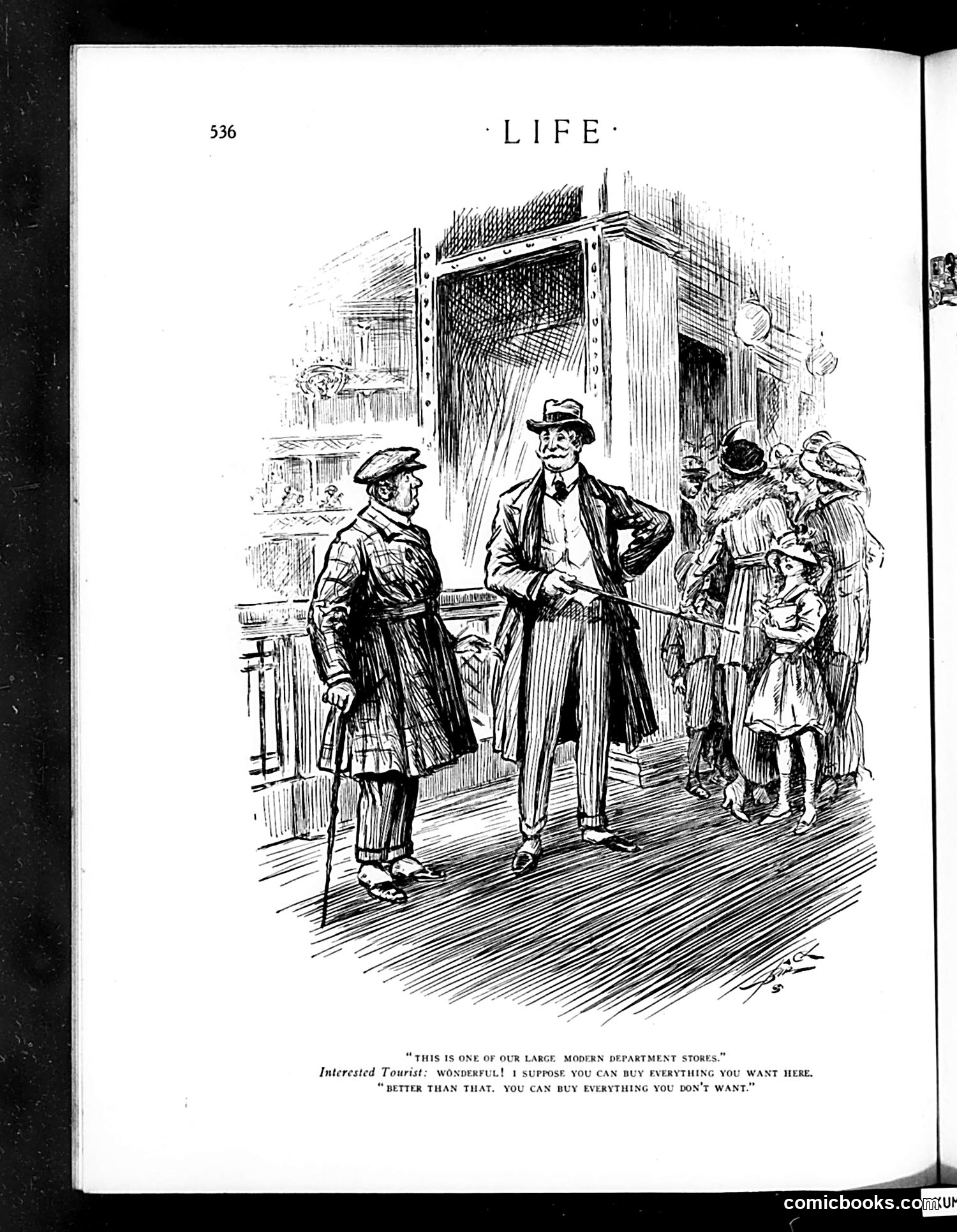
This is a satirical cartoon about department store shopping culture. A well-dressed man with a cane (likely a store owner or manager) addresses an interested tourist, saying their large modern department store stocks "everything you want here" — and better yet, "you can buy everything you don't want." The joke satirizes the aggressive consumerism and merchandising tactics of early 20th-century department stores. Rather than praising their selection, the cartoon mocks how these stores manipulate customers into purchasing unnecessary items through clever display and sales pressure. The tourist's enthusiasm contrasts with the owner's frank admission that the store's real talent lies not in meeting genuine needs, but in creating desire for unwanted goods — a critique of marketing manipulation that remains relevant today.
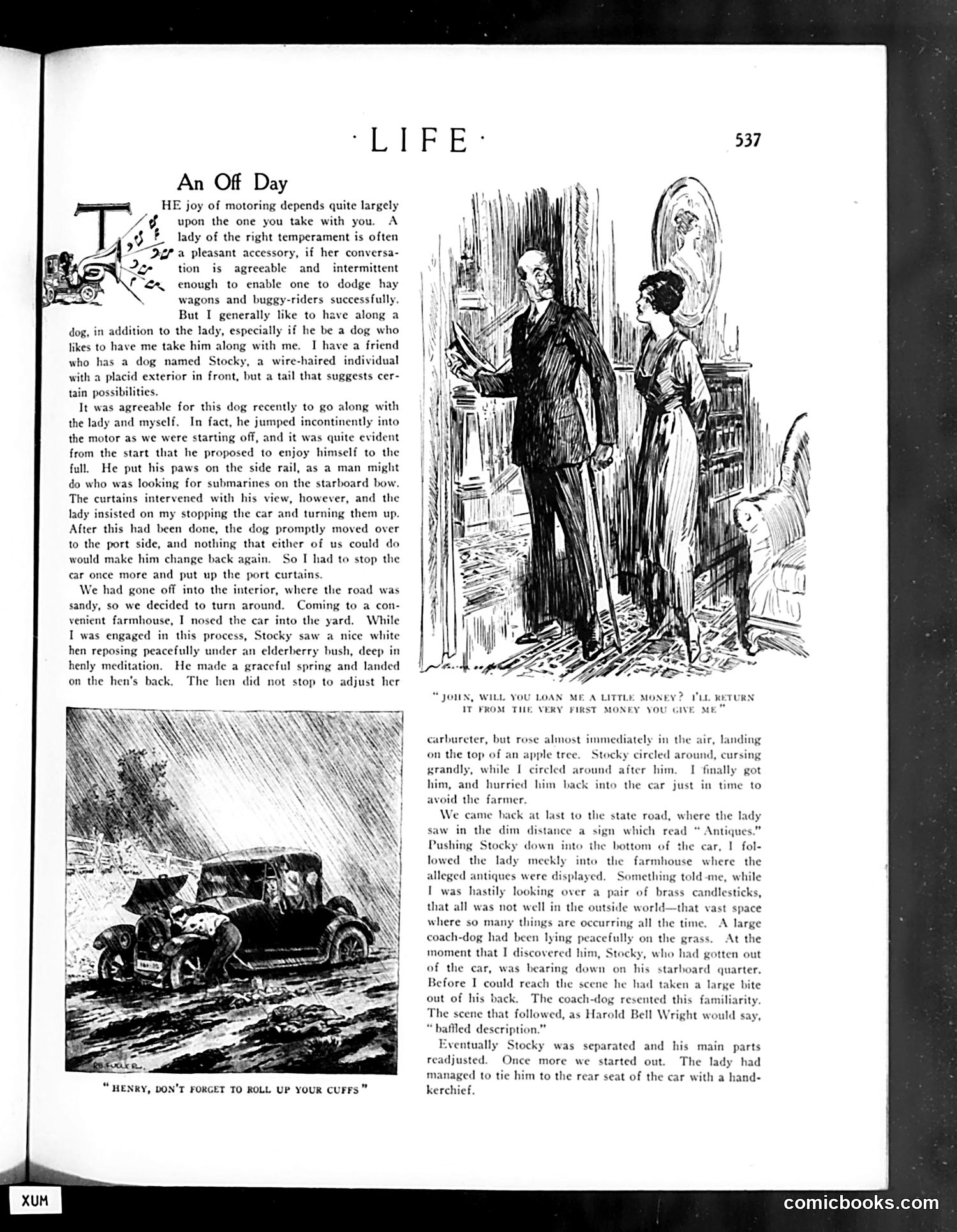
This is a humorous narrative about a motoring mishap. The story describes taking a dog named Stocky on a car ride that goes awry when the dog jumps out near a farmhouse. The two illustrations show: (1) a domestic scene where someone is showing the lady antiques inside a farmhouse, and (2) a car stuck in mud or damaged during rain. The satire targets early automobile culture—specifically the unpredictability of motor trips and the social awkwardness they create. The caption "Henry, don't forget to roll up your cuffs" adds gentle humor about the messy realities of motoring in this era. The joke ultimately mocks how a pleasant outing can quickly deteriorate into disaster, with the dog serving as the catalyst for the day's complications.
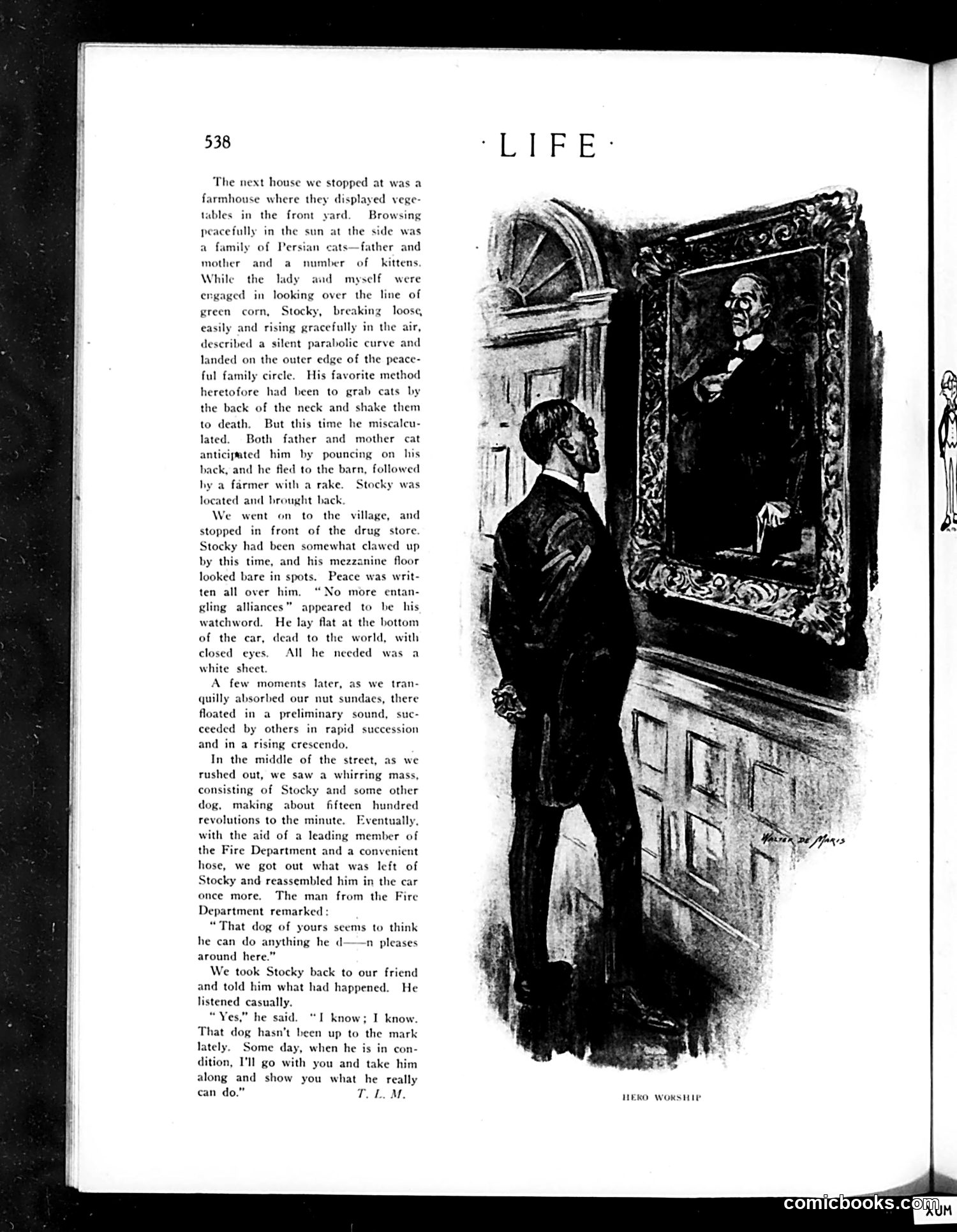
This illustration accompanies a humorous story about a dog named Stocky. The cartoon depicts a man in formal attire viewing what appears to be a portrait or mirror image of himself in an ornate frame. The caption "HERO WORSHIP" suggests ironic commentary on self-admiration or vanity. The accompanying text describes Stocky's misadventures—escaping a farmer, causing chaos in town, and being rescued by the Fire Department. The story culminates when the dog's owner casually remarks he'll eventually train Stocky to demonstrate his true capabilities, revealing the owner's overconfidence in his own abilities to control the unruly dog. The illustration likely satirizes this same self-deluding vanity, showing a man admiring an idealized version of himself while remaining oblivious to reality—much like Stocky's owner's misplaced confidence.
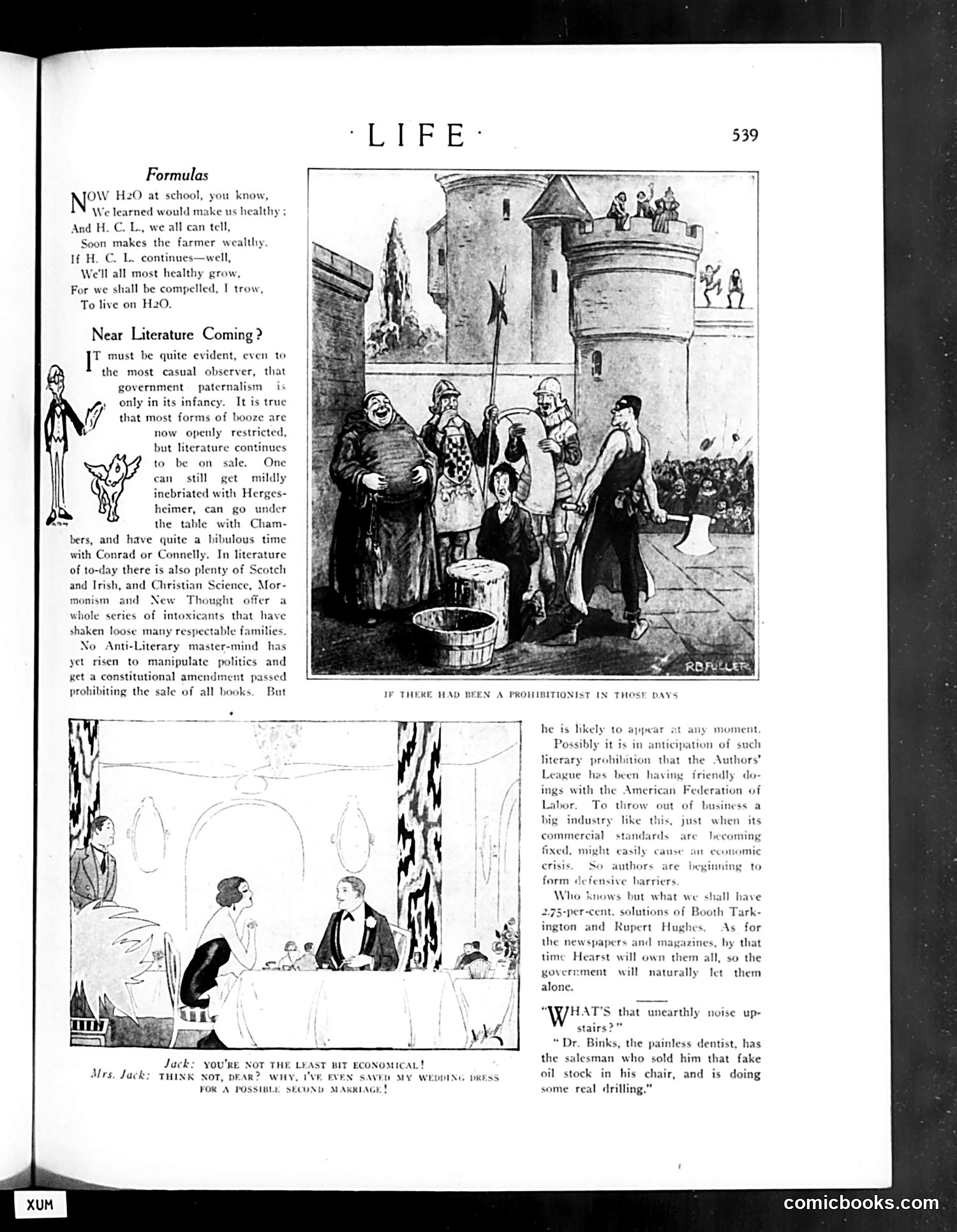
This page contains satirical commentary on literary censorship and Prohibition era America. **Top cartoon**: Depicts a medieval castle tower scene titled "If There Had Been a Prohibitionist in Those Days," mocking anti-alcohol crusaders by humorously suggesting they would have existed historically. The scene shows figures at a tower gate, likely referencing how prohibition advocates would have interfered with historical drinking customs. **"Formulas" poem**: Sarcastically critiques H₂O (water) promotion as a health solution, implying prohibitionists want to force water consumption instead of alcohol. **"Near Literature Coming?" section**: Discusses how literature and "intoxicants" continue despite restrictions. It notes authors are forming defensive organizations against censorship threats, specifically mentioning anticipated "275-per-cent solutions" from figures like Booth Tarkington and Rupert Hughes. **Bottom cartoon**: A domestic humor panel about marital economy and wedding dress savings.
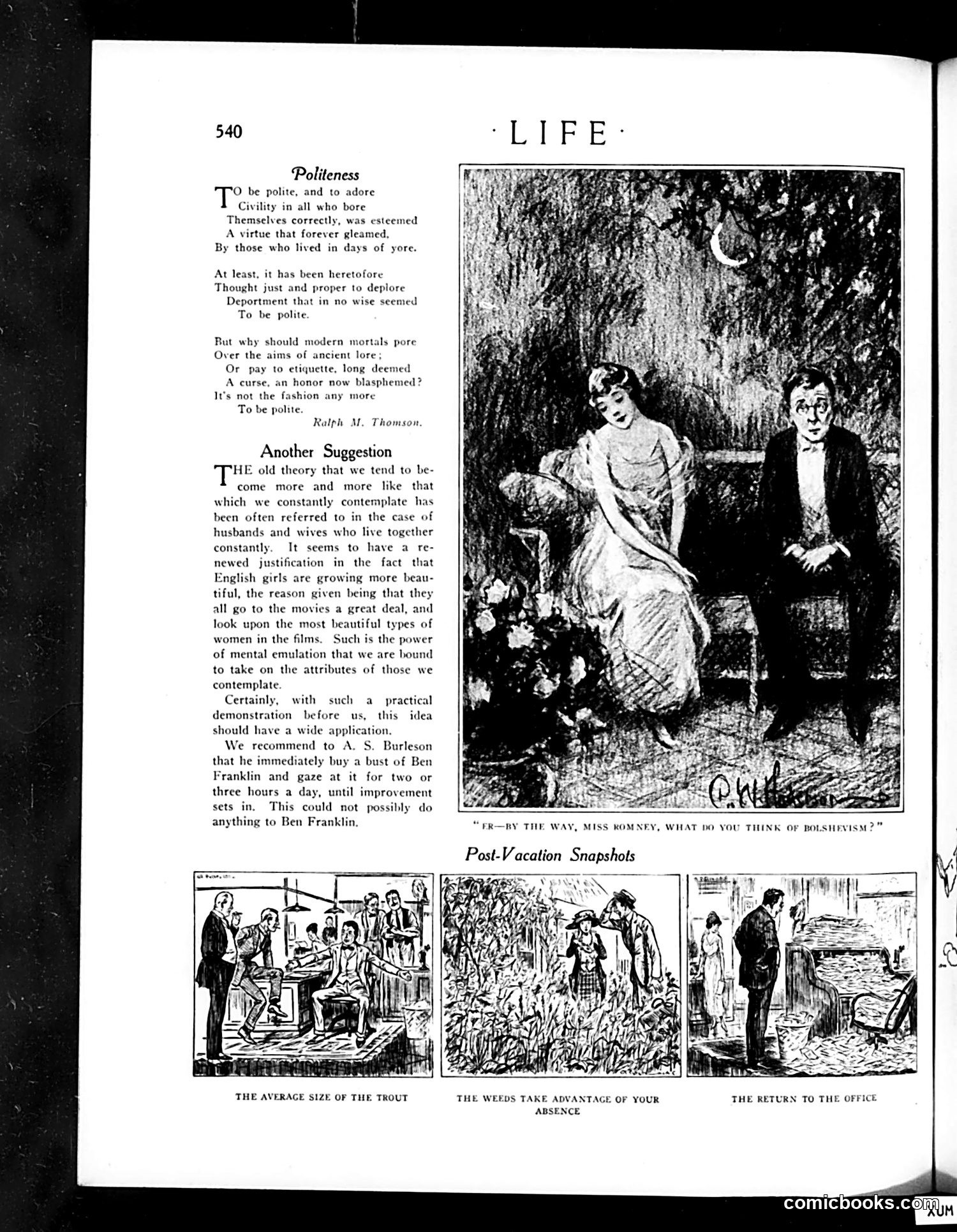
This page contains two distinct satirical pieces: **"Politeness"** (top left): An essay by Ralph M. Thomson lamenting that modern society has abandoned old-fashioned civility and etiquette as outdated, questioning why contemporary people disregard politeness that previous generations valued. **"Another Suggestion"** (middle left): Commentary suggesting that English girls' beauty makes them ideal wives, recommending people gaze at busts of Ben Franklin to appreciate similar qualities—a humorous non sequitur. **"Post-Vacation Snapshots"** (bottom): Three captioned cartoons depicting common vacation-return experiences: fishermen exaggerating trout size, weeds overgrown during absence, and office work piled up. These are gentle, relatable humor about everyday life rather than political satire. The page reflects early 20th-century concerns about manners and leisure culture.
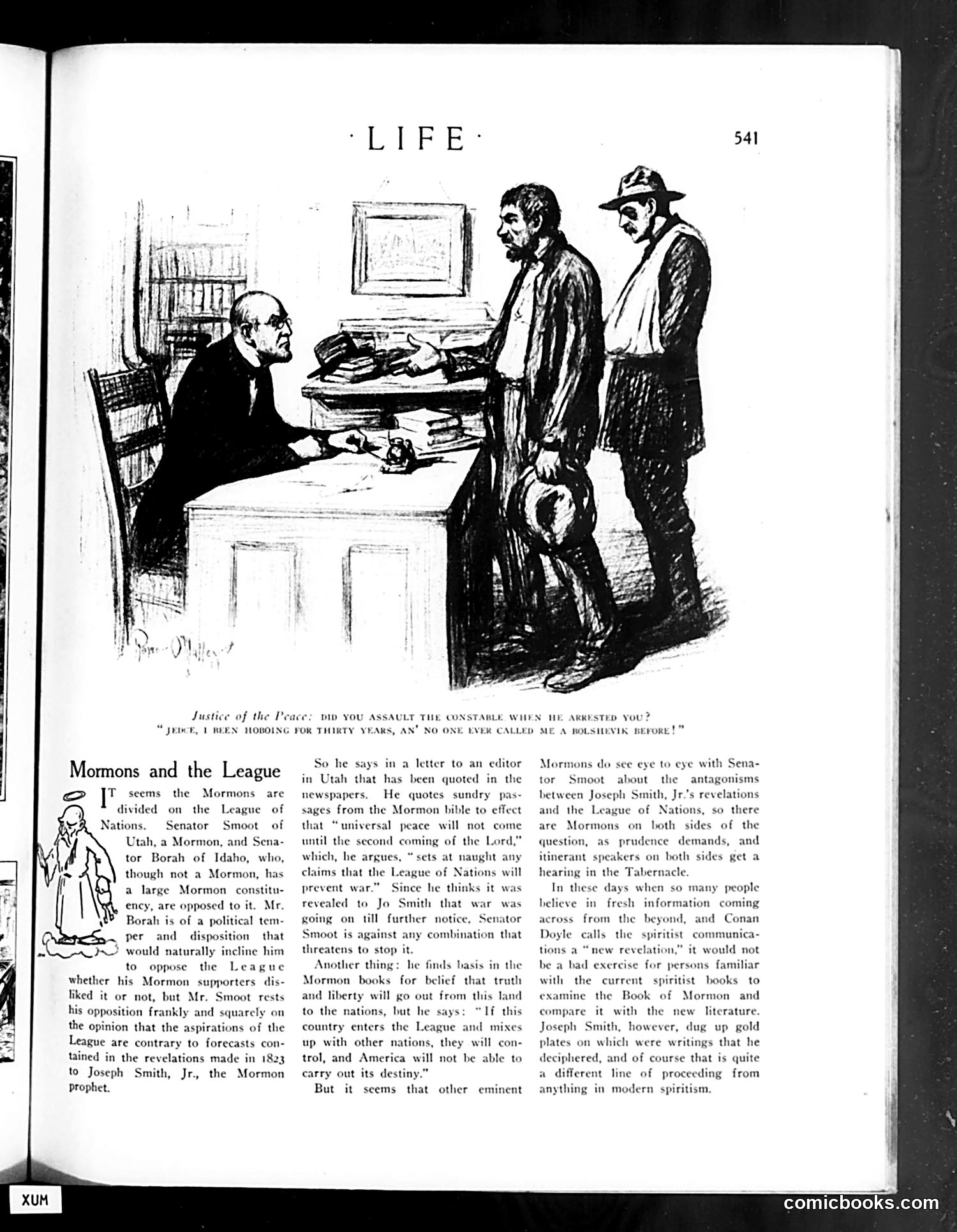
This page satirizes Senator Reed Smoot of Utah, a Mormon politician opposing the League of Nations. The cartoon depicts a courtroom scene where a man seated at a desk (likely a judge or official) is being confronted by two visitors, one claiming thirty years of harboring a fugitive without reporting it. The accompanying article critiques Smoot's opposition to the League, which he believes conflicts with Mormon prophecies about America's role. The satire suggests hypocrisy: Smoot demands strict enforcement of law regarding the League while Mormon teachings allegedly harbor unorthodox views about government and prophecy. The cartoon's caption plays on this tension between legal obligation and sectarian belief.
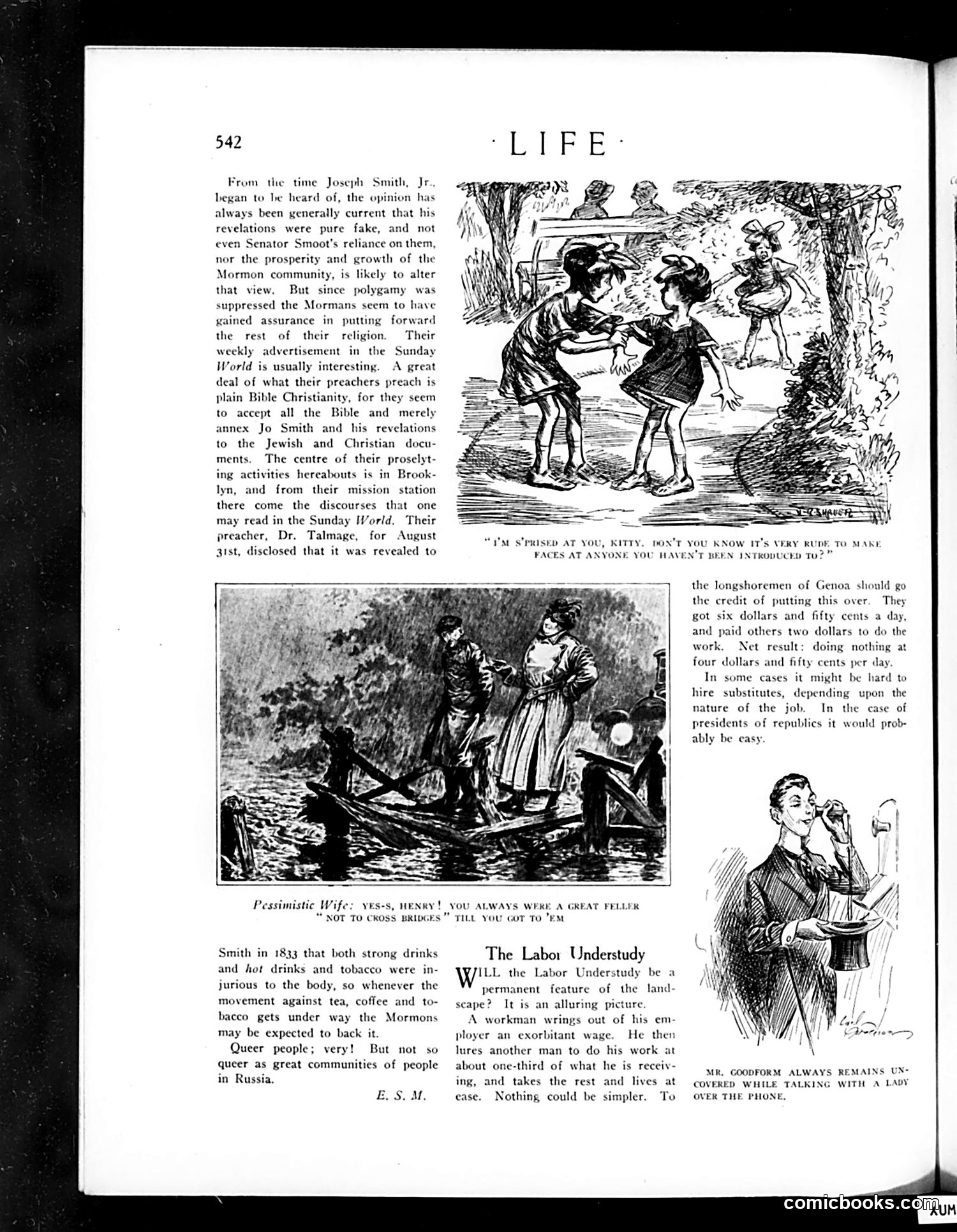
This page critiques two contemporary issues through text and cartoons. **The Mormon content** discusses Joseph Smith Jr. and the Mormon church's Brooklyn missionary activities. The article dismisses Smith's "revelations" as fake while noting that since polygamy was suppressed, Mormons have gained respectability. It sarcastically compares them to "queer people" in Russia, suggesting American Mormons, while unusual, aren't uniquely strange. **"The Labor Understudy"** satirizes a labor scheme where workers demand high wages, then hire substitutes at one-third the pay and pocket the difference—doing no actual work themselves. The article cites Genoa longshoremen as practitioners, earning $6.50/day while paying substitutes $2, netting $4.50 for zero labor. The satire suggests this arrangement is absurdly simple yet exposes worker exploitation and wage arbitrage. The cartoon vignettes provide social humor: a child's rudeness, marital banter about avoiding bridges, and a man's etiquette about phone calls with ladies—unrelated to the main text.
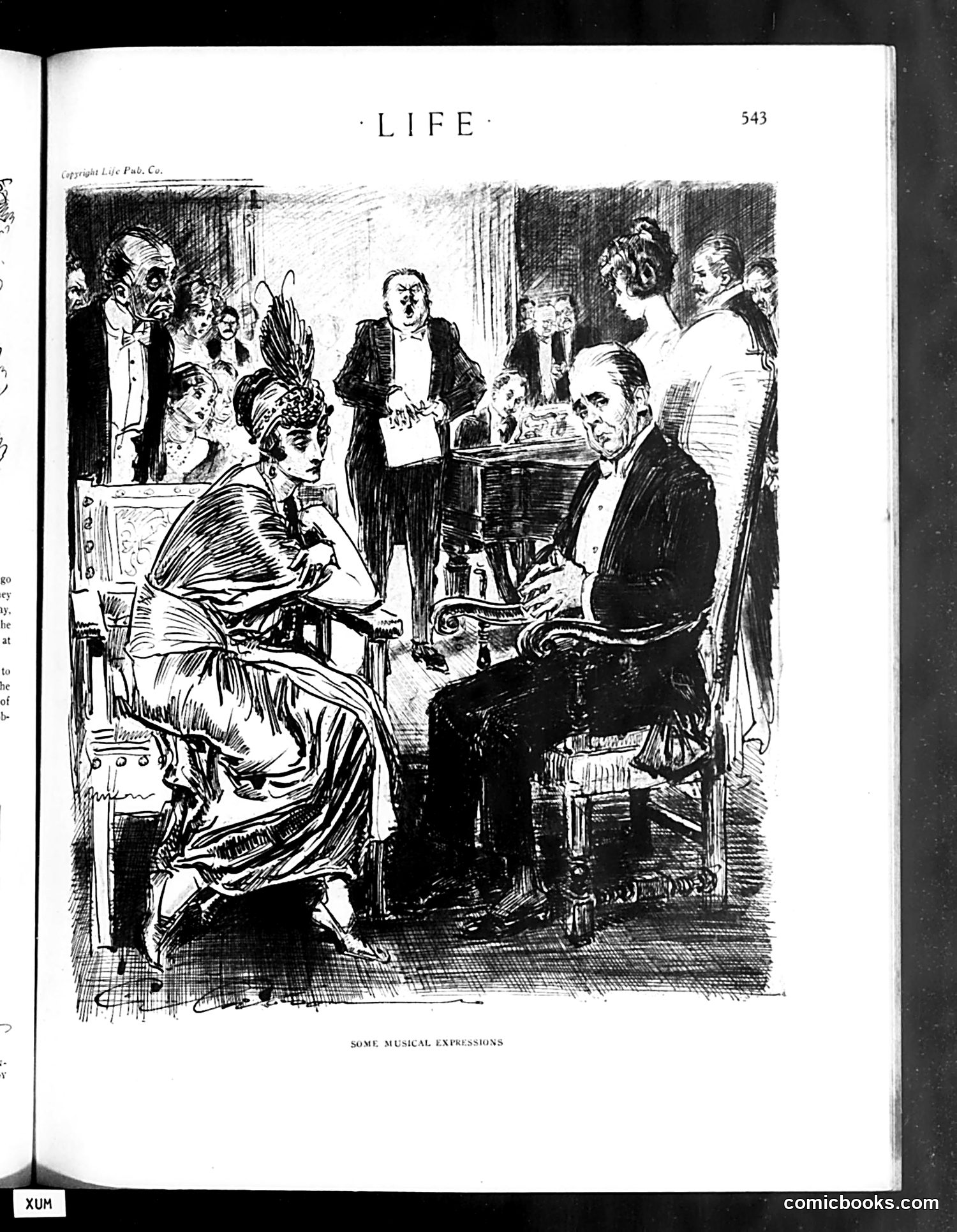
This satirical cartoon depicts a formal social gathering where a woman sits at a piano while well-dressed attendees listen. The title "Some Musical Expressions" suggests commentary on amateur musical performances at high-society events. The satire likely mocks the predictable, exaggerated facial expressions that accompany amateur piano recitals—both from the performer (appearing intensely focused or strained) and from the audience members (showing forced appreciation or barely concealed boredom). The gathered guests display varying degrees of attention, capturing the social performance aspect of such events. This represents *Life* magazine's typical early 20th-century humor: gently ridiculing upper-class social conventions and the pretension surrounding "culture" and artistic refinement in polite society.
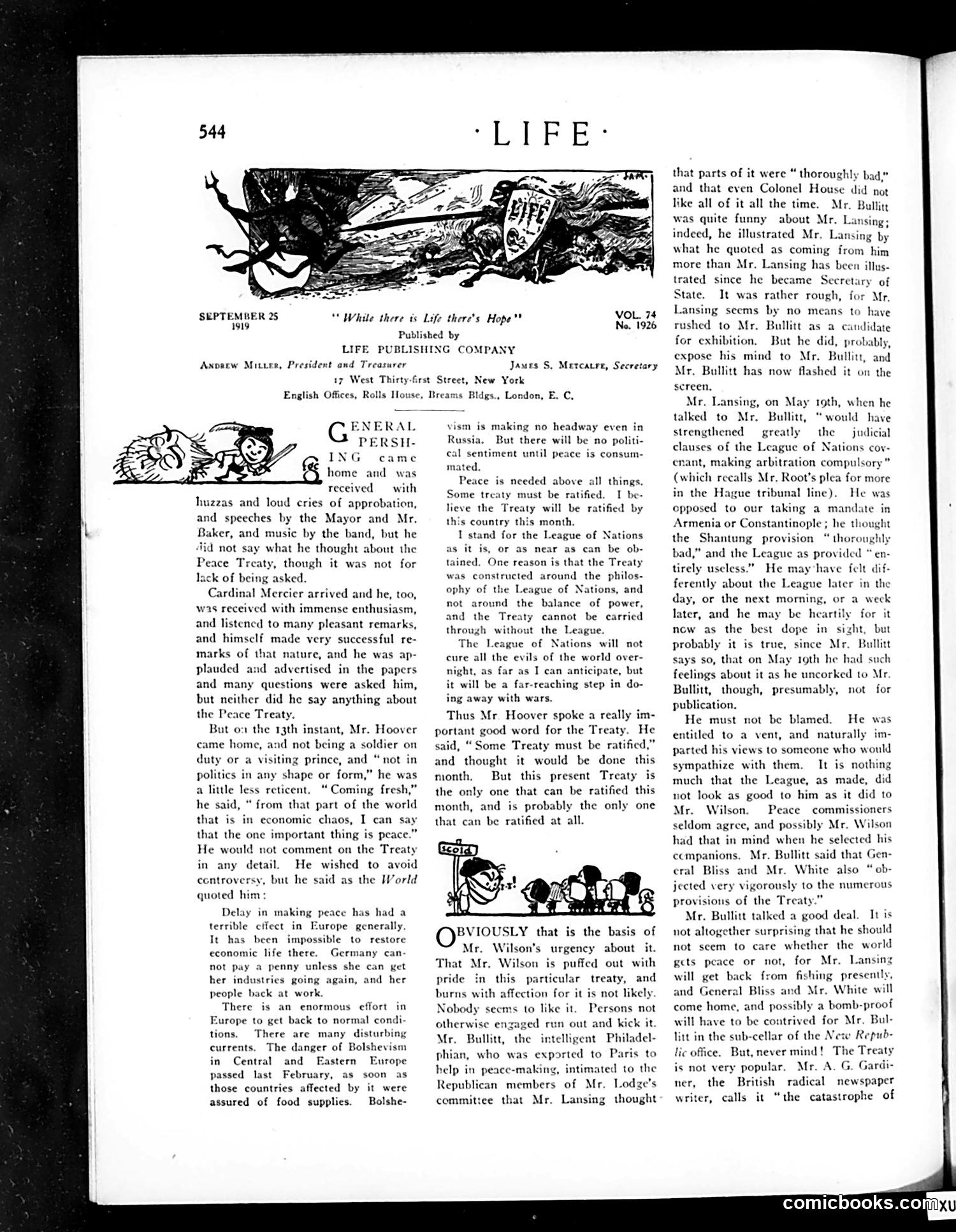
This Life magazine page discusses the Treaty of Versailles ratification debate following World War I. The article highlights statements by Herbert Hoover, who recently returned from post-war Europe, advocating for the treaty's passage. Key figures mentioned include President Wilson (supporting the treaty), Secretary of State Lansing (allegedly critical of it), and William Bullitt (a diplomat who exposed internal dissent to Republican senators). The text notes that various dignitaries—including the Mayor and Cardinal Mercier—visited but avoided public commentary on the controversial treaty. Hoover's cautious endorsement emphasizes the League of Nations as essential to post-war stability and economic recovery, particularly preventing Bolshevism in Europe. The satire targets Wilson's apparent pride in the treaty despite widespread elite disapproval, and Bullitt's role in embarrassing the administration by revealing Secretary Lansing's private doubts to political opponents. The cartoon (partially visible) likely mocks the treaty negotiations or their consequences.
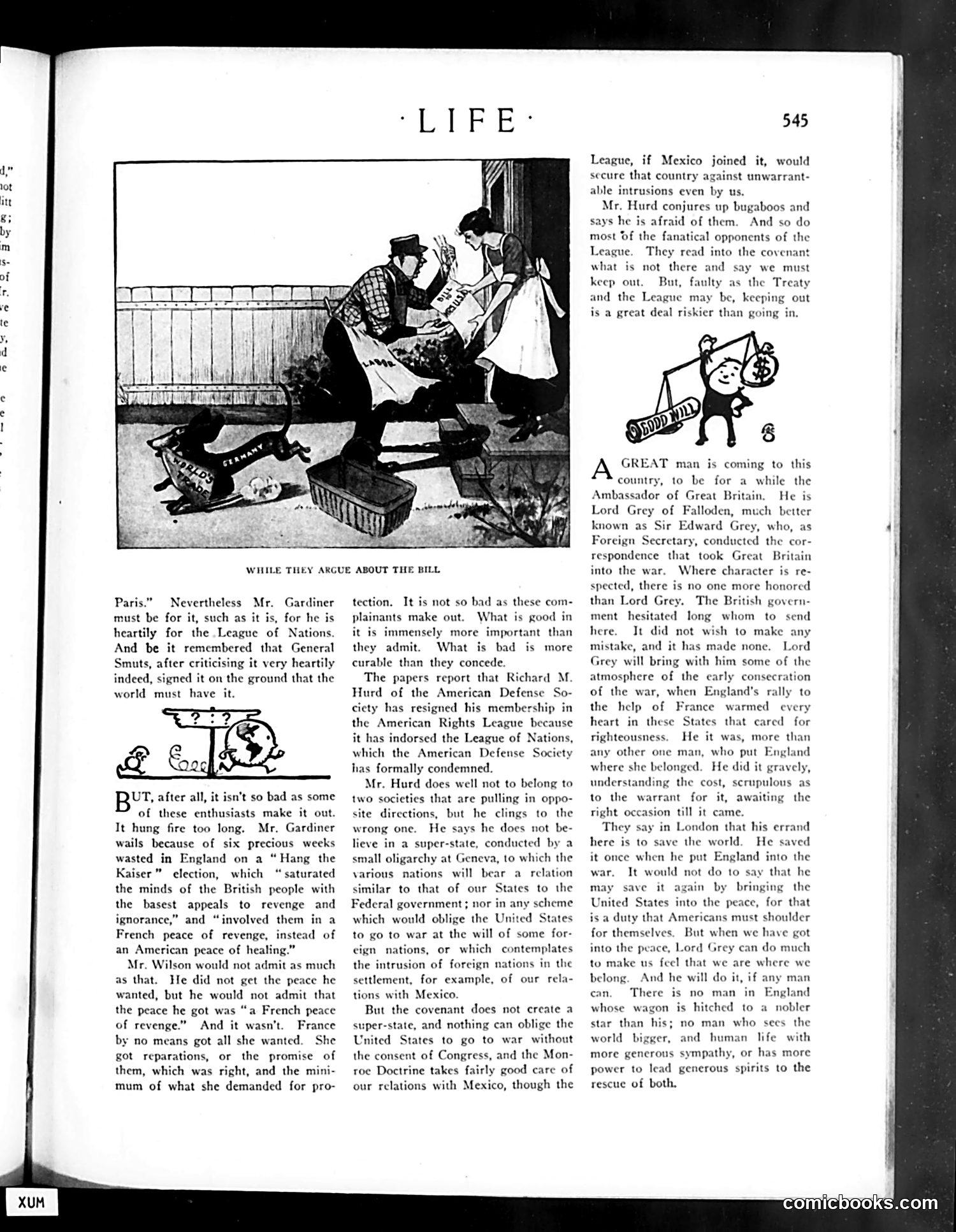
The main cartoon shows figures arguing over documents labeled "the bill" — likely the League of Nations Covenant being debated in post-WWI Britain and America. The visual joke depicts politicians squabbling while practical matters pile up neglected around them (baskets, household items). The text discusses divisions over the League of Nations: Richard M. Hurd resigned from the American Rights League because it endorsed the League, which the American Defense Society opposed. Hurd feared the League would create a "super-state" at Geneva and drag America into foreign wars without Congressional consent. The article's stance is pro-League, dismissing Hurd's fears as "bugaboos" — exaggerated threats. It argues the Monroe Doctrine adequately protects American interests, and that rejecting the League is "riskier than going in." The final section announces Lord Grey's arrival as British Ambassador, praising his character and his role bringing Britain into WWI to aid France — positioned as moral leadership rather than war-mongering. This reflects 1920 isolationist-versus-internationalist debates.
This page is largely illegible due to image quality and contrast. The main visible elements are: - A dark, heavily textured photograph or illustration occupying most of the page - White margins and binding visible on the left - Text at the bottom reading "If Mother Nature Suld" (incomplete, appears cut off) - A reference mark "L E" in the upper right corner The image content itself is too obscured to identify specific figures, caricatures, or political references with confidence. Without clearer visibility of both the illustration and complete text, I cannot reliably explain what satire or social commentary this page contains. The partial caption suggests environmental or nature-related content, but this remains speculative without supporting visual evidence.
This page appears to be from Life magazine and contains a dark photograph or illustration with the partial caption "...ture Sould Go on Strike" visible at the bottom. The image itself is heavily darkened and lacks clear detail, making it difficult to identify specific figures or caricatures with confidence. The caption fragment suggests the content concerns labor strikes, likely a commentary on labor disputes or industrial action that would have been timely when published. Without being able to discern the cartoon's specific figures, composition, or complete caption clearly, I cannot reliably explain what particular strike, industry, or political figures are being satirized. The poor image quality prevents identifying the intended joke or satirical point with the accuracy this analysis requires.
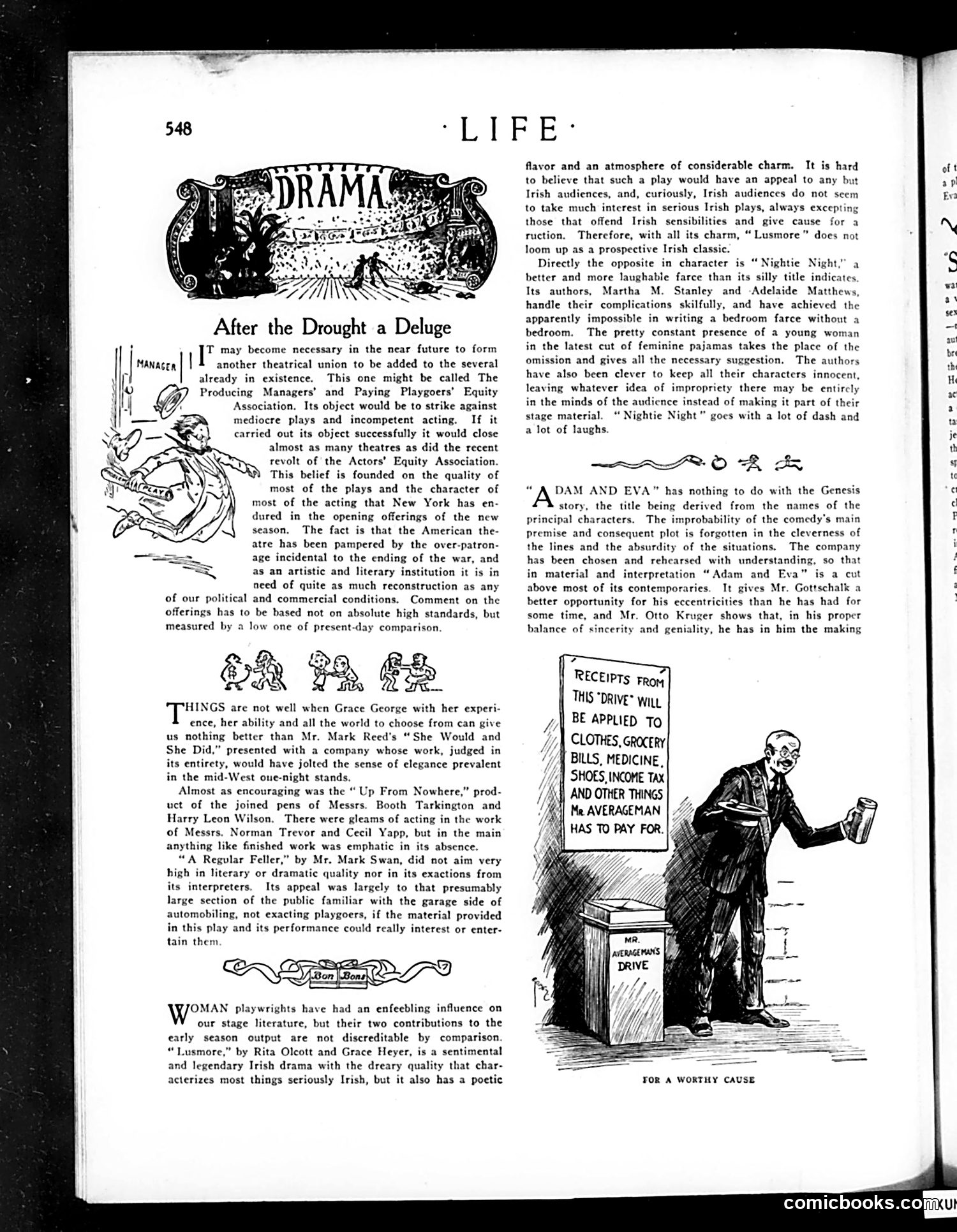
This is drama criticism, not political satire. The page reviews recent Broadway theatrical productions following the post-WWI boom that inflated mediocre work. The critic argues that American theatre needs a new "union" to strike against poor plays and acting—ironically noting this would close as many theatres as the recent Actors' Equity Association strike actually did. Specific reviews mention actress Grace George in "She Would and She Did" (dismissed as suitable only for "mid-West one-night stands"), and Booth Tarkington's "Up From Nowhere" as lacklustre despite some good acting. The small illustration shows a man collecting charitable donations ("Drive") for paying bills—likely commenting on theatre's economic struggles post-war. The page criticizes women playwrights' work while acknowledging slight improvements: "Lusmore" (Irish drama) and "Nightie Night" (farce). The tone reflects elitist standards about theatrical quality declining due to wartime audience expansion.
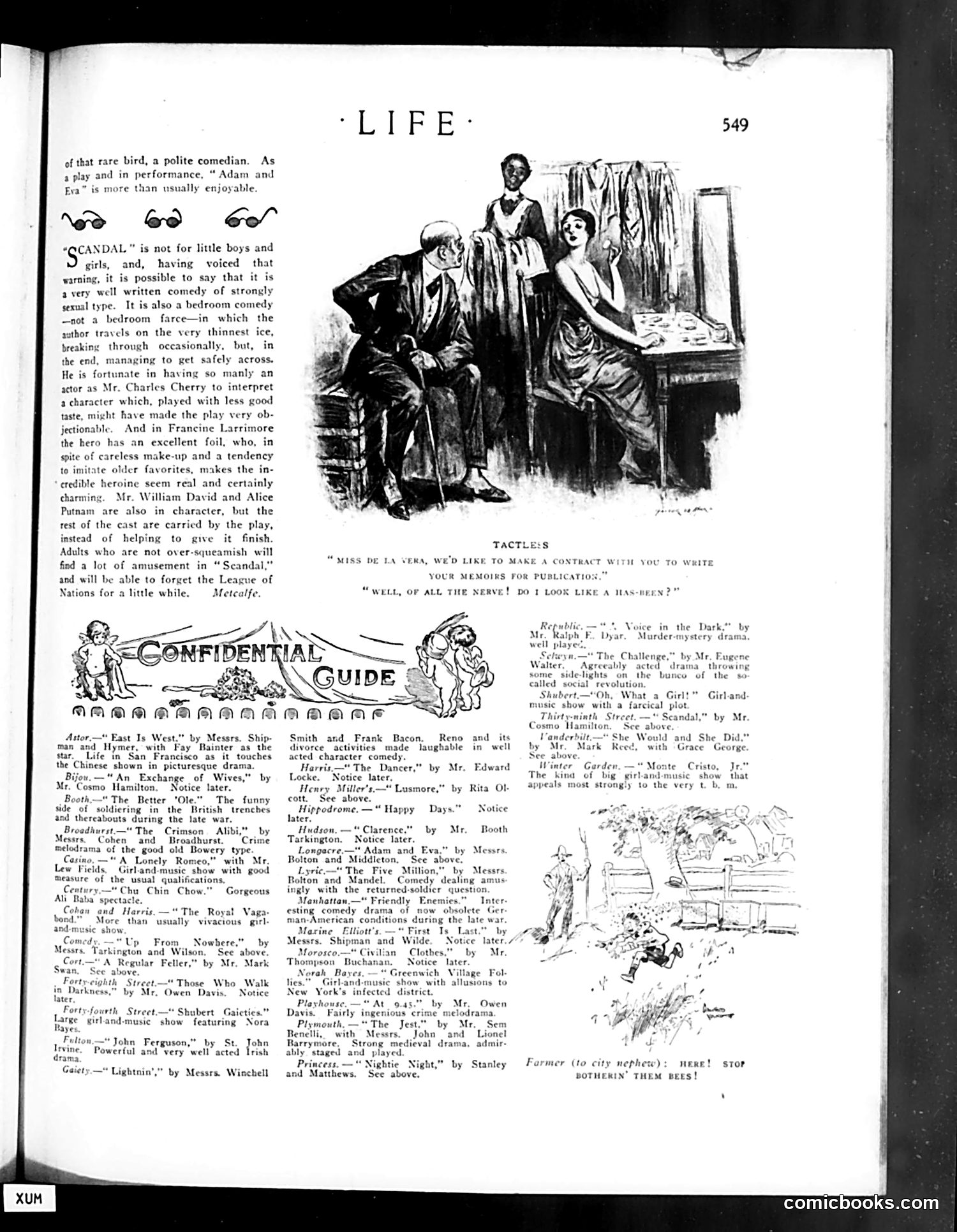
This page from *Life* magazine features theatre reviews and a satirical cartoon about theatrical life. The main illustration depicts a scene titled "TACTICS," showing a woman being propositioned by what appears to be a theatrical producer or publisher who says, "Miss de la Vera, we'd like to make a contract with you to write your memoirs for publication." Her indignant response—"Well, of all the nerve! Do I look like a has-been?"—is the joke's punchline. The satire targets the theatre world's gossip culture and the exploitation of actresses. It mocks how theatrical figures eagerly seek to capitalize on actresses' private lives through sensational memoirs, implying this was a standard (and unwelcome) proposition. The woman's outrage at being asked suggests the practice was common enough to be instantly recognizable to *Life*'s readers as a humorous but cutting commentary on show business opportunism. The surrounding text reviews contemporary Broadway productions, including "Adam and Eva" and "Scandal."
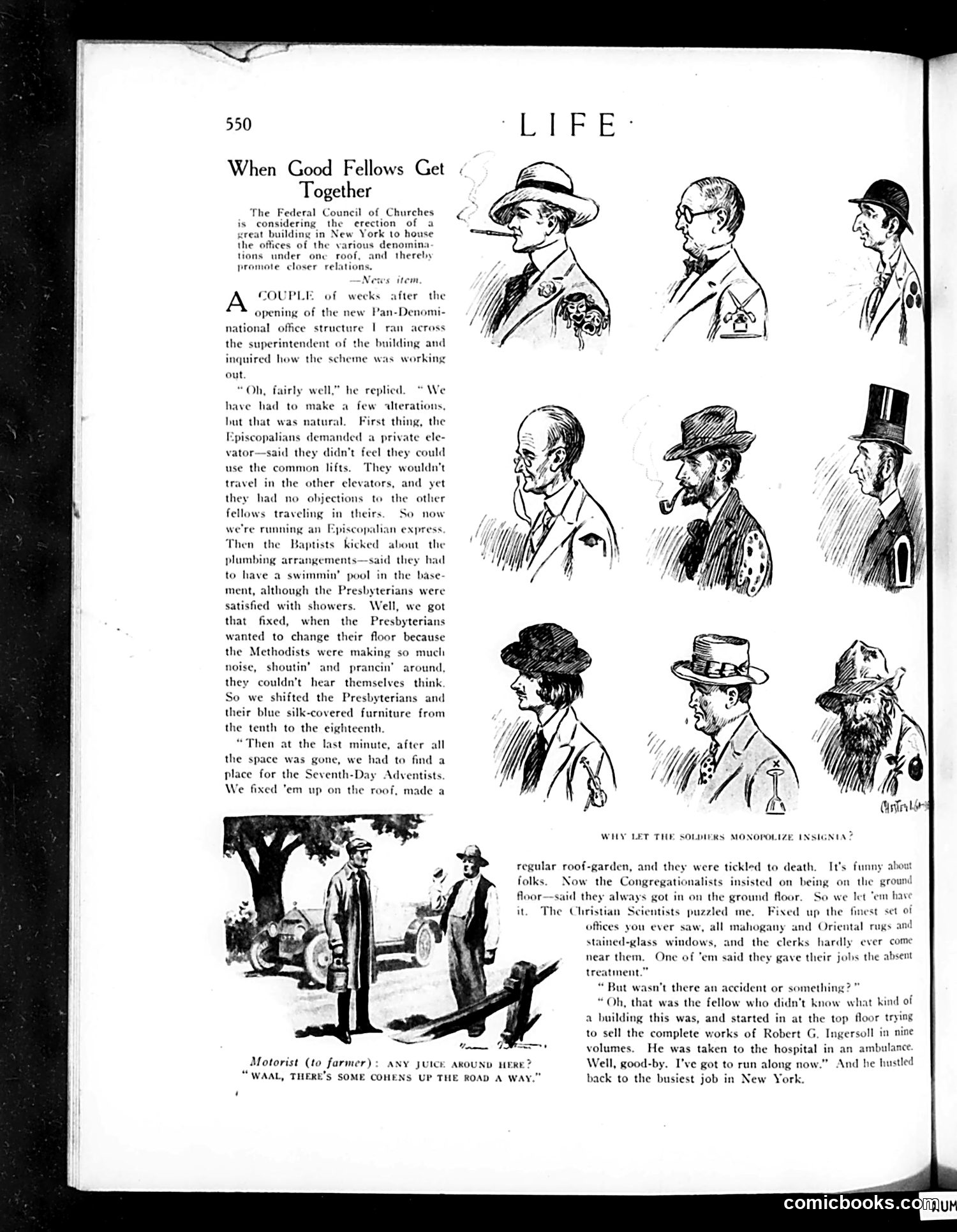
This satirical article mocks the Federal Council of Churches' plan for a Pan-Denominational office building in New York. The humor targets religious denominations' perceived incompatibility and pretensions. The superintendent recounts absurd accommodations required: Episcopalians demand a private elevator (suggesting class consciousness); Baptists need a swimming pool in the basement (caricaturing their baptism practices); Presbyterians relocate due to noisy Methodists (implying behavioral differences); Seventh-Day Adventists settle on the roof (marginalizing them). Congregationalists insist on ground-floor offices, while Christian Scientists get fancy offices they ignore (mocking their philosophy of spiritual healing). The joke: despite promoting "closer relations," each denomination's peculiar demands and incompatibilities make cohabitation nearly impossible. The satirical point is that doctrinal and cultural differences make interfaith cooperation fundamentally impractical, no matter the building's architecture.
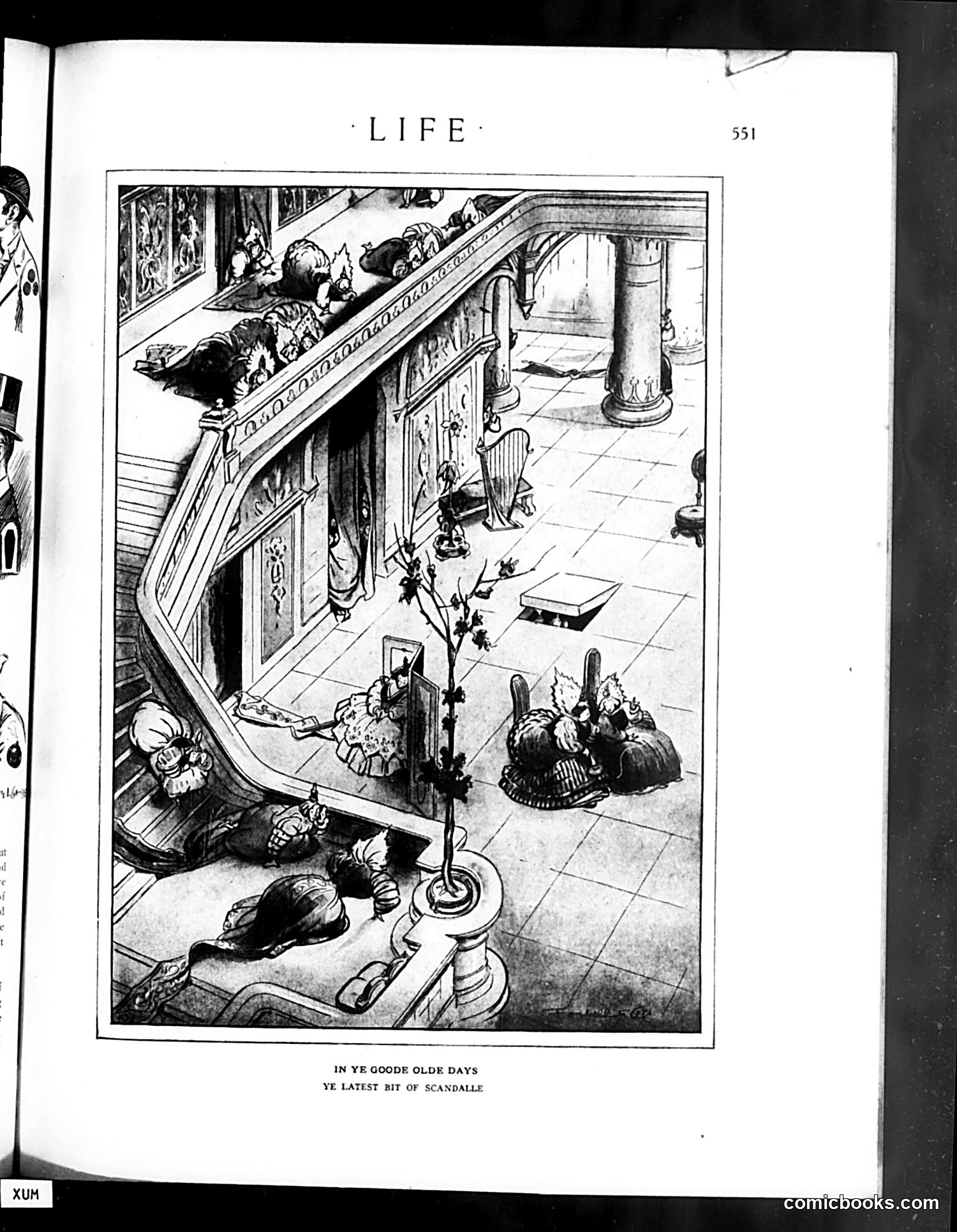
This satirical illustration depicts a fancy hotel or public building lobby, showing elegantly dressed people engaged in gossip and scandal-mongering. The caption "In Ye Goode Olde Days / Ye Latest Bit of Scandalle" uses mock-archaic language to joke about timeless human behavior. The satire suggests that despite pretensions to refinement and propriety, wealthy society folk are fundamentally driven by scandal and gossip—a vice that hasn't changed since "olde days." The ornate architecture and formal dress contrast with the petty, gossipy activity occurring within, mocking the gap between the appearance of sophistication and actual conduct. The detailed interior illustration—featuring a grand staircase, columns, and fashionably dressed figures in animated conversation—emphasizes how scandal permeates supposedly "proper" society spaces.
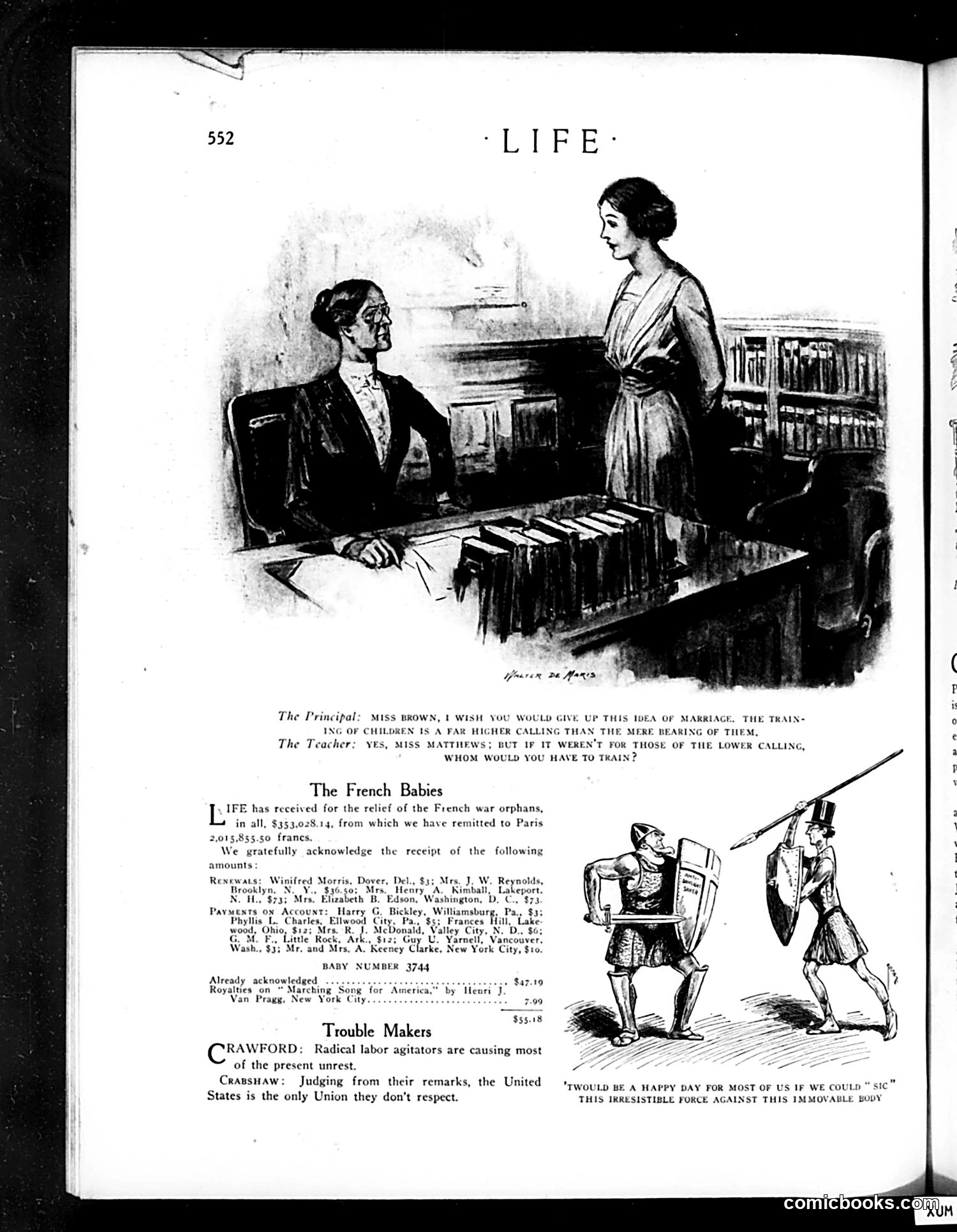
**Top Cartoon:** A school principal and teacher debate women's roles. The principal argues that training children is a "higher calling" than marriage, while the teacher counters that without women fulfilling the "lower calling" of bearing children, there would be no students to teach. This satirizes early 20th-century tensions between feminism and traditional domesticity—mocking the condescension toward motherhood while exposing the logical contradiction in viewing child-rearing as simultaneously noble yet inferior. **"The French Babies" Section:** A fundraising notice acknowledging donations for French war orphans during WWI, listing contributors and amounts ($353,028.14 total collected). **"Trouble Makers" Cartoon:** Two men discuss labor unrest. One blames "radical labor agitators," the other jokes that unions are the only institution these agitators disrespect. The caption suggests siccing this "irresistible force" against an "immovable body"—likely satirizing contemporary labor strikes and management conflicts, with dark humor about using one social problem to solve another.
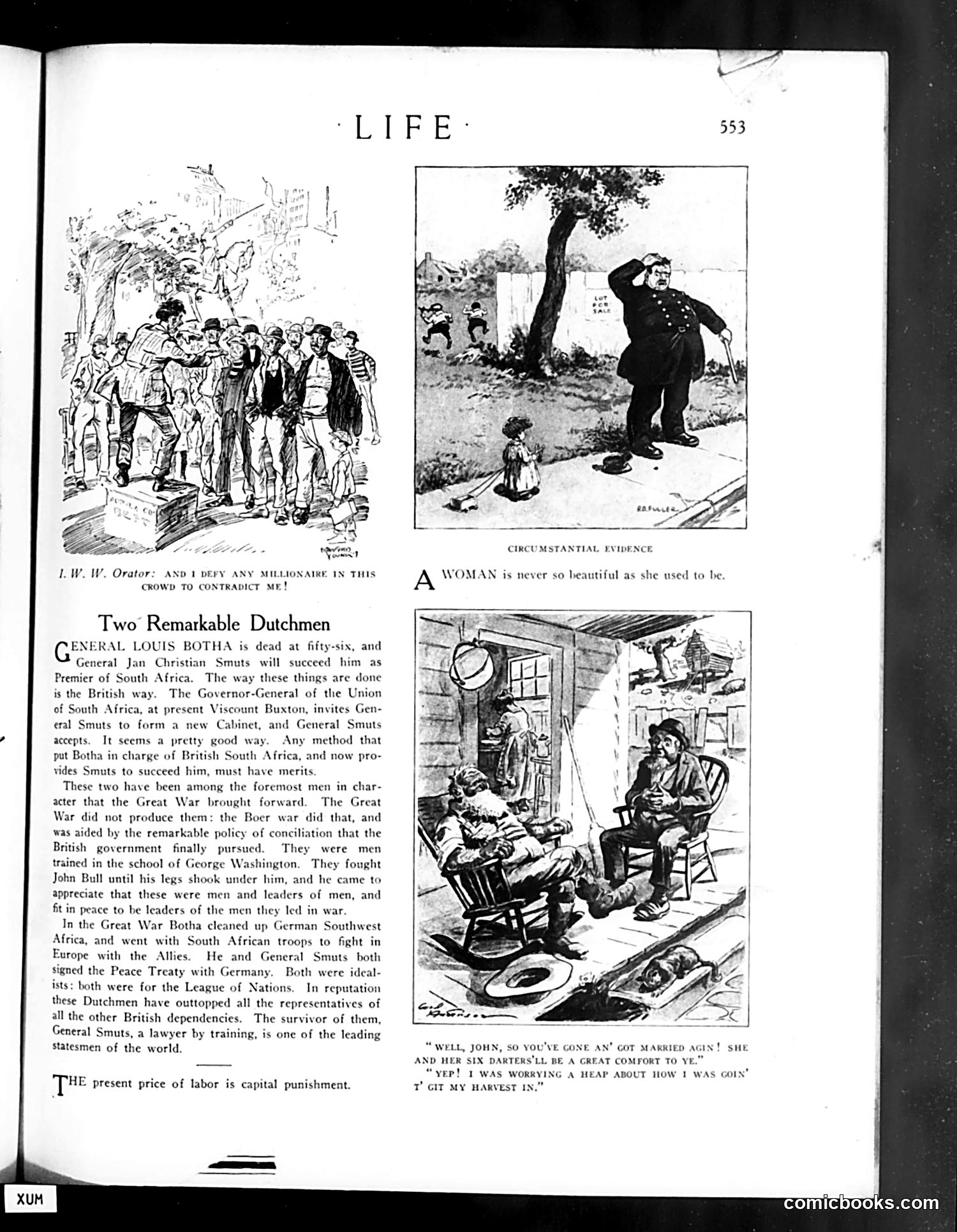
**Top cartoon**: An IWW (Industrial Workers of the World) orator addresses a crowd, boldly challenging any millionaire present to contradict him. This satirizes radical labor organizers of the early 20th century who made inflammatory speeches to workers. The joke mocks the orator's bravado—he's confident precisely *because* no actual millionaire would be in such a crowd. **Main article**: Praises two South African leaders—General Louis Botha (deceased) and his successor Jan Christian Smuts—as exceptional statesmen. The piece celebrates British colonial governance and notes both men fought against Britain in the Boer War but were later reconciled, making them ideal leaders for the post-WWI world. **Bottom cartoons**: Two domestic humor sketches. "Circumstantial Evidence" quips that women age. The final cartoon shows a rural man justifying remarriage: his new wife and her six daughters will help with harvest labor—reframing marriage as economic necessity rather than romance.
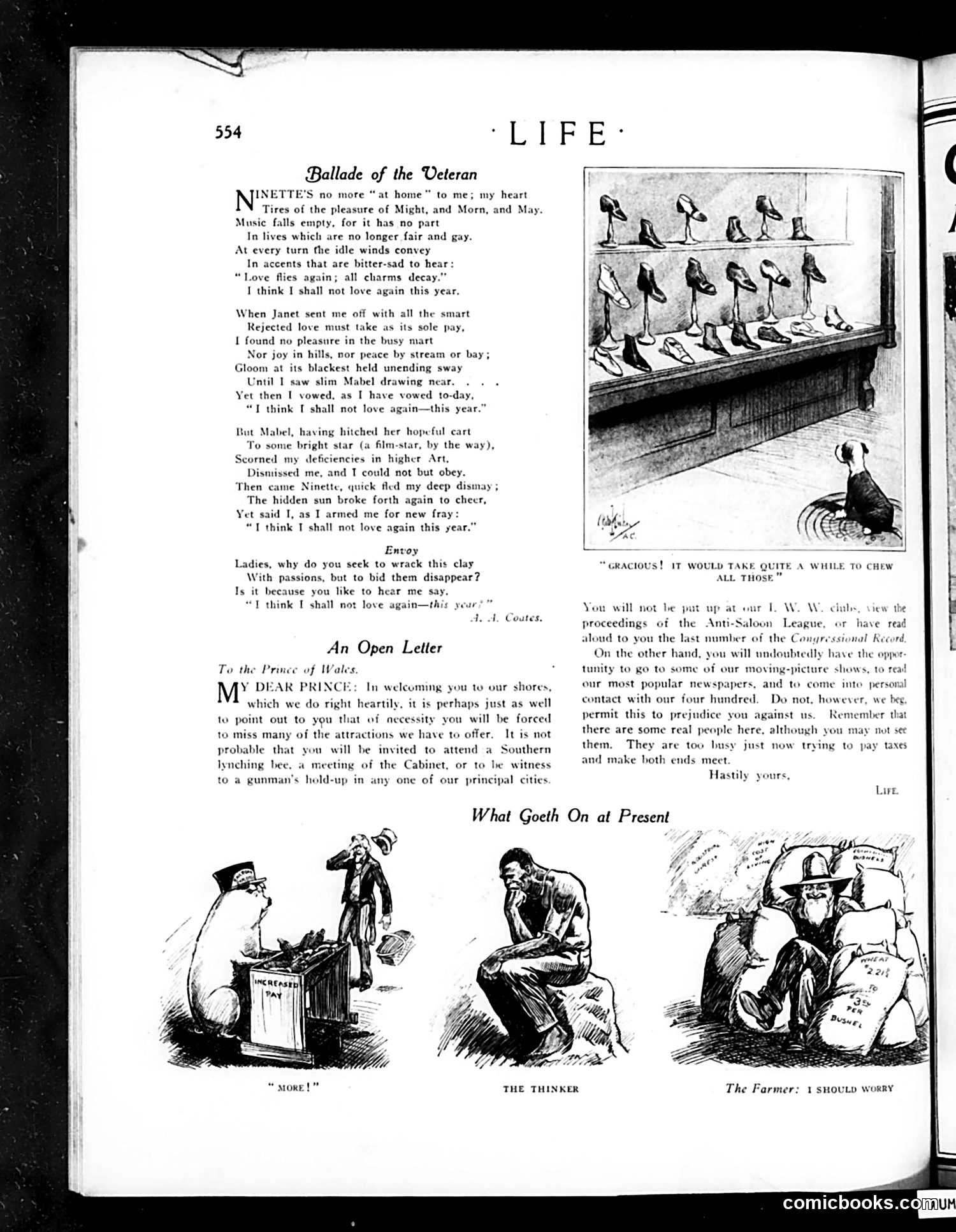
This page contains three distinct satirical pieces: **"Ballade of the Veteran"** is a poem about romantic disappointment. The speaker repeatedly vows not to love again "this year" after being rejected by successive women (Janet, Mabel, Ninette), each departure bringing new infatuation. The satire mocks male romantic fickleness and the cycle of rejection and rebound. **"An Open Letter to the Prince of Wales"** welcomes a royal visitor while sarcastically listing American "attractions" he'll be spared: lynchings, Cabinet meetings, gunman hold-ups, and Congressional proceedings. The joke targets American violence, political dysfunction, and social disorder as national embarrassments. It concludes by noting "real people" exist but are too busy paying taxes. **"What Goeth On at Present"** shows three cartoon vignettes addressing contemporary concerns: "More!" depicts inflation/scarcity, "The Thinker" suggests existential worry, and "The Farmer: I should worry" references agricultural distress—likely Depression-era anxieties about economic hardship affecting different social classes.
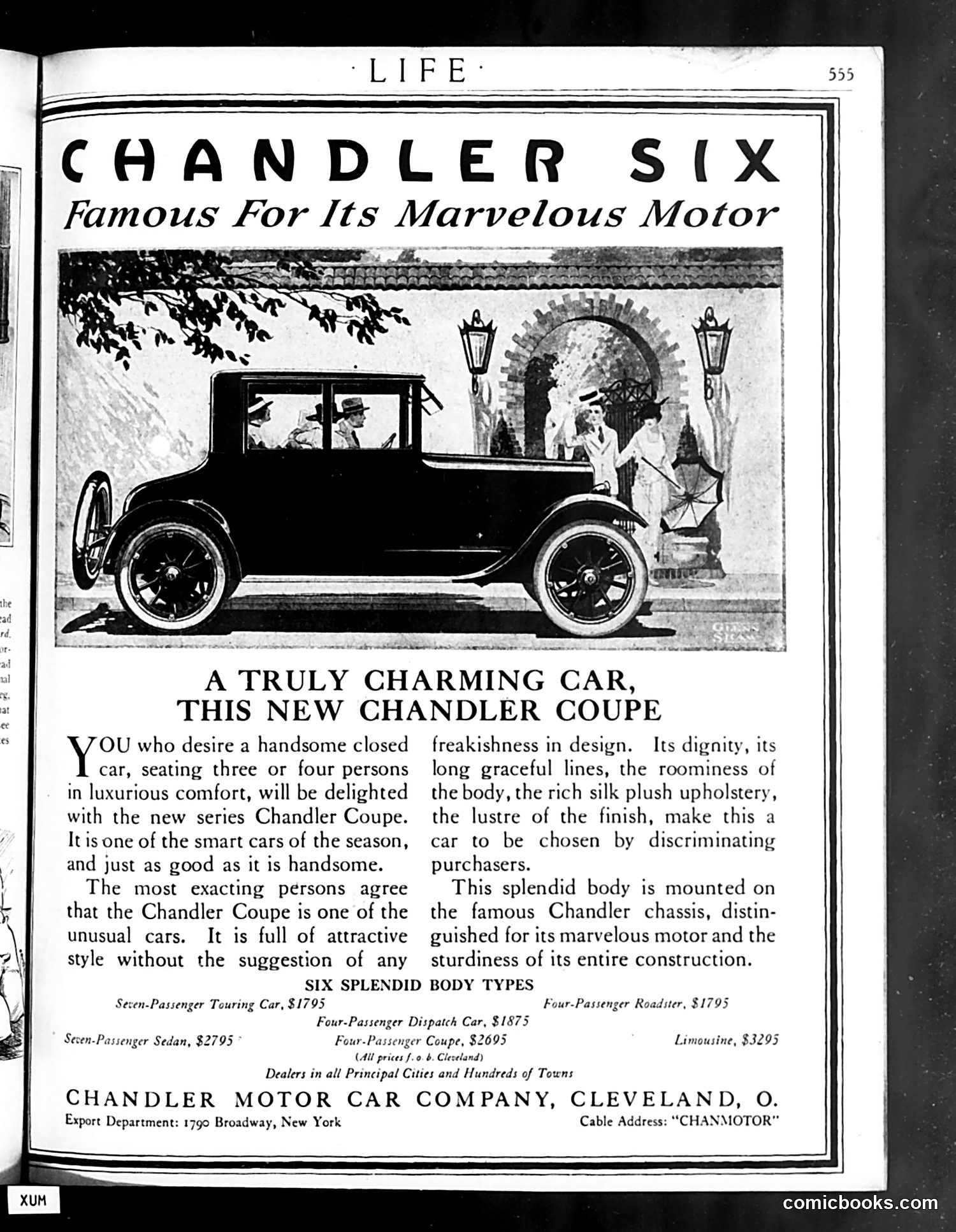
This is **not a cartoon or satire**—it's a straightforward automobile advertisement from Life magazine (page 555). The Chandler Motor Car Company is promoting its new "Six" coupe model. The image shows a luxury automobile of the 1910s-1920s era parked before an elegant archway with well-dressed passengers. The ad emphasizes qualities appealing to wealthy buyers: comfort, style, dignity, and fine materials like "silk plush upholstery." Six body types are listed at various prices ($1,795–$3,295), targeting discriminating purchasers. The company headquarters was in Cleveland, Ohio, with an export office in New York. **Context for modern readers**: This represents peak automobile marketing during the early automotive era, when cars were still luxury goods marketed to the affluent. The emphasis on craftsmanship and styling reflects pre-mass-production attitudes toward automobiles.
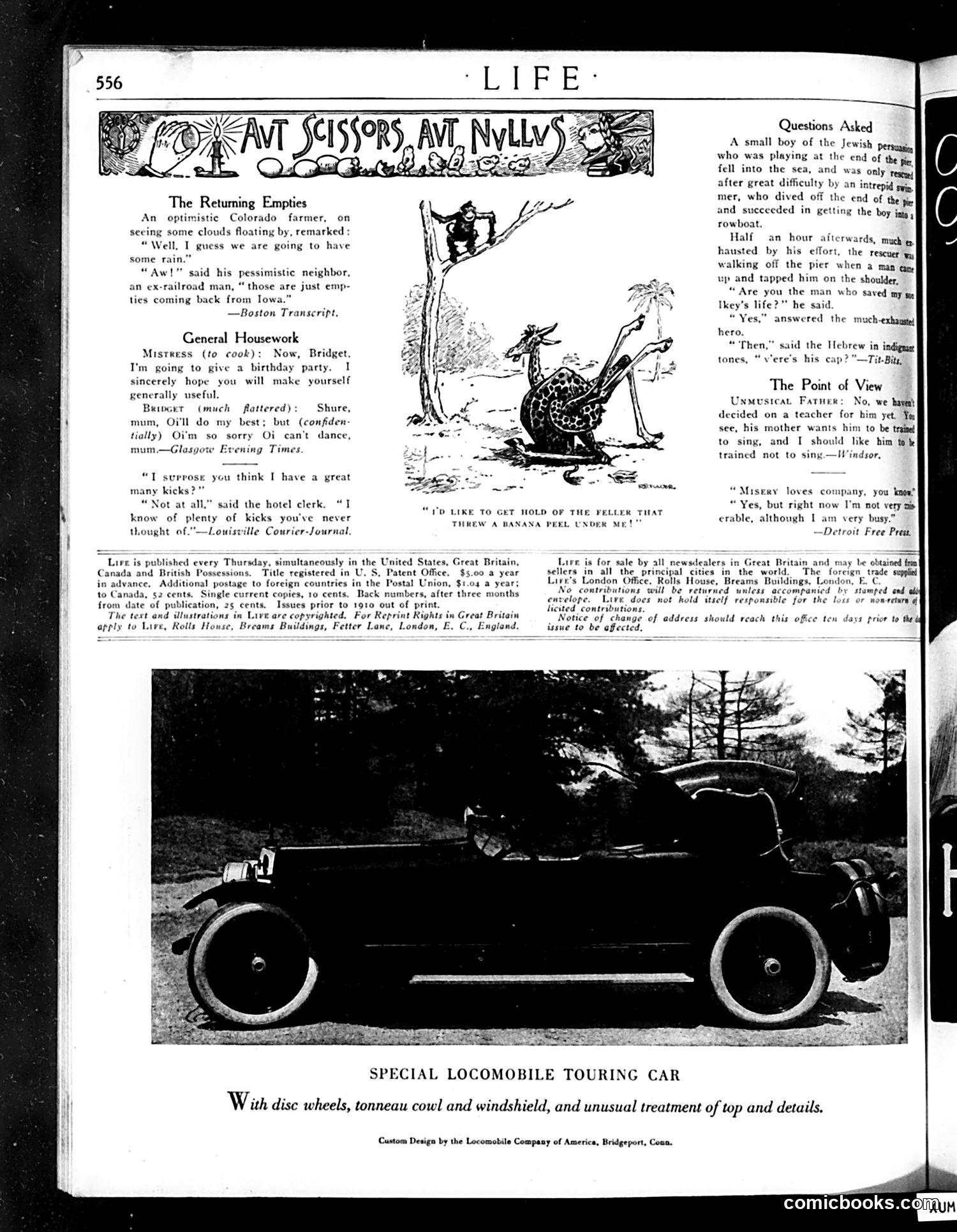
This page collects brief satirical jokes typical of Life magazine's format. The cartoons mock everyday American life: **"The Returning Empties"** jokes about Iowa's agricultural struggles—clouds are "empty" boxcars returning from failed crops, suggesting the state's farming crisis. **"General Housework"** features Irish immigrant domestic servant "Bridget," playing on period stereotypes of Irish maids as hardworking but uneducated. **The banana-peel cartoon** shows slapstick humor about urban mishaps—a common comedy trope of the era. **"Questions Asked"** includes ethnic humor about a Jewish boy rescued from drowning; the father's concern is only the lost cap, playing on period stereotypes about Jewish frugality. The page concludes with advertising for a **Locomobile touring car**, showcasing the magazine's mixed editorial-commercial format. Overall, the humor reflects early 1900s American attitudes: rural economic anxiety, immigrant servant culture, and casual ethnic stereotyping considered acceptable entertainment then.
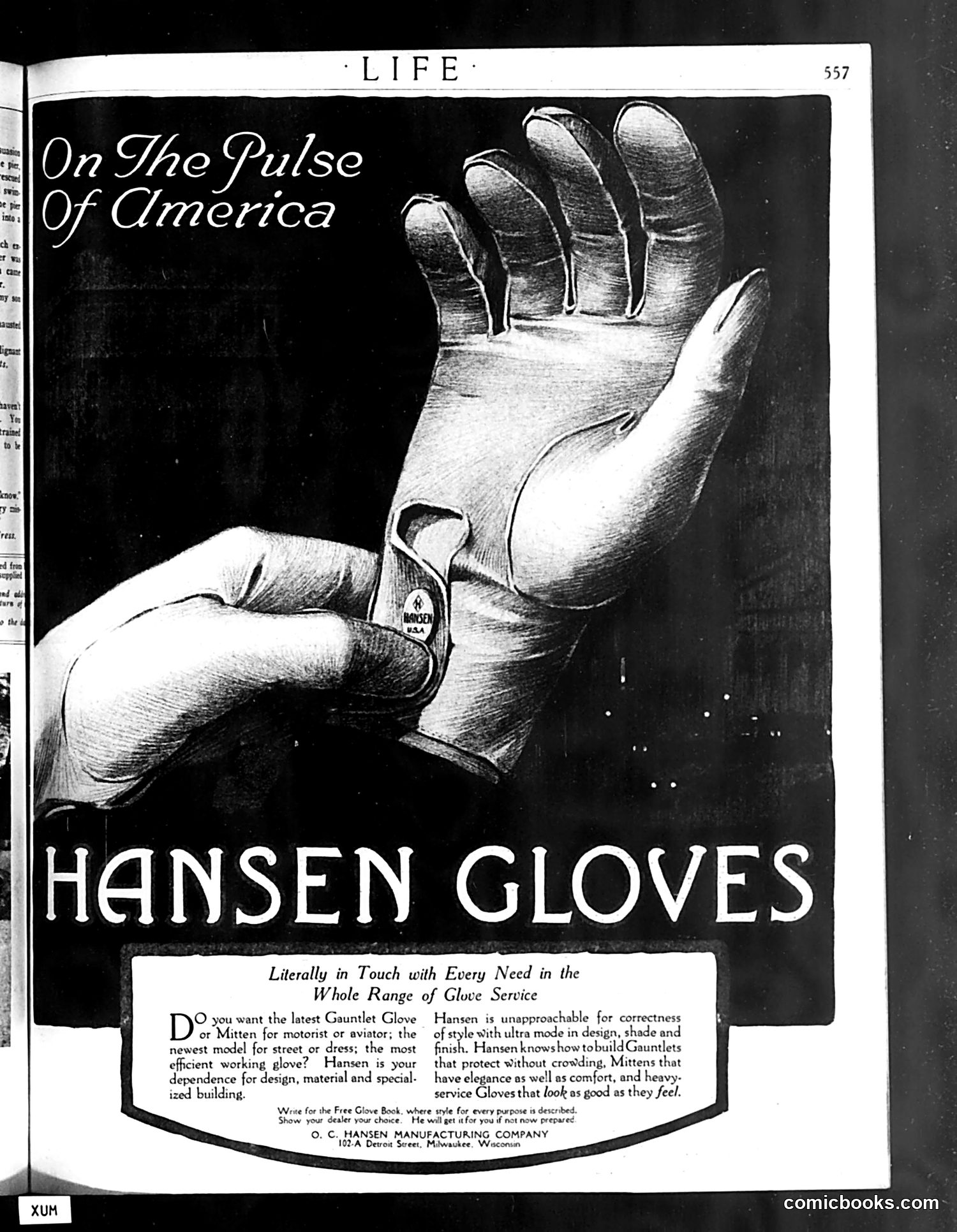
This is primarily a **commercial advertisement**, not political satire. It's a full-page ad for Hansen Manufacturing Company's gloves, appearing in *Life* magazine (page 557). The image shows an **illustrated hand holding a smaller hand**, symbolizing care and touch—a visual metaphor for the product's claim to be "literally in touch with every need." The phrase "On the Pulse of America" is aspirational marketing language suggesting Hansen gloves are essential to American life. The ad emphasizes product range: gauntlets for aviators and motorists, dress gloves, and work gloves. It uses period-appropriate language ("ultra mode," "elegance") and appeals to consumer choice and quality. There is **no political content or satire** visible here. This is straightforward early 20th-century product advertising using symbolic imagery and persuasive copy to market gloves across multiple consumer categories.
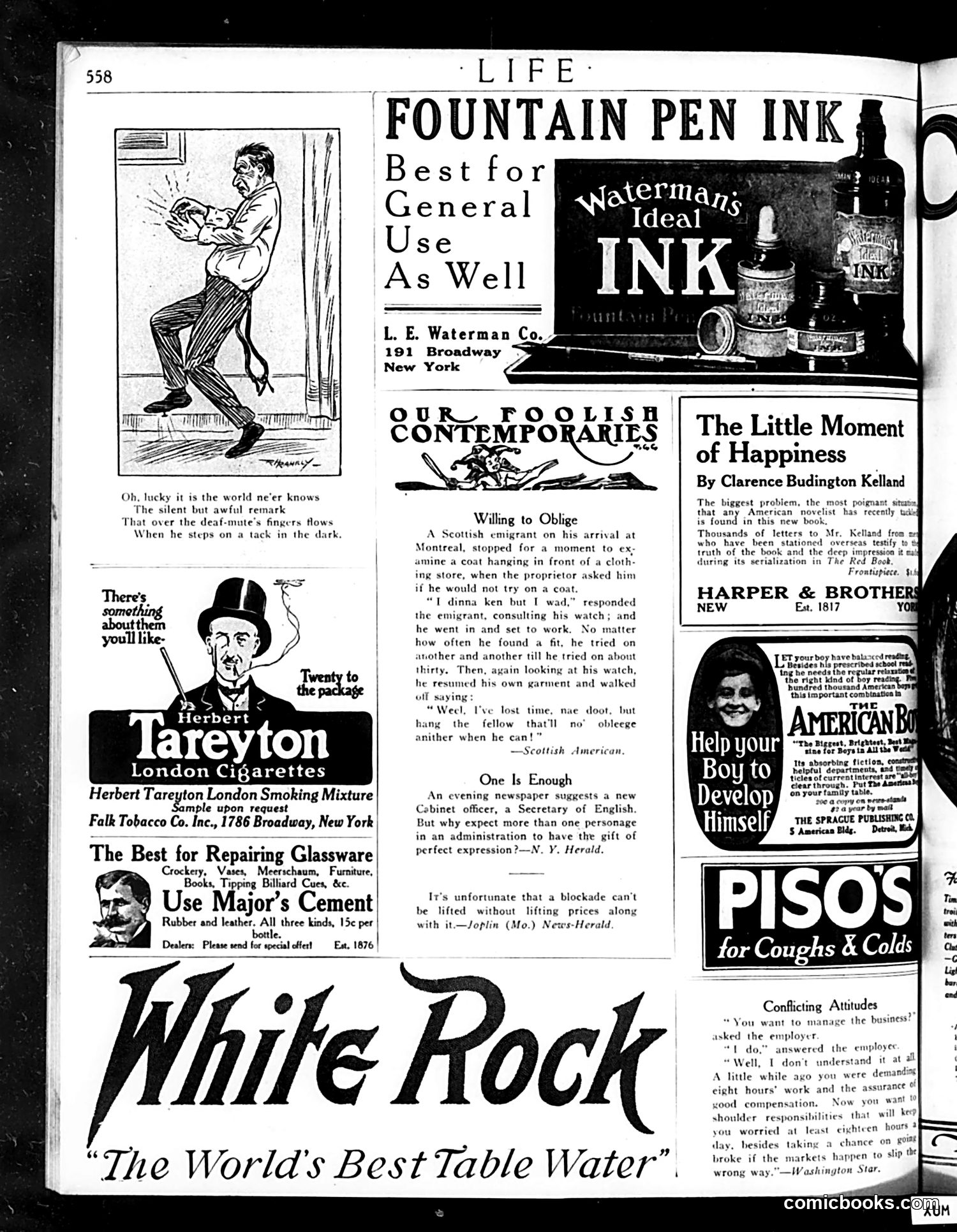
This is primarily an **advertising page** with scattered humor content typical of Life magazine's satirical format. ## Main Content: **"Our Foolish Contemporaries"** section contains three brief humorous anecdotes: - A deaf-mute stepping on a tack (visual joke about silent expression) - A Scottish emigrant exploiting a clothier's politeness by trying on 30 coats while watching the time - A critique of government officials lacking eloquence **"Conflicting Attitudes"** cartoon satirizes labor disputes: an employee demands an 8-hour workday and fair wages, but when offered management responsibility, suddenly worries about stress and financial risk—highlighting the hypocrisy or naiveté of labor demands without accepting corresponding accountability. ## Advertisements: Multiple product ads including Waterman fountain pen ink, Tareyton cigarettes, Major's Cement, and White Rock water dominate the page—standard commercial content for the era. The page reflects early 20th-century American workplace tensions and Scottish-American immigrant stereotypes common to period humor.
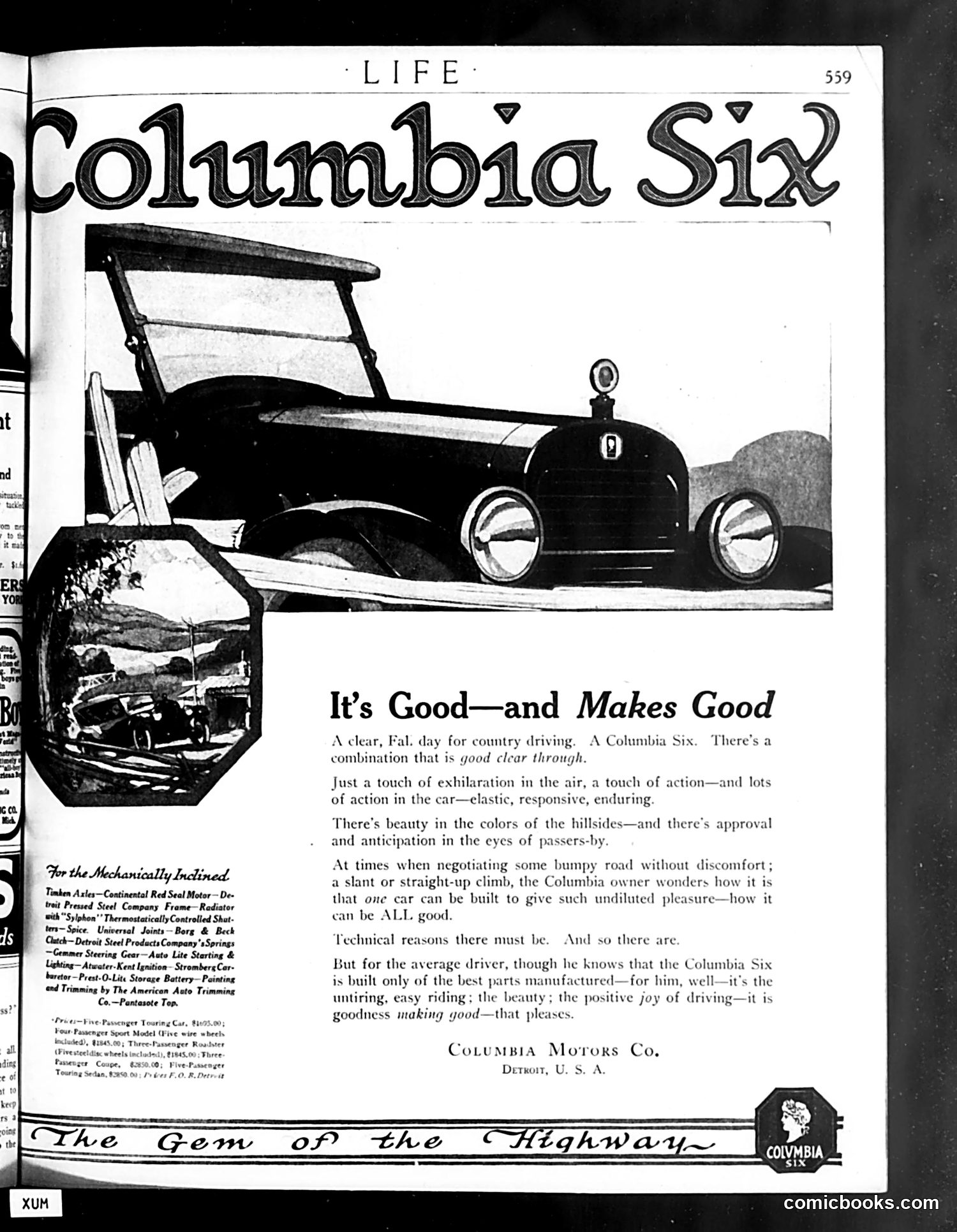
This is a **car advertisement**, not political satire. It promotes the Columbia Six automobile, manufactured by Columbia Motors Co. of Detroit. The page features an illustration of a sleek, open-top touring car on a country road, with appreciative onlookers watching. The ad copy uses emotional language about the driving experience—"exhilaration," "beauty," "undiluted pleasure"—typical of 1920s automobile marketing. The small inset diagram labeled "For the Mechanically Inclined" lists technical components (Benz axles, Continental motors, etc.), addressing buyers interested in engineering details. The tagline "It's Good—and Makes Good" suggests the car's quality and reliability. This appears to be standard product advertising from *Life* magazine's pages, not editorial commentary or satire. No caricatures or political figures are present—just marketing copy and car imagery.
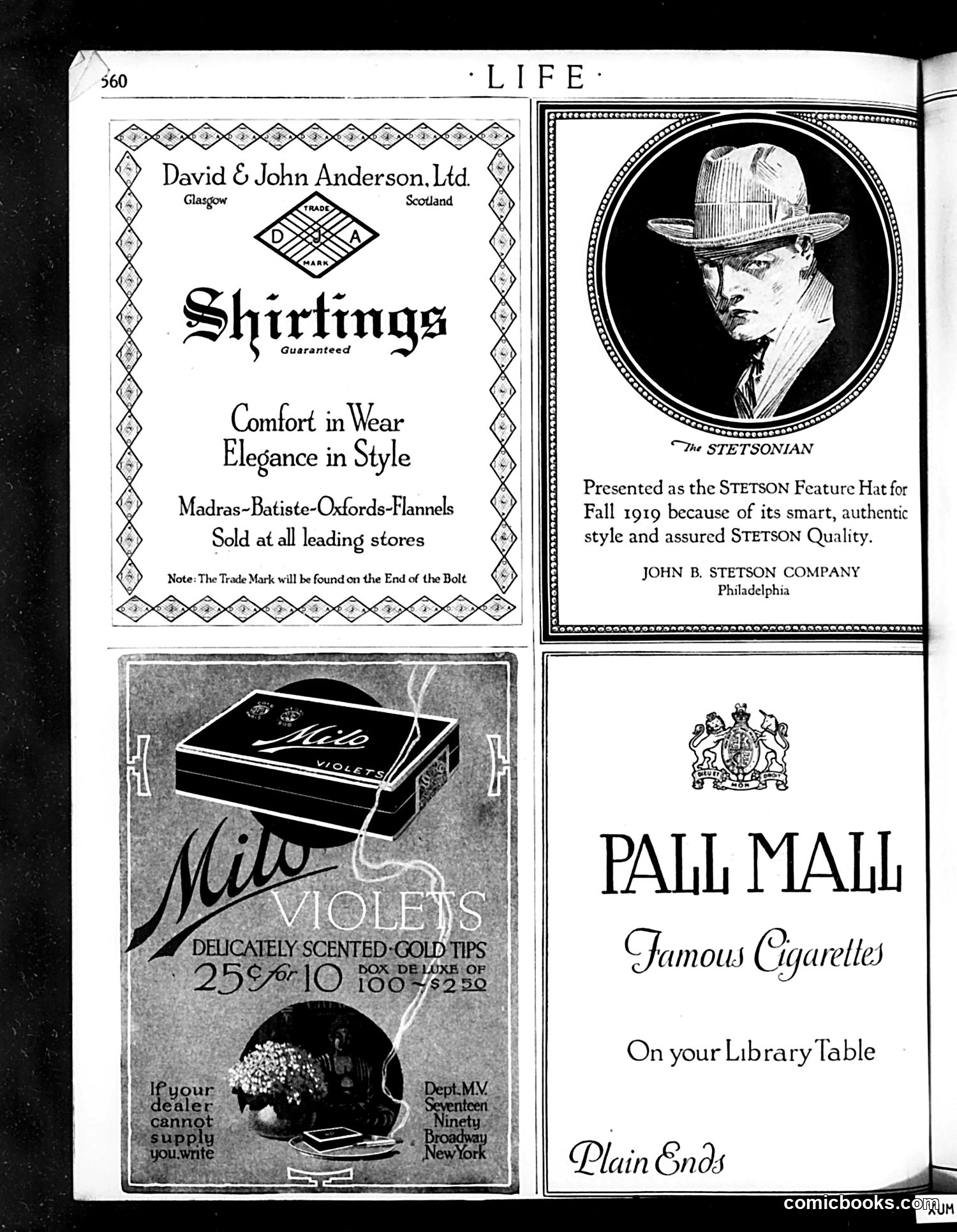
This page consists entirely of **advertisements**, not political cartoons or satire. The ads promote: 1. **David & John Anderson, Ltd.** (Glasgow): Shirtings fabric for men's clothing, emphasizing comfort and elegance. 2. **Stetson Hat Company** (Philadelphia): Features "The Stetsonian" hat for Fall 1919, shown via a portrait illustration of a man in a wide-brimmed hat. The ad emphasizes authentic style and quality. 3. **Milo Violets**: Delicately scented cigarettes with gold tips, priced 25¢ for 10 or $2.50 per box of 100. 4. **Pall Mall Cigarettes**: Positioned as luxury items suitable for display "on your library table," marketed as "famous cigarettes." These represent typical 1919 consumer goods targeting affluent readers—haberdashery, accessories, and premium tobacco products. No satire or political commentary is present.

This page is a **straightforward advertisement** for the Ruud Automatic Gas Water Heater, not political satire or a cartoon with hidden meaning. The ad's headline—"Your Hot-Water Faucets Cannot Tell a Lie"—uses a playful reference to George Washington and the cherry tree legend (honesty cannot be hidden) as a metaphor: the faucets "honestly" deliver hot water because the Ruud system automatically heats it. There's no deception—turn on the tap, get hot water. The imagery shows a gas water heater unit (left) and a hot-water tap labeled "HOT" (upper right), plus a scene of people enjoying modern plumbing. The appeal is to convenience and modernity: over 150,000 homes already had this service; readers should ask their gas company or plumber about installing one. This reflects early-20th-century marketing of household gas appliances as labor-saving innovations.
This is not a cartoon but rather an **advertisement for advertising itself**—a meta-promotional piece by *Life* magazine's advertising department. The page argues that reading advertisements is rational consumer behavior. It urges readers to study ads before shopping to understand "what is new and good" and get better value. The pitch frames advertisements as a "record of progress"—manufacturers' reports of innovations created "for your benefit." This reflects early-20th-century advertising philosophy: positioning ads as educational consumer guidance rather than persuasion. By modern standards, this seems naive or ironic—it treats advertisements as neutral information sources rather than acknowledging their sales intent. The piece's earnest tone and repeated emphasis on saving money while living "better" captures a period when consumer culture was still being normalized, and magazines needed to convince readers that *reading ads was in their interest*.
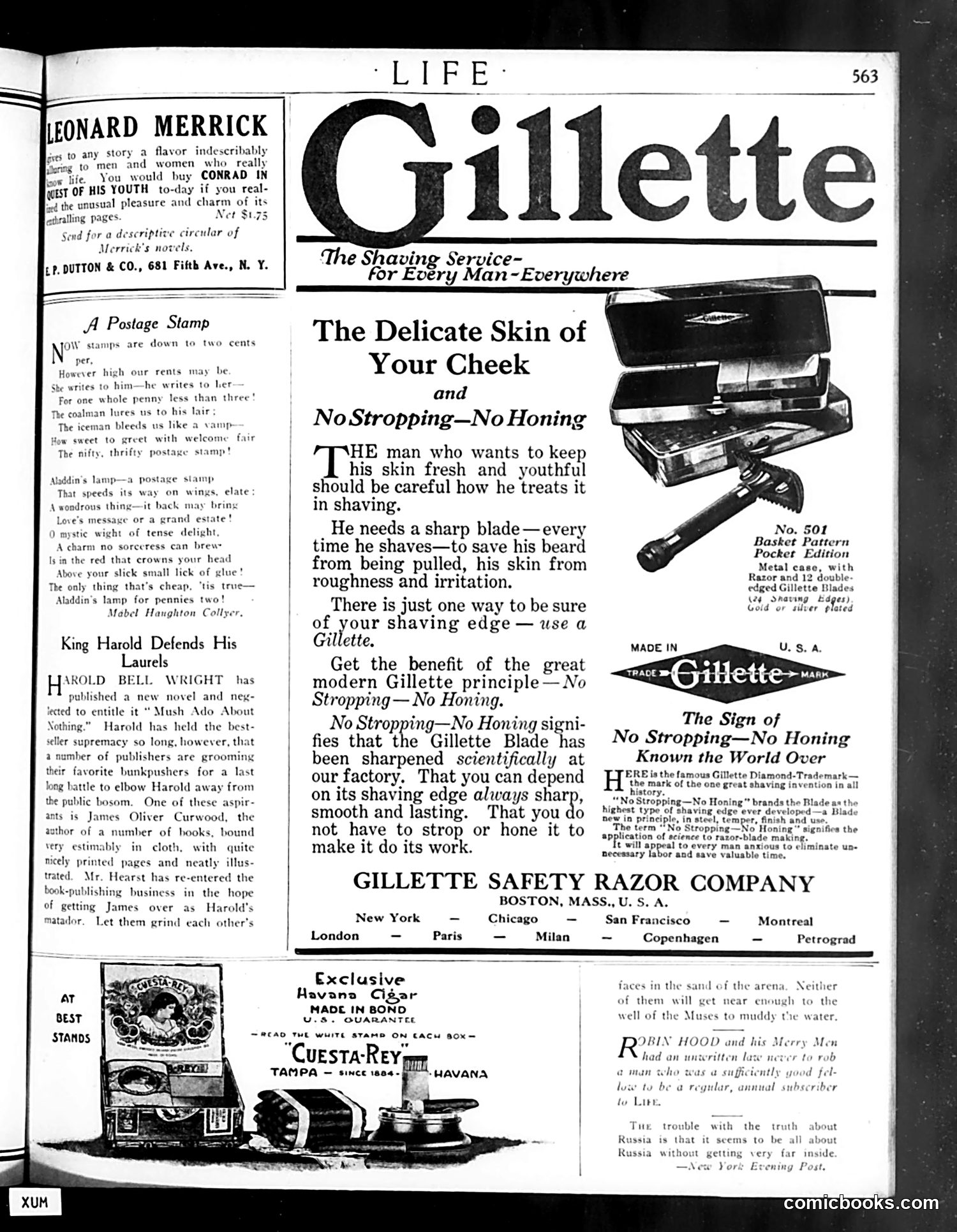
This is primarily a **Gillette razor advertisement** disguised as editorial content—a common advertising practice in early 20th-century magazines. **The satire and context:** The page includes three distinct articles: a book review of Leonard Merrick's novel, a humorous poem about postage stamps (now two cents, a bargain), and commentary on bestselling authors Harold Bell Wright versus James Oliver Curwood. The Wright-Curwood section uses boxing/bullfighting metaphors ("matador," "grind each other's") to describe their commercial competition for readers. **What moderns would miss:** The casual reference to William Randolph Hearst entering book publishing to promote Curwood suggests publisher rivalries were considered newsworthy. The postage stamp poem celebrates postal reform (reduced rates), which was genuinely significant economically. The Gillette ad emphasizes "No Stropping—No Honing"—meaningfully because contemporary razors *required* regular maintenance. This was revolutionary convenience marketing.
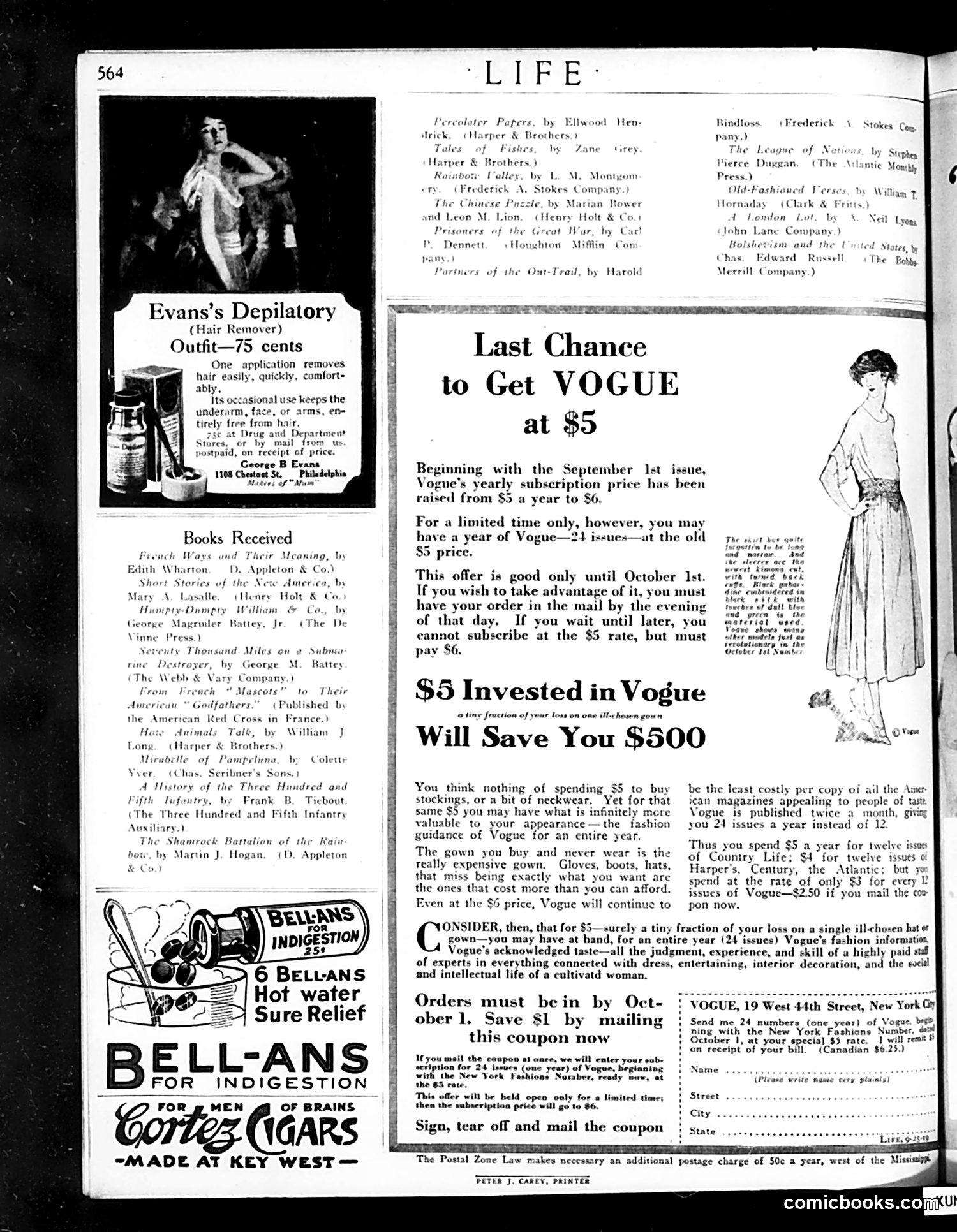
This is primarily a **book review and advertising page**, not a political cartoon. The main content consists of: **Books Received section**: Lists recently published books, including works by Edith Wharton and accounts of World War I and submarine warfare—reflecting post-WWI American literary interests. **Major Advertisement**: A large Vogue magazine subscription pitch dominates the right side. It exploits consumer psychology by offering a limited-time discount ($5 instead of the new $6 yearly rate) with an October 1st deadline, creating urgency. The ad argues that Vogue represents better value than spending $5 on clothing items you might never wear. **Supporting Ads**: Include Evans's Depilatory (hair removal), Bellans (indigestion relief), and Cortez Cigars—typical period products. **Context for Modern Readers**: The ad reveals 1920s attitudes about women's fashion guidance and consumer spending, while the book titles show post-WWI America's interest in war narratives and modernist literature.
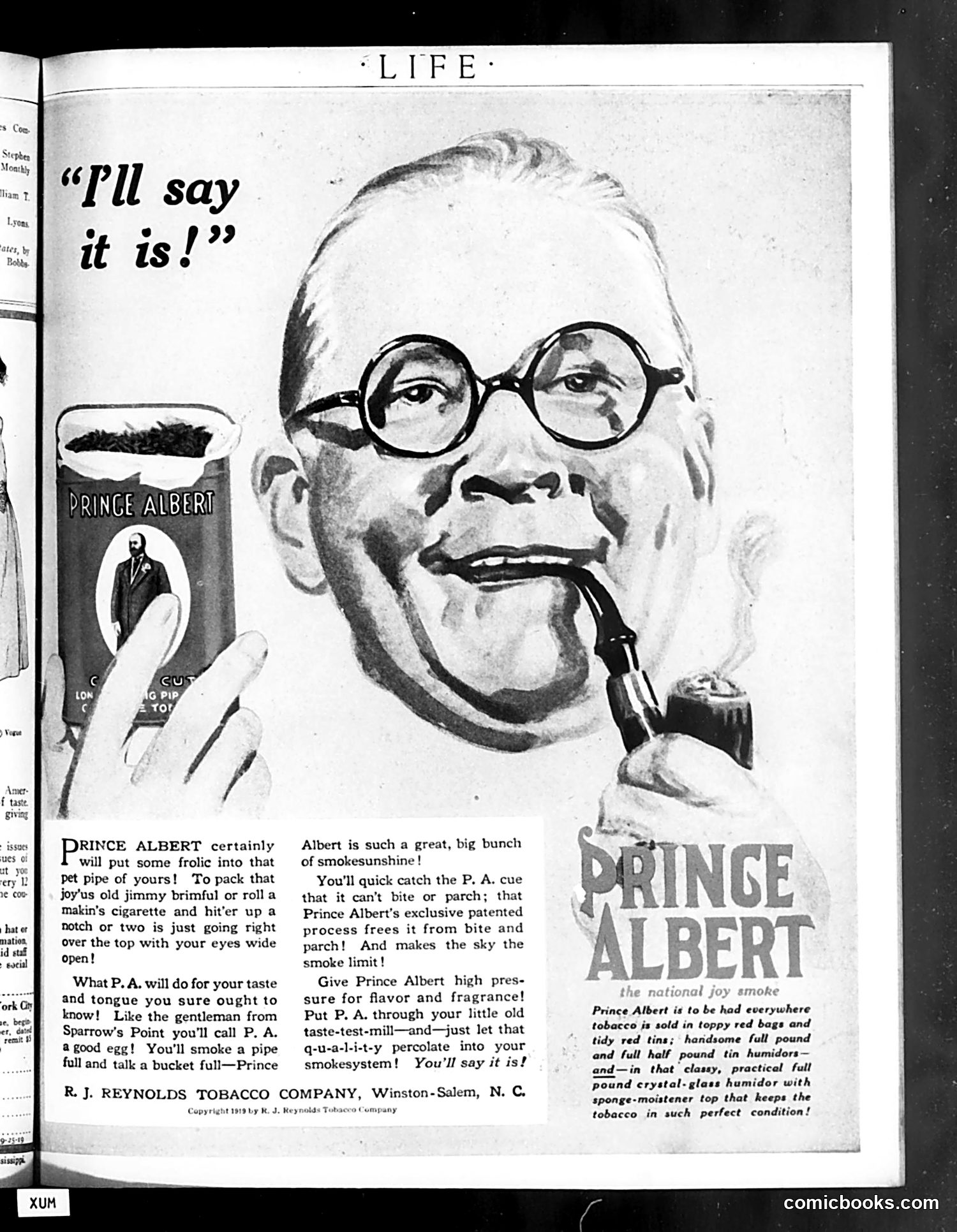
This is a **tobacco advertisement**, not political satire. It promotes Prince Albert pipe tobacco through a cartoon of a bespectacled man declaring "I'll say it is!"—endorsing the product's quality. The ad emphasizes Prince Albert's claimed advantages: it won't "bite or parch" the mouth due to a "patented process," offers superior flavor and fragrance, and comes in convenient packaging (tins, humidors with moisteners). The language is aggressively casual ("frolic," "jimmy brimful," "bucket full"), using colloquial 1919s slang to appeal to working-class smokers. References to "Sparrow's Point" (a steel mill town in Maryland) target industrial workers. This represents **early 20th-century advertising before tobacco health warnings**, when such ads freely celebrated smoking without acknowledging risks—a stark contrast to modern advertising restrictions.