
Life, 1919-09-25 · page 18 of 40
Life — September 25, 1919 — page 18: what you’re looking at
What you’re looking at
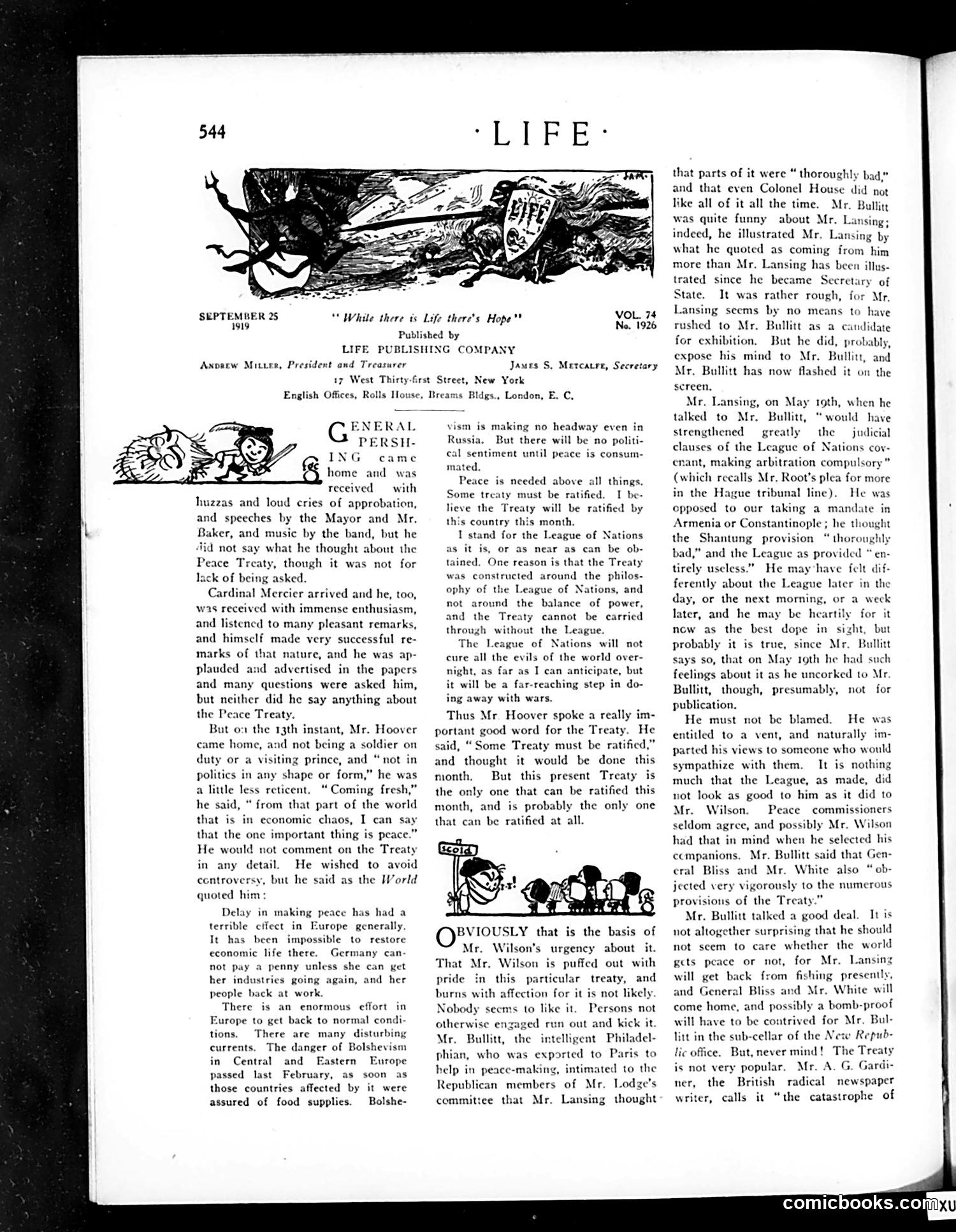
This Life magazine page discusses the Treaty of Versailles ratification debate following World War I. The article highlights statements by Herbert Hoover, who recently returned from post-war Europe, advocating for the treaty's passage. Key figures mentioned include President Wilson (supporting the treaty), Secretary of State Lansing (allegedly critical of it), and William Bullitt (a diplomat who exposed internal dissent to Republican senators). The text notes that various dignitaries—including the Mayor and Cardinal Mercier—visited but avoided public commentary on the controversial treaty. Hoover's cautious endorsement emphasizes the League of Nations as essential to post-war stability and economic recovery, particularly preventing Bolshevism in Europe. The satire targets Wilson's apparent pride in the treaty despite widespread elite disapproval, and Bullitt's role in embarrassing the administration by revealing Secretary Lansing's private doubts to political opponents. The cartoon (partially visible) likely mocks the treaty negotiations or their consequences.
📄 Transcribed text from this page (OCR, searchable)
Machine-transcribed from the original scan — historical spelling and the odd misread are preserved.
SEPTEMBER 25 1919 ‘* While there ts Life there's Hope" Published by LIFE nt and Treasurer t7 West Thir Anpaew Mituee, Presi¢ NERAL ING home received = with as and loud cries of approbation, and speeches by the Mayor and Mr. Baker, and music by the band, but he iid not y what he thought about the Peace Treaty, though it was not for lack of being asked. Cardinal Mercier arrived and he, too, was received with immense enthusiasm, and listened to many pleasant remarks, and himself made very successful re- marks of that nature, and he was ap- plauded and advertised in the papers and many questions were asked him, but neither did he say anything about the Peace Treaty. But o: the 13th instant, Mr. Hoover came home, and not being a soldier on duty or a visiting prince, and “not in politics in any shape or form,” he was a little less reticent. “ Coming fresh,” he said, “ from that part of the world that is in economic chaos, I can say that the one important thing is pea He would not comment on the Treaty in any detail. He wished to avoid controversy, but he said as the World quoted him: came and was Delay in making peace has had a terrible clfect in Europe generally. It has been impossible to restore economic life there. Germany can- not pay a penny unless she can get her industries going again, and her people back at work. There is an enormous effort in Europe to get back to normal condi tions. There are many currents, The danger of Bolshevism in Central and Eastern Europe passed last February, as soon as those countries affected by it were assured of food supplies. Bolshe- disturbing PUBLISHING COMPANY Jaurs S, Mercatre, Secretary rst Street, New York English Offices, Rolls House, Bre: Bldgs., London, E. C, vi is making no headway even in Russia, But there will be no politi- cal sentiment until peace is consum- mated. Peace is needed above all things. Some treaty must be ratified. I be- lieve the Treaty will be ratified by this country this month. I stand for the League of Nations as it is, or as near as can be ob- tained. One reason is that the Treaty was constructed around the philos- ophy of the League of Nations, and not around the balance of power, and the Treaty cannot be carried through without the League. The League of Nations will not cure all the evils of the world over- night, as far as I can anticipate, but it will be a far-reaching step in do- ing away with wars. Thus Mr Hoover spoke a really im- portant good word for the Treaty. He said, “Some Treaty must be ratified,” and thought it would be done this month. But this present Treaty is the only one that can be ratified this month, and is probably the only one that can be ratified at all. BVIOUSLY that is the basis of Mr. Wilson’s urgency about it. That Mr. Wilson is puffed out with pride in this particular treaty, and burns with affection for it is not li Nobody secms to like it. Persons not otherwise ¢ 1 run out and kick it Mr. Bullitt, the intelligent Philadel- phian, who was exported to Paris to help in peace-making, intimated to the Republican members of Mr. Lodge's committee that Mr. Lansing thought Neo. 1926 that parts of it were “ thoroughly bad,” and that even Colonel House did not like all of it all the time. Mr. Bullitt was quite funny about Mr. I indeed, he illustrated Mr. Lansing by what he quoted as coming from him more than Mr. Lansing been illus- trated since he became Secretary of State. It was rather rough, for Mr, Lansing seems by no means to have rushed to Mr. Bullitt as a candidate for exhibition, But he did, probably, expose his mind to Mr. Bulliu, and Mr, Bullitt has now flashed it on the screen, Mr. Lansing, on May 19th, when he talked to Mr. Bullitt, “would have Strengthened greatly the —_ judicial clauses of the League of Nations cov- king arbitration compulsory” Ils Mr, Root's plea for more in the Hague tribunal line). He was opposed to our taking a mandate in Armenia or Constantinople ; he thought the Shantung provision “thoroughly bad,” and the League as provided * en- tirely useless.” He may-have felt dif- ferently about the League later in the day, or the next mornin later, and he may be heartily for it now as the best dope in sight, but probably it is true, since Mr. Bullitt says so, that on May roth he had such feelings about it as he uncorked to Mr. Bullitt, though, presumably, not for publication. He must not be blamed. He was entitled to a vent, and naturally parted his views to someone who would sympathize with them. It is nothing much that the League, as made, did not look as good to him as it did to Mr. Wilson. Peace commissioners seldom agree, and possibly Mr, Wilson had that in mind when he ccmpanions. Mr. Bullitt said that cral Bliss and Mr. White also “ ob- jected very vigorously to the numerous provisions of the Treaty.” Mr. Bullitt talked a good deal. It is not altogether surprising that he should not scem to care whether the world gets peace or not, for Mr. Lansing will get back from fishing presently, and General Bliss and Mr. White will 2 bomb-proof or a week elected his come home, and possibly will have to be contrived for Mr. Bul- litt in the sub-cellar of the New Repub- lic office. But, never mind! The is not very popular. Mr. A. G. Gardi- ner, the British radical newspaper writer, calls it “the catastrophe of Comicbooks.comm