
Life, 1919-09-25 · page 19 of 40
Life — September 25, 1919 — page 19: what you’re looking at
What you’re looking at
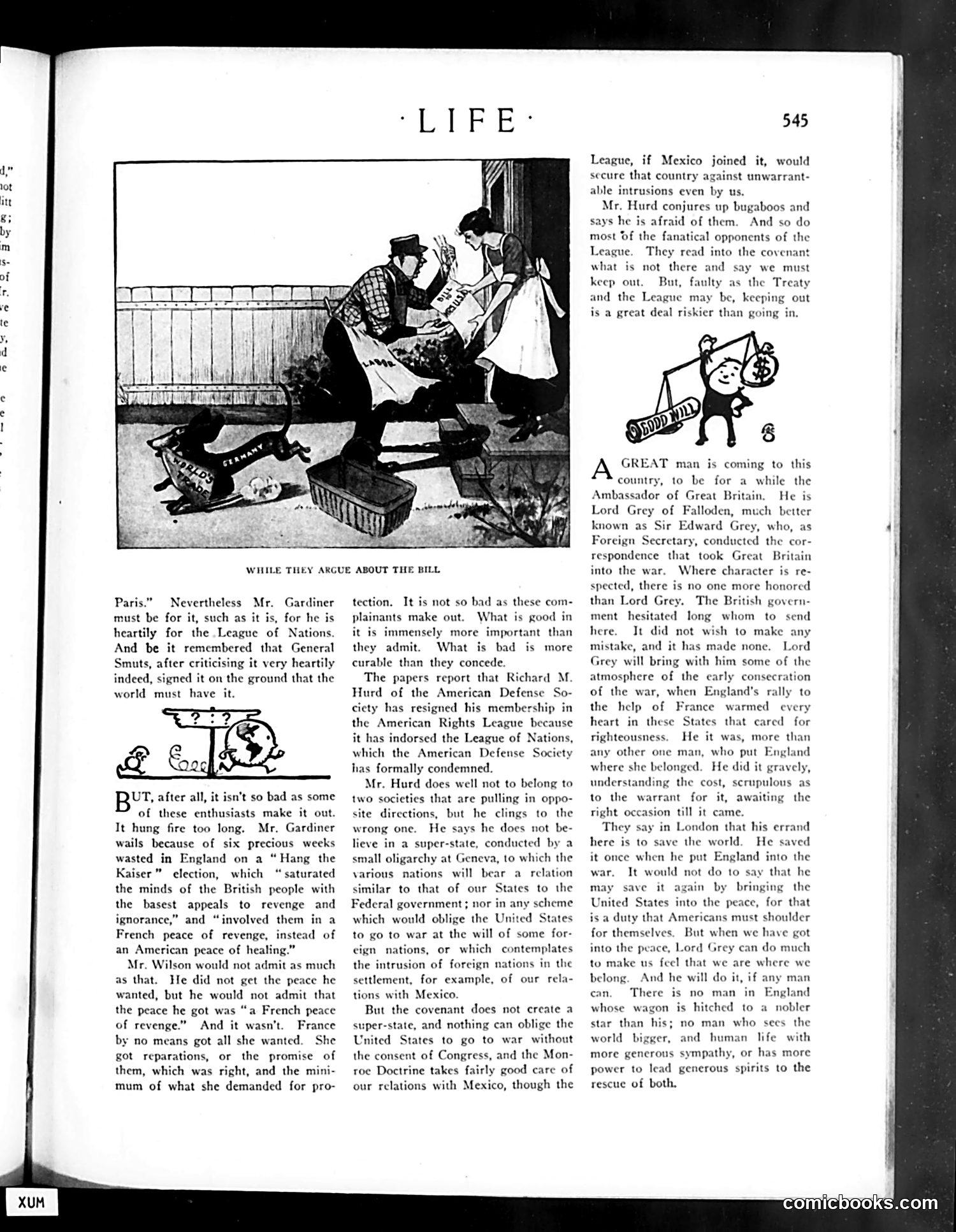
The main cartoon shows figures arguing over documents labeled "the bill" — likely the League of Nations Covenant being debated in post-WWI Britain and America. The visual joke depicts politicians squabbling while practical matters pile up neglected around them (baskets, household items). The text discusses divisions over the League of Nations: Richard M. Hurd resigned from the American Rights League because it endorsed the League, which the American Defense Society opposed. Hurd feared the League would create a "super-state" at Geneva and drag America into foreign wars without Congressional consent. The article's stance is pro-League, dismissing Hurd's fears as "bugaboos" — exaggerated threats. It argues the Monroe Doctrine adequately protects American interests, and that rejecting the League is "riskier than going in." The final section announces Lord Grey's arrival as British Ambassador, praising his character and his role bringing Britain into WWI to aid France — positioned as moral leadership rather than war-mongering. This reflects 1920 isolationist-versus-internationalist debates.
📄 Transcribed text from this page (OCR, searchable)
Machine-transcribed from the original scan — historical spelling and the odd misread are preserved.
WHILE THEY ARGUE ABOUT THE BILL Paris.” Nevertheless Mr. Gardiner must be for it, such as it is, for he is heartily for the League of Nations. And be it remembered that General Smuts, after criticising it very heartily indeed, signed it on the ground that the world must have it. UT, after all, it isn’t so bad as some of these enthusiasts make it out. It hung fire too long. Mr. Gardiner wails because of six precious weeks wasted in England on a “Hang the Kaiser” election, which “saturated the minds of the British people with the basest appeals to revenge and ignorance,” and “involved them in a French peace of revenge, instead of an American peace of healing.” Mr. Wilson would not admit as much as that. He did not get the peace he wanted, but he would not admit that the peace he got was “a French peace of revenge.” And it wasn’t. by no means got all she wanted. got reparations, or the promise of them, which was right, and the mini- mum of what she demanded for pro- tection. It is not so bad as these com- plainants make out. What is good in it is immensely more important than they admit. What is bad is more curable than they concede. The papers report that Richard M. Hurd of the American Defense So- ciety has resigned his membership in the American Rights League because it has indorsed the League of Nations, which the American Defense Society has formally condemned. Mr. Hurd does well not to belong to two societies that are pulling in oppo- site directions, but he clings to the wrong one. He says he does not be- lieve in a super-state, conducted by a small oligarchy at Geneva, to which the various nations will bear a_ relation similar to that of our States to the Federal government; nor in any scheme which would oblige the United States to go to war at the will of some for- eign nations, or which contemplates the intrusion of foreign nations in the settlement, for example, of our rela- tions with Mexico. But the covenant does not create a super-state, and nothing can oblige the United States to go to war without the consent of Congress, and the Mon- roe Doctrine takes fairly good care of our relations with Mexico, though the 545 League, if Mexico joined it, would secure that country against unwarrant- able intrusions even by us. Mr. Hurd conjures up bugaboos and ays he is afraid of them. And so do most Of the fanatical opponents of the They read into the covenant is not there and say keep out. what we must But, faulty as the Treaty and the League may be, keeping out is a great deal riskier than going in, A GREAT man is coming to this country, to be for a while the Ambassador of Great Britain. He is Lord Grey of Falloden, much better known as Sir Edward Grey, who, as reign Secretary, conducted the cor- respondence that took Great Britain into the war. Where character is re- spected, there is no one more honored than Lord Gr The British govern- ment hesitated long here. It did not wish to make any mistake, and it has made none. Lord Grey will bring with him some of the atmosphere of the ly consecration of the war, when England's rally to the help of France heart in these States that cared for righteousness. He it wa any other one man, who put England where she belonged. He did it gravely, understanding the cost, scrupulous as to the warrant for it, awaiting the right occasion till it came. They say in London that his errand here is to save the world. He saved it once when he put England into the whom to send warmed every » More than war. It would not do to say that he may save it United States into the peace, for that is a duty that Americans must shoulder for themselves, But when we have got into the peace, Lord Gri to make us feel that we are where we And he will do it, i There is no whose wagon is hitched to a } no man again by bringing the y can do much belong. ny man England nobler can man in who sees the life more gencrous sympathy, or has more star than world bigger, and human with power to lead generous spirits to the rescue of both,