
Life, 1919-09-25 · page 22 of 40
Life — September 25, 1919 — page 22: what you’re looking at
What you’re looking at
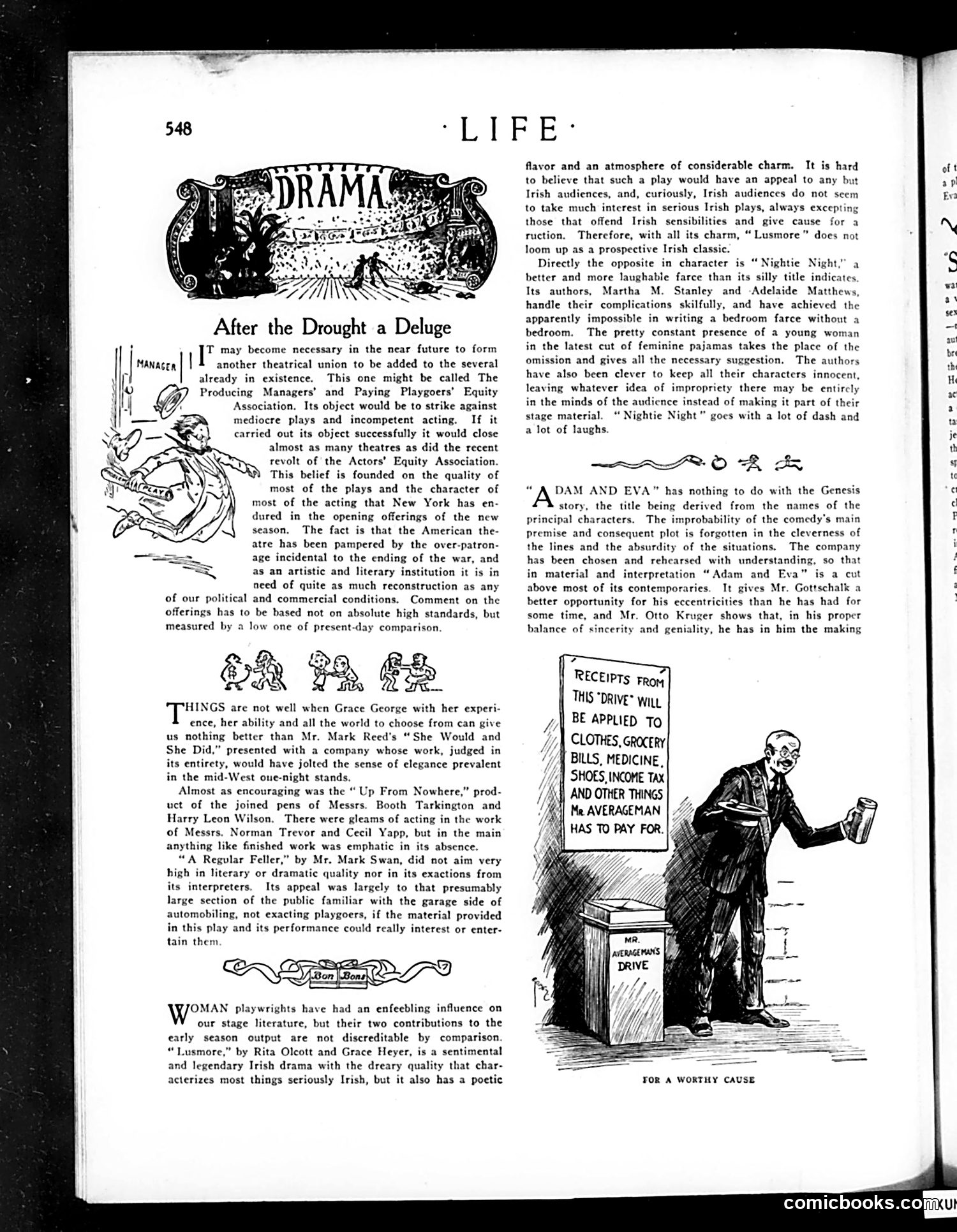
This is drama criticism, not political satire. The page reviews recent Broadway theatrical productions following the post-WWI boom that inflated mediocre work. The critic argues that American theatre needs a new "union" to strike against poor plays and acting—ironically noting this would close as many theatres as the recent Actors' Equity Association strike actually did. Specific reviews mention actress Grace George in "She Would and She Did" (dismissed as suitable only for "mid-West one-night stands"), and Booth Tarkington's "Up From Nowhere" as lacklustre despite some good acting. The small illustration shows a man collecting charitable donations ("Drive") for paying bills—likely commenting on theatre's economic struggles post-war. The page criticizes women playwrights' work while acknowledging slight improvements: "Lusmore" (Irish drama) and "Nightie Night" (farce). The tone reflects elitist standards about theatrical quality declining due to wartime audience expansion.
📄 Transcribed text from this page (OCR, searchable)
Machine-transcribed from the original scan — historical spelling and the odd misread are preserved.
“LIFE After the Drought a Deluge T may become necessary in the near future to form | another theatrical union to be added to the several already in existence. This one might be called The Producing Managers’ and Paying Playgoers’ Equity Association. Its object would be to strike against mediocre plays and incompetent acting. If it carried out its object successfully it would close almost as many theatres as did the recent revolt of the Actors’ Equity Association. This belief is founded on the quality of most of the plays and the character of most of the acting that New York has en- dured in the opening offerings of the new season, The fact is that the American the- atre has been pampered by the over-patron- age incidental to the ending of the war, and as an artistic and literary institution it is in need of quite as much reconstruction as any of our political and commercial conditions. Comment on the offerings has to be based not on absolute high standards, but measured by a low one of present-day comparison. OR FS He 'HINGS are not well when Grace George with her experi- ence, her ability and all the world to choose from can give us nothing better than Mr. Mark Reed's “She Would and She Did,” presented with a company whose work, judged in its entirety, would have jolted the sense of elegance prevalent in the mid-West one-night stands Almost as encouraging was the “ Up From Nowhere,” prod- uct of the joined pens of Messrs. Booth Tarkington and Harry Leon Wilson. There were gleams of acting in the work of Messrs. Norman Trevor and Cecil Yapp, but in the main anything like finished work was emphatic in its absence. “A Regular Feller,” by Mr. Mark Swan, did not aim very high in literary or dramatic quality nor in its exactions from its interpreters. Its appeal was largely to that presumably large section of the public familiar with the garage side of automobiling, not exacting playgoers, if the material provided in this play and its performance could really interest or enter- tain them CAADS Varon ond OMAN playwrights have had an enfeebling influence on our stage literature, but their two contributions to the early season output are not discreditable by comparison “Lusmore,” by Rita Olcott and Grace Heyer, is a sentimental and legendary Irish drama with the dreary quality that char- acterizes most things seriously Irish, but it also has a poetic flavor and an atmosphere of considerable charm. It is hard to believe that such a play would have an appeal to any but Irish audiences, and, curiously, Irish audiences do not seem to take much interest in serious Irish plays, always excepting those that offend Irish sensibilities and give cause for a ruction. Therefore, with all its charm, “Lusmore” does not loom up as a prospective Irish classic. Directly the opposite in character is “Nightie Night,” a better and more laughable farce than its silly title indicates Its authors, Martha M. Stanley and Adelaide Matthews, handle their complications skilfully, and have achieved th apparently impossible in writing a bedroom farce without a bedroom. The pretty constant presence of a young woman in the latest cut of feminine pajamas takes the place of the omission and gives all the necessary suggestion, The authors have also been clever to keep all their characters innocent, leaving whatever idea of impropriety there may be entircly in the minds of the audience instead of making it part of their stage material. “Nightie Night” gocs with a lot of dash and a lot of laughs. DAM AND EVA” has nothing to do with the Genesis tory, the title being derived from the names of the characters. The improbability of the comedy’s main and consequent plot is forgotten in the cleverness of the lines and the absurdity of the situations, The company has been chosen and rehearsed with understanding, so that in material and interpretation “Adam and Eva” is a cut above most of its contemporaries. It gives Mr. Gottschalk a better opportunity for his eccentricities than he has had for some time, and Mr. Otto Kruger shows that, in his proper balance of sincerity and geniality, he has in him the making RECEIPTS FROM THIS “DRIVE Witt |] BE APPLIED To CLOTHES, GROCERY BILLS, MEDICINE, 4 HAS TO PAY FOR. FOR A WORTHY CAUSE comicbooks.coma]