
A complete issue · 48 pages · 1919
Life — September 11, 1919
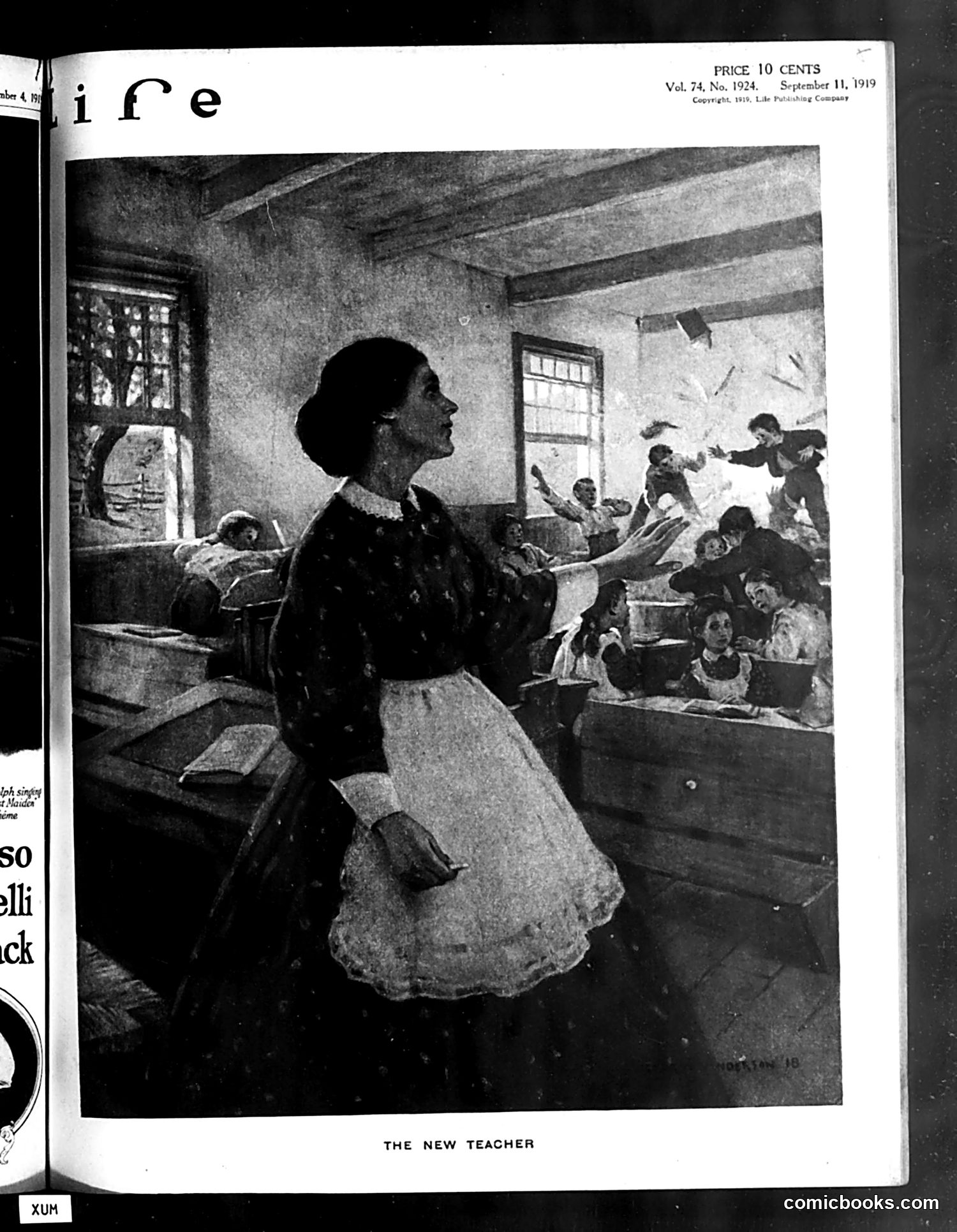
This illustration depicts a woman teacher addressing a classroom of young students in what appears to be a modest, sparsely furnished schoolroom with exposed ceiling beams. The image likely reflects post-WWI social commentary about women entering the teaching profession in greater numbers, a shift accelerated by the war. The title's neutral tone masks potential satire about either the challenges of early-20th-century education or changing gender roles in the workforce. The modest setting and children's apparent inattention might suggest commentary on educational conditions or the difficulties faced by female educators. Without additional article text, the specific satirical target remains unclear, though it relates to early 1920s American social transformation.
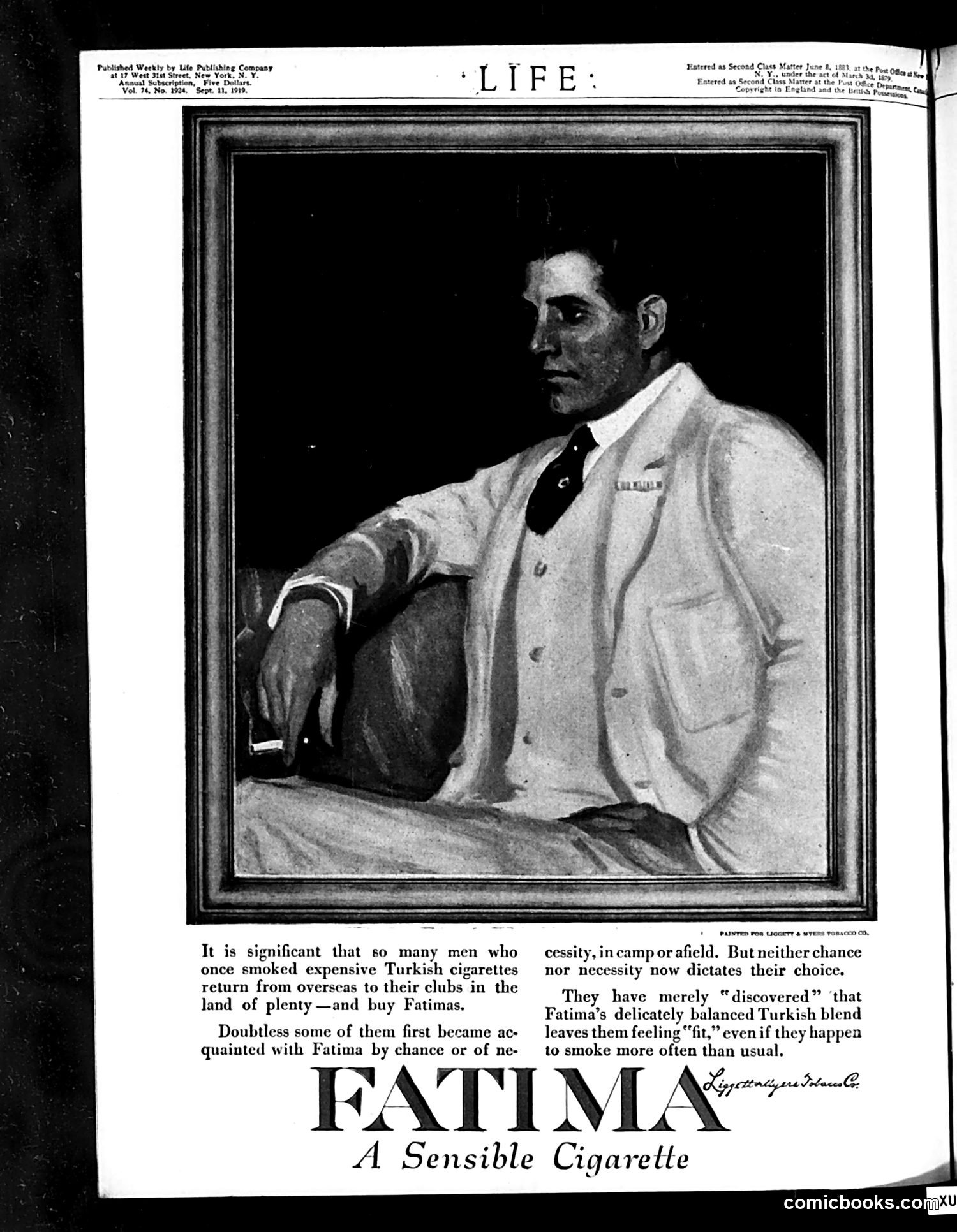
This is primarily **a cigarette advertisement**, not satire or political commentary. The page features a formal portrait of an unidentified man in a light-colored suit, accompanied by advertising copy for Fatima brand cigarettes. The ad's argument is straightforward: many soldiers returning from overseas (likely post-WWI, given the magazine's 1919 date) discovered Fatima cigarettes abroad and now prefer them to expensive Turkish cigarettes previously available at home clubs. The ad claims Fatima's "delicately balanced Turkish blend" makes smokers feel "fit," even if smoked frequently. The "point" is purely commercial—marketing a cigarette brand by suggesting it's the sophisticated choice of returning servicemen. There is no discernible political satire here.
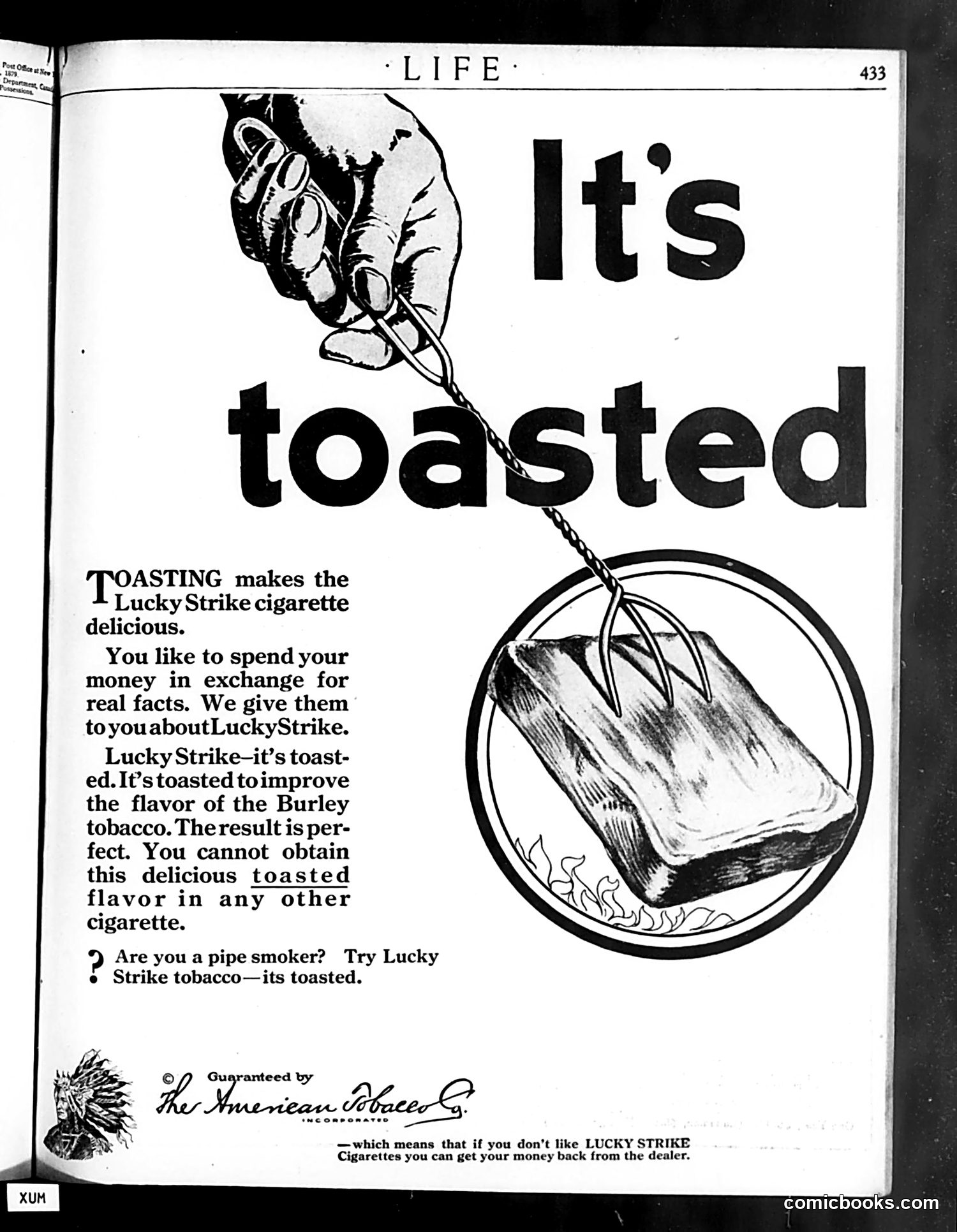
This is a **product advertisement**, not satire or political commentary. It's a vintage Lucky Strike cigarette ad from Life magazine (page 433) promoting the brand's "toasted" tobacco process. The ad uses two visual metaphors: a hand holding a glowing cigarette and a piece of toast in a circle, equating the toasting process with making bread crispy and delicious. The copy claims toasting improves Burley tobacco flavor uniquely, offering consumers "real facts" for their money. A money-back guarantee appears at the bottom. The American Tobacco Company logo is included. This reflects early-20th-century advertising before tobacco health dangers were widely acknowledged or regulated. The "toasted" claim was Lucky Strike's actual marketing strategy from that era.
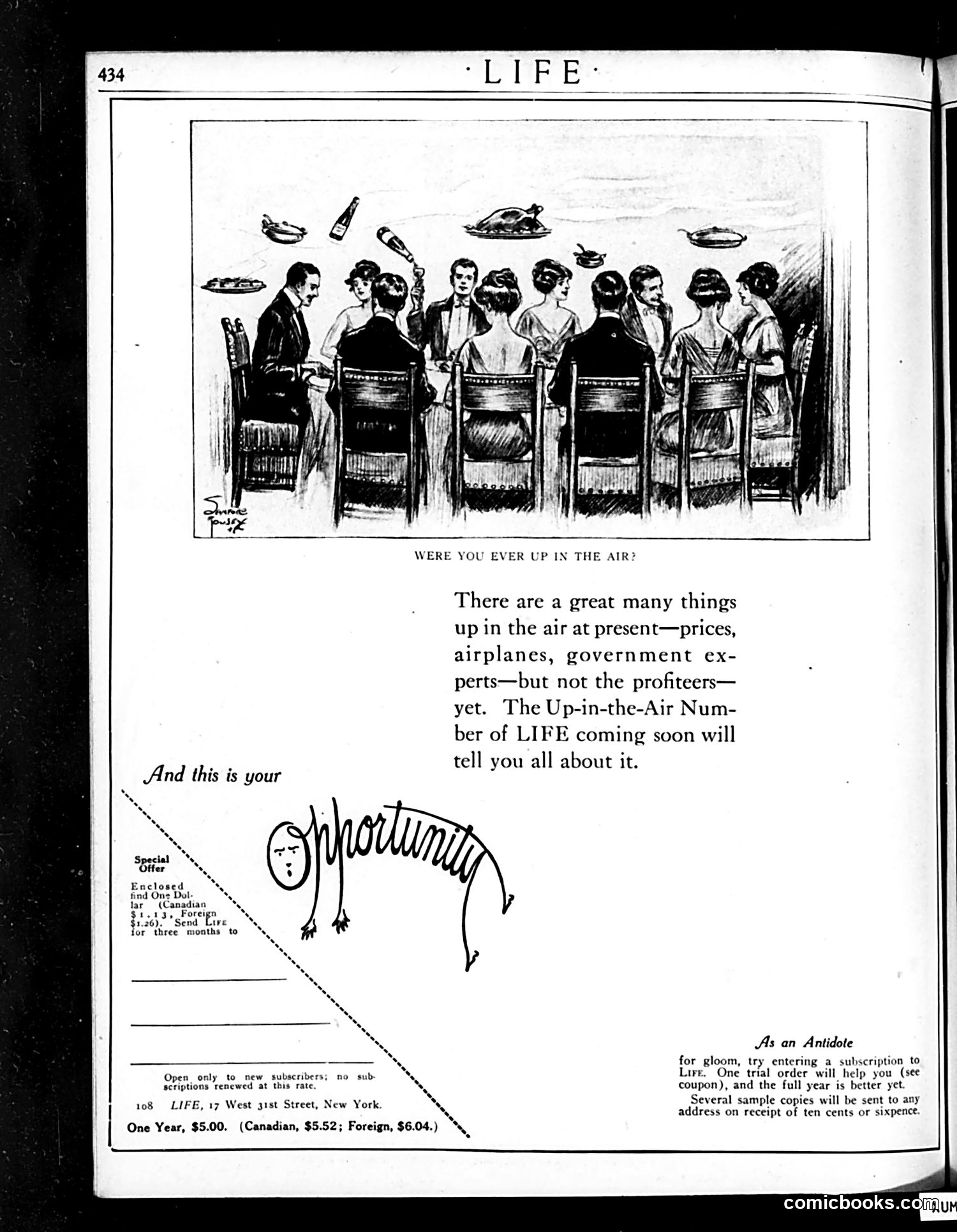
This page is primarily a **subscription advertisement for LIFE magazine** rather than a political cartoon. The illustration at top shows a dinner party scene with the caption "WERE YOU EVER UP IN THE AIR?" The accompanying text uses this as a pun: there are currently many things "up in the air"—prices, airplanes, government experts—"but not the profiteers—yet." This appears to be **satirizing profiteering and inflation** during what seems to be the post-World War I era, when such issues were prominent. The cartoon humorously suggests that an upcoming "Up-in-the-Air Number" of LIFE will expose profiteers who are currently benefiting from economic uncertainty. The crude stick-figure drawing labeled "Opportunity" reinforces the satire about who's actually profiting from these conditions. The page then offers subscription rates ($5 yearly) and trial offers.
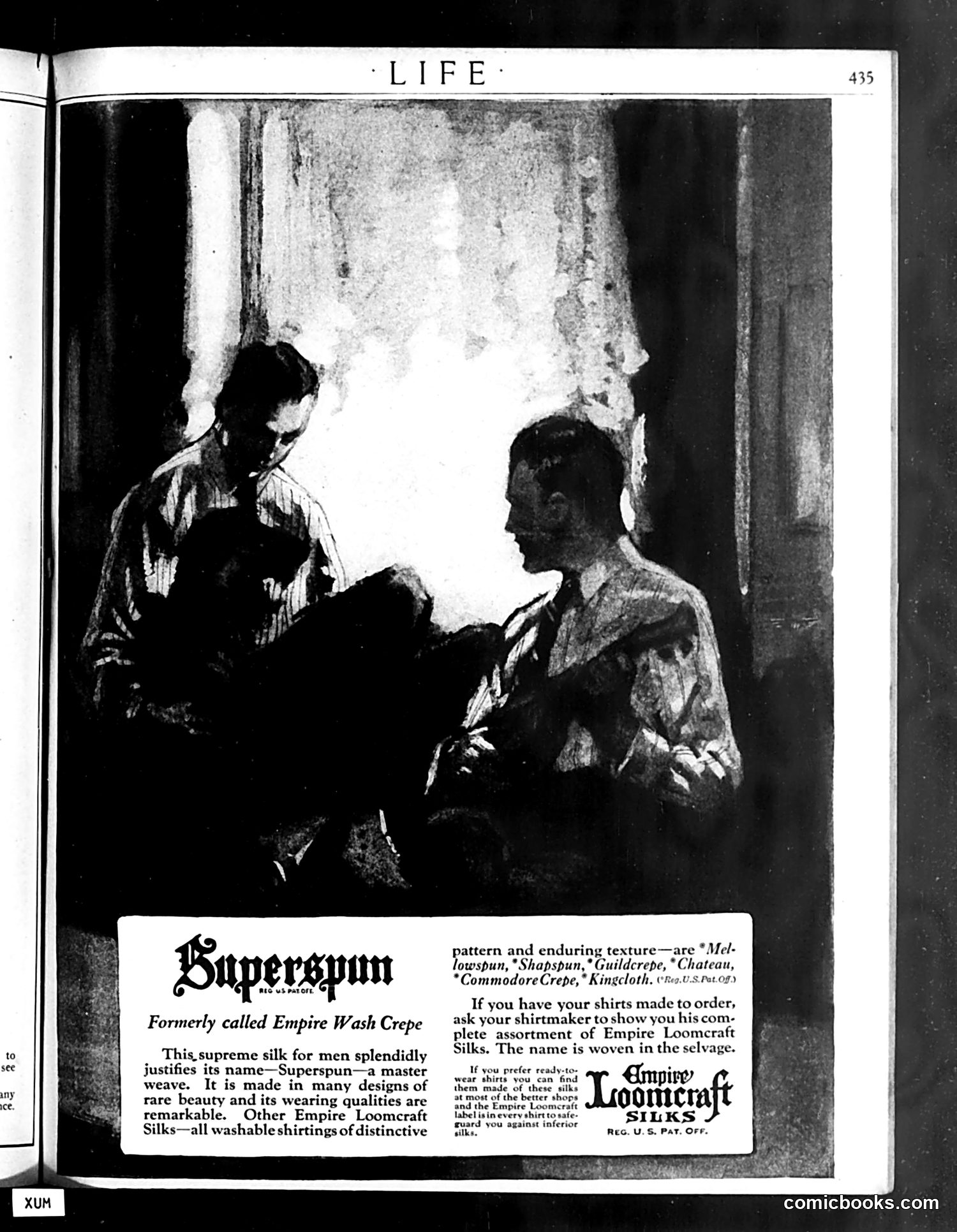
This page is **primarily an advertisement**, not political satire. It promotes "Superspun" silk fabric (formerly called "Empire Wash Crepe"), marketed as a supreme silk suitable for men's dress shirts. The image shows two men in an interior setting, apparently examining or discussing fabric. The advertisement emphasizes that Superspun represents superior weave quality and durability compared to other Empire Loomcraft Silks, with claims that the material is washable and resistant to inferior imitations. The text encourages readers to request Superspun when ordering shirts and to ask their shirtmaker to display the complete Empire Loomcraft Silks assortment. This is straightforward commercial messaging typical of *Life* magazine's advertising content from this era—no political cartoon or satire is present.
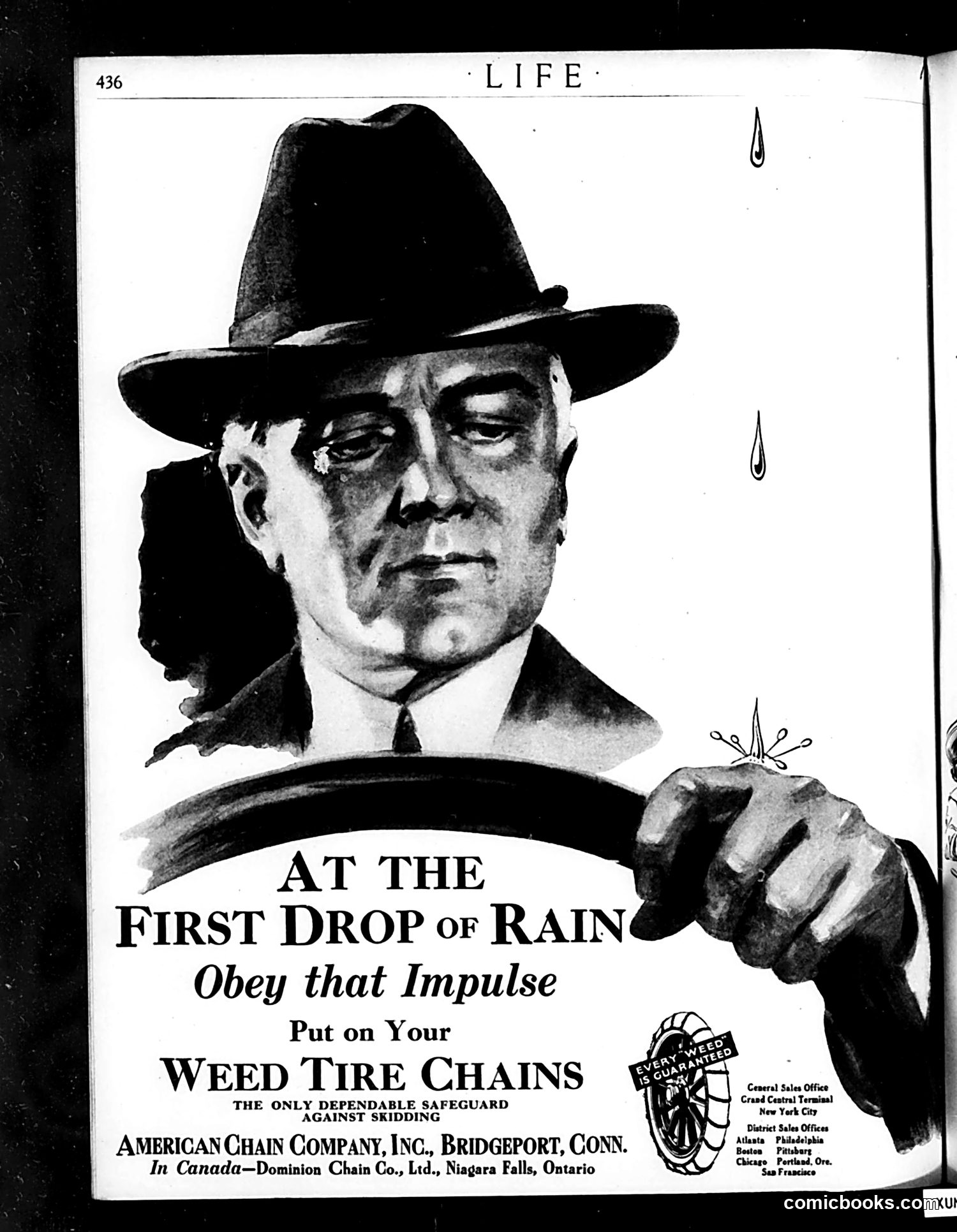
This is **not satire or a political cartoon**—it's a **vintage advertisement** from *Life* magazine (page 436). The image shows a stern-faced man in a cowboy hat holding what appears to be a tire chain, with raindrops illustrated above. The ad promotes **Weed Tire Chains** manufactured by American Chain Company, Inc., based in Bridgeport, Connecticut. The messaging uses dramatic language ("At the First Drop of Rain / Obey that Impulse") to create urgency about purchasing tire chains for wet-weather driving safety. The cowboy imagery and commanding tone suggest authority and reliability. This reflects early 20th-century automotive safety concerns when tire chains were essential equipment for winter and rainy driving conditions. The advertisement targets car owners worried about skidding hazards.
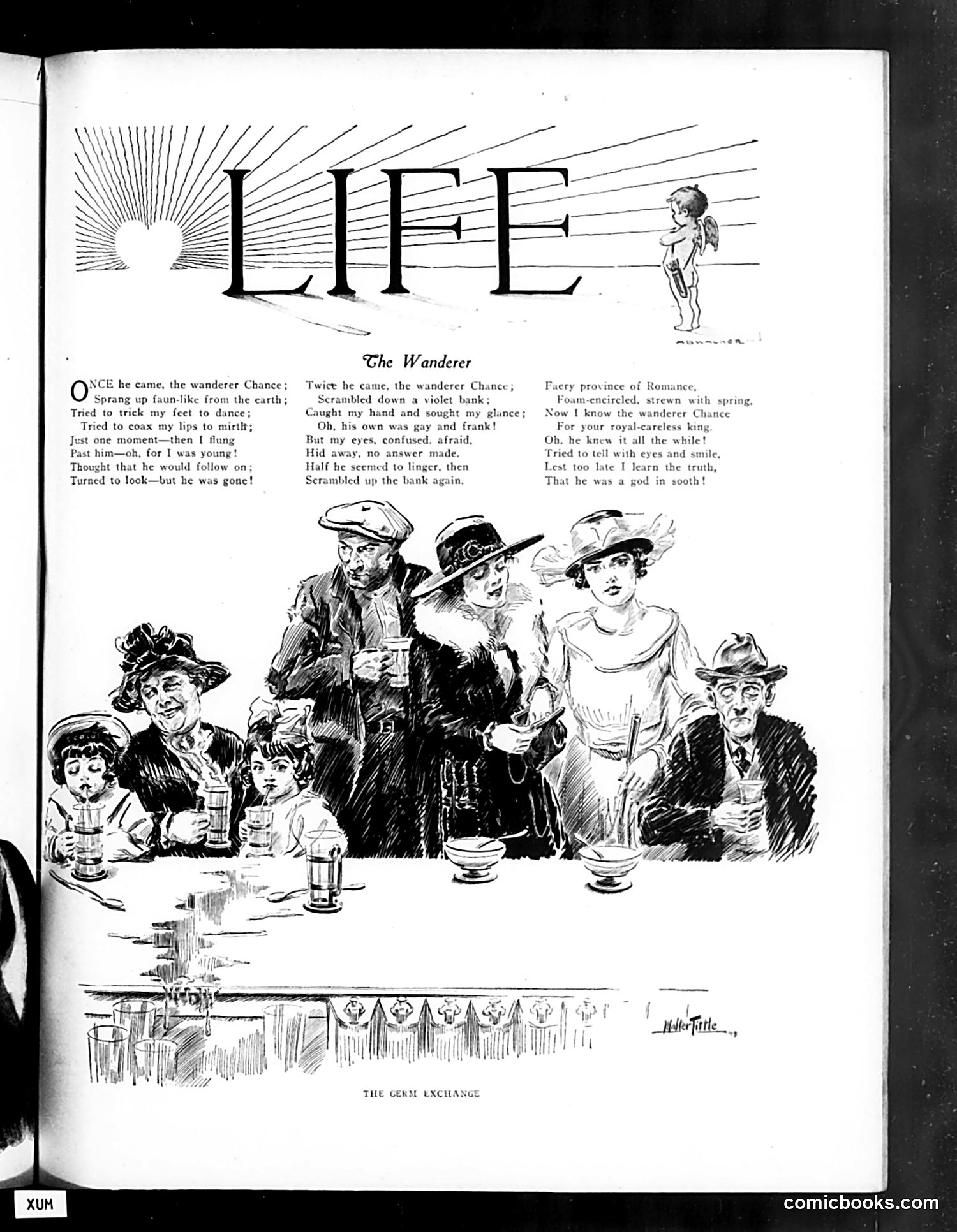
This page features a poem titled "The Wanderer" accompanied by an illustration. The poem describes a traveler who encountered a mysterious, cheerful character and lost him—establishing a nostalgic, reflective tone. The illustration below depicts what appears to be a social gathering or tavern scene with seven figures of varying ages and apparent social classes—from children to elderly men and women—seated around a table with drinks. The style suggests early 20th-century social satire. The specific satirical target remains unclear from the visible content alone. The "wanderer" poem may be allegorical, and the diverse group illustration likely comments on social mixing or class interaction, but without additional historical context, the precise political or social commentary cannot be definitively identified.
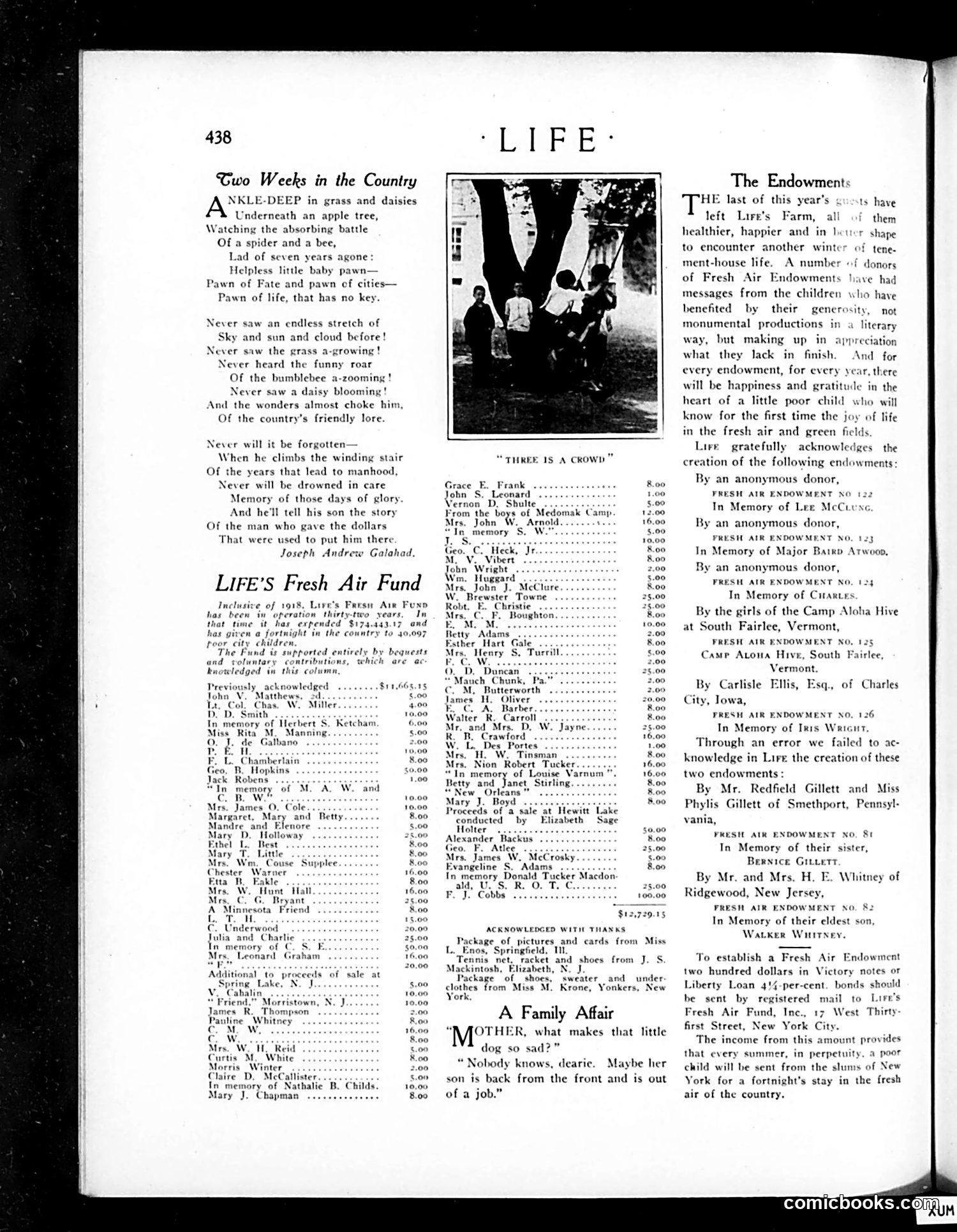
This page contains three distinct sections: 1. **"Two Weeks in the Country"** — A nostalgic poem celebrating rural childhood experiences (nature, freedom, simplicity). 2. **"Three is a Crowd"** — A photograph with accompanying donation list for Life's Fresh Air Fund, a charitable program sending poor urban children to the countryside for summer stays. The donations range from $2 to $100, representing middle-class philanthropic support. 3. **"A Family Affair"** — A brief comic dialogue about a dog and a missing son, likely a joke about domestic life. The page primarily functions as **charitable fundraising**, reflecting early 20th-century Progressive Era values: helping impoverished city children experience nature's moral and health benefits. The satire is minimal; instead, the content promotes middle-class benevolence toward the urban poor.
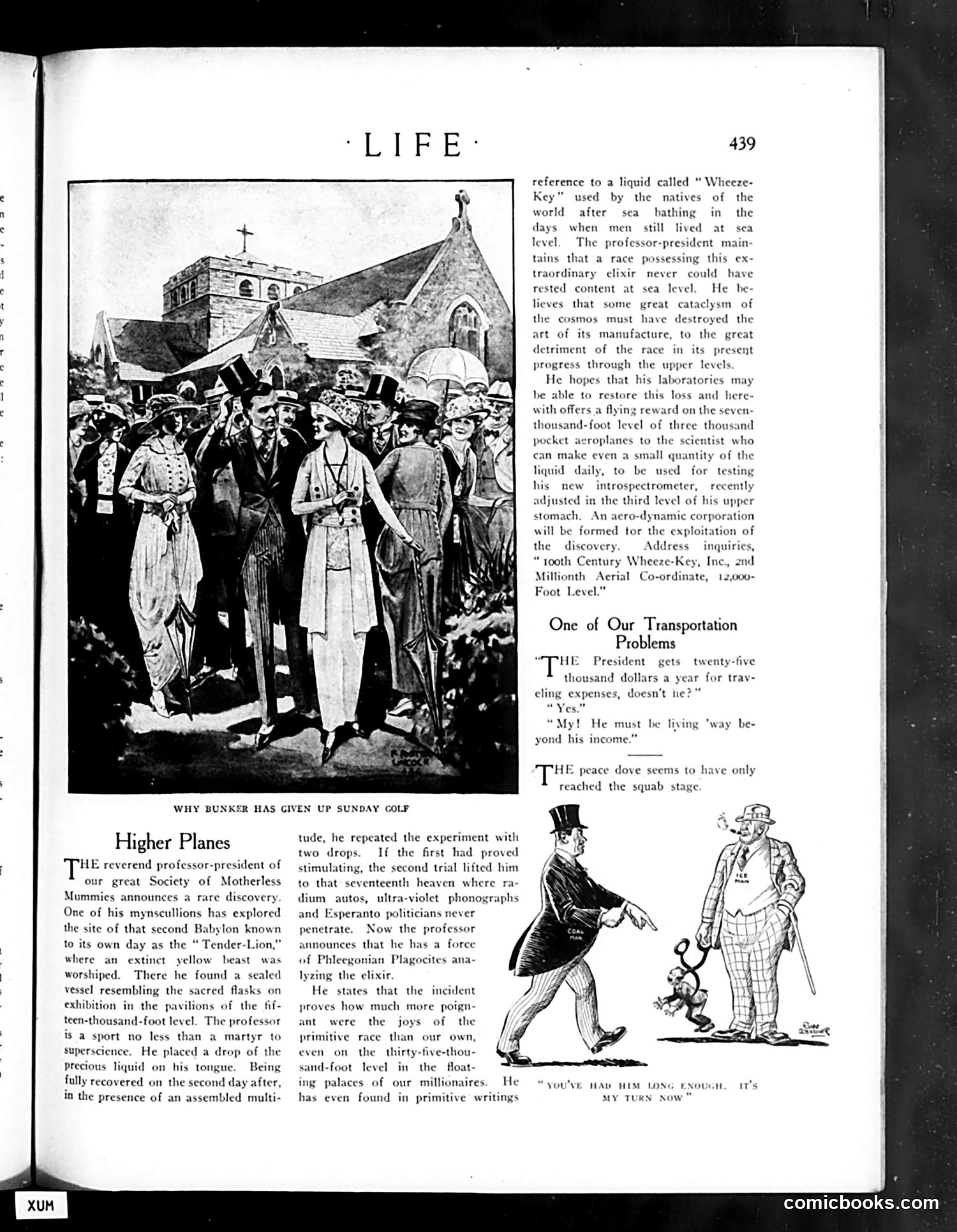
This page satirizes a wealthy man ("the President") who receives $25,000 annually for travel expenses yet lives beyond his means. The main cartoon depicts a church gathering, illustrating the article's premise: even the affluent struggle with overspending. Below, a smaller comic shows a man in formal dress being chased by a woman holding what appears to be a bill or notice, while another man watches. The caption reads: "You've had him long enough. It's my turn now"—suggesting debt collectors or creditors quarreling over who gets to pursue the debtor next. The satire mocks the financial irresponsibility of the wealthy elite during what appears to be the early 20th century, implying that even substantial incomes cannot satisfy excessive spending habits.
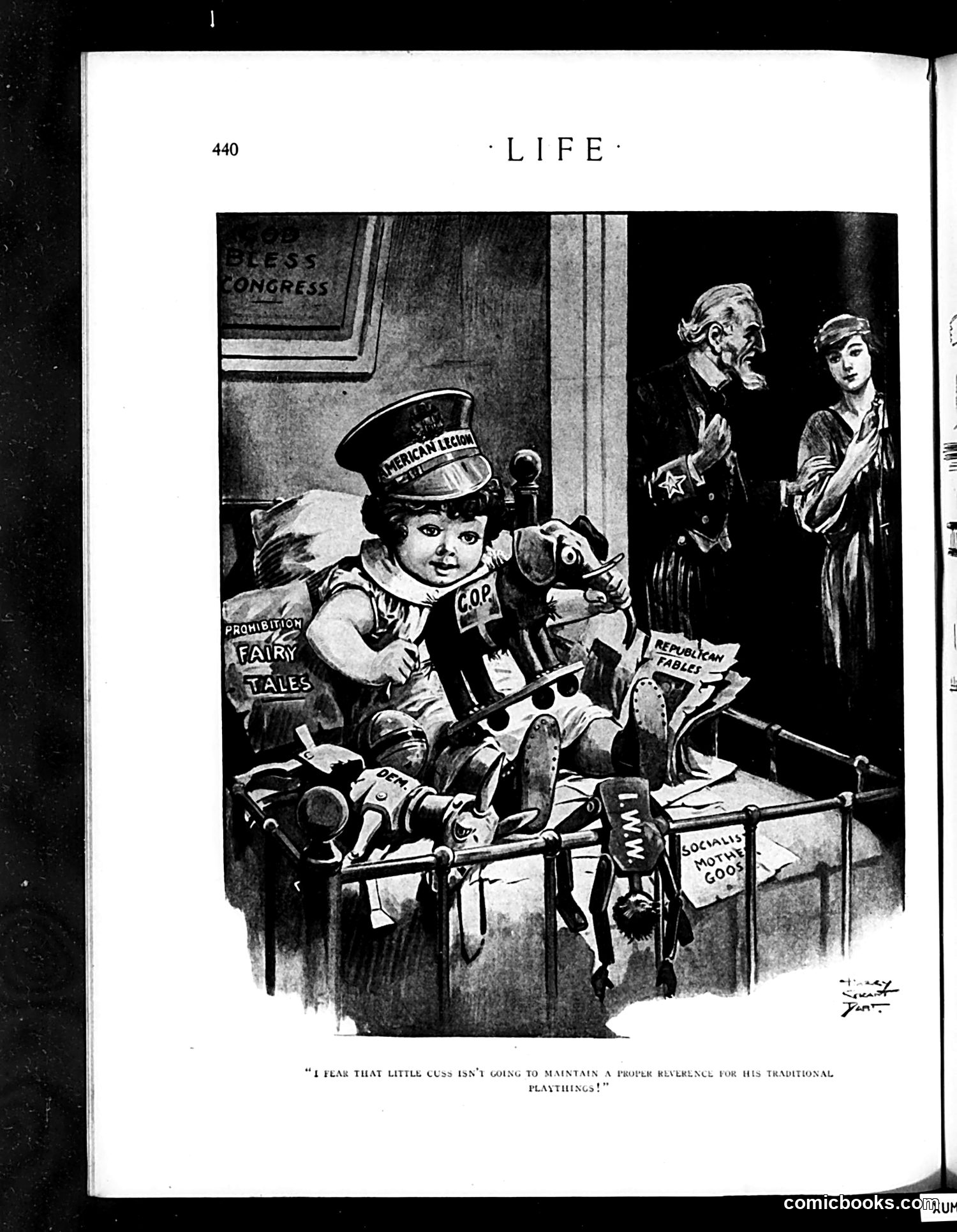
This political cartoon satirizes concerns about traditional American values being threatened by radical ideologies. A cherubic child wearing an "American Legion" cap sits surrounded by propaganda materials labeled "Prohibition Fairy Tales," "G.O.P." (Republican Party), "Republican Fables," and "Socialist Moth Goods." Two sinister figures lurk in the background, appearing to influence the scene. The caption reads: "I fear that little cuss isn't going to maintain a proper reverence for his traditional playings!" The cartoon reflects post-WWI anxieties about socialist and communist influence corrupting American youth and institutions. The American Legion figure represents traditional patriotic values, while the surrounding ideological materials suggest competing worldviews vying for children's allegiance. The ominous figures likely represent foreign or radical agitators.
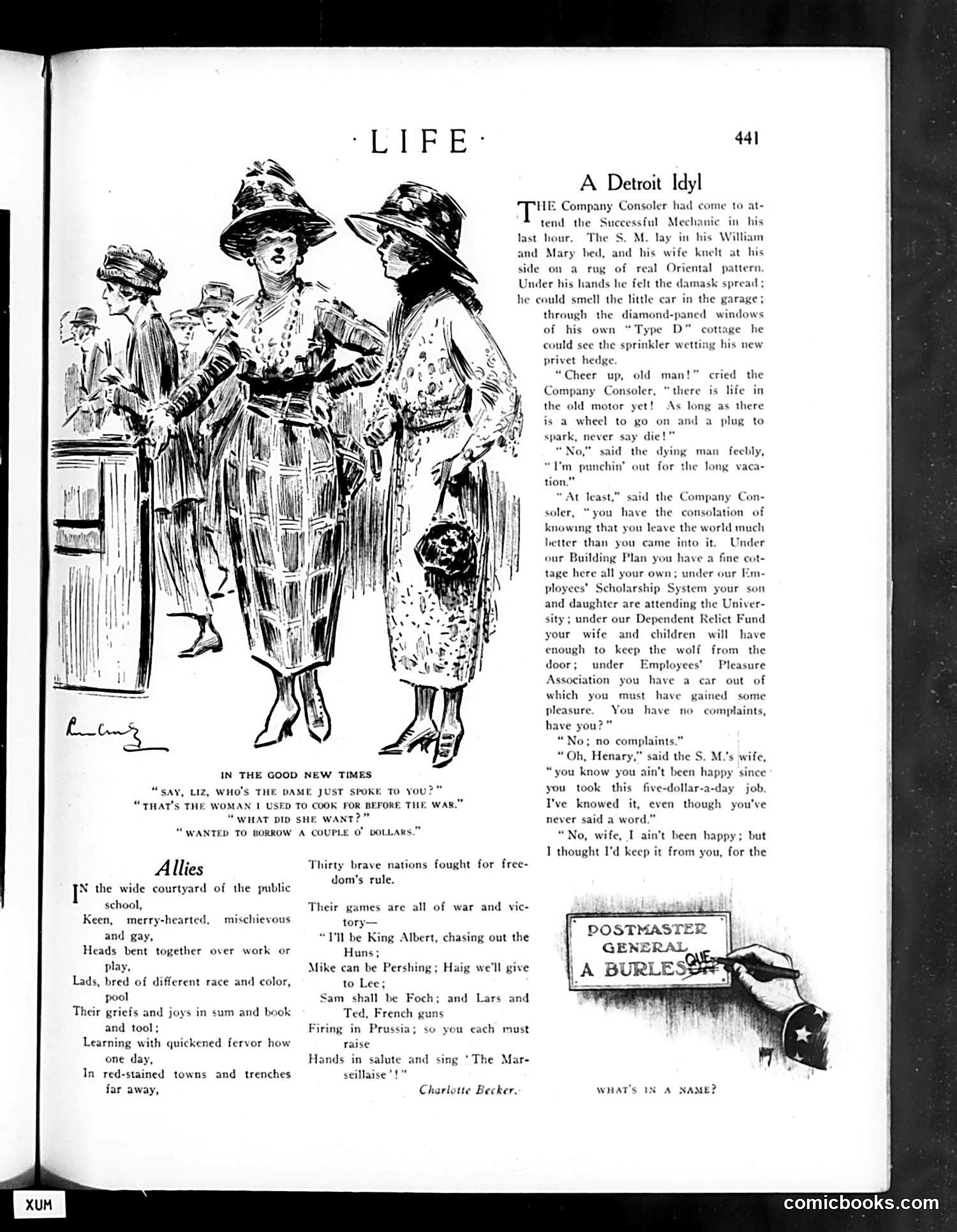
**Top Illustration: "A Detroit Idyl"** This sketch depicts a dying automobile mechanic being consoled by a company representative. The consoler lists employee benefits (cottage, scholarship fund, relief fund, car privileges) to comfort the dying man. The satire critiques corporate paternalism—companies offering modest benefits while workers remain economically precarious. The irony: despite these programs, the man is still dying, suggesting benefits mask systemic inadequacy. **Bottom Section: "Allies"** A patriotic poem about Allied nations fighting in World War I, naming specific countries (King Albert, Pershing, etc.) and their military contributions. This appears to be earnest wartime propaganda rather than satire, celebrating international cooperation against Germany. The page contrasts corporate cynicism with genuine patriotism.
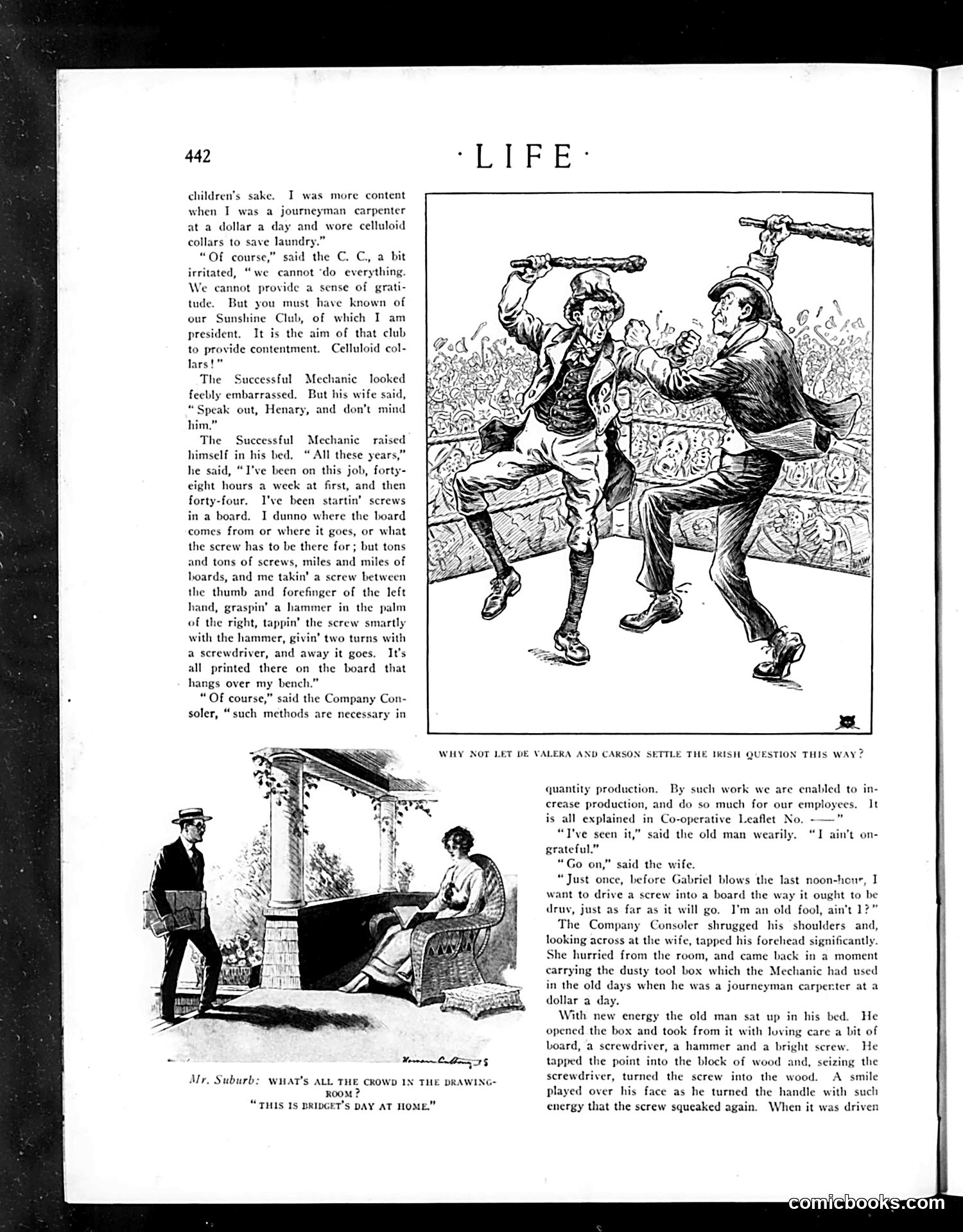
This page contains two distinct cartoons satirizing labor and domestic life. **Top cartoon**: Shows two men in a physical altercation over what appears to be carpentry work. The accompanying text discusses "Successful Mechanic" and disputes about work methods—specifically how to drive screws properly. The satire targets working-class disagreements about trade practices and pride in one's craft. **Bottom cartoon**: Titled "Mr. Suburb: What's All the Crowd in the Drawing-Room? 'This is Bridget's Day at Home,'" depicts a domestic servant (Bridget, likely Irish given the stereotype) entertaining visitors in the drawing room while her employer observes. The joke satirizes class pretensions and the unusual sight of a servant being granted social time in the formal room—a humorous inversion of domestic hierarchy.
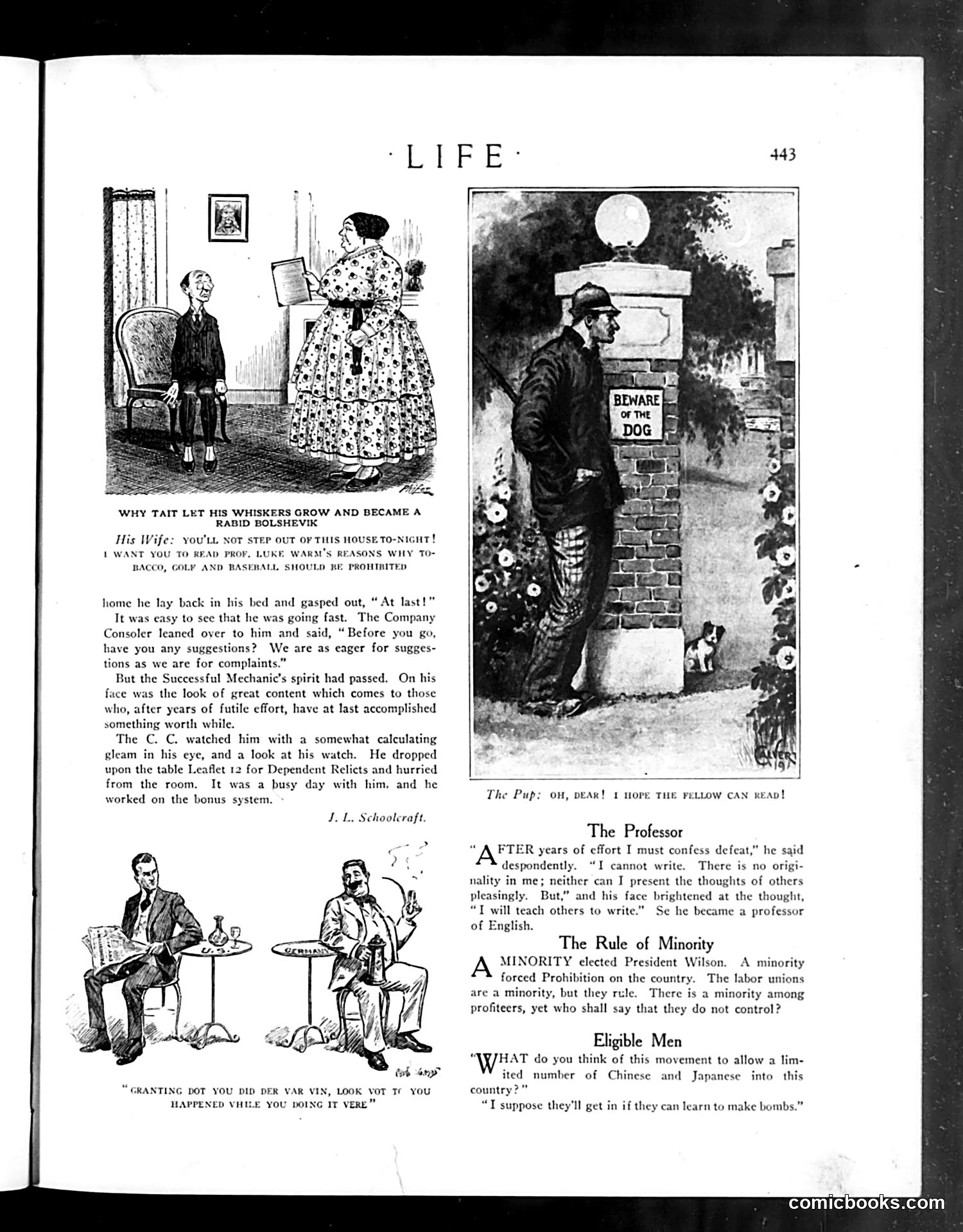
This page contains several unrelated satirical pieces: **"Why Tait Let His Whiskers Grow"** (top left): A domestic scene where a wife forbids her husband from leaving the house at night, claiming she wants to prevent his attendance at "tobacco, golf and baseball." The joke satirizes restrictive spouses and temperance-era wives who controlled husbands' leisure activities. **"The Pup"** (right image): A man passes a "Beware of the Dog" sign. The caption suggests he hopes "the fellow can read"—likely mocking either the dog's literacy or the man's naïve optimism about warning signs. **"The Professor," "The Rule of Minority," and "Eligible Men"** (bottom sections): These appear to be brief satirical commentaries on education, politics (Wilson's presidency, Prohibition, labor unions), and immigration policy, though the text is partially cut off.
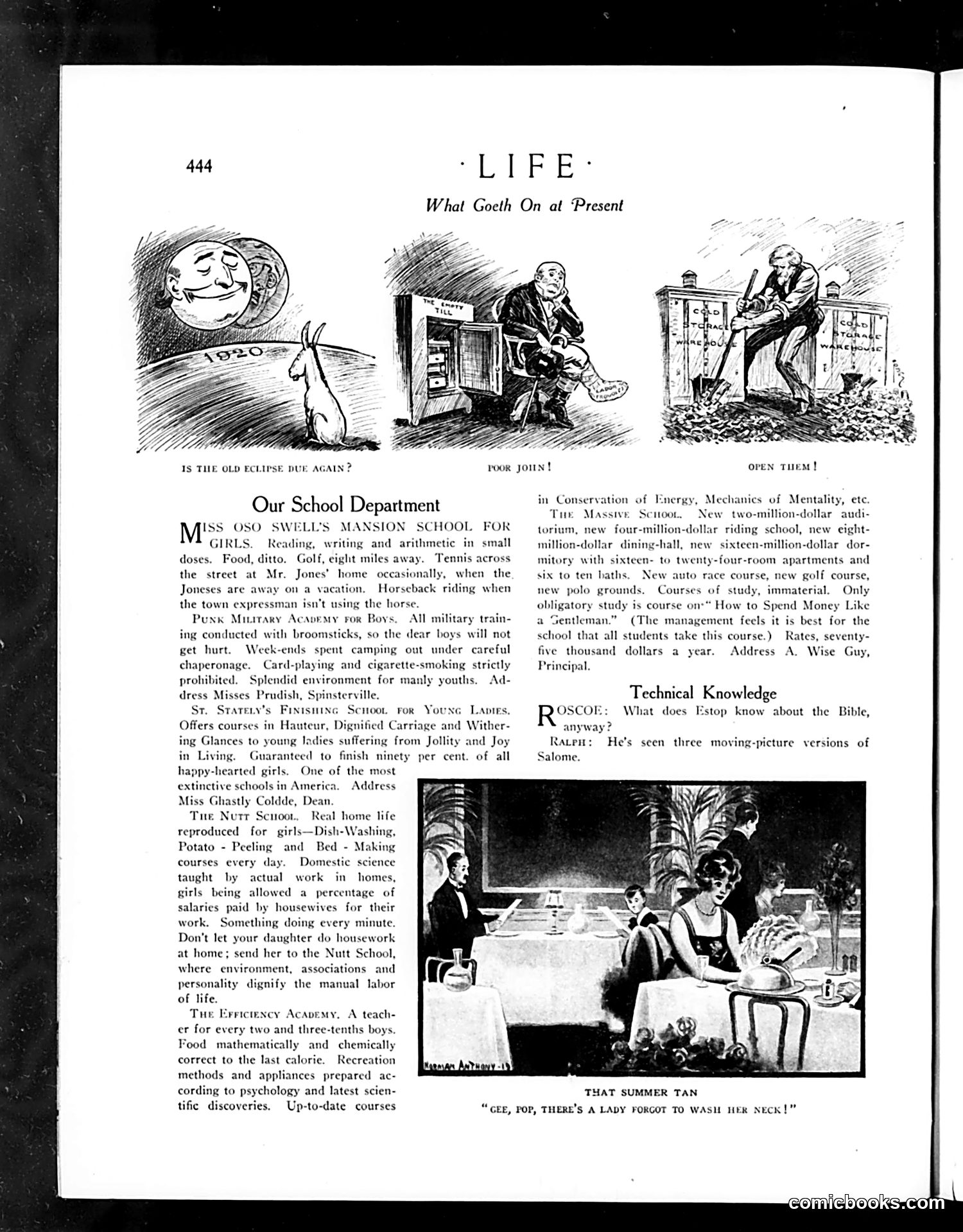
This page contains three political cartoons satirizing 1920s educational trends: 1. **"Is the old eclipse due again?"** A smiling moon/face labeled "1920" watches a goat—likely representing traditional learning or stability—disappear over a horizon, suggesting educational institutions are abandoning established values. 2. **"Poor John!"** A figure sits slumped outside a building, apparently representing a schoolmaster exhausted by modern educational demands and reform pressures. 3. **"Open Them!"** Two figures at filing cabinets labeled with educational terms suggest bureaucratic growth and administrative bloat in schools. The cartoons collectively mock progressive educational reforms and the expanding complexity of school administration during the 1920s, a period of significant pedagogical debate in America. The satire targets both the abandonment of classical methods and institutional inefficiency.
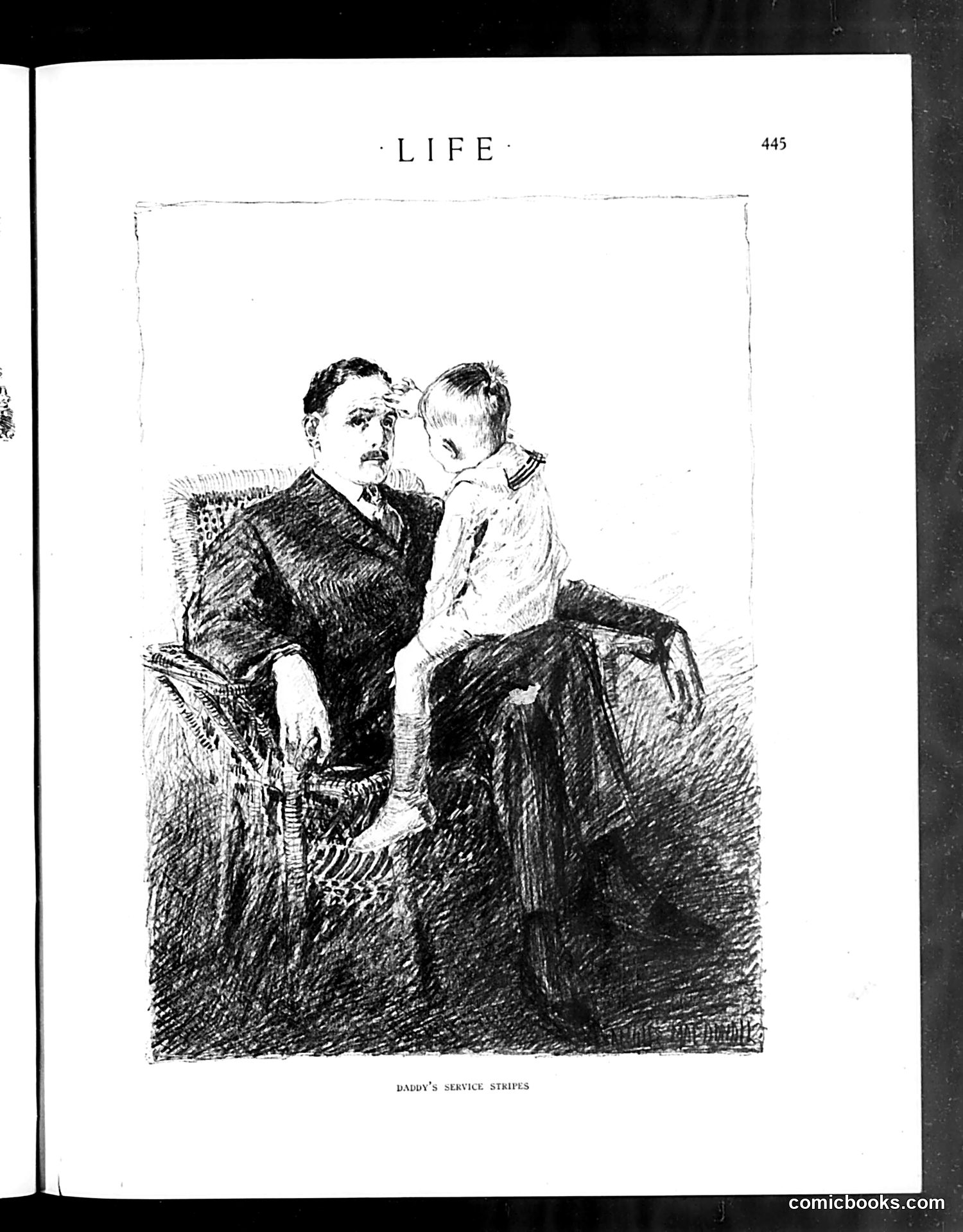
This sketch depicts a man holding a young child on his lap. The title "Daddy's Service Stripes" refers to the military stripes visible on the man's uniform sleeve, suggesting he's a serviceman or soldier. The satire appears to comment on fatherhood during wartime—specifically, the idea that a father's "service" includes both military duty and domestic responsibilities like childcare. The child represents the "stripes" of service earned through parenting duties, humorously equating civilian family obligations with military rank insignia. This likely dates from a period when Life magazine addressed how war affected home life and family structures, treating the dual "service" of soldiers who were also fathers as worthy of satirical commentary.
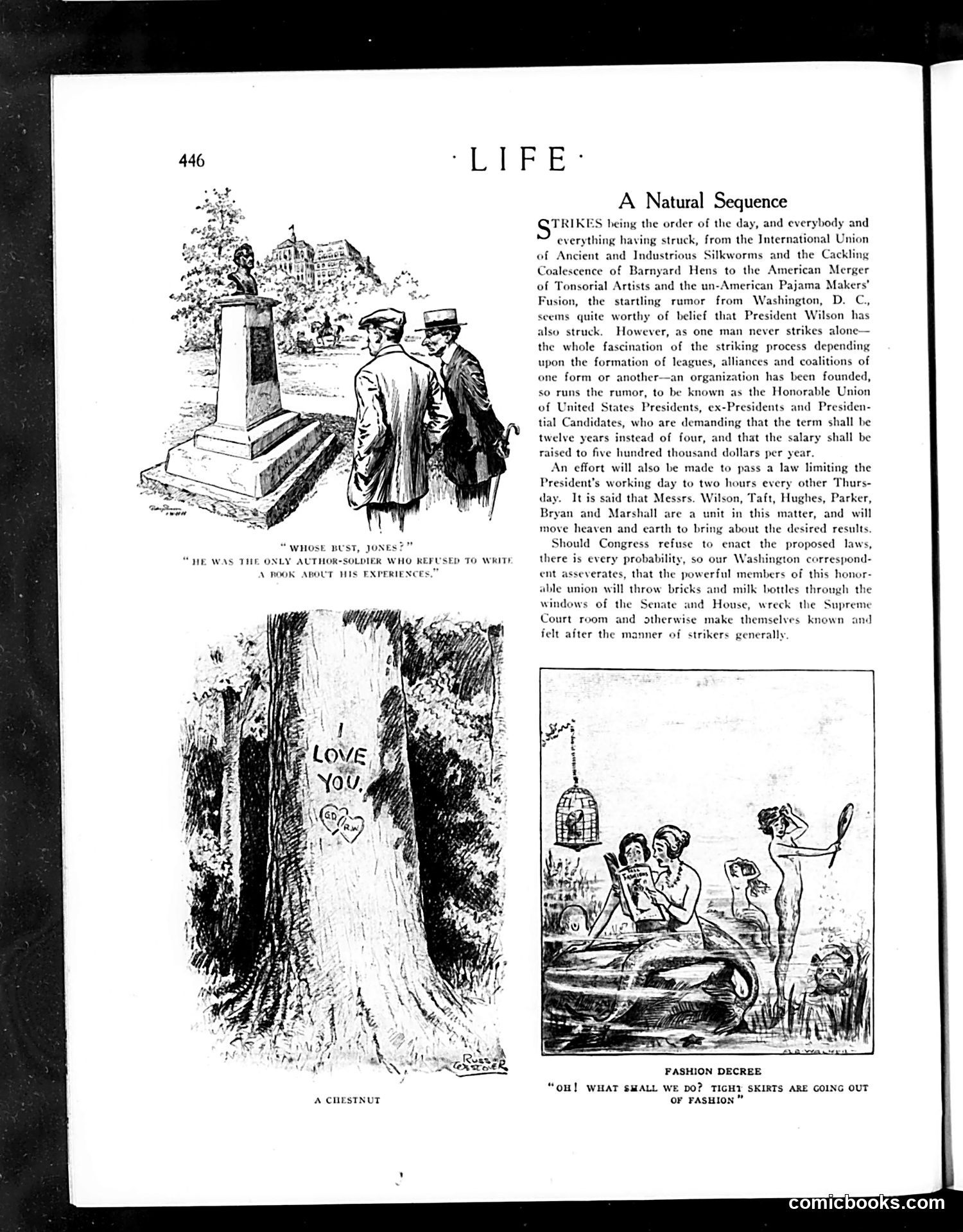
This page satirizes the epidemic of labor strikes occurring in America by imagining President Wilson and other former presidents forming a union demanding better working conditions. The text mockingly lists absurd "strikes" by everything from silkworms to barnyard hens, then proposes that presidents themselves have unionized, demanding twelve-year terms instead of four, $500,000 annual salaries, and a two-hour work week. The top cartoon shows two men at a bust, with a caption about an "author-soldier" who refused to write about his experiences—likely referencing a contemporary public figure. The middle illustration depicts a tree carved with "LOVE YOU"—a sentimental cliché. The bottom cartoon shows fashionable women, with the caption joking that tight skirts are going out of fashion—a lighthearted jab at contemporary clothing trends. Overall, the page uses humor to mock both the strike movement's proliferation and the notion that even presidents might demand labor protections.
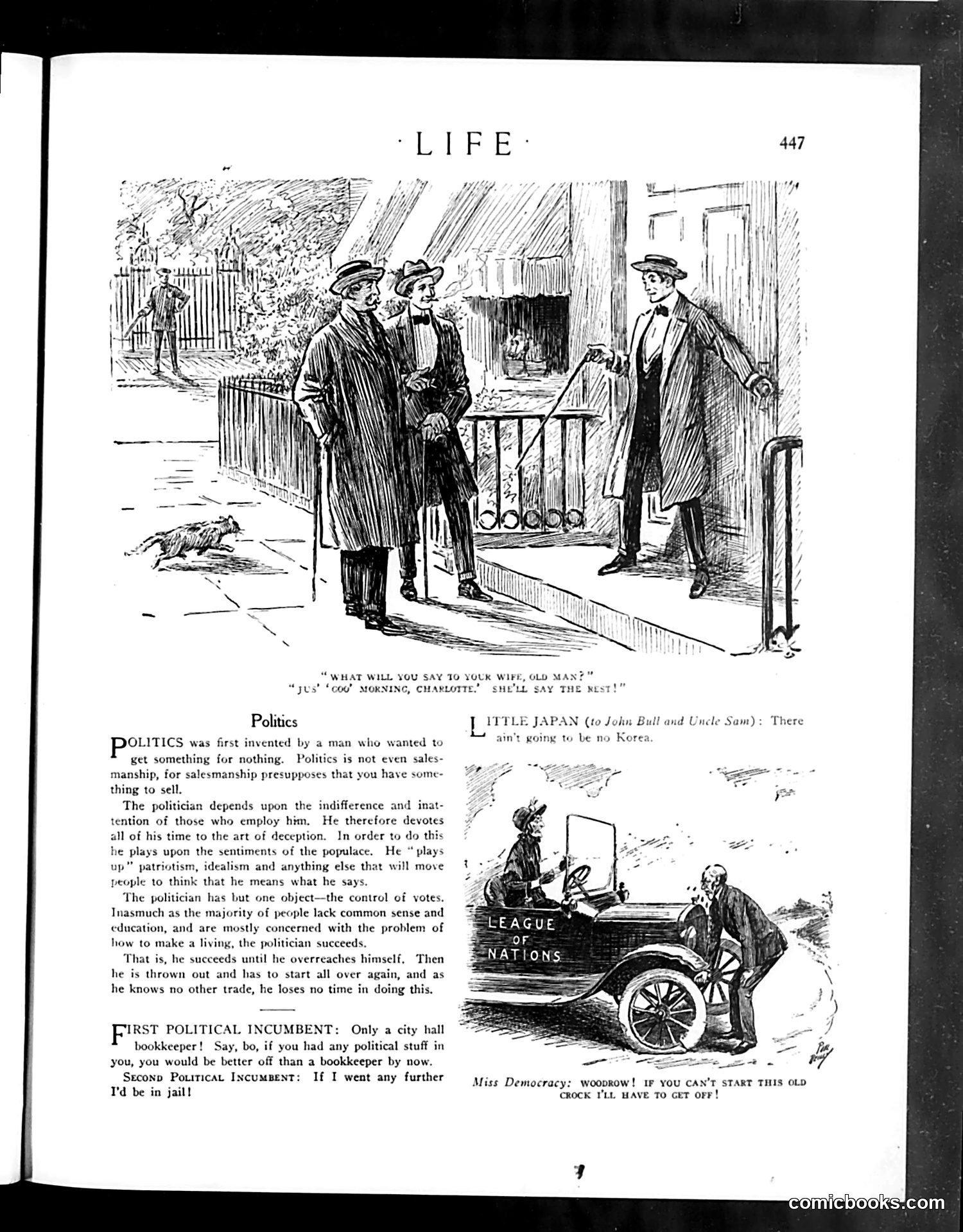
This page contains cynical commentary on American politics circa World War I era. The top cartoon shows a man anxious about explaining something to his wife—likely referring to political corruption or embarrassing behavior he'll need to justify at home. The main text argues politicians are inherently corrupt: they seek power through deception rather than genuine service, exploiting public ignorance and patriotic sentiment to control votes. The dialogue between two "political incumbents" suggests that advancement in politics inevitably leads to criminality—one warns the other that greater political success would land him in jail, implying corruption is systemic. The smaller cartoons address international affairs: "Little Japan" warns John Bull (Britain) and Uncle Sam (America) that Korea will face Japanese control; "Miss Democracy" struggles to start an old vehicle labeled "League of Nations," suggesting post-WWI international cooperation efforts are stalled or failing. The overall message critiques politicians as self-serving fraudsters while democracy itself appears broken.
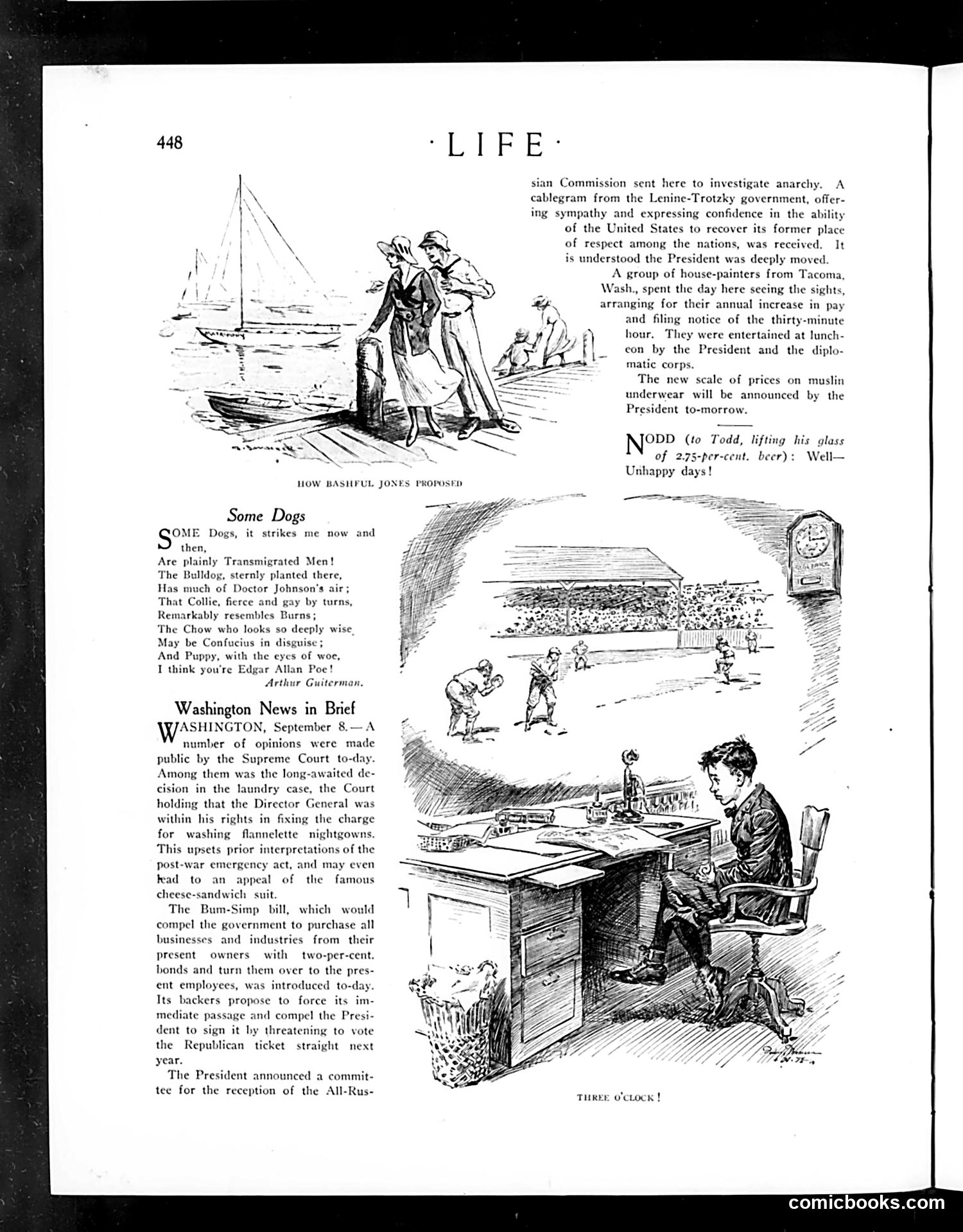
This page satirizes post-WWI American politics and social absurdities circa 1920. The "Washington News in Brief" mocks government overreach: a Supreme Court decision on laundry charges reflects bureaucratic triviality, while the fictional "Bum-Simp bill" parodies radical socialist legislation (likely referencing actual labor-movement proposals). The joke about the Lenin-Trotsky commission references Soviet diplomatic recognition efforts, treating American-Russian relations as laughably presumptuous. The beer reference (2.75-percent) alludes to Prohibition-era weak beer regulations. House-painters demanding 30-minute hours satirizes union demands perceived as excessive. "Some Dogs" is a whimsical poem comparing dogs to famous historical figures (Doctor Johnson, poet Burns, Confucius, Edgar Allan Poe)—intellectual humor unrelated to politics. The illustrations depict leisurely seaside scenes and a child at play—contrasting with the satirized bureaucratic chaos, emphasizing Life's mockery of government pretension versus ordinary American life.
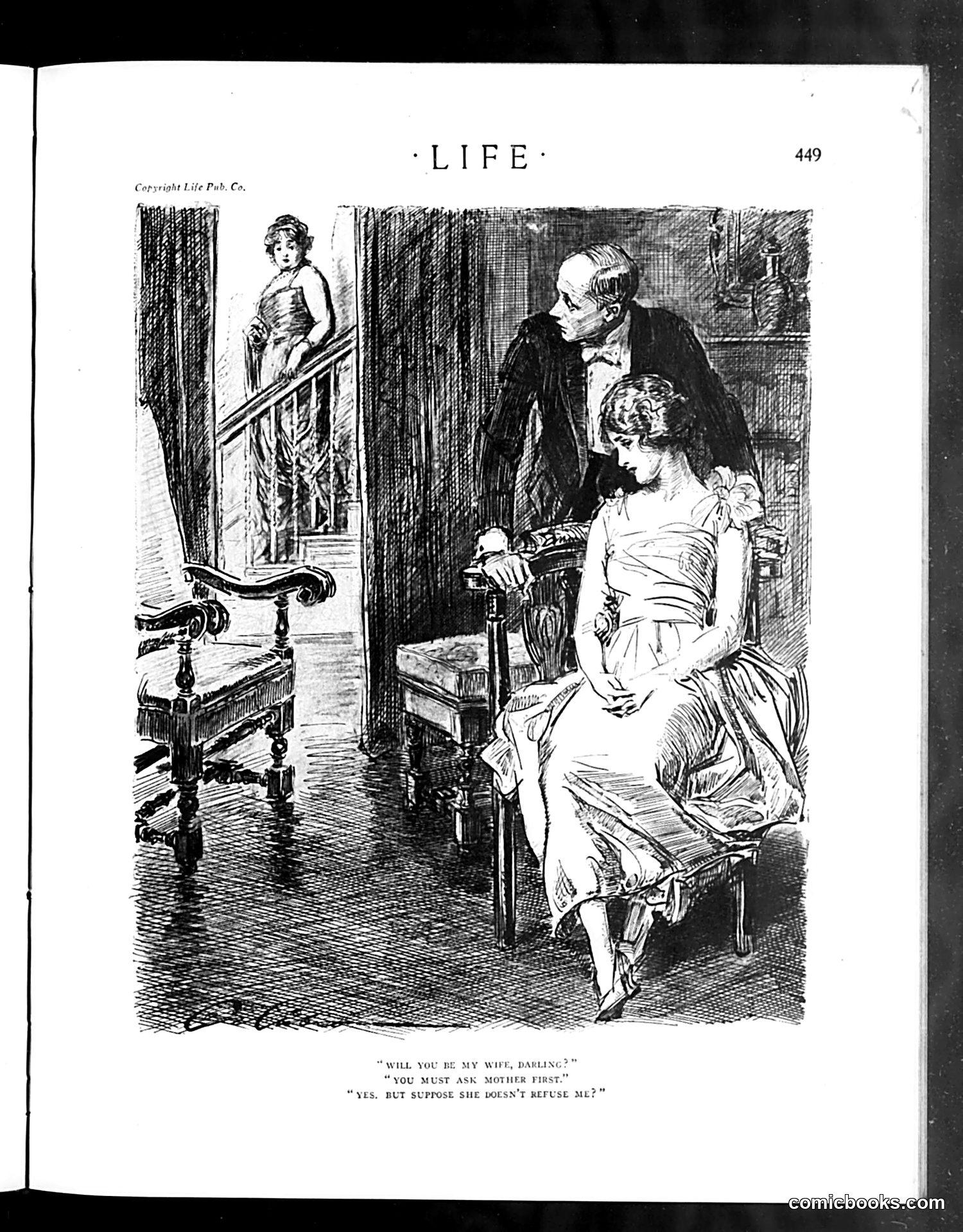
This is a satirical domestic scene from *Life* magazine (page 449). A young woman sits while an older man stands behind her, apparently proposing marriage. The dialogue reveals the joke's point: **"Will you be my wife, darling?"** **"You must ask mother first."** **"Yes, but suppose she doesn't refuse me?"** The humor mocks the social convention requiring a suitor to seek parental permission before proposing. The man's final quip—that he fears the *mother* might accept him as a suitor instead—satirizes the era's marriage-market dynamics where mothers were sometimes portrayed as overeager to secure advantageous matches. The cartoon pokes fun at both rigid courtship rituals and the stereotype of interfering mothers-in-law.
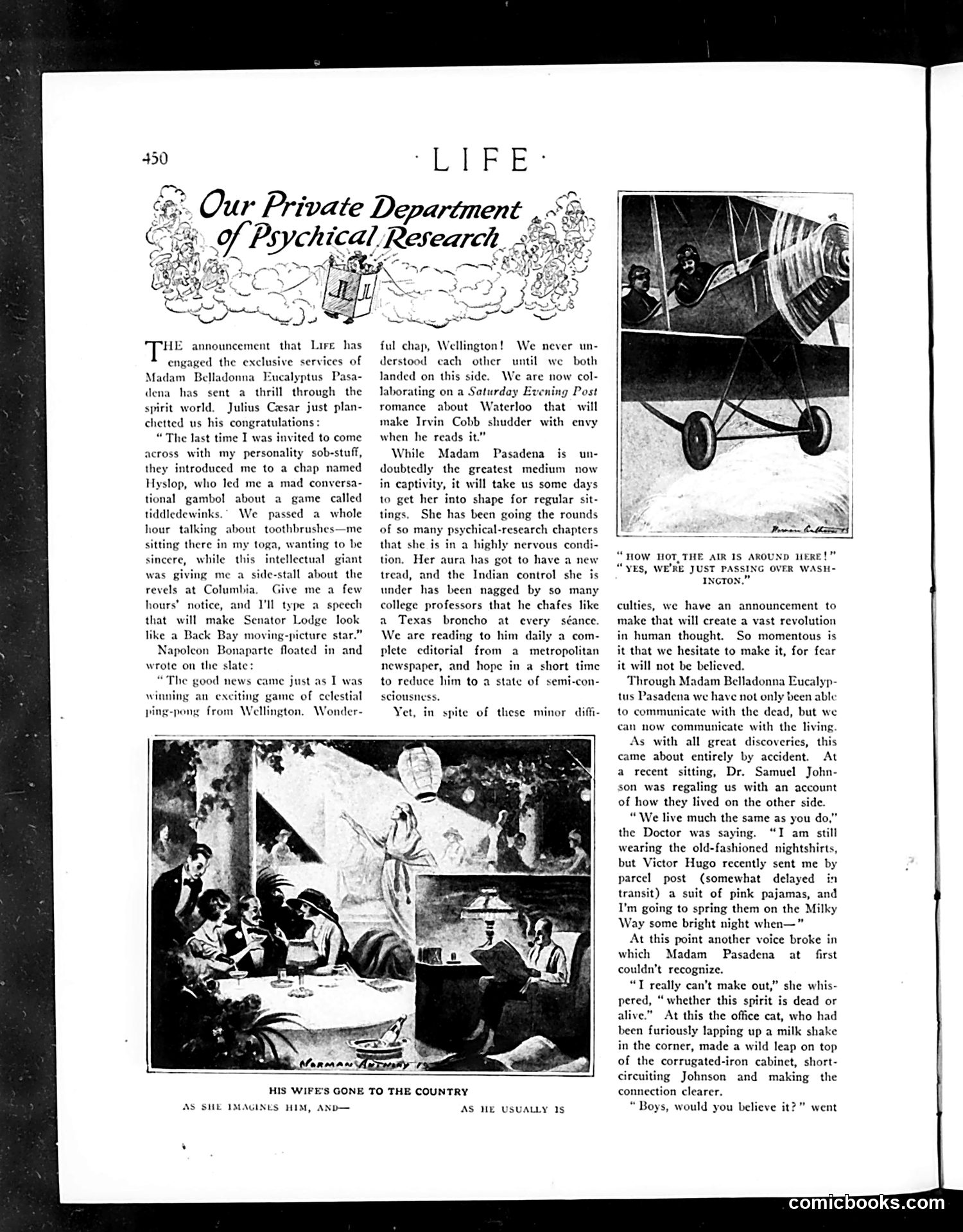
This satirical piece mocks the early 20th-century craze for spiritualism and séances. Life magazine announces it has hired "Madam Belladonna Eucalyptus Pasadena"—a transparently ridiculous name—as an exclusive medium to communicate with the dead. The humor operates on multiple levels: famous historical figures (Julius Caesar, Napoleon Bonaparte, the Duke of Wellington) supposedly send messages via planchette, discussing absurdities like tiddledywinks and ping-pong. The satire escalates when the magazine claims to accidentally contact *living* people instead of the dead, with a punchline involving the office cat short-circuiting the spiritual connection. The accompanying illustration depicts a séance scene. The joke targets gullible spiritualism enthusiasts, charlatan mediums, and the pseudoscientific pretensions of psychical research societies that were genuinely popular and credible-seeming to many Americans at this time. Life's tone suggests the whole enterprise is transparently fraudulent—perfect fodder for their satirical magazine.
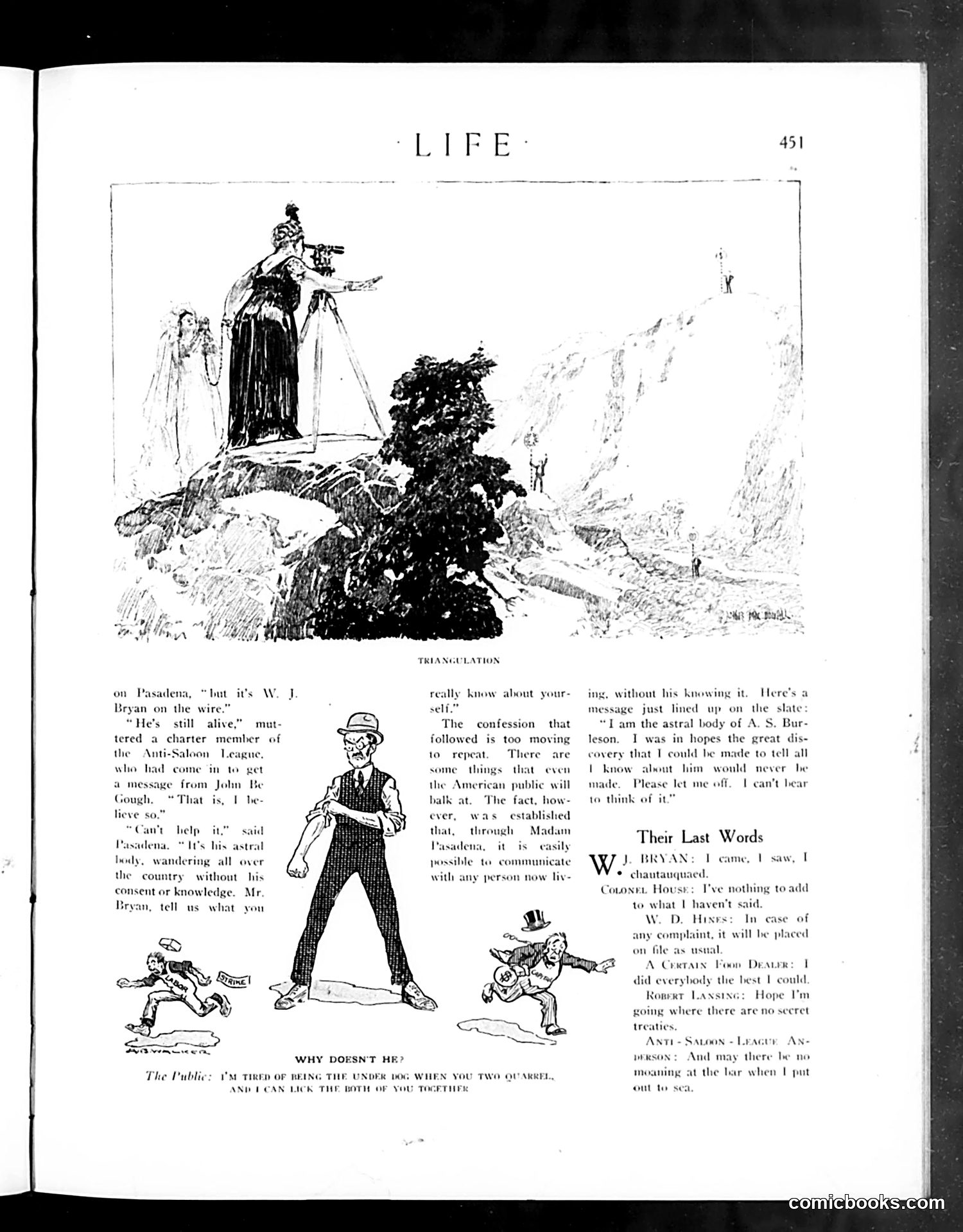
This page satirizes **William Jennings Bryan** and related political figures through spiritualism and debate mockery. The main cartoon "Triangulation" depicts a medium claiming to contact Bryan's "astral body" wandering the country without his consent—a jab at Bryan's constant speaking tours and public prominence. The joke is that even his spirit can't escape performing. The section "Their Last Words" parodies famous last statements from political adversaries: Bryan (chautauquaed—exhausted from speeches), W.D. Hirst, a food dealer, Robert Lansing (Secretary of State, criticizing secret treaties), and an Anti-Saloon League representative. The humor mocks these figures' obsessions and legacies. The lower cartoon "Why Doesn't He?" shows the Public as referee between quarreling figures, tired of being caught in their conflicts—likely referencing Bryan's perennial presidential campaigns and divisive political feuds. The satire targets Bryan's relentless public presence, political rivalry, and the era's temperance and foreign policy debates.
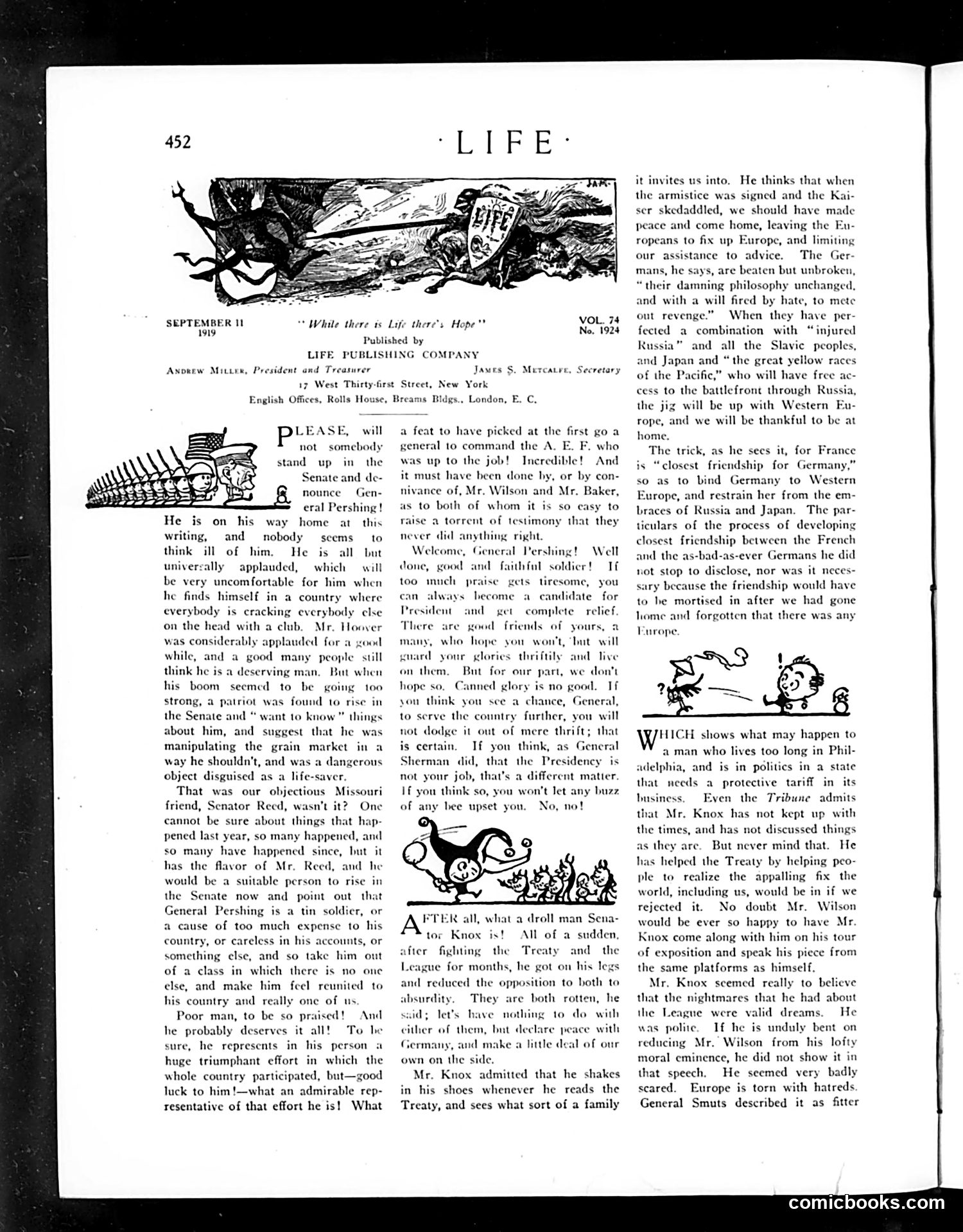
This editorial page satirizes American political figures in the immediate post-war period. The main targets are: **General Pershing**: The piece mockingly warns that excessive praise for the successful WWI commander may invite political criticism—as happened to Herbert Hoover. It suggests Senator Reed might attack Pershing to diminish his popularity. **Senator Knox**: Described as "droll," Knox is ridiculed for suddenly opposing the League of Nations Treaty after months of fighting it. The satire criticizes his proposed alternative: declaring peace with Germany separately and withdrawing American involvement from European affairs. The cartoons (showing caricatured political figures) accompany arguments that Knox underestimates German threat ("their damning philosophy unchanged") and that isolationism is naive. The piece defends the Wilson administration's treaty position against Republican opposition. The context: This reflects fierce 1919 Senate debates over the League of Nations, which ultimately failed ratification.
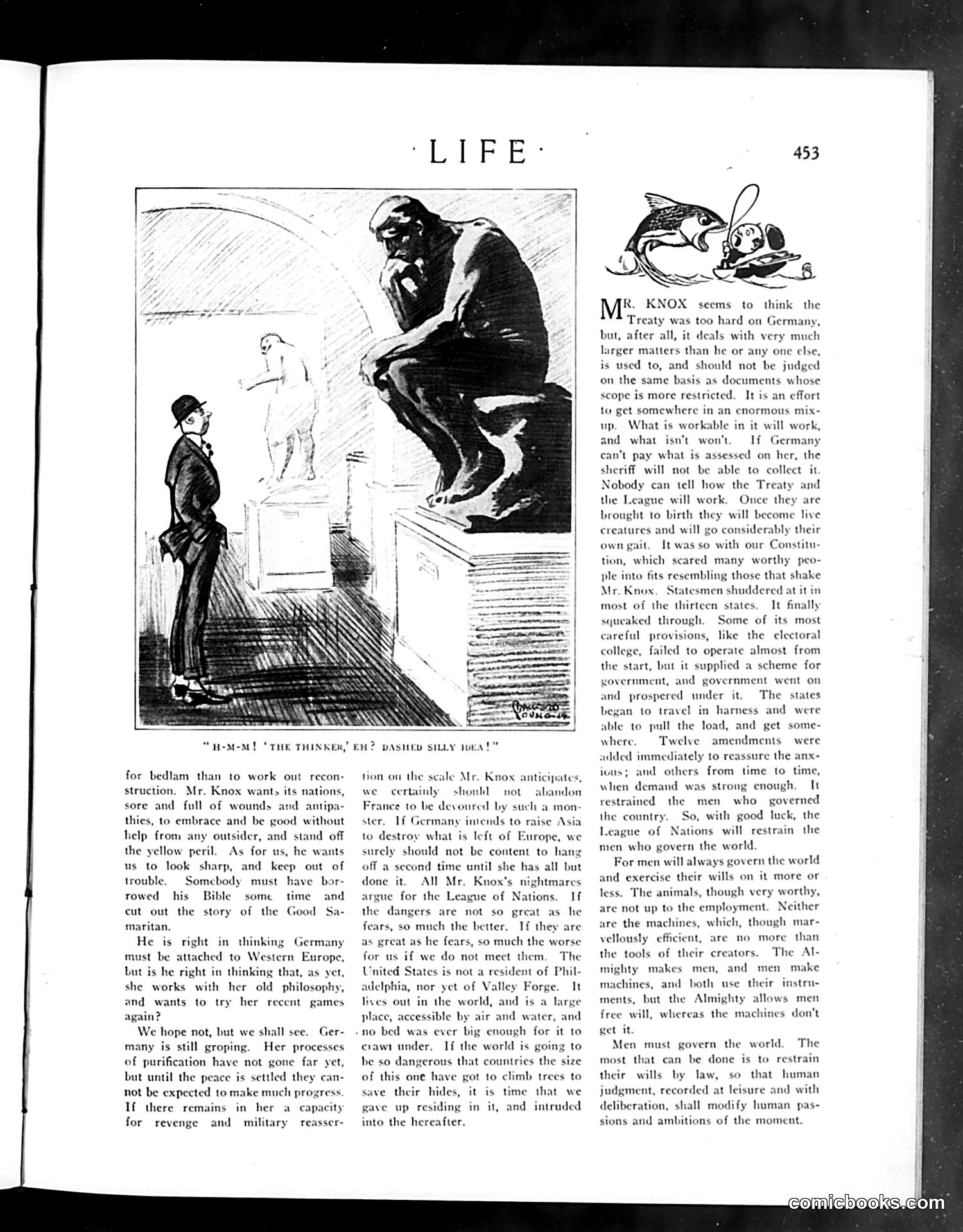
This page critiques Secretary of State Frank B. Knox's skepticism toward the Treaty of Versailles and the League of Nations. The cartoon shows a figure (Knox) contemplating a large, brooding "Thinker"-like figure—likely representing Germany or post-war European problems. The text argues Knox underestimates the Treaty's scope and purpose. It's not a simple financial document but addresses massive geopolitical reconstruction. The author defends the League's necessity: if Germany remains genuinely dangerous, isolationism (Knox's apparent position) won't protect America. The comparison to the U.S. Constitution—initially feared but ultimately workable—suggests the League will succeed through practice despite imperfect design. The satire mocks Knox's simplistic "stay out of trouble" philosophy, countering that America cannot isolate itself from a world it inhabits. The piece emphasizes that humans (not machines or animals) must govern, and restraining power through institutions like the League is essential.
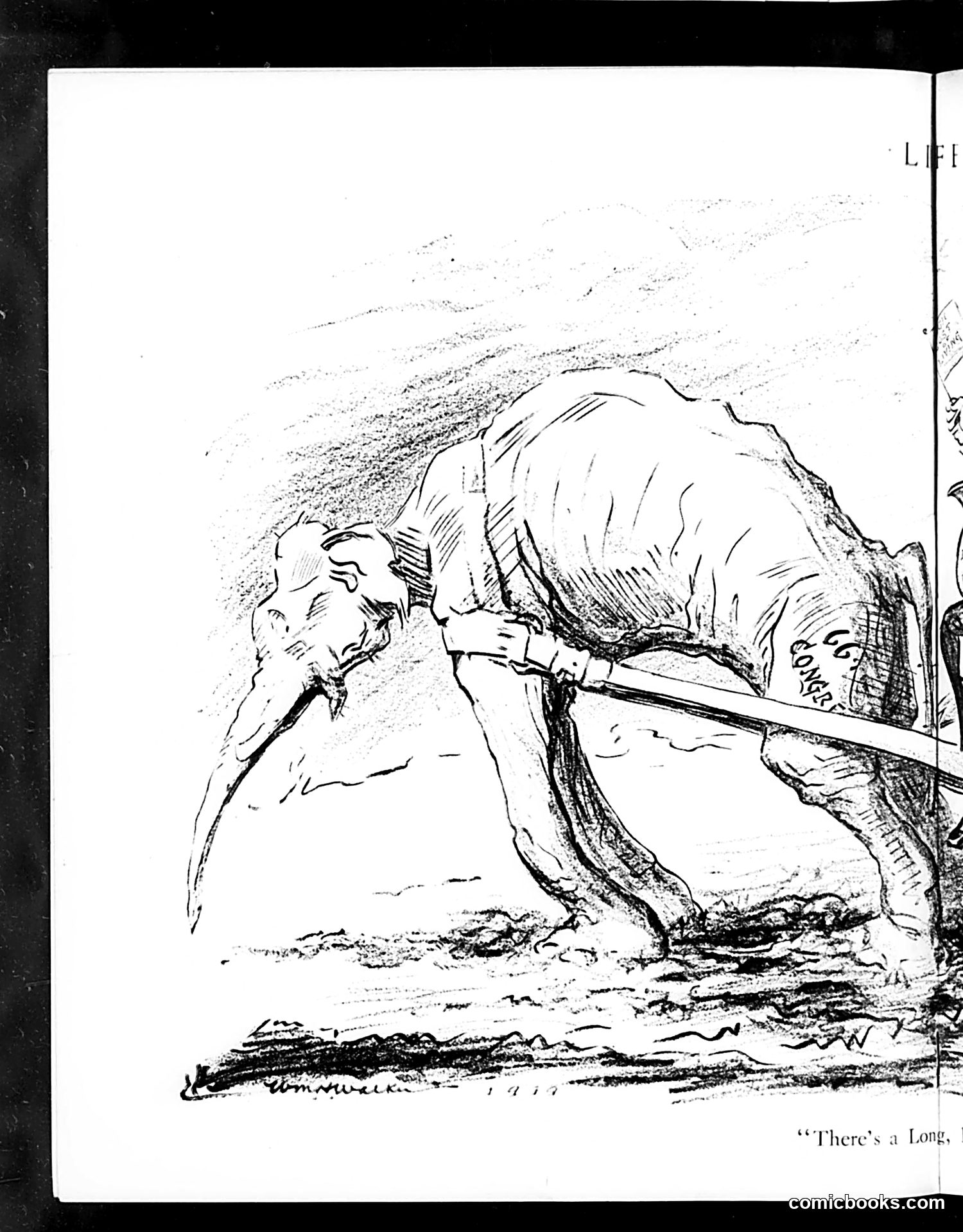
This sketch depicts an elephant wearing what appears to be a saddle or harness, being led or controlled by a rope. The elephant is the traditional symbol of the Republican Party in American political cartoons. The partial caption "There's a Long," (text cut off) suggests this cartoon comments on a prolonged situation or struggle. The imagery of the elephant being restrained or directed implies the cartoonist is commenting on Republican Party control or manipulation—possibly by a political figure or faction. However, without the complete caption and publication date visible, I cannot definitively identify the specific political figures, events, or controversy being satirized. The cartoon clearly critiques how the Republican Party or its leadership is being directed or controlled, but the full context remains unclear from this page fragment.
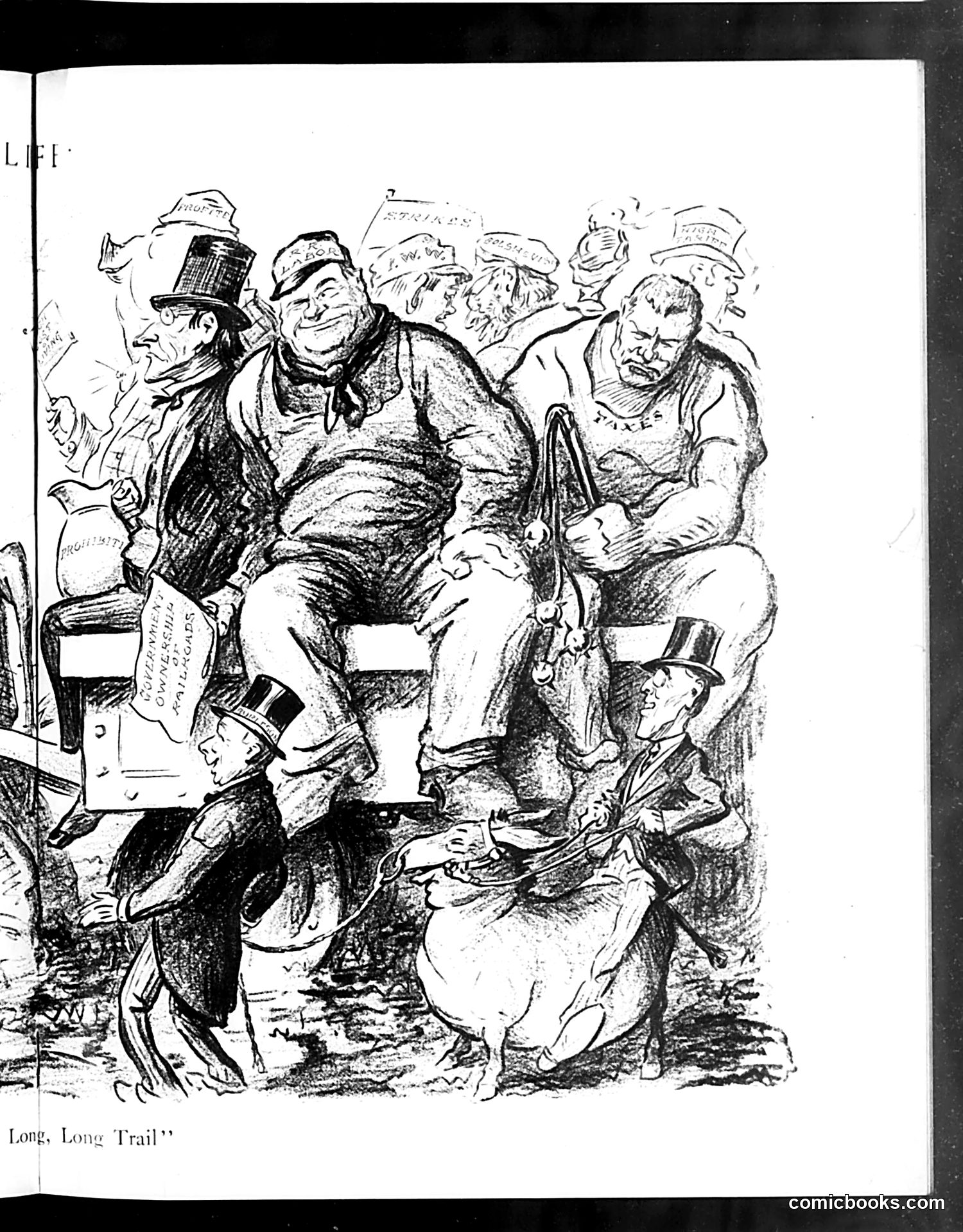
This satirical cartoon depicts a large central figure (likely representing a political leader or public figure) surrounded by smaller characters in top hats. The composition suggests a "long, lone trail"—a journey or ordeal. The style and clothing suggest late 19th or early 20th century American politics. The exaggerated physical proportions and caricature techniques were typical of *Life* magazine's satirical approach during this era. Without clearer text or additional context, I cannot definitively identify the specific political figures or events referenced. The cartoon appears to critique either a political figure's controversial path or decisions, with the surrounding characters possibly representing political allies, opponents, or public observers. The "trail" metaphor suggests a difficult or contentious journey through political circumstances.
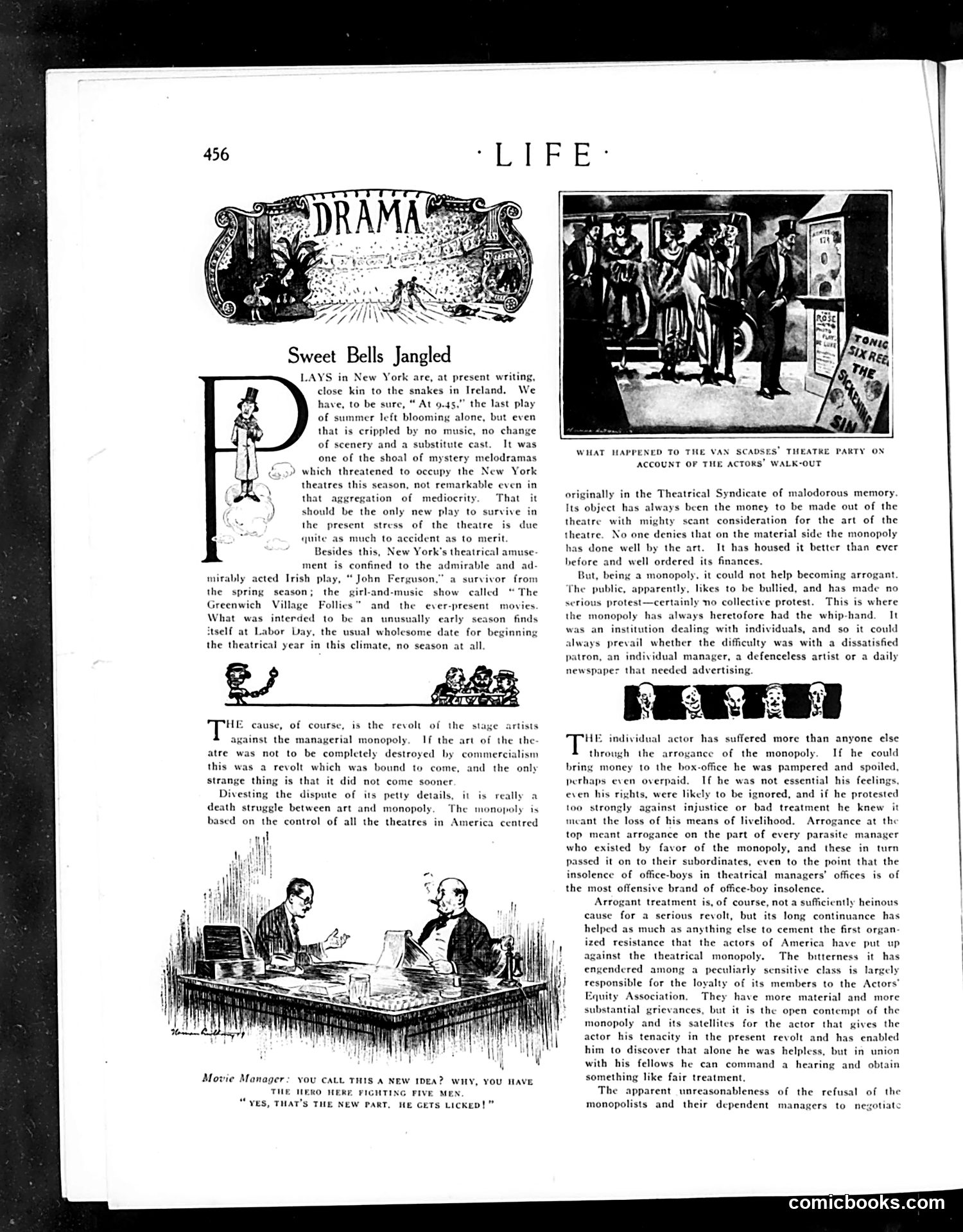
This 1919 *Life* magazine article discusses a actors' strike against theatrical monopolies controlling New York's stage. The cartoon illustrates the irony: a "Movie Manager" proposes showing a hero being defeated by five men as a "new idea," unaware this reflects the current real-world struggle—actors (the "hero") fighting against the theatrical monopoly's control. The article argues that while the monopoly improved theaters' physical conditions and finances, its arrogance toward individual actors was intolerable. Actors faced exploitation: pampered if profitable, ignored or punished if they protested mistreatment. The cartoon's dark humor captures how the actors' genuine grievance—powerlessness against concentrated corporate control—mirrors a lowbrow movie plot twist. The satire targets both the movie industry's creative bankruptcy and the monopoly's dismissive attitude toward workers' legitimate complaints.
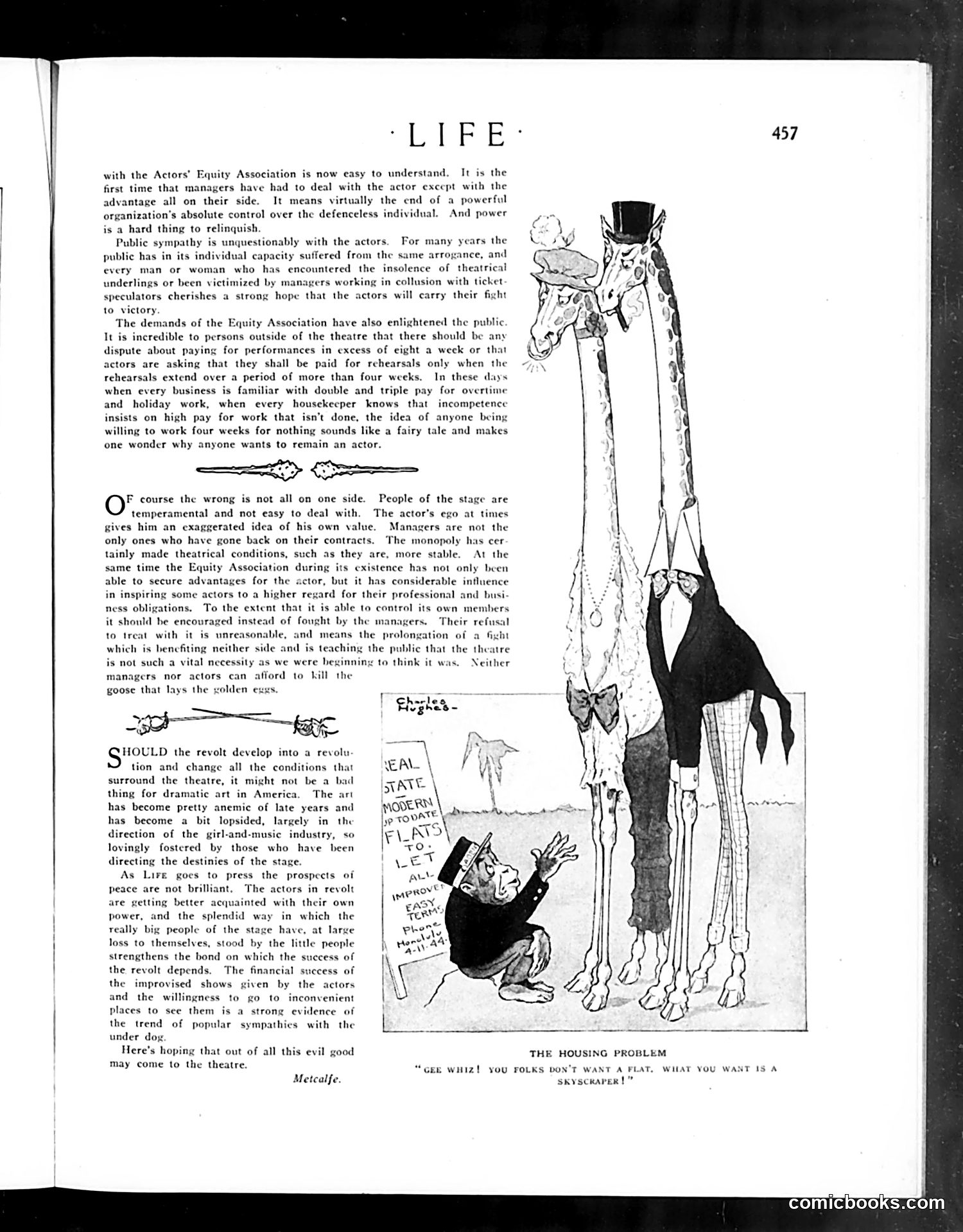
This page discusses the **Actors' Equity Association strike** (appears to be from 1919), presenting Life's editorial support for actors' labor demands against theatrical managers. The main cartoon, titled "The Housing Problem," depicts a landlord (drawn as a tall, thin figure) towering over a tiny tenant holding a sign listing grievances. The joke satirizes both the actors' strike and the broader post-WWI housing shortage: just as actors demand fair pay and working conditions, ordinary people desperately seek affordable housing. The landlord's dismissive response—that tenants want skyscrapers, not flats—mocks landlords' refusal to acknowledge legitimate housing needs, paralleling managers' dismissal of actors' reasonable demands (eight-hour days, paid rehearsals). The editorial argues actors' grievances are justified and that the Equity Association's existence has benefited even theatrical art itself. Life positions itself with "the under dog," hoping labor reform might revitalize American drama.
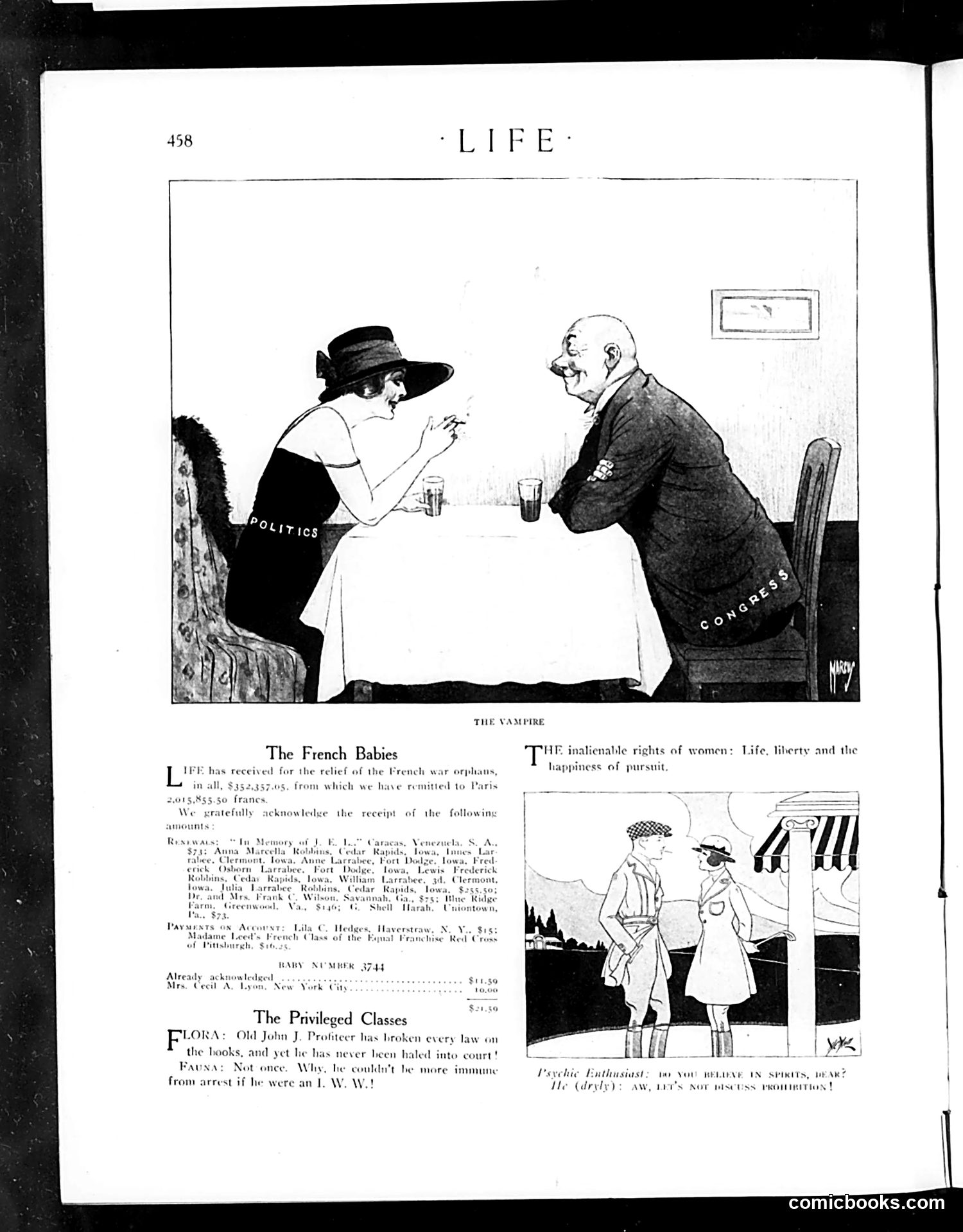
**"The Vampire"** (top): This cartoon satirizes the tension between "Politics" (represented by a woman in a fashionable hat) and "Congress" (a balding politician). The labels suggest Congress is being seduced or manipulated by political interests—the "vampire" imagery implying parasitic influence on government. **"The French Babies"** (left column): A charity appeal acknowledging donations for French war orphans, with editorial matter listing donors. This reflects post-WWI American charitable efforts. **"The Privileged Classes"** (bottom): A dialogue mocking wealthy industrialists ("profiteers"). Flora and Fauna—likely representing natural/social order—joke that a rich businessman is so immune to legal consequences he'd be safer from prosecution than an I.W.W. member (Industrial Workers of the World, a radical labor union). The satire critiques how wealth insulates the powerful from justice while radicals face arrest.
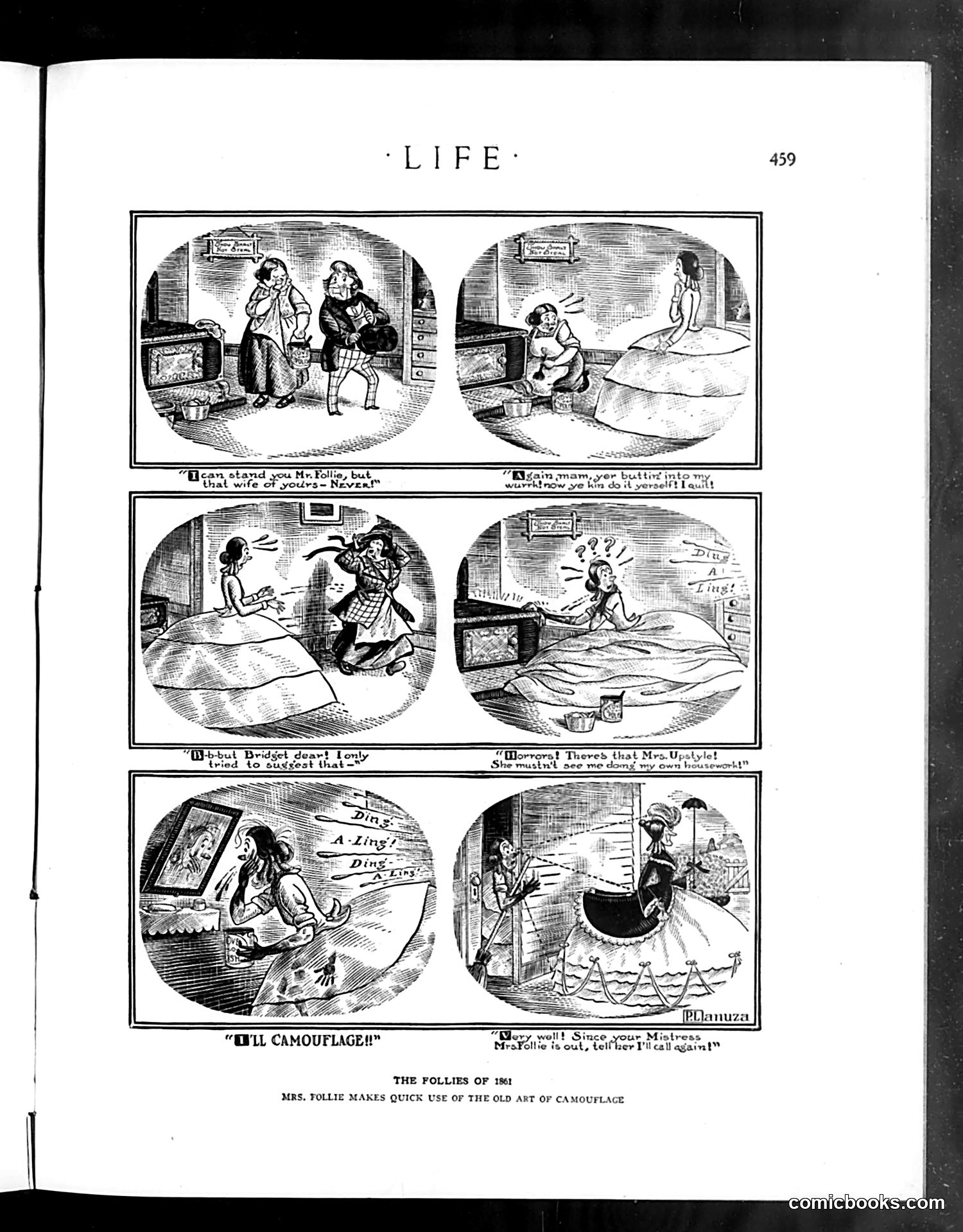
This six-panel comic strip satirizes a domestic dispute where a husband (Mr. Follie) complains about his wife's behavior to a friend, claiming he can't stand "that wife of yours." When confronted, he attempts various excuses and evasions. The wife (Mrs. Follie) then uses "camouflage"—literally hiding herself under bedding and household items—to avoid her husband's complaints. The satire plays on the concept of "camouflage," a military term that had gained prominence during World War I (though the 1861 date appears to reference an earlier Follies publication). The joke suggests marital discord is resolved through avoidance rather than communication, with the wife's physical disappearance serving as commentary on domestic conflict management. The strip mocks both the husband's complainiveness and the wife's evasive tactics.
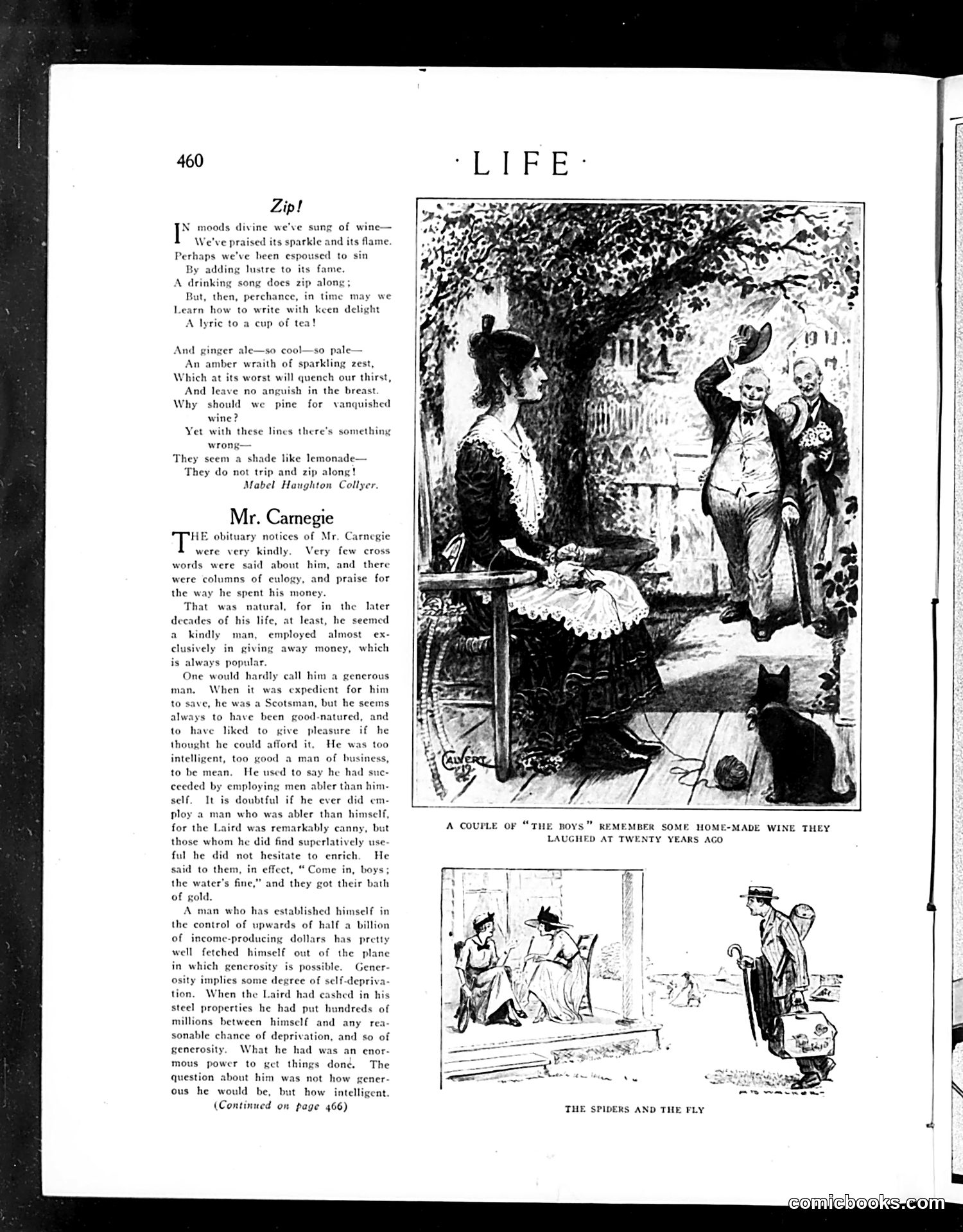
This page contains two main sections: **"Zip!" Poem**: A light verse by Mabel Haughton Collyer playfully contrasting drinking songs about wine and spirits with non-alcoholic beverages like ginger ale and tea. The satire gently mocks attempts to write equally rousing songs about temperate drinks—they lack the vigor ("zip") of alcohol-themed verses. **"Mr. Carnegie" Essay**: A column evaluating Andrew Carnegie's philanthropic legacy following his death. The author argues Carnegie wasn't truly "generous" in the classical sense because generosity requires self-sacrifice. With billions at his disposal, Carnegie couldn't meaningfully deprive himself. The satire's point: his vast wealth made his giving effortless rather than virtuous. The author credits Carnegie's true value to his intelligence and business acumen in employing capable people, not moral virtue. **Illustrations**: Two cartoon vignettes accompany the text, though their specific references to "the boys" remembering home-made wine and "The Spiders and the Fly" remain visually unclear without additional context.
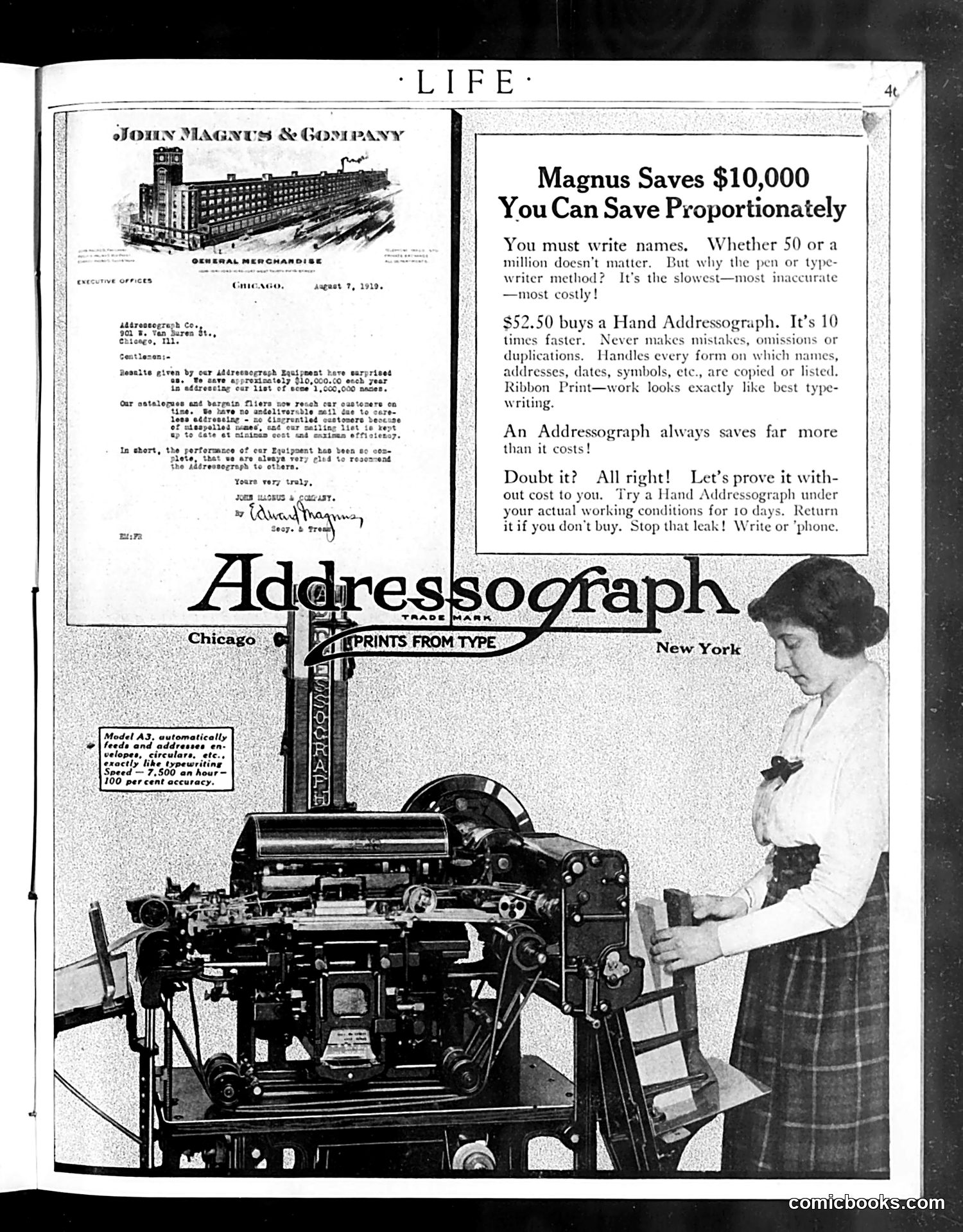
This page is primarily **advertising for the Addressograph machine**, not political satire. The top features a letter from John Magnus & Company (dated August 7, 1919) testimonial, followed by a large advertisement promoting the Hand Addressograph device. The advertisement's pitch centers on **office efficiency and cost savings**. It argues that manual address-writing by pen or typewriter is slow and error-prone, while the Addressograph—a mechanical addressing machine—is faster and more accurate. The headline claims "Magnus Saves $10,000" to demonstrate return on investment. The photograph shows a woman operating the machine, which automatically addresses envelopes or forms. The device can handle "7,500 an hour—100 per cent accuracy," according to the text box. **For modern readers**: This reflects early 20th-century concerns about **business automation and labor efficiency**. The Addressograph represents the kind of mechanical innovation that promised to streamline repetitive clerical work—a major workplace issue of that era when businesses were rapidly scaling up mail-based operations.
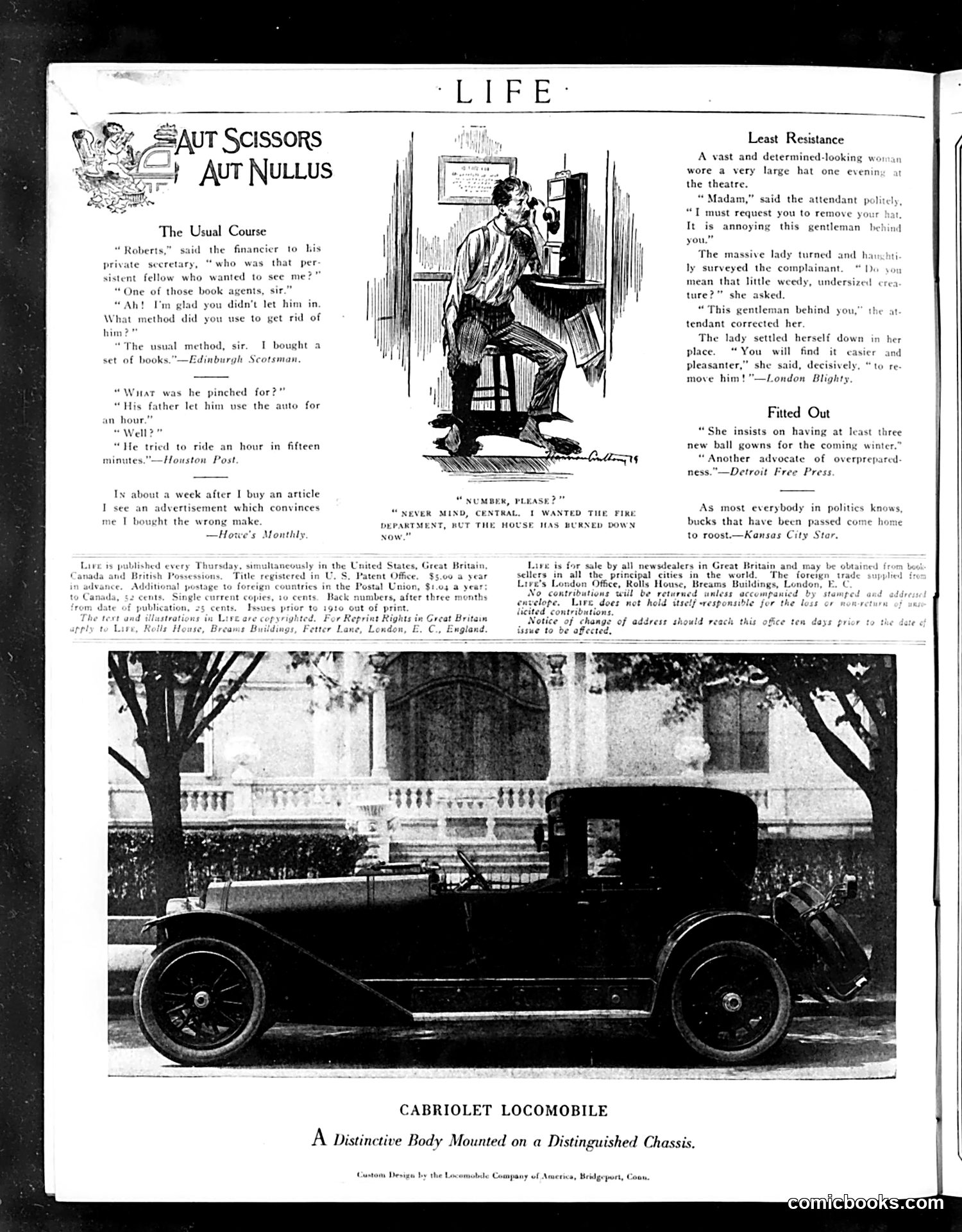
This page contains three unrelated satirical anecdotes and an automobile advertisement, typical of Life's format. **"Least Resistance"** depicts a theater attendant asking a large woman to remove her enormous hat blocking other patrons' views. She dismissively suggests he remove the "little weedy, undersized" man behind her instead. The satire mocks both her rudeness and entitlement—the joke being she refuses reasonable social accommodation, treating the man as an obstacle rather than accepting responsibility. **"Fitted Out"** jokes about a woman demanding three new ball gowns for winter, satirizing extravagant spending and conspicuous consumption as foolish "overpreparedness." **"The Usual Course"** concerns a man buying books to remove a look-alike agent—a light joke about mistaken identity and odd solutions. The **Cabriolet Locomobile** advertisement showcases an early automobile, highlighting its "distinctive body" and "distinguished chassis"—marketing language for wealthy consumers. The page reflects early 20th-century concerns: theater etiquette, class anxiety, consumer excess, and automobile aspirations.
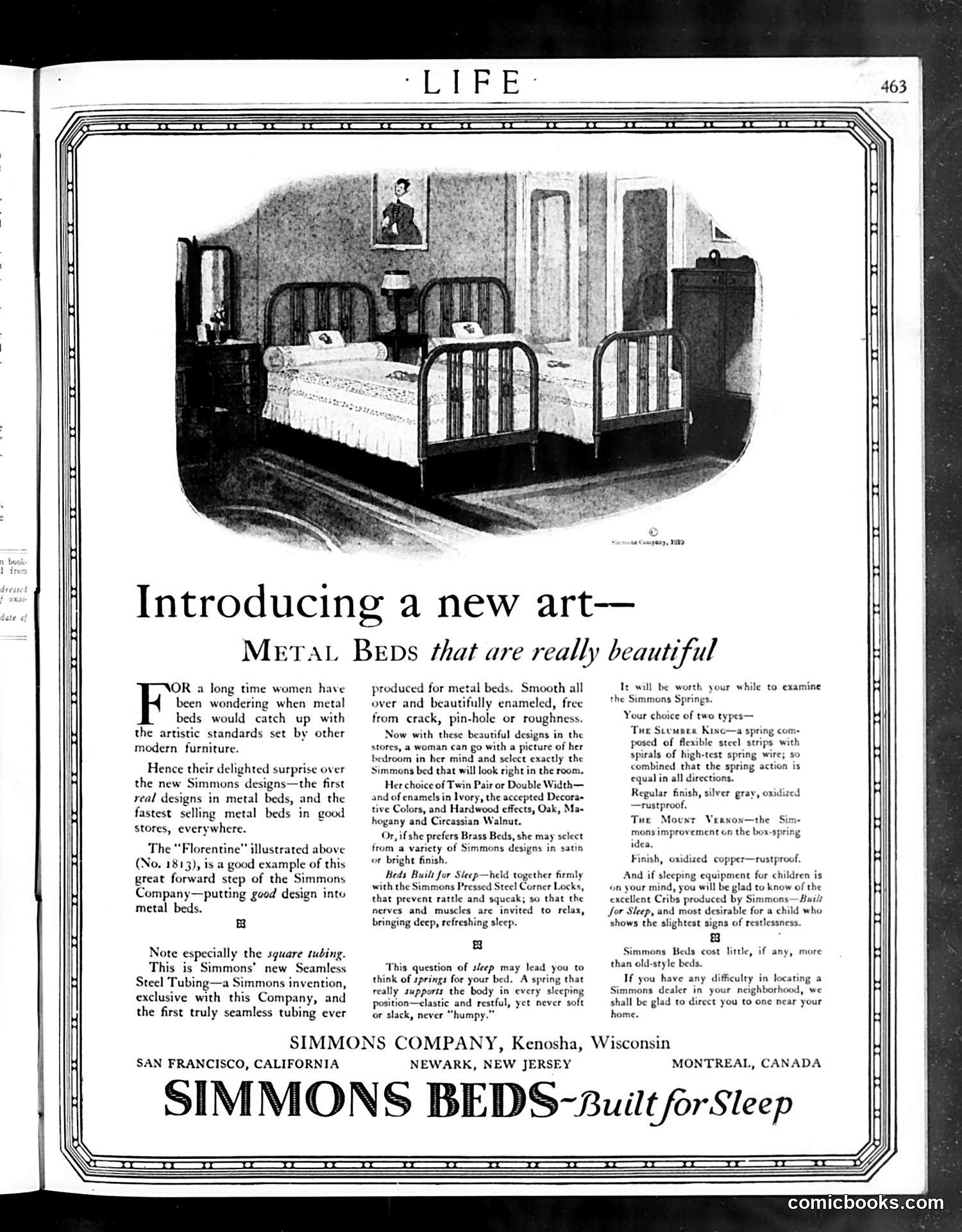
This is **not a cartoon or satire**—it's a straightforward advertisement for Simmons metal beds, appearing in Life magazine (page 463). The page promotes the "Florentine" metal bed design, marketed as the first artistically designed metal beds. The advertisement emphasizes Simmons's innovation: seamless steel tubing, enamel finishes, and various decorative styles (Ivory, hardwood effects, brass). The copy targets female consumers, noting women had "wondered when metal beds would catch up" with modern furniture standards. It details customization options (Twin/Double, colors) and complementary spring systems, positioning Simmons as the quality choice. This reflects early 20th-century consumer culture and gender-targeted marketing—appealing to housewives making bedroom furnishings decisions. The "Built for Sleep" slogan emphasizes restfulness and durability, standard advertising rhetoric of the era.
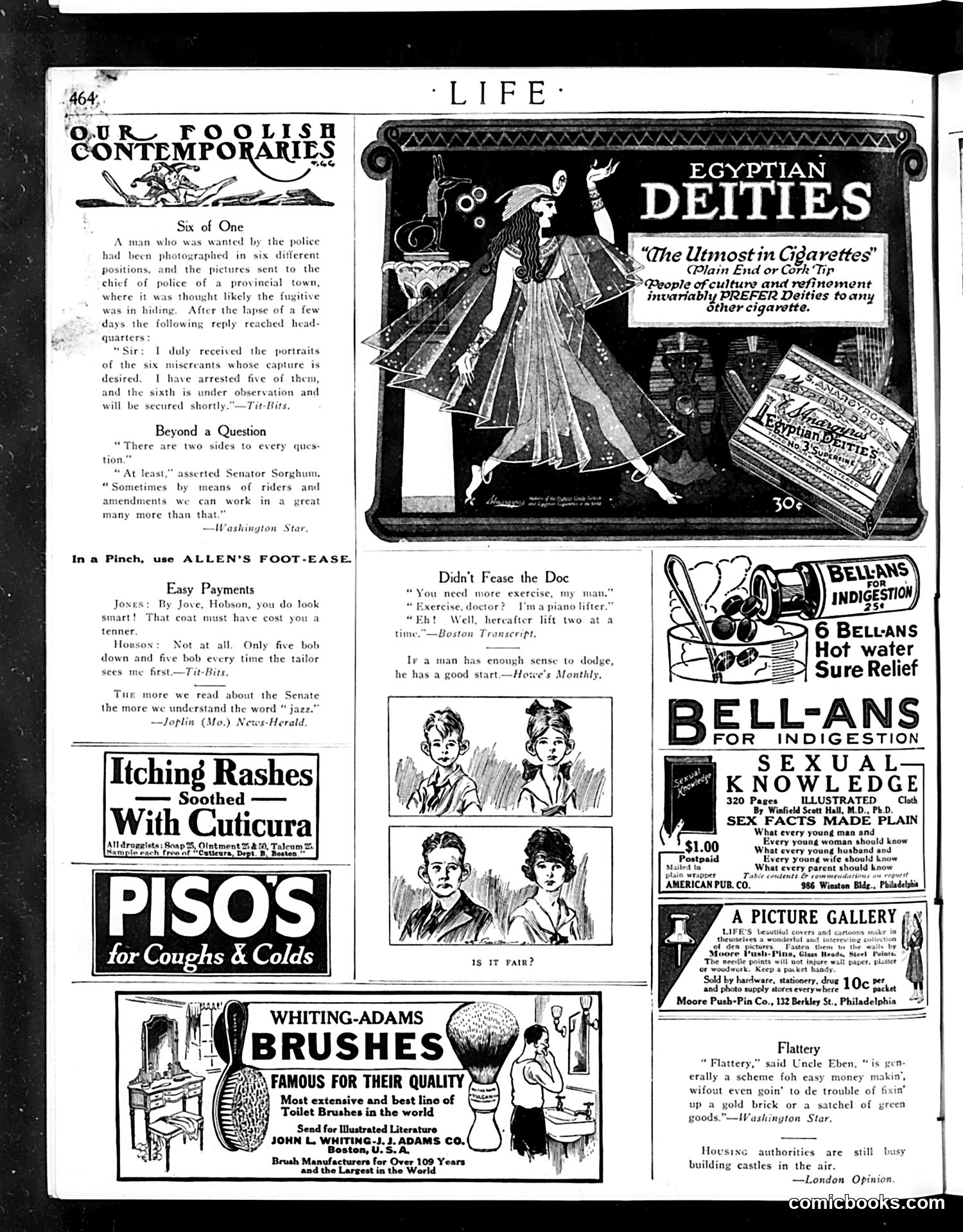
This is primarily an **advertising page** from Life magazine with several short humorous anecdotes interspersed. The main cartoon—"Is It Fair?"—depicts four sketched faces showing the same person's changing expressions, illustrating the concept of perspective in the accompanying anecdote about a man wanted by police who was photographed in six different positions. The joke: a provincial police chief arrests five suspects from six photos, keeps one "under observation"—suggesting he can't tell which is the real criminal. The page's other brief jokes satirize **contemporary absurdities**: a Senator claiming legislation has "more than two sides," a doctor unimpressed by exercise advice, and a character ("Uncle Eben") commenting that flattery is a con scheme easier than creating fake gold bricks. The advertisements (Egyptian Deities cigarettes, Bell-Ans indigestion pills, Cuticura salve, Piso's cough syrup) represent typical early 20th-century patent medicines and consumer products marketed with dubious health claims—now recognizable as snake oil. The page reflects Life's role as satirical commentary on American society, politics, and commerce of its era.
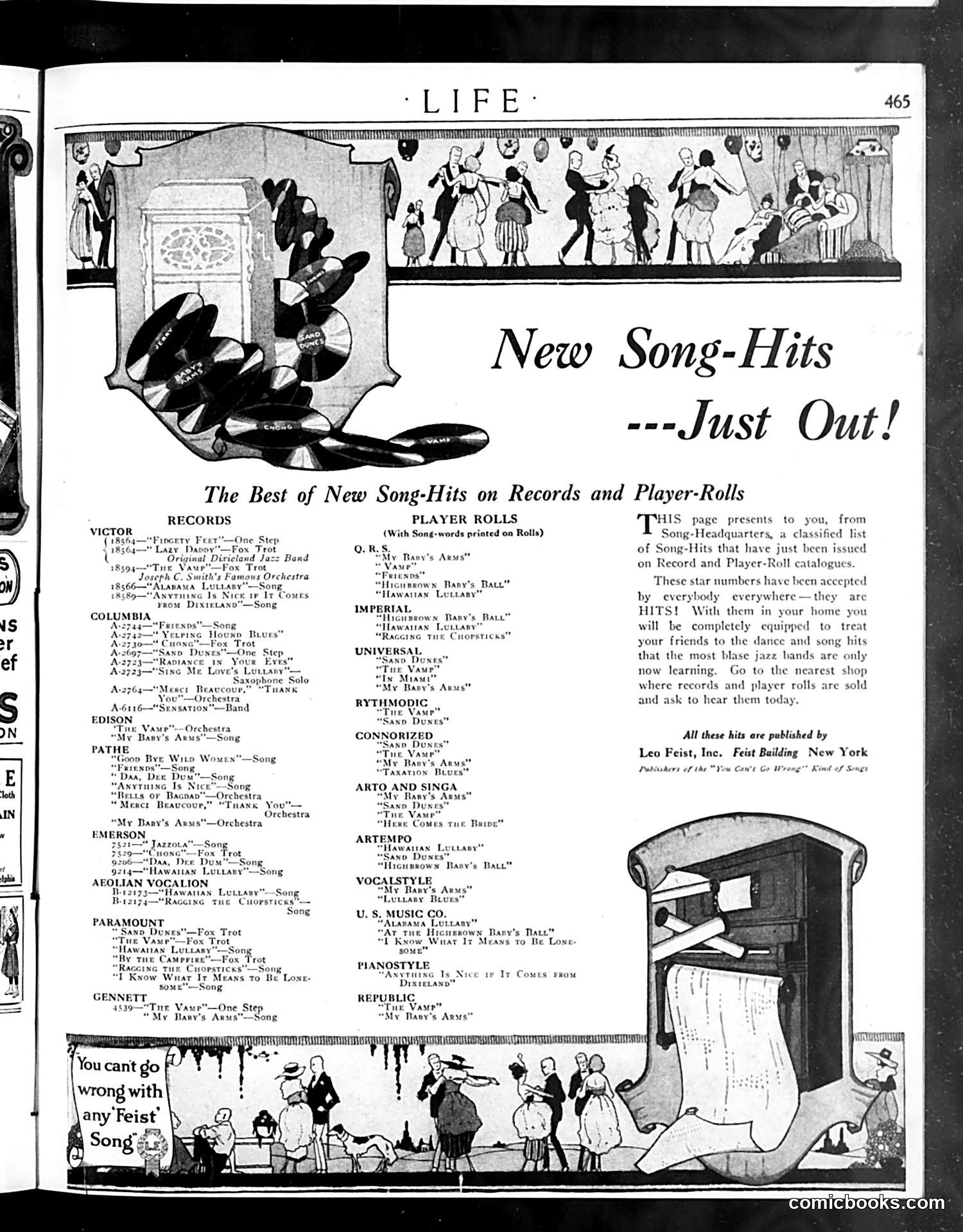
This is primarily a **music industry advertisement**, not political satire. It catalogs newly released popular songs available on phonograph records and player-rolls (mechanical piano rolls) from major labels of the era: Victor, Columbia, Edison, Pathé, and others. The decorative header shows a party scene, and the bottom includes a Feist Music publishing advertisement. The listed songs emphasize **jazz-age hits** of the 1920s—"The Vamp," "Hawaiian Lullaby," "Ragging the Chopsticks," and notably "My Baby's Arms," which appears repeatedly across multiple record labels. The text emphasizes these are proven hits ("HITS! With them in your home you will be completely equipped to treat your friends"). This reflects the consumer culture and home entertainment boom of the early 1920s, when phonographs and player-pianos were becoming standard household items. The page targets middle-class readers wanting current popular music for social gatherings.
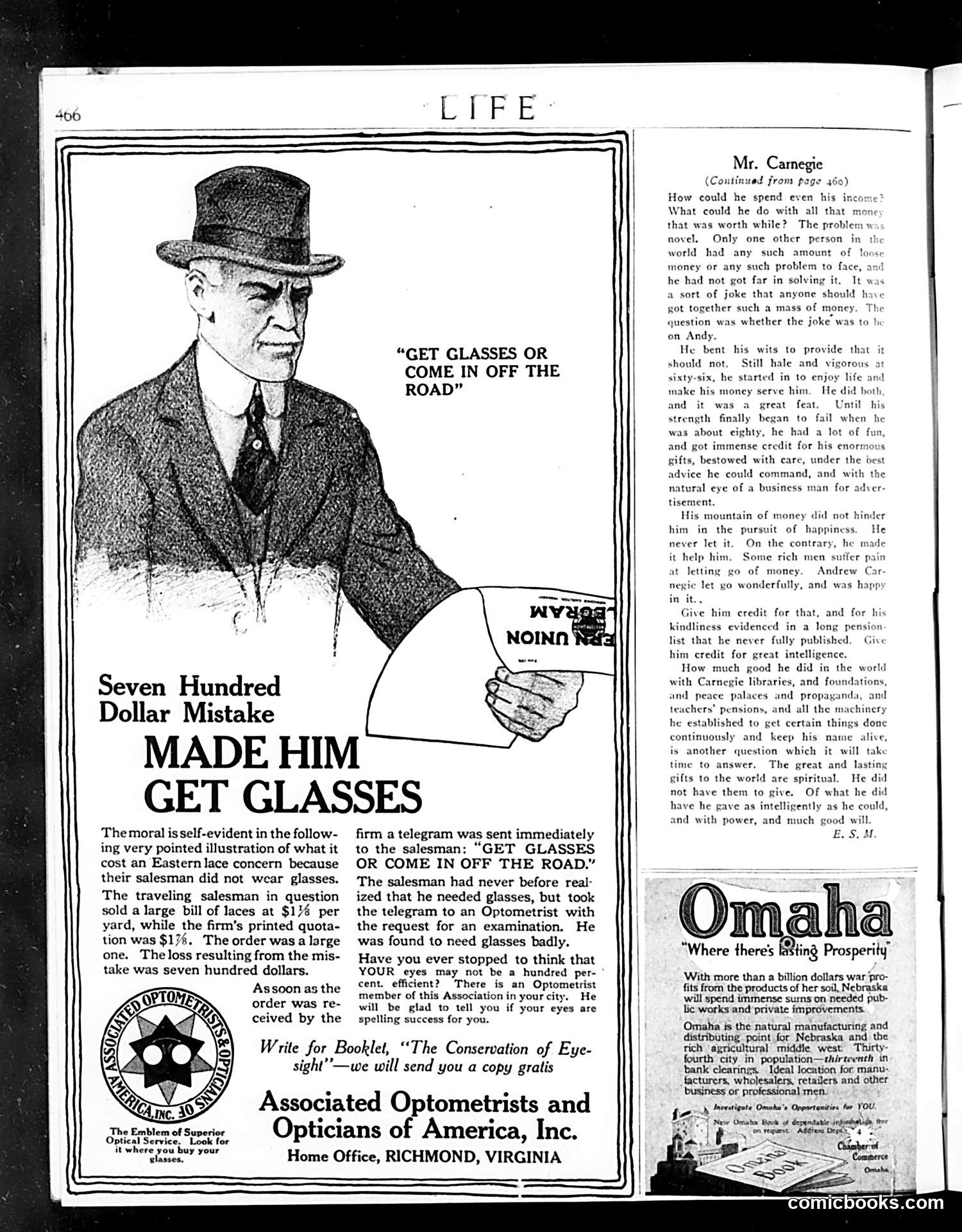
This page combines a **business cautionary tale** (left) with promotional advertising (right). The main cartoon illustrates why an Eastern lace company's traveling salesman costs them $700: he misread prices due to uncorrected vision, quoting $136 instead of $176 per yard. The firm's urgent telegram—"GET GLASSES OR COME IN OFF THE ROAD"—humorously delivers the message that poor eyesight endangers his job and their business. This serves as a **public service message** from the Associated Optometrists and Opticians of America, promoting eye examinations. The implicit argument: defective vision causes real financial harm; businessmen should get checked. The right side shifts to an unrelated biographical piece about **Andrew Carnegie** (the industrialist philanthropist, though not named in visible text), discussing his wealth management and charitable giving. Below that is a booster advertisement for **Omaha, Nebraska**, emphasizing its industrial potential and business opportunities. The page mixes public health advocacy with general corporate promotion—typical of Life magazine's editorial-advertising blend.
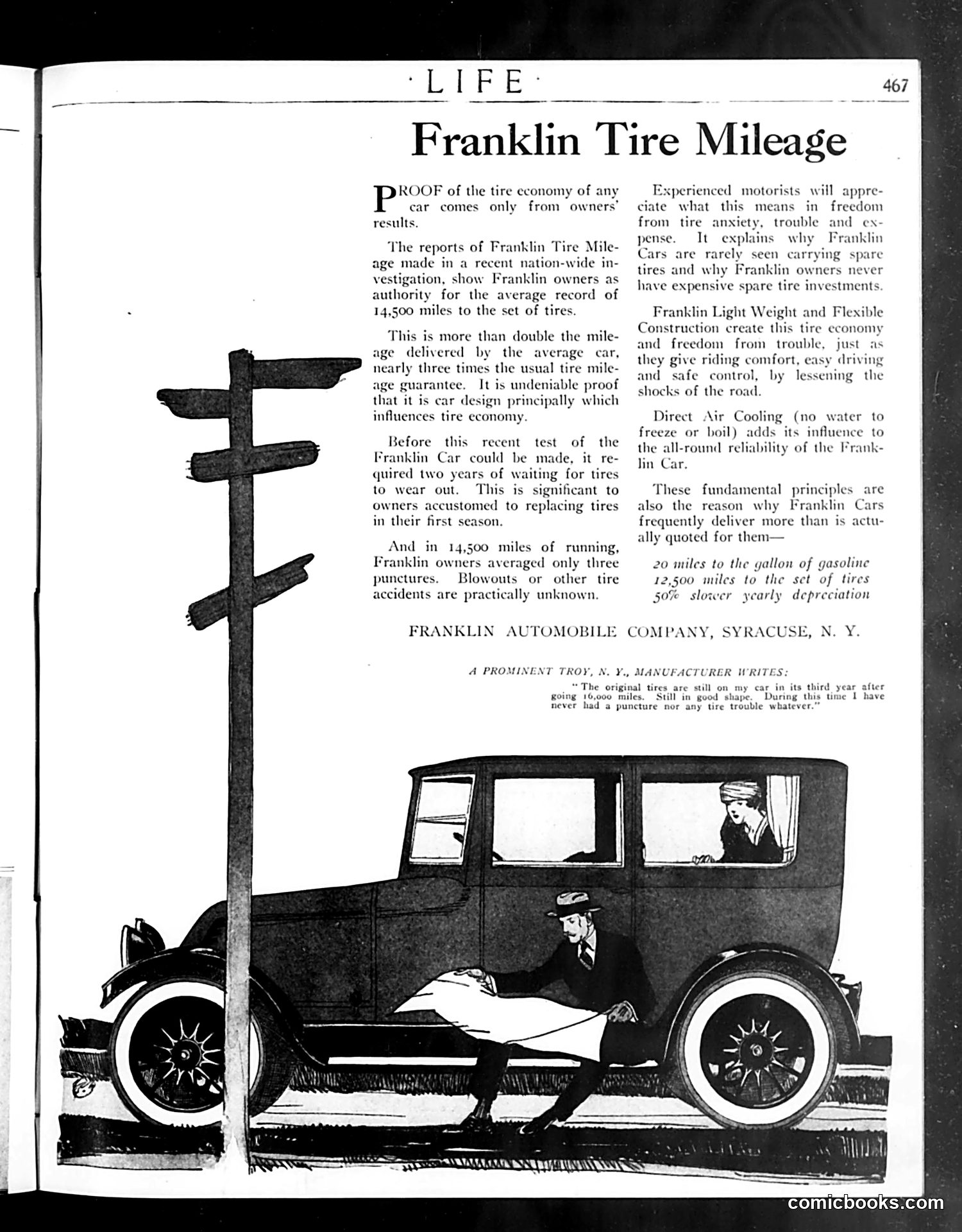
This is a **straight product advertisement**, not satire or political commentary. It promotes Franklin automobiles, emphasizing their exceptional tire economy and reliability. The page claims Franklin owners achieve 14,500 miles per tire set—double the average car's performance—with only three punctures over that distance. The visual shows a well-dressed man changing a tire by a roadside pole, likely illustrating the *rarity* of this task for Franklin owners. The advertisement's appeal targets early-20th-century motorists' genuine anxiety: tire failures and frequent replacements were common automotive problems. By highlighting Franklin's light-weight construction and air cooling (rather than water), the ad suggests superior engineering reduces road shock and tire wear. The testimonial from "a prominent Troy, N.Y. manufacturer" provides social proof—a credible endorsement. For modern readers, this reflects how automobile reliability was still a major selling point when cars were relatively new technology.
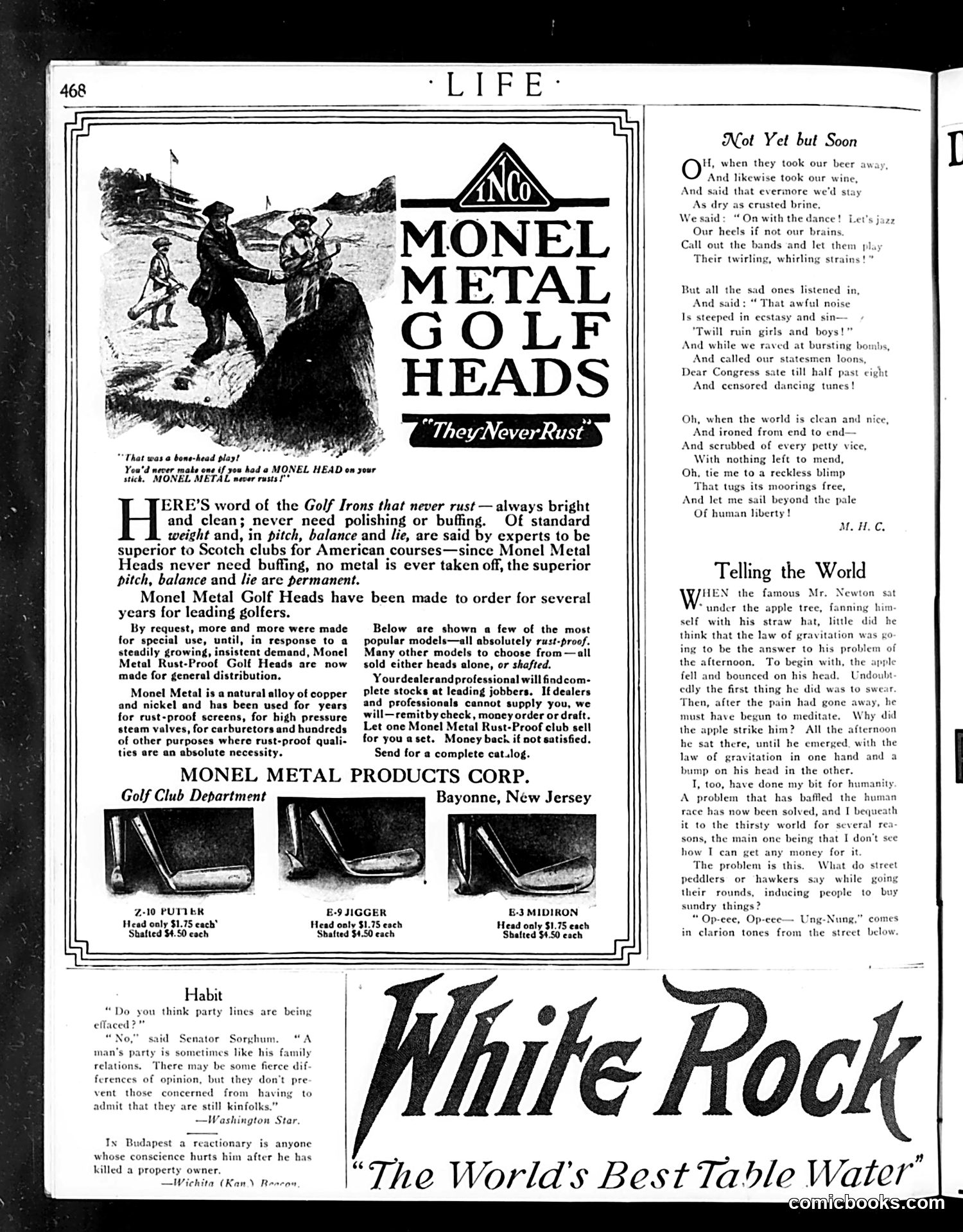
This page is primarily **advertising and light satirical content**, not political cartoons. The main advertisement promotes **Monel Metal Golf Heads**—rust-proof golf clubs made from a copper-nickel alloy. The satirical cartoon shows golfers calling each other "bone-heads," playing on the product name as a pun. The right side contains two pieces of social commentary: 1. **"Not Yet but Soon"**—A poem criticizing Prohibition (beer and wine confiscation) and the government censorship of jazz and dancing, seen as moral overreach by conservative politicians ("Dear Congress sate till half past eight / And censored dancing tunes"). It mocks puritanical restrictions on personal freedom. 2. **"Telling the World"**—A humorous piece referencing Newton's apple anecdote, positioning the author as having solved some unnamed "problem that has baffled the human race," leading to White Rock table water promotion. The page reflects 1920s cultural tensions: Prohibition backlash, generational conflict over jazz and dancing, and consumer advertising disguised as entertainment.

This is a **full-page advertisement**, not satire or political content. It promotes the Ruud automatic gas water heater, a home appliance innovation. The visual compares two scenarios: a hand turning a faucet with robust flow (top) versus weak, disappointing flow (bottom). The message is straightforward—Ruud solves the common household problem of unreliable hot water. The appeal targets **domestic efficiency and convenience**: no lighting or monitoring needed, automatic temperature control, and zero waste. This reflects early 20th-century marketing that emphasized how new technologies would modernize home life and free users from tedious manual labor. The extensive list of branch offices across major American cities demonstrates Ruud's national reach and suggests this was a significant commercial product. The ad assumes readers care about hot water reliability—a relatively novel luxury at the time—making this a window into period consumer priorities and infrastructure development.
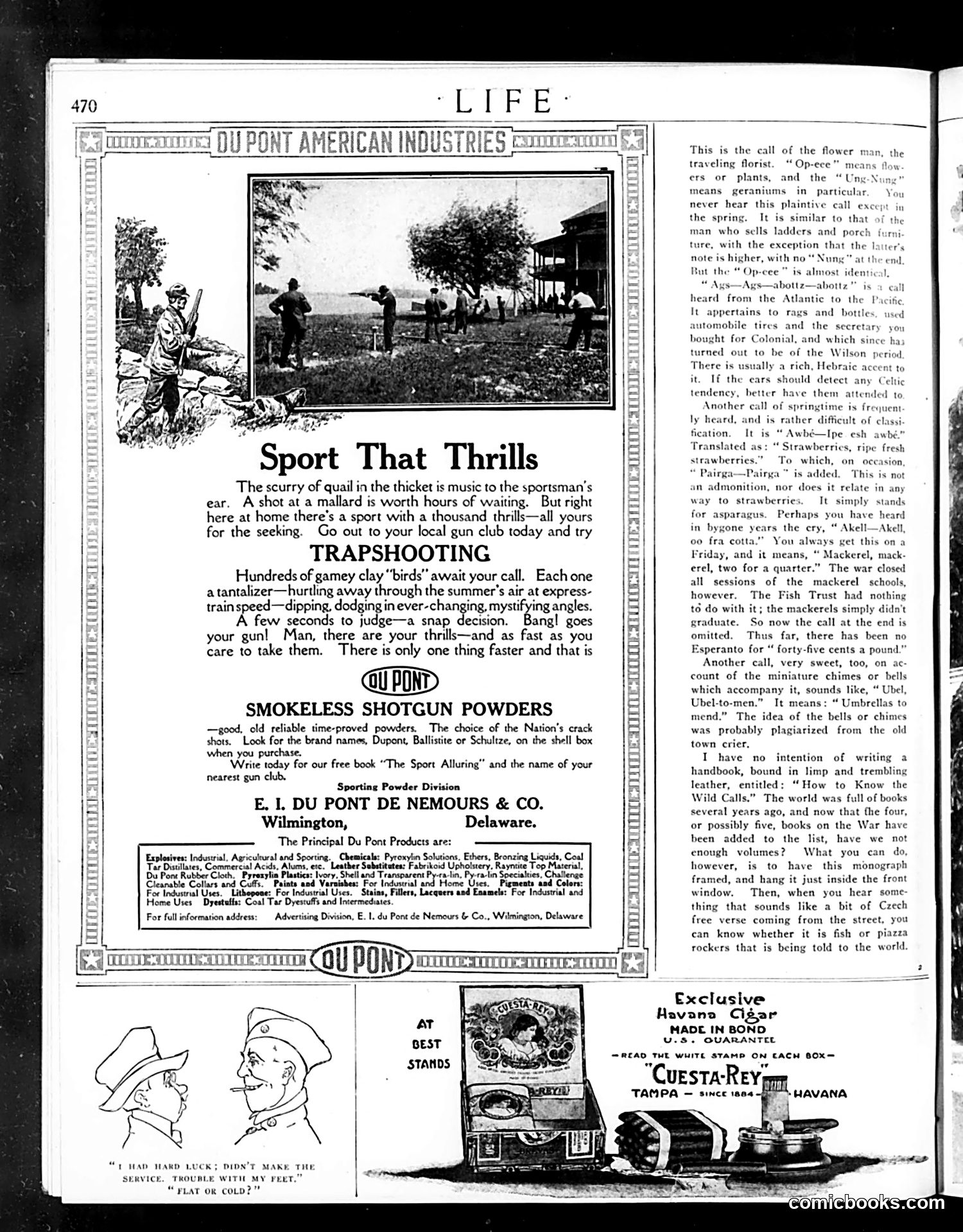
This page is primarily **advertising**, not satire. The dominant content is a Du Pont Industries advertisement for smokeless shotgun powder, promoting clay pigeon shooting ("trapshooting") as a leisure sport accessible to gun clubs. The right column contains an **editorial essay about street vendor calls**—hawkers' cries like "Op-ee" (flowers), "Ags-aholtz" (rags/bottles), and "Awbé" (strawberries). The author discusses how these colorful urban sounds have disappeared or changed, referencing outdated calls like "Mackerel, two for a quarter" and suggesting nostalgia for older city life during the Wilson era. The small cartoon at bottom left shows two soldiers discussing flat feet—likely WWI-related humor about military service difficulties, though context is limited. This reflects *Life* magazine's mixed content: corporate advertising alongside cultural commentary on changing American urban life and leisure culture.
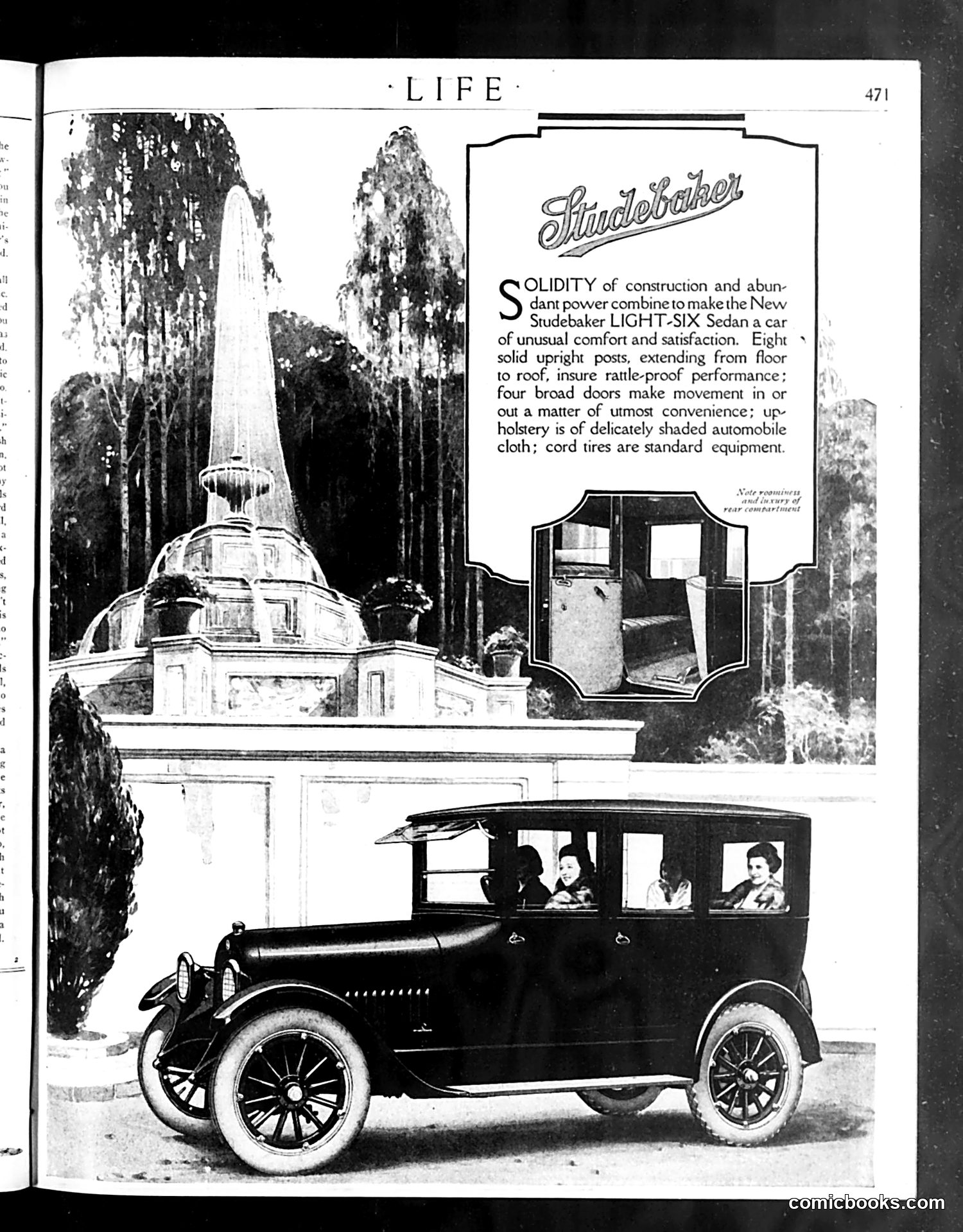
This page is primarily a **Studebaker automobile advertisement**, not political satire. It promotes the Studebaker Light-Six Sedan with emphasis on structural solidity ("eight solid upright posts"), practical features (four broad doors), and comfort amenities (shaded cloth upholstery, cord tires). The advertisement includes an interior cross-section diagram and a full-side photograph of the sedan with passengers. The scenic background with tall trees suggests leisure and travel. This represents typical 1920s automobile marketing emphasizing engineering robustness and comfort as selling points to an affluent readership of *Life* magazine.
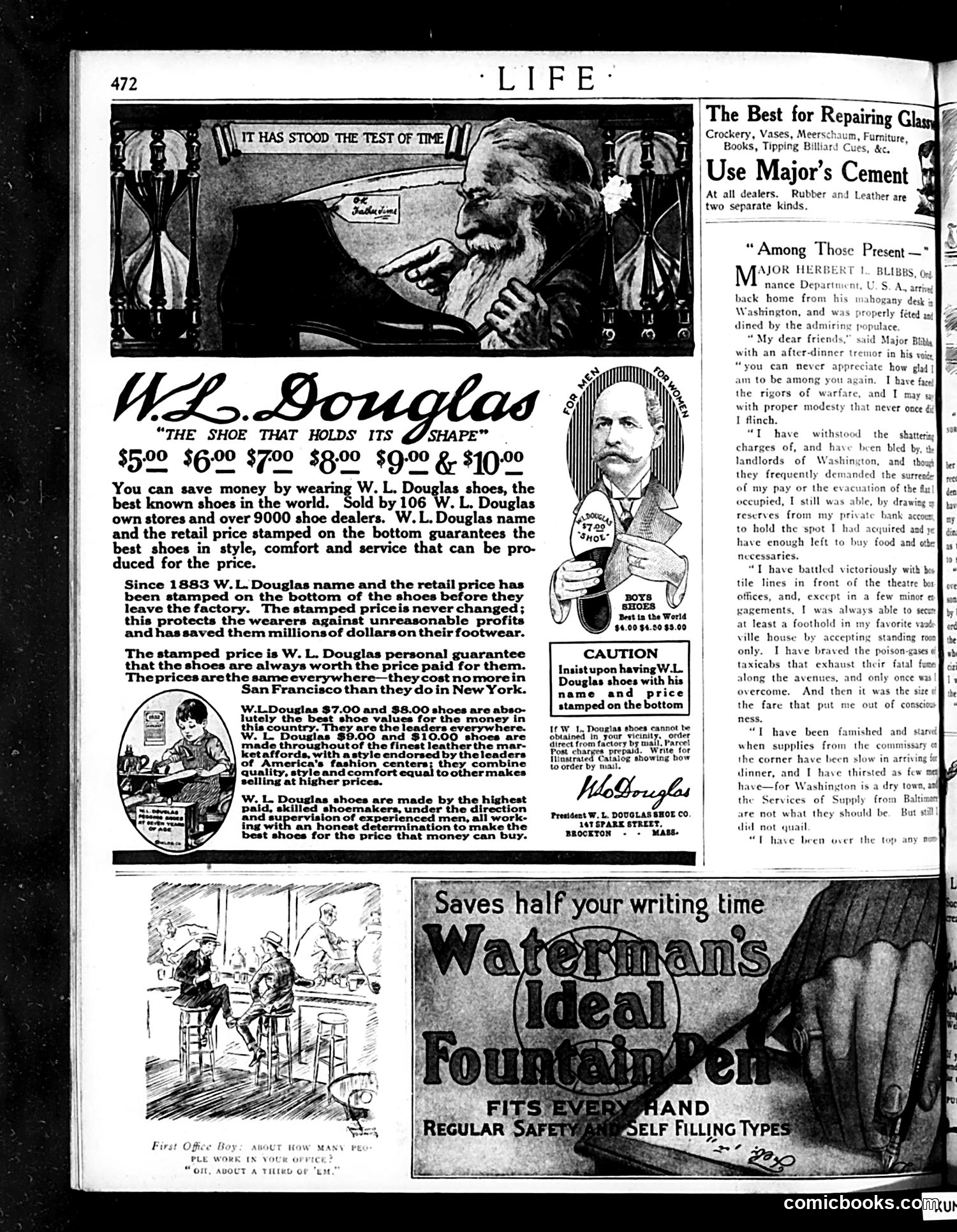
This page is primarily **advertising**, not political satire. The dominant content is a W.L. Douglas shoe advertisement emphasizing the brand's price guarantee—shoes are stamped with retail prices at the factory, ensuring consistent pricing nationwide and protection against "unreasonable profits." The small cartoon at lower left appears to show office workers, captioned about doing work "in your office," likely promoting efficiency. The right-hand column contains "Among Those Present," a humorous social anecdote about Major Herbert I. Blibbs returning from military service in Washington, D.C. The joke relies on his mock-serious recounting of personal hardships (demanding landlords, poison gas from taxi exhausts, difficulty obtaining alcohol during Prohibition) as equivalent to wartime experiences—satirizing how civilians dramatized minor inconveniences as wartime sacrifice. The page also advertises Major's Cement and Waterman's Ideal Fountain Pen. This is typical early 20th-century *Life* magazine formatting: mixed advertising and humor content aimed at middle-class readers.
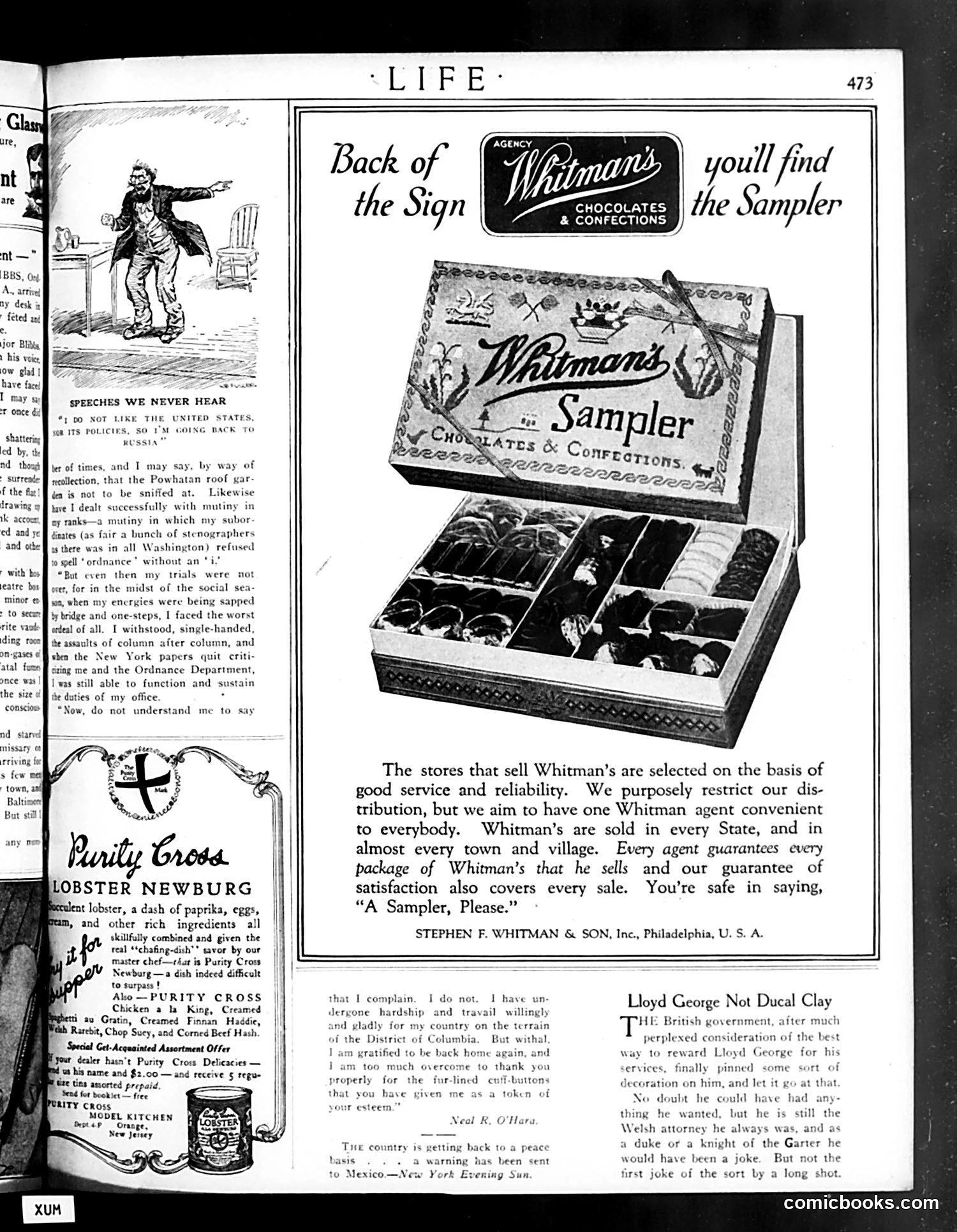
This cartoon mocks a hypothetical speech from someone (likely a government or military official based on context clues about "stenographers" and the "Ordnance Department") expressing disillusionment with American democracy and threatening to return to Russia. The satire targets those who, despite benefiting from U.S. institutions and positions of authority, might nonetheless voice radical criticism or defection threats—a pointed jab at perceived ingratitude or disloyalty. The cartoon's humor derives from the absurdity of such a statement: no patriotic American official would publicly say this. The page also includes period advertisements (Whitman's chocolates, Purity Cross lobster) and a separate article about Lloyd George, the British Prime Minister, receiving honors—unrelated to the cartoon's political commentary.
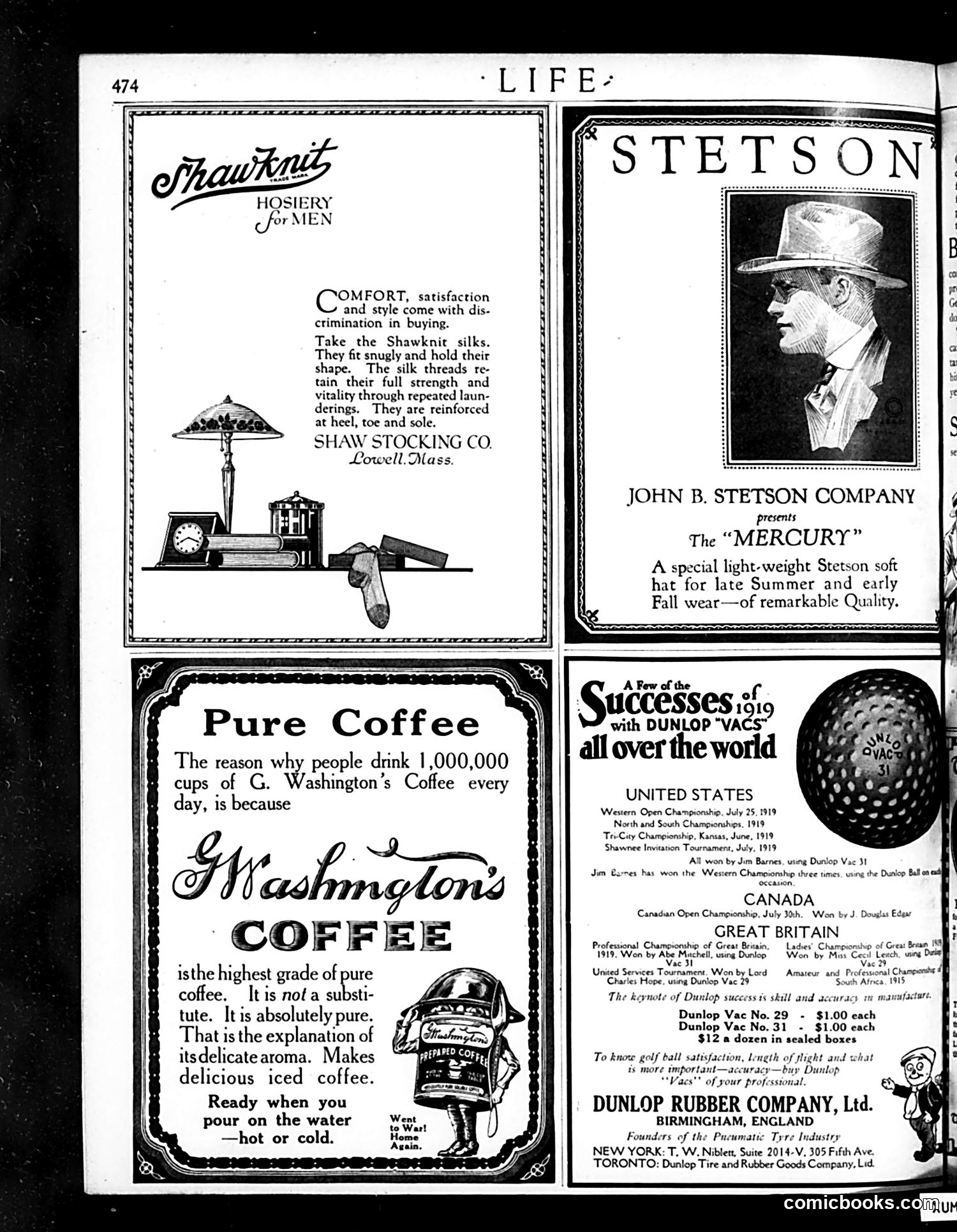
This is primarily a **advertisements page** from Life magazine, not a political cartoon. It contains four separate product ads from circa 1919: 1. **Shawknit Hosiery** (top left): Men's silk socks emphasizing durability through repeated washing 2. **G. Washington's Coffee** (bottom left): Pure coffee brand claiming 1 million daily cups 3. **Stetson "Mercury" Hat** (top right): Lightweight summer/fall hat for men 4. **Dunlop Golf Balls** (bottom right): Rubber golf balls marketed via championship wins by golfer Jim Barnes across 1919 tournaments The page reflects **early 20th-century consumer marketing**: brands using quality claims, celebrity endorsement (Barnes), and appeals to masculine respectability (proper hosiery, coffee, hats). No satire is evident—these are straightforward advertisements targeting affluent male readers of Life magazine.
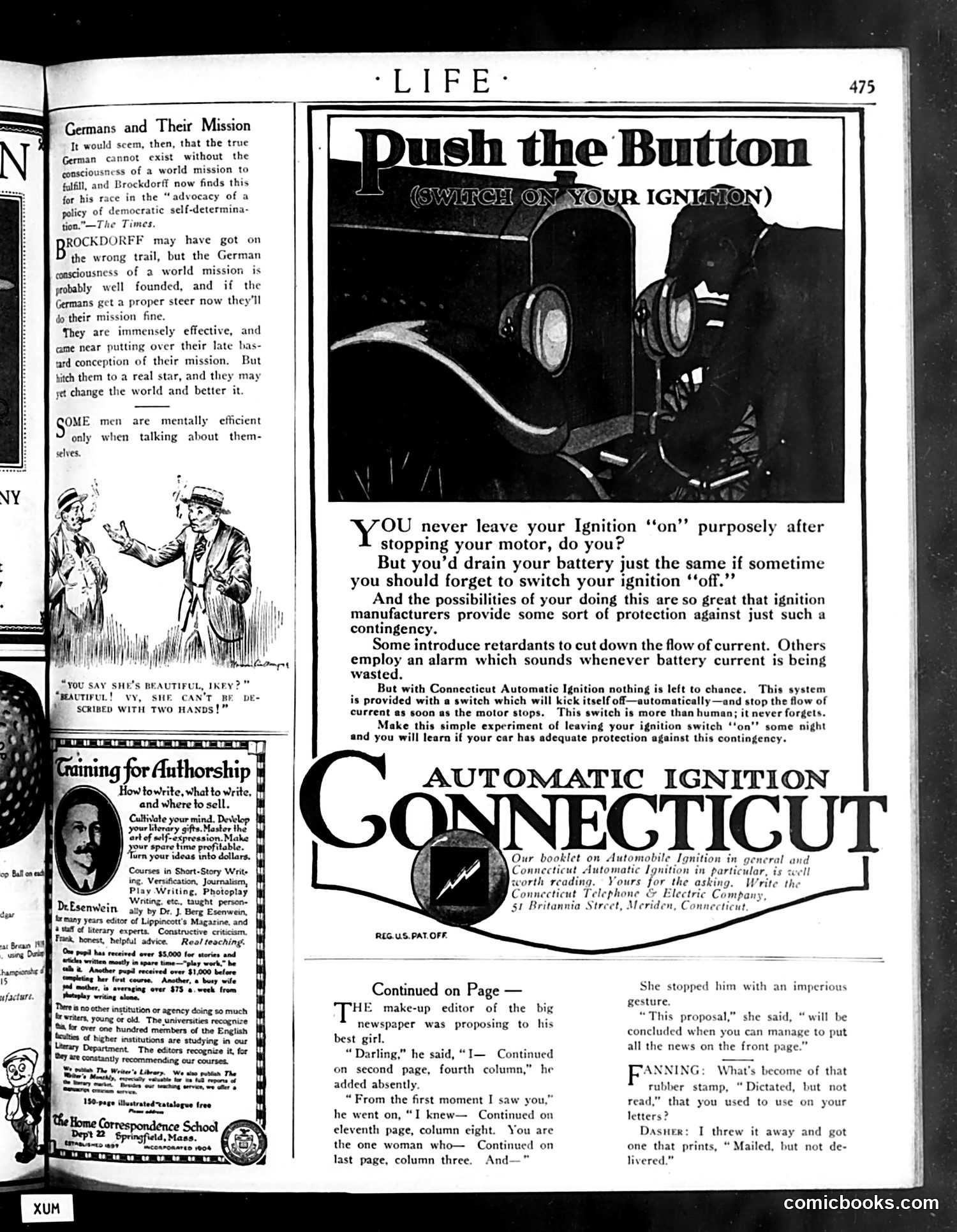
**Top Section — "Germans and Their Mission":** This is post-WWI political commentary. It references "Brockdorff" (likely a German political figure) and critiques German ideology. The passage argues that Germans possess a strong sense of world mission that nearly succeeded in their "late bastard conception" (likely referring to Imperial German war aims). The satire suggests that if Germans redirected this missionary zeal toward democratic ideals rather than conquest, they might actually benefit humanity. The final quip—"Some men are mentally efficient only when talking about themselves"—is a jab at German self-aggrandizement. **Bottom Section — Advertisements:** The page is dominated by two ads: one for Connecticut Automatic Ignition (promoting a car safety feature) and another for a correspondence school teaching authorship. These are straightforward commercial pitches typical of 1920s Life magazine, with no satirical content. **The cartoon** (small illustration, lower left) depicts two men in period dress, likely reinforcing the "Germans" theme above, though specific identities are unclear from the image.
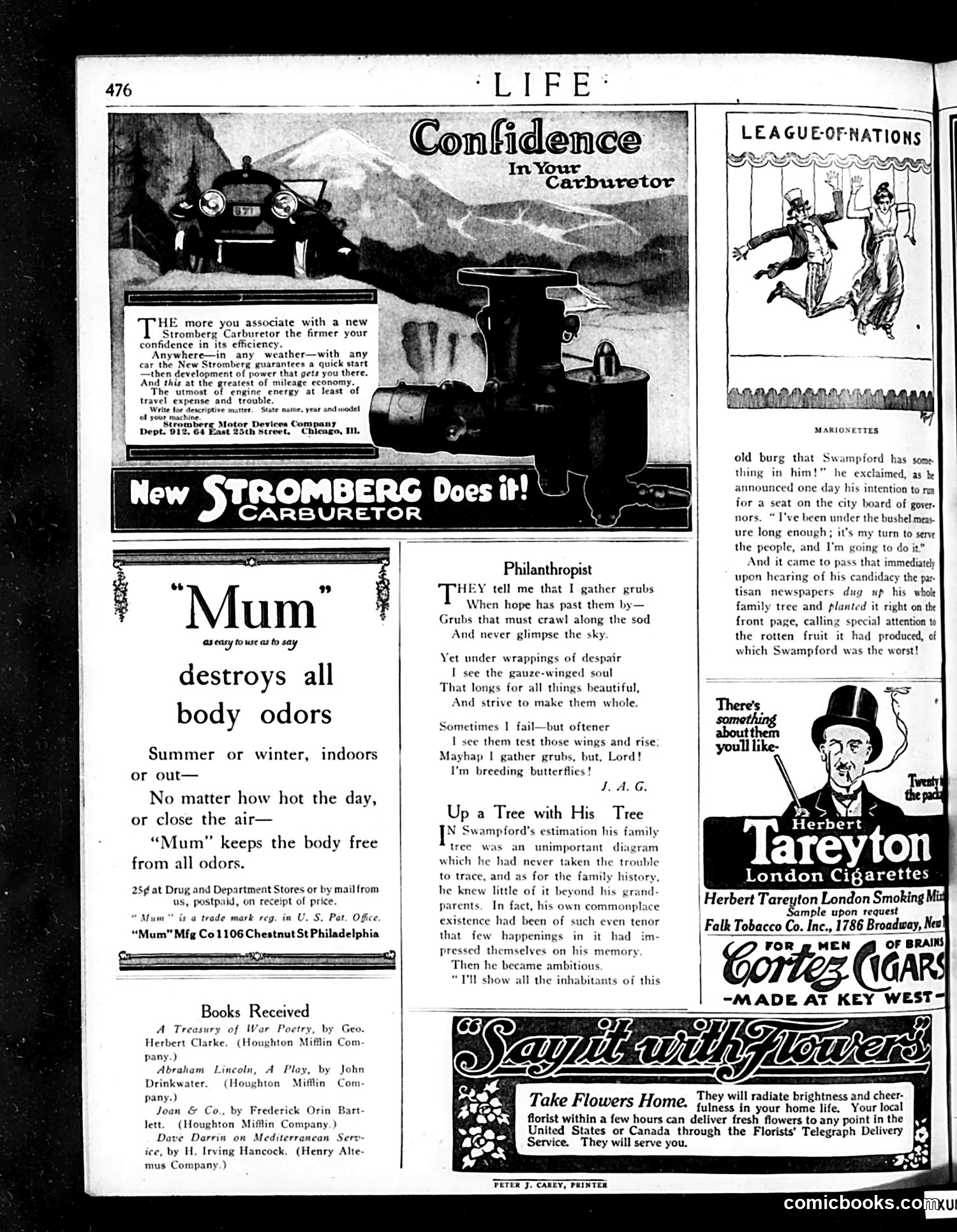
This page is primarily **advertising and literary notices**, not political satire. The main content includes: **Advertisements:** - Stromberg carburetors (emphasizing reliability and efficiency) - "Mum" deodorant (promises odor elimination year-round) - Herbert Tareyton London cigarettes - Cortez cigars - Sayward Flowers (telegraph delivery service) **Editorial Content:** - A poem titled "Philanthropist" about gathering grubs and breeding butterflies (appears to be nature/philosophical verse) - A brief satirical story, "Up a Tree with His Tree," mocking a political candidate (Swampford) whose family genealogy becomes a liability when exposed by partisan newspapers during his campaign for city office The Swampford story is the only clearly satirical element—it lampoons both the candidate's ambition and media sensationalism. The "League of Nations" cartoon (top right) is too small to analyze clearly. The page reflects early 20th-century American consumer culture and modest political humor.
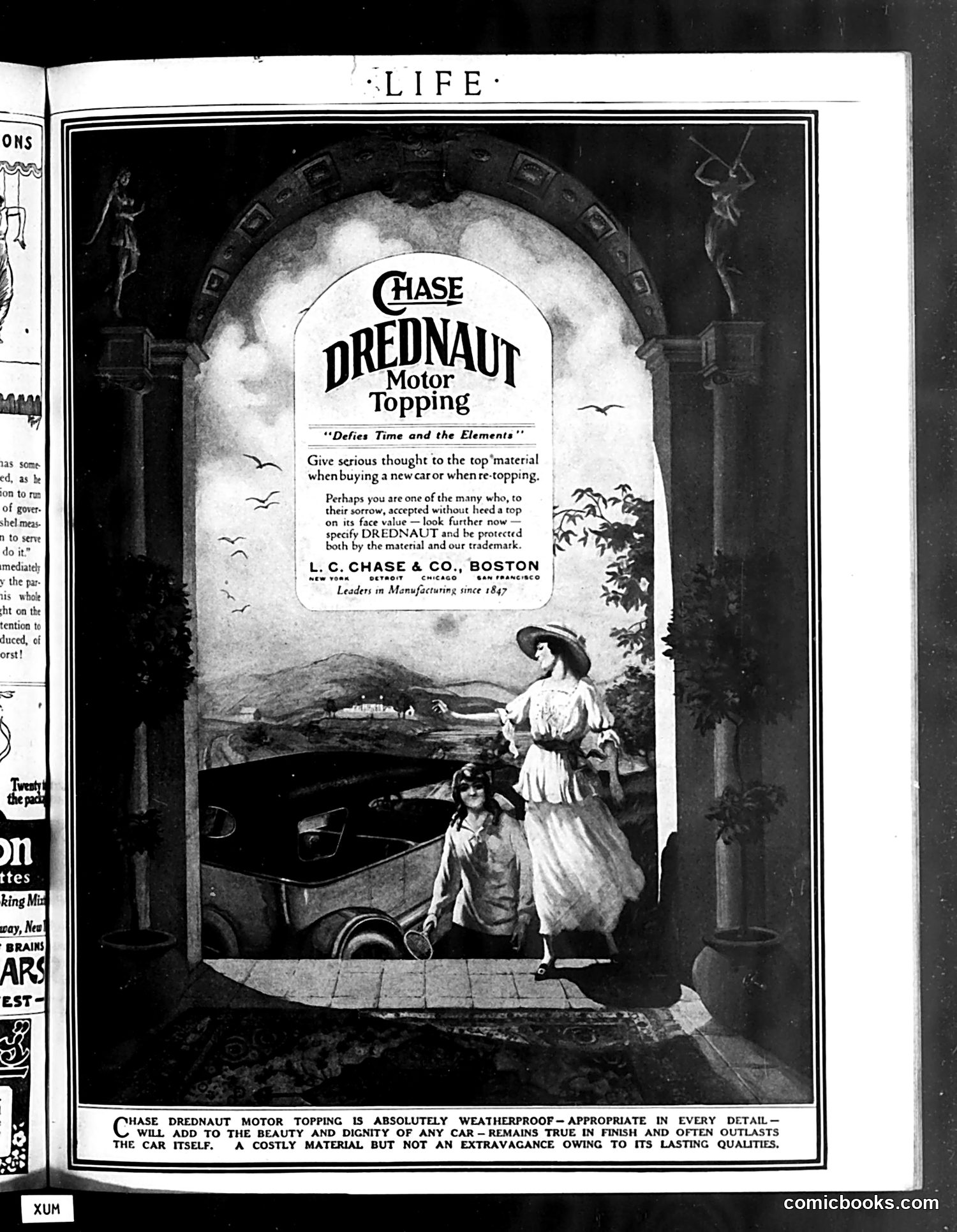
This is **not a political cartoon or satire**—it's a **full-page advertisement** for Chase Drednaut Motor Topping, a car roof material. The image shows a romantic, idealized scene: a woman and child admiring an automobile beneath a classical archway, with landscape visible beyond. The tagline "Defies Time and the Elements" positions the product as durable and protective. The ad's argument is straightforward: buyers shouldn't judge car tops by appearance alone; they should specify Drednaut brand for reliable weatherproofing that outlasts the vehicle itself. The company, L.C. Chase & Co. of Boston, positions itself as an established manufacturer (since 1847). The classical architectural framing and the domestic imagery (mother and child) appeal to consumers' desires for permanence, quality, and respectability—common advertising strategies of this era.
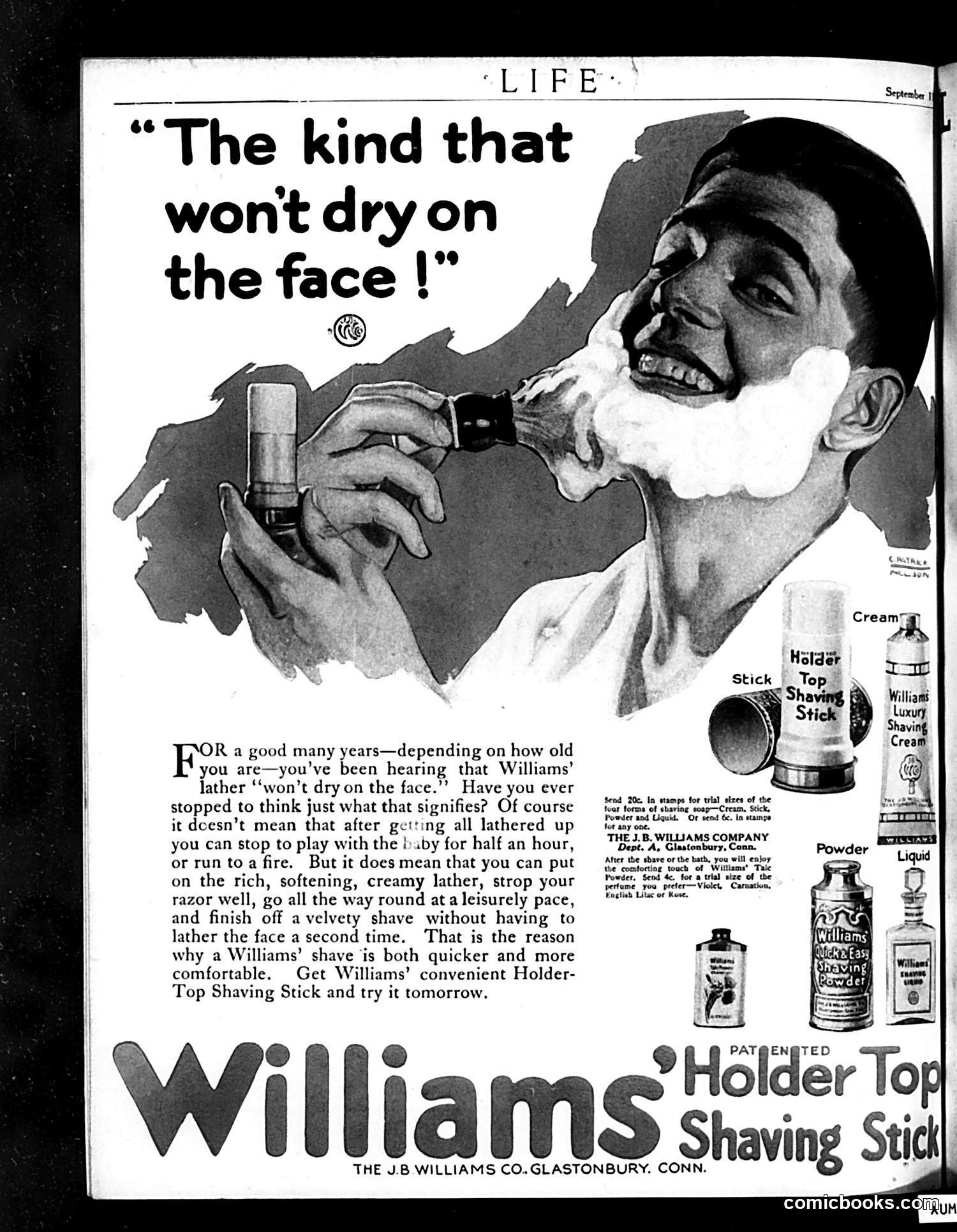
This is a **shaving cream advertisement**, not political satire. It appears from *Life* magazine (likely early 20th century, based on style). The ad features a man demonstrating Williams' shaving products—specifically their "Holder-Top Shaving Stick." The central claim, repeated in the headline, is that Williams lather "won't dry on the face," meaning it stays moist and workable long enough for a complete, leisurely shave without needing to re-lather. The ad's logic pitch: other lathers dry quickly, forcing you to stop mid-shave and add more. Williams lets you shave at a comfortable pace in one application—faster and more comfortable overall. The man's exaggerated expression and the prominent display of various Williams products (cream, powder, liquid) are typical period advertising style: enthusiasm and product visibility rather than subtle messaging. **There is no political or social satire here**—just period marketing emphasizing product superiority.