
Life, 1919-09-11 · page 26 of 48
Life — September 11, 1919 — page 26: what you’re looking at
What you’re looking at
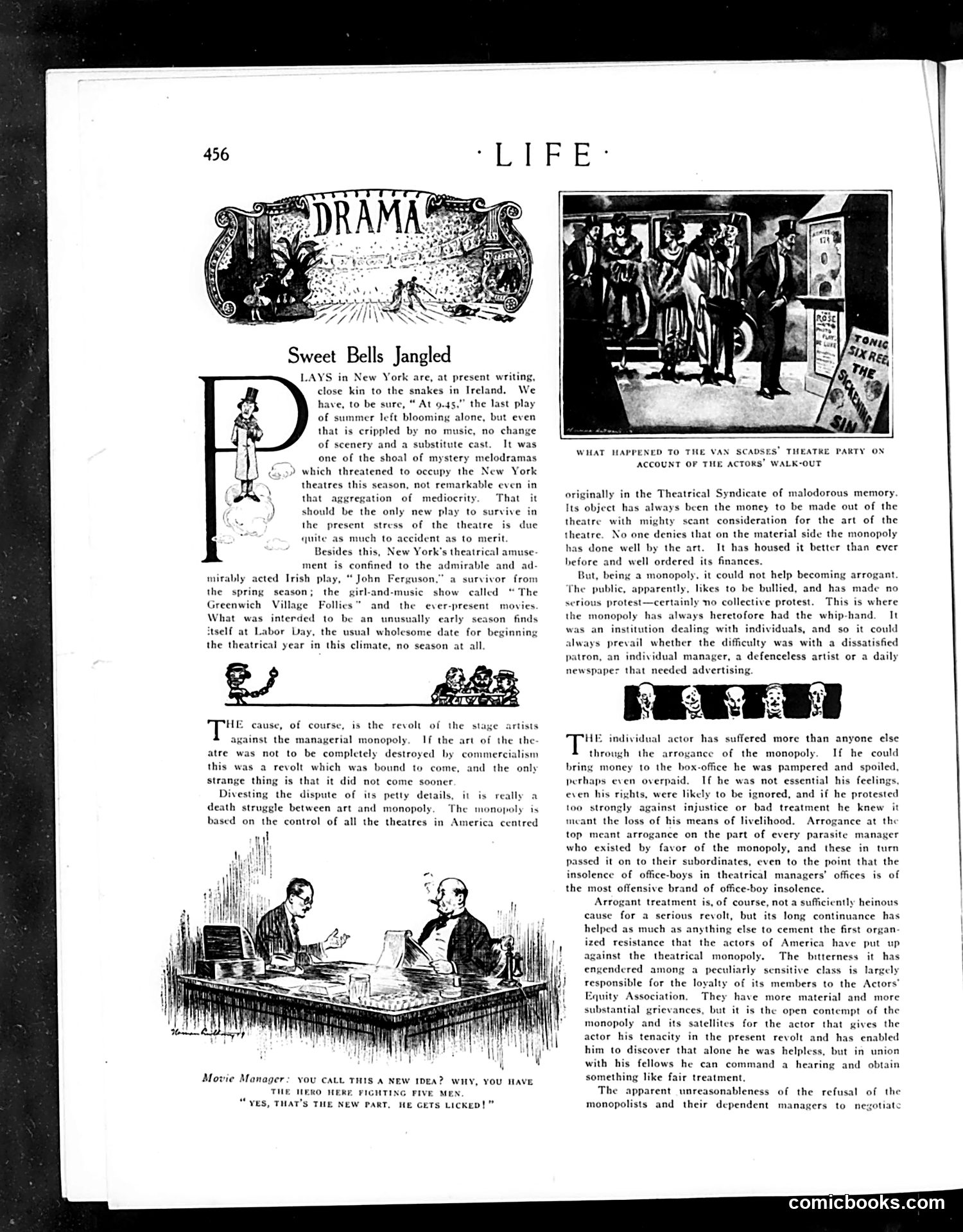
This 1919 *Life* magazine article discusses a actors' strike against theatrical monopolies controlling New York's stage. The cartoon illustrates the irony: a "Movie Manager" proposes showing a hero being defeated by five men as a "new idea," unaware this reflects the current real-world struggle—actors (the "hero") fighting against the theatrical monopoly's control. The article argues that while the monopoly improved theaters' physical conditions and finances, its arrogance toward individual actors was intolerable. Actors faced exploitation: pampered if profitable, ignored or punished if they protested mistreatment. The cartoon's dark humor captures how the actors' genuine grievance—powerlessness against concentrated corporate control—mirrors a lowbrow movie plot twist. The satire targets both the movie industry's creative bankruptcy and the monopoly's dismissive attitude toward workers' legitimate complaints.
📄 Transcribed text from this page (OCR, searchable)
Machine-transcribed from the original scan — historical spelling and the odd misread are preserved.
Sweet Bells Jangled LAYS in New York are, at present writing, close kin to the snakes in Ireland. We At on45.” the last play of summer left blooming alone, by that is crippled by no music, no change of scenery and a substitute cast. It was one of the shoal of mystery melodramas which threatened to occupy the New York theatres this season, not remarkable even in that aggregation of mediocrity. That it )} should be the only new play to survive in the present stress of the theatre is due quite as much to accident as to merit. Besides this, New York's theatrical amuse- ment is confined to the admirable and ad- mirably acted Irish play, “John Ferguson,” a survivor from the spring season; the gitl-and-music show called “The Greenwich Village Follies” and the ever-present movies. What was interded to be an unusually early season finds itself at Labor Day, the usual wholesome date for beginning the theatrical year in this climate, no season at all have, to be sure even cause, of course, is the revolt of the stage artists uinst the managerial monopoly. If the art of the the atre was not to be completely destroyed by commercialism this w s a revolt which was bound to come, and the only Strange thing is that it did not come sooner. Divesting the dispute of its petty details, it is really a death struggle between art and monopoly The monopoly is based on the control of all the theatres in America centred Movie Manager: you catt THs 4 NEW IDEA? wily, YOU HAVE THE HERO HERE FIGHTING FIVE MEN. YES, THAT'S THE NEW PART. HE GETS LICKED! WHAT HAPPENED TO THE VAN SCADSES* THEATRE PARTY ON ACTORS’ WALK-OUT ACCOUNT OF THt originally in the Theatrical Syndicate of malodorous memory: Its object has always been the money to be made out of the theatre with mighty scant consideration for the art of the theatre. No one denies that on the material side the monopoly has done well by the art. It has housed it better than ever before and well ordered its finances. But, being a monopoly, it could not help becoming arrogant. The public, apparently, likes to be bullied, and has made no serious protest—certainly no collective protest. This is where the monopoly has always heretofore had the whip-hand. It was an institution dealing with individuals, and so it could always prevail whether the difficulty was with a dissatisfied patron, an individual manager, a defenceless artist or a daily newspaper that needed advertising HE individual actor has suffered more than anyone else through the arrogance of the monopoly. If he could bring money to the box-office he was pampered and spoiled, perhaps even overpaid. If he was not essential his feelings. even his rights, were likely to be ignored, and if he protested too strongly against injustice or bad treatment he knew it meant the loss of his means of livelihood. Arrogance at the top meant arrogance on the part of every parasite manager who existed by favor of the monopoly, and these in turn passed it on to their subordinates, even to the point that the insolence of office-boys in theatrical managers’ offices is of the most offensive brand of office-boy insolence. Arrogant treatment is, of course, not a sufficiently heinous cause for a serious revolt, but its long continuance has helped as much as anything else to cement the first organ ized resistance that the actors of America have put up against the theatric The bitterness it has engendered among a peculiarly sensitive class is largely responsible for the loyalty of its members to the Actors Equity Association, substantial 1 monopoly, They have more material and more rievances, but it is the open contempt of the monopoly and its satellites for the actor that gives the actor his tenacity in the present revolt and has enabled him to discover that alone he was helpless, but in union with his fellows he can command a hea something like fair treatment. The apparent unreasonableness of the refusal of th monopolists and their dependent mai ‘ing and obtain agers to negoti comicbooks.com