
Life, 1919-09-11 · page 30 of 48
Life — September 11, 1919 — page 30: what you’re looking at
What you’re looking at
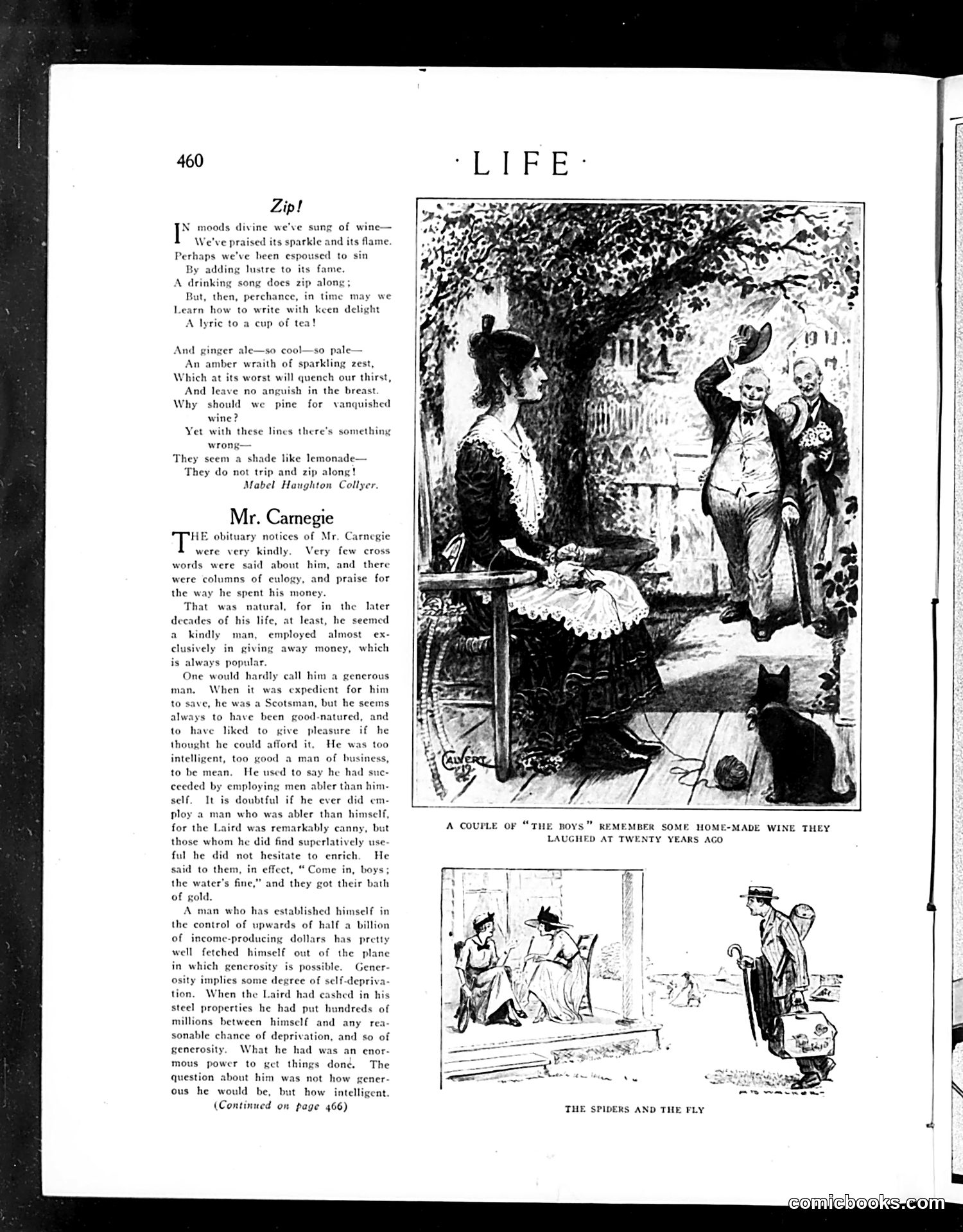
This page contains two main sections: **"Zip!" Poem**: A light verse by Mabel Haughton Collyer playfully contrasting drinking songs about wine and spirits with non-alcoholic beverages like ginger ale and tea. The satire gently mocks attempts to write equally rousing songs about temperate drinks—they lack the vigor ("zip") of alcohol-themed verses. **"Mr. Carnegie" Essay**: A column evaluating Andrew Carnegie's philanthropic legacy following his death. The author argues Carnegie wasn't truly "generous" in the classical sense because generosity requires self-sacrifice. With billions at his disposal, Carnegie couldn't meaningfully deprive himself. The satire's point: his vast wealth made his giving effortless rather than virtuous. The author credits Carnegie's true value to his intelligence and business acumen in employing capable people, not moral virtue. **Illustrations**: Two cartoon vignettes accompany the text, though their specific references to "the boys" remembering home-made wine and "The Spiders and the Fly" remain visually unclear without additional context.
📄 Transcribed text from this page (OCR, searchable)
Machine-transcribed from the original scan — historical spelling and the odd misread are preserved.
460 Zip! N moods divine we've sung of wine— We've praised its sparkle and its flame. Perhaps we've been espoused to sin By adding lustre to its fame A drinking song does zip along; But, then, perchance, in time may we Learn how to write with keen delight A lyric to a cup of tea! And ginger ale—so cool—so pale— An amber wraith of sparkling zest, Which at its worst will quench our thirst, And leave no anguish in the breast Why should we pine for vanquished wine? Yet with these lines there’s something wrong. They seem a shade like lemonade— They do not trip and zip alon Mabel Haughton Collyer. Mr. Carnegie HE obituary notices of Mr. Carnegie were very kindly. Very few cross words were said about him, and there were columas' of eulogy, and praise: for the way he spent his money That was natural, for in the later decades of his life, at least, he seemed a kindly man, employed almost ex- clusively in’ givit way money, which tg always populat. One would hardly call him a generous man. When it was expedient for him to save, he was a Scotsman, but he seems always to have been good-natured, and to have liked to give pleasure if he thought he could afford it. He was too intelligent, too good a man of business, to be mean. He used to say he had sv ceeded by employing men abler than him- self. It is doubtful if he ever did em- ploy a man who was abler than himself, for the Laird was remarkably canny, but A COUPLE OF “THE noys” REMEMBER SOME HOME-MADE WINE THEY those whom he did find superlatively use- LAUGHED AT TWENTY YEARS AGO ful he did not hesitate to enrich, He said to them, in effect, “Come in, boys; the water's fine,” and they got their bath of gold. A man who has established himself in the control of upwards of half a billion of income-producing dollars has pretty well fetched himself out of the plane in which gencrosity is possible. Gener- osity implies some degree of self-depriva- tion. When the Laird had cashed in his steel properties he had put hundreds of millions between himself and any rea sonable chance of deprivation, and so of generosity. What he had was an enor- mous power to get things done. The question about him was not how gener- ous he would be, but how intelligent. (Continued on page 466) THE SPIDERS AND THE FLY