
A complete issue · 48 pages · 1919
Life — September 4, 1919
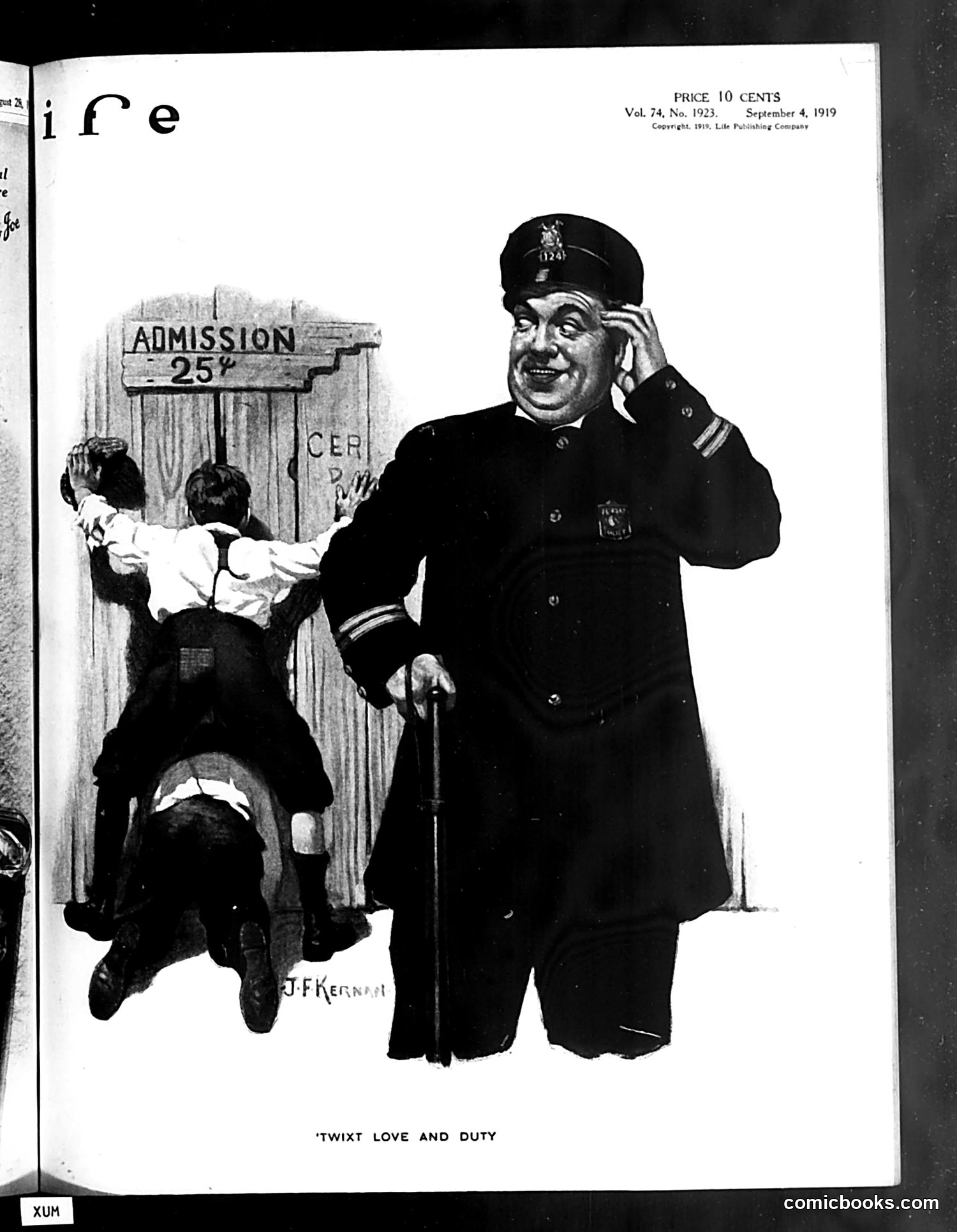
This Life magazine cover from September 4, 1919 depicts a uniformed military officer (identifiable by his cap and insignia) caught in a humorous dilemma. He's being pulled in opposite directions: toward a woman at an "Admission 25¢" booth (likely representing entertainment or romantic temptation) while simultaneously being tugged by children clinging to his legs (representing family obligations and duty). The title "'Twixt Love and Duty" plays on this tension. The cartoon satirizes the postwar period—likely commenting on servicemen returning from World War I facing the conflict between resuming civilian pleasures versus family responsibilities. The exaggerated facial expression emphasizes the impossible choice, making light of soldiers' readjustment challenges in 1919.
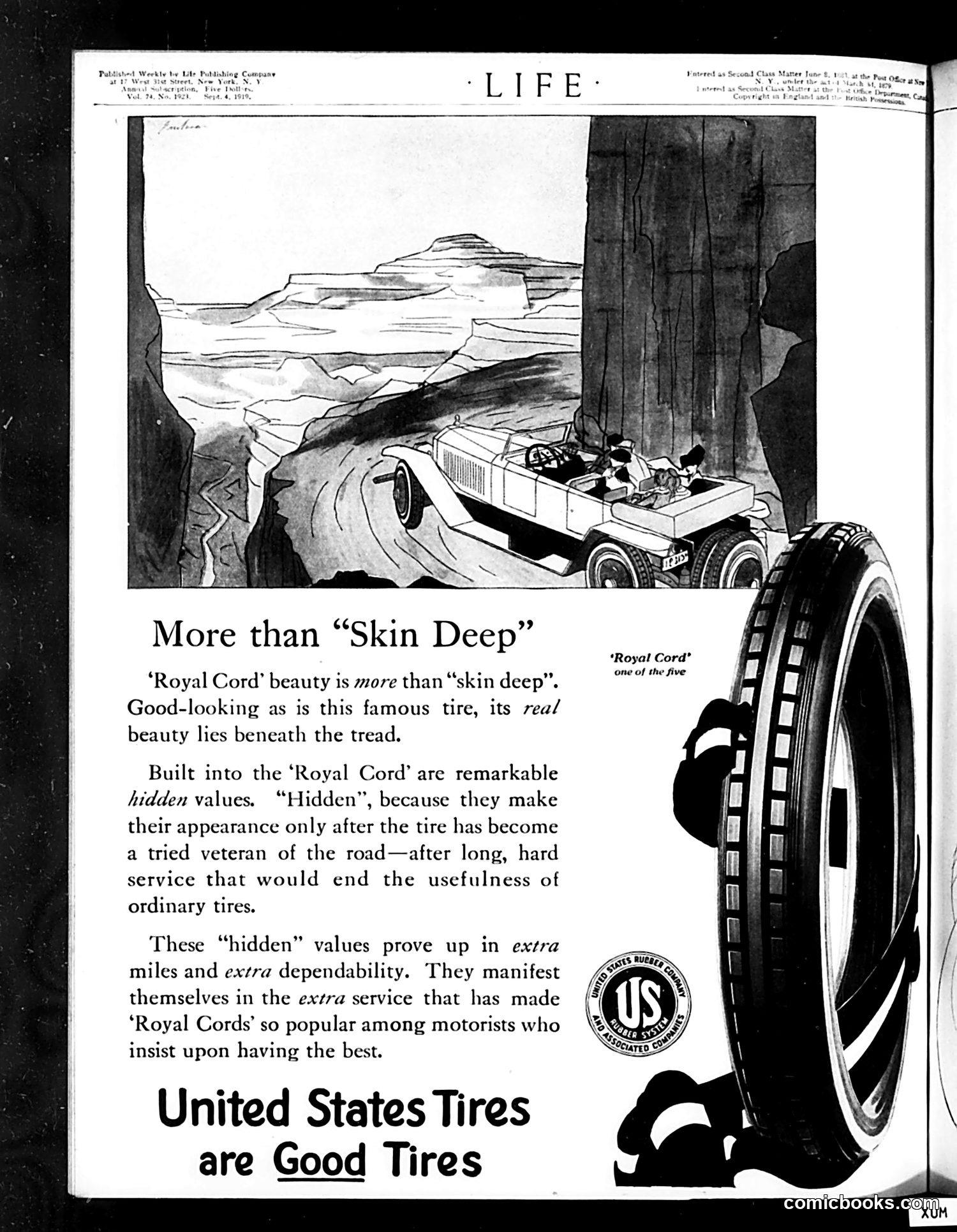
This page is primarily **advertising, not satire or political commentary**. It's a United States Tires company advertisement for "Royal Cord" brand tires, published in *Life* magazine. The ad uses an illustration of an early automobile navigating dramatic canyon scenery to suggest durability and adventure. The accompanying text emphasizes that Royal Cord tires offer beauty *plus* hidden structural qualities—superior durability that reveals itself through extended use and "extra service." The headline "More than 'Skin Deep'" plays on the common expression to argue that these tires have inner strength beyond their surface appearance. A large tire image dominates the right side of the page. This reflects early 20th-century automotive advertising emphasizing reliability and performance during an era when tire quality significantly affected vehicle safety and capability.
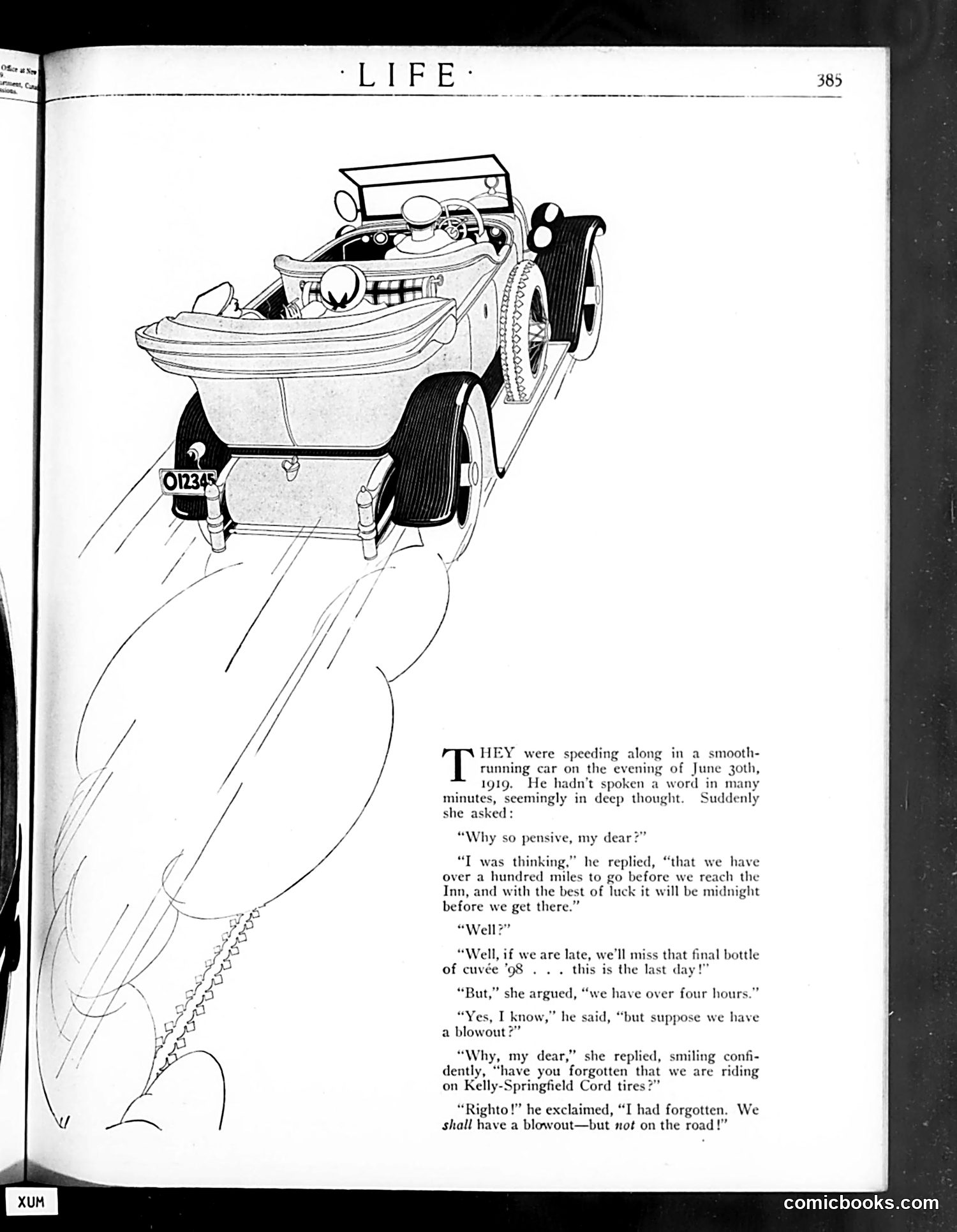
This page from Life magazine (page 383) contains a humorous short story rather than political satire. The illustration shows a couple in an open-air automobile from approximately 1919, speeding along a road. The joke centers on tire reliability. The man worries they won't reach their destination by midnight to buy a final bottle of wine (suggesting Prohibition's impending enforcement on June 30, 1919). The woman reassures him they're safe because they have "Kelly-Springfield Cord tires"—a real tire brand known for durability. The man's punchline: they'll have a blowout, but not while driving. This is essentially an advertisement disguised as entertainment, promoting Kelly-Springfield tires through humor. The Prohibition reference dates it precisely to 1919.
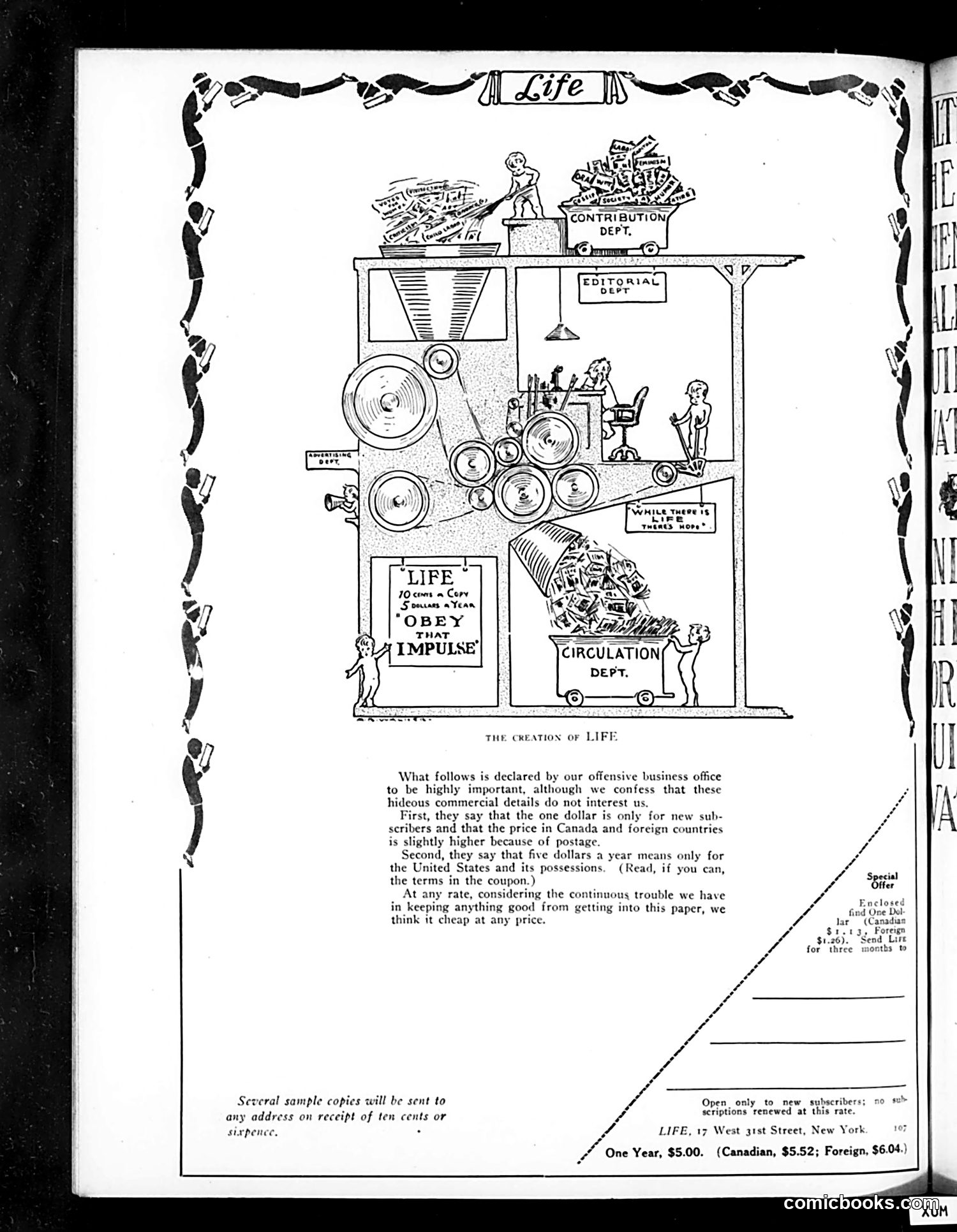
This is a satirical diagram showing *Life* magazine's internal operations as an industrial machine. The cartoon depicts various departments (Contribution, Editorial, Circulation) as mechanical gears and conveyor systems, with human figures operating them. The accompanying text humorously explains the magazine's subscription pricing structure: one dollar for new subscribers (higher in Canada/abroad due to postage), five dollars yearly for U.S. readers. The business office presents these "hideous commercial details" as necessary evils, joking they keep quality content affordable "at any price." The machine metaphor satirizes how a satirical magazine itself operates as a commercial enterprise—ironically treating its own profit-driven mechanics as the subject of satire, similar to how it mocks other institutions.
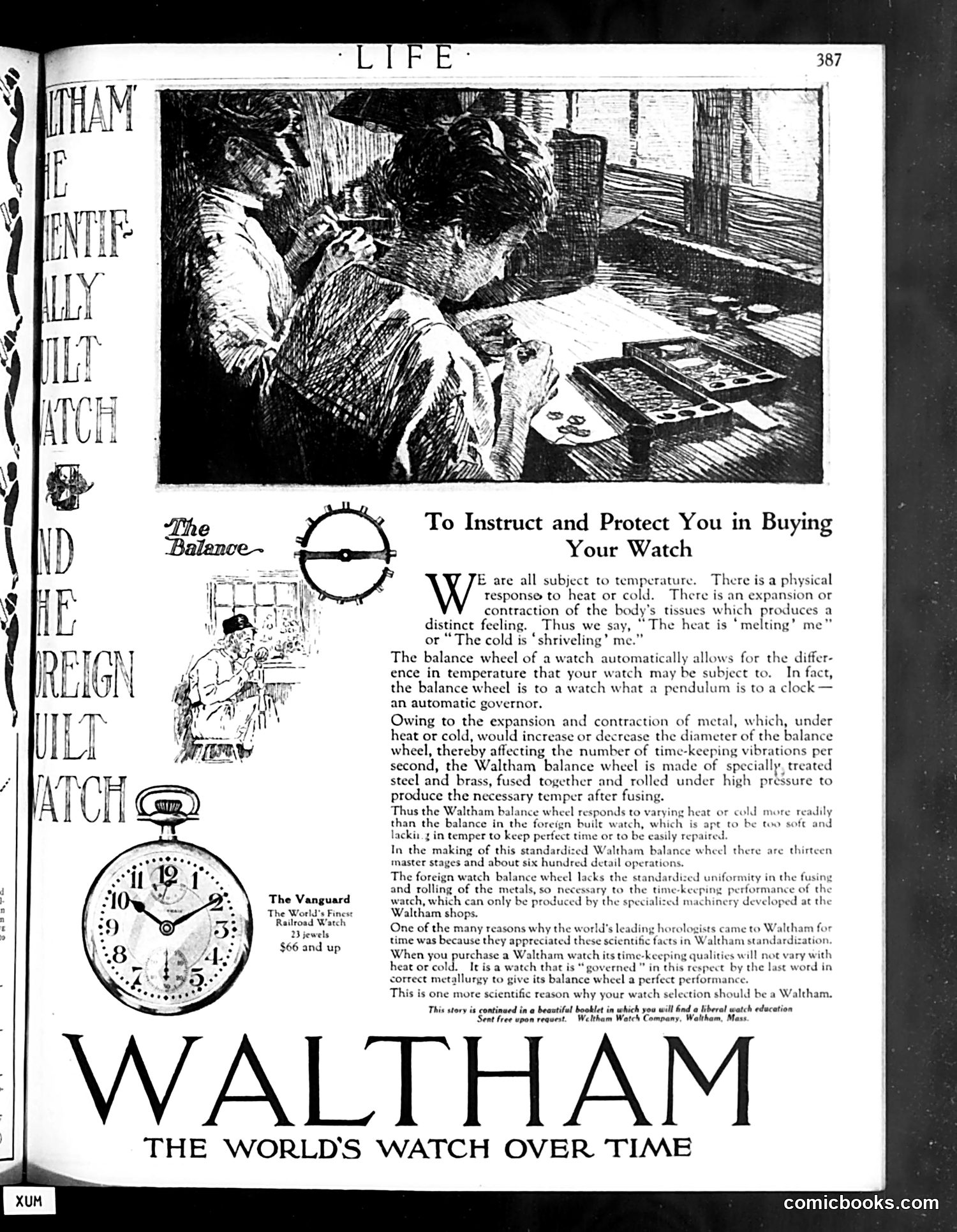
This page is primarily **advertising, not satire or political commentary**. It's a Waltham Watch Company advertisement from Life magazine (page 387). The top illustration shows two people examining watches at a workbench—likely depicting craftsmen or jewelers inspecting timepieces. The lengthy text below explains Waltham's technical innovations, specifically their balance wheel design that compensates for temperature fluctuations in metal. The advertisement emphasizes scientific precision: Waltham's balance wheel allegedly performs better than competitors' because it's made from specially treated steel and brass, created through standardized manufacturing processes. The "Vanguard" pocket watch image and tagline "THE WORLD'S WATCH OVER TIME" promote the brand's reliability and superiority. This is straightforward product marketing highlighting engineering excellence—no political message or satire is present.
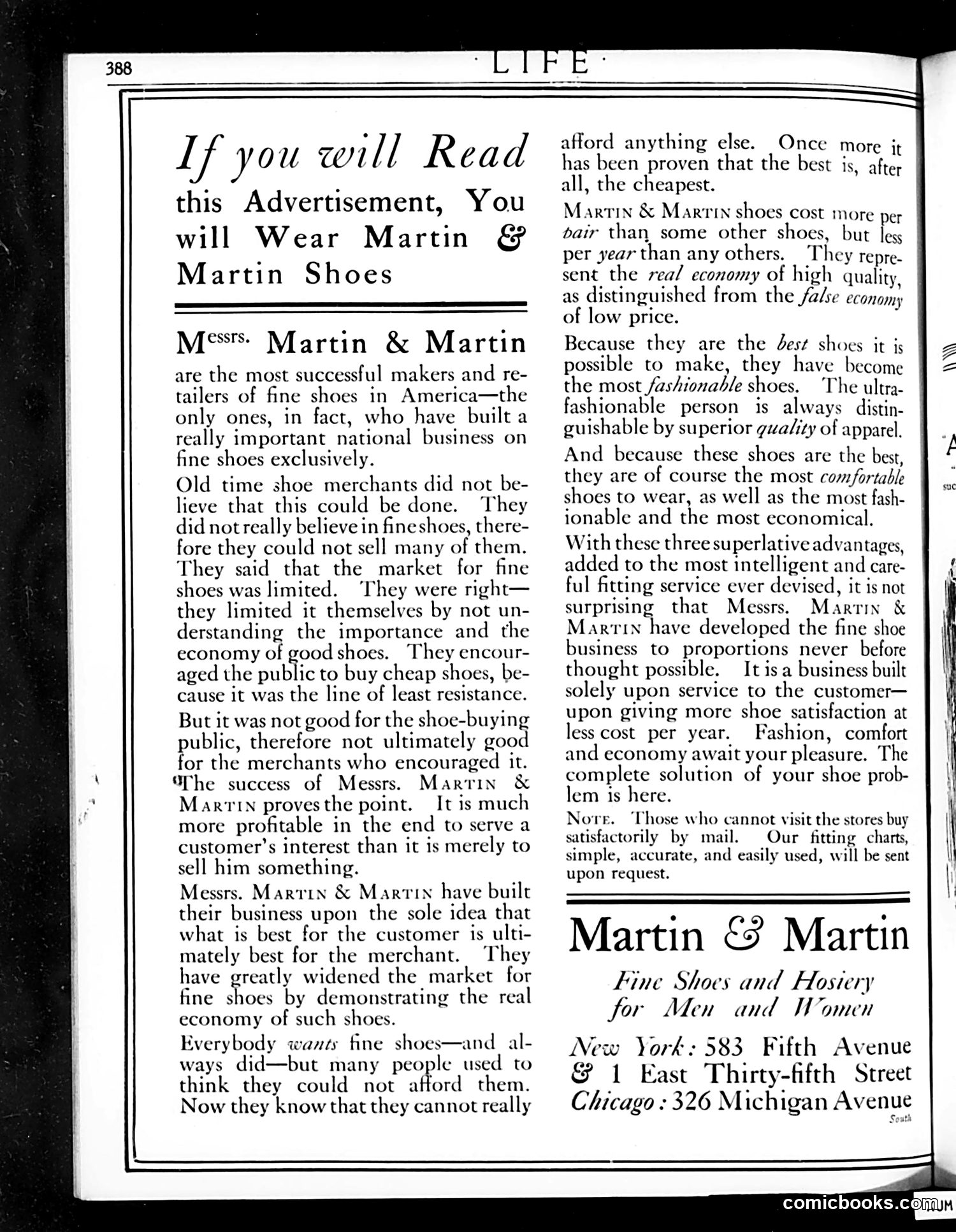
This page is **entirely an advertisement**, not satire or editorial content. It's a full-page ad for Martin & Martin fine shoes, appearing in Life magazine (page 388). The ad makes no cartoons or political references. Instead, it uses persuasive rhetoric common to early 20th-century advertising: claiming Martin & Martin pioneered quality shoe manufacturing as a national business, positioning fine shoes as both luxurious and economical. The ad argues that while their shoes cost more per pair than competitors, they last longer, making them cheaper annually. The text emphasizes that quality shoes indicate refined character and that the company serves customer interest—a sales pitch rather than humor. Two store locations are listed: New York and Chicago.
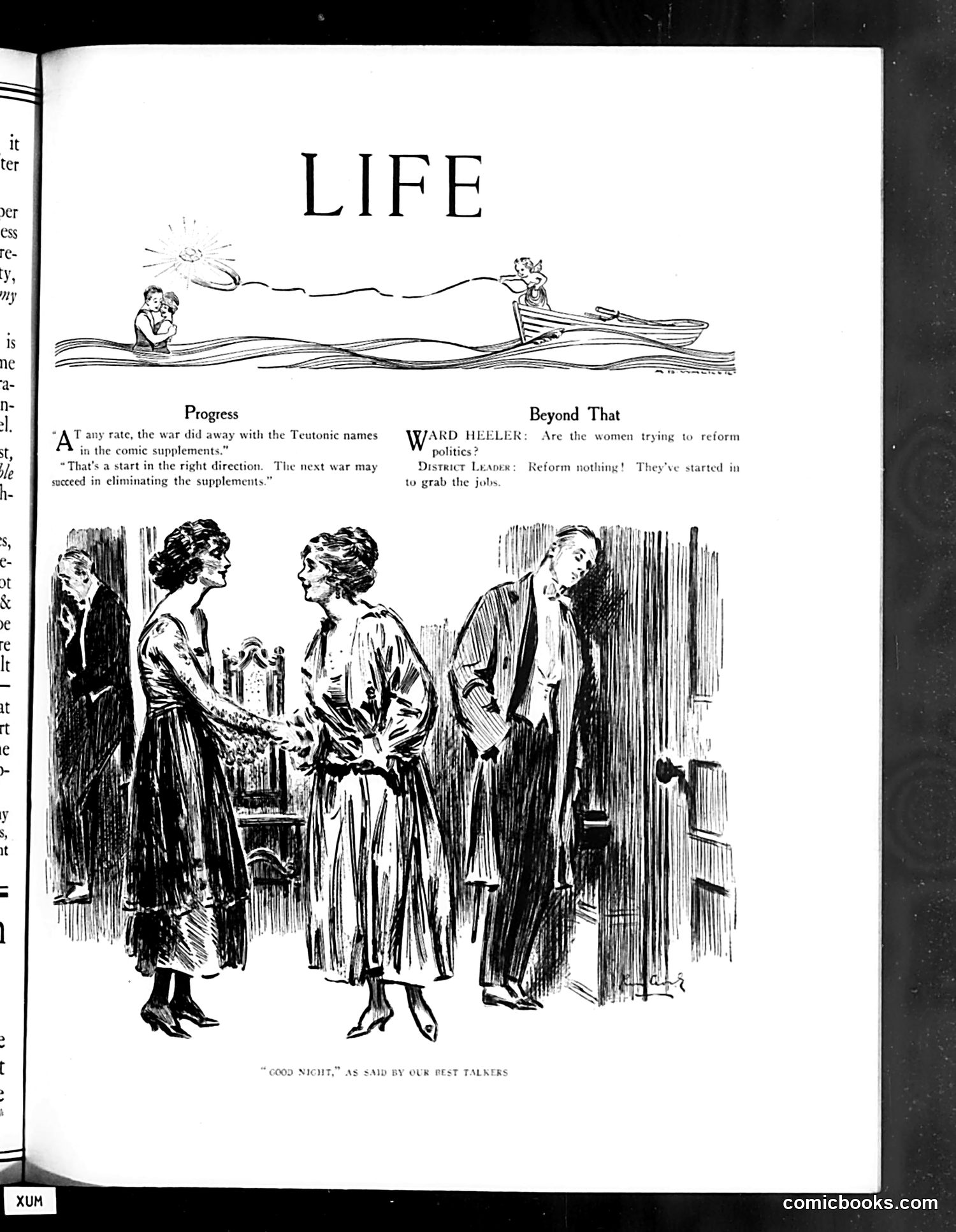
This page contains two satirical sections titled "Progress" and "Beyond That," commenting on early 20th-century social issues. The top cartoon references the Teutonic names in "comic supplements" (comic strips), suggesting WWI influenced cultural attitudes toward German names. The lower cartoon depicts a social conversation with a dialogue between a "Ward Heeler" (a political operative) and a "District Leader." The Ward Heeler dismisses women's political reform efforts, claiming women have "started in to grab the jobs" rather than genuinely reforming politics. The caption reads "Good night," as said by "our best talkers." The satire targets male political resistance to female political participation and reform efforts, presenting the dismissive attitude of established male politicians toward women's political ambitions during the early women's suffrage movement era.
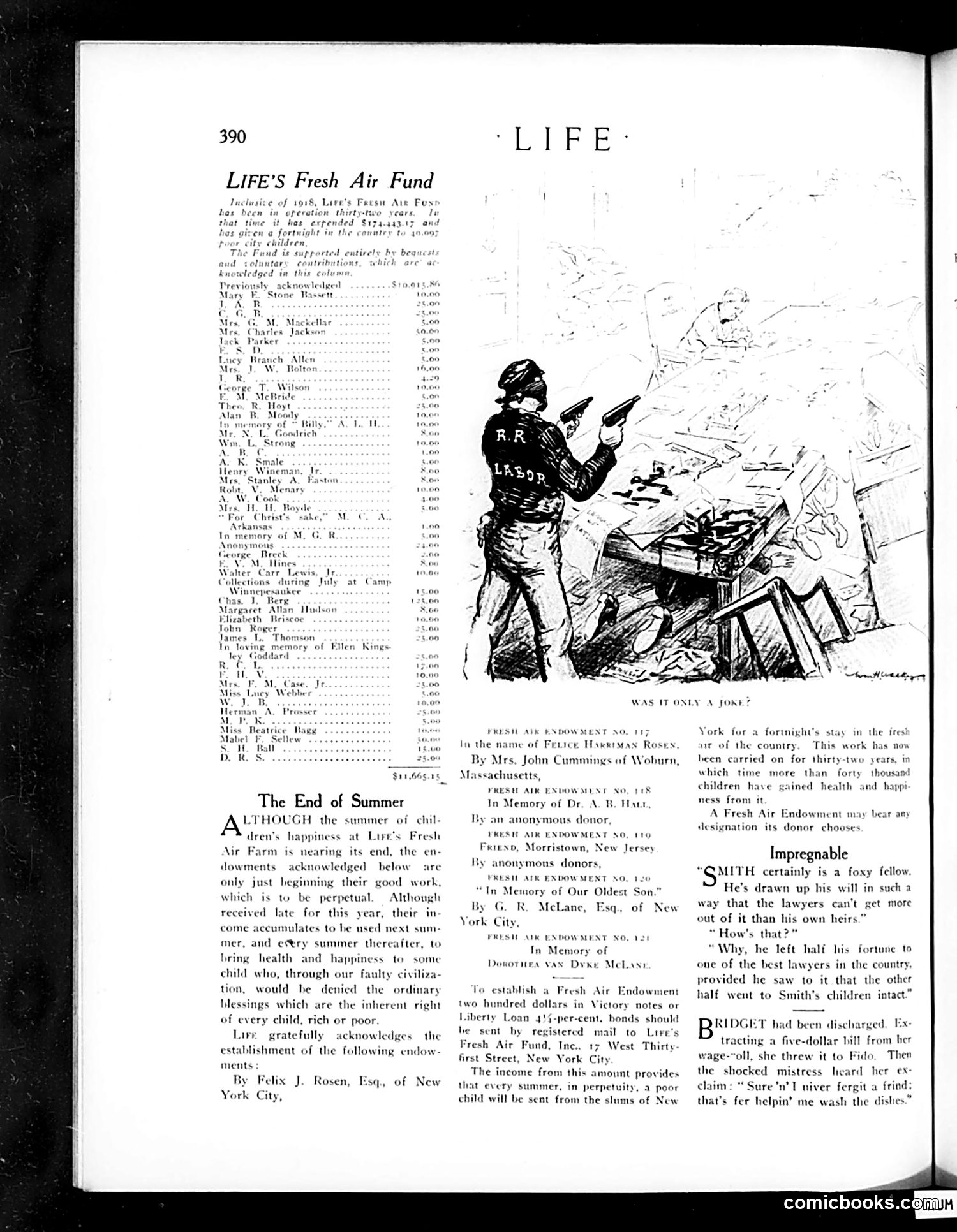
This cartoon satirizes a soldier's casual attitude toward wartime destruction. The figure labeled "R.R." (likely representing a railroad worker or military personnel) stands amid wreckage and debris, gesturing dismissively at the devastation around him. The caption "Was It Only a Joke?" suggests he treated some serious matter—possibly property destruction, negligence, or a reckless action—as humorous when it caused real damage. The image critiques how those in authority positions rationalize or minimize serious consequences through humor, and the public's willingness to accept such dismissals. This appears connected to Life's early 20th-century tradition of satirizing institutional irresponsibility and the gap between workers' casual attitudes and actual harm caused.
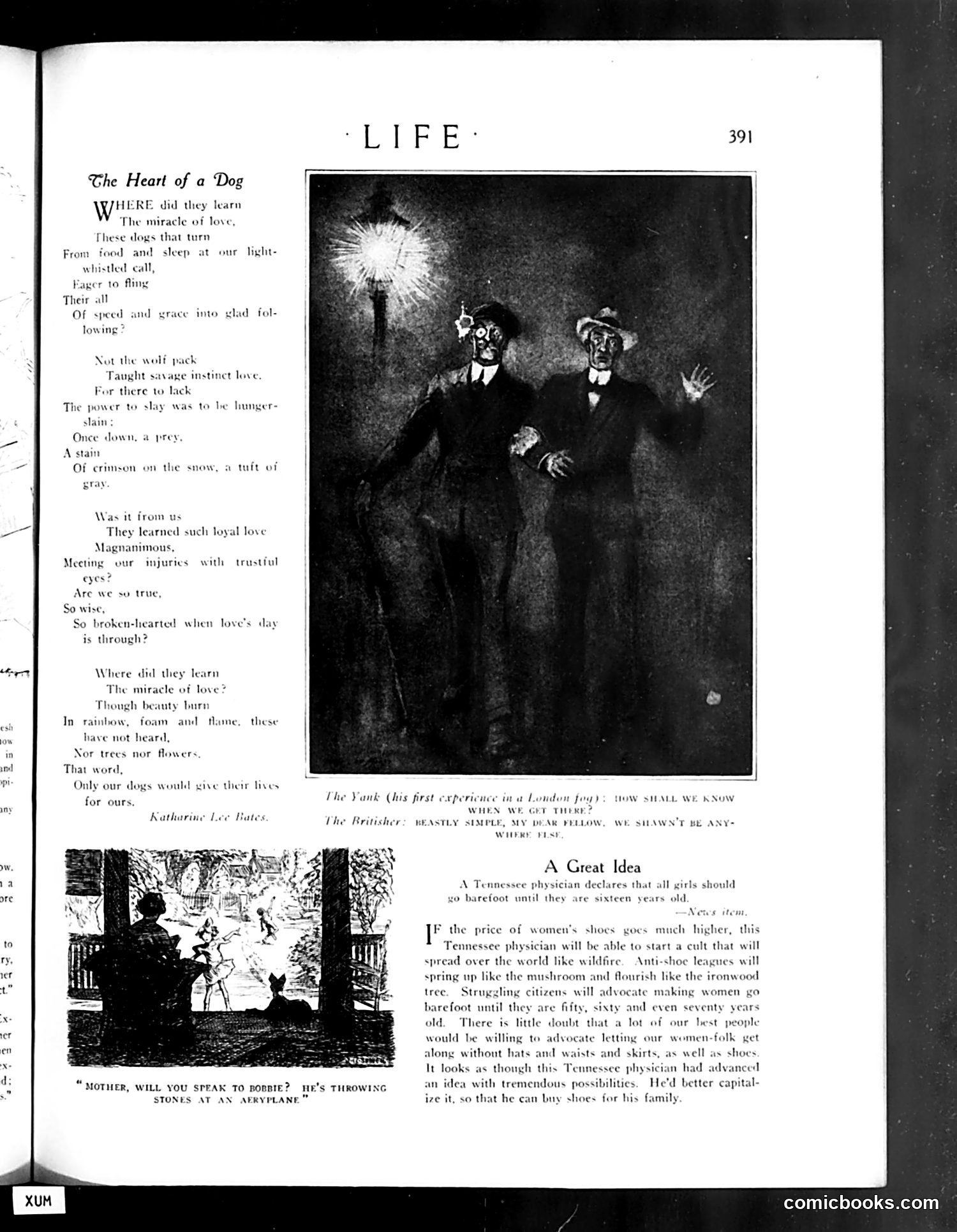
**"The Heart of a Dog"** is a sentimental poem by Katharine Lee Bates celebrating dogs' capacity for loyalty and love, contrasting them favorably with humans' moral failings. **The cartoon** shows two men in formal attire with dog heads, titled "The Yank (his first experience in a London toy): 'How shall we know / The Britisher: Beastly simple, my dear fellow. We shan't be anywhere else.'" This satirizes American tourists in London, mocking their inability to distinguish themselves from British counterparts—a jab at American cultural pretension and lack of sophistication abroad. **"A Great Idea"** sarcastically proposes girls go barefoot until age sixteen, claiming a Tennessee physician advocates this to reduce shoe costs. The satire critiques absurd cost-cutting proposals while addressing gender and class concerns.
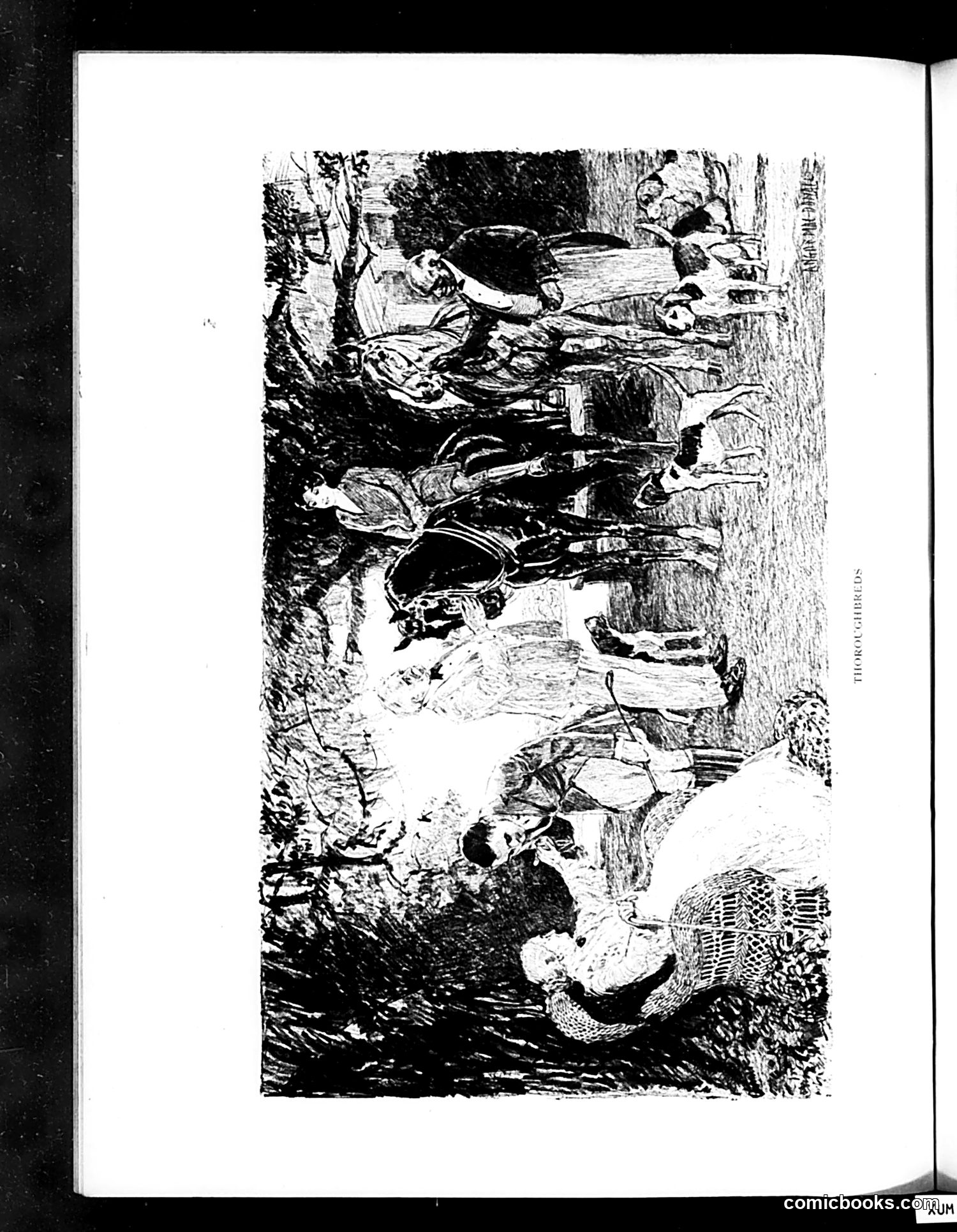
I can see this is a sketch or etching showing multiple figures in what appears to be an outdoor or rural setting, rendered in black and white with significant detail work. However, the image is rotated and difficult to read clearly, and the OCR text provided appears to be blank or unreadable on my end. Without legible text identifying the cartoon's title, date, or caption, and given the image's orientation and print quality, I cannot confidently identify the specific political figures, events, or satirical points being referenced. To provide accurate historical analysis as requested, I would need either a clearer, properly-oriented image or the actual readable OCR text from the page. I apologize that I cannot be more helpful without risking inaccurate interpretation.
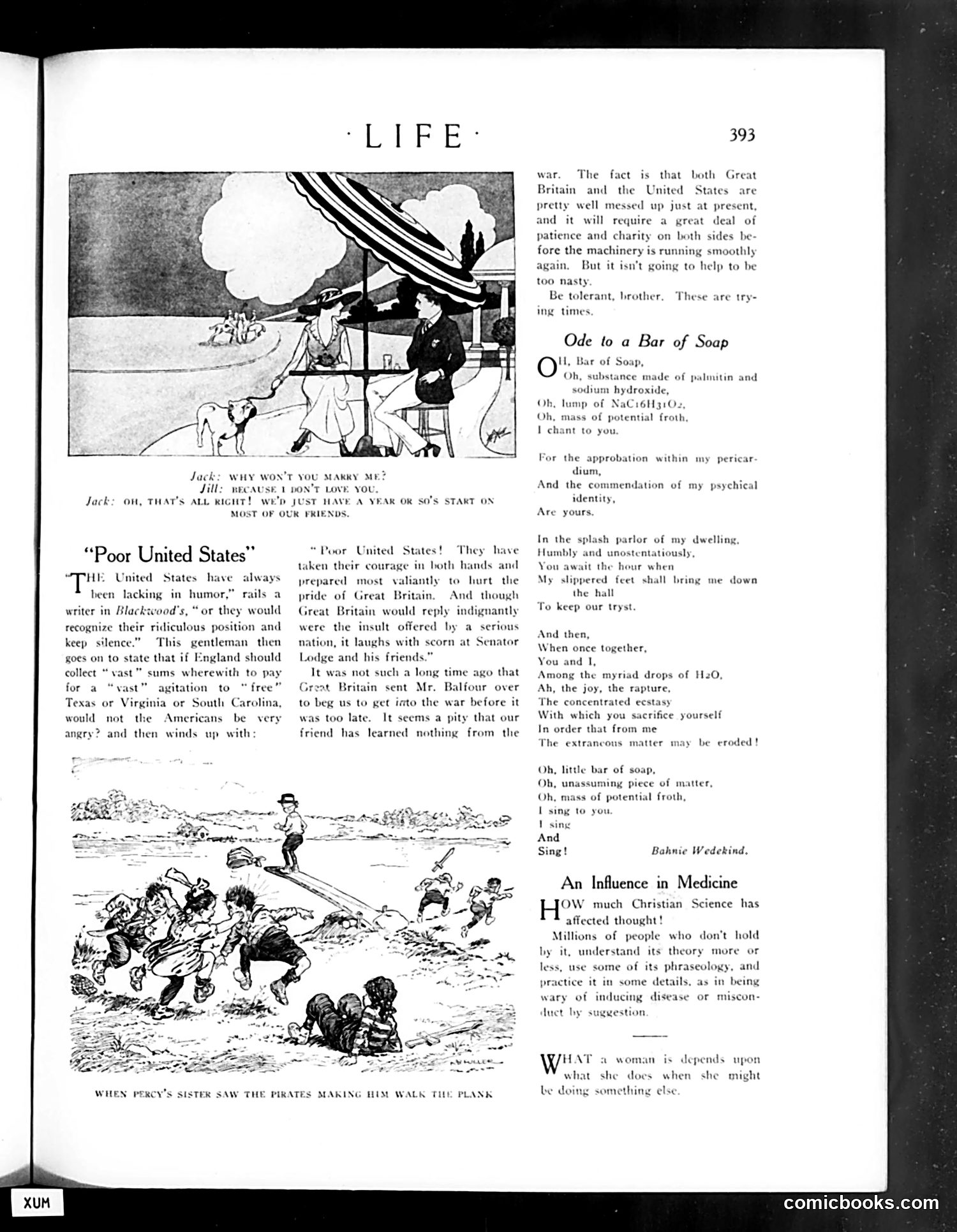
The top cartoon depicts a dialogue between "Jack" and "Jill" about marriage, with the woman declining: "Oh, that's all right! We'll just have a year or so's start on most of our friends." This satirizes the common practice of couples delaying marriage during wartime. The "Poor United States" section criticizes American isolationism and lack of preparedness before entering World War I. It mocks the U.S. for not learning from Britain's experience and suggests America should have entered the war earlier. The bottom illustration shows pirates forcing someone to "walk the plank," likely satirizing political or social power dynamics of the era. The page also includes a poem "Ode to a Bar of Soap" by Bahnie Wedekind, a humorous tribute to soap—a commodity relevant during WWI rationing.
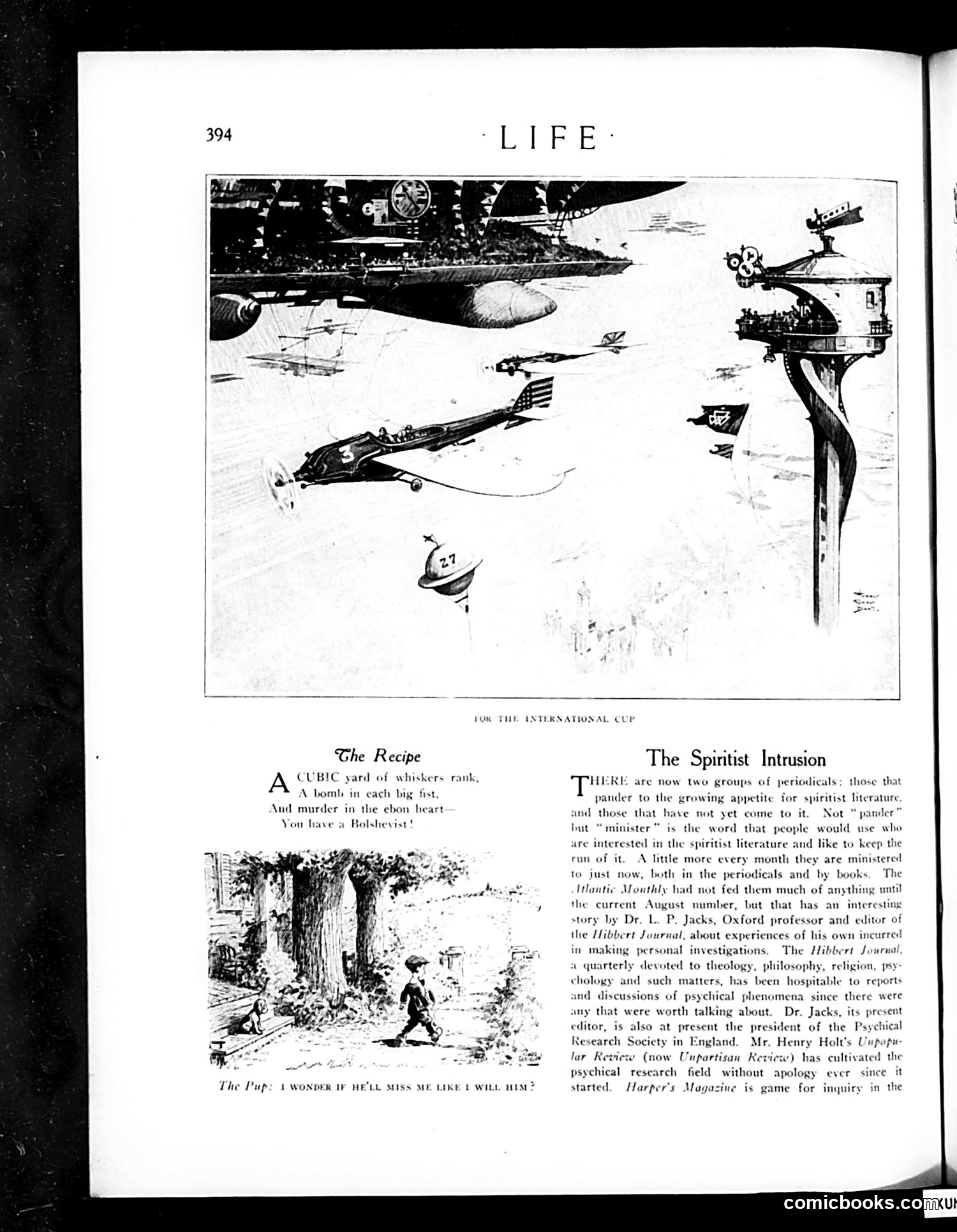
The top illustration depicts a satirical maritime scene titled "For the International Cup," showing various vessels and aircraft in absurdist conflict—likely commentary on naval arms races or international military competition, though the specific event is unclear from this image alone. Below are two articles: "The Recipe" (left) and "The Spiritist Intrusion" (right). "The Recipe" appears to be dark political satire with an illustration of a figure near a cottage, accompanied by cryptic violent imagery ("A cubic yard of whiskers rank, / A bomb in each leg fist"). "The Spiritist Intrusion" discusses spiritualist literature and psychical research societies, referencing publications like the *Hibbert Journal* and *Harper's Magazine*. This section appears to mock or critique contemporary interest in spiritualism and occult investigation rather than offering straightforward reporting.
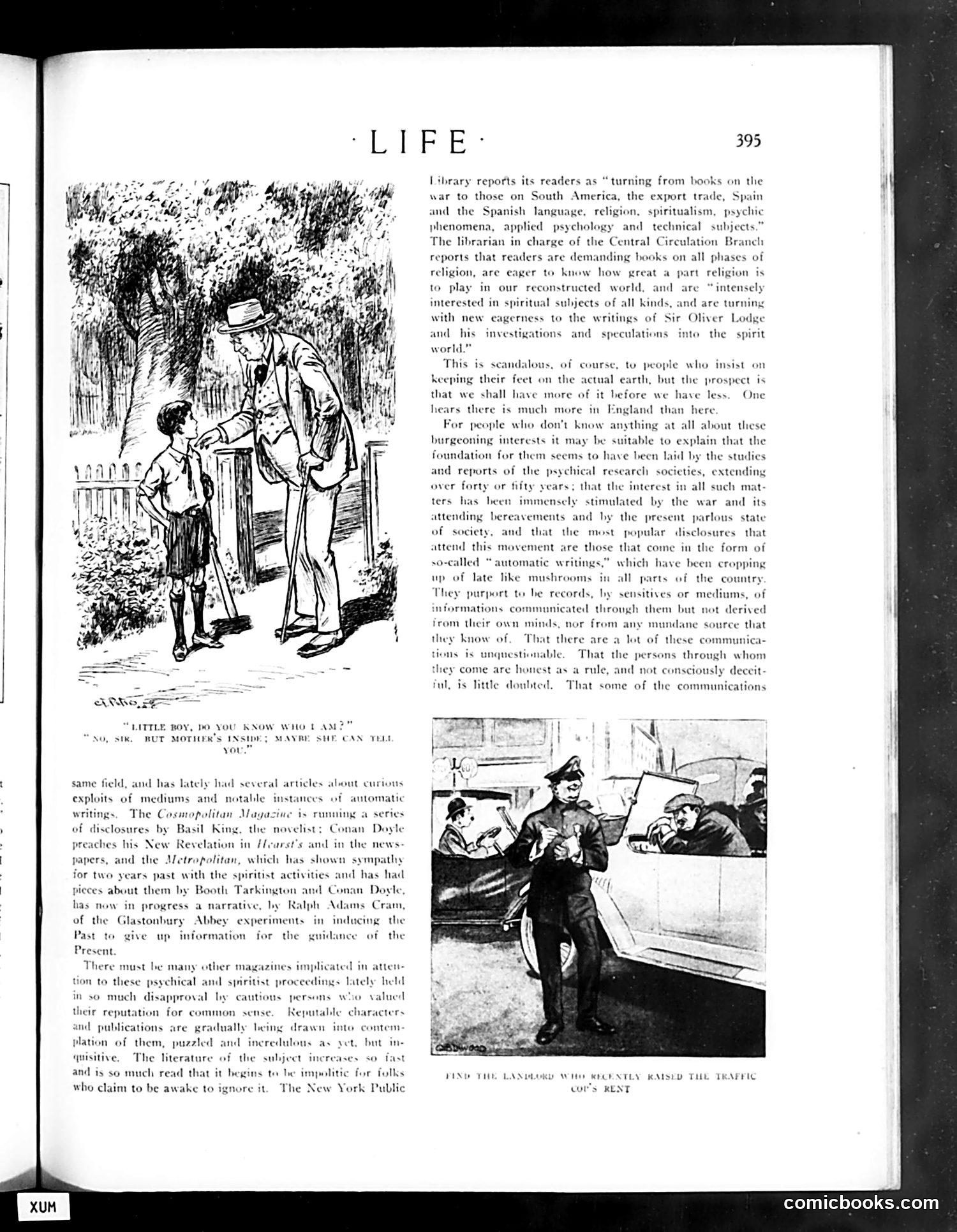
This page from *Life* magazine (page 395) contains a satirical cartoon and accompanying editorial commentary about spiritualism and psychic phenomena. **The Cartoon:** Shows an adult man in a hat speaking to a small boy on a street. The caption reads: "Little Boy, do you know who I am?" "No, sir; but Mother's inside; maybe she can tell you." **The Satire:** The joke mocks spiritualism and mediums—the adult represents someone claiming mysterious or special identity, while the boy's innocent response suggests the mother consults mediums/spiritualists who might "know" unknowable things. **Context:** The text criticizes the proliferation of spiritualist literature, "automatic writings," and psychic claims gaining popularity post-WWI. The editorial dismisses these as unverifiable nonsense exploited by magazines and publications seeking credibility through association with occult interests.
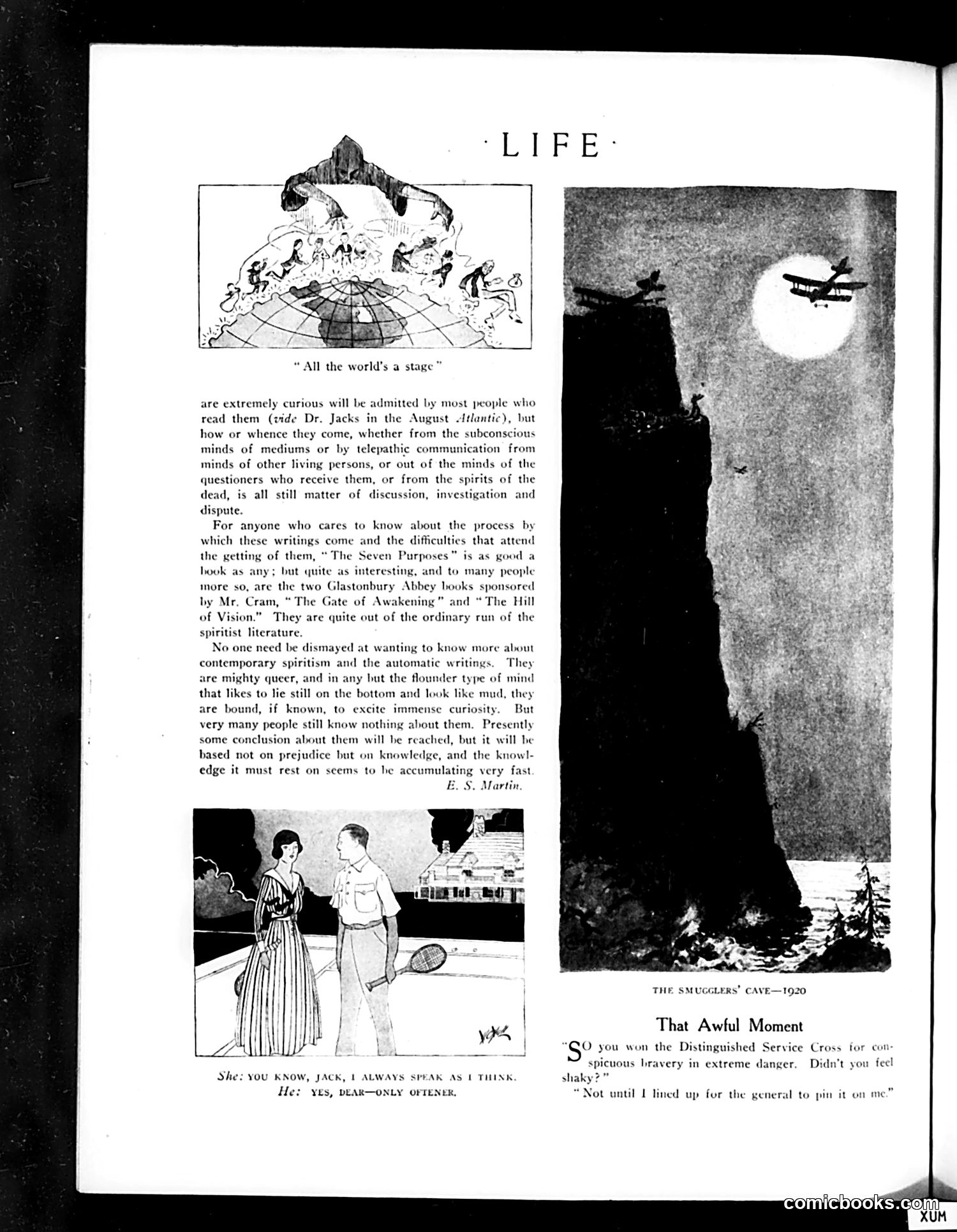
This page contains three distinct pieces: 1. **Top illustration** ("All the world's a stage"): A satirical drawing showing figures performing on a globe, illustrating the theatrical nature of global affairs. 2. **Main text** by E.S. Martin discusses spiritualism and automatic writing—contemporary interest in séances and psychic phenomena. The author expresses curiosity about these practices while noting they remain controversial and require investigation rather than prejudice. 3. **Bottom cartoon**: A domestic scene captioned "She: you know, Jack, I always speak as I think. He: yes, dear—only oftener." This satirizes marital dynamics, humorously suggesting wives talk excessively. 4. **Right sidebar** titled "That Awful Moment" presents a military anecdote about awarding the Distinguished Service Cross, with understated humor about bureaucratic timing.
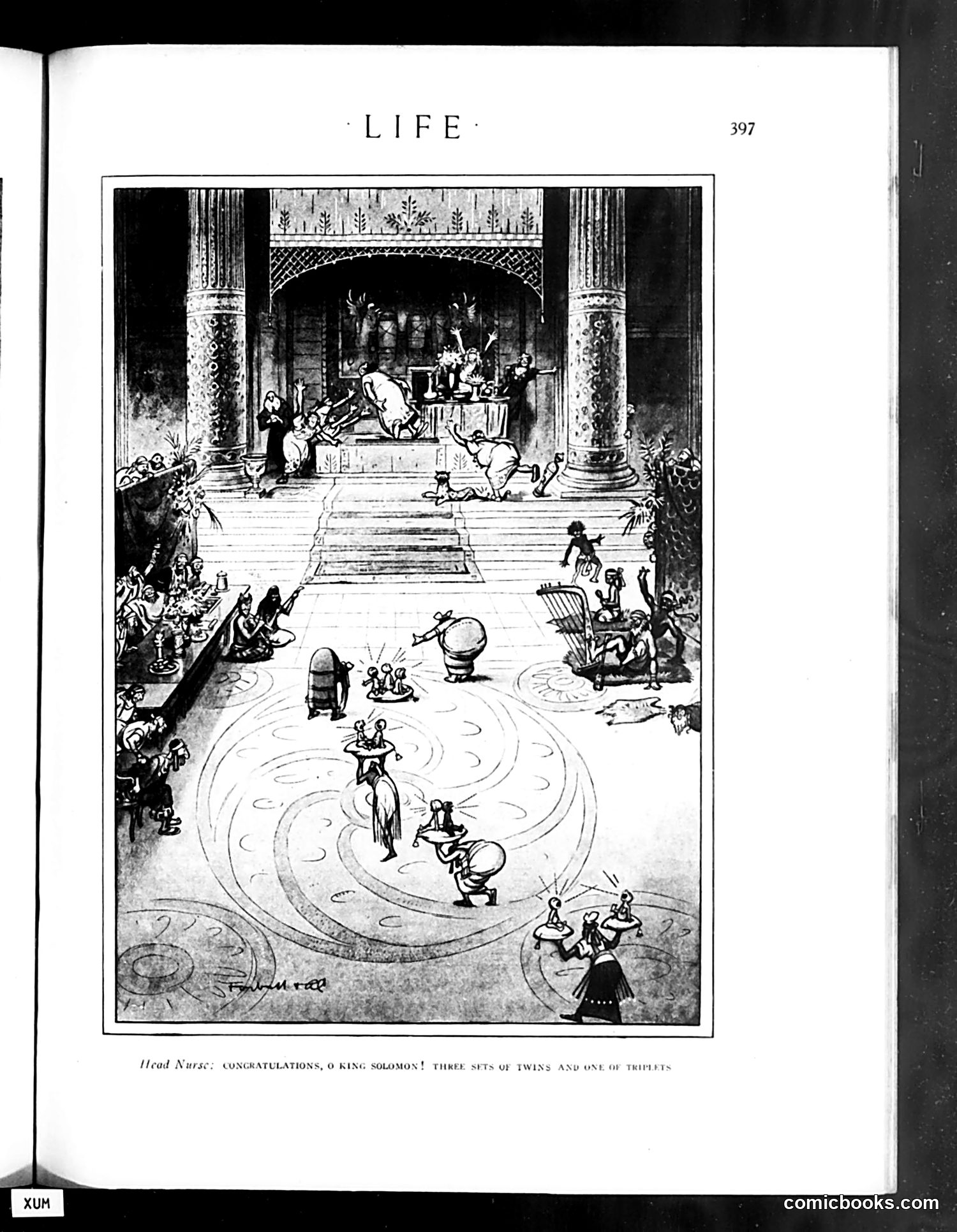
This is a satirical illustration titled "Head Nurse" from *Life* magazine (page 397). The caption reads: "Congratulations, O King Solomon! Three sets of twins and one of triplets." The cartoon depicts King Solomon presiding over a biblical court scene, with a large spiral pattern on the floor containing figures representing multiple sets of twins and triplets. Crowds line both sides of the ornate palace hall. The satire appears to reference Solomon's legendary wisdom and his many wives—he's being humorously "congratulated" on producing numerous multiple births. This likely mocks either: (1) Solomon's biblical reputation for extensive procreation, or (2) contemporary concerns about population growth or large families. The cartoon uses the biblical king as a vehicle for social commentary about fertility and reproduction, treating the multiplication of children as a matter requiring royal "judgment" or attention.
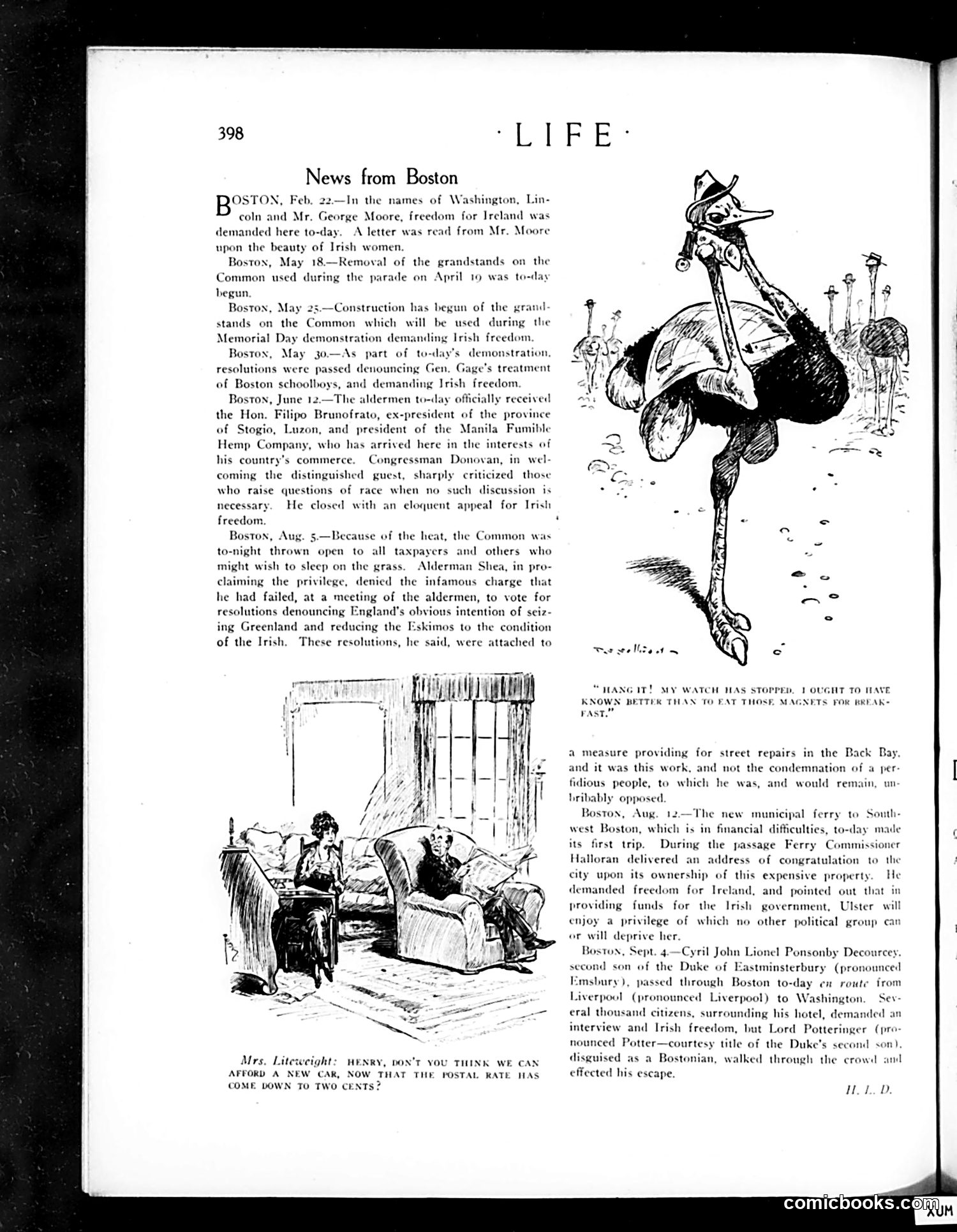
This page satirizes Boston's obsession with Irish independence activism. The "News from Boston" column reports absurd civic events where Boston officials constantly demand Irish freedom—whether dedicating a ferry, welcoming a Filipino business delegate, or opening the Common to sleepers. The joke: Irish freedom becomes a reflexive, hollow political platitude disconnected from actual governance or relevance. The cartoons mock related themes: One shows an ostrich-like figure with a stopped watch, captioned about eating magnets for breakfast—likely mocking absent-minded distraction. The second depicts a woman suggesting a new car given postal rates dropping to two cents, satirizing consumer distraction from serious matters. The satire suggests Boston's political class uses Irish freedom as convenient rhetoric while ignoring practical concerns, and that ordinary citizens drift from topic to topic without genuine engagement.
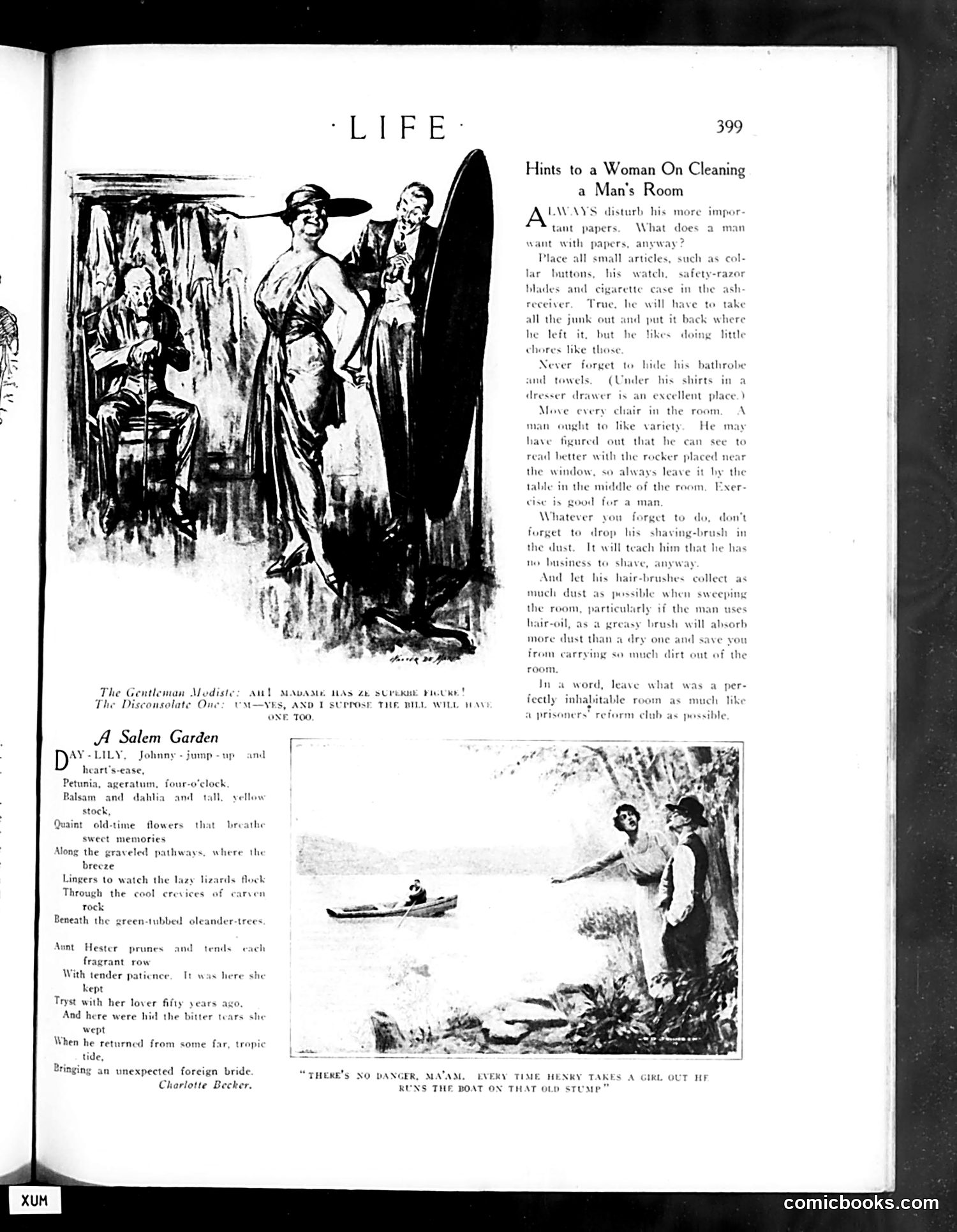
This page contains satirical advice and lighter content typical of Life magazine's humor section. **"Hints to a Woman On Cleaning a Man's Room"** is **satirical domestic advice** that reverses conventional wisdom. Rather than offering genuine cleaning tips, it ironically instructs women to deliberately disorganize a man's room—hiding his belongings, moving furniture, disturbing papers—under the pretense of "helpfulness." The joke mocks both incompetent housekeeping and the frustration husbands experience when well-meaning wives reorganize their spaces, destroying their systems. This reflects early 20th-century gender dynamics where women managed households. **"A Salem Garden"** is a sentimental poem by Charlotte Becker about an elderly woman tending her garden, where she kept a romantic tryst fifty years prior with a lover who later returned with an unexpected foreign bride. The accompanying illustration shows figures by a boat and garden setting, illustrating the nostalgic, melancholic narrative. Both pieces represent Life's mix of humor and sentiment aimed at middle-class American readers of that era.
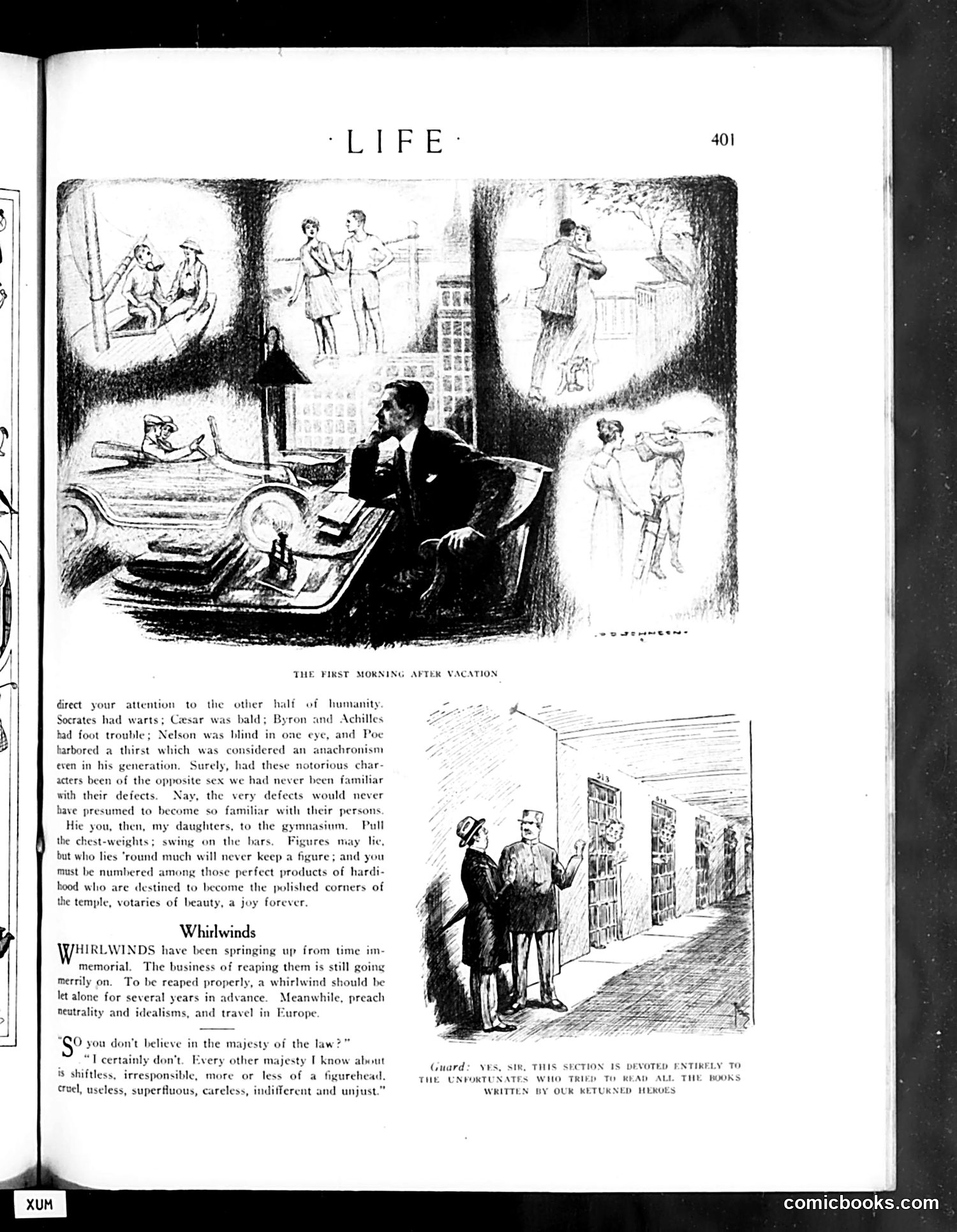
**"The First Morning After Vacation"** (top cartoon): A man at his desk, surrounded by thought-bubbles showing idealized vacation scenes, contrasts sharply with his cramped reality. The satire mocks the gap between vacation fantasies and the mundane work-life that awaits—a timeless commentary on returning to the office. **Text section on women's fitness**: Sarcastically encourages women to exercise, citing that even great historical men (Socrates, Caesar, Byron, Nelson, Poe) had physical flaws, implying women should work harder to maintain perfection. This reflects early 20th-century anxieties about women's bodies and appearance. **"Whirlwinds" section**: A political/social commentary (unclear exactly which policy or event, but mentions "neutrality," "idealism," and "Europe"), criticizing someone or some group for promoting ideals while preparing for conflict. **Bottom cartoon**: A prisoner remarks he doesn't believe in "the majesty of the law," satirizing the legal system as corrupt and unreliable—comparing it unfavorably to other "majesties." The page blends humor with social criticism typical of Life magazine's satirical approach.
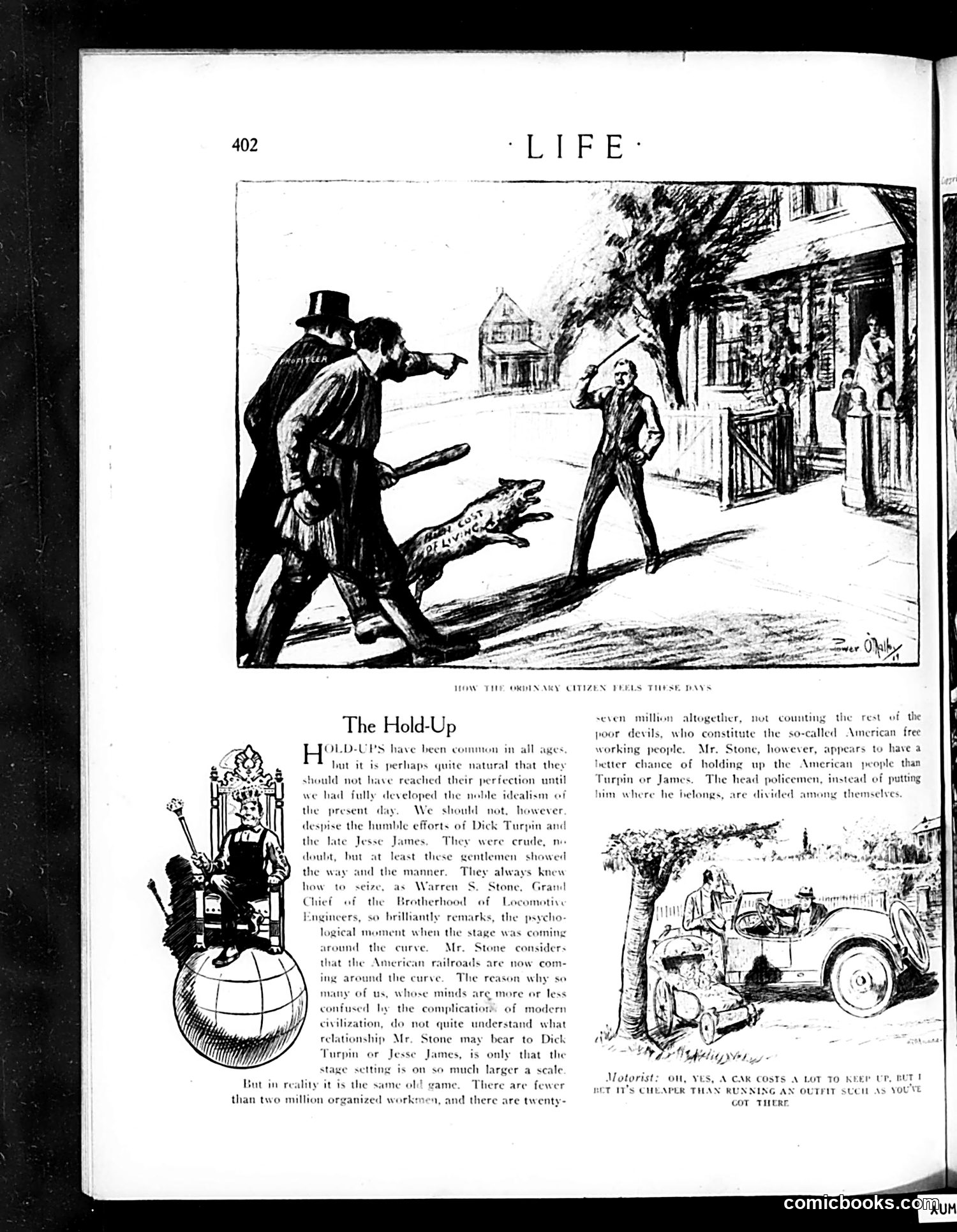
This page satirizes labor union leader Warren S. Stone, Grand Chief of the Brotherhood of Locomotive Engineers, by comparing him to historical highwaymen Dick Turpin and Jesse James. The top cartoon shows a street hold-up, captioned "HOW ORDINARY CITIZENS FEEL THESE DAYS"—suggesting Stone's union tactics feel like robbery to the public. The article argues Stone is exploiting a psychological moment (like bandits seizing opportunities) to extract concessions from railroads. The satire's bite: Stone commands only 2 million organized workers yet somehow holds leverage over 27+ million unorganized laborers and the broader American public. The final irony comes via the motorist cartoon: citizens grumble about car maintenance costs, yet tolerate union "hold-ups" that arguably cost more. The piece mocks both Stone's power grab and the public's seeming helplessness against it—"the head policemen...are divided among themselves." This reflects early 20th-century anti-union sentiment among middle-class audiences.
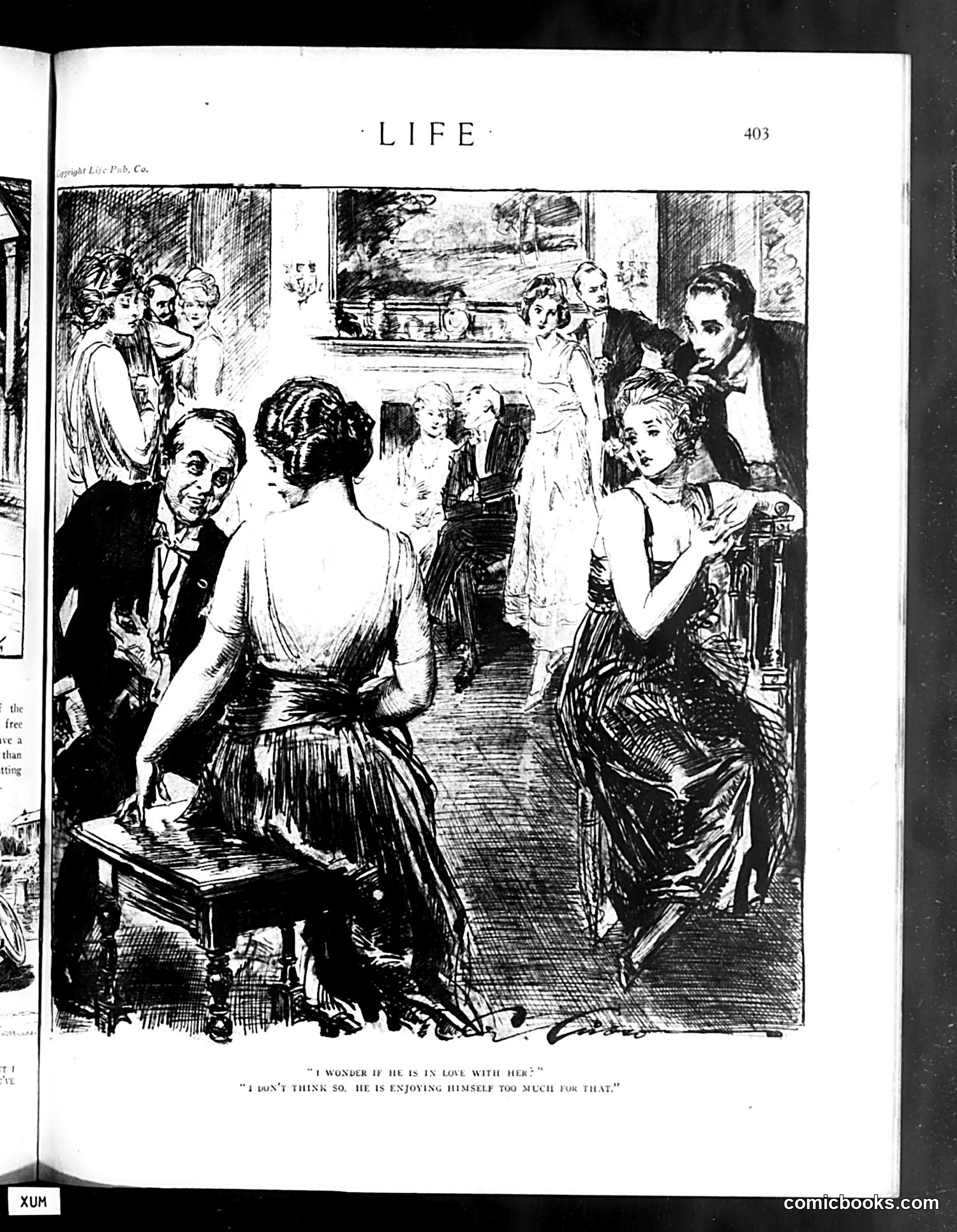
This is a single satirical cartoon from *Life* magazine (page 403) depicting an elegant social gathering. Two women in the foreground observe a man in dark formal wear who appears to be enjoying himself prominently among the guests. The joke plays on social expectations: one woman wonders if the man is romantically interested in the woman he's with ("in love with her"), while the other dismisses this notion, suggesting he's too self-absorbed and entertained by the overall social scene to be genuinely romantic. The satire targets male vanity and shallow social behavior—the implication being that some men prioritize their own enjoyment and social performance over genuine emotional connection. The cartoon mocks this self-centered socializing as incompatible with authentic romantic feeling.
This page discusses the Senate's imminent debate over President Wilson's Peace Treaty following World War I, specifically its controversial Shantung provision favoring Japan over China. The article identifies eight Republican senators opposing the treaty: Knox, Moses, Brandegee, Poindexter, Fall, Borah, Johnson, and Reed. It characterizes them variously as "hard-shell reactionaries," isolationists wanting America to "flock alone," and Roosevelt Progressives. The satire's point: ratification requires 64 of 96 senators' votes. With 46 Democrats supporting it, only 18 of 49 Republicans need to vote yes—leaving 31 Republicans free to obstruct without killing it. The author argues the Shantung provision, while imperfect, shouldn't wreck the entire treaty, and expresses optimism that enough Republicans will abandon their obstructionist colleagues to ensure passage. The cartoons (unclear in reproduction) likely mock the treaty opponents' rigidity.
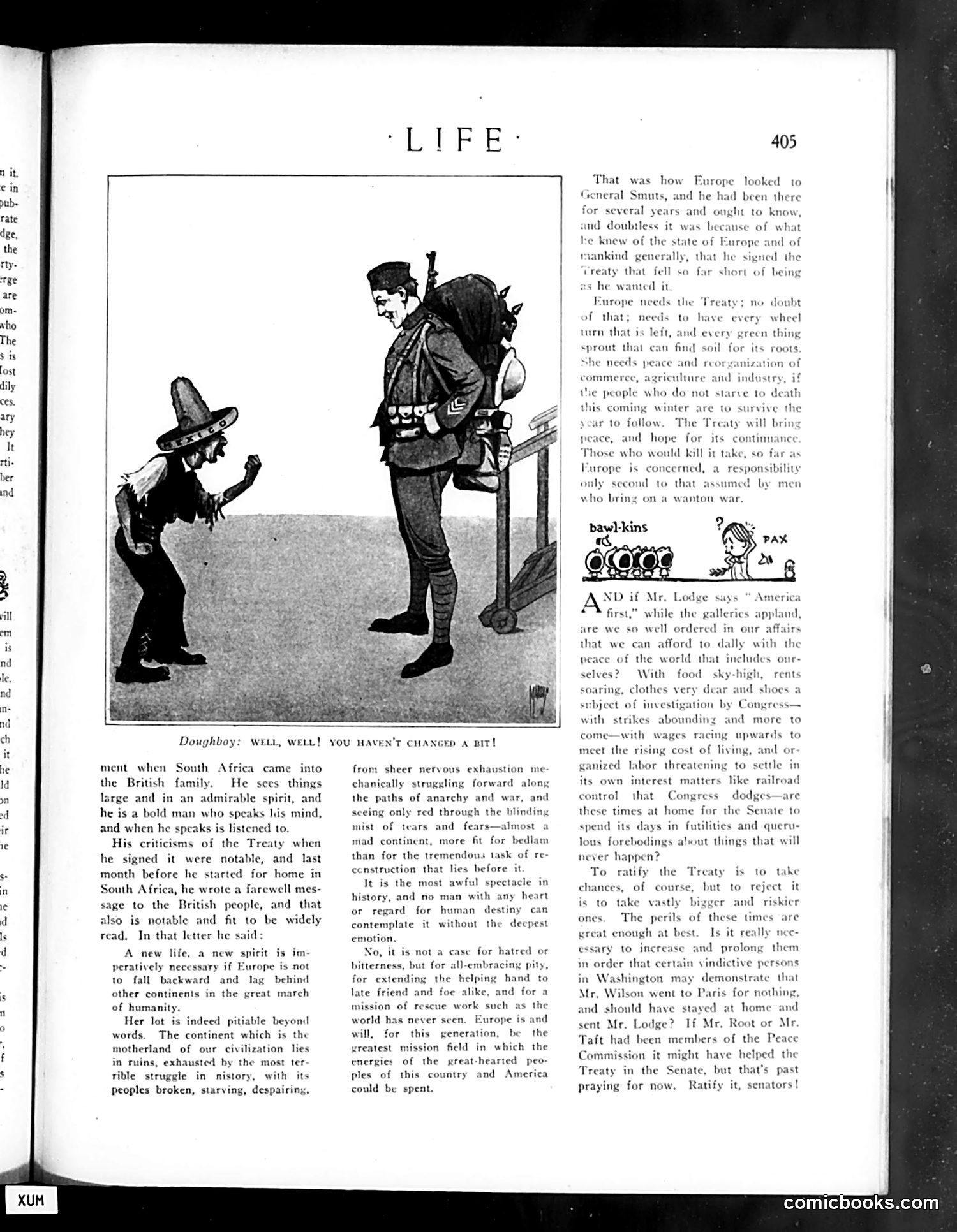
This cartoon depicts a **World War I American soldier ("doughboy")** encountering what appears to be **Europe personified as a ravaged, skeletal figure**. The "haven't changed a bit" is darkly ironic—Europe has catastrophically changed, devastated by war. The accompanying text discusses **General Smuts of South Africa** and his criticisms of the post-WWI **Treaty of Versailles**. The article argues Europe desperately needs the treaty to rebuild from total destruction, and warns against American isolationists (particularly **Senator Lodge**, referenced in the text) who oppose U.S. ratification. The satire targets those who would reject the treaty: the cartoon's stark visual contrast between the healthy soldier and broken Europe underscores the article's point—rejecting peace measures risks prolonging catastrophe. The joke bitterly suggests that nothing improving for Europe means the soldier's sacrifice meant nothing.
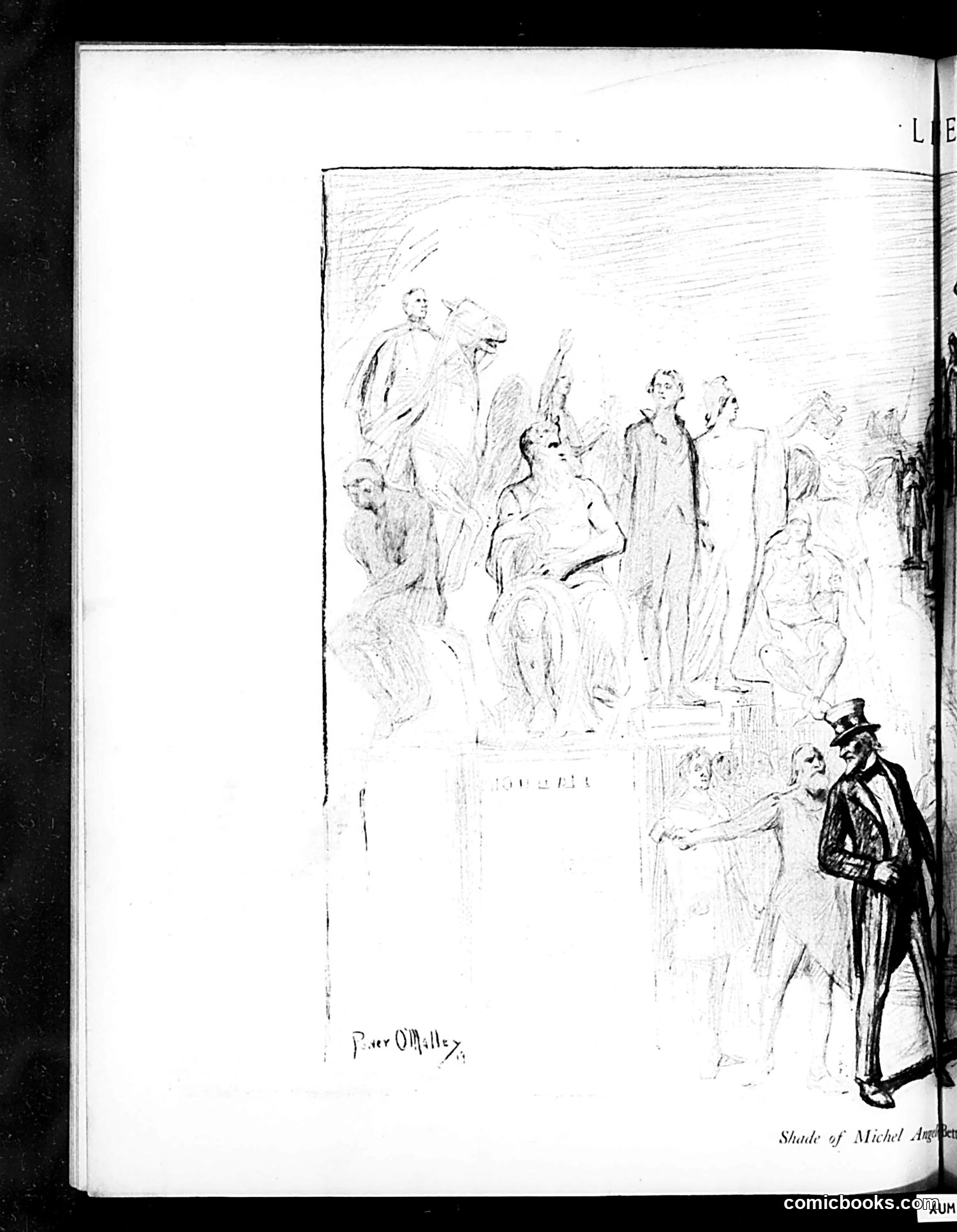
This page features a sketch titled "Shade of Michel Angelo" (referencing Michelangelo, the Renaissance master). The image shows two figures on the right—one in dark formal dress with a top hat, gesturing toward a large group of ethereal, loosely-sketched figures above them. The satire appears to critique someone's artistic or creative pretensions by invoking Michelangelo's ghost as a witness. The formally-dressed figure seems to be presenting or defending the sketchy figures above as if they were serious artistic work. The contrast between the sharply-rendered lower figures and the vague, hastily-drawn upper group suggests mockery of inferior or pretentious art being passed off as masterful work. The signature reads "Peter Newell," the cartoonist.
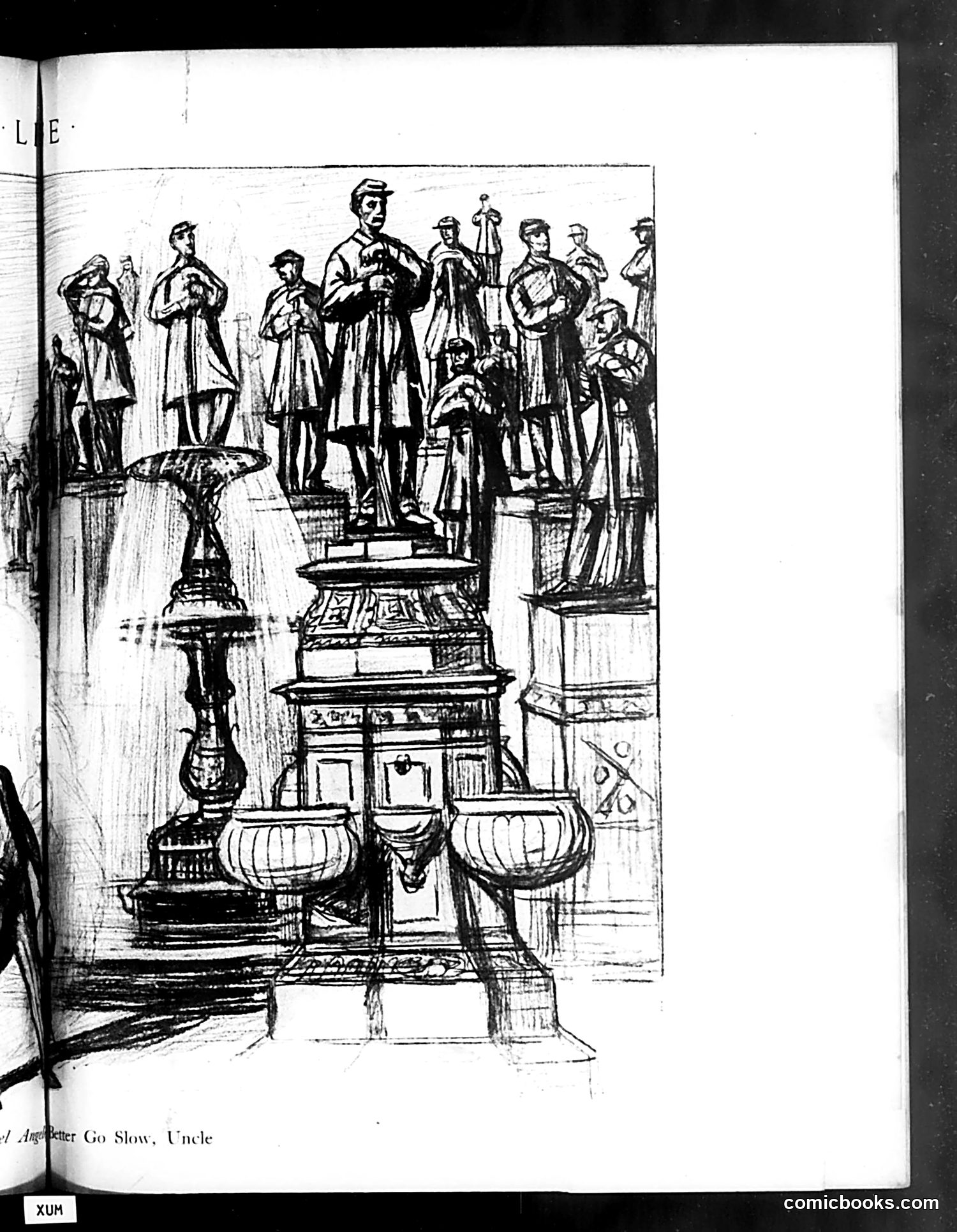
This appears to be a satirical illustration from *Life* magazine showing a formal military or governmental ceremony. A central figure stands elevated on a pedestal or platform, surrounded by uniformed officials and dignitaries in period dress (appears to be 19th century based on the clothing style). The caption reads "Better Go Slow, Uncle" and references "Petter Go," though the OCR is unclear on exact wording. The satire likely critiques either: - A governmental appointment or promotion being rushed - Military advancement or decision-making proceeding too hastily - A political figure (possibly nicknamed "Uncle") being cautioned about precipitous action Without clearer context or date information visible on the page, I cannot identify the specific historical event or figures being mocked. The formal ceremony setting and warning tone suggest commentary on governmental overreach or hasty policy-making.
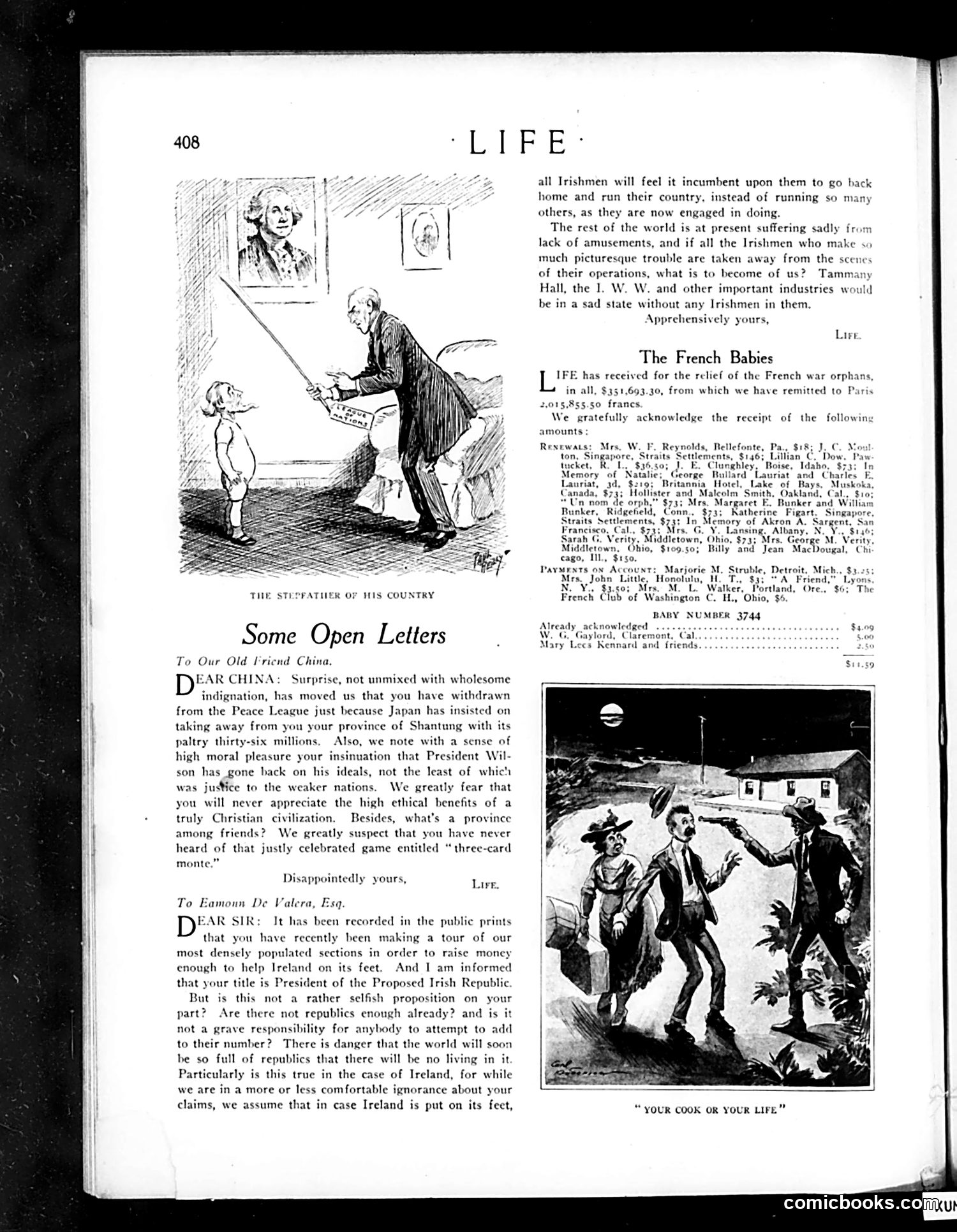
**Top Cartoon ("The Stepfather of His Country"):** A stern man with a cane supervises a naked child fishing in a barrel—likely satirizing someone's paternalistic control or interference with Ireland/Irish affairs. The title references George Washington ("Father of His Country"), inverting the concept to suggest unwanted guardianship. **Open Letters Section:** Two satirical letters mock contemporary political figures and events: 1. **To China:** Mocks China's withdrawal from the Peace League after Japan seized Shantung Province. Life sarcastically suggests China should accept this loss as a lesson in "Christian civilization" and friendship—heavy irony criticizing the post-WWI power dynamics and Western hypocrisy. 2. **To Éamonn De Valera:** Ridicules the Irish independence leader (then fundraising in America for an Irish Republic) as selfish for wanting Irish independence, sarcastically warning the world will be "too full of republics." This reflects anti-Irish sentiment and American skepticism toward Irish nationalism. **Bottom Image ("Your Cook or Your Life"):** Unclear context, but appears to depict a threatening scenario. The page reflects 1920s American attitudes: condescension toward non-white nations, skepticism of Irish independence movements, and support for existing power structures.
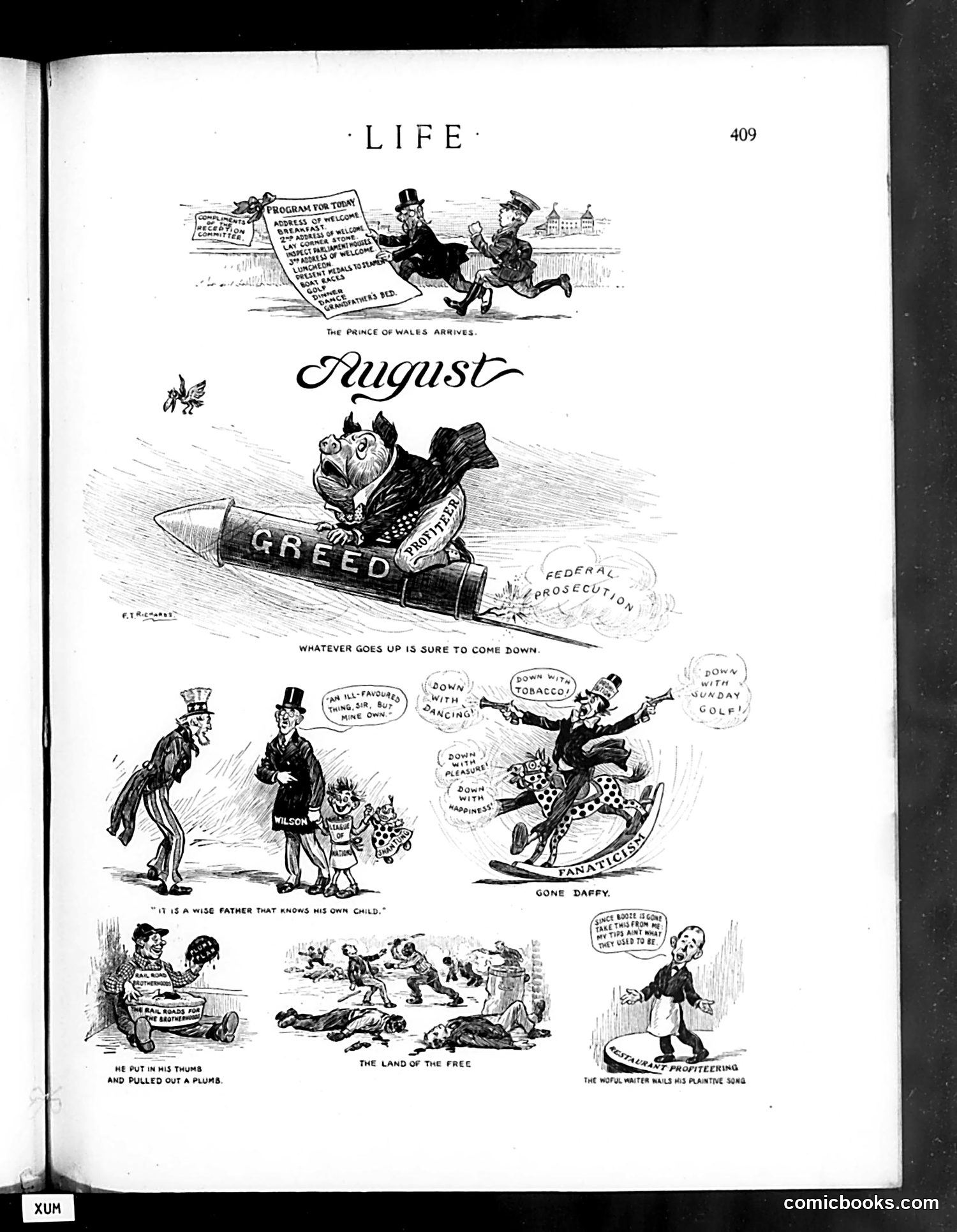
This page satirizes early 20th-century American social and political issues through multiple cartoon vignettes: **Top cartoon**: "The Prince of Wales Arrives" shows officials scrambling with a welcome program—likely mocking excessive preparation for royal visits. **Center**: A large figure labeled "GREED" rides a bomb toward "Federal Prosecution," captioning "Whatever Goes Up Is Sure to Come Down"—warning that unchecked greed faces legal consequences. **Lower cartoons** reference contemporary anxieties: "Gone Daffy" shows people obsessing over tobacco, golf, and other pastimes; "It Is a Wise Father" and "The Land of the Free" appear to critique social inequality and injustice; "The Woful Waiter" depicts economic hardship among working people. The overall theme condemns greed, frivolous excess among the wealthy, and the suffering of ordinary Americans—reflecting Progressive Era concerns about corporate malfeasance and social inequality.
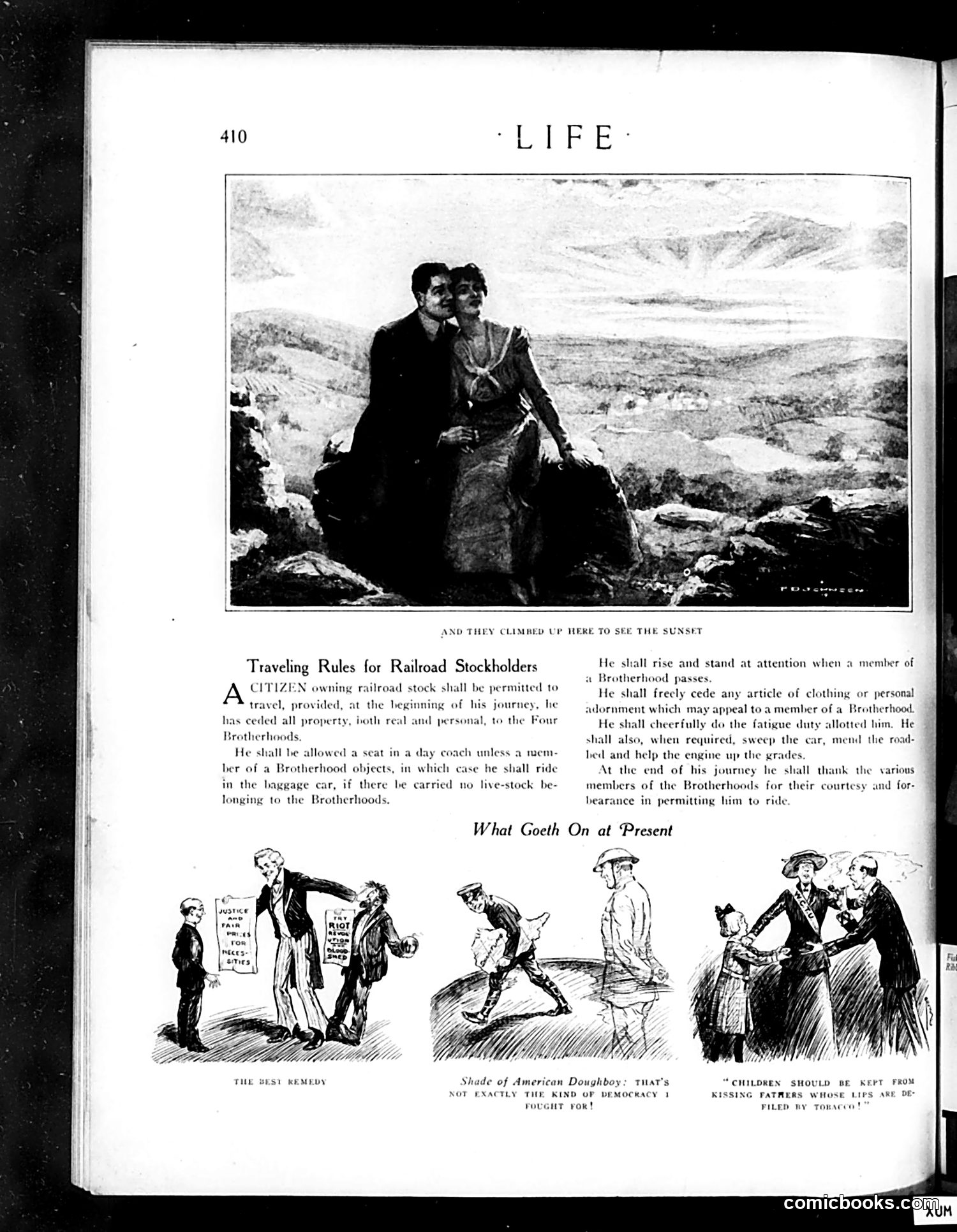
This Life magazine page satirizes the dominance of railroad labor unions (the "Four Brotherhoods"—likely referring to major railroad worker unions of the era) over railroad stockholders and management. The top photograph shows a couple viewing scenery, captioned "And they climbed up here to see the sunset"—a romantic, innocent scene contrasting with the harsh rules below. The "Traveling Rules" mock how stockholders must surrender all property to unions, perform menial labor, and show deference to Brotherhood members—inverting normal class hierarchies. The three cartoons below ("What Goeth On at Present") continue the critique: "The Best Remedy" suggests union power as a solution, while "Shade of American Doughboy" cynically questions whether this worker dominance represents the democracy WWI soldiers fought for. The final panel warns children away from tobacco-using workers. The satire targets what the magazine viewed as excessive union power constraining capital and respectability during labor's post-WWI strength.
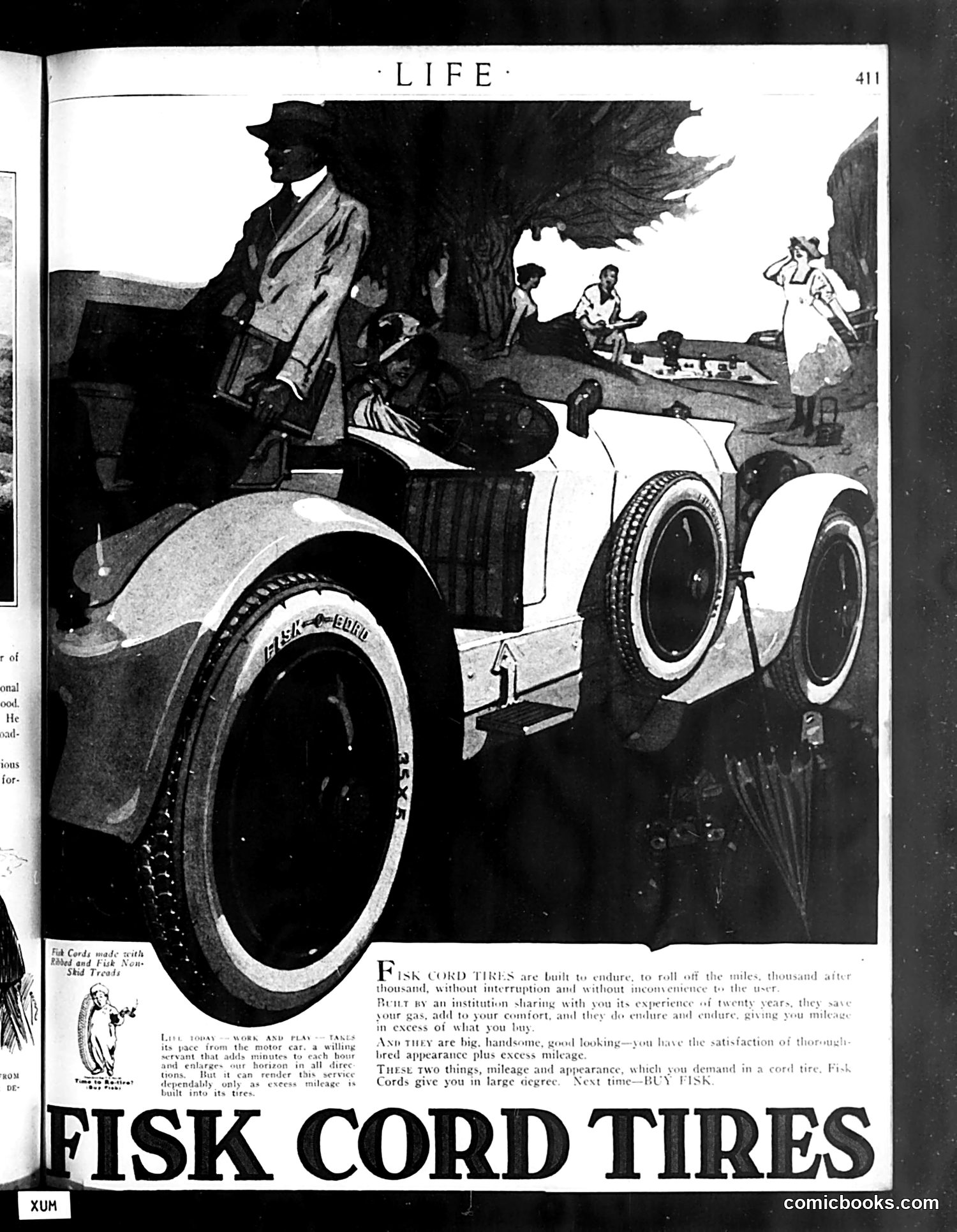
This is a **tire company advertisement**, not political satire. The page promotes Fisk Cord Tires to early automobile owners (likely 1910s-1920s based on the car style and typography). The image depicts a well-dressed man in a suit and hat standing beside a touring car, with passengers and onlookers. The composition suggests leisure, status, and modern mobility—selling aspirational lifestyle rather than just a product. The advertisement's pitch emphasizes **durability** ("roll off the miles, thousand after thousand, without interruption"), **appearance** ("big, handsome, good looking"), and **mileage**—key concerns for early motorists when tire reliability was genuinely uncertain. The small cartoon vignette (left margin, unclear subject) appears to be supplementary comic content, separate from the main ad.
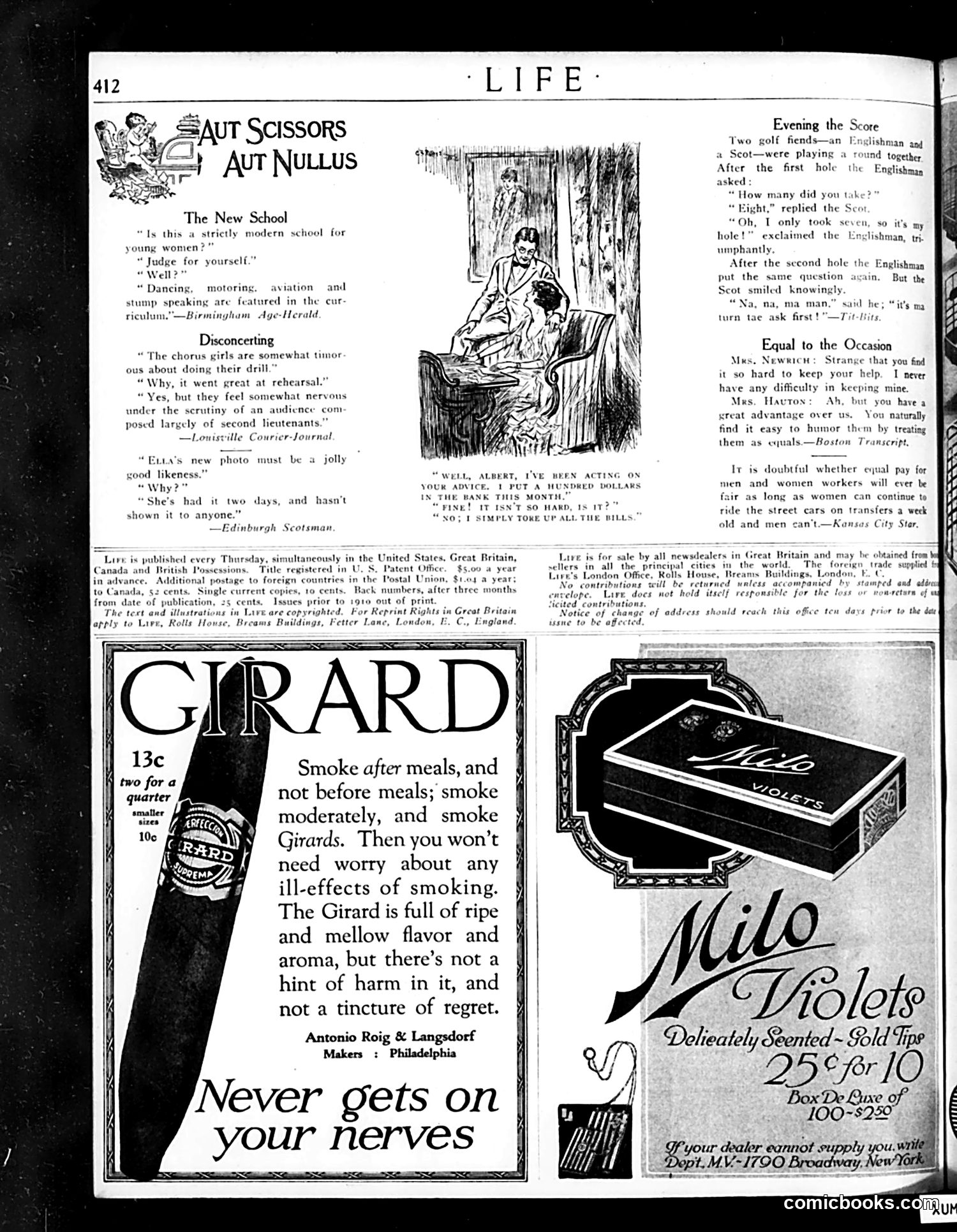
This page from *Life* magazine combines several short satirical pieces with period advertisements. **The cartoons** mock early 20th-century social trends: "The New School" questions whether modern curricula (dancing, motoring, aviation, stump speaking) constitute real education. "Disconcerting" jokes that chorus girls feel nervous performing before military officers. Other brief jokes target photography vanity and financial irresponsibility. **"Evening the Score"** presents a golf anecdote where a Scottish player refuses to answer about his score after the Englishman volunteered his, turning the tables on the traditional dynamic—likely satirizing national stereotypes about English superiority and Scottish cunning. **"Equal to the Occasion"** ironically suggests women naturally excel at managing household help through flattery rather than fairness, while a closing comment questions equal-pay fairness when women ride free on week-old transfers while men pay full fare. **The advertisements**—Girard cigars and Milo Violets candy—are typical period marketing with health-related claims.
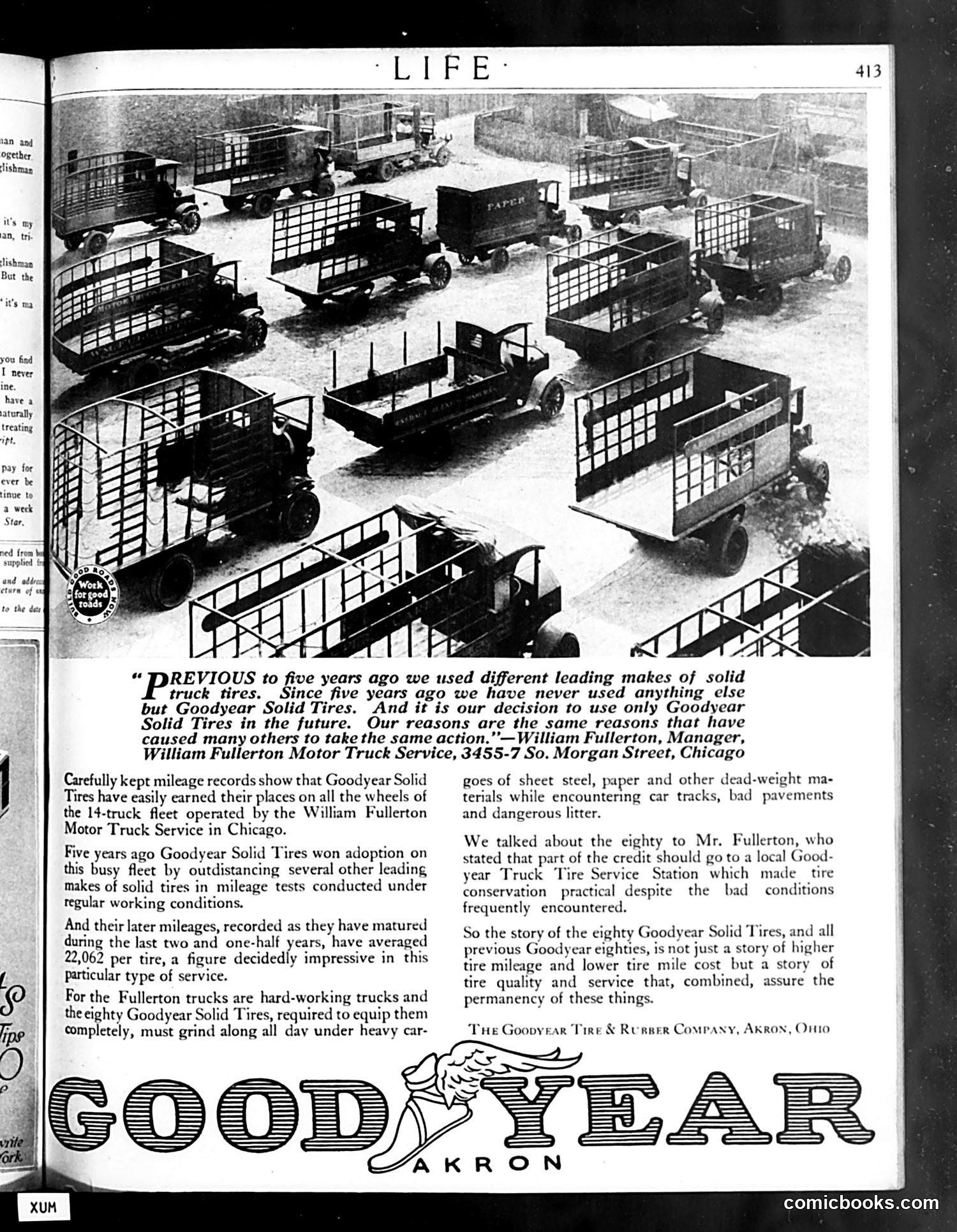
This is **not a cartoon or satire page**—it's a full-page **Goodyear tire advertisement** from Life magazine (page 413). The image shows an aerial photograph of multiple commercial trucks equipped with various tire types, arranged in a yard. The ad features a testimonial from William Fullerton, manager of a Chicago motor truck service, claiming that his fleet switched exclusively to Goodyear Solid Tires five years prior and has never used competitors since. The advertisement emphasizes durability through specific metrics: Fullerton's 14-truck fleet averaged 22,062 miles per tire over 2.5 years while hauling heavy industrial cargo (sheet steel, paper) under rough urban conditions. The text positions Goodyear's service stations as key to this reliability. This represents early 20th-century **industrial advertising**, using real business testimonials and quantified performance data as persuasion tactics—a common approach in trade publications aimed at fleet managers and business owners.
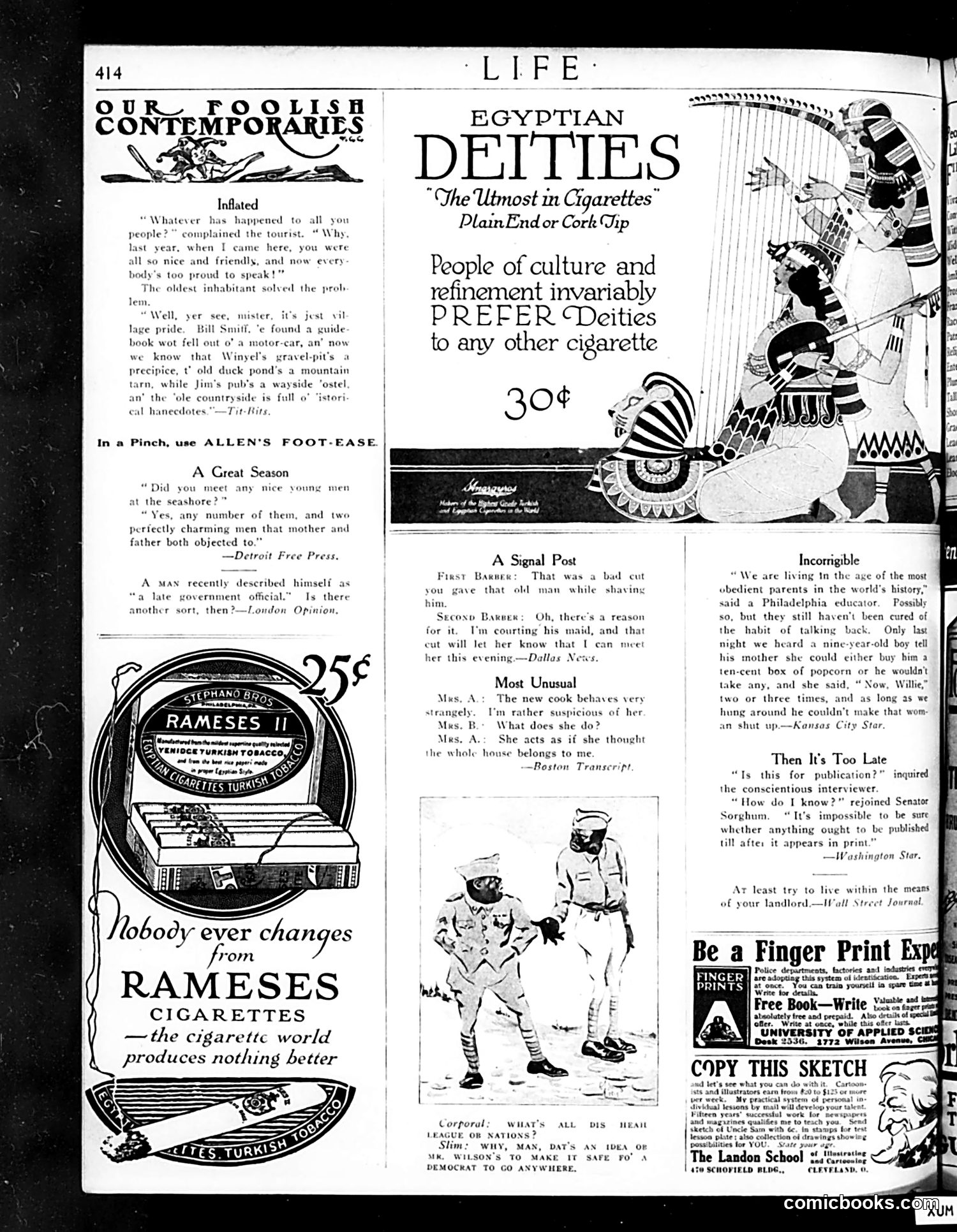
This page contains several short satirical pieces typical of Life magazine's humor: **"Our Foolish Contemporaries"** presents brief comic anecdotes mocking human behavior—tourists complaining about changed hospitality, young women attracted to unsuitable men, and government officials. **The Egyptian Deities cigarette ad** (center-right) uses Egyptian imagery and stereotypes to market cigarettes as sophisticated, playing on early 20th-century fascination with Egypt and Egyptology. **"A Signal Post"** jokes about a barber cutting a customer's face intentionally to impress the man's maid—dark humor about courtship sabotage. **The cartoon (bottom center)** shows a soldier confused by "League of Nations," with the caption suggesting it's Wilson's invention to make it safe for Democrats to travel—political satire about post-WWI international diplomacy and partisan skepticism. **Other pieces** satirize new household workers, obedient modern parents, and editorial ethics. The ads (Rameses cigarettes, fingerprinting school) are period typical. Overall, the page reflects 1920s American attitudes: skepticism toward progressive ideals, gender/class humor, and casual use of ethnic stereotypes.
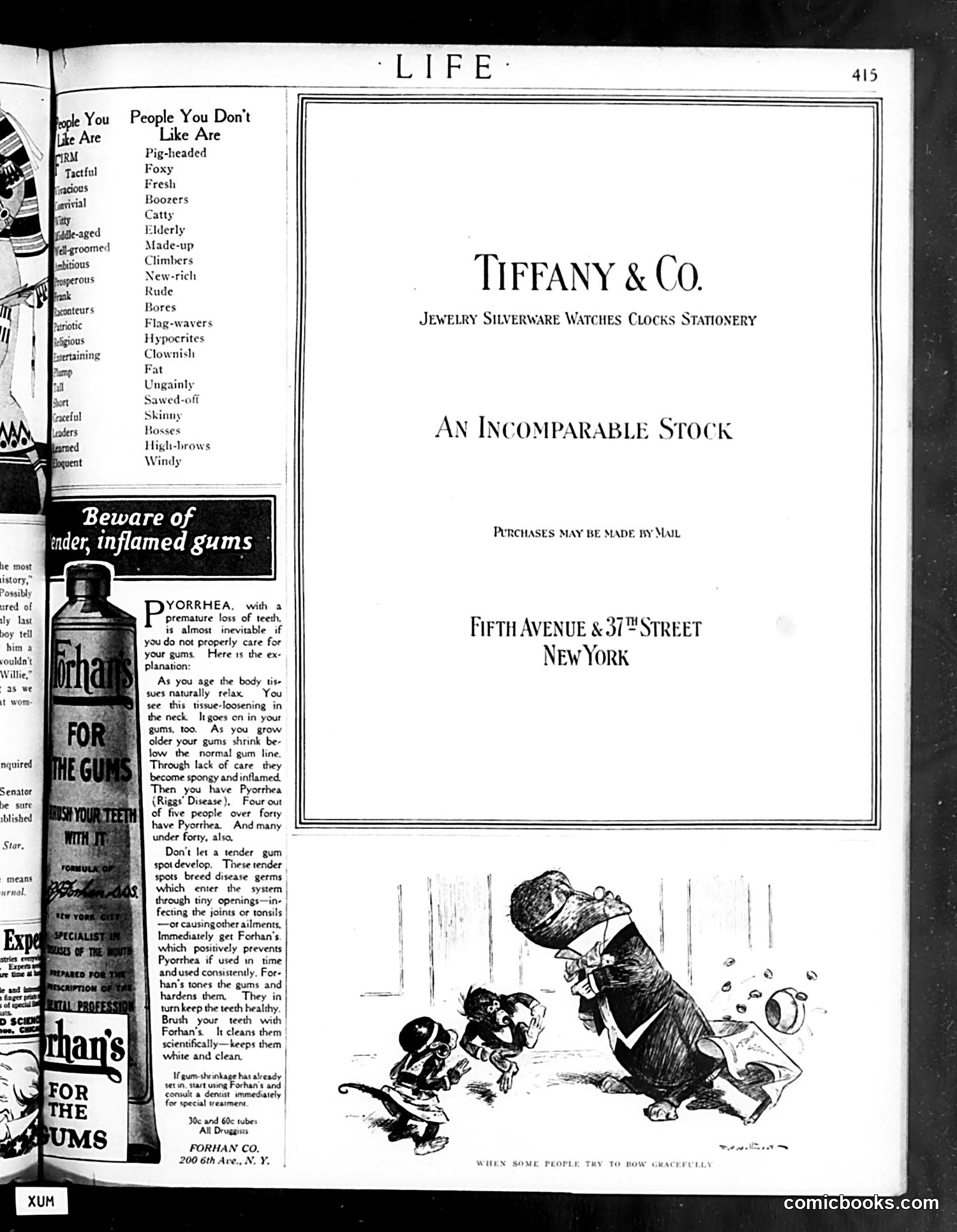
This page mixes advertising with social commentary typical of Life's satirical approach. **Left side:** A humorous taxonomy lists unflattering character types people dislike—"Pig-headed," "Foxy," "Fresh," "Boozers," "Catty," etc. This is vintage Life-style social satire, gently mocking human personality flaws and social pretension. **Center:** A Forhan's toothpaste advertisement warns about pyorrhea (gum disease), presenting it as an inevitable consequence of aging unless properly prevented—a common health-anxiety sales pitch of the era. **Right side:** A Tiffany & Co. luxury goods advertisement for jewelry, silverware, and watches. **Bottom cartoon:** An untitled illustration captioned "When Some People Try to Row Gracefully" shows figures apparently struggling comically with rowing, likely satirizing pretentious attempts at genteel recreation. The page reflects 1920s-30s Life magazine's blend of social satire, period health concerns, and high-end consumer advertising targeting affluent readers.
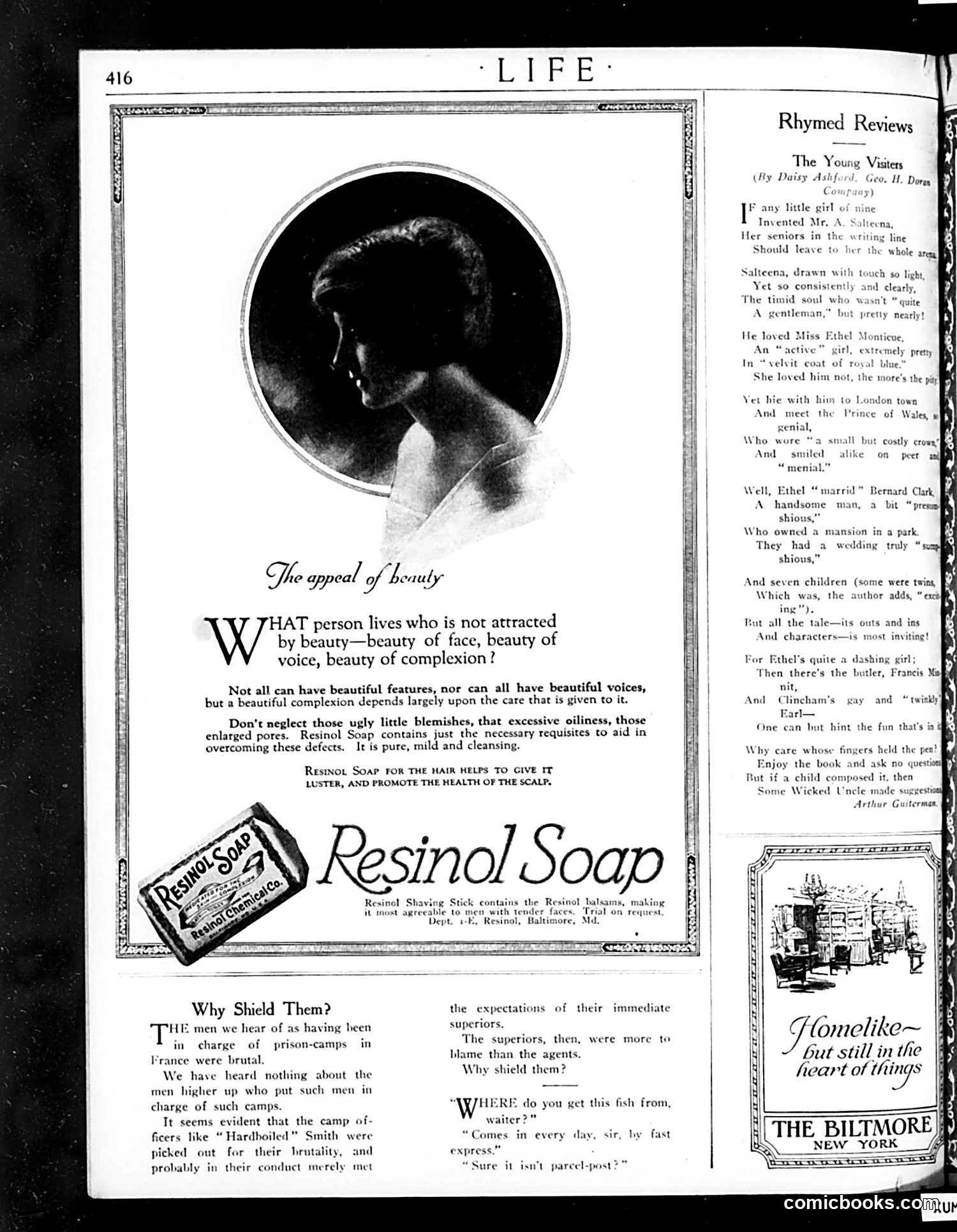
This page contains two distinct items: **Main Advertisement:** A Resinol Soap ad featuring a classical profile portrait of a woman's face, emphasizing beauty of complexion. The ad targets insecurities about "blemishes," "oiliness," and "enlarged pores," promising the soap will improve appearance. This represents typical early 20th-century beauty marketing that equated personal worth with physical appearance. **"Why Shield Them?" Editorial:** A brief political commentary questioning why military superiors who authorized brutal prison camp conditions in France during WWI remain unpunished while lower-ranking officers like "Hardboiled" Smith face consequences. The author argues those giving orders bear greater responsibility than those executing them, calling for accountability up the chain of command. **"Rhymed Reviews":** A humorous verse review of *The Young Visiters* by Daisy Ashford, a novel written by a nine-year-old girl that became famous for its charming naïveté and accidental humor. The reviewer celebrates the book's innocent appeal regardless of the author's age.
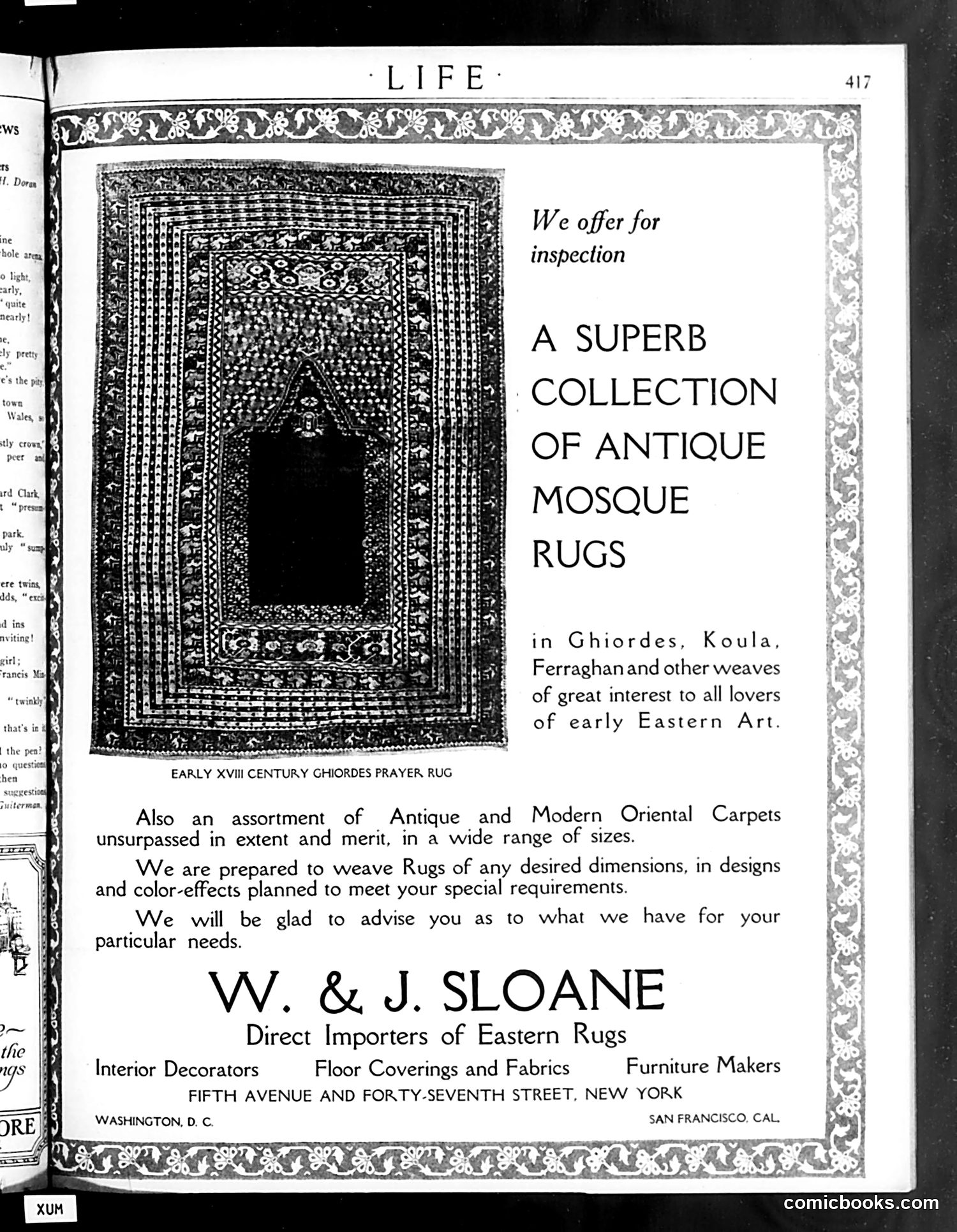
This page is **not a cartoon or satire**—it's a straightforward advertisement. W. & J. Sloane, a high-end interior design and furniture company, is promoting their collection of antique Oriental rugs, particularly mosque prayer rugs from the 18th century. The large image shows an ornate Ghiordes prayer rug with elaborate geometric and floral borders framing a central prayer niche. The ad targets wealthy clients interested in "early Eastern Art," offering both imported antique rugs and custom weaving services in various sizes and designs. The company operated from locations in New York, Washington D.C., and San Francisco. This represents typical early 20th-century Life magazine advertising—luxury goods marketed to affluent readers. There is no satirical or political content present on this page.
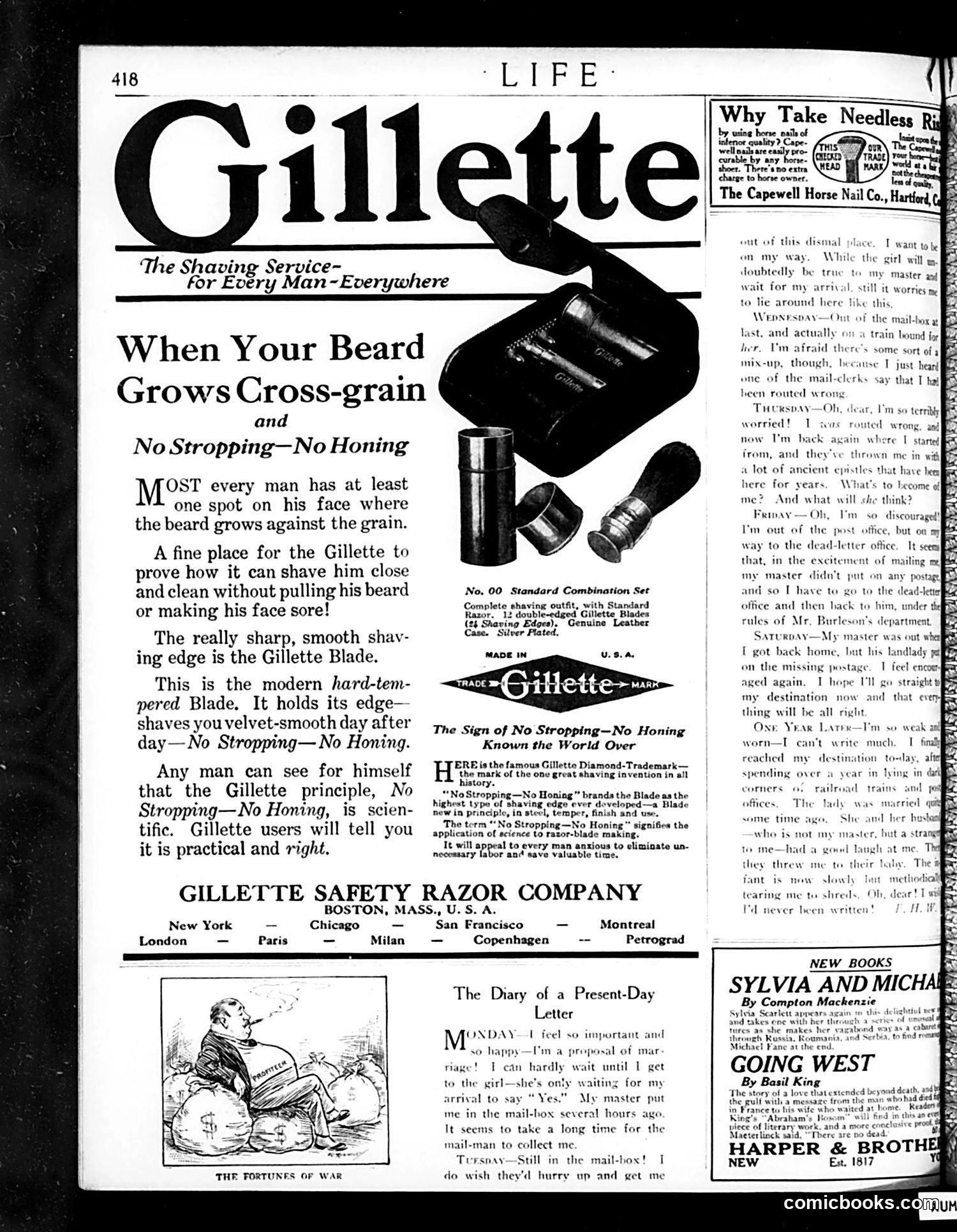
This page is primarily a **Gillette Safety Razor advertisement**, not a political cartoon. The main content promotes the Gillette blade's innovation: requiring "No Stropping—No Honing" (no manual sharpening), which was a genuine technological advance allowing daily use without maintenance. The **cartoon below** (titled "The Fortunes of War") is a humorous anthropomorphization of a love letter that gets lost in the mail system. The letter—personified as anxious and distressed—recounts its journey through multiple postal mishaps: being misdirected, stuck in mailboxes, routed to the dead-letter office, and languishing for a year before finally reaching its destination, now worn and damaged. The satire targets **postal service inefficiency**, apparently referencing Postmaster General Burleson's department policies. For modern readers, the joke relies on the now-quaint notion that important correspondence could be delayed for months or years due to bureaucratic bungling—a real frustration in the pre-digital era when mail was the primary communication method. The page also includes book advertisements and other miscellaneous content typical of *Life* magazine's format.
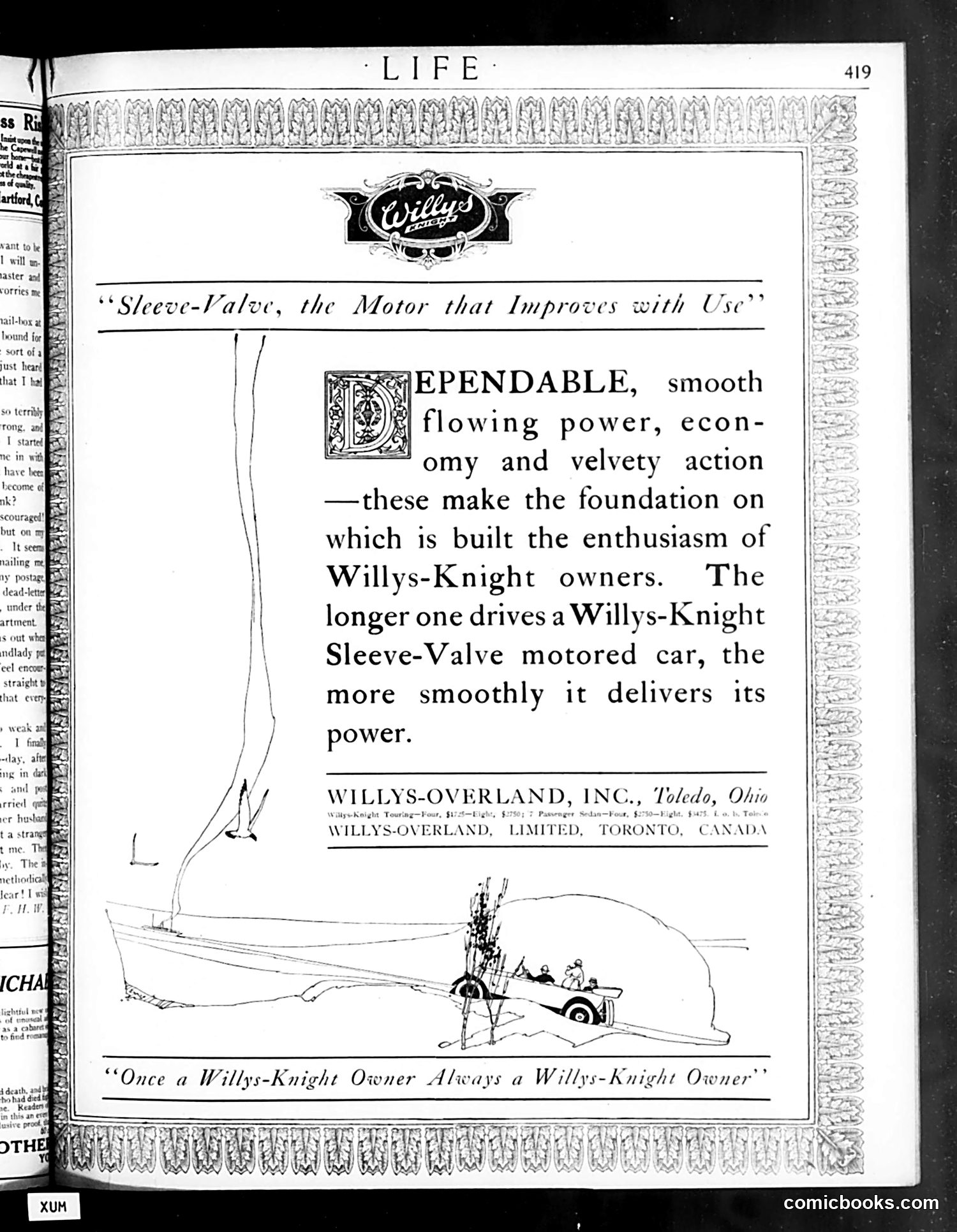
This is **not a cartoon or satire** — it's a straightforward automobile advertisement for Willys-Knight vehicles, appearing in *Life* magazine (page 419). The ad promotes the "Sleeve-Valve" motor technology, claiming it improves with use and delivers increasingly smooth power over time. The illustrative sketch shows a car on a beach with passengers, emphasizing leisure and reliability. The tagline "Once a Willys-Knight Owner Always a Willys-Knight Owner" suggests customer loyalty based on the vehicle's quality. **Publisher**: Willys-Overland, Inc. (Toledo, Ohio) and Willys-Overland Limited (Toronto, Canada). This represents early automotive advertising's emphasis on mechanical superiority and durability as selling points — concepts modern readers might find quaint in an era of mass-produced cars.
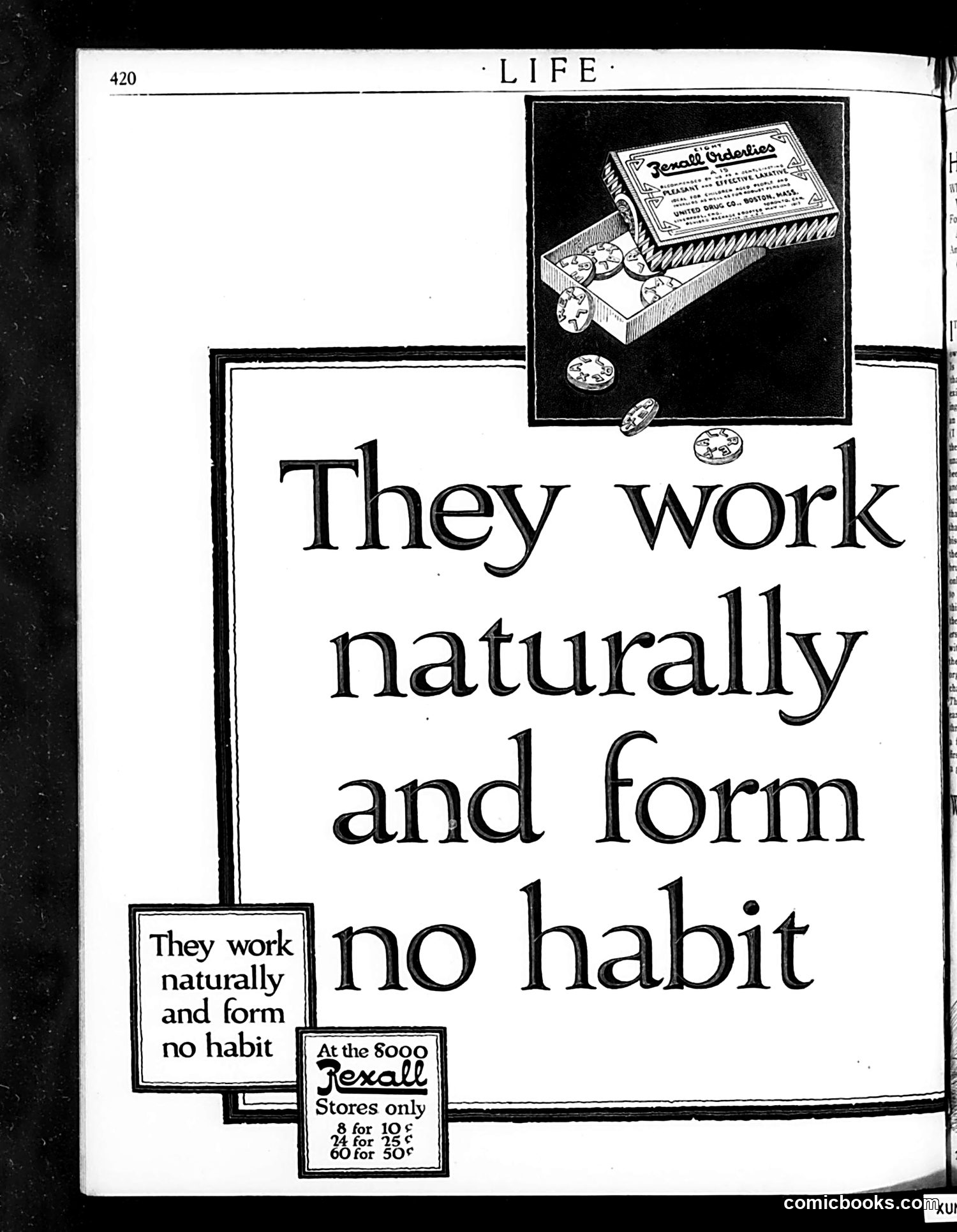
This is a **product advertisement** for Rexall brand candies, not a political cartoon. The ad promotes "Rexall Diddies"—small candies sold at Rexall drugstores. The headline "They work naturally and form no habit" is a humorous double entendre. It simultaneously describes how the candies function (forming shapes naturally without requiring habit-forming substances) while parodying contemporary medical/pharmaceutical advertising language about habit-forming drugs. The visual shows an opened box of candies spilling out. The pricing structure ("8 for 10¢, 24 for 25¢, 60 for 50¢") suggests bulk purchasing incentives typical of early 20th-century retail. The joke relies on readers recognizing the stilted language of drug advertisements and applying it absurdly to penny candies, creating mild satire of advertising conventions themselves.
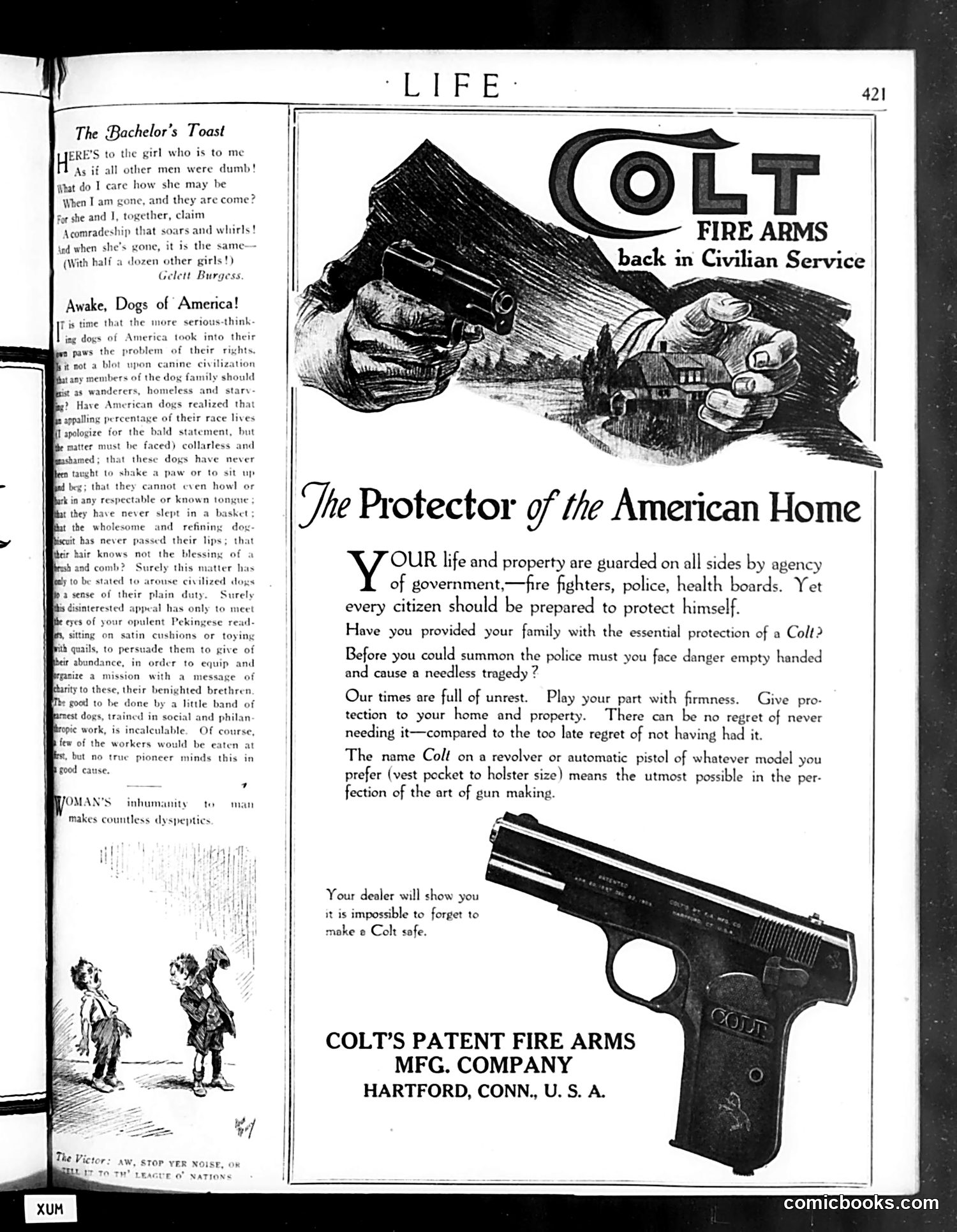
This page mixes satirical poetry with a firearms advertisement, reflecting post-WWI American anxieties. **"The Bachelor's Toast"** by Gelett Burgess satirizes shallow male romanticism—a man claims devotion to "the girl" while simultaneously courting half a dozen others, exposing hypocrisy in bachelor culture. **"Awake, Dogs of America!"** is absurdist satire anthropomorphizing dogs as a neglected underclass, paralleling labor and social-justice movements of the era. It mocks sentimental reform rhetoric by applying it ridiculously to canine "rights." **The Colt advertisement** exploits post-WWI concerns about domestic security and "unrest," urging citizens to arm themselves for home protection. The phrase "back in Civilian Service" references weapons returning from military to civilian use. This represents how manufacturers capitalized on social anxiety—suggesting police protection was insufficient and personal firearms were necessary for family safety during uncertain times. The advertisement's implicit message: chaos requires civilian gun ownership.
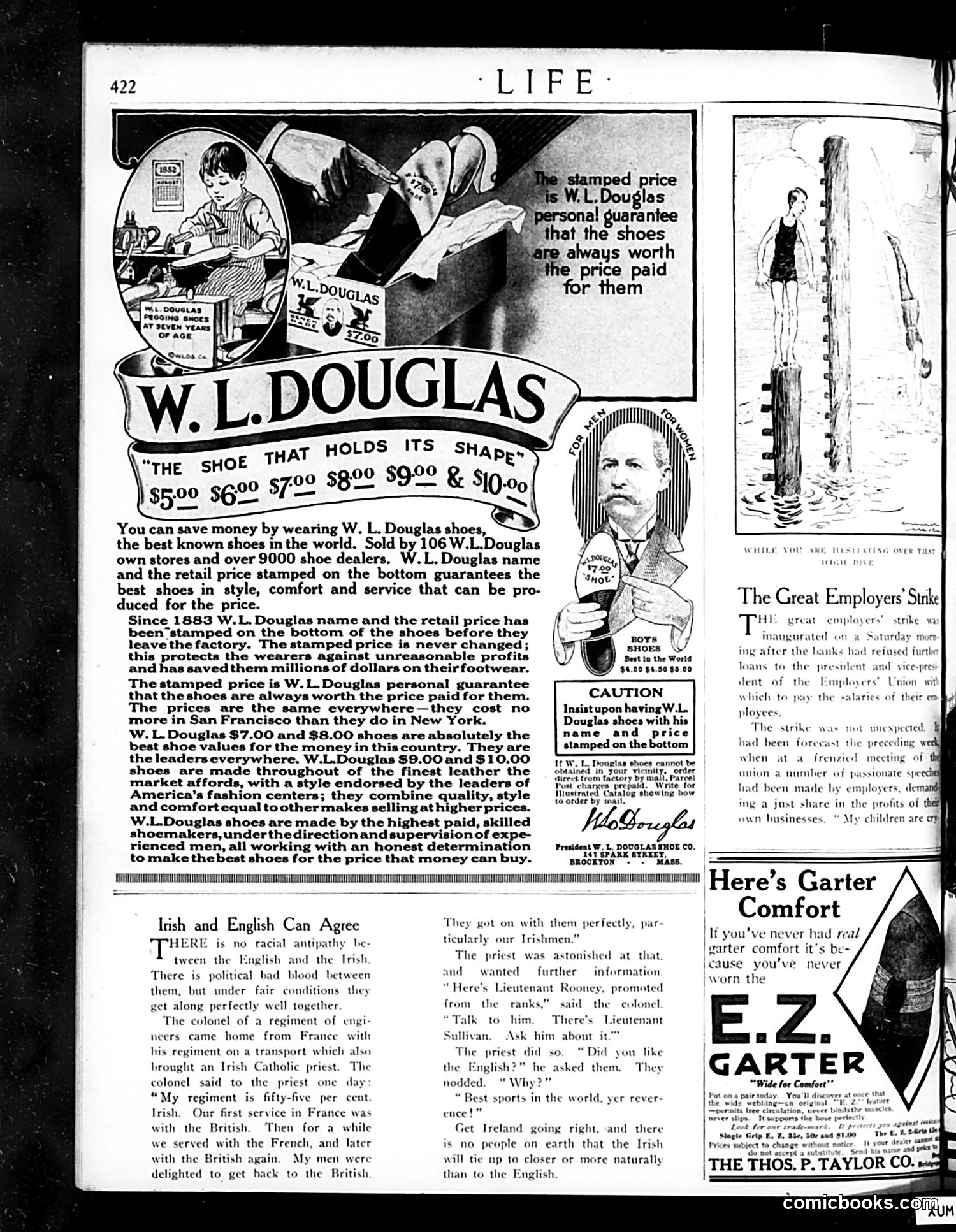
This page is primarily **advertising**, dominated by a large W.L. Douglas shoe advertisement touting the brand's price-stamped guarantee system (prices $5-$10). The ad emphasizes that the stamped retail price protects consumers from inflated markups and promises consistent pricing nationwide. Below the shoe ad appears a brief satirical story titled "The Great Employers' Strike," which depicts employers refusing to pay workers' salaries—a dark inversion of typical labor strikes where workers refuse work. The page also contains a humorous anecdote titled "Irish and English Can Agree," where a colonel describes his regiment's preference for working with British soldiers over French ones, suggesting unlikely camaraderie between traditionally antagonistic groups. The remaining content includes advertisements for E.Z. Garter and other products. **For modern readers:** The shoe ad reflects early 20th-century consumer concerns about pricing transparency and fair value. The satirical content pokes fun at class dynamics and international military relationships during or after WWI.
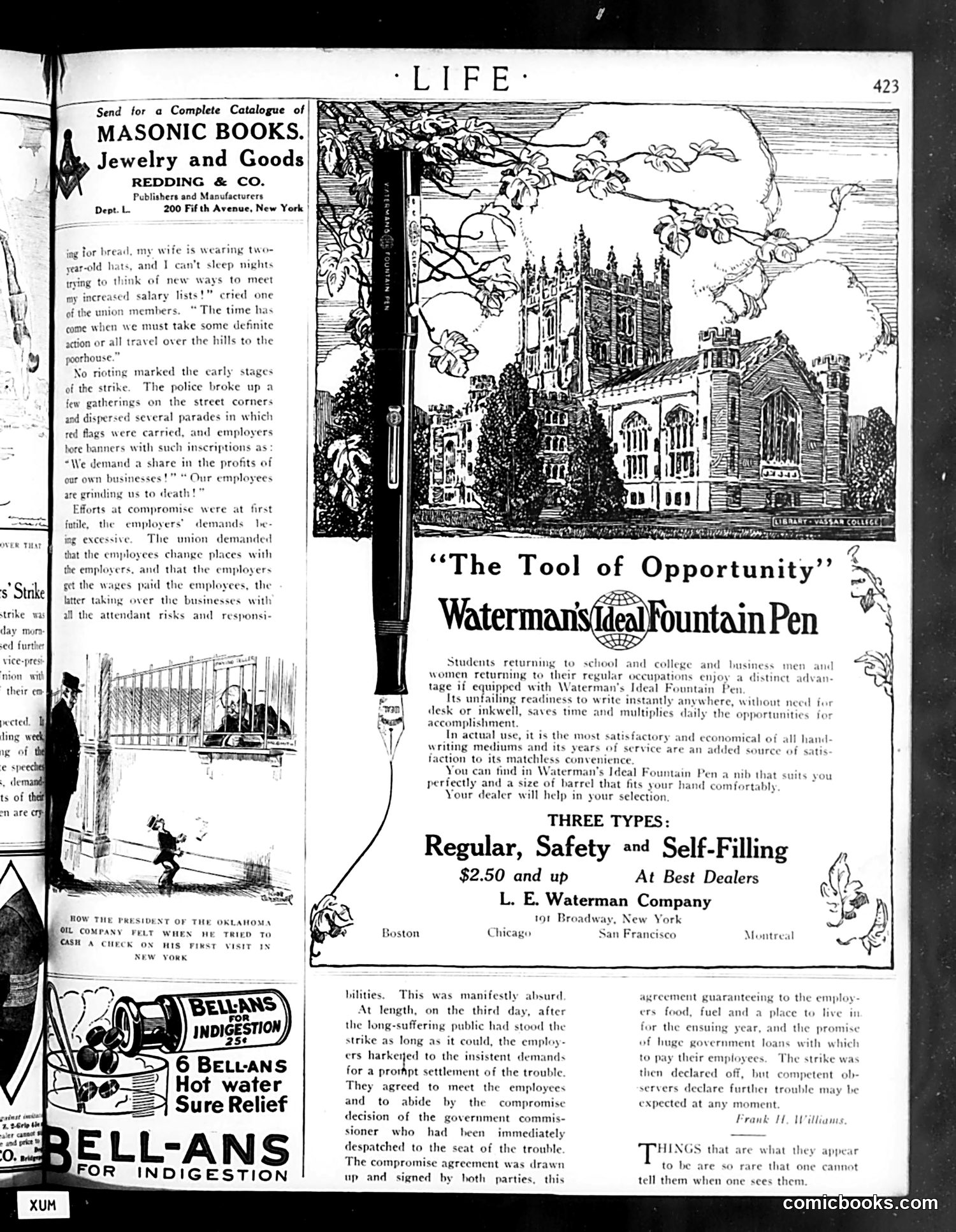
This page from *Life* magazine contains a satirical narrative (likely from the early 1900s) mocking an absurd labor dispute. The story describes union members demanding they swap positions with their employers—workers would take over the businesses while owners receive employee wages and "food, fuel and a place to live." The satire targets both sides: workers making unreasonable demands ("We demand a share in the profits") and employers' initial intransigence. The government commissioner's compromise—essentially paying workers' salaries via loans—is presented as ridiculous. The final caption ("Things that are what they appear to be are so rare...") suggests the entire settlement is fraudulent theater. This reflects broader early-20th-century labor unrest anxieties, ridiculing workers' grievances while mocking how easily authorities could be manipulated. The page also contains period advertisements (Waterman pens, Bell-Ans indigestion relief), typical of *Life*'s format.
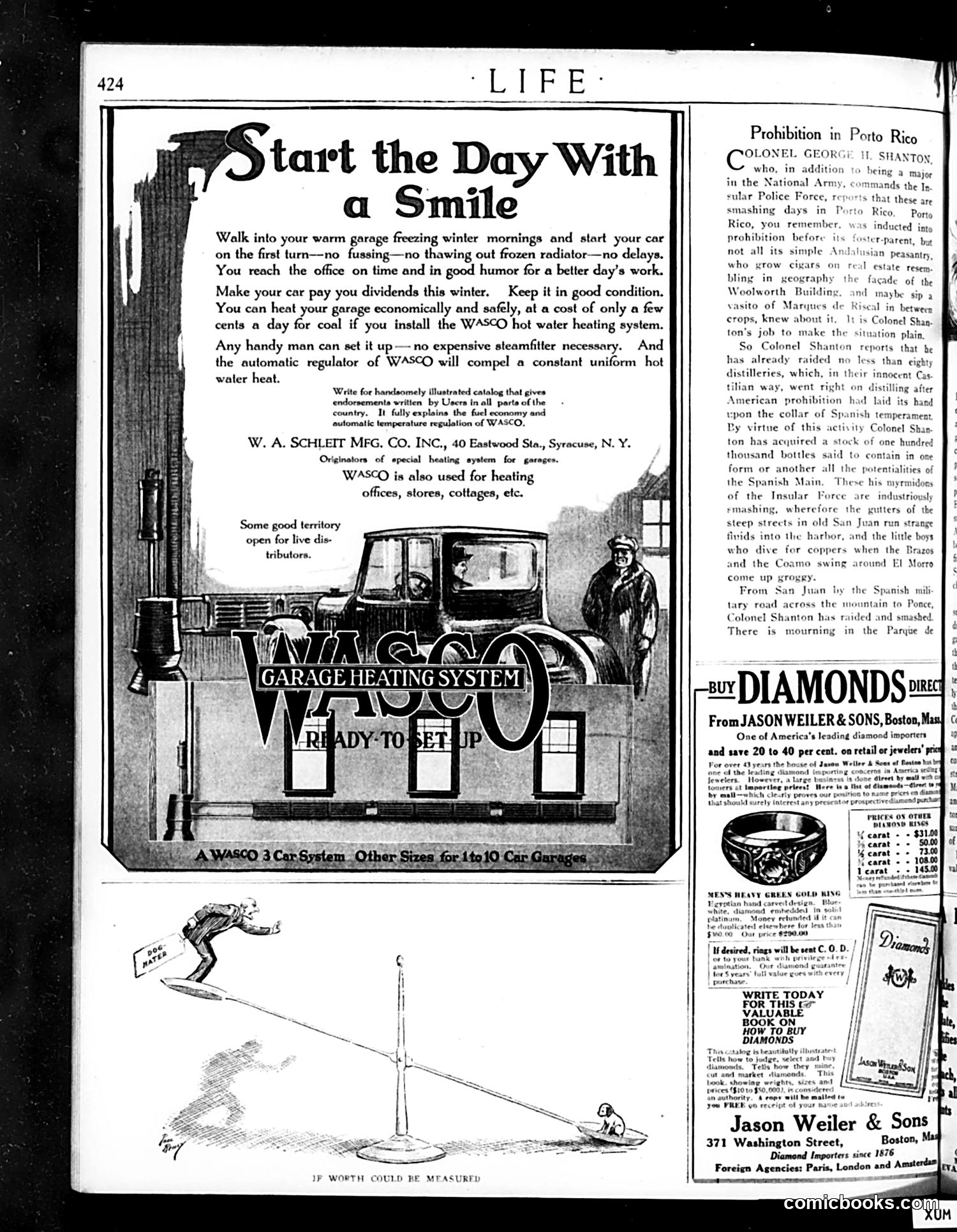
This page is primarily **advertising**, not political satire. The dominant feature is a WASCO garage heating system advertisement ("Start the Day With a Smile"), occupying roughly two-thirds of the space. However, the right column contains a brief **satirical article** titled "Prohibition in Porto Rico" by Colonel George H. Shanton. The piece mocks the failure of American Prohibition in Puerto Rico: Shanton reports raiding 80 distilleries that openly continued operating despite U.S. prohibition law. The satire highlights the absurdity and ineffectiveness of Prohibition enforcement in the territory—locals apparently continued their traditional distilling practices ("in their innocent Castilian way") regardless of American legal authority. The article suggests Prohibition as foreign policy was ridiculous and unenforceable. The remaining space contains diamond-selling advertisements from Jason Weiler & Sons. This reflects 1920s-era skepticism about Prohibition's viability, particularly in culturally distinct territories.
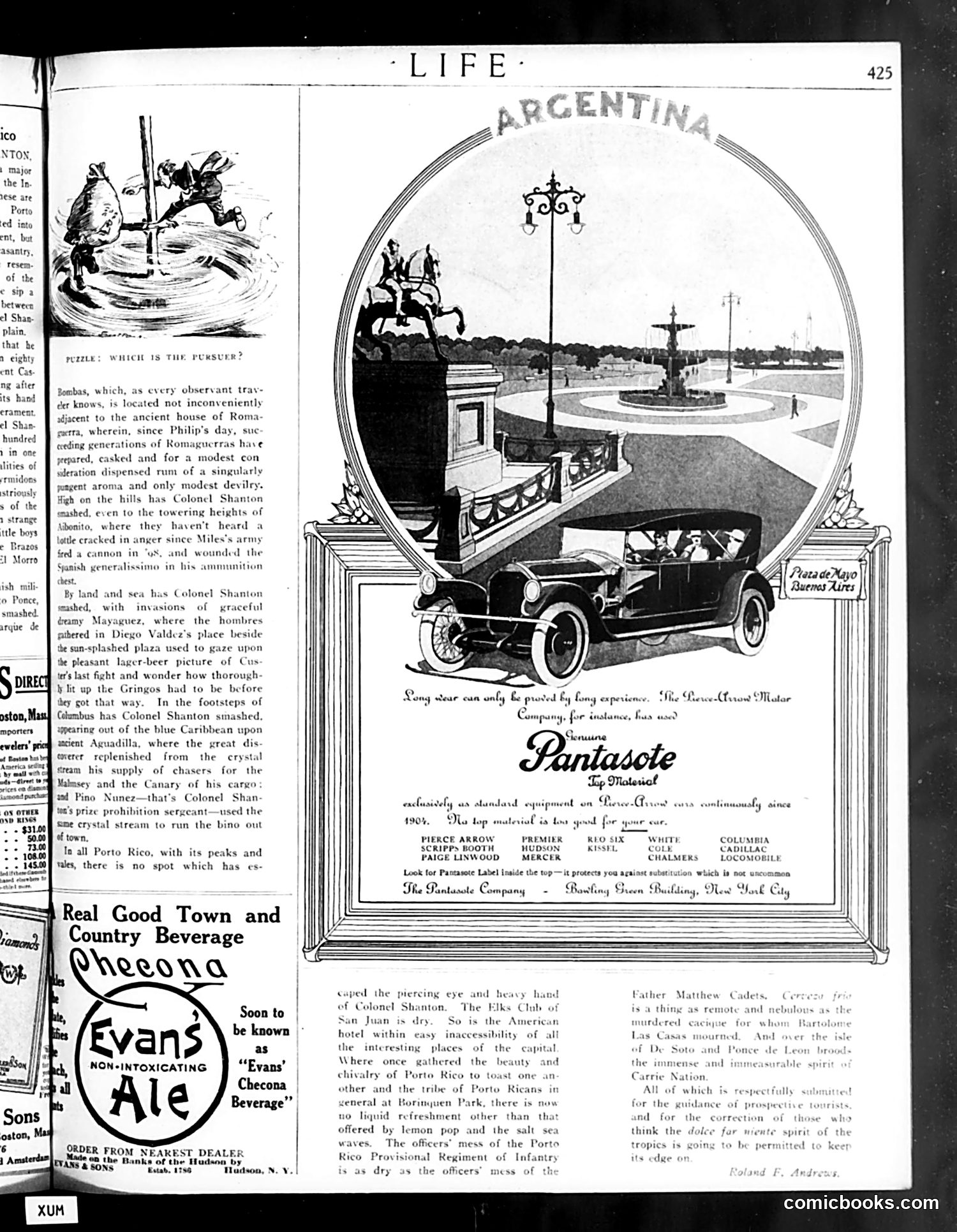
This page contains a satirical article titled "WHICH IS THE PURSUER?" about Colonel Shanton's travels through Puerto Rico during Prohibition. The cartoon depicts a man driving a car while being chased—the visual pun plays on whether the "pursuer" is law enforcement chasing a bootlegger, or vice versa. The text humorously documents Shanton's extensive rum-drinking across Puerto Rico, referencing historical events like Miles's army and Columbus. It mocks Prohibition's effects by noting that once-vibrant social spots like the Elks Club are now dry, offering only "lemon pop and salt sea waves." The article satirizes Prohibition enforcement by mentioning "Sergeant Pino Nunez," a "prize prohibition sergeant" who used local water to run bootleggers out of town. The advertisement for Pantasote car upholstery appears unrelated to the satirical content, typical of Life's mixed editorial-advertising format.
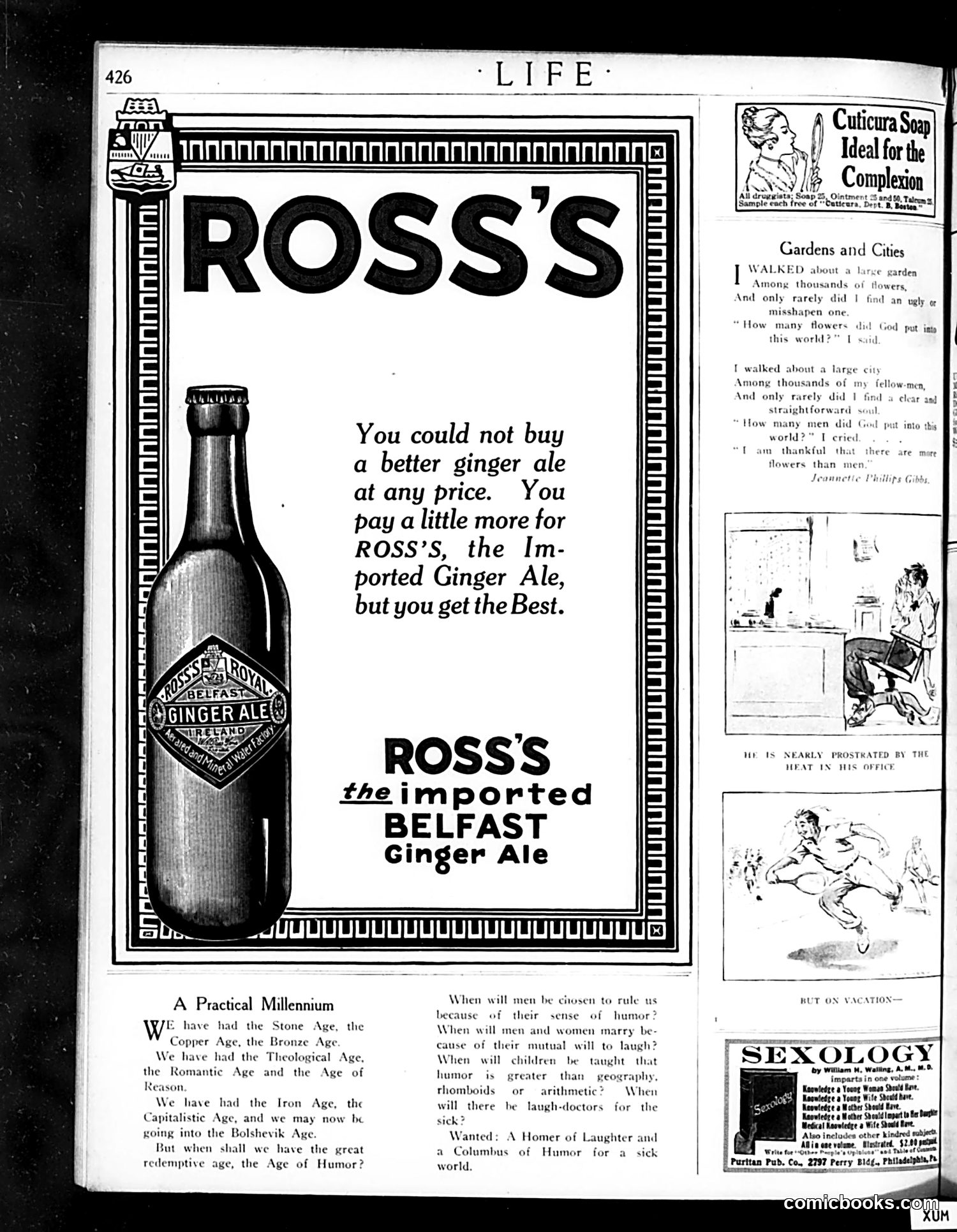
This page is primarily **advertising and editorial content**, not political cartoons. The dominant feature is a **Ross's Ginger Ale advertisement** featuring a bottle and copy claiming superiority through imported quality—a common early-20th-century marketing appeal to prestige. The right side contains: 1. **"Gardens and Cities"** — a sentimental poem by Jeannette Phillips Gibbs contrasting flowers in nature with men in cities, suggesting urban life lacks beauty or goodness. 2. **Two cartoon vignettes** depicting office heat: a man "nearly prostrated by heat in his office" and another "on vacation"—light humor about summer workplace discomfort. 3. **"A Practical Millennium"** — satirical editorial musing on historical ages (Stone, Bronze, Iron, Capitalistic) and proposing an "Age of Humor" as humanity's redemptive future. It ironically questions when humor will be valued over academics and calls for "laugh-doctors for the sick." The piece gently satirizes modern civilization's overly serious nature. The overall page reflects early-1900s Life magazine's mix of consumer advertising with light social commentary.
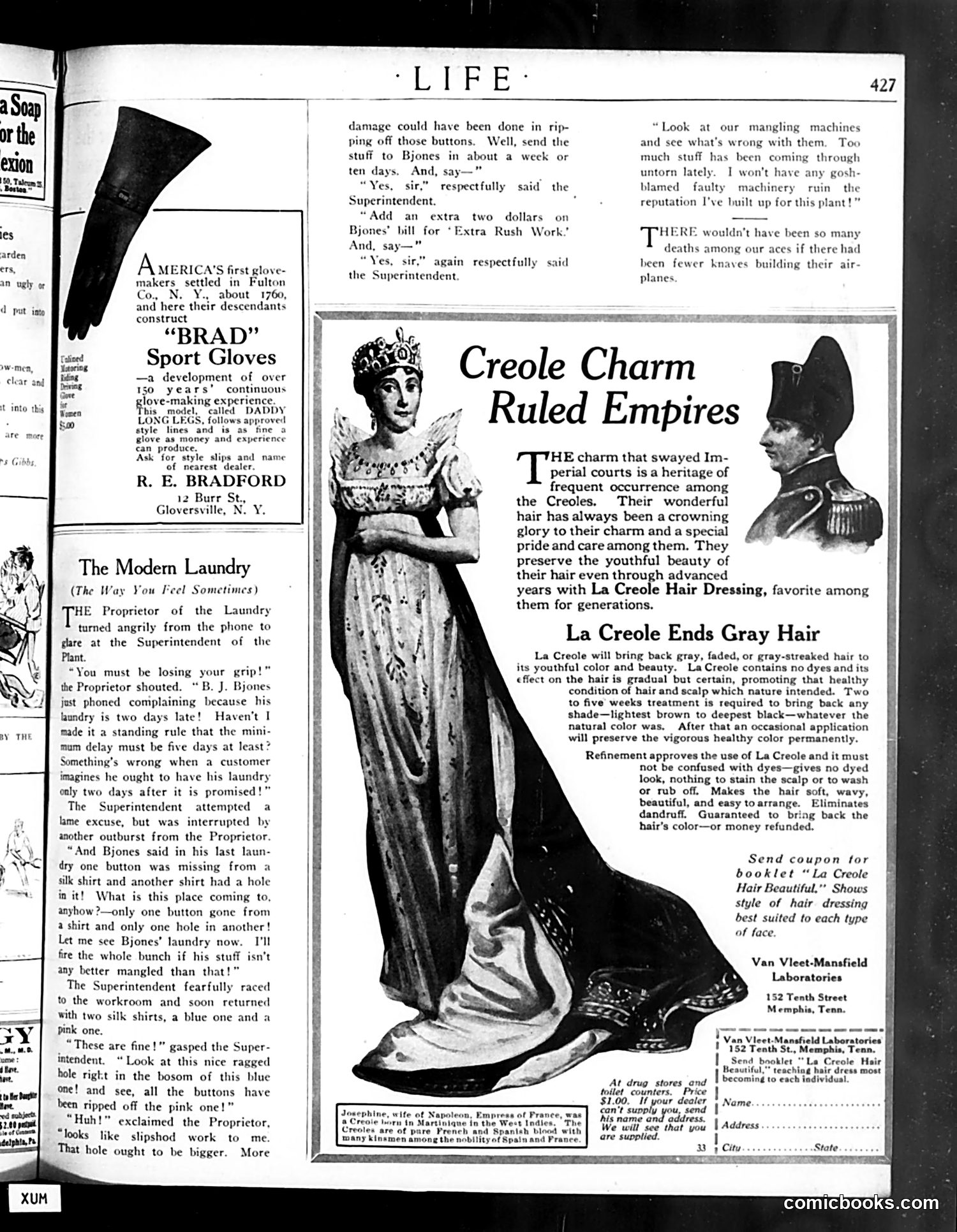
This page contains two distinct items: **"The Modern Laundry" (left):** A satirical cartoon about perverse management. The laundry proprietor has deliberately set a standard of *poor* service—five-day delays, missing buttons, torn clothes—as acceptable. When a customer (B.J. Bjones) complains about receiving laundry in only two days with minimal damage, the proprietor is outraged, viewing it as substandard work. The joke mocks absurd business practices and inverted priorities: the owner rewards negligence and punishes efficiency. **"Creole Charm Ruled Empires" (right):** A hair-treatment advertisement featuring Josephine Bonaparte, Napoleon's wife, who was Creole. The ad promotes "La Creole Hair Dressing" for restoring gray hair, using her as a status symbol of elegance and imperial charm. The product claims to gradually restore natural color without obvious dyes. This reflects early-20th-century beauty advertising targeting women concerned with aging appearance.
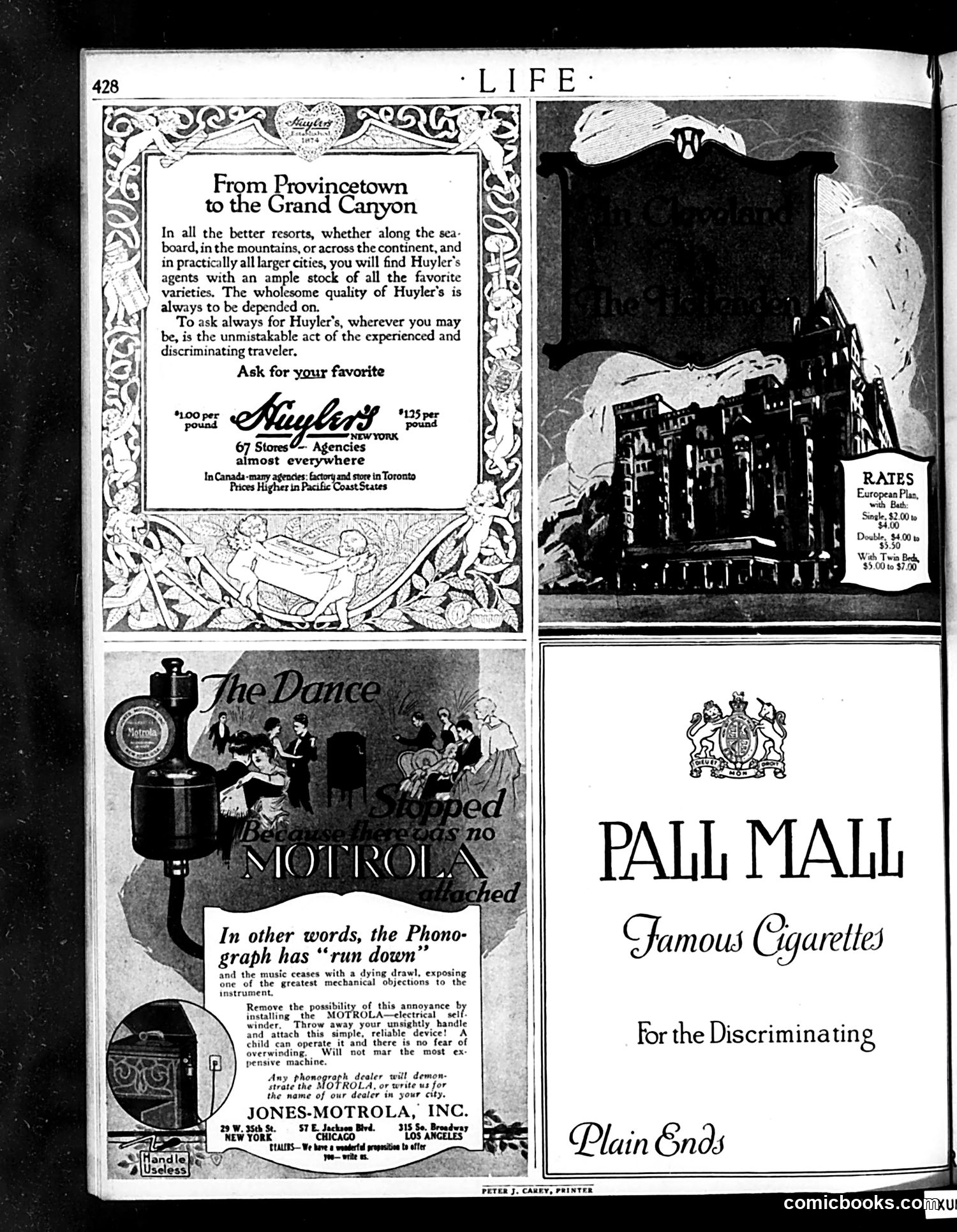
This page is primarily **advertising**, not political satire. It contains three distinct ads from the early 20th century: 1. **Huyler's Chocolates** – A luxury candy brand marketing itself as the choice of "experienced and discriminating travelers" available at resorts and cities nationwide. 2. **Motrola** – An electrical self-winding device for phonographs. The ad addresses a genuine mechanical problem: phonograph hand-cranks required constant attention. The Motrola promised to eliminate this annoyance, making operation automatic and childproof. 3. **Pall Mall Cigarettes** – Marketing "famous cigarettes" to "the discriminating" consumer, emphasizing refined taste through "plain ends." The page reflects early-1900s consumer culture, targeting affluent travelers and emphasizing convenience, quality, and social sophistication. There is no political cartoon or satire present—only period advertising appeals to aspirational consumers.
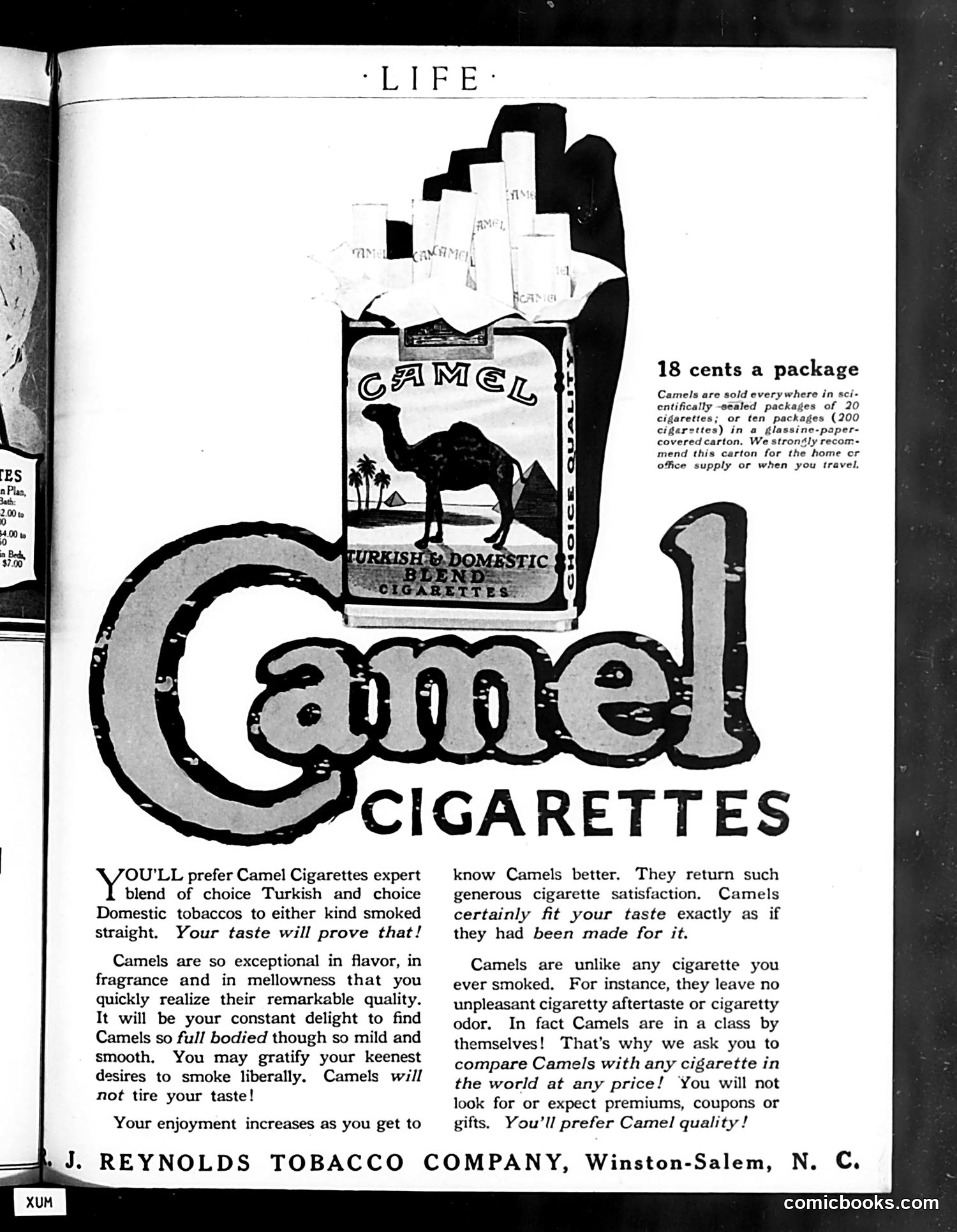
This is **not satire or political commentary**—it's a straightforward cigarette advertisement from Life magazine, likely early-to-mid 20th century. The page promotes Camel cigarettes by R.J. Reynolds Tobacco Company. The central image shows a Camel cigarette package featuring the iconic camel logo and "Turkish & Domestic Blend" labeling. The ad emphasizes quality through claims of superior flavor, lack of unpleasant aftertaste, and a blend of Turkish and domestic tobaccos. **Historical context for modern readers:** This advertisement predates tobacco health warnings and represents an era when cigarettes were openly marketed to the general public without health disclaimers. The price (18 cents per package) and packaging details reflect early 20th-century retail practices. The ad's appeals to taste and "quality" would later become legally restricted as scientific evidence of smoking's dangers emerged.
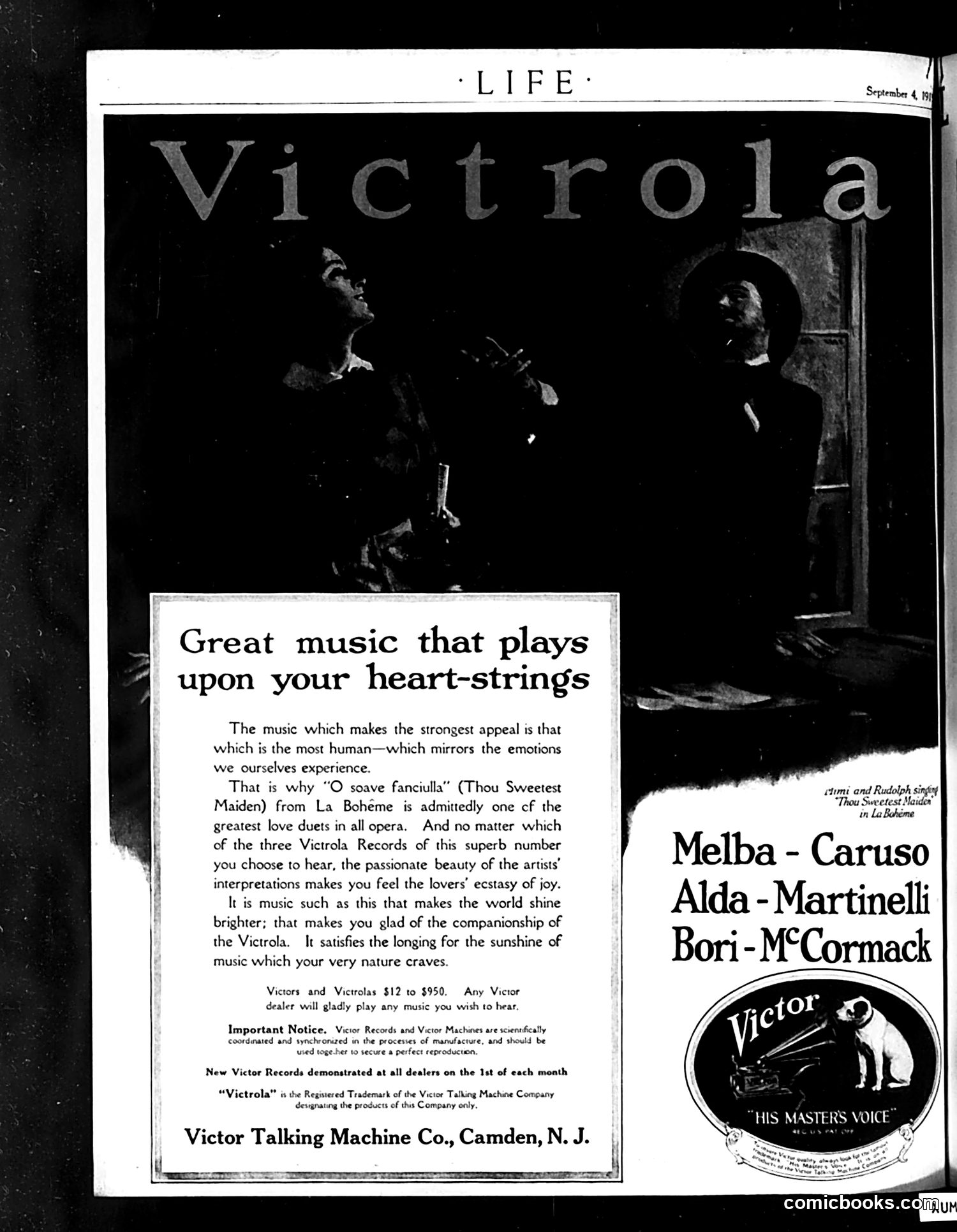
This is primarily a **Victrola (phonograph) advertisement**, not a political cartoon. The page features an ad promoting Victor Talking Machine Company's records and equipment. The ad references famous opera singers of the era—**Melba, Caruso, Alda, Martinelli, and Bori**—performing "O soave fanciulla" from *La Bohème*. These were celebrated Metropolitan Opera stars of the early 20th century. The advertisement's strategy appeals to emotional and cultural aspirations: it argues that great music "mirrors the emotions we ourselves experience" and that owning a Victrola satisfies humanity's innate craving for music and beauty. The product range ($12 to $950) suggests models for different income levels. There is **no satire or cartoon content**—this is straightforward commercial messaging using prestige associations (famous opera, human emotion, cultural refinement) to market consumer technology to American readers.