
Life, 1919-09-04 · page 23 of 48
Life — September 4, 1919 — page 23: what you’re looking at
What you’re looking at
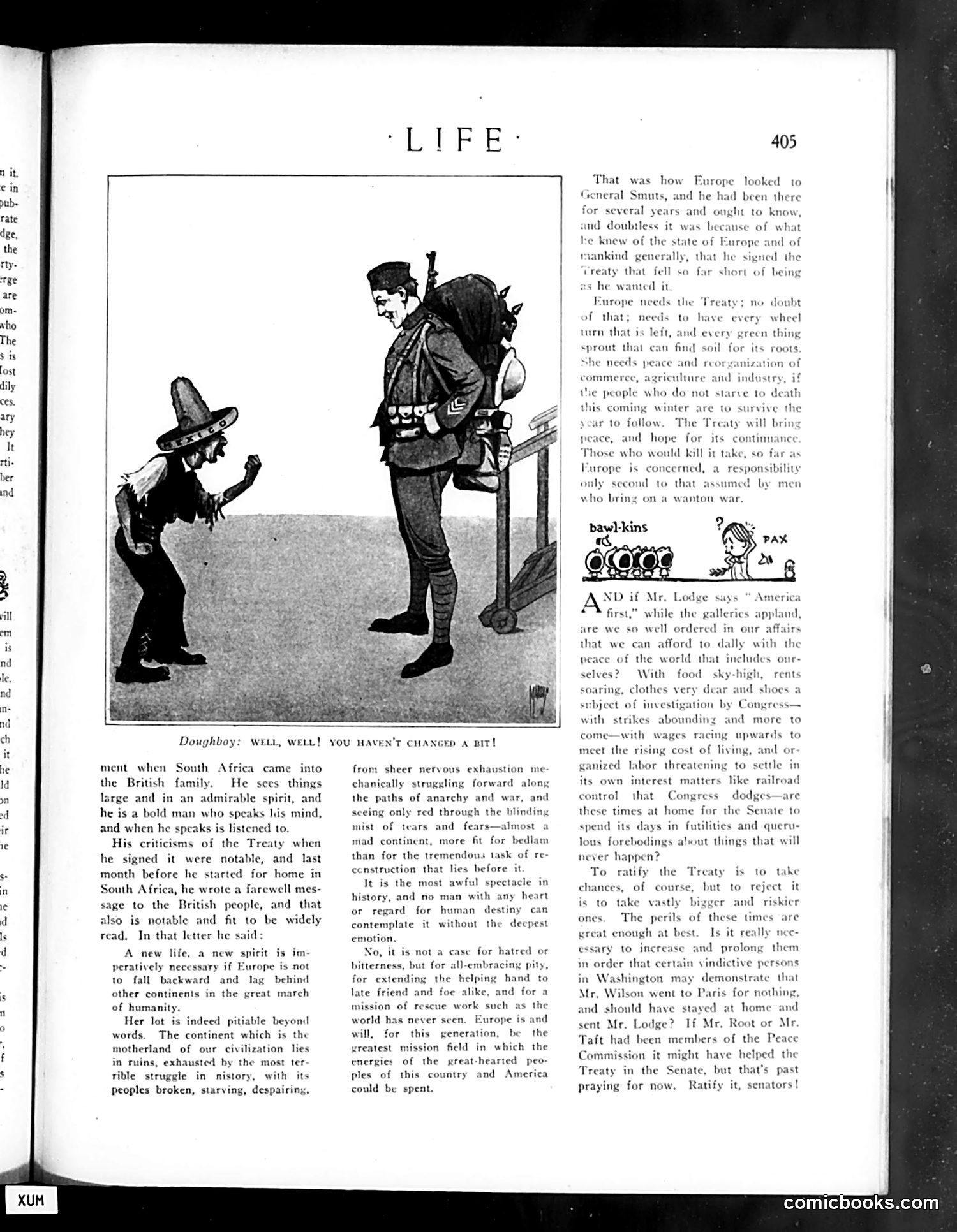
This cartoon depicts a **World War I American soldier ("doughboy")** encountering what appears to be **Europe personified as a ravaged, skeletal figure**. The "haven't changed a bit" is darkly ironic—Europe has catastrophically changed, devastated by war. The accompanying text discusses **General Smuts of South Africa** and his criticisms of the post-WWI **Treaty of Versailles**. The article argues Europe desperately needs the treaty to rebuild from total destruction, and warns against American isolationists (particularly **Senator Lodge**, referenced in the text) who oppose U.S. ratification. The satire targets those who would reject the treaty: the cartoon's stark visual contrast between the healthy soldier and broken Europe underscores the article's point—rejecting peace measures risks prolonging catastrophe. The joke bitterly suggests that nothing improving for Europe means the soldier's sacrifice meant nothing.
📄 Transcribed text from this page (OCR, searchable)
Machine-transcribed from the original scan — historical spelling and the odd misread are preserved.
wes a esy..) Doughboy: wett, WELL! you HAVEN'T CHANGED A BIT! ment when South Africa came into the British family. He sees things arge and in an admirable spirit, and he is a bold man who speaks his mind, and when he speaks is listened to. His criticisms of the Treaty when he signed it were notable, and last month before he started for home in South Africa, he wrote a farewell mes- sage to the British people, and that also is notable and fit to be widely read. In that letter he said A new life, a new spirit is im- peratively necessary if Europe is not to fall backward and lag behind other continents in the great march of humanity. Her lot is indeed pitiable beyond words. The continent which is the motherland of our civilization lies in ruins, exhausted by the most ter rible struggle in nistory, with its peoples broken, starving, despairing, from sheer nervous exhaustion chanically struggling forward along the paths of anarchy and war, and seeing only red through the blinding mist of tears and fears—almost a mad continent, more fit for bedlam than for the tremendous task of re censtruction that lies before it It is the most awful spectacle in history, and no man with any heart or regard for human destiny can contemplate it without the deepest emotion, No, it is not a case for hatred or bitterness, but for all-embracing pity, for extending the helping hand late friend and foe alike, and for mission of rescue work such as the world has never scen. Europe is and will, for this generation, be the xreatest mission field in which the energies of the great-hearted peo- ples of this country and America could be spent. 405 That was how Europe looked to cneral Smuts, and he had been there for several years and ought to know, and doubtless it was because of what he knew of the state of Europe and of raankind generally, that he signed the ‘reaty that fell so far short of being as he wanted it Enrope needs the ‘Treaty; no doubt of that; needs to have every wheel turn that is every green thing sprout that can find soil for its roots She needs peace and reorganization of commerce, agriculture and industry, if the people who do not starve to death this coming winte to survive the sear to follow. The Treaty will bring ace, and hope for its continuance Those who would kill it take, so far as Europe is concerned, a responsibility only second to that assumed by m who bring on a wanton war, ND if Mr. Lodge says * first,” while the galleries appland, America are we so well ordered in our affairs that we can afford to dally with the peace of the world that includes our- selves? With food sky-high, rents soaring, clothes very dear and shoes a subject of investigation by Congress— with strikes abounding and more to come—with cing upwards to meet the rising cost of living, and or ganized labor threatening to settle in its own interest matters like railroad control that Congress dodges—are these times at home for the ate to spend its days in futilities and queru- lous forebodings about things that will never happen? Po ratify the Treaty is to take chances, of course, but to reject it is to take vastly bigger and riskier ones. The perils of these times are sreat enough at best. Is it really essary to increase and prolong them in order that certain vindictive persons in Washington may demonstrate that Mr, Wilson went to Paris for nothing, and should have stayed at home and sent Mr. Lodge? If Mr. Root or Mr. Taft had been members of the Peace Commission it might have helped the Treaty in the Senate, but that’s past praying for now. Ratify it, senators! comicbooks.com