
Life, 1919-09-04 · page 22 of 48
Life — September 4, 1919 — page 22: what you’re looking at
What you’re looking at
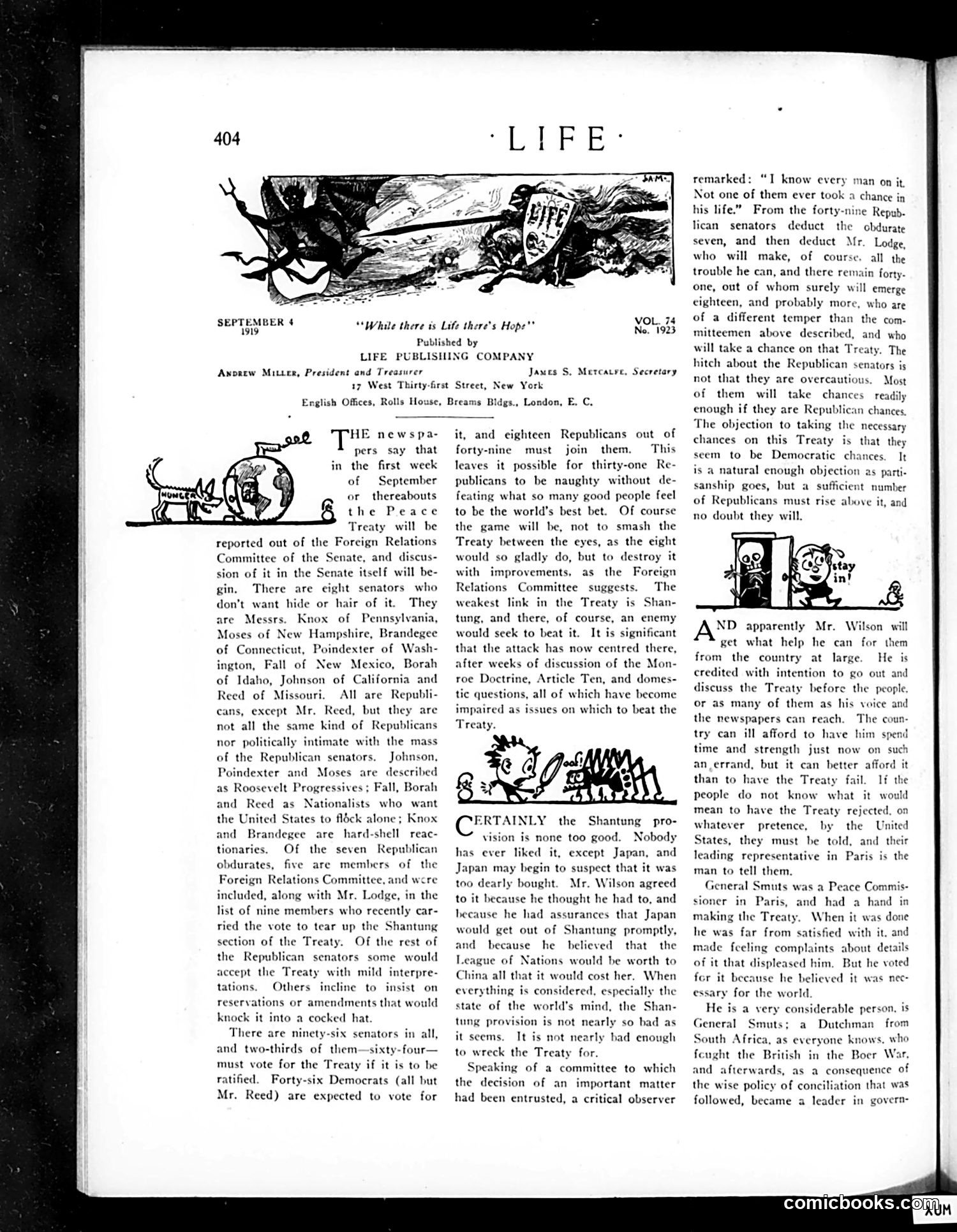
This page discusses the Senate's imminent debate over President Wilson's Peace Treaty following World War I, specifically its controversial Shantung provision favoring Japan over China. The article identifies eight Republican senators opposing the treaty: Knox, Moses, Brandegee, Poindexter, Fall, Borah, Johnson, and Reed. It characterizes them variously as "hard-shell reactionaries," isolationists wanting America to "flock alone," and Roosevelt Progressives. The satire's point: ratification requires 64 of 96 senators' votes. With 46 Democrats supporting it, only 18 of 49 Republicans need to vote yes—leaving 31 Republicans free to obstruct without killing it. The author argues the Shantung provision, while imperfect, shouldn't wreck the entire treaty, and expresses optimism that enough Republicans will abandon their obstructionist colleagues to ensure passage. The cartoons (unclear in reproduction) likely mock the treaty opponents' rigidity.
📄 Transcribed text from this page (OCR, searchable)
Machine-transcribed from the original scan — historical spelling and the odd misread are preserved.
SEPTEMBER ¢ 19 “While there is Life there's Hope"* Published by LIFE PUBLISHING Aworew Mutter, President and Treasurer COMPANY Janes S. Mercaye, Secretary 17 West Thirty-first Street, New York English Offices, Rolls House, Breams Bldgs., London, E. C. newspa- pers say that in the first week of September or thereabouts the Peace Treaty will be reported out of the Foreign Relations Committee of the Senate, and discus- sion of it in the Senate itself will be- gin. There are eight senators who don't want hide or hair of it. They are Messrs. Knox of Pennsylvania, Moses of New Hampshire, Brandegee of Connecticut, Poindexter of Wash- ington, Fall of New Mexico, Borah of Idaho, Johnson of California and Reed of Missouri, All are Republi- cans, except Mr. Reed, but they are not all the same kind of Republicans THE nor politically intimate with the mass of the Republican senators. Johnson, Moses are described all, Borah Poindexter and as Roosevelt Progressives and Reed as Nationalists who want the United States to fléck alone; Knox Brandegee hard-shell reac- tionaries. Of the seven Republican obdurates, members of the and are five are Foreign Relations Committee, and were included, along with Mr. Lodge, in the list of nine members who recently car- ried the vote to tear up the Shantung section of the Treaty. Of the rest of the Republican senators some would accept the Treaty with mild interpre- tations. Others reservations or amendments that would knock it into a cocked hat. There are ninety-six senators in all, incline to insist on and two-thirds of them—sixty-four— must vote for the Treaty if it is to be ratified. Forty-six Democrats (all but Mr. Reed) are expected to vote for it, and eighteen Republicans out of forty-nine must join them. — This leaves it possible for thirty-one Re publicans to be naughty without de- feating what so many good people feel to be the world’s best bet. Of course the game will be, not to smash the Treaty between the eyes, as the eight would so gladly do, but to destroy it with Foreign Relations Committee suggests. The weakest link in the Treaty is Shan- tung, and there, of course, an enemy would seek to beat it. It is significant that the attack has now centred there, after weeks of discussion of the Mon- roe Doctrine, Article Ten, and domes- tic questions, all of which have become impaired as issues on which to beat the improvements, as the ERTAINLY the Shantung pro- vision is none too good. Nobody has ever liked it, except Japan, and Japan may begin to suspect that it was too dearly bought. Mr. Wilson agreed to it because he thought he had to, and because he had assurances that Japan would get out of Shantung promptly, and because he believed that the League of Nations would be worth to China all that it would cost her. When everything is considered, especially the state of the world’s mind, the Shan- tung provision is not nearly so bad as it seems. It is not nearly had enough wreck the Treaty for. peaking of a committee to which the decision of an important matter had been entrusted, a critical observer remarked: “I know every man on it, Not one of them ever took a chance in his life." From the forty-nine Repub- lican senators deduct the obdurate seven, and then deduct Mr. Lodge, who will make, of course, all the trouble he can, and there remain forty- one, out of whom surely will emerge eighteen, and probably more, who are of a different temper than the com- mitteemen above described, and who will take a chance on that Treaty. The hitch about the Republican senators js not that they are overcautious. Most of them will take chances readily enough if they are Republican chances. The objection to taking the necessary chances on this Treaty is that they seem to be Democratic cha f is a natural enough objection as parti- sanship goes, but a sufficient number of Republicans must rise above it, and no doubt they will. nces. It apparently Mr. Wilson will get what help he can for them from the country at large. He is credited with intention to go out and discuss the Treaty before the people, or as many of them as his voice and the newspapers can reach. The coun- try can ill afford to have him spend time and strength just now on suc an errand, but it can better afford it than to have the Treaty fail. If people do not know what it would mean to have the Treaty rejected, of whatever pretence, by the United States, they must be told, and_ their leading representative in Paris is the man to tell them. General Smuts v sioner a Peace Commis- in Paris, and had a hand in ng the Treaty. When it was done he was far from satisfied with it, and made feeling complaints about details f it that displeased him. But he voted for it because he believed it was nec- essary for the world He is a very considerable person. is General Smuts; a Dutchman South Africa, as everyone knows, who feught the British in the Boer War, and afterwards, as a consequence of the wise policy of conciliation that was followed, became a from leader in go' comicbooks.conmm