
A complete issue · 46 pages · 1919
Life — April 10, 1919
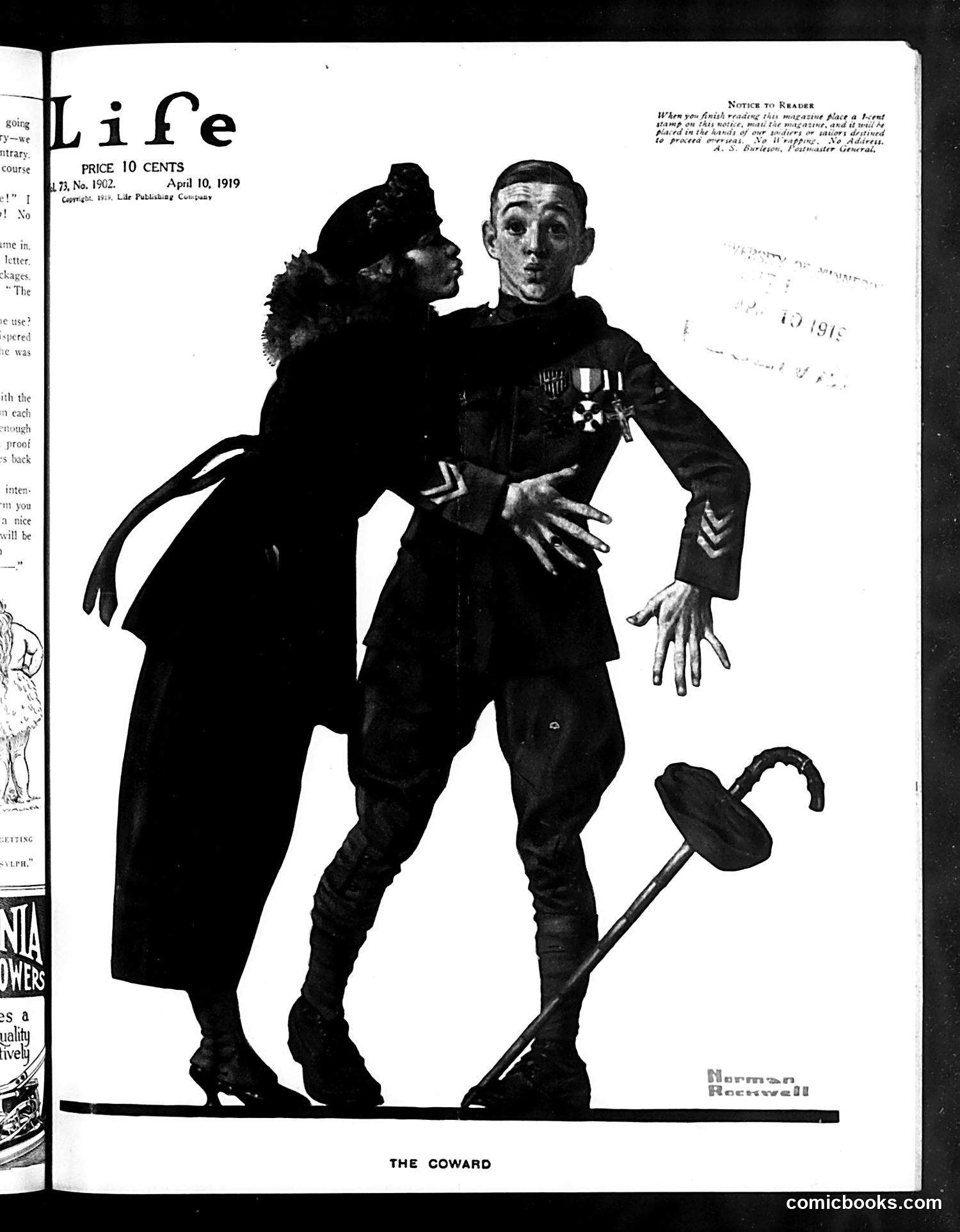
This Norman Rockwell illustration, titled "The Coward," depicts a decorated military officer being confronted by a woman (likely representing public shame or a jilted lover). The soldier wears WWI-era uniform with visible medals and insignia, yet appears defensive and cowering. The satire likely critiques men who claimed military service or wore uniforms while avoiding actual combat, or soldiers who used their rank to avoid danger. The woman's accusatory stance and the discarded umbrella suggest hypocrisy—the officer presenting himself as a hero while being exposed as having shirked duty or responsibility. Published just after WWI's end, this reflects postwar discussions about genuine versus fraudulent military credentials and public accountability.
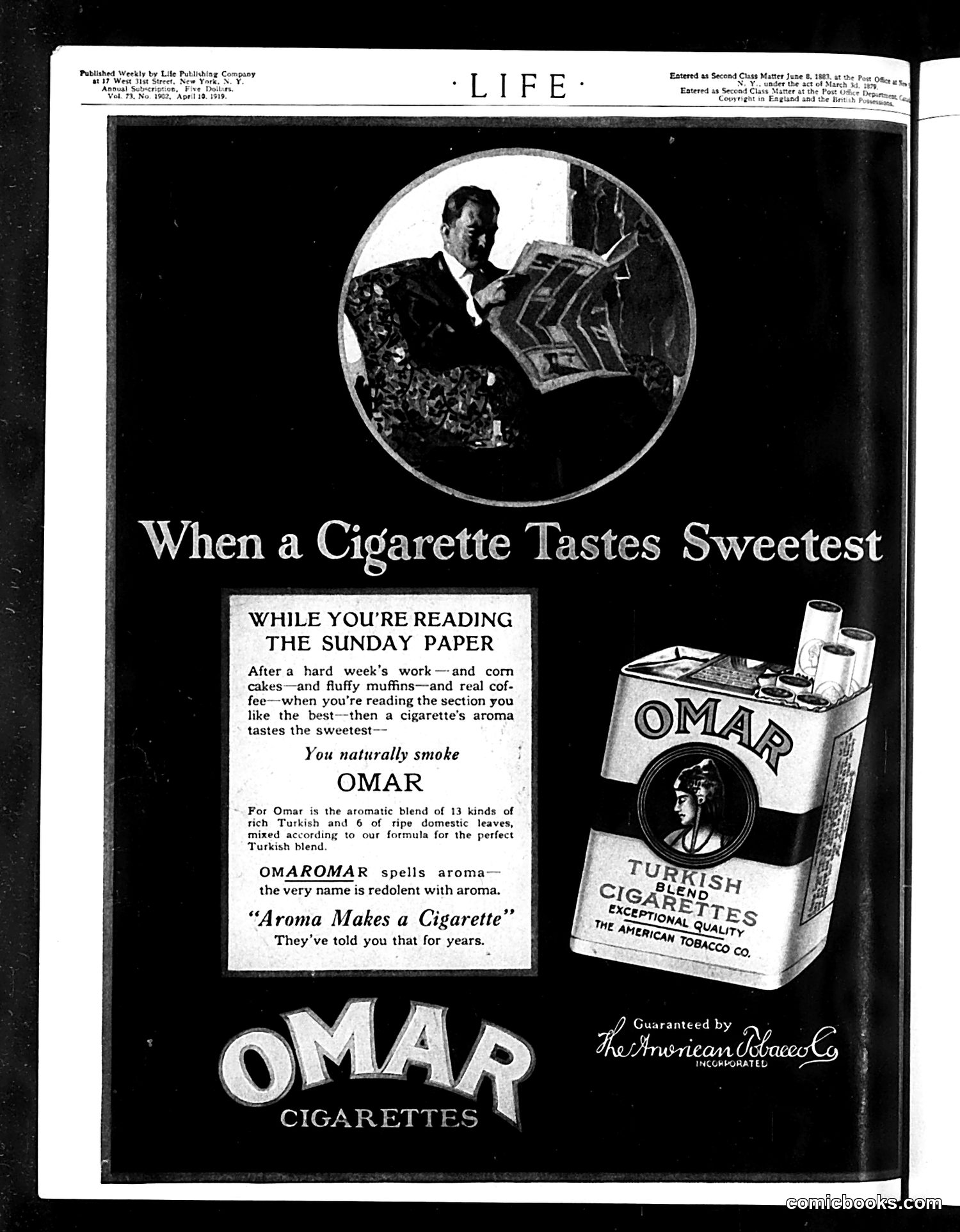
This page is primarily a **cigarette advertisement**, not satire or political commentary. It advertises Omar Turkish Blend Cigarettes from The American Tobacco Company. The ad features a circular vignette of a man reading the Sunday newspaper, with the tagline "When a Cigarette Tastes Sweetest" — suggesting smoking enhances leisure activities like newspaper reading. The marketing copy emphasizes the product's "aroma," claiming the blend of Turkish and domestic tobacco creates an exceptional smoking experience. The slogan "Aroma Makes a Cigarette" reinforces this branding approach. A product package image appears on the right side. This represents straightforward early 20th-century tobacco marketing, not political satire. Modern readers should note this reflects an era when cigarette advertising in mainstream publications was completely normalized and unregulated.
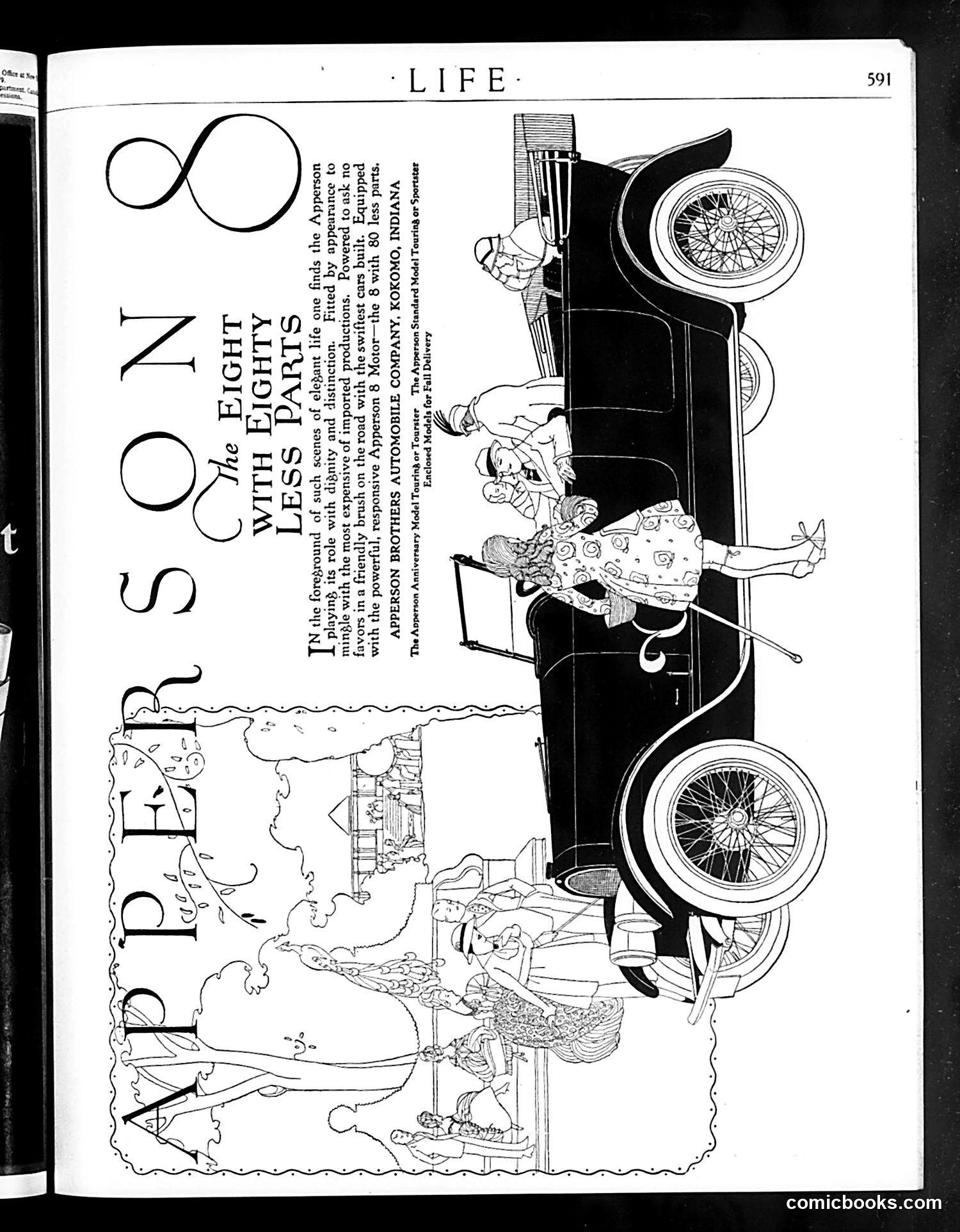
This page features "A Dude's Own," a satirical illustration about automobile ownership in what appears to be the early 1900s (based on the car's design). The left panel shows a map of the United States with rural scenes, while the right panel depicts a well-dressed man in a motorcar with prominent spoked wheels. The satire critiques the disconnect between urban "dudes" (city-dwelling wealthy men) and practical country life. The text indicates the man plays with his automobile "like a child with expensive imported playthings," experiencing car breakdowns and repairs while country folks observe—suggesting that city wealth doesn't translate to mechanical competence or understanding of rural realities. The humor targets class pretension and the novelty of early automobiles among the wealthy elite.
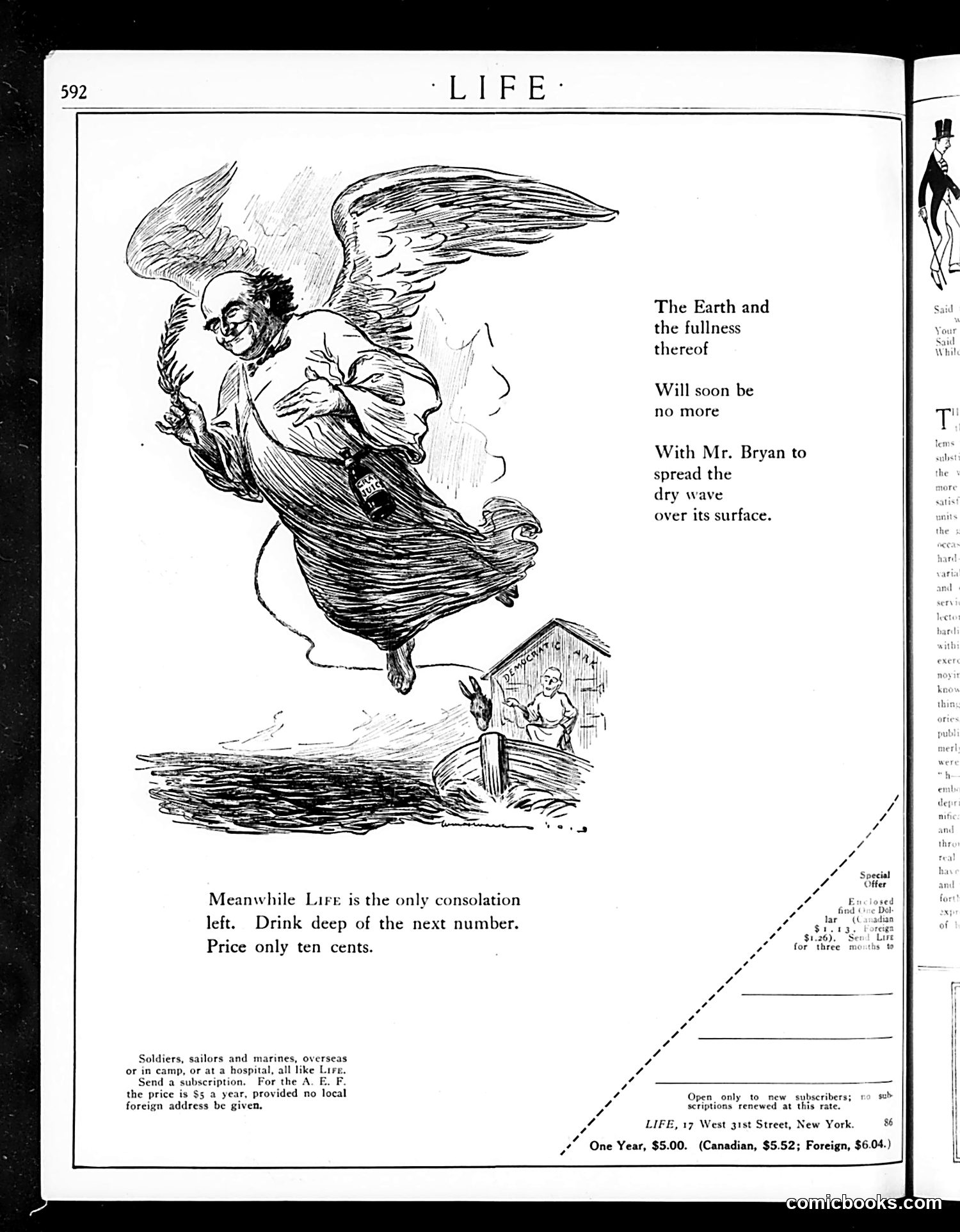
This is a satirical advertisement for *Life* magazine itself, not a political cartoon. The winged figure appears to be an angel or allegorical spirit carrying a small house and person, hovering over a landscape. The accompanying text predicts that "The Earth and the fullness thereof / Will soon be no more / With Mr. Bryan to spread the dry wave over its surface." This references William Jennings Bryan, likely during his 1896 or 1900 presidential campaign. The satire suggests Bryan's policies (possibly his monetary positions or populist platform) would devastate the American landscape and economy. The "dry wave" implies drought or economic ruin spreading across the nation. The ad urges readers to find "consolation" in *Life* magazine subscriptions at ten cents.
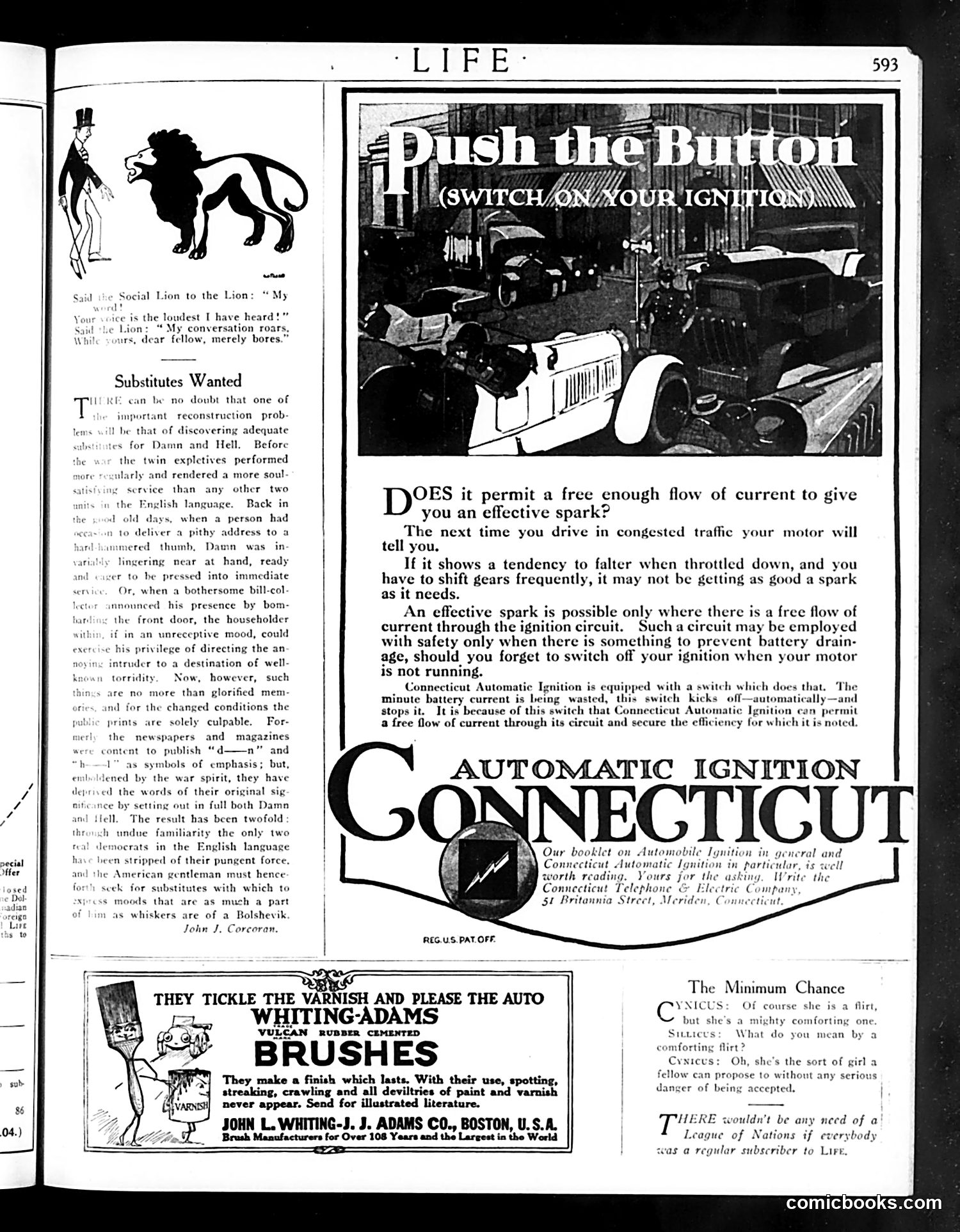
This page is primarily **advertising** rather than satire or political commentary. The main content includes: 1. **Top left**: A humorous cartoon about a "Social Lion" complaining to an actual lion about his loud voice—a simple joke about verbose socialites. 2. **"Substitutes Wanted"**: An editorial piece discussing the need for adequate substitutes for Damn and Hell in English language, noting that newspapers and magazines previously used creative euphemisms. This appears to reflect early 20th-century debates about acceptable language in print. 3. **Major advertisements**: Connecticut Automatic Ignition (car ignition systems), Whiting-Adams Brushes, and other products dominate the layout. The page reflects typical *Life* magazine content from this era—mixing light social commentary with commercial advertising rather than sharp political satire.
This page is **not a cartoon or satire** — it's a straightforward advertisement for Martin & Martin Shoes, a high-end footwear retailer. The ad promotes their new second New York store (583 Fifth Avenue) and existing Chicago location, emphasizing quality over price. Key selling points include: - Shoes priced at $10-$20 (expensive for the era) - Claim of superior comfort and durability despite higher initial cost - Focus on "social correctness" and fashion for wealthy clientele - Personal fitting service and mail-order availability - Emphasis on customer satisfaction over aggressive salesmanship The italicized text highlights the brand's philosophy: prioritizing permanent customer relationships over quick profits. This represents early 20th-century luxury marketing targeting fashionable, affluent Americans.
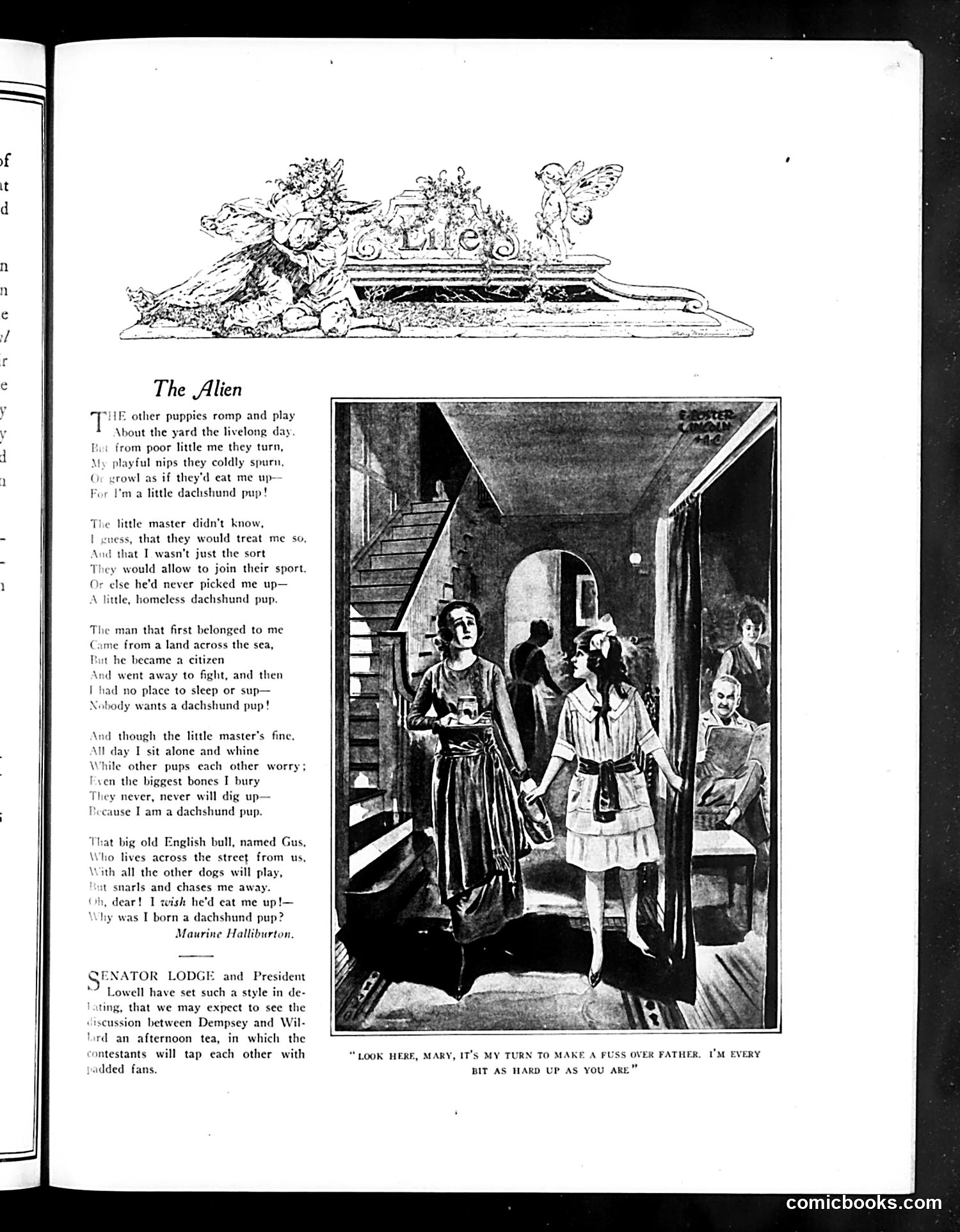
This page contains a poem by Maurine Halliburton titled "The Alien," told from a dachshund's perspective. The poem expresses the dog's longing for its original owner who "came from a land across the sea" and went away to fight, leaving the pet unwanted and homeless. The satire appears to reference anti-German sentiment during or after World War I. Dachshunds—a German breed—faced discrimination in America during this period, often viewed as "alien" due to their nationality of origin. The poem humorously personifies this prejudice through the dog's voice, highlighting how innocent creatures suffered collateral damage from wartime xenophobia. The accompanying illustration depicts a domestic scene, emphasizing the pet's displacement and rejection despite its loyalty.
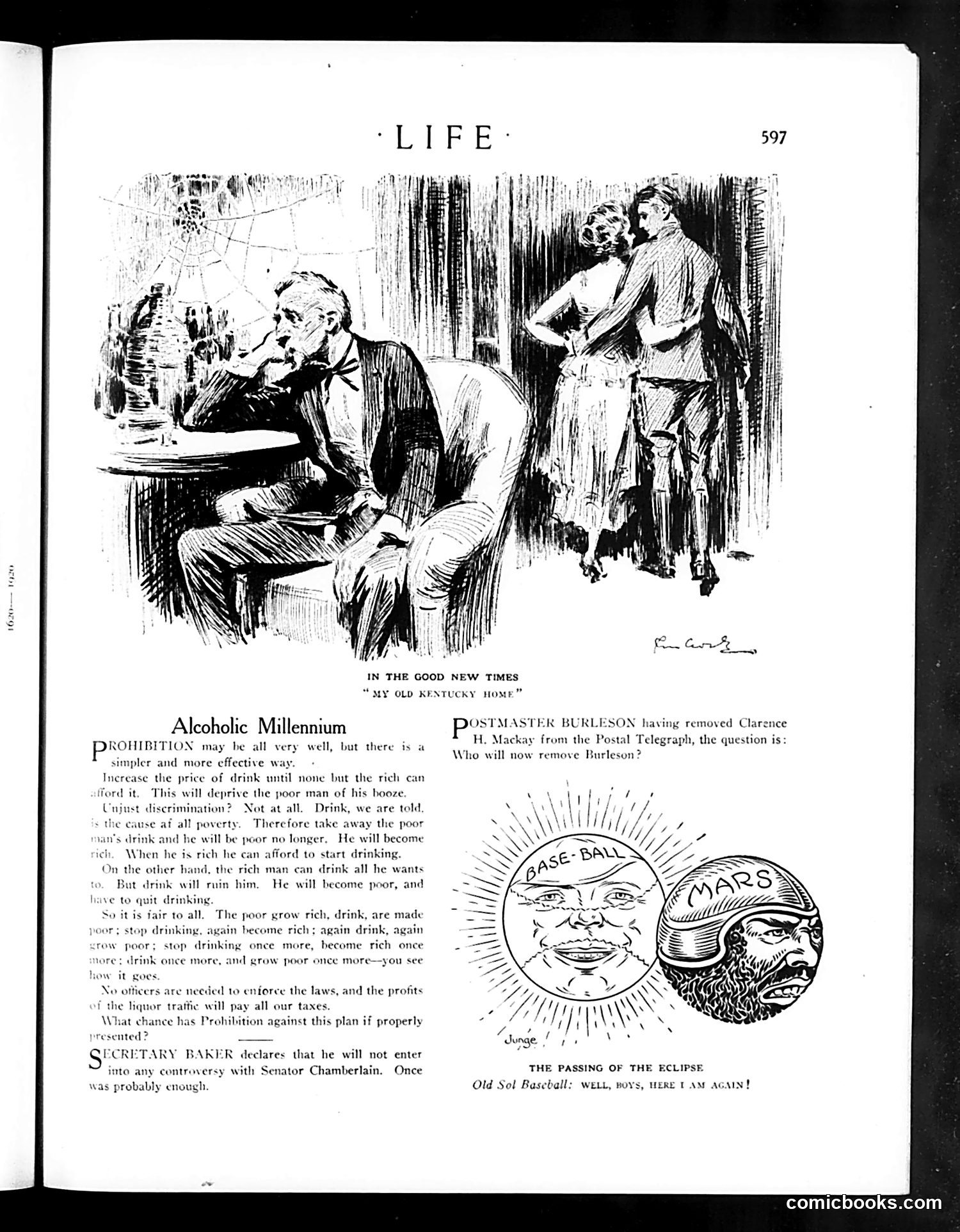
**Top article & sketch**: Satirizes Prohibition arguments. The piece mocks the logic that removing poor people's access to alcohol will make them rich—if they can't drink, they won't need money for booze. It then absurdly extends this: rich people can drink as much as they want, so they'll become poor. The cartoon shows an older man contemplating this paradox while younger figures socialize in the background. **Bottom cartoon**: "The Passing of the Eclipse" features two caricatured heads labeled "Base-Ball" and "Mars," with accompanying text about postmaster Burleson removing Clarence H. Mackay and questioning who will remove "Burleson"—likely political criticism of government overreach or postal censorship during WWI era.
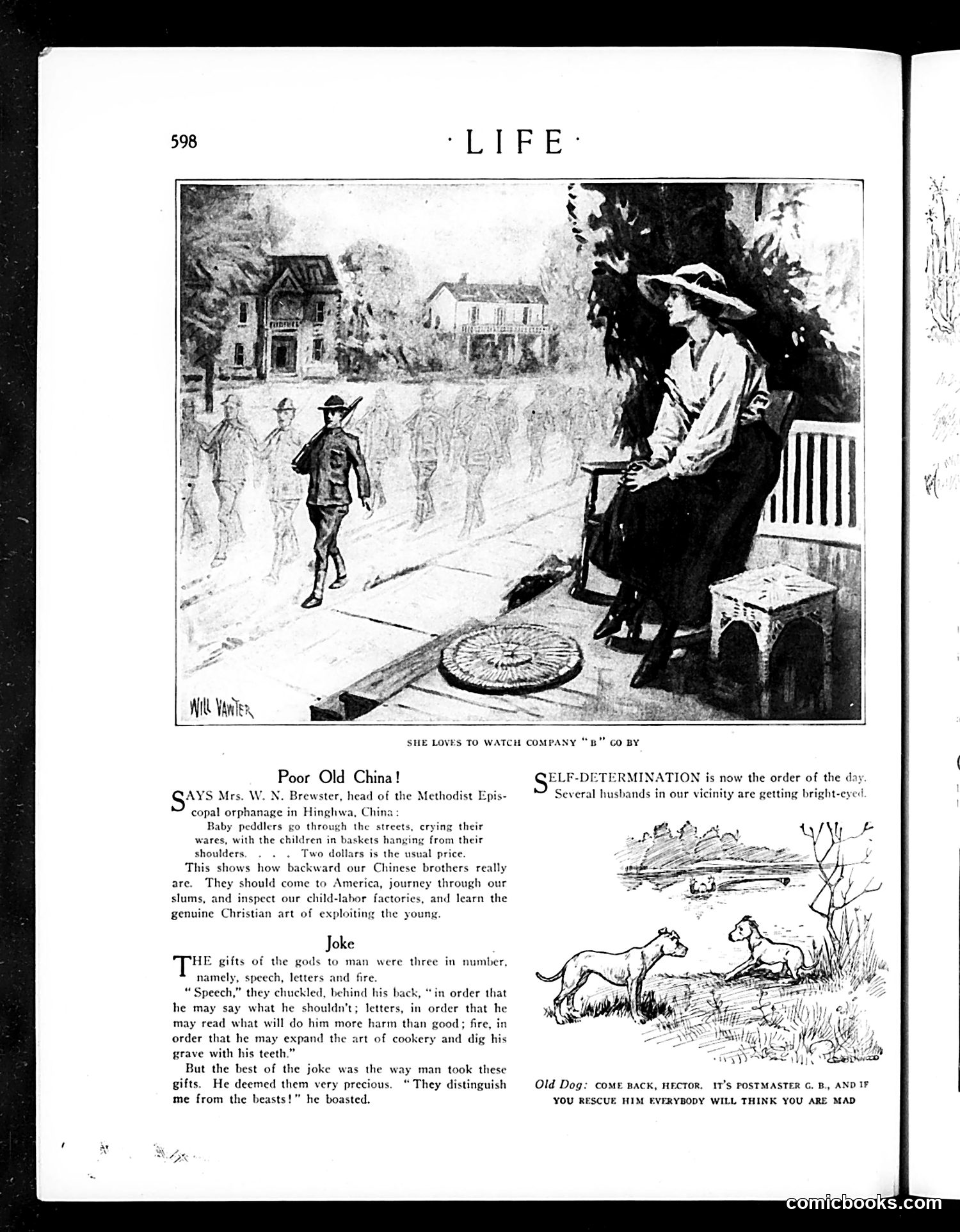
**Top Cartoon:** Titled "She Loves to Watch Company 'B' Go By," this illustration depicts a woman watching soldiers march past, with military buildings in the background. The cartoon satirizes women's romantic interest in soldiers and military spectacle during wartime. **"Poor Old China" Section:** This article criticizes Chinese poverty and child labor, presenting a condescending Western perspective on conditions in Hinghwa, China. It describes impoverished children and suggests Christian missionary intervention as the solution—reflecting the paternalistic attitudes of early 20th-century American imperialism. **"Joke" Section:** A humorous anecdote about mankind's three gifts (speech, letters, fire), concluding that man's greatest achievement was using these gifts to "distinguish me from the beasts!"—a commentary on human vanity. **Bottom Illustration:** A sketch of dogs, captioned with a postmaster joke.
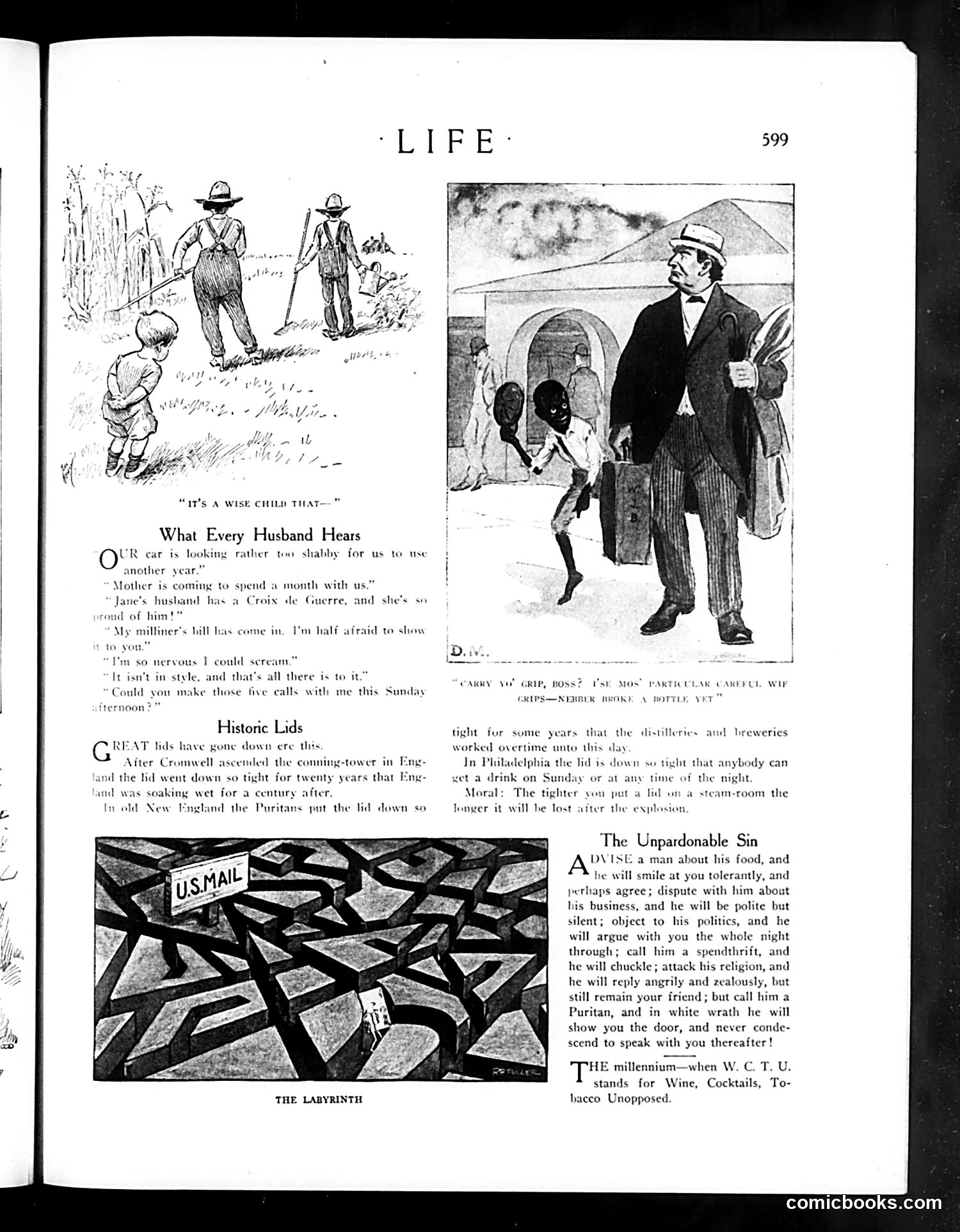
This page contains satirical humor about domestic life and Prohibition-era social issues. **"What Every Husband Hears"**: A sketch mocking wives' complaints—about car expenses, mother-in-law visits, and social obligations. The humor targets the stereotypical nagging spouse. **"Historic Lids"**: References Puritan and Cromwellian England's restrictions on behavior, comparing them to contemporary American Prohibition enforcement. The joke equates strict alcohol laws with historical moral authoritarianism. **"The Unpardonable Sin"**: Satirizes the Puritan type—someone judgmentally pious who criticizes others' drinking, politics, and religion while remaining self-righteous. The mockery suggests such moral superiority is worse than the vices being condemned. **"The Labyrinth"** (illustration): Depicts mail as a maze, likely criticizing postal service inefficiency. The overall tone reflects 1920s-30s skepticism toward Prohibition and rigid moral standards.
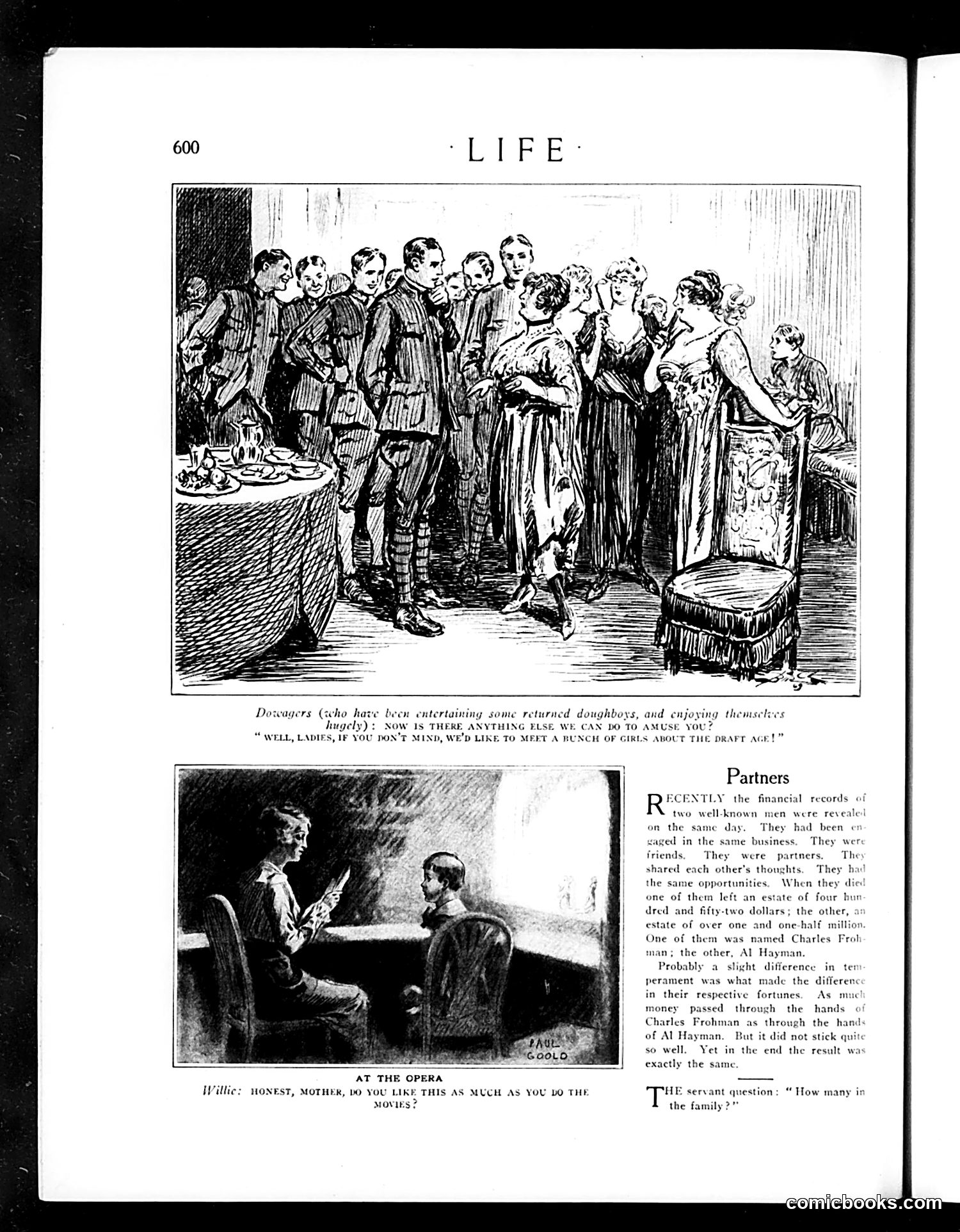
**Top Cartoon**: Depicts young men at a social gathering with women, asking how to "amuse" the group. The caption jokes about entertaining "returned doughboys" (WWI soldiers) home on leave, suggesting they want to arrange social activities with young women. **Bottom Cartoon and Article**: Titled "Partners," this illustrates two businessmen and recounts a story about financial partners—Charles Frohman and Al Hayman—who shared a business but accumulated vastly different fortunes ($452 vs. $1.5+ million). The satire questions how identical circumstances produced such disparate outcomes, and includes a separate joke about a servant asking a wealthy family "How many in the family?" Both pieces satirize social class differences and post-WWI American life.
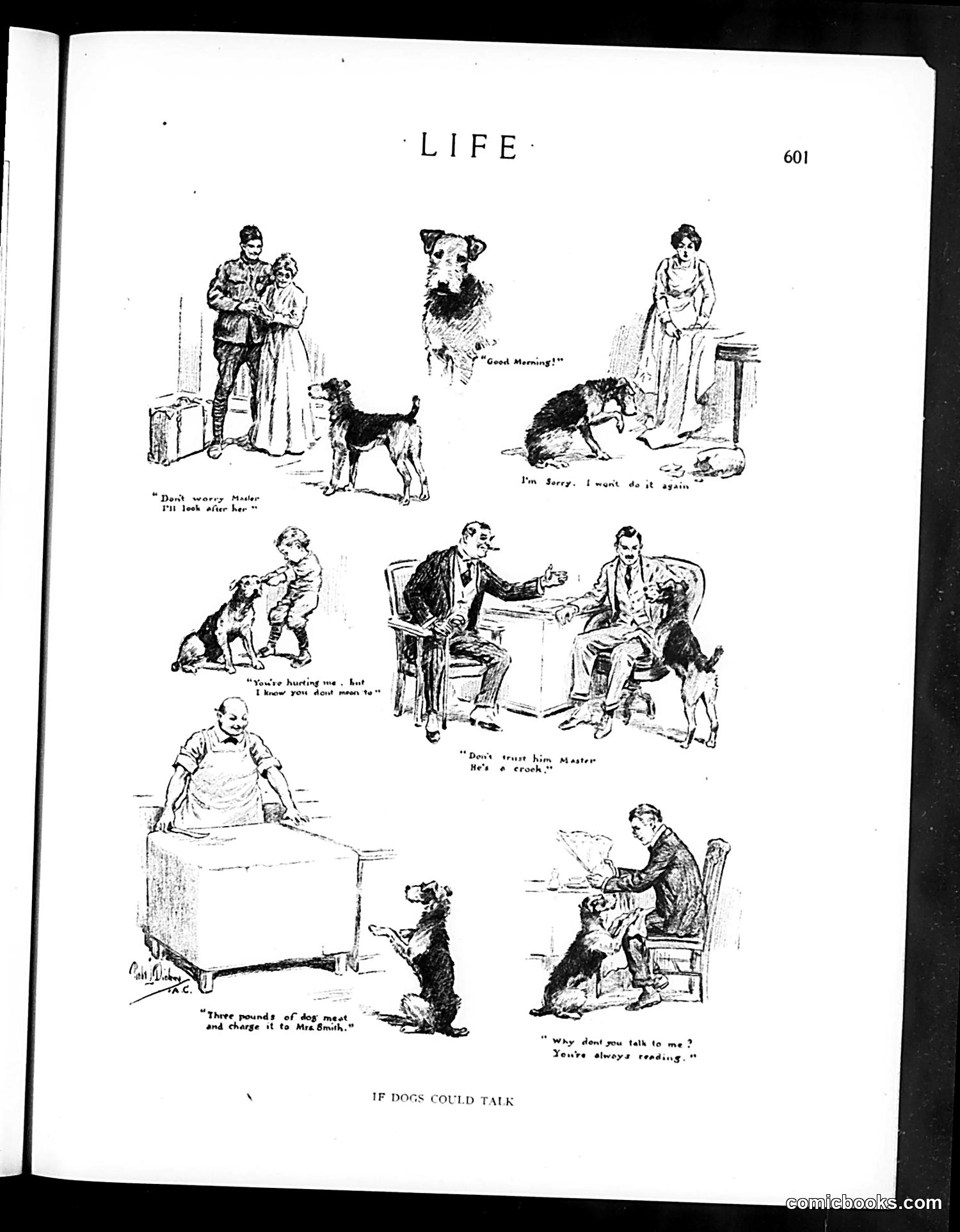
This is a humorous series of six illustrated vignettes imagining what dogs might say if they could speak to humans. The scenarios depict common domestic situations: 1. A departing master reassuring his dog he'll return 2. A dog greeting its owner cheerfully each morning 3. A dog apologizing for misbehavior 4. A dog defending itself against accusations of theft 5. A dog warning its master against trusting a disreputable visitor 6. A dog complaining about being ignored while its owner reads The satire suggests dogs possess loyalty, remorse, and protective instincts—qualities their humans often fail to recognize or appreciate. The cartoons humorously highlight the gap between human assumptions about animal behavior and what dogs might actually "think," gently critiquing human insensitivity to their pets' emotional lives.
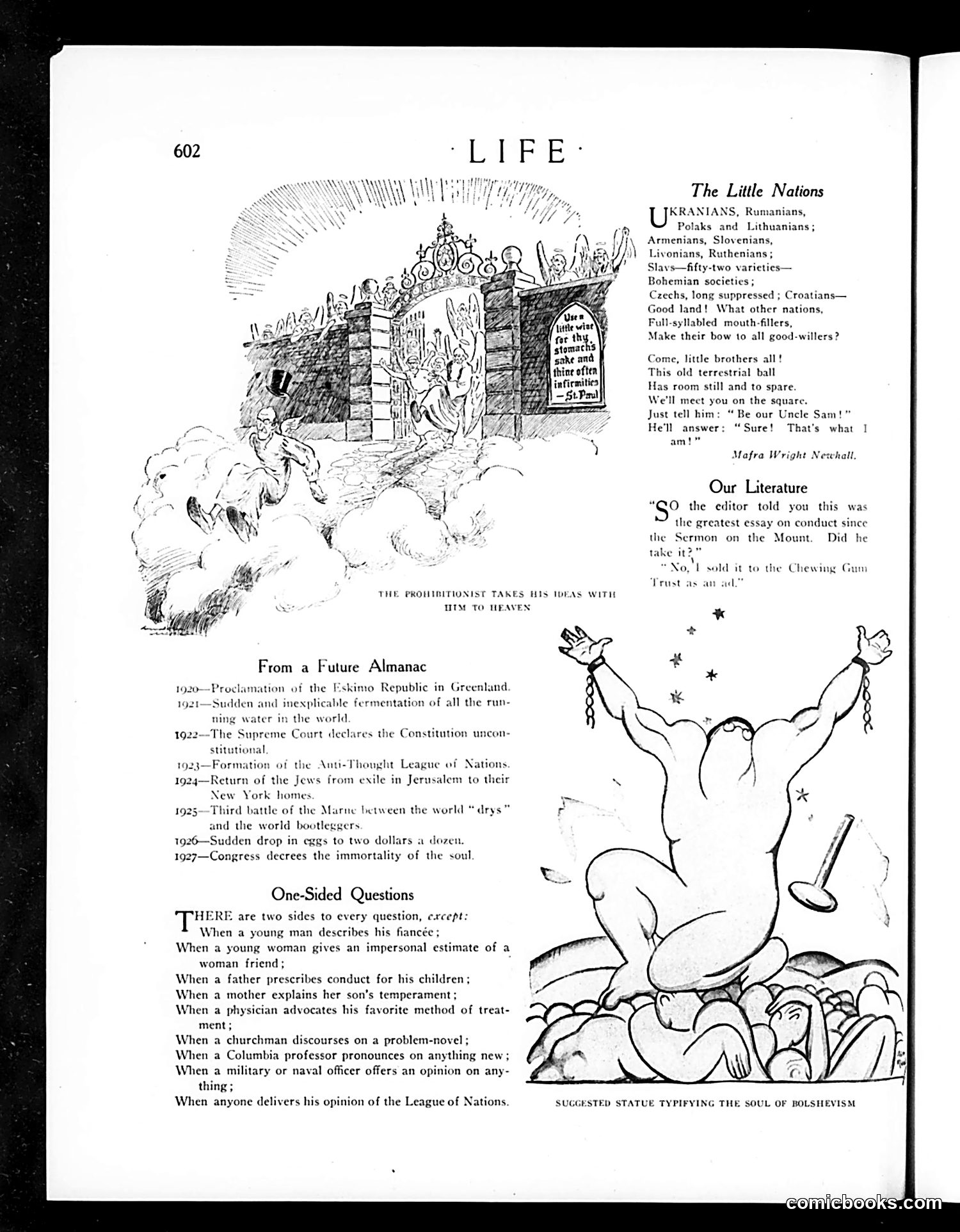
This page from *Life* magazine contains three satirical pieces: 1. **"The Prohibitionist Takes His Ideas with Him to Heaven"** - A cartoon mocking American Prohibition (1920-1933), depicting a prohibitionist ascending to heaven while carrying his anti-alcohol ideology. The satire suggests such fervent moral positions are impractical or absurd. 2. **"From a Future Almanac"** - Humorous fake predictions (1920-1927) satirizing contemporary political turmoil: the new Eskimo Republic, global water fermentation, constitutional crises, and the Anti-Thought League—mocking post-WWI chaos and emerging totalitarian concerns. 3. **"One-Sided Questions"** - A list mocking how various authorities (fathers, clergy, military officers, professors, League of Nations officials) presume expertise on matters beyond their competence, satirizing unwarranted institutional authority and overreach.
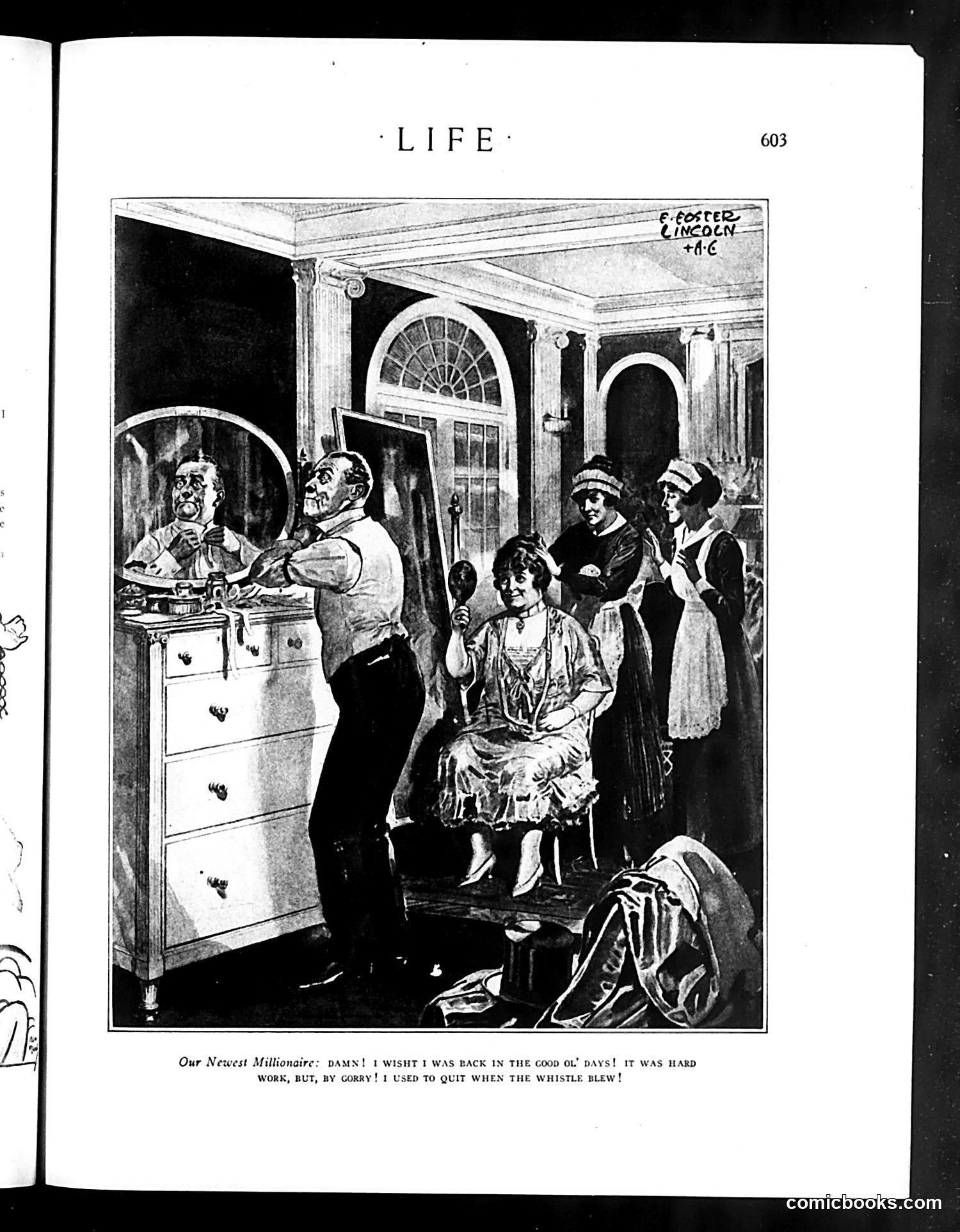
This is a cartoon titled "Our Newest Millionaire," depicting a wealthy man admiring himself in a mirror while surrounded by servants and staff in an elegant interior. The caption reads: "DAMN! I WISH I WAS BACK IN THE GOOD OL' DAYS! IT WAS HARD WORK, BUT, BY GORRY! I USED TO QUIT WHEN THE WHISTLE BLEW!" The satire targets newly wealthy industrialists or businessmen of the early 20th century. The joke is ironic: despite achieving millionaire status, the character nostalgically longs for the simpler life of a working man with set hours—when he could leave work at the factory whistle. The cartoon mocks how wealth and status, while enviable, bring new pressures and anxieties that the character finds burdensome compared to his former working-class existence.
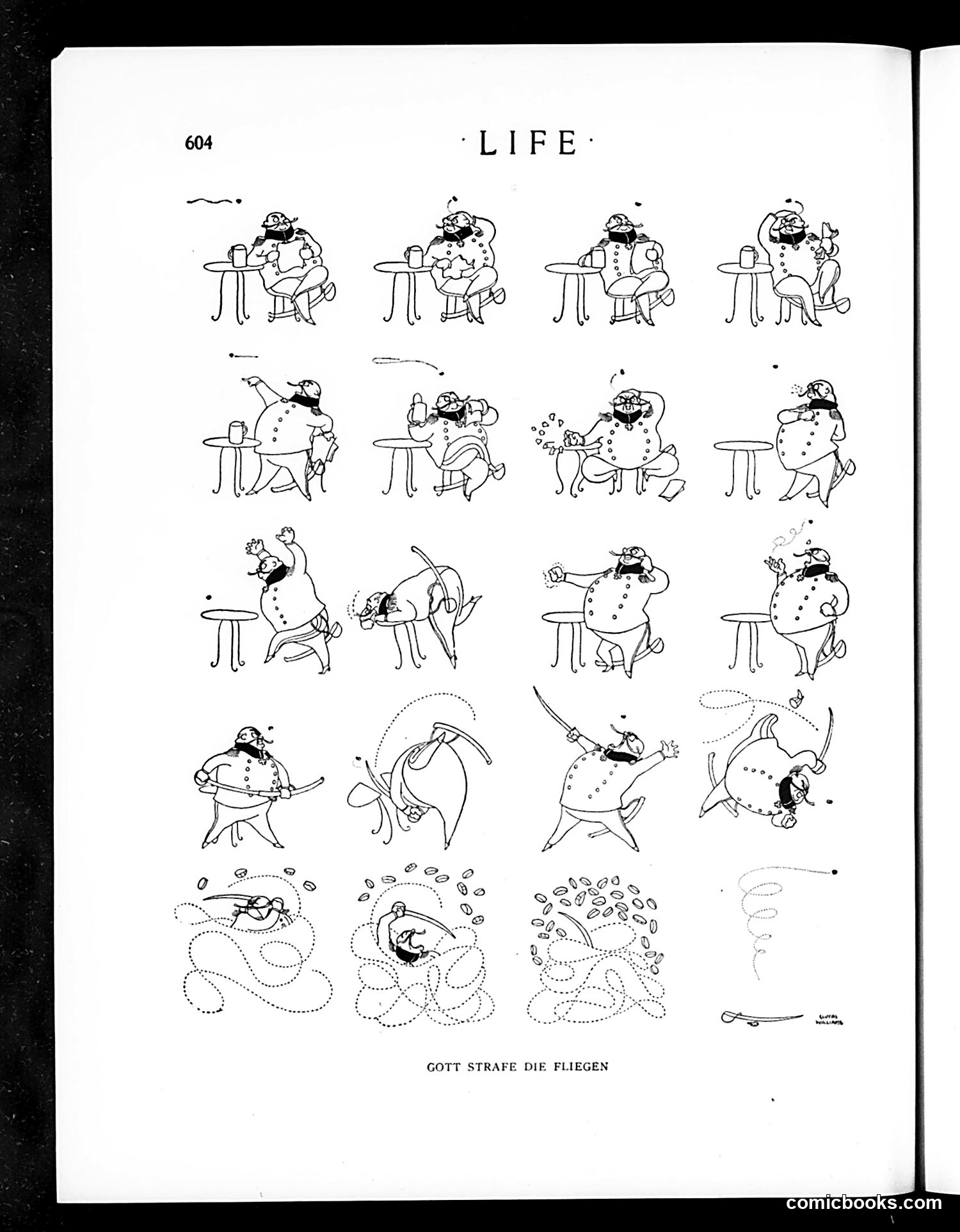
This appears to be a German-language satirical cartoon sequence titled "Gott Strafe Die Fliegen" (God Punish the Flies). The strip shows a rotund figure seated at a table repeatedly being pestered by a fly—the character swats, chases, and grows increasingly frustrated through various comedic poses and actions. The German title suggests this is anti-British WWI propaganda. "Gott Strafe England" (God Punish England) was a common German slogan during World War I, and "die Fliegen" (the flies) likely represents British aircraft or the British themselves as persistent annoyances. The humor derives from the figure's futile attempts to eliminate the pest, possibly satirizing German frustrations with British military operations or presence during the war.
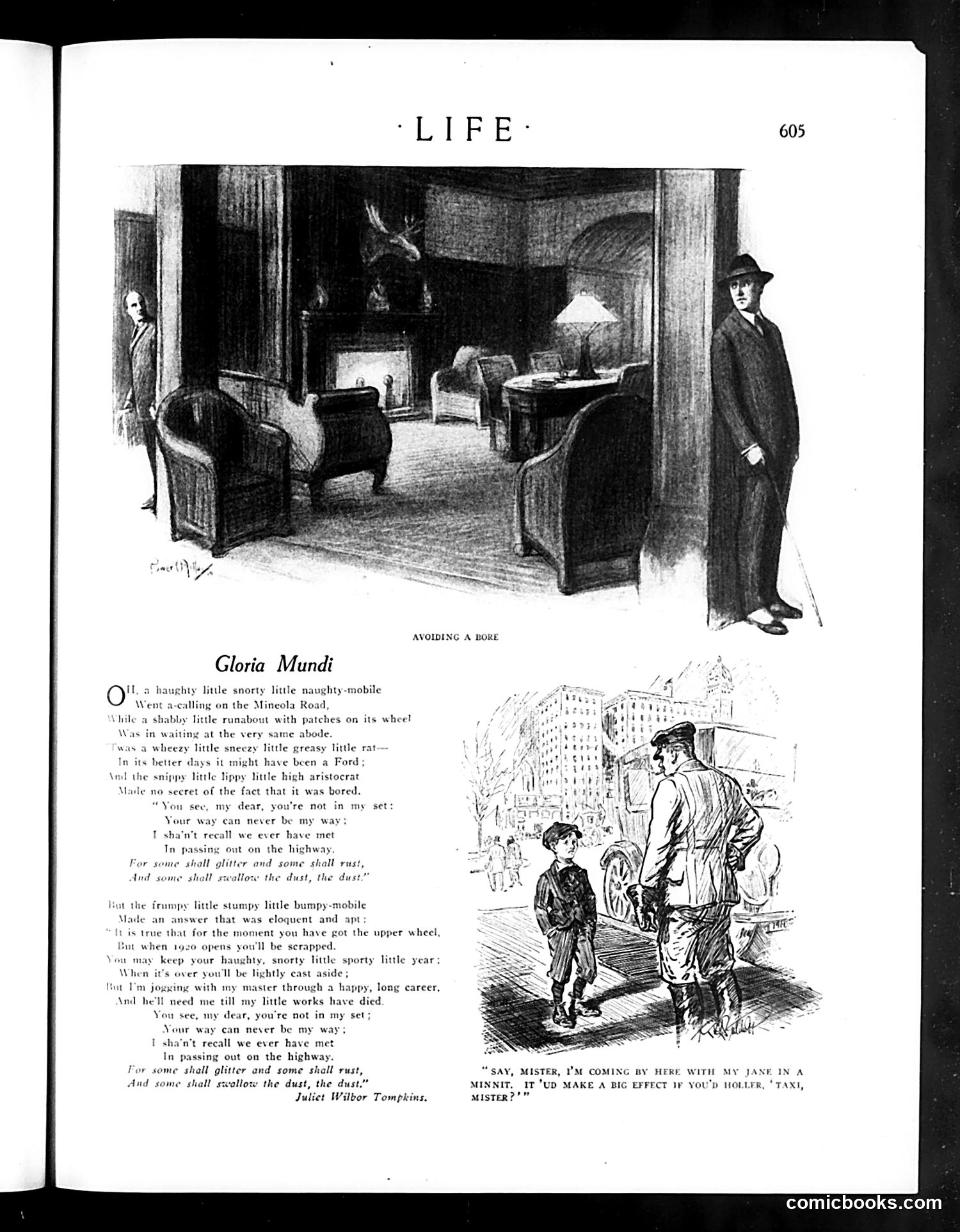
This satirical piece uses cars as stand-ins for social classes. A fancy, snobbish automobile (representing the wealthy elite) encounters a shabby, worn-out vehicle (representing the working class) on the road. The wealthy car boasts of its superiority and exclusive "set," refusing to acknowledge the humble car as an equal. The working-class car's response forms the satire's point: though currently inferior, it will outlast its haughty rival. When "1920 opens," the fancy car will be "scrapped"—likely referencing economic cycles or social upheaval—while the humble car continues serving its loyal master faithfully for years. The accompanying street scene shows a boy trying to impress his date by asking a man to call for a taxi, reinforcing themes of aspiration and pretense. The title "Gloria Mundi" (Latin: "glory of the world") ironically comments on how fleeting status and material superiority truly are.
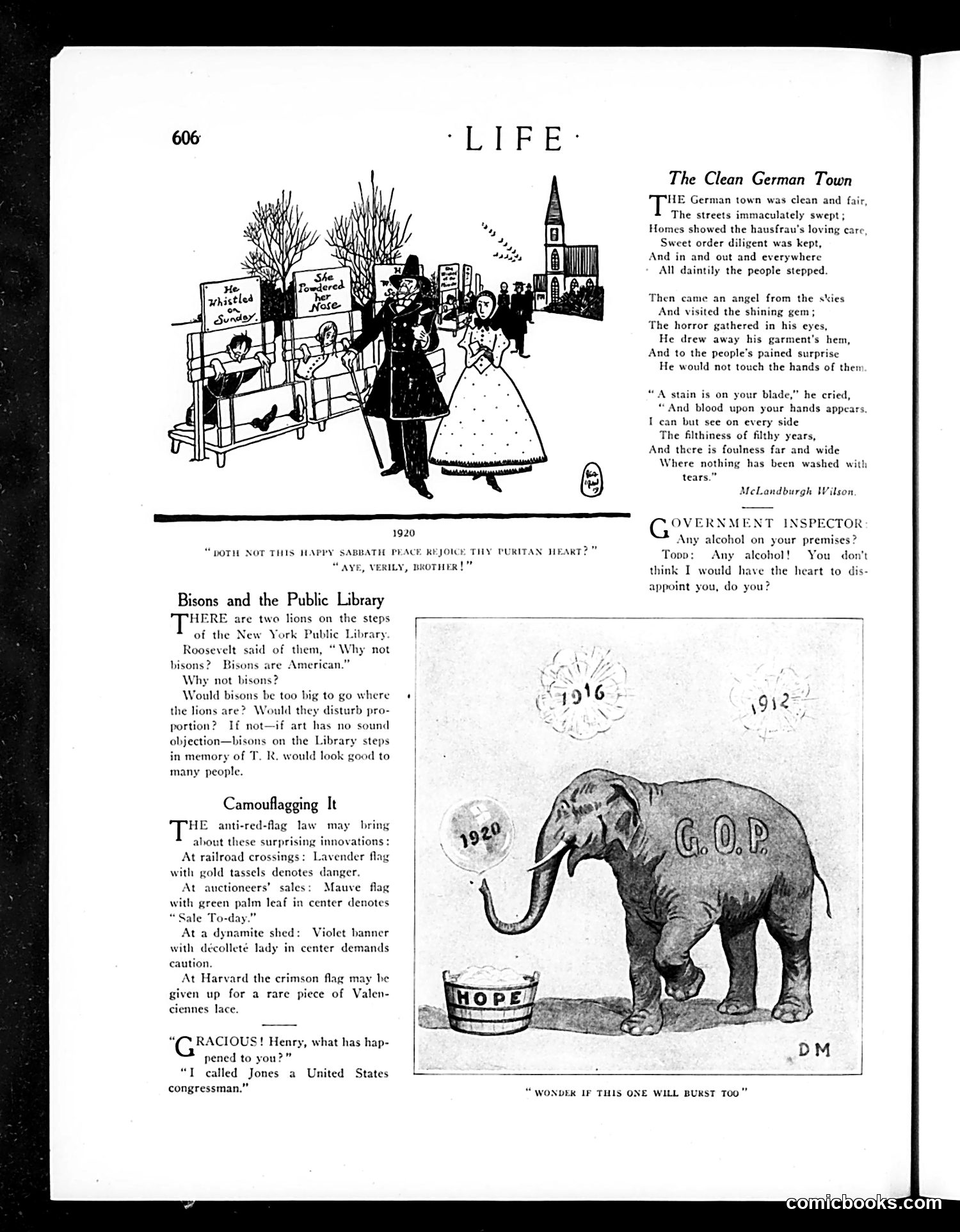
**The main political cartoon** (bottom right, by DM) depicts an elephant labeled "G.O.P." (Republican Party) with its trunk caught in a bucket labeled "HOPE," dated 1920. Years marked 1912, 1916, and 1920 appear above, showing the elephant's declining size over time. The caption asks if "this one will burst too," suggesting the Republican Party is weakening and may collapse entirely. **Historical context**: This reflects post-WWI disillusionment and the 1920 presidential election period when Republicans faced internal divisions and public skepticism following the Wilson administration. **The poem "The Clean German Town"** by McLandburgh Wilson is a moral indictment of Germany for WWI atrocities—depicting a superficially orderly society with hidden "blood" and spiritual filth that no amount of cleanliness can wash away. **Minor content** includes satirical quips about Prohibition enforcement, suggestions to replace library lions with bison, and anti-flag law commentary—all reflecting 1920s social debates.
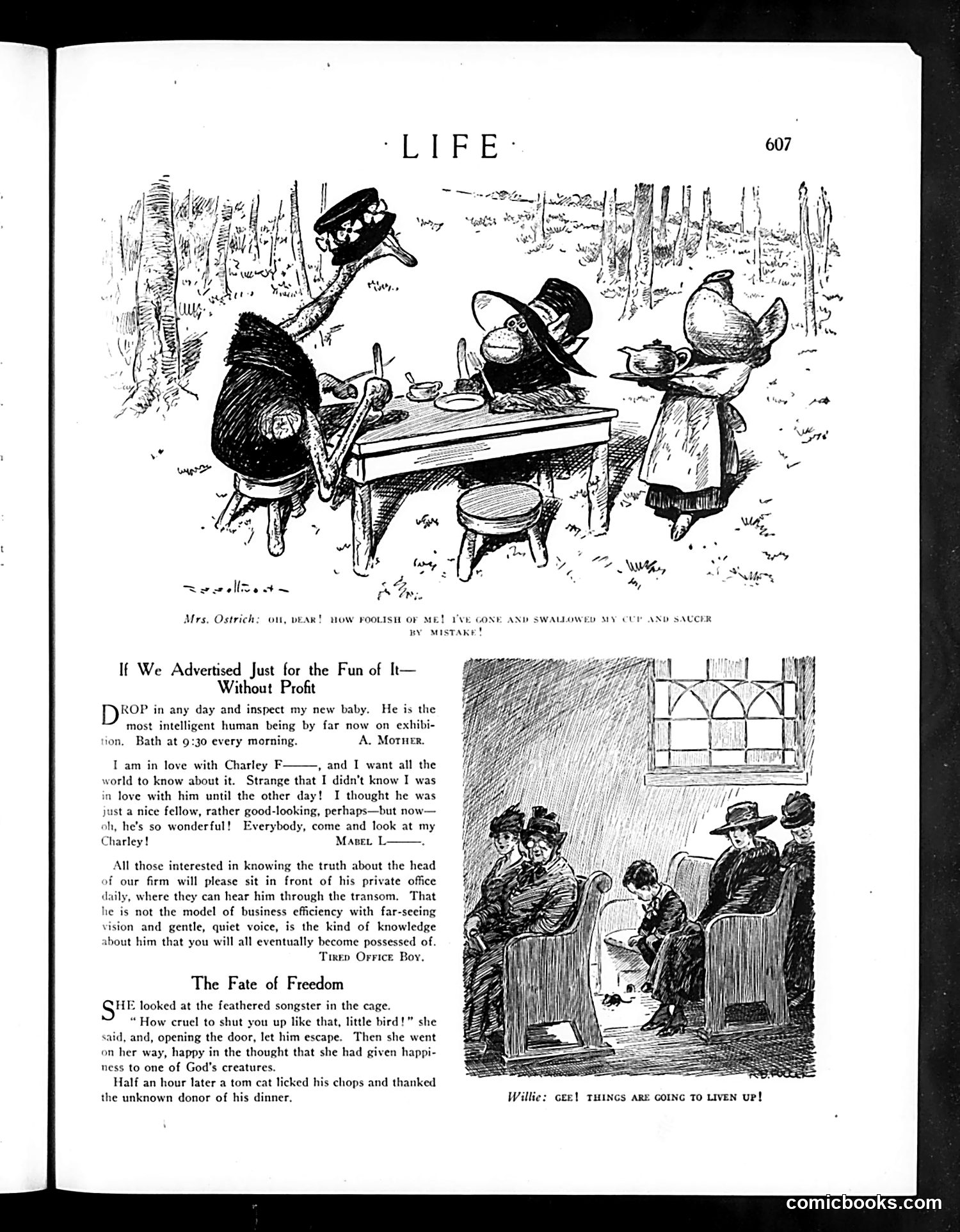
This page satirizes overly sentimental or foolish personal advertisements. The top cartoon shows an ostrich absurdly claiming she swallowed her cup and saucer—mocking advertisements that broadcast trivial or embarrassing personal moments. Below, the section "If We Advertised Just for the Fun of It" presents three fictional ads ridiculing common advertisement tropes: a mother boasting about her baby's intelligence, a woman publicly declaring infatuation with "Charley F—," and a tired office boy exposing his boss's actual inefficiency rather than praising him. The final story, "The Fate of Freedom," offers dark satire on naive sentimentality: a woman proudly frees a caged bird, believing she's performing a moral act, only for a cat to immediately catch and eat it. The punchline—"things are going to liven up!"—suggests unintended consequences of well-meaning but thoughtless actions. The satire targets both self-indulgent advertising and misplaced idealism.
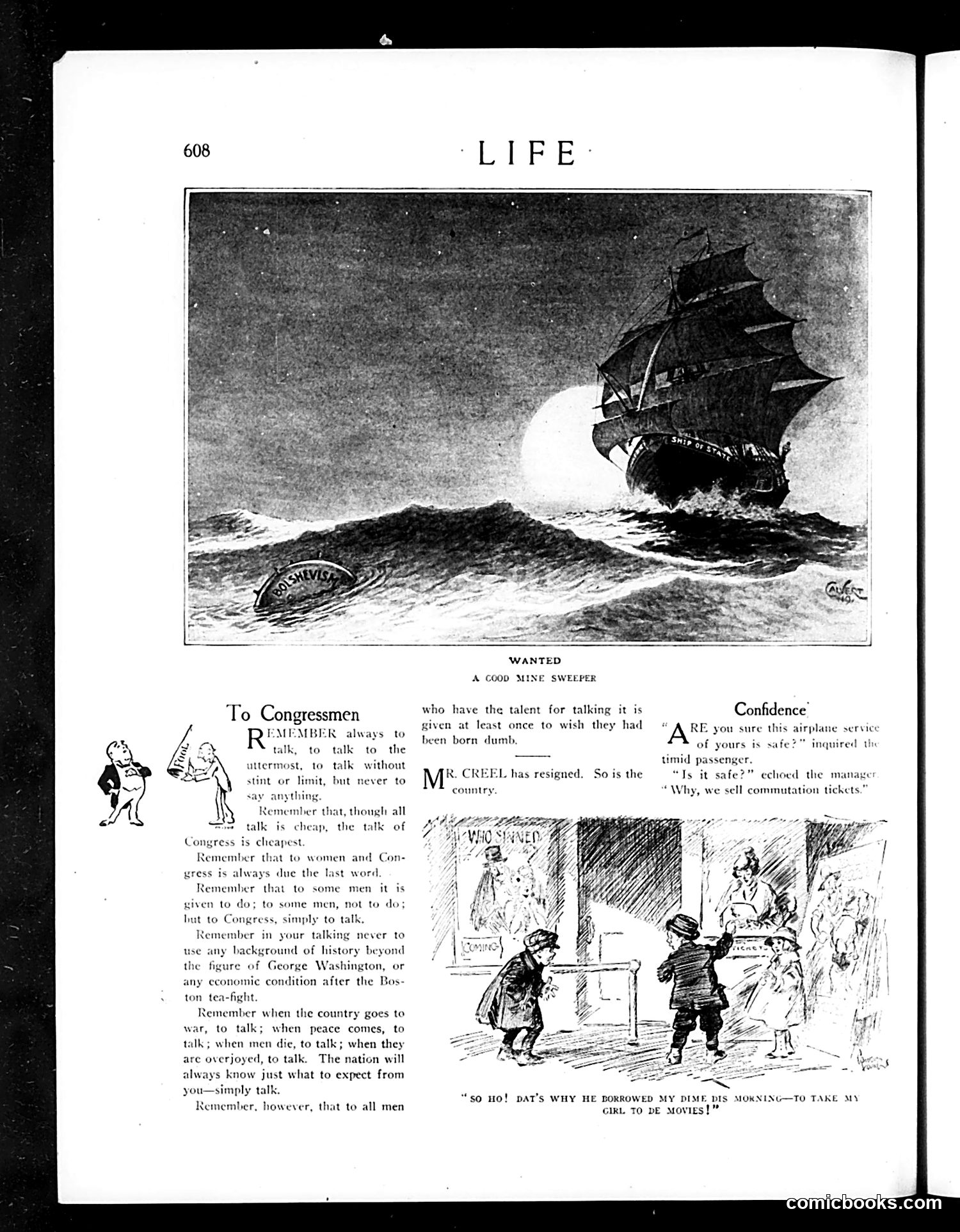
This page contains two satirical pieces mocking American institutions and wartime management: **"To Congressmen"** (left): A scathing critique of Congress as all talk and no action. The text sardonically advises legislators to speak endlessly while saying nothing meaningful, never referencing history or economics beyond Washington and the Boston Tea Party. The satire suggests Congress is useless during both war and peace—merely producing empty rhetoric while the nation suffers. **"Mr. Creel Has Resigned"**: References George Creel, who headed the Committee on Public Information during WWI. His resignation is treated as a loss equivalent to losing the country itself, suggesting he was vital to war efforts. **"Confidence"**: A brief joke about an airplane service selling "commutation tickets" (transit passes) to reassure safety-conscious passengers—absurdist humor about corporate double-speak. **The bottom cartoon** depicts a working-class character borrowing a dime to take his girlfriend to movies, likely commenting on wartime economic hardship or rationing affecting ordinary Americans.
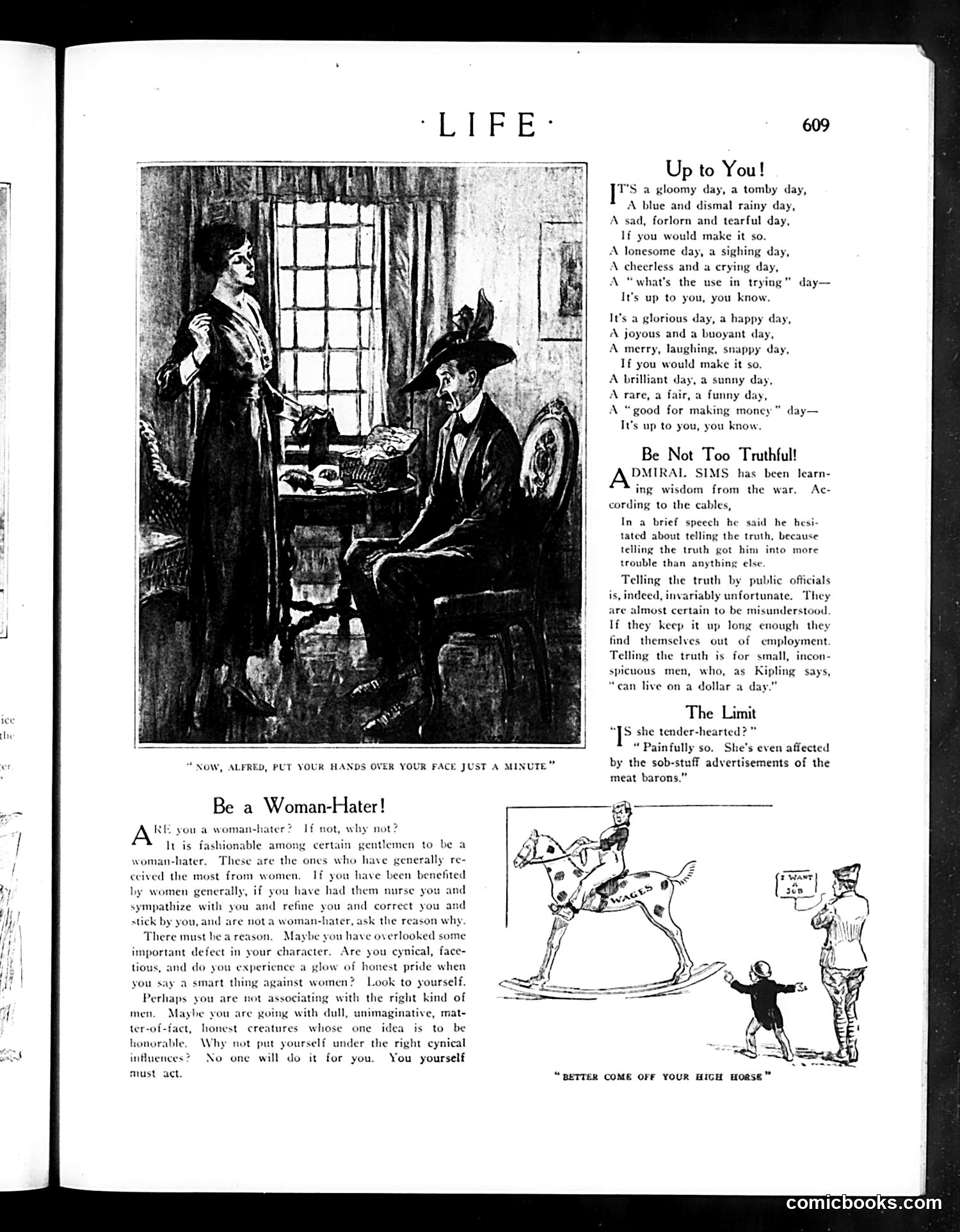
This page contains three satirical pieces typical of early 20th-century American humor: **"Be Not Too Truthful!"** references Admiral Sims (WWI-era naval officer), sarcastically praising his learned lesson that public officials who tell the truth face consequences and unemployment. The satire mocks government dishonesty as standard practice. **"Be a Woman-Hater!"** ironically urges men to adopt misogyny as fashionable, while exposing the hypocrisy: those who benefited most from women's support yet despise them should examine their character. It's a backhanded critique of ungrateful men. **"The Limit"** jokes about a woman so emotionally susceptible that she's moved to tears by meat industry advertisements—a jab at both sentimental advertising tactics and female sentimentality. The cartoon "Better Come Off Your High Horse" (bottom right) shows someone literally on a rocking horse being instructed to dismount, likely satirizing pretentiousness or unrealistic ambitions. Overall, the page blends political cynicism with gender commentary typical of 1920s Life magazine.
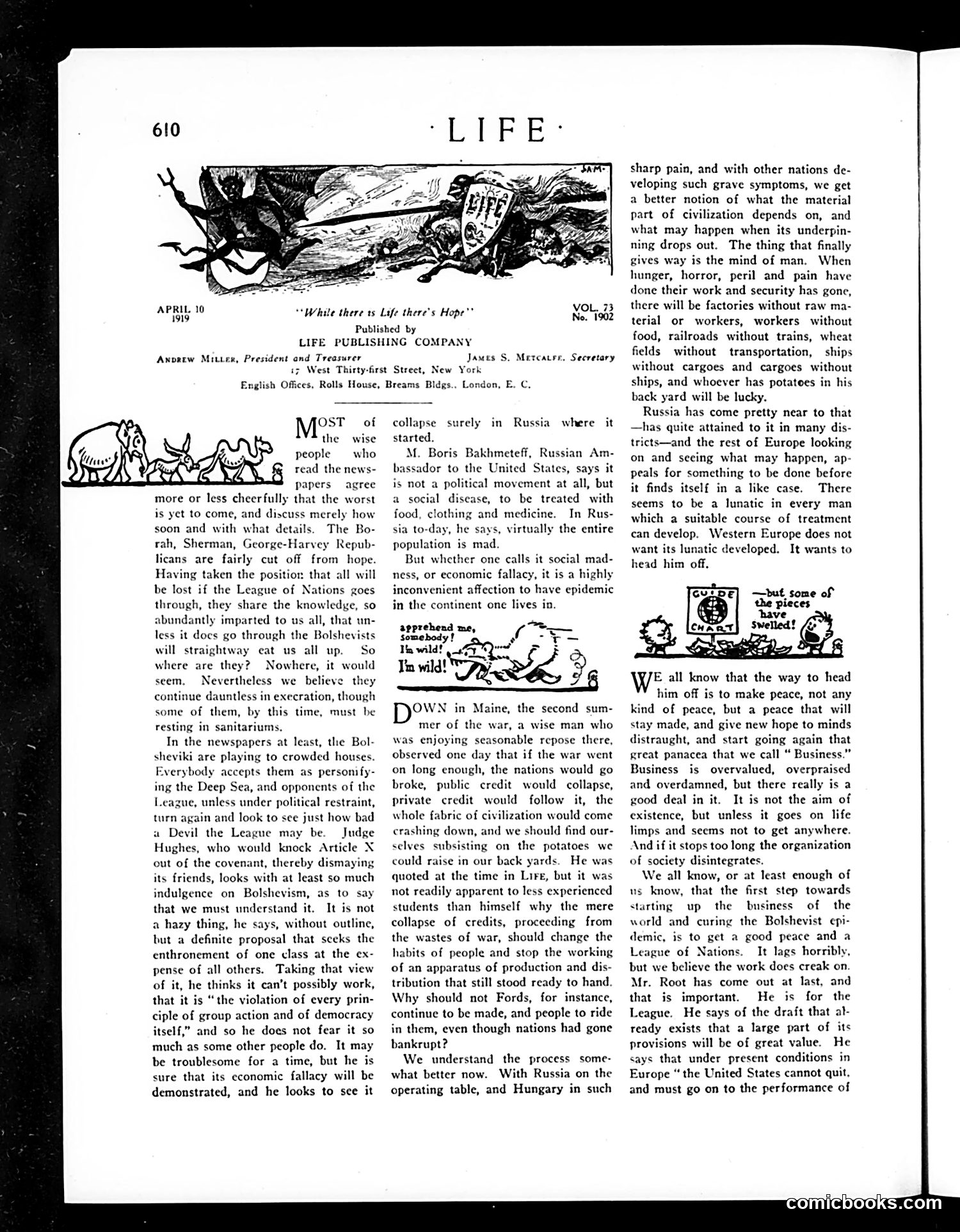
This April 1919 *Life* editorial discusses the collapse of European civilization following World War I, using Russia and Hungary as cautionary examples. The cartoons illustrate anxieties about Bolshevism spreading westward. The main figures referenced are: Judge Hughes (opposing the League of Nations), Senator Borah and others ("George-Harvey Republicans") who fear Bolshevism will triumph if the League fails, and M. Boris Bakhmeteff, the Russian Ambassador, who characterizes Bolshevism as a "social disease" requiring food and medicine rather than political action. The satire targets American pessimists who prophesy civilization's collapse. A small cartoon shows a panicked figure ("apprehend me, somebody! I'ts wild!") representing public hysteria about Bolshevism. The editorial's central argument: material civilization depends ultimately on psychological stability ("the mind of man"). Without sound institutions and morale, factories and farms cease functioning—not because machinery breaks, but because the will to work disappears. The piece suggests both Western dismissal of Bolshevism's threat and overblown panic are misguided.
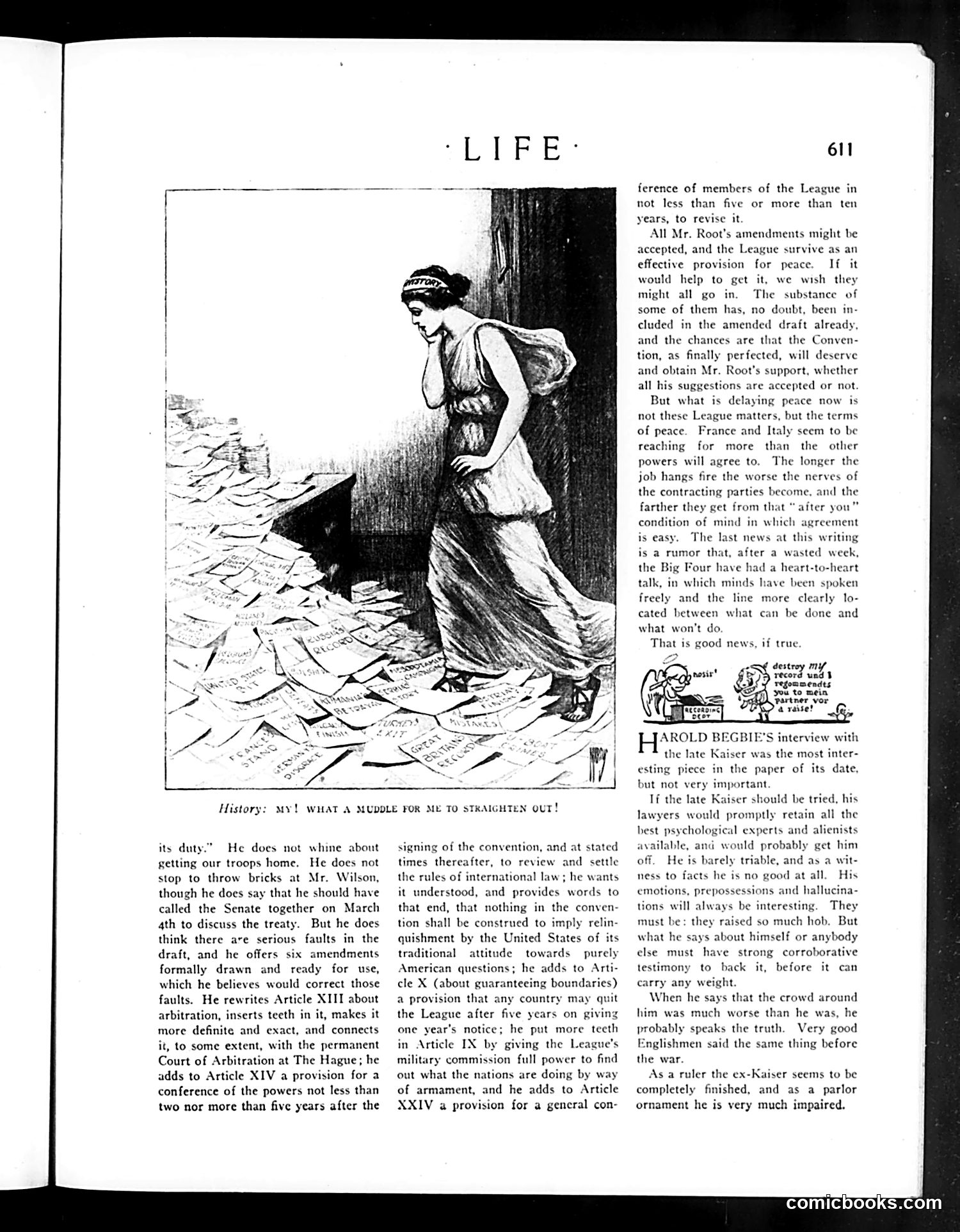
This political cartoon satirizes post-World War I peace negotiations, likely from 1919. The illustration depicts a woman (representing Lady Liberty or America) overwhelmed by scattered papers—symbolizing the complex Treaty of Versailles and League of Nations draft. The accompanying text discusses Elihu Root's proposed amendments to strengthen the League of Nations covenant, particularly regarding arbitration, military oversight, and nations' right to withdraw. The article criticizes delays in peace negotiations caused by French and Italian demands for harsher terms against Germany, warning that prolonged uncertainty worsens diplomatic relations. The cartoon's title jokes that the woman cannot "straighten out" the tangled mess of international agreements and competing national interests. This reflects contemporary American frustration with the protracted, complicated peace process and skepticism about whether an effective League structure could emerge from such confusion and competing demands.
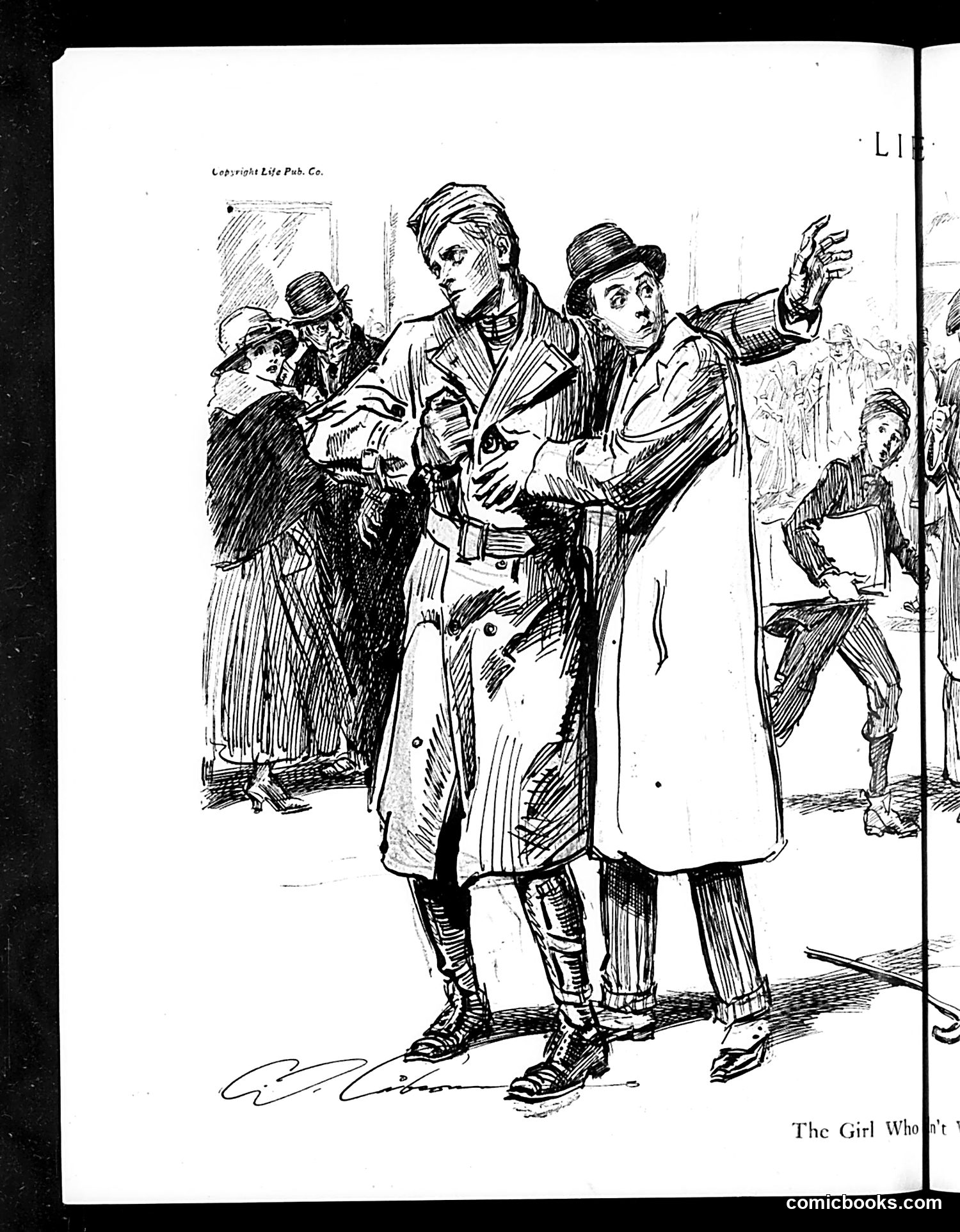
This appears to be an illustration from Life magazine's satirical section, showing a dramatic scene with a central male figure in military or formal dress uniform being confronted or accosted by several other characters—men in bowler hats and formal wear who seem to be gesturing urgently at him. The scene suggests either a comedic misunderstanding or a social/political confrontation. Without the complete title visible ("The Girl Whoff't" appears cut off) and lacking publication date or artist attribution, the specific satire remains unclear. The formal dress, military styling, and apparent dramatic tension suggest this may reference a contemporary scandal, social controversy, or romantic entanglement of the era, but I cannot identify the specific figures or events without additional context.
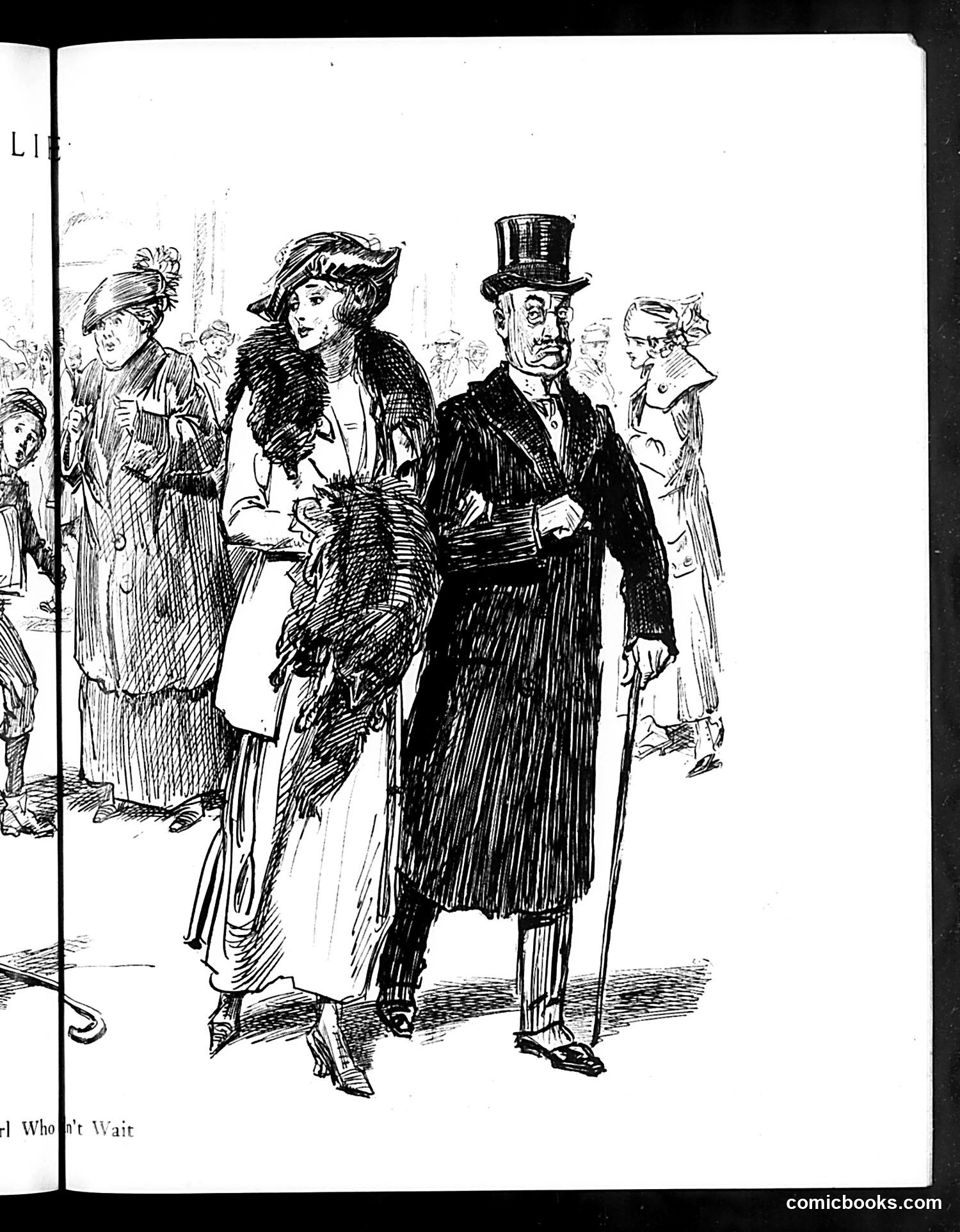
This is a satirical illustration titled "Who Won't Wait" depicting a social scene with well-dressed figures in what appears to be late 19th or early 20th-century attire. The central figures—a woman in elegant dress with fur trim and a gentleman in formal wear with a top hat—appear to be the focus of social scrutiny. The cartoon likely satirizes issues of social propriety, romance, or courtship conventions of the era. The title "Who Won't Wait" suggests commentary on impatience—possibly regarding romantic advances, social expectations, or someone's unwillingness to follow protocol. The background figures observing the central pair suggest public judgment or gossip. Without clearer text or additional context about which specific incident or social scandal this references, the exact target of satire remains unclear, though it appears to critique behavioral breaches of Victorian/Edwardian social norms.
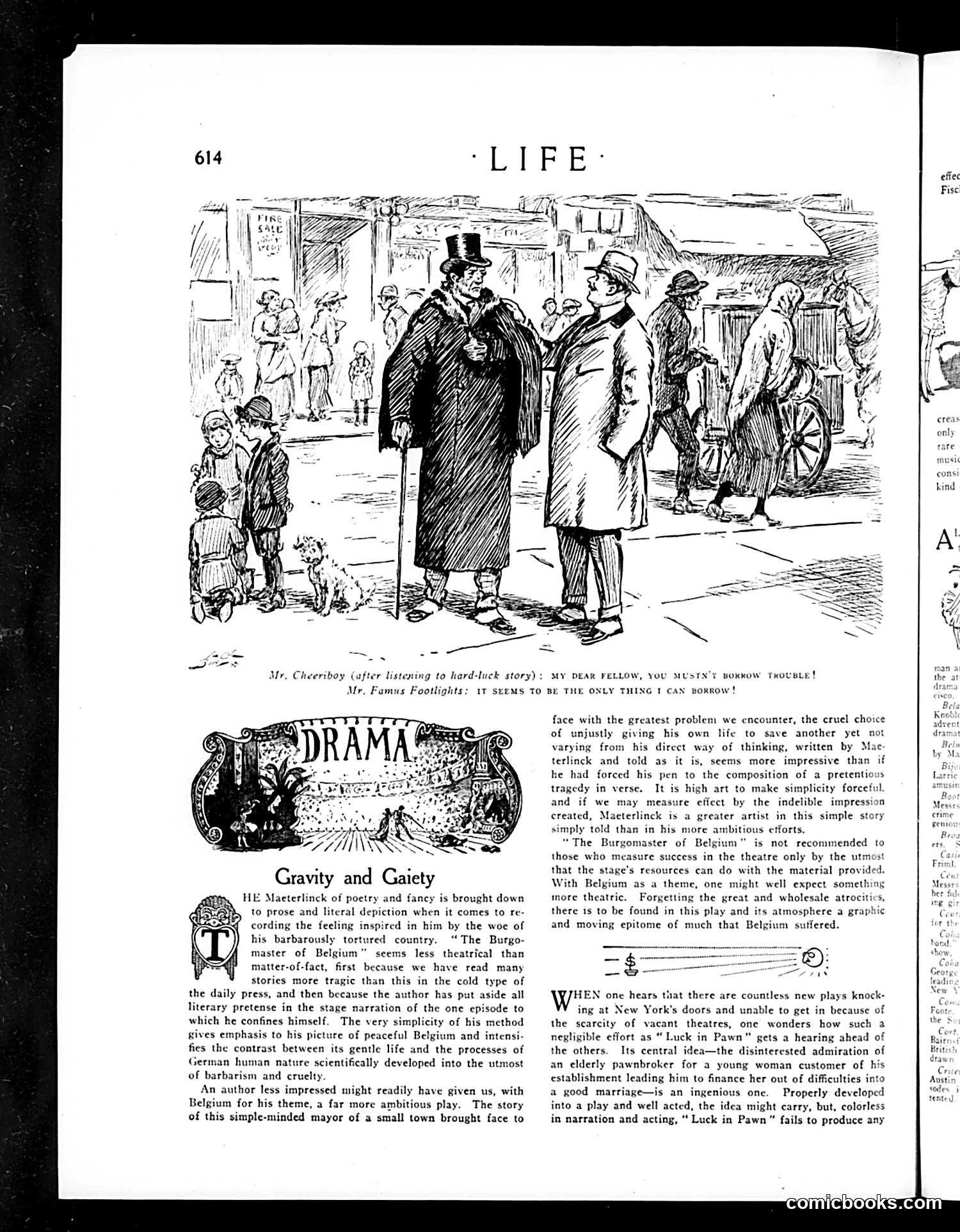
This page contains two theatrical reviews from Life magazine, likely from the early 20th century. The cartoon at top depicts a street scene where a man in a top hat (labeled "Mr. Famous Footlights," appearing to be an actor or theater personality) tells another gentleman that borrowing trouble is "the only thing I can borrow"—a joke about actors' financial struggles and perpetual debt. Below, two play reviews discuss: 1. **"The Burgomaster of Belgium"** — praised for its simplicity in depicting Belgian suffering during what appears to be WWI. The reviewer argues that Maeterlinck's restrained, matter-of-fact approach to the mayor's moral dilemma is more powerful than theatrical grandstanding. 2. **"Luck in Pawn"** — criticized as negligible and colorless, despite an ingenious premise about a pawnbroker financing a young woman's marriage. The reviewer finds it lacks compelling execution. Both reviews exemplify early 20th-century theater criticism's concern with artistic restraint versus spectacle.
This page is primarily a theater review section titled "Confidential Guide," cataloging New York Broadway productions with brief critical assessments. The content discusses recently opened plays, musicals, and farces—including titles like "Tumble In," "39 East," and "Friendly Enemies." The satirical element lies in the *style* of these capsule reviews: they use irreverent, gossipy language typical of *Life* magazine's theater criticism. For example, reviewers note when musical adaptations of comedies lose their humor by adding songs and "feminine attractiveness," or dismiss productions as "not impressive girl-and-music shows." The opening paragraphs critique how musicalizing comedies drains their comedy—suggesting that adding chorus girls and music substitutes spectacle for genuine wit. The scattered decorative illustrations show theatrical figures in period dress, reinforcing the entertainment focus. This represents early 20th-century theatrical criticism aimed at a sophisticated, theater-going audience.
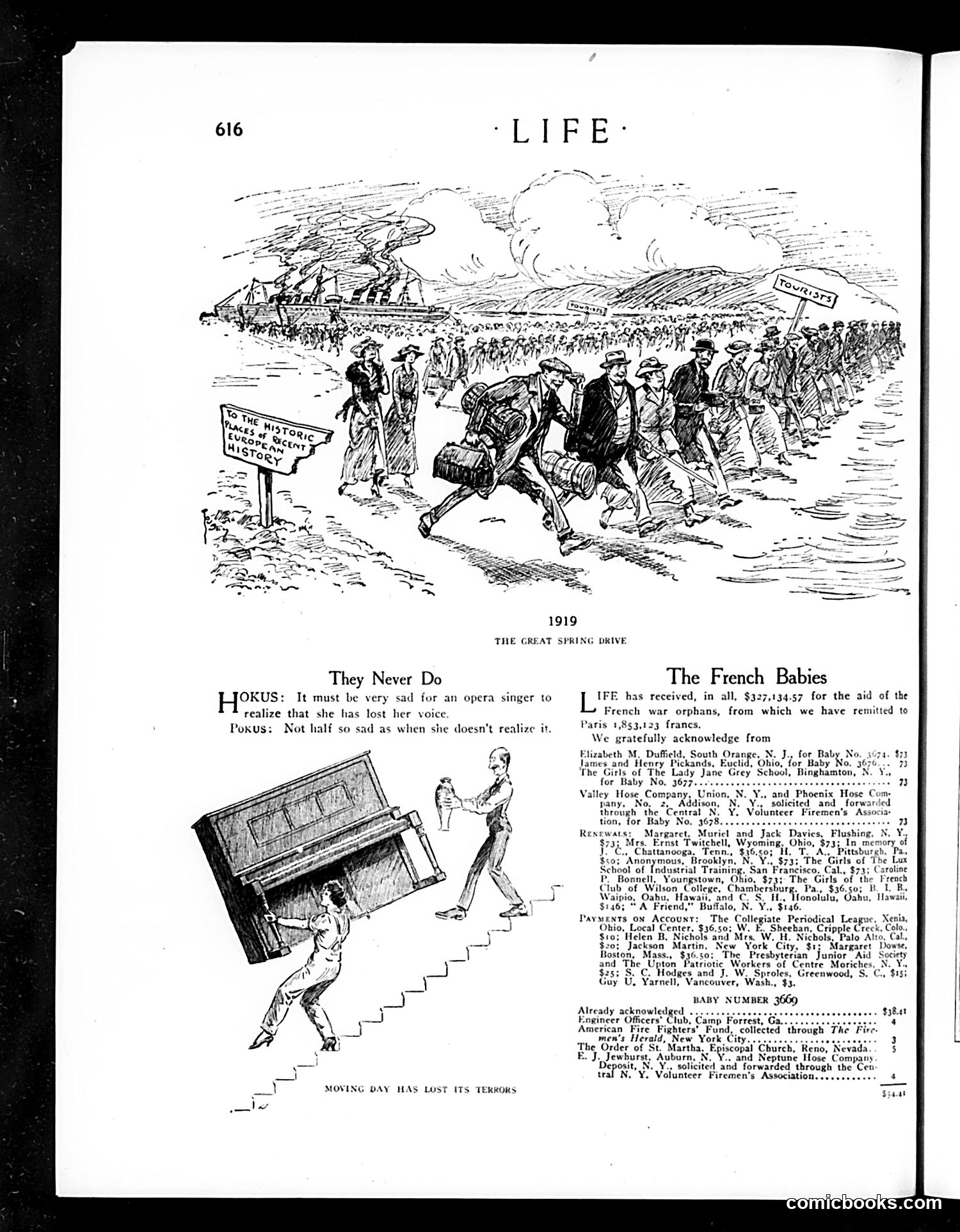
This 1919 *Life* magazine page contains two separate items: **"The Great Spring Drive"** (top cartoon): A satirical illustration of a massive charitable campaign to aid French war orphans following World War I. The cartoon shows crowds of people being mobilized like an army—literally carrying large supplies and marching toward ships. The visual pun compares organized fundraising to a military campaign, reflecting how American philanthropic efforts were conducted with mobilization-style intensity in the post-WWI period. **"They Never Do"** (left cartoon): A joke about opera singers who lose their vocal abilities. The humor relies on the irony that the tragedy isn't realizing you've lost your voice—it's *not* realizing it, implying such singers lack self-awareness. The right column extensively lists donors to the French Baby Fund, documenting *Life*'s charitable campaign. This appears to be advertising/editorial content celebrating reader contributions rather than satirical commentary.
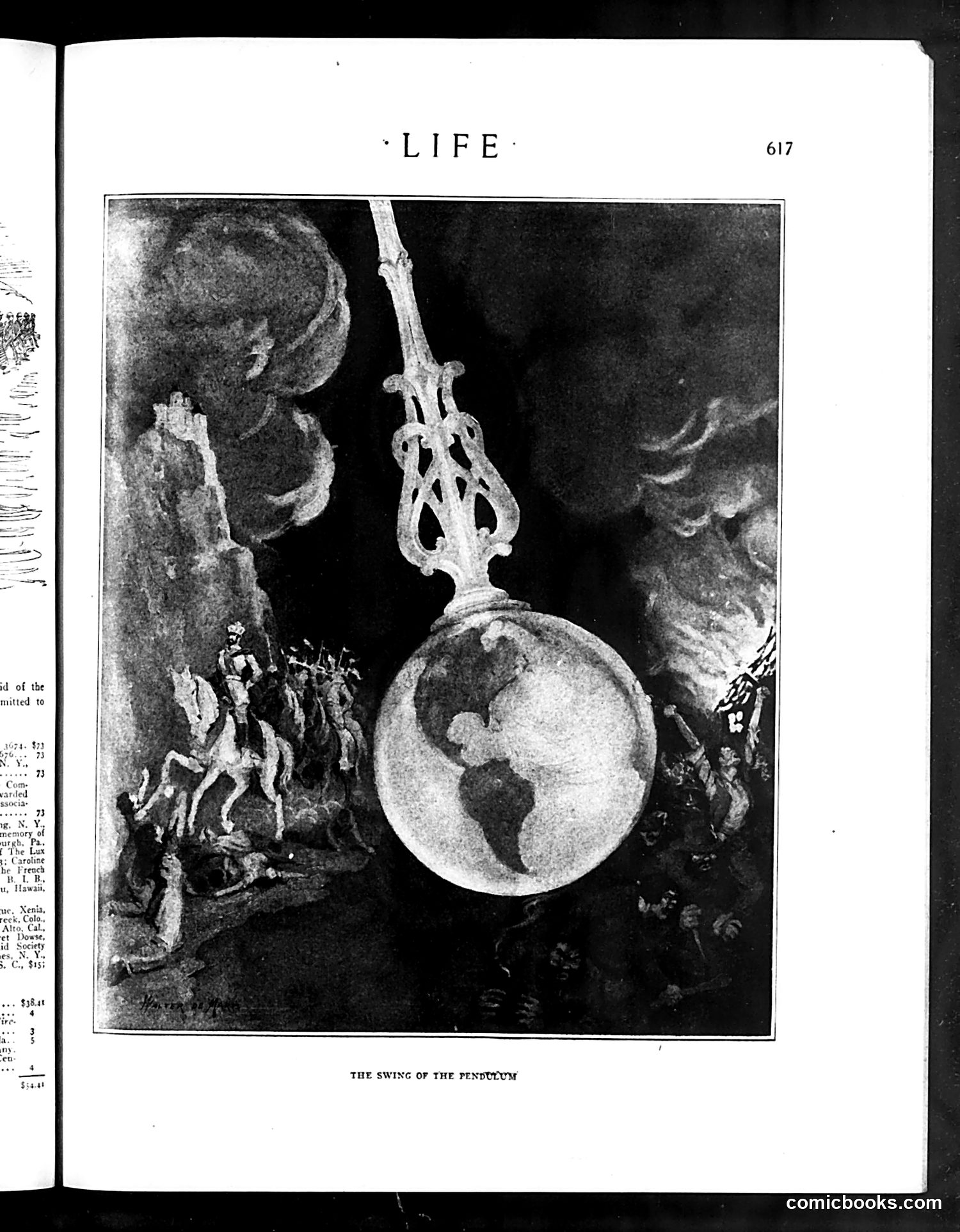
This illustration depicts a large globe suspended by an ornate chain, flanked by two sculptural busts. The image's title suggests a commentary on shifting political or social forces. The "pendulum" metaphor refers to cyclical swings in power, policy, or public opinion. The globe at the center symbolizes world affairs or global impact. The flanking busts likely represent opposing political figures or ideologies whose influence alternates dominance—hence the pendulum's swing between them. Without clearer identification of the specific busts or the publication date, the exact political reference remains unclear. However, the imagery suggests early-to-mid 20th-century commentary on competing political movements or international relations. The elaborate artistic style typical of *Life* magazine's satirical work emphasizes the gravity of these shifting forces.
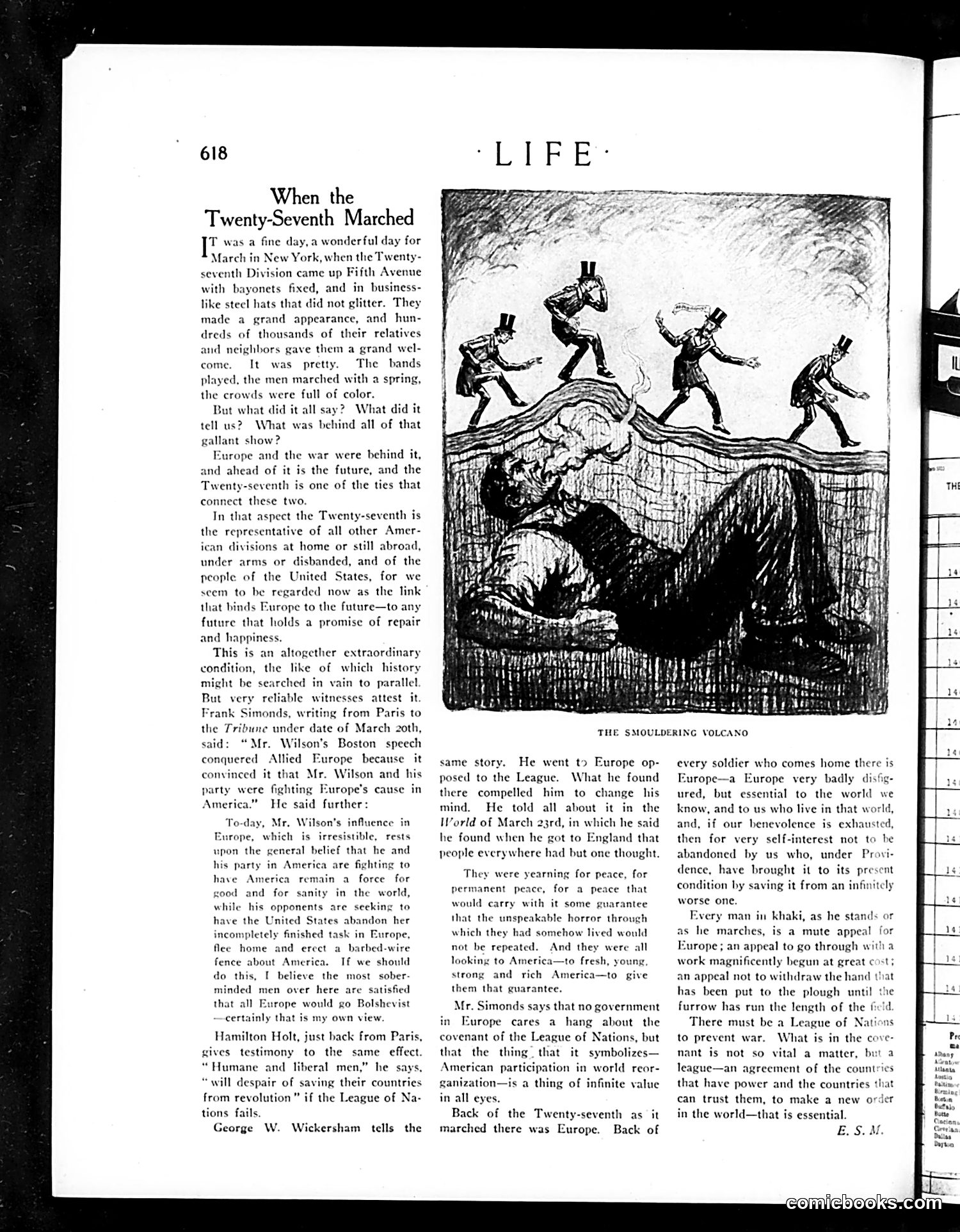
This 1919 article celebrates the Twenty-Seventh Division's homecoming parade up Fifth Avenue in New York City. The accompanying cartoon—titled "The Smoldering Volcano"—depicts soldiers atop a volcanic mountain, suggesting Europe's precarious post-WWI instability. The satire critiques American isolationism. The text argues that American soldiers represent a vital "link" between war-torn Europe and the world's future. Through quotes from Frank Simonds, Hamilton Holt, and George Wickersham (real political figures), the author contends that Europe desperately needs continued American engagement—specifically through President Wilson's League of Nations—to prevent Bolshevik revolution and chaos. The cartoon's volcanic imagery warns that Europe remains dangerously unstable. The soldiers marching represent America's moral obligation to complete the work of reconstruction rather than retreat into isolationism. This reflects the 1919 debate over U.S. participation in the League of Nations, which ultimately failed in the Senate.
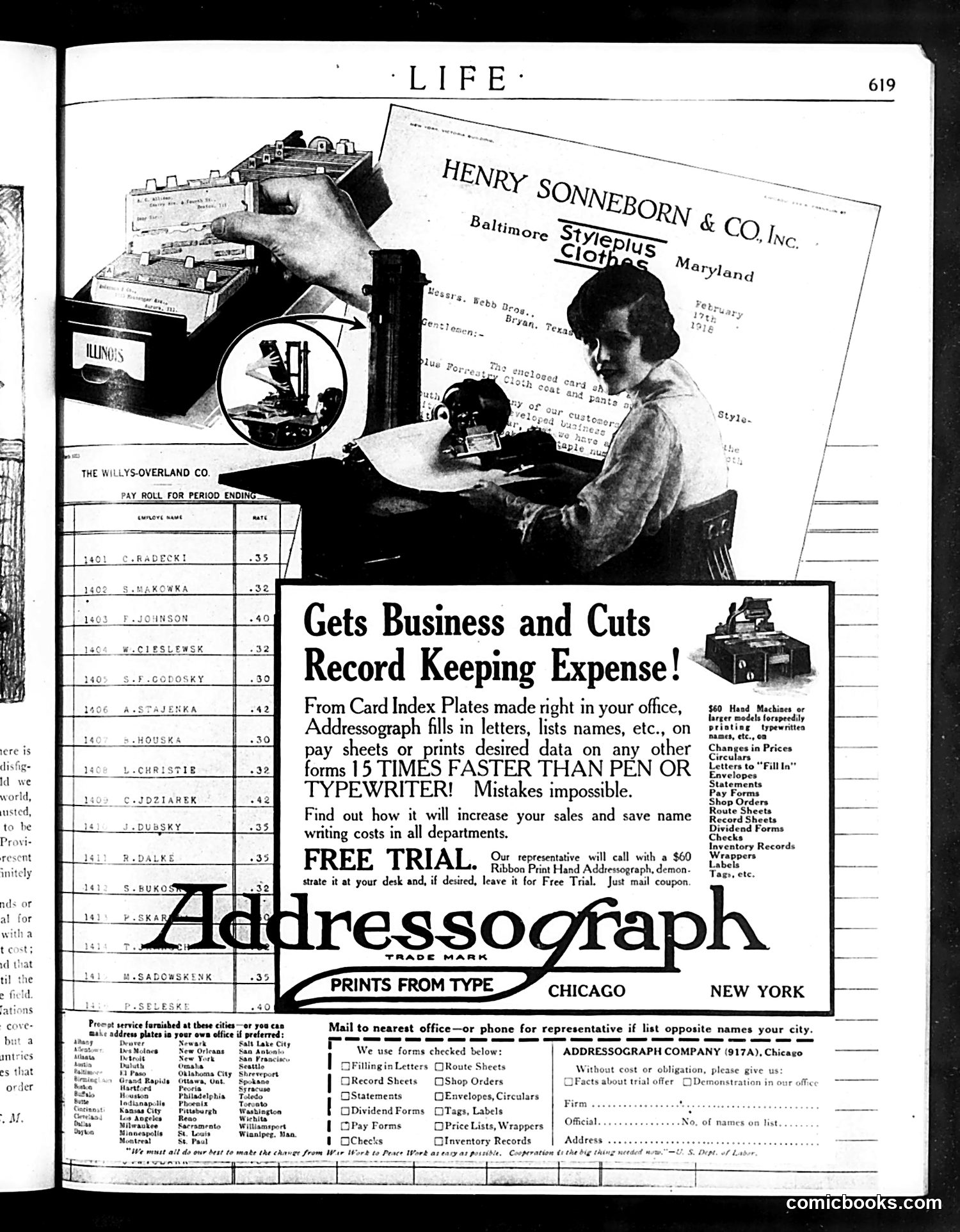
This page is primarily a **business advertisement**, not political satire. It promotes the Addressograph, a mechanical addressing machine for offices. The image shows a businesswoman using the device to fill in correspondence and payroll forms. The advertisement emphasizes efficiency: the machine prints 15 times faster than pen or typewriter while eliminating errors. The contextual detail is the **payroll sheet from Willys-Overland Co.** (an automobile manufacturer), suggesting this is pitched at post-WWI businesses needing to modernize clerical work. The small text mentions converting "from War Work to Peace Work," placing this in the 1918-1920 transition period. For modern readers: this reflects an era when office automation—mechanical rather than electronic—was revolutionary. The advertisement targets managers concerned with labor costs and efficiency, positioning the Addressograph as a modern business solution. There is no satire present; it's straightforward commercial promotion.
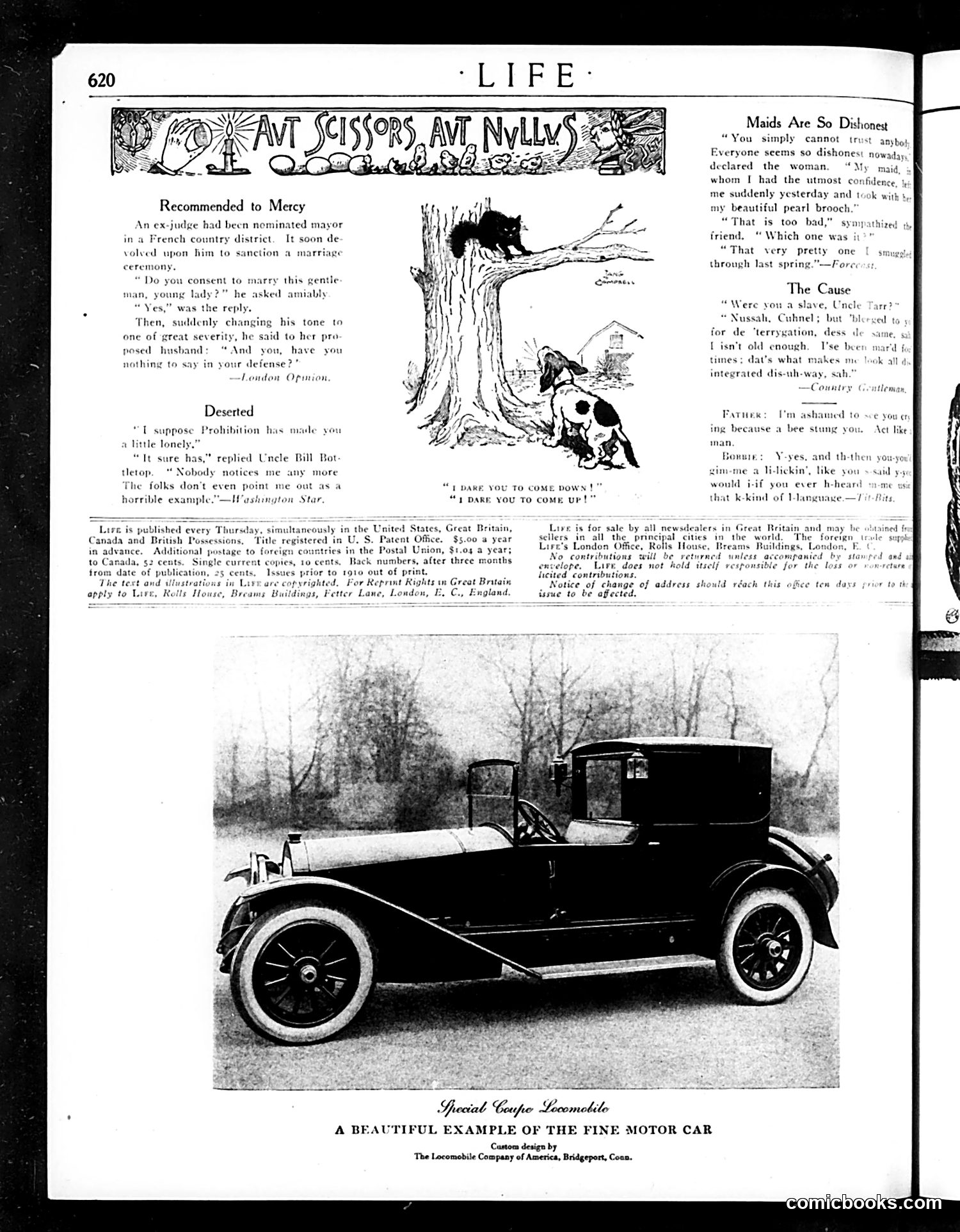
This page contains three unrelated humorous anecdotes typical of Life's satirical content, plus an advertisement for a Locomobile automobile. **The cartoons/text jokes:** 1. **"Recommended to Mercy"**: A former judge, now officiating his first marriage ceremony, addresses the groom with mock-courtroom severity, asking "have you nothing to say in your defense?" — satirizing bureaucratic pomposity and the absurdity of applying legal formality to weddings. 2. **"Deserted"**: Uncle Bill Bottletop laments that Prohibition has made him "lonely" because "nobody notices me anymore" — he's no longer pointed out as "a horrible example." This satirizes how Prohibition removed social disapproval of heavy drinkers since drinking itself was now legally forbidden. 3. **"Maids Are So Dishonest"** and **"The Cause"**: Brief domestic comedy sketches about servants and racial dialect humor typical of the era. The page also features an automobile advertisement, which was common in Life magazine's layout.
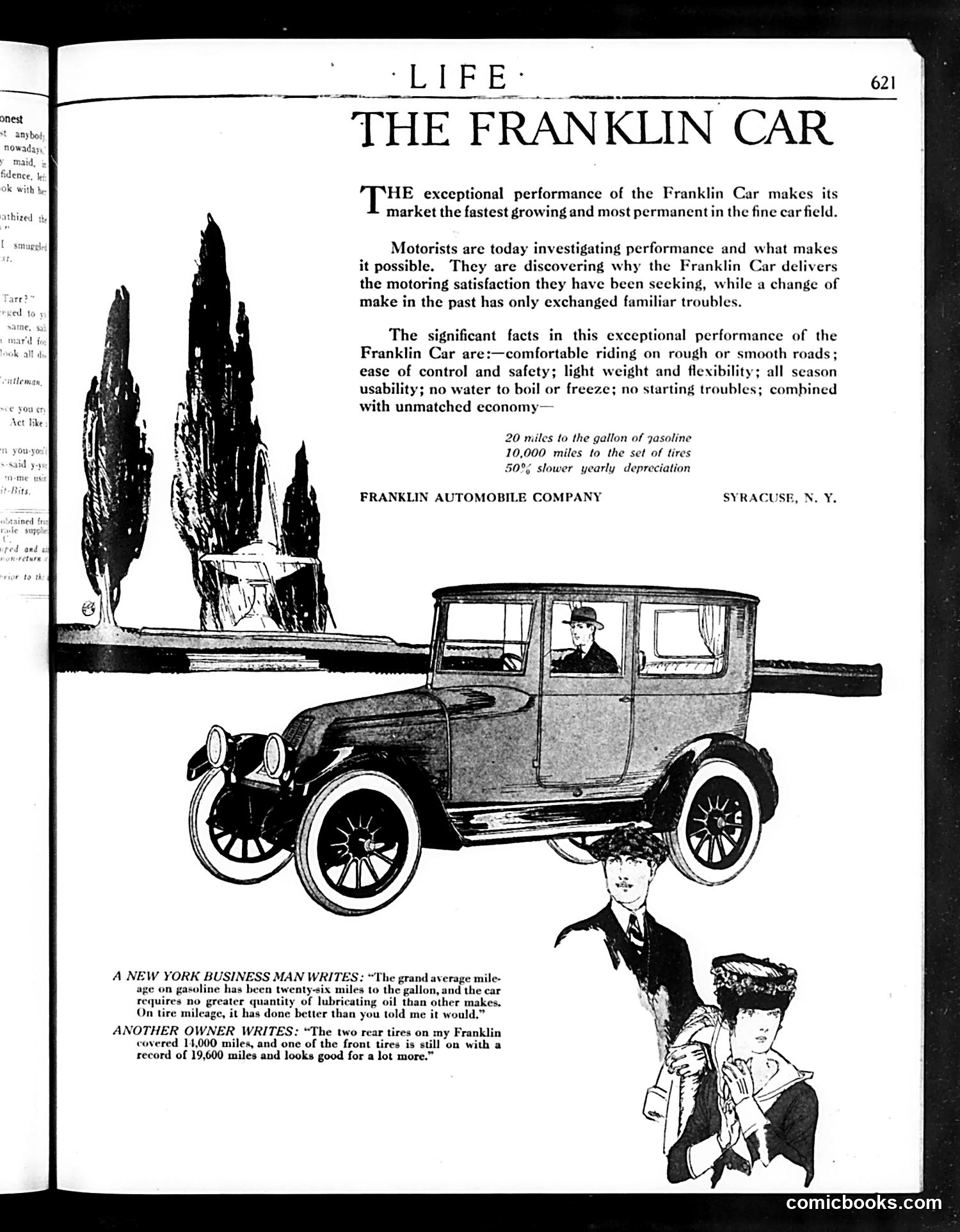
This is a **straightforward automobile advertisement**, not satire or political commentary. Published in *Life* magazine (page 621), it promotes the Franklin Automobile Company of Syracuse, New York. The page features a detailed illustration of the Franklin car with two testimonial quotes from satisfied owners—a New York businessman and another owner—praising its fuel economy (26 miles per gallon), tire durability, and low maintenance costs. The ad emphasizes the car's key selling points: no water-cooling system (avoiding freeze/boil issues), light weight, safety, and exceptional longevity. The decorative illustration at top left (tall cypress-like trees) appears purely ornamental, setting a scenic context for the vehicle. This represents typical early 20th-century automotive advertising strategy: leveraging real customer testimonials to establish credibility and differentiate the product in a competitive market.
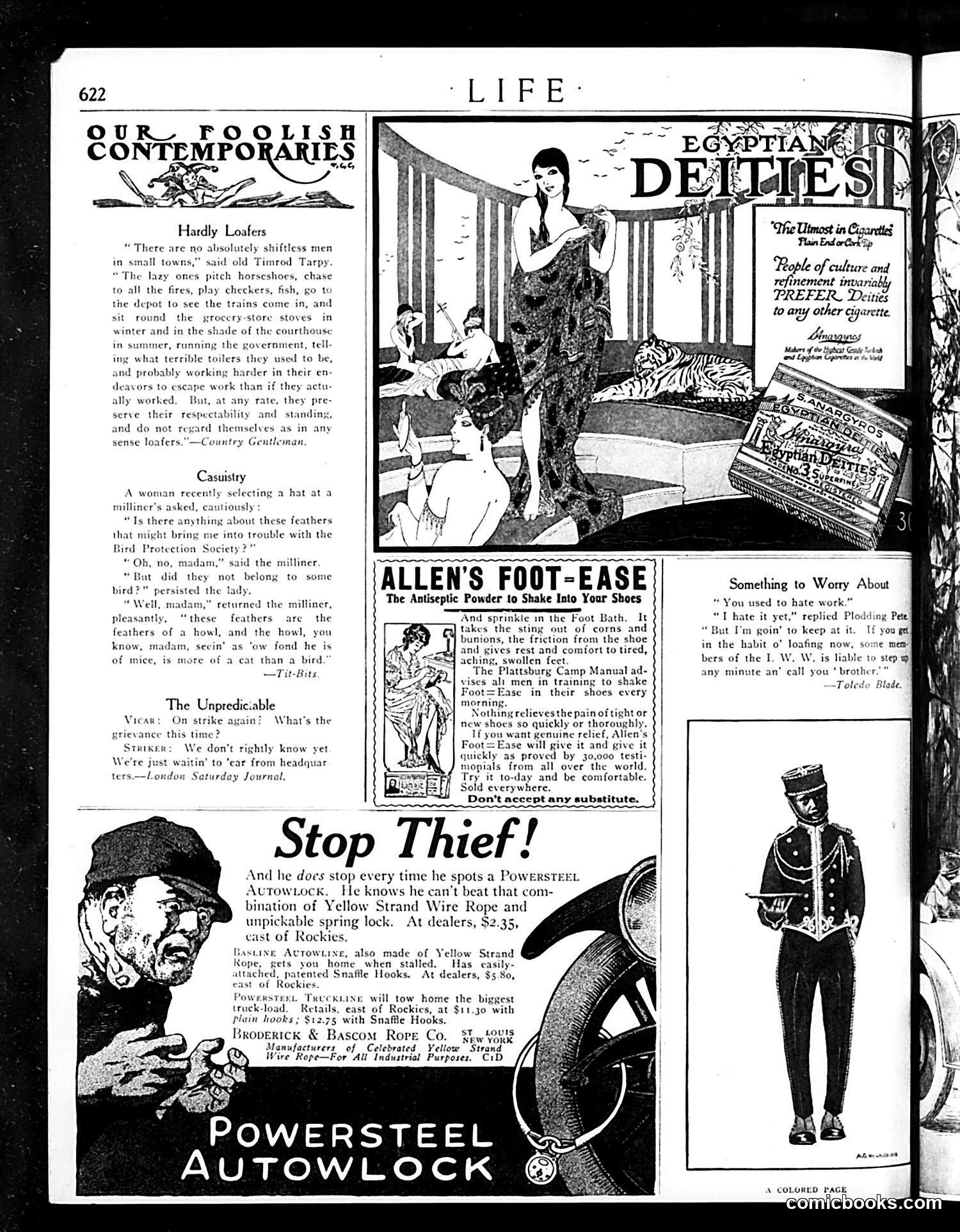
This page from *Life* magazine comprises satirical commentary and period advertising. **"Our Foolish Contemporaries"** section contains three brief satirical pieces mocking social pretension and logical inconsistency: 1. **"Hardly Loafers"**: Quotes a character defending small-town idlers as "respectable," noting they work harder avoiding work than if they simply worked—satire on rationalization of laziness. 2. **"Casuistry"**: A woman asks a milliner if feathers might trouble the Bird Protection Society; the milliner claims they're from a bird "as fond of mice...as a bird"—absurd circular logic mocking evasive reasoning. 3. **"The Unpredictable"**: A vicar asks a striking worker why they're striking; the worker admits ignorance, awaiting headquarters' orders—satire on labor movement's perceived lack of individual agency. **Advertisements** occupy the remainder: Egyptian Deities cigarettes, Allen's Foot-Ease powder, and Powersteel Autowlock (vehicle security device). The "Stop Thief!" ad features a caricatured criminal face, typical period advertising imagery. This is primarily a humor and advertising page from the early 20th century.
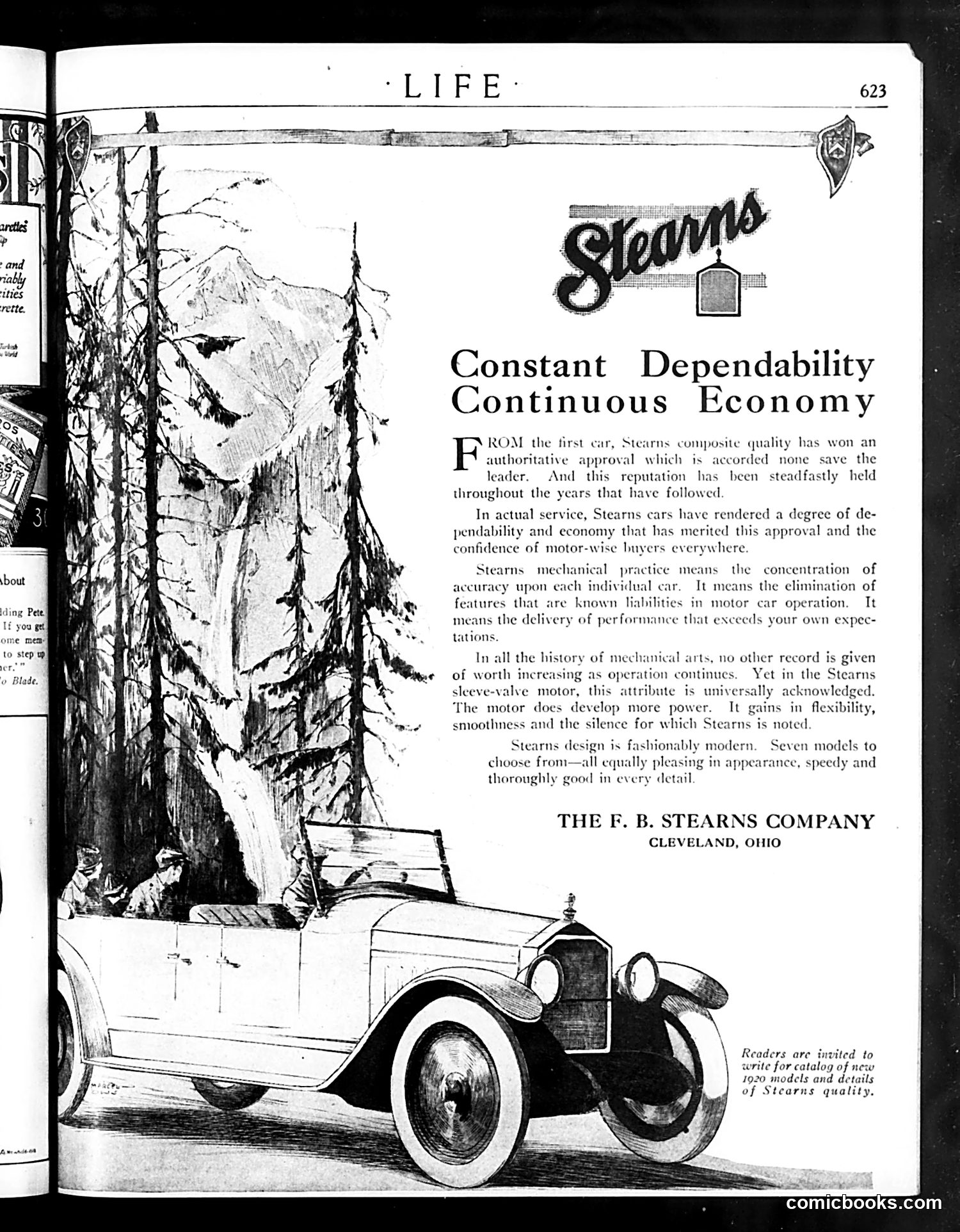
This is not a cartoon or satire—it's a **full-page automobile advertisement** for the F. B. Stearns Company of Cleveland, Ohio. The page promotes Stearns automobiles by emphasizing their reliability and economy. The illustration shows a stylized early-1920s touring car positioned against a dramatic mountain landscape with hikers, suggesting adventure and durability. The ad's claims focus on the car's "sleeve-valve motor," which allegedly improves with use, gains flexibility, and runs smoothly and quietly. The text promises "composite quality" and "constant dependability" while offering seven model choices. This represents typical early automotive advertising rhetoric—emphasizing mechanical superiority and trustworthiness to appeal to affluent buyers considering which brand to purchase. The mountainous setting symbolizes the car's capability for rugged travel.
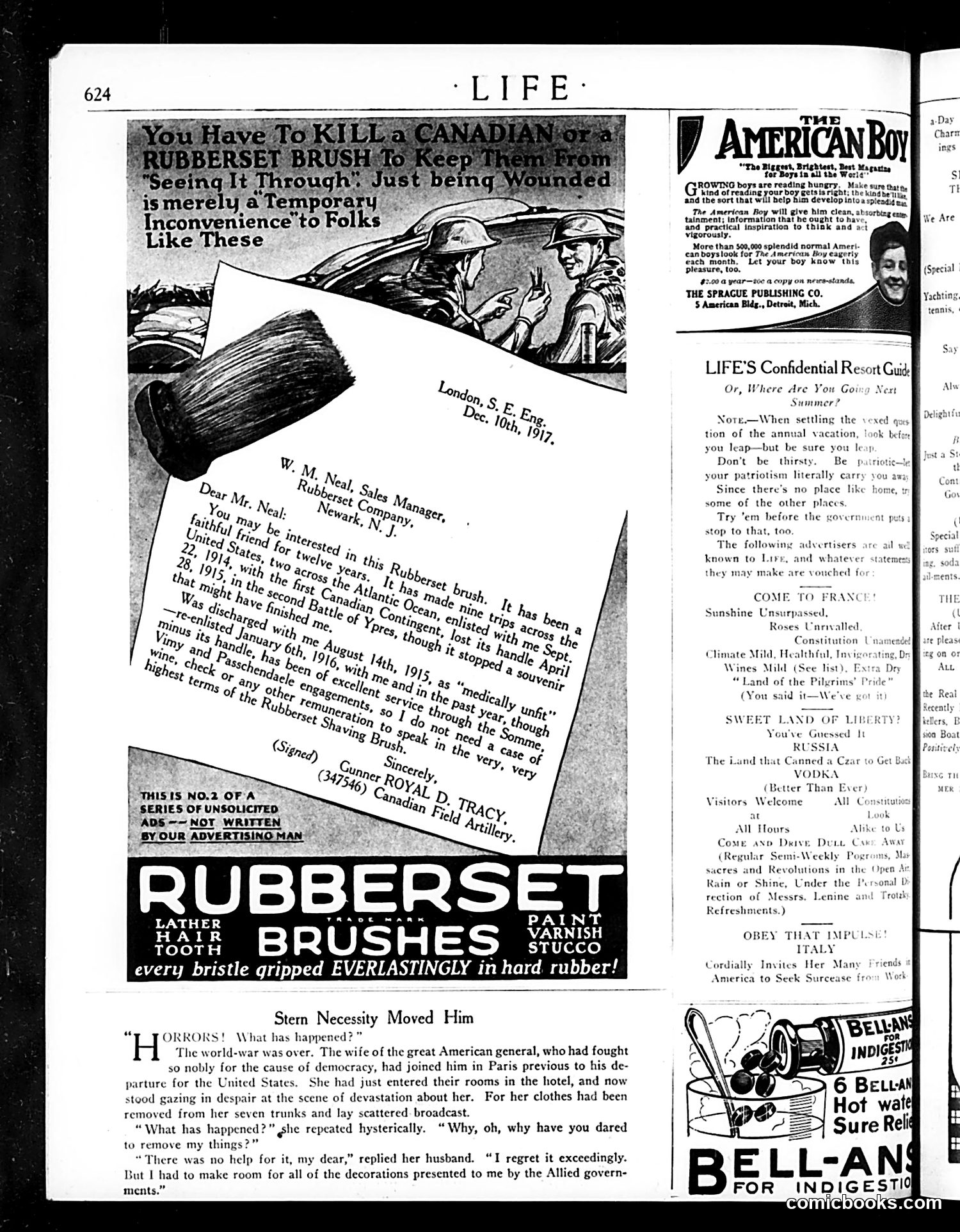
**Main Cartoon—"Rubberset Brushes":** This advertisement disguises itself as a unsolicited testimonial letter from a Canadian soldier (Royal D. Tracy) praising rubber brushes for trench warfare. The satire plays on post-WWI marketing: companies exploited soldier credibility to sell mundane products. The letter's dramatic framing—wounded soldiers, combat conditions—inflates brush utility absurdly. A footer notes these are "NOT WRITTEN BY OUR ADVERTISING MAN," which itself is satirical commentary on fake endorsements. **"Stern Necessity Moved Him" Story:** This brief comic sketch satirizes post-war vanity and trophy-collecting. A general's wife discovers her clothes removed from hotel trunks. His explanation: he needed space for military decorations from Allied governments. The humor mocks how war heroes prioritized medals and glory over domestic practicality—a gentle jab at masculine pomposity and the exaggerated self-importance of victorious officers returning home. **Context:** This reflects 1920s American attitudes toward WWI veterans and commercialized patriotism.
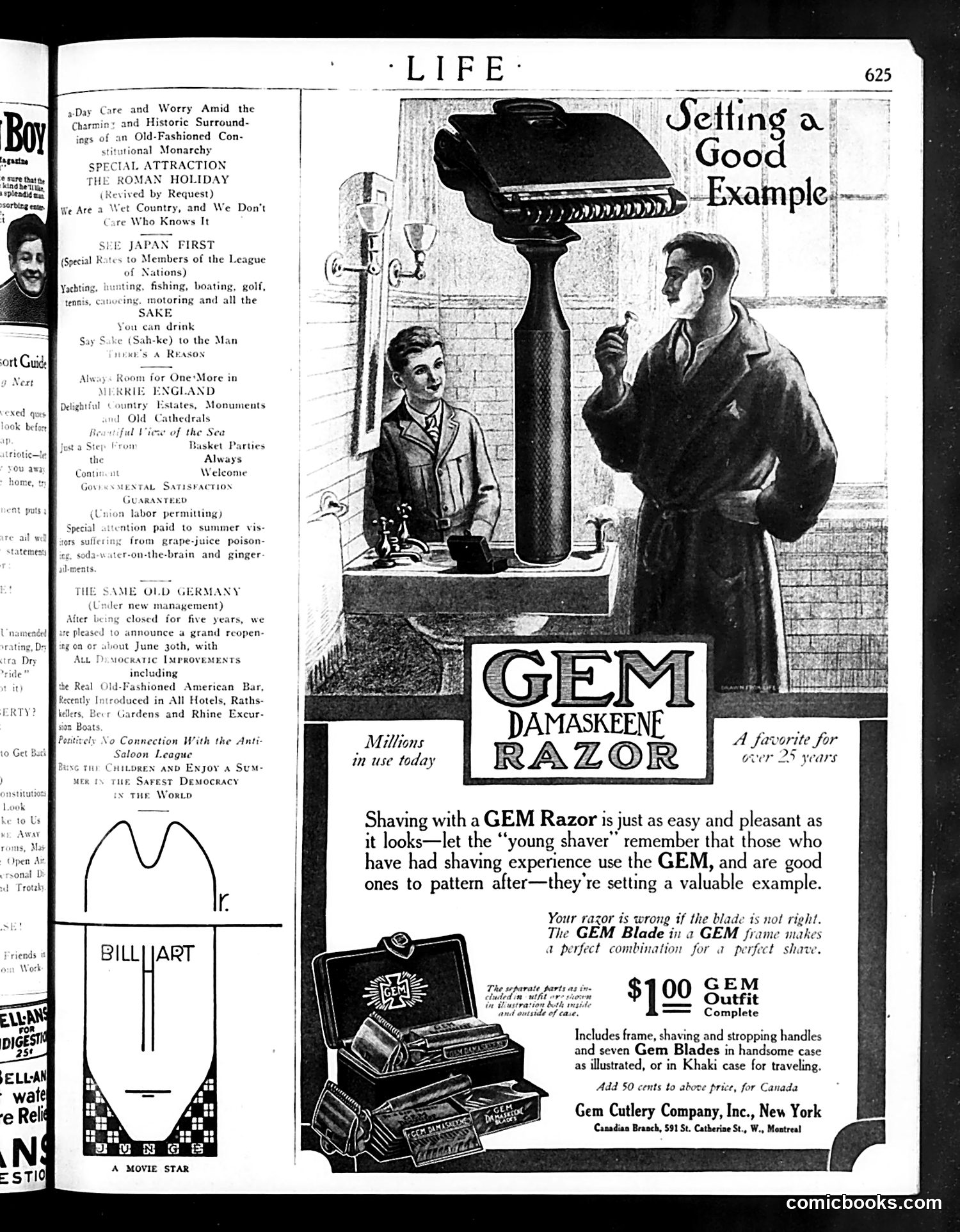
This page is primarily **advertising for Gem Razors**, not political satire. The main illustration shows two men—an older, experienced shaver instructing a younger one—with the headline "Setting a Good Example." The advertisement's message is straightforward: buy Gem Razors because experienced users trust them, and you should follow their example. The left column contains brief humorous travel/leisure notices (appearing to mock tourism slogans), including a reference to "The Same Old Germany (Under new management)"—likely a post-WWI jab at Germany's Weimar Republic reopening for tourism. However, the page's dominant content is commercial, not satirical. The small cartoon at bottom left labeled "A Movie Star" appears unrelated to the main messaging.
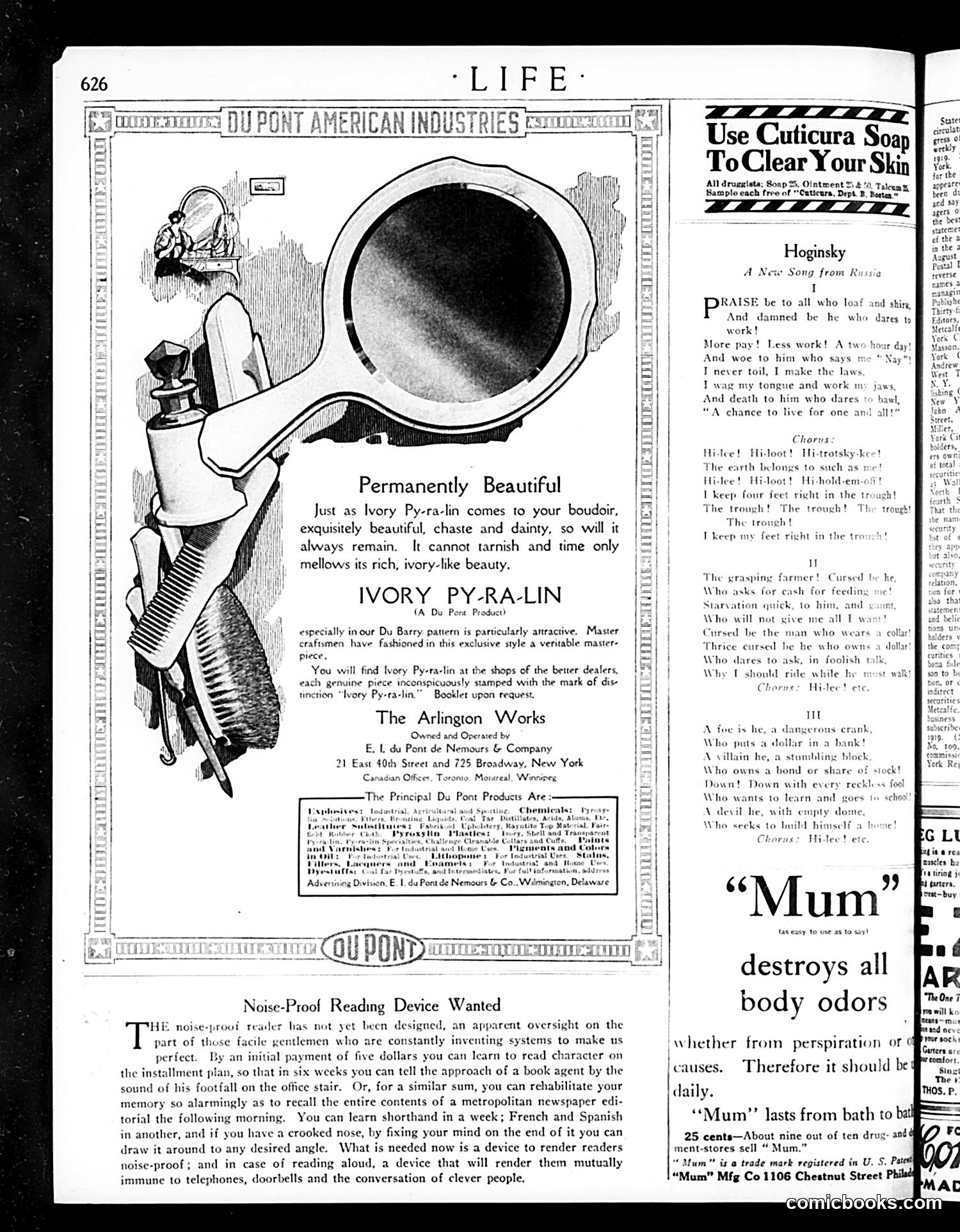
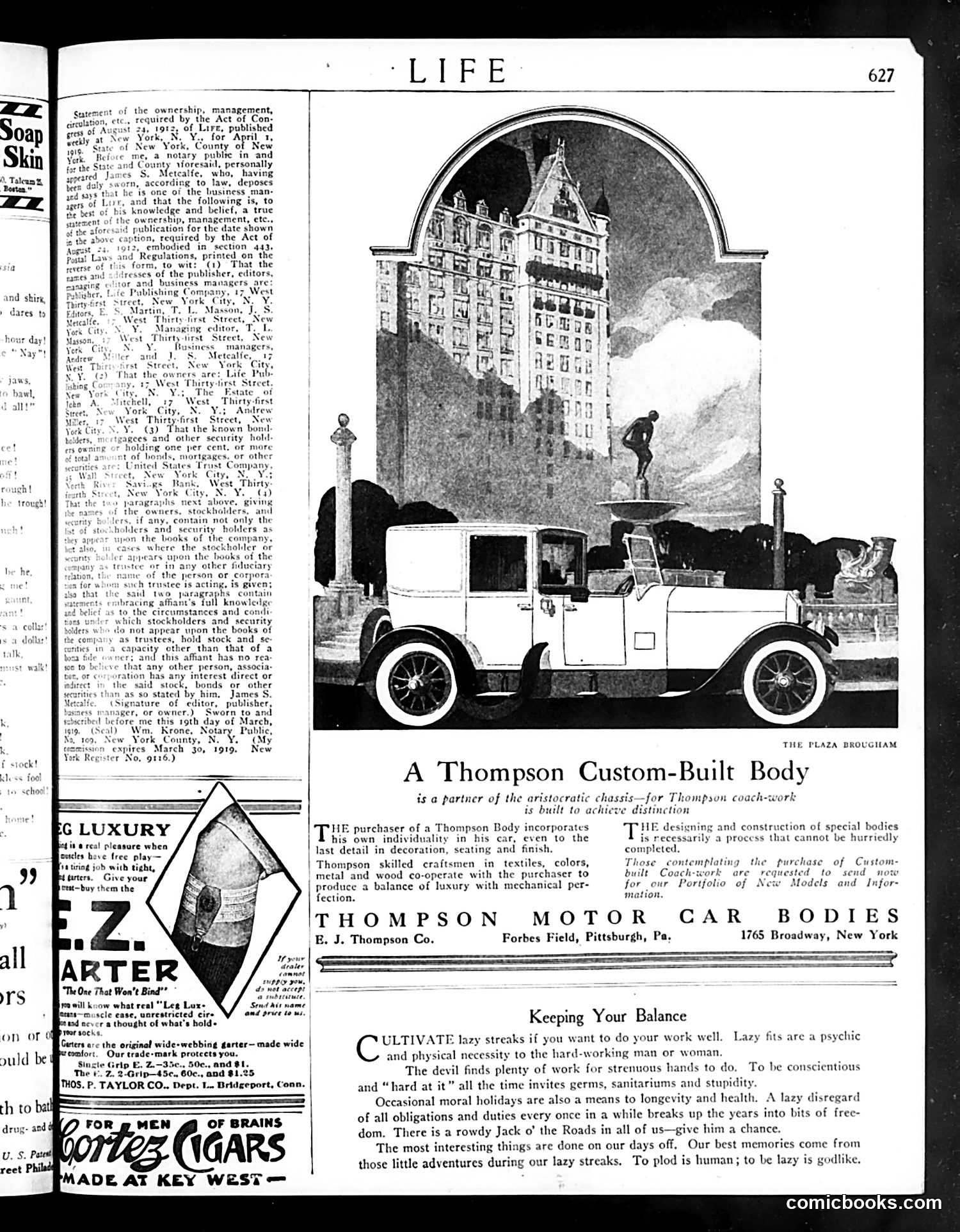
This page is primarily **advertising and editorial content**, not political satire. The main feature is a **Thompson Motor Car Bodies advertisement** showing a luxury automobile with an ornate building in the background. The ad emphasizes custom craftsmanship and aristocratic design—appealing to wealthy buyers who wanted personalized, high-end vehicles. Below that is an essay titled **"Keeping Your Balance"** that argues for the value of laziness and rest. It's a lifestyle piece suggesting that taking breaks, "lazy streaks," and moral holidays are necessary for health and creativity. This reflects early 20th-century emerging attitudes about work-life balance and mental health—contrasting with older Protestant work-ethic values. The page also contains **statutory ownership/publication notices** for *Life* magazine (required by law), identifying the publisher and editors. There are **additional advertisements** for luxury items like garters and cigars. No clear political cartoon or satire is present on this page.
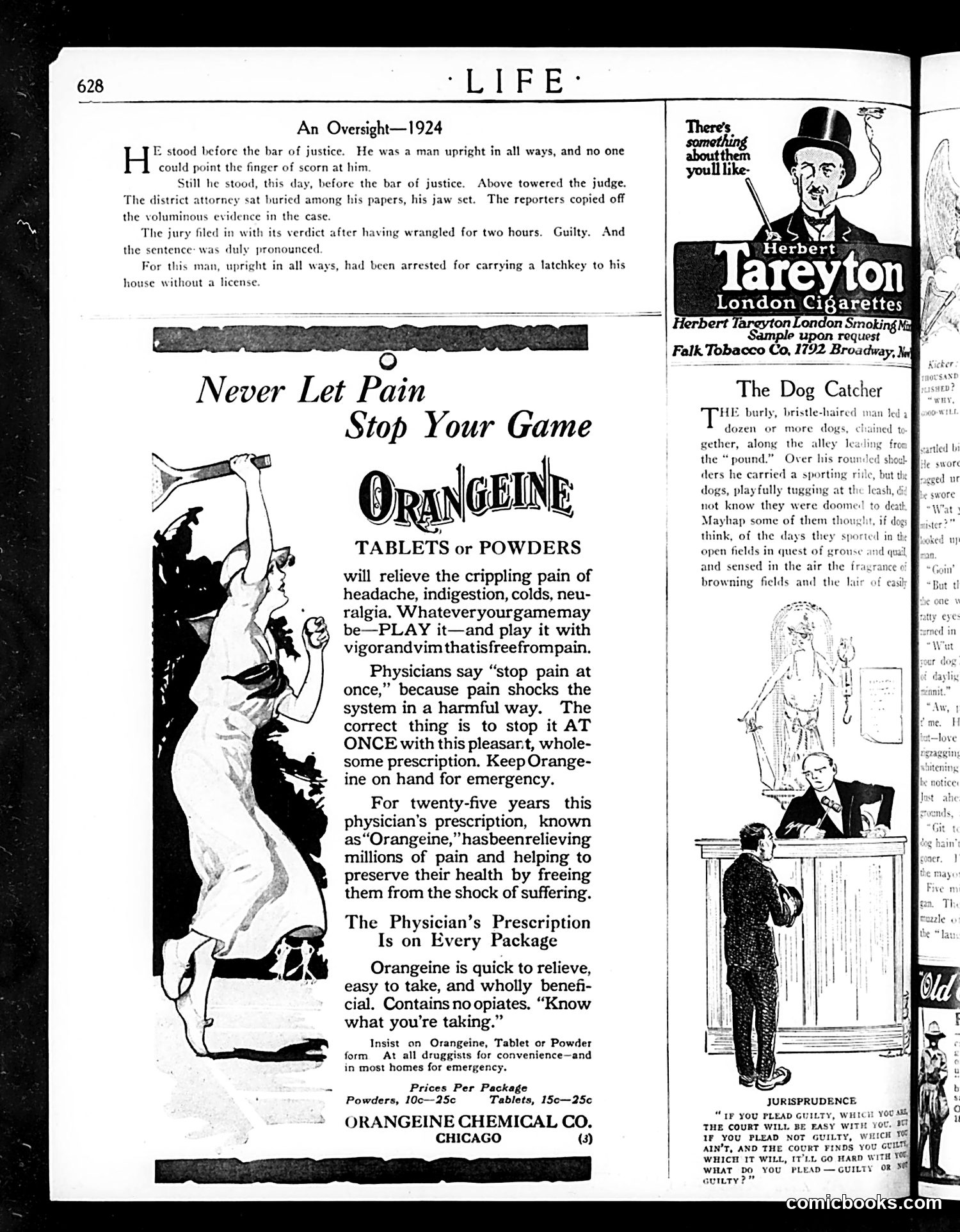
**"An Oversight" Cartoon:** This satirical piece mocks absurd legal enforcement. It depicts a man of unimpeachable character convicted and sentenced merely for carrying a latchkey to his own house without a license. The joke critiques bureaucratic overreach and nonsensical regulation—the "oversight" being that such petty licensing requirements exist at all, or that they're enforced against obviously law-abiding citizens. It's social satire targeting excessive government regulation during the 1920s. **"Jurisprudence" Cartoon:** The lower panel depicts a judge essentially telling a defendant the outcome is predetermined: plead guilty or not guilty, either way the court will find guilt and punish harshly. It satirizes judicial bias and the futility of legal defense when the system is rigged against the accused. **Other Content:** The page also contains period advertisements (Orangeine pain tablets, Herbert Tareyton cigarettes, and a humorous piece about a dog catcher), typical of Life's mixed editorial-advertising format.
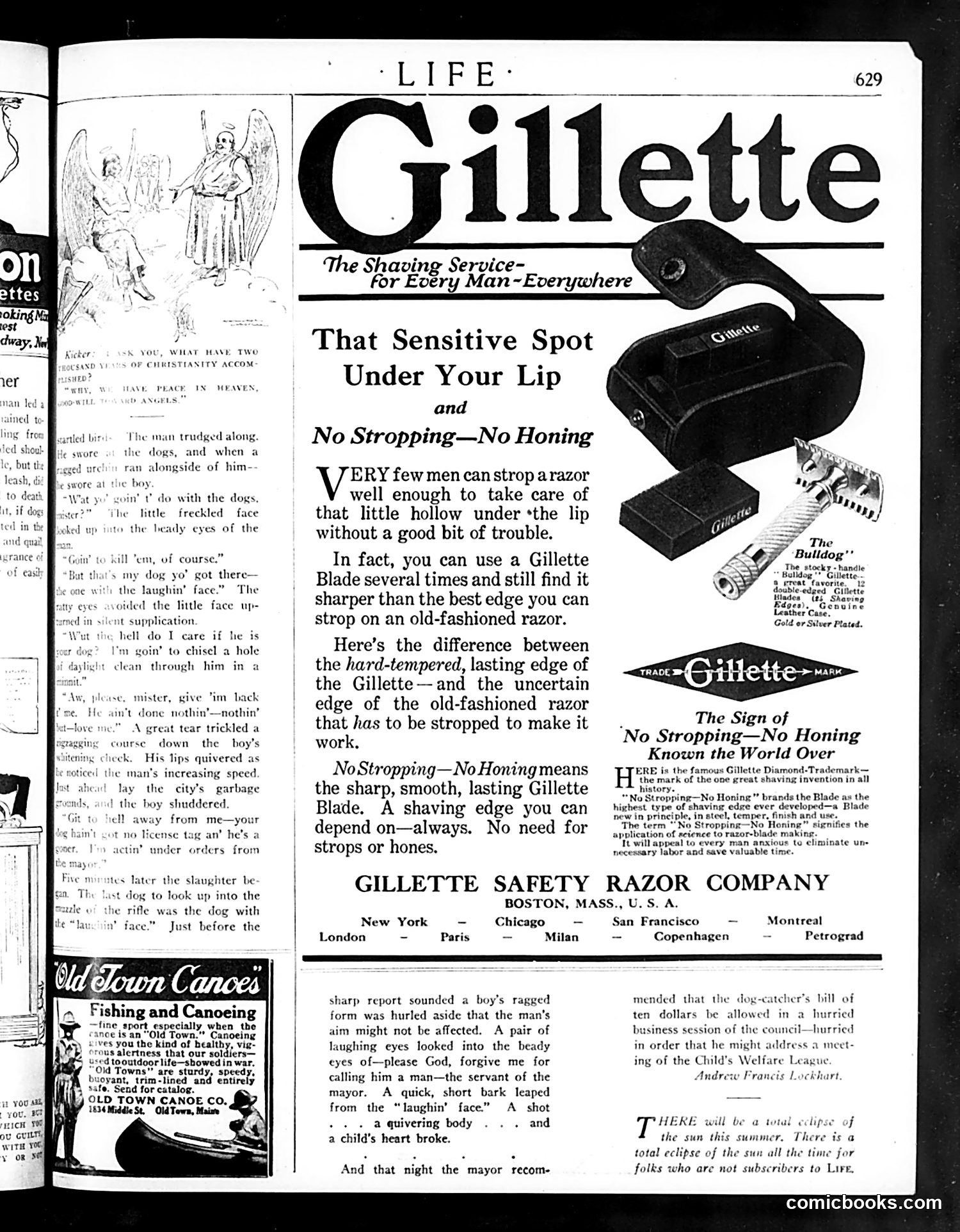
This page is primarily **commercial advertising**, not political satire. The dominant content is a Gillette Safety Razor advertisement promoting the "No Stropping—No Honing" blade as superior to traditional straight razors. On the left side is a short **story or anecdote** (author: Andrew Francis Lockhart) depicting a dark urban scene: a cruel man with a dog-catcher's cart mistreats a boy and his dog. The boy's dog is shot, breaking the child's heart. The mayor later approves payment for the dog-catcher's services—a grim commentary on bureaucratic indifference to cruelty. Below is an advertisement for **Old Town Canoes**, emphasizing their sturdiness and connection to American outdoor vigor and military preparedness. The final line is a characteristic Life magazine joke: a solar eclipse announcement, followed by the quip that subscribers shouldn't worry about missing it since non-subscribers experience permanent darkness (implying those without Life magazine access miss cultural awareness). **This is primarily a product advertising page with embedded literary/satirical content, not political cartooning.**
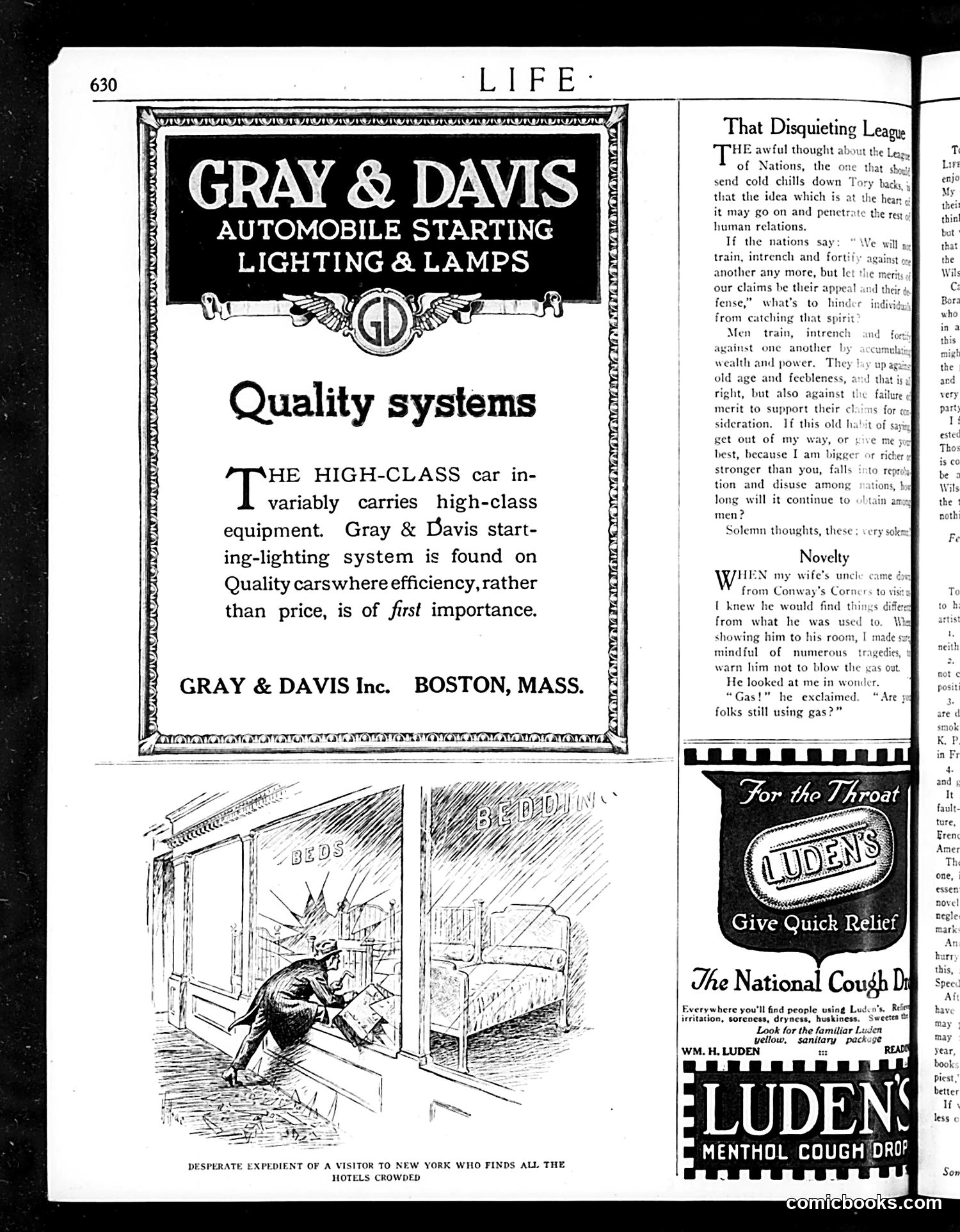
This page is primarily **advertising**, not satire. The dominant content is a Gray & Davis automobile lighting systems advertisement emphasizing quality over price for high-class vehicles. Below the ad appears a **cartoon** with caption "Desperate Expedient of a Visitor to New York Who Finds All the Hotels Crowded." The sketch shows a disheveled man attempting to sleep in a storefront window display labeled "BEDS"—a visual joke about severe hotel shortage. This likely reflects post-WWI housing pressures in New York City. The right column contains unrelated editorial content: an article titled "That Disquieting League" (appears to discuss the League of Nations), a brief humor piece titled "Novelty" about a country visitor unfamiliar with gas lighting, and advertisements for Luden's cough drops. The page exemplifies early 20th-century Life magazine's mix of advertising, light humor, and serious political commentary.
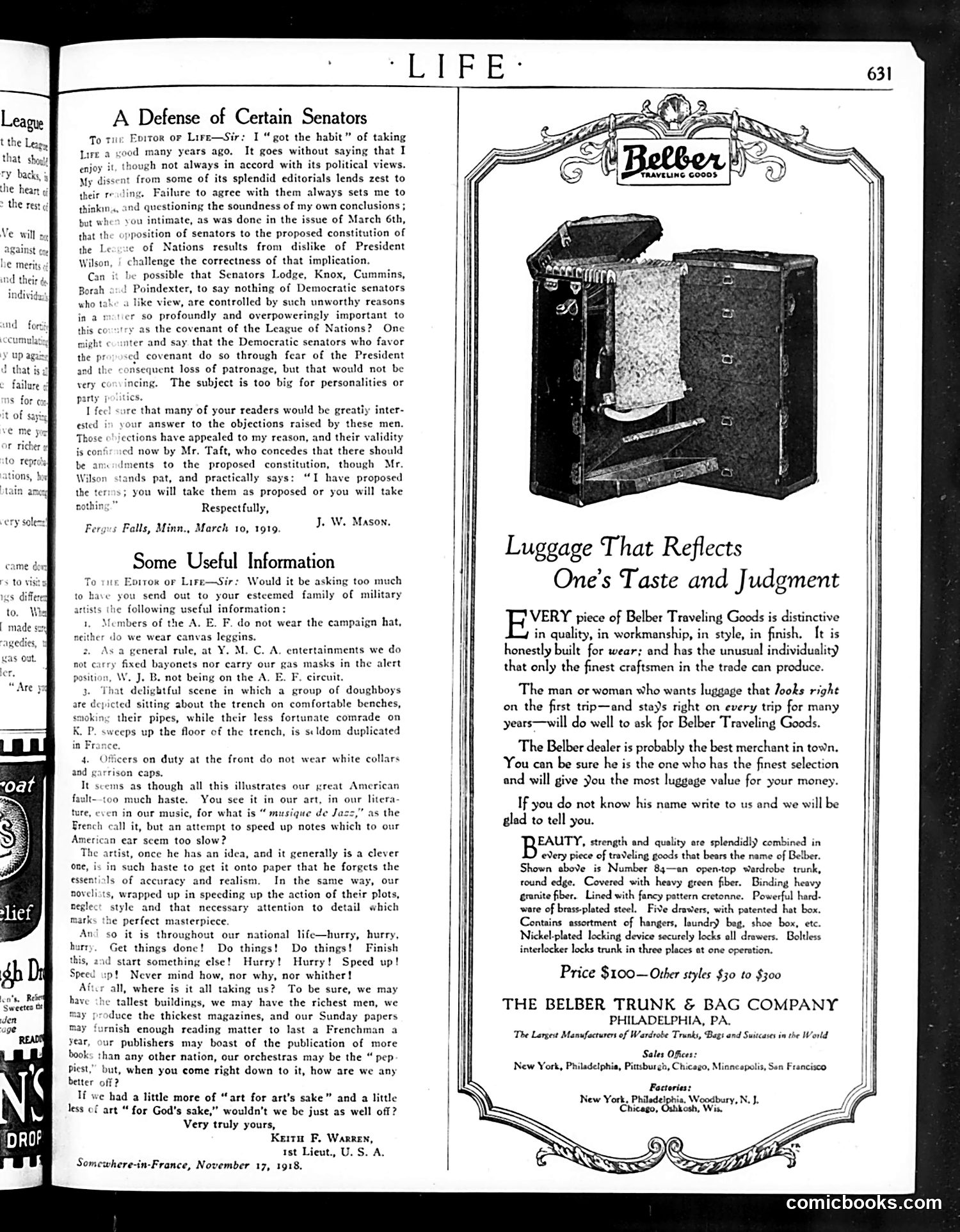
This page contains two letters to the editor and a Belber luggage advertisement—no political cartoon. **"A Defense of Certain Senators"** responds to Life's earlier criticism (March 6th issue) of senators opposing President Wilson's proposed League of Nations constitution. J. W. Mason argues that Republican senators like Lodge, Knox, Cummins, and Poindexter opposed the League based on legitimate policy disagreements, not personal dislike of Wilson or fear of losing patronage. He notes even Taft conceded amendments were needed, contradicting Wilson's take-it-or-leave-it stance. **"Some Useful Information"** humorously corrects inaccurate depictions of American Expeditionary Forces soldiers in Life's illustrations—soldiers don't wear campaign hats or white collars on duty, etc. Keith F. Warren uses this to critique American culture's broader "hurry, hurry" mentality sacrificing accuracy and craftsmanship for speed across art, literature, and publishing.
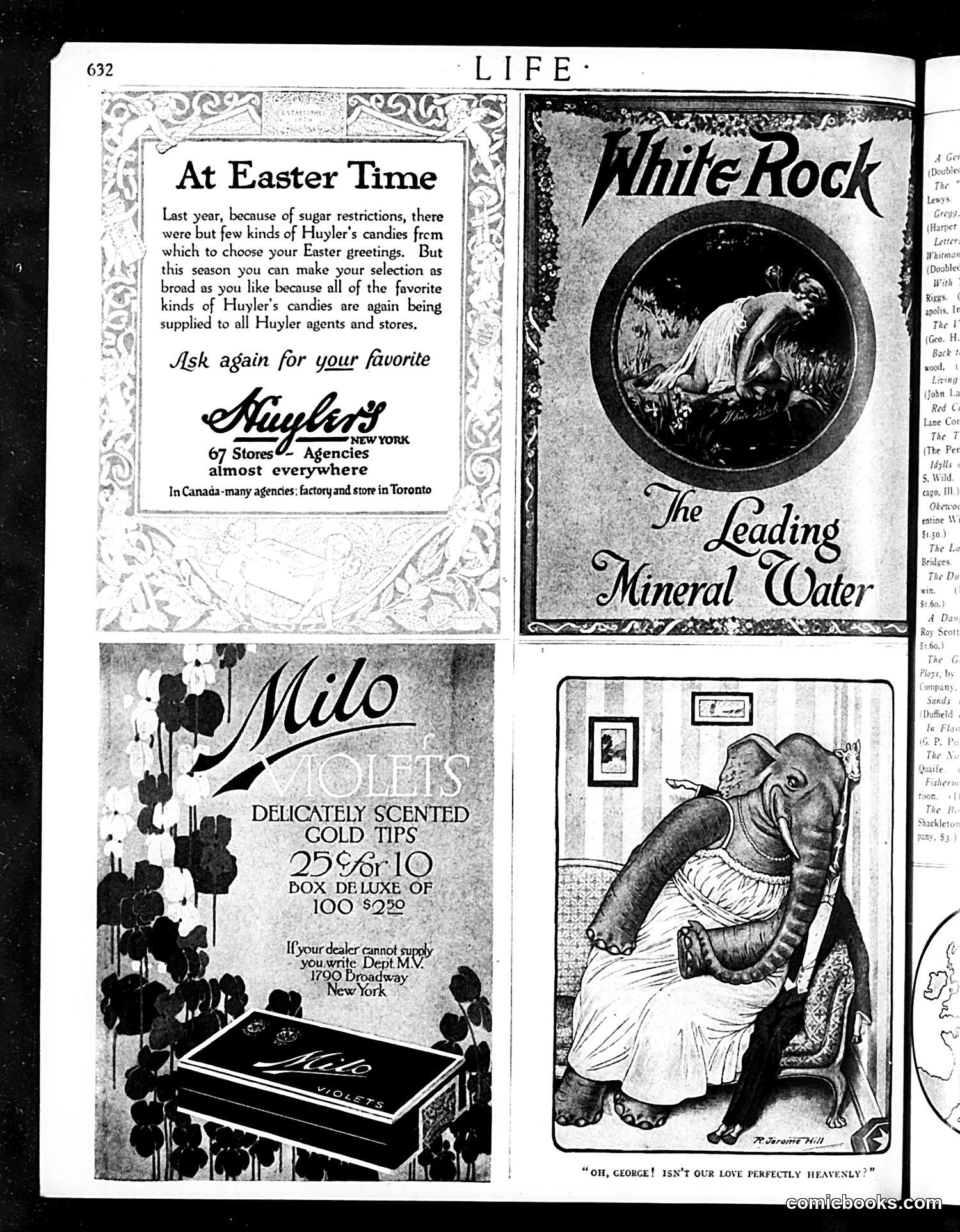
This page is primarily **advertising**, not political satire. It contains four commercial advertisements from the 1910s-1920s era: 1. **Huyler's Candies**: Easter greeting chocolates, noting sugar restrictions have been lifted, allowing fuller product selection again (likely WWI rationing reference). 2. **White Rock Mineral Water**: "The Leading Mineral Water" advertisement with classical imagery of a reclining figure. 3. **Milo Violet Scented Gold Tips**: Delicately scented cigarettes or cigars priced at 25¢/10 or $2.50 per box of 100. 4. **Bottom cartoon**: A humorous domestic scene showing a woman (possibly caricatured) confronting a man, with caption "OH, GEORGE! ISN'T OUR LOVE PERFECTLY HEAVENLY?" — depicting marital discord, likely satirizing romantic idealization versus reality. The page reflects early 20th-century consumer goods and period attitudes toward marriage and gender relations rather than political commentary.
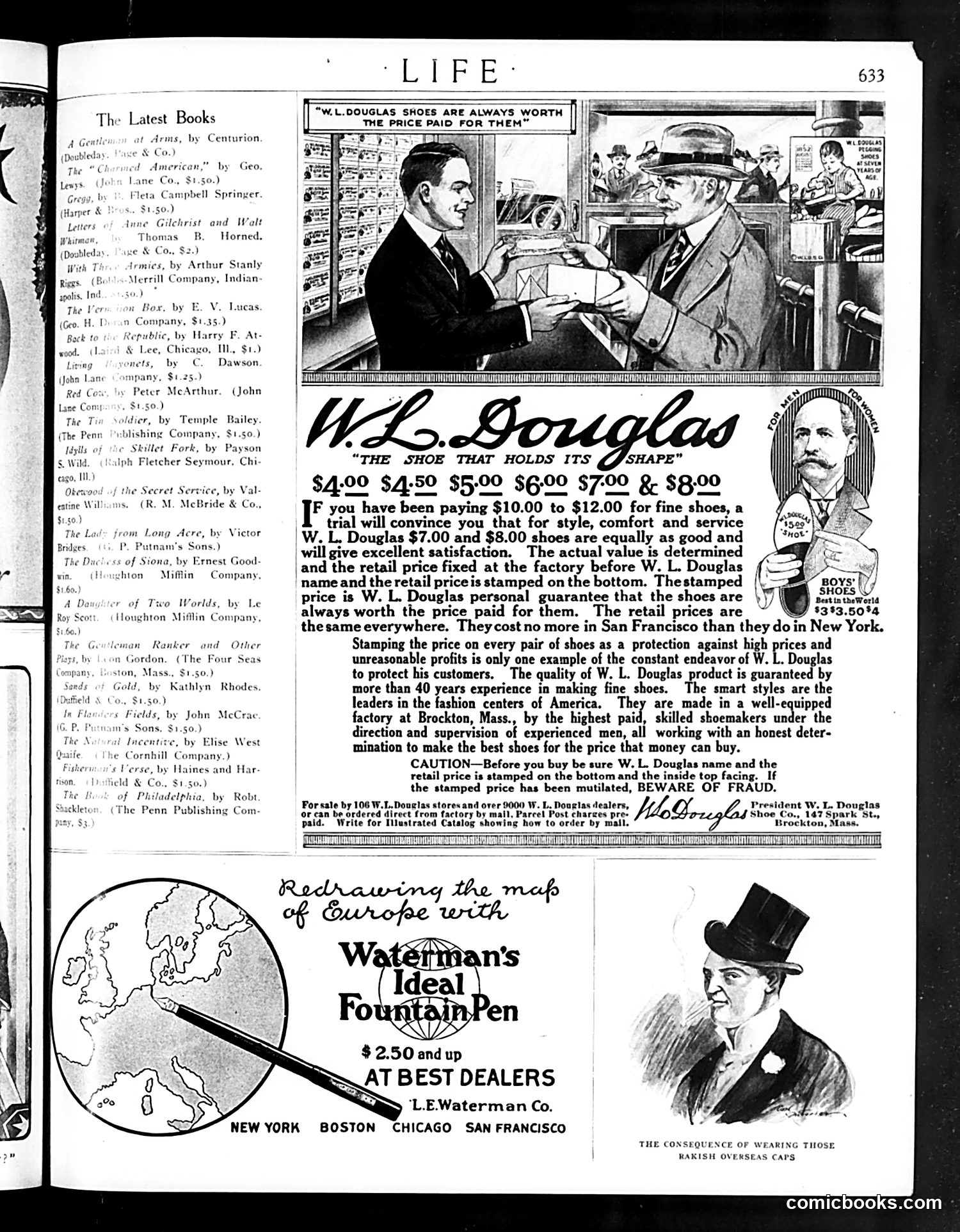
This page is primarily **advertising**, not editorial satire. The dominant content is a W.L. Douglas Shoes advertisement featuring a cartoon scene of a salesman pitching shoes to a customer. The **shoe ad's visual joke** is straightforward: it shows a well-dressed salesman convincing a working-class man (identifiable by his worn clothes and hat) that Douglas shoes are worth their price. The accompanying text emphasizes Douglas's innovation of stamping retail prices directly on shoes to prevent price-gouging and fraud—a consumer-protection measure unusual for the era. The ad's appeal is aspirational: it promises that affordable shoes ($4-8) offer the same quality as expensive ones ($10-12), democratizing access to "smart styles" from "fashion centers of America." Below is a smaller **Waterman Fountain Pen advertisement** with a globe map, and a cartoon of a man wearing "rakish overseas caps"—likely referencing WWI military headgear, suggesting patriotic/wartime relevance. The page also lists recent book releases, typical for *Life* magazine's cultural coverage.
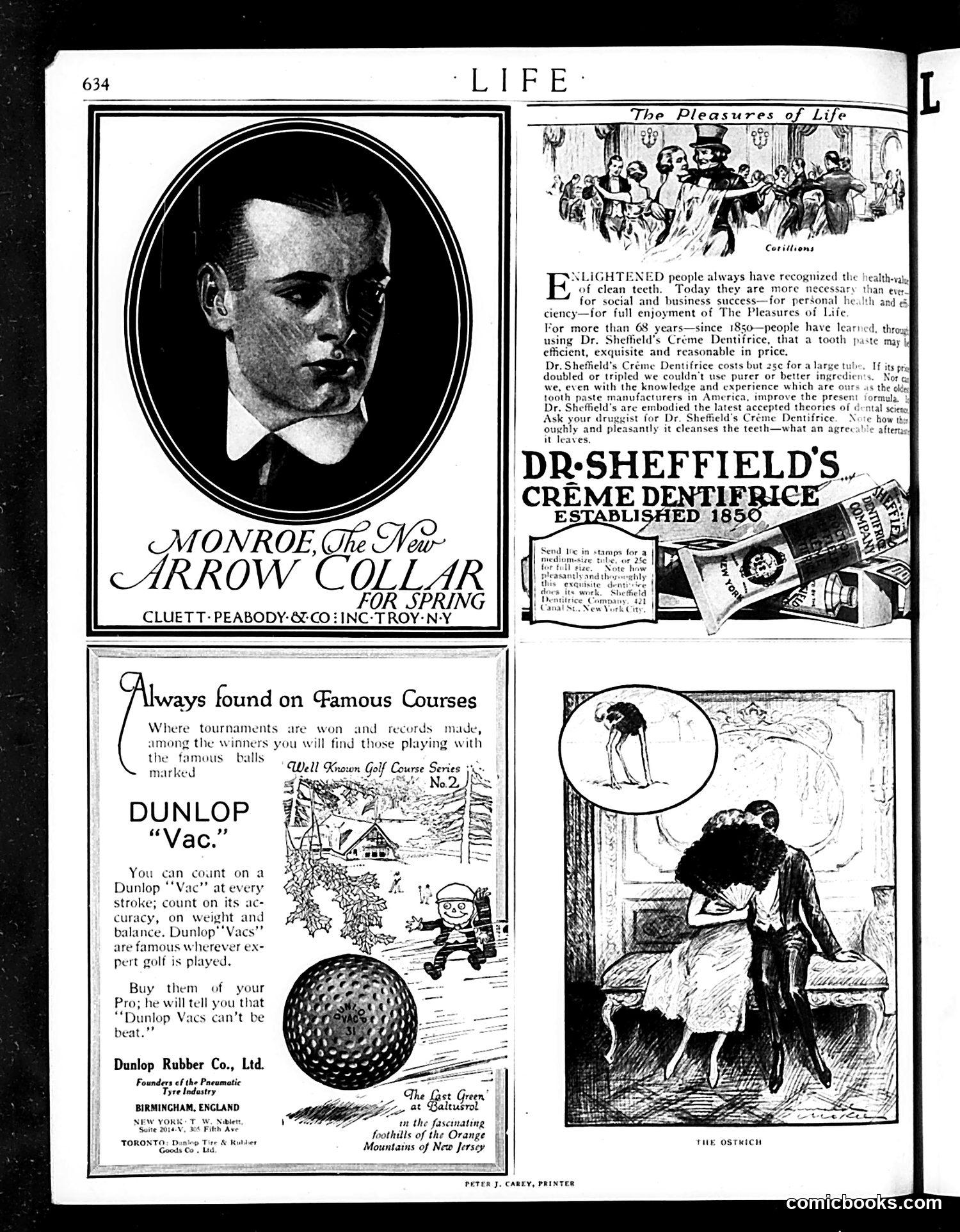
This page is primarily **advertising**, not political satire. It contains four commercial advertisements from the early 20th century: 1. **Monroe Arrow Collar** (top left): A portrait advertisement for a men's shirt collar brand by Cluett-Peabody & Co. 2. **Dr. Sheffield's Crème Dentifrice** (top right): A dental product ad emphasizing that clean teeth are essential for social and business success—reflecting era-specific anxieties about personal hygiene and social standing. 3. **Dunlop "Vac" Golf Balls** (bottom left): An ad targeting golfers, claiming superiority on famous courses. References "Well Known Golf Course Series." 4. **"The Ostrich"** (bottom right): An illustrated cartoon showing a man and woman, with a golfing figure in a thought bubble. The caption suggests this relates to the golf course advertising theme. The page reflects early-1900s consumer culture priorities: appearance, grooming, and leisure activities as markers of respectability.