
Life, 1919-04-10 · page 22 of 46
Life — April 10, 1919 — page 22: what you’re looking at
What you’re looking at
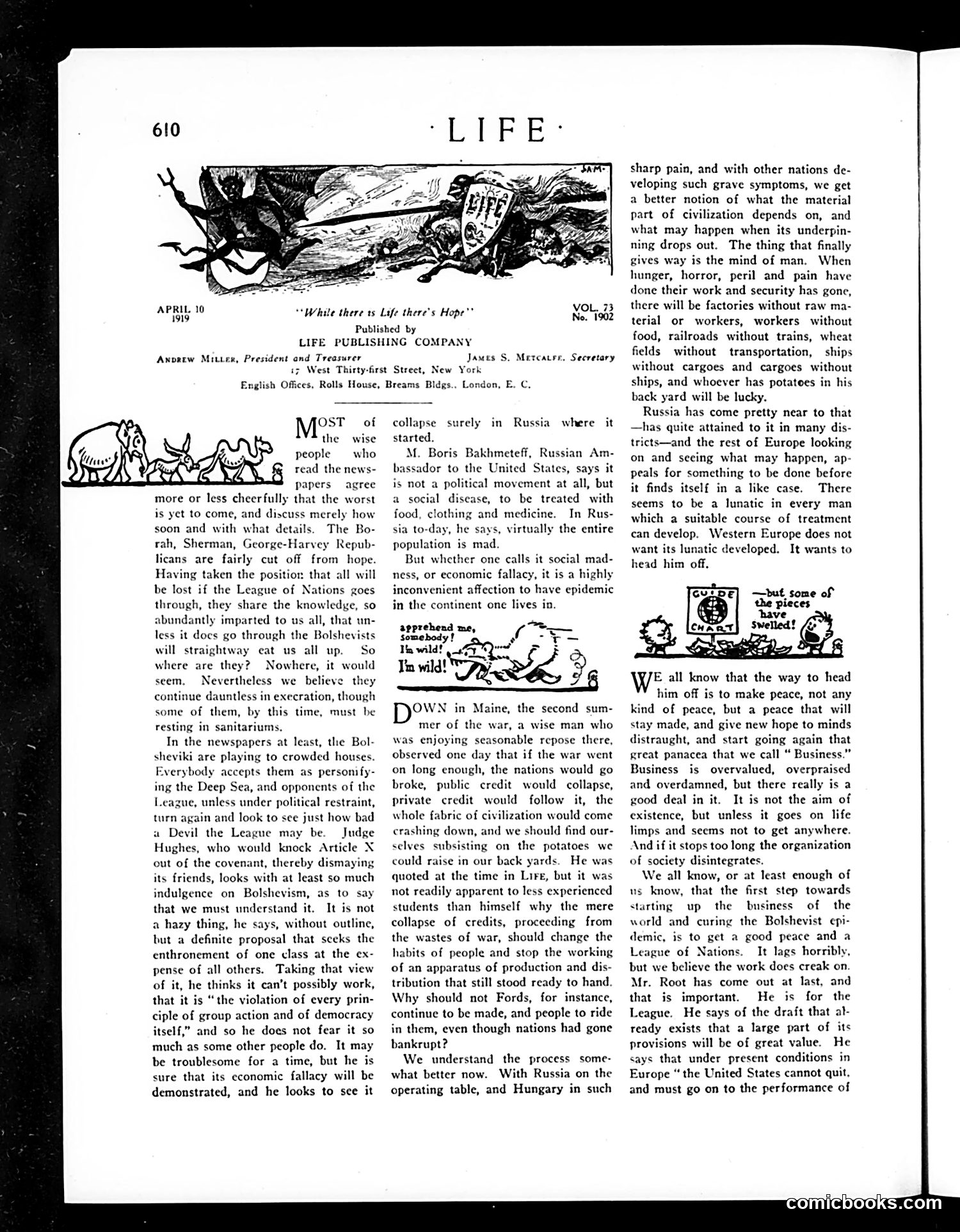
This April 1919 *Life* editorial discusses the collapse of European civilization following World War I, using Russia and Hungary as cautionary examples. The cartoons illustrate anxieties about Bolshevism spreading westward. The main figures referenced are: Judge Hughes (opposing the League of Nations), Senator Borah and others ("George-Harvey Republicans") who fear Bolshevism will triumph if the League fails, and M. Boris Bakhmeteff, the Russian Ambassador, who characterizes Bolshevism as a "social disease" requiring food and medicine rather than political action. The satire targets American pessimists who prophesy civilization's collapse. A small cartoon shows a panicked figure ("apprehend me, somebody! I'ts wild!") representing public hysteria about Bolshevism. The editorial's central argument: material civilization depends ultimately on psychological stability ("the mind of man"). Without sound institutions and morale, factories and farms cease functioning—not because machinery breaks, but because the will to work disappears. The piece suggests both Western dismissal of Bolshevism's threat and overblown panic are misguided.
📄 Transcribed text from this page (OCR, searchable)
Machine-transcribed from the original scan — historical spelling and the odd misread are preserved.
APRIL 10 i919 “While there ts Life there's Hope"* Published by LIFE PUBLISHING COMPANY Anprtw Mitter, President end Treasurer James S, Metcatre, Secretary 17 West Thirty-first Street, New York English Offices, Rolls House, Breams Bldgs. OST of the wise people who read the news- papers agree more or less cheerfully that the worst is yet to come, and discuss merely how soon and with what details. The Bo- rah, Sherman, George-Harvey Repub- licans are fairly cut off from hope. Having taken the position that all will be lost if the League of Nations through, they share the knowledge, so abundantly imparted to us all, that un- less it docs go through the Bolshevists will straightway eat us all up. So where are they? Nowhere, it would seem. Nevertheless we believe they continue dauntless in execration, though some of them, by this time, must be resting in sanitariums, In the newspapers at least, the Bol- sheviki are playing to crowded houses. Everybody accepts them as personify- ing the Deep Sea, and opponents of the League, unless under political restraint, turn again and look to see just how bad au Devil the League may be. Judge Hughes, who would knock Article X out of the covenant, thereby dismaying its friends, looks with at least so much indulgence on Bolshevism, as to say that we must understand it. It is not a hazy thing, he says, without outline, but a definite proposal that seeks the enthronement of one class at the ex- pense of all others. Taking that view of it, he thinks it can’t possibly work, that it is “the violation of every prin- ciple of group action and of democracy itself,” and so he does not fear it so much as some other people do. It may be troublesome for a time, but he is sure that its economic fallacy will be demonstrated, and he looks to see it London, E. C. collapse surely in Russia where it started. M. Boris Bakhmeteff, Russian Am- bassador to the United States, says it is not a political movement at all, but a social disease, to be treated with food, clothing and medicine. In Rus- sia to-day, he says, virtually the entire population is mad. But whether one calls it social mad- ness, or economic fallacy, it is a highly inconvenient affection to have epidemic in the continent one lives in. apprehend me, \aitee Somebody ! Tia wild! Tn wis ah fo Ey PA OWN in Maine, the second sum- mer of the war, a wise was enjoying seasonable repose there, man who observed one day that if the war went on long enough, the nations would go broke, public credit would collapse, private credit would follow it, the whole fabric of civilization would come crashing down, and we should find our- selves subsisting on the potatoes we could raise in our back yards. He was quoted at the time in Lire, but it was not readily apparent to less experienced students than himself why the mere collapse of credits, proceeding from the wastes of war, should change the habits of people and stop the working of an apparatus of production and dis- tribution that still stood ready to hand. Why should not Fords, for instance, continue to be made, and people to ride in them, even though nations had gone bankrupt? We understand the process some- what better now. With Russia on the operating table, and Hungary in such sharp pain, and with other nations de- veloping such grave symptoms, we get a better notion of what the material part of civilization depends on, and what may happen when its underpin- ning drops out. The thing that finally gives way is the mind of man. When hunger, horror, peril and pain have done their work and security has gone, there will be factories without raw ma- terial or workers, workers without food, railroads without trains, wheat fields without transportation, ships without cargoes and cargoes without ships, and whoever has potatees in his back yard will be lucky. Russia has come pretty near to that —has quite attained to it in many dis- tricts—and the rest of Europe looking on and seeing what may happen, ap- peals for something to be done before it finds itself in a like case. There seems to be a lunatic in every man which a suitable course of treatment can develop. Western Europe does not want its lunatic developed. It wants to head him off. —but some of the pieces E all know that the way to head him off is to make peace, not any kind of peace, but a peace that will stay made, and give new hope to minds distraught, and start going again that great panacea that we call “ Business.” Business is overvalued, overpraised and overdamned, but there really is a good deal in it. It is not the aim of existence, but unless it goes on life limps and seems not to get anywhere. And if it stops too long the organization of society disintegrates. We all know, or at least enough of us know, that the first step towards starting up the business of the world and curing the Bolshevist epi- demic, is to get a good peace and a League of Nations. It lags horribly, but we believe the work does creak on. Mr. Root has come out at last, and that is important. He is for the League. He says of the draft that al- ready exists that a large part of its provisions will be of great value. He says that under present conditions in Europe “the United States cannot quit, and must go on to the performance of