
Life, 1919-04-10 · page 30 of 46
Life — April 10, 1919 — page 30: what you’re looking at
What you’re looking at
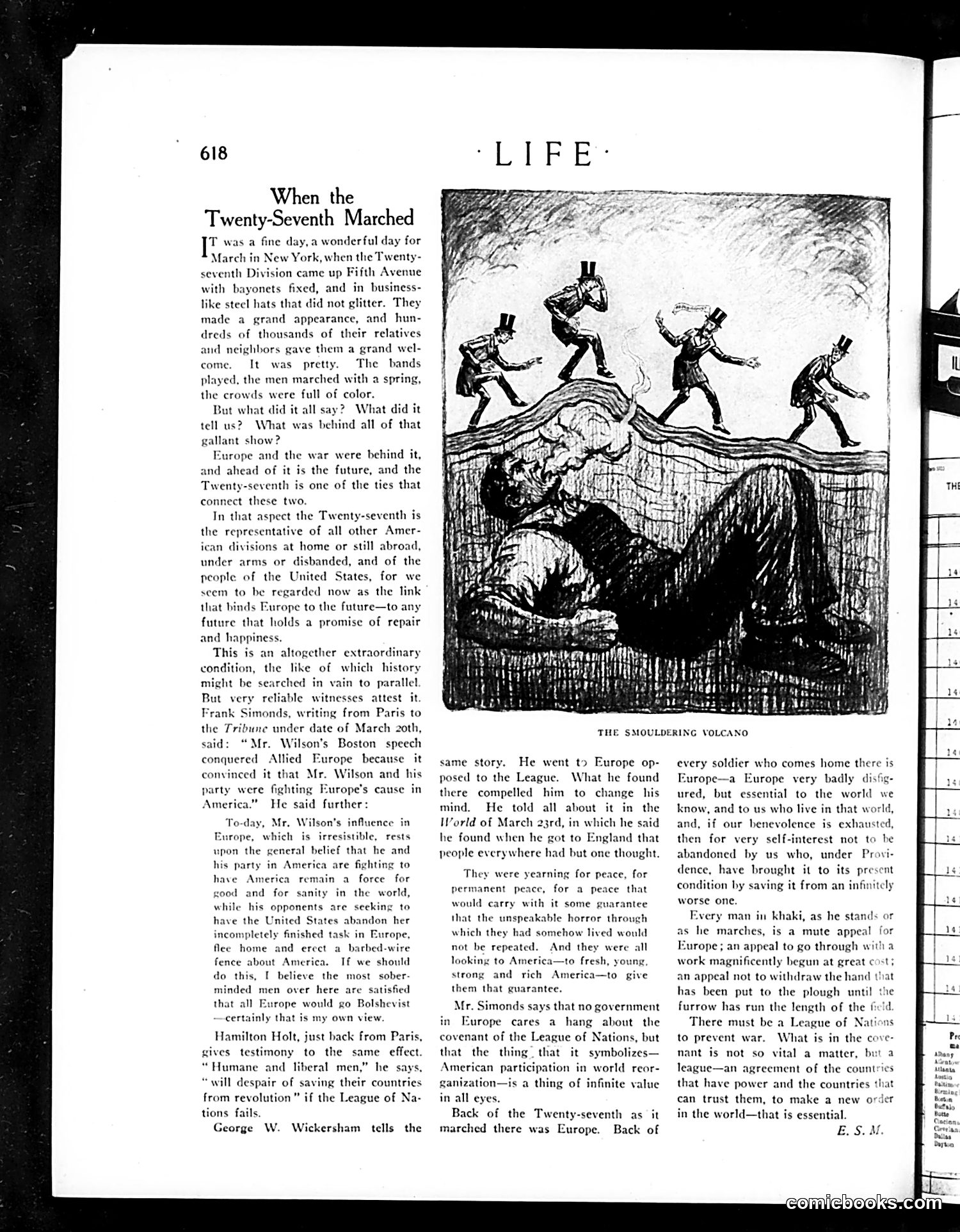
This 1919 article celebrates the Twenty-Seventh Division's homecoming parade up Fifth Avenue in New York City. The accompanying cartoon—titled "The Smoldering Volcano"—depicts soldiers atop a volcanic mountain, suggesting Europe's precarious post-WWI instability. The satire critiques American isolationism. The text argues that American soldiers represent a vital "link" between war-torn Europe and the world's future. Through quotes from Frank Simonds, Hamilton Holt, and George Wickersham (real political figures), the author contends that Europe desperately needs continued American engagement—specifically through President Wilson's League of Nations—to prevent Bolshevik revolution and chaos. The cartoon's volcanic imagery warns that Europe remains dangerously unstable. The soldiers marching represent America's moral obligation to complete the work of reconstruction rather than retreat into isolationism. This reflects the 1919 debate over U.S. participation in the League of Nations, which ultimately failed in the Senate.
📄 Transcribed text from this page (OCR, searchable)
Machine-transcribed from the original scan — historical spelling and the odd misread are preserved.
618 When the Twenty-Seventh Marched T was a fine day, a wonderful day for March in New York, when the Twenty- seventh Division came up Fifth Avenue with bayonets fixed, and in business- like steel hats that did not glitter. They made a grand appearance, and hun- dreds of thousands of their relatives and neighbors gave them a grand wel- come. It was pretty The bands played, the men marched with a spring, the crowds were full of color. But what did it all say? What did it tell us? What was behind all of that nt show ? rope and the war were behind it, and ahead of it is the future, and the Twenty-seventh is one of the ties that connect these two. In that aspect the Twenty-seventh is the representative of all other Amer- ican divisions at home or still abroad, under arms or disbanded, and of the people of the United States, for we seem to be regarded now the link that binds Europe to the future—to any future that holds a promise of repair and happiness. This is an altogether extraordinary condition, the like of which history might be searched in vain to parallel But very reliable witnesses attest it. Frank Simonds, writing from Paris to the Tribune under date of March 2oth, said: “Mr. Wilson's Boston speech conquered Allied Europe because it convinced it that Mr. Wilson and his party were fighting Europe's cause in Americ He said further: To-day, Mr. Wilson's influence in Europe, which is irresistible, rests the general belief that he and his party in America are fighting to America remain a force for good and for sanity in the world, while his opponents are seeking to have the United States abandon her incompletely finished task in Europe, flee home and erect a bart America. If we should believe the most minded men over here are satisfied that all Europe would go Bolshevist certainly that is my own view. have -wire fence about do this, [ sober- Hamilton Holt, just back from Paris, gives testimony to the same effect “Humane and liberal men,” he i. “will despair of saving their countries from revolution” if the League of Na- tions fails George W. Wickersham tells the same story. He went to Europe op- posed to the League. What he found there compelled him to change his mind. He told all about it in the World of March 23rd, in which he said he found when he got to England that people everywhere had but one thought. They were yearning for peace, for permanent peace, for a peace that would carry with it some guarantee that the unspeakable horror through which they had somehow lived would not be repeated. lool K to / strong and And they were all merica—to fresh, young rich America—to them that guarantee. give Mr. Simonds says that no government in Europe cares a hang about the covenant of the League of Nations, but that the thing. that it symbolizes— American participation in world reor- ganization—is a thing of infinite value in all eyes. Back of the Twent marched there was seventh as it urope. Back of every soldier who comes home there is Europe—a Europe very badly dis ured, but essential to the world we know, and to us who live in that wor and, if our benevolence is exhausted, then for very self-interest not to be abandoned by us who, under Provi- dence, have brought it to its present condition by saving it from an infinitely worse one. Every man in khaki, as he stan: as he marches, is a mute appeal for Europe; an appeal to go through with a work magnificently begun at great ¢ an appeal not to withdraw the hand has been put to the plough until ¢ furrow has run the length of the f There must be a League of Nat to prevent war. What is in the nant is not so vital a matter, but a league—an agreement of the countries that have power and the countries that can trust them, to make a new order in the world—that is essential. E.S.M