
Life, 1919-04-10 · page 23 of 46
Life — April 10, 1919 — page 23: what you’re looking at
What you’re looking at
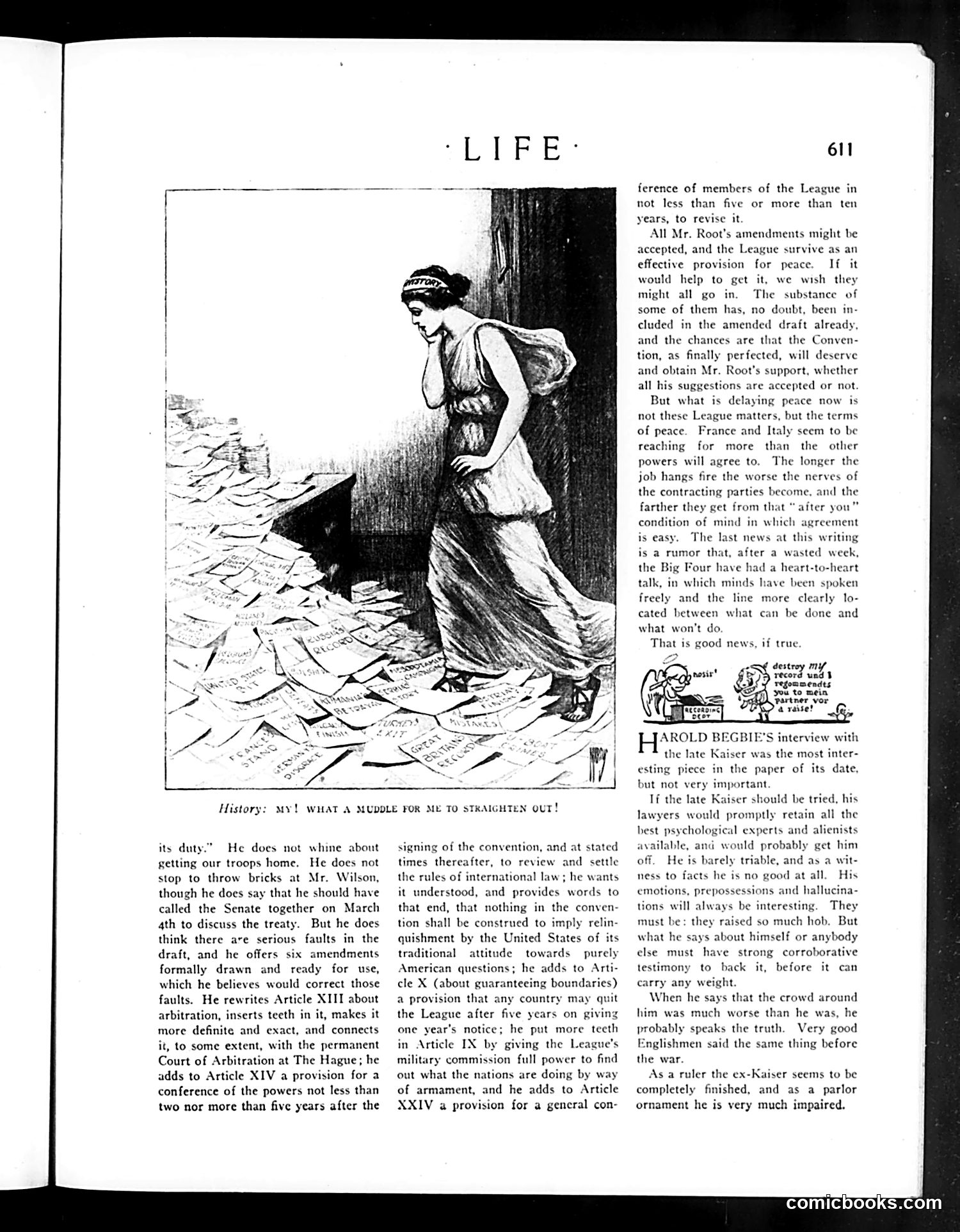
This political cartoon satirizes post-World War I peace negotiations, likely from 1919. The illustration depicts a woman (representing Lady Liberty or America) overwhelmed by scattered papers—symbolizing the complex Treaty of Versailles and League of Nations draft. The accompanying text discusses Elihu Root's proposed amendments to strengthen the League of Nations covenant, particularly regarding arbitration, military oversight, and nations' right to withdraw. The article criticizes delays in peace negotiations caused by French and Italian demands for harsher terms against Germany, warning that prolonged uncertainty worsens diplomatic relations. The cartoon's title jokes that the woman cannot "straighten out" the tangled mess of international agreements and competing national interests. This reflects contemporary American frustration with the protracted, complicated peace process and skepticism about whether an effective League structure could emerge from such confusion and competing demands.
📄 Transcribed text from this page (OCR, searchable)
Machine-transcribed from the original scan — historical spelling and the odd misread are preserved.
History: M its duty.” He does not whine about getting our troops home. He does not stop to throw bricks at Mr. Wilson, though he does say that he should have called the Senate together on March 4th to discuss the treaty. But he does think there are serious faults in the draft, and he offers six amendments formally drawn and ready for use, which he believes would correct those faults. He rewrites Article XIII about arbitration, inserts teeth in it, makes it more definite and exact, and connects it, to some extent, with the permanent Court of Arbitration at The Hague; he adds to Article XIV a provision for a conference of the powers not less than two nor more than five years after the ! WHAT A MUDDLE FOR ME TO STRAIGHTEN OUT! signing of the convention, and at stated times thereafter, to review and settle the rules of international law; he wants it understood, and provides words to that end, that nothing in the conven- tion shall be construed to imply relin- quishment by the United States of its traditional attitude towards purely American questions; he adds to Arti- cle X (about guaranteeing boundaries) a provision that any country may quit the League after five years on giving one year's notice; he put more teeth in Article IX by giving the League's military commission full power to find out what the nations are doing by way of armament, and he adds to Article XXIV a provision for a general con- 6ll ference of members of the League in not less than five or more than ten years, to revise it. All Mr. Root’s amendments might be accepted, and the League survive as an effective provision for peace. If it would help to get it, we wish they might all go in. The substance of some of them has, no doubt, been in- cluded in the amended draft already, and the chances are that the Conven- tion, as finally perfected, will deserve and obtain Mr. Root’s support, whether all his suggestions are But what is delaying peace now is not these League matters, but the terms of peace. France and Italy seem to be reaching for more than the powers will agree to. The longer the job hangs fire the worse the nerves of the contracting parties become, and the farther they get from that “after you” condition of mind in which agreement The last news at this writing ‘cepted or not. other is easy. is a rumor that, after a wasted week, the Big Four have had a heart-to-heart talk, in which minds have been spoken freely and the line more clearly lo- cated between what can be done and what won't do. That is good news, if true. g destroy m secerd wad 3 Tepoomentes you to mein partner vor AROLD BEGBIE'’S interview with the late Kaiser the most inter- esting piece in the paper of its date, but not very important. If the late Kaiser should be tried, his lawyers would promptly retain all the best psycholc available, and would probably get him off. He is barely triable, and as a wit- ness to facts he is no good at all. His emotions, prepossessions and hallucina- tions will alwa They must be: they raised so much hob. But what he says about himself or anybody else must strong corroborative testimony to back it, before it can carry any weight. When he says that the crowd around him was much worse than he was, he probably speaks the truth. Very good Englishmen said the same thing before the war. As a ruler the ex-Kaiser seems to be completely finished, and as a parlor ornament he is very much impaired. 1 experts and alienists s be interesting have comicbooks.com