
A complete issue · 42 pages · 1919
Life — February 13, 1919
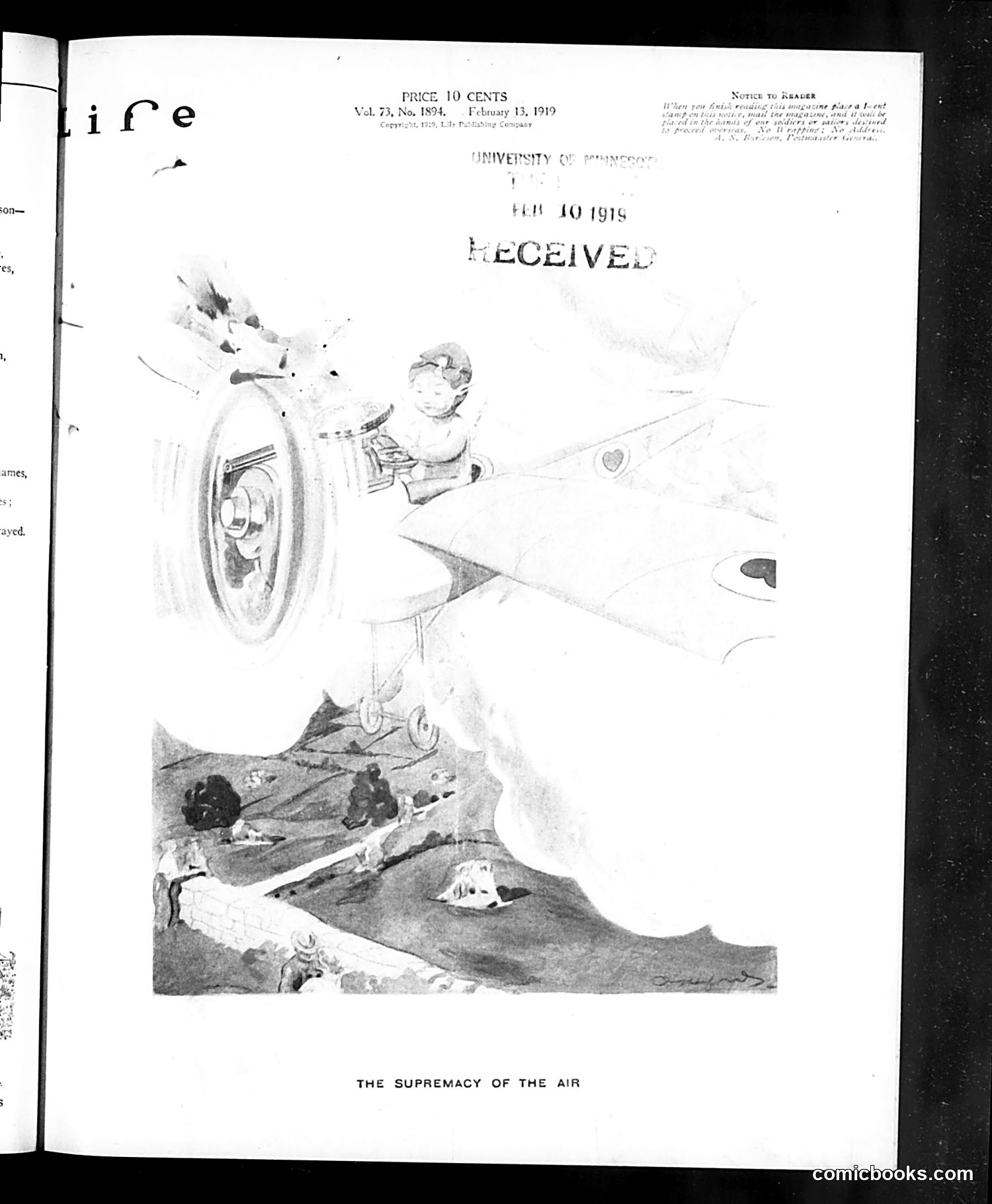
This *Life* magazine cover from February 13, 1919, celebrates aviation as humanity's future, published just months after World War I ended. The illustration depicts a cherub or cupid figure piloting an early aircraft above a terrestrial landscape with soldiers and trenches below—visualizing air power's dominance over ground-based warfare. The satire suggests that aerial combat has rendered traditional land-based military strategy obsolete. The heavenly, almost divine positioning of the aircraft emphasizes this new technological supremacy. This reflects post-WWI enthusiasm for aviation's potential, though the image's ironic tone (using a cherub as pilot) hints at the magazine's characteristic satirical skepticism about blind technological optimism and militarism.
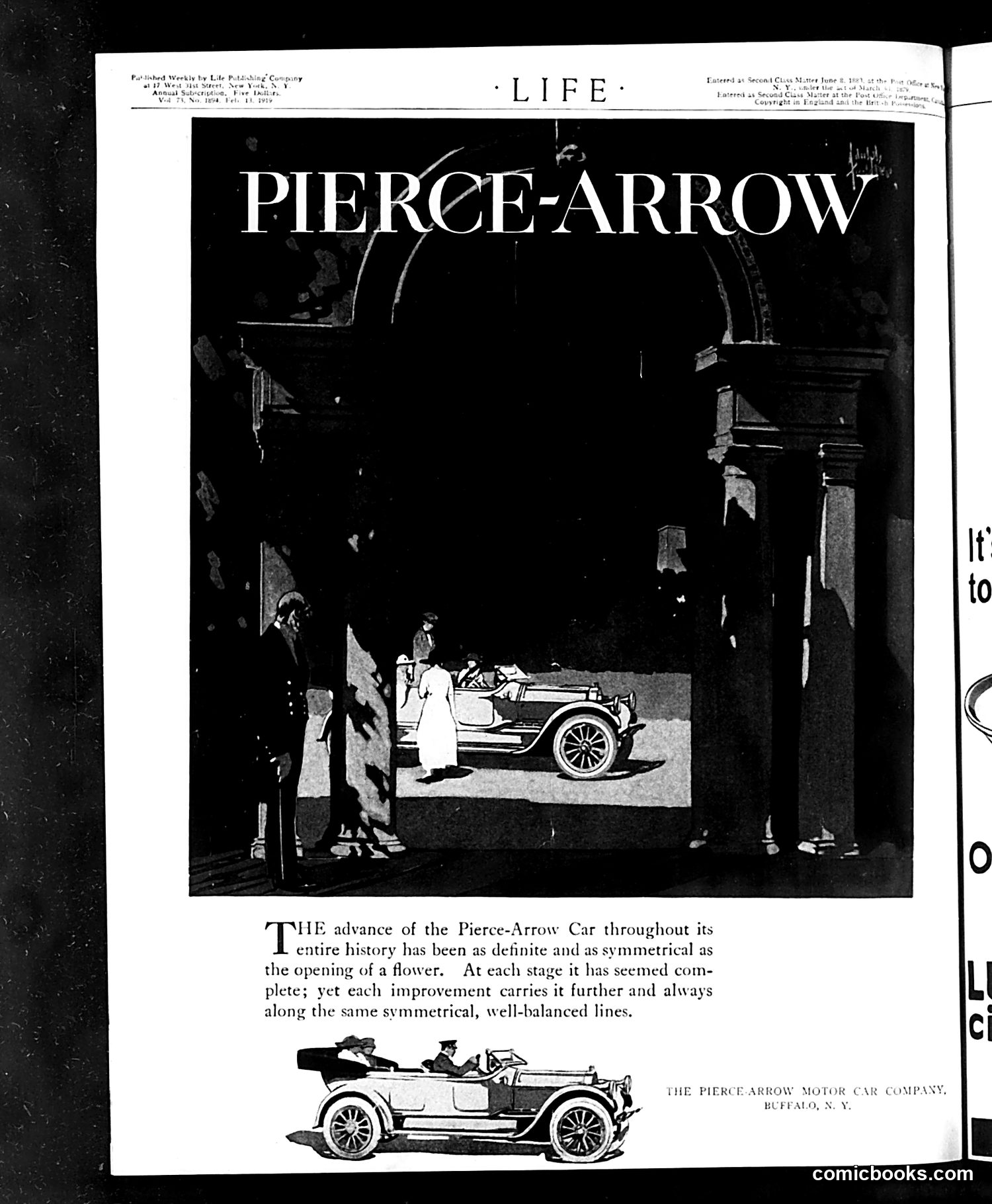
This is **not satire or a political cartoon** — it's a straightforward **automobile advertisement** for the Pierce-Arrow Motor Car Company of Buffalo, New York. The page features promotional copy describing the car's design philosophy: "The advance of the Pierce-Arrow Car throughout its entire history has been as definite and as symmetrical as the opening of a flower." The ad emphasizes that improvements maintain consistent, balanced design principles. The imagery shows the luxury vehicle in an elegant architectural setting (classical columns and arches), suggesting sophistication and prestige. The side-view illustration displays the car's sleek profile with passengers. This represents typical early-20th-century advertising strategy: associating automobiles with refined aesthetics and gradual, harmonious progress to appeal to wealthy consumers.
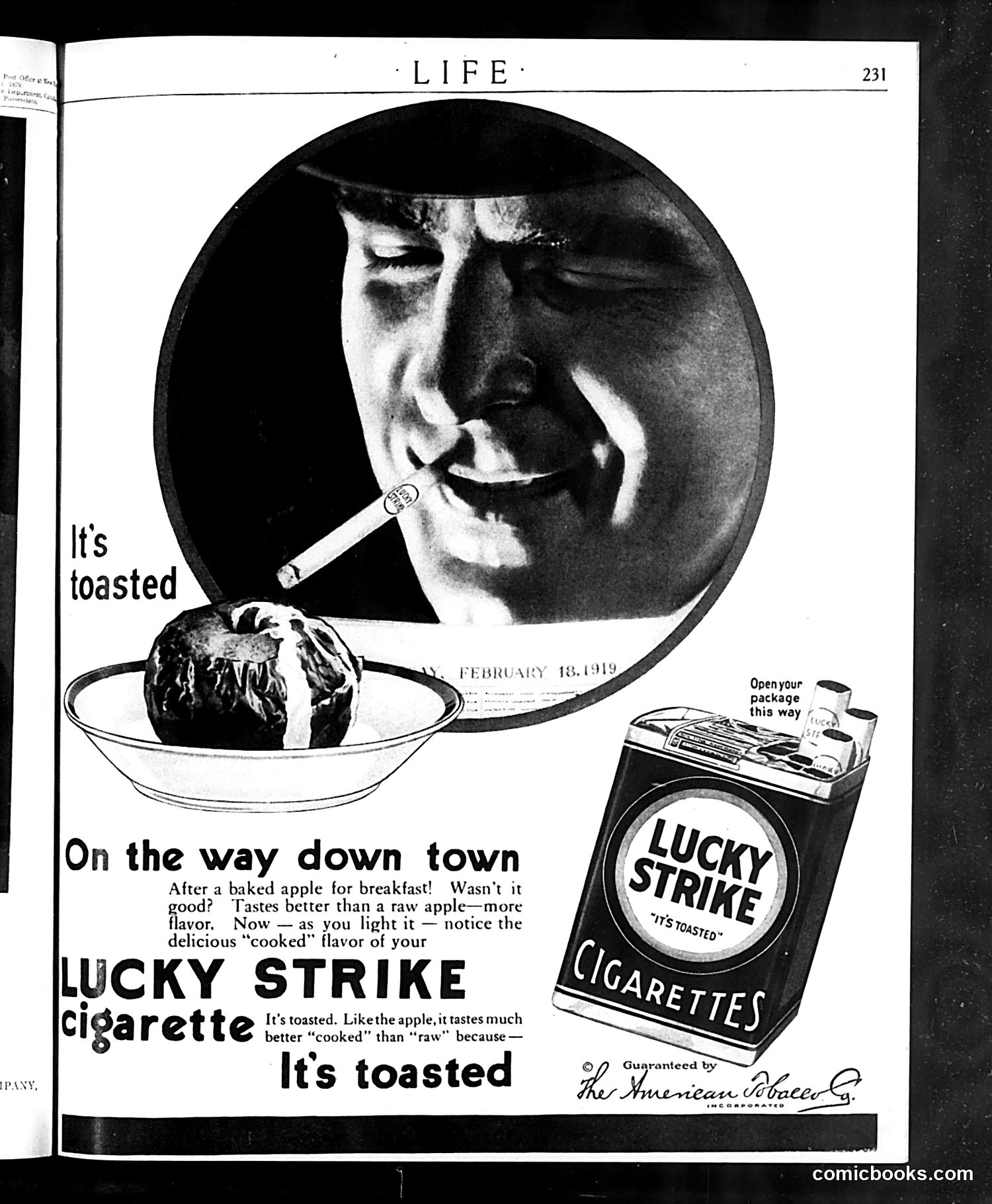
This is primarily a **Lucky Strike cigarette advertisement**, not satire or political commentary. The ad uses a health-related marketing strategy common in 1919. The image shows a man smoking a cigarette alongside a baked apple, drawing a parallel between the two. The advertisement's logic compares cigarette smoking to eating cooked food: just as baking makes an apple "taste better" than raw, the "toasting" process supposedly makes Lucky Strike cigarettes superior to "raw" tobacco. The phrase "It's toasted" became Lucky Strike's famous marketing slogan. This ad represents pre-regulation tobacco marketing that made dubious health and quality claims. The date indicates February 18, 1919—decades before cigarette health warnings became mandatory.
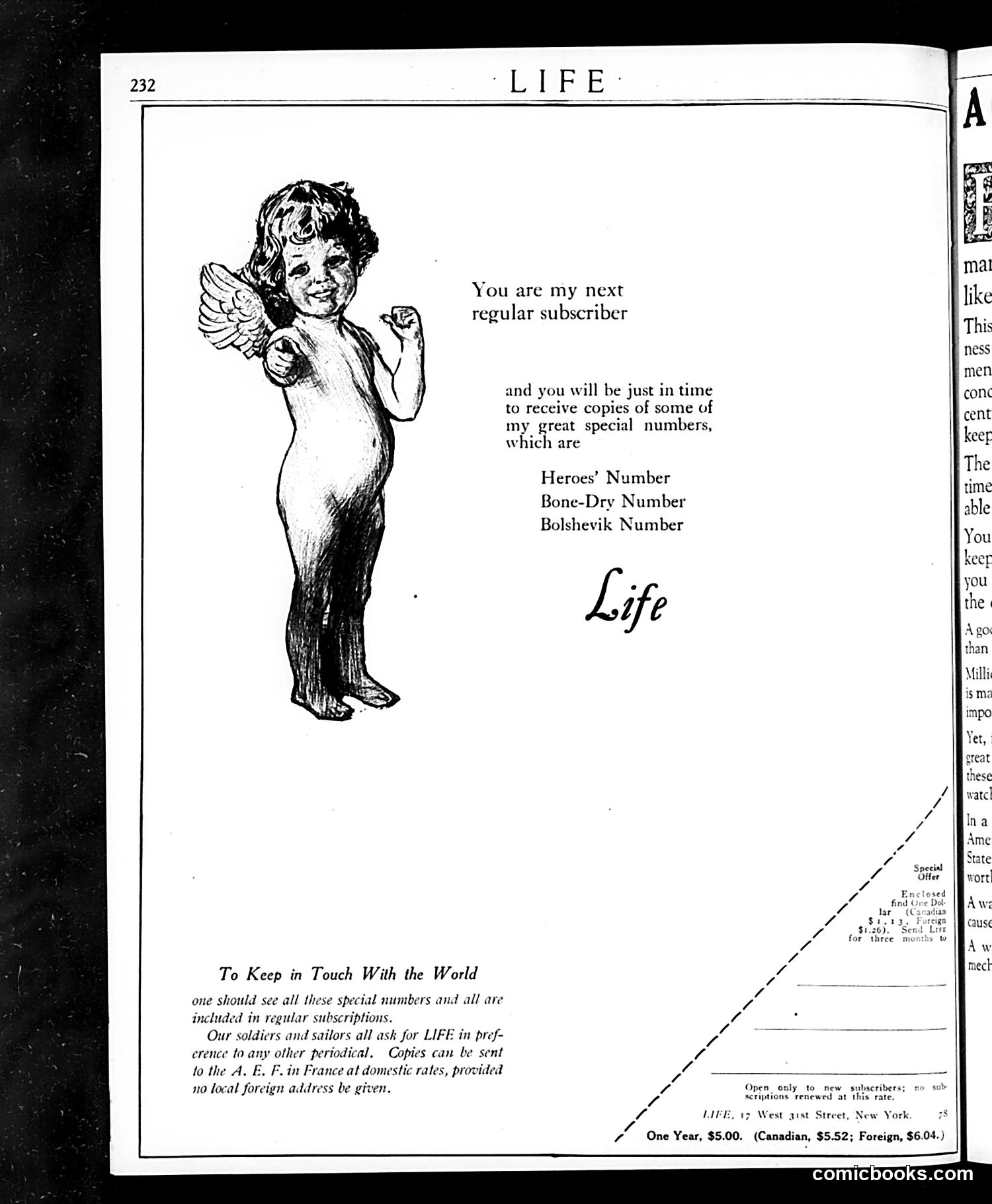
This page is primarily **subscription advertising** for *Life* magazine, not political satire. The cherub figure is *Life*'s mascot—a classical putto (cupid) used to personify the magazine itself. The text pitches subscription benefits: readers will receive special numbered issues (Heroes' Number, Bone-Dry Number, Bolshevik Number) and can send subscriptions to soldiers and sailors abroad. The lower section emphasizes *Life*'s appeal to military personnel during what appears to be **World War I era** (given references to A.E.F. in France and soldiers requesting the magazine). The "Bone-Dry" and "Bolshevik" numbers suggest *Life* covered contemporary topics—Prohibition and post-Russian Revolution politics—making it relevant reading for troops abroad. This is essentially a **recruitment pitch** for magazine subscriptions, not editorial content.
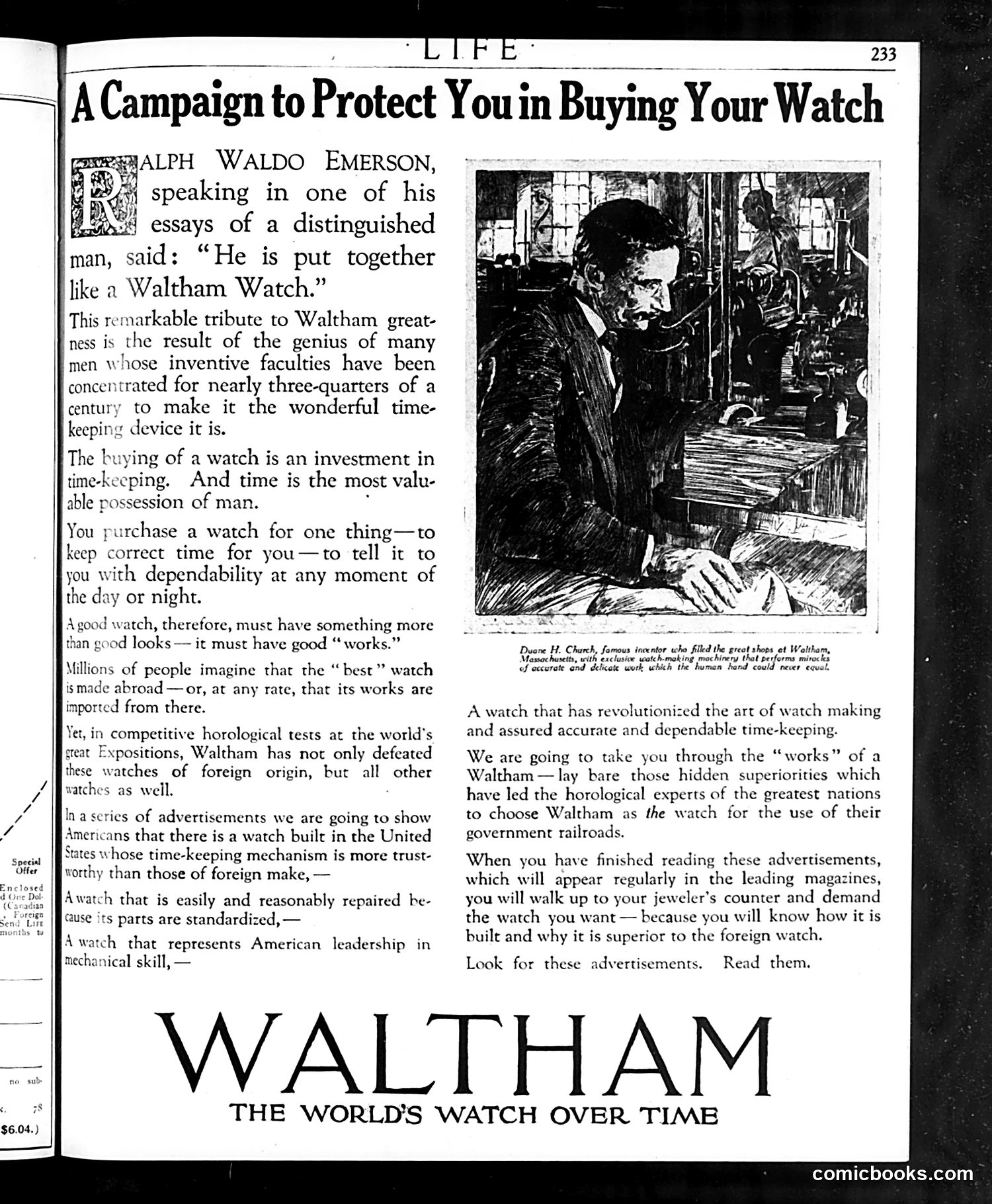
This is primarily a **Waltham Watch advertisement**, not satire or political commentary. The page opens with a quote from Ralph Waldo Emerson praising precision engineering ("put together like a Waltham Watch"), then pivots to a sales pitch. The illustration shows what appears to be a **watchmaker or jeweler at work**, demonstrating the craftsmanship behind Waltham products. The advertisement emphasizes American manufacturing superiority, claiming Waltham watches have "defeated" foreign competitors in "horological tests" at world's expositions. The campaign promises a series of advertisements explaining Waltham's technical advantages, positioning the watch as an "investment in time-keeping" with superior American "mechanical skill" and standardized parts for easy repair—a practical sales argument for early 20th-century consumers.
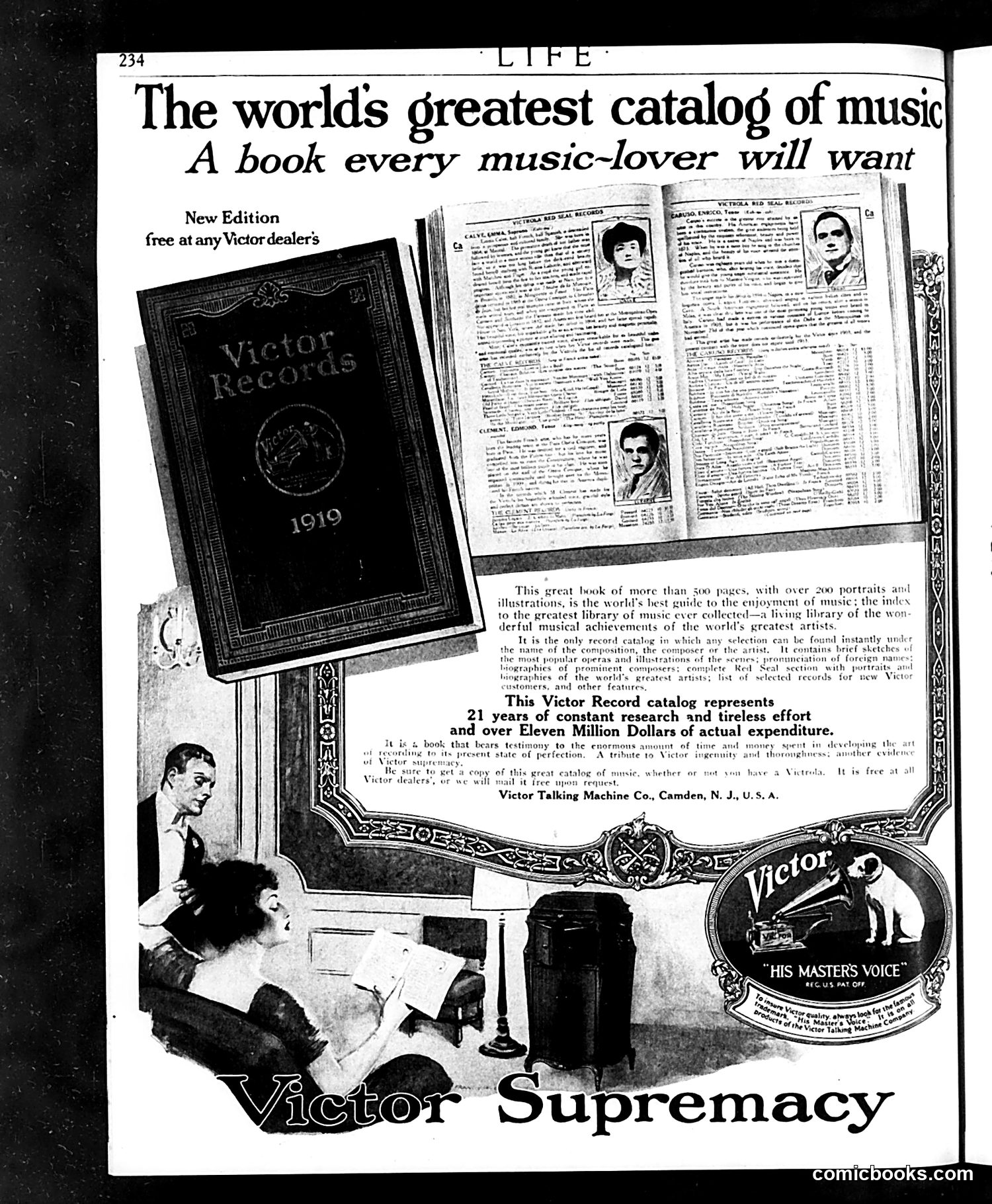
This is primarily a **Victor Records advertisement**, not satire or political commentary. The page promotes Victor's 1919 music catalog as "the world's greatest catalog of music" and "a book every music-lover will want." The ad emphasizes the catalog's scope: over 500 pages with 200+ portraits, covering the world's greatest artists and musical achievements. It highlights that the catalog represents "21 years of constant research and tireless effort and over Eleven Million Dollars of actual expenditure." The imagery shows the physical catalog and a couple consulting it, along with portraits of (unnamed in this image) prominent musicians of the era. The "His Master's Voice" logo appears at bottom right—Victor's famous trademark. This is straightforward commercial advertising for a music industry product, not satirical commentary.
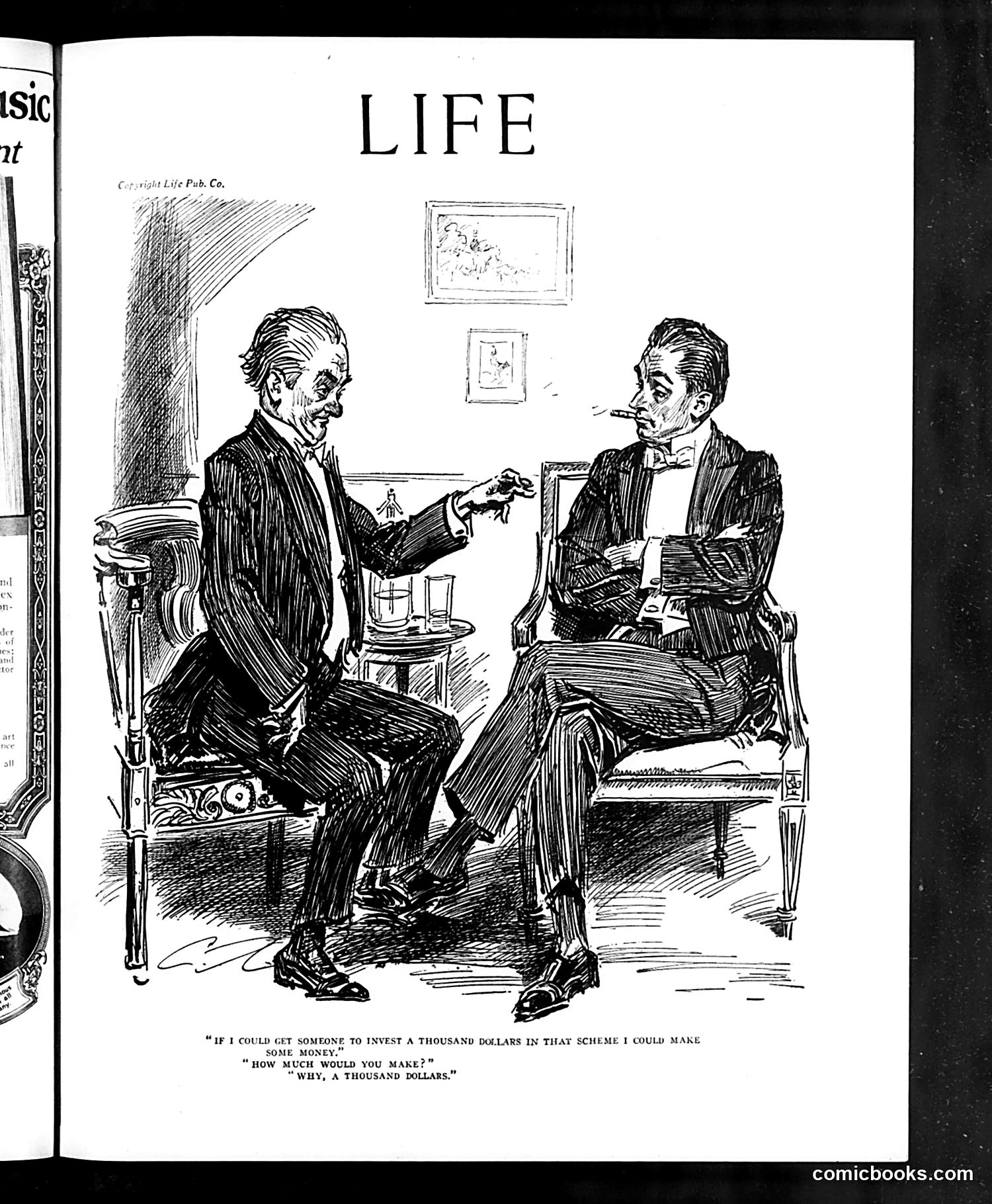
This is a satirical cartoon from *Life* magazine depicting two well-dressed men in conversation. The man on the left, gesturing animatedly, proposes a financial scheme to the seated man: "If I could get someone to invest a thousand dollars in that scheme I could make some money." The seated man responds: "How much would you make?" The first man answers: "Why, a thousand dollars." The satire mocks a common con scheme or dubious investment pitch of the era—the proposer's plan is simply to pocket the investor's money rather than generate actual returns. The joke exposes the transparent self-interest behind such pitches: the "scheme" exists purely to enrich the schemer at the investor's expense, with no legitimate business purpose.
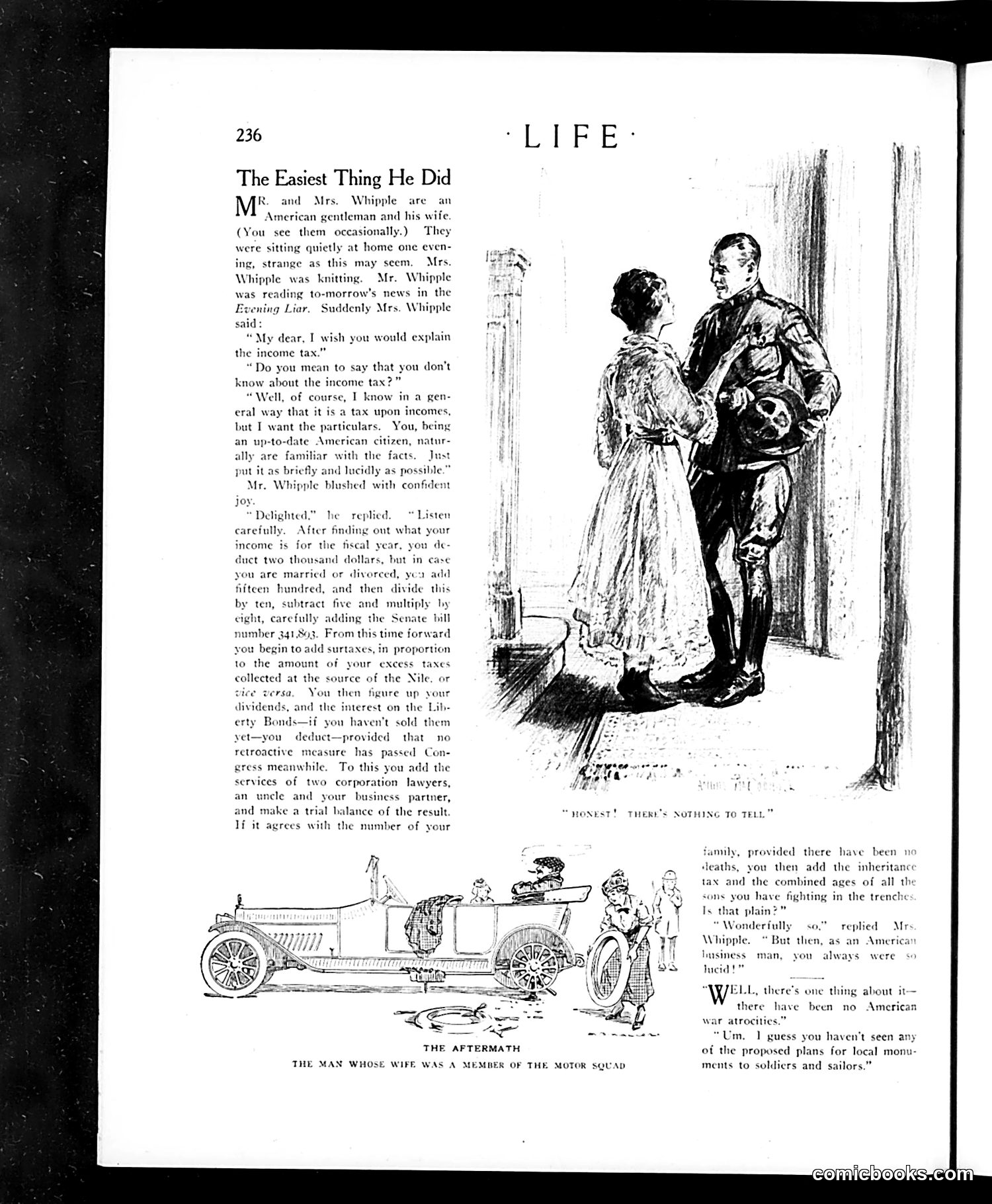
This satirical story mocks an American gentleman's ignorance about income tax. Mr. Whipple confidently claims to understand taxation "in a general way," but when asked for specifics, he reveals complete befuddlement. The joke centers on the complexity of early income tax calculations—surcharges, dividends, Liberty Bond interest, corporate lawyer fees—which Mr. Whipple attempts to navigate unsuccessfully. The humor lies in his blustering confidence masking total incomprehension, a common satire target in Life magazine. The accompanying cartoon "The Aftermath" depicts a motorist whose wife belonged to a "Motor Squad," suggesting wartime service. The final dialogue references American war memorials, connecting personal sacrifice to civic responsibility—a contemporary WWI-era concern.
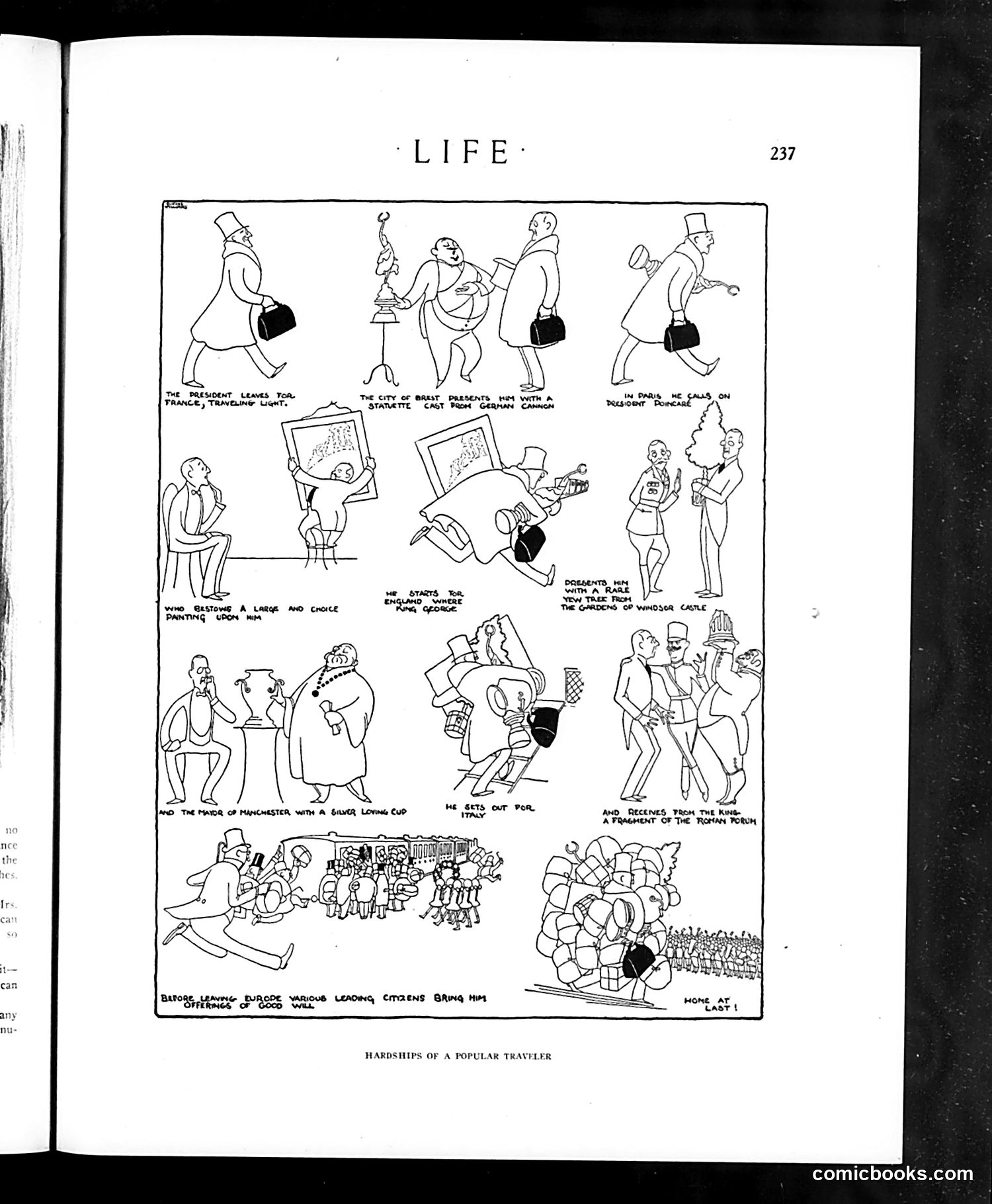
This cartoon satirizes the exhausting demands placed on a prominent public figure—likely a politician or celebrity—who travels extensively. The sequence depicts escalating complications: the traveler departs with minimal luggage, receives elaborate civic honors (a statue presentation), endures physical mishaps (falling with luggage), participates in formal ceremonies, encounters various social obligations, and ultimately faces overwhelming crowds of well-wishers upon returning home. The humor lies in contrasting the glamour of being a "popular traveler" with its actual burden—constant ceremonies, formal dinners, public appearances, and the relentless attention of crowds. The final panel shows the traveler literally buried under masses of people, suggesting that popularity becomes physically exhausting and inescapable. The cartoon mocks both celebrity culture and the social expectations placed on prominent travelers.
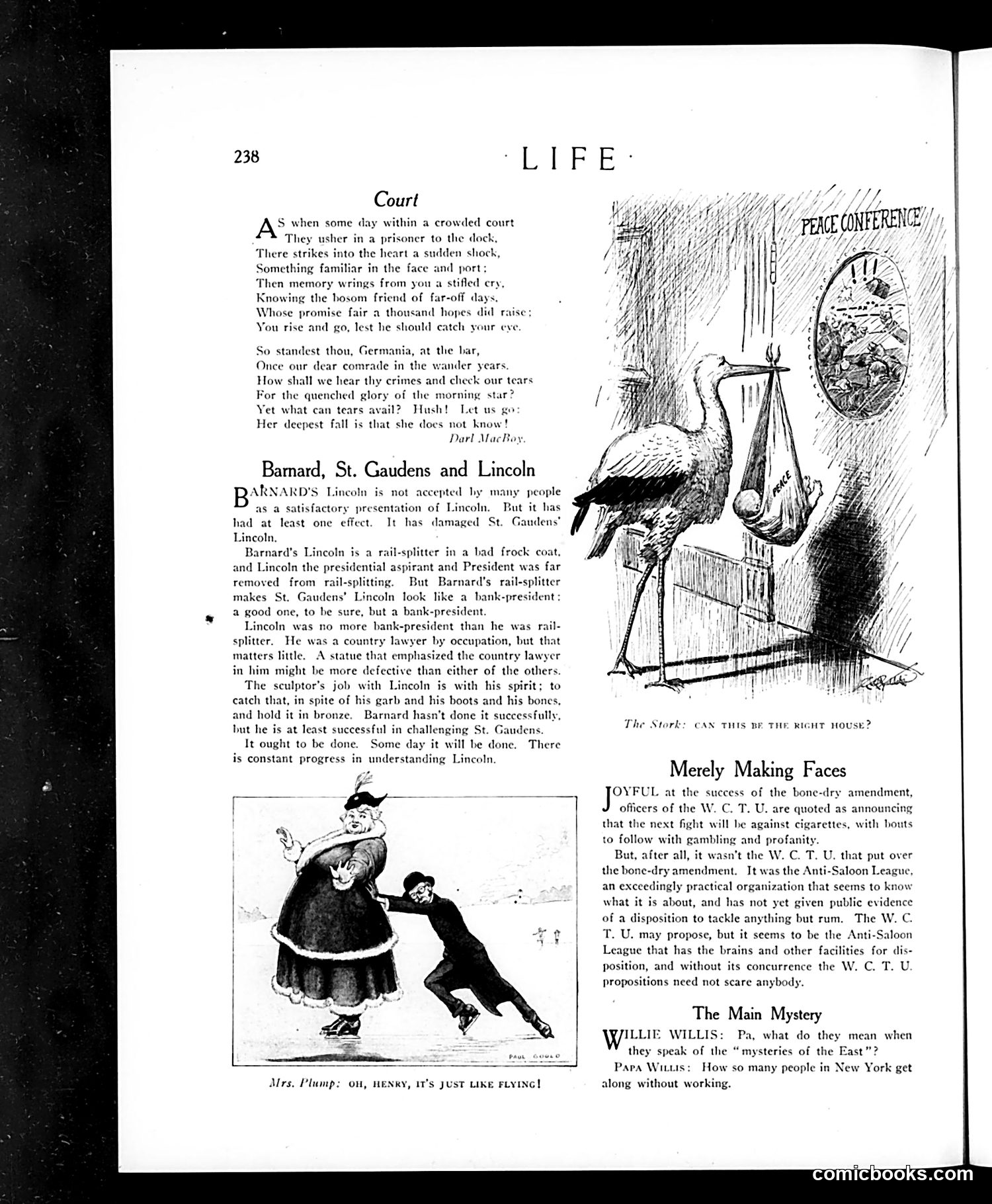
This page contains three separate pieces of satirical content: 1. **"Court"** — A poem addressing "Germannia" (Germany personified), lamenting a fallen comrade, likely referencing WWI losses. 2. **"Barnard, St. Gaudens and Lincoln"** — A critical essay comparing three artistic representations of Lincoln. It argues Barnard's sculpture better captures Lincoln's actual character (a country lawyer with grit) than St. Gaudens' more polished, "bank-president" version. 3. **"Merely Making Faces"** and **"The Main Mystery"** — Brief humor pieces mocking Prohibition-era reform organizations (the Anti-Saloon League) and satirizing New York's economic mysteries. The cartoons accompanying these pieces use exaggeration and visual humor typical of Life's satirical style to mock contemporary political and social issues.
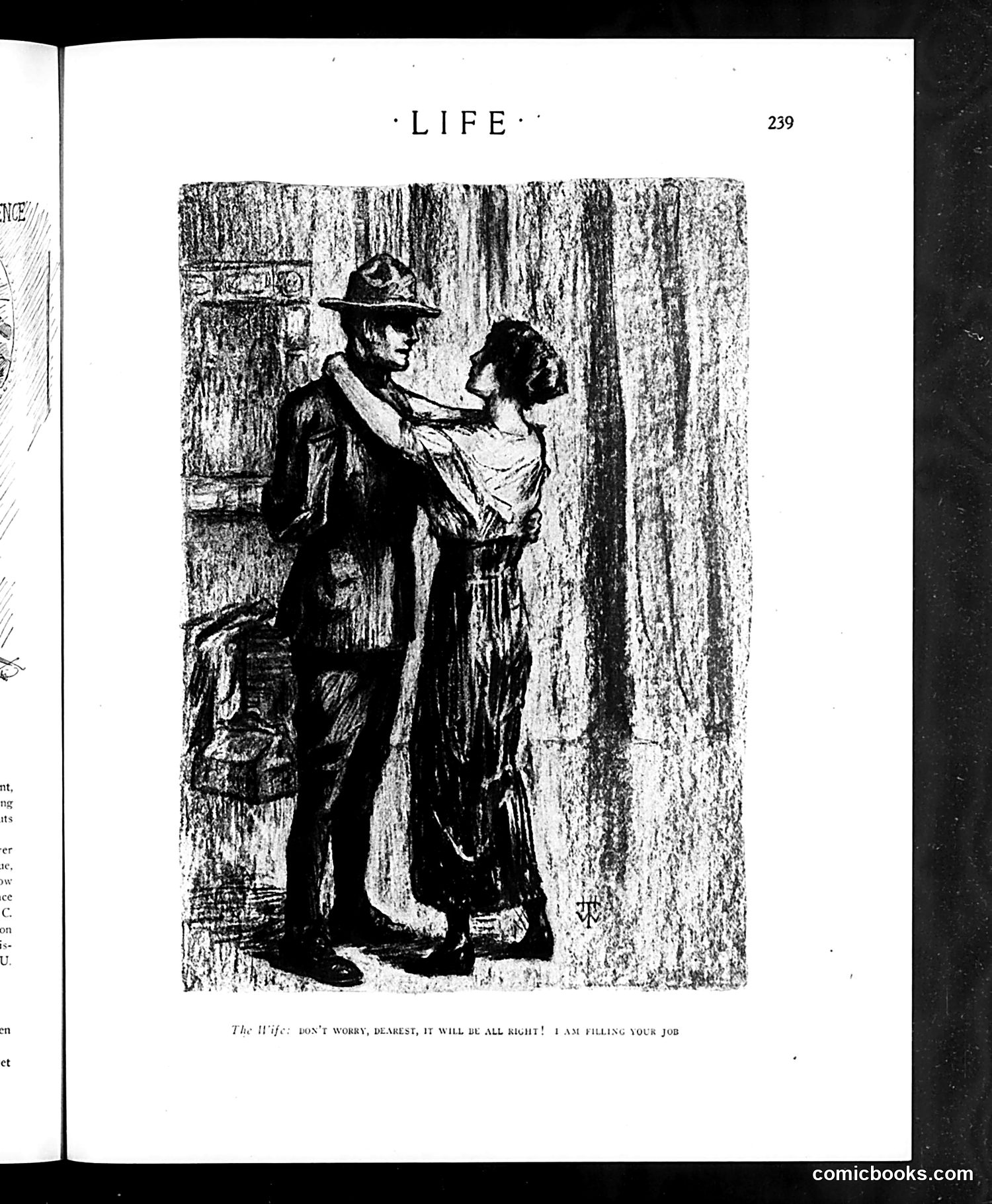
This page from *Life* magazine (page 239) contains a single illustration with accompanying caption. The image depicts a man in a dark suit and wide-brimmed hat standing against a wall, embracing or restraining a woman in light clothing. The caption reads: "The Wife: 'DON'T WORRY, DEAREST, IT WILL BE ALL RIGHT! I AM FILLING YOUR JOB'" This appears to be satirizing early 20th-century gender roles and wartime labor dynamics. The joke likely references women entering the workforce during a period when men were absent (possibly military service), with the wife reassuring her husband that she'll manage his job—a commentary on women's emerging economic independence and the social anxieties this generated. The illustration's intimate pose and the wife's confident declaration suggest gentle satire of changing domestic and professional relationships.
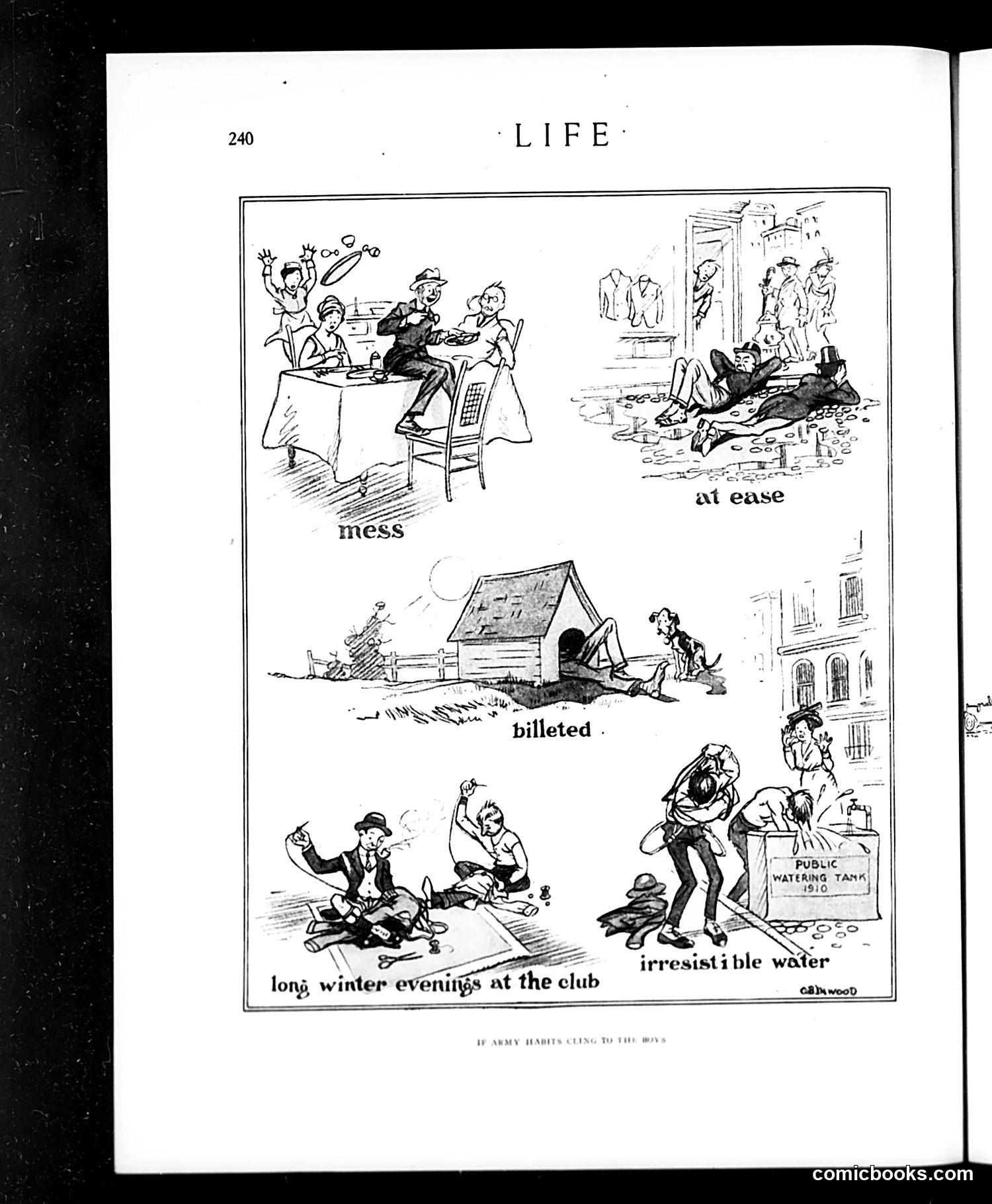
This page contains five satirical cartoon panels depicting social vices or undesirable behaviors among what appears to be upper-class men. Each panel is labeled: - **"mess"**: Chaotic dining scene with food flying - **"at ease"**: Man lounging indolently on a street - **"billeted"**: Man entering/inhabiting a small shelter - **"long winter evenings at the club"**: Men gambling or engaged in idle activities - **"irresistible water"**: Man being drawn toward a public watering tank (1910) The page's subtitle reads "IF ARMY HABITS CLING TO THE BOYS," suggesting these panels critique poor behavioral habits allegedly acquired or reinforced through military service. The satire targets slovenliness, laziness, homelessness, gambling, and alcoholism as persistent soldier behaviors that carry over into civilian life.
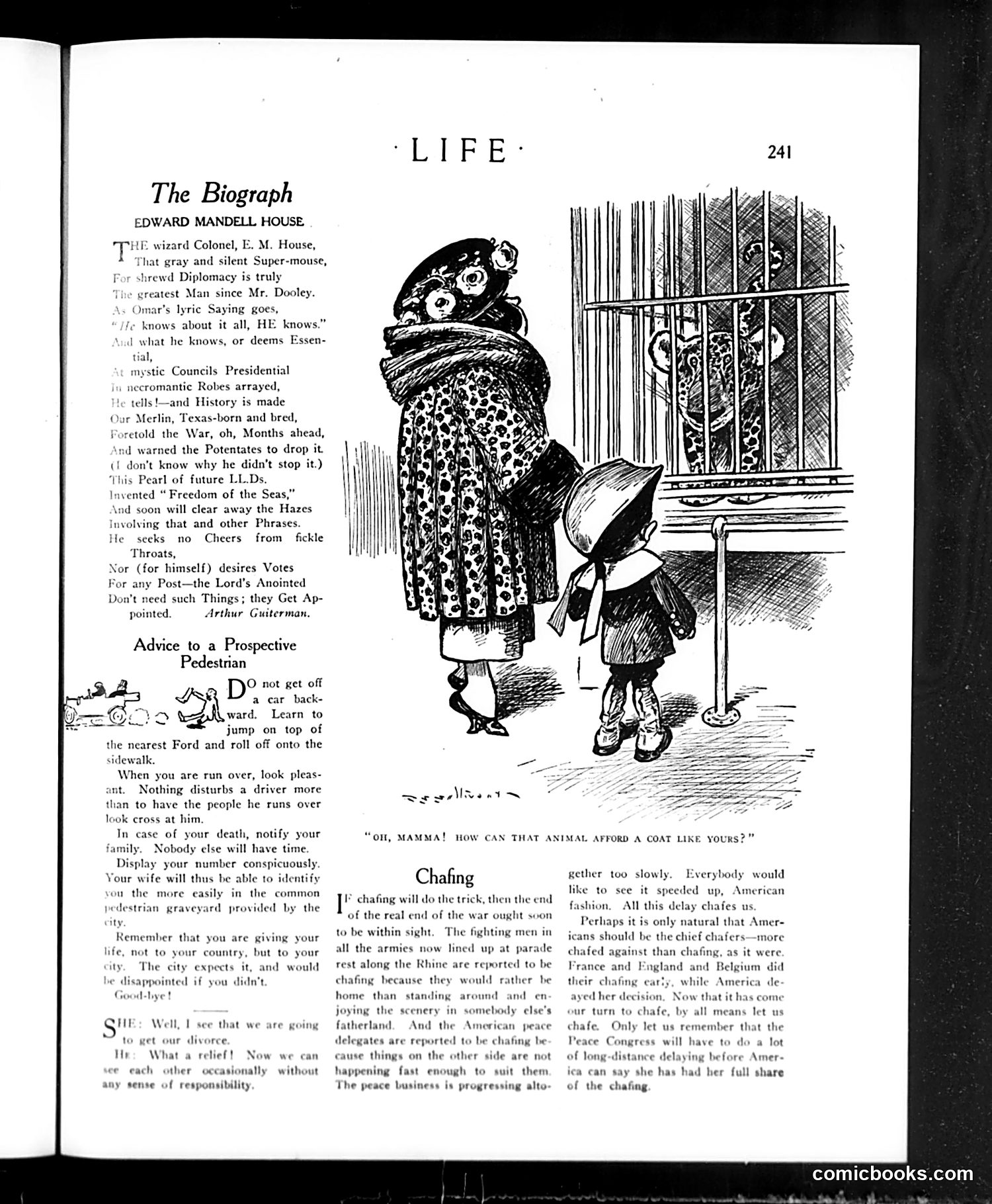
This page contains two satirical pieces from the post-WWI era: **"The Biograph"** (top left) is a poem by Arthur Guiterman mocking Colonel E.M. House, described as a "gray and silent Super-mouse" involved in diplomatic negotiations. It satirizes his role in peace negotiations, inventing phrases like "Freedom of the Seas." **The illustration** shows a well-dressed woman in a luxurious coat speaking to a child, captioned: "Oh, Mamma! How can that animal afford a coat like yours?" This is ironic social commentary on wealth inequality and conspicuous consumption. **"Chafing"** (bottom) discusses post-war delays in peace negotiations, suggesting American delegates are "chafing"—growing impatient—while peace talks drag on. It criticizes the slow diplomatic process preventing soldiers' return home.
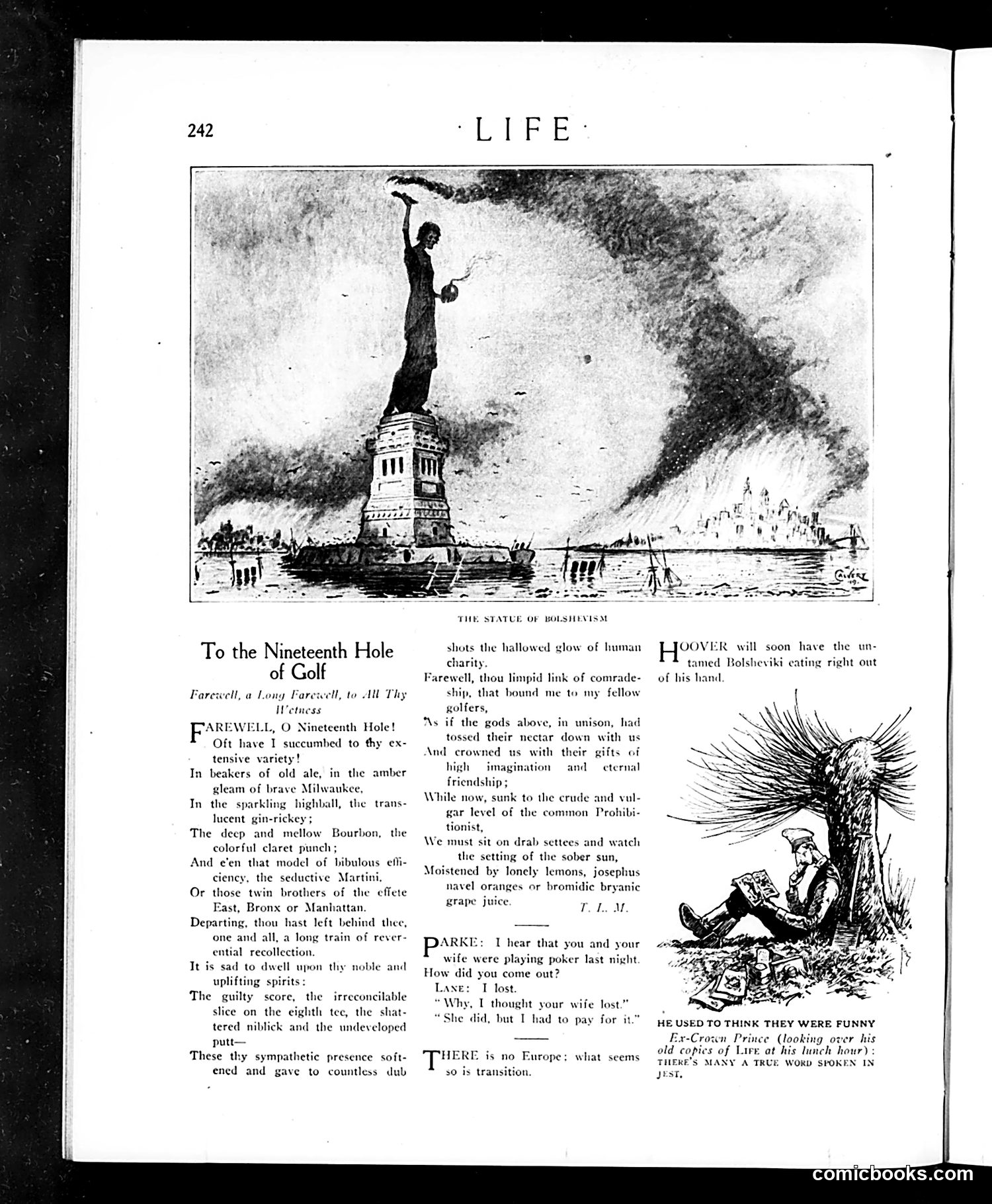
This page contains a poem "To the Nineteenth Hole of Golf" (a golf reference) and two satirical cartoons. **Top illustration:** "The Statue of Bolshevism" depicts the Statue of Liberty transformed into a Bolshevik figure with fire and destruction in the background. This reflects anti-communist sentiment following the Russian Revolution, portraying the spread of Bolshevism as a threat to American values. **Bottom cartoon:** Shows two men discussing poker losses. One claims his wife "lost" money; the other assumes he had to pay her back. The caption indicates these men "used to think they were funny," suggesting satire about changing attitudes or behavior, possibly related to Prohibition-era social changes or shifting gender dynamics in post-WWI America. Both pieces reflect early 20th-century American anxieties about radical politics and social transformation.
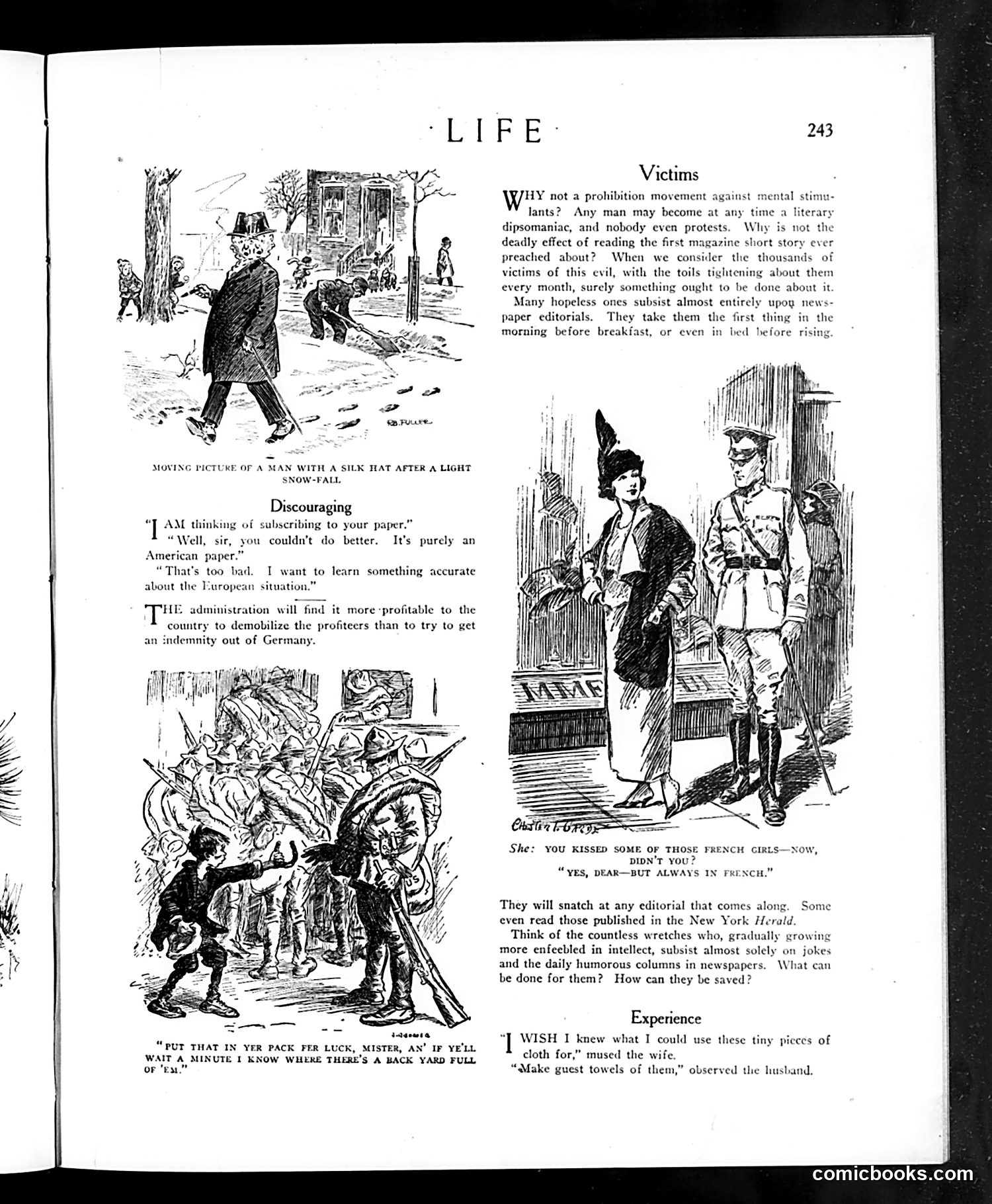
This page contains satirical commentary on post-WWI social issues. The "Victims" section critiques newspapers' focus on sensationalism (mental stimulants, literary dipsomaniacs) rather than serious problems affecting society's vulnerable. The "Discouraging" dialogue mocks American isolationism—a character dismisses European news as unprofitable compared to domestic profiteering. A cartoon depicts soldiers, likely referencing wartime experiences and their aftermath. The "Experience" section shows a domestic scene where a wife suggests using scraps as guest towels, and the husband quips about making them from cloth—satire on post-war economic hardship and domestic adjustment. The French kiss joke references American soldiers' romantic encounters abroad during WWI. Overall, the page satirizes American indifference to international affairs, profiteering, and economic struggles following the war.
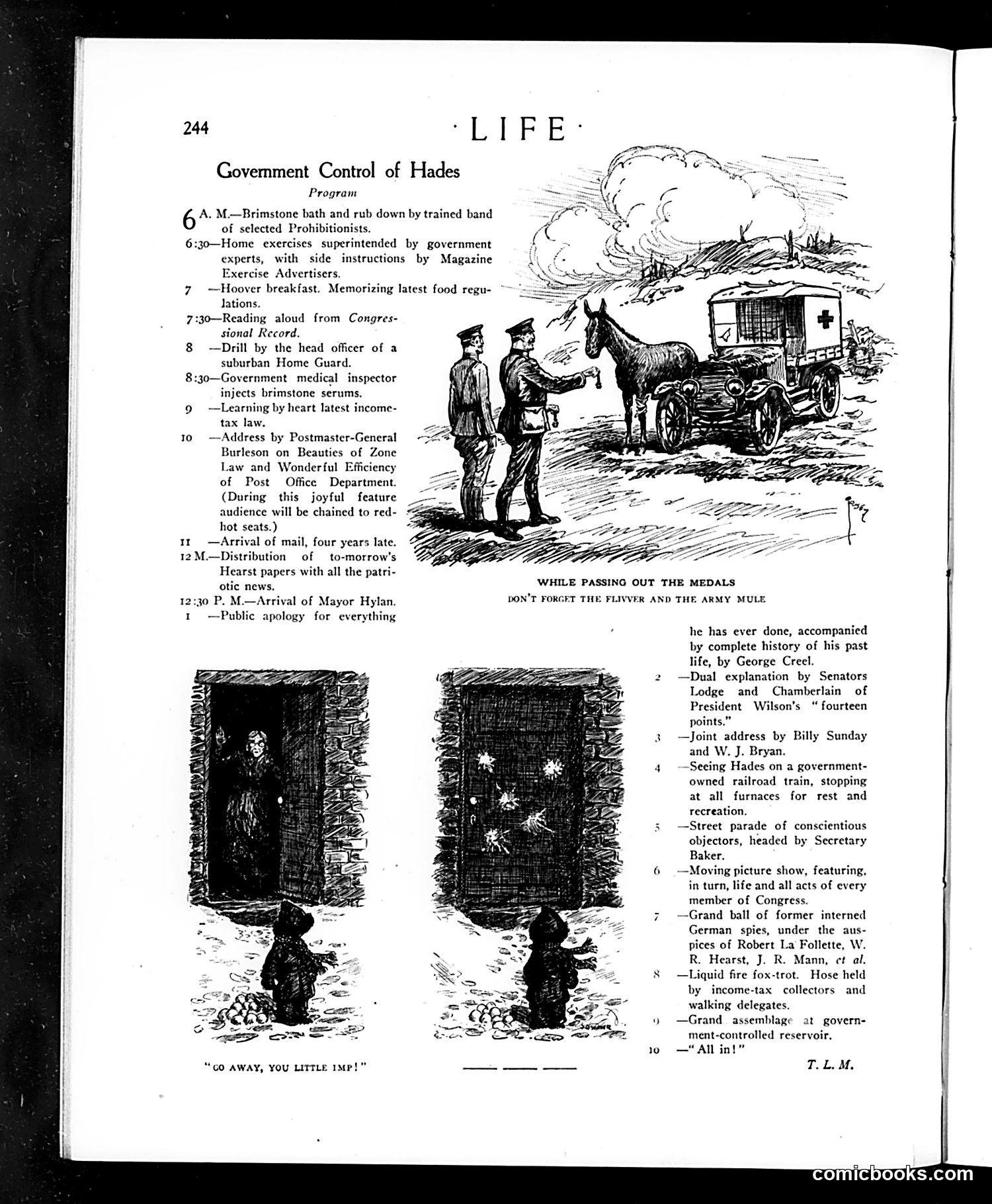
This is a savage satirical "program" mocking American government overreach during the Wilson administration (likely WWI era). The joke: Hell itself has been federalized, run by the same incompetent or tyrannical officials tormenting the living. The targets include: - **Prohibitionists** (alcohol ban enforcers) - **Herbert Hoover** (food rationing administrator) - **Postmaster-General Burleson** (censorship enforcer) - **Mayor Hylan** (NYC politician) - **George Creel** (propaganda chief) - **Senators Lodge and Chamberlain** (Wilson critics) - **Religious figures** (Billy Sunday, W.J. Bryan) The satire attacks government control of daily life (food, mail, income taxes, censorship), conscription, and the post-WWI political chaos. The cartoon bottom-left shows a small demon being expelled, captioned "GO AWAY, YOU LITTLE IMP!"—suggesting bureaucrats are worse than Hell itself. The message: wartime/postwar government expansion is so oppressive that even the damned would prefer actual demons.
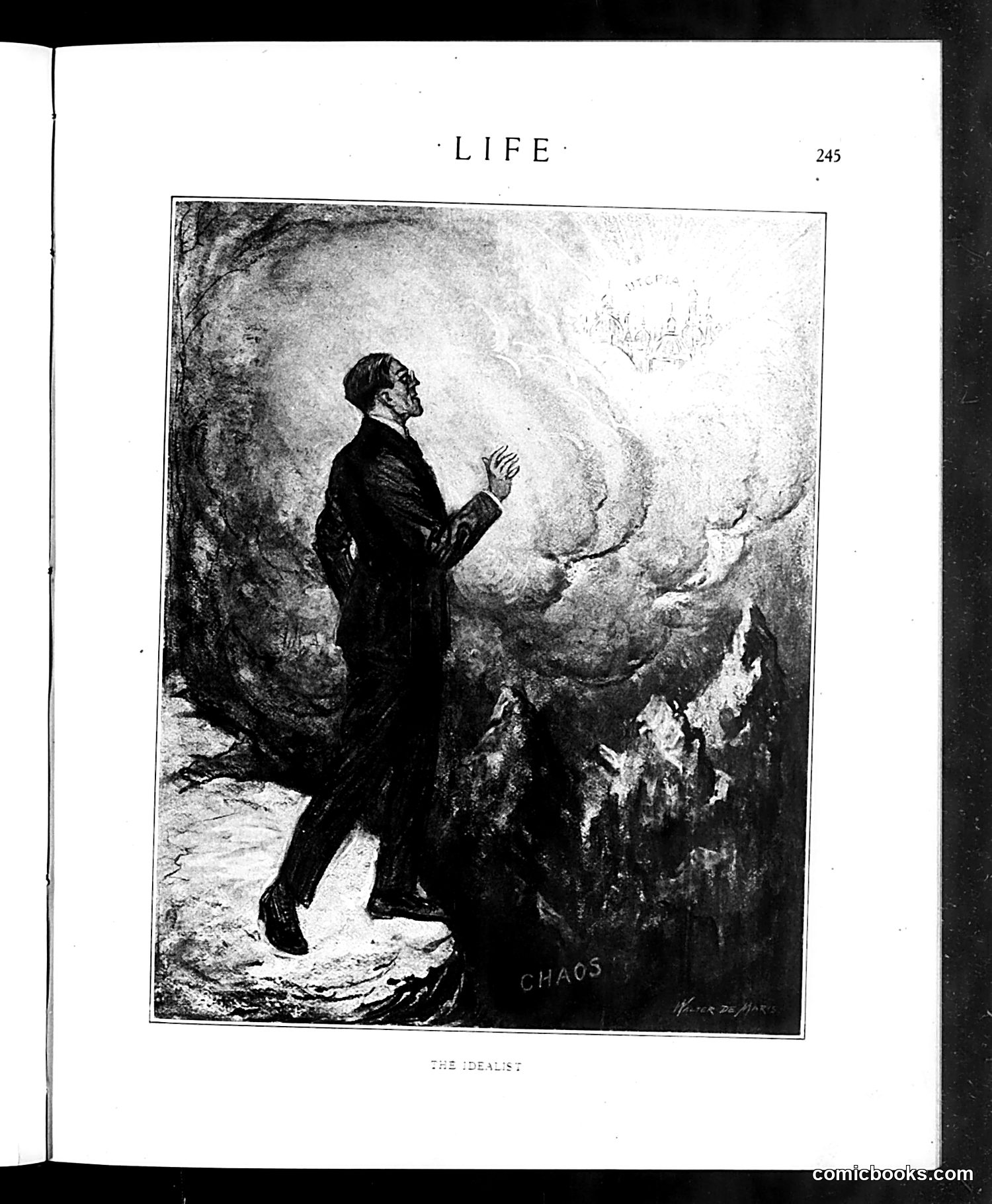
This political cartoon depicts a man in formal Victorian-era dress standing on rocky ground, gesturing toward swirling chaos and fire in the background. The word "CHAOS" is visible in the lower right. The title "THE IDEALIST" suggests this is satirizing someone advocating idealistic principles or radical change. The figure appears to be an orator or reformer, gesturing passionately while chaos erupts behind him—implying the cartoon critiques idealists whose grand visions lead to destructive outcomes. Without the publication date visible, the specific political figure or movement referenced is unclear, but the satire targets the gap between idealistic rhetoric and chaotic practical consequences, a common theme in Life magazine's political commentary during the late 19th/early 20th century.
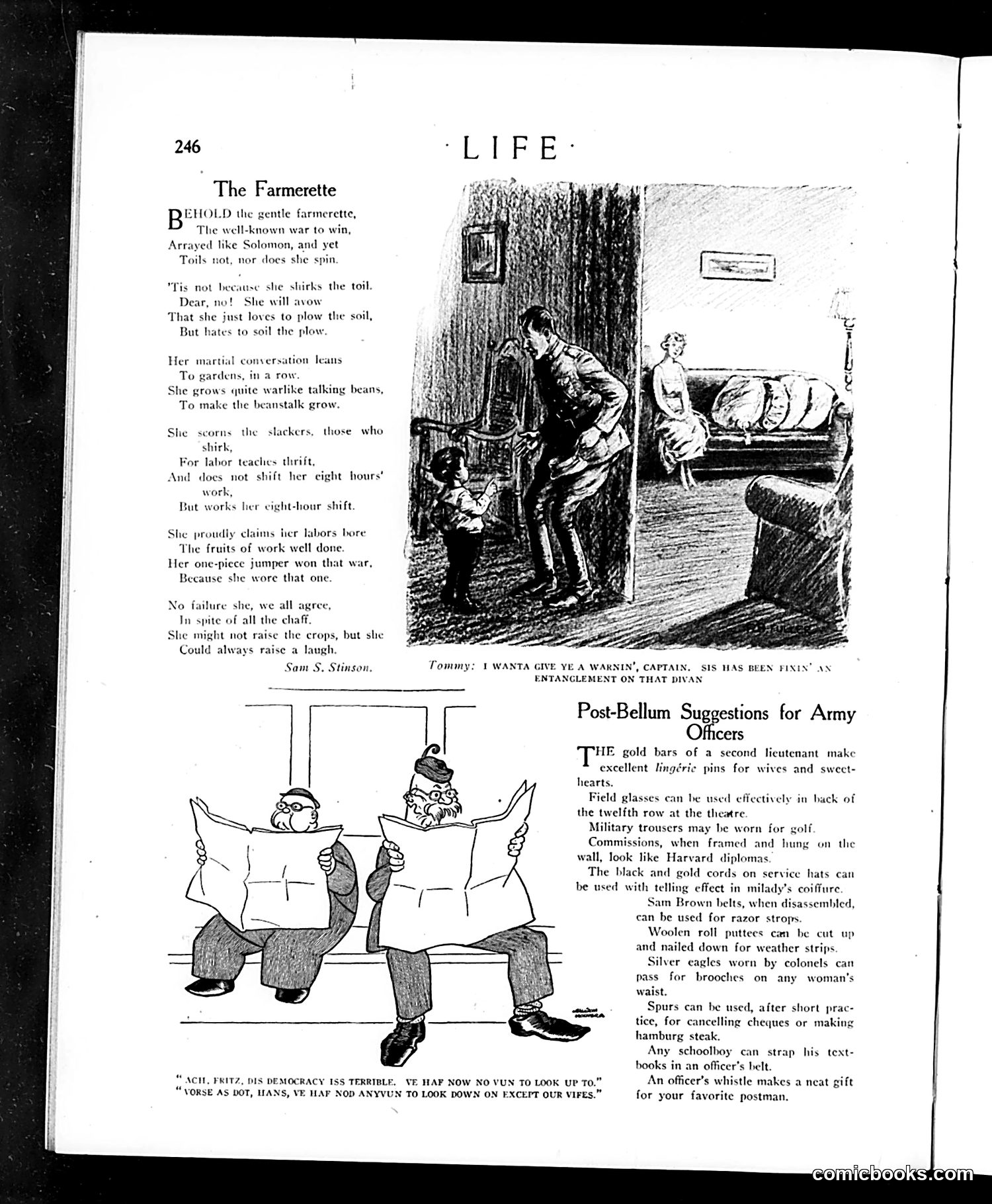
**"The Farmerette" Poem:** This satirizes women war workers during WWI. The poem mocks the "farmerette"—women recruited for agricultural labor during the war—as ineffectual and vain. She loves talking about farming but "hates to soil the plow," scorns slackers, yet actually fails to raise crops. The joke: her real contribution was merely *existing* in her one-piece jumper, not actual productivity. It's gentle mockery of romanticized female patriotism versus practical competence. **Lower Cartoon:** Two German soldiers (identifiable by dialect: "ACH, FRITZ," "VORSE AS DOT, HANS") lament democracy's destruction of hierarchy. Previously, they had superiors to respect and inferiors to dominate. Now, they joke bitterly, they can only look down on their wives. The satire targets German militarism and rigid class structure while suggesting American democracy's leveling effect—presented as both progress and emasculation depending on perspective. **"Post-Bellum Suggestions":** Satirizes officers' wives monetizing military insignia and equipment for fashion accessories and household goods—absurdist humor about peacetime materialism replacing martial purpose.
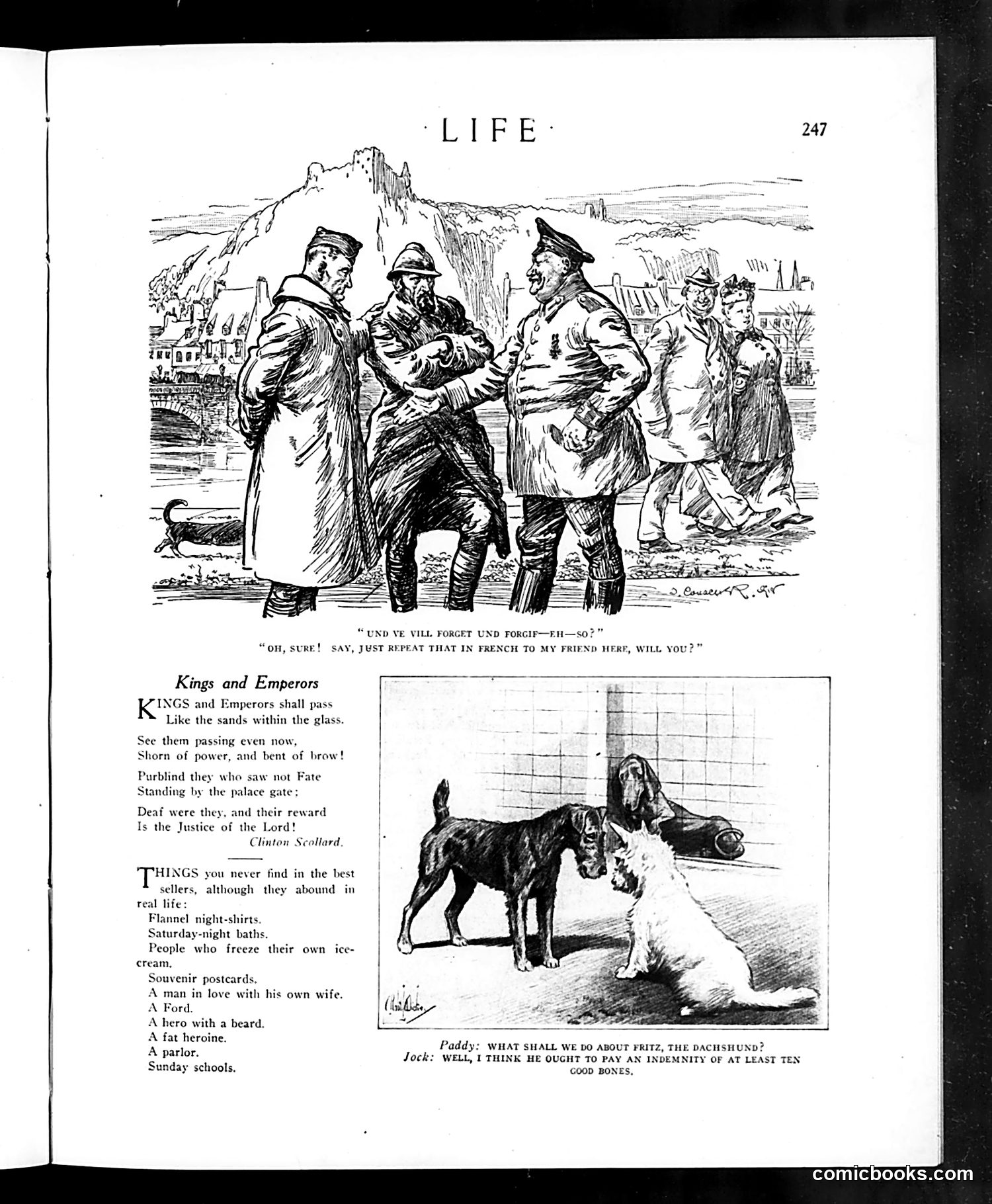
The top cartoon depicts WWI-era soldiers, likely American and British officers, with one attempting to repeat German phrases ("und ve vill forget und forgif") to a French officer. The satire mocks the difficulty of post-war reconciliation—the broken German accent emphasizes the absurdity of expecting former enemies to forgive and forget quickly after devastating conflict. The bottom illustration shows two dogs discussing a dachshund ("Fritz")—a German breed name that became a derogatory term for Germans during WWI. The joke about demanding an "indemnity" references actual post-war reparations imposed on Germany, here absurdly applied to a pet dog. This reflects contemporary anti-German sentiment and the punitive Treaty of Versailles negotiations. The "Kings and Emperors" poem appears to celebrate the fall of European monarchies and their wartime leadership, presenting it as divine justice for their blindness to fate.
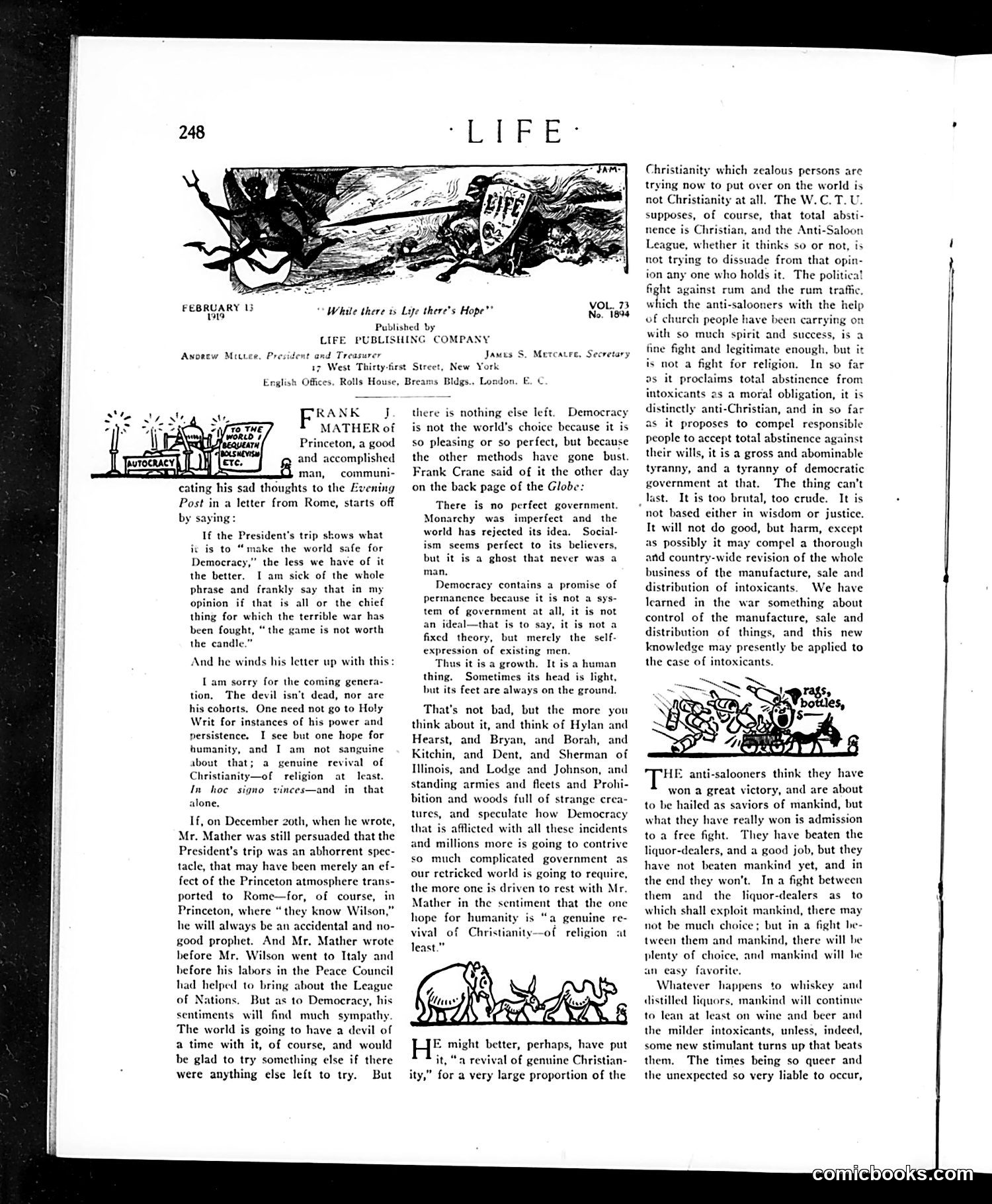
This page critiques President Wilson's post-WWI diplomatic efforts and discusses democracy's viability. Frank Mather of Princeton, writing from Rome, expresses disillusionment that the war was fought for "making the world safe for Democracy" — questioning whether democracy is worth defending. The editorial responds by arguing democracy persists not from idealism but because other systems (monarchy, socialism) have failed. It's described as humanity's self-expression rather than fixed theory. However, the piece sarcastically undermines this by listing contemporary politicians (appears to reference Hylan, Hearst, Bryan, Borah, Lodge, Johnson) and complications (prohibition, militaries) that make democracy seem unworkable. The concluding criticism targets religious organizations like the WCTU and Anti-Saloon League, arguing they misrepresent Christianity by conflating temperance legislation with genuine faith—suggesting zealous reformers have corrupted authentic religion.
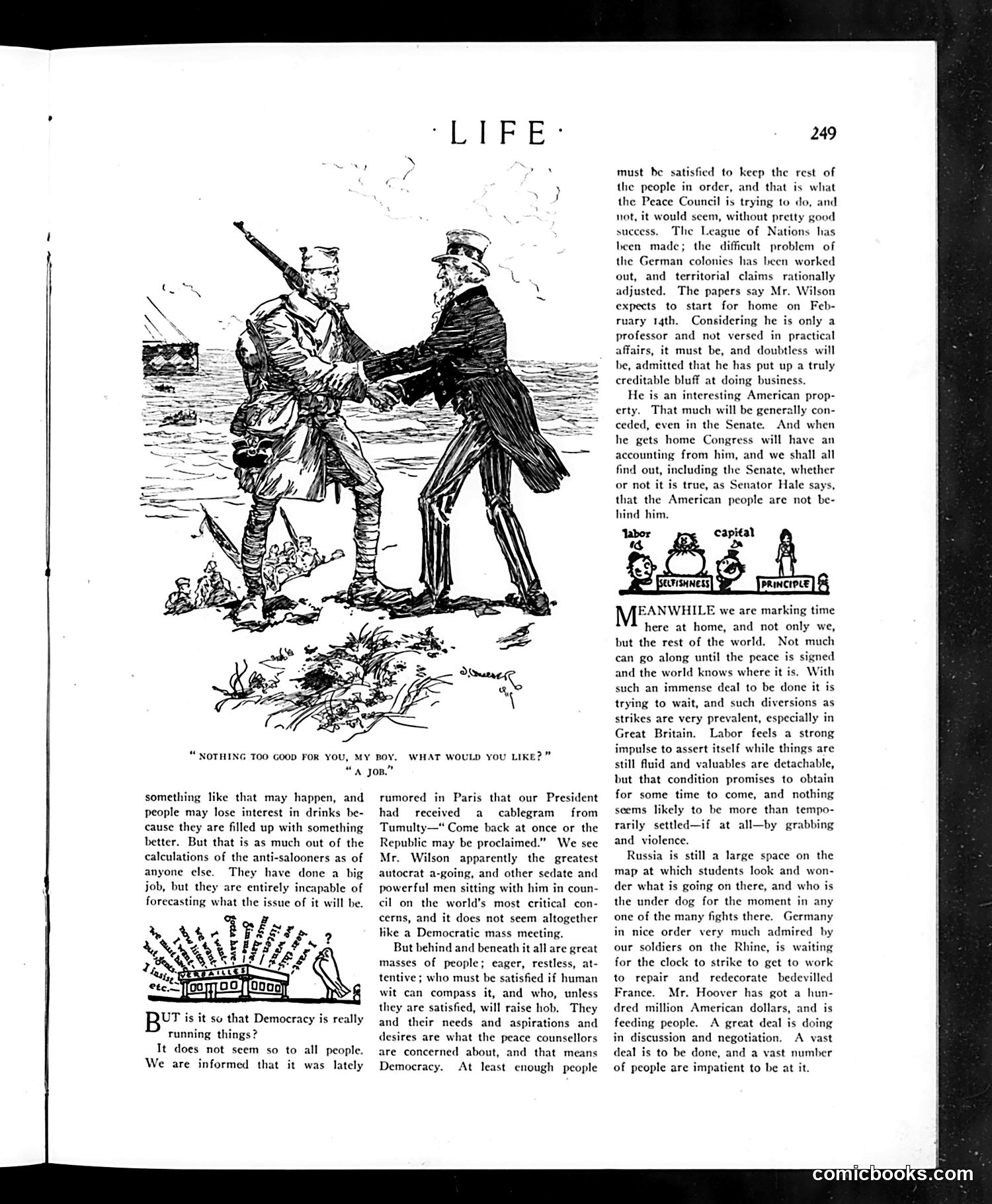
The main cartoon depicts a soldier offering a job to a civilian, captioned "Nothing too good for you, my boy. What would you like? A job." This appears to reference post-war employment concerns and labor unrest. The article discusses President Wilson's role at the Paris Peace Conference (evidently early 1919), sarcastically praising his diplomatic accomplishments despite being "only a professor." It notes rumors he might be recalled to preserve "the Republic," suggesting concerns about executive overreach. The piece addresses broader anxieties: whether democracy is actually functioning when powerful men negotiate world affairs; labor's restlessness in Britain and elsewhere; the uncertain situation in Russia and Germany; and widespread impatience for peace settlements and economic stability. The overall tone suggests both cautious optimism about peace-making progress and anxiety about post-war social instability—strikes, unemployment, and whether ordinary people will accept the outcomes being negotiated.
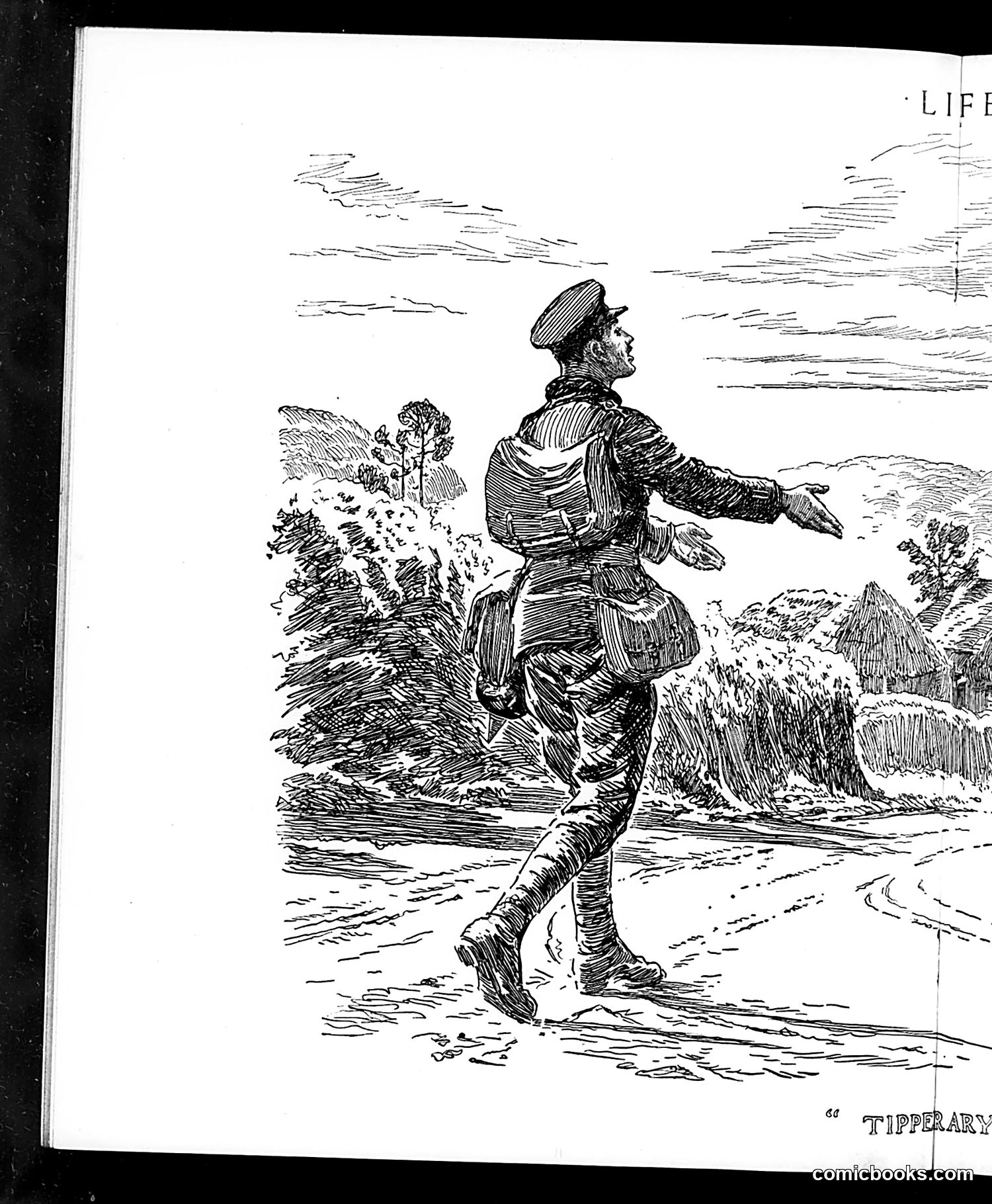
This is a pen-and-ink illustration from *Life* magazine's "Tipperary" section (visible at bottom). The image shows a soldier in WWI-era military uniform and cap, striding confidently across a rural landscape with trees and thatched structures. The soldier appears to be an Irish or British infantryman, given the uniform style and the "Tipperary" reference—likely alluding to the famous WWI marching song "It's a Long Way to Tipperary." The confident, forward-striding pose suggests patriotic enthusiasm or determination. The illustration likely satirizes or comments on military recruitment, wartime morale, or soldiers' optimism about combat during World War I. The rural Irish setting combined with the soldier's energetic posture may be commentary on recruitment efforts or national pride during the war period.
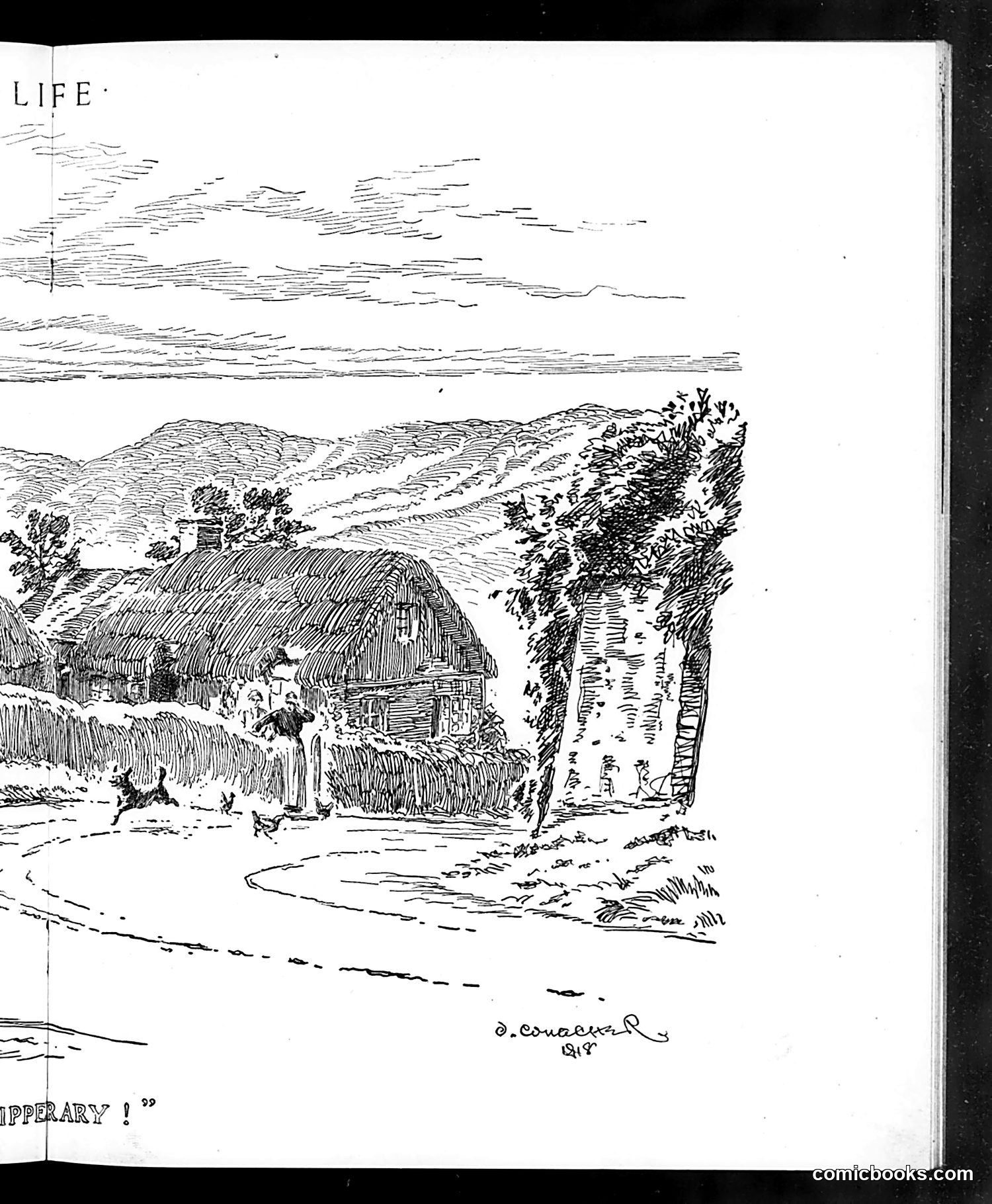
This page contains a pen-and-ink illustration titled "LIFE" showing a rural landscape with a thatched cottage, rolling hills, vegetation, and figures in the foreground. The signature appears to read "S. Covarrubias" with a date. However, the OCR'd text is severely corrupted and illegible—it appears to be mostly scanning artifacts rather than actual readable content. Without clear text to work from, I cannot identify the specific satirical point, political references, or social commentary this illustration was meant to convey. The image itself depicts a peaceful countryside scene, but without accompanying legible caption or article text, the cartoon's intended meaning—who it depicts, what it satirizes, or what event it references—**remains unclear**. To properly explain the satire to a modern reader would require readable OCR text or clearer source material.
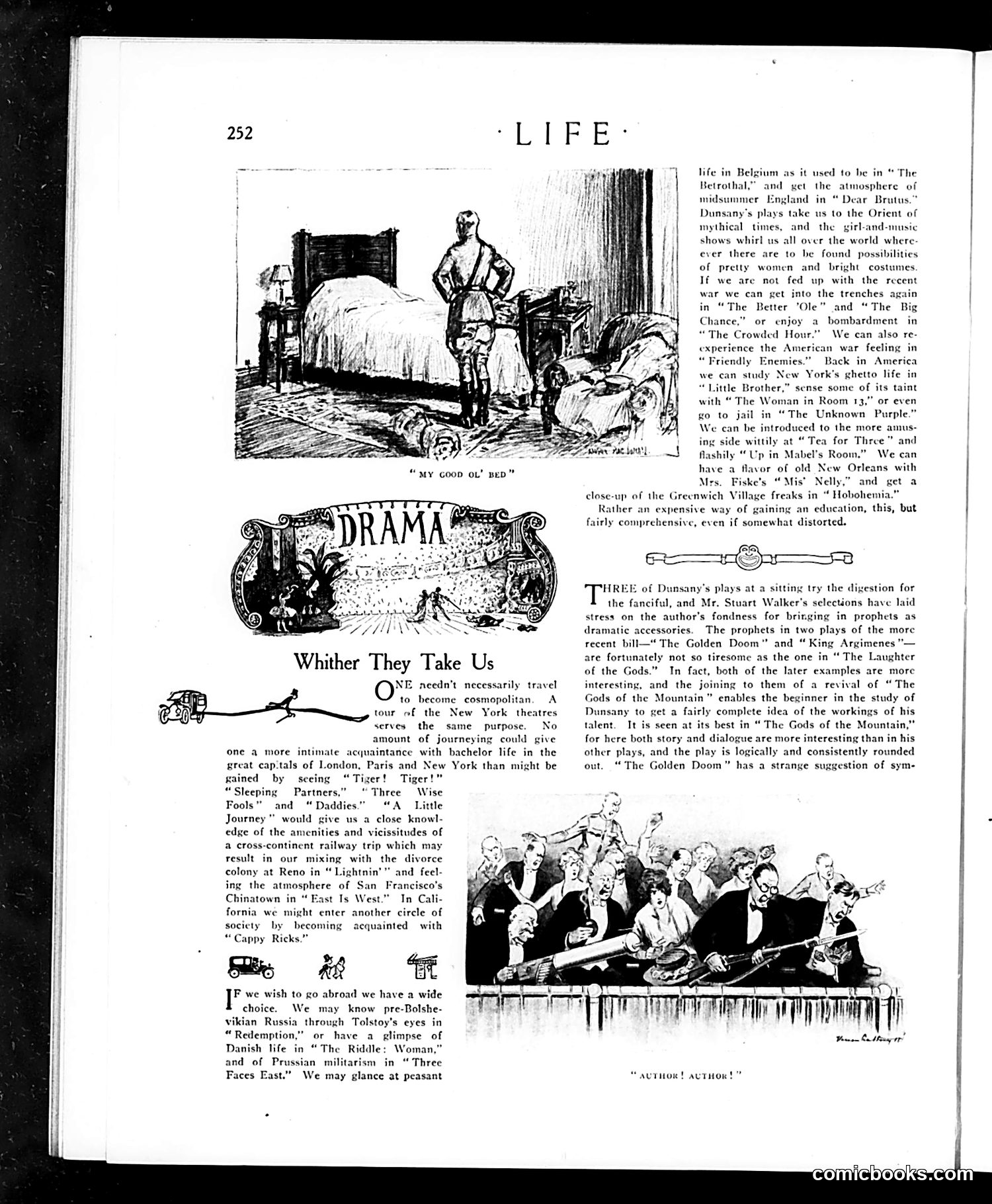
This page reviews theatrical offerings available to New York audiences circa 1920s. The satire's point: attending Broadway plays provides a cost-effective (if "somewhat distorted") education about world cultures and lifestyles without travel. The article catalogs plays thematically—showing how theater permits "armchair tourism": seeing pre-revolutionary Russia via Tolstoy adaptations, experiencing Prussian militarism, observing San Francisco's Chinatown, exploring divorce-colony life at Reno, studying New York's ghetto, and sampling Greenwich Village bohemianism. The bottom illustration labeled "AUTHOR! AUTHOR!" depicts a theatrical curtain call with the audience applauding performers—a standard theater scene emphasizing the page's focus on stage productions. The separate review discusses Lord Dunsany's plays, praising "The Gods of the Mountain" as his most coherent work while finding his prophetic characters sometimes tedious. The critique suggests Dunsany's strength lies in story and dialogue rather than his reliance on mystical dramatic accessories.
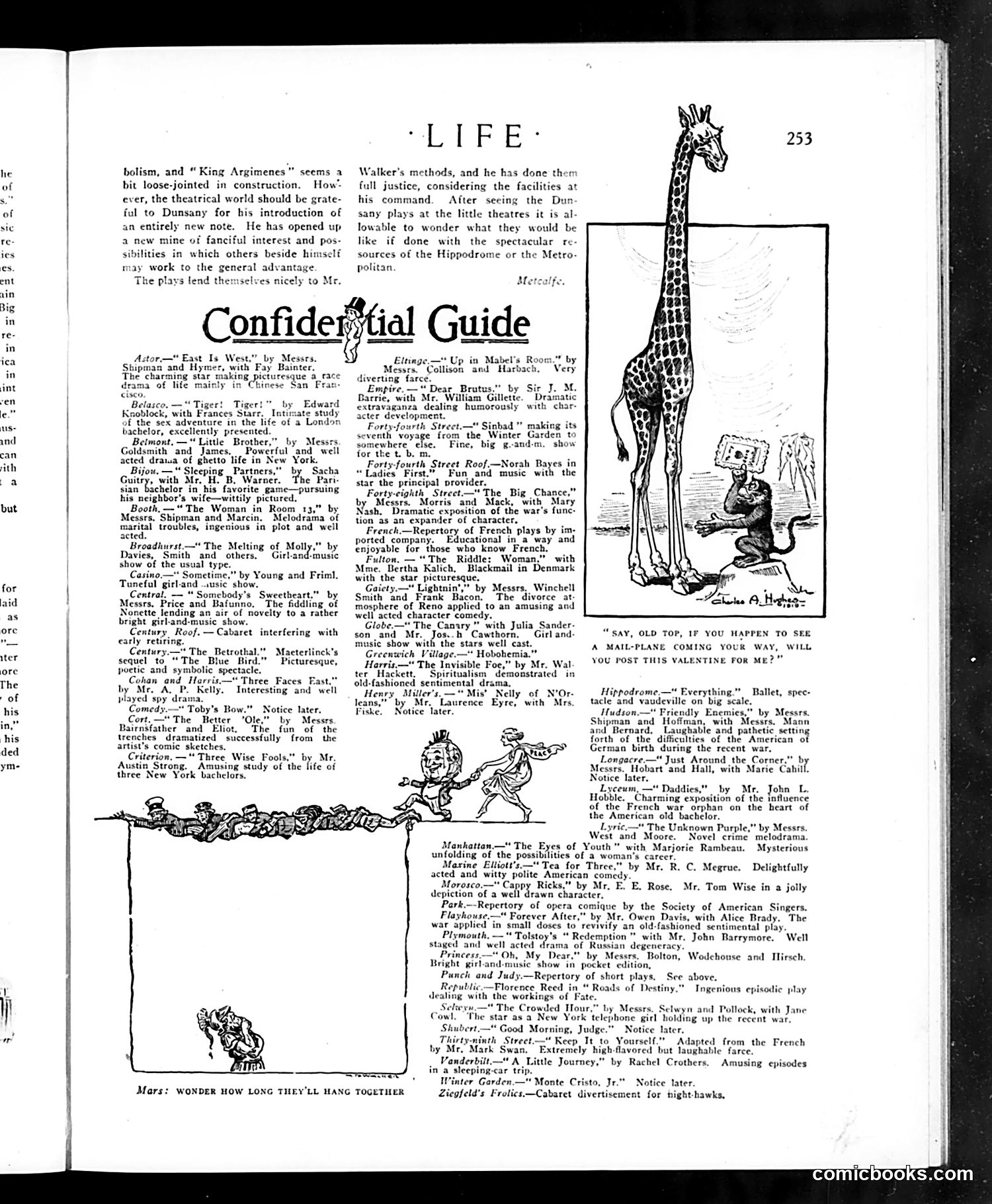
This page is primarily a **theatrical review column** titled "Confidential Guide," listing Broadway productions with brief critiques. The satirical content appears in the **illustrations**: The main cartoon shows a giraffe with a small human figure posting a valentine on its neck, captioned "Say, old top, if you happen to see a mail-plane coming your way, will you post this valentine for me?" This is **WWI-era satire** mocking the nascent aviation industry and wartime communication. The absurdist humor—asking an animal to mail something via airplane—reflects contemporary bewilderment at modern technology. Below is a smaller illustration of two figures labeled "Mars: wonder how long they'll hang together," likely satirizing marital instability or war's social disruptions. The theatrical reviews themselves contain mild social commentary on contemporary plays addressing character development, divorce, and wartime themes, but the page's primary satire is visual rather than textual.
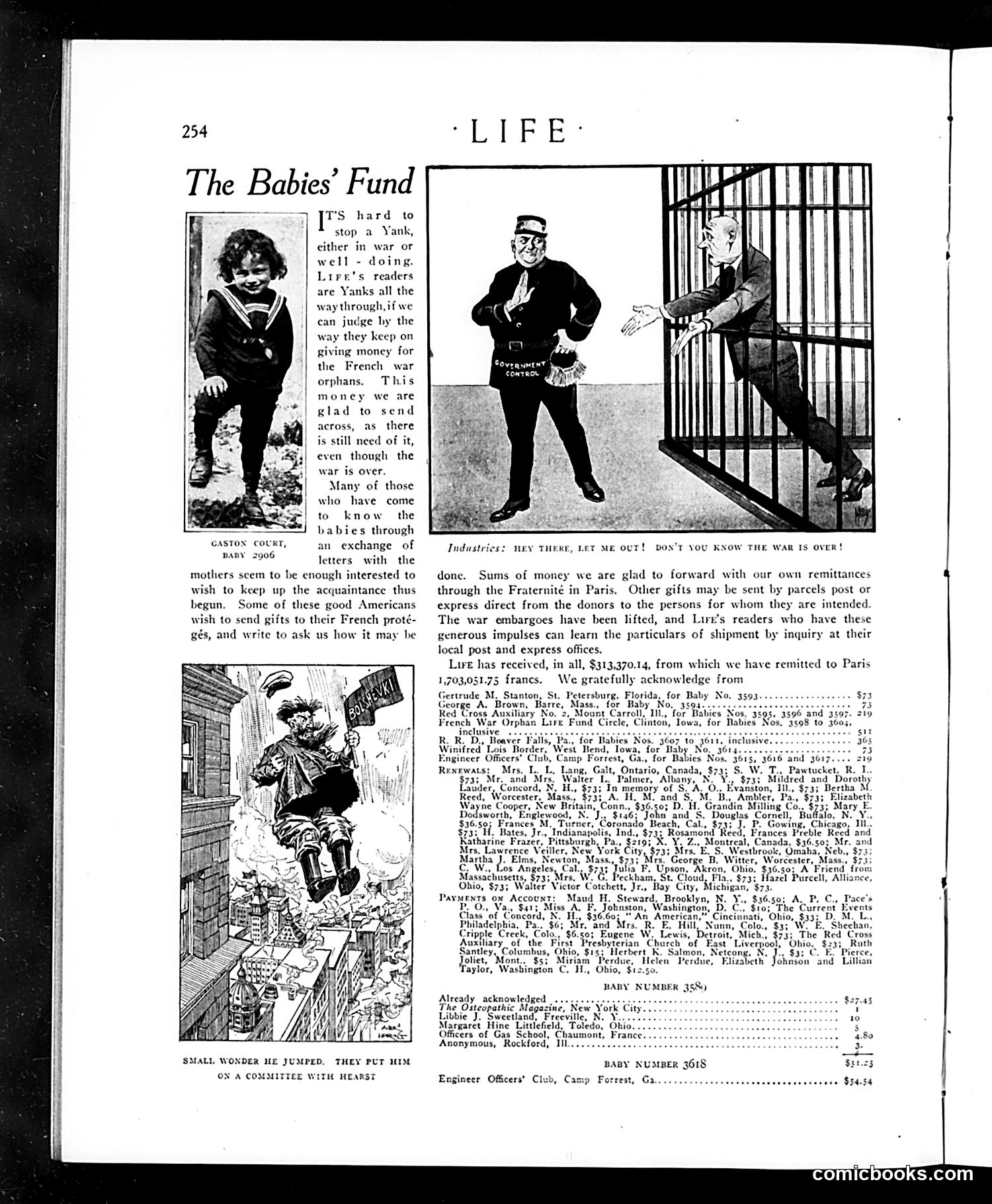
This page documents Life magazine's charitable campaign supporting French war orphans following World War I. The article explains that American readers have donated over $313,000 to help French children, with funds remitted through the "Fraternité in Paris." The cartoon at top right shows a caricatured official figure ("Industries") refusing to release a baby from a cage, saying "the war is over"—satirizing bureaucratic obstruction of aid despite the war's conclusion. The bottom cartoon, titled "Small Wonder He Jumped," depicts someone jumping away from a committee meeting—the caption jokes that sitting on a committee "with Hearst" (William Randolph Hearst, the powerful newspaper magnate) would startle anyone. This is satirical commentary on Hearst's reputation or personality. The bulk of the page consists of donor acknowledgments—names and amounts contributed—reflecting the magazine's practice of publicizing charitable giving during this postwar relief effort.
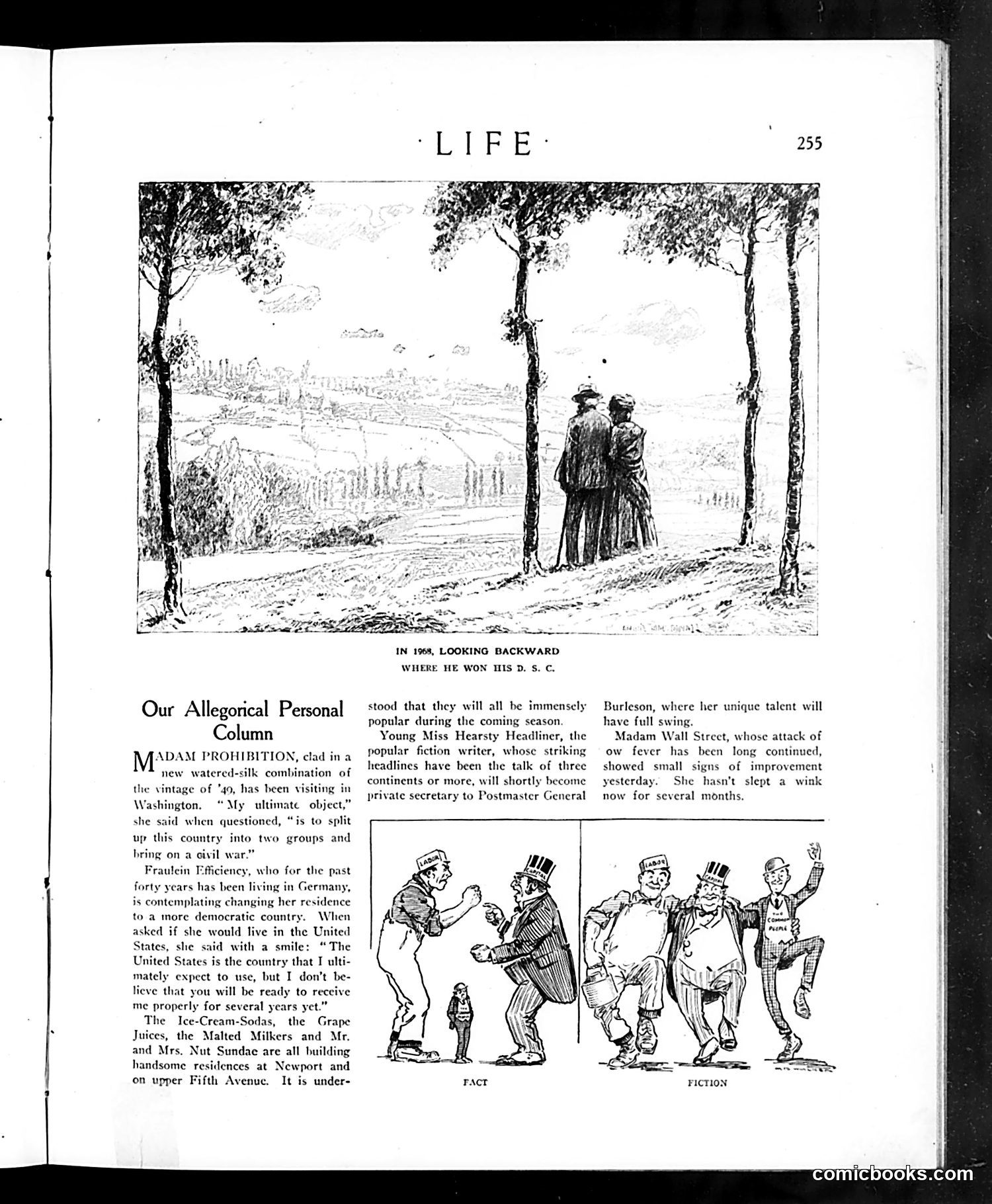
This page satirizes American social and political figures through allegorical "personal column" gossip. Key targets: **"Adam Prohibition"** represents the Prohibition movement itself, depicted as wanting to split the country and cause civil war—mocking anti-alcohol activists as destructive extremists. **"Fraulein F.E."** appears to represent Germany, suggesting it won't consider America "ready" for years—likely commentary on post-WWI international relations and American isolationism. The lighter social satire mocks wealthy elites: ice cream sodas and malted drinks as nouveau-riche building Newport mansions, and "Young Miss Hearsty Headliner" (possibly referencing William Randolph Hearst's publications) becoming a postmaster's secretary. **"Madam Wall Street"** suffers "ow fever" (likely "cow fever"?) with chronic insomnia—satirizing financial markets' instability and stress. The cartoon contrasts "FACT" and "FICTION," though their specific meaning is unclear from this excerpt alone.
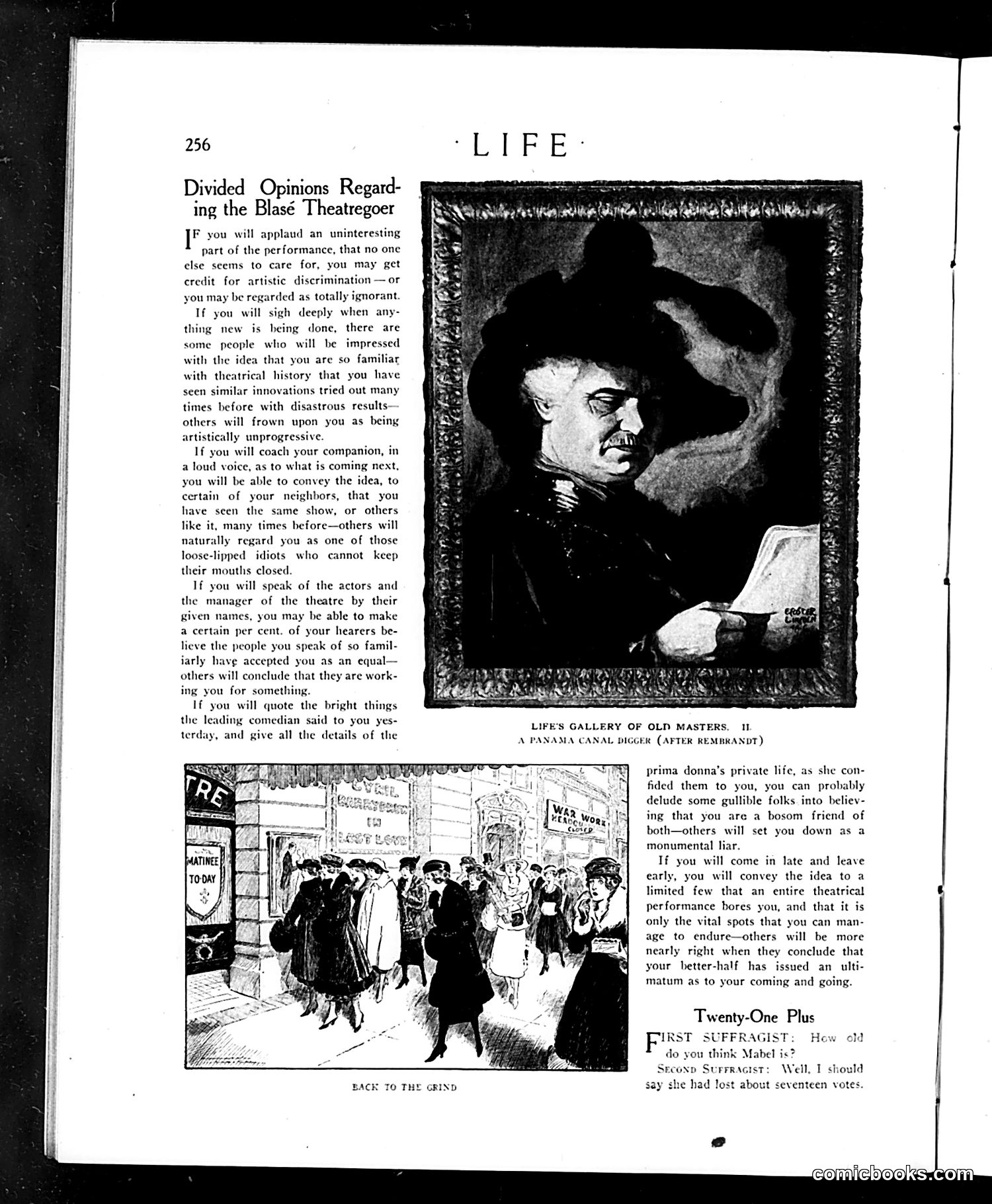
This page satirizes the social pretensions of theatergoers through a guide on how different behaviors at performances will be misinterpreted by audiences. The humor lies in showing that whatever one does at the theater—applauding unpopular moments, sighing at innovations, coaching companions, name-dropping actors, quoting comedians, or arriving late—will be judged negatively by *someone*, making it impossible to appear genuinely sophisticated. The two illustrated scenes show theater crowds ("Back to the Grind" depicts ordinary theatergoers); the upper portrait references old master paintings to mock theatrical pretension. The "Twenty-One Plus" joke at bottom addresses women's suffrage: a suffragist estimates a woman's age as "seventeen votes," implying women voters were relatively new and numerically significant in elections.
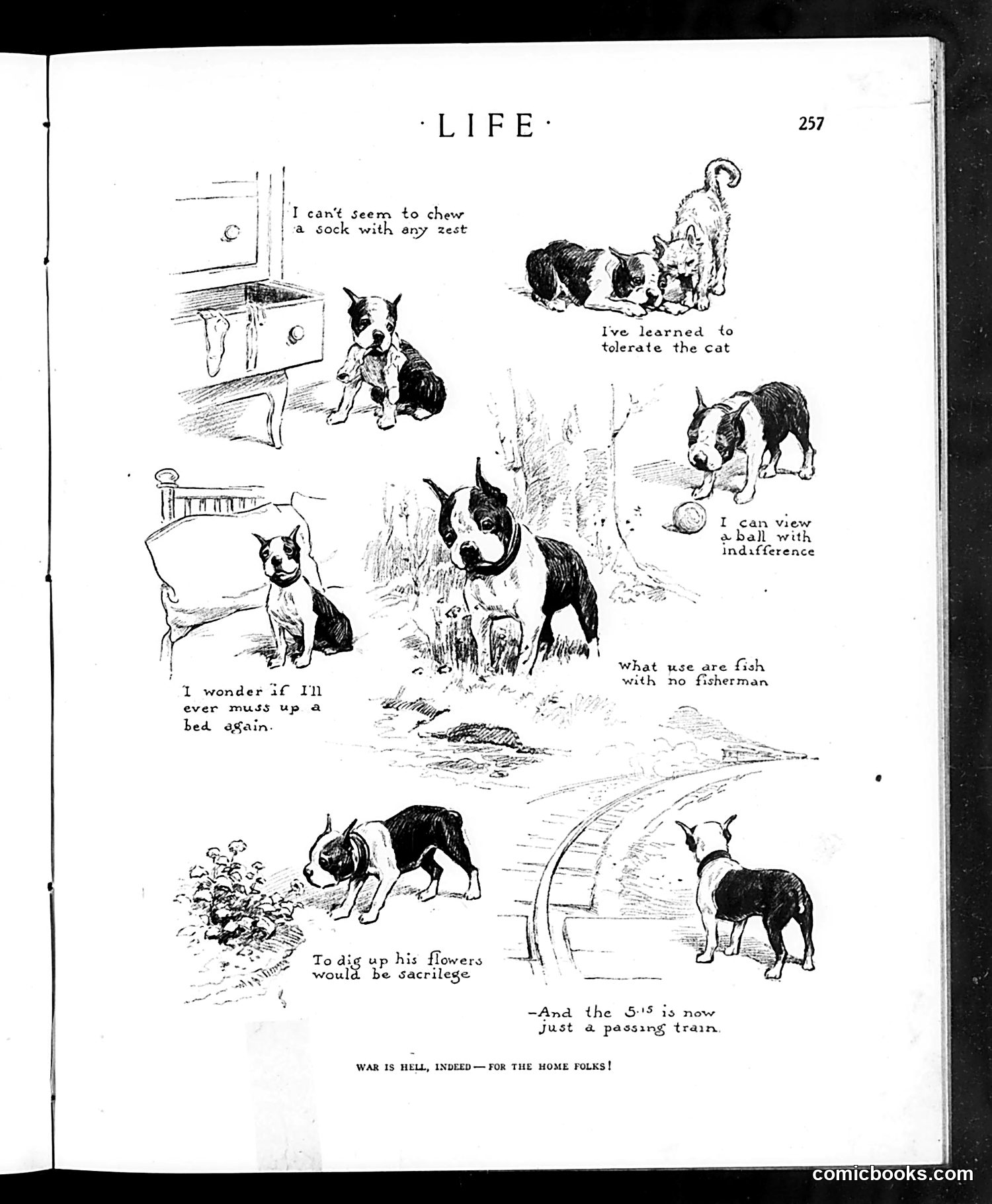
This is a humorous single-page comic from Life magazine depicting a dog's complaints about home life during wartime (likely WWI era, given the "5'15" train reference and "war is hell" closing line). The dog expresses various frustrations: inability to chew socks, forced tolerance of the cat, indifference toward balls, and questioning the usefulness of fish without a fisherman to catch them. He wonders if he'll ever mess up a bed again and laments that digging up flowers would now be "sacrilege." The final panel—"the 5'15 is now just a passing train"—likely suggests the dog's owner has departed for military service. The caption "War is Hell, Indeed—For the Home Folks!" frames this as domestic inconvenience during wartime: the joke being that the dog's petty grievances represent how war disrupts even trivial home routines when family members enlist or are drafted.
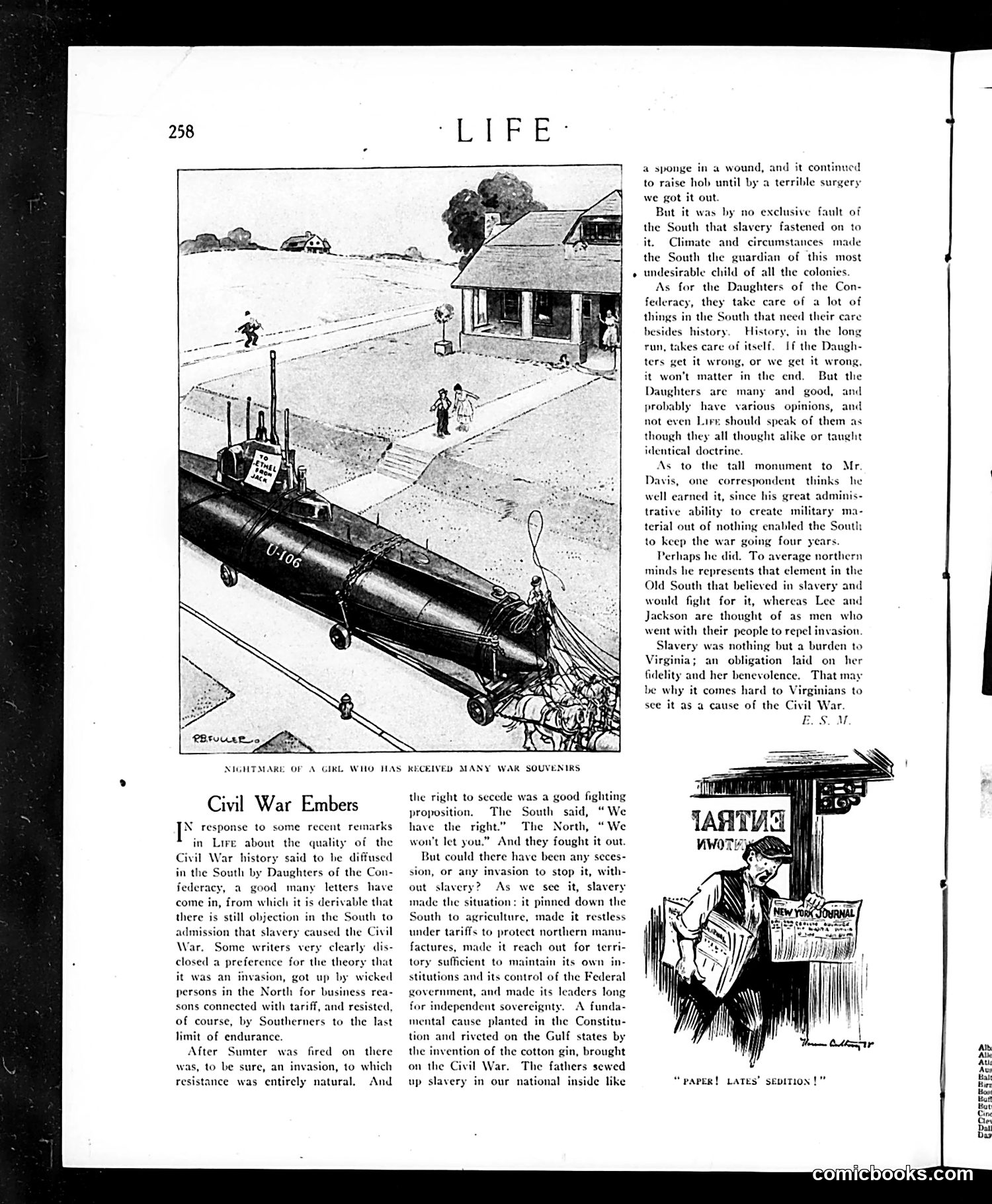
**The Main Cartoon:** The top illustration depicts a nightmare vision of a massive Civil War-era torpedo or submarine labeled "U.S.106" positioned near a rural Southern homestead. A young woman who has "received many war souvenirs" appears to be dreaming this threatening image—visualizing weaponry intruding upon peaceful domestic Southern life. **The Political Context:** The article "Civil War Embers" responds to ongoing Southern resistance to acknowledging slavery as the Civil War's cause. Some Southern groups (particularly the Daughters of the Confederacy) promoted alternative narratives: that Northern economic interests (tariffs, business schemes) provoked the war, or that the South merely defended its right to secede. **Life's Position:** The magazine argues slavery was the "fundamental cause"—embedded in the Constitution and Southern economy through the cotton gin—making secession and invasion inevitable. The cartoon likely satirizes Southern anxiety about Northern military power and their selective memory regarding slavery's role. **The Satire:** By depicting weaponry invading Southern domestic peace, Life mocks the South's victim narrative while insisting historical accuracy matters more than comfortable mythology.
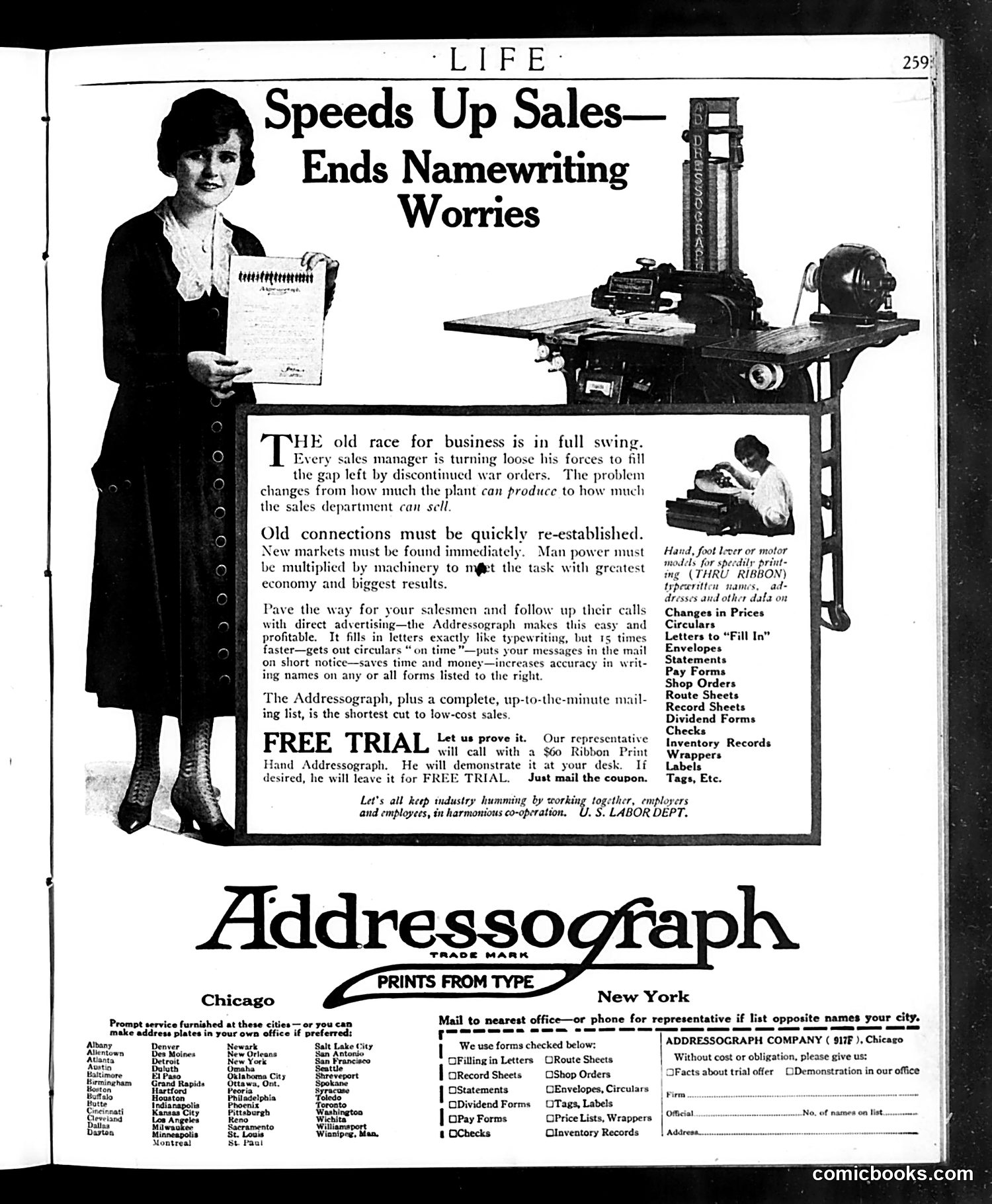
This is primarily a **business advertisement**, not political satire. It appeared in *Life* magazine during the post-World War I economic transition (likely early 1920s). The ad promotes the **Addressograph**—a mechanical machine that printed names and addresses on documents, replacing tedious hand-writing. The female figure on the left displays a stack of addressed circulars. **Historical context**: With wartime production ending, American businesses urgently needed to rebuild civilian sales networks. The ad appeals to sales managers' anxiety about efficiency and cost-reduction, positioning the Addressograph as solving the bottleneck of manually addressing thousands of letters and forms. **The pitch**: The machine prints "exactly like typewriting, but 15 times faster" and handles various business forms (invoices, statements, labels, etc.). The small reference to the **U.S. Labor Department** ("Let's all keep industry humming") reflects post-war messaging about labor-management cooperation—though the irony (unstated) is that such labor-saving devices displaced clerical workers, predominantly women.
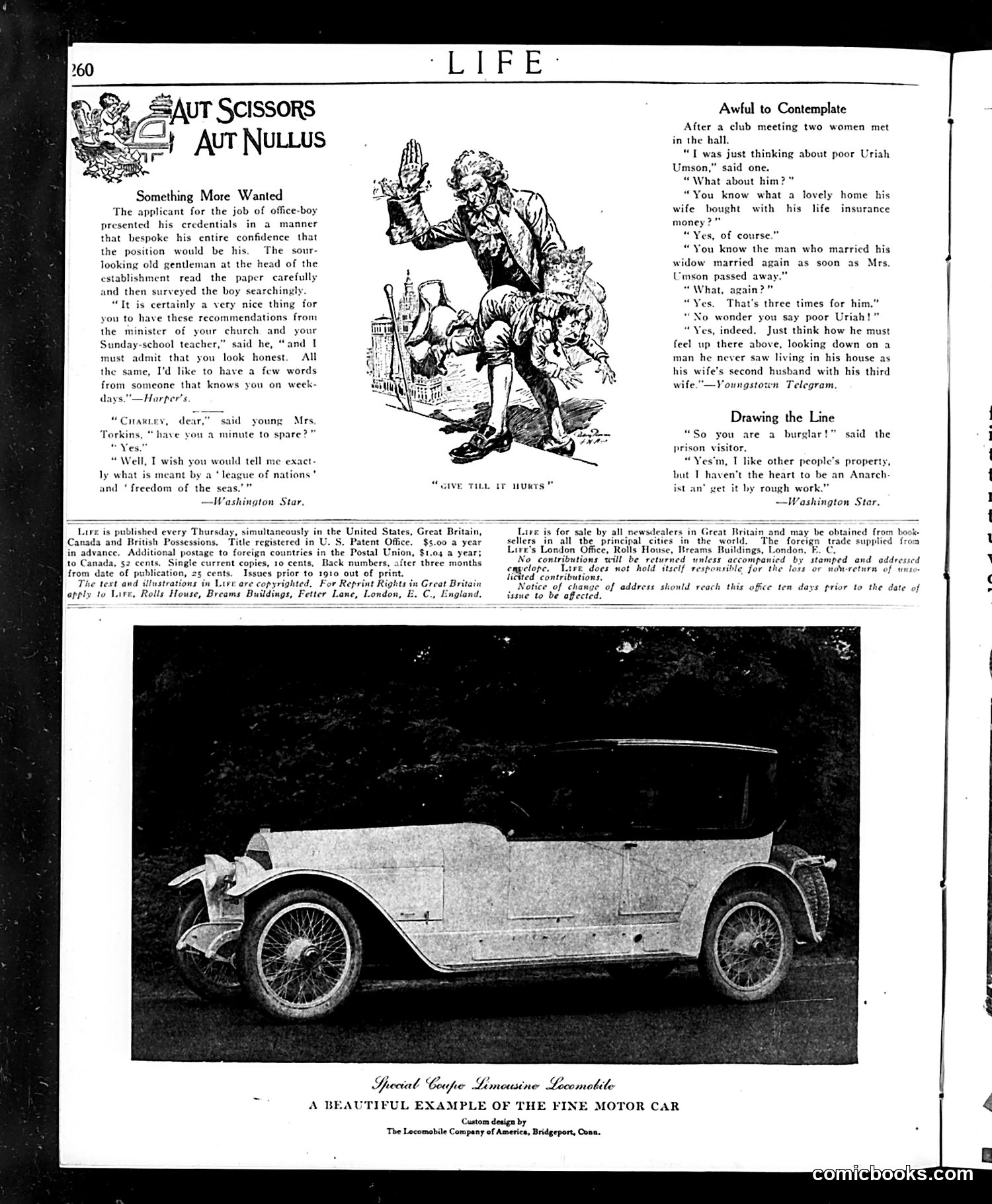
This page contains three separate humorous anecdotes typical of Life's satirical content: 1. **"Something More Wanted"** (Harper's): An office boy applicant presents glowing recommendations from his church minister and Sunday school teacher, but the skeptical employer dismisses them. He wants character references from someone who knows the boy on *weekdays*—implying that moral behavior differs when religious authority isn't watching. The joke mocks the gap between Sunday piety and weekday conduct. 2. **"League of Nations" joke** (Washington Star): A wife asks her husband to explain contemporary political concepts. The humor plays on the technical incomprehensibility of post-WWI international organizations to ordinary citizens. 3. **"Drawing the Line"** (Washington Star): A burglar tells a prison visitor he steals but won't become an anarchist using violence. The satire suggests that even criminals have ethical limits—a dark commentary on social hierarchies of morality. The page also advertises a Lecomobile automobile as "a beautiful example of the fine motor car," representing period consumer goods marketing.
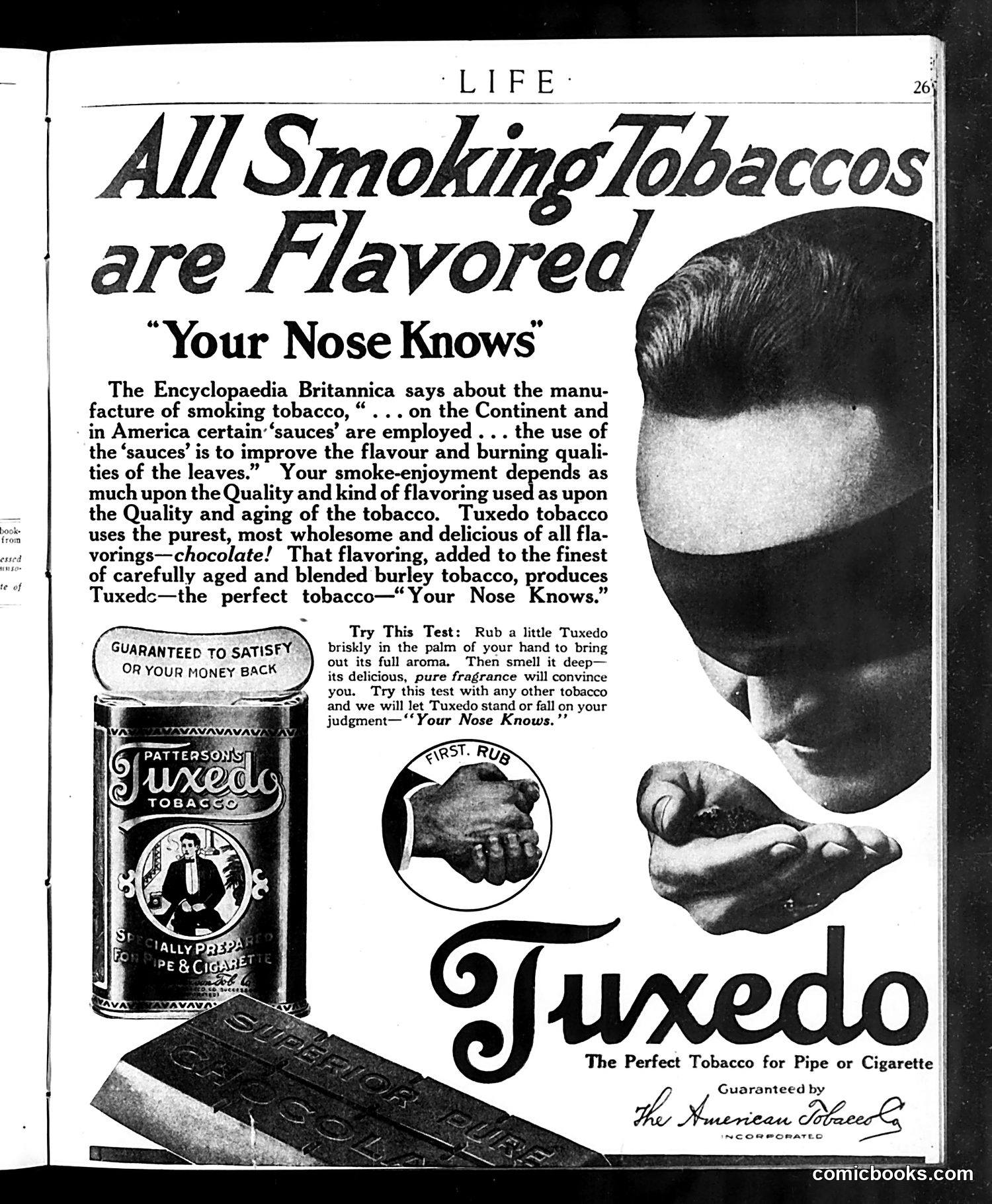
This is a **full-page tobacco advertisement**, not satire or political commentary. It promotes Tuxedo brand smoking tobacco using the slogan "Your Nose Knows." The ad claims Tuxedo uses chocolate flavoring—presented as superior to competitors' flavorings. It cites Encyclopedia Britannica to establish authority, then invites readers to conduct a "smell test" to verify quality. The imagery shows a man's face in profile and a hand demonstrating the rubbing technique described. The "guarantee" promises satisfaction or money back, a common early 20th-century advertising tactic. **For modern readers**: This represents vintage tobacco marketing before health warnings existed. The emphasis on "pure" and "wholesome" flavorings reflects pre-regulation standards. The pseudo-scientific approach (encyclopedia citations, direct sensory tests) typified advertising's persuasion methods in this era. Such ads would be prohibited today due to tobacco advertising restrictions and health disclosure requirements.
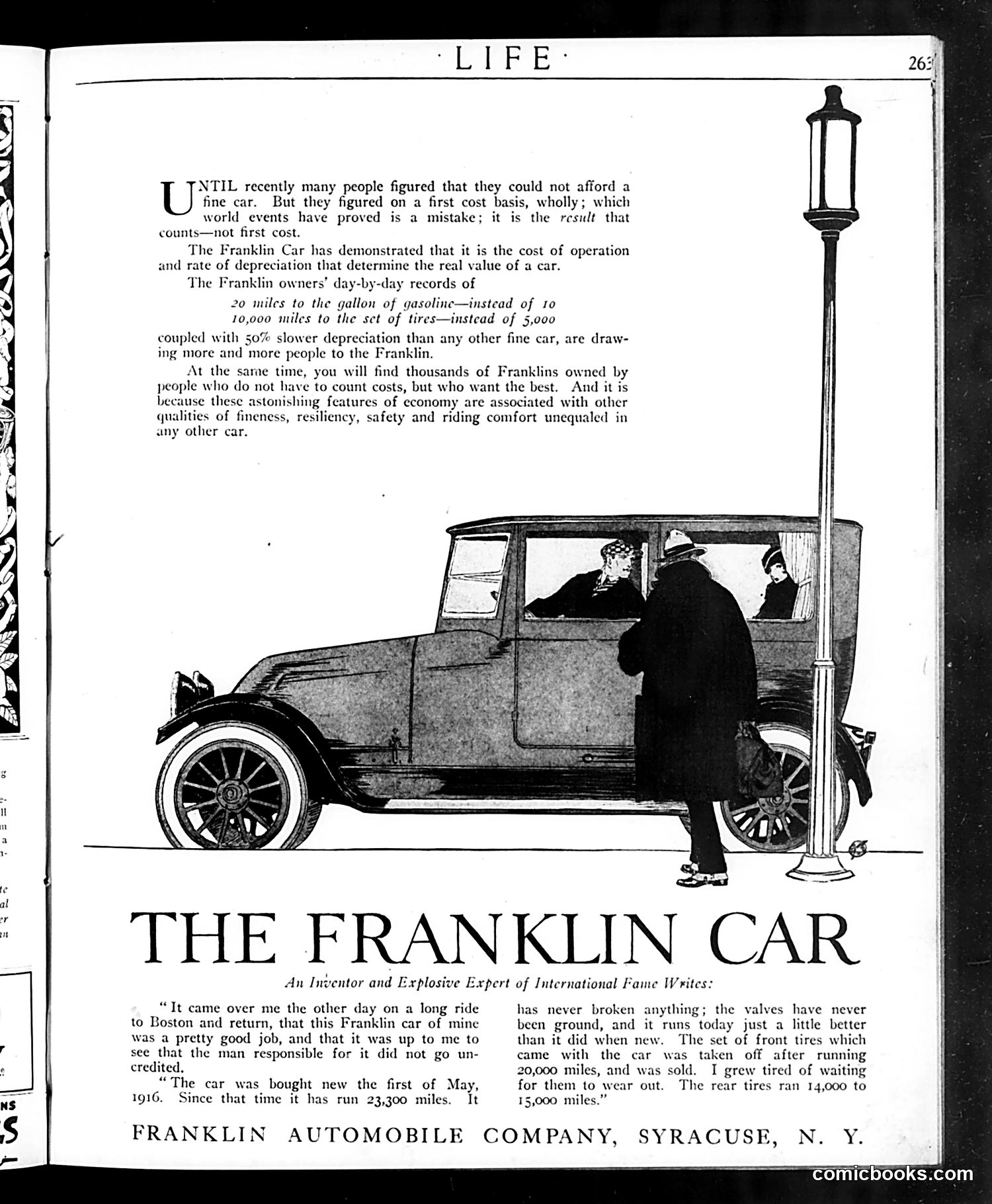
This is primarily **advertising**, not satire. The page promotes the Franklin automobile through testimonial advertising. The illustration shows a well-dressed man in a coat and hat standing beside a Franklin car, apparently about to depart on a journey. Three passengers are visible inside the vehicle. The advertisement argues that potential car buyers incorrectly focus on "first cost" (purchase price) rather than "result" (total cost of operation). It cites Franklin owners' records claiming superior fuel economy (20 mpg vs. 10) and tire longevity (10,000 miles vs. 5,000), plus slower depreciation. The credibility appeal features testimony from an unnamed "Inventor and Explosive Expert of International Fame" who reports owning a Franklin since May 1916 with 23,300 miles, requiring no maintenance—valves never ground, original tires outlasting expectations. For modern readers: this represents early automotive marketing emphasizing reliability and economy to justify premium pricing, before standardized fuel-economy ratings existed.
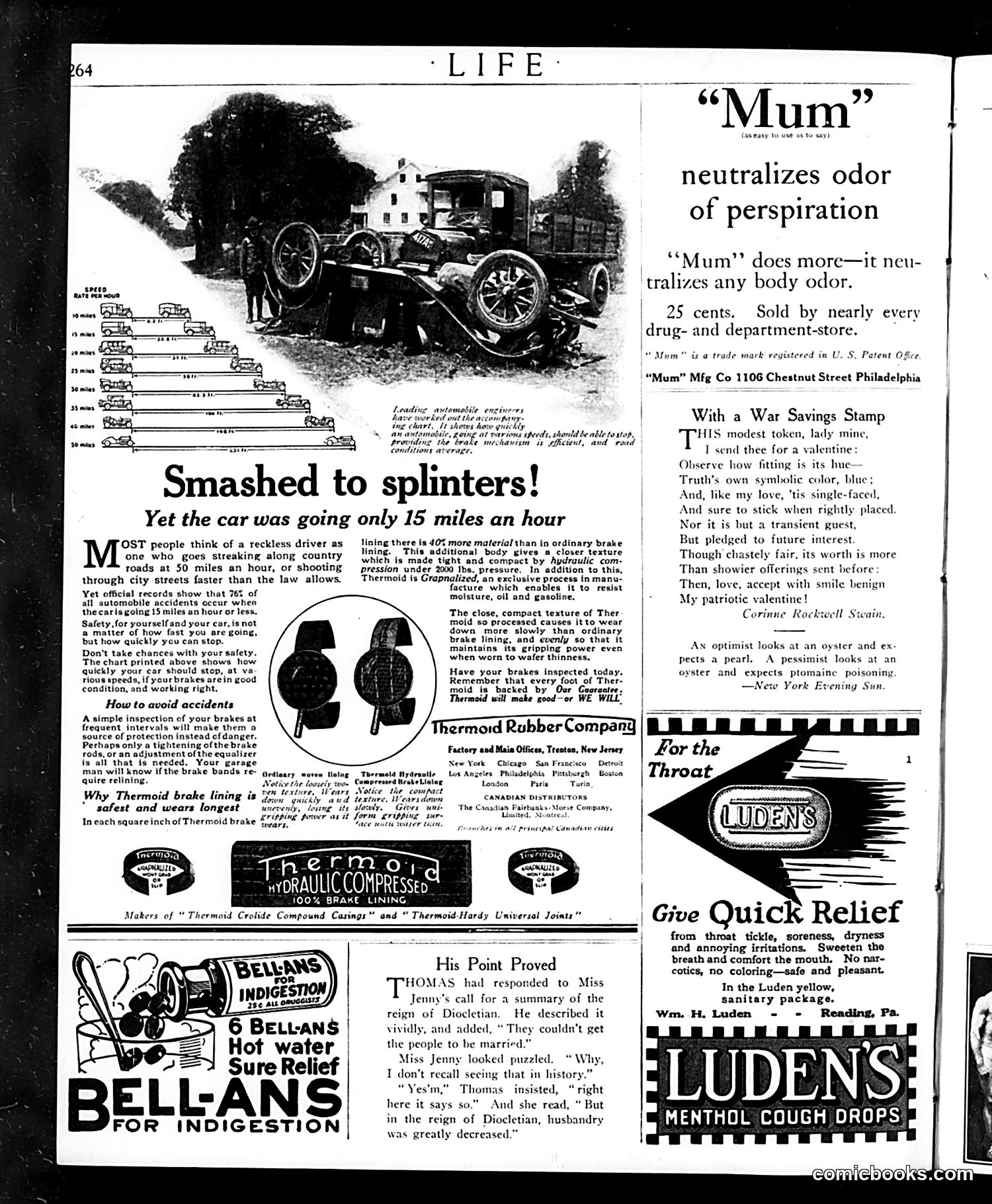
This page from *Life* magazine combines advertisements with satirical content typical of the era. The main cartoon is a visual joke about a car crash: a detailed technical chart shows stopping distances at various speeds, yet the headline emphasizes the car was going only 15 mph when "smashed to splinters." The satire critiques drivers who assume safety depends on speed alone, when accident records show 76% of crashes occur at low speeds—the real issue is brake maintenance and stopping ability, not recklessness. The bottom contains a wordplay joke: a student misreads Diocletian's reign, confusing "husbandry was greatly decreased" (agricultural decline under the Roman emperor) with a statement about marriage. It's gentle humor about reading comprehension. The rest is period product advertising (brake linings, deodorant, cough drops, antacids)—standard for *Life*'s revenue model.
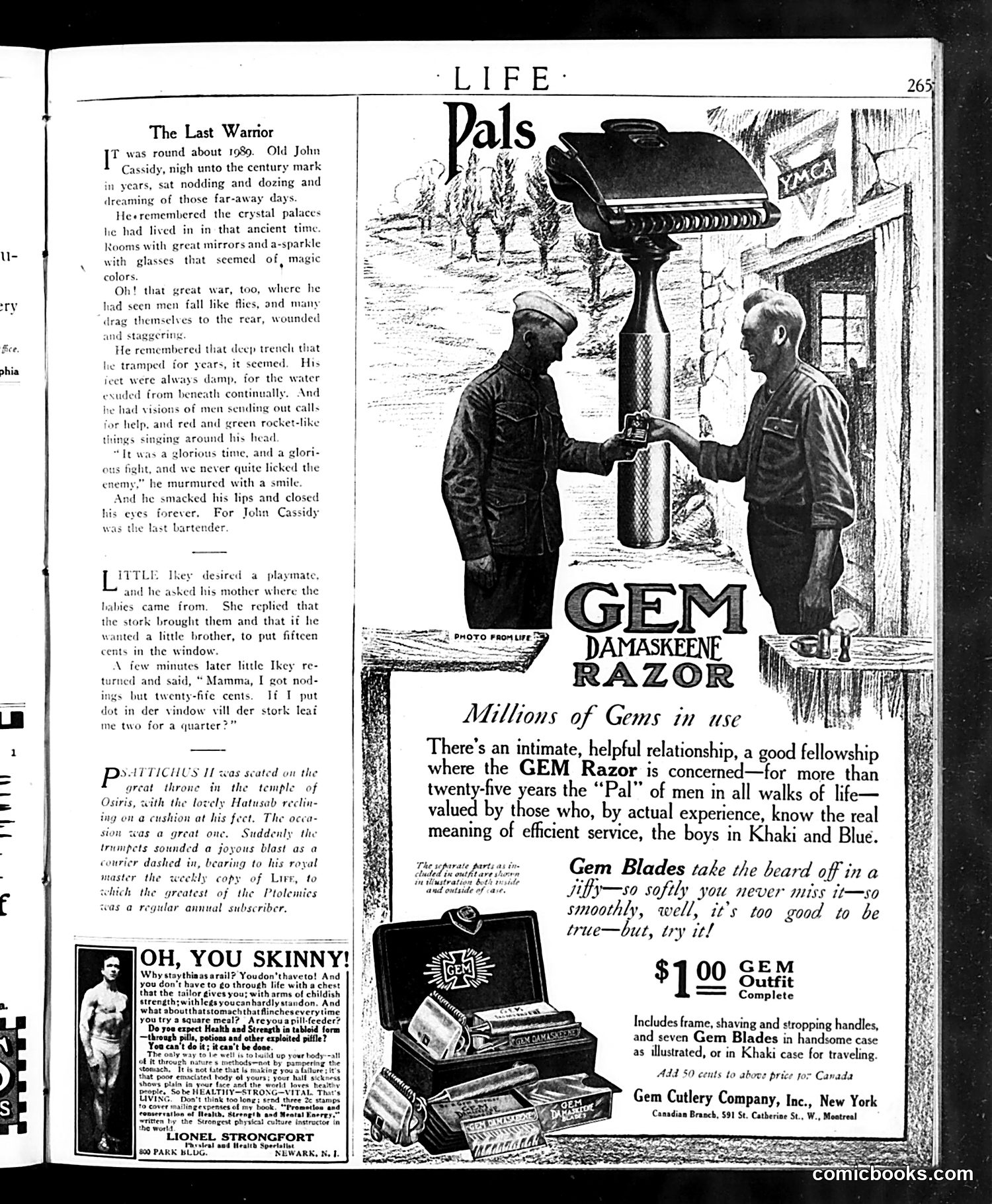
This page contains three short satirical stories typical of Life's humor: **"The Last Warrior"** depicts an elderly man named John Cassidy dying while reminiscing about WWI—the trenches, casualties, and combat. The grim joke: he was "the last bartender," not a soldier. The satire mocks nostalgic glorification of war by revealing the narrator's actual non-combat role. **"Little Ikey"** is a crude ethnic joke featuring a Yiddish-accented child misunderstanding his mother's stork story about babies. He attempts to "order" a sibling by depositing money in the window, then requests two for a quarter—a joke about Jewish bargaining stereotypes common to early 20th-century American humor. **"Pattichis II"** appears to joke about ancient Egypt, though details are unclear from the OCR. The page is dominated by a **Gem Damascene Razor advertisement** showing two men (one appears to be a soldier in "Khaki"), targeting WWI servicemen. The ad claims the razor is the trusted choice of soldiers and working men, priced at $1.00 complete with blades and case.
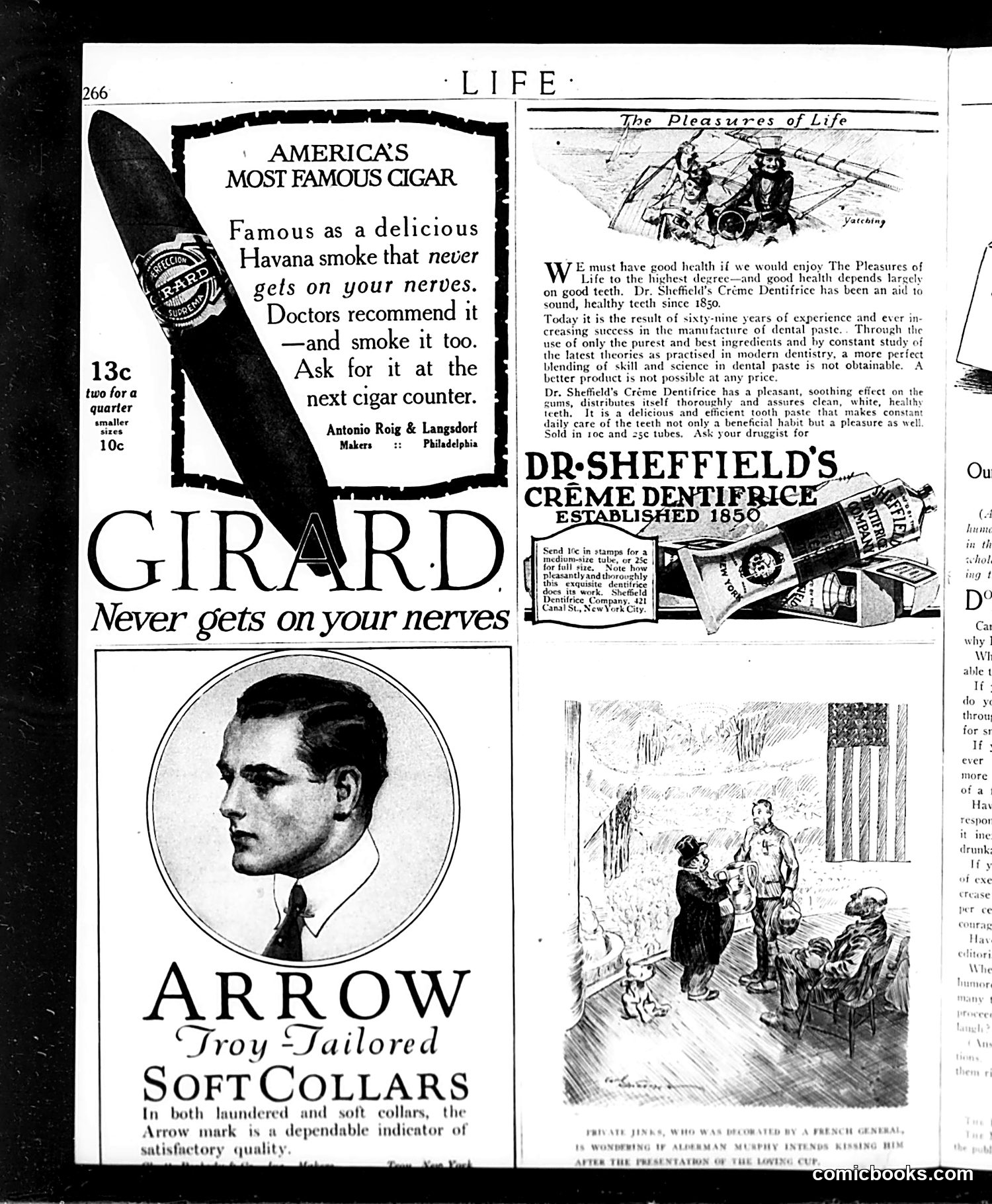
This page contains **three product advertisements**, not political cartoons: 1. **GIRARD Cigars**: Claims the product "never gets on your nerves" and that doctors recommend it. Features a profile portrait of a man and emphasizes it's a Havana smoke made in Philadelphia. 2. **DR. SHEFFIELD'S CREME DENTIFRICE**: A toothpaste ad (established 1850) promoting dental health and claiming superior quality through "sixty-nine years of experience." Includes product images. 3. **ARROW Soft Collars**: Features a man's portrait endorsing Troy-tailored collars as a "dependable indicator of satisfactory quality." The right side contains an article titled "The Pleasures of Life" with an illustration about health and teeth. **For modern readers**: This is a vintage *Life* magazine page from approximately the 1910s-1920s. The ads reflect period attitudes—notably, doctors endorsing cigars as beneficial, and the assumption that collar quality indicates character. The design and typography are typical of early 20th-century American advertising.
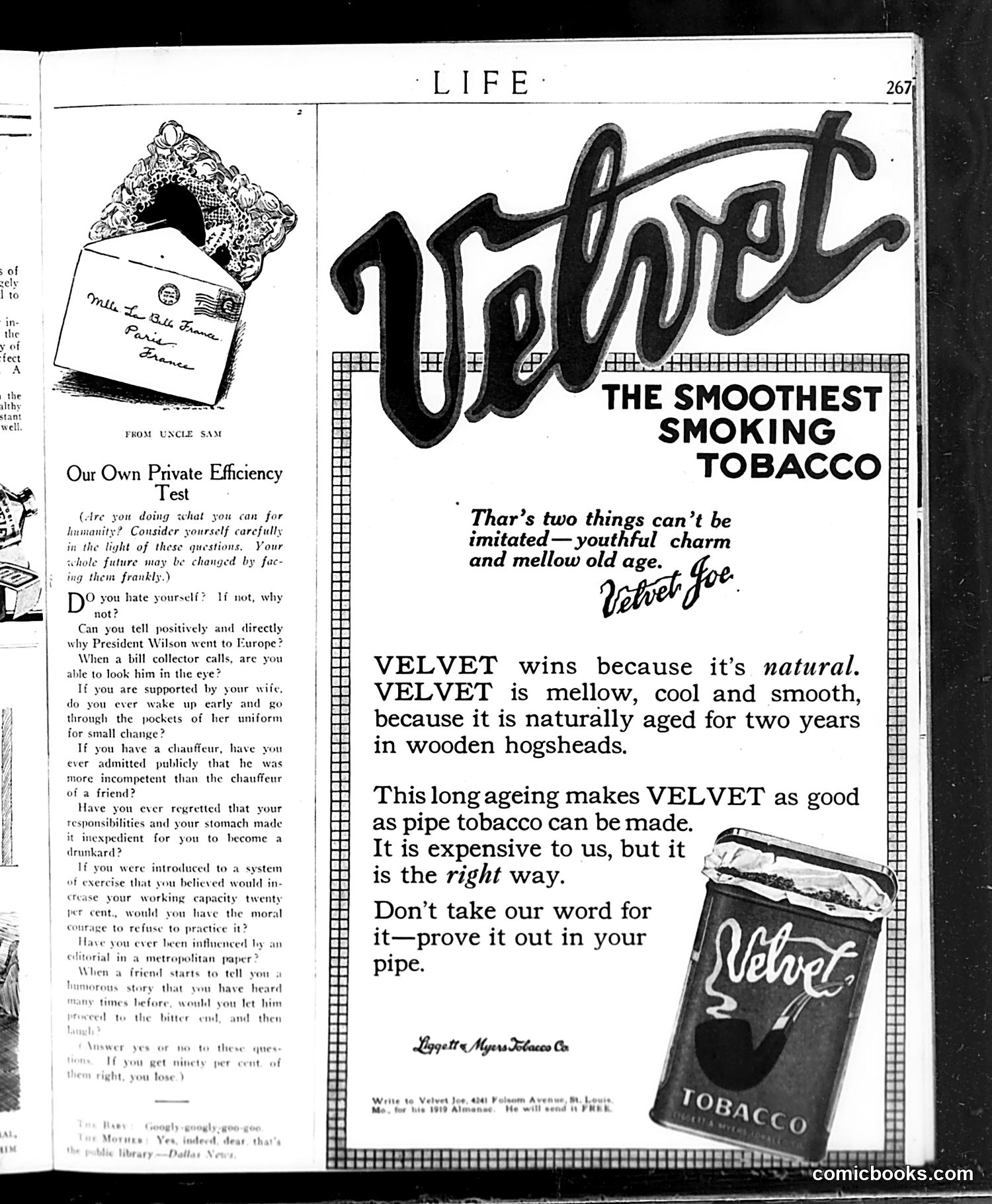
This page contains two distinct elements: **Left side:** A satirical "efficiency test" titled "From Uncle Sam" that mocks American self-improvement culture and middle-class anxiety. It poses deliberately absurd or uncomfortable questions—about self-hatred, President Wilson's European trip, bill collectors, spousal support, servants, and moral weakness—designed to make readers feel inadequate. The satire targets the era's obsession with "efficiency" and self-examination. **Right side:** A Velvet tobacco advertisement claiming superiority through natural aging in wooden hogsheads for two years. It appeals to sophistication ("youthful charm and mellow old age") and invites consumer testing. The juxtaposition is ironic: Life's satirical content mocking inefficiency and moral questioning sits beside an advertisement for an expensive product promising quality through time-honored methods. This reflects 1920s advertising's appropriation of authenticity claims, while Life simultaneously critiques consumer culture's anxieties.
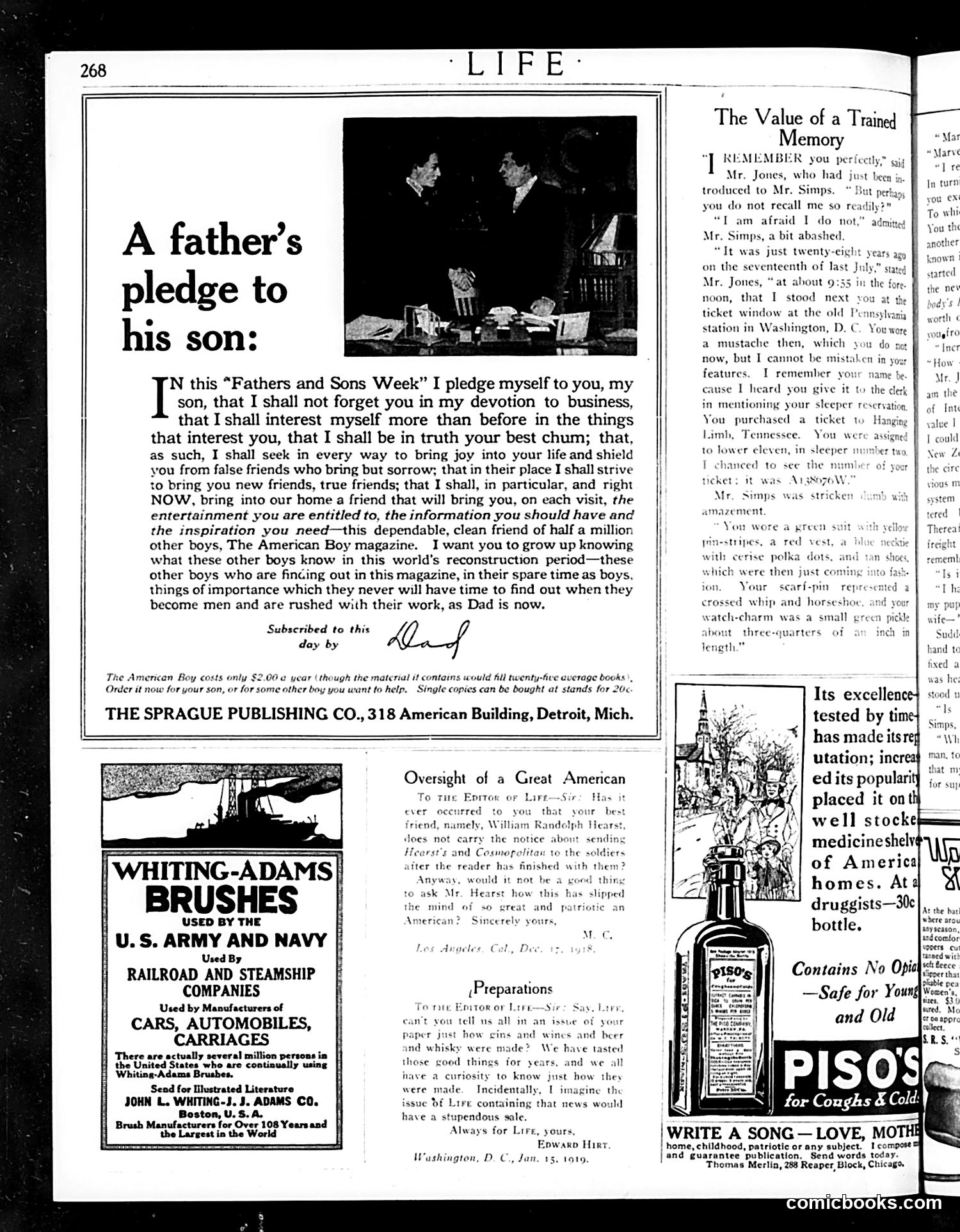
This page (from 1919, based on the letter dates) primarily consists of **advertisements and reader letters**, not political satire. The main content is a "Fathers and Sons Week" advertisement for *The American Boy* magazine. A father pledges to be more involved in his son's life and interests—specifically by subscribing to this publication as a "dependable, clean friend" offering entertainment and information boys need during "this world's reconstruction period" (post-WWI). Below are reader letters to the editor, including one referencing **William Randolph Hearst**, the famous newspaper magnate, questioning why *Life* doesn't mention his publications (*Hearts* and *Cosmopolitan*) when readers finish with them—a gentle jab at Hearst's oversight or rivalry. The page also advertises **Whiting-Adams Brushes** (used by military, railroads, and manufacturers) and **Piso's cough medicine**. There is no political cartoon visible—this is primarily a commercial page reflecting period advertising and light editorial humor.
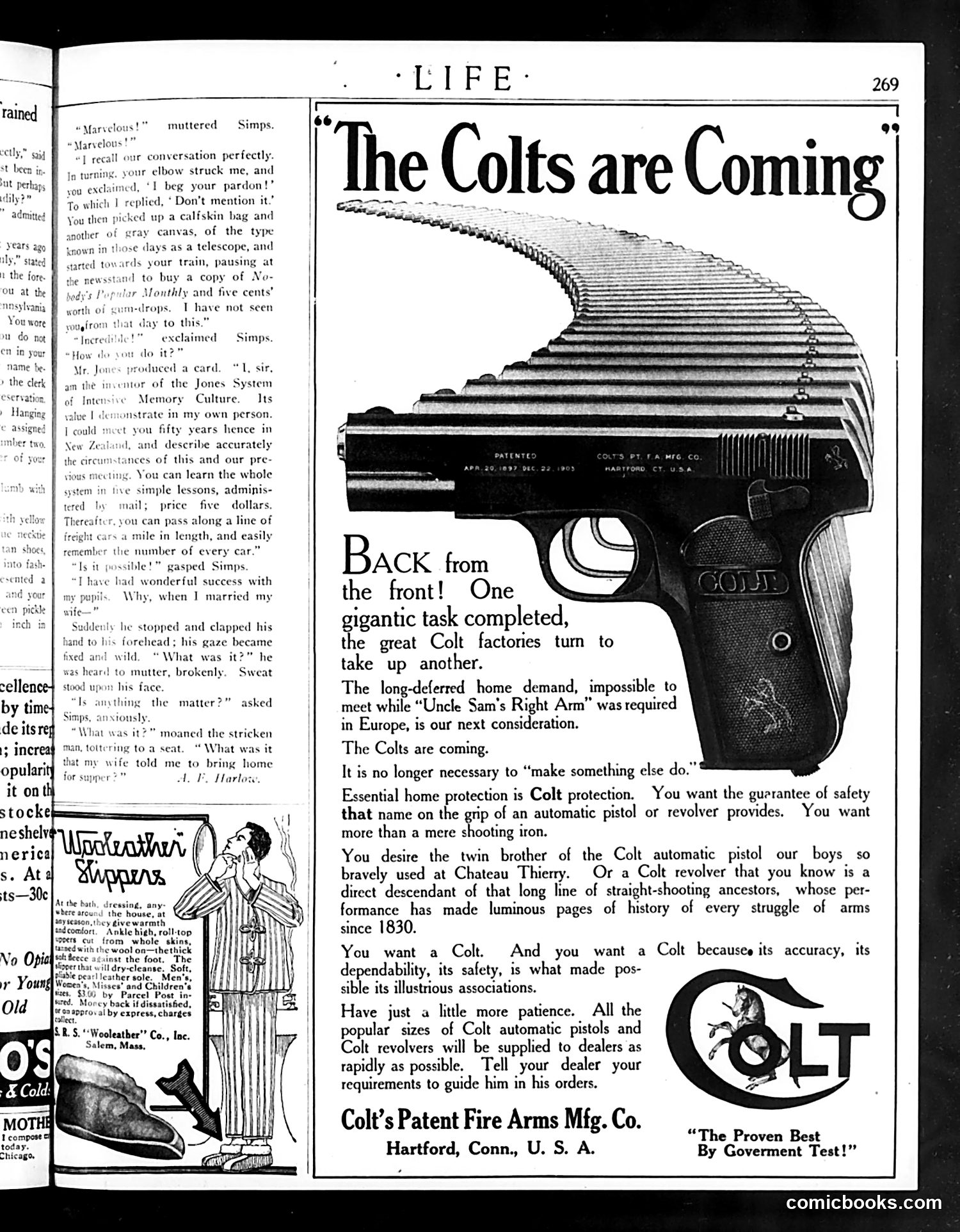
This page is **primarily a Colt firearms advertisement**, not political satire. The dominant feature is a large ad for Colt pistols and revolvers, positioned as essential "home protection" following World War I. **The Advertisement's Context:** The headline "The Colts Are Coming" references the post-WWI period when American factories, including Colt, were transitioning from wartime military production back to civilian goods. The ad explicitly mentions "Uncle Sam's Right Arm" (military service) and references the Colt's use at Château Thierry (a major 1918 battle), leveraging patriotic associations to market firearms for home defense. **The Left Column:** Contains an unrelated satirical story about Mr. Jones, who claims to have invented a "Memory Culture" system allowing people to recall details from decades past. It's a light humor piece mocking memory-improvement schemes. The page reflects post-WWI American anxiety about civilian security and manufacturers' pivot to domestic markets after wartime contracts ended.
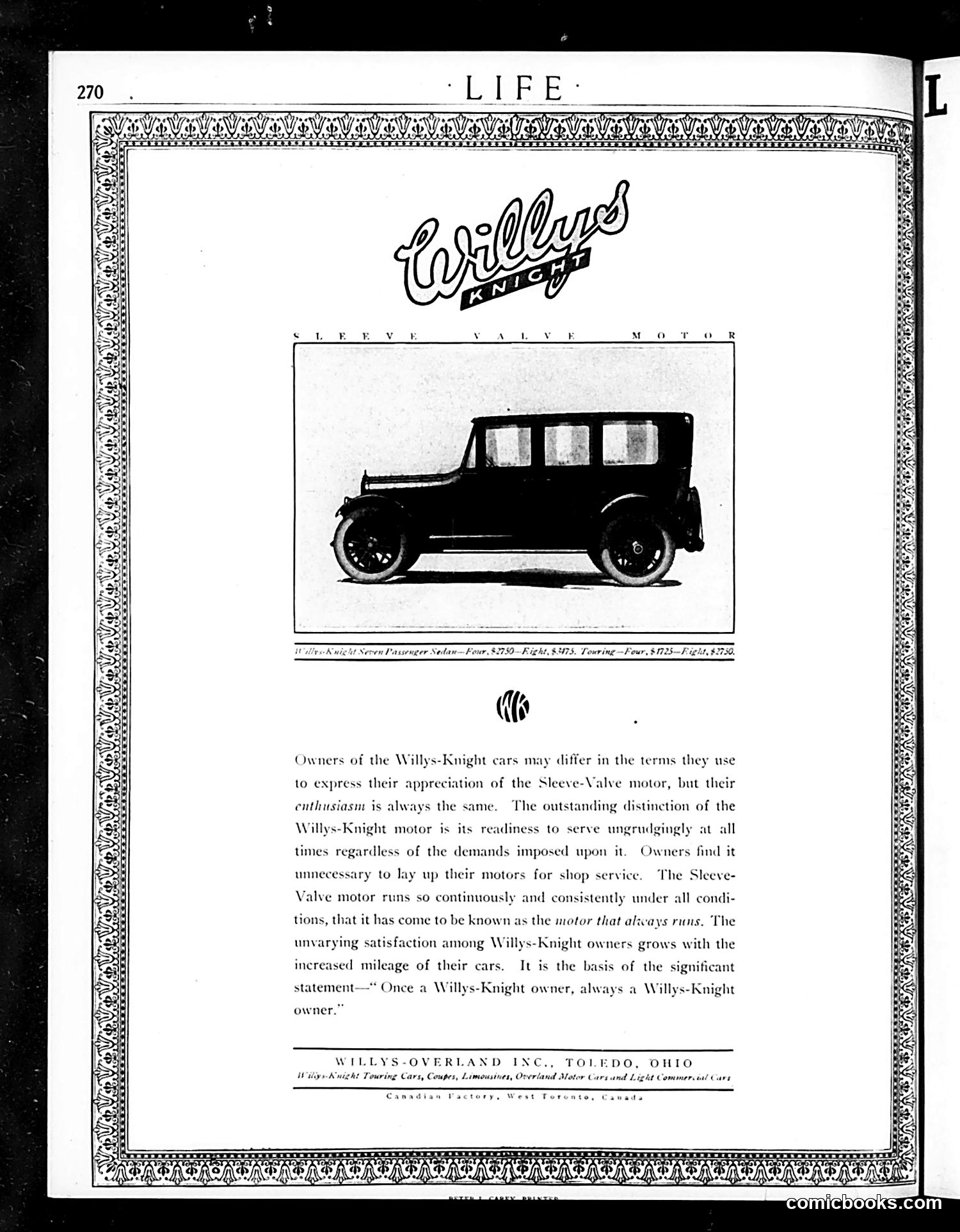
This is **not a cartoon or satire**—it's a straightforward automobile advertisement for the Willys-Knight car, appearing in *Life* magazine (page 270). The page features a side-view illustration of a boxy sedan with the Willys-Knight logo. The accompanying text promotes the car's "Sleeve-Valve motor," emphasizing its reliability and durability. The pitch claims owners find it unnecessary to service the engine and that the motor "always runs"—establishing the slogan "Once a Willys-Knight owner, always a Willys-Knight owner." The ad is issued by Willys-Overland Inc. of Toledo, Ohio, with manufacturing noted in West Toronto, Canada. **Why it appears in *Life*:** Though *Life* was satirical, it also carried paid advertisements to fund publication. This is simply a period automotive ad emphasizing mechanical dependability—a key selling point in the early automobile era when engine reliability was far from guaranteed.