
Life, 1919-02-13 · page 20 of 42
Life — February 13, 1919 — page 20: what you’re looking at
What you’re looking at
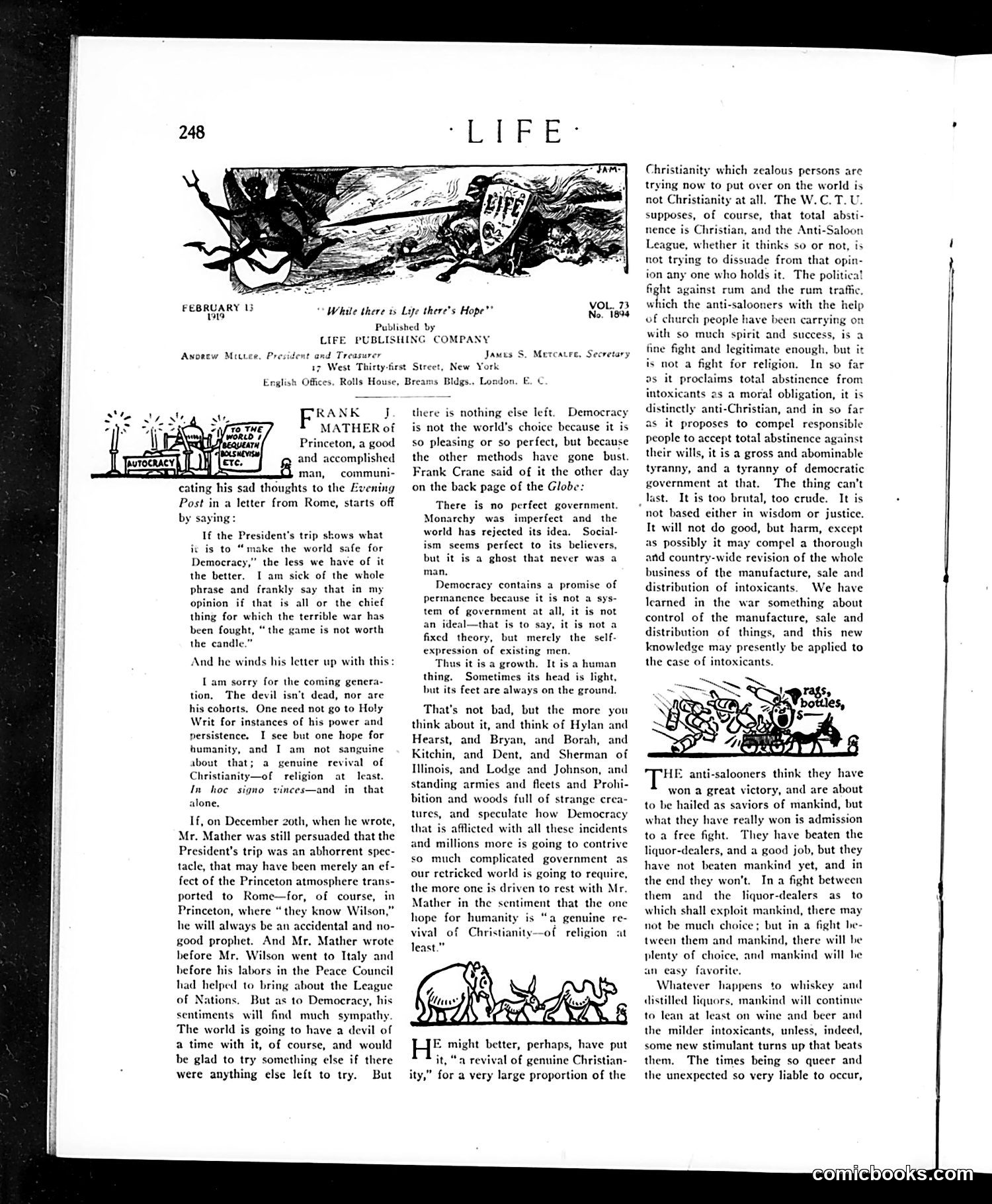
This page critiques President Wilson's post-WWI diplomatic efforts and discusses democracy's viability. Frank Mather of Princeton, writing from Rome, expresses disillusionment that the war was fought for "making the world safe for Democracy" — questioning whether democracy is worth defending. The editorial responds by arguing democracy persists not from idealism but because other systems (monarchy, socialism) have failed. It's described as humanity's self-expression rather than fixed theory. However, the piece sarcastically undermines this by listing contemporary politicians (appears to reference Hylan, Hearst, Bryan, Borah, Lodge, Johnson) and complications (prohibition, militaries) that make democracy seem unworkable. The concluding criticism targets religious organizations like the WCTU and Anti-Saloon League, arguing they misrepresent Christianity by conflating temperance legislation with genuine faith—suggesting zealous reformers have corrupted authentic religion.
📄 Transcribed text from this page (OCR, searchable)
Machine-transcribed from the original scan — historical spelling and the odd misread are preserved.
FEBRUARY G While there ts Pub LIFE PUBLISE and Ti 17 West Thirty-tir English Offices, Rolls House, Avorew Mette, Pres: FRANK J MATHER of Princeton, a good @ and accomplished $} man, communi- cating his sad thoughts to the ning Post in a letter from Rome, starts off by saying: If the President's trip shows what ic is to “‘make the world safe for Democracy,” the less we have of it the better. I am sick of the whole phrase and frankly say that in my opinion if that is all or the chief thing for which the terrible war has been fought, “the game is not worth the candle.” And he winds his letter up with this: Lam sorry for the coming genera- tion, The devil isn't dead, nor are his cohorts. One need not go to Holy Writ for instances of his power and persistence. I sce but one hope for humanity, and IT am not sanguine about that; a genuine revival of Christianity—of religion at least. In hoc signo vinces—and in that alone. If, on December zoth, when he wrote, Mr. Mather was still persuaded that the President's trip was an abhorrent spec- tacle, that may have been merely an ef- fect of the Princeton atmosphere trans- ported to Rome—for, of course, in Princeton, where “they know Wilson,” he will always be an accidental and no- good prophet. And Mr, Mather wrote before Mr, Wilson went to Italy and before his labors in the Peace Council had helped to bring about the League of Nations. But as to Democracy, his sentiments will find much sym, The world is going to have a de a time with it, of course, and would be glad to try something else if there were anything else left to try. But Liye there's Hope”” Medes shed by 1ING COMPANY James S. Mere st Street, New York Breams Bldgs.. London. E. € there is nothing else left. Democracy is not the world’s choice because it is so pleasing or so perfect, but because the other methods have gone bust. Frank Crane said of it the other day on the back page of the Globe: There is no perfect government. Monarchy was imperfect and the world has rejected its idea. Social- ism seems perfect to its believers, but it is a ghost that never was a man, Democracy contains a promise of permanence because it is not a sys- tem of government at all, it is not an ideal—that is to say, it is not a fixed theory, but merely the self- expression of existing men. Thus it isa growth. It is a human thing. Sometimes its head is light, but its feet are always on the ground. That's not bad, but the more you think about it, and think of Hylan and Hearst, and Bryan, and Borah, and Kitchin, and Dent, and Sherman of Illinois, and Lodge and Johnson, and standing armies and fleets and Prohi- bition and woods full of strange crea- tures, and speculate how Democracy that is afflicted with all these incidents and millions more is going to contriv so much complicated government as our retricked world is going to require, the more one is driven to rest with Mr. Mather in the sentiment that the one hope for humanity is “a genuine re- al of Christianity—of religion at \ SS PDN H might better, perhaps, have put val of genuine Christian- ity,” for a very large proportion of the Christianity which zealous persons are trying now to put over on the world is not Christianity at all. The W.C.T.U. supposes, of course, that total absti- nence is Christian, and the Anti-Saloon League, whether it thinks so or not, is not trying to dissuade from that opin- ion any one who holds it. The politica fight against rum and the rum traffic, which the anti-salooners with the help of church people have been carrying on with so much spirit and success, is a fine fight and legitimate enough, but it is not a fight for religion. In so far as it proclaims total abstinence from toxicants as a moral obligation, it is distinctly anti-Christian, and in so far as it proposes to compel responsible people to accept total abstinence against their wills, it is a gross and abominable tyranny, and a tyranny of democratic government at that. The thing can’t last. It is too brutal, too crude. It is not based either in wisdom or justice. It will not do good, but harm, except as possibly it may compel a thorough and country-wide revision of the whole business of the manufacture, sale and distribution of intoxicants. We have Icarned in the war something about control of the manufacture, sale and distribution of things, and this new knowledge may presently be applied to the case of intoxicants HE, anti-salooners think they have won a great victory, and are about to be hailed as saviors of mankind, but what they have really won is admission toa free fight. They have beaten the liquor-dealers, and a good job, but they have not beaten mankind yet, and in the end they won't. Ina fight between them and the liquor-dealers as to which shall exploit mankind, there may not be much choice; but in a fight he tween them and mankind, there will be plenty of choice, and mankind will be an easy favorite, Whatever happens to whiskey and distilled liquors, mankind will continue to lean at least on wine and beer and the milder intoxicants, unless, indeed, some new stimulant turns up that beats them. The times being so queer and the unexpected so very liable to occur,