
Life, 1919-02-13 · page 24 of 42
Life — February 13, 1919 — page 24: what you’re looking at
What you’re looking at
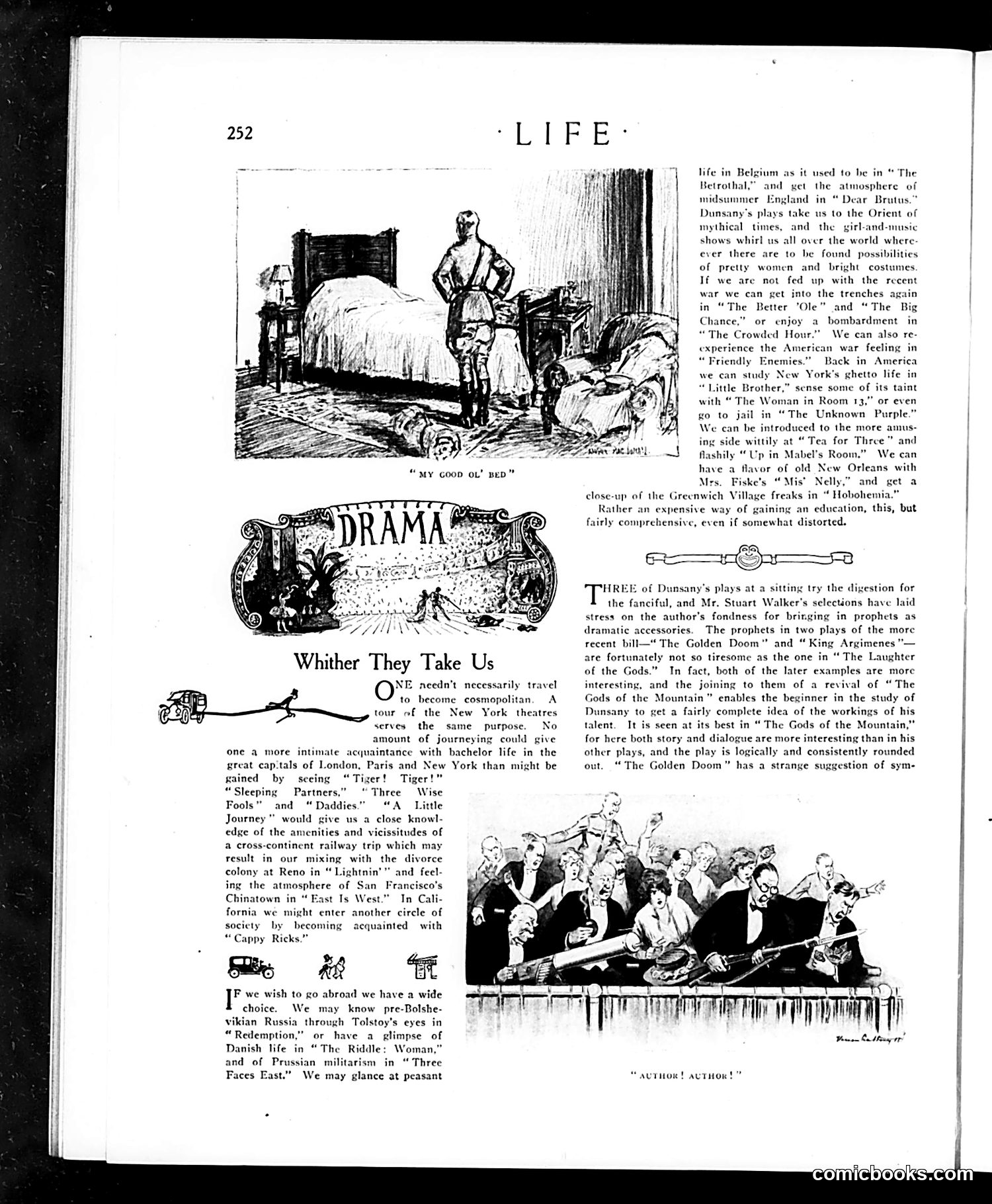
This page reviews theatrical offerings available to New York audiences circa 1920s. The satire's point: attending Broadway plays provides a cost-effective (if "somewhat distorted") education about world cultures and lifestyles without travel. The article catalogs plays thematically—showing how theater permits "armchair tourism": seeing pre-revolutionary Russia via Tolstoy adaptations, experiencing Prussian militarism, observing San Francisco's Chinatown, exploring divorce-colony life at Reno, studying New York's ghetto, and sampling Greenwich Village bohemianism. The bottom illustration labeled "AUTHOR! AUTHOR!" depicts a theatrical curtain call with the audience applauding performers—a standard theater scene emphasizing the page's focus on stage productions. The separate review discusses Lord Dunsany's plays, praising "The Gods of the Mountain" as his most coherent work while finding his prophetic characters sometimes tedious. The critique suggests Dunsany's strength lies in story and dialogue rather than his reliance on mystical dramatic accessories.
📄 Transcribed text from this page (OCR, searchable)
Machine-transcribed from the original scan — historical spelling and the odd misread are preserved.
Whither They Take Us NE needn't necessarily travel to become cosmopolitan. A tour of the New York theatres serves the same purpose. No amount of journeying could give one a more intimate acquaintance with bachelor life in the great cap:tals of London, Paris and New York than might be gained by seeing “Tiger! Tiger!” “Sleeping — Partner: “Three Wise Fools” and “ Daddies." “A Little Journey” would give us a close knowl- edge of the amenities and vicissitudes of a cross-continent railway trip which may result in our mixing with the divorce colony at Reno in “ Lightnin’ and feel- ing the atmosphere of San Francisco's Chinatown in “East Is West.” In Cali- fornia we might enter another circle of society by becoming acquainted with “Cappy Ricks.” F we wish to go abroad we have a wide choice. We may know pre-Bolshe- vikian Russia through Tolstoy's eyes in “Redemption,” or have a glimpse of Danish life in “The Riddle: Woman,” and of Prussian militarism in “Three ces East.” We may glance at peasant life in Be Betrothal, mas it used to he in * The sphere of midsummer Brutus.” Dunsany’s plays take us to the Orient of mythical times, and the girl-and-music shows whirl us all over the world where- ever there are to he found possibilities of pretty women and bright costumes. If we are not fed up with the recent war we can get into the trenches again in “The Better ‘Ole” and “The Big Chance,” or enjoy a bombardment in “The Crowded Hour.” We can also re- experience the American war feeling in bog ndly Enemies. Back in America we can study New York's ghetto life in “Little Brother,” sense some of its taint with “The Woman in Room 13,” or even go to jail in “The Unknown Purple.” We can be introduced to the more amus- r ing side wittily at “Tea for Three” and flash Up in Mabel’s Room,” We can have a flavor of old New Orleans with Mrs. Fiske’s “ Mis’ Nelly,” and get a close-up of the Greenwich Village freaks in “ Hobohemi: Rather an expensive way of gaining an education, this, but if somewhat distorted. fairly comprehensive, even aaa HREE of Dunsany’s plays at a sitting try the digestion for the fanciful, and Mr. Stuart Walker's sele stress on the author's fondness for bringing in prophets as dramatic accessories. The prophets in two plays of the more recent bill— The Golden Doom" and “King Argimene: are fortunately not so tiresome as the one in “The Laughter of the Gods.” In fact, both of the later examples are more interesting, and the joining to them of a revival of “The Gods of the Mountain” enables the beginner in the study of Dunsany to get a fairly complete idea of the workings of h It is seen at its best in “ The Gods of the Mountain, for here both story and dialogue are more interesting than in his other plays, and the play is logically and consistently rounded out. “The Golden Doom” has a strange suggestion of sym- jons have laid talent “AUTHOR! AUTHOR!