
Life, 1919-02-13 · page 10 of 42
Life — February 13, 1919 — page 10: what you’re looking at
What you’re looking at
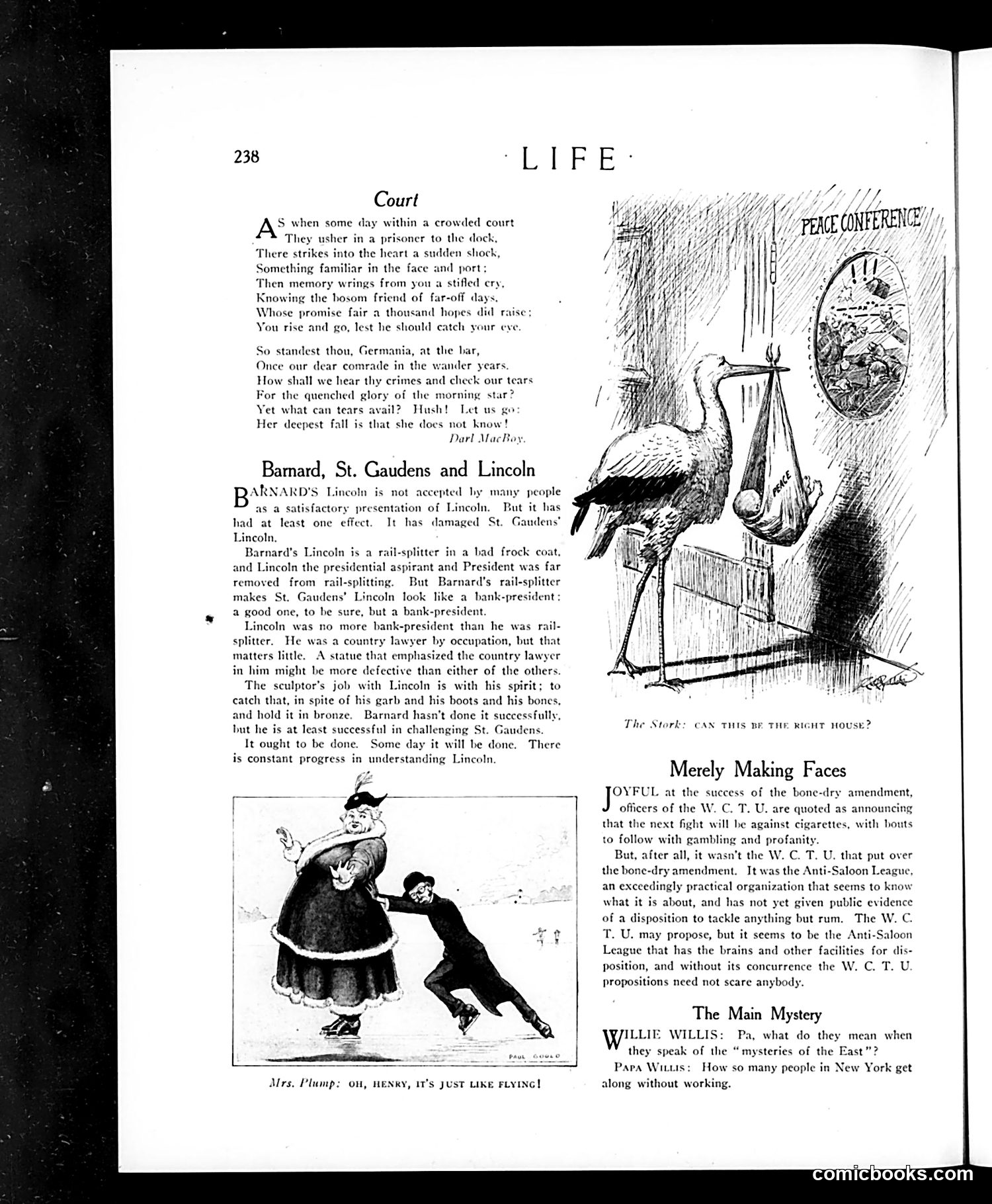
This page contains three separate pieces of satirical content: 1. **"Court"** — A poem addressing "Germannia" (Germany personified), lamenting a fallen comrade, likely referencing WWI losses. 2. **"Barnard, St. Gaudens and Lincoln"** — A critical essay comparing three artistic representations of Lincoln. It argues Barnard's sculpture better captures Lincoln's actual character (a country lawyer with grit) than St. Gaudens' more polished, "bank-president" version. 3. **"Merely Making Faces"** and **"The Main Mystery"** — Brief humor pieces mocking Prohibition-era reform organizations (the Anti-Saloon League) and satirizing New York's economic mysteries. The cartoons accompanying these pieces use exaggeration and visual humor typical of Life's satirical style to mock contemporary political and social issues.
📄 Transcribed text from this page (OCR, searchable)
Machine-transcribed from the original scan — historical spelling and the odd misread are preserved.
Court S$ when some day within a crowded court They usher in a prisoner to the dock, There strikes into the heart a sudden shock, Something familiar in the face and port: Then memory wrings from you a stifled ery, Knowing the hosom friend of far-off days, Whose promise fair a thousand hopes did raise; You rise and go, lest he should catch your eye. So standest thou, Germania, at the bar, Once our dear comrade in the wander years How shall we hear thy crimes and check our tears For the quenched glory of the morning star? Yet what can tears avail? Hush! Let us ¢ Her deepest fall is that she does not know! Darl MacBoy. Bamard, St. Gaudens and Lincoln ARNARD'S as a satisfactory presentation of Lincoln, But it has had at least one effect. It has damaged St. Gaudens’ Lincoln, Barnard’s Lincoln is a rail-splitter in a bad frock coat, and Lincoln the presidential aspirant and President was far removed from rail-splitting. But Barnard’s rail-splitter makes St, Gaudens’ Lincoln look like a bank-president : a good one, to be sure, but a bank-president Lincoln was no more bank-president than he was ra splitter. He was a country lawyer by occupation, but that matters little. A statue that emphasized the country lawyer in him might be more defective than cither of the others. The sculptor’s job with Lincoln is with his spirit; to catch that, in spite of his garb and his boots and his bones, and hold it in bronze, Barnard hasn't done it successfully, but he is at least successful in challenging St. Gaudens. It ought to be done. Some day it will he done. There is constant progress in understanding Lincoln incoln is not accepted hy many people Mrs. Plump: ou, HENRY, 11's JUST LIKE FLYING! The Stork: CAN THIS BE THE RIGHT HoUSsE? Merely Making Faces OYFUL at the success of the bone-dry amendment, officers of the W. C. T. U. are quoted as announcing at the next fight will he against cigarettes, with bouts to follow with gambling and profanity. But, after all, it wasn’t the W. C. T. U. that put over the bone-dry amendment. It was the Anti-Saloon League, an exceedingly practical organization that seems to know what it is about, and has not yet given public evidence of a disposition to tackle anything but rum. The W. C. T. U. may propose, but it seems to be the Anti-Saloon League that has the brains and other facilities for dis- position, and without its concurrence the W. C. T. U. propositions need not scare anybody. The Main Mystery ILLIE WILLIS: they speak of the “mysteries of the East”? Papa Wittts: How so many people in New York get along without working. Pa, what do they mean when