
Life, 1919-02-13 · page 30 of 42
Life — February 13, 1919 — page 30: what you’re looking at
What you’re looking at
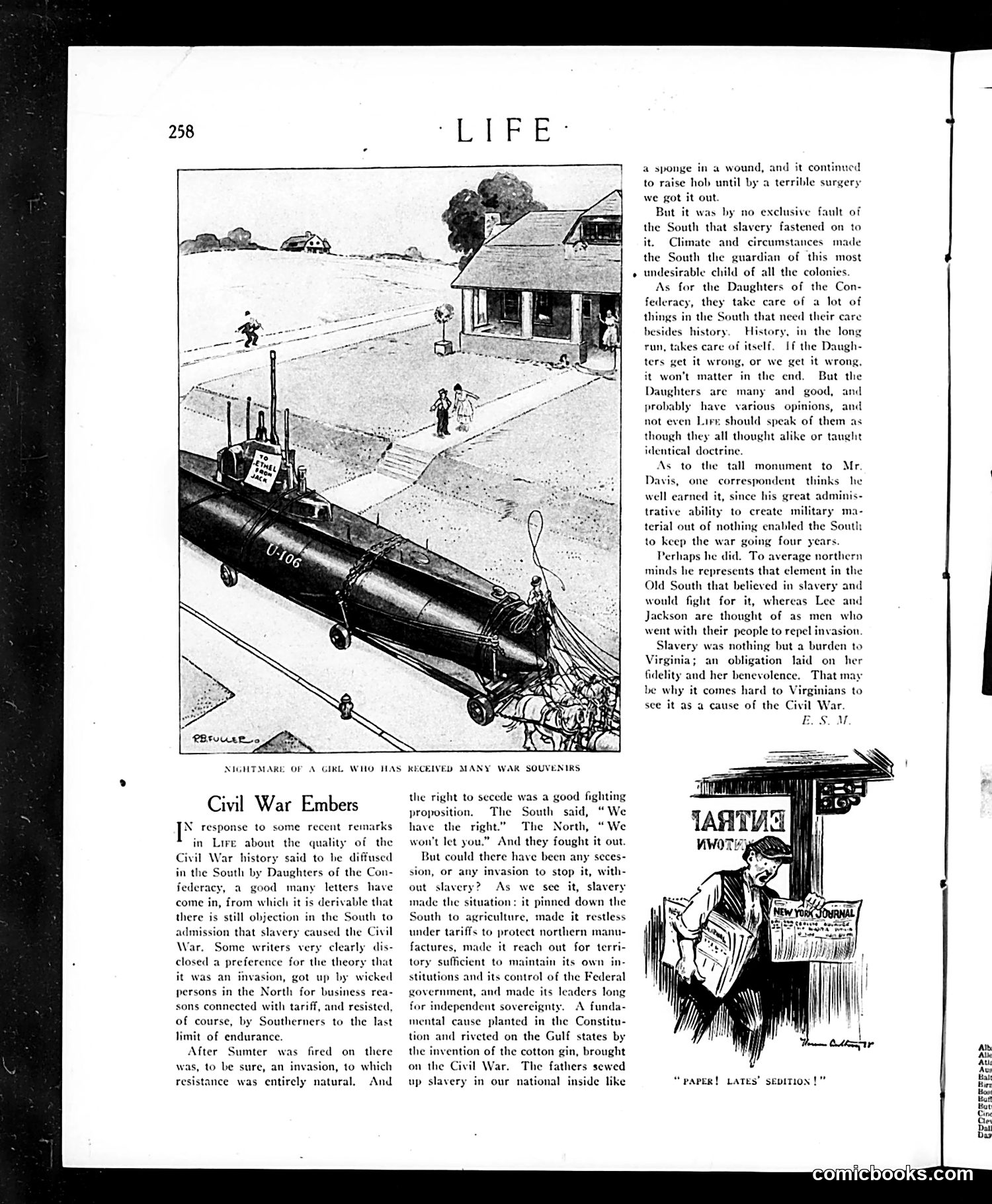
**The Main Cartoon:** The top illustration depicts a nightmare vision of a massive Civil War-era torpedo or submarine labeled "U.S.106" positioned near a rural Southern homestead. A young woman who has "received many war souvenirs" appears to be dreaming this threatening image—visualizing weaponry intruding upon peaceful domestic Southern life. **The Political Context:** The article "Civil War Embers" responds to ongoing Southern resistance to acknowledging slavery as the Civil War's cause. Some Southern groups (particularly the Daughters of the Confederacy) promoted alternative narratives: that Northern economic interests (tariffs, business schemes) provoked the war, or that the South merely defended its right to secede. **Life's Position:** The magazine argues slavery was the "fundamental cause"—embedded in the Constitution and Southern economy through the cotton gin—making secession and invasion inevitable. The cartoon likely satirizes Southern anxiety about Northern military power and their selective memory regarding slavery's role. **The Satire:** By depicting weaponry invading Southern domestic peace, Life mocks the South's victim narrative while insisting historical accuracy matters more than comfortable mythology.
📄 Transcribed text from this page (OCR, searchable)
Machine-transcribed from the original scan — historical spelling and the odd misread are preserved.
NIGHTMARE OF Civil War Embers N response to some recent remarks in Lire about the quality of the Civil War history said to he di in the South by Daughters of the Con- jeracy, a good many letters have come in, from which it is derivable that there is still objection in the South to used. admission that slavery caused the Civil War. Some writers very clearly dis- closed a preference for the theory that it was an invasion, got up by wicked persons in the North for business rea- sons connected with tariff, and resisted, of course, by Southerners to the last limit of endurance. After Sumter was fired on there . to be sure, an invasion, to which sistance was entirely natural, And A GIRL WHO HAS KECEIVED MANY WAR SOUVENIRS the right to secede was a good fighting proposition. The South said, “We have the right.”| The North, “We won't let you.” And they fought it out. But could there have been any seces- sion, or any invasion to stop it, with- out. slavery? made the situation: it pinned down the South to agriculture, made it restless under tariffs to protect northern manu- factures, made it reach out for terri- tory sufficient to maintain its own in- stitutions and its control of the Federal government, and made its leaders long for independent sovereignty. A funda- mental cause planted in the Constitu- tion and riveted on the Gulf states by the invention of the cotton gin, brought on the Civil War. The fathers sewed up slavery in our national inside like As we sce it, slavery nd it continued terrible surgery a sponge in a wound, a to raise hob until by we got it out. But it was by no exclusive fault of the South that slavery fastened on to it. Climate and circumstances made the South the guardian of this most undesirable child of all the colonies. As for the Daughters of the Con- federacy, they take care of a lot of things in the South that need their care History, in the long run, takes care of itself. If the Daugh- ters get it wrong, or we get it wrong. it won't matter in the end, But tl Daughters are many and good, and probably have various opinions, and not even Lire should speak of them as though they all thought alike or taught identical doctrine. As to the tall Davis, one besides history monument to Mr. thinks he well earned it, since his great adminis- trative ability to create military ma- terial out of nothing enabled the South to keep the war going four years. Perhaps he did. To average northern minds he represents that clement in the Old South that believed in slavery and would fight for it, whereas Lee and Jackson are thought of as men who went with their people to repel invasion. avery was nothing but a burden to Virginia; an obligation laid on her fidelity and her benevolence. That may correspondent be why it comes hard to Virginians to see it as a cause of the Civil War. Se AL, “paper! Lates’ sevition |