
A complete issue · 34 pages · 1919
Life — January 16, 1919
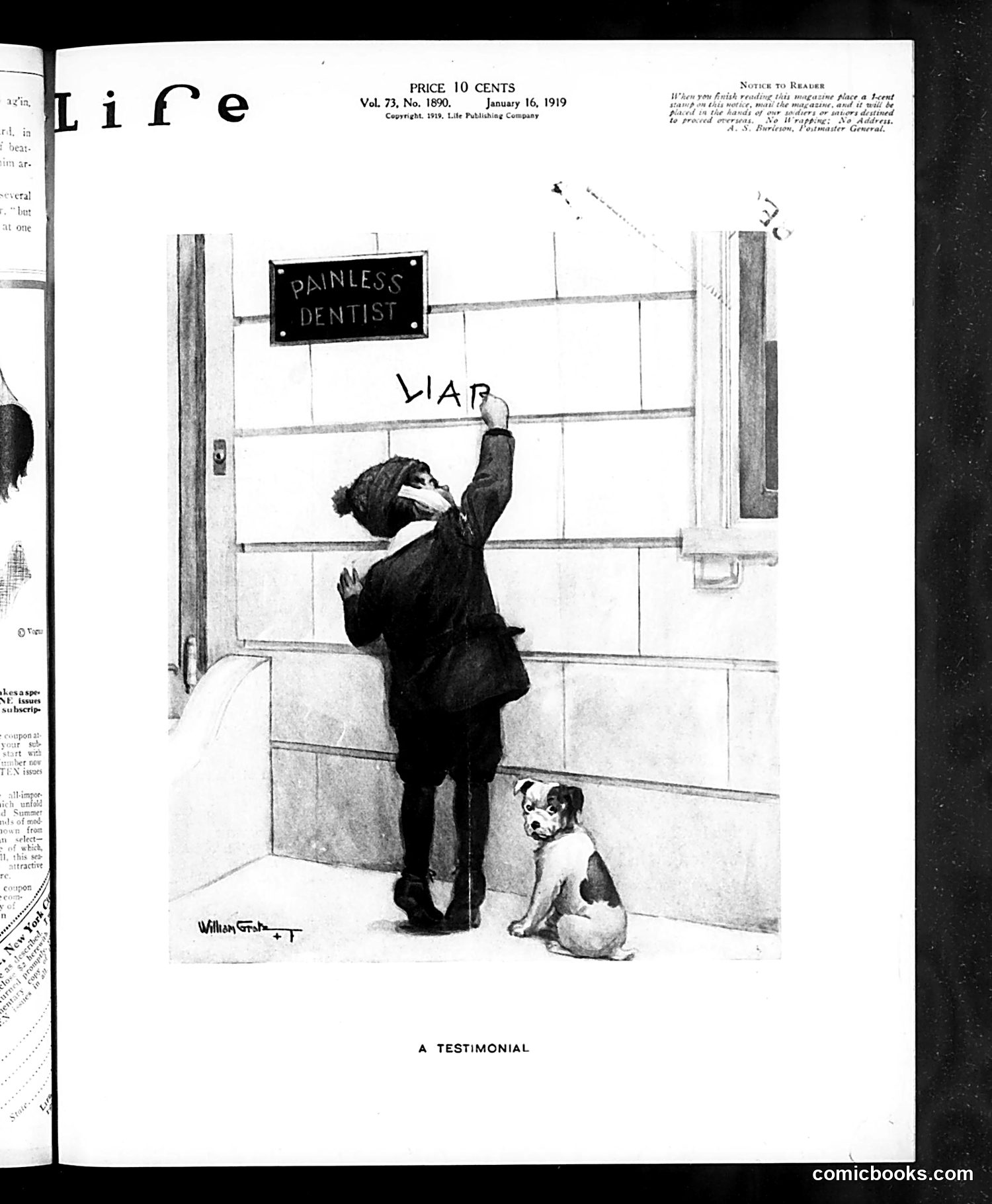
This cartoon satirizes the advertising claims of painless dentists. A man writes "LIAR" on a dentist's window while a small dog watches. The "Painless Dentist" sign hangs above, and the man's gesture suggests he's leaving an angry testimonial based on his experience. The joke is straightforward: despite the dentist's promise of painlessness, the patient found the experience painful enough to publicly denounce the claim as false. The cartoon mocks both exaggerated medical advertising and the gap between promises and reality. The dog's presence adds absurdist humor—even the animal seems skeptical of the dentist's claims. This reflects 1919 consumer skepticism toward unregulated medical advertising.
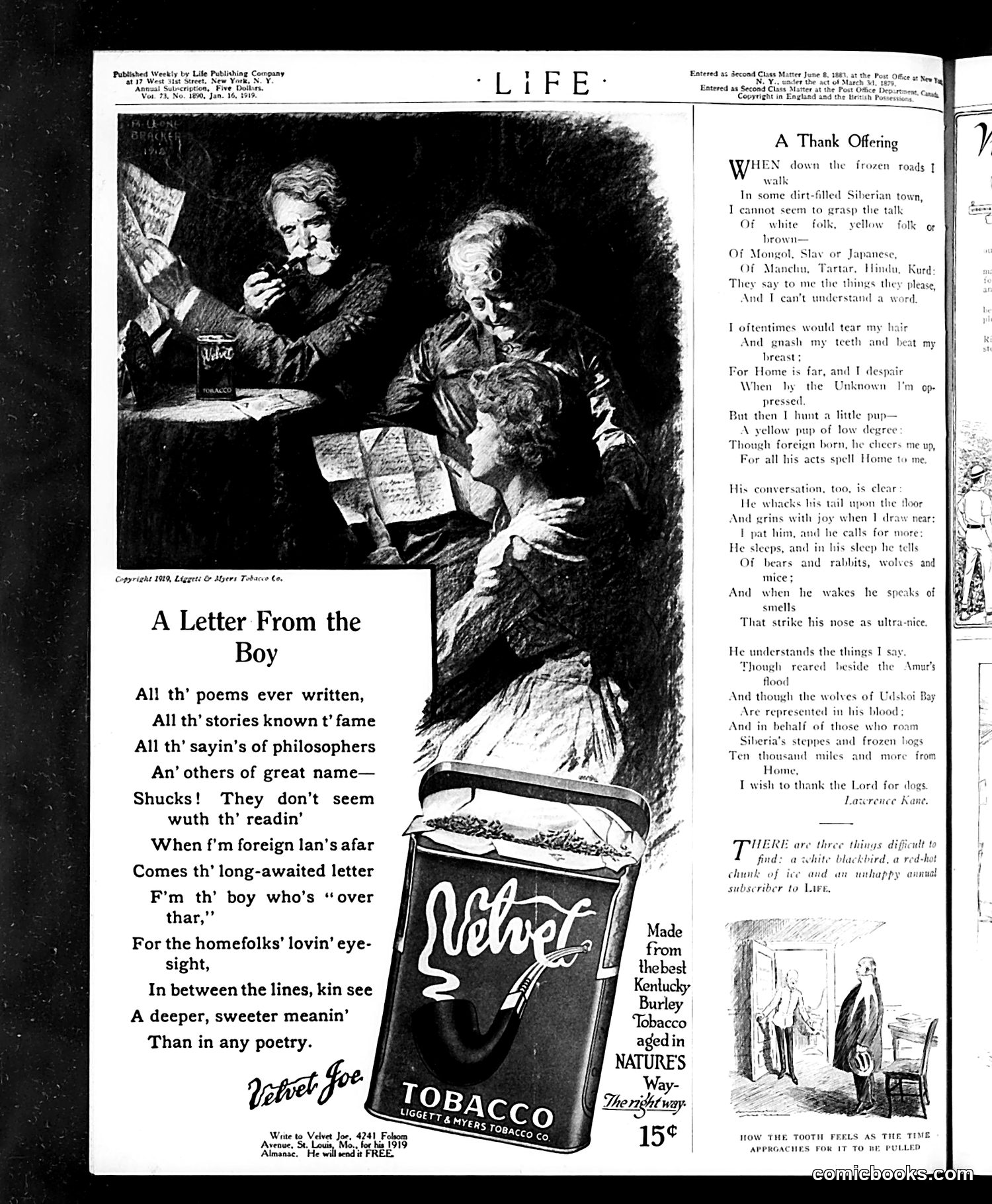
This page contains two distinct pieces: a tobacco advertisement and unrelated poetry. **The Advertisement:** The left side features "A Letter From the Boy," a Velvet Joe tobacco ad. The poem presents a sentimental appeal—a soldier or immigrant abroad receives letters from home, finding them more meaningful than literature. The accompanying illustration shows figures reading correspondence. The ad then pivots to selling Velvet tobacco as the comfort of home. **The Right Side:** "A Thank Offering" is a poem about longing for home while stationed in a foreign land (Siberia is specifically mentioned). It contains no satire or political commentary—it's straightforward nostalgic verse about missing one's homeland and family pets. Neither element constitutes political satire typical of Life magazine's editorial cartoons from this era.
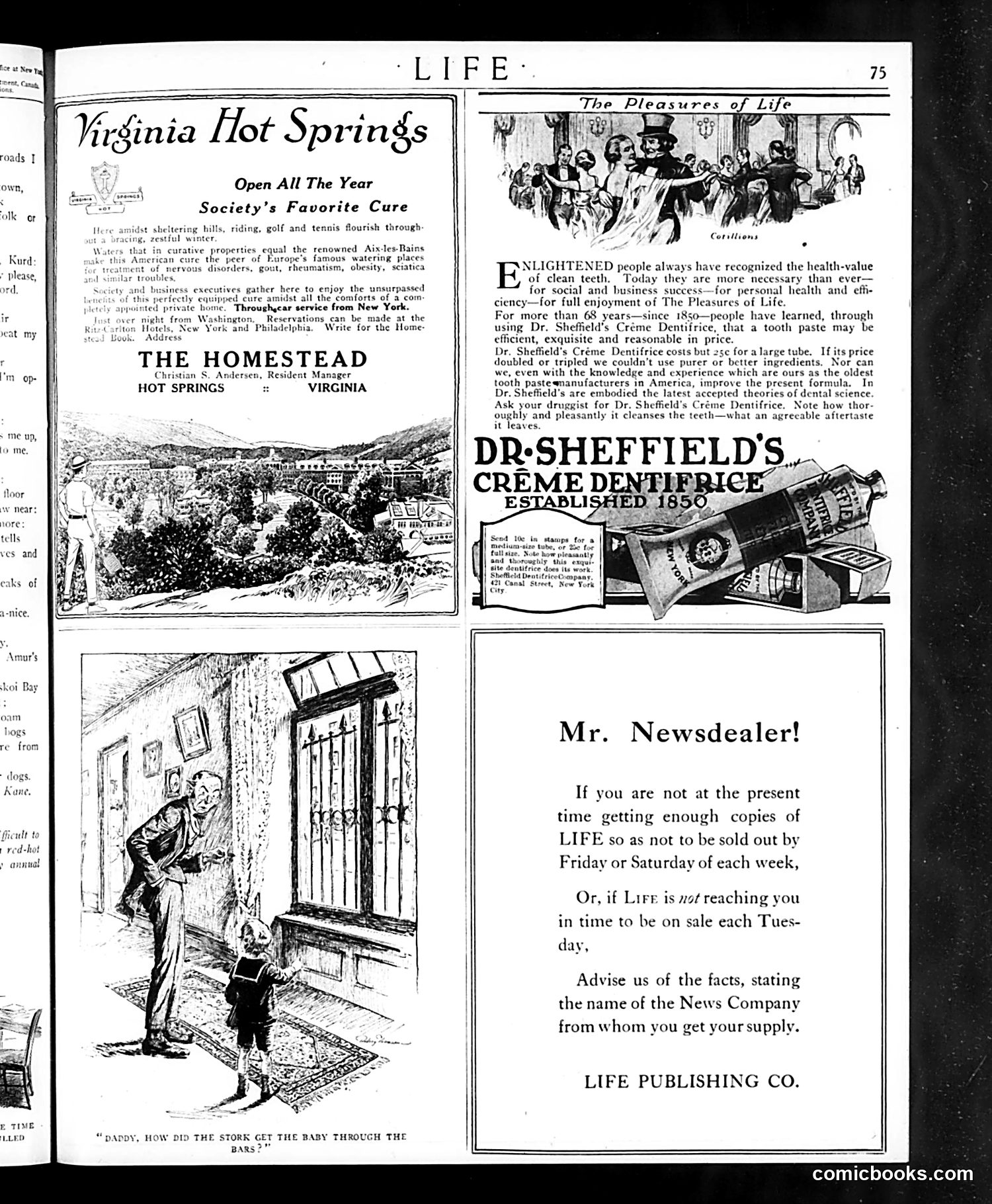
This page is **primarily advertising** with one small cartoon. The main advertisements promote Virginia Hot Springs and Dr. Sheffield's Creme Dentifrice (toothpaste, established 1650). These represent typical early 20th-century patent medicine and personal care products marketed with health claims. The cartoon at bottom left, captioned "Daddy, how did the stork get the baby through the bars?" shows a father and child at a window or gate. This is a **period joke about sex education**—the child innocently questions the "stork delivers babies" explanation parents gave to avoid discussing reproduction. The humor relies on the gap between Victorian euphemism and children's literal observations. A standard joke type of the era. The right side contains a **publisher's notice** asking newsstand owners to stock more copies of *Life* magazine.
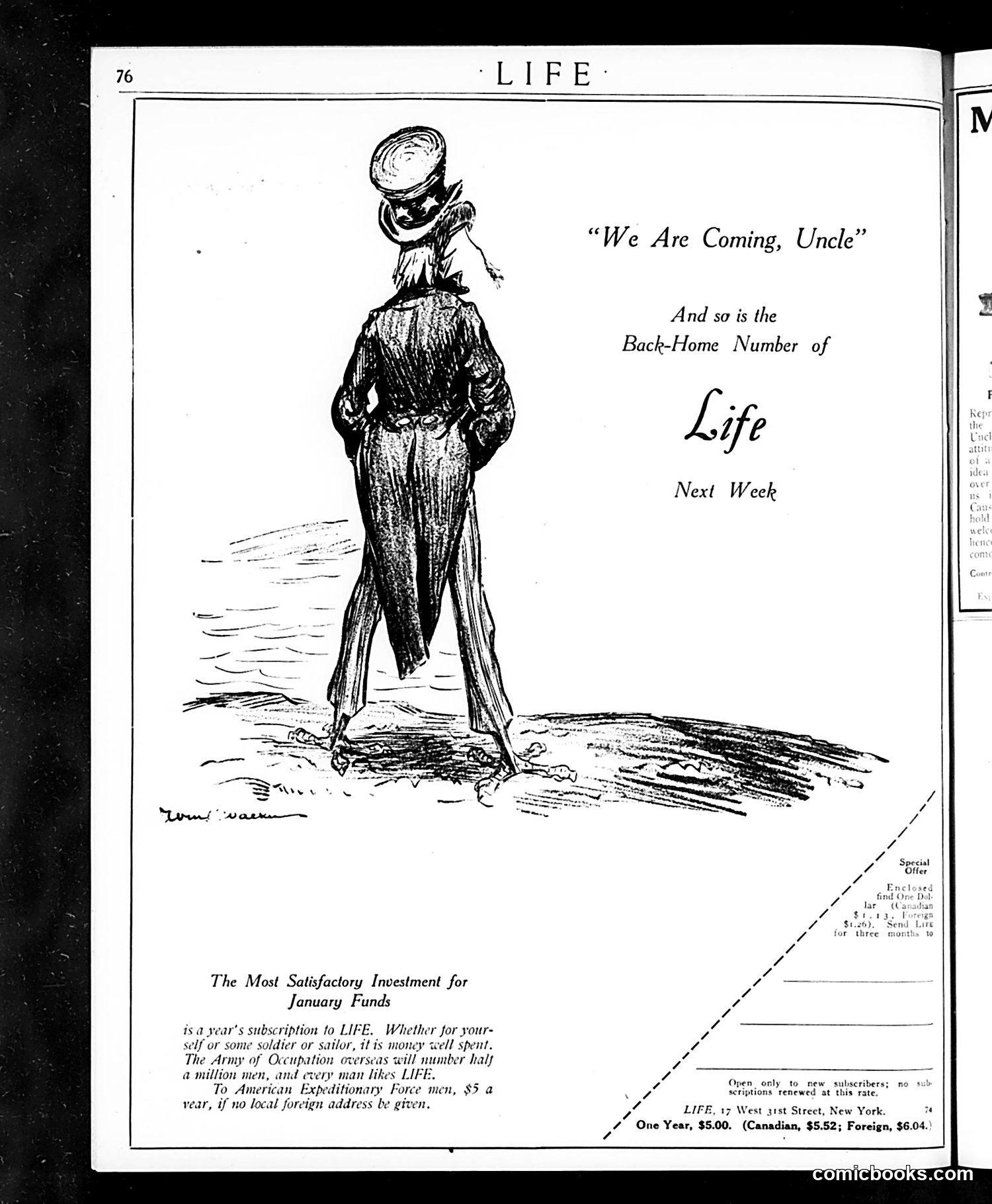
This is primarily **advertising for Life magazine subscriptions**, not political satire. The central image shows a soldier or sailor in military uniform standing at attention, with text reading "We Are Coming, Uncle" — a reference to the Civil War song "We Are Coming, Father Abraham" (recontextualized for WWI-era recruitment). The advertisement promotes Life magazine as a gift for American Expeditionary Force soldiers overseas, costing $5 annually. It emphasizes that "every man likes LIFE," positioning the magazine as morale-boosting entertainment for troops. The "back-home number" teased for next week appears to be the magazine's regular promotional strategy. This reflects WWI-era patriotism and commercial targeting of military audiences during America's involvement in the war.
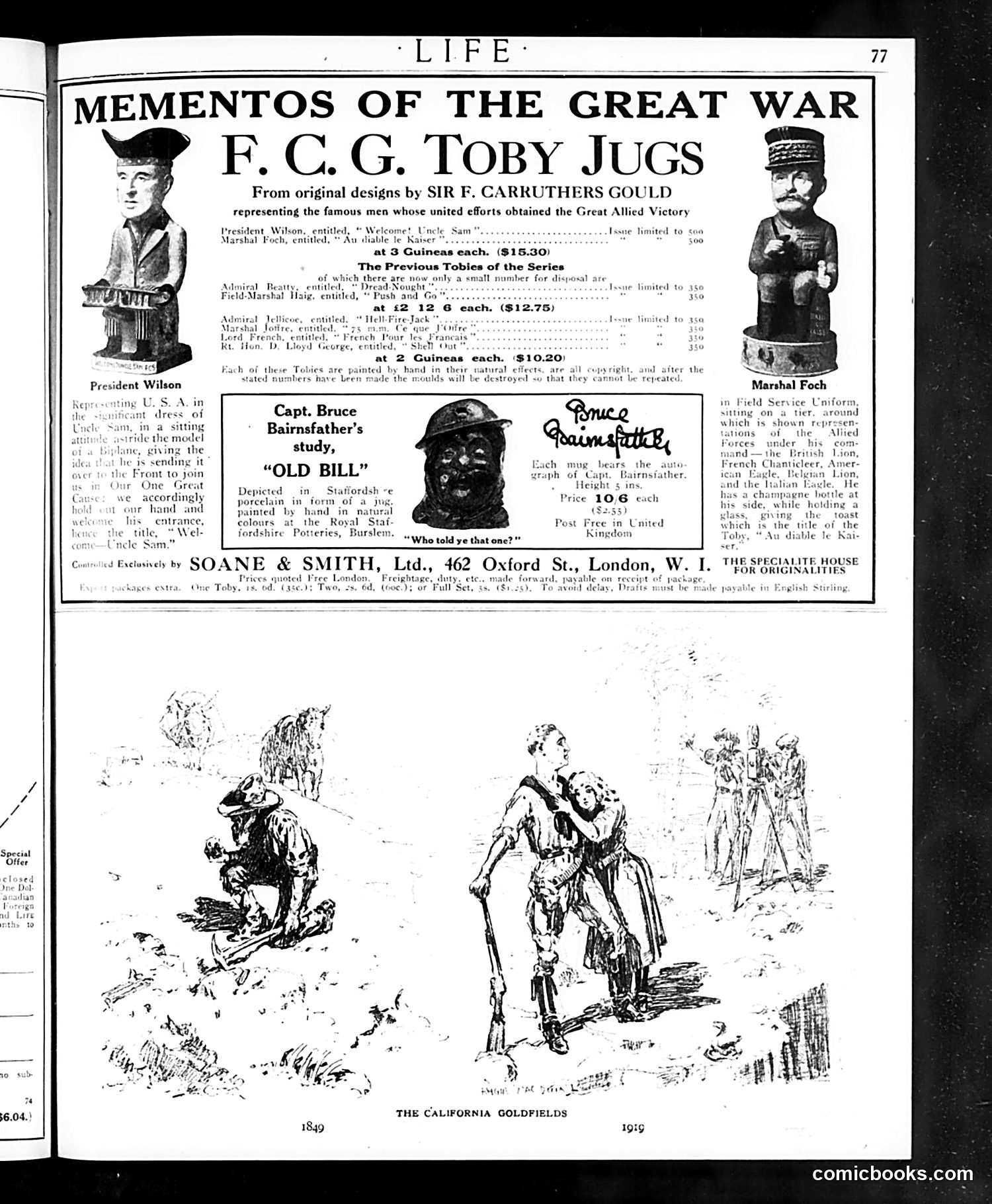
This page is primarily **advertising for collectible ceramic jugs** rather than political satire. The top section promotes "Mementos of the Great War" F.C.G. Toby Jugs—hand-painted figurines depicting Allied war leaders including President Wilson and Marshal Foch. These sold for 10-15 shillings each through Soane & Smith Ltd., a London retailer. The bottom illustration contrasts "The California Goldfields" across two time periods (1849 and 1919), showing the transformation from individual prospectors to organized military/industrial operations—likely commenting on how America's frontier individualism evolved into regimented modern society during WWI. The page reflects post-WWI commemorative merchandise culture and nostalgia marketing to British audiences.
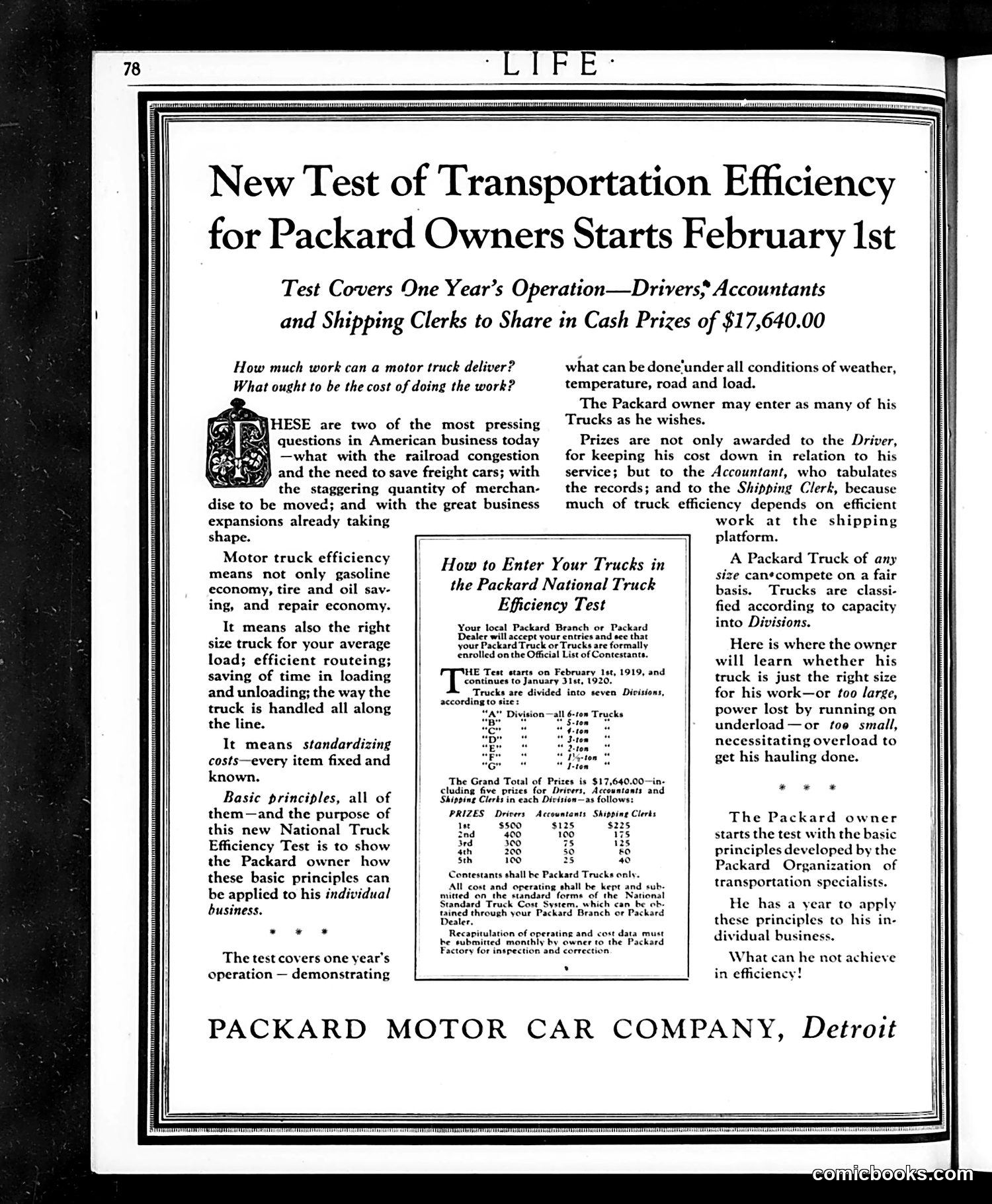
This page is **not a cartoon or satirical content** — it's a straightforward advertisement from Packard Motor Car Company announcing a "National Truck Efficiency Test" beginning February 1st. The ad promotes a competition for Packard truck owners to demonstrate transportation efficiency over one year. Participants (drivers, accountants, and shipping clerks) compete for $17,640 in cash prizes by proving cost-effectiveness across seven truck divisions classified by capacity. The text emphasizes practical business benefits: right-sizing vehicles, standardizing costs, and optimizing efficiency. There's no satire or political commentary present. This appears in *Life* magazine simply as paid advertising addressing a business audience concerned with post-WWI freight management and railroad congestion.
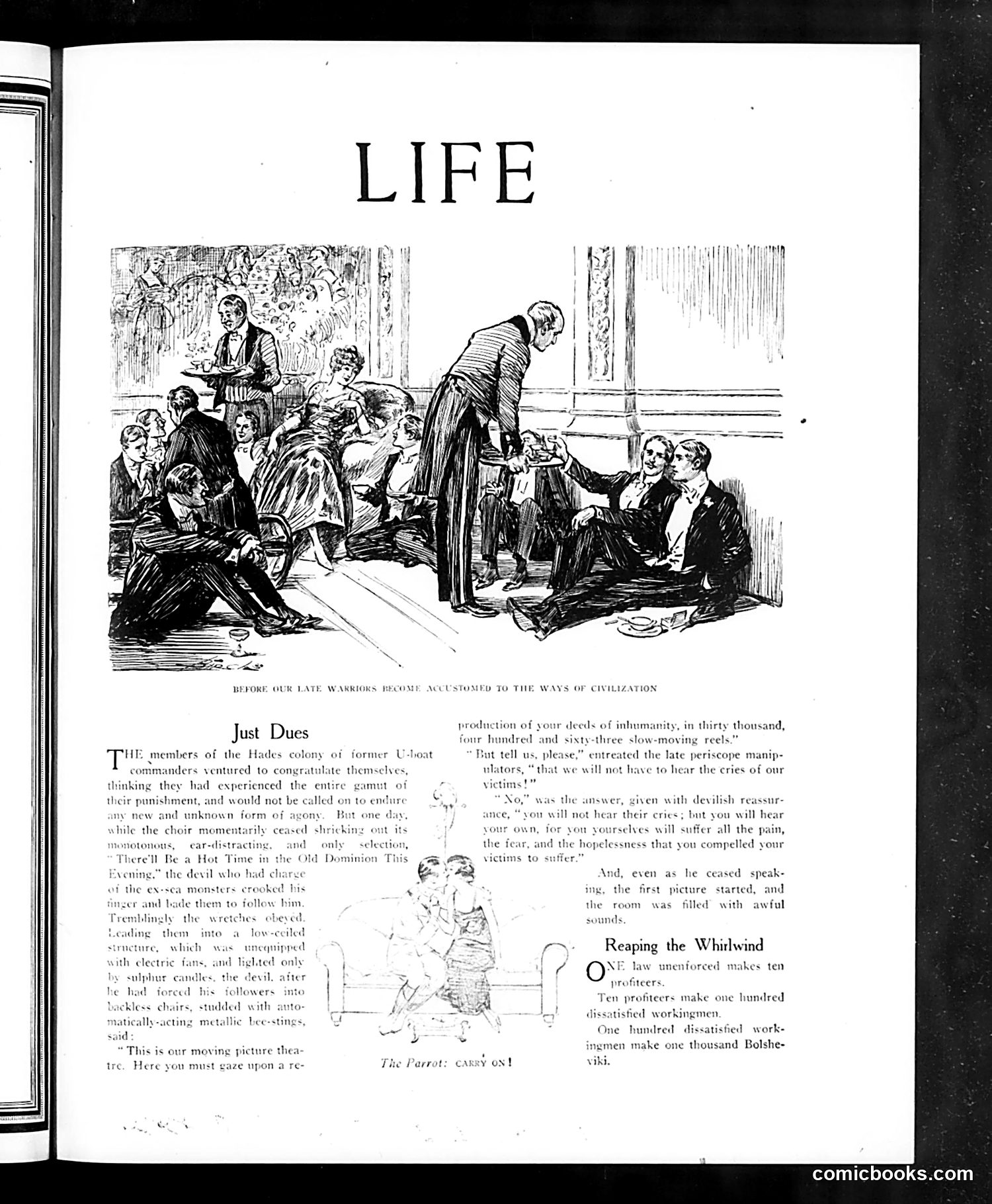
This page satirizes **Bolshevism and communist revolution**, likely from the early 1920s post-Russian Revolution period. The main illustration shows what appears to be a **devil figure** addressing a gathering of former soldiers ("Hades colony of former U-boat commanders"), tempting them toward violent revolution. The caption warns these ex-warriors are being seduced into a "low-ceilinged structure" lit only by sulfur candles—a hellish metaphor for communism. The text beneath ("Reaping the Whirlwind") uses a mathematical progression joke: one profiteer makes ten protesters; ten make one hundred dissatisfied workers; one hundred make "one thousand Bolsheviki." This satirizes how communist recruitment spreads geometrically through social discontent. The satire presents Bolshevism as demonic manipulation exploiting economic grievance among the working class and military veterans.
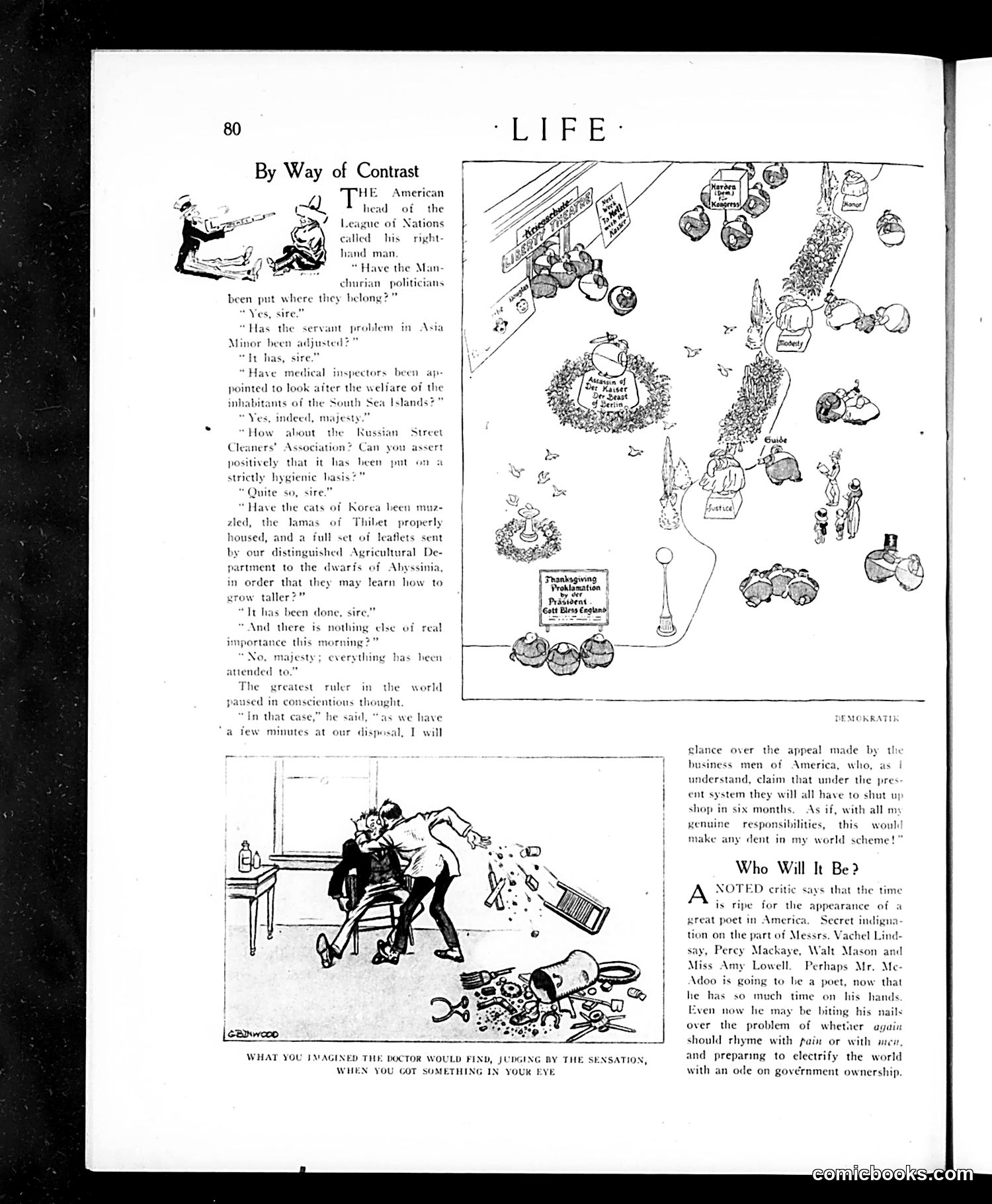
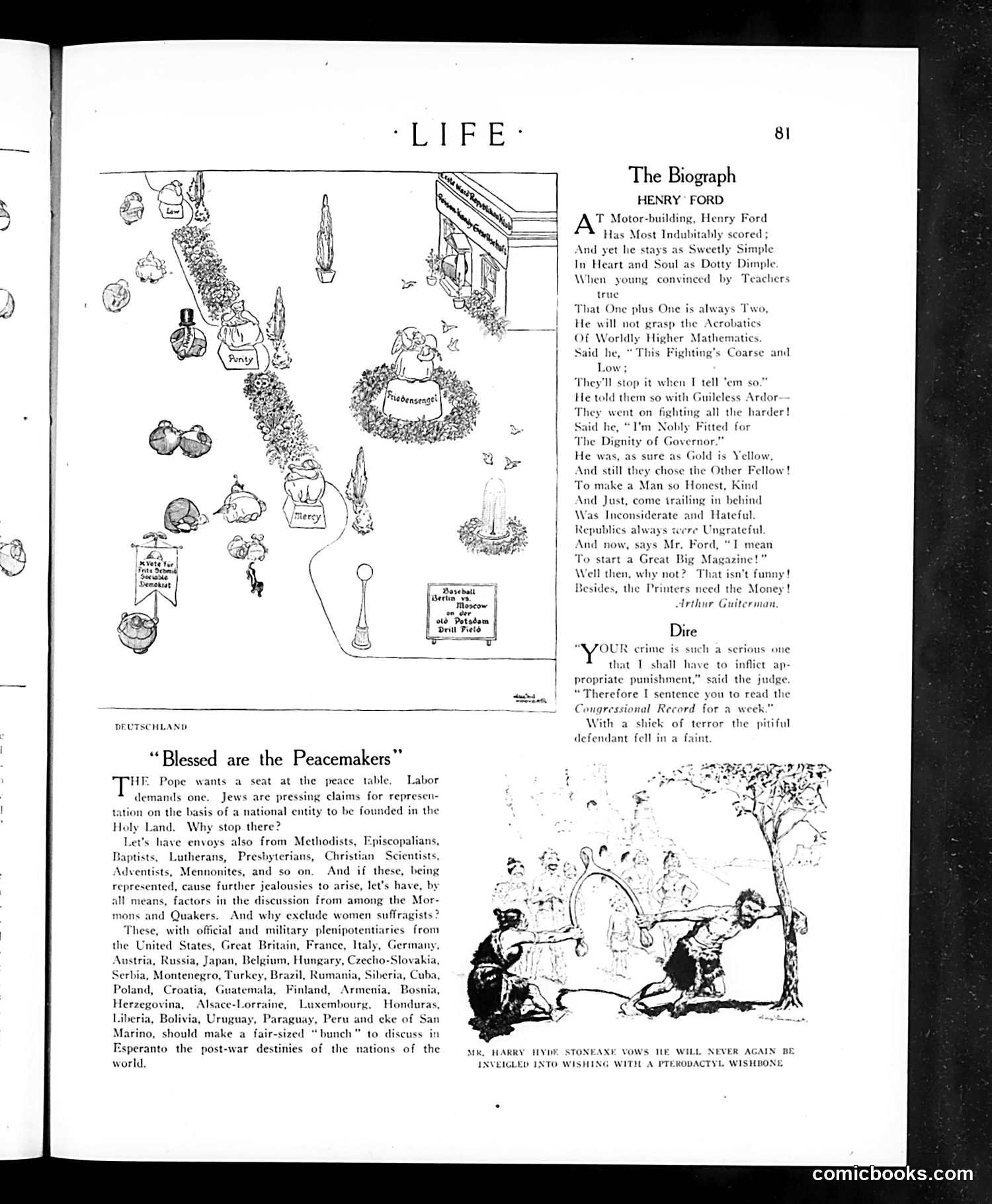
**Top Section - "The Biograph" (Henry Ford):** This is a satirical biographical poem about Henry Ford. The accompanying map-like illustration shows Ford's various business ventures and automobiles scattered across a landscape. The verse mocks Ford's contradictions: he's portrayed as mathematically illiterate yet successful, claiming to be "Noble Fitted for / The Dignity of Governor" while remaining obstinate. The satire targets Ford's inconsistency—he claims to mean well starting a magazine but the real motivation is profit ("the Printers need the Money"). **Bottom Section - "Blessed are the Peacemakers":** This section discusses post-WWI peace efforts, proposing that the Pope convene representatives from numerous nations (listed exhaustively) to discuss post-war international relations. The accompanying illustration shows two figures in apparent conflict, with text indicating a wish that disputes be settled through non-violent means rather than "pterodactyl wishbone" divination.
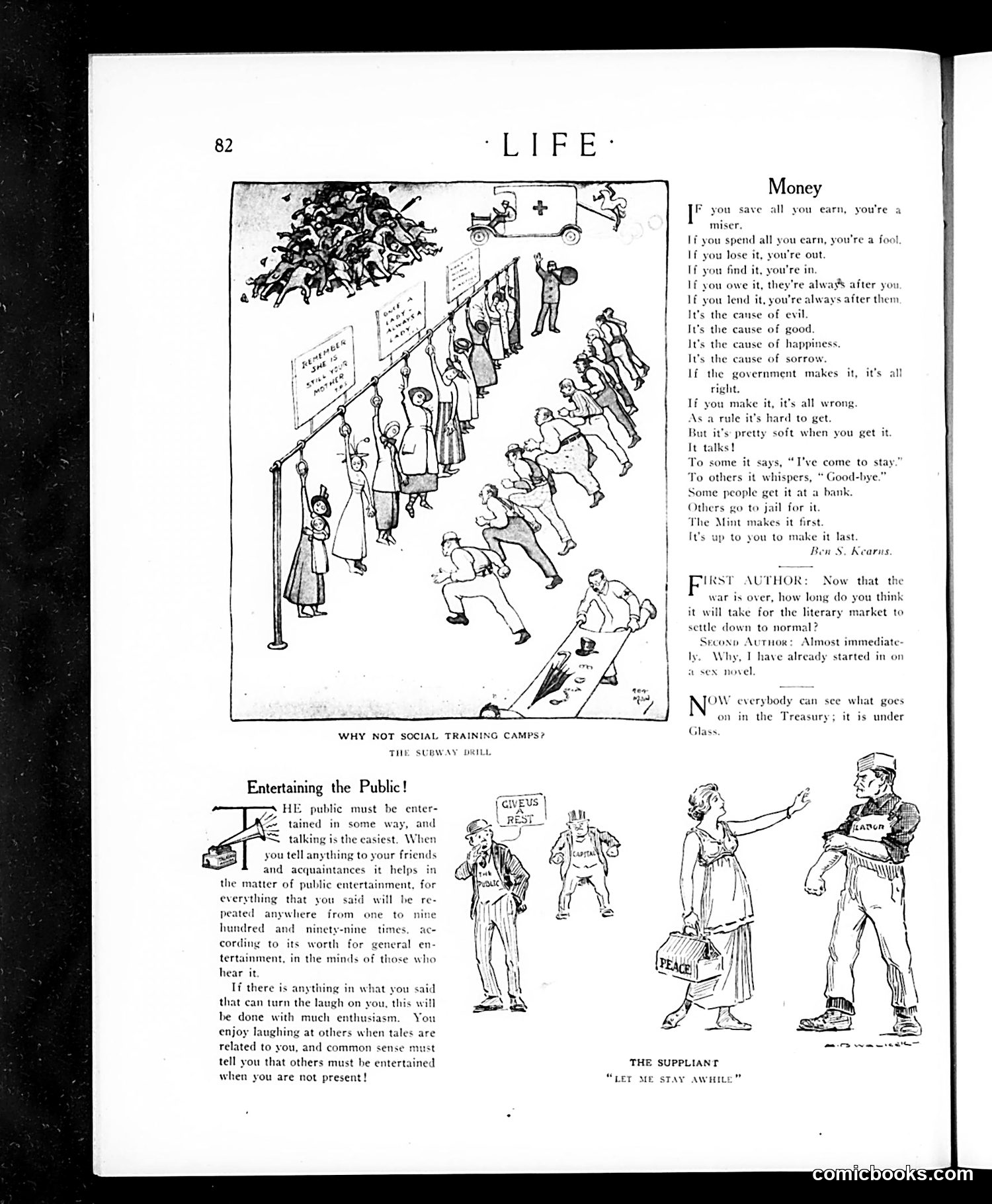
**Top Cartoon: "Why Not Social Training Camps? The Subway Ideal"** This satirizes crowded New York subway conditions. The cartoon depicts people literally stacked on top of each other in a chaotic pile, mocking the idea that subways could serve as "social training." The joke: subway conditions are so inhumanly packed that they're the opposite of civilized social interaction. **"Money" Poem & Dialogue** A cynical verse about money's paradoxical nature (save it = miser, spend it = fool, lose it = out, etc.). Below, two authors discuss post-WWI literary trends, with one humorously claiming to have already started a "sex novel"—reflecting the era's cultural shift toward more candid writing. **"Entertaining the Public" Section & "The Suppliant" Cartoon** Advice on public speaking and humor. The cartoon shows a woman pleading with a man for peace while he appears aggressive—likely satirizing post-war tensions or domestic politics.
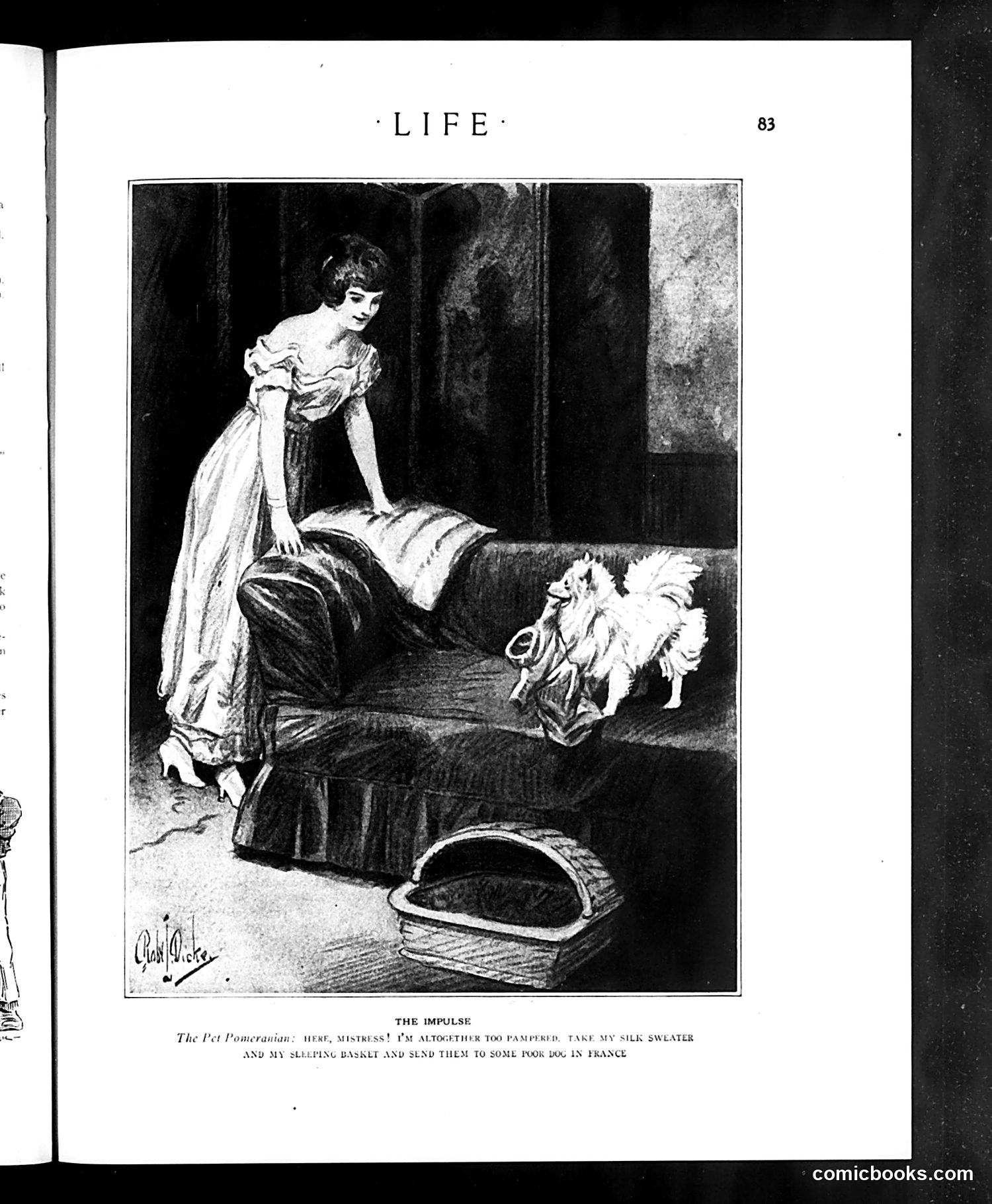
This cartoon satirizes wealthy women's charitable impulses. A fashionably dressed woman in an elegant gown stands over a Pomeranian dog, gesturing toward a sleeping basket and silk sweater. The caption reads: "HERE, MISTRESS! I'M ALTOGETHER TOO PAMPERED. TAKE MY SILK SWEATER AND MY SLEEPING BASKET AND SEND THEM TO SOME POOR DOG IN FRANCE." The joke mocks the contradiction between genuine altruism and self-indulgent "charity." The woman intends to donate her pet's luxuries to help suffering dogs in post-WWI France, yet her pampered Pomeranian sarcastically suggests she remains blind to the absurdity—donating a dog's silk sweater while presumably her own charitable giving is minimal or performative. It critiques upper-class women who engage in fashionable charity work without meaningful sacrifice.
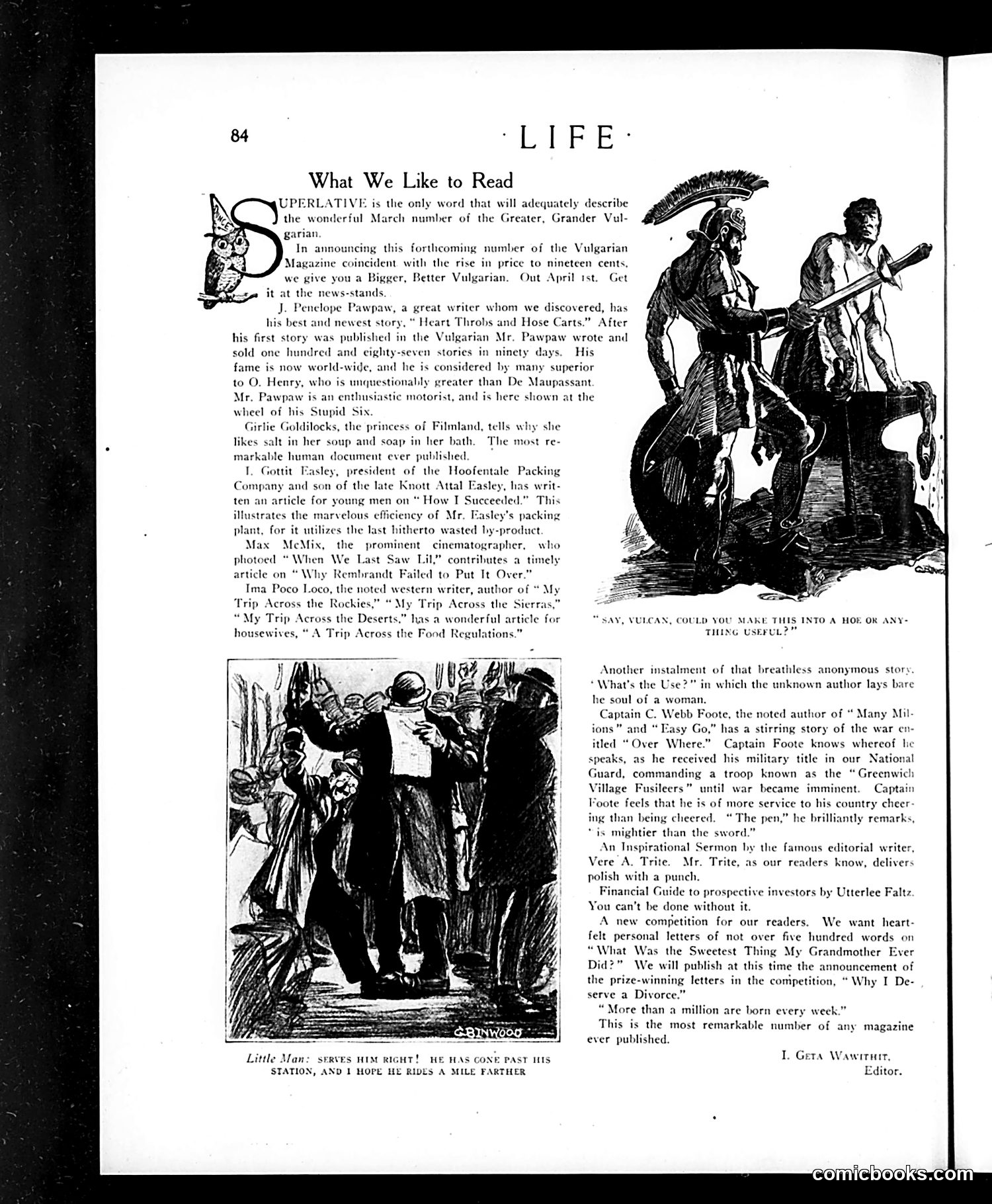
This editorial page showcases Life's upcoming magazine content. The two illustrations accompany brief promotional descriptions of featured stories and writers. The upper right cartoon depicts a vulgar or crude figure—labeled "Say, Vulcan, could you make this into a hoe or anything useful?"—likely satirizing pretentious or overly complex literature by suggesting even skilled craftsmanship can't salvage poor writing. The lower left illustration, captioned "Little Man serves him right! he has gone past his station, and I hope he rides a mile farther," appears to depict class-based social commentary—mocking someone who has exceeded their "proper" social position. Both images support the page's broader purpose: promoting Life's literary content while making light of social pretensions and literary merit.
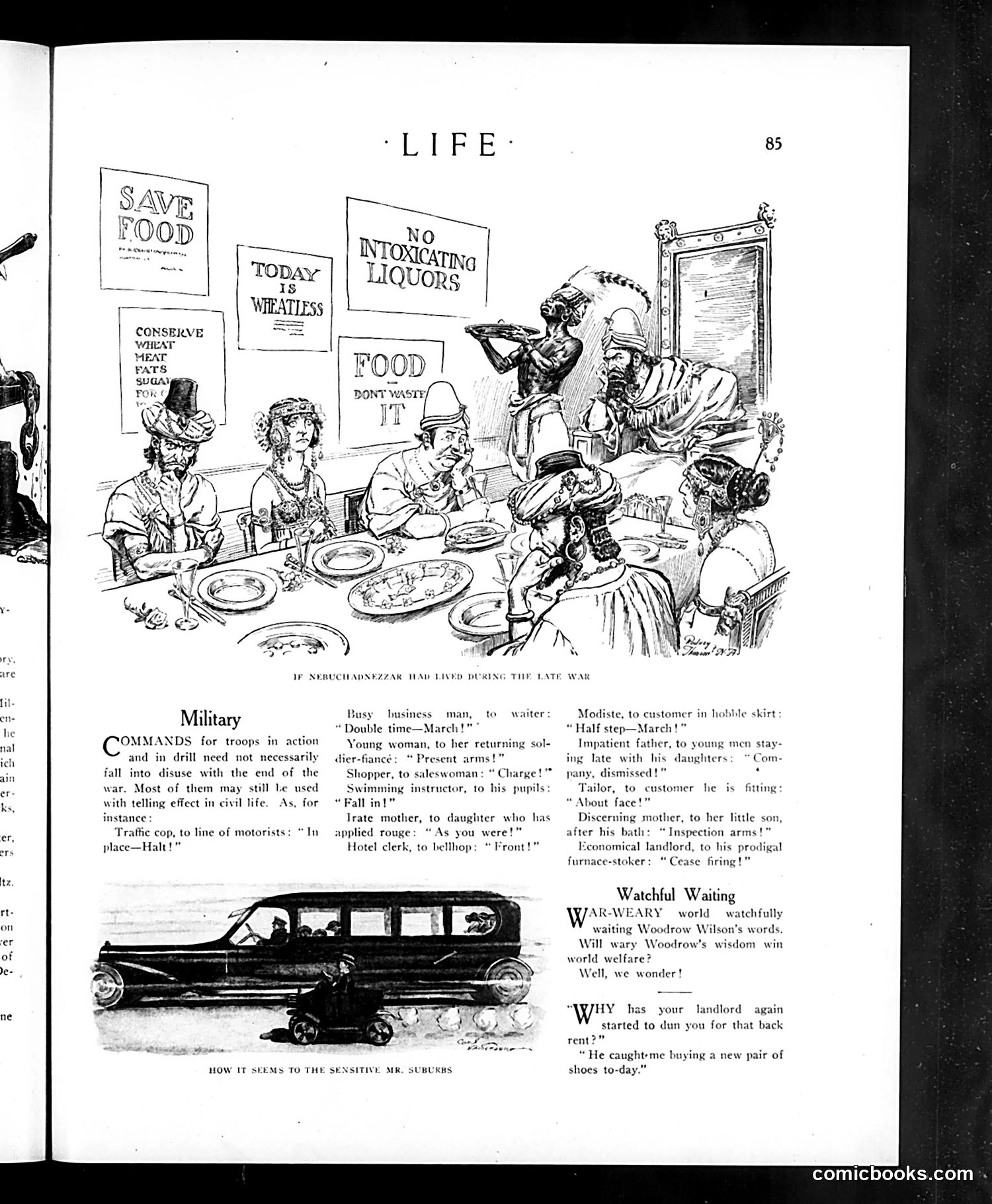
This page features wartime satire from World War I era (based on the caption "If Neuchâtels Had Lived During the Late War"). The main cartoon depicts a dinner party where various civilians display absurd, exaggerated military commands and behaviors—a waiter shouts "Double time—March!" and a tailor declares "About face!" The signs visible reference wartime rationing and prohibition: "Save Food," "No Intoxicating Liquors," and "Food Don't Waste It." The satire mocks home-front civilians who adopt military mannerisms and language during wartime, treating ordinary civilian life as if they're conducting military operations. It's comedy about civilians overcompensating with pseudo-military authority during the war effort, conflating domestic inconveniences with actual military discipline.
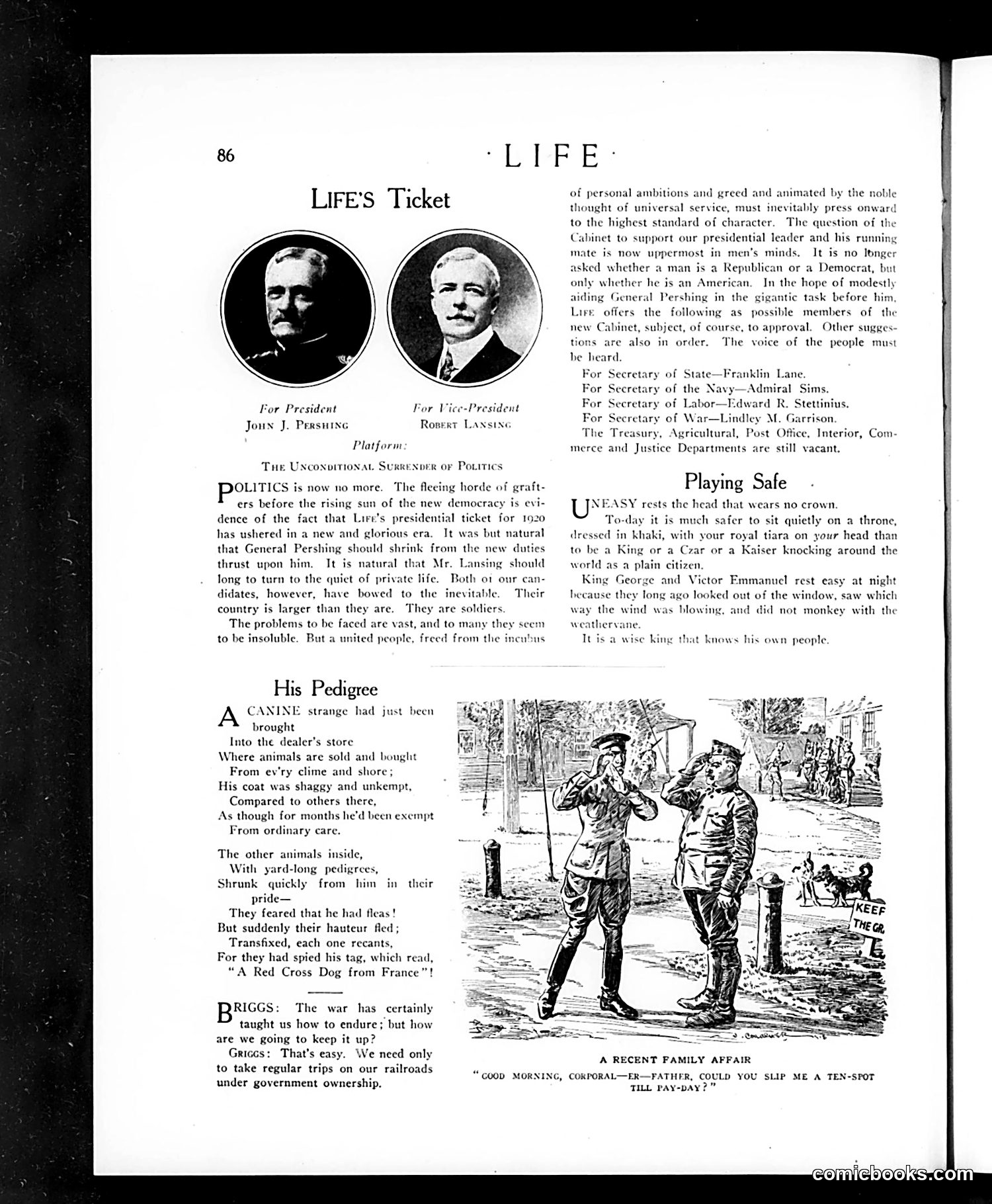
**"Life's Ticket"** presents two portrait photographs labeled "For President: John J. Pershing" and "For Vice-President: Robert Lansing." The accompanying text proposes these military/political figures as potential Cabinet members under an unspecified presidential leader, discussing the need for qualified leadership amid post-war challenges. **"His Pedigree"** is a humorous poem about a mangy dog from a pet-store, discovered to be "A Red Cross Dog from France"—likely satirizing the valorization of war service. **"A Recent Family Affair"** cartoon depicts two soldiers, one asking the other for a ten-spot loan until payday, illustrated with period military uniforms and street setting. The page reflects post-WWI American political discourse regarding leadership and military service's cultural status.
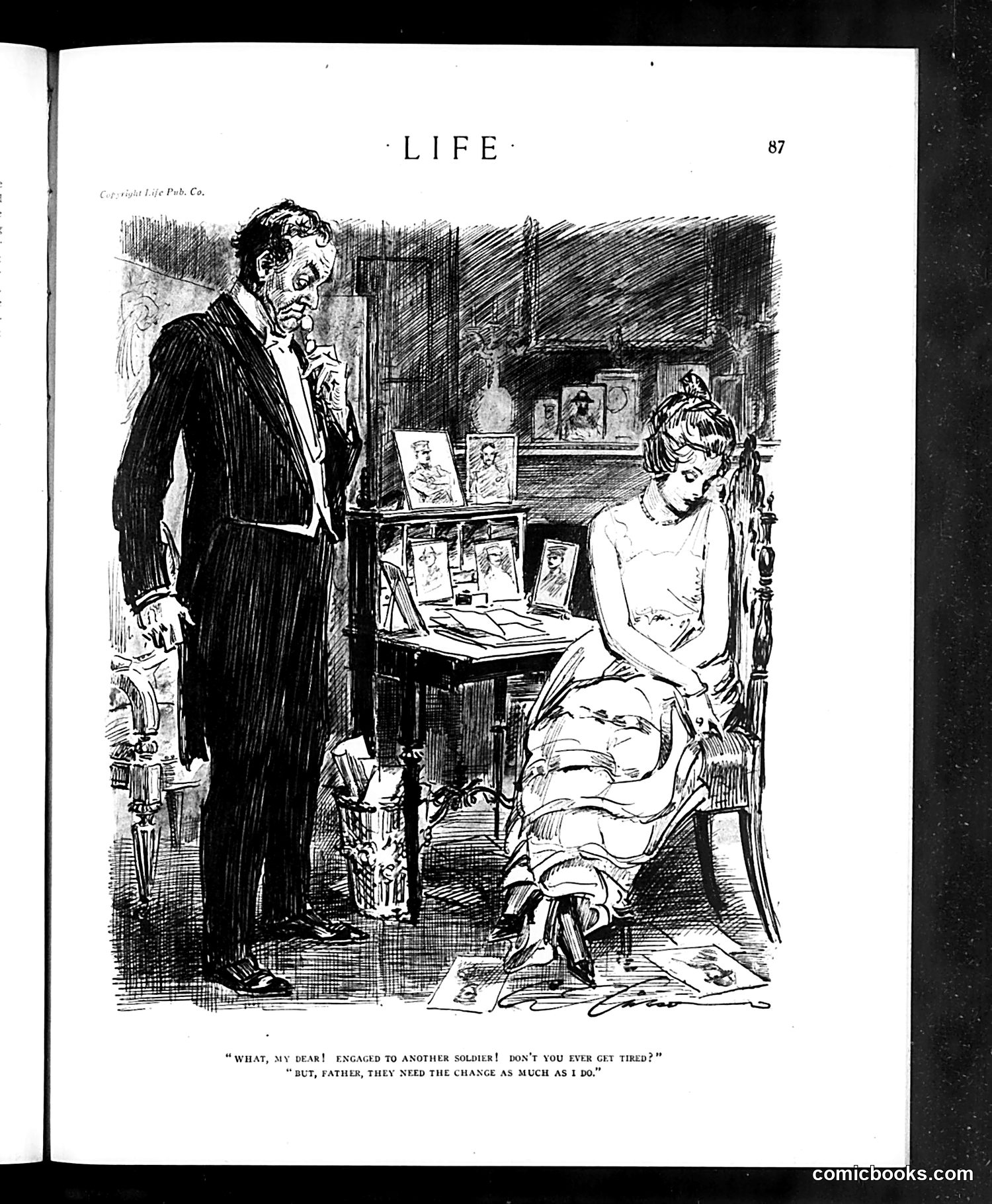
This is a satirical cartoon from *Life* magazine depicting a domestic scene. A distressed father confronts his daughter about being engaged to "another soldier," while pictures of military officers line the desk behind her. The daughter, seated and looking down, responds that soldiers "need the change as much as I do." The satire targets the phenomenon of young women rapidly cycling through engagements to different servicemen—likely during World War I or the interwar period. The cartoon mocks both the daughters' fickleness in romance and simultaneously suggests soldiers deserve romantic variety as a form of rest and recreation from military service. The numerous framed portraits emphasize the rapid succession of engagements, making the daughter's behavior appear comically promiscuous or inconstant.
**The Cartoon:** The masthead illustration depicts a reclining figure, likely representing Theodore Roosevelt, who died recently (the text confirms this). The figure appears skeletal or death-like, reflecting the magazine's mourning. **The Context:** This is primarily a commemorative editorial rather than satire. Life's editors praise Roosevelt as an "enormous personality" beloved across political divides—admired even by opponents. They acknowledge his recent physical decline from a South American illness. **The Point:** The essay debates Roosevelt's philosophy on the use of force versus Christian teachings about non-resistance. Roosevelt favored forceful intervention (criticized McKinley's restraint in Cuba, Wilson's in Mexico), while the editors note tension between Christian pacifism and practical necessity. They ultimately side with Roosevelt's view that force is sometimes justified, contrasting this with the contemporary League of Nations debate and post-WWI politics. The piece is respectful remembrance rather than satire—celebrating Roosevelt's vigorous character while grappling with his controversial political legacy.
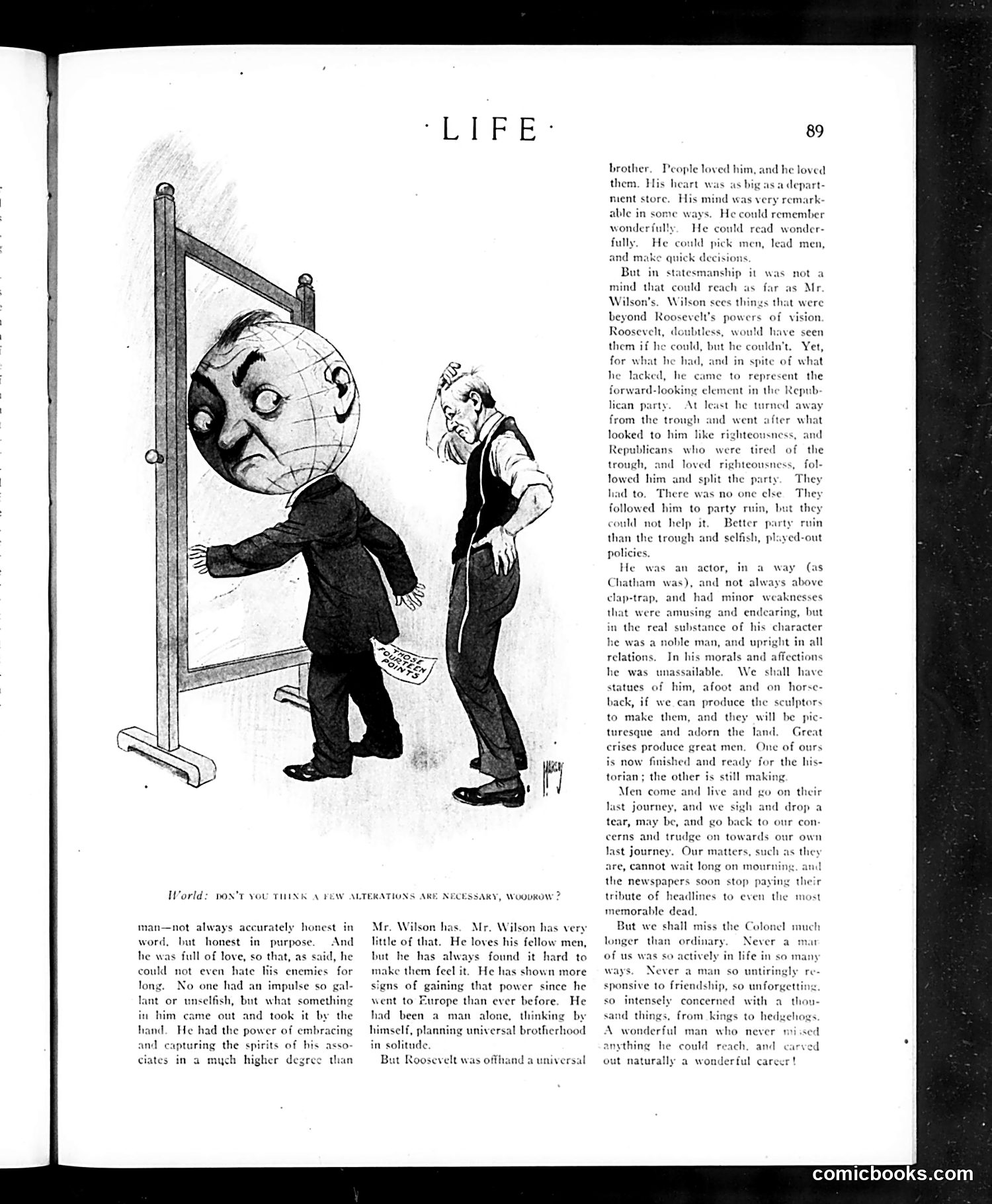
This editorial cartoon compares **Theodore Roosevelt** (the large globe-headed figure) with **Woodrow Wilson** (the observing man). The globe-head is a visual metaphor for Roosevelt's expansive, world-encompassing vision and his role as a global statesman. The text accompanying the cartoon contrasts the two leaders: Roosevelt possessed charisma, decisive action, and the ability to inspire loyalty, but lacked Wilson's intellectual breadth and long-range strategic vision. Roosevelt "loved" people naturally; Wilson struggles to make his fellow-feeling apparent. The cartoon's caption asks Wilson if alterations are needed—likely referencing Republican Party divisions. Roosevelt's forward-looking republicanism split the GOP, yet his charisma commanded loyalty despite leading followers toward "party ruin." **Context**: This appears post-WWI, eulogizing Roosevelt's death (1919). The satire suggests Wilson's cooler intellectualism differs fundamentally from Roosevelt's passionate, personable leadership style—each approach having merits and limitations.
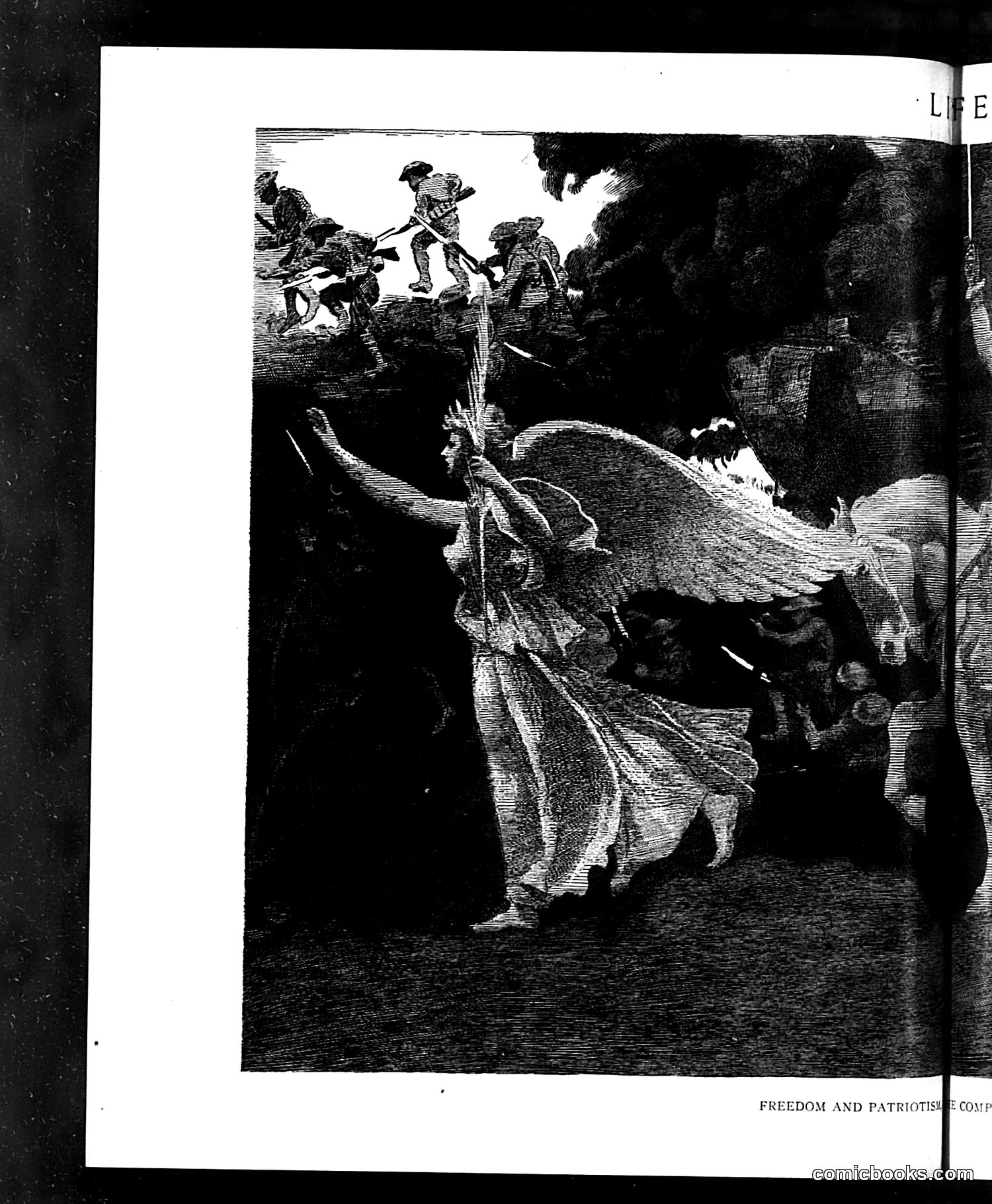
This is a satirical engraving titled "Freedom and Patriotism's Comp[any]" depicting an allegorical winged female figure (representing Liberty or Freedom) gesturing commandingly toward a group of armed soldiers on elevated ground. The soldiers appear to be in military formation, suggesting mobilization or military action. The satire likely critiques the relationship between patriotic rhetoric and actual military conduct or government policy. The commanding pose of the Liberty figure suggests irony—perhaps questioning whether military actions truly serve freedom or whether freedom is being invoked to justify military objectives. Without specific date or publication context visible, the precise historical event referenced remains unclear, though the style suggests 19th-century American satire.
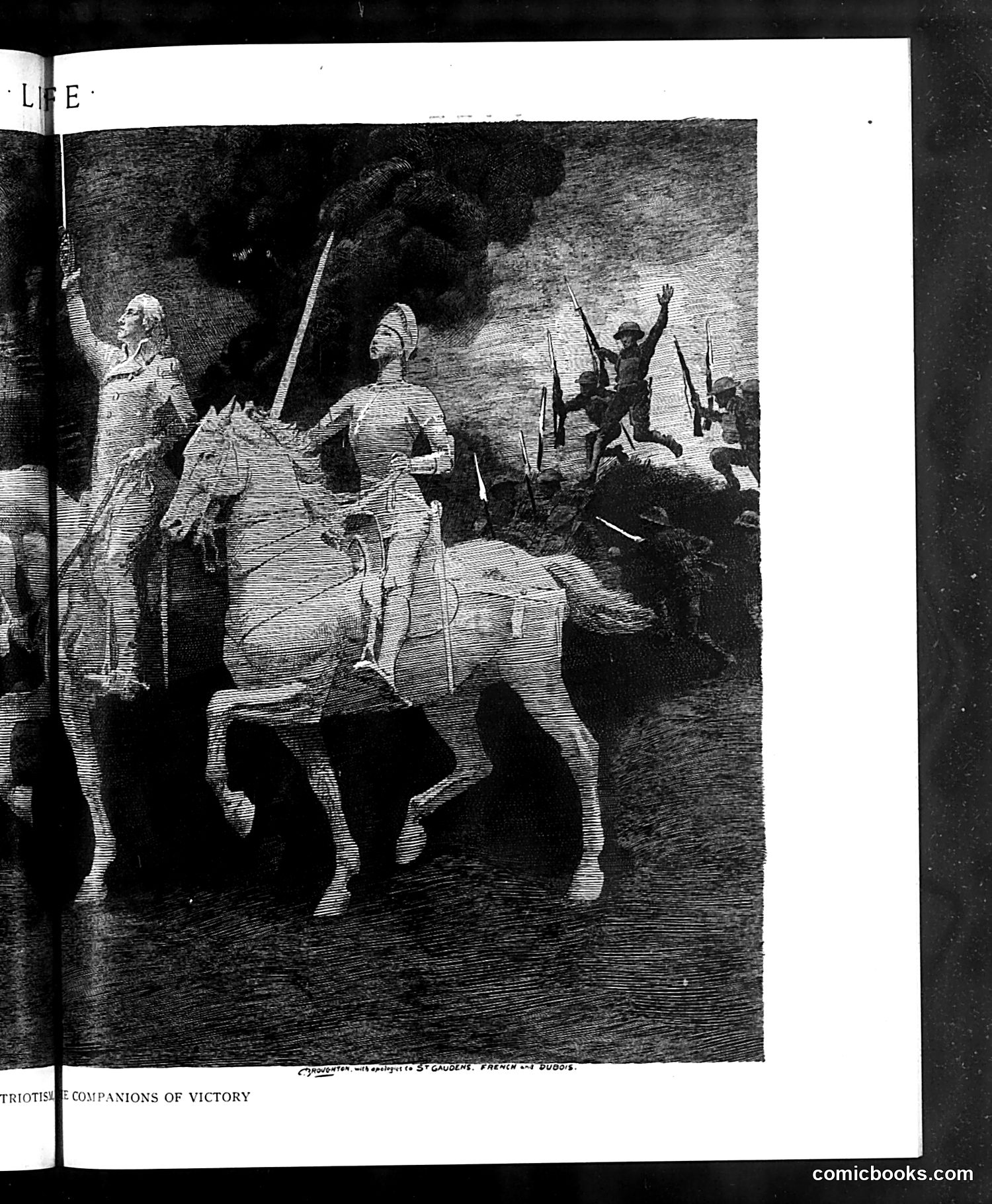
This engraving depicts a military scene with mounted soldiers carrying weapons and flags. The caption reads "Patriotisme Companions of Victory" and references "French and Buddies" (likely "French and Doughboys" — American WWI soldiers). The image appears to be WWI-era satire celebrating the Allied partnership between French and American forces. The dramatic engraving style, with its heavy cross-hatching, emphasizes heroic military action — soldiers on horseback with raised weapons and flags. The satire likely comments on Franco-American military cooperation during World War I, possibly commenting on their shared struggle or celebrating their alliance. The theatrical, exaggerated style typical of *Life* magazine's satirical approach suggests the artist is making some commentary about patriotism or military glory, though the specific political point remains unclear from this image alone.
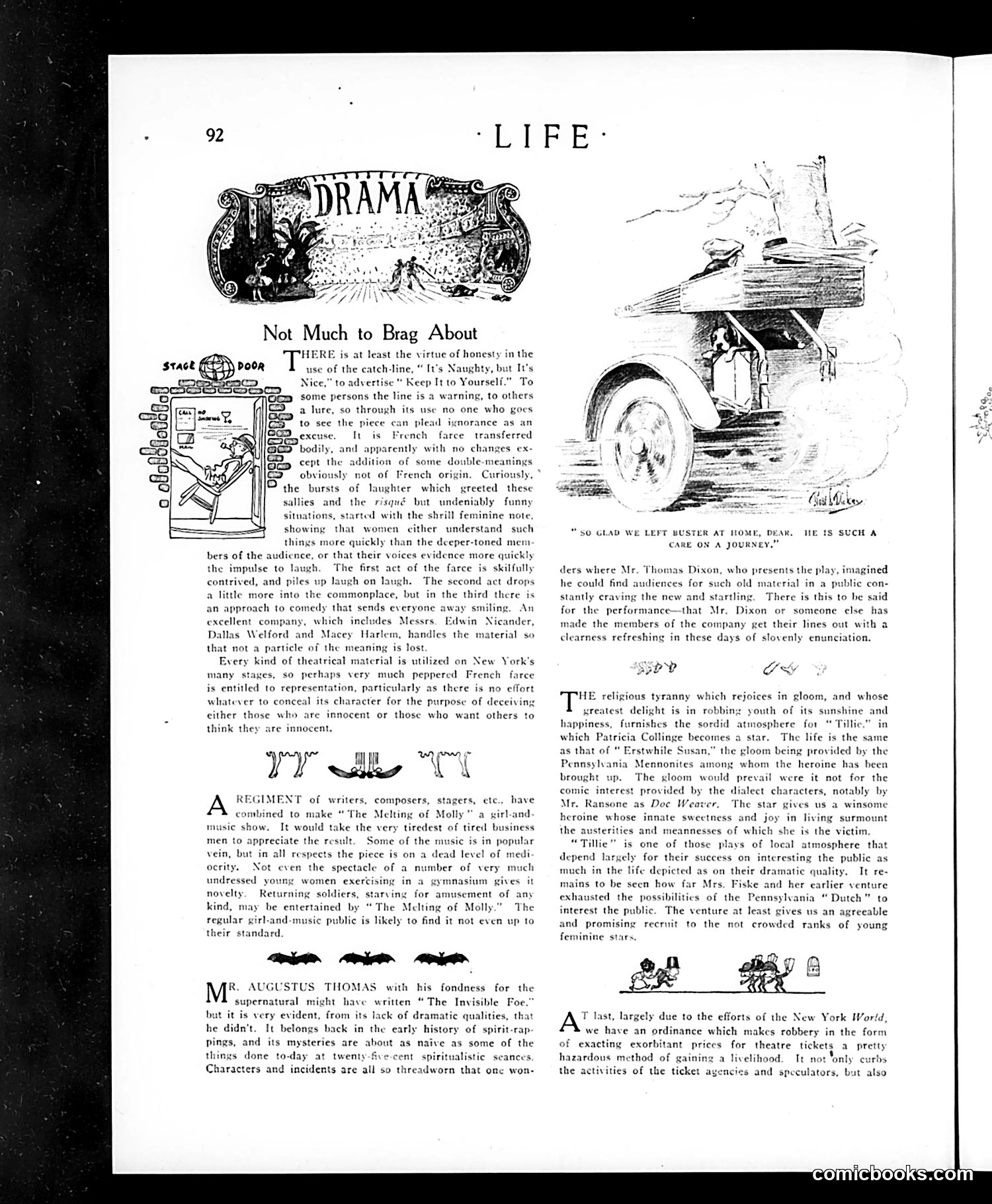
This page reviews three theatrical productions of the era (appears to be early 1900s, given references to "returning soldiers"): **"Keep It to Yourself"** — A French farce advertised with the risqué slogan "It's Naughty, but It's Nice." The reviewer notes it's honest about its bawdy nature, making audiences aware what they're getting. The sketch shows a car with the caption mocking someone bringing a child ("Buster") to such entertainment — the joke being adults shouldn't expose children to risqué plays. **"The Melting of Molly"** — A girl-and-music show featuring undressed women exercising. The reviewer dismisses it as mediocre, suggesting only exhausted soldiers and lowbrow audiences would find it entertaining. **"Tillie"** — A Mennonite-themed play dealing with religious strictness and gloom, redeemed by dialect-comedy characters and a sweet heroine (Patricia Collinge). The satire targets theatrical mediocrity and exploitative entertainment aimed at unsophisticated audiences during wartime.
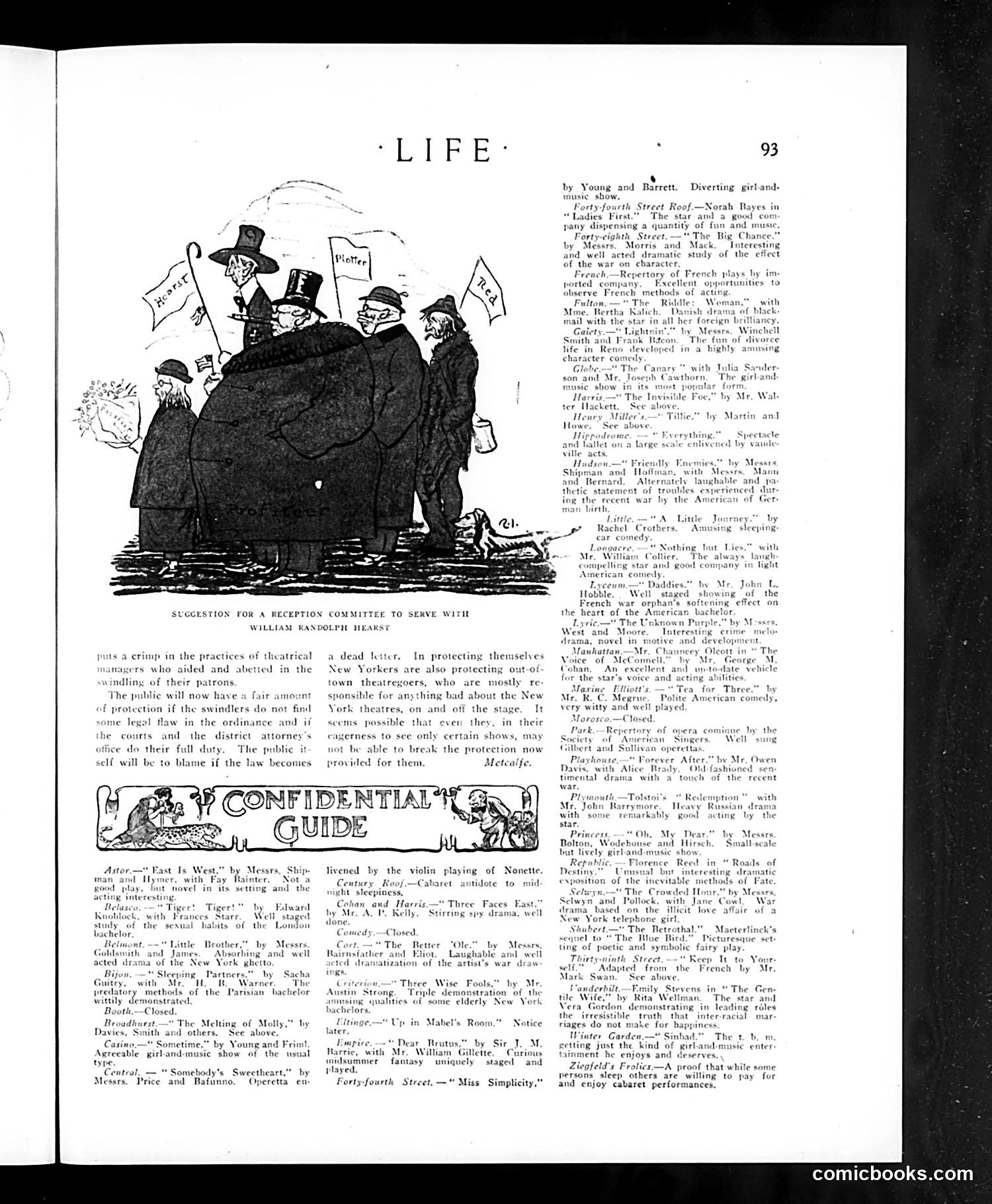
This cartoon satirizes William Randolph Hearst, the powerful newspaper magnate and theatrical patron. The image depicts a large, menacing figure (Hearst, identifiable by his prominence in the text) surrounded by smaller figures carrying flags labeled with theatrical terms like "Vaudeville" and "Box." The satire critiques Hearst's control and influence over New York theater. The "reception committee" joke suggests that theater managers, actors, and industry figures are forced to serve Hearst's interests rather than operating independently. The dark, oversized central figure represents Hearst's outsized power to dominate and shape the theatrical world according to his preferences. The surrounding text reviews current Broadway productions, providing context that this was a period when wealthy patrons like Hearst significantly influenced what shows succeeded or failed in New York theaters—a form of cultural gatekeeping that Life magazine's editors viewed as problematic.
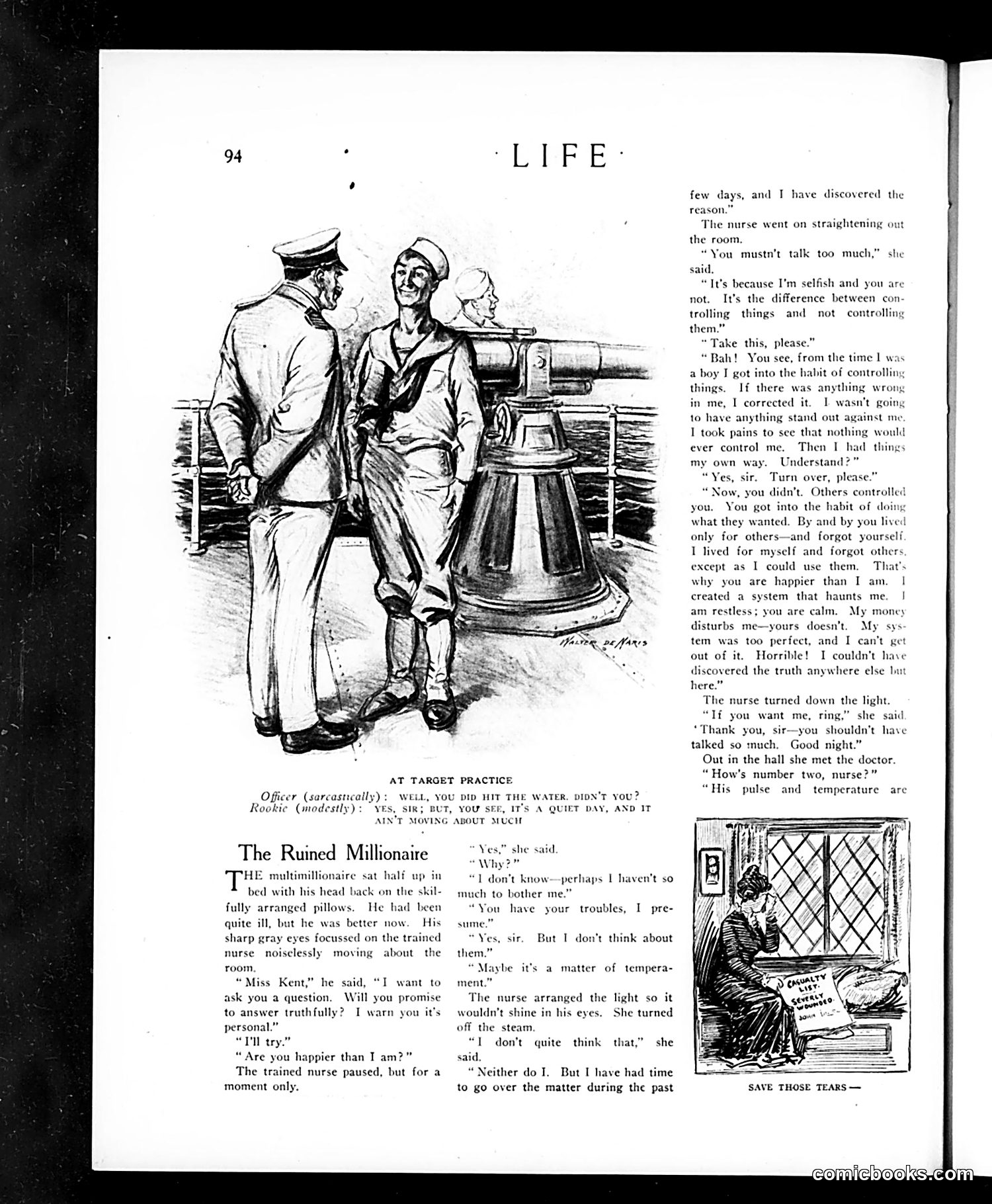
**"At Target Practice"** (top cartoon): A military officer sarcastically criticizes a rookie's poor marksmanship. The rookie defensively claims he hit the water—a literal excuse that misses the point entirely. The humor lies in the rookie's obliviousness: he's so far off-target that hitting water (presumably near the target) is somehow presented as acceptable. It satirizes making excuses for failure. **"The Ruined Millionaire"** (main story): A wealthy, bedridden man asks his nurse if she's happier than he is. She answers yes. His realization: he spent life controlling everything (including people), becoming enslaved by his own rigid system and wealth. She found happiness by accepting life's uncontrollability. The satire critiques wealthy self-made men whose pursuit of absolute control over circumstances and people ultimately creates their own misery, while simpler people find contentment in acceptance.
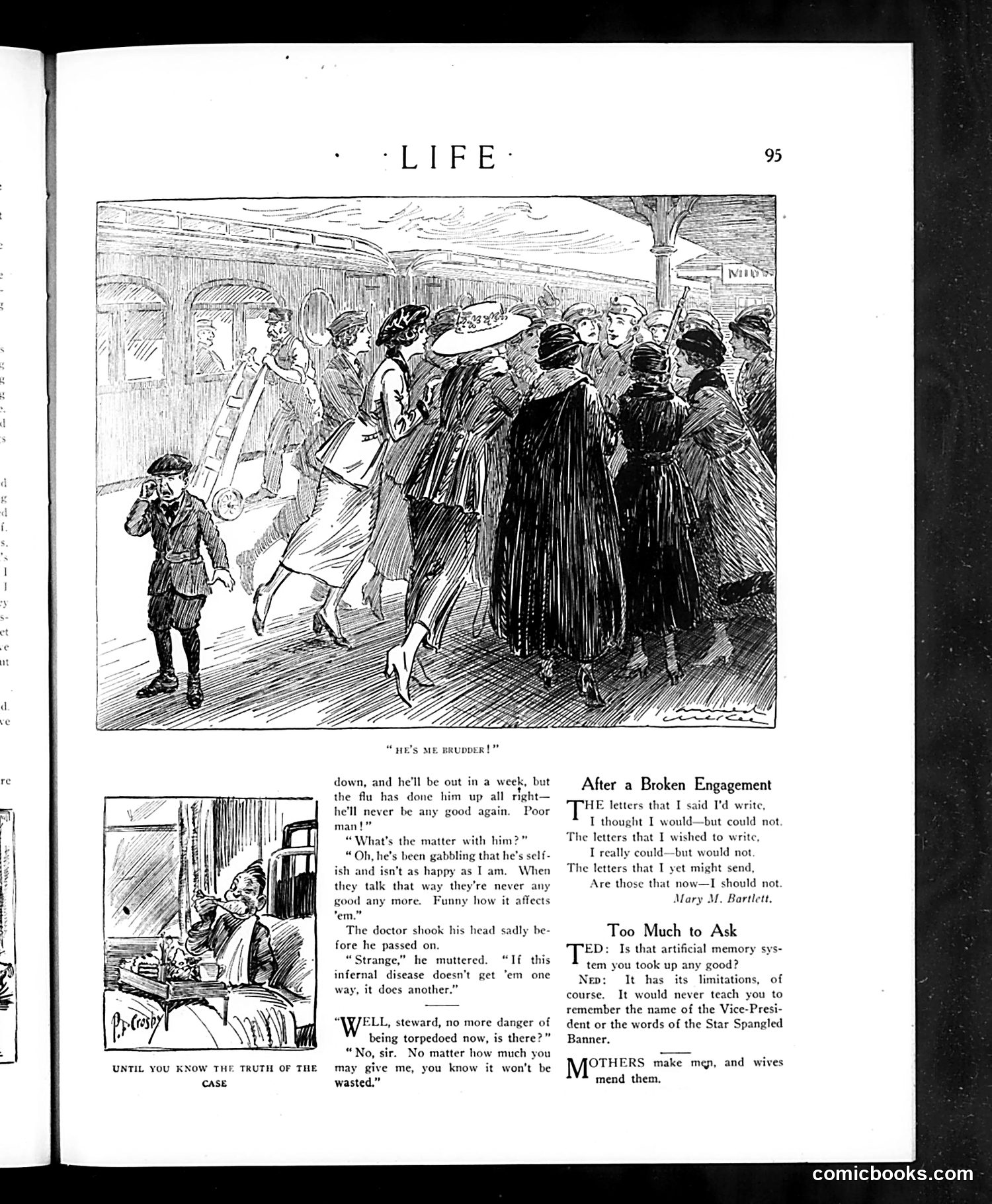
This page contains three separate satirical pieces from Life magazine (likely early 20th century): **Top cartoon "He's Me Brudder!"**: Shows a crowded dock scene where a man claims kinship to avoid trouble. The accompanying dialogue reveals dark satire about influenza's psychological effects—the disease apparently causes victims to become introspective and "talk that way" (expressing selfishness concerns), making them "never any good any more." The doctor's response suggests the flu destroys both body and spirit unpredictably. **Lower left cartoon "Until You Know the Truth of the Case"**: Depicts a ship's steward assuring a passenger about safety from torpedoes, implying the steward accepts bribes ("no matter how much you may give me") without fear of waste—likely satirizing wartime corruption or confidence schemes. **Text pieces**: Include poetry about regretted letters after a broken engagement, and humorous observations about artificial memory systems and gender roles. The page overall reflects early-20th-century concerns: wartime dangers, disease, romantic disappointment, and social hypocrisy.
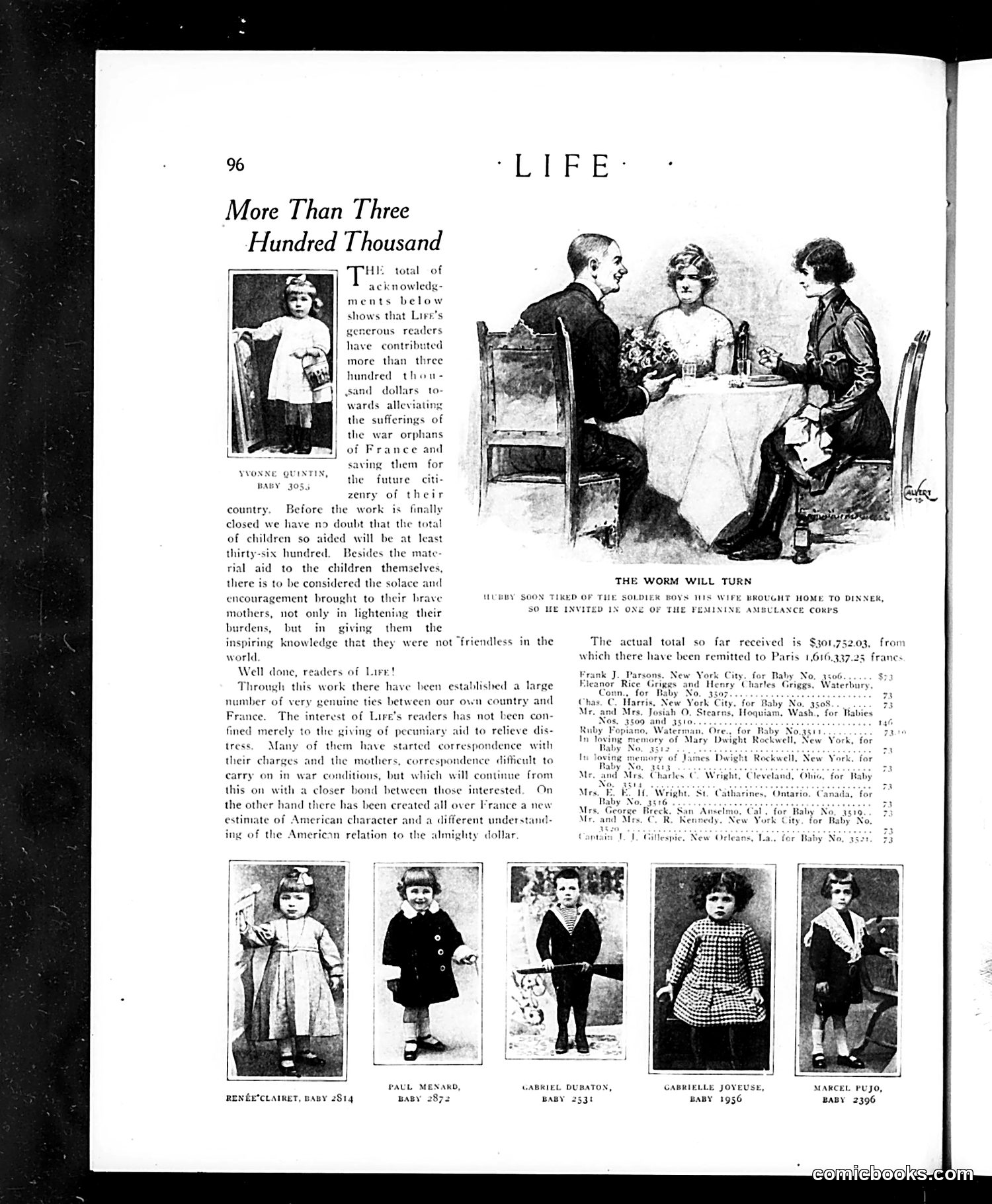
This page documents Life magazine's charitable campaign to aid French war orphans during World War I. The headline "More Than Three Hundred Thousand" refers to dollars raised by readers. The main cartoon, "The Worm Will Turn," depicts a domestic scene where a soldier's wife has invited female ambulance corps workers to dinner. The satire likely mocks how the war has inverted traditional gender roles—women now serve in military support positions ("ambulance corps"), which would have been scandalous pre-war. The "worm turning" suggests role reversals and social upheaval caused by the conflict. Below are photographs of French orphans being sponsored through the campaign, each assigned a "baby number." The text emphasizes that American readers' contributions have created genuine personal bonds between American donors and French families, challenging European stereotypes that Americans care only about money. This served propagandistic purposes, promoting American generosity and Franco-American solidarity during the war.
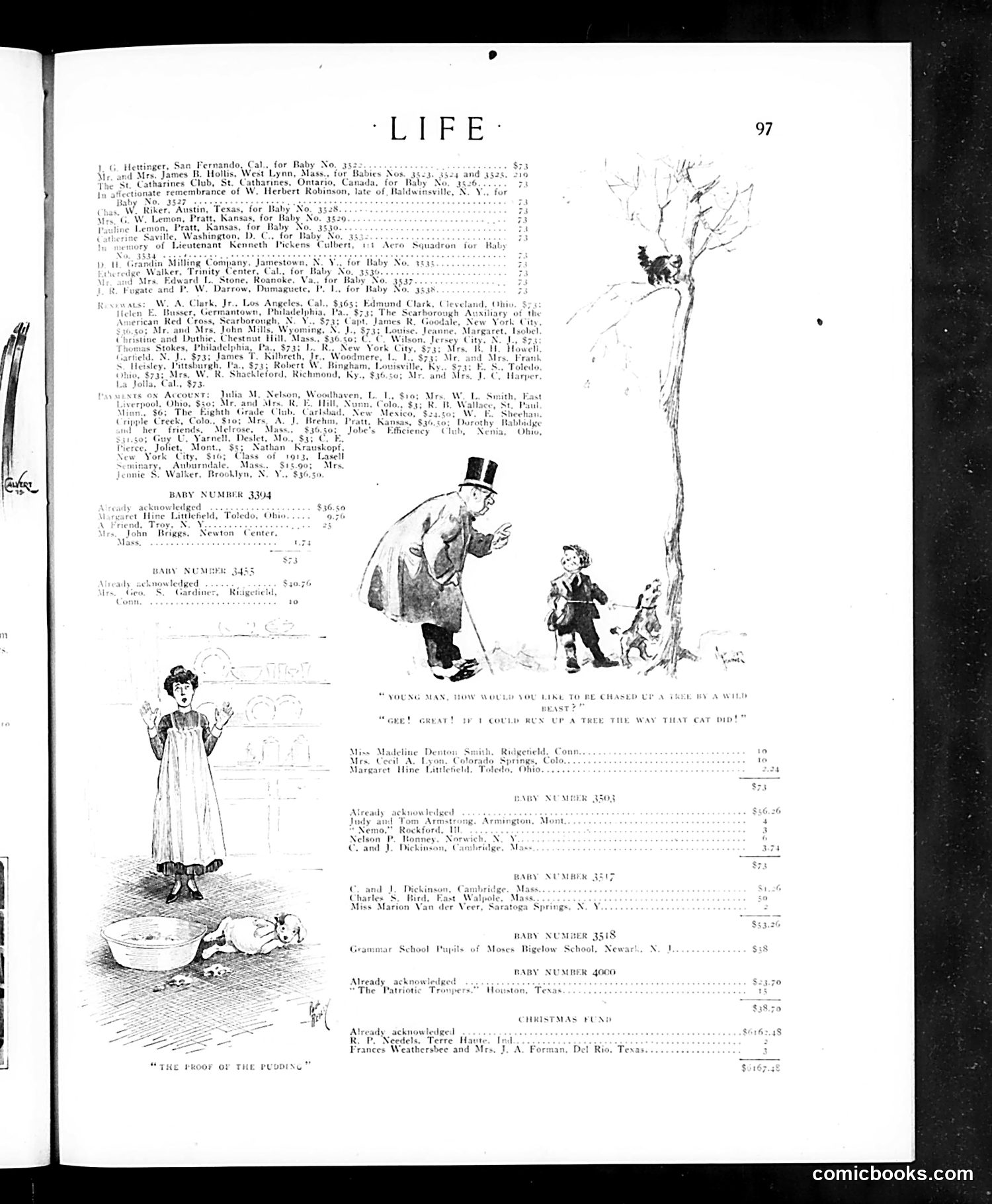
This page combines fundraising acknowledgments with satirical cartoons typical of Life magazine's format. The main cartoon shows an adult (appears to be a gentleman in a top hat) and children near a tree, with dialogue: "Young man, how would you like to be chased up a tree by a wild beast?" and "Gee! Great! If I could run up a tree the way that cat did!" The joke targets children's overconfidence and naïveté—the child enthusiastically agrees to being chased by a wild animal, seemingly unaware of actual danger. This reflects turn-of-the-century satirical humor about childhood innocence versus adult awareness of real consequences. The left illustration, captioned "The Proof of the Pudding," shows a woman and children in domestic scenes, likely commenting on parenting or domestic life—common Life magazine subjects. The bulk of the page lists donors to baby-related charitable funds, indicating this was a fundraising issue for children's welfare causes.
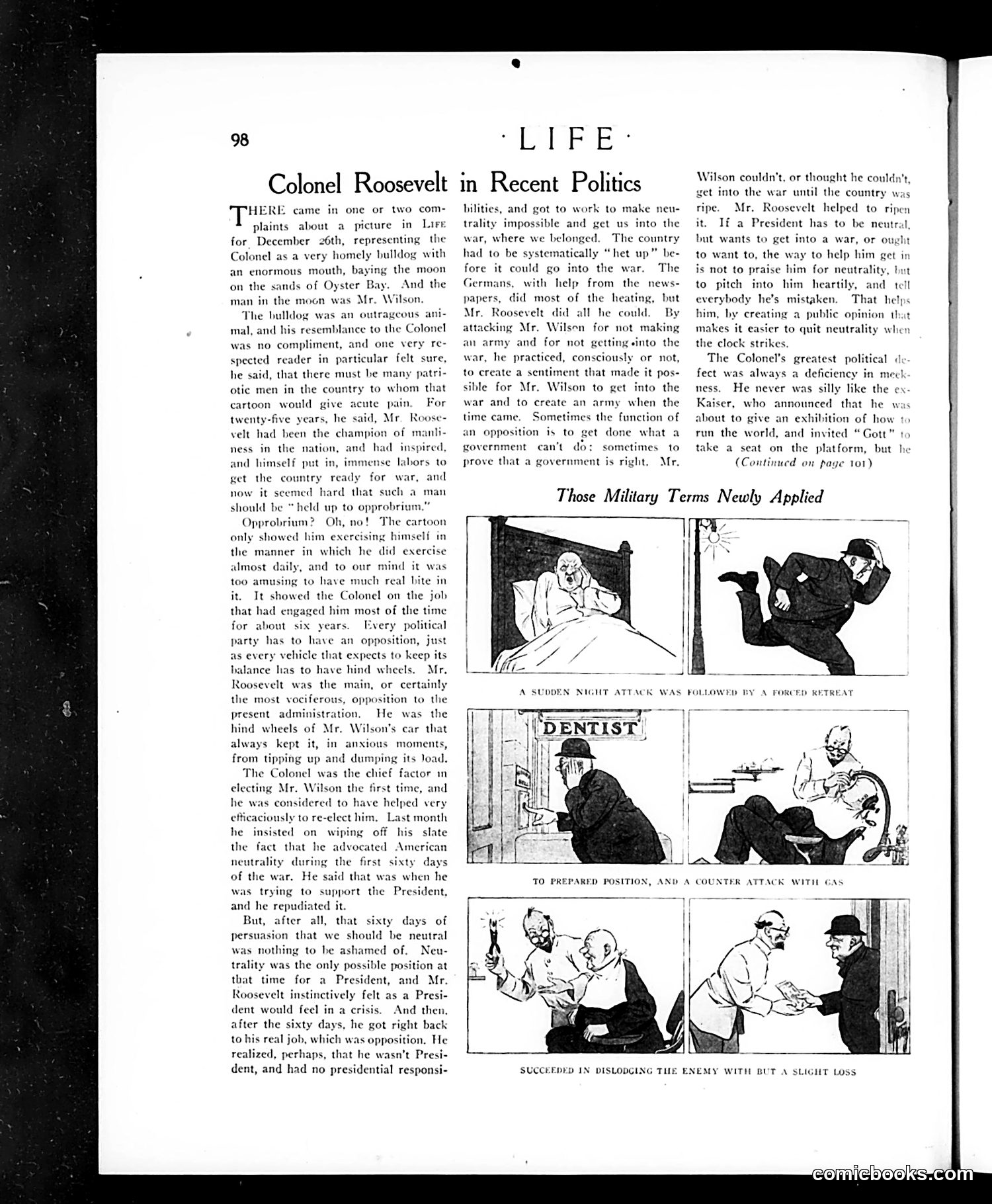
This Life magazine article defends Colonel Theodore Roosevelt against complaints that a previous cartoon caricatured him unflattering as a bulldog. The piece argues Roosevelt's aggressive opposition to President Wilson's administration was actually constructive. The article's central point: Roosevelt served as necessary political "opposition"—the "hind wheels" keeping Wilson's government balanced. While Wilson needed to maintain official neutrality early in WWI, Roosevelt publicly attacked this stance, creating public pressure that eventually enabled Wilson to enter the war (1917). The author credits Roosevelt with "ripening" American public opinion for war rather than criticizing him. The cartoon series below titled "Those Military Terms Newly Applied" shows civilians preparing for combat—a dentist, person under bombardment, etc.—satirizing how war terminology had entered everyday civilian life during the conflict.
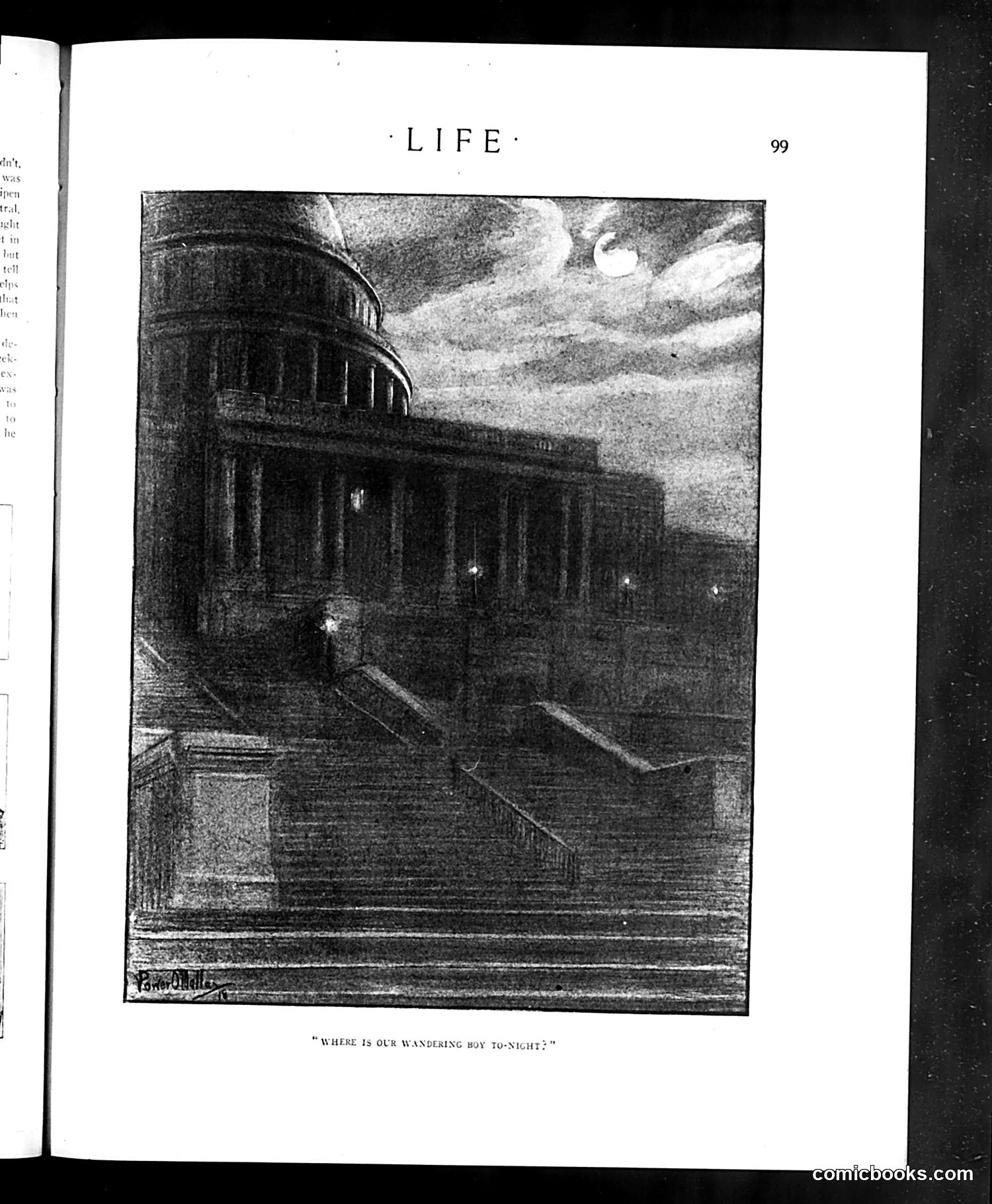
This image is a nighttime scene of the U.S. Capitol building under moonlight, appearing somewhat ominous or foreboding. The caption reads: "Where is Our Wandering Boy To-Night?" The cartoon uses a common Victorian sentimental phrase—originally from a popular 1877 song about a mother worrying about her wayward son—to satirize a politician or public figure. By applying this anxious maternal question to the Capitol, the artist suggests concern about the whereabouts or activities of some government official or representative during nighttime hours, implying potentially improper conduct or absence from duty. The specific political figure or scandal referenced is unclear from the image alone, as Life magazine frequently used this type of rhetorical questioning to critique politicians' behavior or accountability.
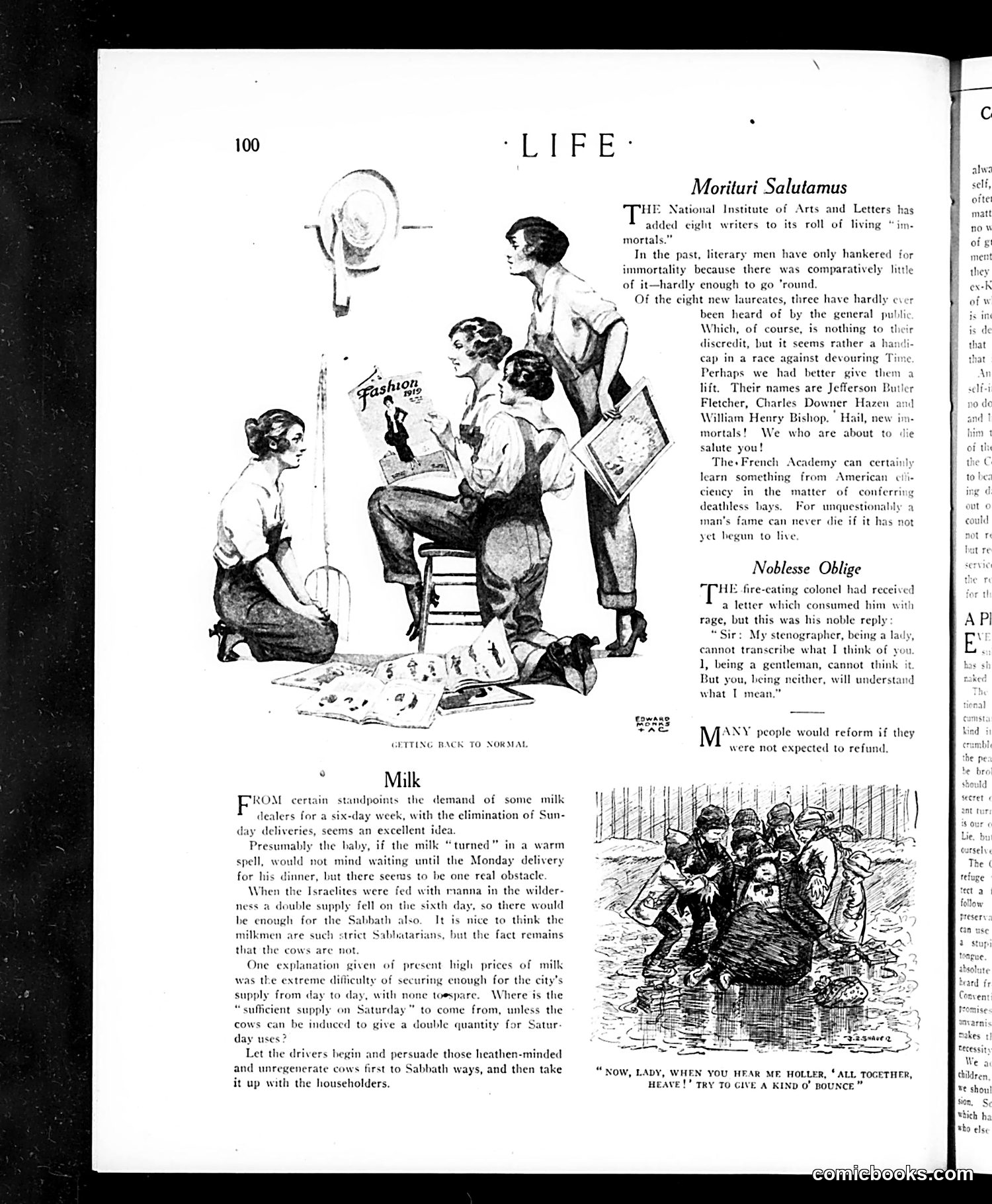
This page satirizes several contemporary issues circa early 20th century. **Top cartoon ("Getting Back to Normal")**: Shows children playing with art supplies in chaotic fashion. The caption jokes about the National Institute of Arts and Letters conferring immortality on three obscure writers—Jefferson Butler Fletcher, Charles Downer Hazen, and William Henry Bishop—whom the public has never heard of. The satire: the Institute grants "deathless" fame to nobodies, making their obscurity permanent rather than conferring actual honor. **"Noblesse Oblige" section**: A colonel's witty putdown of someone uncouth, playing on class distinctions and what gentlemen can/cannot say aloud. **"Milk" section**: Critiques dairy delivery debates. Some milk dealers wanted six-day weeks (no Sunday delivery for religious reasons). The satire mocks this as impractical: cows don't observe the Sabbath, so there's no logical reason to skip Sunday deliveries. It's commentary on how religious observance conflicts with practical economic needs during a milk shortage. The bottom illustration appears to show someone attempting to move a heavy object.
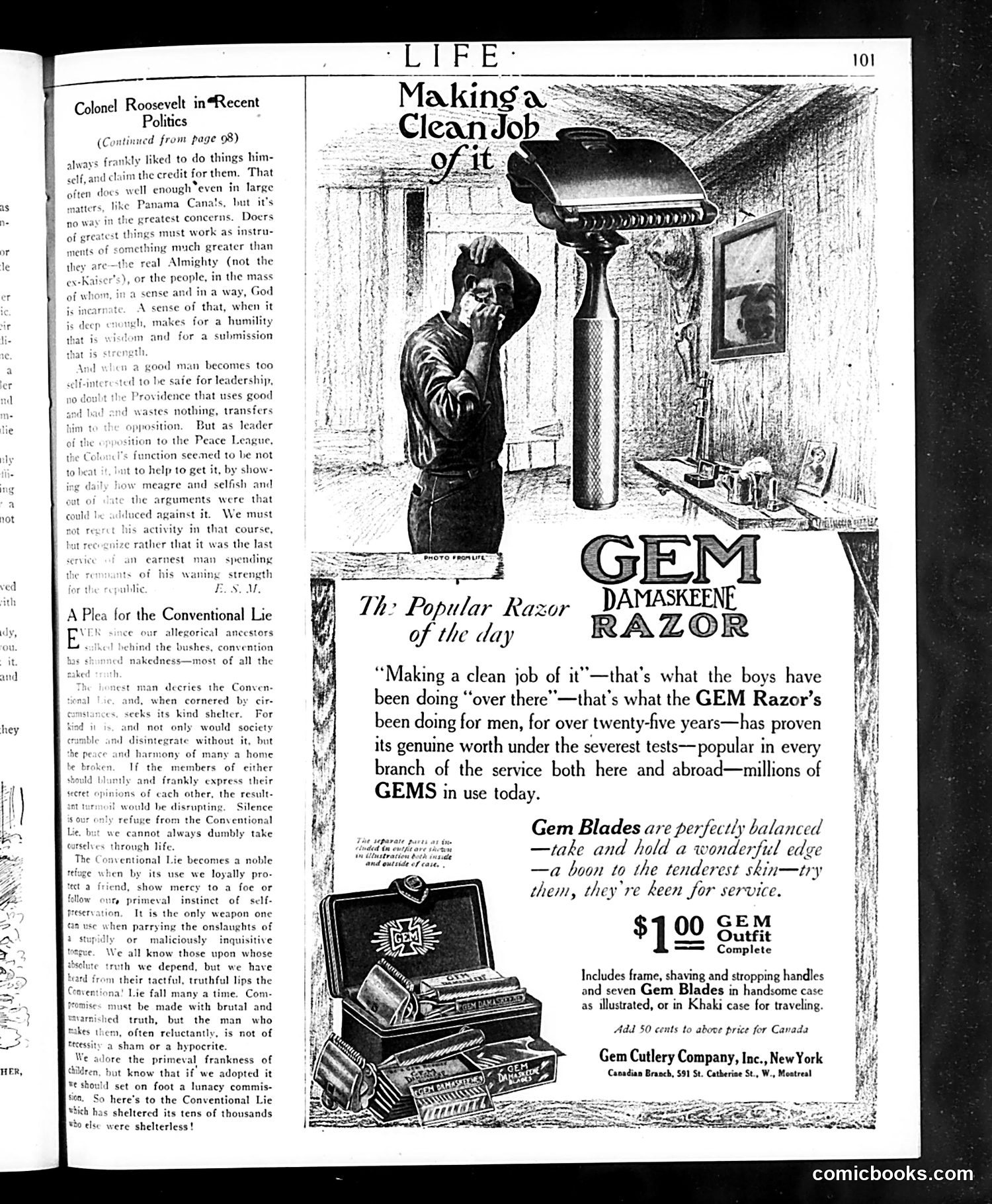
This page contains two distinct elements: ## Left Column: Political Commentary An essay titled "Colonel Roosevelt in Recent Politics" critiques Theodore Roosevelt's post-presidency behavior. The text argues Roosevelt claims credit for major accomplishments (like the Panama Canal) and, when opposing the Peace League, functions primarily to obstruct rather than constructively lead. The piece suggests his opposition lacks humility and wastes his remaining political strength on selfish argumentation. ## Right Side: Advertisement The dominant content is a **Gem Damaskeene Razor advertisement** featuring an illustration of a soldier cleaning/polishing his rifle with the caption "Making a clean job of it." The ad exploits patriotic sentiment by claiming the razor has served soldiers "over there" (in WWI) for 25 years, positioning it as battle-tested and militarily approved. The "$1.00 Complete" price point and references to "Khaki case for traveling" directly market to servicemen. **Context**: This appears to be from the post-WWI era, using soldier imagery to sell consumer goods through appeals to military credibility and patriotic duty.
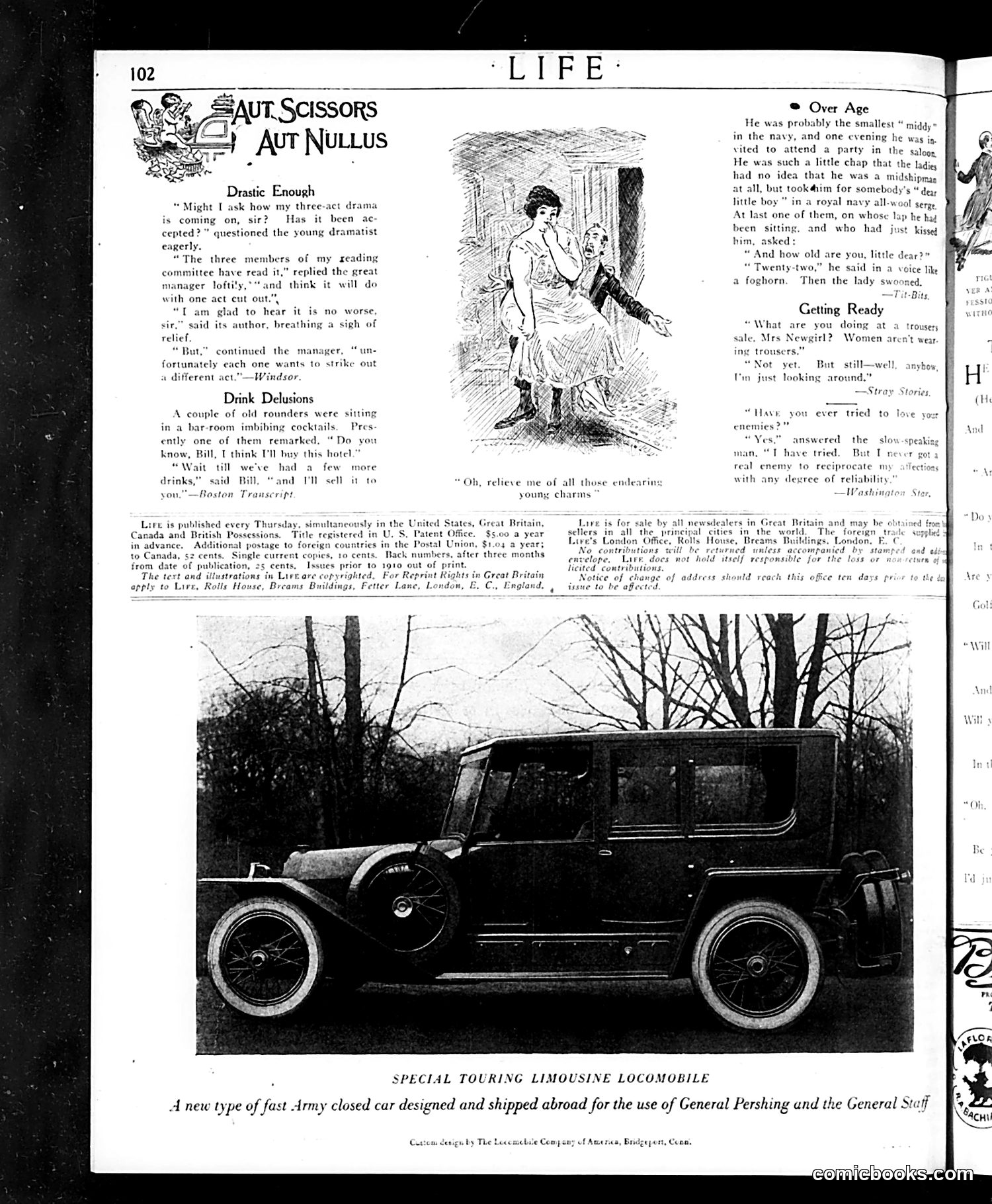
This page contains three separate humor items typical of Life's satirical content: **"Drastic Enough"**: A joke about a playwright whose three-act drama is rejected by a reading committee. The manager suggests cutting one act, which the author celebrates—only for the manager to add that each committee member wants to cut a *different* act, implying the play is unsalvageable. This satirizes theatrical gatekeeping and artistic pretension. **"Drink Delusions"**: Two alcoholics in a bar discuss buying the hotel. After more drinking, one says they'll sell it to the other. This mocks alcoholic delusion and the loose promises made while intoxicated. **"Over Age"**: A naval midshipman (youngest rank) is so small he's mistaken for a child at a party. When asked his age, his deep voice revealing he's actually twenty-two causes a lady to faint. The humor derives from the absurd contrast between appearance and reality. The page also features a photograph of a special limousine designed for General Pershing and military staff during WWI—practical editorial content amid the humor.
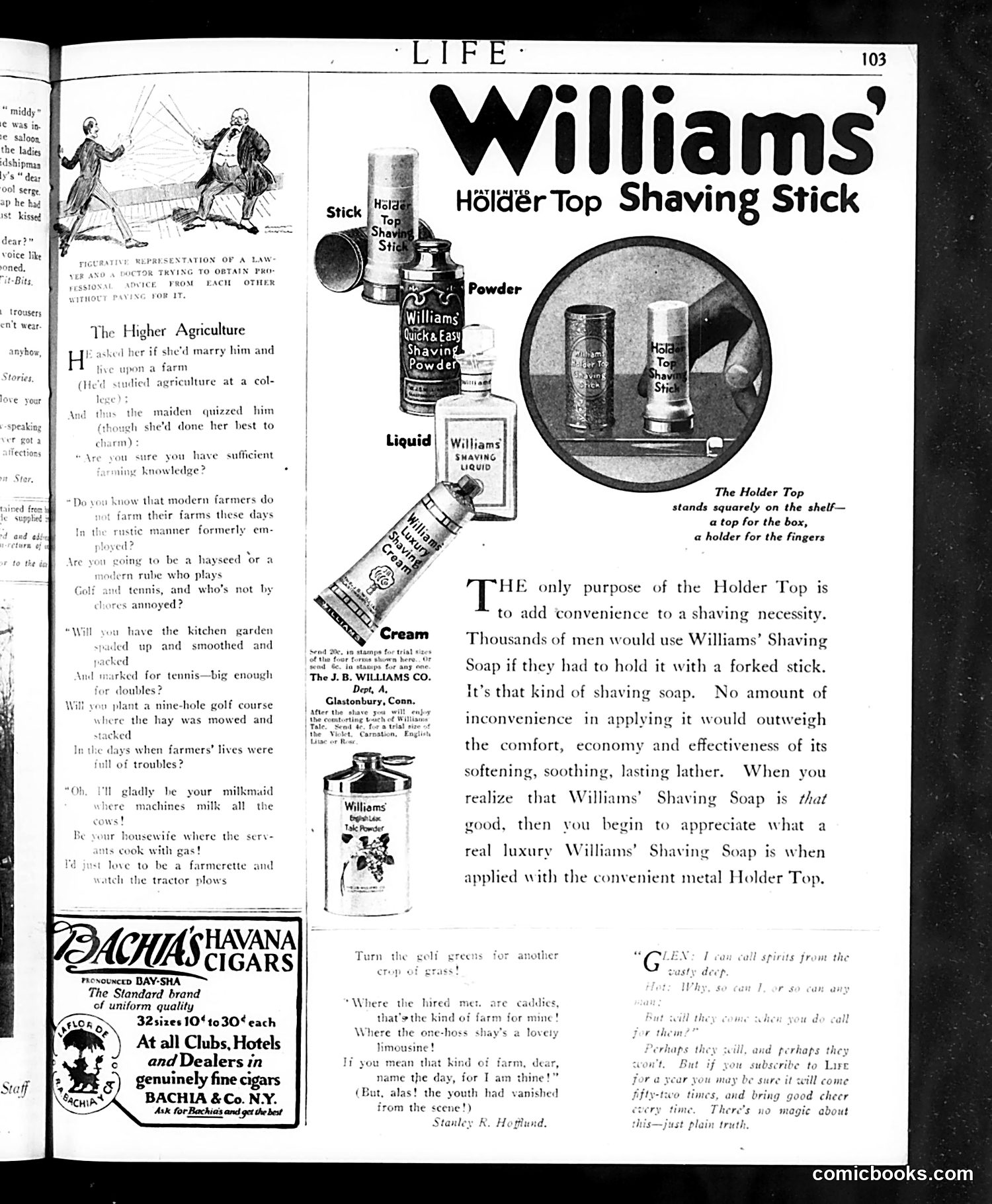
This page is primarily **advertising**, not editorial satire. The dominant content is a full-page advertisement for Williams' Holder Top Shaving Stick, a metal device designed to hold shaving soap for easier application. The left side contains a brief satirical dialogue titled "The Higher Agriculture"—a comic exchange between a young man and woman about modern farming. The woman quizzes him on agricultural knowledge, then suggests he become a "farmette" (female farmer) instead. The humor relies on early-20th-century gender role reversals: the notion of men doing "women's work" like kitchen gardening or managing domestic farms was considered absurd. Bottom left features an advertisement for **Bachia Havana Cigars**, emphasizing quality and uniform product standards. The page reflects 1920s consumer culture: advertisements dominate, and light satirical content is secondary filler. The farming dialogue gently mocks both rural traditionalism and emerging gender role changes during the post-WWI era.
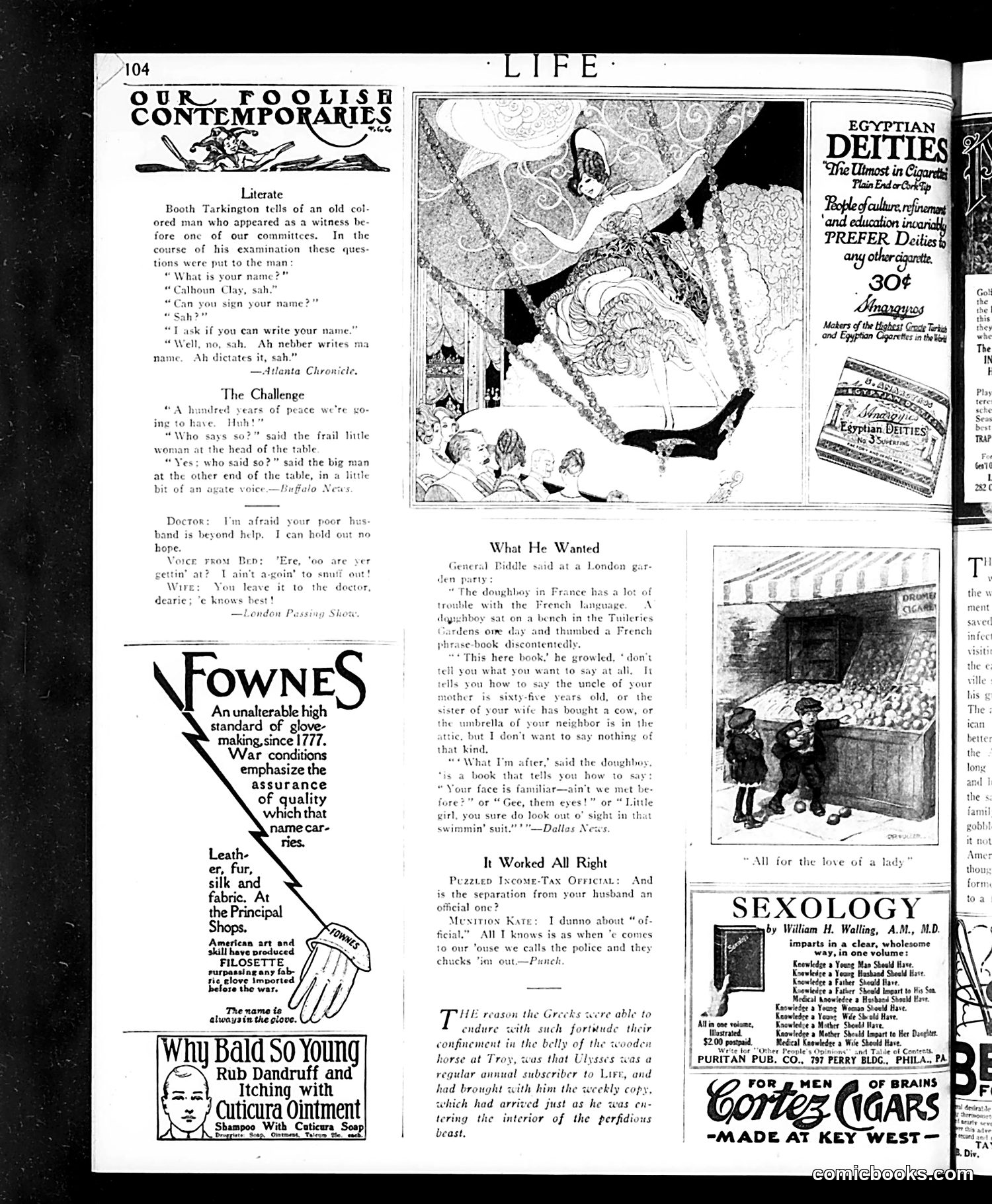
This page from *Life* magazine presents humorous anecdotes mocking various contemporaries. The main cartoon/text feature titled "Our Foolish Contemporaries" includes: 1. **The Literate** - Booth Tarkington's anecdote about an elderly Black man claiming he "dictates" his name rather than writing it, satirizing illiteracy or pretension. 2. **The Challenge** - A domestic dispute joke about a couple arguing over who claimed "a hundred years of peace." 3. **The doughboy in Paris** - A soldier frustrated trying to learn French phrases for everyday situations, unable to communicate desire beyond guidebook phrases. These satirize American ignorance, domestic discord, and soldiers' struggles abroad. The page also contains period advertisements (Fownes gloves, Cuticura products, cigars, and a "Sexology" book), typical of early 20th-century magazine content. The satire targets foolish behavior among educated and uneducated Americans alike.
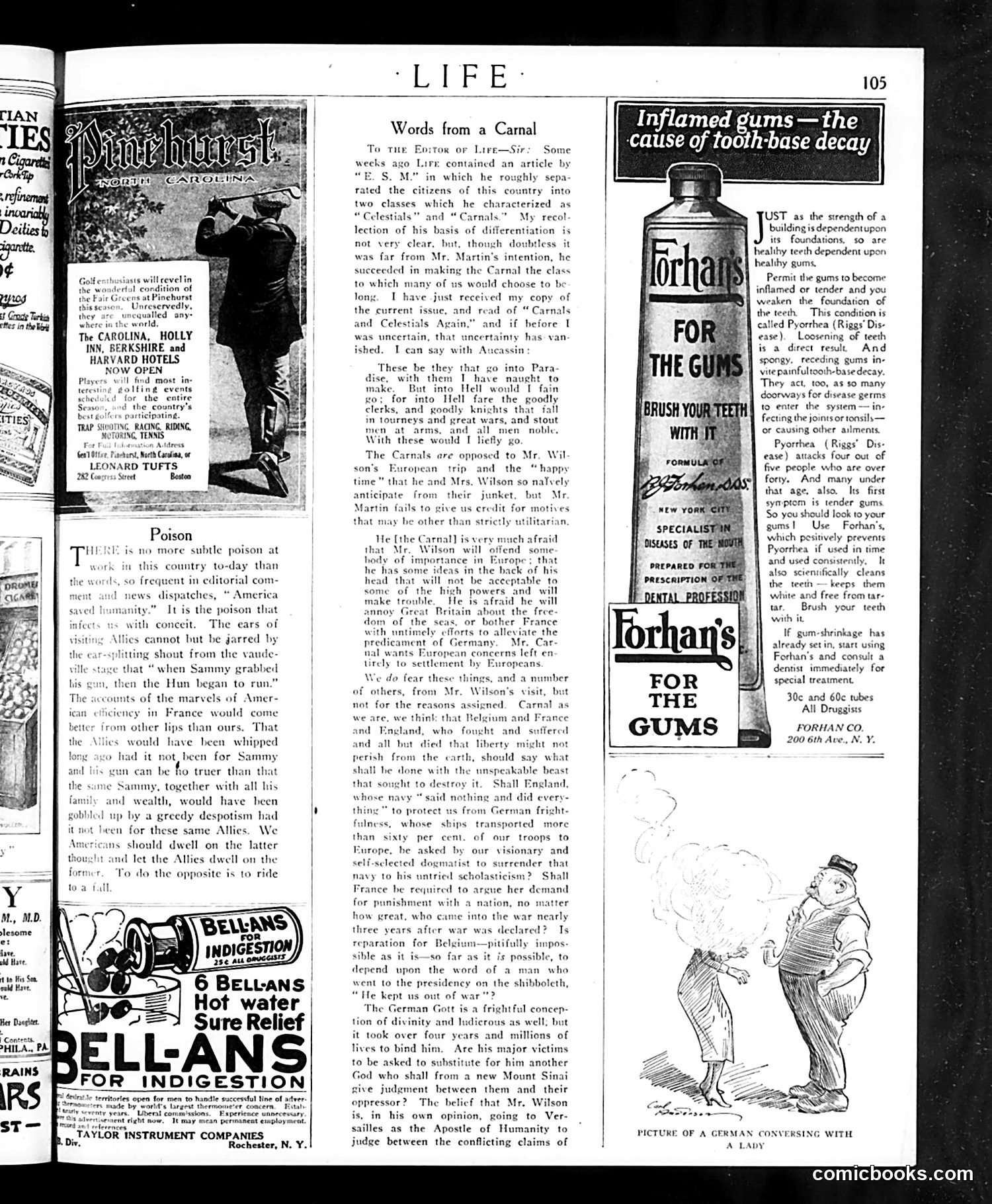
This page contains a letter to *Life* magazine's editor protesting an earlier article by someone named Martin that divided Americans into "Celestials" (idealists) and "Carnals" (pragmatists). The letter writer, identifying as "Carnal," defends practical concerns about President Wilson's planned European trip after WWI. The Carnals fear Wilson will make diplomatic blunders—offending Britain over naval power, or showing excessive sympathy to Germany—despite these nations' wartime sacrifices. The satire cuts both ways: the writer mocks the "Celestial" idealism of Wilson's visionary diplomacy while defending realistic skepticism about post-war negotiations. The reference to Britain's navy protecting American troops emphasizes practical wartime contributions over abstract principles. The cartoon at page bottom (showing a German conversing with a lady) likely relates to post-war concerns about German influence, though context is unclear from this excerpt alone.
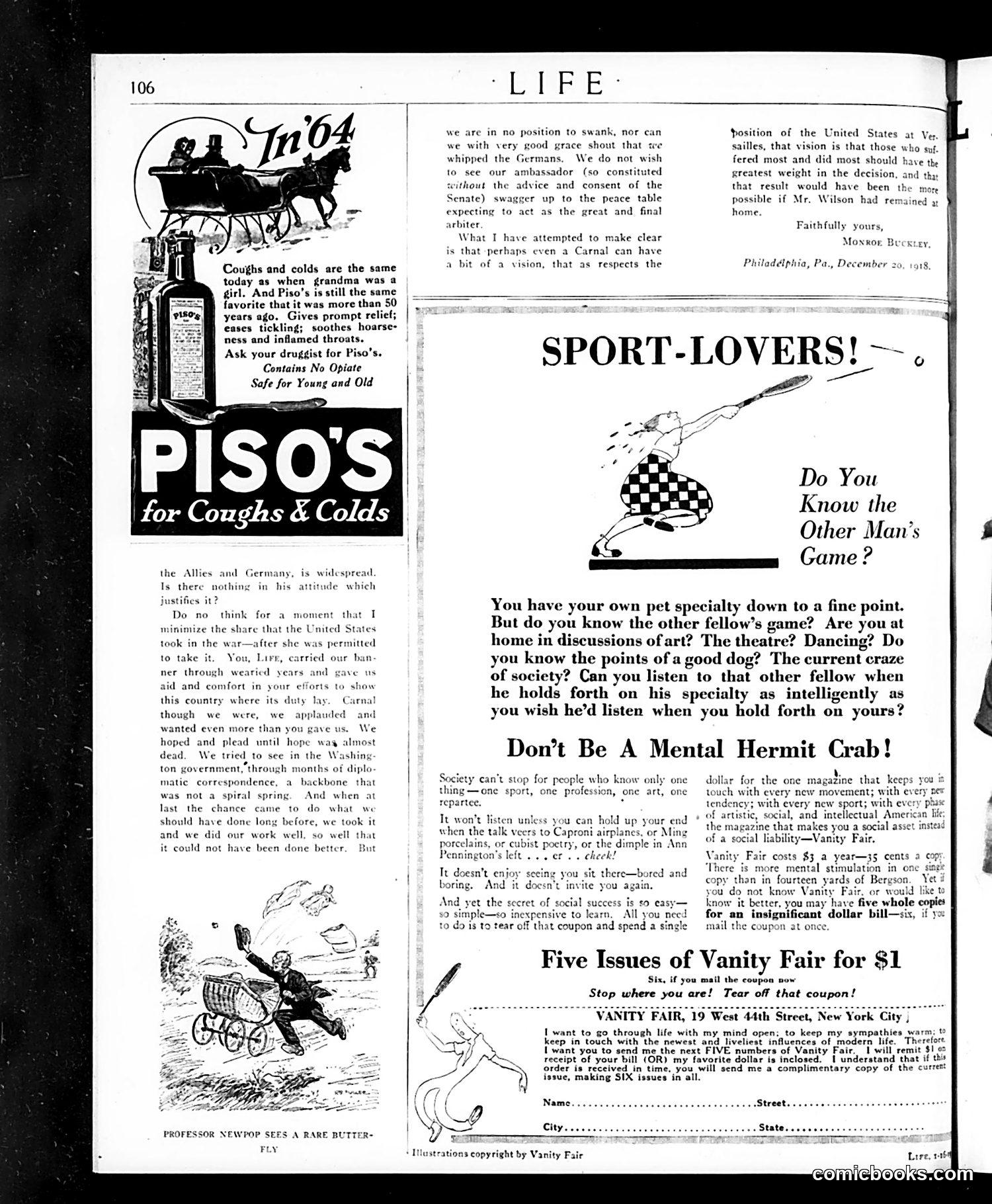
This page mixes editorial content with advertisements, primarily addressing post-WWI American attitudes. **The Political Letter**: The left column contains a letter discussing the Paris peace negotiations (Versailles Conference). The writer argues against American swagger at the peace table, suggesting the U.S. shouldn't dominate decisions since Allied nations "suffered most and did most." This reflects 1918 debates over President Wilson's role in peace-making and whether the Senate should have had more input on ambassadorial appointments. **The Cartoons**: Small satirical illustrations accompany the text, including "Professor Newpop Sees a Rare Butterfly"—likely mocking academic absent-mindedness. **The Advertisements**: The Piso's cough medicine ad is vintage patent-medicine marketing (note the mention of opium); the Vanity Fair subscription drive promotes intellectual sophistication and cultural awareness to young Americans, positioning the magazine as essential for staying "in touch with every new movement." The page reflects post-WWI American concerns: international diplomacy, consumer culture, and aspirational middlebrow intellectualism.