
Life, 1919-01-16 · page 16 of 34
Life — January 16, 1919 — page 16: what you’re looking at
What you’re looking at
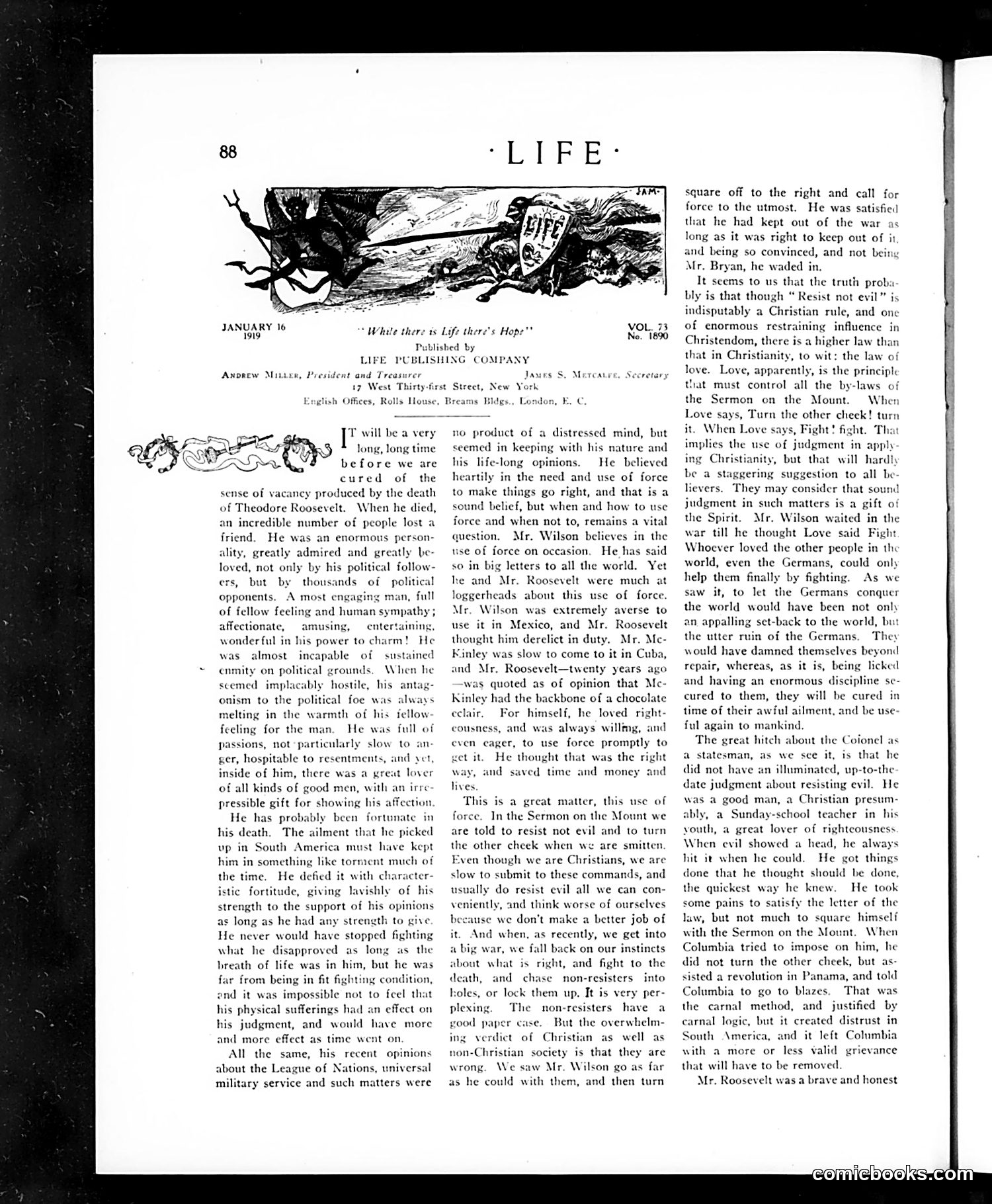
**The Cartoon:** The masthead illustration depicts a reclining figure, likely representing Theodore Roosevelt, who died recently (the text confirms this). The figure appears skeletal or death-like, reflecting the magazine's mourning. **The Context:** This is primarily a commemorative editorial rather than satire. Life's editors praise Roosevelt as an "enormous personality" beloved across political divides—admired even by opponents. They acknowledge his recent physical decline from a South American illness. **The Point:** The essay debates Roosevelt's philosophy on the use of force versus Christian teachings about non-resistance. Roosevelt favored forceful intervention (criticized McKinley's restraint in Cuba, Wilson's in Mexico), while the editors note tension between Christian pacifism and practical necessity. They ultimately side with Roosevelt's view that force is sometimes justified, contrasting this with the contemporary League of Nations debate and post-WWI politics. The piece is respectful remembrance rather than satire—celebrating Roosevelt's vigorous character while grappling with his controversial political legacy.
📄 Transcribed text from this page (OCR, searchable)
Machine-transcribed from the original scan — historical spelling and the odd misread are preserved.
Va Aa S JANUARY 16 1919 * Whale there is Life ther Published by LIFE Anprew Miter, President and Treasurer PUBLISHING COMPANY Janes S. Mereate 17 West Thirty-first Street, New York h Offices, Rolls House, T will be a very long, long time before we are cured of the sense of vacancy produced by the death of Theodore Roosevelt. When he died, an incredible number of people lost friend. He was an enormous person- ality, greatly admired and greatly be- loved, not only by his political follow- ers, but by thousands of political opponents, A most enga of fellow feeling and human sympathy ; affectionate, amusing, wonderful in his power to charm! was almost incapable of sustained enmity on political grounds. When he scemed implacably hostile, his antag- onism to the political foe was always melting in the warmth of his fellow feeling for the man. He was full of passions, not particularly slow to an- ger, hospitable to resentments, and yet, ging man, full entertaining, inside of him, there was a xreat lover of all kinds of good men, with an irre pressible gift for showing his affection. He has probably been fortunate in his death. The ailment that he picked up in South America must have kept him in something like torment much of the time. He defied it with character- istic fortitude, giving lavishly of his strength to the support of his opinions as long as he had any strength to give He never would have stopped fighting what he disapproved as long as the breath of life was in him, but he was far from being in fit fighting condition, and it was impossible not to feel that his physical sufferings had an effect on his judgment, and would have more and more effect as time went on. All the same, his recent opinions about the League of Nations, universal military service and such matters were no product of a distressed mind, but seemed in keeping with his nature and his life-long opinions. He believed heartily in the need and use of force to make things go right, and that is a sound belief, but when and how to use force and when not to, remains a vital question. Mr. Wilson believes in the use of force on occasion. He has said so in big letters to all the world. Yet lhe and Mr. Roosevelt were much at loggerheads about this use of force. Mr, Wilson was extremely averse to use it in Mexico, and Mr. Roosevelt thought him derelict in duty. Mr. Me- Kinley was slow to come to it in Cuba, and Mr. Roosevelt—twenty years ago was quoted as of opinion that Mc- Kinley had the backbone of a chocolate celair, For himself, he loved right- cousness, and was always willmg, and even cager, to use force promptly to Ket He thought that was the right way, and saved time and money and lives, This is a great matter, this use of force. In the Sermon on the Mount we are told to resist not evil and to turn the other cheek when we are smitten. Even though we are Christians, we are slow to submit to these commands, and usually do resist evil all we can con- veniently, and think worse of ourselves because we don’t make a better job of it. And when, as recently, we get into a big war, we fall back on our instincts about what is right, and fight to the death, and non-resisters into holes, or lock them up. It is very per- The non-resisters have a good paper case. But the overwhelm- ing verdict of Christian as well as non-Christian society is that they are We saw Mr. Wilson go as far nd then turn chase plexing. wrong. as he could with them, square off to the right and call for force to the utmost. He was satisfied that he had kept out of the war as long as it was right to keep out of it and being so convinced, and not beiny Mr. Bryan, he waded in. It seems to us that the truth proba is that though “ Resist not evil” is indisputably a Christian rule, and one of enormous restraining influence in Christendom, there is a higher law than that in Christianity, to wit: the law of love. Love, apparently, is the principle that must control all the by-laws of the Sermon on the Mount. Wher Love says, Turn the other cheek! turn it. When Love says, Fight! fight. Th: implies the use of judgment in apply i Christianity, but that will hardly gering suggestion to all be- evers. They may consider that sou judgment in such matters is a gift of the Spirit. Mr. Wilson waited in the war till he thought Love said Fight Whoever loved the other people in thc world, even the Germans, could only help them finally by fighting. As we saw it, to let the Germans conquer the world would have been not only an appalling set-back to the world, but the utter ruin of the Germans. They would have damned themselves beyond repair, whereas, as it is, being licked and having an enormous discipline se- cured to them, they will be cured in time of their awiul ailment, and be use: ful again to mankind. The great hitch about the Coionel as a statesman, as we sce it, is that he did not have an illuminated, up-to-the date judgment about resisting evil. He was a good man, a Christian presum- ly, a Sunday-school teacher in his youth, a great lover of righteousness When evil showed a head, he always hit it when he could. He got things done that he thought should be done, the quickest way he knew. He took some pains to satisfy the letter of the law, but not much to square himself with the Sermon on the Mount. When Columbia tried to impose on him, he did not turn the other cheek, but as- sisted a revolution in Panama, and told Columbia to go to blazes. That was the carnal method, and justified by carnal logic, but it created distrust in South \merica, and it left Columbia with a more or less valid grievance that will have to be removed Mr. Roosevelt was a brave and honest ca st