
Life, 1919-01-16 · page 28 of 34
Life — January 16, 1919 — page 28: what you’re looking at
What you’re looking at
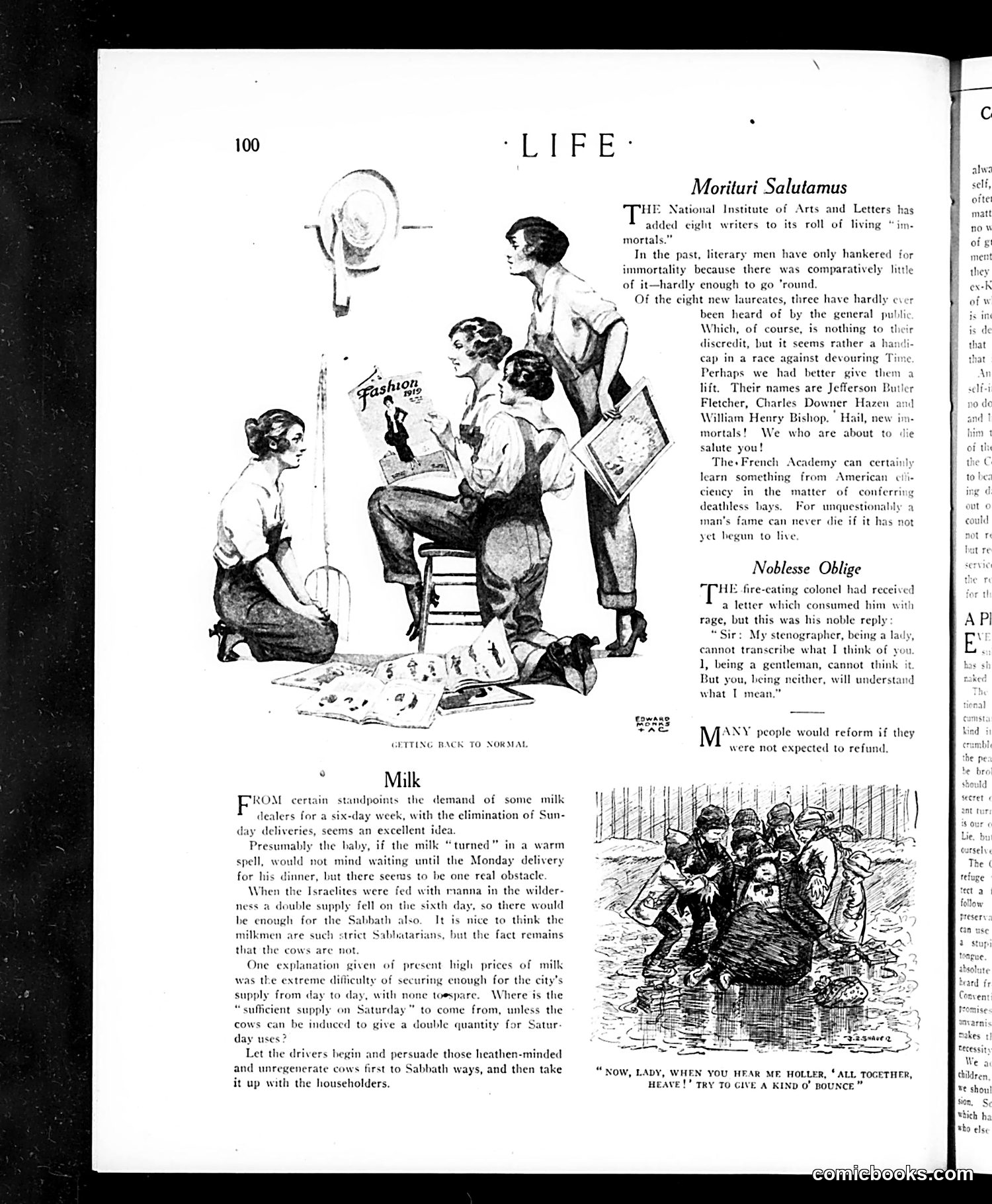
This page satirizes several contemporary issues circa early 20th century. **Top cartoon ("Getting Back to Normal")**: Shows children playing with art supplies in chaotic fashion. The caption jokes about the National Institute of Arts and Letters conferring immortality on three obscure writers—Jefferson Butler Fletcher, Charles Downer Hazen, and William Henry Bishop—whom the public has never heard of. The satire: the Institute grants "deathless" fame to nobodies, making their obscurity permanent rather than conferring actual honor. **"Noblesse Oblige" section**: A colonel's witty putdown of someone uncouth, playing on class distinctions and what gentlemen can/cannot say aloud. **"Milk" section**: Critiques dairy delivery debates. Some milk dealers wanted six-day weeks (no Sunday delivery for religious reasons). The satire mocks this as impractical: cows don't observe the Sabbath, so there's no logical reason to skip Sunday deliveries. It's commentary on how religious observance conflicts with practical economic needs during a milk shortage. The bottom illustration appears to show someone attempting to move a heavy object.
📄 Transcribed text from this page (OCR, searchable)
Machine-transcribed from the original scan — historical spelling and the odd misread are preserved.
Morituri Salutamus HE, National Institute of Arts and Letters added cight writers to its roll of living “im. no mortals.” tr In the past, li ‘y men have only hankered for 1 immortality because there was comparatively little of it—hardly enough to go ‘round. Of the cight new laureates, three have hardly ever been heard of by the general public Which, of course, is nothing to their discredit, but it seems rather a h cap in a race against devouring Tine Perhaps we had better give them a lift. Their names are Jefferson Butler Fletcher, Charles Downer Hazen ani William Henry Bishop.’ Hail, new imn- mortals! We who are about to salute you! Thes French Academy can certainly learn something from American elie ciency in the matter of conferring deathless bays. For unquestionably a man’s fame can never die if it has not yet hegun to live. Noblesse Oblige THE fire-cating colonel had received a letter which consumed him with rage, but this was his noble reply: “Sir: My stenographer, being a lady, cannot transcribe what I think of you 1, being a gentleman, cannot think it But you, being neither, will understand what T mean,” ANY pcople would reform if they GETTING BACK TO NORMAL were not expected to refund. Milk ROM certain standpoints the demand of some milk d rs for a six-day week, with the elimination of Sun- day deliveries, seems an excellent idea. Presumably the baby, if the milk “turned” in a warm spell, would not mind waiting until the Monday delivery for his dinner, but there seems to be one real obstacle. When the Israelites were fed with manna in the wilder- ness a double supply fell on the sixth day, so there would he enough for the Sabbath also. It is nice to think the milkmen are such strict Sabhatarians, but the fact remains that the cows are not. One explanation given of present high prices of milk was the extreme difficulty of securing enough for the city’s supply from day to day, with none toespare. Where is the “sufficient supply on Saturday” to come from, unless the cows can be induced to give a double quantity for Satur- day uses? Let the drivers begin and persuade those heathen-minded and unregenerate cows first to Sabbath ways, and then take “NOW, LADY, WHEN YOU HFAR ME it up with the householders. HEAVE!’ TRY TO GIVE A KI