
Life, 1919-01-16 · page 26 of 34
Life — January 16, 1919 — page 26: what you’re looking at
What you’re looking at
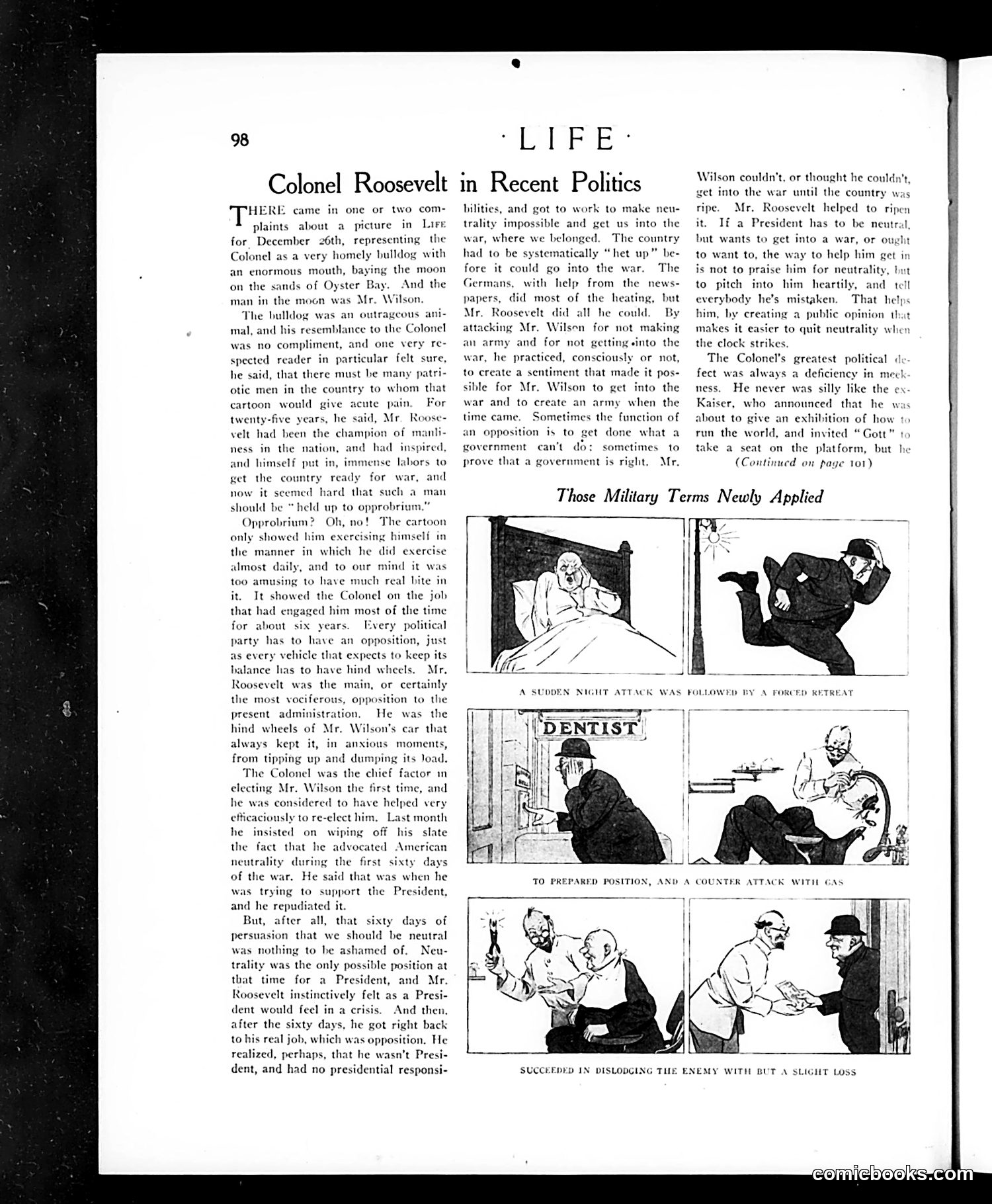
This Life magazine article defends Colonel Theodore Roosevelt against complaints that a previous cartoon caricatured him unflattering as a bulldog. The piece argues Roosevelt's aggressive opposition to President Wilson's administration was actually constructive. The article's central point: Roosevelt served as necessary political "opposition"—the "hind wheels" keeping Wilson's government balanced. While Wilson needed to maintain official neutrality early in WWI, Roosevelt publicly attacked this stance, creating public pressure that eventually enabled Wilson to enter the war (1917). The author credits Roosevelt with "ripening" American public opinion for war rather than criticizing him. The cartoon series below titled "Those Military Terms Newly Applied" shows civilians preparing for combat—a dentist, person under bombardment, etc.—satirizing how war terminology had entered everyday civilian life during the conflict.
📄 Transcribed text from this page (OCR, searchable)
Machine-transcribed from the original scan — historical spelling and the odd misread are preserved.
Colonel Roosevelt HERE plaints about a picture in’ Lire for December 26th, representing the Colonel as a very homely bulldog with n enormous mouth, baying the moon on the sands of Oyster Bay. And the man in the moon was Mr. Wilson, came in one or two com- The bulldog was an outrageous ani- mal, and his resemblance to the Colonel was no compliment, and one very re- spected reader in particular felt sure, he said, that there must be many patri- otic men in the country to whom that cartoon would give acute pain. For twenty-five yea Mr velt had been the champion of manli- ness in the nation, and had inspired, sy he said Roose- and himself put in, immense labors to get the country ready for war, and now it scemed hard that such a man “held up to opprobrium.” Oh, no! The cartoon only showed him exercising himself in the manner in which he did exercise almost daily, and to our mind it was too amusing to have much real bite in it. It showed the Colonel on the job should be Opprobrium ? that had engaged him most of the time for about Every. politics party has to have an opposition, just as every vehicle that expects to keep its balance has to have hind wheels, Mr. Roosevelt was the main, or certainly the most vociferous, opposition to the present administration. He was the hind wheels of Mr. Wilson's car that six years. always kept it, in anxious from tip moments, ing up and dumping its Joa The Colonel was the chief factor im electing Mr. Wilson the first time, and he was considered to have helped very efticaciously to re-elect him, Last month he insisted on wiping off his slate the fact that he advocated American neutrality during the first sixty day of the war. He said that was when he was trying to support the President, and he repudiated it. But, after all, that sixty days of persuasion that we should be neutral was nothing to be ashamed of. Neu- trality was the only possible position at that time for a President, and Mr. Roosevelt instinctively felt as a Presi dent would feel in a crisis. And then, after the sixty ys, he got right back to his real job, which was opposition. He realized, perhaps, that he wasn’t Presi- dent, and had no presidential responsi- “LIFE - in Recent Politics bilities, and got to work to make neu- trality impossible and get us into the war, where we belonged. The country had to be systematically “het up” be- fore it could go into the war. The Germans, with help from the news- papers, did most of the heating, but Mr. Roosevelt did all By attacking Mr. Wilson for not making an army and for not getting «into the war, he practiced, consciously or not, to create a sentiment that made it pos- sible for Mr. Wilson to get into the war and to create an army when the time came. ometimes the function of he could. an opposition is to get done what a government prove that a government is right, can't do; sometimes to Mr. Those Military Terms Wilson couldn't, or thought he couldn't, get into the war until the country was ripe. Mr. Roosevelt helped to ripen it. If a President has to be neutral, but wants to get into a war, or ought to want to, the way to help him get in is not to praise him for neutrality, but to pitch into him heartily, tell everybody he’s mistaken. That helps im, by creating a public opinion that makes it easier to quit neutrality when the clock strikes. The Colonel's greatest political « fect was always a deficiency in meek ness. He never was silly like the ex Kaiser, who announced that about to give an exhibition of how to run the world, and invited “Gott” to take a seat on the platform, but he (Continued on page 101) and he w Newly Applied A SUDDEN NIGHT ATTACK WAS oe \(DENTIST | FOLLOWED RY TO PREPARED POSITION, AND A A FORCED RETREAT COUNTER ATTACK WITH GAS SUCCEEDED IN DISLODGING THE ENEMY WITH BUT \ SLIGHT Loss